You are currently viewing a new version of our website. To view the old version click .

Cancers, Volume 9, Issue 8

August 2017 - 15 articles

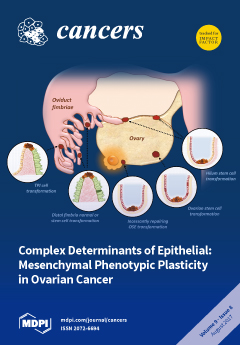
Cover Story: Metastasis of epithelial ovarian cancer (EOC) occurs primarily via transcoelomic dissemination of shed tumor cells and multicellular aggregates that avoid anoikis and ultimately adhere to and anchor within the submesothelial lining of the peritoneal cavity to generate widely disseminated metastases. This unique microenvironment is highly permissive for phenotypic plasticity. In this review, we summarize current knowledge of EOC heterogeneity in the context of epithelial:mesenchymal and mesenchymal:epithelial transition (EMT, MET), outline regulators of this process, address controversies in EMT and chemoresistance, and highlight computational modeling approaches toward a better understanding EMT/MET in EOC. View this paper
  • Issues are regarded as officially published after their release is announced to the table of contents alert mailing list .
  • You may sign up for email alerts to receive table of contents of newly released issues.
  • PDF is the official format for papers published in both, html and pdf forms. To view the papers in pdf format, click on the "PDF Full-text" link, and use the free Adobe Reader to open them.

Articles (15)

  • Article
  • Open Access
29 Citations
8,273 Views
14 Pages

Performance of a RT-PCR Assay in Comparison to FISH and Immunohistochemistry for the Detection of ALK in Non-Small Cell Lung Cancer

  • David R. Hout,
  • Brock L. Schweitzer,
  • Kasey Lawrence,
  • Stephan W. Morris,
  • Tracy Tucker,
  • Rosetta Mazzola,
  • Rachel Skelton,
  • Frank McMahon,
  • John Handshoe and
  • Mary Lesperance
  • + 2 authors

1 August 2017

Patients with lung cancers harboring an activating anaplastic lymphoma kinase (ALK) rearrangement respond favorably to ALK inhibitor therapy. Fluorescence in situ hybridization (FISH) and immunohistochemistry (IHC) are validated and widely used scree...

  • Review
  • Open Access
74 Citations
13,266 Views
15 Pages

EMT/MET at the Crossroad of Stemness, Regeneration and Oncogenesis: The Ying-Yang Equilibrium Recapitulated in Cell Spheroids

  • Elvira Forte,
  • Isotta Chimenti,
  • Paolo Rosa,
  • Francesco Angelini,
  • Francesca Pagano,
  • Antonella Calogero,
  • Alessandro Giacomello and
  • Elisa Messina

29 July 2017

The epithelial-to-mesenchymal transition (EMT) is an essential trans-differentiation process, which plays a critical role in embryonic development, wound healing, tissue regeneration, organ fibrosis, and cancer progression. It is the fundamental mech...

  • Commentary
  • Open Access
9 Citations
7,209 Views
14 Pages

28 July 2017

Our research has identified several examples in which reduced VEGF-A binding to deficient vascular extracellular matrix leads to deficits in tumor vascularization and tumor growth: (1) germline ablation of collagen VI in the stroma of intracranial B1...

  • Review
  • Open Access
111 Citations
8,799 Views
8 Pages

26 July 2017

Integrin activity and function is classically related to the bi-directional regulation of cell-extracellular matrix (ECM) contacts that regulate a number of cell pathways linked to cell adhesion, cell detachment from ECM, cell migration, and anoikis....

  • Article
  • Open Access
36 Citations
7,155 Views
15 Pages

Involvement of the Integrin α1β1 in the Progression of Colorectal Cancer

  • Salah Boudjadi,
  • Gérald Bernatchez,
  • Blanche Sénicourt,
  • Marco Beauséjour,
  • Pierre H. Vachon,
  • Julie C. Carrier and
  • Jean-François Beaulieu

26 July 2017

Integrins are a family of heterodimeric glycoproteins involved in bidirectional cell signaling that participate in the regulation of cell shape, adhesion, migration, survival and proliferation. The integrin α1β1 is known to be involved in RAS/ERK pro...

of 2

Get Alerted

Add your email address to receive forthcoming issues of this journal.

XFacebookLinkedIn
Cancers - ISSN 2072-6694