


Simple Summary
Early-stage HER2 (Human Epidermal Growth Factor Receptor 2)-positive breast cancer represents a biologically aggressive subtype. However, outcomes have substantially improved with the introduction of HER2-targeted therapies. From both a biological and clinical perspective, the concomitant administration of chemotherapy and HER2-directed treatment appears critical to maximize antitumor efficacy. Concerns regarding cardiac toxicity remain a major barrier to the continued use of conventional anthracyclines. To the best of our knowledge, our study provides one of the largest patient collectives to assess the efficacy and safety of simultaneous anthracycline-based chemotherapy and dual HER2 blockade. In our cohort, providing real-world data, simultaneous anthracycline-based chemotherapy and dual HER2 blockade in early-stage HER2-positive breast cancer was an effective treatment with a pCR rate of 82% and a low rate of left ventricular systolic dysfunction.
Abstract
Background: Early-stage HER2 (Human Epidermal Growth Factor Receptor 2)-positive breast cancer represents a biologically aggressive disease subtype. The introduction of HER2-directed therapies has substantially improved outcomes for patients with HER2-positive early breast cancer. There are multiple neoadjuvant regimens combining chemotherapy with anti-HER2 therapy; however, cardiac toxicity remains a concern, particularly with anthracycline-containing regimens. Non-pegylated liposomal doxorubicin (NPLD) has been developed to reduce cardiotoxicity while preserving antitumor activity. Here, we present a retrospective analysis of patients with early-stage HER2-positive breast cancer treated with six cycles of neoadjuvant NPLD, docetaxel and concurrent dual-HER2-targeting with trastuzumab and pertuzumab. Methods: We retrospectively analyzed consecutive patients treated at the Department of Obstetrics and Gynecology, Medical University of Innsbruck, between April 2013 and February 2022. The primary endpoint was pathological complete response (pCR). Secondary endpoints included cardiac safety measured with left ventricular systolic dysfunction (LVSD). LVSD was assessed at baseline, after neoadjuvant treatment before surgery and at adjuvant treatment completion and graded per CTCAE (grade 2: left ventricular ejection fraction (LVEF) 40–49% and/or an LVEF decline of >10%). Results: Overall, 164 patients were identified with a median follow-up of 91 months. A pCR was observed in 82% (132/161) of patients (HR-negative 92.8%, HR-postive 73.9%; p = 0.002). At both time points, two patients (1%) had grade 2 left ventricular systolic dysfunction. Conclusions: In this real-world cohort, anthracycline-containing chemotherapy with NPLD with concurrent HER2-directed therapy showed a high rate of pCR, while a low rate of LVSD was observed.
1. Introduction
While HER2 (Human Epidermal Growth Factor Receptor 2)-positive breast cancer represents a biologically aggressive disease subtype, outcomes have improved substantially with the introduction of HER2-targeted therapies [1], achieving high response rates in HER2-positive early breast cancer and favorable long-term outcomes [2,3,4,5]. The ASCO guidelines recommend neoadjuvant systemic therapy consisting of chemotherapy and HER2-directed treatment with trastuzumab and pertuzumab for patients with node positive or high-risk node-negative HER2-positive breast cancer [6]. Similarly, the ESMO guidelines recommend a neoadjuvant approach for patients with clinically stage II and III disease [7,8]. Anthracycline-containing as well as anthracycline-free regimens in combinations with HER2-targeted agents have been a backbone of neoadjuvant chemotherapy in patients with HER2-positive disease [9,10,11]. From both a biological and clinical perspective, the concomitant administration of chemotherapy and HER2-directed treatment appears critical to maximize antitumor efficacy. Historically, anthracyclines have been considered a cornerstone of chemotherapy, but their role is being increasingly questioned due to cumulative cardiotoxicity and the risk of secondary acute myeloid leukemia, resulting in the development of anthracycline-free treatment approaches [12]. Cardiac toxicity is of particular concern in HER2-positive breast cancer, as concurrent treatment with anthracyclines and HER2-directed therapies is associated with an increased risk of cardiac dysfunction [13,14]. These findings were not replicated in the TRYPHAENA trial, in which no increase in cardiac toxicity was observed when trastuzumab and pertuzumab were administered concomitantly with anthracyclines [11]. Moreover, the anthracycline-free TCHP arm of the TRYPHAENA trial was associated with the highest rates of diarrhea and febrile neutropenia and increased sensitivity of HER2-positive breast cancer to anthracycline-containing chemotherapy due to co-amplification of TOP2 has been suggested. Non-pegylated liposomal doxorubicin has been developed to reduce cardiotoxicity while preserving antitumor activity, offering a potential strategy to maintain an anthracycline-based approach while improving cardiac safety [11].
At our center, six cycles of NPLD plus docetaxel with concurrent trastuzumab/pertuzumab has been used as the standard neoadjuvant treatment in patients with HER2-positive early breast cancer from April 2013 based upon the results from the ABCSG-32 trial, where safety and efficacy of NPLD/docetaxel and trastuzumab was established. Here we present real-world efficacy and safety results of all patients treated with the NPLD/docetaxel + HP regimen at our center between April 2013 and February 2022 with a follow-up of 91 months.
2. Materials and Methods
2.1. Study Design and Patients
We performed a retrospective single center analysis of 164 consecutive patients with early-stage HER2-positive breast cancer treated at the Department of Obstetrics and Gynecology, Medical University of Innsbruck between April 2013 and February 2022. Data were gathered using oncology information system “c37.Cancer Center”, a digital tool for documentation and gathering of pseudonymized cancer data from different clinical tools. Hormone receptor-positive patients were defined as ER and/or PR with a staining >10% [15]. HER2 positivity was defined following ASCO/CAP guidelines. The study was registered and approved by the local ethics committee (votum number 1083/2026).
2.2. Chemotherapy Regimen
By decision of a multidisciplinary tumor board, patients were routinely assigned to receive six cycles of a neoadjuvant regimen consisting of NPLD (50 mg/m2), docetaxel (75 mg/m2), and dual HER2 blockade with trastuzumab (1. Dose 8 mg/kg, followed by 6 mg/kg) and pertuzumab (840 mg at 1. Administration, followed by 420 mg) administered concurrently once every three weeks. As part of supportive care, all patients received primary prophylaxis with long-acting granulocyte colony-stimulating factor, administered 24 h after each chemotherapy cycle.
2.3. Study Endpoints
The primary endpoint of this retrospective real-world analysis was rate of patients with pathological complete response (pCR) defined as ypT0/is, ypN0. Secondary endpoints-included long-term clinical outcomes were disease-free survival (DFS) and overall survival (OS) as well as cardiac toxicity. Cardiac toxicity was assessed by serial echocardiographic measurement of the left ventricular ejection fraction (LVEF) at baseline and after six neoadjuvant treatment cycles as well as after completion of adjuvant treatment and graded according to CTCAE version 5.0.
2.4. Statistical Analysis
Due to the retrospective nature of the study, no formal sample size calculation was performed, and all statistical analysis are descriptive by nature. We report absolute numbers and percentages for categorical data and medians and interquartile ranges (Q1, Q3) for continuous data. Subgroup comparisons were conducted using appropriate statistical tests (e.g., chi-squared test, Fisher’s exact test; for comparisons with values reported in the literature: one-sample chi-squared test).
Overall survival (OS) and disease-free survival (DFS) were estimated using the Kaplan–Meier product-limit method. Adjusted hazard ratios (HRs) and corresponding 95% confidence intervals (CIs) were estimated using multivariable Cox proportional hazard regression models adjusted for clinically relevant covariates (e.g., hormone receptor status, age, and tumor stage). Median follow-up time was calculated using the reverse Kaplan–Meier method. p-values <0.05 were considered statistically significant. Statistical analysis was carried out using SPSS version 30.00.
3. Results
3.1. Study Population
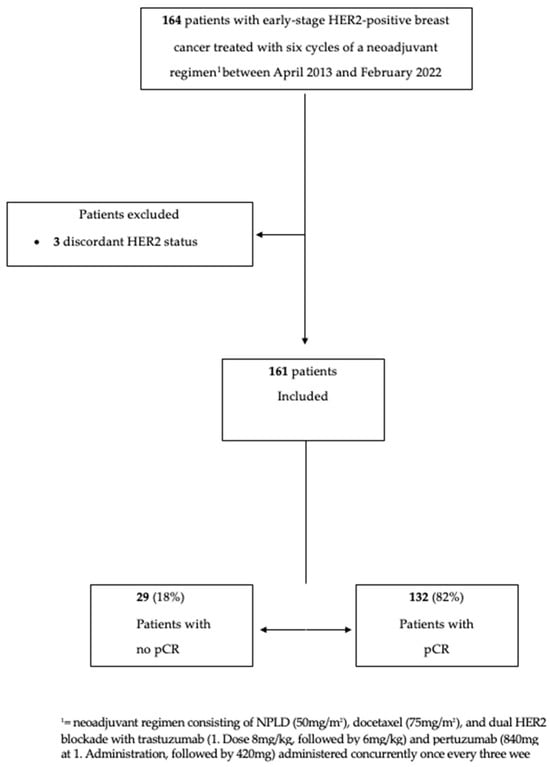
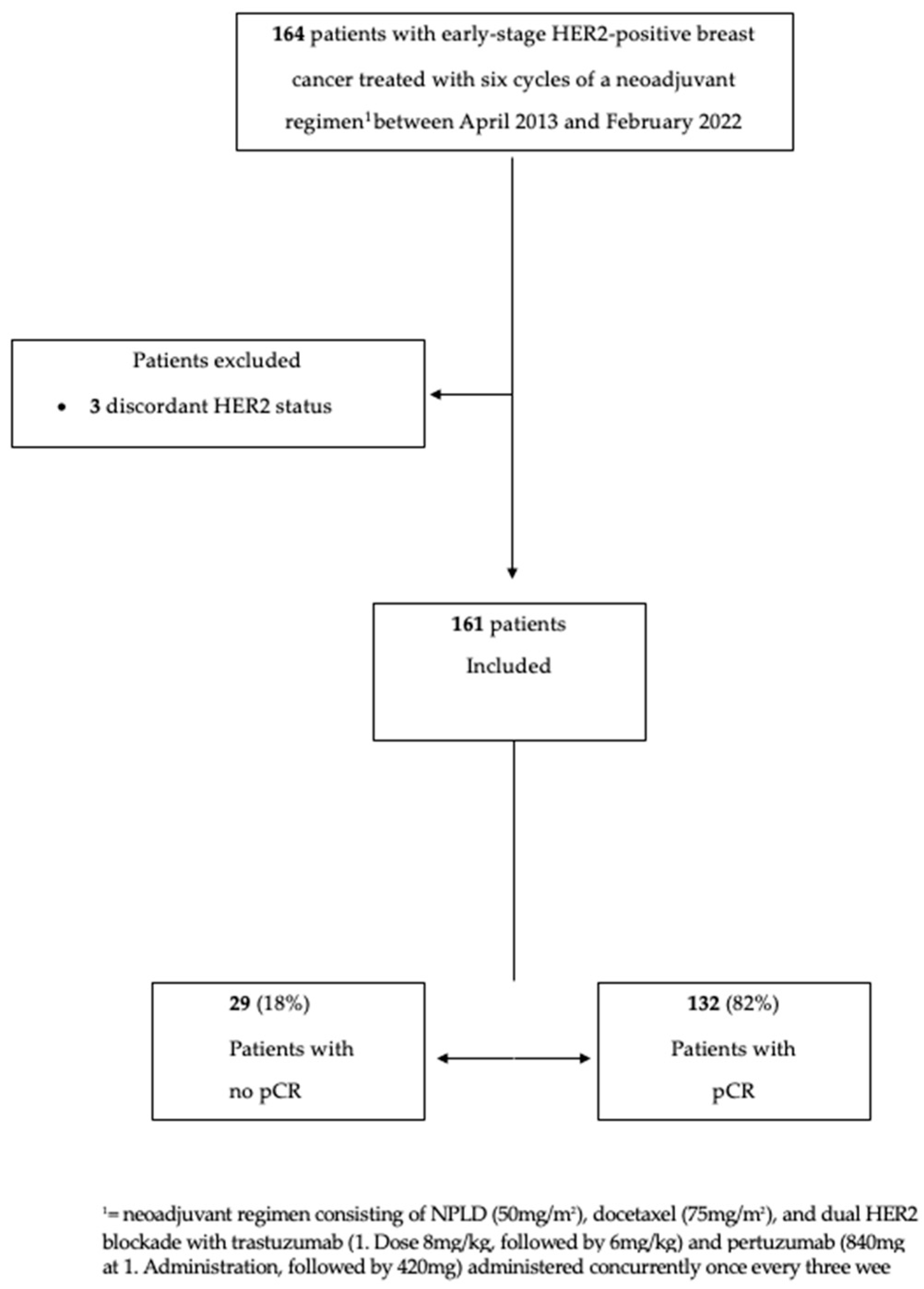
A total of 164 patients were included in this analysis with a median follow-up of 91 months (84.5, 97). The median age at diagnosis was 51 years (Q1, Q3; 43, 59). Overall, 56% of patients were premenopausal at diagnosis, 58% had hormone receptor (HR)-positive disease. Patient characteristics are summarized in Table 1. The Table A1 shows the tumor characteristics of the nineteen patients with two lesions. As Figure 1 shows, the three patients with discordant HER2 statuses were excluded from the pCR analysis as well as OS and DFS calculations. Overall, 95,7% (157/164) completed all six cycles. Three patients received three cycles, one patient four cycles, two patients three cycles and one patient one cycle. Furthermore, 87,2% of patients (143/164) received their therapy without dose reduction, 19 patients had a dose reduction of 20% and two of 25% of the chemotherapy agents. The reasons were patient preference due to subjectively poor tolerability (12/21 patients) followed by febrile neutropenia (6/21 patients) and hematologic abnormalities (3/21 patients).
Table 1.
Baseline tumor and patient characteristics.
Figure 1.
Flowchart. pCR = pathological complete response.
The post-neoadjuvant therapy of all patients is shown in Table A2. In their post-neoadjuvant therapy 93 patients (56.7%) received endocrine therapy, 70 without GNRH (gonadotropin-releasing hormone) and 23 (40%) with GNRH. Overall, eight patients without pCR received Trastuzumab Emtansin.
3.2. Pathological Complete Response Rate
A pCR was observed in 82.0% (132/161) of patients. In univariable analysis HR-negative tumors were associated with significantly higher pCR rates compared to HR-positive tumors (92.8% vs. 73.9%; p = 0.002). Despite other tumor or patient characteristics no statistically different treatment response was seen in univariable analysis (Table 2).
Table 2.
Univariable analysis of patient and tumor characteristics by treatment response (pCR vs. non-pCR).
3.3. Cardiotoxicity
LVEF data was available for 89% (146/164) of patients after neoadjuvant treatment before surgery and 90% (147/164) at adjuvant treatment completion. At both time points, two patients (1%; 2/146, 2/147) had a LVSD grade CTCAE 2 (LVEF 40–49% and/or LVEF reduction of >10%). Median LVEF is shown in Table 3.
Table 3.
Median LVEF.
3.4. Disease-Free Survival, Overall Survival and Follow-Up
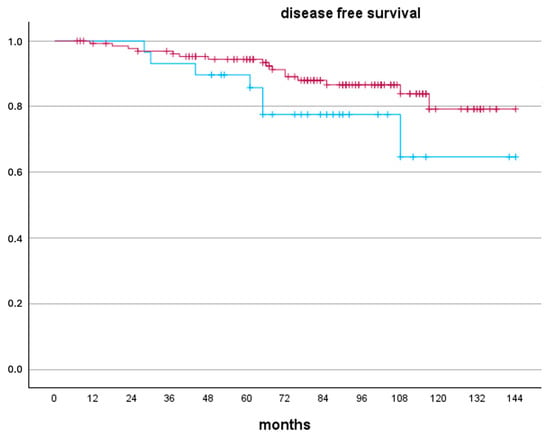
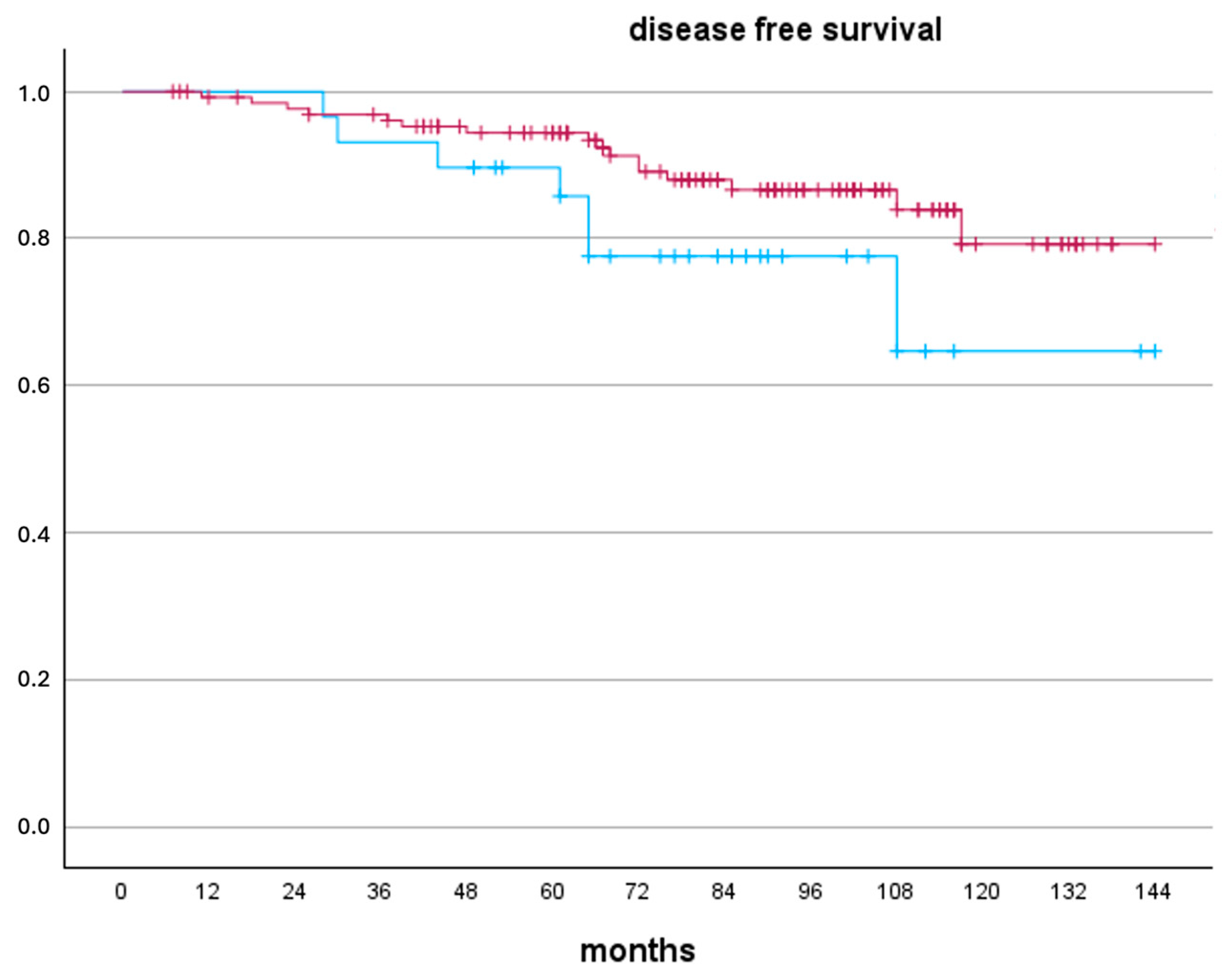
Median follow-up in the overall patient population was 91 months (Q1, Q3; 84.5, 97). Disease-free and overall survival are shown in Figure 2 and Table 4.
Figure 2.
Disease-free survival according to treatment response (pCR vs. non pCR). pCR yes = red, pCR no = blue, (log rank test p = 0.112).
Table 4.
Overall-survival.
In total, 20 patients had a recurrence (12.4%). Overall, 11 patients had a local recurrence, seven had a distant recurrence and two had a recurrence local as well as distant.
Of the patients without pCR at surgery, 24.1% had a recurrence event, compared with 9.8% of patients with pCR (p = 0.056, Fisher’s exact test) (Table 5). After 5 and 7 years DFS was 89% and 84%. DFS was numerically but not statistically better in patients achieving a pCR than in those without pCR (HR 0.486, 95% CI 0.20–1.18; p = 0.112) (Figure 2).
Table 5.
Recurrence and pCR at surgery.
In a multivariate Cox regression analysis hormone receptor status (HR 0.33 (0.13–0.86) and pCR (HR 0.31 (0.12–0.83) had a significant impact on DFS when adjusted for age (p = 0.022; p = 0.020) (Table 6).
Table 6.
Multivariable Cox regression.
During our observation period, six patients (3.7%) died—three with and three without known recurrence of breast cancer. OS overall was excellent after 5 and 7 years with 98% and 96%, respectively, with no significant difference between pCR and non-pCR patients.
4. Discussion
This retrospective real-world analysis demonstrates the effectiveness and tolerability of six cycles of neoadjuvant NPLD and docetaxel plus trastuzumab and pertuzumab in 164 patients with HER2-positive early breast cancer. High rates of pathologic complete response were observed irrespective of HR status, accompanied by favorable long-term outcomes and a low incidence of LVSD.
In this cohort with early HER2-positive breast cancer we were able to achieve pCR in 82%. The TRYPHAENA study evaluating pertuzumab and trastuzumab plus standard neoadjuvant anthracycline-containing and anthracycline-free chemotherapy regimens in patients with HER2-positive early breast cancer reports a pCR of 61.6% and 57.3% for the two arms containing anthracycline and 66.2% for the anthracycline-free arm [11]. Similarly, the TRAIN-2 observed a pCR in 67% patients in the anthracycline group and in 68% in the non-anthracycline group [10]. Consequently, these two studies do not allow a definitive conclusion on whether anthracycline-containing or anthracycline-free chemotherapy is more effective. Because our study was a single-arm analysis of an anthracycline-containing regimen, it cannot provide new evidence on the comparative efficacy of anthracycline-containing versus anthracycline-free chemotherapy. Further prospective studies are urgently needed to address this question.
The neoCARHP study compared the efficacy of investigator-selected taxane plus trastuzumab and pertuzumab, with carboplatin or without carboplatin. pCR was achieved in 64.1% of patients in the group without carboplatin and in 65.9% of patients in the group with carboplatin [16].
Real-world data from 302 patients provided by Ma et al. reports a pCR rate of 73.1% for patients receiving trastuzumab and pertuzumab with taxane and carboplatin and 65.1% for those with sequential anthracycline and cyclophosphamide, followed by dual blockade and taxane [17]. The authors Hall et al. also published real-world data from 78 patients receiving neoadjuvant trastuzumab and pertuzumab combined with chemotherapy and report a pCR in 46.3% of patients [18].
In our cohort, pCR rates were among the highest reported. These findings indicate that the NPLD (50 mg/m2), docetaxel (75 mg/m2) and dual HER2 blockade with trastuzumab and pertuzumab regimen may be highly effective in routine clinical practice.
In our analysis, patients with hormone receptor-negative tumors achieved pCR more often compared to those with hormone receptor-positive tumors (92.8% (64/69) HR-negative vs. 73.9% (68/92) HR-positive patients (p = 0.002)). This phenomenon has been previously shown in studies. Studies by Xiangmin et al. and Hall et al., also providing real-world data, report higher pCR rates for patients with HR-negative tumors compared to those with HR-positive tumors [17,18]. Similar results were reported in the DESTINY-Breast11 trial, with rates of pCR in non-luminal patients of 83.1% versus 61.4% in HR-positive patients [19].
In our cohort, pCR was associated with a numerical improvement in OS and DFS, but the associations were not statistically significant, likely reflecting the limited number of outcome events. In a Cox regression analysis with multiple covariates, hormone receptor status (HR 0.33 (0.13–0.86), p = 0.022) and pCR (HR 0.31 (0.12–0.83), p = 0.020) were significantly related to disease-free survival when adjusted for age. The authors would like to note that, owing to the small sample size, this analysis is exploratory in nature and therefore authors plan to continue the long-term follow-up of the cohort.
In this cohort, substitution of conventional anthracyclines by NPLD resulted in an excellent cardiac safety profile, and a LVEF-drop CTCAE grade 2 was observed in two patients only during treatment. Schneeweiss et al. report an incidence of LVSD CTCAE grade 2 of 5.6% and 5.3% in their study arms containing anthracyclines and dual blockade [11]. The study group compared the cardiac safety of pertuzumab and trastuzumab in combinations with neoadjuvant anthracycline-containing and anthracycline-free chemotherapy regimens in patients with HER2-positive early breast cancer and came to the conclusion that the dual HER2 blockade resulted in low rates of LVSD CTCAE grade 2 and especially of symptomatic LVSD in all groups [11]. Similarly, in the TRAIN-2 trial comparing dual HER2 blockade with neoadjuvant chemotherapy with and without anthracyclines, symptomatic LVSD was rare in both groups [10]. In their three-year follow-up, authors report LVEF CTCAE grade 2 was more common in patients who received anthracyclines [20]. The Aphinity trial evaluating the cardiac safety of dual anti-HER2 blockade reports an incidence of cardiac events (defined as CTCAE grade 2 or cardiac death) in 3.3% of their patient population consisting of 4769 patients [13]. The authors conclude that dual HER2 blockade does not increase the risk of cardiac event compared to only trastuzumab. Furthermore, they suggest that, as the use of anthracycline-based chemotherapy increases the risk of cardiac events, non-anthracycline chemotherapy may be considered particularly in patients with cardiovascular risk factors [13]. Comparing T-DXd followed by weekly paclitaxel with dual blockade to ddAC- paclitaxel-HP (THP), Harbeck et al. reported LVEF dysfunction in 1.3% and 6.1%, respectively [19]. Grade ≥3 events occurred in 0.3% in the T-DXd-THP group, compared to 1.9% in the anthracycline-containing group.
Our findings therefore are consistent with the currently available literature suggesting that neoadjuvant NPLD/docetaxel combined with trastuzumab and pertuzumab is associated with a low incidence of cardiac toxicity despite incorporating an anthracycline [12]. The especially low incidence of LVSD in our cohort may also reflect our multidisciplinary cardio-oncology approach. Serial echocardiographic monitoring and close collaboration with cardiologists enable early identification of patients at increased risk of cardiotoxicity and individualized monitoring or treatment adaptation, which may have contributed to the favorable cardiac safety observed in our cohort.
More recently, antibody–drug conjugates (ADCs) are being evaluated in multiple clinical trials with the aim of redefining treatment standards in the early setting.
The DESTINY-Breast11 study (DB11) compared Trastuzumab Deruxtecan (T-DXd) (eight cycles), T-DXd-THP (four + four cycles), and ddAC-THP (four + four cycles) [19]. T-DXd-alone arm enrolment closed early following the Independent Data Monitoring Committee recommendation. The study reports pCR significantly more often in the T-DXd-THP arm compared to the ddAC-THP arm (67.3% vs. 56.3%) [19]. It seems this study design might be methodologically limited, particularly when anthracycline-based regimens are administered without concurrent HER2-targeted therapy and compared with modern regimens that include simultaneous HER2 blockade. The DB11 study included patients with a primary clinical tumor stage of ≥cT3 and cN0–3, or a primary tumor of any size with positive lymph node involvement. When we exclude all patients from our analysis that do not match the inclusion criteria of DB11 and have a clinical tumor size <cT3 and no lymph node involvement, 130 patients with ≥cT3 and/or positive lymph nodes remain. From this subgroup in our retrospective analyses, 105/130 (80.8%) patients achieved pCR. However, the authors acknowledge that, although our patient cohort was matched to that of the DB11 study, a cross-trial comparison is limited by differences in study design and should be seen as contextual evidence.
Furthermore, the DB11 trial was not powered to evaluate DFS or OS as primary endpoints which makes further comparisons difficult.
Taking into consideration that giving a large patient population with a good prognosis a therapy in the first line that could potentially cause a grade 5 interstitial lung disease (ILD), it is the authors’ opinion that a cautious approach is essential. Furthermore, extensive patient education and guidelines for screening of potential ILD are needed.
Although not the focus of our work, the authors would like to note that new agents such as T-DXd impose a considerably higher financial burden on health care systems than established regimens, and this burden is likely to grow if they are used in earlier treatment lines.
In recent years, research has increasingly shifted towards personalization and possible de-escalation of therapy for patients with early breast cancer.
According to the ESMO guidelines, breast-conserving surgery is an appropriate surgical option for most patients with breast cancer [7]. Before anti-HER2-targeted therapy there was some hesitancy regarding breast-conserving surgery for HER2-positive patients [21,22]. A meta-analysis by He et al. investigating twelve studies with overall 2366 subjects found, that if patients with HER2-enriched breast cancer received anti-HER2-targeted therapy of trastuzumab, local–regional relapse was similar between patients who received mastectomy and breast-conserving therapy [23]. Furthermore, a retrospective study by Gentile et al. came to the conclusion, that in patients with triple-negative or HER2-enriched ipsilateral breast cancer recurrence, a salvage mastectomy is not always necessary and does not seem to increase survival compared to a second breast-conserving surgery [24].
Regarding de-escalation of systemic treatment there has been substantial research in recent years. The DECRESCENDO trial investigated de-escalating chemotherapy in HER2-positive, estrogen receptor-negative, node-negative early breast cancer using neoadjuvant taxane plus trastuzumab/pertuzumab [25]. The DECRESCENDO trial was terminated early due to slow recruitment that led to financial support withdrawal. The group presented their results at the 2025 San Antonio Breast Cancer Poster Session and reported a pCR rate of 86% pCR rate [26].
The DAPHNe trial included patients with stage II to III ERBB2-positive breast cancer receiving neoadjuvant THP for 12 weeks. The 5-year event-free survival was 99% (95% CI, 97–100%) and the 5-year overall survival was 99% [27].
Data regarding safety of de-escalation has also been published for the adjuvant setting. Tolaney et al. published their 10-year analysis for adjuvant paclitaxel and trastuzumab for node-negative, HER2-positive breast cancer and report a 10-year invasive disease-free survival of 91.3% and 10-year overall survival of 94.3% [28]. In our institution we give low-risk patients chemotherapy according to the APT trial.
In a study published by Waks et al. all patients were planned to receive neoadjuvant paclitaxel-HP, and patients who experienced pCR were recommended to receive adjuvant HP only, without further adjuvant cytotoxic chemotherapy [29]. During their follow-up of median 19.1 months there were no breast cancer recurrences. Planned and ongoing prospective trials should clarify the long-term efficacy of this approach.
In addition, biomarker- and imaging-based approaches are being explored to identify early response and select patients in whom chemotherapy can be omitted.
In their secondary analysis, investigators of the DAPHNe trial reported that ctDNA clearance occurred in 49 of 51 patients (96.1%) after neoadjuvant therapy, which supports the need of further investigation of ctDNA-guided de-escalation strategies in this setting [27]. The PHERGain study used a PET-based, pCR-adapted strategy to identify patients to omit chemotherapy [12]. The study reported a 3-year invasive disease-free survival of 94.8%. [12]. A trial published by Guarneri et al. deescalated neoadjuvant therapy based on Ki67 response after 2-week letrozole and met their primary end point of pre-specified pCRs [30].
Given the retrospective nature of our study and the limited sample size, follow-up for patients was performed to the best possible extent. In our patient collective, 30% had clinical stage one disease, which may have contributed to the high pCR rates observed in this cohort. Overall, the neoadjuvant chemotherapy was also made available to 47 patients with cT1c tumors and one patient with a cT1b tumor through a multidisciplinary tumor board. The patient with cT1b tumor had positive lymph nodes prior to therapy, as did 38 of the 47 (78.2%) patients with cT1c tumors. This might make our study population more difficult to compare to other studies, but for this reason we provided pCR rate for a patient collective like the DB11 in our discussion and Table 2. The authors plan to do a follow-up analysis to provide more data regarding OS and DFS. The currently small number of events limits the strength and interpretability of this analysis. As this was a retrospective, single-arm analysis, the high pCR rate cannot be attributed to any single component of the regimen such as NPLD. Larger randomized controlled trials are required to determine the contribution of individual agents and especially evaluate the contribution of NPLD on the overall efficacy.
As more options for treatment monitoring become available, it seems there is a shift to more personalized treatment for patients. This provides the possibility of de-escalation for low-risk patient populations as well as a mindful choice of therapies regarding patients’ pre-existing conditions that leave them at a higher risk for certain adverse events.
Still, physicians should keep in mind that neoadjuvant chemotherapy facilitates early response monitoring.
5. Conclusions
In our real-world cohort, concurrent non-pegylated liposomal doxorubicin (NPLD) plus docetaxel and dual HER2 blockade appeared highly effective in early-stage HER2-positive breast cancer, with a pCR rate of 82% and a low rate of left ventricular systolic dysfunction.
Author Contributions
Conceptualization, M.E., R.P. and D.E.; methodology, M.E., R.P. and D.E.; validation, M.E., R.P., and S.M.; formal analysis, M.E., R.P., D.R., S.M. and D.E.; investigation, M.E., R.P., D.R., K.S., B.F., C.B., A.R., S.T., K.K., C.A., J.U., I.A. and D.E.; data curation, D.E.; writing—original draft preparation, M.E., R.P. and D.E.; writing—review and editing, M.E., R.P., D.R., S.M., K.S., B.F., C.B., A.R., S.T., K.K., C.A., J.U., I.A. and D.E.; project administration, M.E., R.P. and D.E. All authors have read and agreed to the published version of the manuscript.
Funding
This research received no external funding.
Institutional Review Board Statement
The study was conducted in accordance with the Declaration of Helsinki and approved by the Institutional or Ethics Committee of the University of Innsbruck, Austria (votum number 1083/2026 and date of approval 9 April 2026).
Informed Consent Statement
Patient consent was waived due to the retrospective study design and the use of anonymized data collected via the electronic case form.
Data Availability Statement
Data is available from the corresponding author upon reasonable request.
Acknowledgments
During the preparation of this work the authors used academic AI (an internal AI platform of the Medical University of Innsbruck, accessed October 2026) from the medical university of Innsbruck in order to generate the images for their graphical abstract. The authors have reviewed and edited the output and take full responsibility for the content of this publication.
Conflicts of Interest
Miriam Emmelheinz reports receiving support for attending meetings from Teva Ratiopharm, Sandoz and Lilly. Christine Brunner reports receiving consulting fees from Gilead Sciences and Novartis, honoraria for presentations from AMGEN, DaiichiSanyko, AstraZeneca, Gilead Sciences, SEAGEN, Pfizer, and Novartis and support for attending meetings from DaiichiSanyko, AstraZeneca, and Novartis and participation on the advisory board for Pfizer. Annette Reiner reports an immediate family member having stocks of Pfizer and Biotec, receiving honoraria from DaichiiSankyo, Lilly, and AstraZeneca, a consulting role for Novartis and support for attending meetings from Tevapharm, Gilead, Daichii Sankyo. Sandra Toth reports support for attending meetings from Gilead, Pfizer, Stemline Therapeutics, Pharmaand GmbH. Daniel Egle reports receiving consulting fees from AstraZeneca, Daiichi-Sankyo, Gilead, Lilly, MSD, Novartis, Pfizer, Roche, Sandoz and Seagen and honoraria for presentations from Amgen, AstraZeneca, Daiichi-Sankyo, Gilead, Lilly, MSD, Novartis, Pfizer, Pierre-Fabre, Roche, Sandoz and Seagen and support for attending meetings from DaiichiSanyko, Gilead, Pfizer and AstraZeneca. All other authors (Ricarda Purtscheller, Daniel Reimer, Sarah Maier, Katharina Steger, Barin Feroz, Katharina Knoll, Carmen Albertini, Julia Unterthurner, Ibrahim Alkatout) declare no conflicts of interest regarding this project.
Abbreviations
The following abbreviations are used in this manuscript:
| HER2 | Human Epidermal Growth Factor Receptor 2 |
| NPLD | Non-pegylated liposomal doxorubicin |
| pCR | Pathological complete response |
| LVSD | Left ventricular systolic dysfunction |
| DFS | Disease-free survival |
| LVEF | Left ventricular ejection fraction |
| OS | Overall survival |
| HR | Hazard ratios |
| T-DXd | Trastuzumab Deruxtecan |
| THP | Paclitaxel-HP |
| ILD | Interstitial lung disease |
Appendix A
Table A1.
Tumor characteristics of the 19 patients with two lesions.
Table A2.
Post-neoadjuvant therapy.
References
- Baselga, J.; Perez, E.A.; Pienkowski, T.; Bell, R. Adjuvant trastuzumab: A milestone in the treatment of HER-2-positive early breast cancer. Oncologist 2006, 11, 4–12. [Google Scholar] [CrossRef] [Scilit] [PubMed]
- Cameron, D.; Piccart-Gebhart, M.J.; Gelber, R.D.; Procter, M.; Goldhirsch, A.; de Azambuja, E.; Castro, G.; Untch, M.; Smith, I.; Gianni, L.; et al. 11 years’ follow-up of trastuzumab after adjuvant chemotherapy in HER2-positive early breast cancer: Final analysis of the HERceptin Adjuvant (HERA) trial. Lancet 2017, 389, 1195–1205. [Google Scholar] [CrossRef] [Scilit] [PubMed]
- Perez, E.A.; Romond, E.H.; Suman, V.J.; Jeong, J.H.; Davidson, N.E.; Geyer, C.E.; Martino, S.; Mamounas, E.P.; Kaufman, P.A.; Wolmark, N. Four-year follow-up of trastuzumab plus adjuvant chemotherapy for operable human epidermal growth factor receptor 2-positive breast cancer: Joint analysis of data from NCCTG N9831 and NSABP B-31. J. Clin. Oncol. 2011, 29, 3366–3373. [Google Scholar] [CrossRef] [Scilit] [PubMed]
- Gianni, L.; Eiermann, W.; Semiglazov, V.; Manikhas, A.; Lluch, A.; Tjulandin, S.; Zambetti, M.; Vazquez, F.; Byakhow, M.; Lichinitser, M.; et al. Neoadjuvant chemotherapy with trastuzumab followed by adjuvant trastuzumab versus neoadjuvant chemotherapy alone, in patients with HER2-positive locally advanced breast cancer (the NOAH trial): A randomised controlled superiority trial with a parallel HER2-negative cohort. Lancet 2010, 375, 377–384. [Google Scholar] [CrossRef] [Scilit] [PubMed]
- Gianni, L.; Eiermann, W.; Semiglazov, V.; Lluch, A.; Tjulandin, S.; Zambetti, M.; Moliterni, A.; Vazquez, F.; Byakhov, M.J.; Lichinitser, M.; et al. Neoadjuvant and adjuvant trastuzumab in patients with HER2-positive locally advanced breast cancer (NOAH): Follow-up of a randomised controlled superiority trial with a parallel HER2-negative cohort. Lancet Oncol. 2014, 15, 640–647. [Google Scholar] [CrossRef] [Scilit] [PubMed]
- Korde, L.A.; Somerfield, M.R.; Carey, L.A.; Crews, J.R.; Denduluri, N.; Hwang, E.S.; Khan, S.A.; Loibl, S.; Morris, E.A.; Perez, A.; et al. Neoadjuvant Chemotherapy, Endocrine Therapy, and Targeted Therapy for Breast Cancer: ASCO Guideline. J. Clin. Oncol. 2021, 39, 1485–1505. [Google Scholar] [CrossRef] [Scilit] [PubMed]
- Loibl, S.; André, F.; Bachelot, T.; Barrios, C.H.; Bergh, J.; Burstein, H.J.; Cardoso, M.J.; Carey, L.A.; Dawood, S.; Del Mastro, L.; et al. Early breast cancer: ESMO Clinical Practice Guideline for diagnosis, treatment and follow-up. Ann. Oncol. 2024, 35, 159–182. [Google Scholar] [CrossRef] [Scilit] [PubMed]
- Cardoso, F.; Kyriakides, S.; Ohno, S.; Penault-Llorca, F.; Poortmans, P.; Rubio, I.T.; Zackrisson, S.; Senkus, E.; ESMO Guidelines Committee. Early breast cancer: ESMO Clinical Practice Guidelines for diagnosis, treatment and follow-up. Ann. Oncol. 2019, 30, 1194–1220. [Google Scholar] [CrossRef] [Scilit] [PubMed]
- Slamon, D.; Eiermann, W.; Robert, N.; Pienkowski, T.; Martin, M.; Press, M.; Mackey, J.; Glaspy, J.; Chan, A.; Pawlicki, M.; et al. Adjuvant trastuzumab in HER2-positive breast cancer. N. Engl. J. Med. 2011, 365, 1273–1283. [Google Scholar] [CrossRef] [Scilit] [PubMed]
- van Ramshorst, M.S.; van der Voort, A.; van Werkhoven, E.D.; Mandjes, I.A.; Kemper, I.; Dezentjé, V.O.; Oving, I.M.; Honkoop, A.H.; Tick, L.W.; van de Wouw, A.J.; et al. Neoadjuvant chemotherapy with or without anthracyclines in the presence of dual HER2 blockade for HER2-positive breast cancer (TRAIN-2): A multicentre, open-label, randomised, phase 3 trial. Lancet Oncol. 2018, 19, 1630–1640. [Google Scholar] [CrossRef] [Scilit] [PubMed]
- Schneeweiss, A.; Chia, S.; Hickish, T.; Harvey, V.; Eniu, A.; Hegg, R.; Tausch, C.; Seo, J.H.; Tsai, Y.F.; Ratnayake, J.; et al. Pertuzumab plus trastuzumab in combination with standard neoadjuvant anthracycline-containing and anthracycline-free chemotherapy regimens in patients with HER2-positive early breast cancer: A randomized phase II cardiac safety study (TRYPHAENA). Ann. Oncol. 2013, 24, 2278–2284. [Google Scholar] [CrossRef] [Scilit] [PubMed]
- Pérez-García, J.M.; Cortés, J.; Ruiz-Borrego, M.; Colleoni, M.; Stradella, A.; Bermejo, B.; Dalenc, F.; Escrivá-de-Romaní, S.; Calvo Martínez, L.; Ribelles, N.; et al. 3-year invasive disease-free survival with chemotherapy de-escalation using an. Lancet 2024, 403, 1649–1659. [Google Scholar] [CrossRef] [Scilit] [PubMed]
- de Azambuja, E.; Agostinetto, E.; Procter, M.; Eiger, D.; Pondé, N.; Guillaume, S.; Parlier, D.; Lambertini, M.; Desmet, A.; Caballero, C.; et al. Cardiac safety of dual anti-HER2 blockade with pertuzumab plus trastuzumab in early HER2-positive breast cancer in the APHINITY trial. ESMO Open 2023, 8, 100772. [Google Scholar] [CrossRef] [Scilit] [PubMed]
- Gonciar, D.; Mocan, L.; Zlibut, A.; Mocan, T.; Agoston-Coldea, L. Cardiotoxicity in HER2-positive breast cancer patients. Heart Fail. Rev. 2021, 26, 919–935. [Google Scholar] [CrossRef] [Scilit] [PubMed]
- Allison, K.H.; Hammond, M.E.H.; Dowsett, M.; McKernin, S.E.; Carey, L.A.; Fitzgibbons, P.L.; Hayes, D.F.; Lakhani, S.R.; Chavez-MacGregor, M.; Perlmutter, J.; et al. Estrogen and Progesterone Receptor Testing in Breast Cancer: ASCO/CAP Guideline Update. J. Clin. Oncol. 2020, 38, 1346–1366. [Google Scholar] [CrossRef] [Scilit] [PubMed]
- Gao, H.F.; Ye, G.L.; Lin, Y.; Huang, Q.; Dong, J.; Cao, Y.; Zhao, Y.X.; Chen, Q.J.; Ma, S.H.; Ouyang, J.; et al. Neoadjuvant Taxane Plus Trastuzumab and Pertuzumab With or Without Carboplatin in Human Epidermal Growth Factor Receptor 2-Positive Breast Cancer: The Randomized Noninferiority Phase III neoCARHP Trial. J. Clin. Oncol. 2026, 44, 1587–1596. [Google Scholar] [CrossRef] [Scilit] [PubMed]
- Ma, X.; Zhang, X.; Zhou, X.; Ren, X.; Zhang, W.; Yang, R.; Song, T.; Liu, Y. Real-world study of trastuzumab and pertuzumab combined with chemotherapy in neoadjuvant treatment for patients with HER2-positive breast cancer. Medicine 2022, 101, e30892. [Google Scholar] [CrossRef] [Scilit] [PubMed]
- Hall, B.J.; Bhojwani, A.A.; Wong, H.; Law, A.; Flint, H.; Ahmed, E.; Innes, H.; Cliff, J.; Malik, Z.; O’Hagan, J.E.; et al. Neoadjuvant Trastuzumab and Pertuzumab for Early HER2-Positive Breast Cancer: A Real World Experience. Breast J. 2022, 2022, 7146172. [Google Scholar] [CrossRef] [Scilit] [PubMed]
- Harbeck, N.; Modi, S.; Pusztai, L.; Ohno, S.; Wu, J.; Kim, S.B.; Yoshida, A.; Fabi, A.; Cao, X.; Joseph, R.; et al. Neoadjuvant trastuzumab deruxtecan alone or followed by paclitaxel, trastuzumab, and pertuzumab for high-risk HER2-positive early breast cancer (DESTINY-Breast11): A randomised, open-label, multicentre, phase III trial. Ann. Oncol. 2026, 37, 166–179. [Google Scholar] [CrossRef] [Scilit] [PubMed]
- van der Voort, A.; van Ramshorst, M.S.; van Werkhoven, E.D.; Mandjes, I.A.; Kemper, I.; Vulink, A.J.; Oving, I.M.; Honkoop, A.H.; Tick, L.W.; van de Wouw, A.J.; et al. Three-Year Follow-up of Neoadjuvant Chemotherapy With or Without Anthracyclines in the Presence of Dual ERBB2 Blockade in Patients With ERBB2-Positive Breast Cancer: A Secondary Analysis of the TRAIN-2 Randomized, Phase 3 Trial. JAMA Oncol. 2021, 7, 978–984. [Google Scholar] [CrossRef] [Scilit] [PubMed]
- Voduc, K.D.; Cheang, M.C.; Tyldesley, S.; Gelmon, K.; Nielsen, T.O.; Kennecke, H. Breast cancer subtypes and the risk of local and regional relapse. J. Clin. Oncol. 2010, 28, 1684–1691. [Google Scholar] [CrossRef] [Scilit] [PubMed]
- Nguyen, P.L.; Taghian, A.G.; Katz, M.S.; Niemierko, A.; Abi Raad, R.F.; Boon, W.L.; Bellon, J.R.; Wong, J.S.; Smith, B.L.; Harris, J.R. Breast cancer subtype approximated by estrogen receptor, progesterone receptor, and HER-2 is associated with local and distant recurrence after breast-conserving therapy. J. Clin. Oncol. 2008, 26, 2373–2378. [Google Scholar] [CrossRef] [Scilit] [PubMed]
- Ditsch, N.; Kolberg-Liedtke, C.; Friedrich, M.; Jackisch, C.; Albert, U.S.; Banys-Paluchowski, M.; Bauerfeind, I.; Blohmer, J.U.; Budach, W.; Dall, P.; et al. AGO Recommendations for the Diagnosis and Treatment of Patients with Early Breast Cancer: Update 2021. Breast Care 2021, 16, 214–227. [Google Scholar] [CrossRef] [Scilit] [PubMed]
- Gentile, D.; Sagona, A.; Spoto, R.; Franceschini, D.; Vaccari, S.; Vinci, V.; Biondi, E.; Scardina, L.; Tinterri, C. Salvage Mastectomy Is not the Treatment of Choice for Aggressive Subtypes of Ipsilateral Breast Cancer Recurrence: A Single-Institution Retrospective Study. Eur. J. Breast Health 2022, 18, 315–322. [Google Scholar] [CrossRef] [Scilit] [PubMed]
- Debien, V.; Adam, V.; Coart, E.; Agostinetto, E.; Goulioti, T.; Molinelli, C.; Arahmani, A.; Zoppoli, G.; Piccart, M. DECRESCENDO: De-escalating chemotherapy in HER2-positive, estrogen receptor-negative, node-negative early breast cancer. Future Oncol. 2023, 19, 1655–1667. [Google Scholar] [CrossRef] [Scilit] [PubMed]
- Agostinetto, E. San Antonio Breast Cancer Poster Session. American Association for Cancer Research last opened 10.11.26. Available online: https://aacrjournals.org/clincancerres/article/31/12_Supplement/P3-11-03/753048/Abstract-P3-11-03-De-escalation-of-chemotherapy-in (accessed on 10 November 2026).
- Tarantino, P.; Li, T.; Ogayo, E.R.; Rahman, T.; DiLullo, M.K.; Patel, A.; El-Refai, S.; Abbott, C.; Li, B.; Boyle, S.M.; et al. Neoadjuvant Paclitaxel, Trastuzumab, and Pertuzumab for Stage II to III, ERBB2-Positive Breast Cancer: A Secondary Analysis of the DAPHNe Trial. JAMA Oncol. 2026, 12, 868–874. [Google Scholar] [CrossRef] [Scilit] [PubMed]
- Tolaney, S.M.; Tarantino, P.; Graham, N.; Tayob, N.; Parè, L.; Villacampa, G.; Dang, C.T.; Yardley, D.A.; Moy, B.; Marcom, P.K.; et al. Adjuvant paclitaxel and trastuzumab for node-negative, HER2-positive breast cancer: Final 10-year analysis of the open-label, single-arm, phase 2 APT trial. Lancet Oncol. 2023, 24, 273–285. [Google Scholar] [CrossRef] [Scilit] [PubMed]
- Waks, A.G.; Desai, N.V.; Li, T.; Poorvu, P.D.; Partridge, A.H.; Sinclair, N.; Spring, L.M.; Faggen, M.; Constantine, M.; Metzger, O.; et al. A prospective trial of treatment de-escalation following neoadjuvant paclitaxel/trastuzumab/pertuzumab in HER2-positive breast cancer. npj Breast Cancer 2022, 8, 63. [Google Scholar] [CrossRef] [Scilit] [PubMed]
- Guarneri, V.; Dieci, M.V.; Bisagni, G.; Frassoldati, A.; Bianchi, G.V.; De Salvo, G.L.; Orvieto, E.; Urso, L.; Pascual, T.; Paré, L.; et al. De-escalated therapy for HR+/HER2+ breast cancer patients with Ki67 response after 2-week letrozole: Results of the PerELISA neoadjuvant study. Ann. Oncol. 2019, 30, 921–926. [Google Scholar] [CrossRef] [Scilit] [PubMed]

Disclaimer/Publisher’s Note: The statements, opinions and data contained in all publications are solely those of the individual author(s) and contributor(s) and not of MDPI and/or the editor(s). MDPI and/or the editor(s) disclaim responsibility for any injury to people or property resulting from any ideas, methods, instructions or products referred to in the content. |
© 2026 by the authors. Licensee MDPI, Basel, Switzerland. This article is an open access article distributed under the terms and conditions of the Creative Commons Attribution (CC BY) license.