


Simple Summary
Robotic surgery is increasingly used to treat colon cancer, but evidence specifically addressing left colectomy remains limited. We compared robotic and laparoscopic left colectomy in 148 patients treated at a single hospital over an 11-year period during the introduction of robotic surgery. Patients undergoing robotic surgery had shorter hospital stays and spent less time in intensive care, although their operations took slightly longer. Major postoperative complications, conversion to open surgery, and anastomotic leakage occurred less frequently in the robotic group, but these differences were not statistically significant. Both approaches achieved high standards of surgical resection quality, including adequate lymph node removal. Our findings suggest that robotic left colectomy can be successfully introduced into routine clinical practice by experienced colorectal surgeons. However, changes in clinical practice over time may have influenced the results.
Abstract
Background: Robotic-assisted colectomy has increasingly been adopted for the treatment of colon cancer. This study compared perioperative and oncological outcomes of robotic and laparoscopic left colectomy during an 11-year study period encompassing the institutional transition to robotic surgery. Methods: This retrospective single-center cohort study included consecutive patients undergoing elective minimally invasive left colectomy for histologically confirmed adenocarcinoma of the descending or sigmoid colon between January 2015 and December 2025. Perioperative and pathological outcomes were compared between laparoscopic and robotic surgery. Multivariable logistic and linear regression analyses were performed to adjust for potential confounders, including age, sex, body mass index, ASA class, presence of at least one comorbidity, previous abdominal surgery, smoking status, anticoagulant therapy, and UICC stage. Results: A total of 148 patients were included, comprising 70 laparoscopic and 78 robotic procedures. Robotic surgery was associated with numerically lower risks of conversion (5.1% vs. 12.9%), anastomotic leakage (4.3% vs. 11.1%), major morbidity (6.4% vs. 10.0%), and reoperation (6.4% vs. 10.0%) than laparoscopic surgery, although these differences were not statistically significant. In multivariable analyses, robotic surgery was associated with a shorter postoperative hospital stay (mean difference −4.4 days, 95% CI: [−6.8, −2.0]; p < 0.001) and shorter ICU stay (mean difference −2.6 days, 95% CI: [−3.9, −1.3]; p < 0.001), while operative time was longer (mean difference +16 min, 95% CI: [0.99, 31]; p = 0.037). Oncological quality was comparable between both approaches, with R0 resection achieved in 98.6% of patients and an adequate lymph node yield in both groups. Conclusions: During the institutional transition from laparoscopic to robotic left colectomy, robotic surgery was associated with shorter postoperative hospital and ICU stays and favorable pathological resection outcomes. These findings support the feasibility of introducing robotic left colectomy into routine colorectal practice by experienced colorectal surgeons, although uncertainty remains regarding comparative postoperative safety.
1. Introduction
Colorectal cancer (CRC) is the third most diagnosed malignancy and the second leading cause of cancer-related death worldwide [1]. Surgery remains the cornerstone of curative treatment for patients with localized colon cancer. The primary objective is to achieve complete oncological resection while minimizing perioperative morbidity and promoting rapid postoperative recovery. Accordingly, current international guidelines recommend minimally invasive colectomy whenever technically feasible without compromising oncological principles [2,3].
Over the past two decades, laparoscopic colectomy has become the standard minimally invasive approach for colon cancer. Several landmark randomized controlled trials demonstrated that laparoscopic surgery is associated with reduced postoperative pain, faster recovery, and shorter hospital stay while maintaining oncological outcomes equivalent to those of open surgery [4,5,6]. Consequently, laparoscopic colectomy has been widely adopted as the preferred surgical technique for elective colon cancer resection.
More recently, robotic-assisted surgery has increasingly been adopted for the treatment of colon cancer. Recent retrospective studies, nationwide cohort analyses, and meta-analyses have demonstrated oncological outcomes comparable to laparoscopic surgery while suggesting potential perioperative advantages, including lower conversion rates and improved short-term postoperative recovery. Meta-analyses of randomized trials have similarly reported lower conversion rates with robotic surgery, while overall postoperative morbidity remains comparable and operative time is longer [7]. However, evidence specifically addressing robotic left colectomy remains limited, as the available literature is dominated by retrospective single-center studies, propensity score-matched analyses, and meta-analyses, while randomized evidence specifically focused on left colectomy remains scarce [8,9,10].
Consequently, further real-world studies remain necessary to evaluate the perioperative safety and oncological quality of robotic left colectomy under routine clinical conditions. Studies reporting institutional experience during the transition from laparoscopic to robotic colorectal surgery provide valuable information regarding the implementation of this technology in daily surgical practice and complement the currently available evidence [8,9,11].
The present study therefore aimed to compare perioperative outcomes and oncological quality between laparoscopic and robotic left colectomy for left-sided colon cancer in a consecutive series of patients during an 11-year study period encompassing the institutional transition to robotic surgery.
2. Materials and Methods
2.1. Study Design
This retrospective single-center cohort study was conducted at the Department of Surgery, University Medical Center OWL, Campus Klinikum Lippe, Medical School OWL, Bielefeld University, Germany. Consecutive patients undergoing surgery for left-sided colon cancer between January 2015 and December 2025 were screened for eligibility.
During the study period, robotic left colectomy was progressively introduced into routine clinical practice following the implementation of the da Vinci® robotic surgical platform (Intuitive Surgical, Inc., Sunnyvale, CA, USA), resulting in a gradual institutional transition from laparoscopic to robotic surgery.
2.2. Patient Selection
For the primary comparative analysis, patients undergoing elective minimally invasive left colectomy for histologically confirmed adenocarcinoma of the descending or sigmoid colon were eligible for inclusion. Patients were categorized according to the surgical approach performed into a laparoscopic or robotic group.
Patients undergoing emergency surgery or primary open surgery were excluded.
2.3. Surgical Procedures
Laparoscopic left colectomies were performed by experienced minimally invasive colorectal surgeons or by colorectal surgery trainees under direct supervision. Robotic procedures were performed exclusively by experienced colorectal surgeons using the da Vinci® robotic platform (Intuitive Surgical, Inc., Sunnyvale, CA, USA). The institutional robotic surgery program was initiated in 2018 with the introduction of the da Vinci X system and was progressively expanded throughout the study period. By 2025, both the da Vinci Xi and the da Vinci 5 systems were available for clinical use. Laparoscopic left colectomy was performed using a conventional four-port technique consisting of one 12-mm camera trocar, two 5-mm working trocars, and one 12-mm trocar in the right iliac fossa. Robotic procedures were performed using the da Vinci® robotic platform (Intuitive Surgical, Inc., Sunnyvale, CA, USA) with four 8-mm robotic trocars and one 12-mm assistant trocar.
In both groups, a standardized oncological technique was applied using a medial-to-lateral approach. Following central ligation of the inferior mesenteric artery, the left ureter was routinely identified and preserved. Dissection was continued caudally by entering the total mesorectal excision (TME) plane to mobilize the upper rectum, followed by cranial dissection with division of the inferior mesenteric vein at the inferior border of the pancreas whenever anatomically feasible. The sigmoid and descending colon were subsequently mobilized, and the splenic flexure was mobilized when necessary to achieve a tension-free colorectal anastomosis.
The distal resection margin was defined in the upper rectum, and the mesorectum was divided accordingly. The proximal resection margin was determined according to oncological principles, followed by mesenteric division close to the bowel wall. Before bowel transection, perfusion of both the proximal colon and rectal stump was routinely assessed using indocyanine green (ICG) fluorescence angiography.
The upper rectum was transected intracorporeally using a 60-mm Signia™ stapling device with a Tri-Staple™ purple reload (Medtronic, Minneapolis, MN, USA). The specimen was extracted through a Pfannenstiel incision protected with an Alexis® wound retractor (Applied Medical, Rancho Santa Margarita, CA, USA). The proximal colon was divided extracorporeally after placement of a purse-string clamp, and the anvil of a 31-mm Covidien circular stapler (Medtronic, Minneapolis, MN, USA) was secured using a purse-string suture. A 31-mm stapler was used as the standard device whenever the bowel lumen permitted. The bowel was then returned to the abdominal cavity, and an intracorporeal end-to-end colorectal anastomosis was created. Anastomotic integrity was routinely assessed by intraoperative rigid rectoscopy and an air-leak test. A pelvic drain was routinely placed before standard fascial and skin closure.
2.4. Data Collection
Clinical, perioperative, and pathological data were retrospectively collected from the institutional electronic medical records and operative reports. Patient baseline characteristics included age, sex, body mass index (BMI), American Society of Anesthesiologists (ASA) classification, relevant comorbidities, previous abdominal surgery, smoking status, anticoagulant treatment, tumor location, and type of reconstruction.
Perioperative variables included surgical approach, operative time, conversion to open surgery, intraoperative complications, anastomotic leakage, postoperative complications according to the Clavien–Dindo classification [12], reoperation, 30-day readmission, 30-day mortality, length of hospital stay, and intensive care unit (ICU) stay.
Pathological data included resection margin status, number of harvested lymph nodes, pathological T and N stage, UICC stage, lymphatic invasion, venous invasion, perineural invasion, and tumor deposits.
Restoration of bowel continuity was recorded as primary anastomosis or Hartmann’s procedure. Conversion was defined as any intraoperative change from a minimally invasive approach to an open procedure requiring a midline laparotomy. Anastomotic leakage was defined as a clinically or radiologically confirmed defect of the anastomosis requiring conservative, interventional, or surgical treatment. Anastomotic leakage rates were calculated only among patients who underwent primary anastomosis. Patients undergoing Hartmann’s procedure were excluded from the denominator. No rectal stump leaks occurred in either group.
Operative time was defined as the interval from skin incision to skin closure. Robotic docking and undocking were included when performed within this interval, whereas preoperative robotic setup was excluded.
2.5. Study Endpoints
The primary endpoint was major postoperative morbidity, defined as Clavien–Dindo grade IIIb or higher within 30 days after surgery. This threshold includes complications requiring intervention under general anesthesia or more severe postoperative events. No Clavien–Dindo grade IIIa complications occurred in either group.
Secondary endpoints included conversion to open surgery, anastomotic leakage, reoperation, operative time, length of hospital stay, intensive care unit (ICU) stay, 30-day mortality, and pathological outcomes as measures of oncological quality.
2.6. Statistical Analysis
Baseline patient characteristics, perioperative outcomes, and oncological quality parameters were summarized using descriptive statistics. Continuous variables are reported as means with standard deviations (SDs), while categorical variables are presented as percentages. No direct unadjusted statistical comparisons between groups were performed. Instead, we evaluated surgery-type-specific differences using appropriate multivariable regression models adjusted for relevant potential confounders. Binary outcomes were analyzed with multivariable logistic regression, and continuous outcomes were assessed using multivariable linear regression. All models were adjusted for the following potential confounders: age, sex, body mass index (BMI), American Society of Anesthesiologists (ASA) score, presence of at least one comorbidity, history of previous abdominal surgery, smoking status, anticoagulant therapy, and UICC stage. ASA score and UICC stage were dichotomized into two groups: I/II and III/IV. This categorization was performed due to the limited number of cases in categories I and IV, respectively. For logistic regression models, effect estimates are presented as odds ratios (ORs) with 95% confidence intervals (CIs). For linear regression models, results are reported as regression coefficients with 95% CIs. Given the limited number of events for some binary outcomes relative to the number of covariates, additional sensitivity analyses were performed to assess the robustness of the findings and the potential impact of overfitting. These analyses used a reduced adjustment set consisting of age, sex, BMI, ASA score, and smoking status. For continuous outcomes, multivariable linear regression models were applied, whereas binary outcomes were analyzed using Firth-corrected logistic regression. The results of these sensitivity analyses are presented in the Supplementary Material (Tables S8 and S9). No missing values were present in the variables included in the regression analyses, and no imputation was required. Statistical analyses were performed using R software (version 4.6.1).
2.7. Ethical Approval
The study protocol was approved by the Ethics Committee of the Medical Association of Westphalia-Lippe and the University of Münster (Reference No. 2025-767-f-S). The study was conducted in accordance with the ethical principles of the Declaration of Helsinki.
3. Results
3.1. Study Cohort and Institutional Adoption
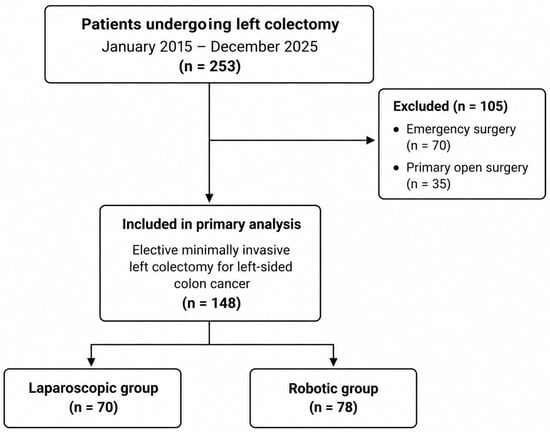
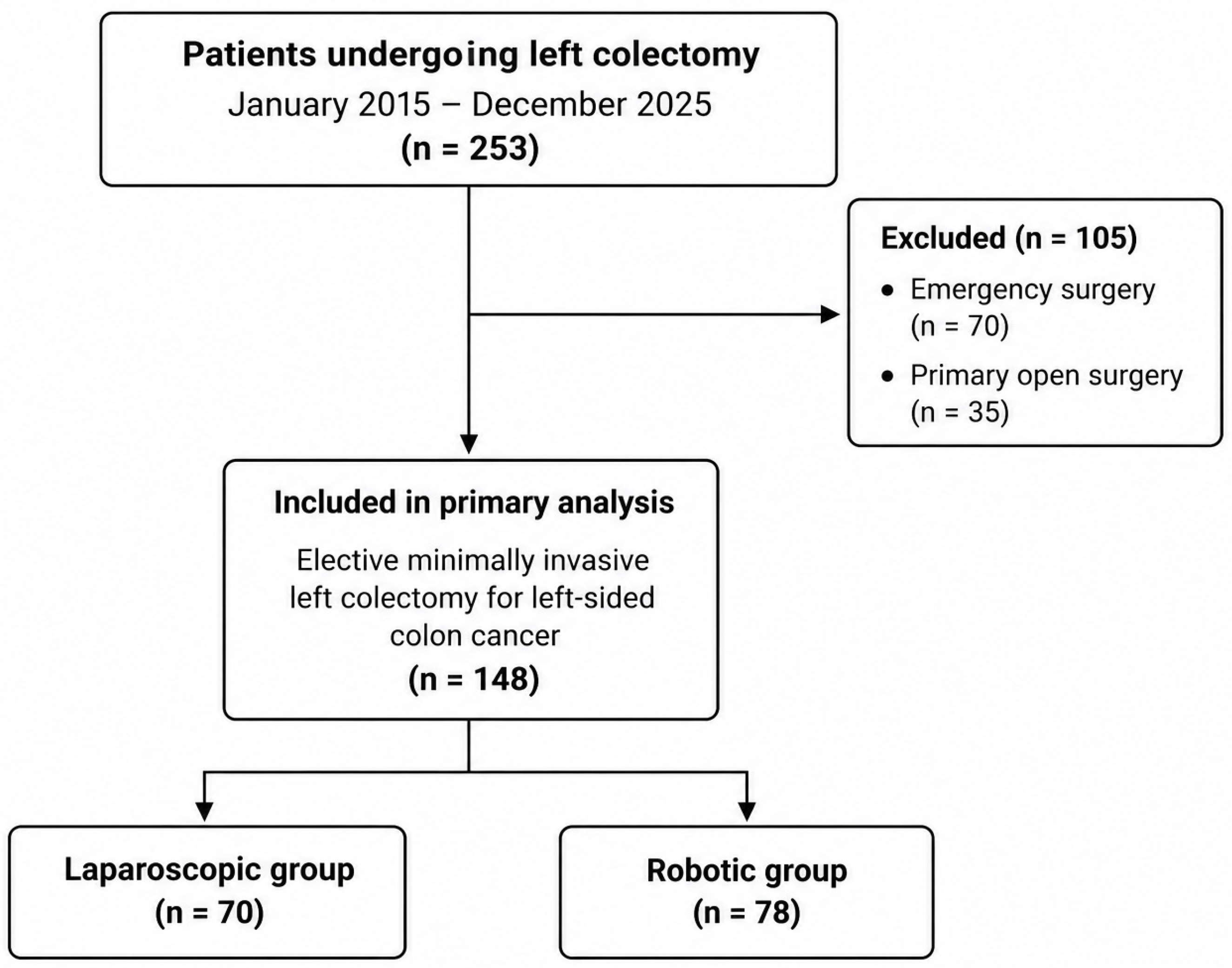
During the study period, 253 patients undergoing left colectomy were identified. Of these, 70 patients undergoing emergency surgery and 35 undergoing primary open surgery were excluded. The final study cohort comprised 148 patients, including 70 laparoscopic and 78 robotic procedures (Figure 1).
Figure 1.
Patient flow diagram. Flowchart illustrating patient selection for the primary comparative analysis.
The annual distribution of surgical approaches in the complete institutional cohort is presented in Supplementary Figure S1 and Table S1, illustrating the progressive adoption of robotic left colectomy during the study period.
3.2. Patient Characteristics
A total of 148 patients underwent minimally invasive left colectomy, including 70 laparoscopic and 78 robotic procedures. The overall mean age was 71.1 ± 11.5 years, and 59.5% of patients were male. Baseline demographic and clinical characteristics were generally similar between the two groups, although patients undergoing robotic surgery were more frequently classified as ASA III (51.3% vs. 37.1%). The prevalence of major comorbidities, previous abdominal surgery, smoking status, anticoagulant therapy, and the type of reconstruction was similar between the two cohorts (Table 1).
Table 1.
Baseline characteristics of patients undergoing laparoscopic and robotic left colectomy.
3.3. Perioperative Outcomes
Robotic left colectomy was associated with numerically lower risks of conversion (5.1% vs. 12.9%), anastomotic leakage (4.3% vs. 11.1%), major morbidity (6.4% vs. 10.0%), reoperation (6.4% vs. 10.0%), and 30-day mortality (0% vs. 2.9%) than laparoscopic surgery, whereas minor morbidity (12.8% vs. 8.6%) occurred slightly more frequently. No intraoperative complications occurred in either group. In addition, patients undergoing robotic surgery had a shorter postoperative hospital stay (Mean: 7.8 vs. 11.5 days) and ICU stay (Mean: 0.2 vs. 2.5 days) but a longer operative time (Mean: 175 vs. 153 min) (Table 2). The reasons for conversion to open surgery are detailed in Supplementary Table S2, and the management of anastomotic leakage is summarized in Supplementary Table S3.
Table 2.
Perioperative outcomes after laparoscopic and robotic left colectomy.
3.4. Pathological and Oncological Outcomes
An R0 resection was achieved in 146 of 148 patients (98.6%), including all patients treated robotically. R0 resection referred to histologically tumor-free resection margins of the primary colonic tumor and did not imply complete resection of metastatic disease. No simultaneous metastatic resections were performed among the 29 patients with UICC stage IV disease.
The mean number of harvested lymph nodes was 29.2 ± 12.5 and exceeded recommended oncological quality standards in both groups. Patients in the laparoscopic cohort more frequently presented with lymphatic invasion, venous invasion, perineural invasion, tumor deposits, and higher pathological UICC stages (Table 3).
Table 3.
Pathological and oncological outcomes after laparoscopic and robotic left colectomy.
3.5. Multivariable Regression Analyses
After adjustment for age, sex, BMI, ASA class, presence of at least one comorbidity, previous abdominal surgery, smoking status, anticoagulant treatment, and UICC stage, robotic surgery was associated with a statistically significantly shorter postoperative length of stay (mean difference [MD] −4.4 days, 95% CI: [−6.8, −2.0]; p < 0.001) and ICU stay (MD −2.6 days, 95% CI: [−3.9, −1.3]; p < 0.001). Operative time was statistically significantly longer in the robotic group (MD +16 min, 95% CI: [0.99, 31]; p = 0.037). None of the adjusted associations for major morbidity, minor morbidity, conversion, anastomotic leakage, or reoperation reached statistical significance. Point estimates for major morbidity, conversion, anastomotic leakage, and reoperation were lower with robotic surgery (Table 4).
Table 4.
Adjusted effect estimates of robotic versus laparoscopic left colectomy for perioperative outcomes.
3.6. Supplementary Analyses
The institutional adoption of robotic left colectomy over the study period is illustrated in Supplementary Figure S1. The figure depicts the annual distribution of surgical approaches within the entire institutional cohort. The Supplementary Material further includes the complete multivariable regression results (Tables S4 and S5), temporal trends in surgical practice (Table S1), annual perioperative outcomes (Tables S6 and S7), reasons for conversion (Table S2), management of anastomotic leakage (Table S3), and additional sensitivity analyses using reduced adjustment sets for the multivariable regression models (Tables S8 and S9), as well as a separate sensitivity analysis of ICU admission and length of stay (Table S10). Diagnostic plots for the multivariable linear regression models of ICU stay, hospital length of stay, and operative time are provided in Supplementary Figures S2–S4, respectively.
4. Discussion
4.1. Principal Findings
The present study demonstrates the feasibility of introducing robotic left colectomy for colon cancer into routine clinical practice, with favorable perioperative outcomes and pathological resection quality during the institutional transition from laparoscopic surgery.
Although major postoperative morbidity was numerically less frequent after robotic surgery, the adjusted estimate was imprecise (OR 0.52, 95% CI 0.13–2.00), precluding firm conclusions regarding comparative safety. Numerically lower rates of conversion to open surgery, anastomotic leakage, and reoperation were also observed with robotic surgery. In addition, robotic surgery was associated with statistically significantly shorter postoperative hospital and ICU stays, despite a modest increase in operative time. Importantly, the implementation of robotic left colectomy was not associated with deterioration in pathological quality, with excellent resection quality and adequate lymph node retrieval achieved throughout the study period.
4.2. Perioperative Outcomes
Robotic left colectomy was associated with shorter postoperative hospital and ICU stays despite a modest increase in operative time. Although conversion to open surgery, anastomotic leakage, major postoperative complications, and reoperation occurred less frequently following robotic surgery, these differences did not reach statistical significance after multivariable adjustment.
The observed reduction in postoperative hospital stay is consistent with the growing evidence of improved postoperative recovery after robotic colectomy. Comparative studies and recent meta-analyses have reported shorter length of stay and lower conversion rates following robotic compared with laparoscopic colectomy while demonstrating comparable postoperative morbidity [8,9,10,13,14,15,16,17]. In our cohort, robotic surgery remained associated with a 4.4-day shorter hospital stay and a 2.6-day shorter ICU stay after adjustment for the measured clinical confounders included in the multivariable models. The marked difference in postoperative hospital stay and ICU stay should be interpreted with caution, as changes in institutional perioperative management and postoperative care pathways over the study period may also have influenced this outcome. This is particularly relevant given the increasing implementation and standardization of enhanced recovery pathways in colorectal surgery over the past decade [18]. No formal changes to institutional perioperative care protocols or standardized discharge criteria were introduced during the study period. However, postoperative clinical practice gradually evolved with increasing experience in minimally invasive colorectal surgery. Patients were increasingly managed on the regular surgical ward rather than being routinely admitted to the ICU, and earlier discharge became more common when postoperative recovery was adequate. These changes may have contributed to the observed differences in hospital and ICU stay independently of the surgical approach.
Longer operative time is one of the most consistently reported limitations of robotic colectomy [8,13,19]. Besides robotic docking and system setup, this finding should be interpreted in the context of our institutional implementation strategy. Until 2020, robotic colorectal surgery at our institution was largely limited to rectal cancer. Thereafter, the robotic program was expanded to include right and left colectomy as well as surgery for diverticular disease, while three colorectal surgeons simultaneously progressed through their learning curves for robotic colonic surgery. Consequently, a substantial proportion of robotic left colectomies were performed during the early implementation phase, which likely contributed to the observed increase in operative time. Previous studies have demonstrated that operative performance during robotic colorectal surgery evolves with increasing surgeon and institutional experience, with the learning curve influenced by prior surgical experience, case complexity, and structured robotic training [20,21].
Despite this learning phase, major postoperative morbidity was numerically lower after robotic surgery, although the limited number of events and wide confidence intervals prevent definitive conclusions regarding comparative safety. Although lower adjusted odds ratios were observed for conversion, anastomotic leakage, major postoperative complications, and reoperation, the relatively low number of events limited the statistical power to detect significant differences. Nevertheless, the consistent direction of these effect estimates, together with the observed improvements in postoperative recovery, supports the clinical feasibility of robotic left colectomy. Importantly, these findings reflect routine clinical practice during the institutional implementation of a robotic colorectal program and therefore provide real-world evidence that favorable perioperative outcomes can be achieved even during the adoption of this technique [8,9,10,11].
4.3. Oncological Quality
Maintaining oncological quality is essential when introducing a new surgical technique for cancer. In our cohort, R0 resection was achieved in 97.1% of patients undergoing laparoscopic surgery and in 100% of those undergoing robotic surgery, while the mean lymph node harvest was 31.1 ± 12.1 and 27.5 ± 12.6, respectively. Both groups exceeded the recommended minimum lymph node yield of 12 nodes, indicating that robotic left colectomy was not associated with compromised pathological quality [3]. All patients in both groups had at least 12 examined lymph nodes. The reported R0 resection rates referred exclusively to the primary colonic tumor and not to the complete resection of metastatic disease. These findings are consistent with previous studies demonstrating comparable oncological quality between robotic and laparoscopic colectomy with respect to resection margins and lymph node harvest [8,9,10,13,19,22,23]. Although long-term oncological outcomes were beyond the scope of this study, the high R0 resection rate and adequate lymph node harvest observed in both groups indicate favorable pathological resection quality during the institutional implementation of robotic left colectomy. Available comparative data have also suggested broadly comparable long-term oncological outcomes between robotic and laparoscopic colectomy, although the evidence remains predominantly observational and further prospective data are required [23,24,25].
4.4. Transition to Robotic Surgery
Beyond comparing two minimally invasive approaches, the present study evaluates the institutional implementation of robotic left colectomy over an 11-year study period. By capturing the gradual adoption of robotic surgery in routine clinical practice, our findings provide real-world evidence on the introduction of a robotic colorectal program.
Our findings complement the existing literature comparing robotic and laparoscopic colectomy by demonstrating that favorable perioperative and pathological outcomes can be maintained throughout the implementation of a robotic colorectal program [8,9,11,13,26]. Although a learning curve was expected during the expansion of robotic colorectal surgery, favorable perioperative and pathological outcomes were observed throughout the study period. This observation is consistent with our previous institutional experience demonstrating stable perioperative safety and oncological quality during structured implementation of robotic colorectal surgery within a dual-console training program [27].
Recent evidence further indicates that learning curves in robotic colorectal surgery are procedure- and context-specific and may be influenced by surgeon experience, institutional setting, case mix, and training strategy [28,29]. Consistent with these observations, our findings suggest that robotic left colectomy can be successfully integrated into an established colorectal program with favorable perioperative and pathological outcomes.
4.5. Strengths and Limitations
This study has several strengths. It includes a consecutive cohort of patients undergoing elective minimally invasive left colectomy over an 11-year study period, reflecting routine clinical practice during the institutional introduction of robotic surgery. By capturing the transition from laparoscopic to robotic left colectomy under everyday clinical conditions, the study provides an unselected clinical cohort that complements the existing comparative literature. In addition, surgical procedures were performed using a standardized operative technique, and multivariable regression analyses were applied to adjust for relevant clinical confounders.
Several limitations should be acknowledged. First, the retrospective single-center design limits the generalizability of the findings and introduces the potential for residual confounding despite multivariable adjustment. Although the regression models were adjusted for UICC stage and other relevant clinical variables, differences in disease severity between the study groups and unmeasured confounders cannot be excluded. Furthermore, laparoscopic procedures could be performed by trainees under direct supervision, whereas robotic procedures were performed exclusively by experienced colorectal surgeons, which may have introduced additional confounding related to surgeon experience. Second, because robotic surgery was introduced progressively during the study period, temporal changes in perioperative management, institutional experience, and postoperative care may have contributed to the observed differences in postoperative recovery independently of the surgical approach. Both surgical approaches were used in 2018, 2019, and 2021–2023, with a total of 32 laparoscopic and 43 robotic procedures during these overlapping years (Supplementary Table S1). This limited and unbalanced temporal overlap made it difficult to distinguish the effect of surgical approach from changes related to calendar year, postoperative care, and increasing institutional experience. Third, the sample size limited the statistical power to detect differences in infrequent outcomes such as anastomotic leakage, major postoperative morbidity, and conversion. The low number of events relative to the number of covariates also increased the risk of overfitting in the original multivariable models. Although sensitivity analyses using reduced adjustment sets and Firth-corrected logistic regression were performed, residual confounding and uncertainty in the estimates remain. Furthermore, adjustment for pathological UICC stage, which was determined after surgery, may have affected the interpretation of the original adjusted estimates. Fourth, the robotic cohort included procedures performed during the institutional learning curve, which may have influenced operative time. Finally, long-term oncological outcomes were not evaluated. Cost-effectiveness was also beyond the scope of the present study, which is relevant because economic analyses have reported higher procedure-related costs for robotic colectomy, while the overall cost-effectiveness may depend on operative efficiency, institutional volume, and postoperative outcomes [30,31].
5. Conclusions
Robotic left colectomy was associated with shorter postoperative hospital and ICU stays and favorable pathological resection outcomes during the institutional transition from laparoscopic to robotic surgery. Although operative time was longer, the limited number of major postoperative complications and the wide confidence interval preclude definitive conclusions regarding comparative safety. Our findings support the feasibility of integrating robotic left colectomy into routine colorectal practice by experienced colorectal surgeons. Larger prospective multicenter studies are warranted to confirm these findings and evaluate long-term oncological outcomes and cost-effectiveness.
Supplementary Materials
The following supporting information can be downloaded at: https://www.mdpi.com/article/10.3390/cancers18233798/s1. Table S1: Temporal trends in surgical approach for left colectomy (2015–2025); Table S2: Reasons for conversion to open surgery; Table S3: Management of anastomotic leakage; Table S4: Multivariable linear regression analyses for continuous perioperative outcomes; Table S5: Multivariable logistic regression analyses for binary perioperative outcomes; Table S6: Annual perioperative outcomes after laparoscopic left colectomy; Table S7: Annual perioperative outcomes after robotic left colectomy; Table S8: Sensitivity analysis: Multivariable linear regression analyses for continuous perioperative outcomes; Table S9: Sensitivity analysis: Multivariable Firth-corrected logistic regression analyses for binary perioperative outcomes; Table S10: Sensitivity analysis using multivariable Firth logistic regression for ICU admission and multivariable Gamma regression for ICU length of stay; Figure S1: Transition from open to laparoscopic and robotic left colectomy between 2015 and 2025; Figure S2: Diagnostic plots for the multivariable linear regression model of ICU stay (days); Figure S3: Diagnostic plots for the multivariable linear regression model of length of stay (days); Figure S4: Diagnostic plots for the multivariable linear regression model of operation time (min).
Author Contributions
Conceptualization, Z.M. and A.B.; methodology, Z.M., A.B., K.B. and A.H.; formal analysis, K.B. and A.H.; investigation, Z.M. and A.B.; data curation, Z.M. and A.B.; writing—original draft preparation, A.B. and Z.M.; writing—review and editing, Z.M., A.B., K.B., A.H., J.M., K.N., M.L., F.N., J.H. and B.-C.S.; supervision, J.H. and Z.M.; project administration, Z.M. All authors have read and agreed to the published version of the manuscript.
Funding
This research received no external funding.
Institutional Review Board Statement
The study was conducted in accordance with the Declaration of Helsinki and was approved by the Ethics Committee of the Medical Association of Westphalia-Lippe and the University of Münster (approval number: 2025-767-f-S, approval date: 15 September 2025).
Informed Consent Statement
The requirement for individual informed consent was waived by the responsible Ethics Committee due to the retrospective study design.
Data Availability Statement
The data presented in this study are available from the corresponding author upon reasonable request and subject to the necessary institutional and data-protection approvals. The data are not publicly available due to patient privacy and data-protection restrictions.
Conflicts of Interest
J.H. has received honoraria from AstraZeneca. Z.M., B.-C.S., K.N., M.L. and F.N. have received travel and accommodation support and/or reimbursement of related expenses from Intuitive Surgical. The remaining authors declare no conflicts of interest.
Abbreviations
ASA, American Society of Anesthesiologists; BMI, body mass index; CI, confidence interval; COPD, chronic obstructive pulmonary disease; CRC, colorectal cancer; ICG, indocyanine green; ICU, intensive care unit; MD, mean difference; OR, odds ratio; Q1, first quartile; Q3, third quartile; SD, standard deviation; TME, total mesorectal excision; UICC, Union for International Cancer Control.
References
- Sung, H.; Ferlay, J.; Siegel, R.L.; Laversanne, M.; Soerjomataram, I.; Jemal, A.; Bray, F. Global Cancer Statistics 2020: GLOBOCAN Estimates of Incidence and Mortality Worldwide for 36 Cancers in 185 Countries. CA Cancer J. Clin. 2021, 71, 209–249. [Google Scholar] [CrossRef] [Scilit] [PubMed]
- Argilés, G.; Tabernero, J.; Labianca, R.; Hochhauser, D.; Salazar, R.; Iveson, T.; Laurent-Puig, P.; Quirke, P.; Yoshino, T.; Taieb, J.; et al. Localised colon cancer: ESMO Clinical Practice Guidelines for diagnosis, treatment and follow-up. Ann. Oncol. 2020, 31, 1291–1305. [Google Scholar] [CrossRef] [Scilit] [PubMed]
- Vogel, J.D.; Felder, S.I.; Bhama, A.R.; Hawkins, A.T.; Langenfeld, S.J.; Shaffer, V.O.; Feingold, D.L.; Steele, S.R. The American Society of Colon and Rectal Surgeons Clinical Practice Guidelines for the Management of Colon Cancer. Dis. Colon. Rectum 2022, 65, 148–177. [Google Scholar] [CrossRef] [Scilit] [PubMed]
- Lacy, A.M.; García-Valdecasas, J.C.; Delgado, S.; Castells, A.; Taurá, P.; Piqué, J.M.; Visa, J. Laparoscopy-assisted colectomy versus open colectomy for treatment of non-metastatic colon cancer: A randomised trial. Lancet 2002, 359, 2224–2229. [Google Scholar] [CrossRef] [Scilit] [PubMed]
- Veldkamp, R.; Kuhry, E.; Hop, W.C.; Jeekel, J.; Kazemier, G.; Bonjer, H.J.; Haglind, E.; Påhlman, L.; Cuesta, M.A.; Msika, S.; et al. Laparoscopic surgery versus open surgery for colon cancer: Short-term outcomes of a randomised trial. Lancet Oncol. 2005, 6, 477–484. [Google Scholar] [CrossRef] [Scilit] [PubMed]
- Guillou, P.J.; Quirke, P.; Thorpe, H.; Walker, J.; Jayne, D.G.; Smith, A.M.; Heath, R.M.; Brown, J.M.; MRC CLASICC Trial Group. Short-term endpoints of conventional versus laparoscopic-assisted surgery in patients with colorectal cancer (MRC CLASICC trial): Multicentre, randomised controlled trial. Lancet 2005, 365, 1718–1726. [Google Scholar] [CrossRef] [Scilit] [PubMed]
- Pompeu, B.F.; de Moraes Alves, L.E.B.; Pigossi, B.D.; Barone, G.L.; Delgado, L.M.; Guedes, L.S.S.P.; Poli de Figueiredo, S.M.; Formiga, F.B. Robotic Versus Laparoscopic Surgery for Colorectal Cancer: A Trial Sequential Meta-Analysis of Randomized Trials. J. Laparoendosc. Adv. Surg. Tech. A 2025, 35, 621–639. [Google Scholar] [CrossRef] [Scilit] [PubMed]
- Solaini, L.; Bocchino, A.; Avanzolini, A.; Annunziata, D.; Cavaliere, D.; Ercolani, G. Robotic versus laparoscopic left colectomy: A systematic review and meta-analysis. Int. J. Colorectal Dis. 2022, 37, 1497–1507. [Google Scholar] [CrossRef] [Scilit] [PubMed] [PubMed Central]
- Rein, L.K.L.; Dohrn, N.; Gögenur, I.; Falk Klein, M. Robotic versus laparoscopic approach for left-sided colon cancer: A nationwide cohort study. Colorectal Dis. 2023, 25, 2366–2377. [Google Scholar] [CrossRef] [Scilit] [PubMed]
- Emile, S.H.; Horesh, N.; Garoufalia, Z.; Gefen, R.; Zhou, P.; Strassman, V.; Wexner, S.D. Robotic and laparoscopic colectomy: Propensity score-matched outcomes from a national cancer database. Br. J. Surg. 2023, 110, 717–726. [Google Scholar] [CrossRef] [Scilit] [PubMed]
- Widder, A.; Kelm, M.; Reibetanz, J.; Wiegering, A.; Matthes, N.; Germer, C.T.; Seyfried, F.; Flemming, S. Robotic-Assisted versus Laparoscopic Left Hemicolectomy-Postoperative Inflammation Status, Short-Term Outcome and Cost Effectiveness. Int. J. Environ. Res. Public Health 2022, 19, 10606. [Google Scholar] [CrossRef] [Scilit] [PubMed] [PubMed Central]
- Clavien, P.A.; Barkun, J.; de Oliveira, M.L.; Vauthey, J.N.; Dindo, D.; Schulick, R.D.; de Santibañes, E.; Pekolj, J.; Slankamenac, K.; Bassi, C.; et al. The Clavien-Dindo classification of surgical complications: Five-year experience. Ann. Surg. 2009, 250, 187–196. [Google Scholar] [CrossRef] [Scilit] [PubMed]
- Gass, J.M.; Daume, D.; Schneider, R.; Steinemann, D.; Mongelli, F.; Scheiwiller, A.; Fourie, L.; Kern, B.; von Flüe, M.; Metzger, J.; et al. Laparoscopic versus robotic-assisted, left-sided colectomies: Intra- and postoperative outcomes of 683 patients. Surg. Endosc. 2022, 36, 6235–6242. [Google Scholar] [CrossRef] [Scilit] [PubMed] [PubMed Central]
- Hettiarachchi, T.S.; Askari, A.; Rudge, E.; Hao, L.T.; Sarwar, S.; Dowsett, D.; El Hadi, A.; Shaikh, I. Comparison of robotic vs laparoscopic left-sided colorectal cancer resections. J. Robot. Surg. 2023, 17, 205–213. [Google Scholar] [CrossRef] [Scilit] [PubMed] [PubMed Central]
- Ingham, A.R.; Kong, C.Y.; Wong, T.N.; McSorley, S.T.; McMillan, D.C.; Nicholson, G.A.; Alani, A.; Mansouri, D.; Chong, D.; MacKay, G.J.; et al. Robotic-assisted surgery for left-sided colon and rectal resections is associated with reduction in the postoperative surgical stress response and improved short-term outcomes: A cohort study. Surg. Endosc. 2024, 38, 2577–2592. [Google Scholar] [CrossRef] [Scilit] [PubMed] [PubMed Central]
- Mohammed, K.B.; Kahin, M.; Okasha, A.A.; Alshagager, R.R.; Almutawa, A.M.; Alkhatib, Y.; Alanazi, S.F.; Alfaraj, F.Y.; Al Mustafa, A.S.; Alshuaib, A.K.; et al. Comparative Efficacy of Robotic-Assisted Versus Laparoscopic Resection for Colorectal Cancer: A Systematic Review and Meta-Analysis of Randomized Controlled Trials. Cureus 2026, 18, e102032. [Google Scholar] [CrossRef] [Scilit] [PubMed] [PubMed Central]
- Cuk, P.; Kjær, M.D.; Mogensen, C.B.; Nielsen, M.F.; Pedersen, A.K.; Ellebæk, M.B. Short-term outcomes in robot-assisted compared to laparoscopic colon cancer resections: A systematic review and meta-analysis. Surg. Endosc. 2022, 36, 32–46. [Google Scholar] [CrossRef] [Scilit] [PubMed] [PubMed Central]
- Irani, J.L.; Hedrick, T.L.; Miller, T.E.; Lee, L.; Steinhagen, E.; Shogan, B.D.; Goldberg, J.E.; Feingold, D.L.; Lightner, A.L.; Paquette, I.M. Clinical Practice Guidelines for Enhanced Recovery After Colon and Rectal Surgery from the American Society of Colon and Rectal Surgeons and the Society of American Gastrointestinal and Endoscopic Surgeons. Dis. Colon. Rectum 2023, 66, 15–40. [Google Scholar] [CrossRef] [Scilit] [PubMed] [PubMed Central]
- Huang, Z.; Li, T.; Zhang, G.; Zhou, Z.; Shi, H.; Tang, C.; Yang, L.; Lei, X. Comparison of open, laparoscopic, and robotic left colectomy for radical treatment of colon cancer: A retrospective analysis in a consecutive series of 211 patients. World J. Surg. Oncol. 2022, 20, 345. [Google Scholar] [CrossRef] [Scilit] [PubMed] [PubMed Central]
- Wong, N.W.; Teo, N.Z.; Ngu, J.C. Learning Curve for Robotic Colorectal Surgery. Cancers 2024, 16, 3420. [Google Scholar] [CrossRef] [Scilit] [PubMed] [PubMed Central]
- Flynn, J.; Larach, J.T.; Kong, J.C.H.; Waters, P.S.; Warrier, S.K.; Heriot, A. The learning curve in robotic colorectal surgery compared with laparoscopic colorectal surgery: A systematic review. Colorectal Dis. 2021, 23, 2806–2820. [Google Scholar] [CrossRef] [Scilit] [PubMed]
- de Almeida Leite, R.M.; Araujo, S.E.A.; Callado, G.Y.; Bossie, H.; Ricciardi, R. Oncologic outcomes for robotic versus laparoscopic colectomy for colon cancer: An ACS-NSQIP analysis. J. Robot. Surg. 2024, 18, 341. [Google Scholar] [CrossRef] [Scilit] [PubMed]
- Mirkin, K.A.; Kulaylat, A.S.; Hollenbeak, C.S.; Messaris, E. Robotic versus laparoscopic colectomy for stage I-III colon cancer: Oncologic and long-term survival outcomes. Surg. Endosc. 2018, 32, 2894–2901. [Google Scholar] [CrossRef] [Scilit] [PubMed]
- Xu, M.; Zhao, Z.; Jia, B.; Liu, R.; Liu, H. Perioperative and long-term outcomes of robot-assisted versus laparoscopy-assisted hemicolectomy for left-sided colon cancers: A retrospective study. Updat. Surg. 2021, 73, 1049–1056. [Google Scholar] [CrossRef] [Scilit] [PubMed] [PubMed Central]
- Zheng, H.; Wang, Q.; Fu, T.; Wei, Z.; Ye, J.; Huang, B.; Li, C.; Liu, B.; Zhang, A.; Li, F.; et al. Robotic versus laparoscopic left colectomy with complete mesocolic excision for left-sided colon cancer: A multicentre study with propensity score matching analysis. Tech. Coloproctol. 2023, 27, 559–568. [Google Scholar] [CrossRef] [Scilit] [PubMed]
- Coco, D.; Leanza, S. Robotic versus laparoscopic left-sided colectomy: A propensity-matched analysis of surgical outcomes, oncologic efficacy, and cost-effectiveness. J. Robot. Surg. 2025, 19, 481. [Google Scholar] [CrossRef] [Scilit] [PubMed]
- Madarasz, Z.; Nowakowski, K.; Leitz, M.; Sturzu, B.C.; Baltamar, A.; Baginski, K.; Hoyer, A.; Vladimirov, M.; Hoeppner, J.; Nimczewski, F. Learning curves and outcomes of robotic colorectal surgery: A single-surgeon experience within a structured dual-console training program. J. Robot. Surg. 2026, 20, 170. [Google Scholar] [CrossRef] [Scilit] [PubMed] [PubMed Central]
- Pal, A.; Jayawardene, M. Robotic colorectal surgery: Making sense of the learning curve. J. Robot. Surg. 2026, 20, 309. [Google Scholar] [CrossRef] [Scilit] [PubMed]
- Yabusaki, N.; Ishiyama, A.; Mori, T.; Hirota, M.; Yokoi, K. Risk-adjusted learning curve for robotic colorectal surgery in an educational setting: A single-center consecutive series. J. Robot. Surg. 2026, 20, 326. [Google Scholar] [CrossRef] [Scilit] [PubMed]
- Simianu, V.V.; Gaertner, W.B.; Kuntz, K.; Kwaan, M.R.; Lowry, A.C.; Madoff, R.D.; Jensen, C.C. Cost-effectiveness Evaluation of Laparoscopic Versus Robotic Minimally Invasive Colectomy. Ann. Surg. 2020, 272, 334–341. [Google Scholar] [CrossRef] [Scilit] [PubMed]
- Chok, A.Y.; Zhao, Y.; Tan, I.E.; Au, M.K.H.; Tan, E.J.K.W. Cost-effectiveness comparison of minimally invasive, robotic and open approaches in colorectal surgery: A systematic review and bayesian network meta-analysis of randomized clinical trials. Int. J. Colorectal Dis. 2023, 38, 86. [Google Scholar] [CrossRef] [Scilit] [PubMed]

Disclaimer/Publisher’s Note: The statements, opinions and data contained in all publications are solely those of the individual author(s) and contributor(s) and not of MDPI and/or the editor(s). MDPI and/or the editor(s) disclaim responsibility for any injury to people or property resulting from any ideas, methods, instructions or products referred to in the content. |
© 2026 by the authors. Licensee MDPI, Basel, Switzerland. This article is an open access article distributed under the terms and conditions of the Creative Commons Attribution (CC BY) license.