


Simple Summary
Cervical cancer is one of the most common cancers in women worldwide. When a tumor has grown beyond the earliest stage but has not spread widely (International Federation of Gynecology and Obstetrics [FIGO] stage IB2–IIB; locally advanced cervical cancer), doctors can choose among several combinations of chemotherapy, radiotherapy, and surgery. The two main options are radiotherapy combined with chemotherapy (concurrent chemoradiotherapy) and chemotherapy given before radical surgery (neoadjuvant chemotherapy followed by surgery). Few trials have compared the two directly, and no trial has compared chemoradiotherapy head-to-head with alternative surgery-based strategies. We combined the results of seven randomized trials, including 1936 patients, using network meta-analysis, which allows several treatments to be compared and ranked simultaneously. Differences in long-term survival were small and uncertain, and when only trials at low risk of bias were analyzed, several rankings could no longer be reliably recalculated. Neoadjuvant chemotherapy followed by surgery reduced deep tumor invasion into the cervix more than surgery alone did, but this did not translate into a survival advantage. Our results show what the available evidence supports and where it remains uncertain, rather than identifying a single best treatment, and highlight the need for trials directly comparing chemoradiotherapy with surgery.
Abstract
Background: For International Federation of Gynecology and Obstetrics (FIGO) stage IB2–IIB cervical cancer, concurrent chemoradiotherapy (CCRT), neoadjuvant chemotherapy followed by surgery (NACT-S), surgery alone (S), preoperative brachytherapy followed by surgery (BT-S), and preoperative radiotherapy followed by surgery (RT-S) are used, but their comparative effectiveness remains uncertain. Methods: PubMed, Embase, CENTRAL, the Web of Science Core Collection, Scopus, CNKI, Wanfang Data and SinoMed were searched initially on 1 May 2026 and again on 1 November 2026, along with ClinicalTrials.gov and the WHO ICTRP, for randomized trials of FIGO stage IB2–IIB disease comparing at least two of the five strategies. Risk of bias was assessed with RoB 2. Bayesian random-effects network meta-analyses were fitted in gemtc/rjags, with a sensitivity analysis restricted to trials at low risk of bias. Results: Seven trials (1936 patients) were included. CCRT was compared with S only indirectly, through NACT-S (overall survival hazard ratio [HR] 0.81, 95% credible interval [CrI] 0.39–1.62). No overall survival comparison showed a clear difference (NACT-S vs. CCRT HR 1.11, 95% CrI 0.73–1.69), and CCRT and NACT-S had similar probabilities of ranking first (51.6% vs. 46.4%). Only two estimates had credible intervals that excluded no difference: 5-year disease-free survival (CCRT vs. NACT-S, odds ratio [OR] 1.45, 95% CrI 1.01–2.09) and deep stromal invasion (NACT-S vs. S, OR 0.38, 95% CrI 0.18–0.80). Restricting the analysis to trials at low risk of bias left only single-trial estimates for overall and failure-free survival, precluding re-estimation of complete-network rankings. Conclusions: No strategy showed a clear overall-survival advantage in FIGO stage IB2–IIB disease. CCRT and NACT-S performed similarly; the CCRT-vs.-S estimate rested entirely on indirect evidence, and the robustness of the rankings could not be established. Head-to-head trials of CCRT vs. surgery alone are needed.
1. Introduction
Cervical cancer is the fourth most common cancer among women worldwide, with an estimated 660,000 new cases and 350,000 deaths annually [1,2]. The management of locally advanced cervical cancer, specifically International Federation of Gynecology and Obstetrics (FIGO) stage IB2 to IIB disease, is challenging, and the optimal treatment strategy remains debated [3,4]. For patients with FIGO stage IB2–IIB disease, the volume of the primary tumor or parametrial invasion precludes simple surgery; however, the disease remains potentially curable with aggressive multimodal treatment [5,6].
Current multimodal therapies fall into two main pathways: a definitive radiotherapy-based strategy with concurrent chemoradiotherapy and a surgery-based strategy in which neoadjuvant chemotherapy is followed by radical hysterectomy [4]. Concurrent chemoradiotherapy, the established standard of care since landmark trials in the late 1990s, combines systemic chemotherapy with pelvic radiation to target both local disease and potential micrometastases [7,8]. Multiple prospective trials have shown that adding platinum-based chemotherapy to radiotherapy improves survival compared with radiotherapy alone [7,8,9], leading to its widespread adoption as the cornerstone of management of locally advanced cervical cancer. In contrast, neoadjuvant chemotherapy followed by radical surgery aims to downstage the primary tumor, potentially converting inoperable tumors to operable ones and facilitating less radical surgery [10,11], and it has the advantage of preserving ovarian function in younger patients [10,12]. Historically, other strategies, such as radical surgery alone or surgery preceded by preoperative radiotherapy (e.g., brachytherapy or external beam radiotherapy), have also been used but are no longer widely used [10]. These strategies were nevertheless retained in the network because each was prespecified in the registered protocol, remains in use in some centers and regions, and is supported by randomized evidence that would otherwise be discarded. Because they sit on the surgery-based side of the network, their inclusion adds randomized information without altering the comparison of primary interest, whereas neoadjuvant chemotherapy followed by radical surgery is the bridging node linking the chemoradiotherapy-based and surgery-based halves of the network [13,14].
Although these are the two cornerstone modalities, direct evidence comparing concurrent chemoradiotherapy with neoadjuvant chemotherapy followed by radical surgery remains sparse, and the preferred strategy remains unresolved. Only two phase III trials have addressed this comparison head-to-head. In EORTC-55994, the largest multicenter trial, 5-year overall survival did not differ significantly between the two arms [14]; the trial reported by Gupta and colleagues likewise found no overall-survival difference, although disease-free survival was significantly better with chemoradiotherapy [13]. The two trials differed in stage eligibility, in chemotherapy scheduling and in the proportion of patients who completed protocol treatment, and neither was designed to compare the remaining strategies. Retrospective comparisons have reported conflicting estimates for these modalities [15], whereas the randomized evidence has consistently shown no overall-survival difference [13,14]. Pairwise meta-analyses pooling these and other studies have yielded heterogeneous estimates with wide confidence intervals and have thus not settled the question [16]. Just as importantly, no randomized trial has compared concurrent chemoradiotherapy directly with surgery alone, preoperative brachytherapy followed by surgery, or preoperative radiotherapy followed by surgery. Pairwise meta-analysis cannot fill this gap: it can only synthesize comparisons that have been tested directly and can neither compare nor rank strategies that have never been compared within a trial [17].
Network meta-analysis addresses this limitation by combining direct and indirect evidence within a single framework, allowing several interventions to be compared and ranked simultaneously even when head-to-head trials are absent. This is particularly relevant to locally advanced cervical cancer, in which several alternatives coexist but direct comparative evidence is sparse. Previous network meta-analyses have provided useful insights but do not answer the present question. For example, Cheng et al. [18] ranked concurrent chemoradiotherapy highest for overall and progression-free survival, but their analysis was restricted to FIGO stage IB2/IIA2 disease and predated the publication of the phase III EORTC-55994 trial. To our knowledge, no network meta-analysis has simultaneously compared all five strategies across the full FIGO IB2–IIB spectrum while incorporating the most recent randomized evidence. An updated synthesis of this kind is therefore warranted.
To address this gap, we conducted a systematic review and Bayesian network meta-analysis of randomized controlled trials to compare the relative effectiveness of five primary treatment strategies (concurrent chemoradiotherapy [CCRT], neoadjuvant chemotherapy followed by radical surgery [NACT-S], surgery alone [S], preoperative brachytherapy followed by surgery [BT-S], and preoperative radiotherapy followed by surgery [RT-S]) in patients with FIGO stage IB2–IIB locally advanced cervical cancer, focusing on long-term survival and pathological response. Our aim was to provide the most current synthesis of the randomized evidence and to support individualized clinical decision-making while explicitly characterizing the uncertainty of the comparative estimates.
2. Materials and Methods
2.1. Study Design and Registration
This network meta-analysis was conducted and reported in accordance with the Preferred Reporting Items for Systematic Reviews and Meta-Analyses extension statement for Network Meta-Analyses (PRISMA-NMA) [19,20]. The completed PRISMA-NMA checklist is provided in Table S1. The study protocol was registered a priori in the International Prospective Register of Systematic Reviews (PROSPERO; registration number CRD420261491344). One deviation from the registered protocol occurred. Safety was specified as a secondary outcome, but toxicity reporting was inconsistent across the included trials, and only one trial reported grade ≥ 3 adverse events, so none of the prespecified safety outcomes could be analyzed. Ethics approval was not required because this study was based on published data.
2.2. Data Sources and Search Strategy
A comprehensive systematic literature search was conducted in eight electronic databases: PubMed, Embase, the Cochrane Central Register of Controlled Trials (CENTRAL), the Web of Science Core Collection, Scopus, the China National Knowledge Infrastructure (CNKI), Wanfang Data and SinoMed (Chinese Biomedical Literature Database). Each database was searched from inception, initially on 1 May 2026 and again on 1 November 2026, without restriction on publication date. For each database, controlled vocabulary, where available (MeSH in PubMed, Emtree in Embase, and the Chinese Subject Headings in SinoMed), was combined with free-text terms grouped into concept blocks covering the disease (“uterine cervical neoplasms”, “cervical cancer”, “cervix cancer”), the FIGO stage (“locally advanced”, “stage IB2”, “stage IIB”, “bulky tumor”) and the study design (“randomized controlled trial”, “randomized controlled trial”, “randomized trial”, “randomized trial”). The individual blocks were applied according to the coverage and indexing conventions of each platform: intervention terms (“neoadjuvant chemotherapy”, “concurrent chemoradiotherapy”, “chemoradiation”, “radical hysterectomy”, “radiotherapy”, “brachytherapy”) were additionally included in the Web of Science and SinoMed strategies; trial-design terms were restricted to the title field in Wanfang Data to improve precision; and no separate study-design block was required in CENTRAL, which indexes controlled trials only. Synonyms within each block were combined with OR and the blocks with AND; spelling variants, truncation, and proximity operators were adapted to the syntax of each platform, and records not involving humans were excluded in PubMed and Embase. The full line-by-line search strategies, the interface used, the dates on which each search was run, and the number of records retrieved are provided in Table S2. Two trial registries, ClinicalTrials.gov and the World Health Organization International Clinical Trials Registry Platform (ICTRP), were searched separately for registered and ongoing trials, without restriction on recruitment status or availability of results; the search dates are recorded in Table S2. The reference lists of relevant reviews and of all included trials were also screened manually. Records from all sources were combined into a single master record file; potential duplicates were flagged by matching digital object identifiers, normalized titles, and first author plus year of publication, and each flagged group was adjudicated independently by two reviewers, with disagreements resolved by a third reviewer. Duplicate records were removed before screening. No language restriction was applied at the search stage. Titles and abstracts of records not published in English were assessed with the aid of translation software and, where necessary, by a bilingual member of the review team; all studies that ultimately met the eligibility criteria were published in English.
2.3. Eligibility Criteria and Study Selection
Studies were eligible if they met all of the following population, intervention, comparator, outcome, and study design (PICOS) criteria: (a) population—women with histologically confirmed, previously untreated cervical cancer of FIGO stage IB2 to IIB (as staged by the trial authors under any edition of the FIGO classification), and trials that also enrolled patients outside this range were eligible only if IB2–IIB data were reported separately or could be derived; (b) intervention and comparator—a comparison of at least two of the five prespecified strategies, namely CCRT, NACT-S, S, BT-S, and RT-S, with no restriction on which strategy served as the comparator, so that single-arm studies were ineligible by definition; (c) outcomes—reporting of at least one prespecified outcome, namely overall survival, failure-free, disease-free, or progression-free survival, 3- or 5-year overall or disease-free survival, or pathological response including deep stromal invasion; and (d) study design—a randomized controlled trial published as a full report in a peer-reviewed journal, with data that could be extracted or calculated and no restriction on publication year.
Studies were excluded if any of the following applied: (a) the population lay wholly outside FIGO IB2–IIB, or comprised previously treated or recurrent disease, and IB2–IIB data could not be separated; (b) fewer than two of the five prespecified strategies were compared, or the only comparison addressed a strategy outside the prespecified set, such as immunotherapy, targeted therapy, radiotherapy dose escalation, or surgical approach; (c) none of the prespecified outcomes was reported in a form that permitted extraction or calculation; or (d) the design was not randomized, or the report was not a full-length primary report (narrative or systematic review, case report, editorial, trial protocol, or conference abstract).
Two reviewers independently screened the titles and abstracts of all records identified by the search and then assessed the full texts of all potentially eligible reports. Screening was performed using a standardized form, and disagreements were resolved by consensus or by consultation with a third senior reviewer.
2.4. Data Extraction and Quality Assessment
Data extraction was performed independently by three reviewers using a standardized, piloted data capture form. The extracted data comprised the first author, publication year, trial name/identifier, study design, patient characteristics (sample size, age, FIGO stage, histology), interventions in each study arm, and length of follow-up. Any discrepancies between reviewers were resolved through discussion with a fourth senior reviewer.
For time-to-event outcomes, namely overall survival and failure-free survival, the hazard ratio (HR) and its 95% confidence interval (CI) were preferentially extracted. If these statistics were not reported directly, data were extracted from published Kaplan–Meier curves using validated reconstruction methods such as the Guyot algorithm [21]. For dichotomous outcomes (namely, 3- and 5-year survival rates and the proportion of patients with deep stromal invasion), the number of events and the total number of patients in each arm were extracted.
The risk of bias for each included randomized controlled trial was assessed independently by two reviewers using the revised Cochrane risk-of-bias tool for randomized trials (RoB 2) [22], which evaluates five domains: bias arising from the randomization process; bias due to deviations from intended interventions; bias due to missing outcome data; bias in measurement of the outcome; and bias in selection of the reported result. Because RoB 2 judgments are outcome-specific, each trial was assessed separately for overall survival and for failure-free survival. Overall judgments were categorized as “low risk,” “some concerns,” or “high risk.” Discrepancies between the two assessors were resolved by discussion, with a third reviewer consulted when consensus was not reached.
2.5. Statistical Analysis
The primary outcomes were overall survival (OS) and failure-free survival (FFS). The secondary outcomes were 3- and 5-year OS, 3- and 5-year disease-free survival (DFS), and the proportion of patients with deep stromal invasion (≥2/3). Hazard ratios were used as the effect measure for survival data and odds ratios (ORs) for dichotomous outcomes. Estimates derived from the Bayesian network models are reported with 95% credible intervals (CrIs), whereas single-trial estimates are reported with 95% confidence intervals (CIs).
A Bayesian network meta-analysis was performed using R software (version 4.2.3; The R Foundation for Statistical Computing, Vienna, Austria) with the gemtc and rjags packages [23]. Because of the anticipated clinical and methodological heterogeneity between studies, a random-effects consistency model was used. Vague priors were specified for the effect size and heterogeneity parameters. Markov chain Monte Carlo (MCMC) simulation was run with three independent chains, each with 20,000 burn-in iterations followed by 100,000 sampling iterations, with a thinning interval of 10. Model convergence was assessed using Markov chain trace plots and the Gelman–Rubin–Brooks statistic. A potential scale reduction factor (R-hat) < 1.05 was taken to indicate convergence.
Treatment rankings were estimated for each outcome based on the surface under the cumulative ranking curve (SUCRA) values (ranging from 0% to 100%, with higher values indicating a better rank) [24]. The ranking probabilities and SUCRA values were presented using rankograms and heatmaps. Global inconsistency was evaluated by comparing the fit between the consistency and inconsistency models using the deviance information criterion (DIC). A DIC difference > 5 was taken to indicate significant inconsistency [25]. Heterogeneity was assessed using the I2 statistic derived from the network meta-analysis model. A sensitivity analysis compared fixed-effect and random-effects models. If ≥10 studies were available for an outcome, publication bias was assessed using comparison-adjusted funnel plots [26].
A post hoc risk-of-bias sensitivity analysis was undertaken using the existing extraction dataset after excluding trials rated as having some concerns. Where a connected network remained, binomial-logit models were fitted in gemtc, accounting for correlations in multi-arm trials. For the 3-year survival outcomes, the restricted network included Yang 2016 and Li 2016 [27,28] and the S, NACT-S, and RT-S nodes. Normal priors (mean 0, standard deviation 15) were assigned to the treatment and baseline log-odds parameters, and a Uniform (0, 2) prior was assigned to the heterogeneity standard deviation. Fixed-effect models and a Uniform (0, 1) heterogeneity prior were examined as additional sensitivity analyses. Three chains used 20,000 adaptation/burn-in iterations and 100,000 sampling iterations, with a thinning interval of 10. When only one trial remained, its effect was reported with a 95% confidence interval rather than presented as a pooled network estimate. The treatment codes and numerical inputs of the primary analysis were unchanged.
3. Results
3.1. Study Selection and Study Characteristics
The searches yielded 8283 records from the eight electronic databases and 1021 records from the two trial registries (ClinicalTrials.gov and the WHO ICTRP). After removal of duplicates and screening of titles and abstracts, 25 full-text articles were assessed for eligibility, and seven randomized controlled trials randomizing 1936 patients were included (Figure S1). The included trials were published between 2012 and 2023. Although the databases were researched on 1 November 2026, no further trial meeting the eligibility criteria was published after 2023. The only notable later publication was the INTERLACE trial (NCT01566240), which compared induction chemotherapy followed by chemoradiotherapy with chemoradiotherapy alone. It was assessed at full text but was not eligible because local treatment in both arms was radiotherapy rather than surgery and because its eligibility criteria extended beyond FIGO stage IB2–IIB. It is therefore discussed narratively rather than included in the network. The characteristics of the included studies are summarized in Table 1.
Table 1.
Characteristics of the seven randomized controlled trials included in the network meta-analysis.
3.2. Risk of Bias Assessment
Three trials (Gupta 2018, Yang 2016, and Li 2016) [13,27,28] received an overall judgment of low risk of bias, and four trials (Kenter 2023, Katsumata 2013, Jing 2021, and Wen 2012) [14,29,30,31] an overall judgment of some concerns. In the latter four trials, the concerns arose principally from bias due to deviations from intended interventions; in Jing 2021 [30] additional concerns arose from measurement of the outcome. The remaining domains were judged at low risk in all four trials. No trial was judged at high overall risk of bias (Figure S2). Because these judgments could influence the network estimates, the four trials with some concerns were excluded from the sensitivity analysis reported in Section 3.5.
3.3. Comparative Effects of the Interventions
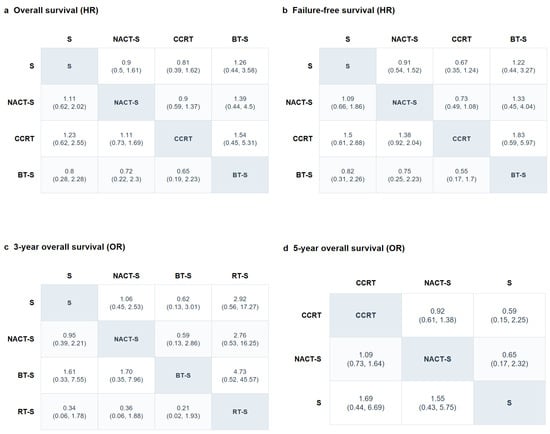
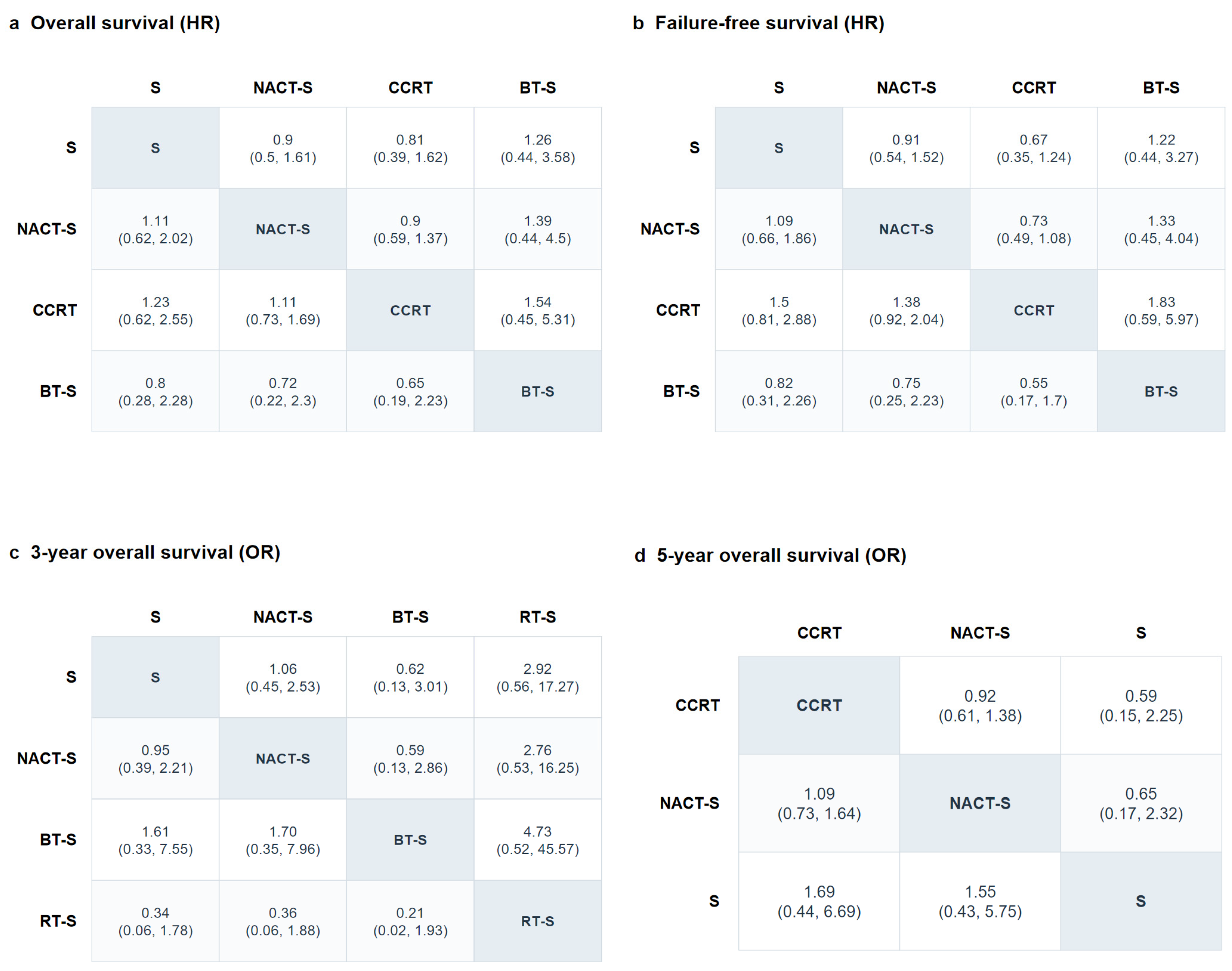
The network meta-analysis of overall survival (Figure S3a) and failure-free survival (Figure S3b) included four treatment strategies. Five studies contributed to the overall survival analysis. Compared with S, both concurrent chemoradiotherapy and neoadjuvant chemotherapy followed by radical surgery were associated with higher overall survival, but neither difference was statistically significant (HR: 0.81, 95% CrI: 0.39–1.62 for concurrent chemoradiotherapy vs. S; and HR: 0.90, 95% CrI: 0.50–1.61 for neoadjuvant chemotherapy followed by radical surgery vs. S). In contrast, compared with S, preoperative brachytherapy followed by surgery was associated with lower overall survival, although this difference was also not statistically significant (HR: 1.26, 95% CrI: 0.44–3.58) (Figure 1).
Figure 1.
League tables for overall survival, failure-free survival, and fixed-time (3- and 5-year) overall survival. (a) Overall survival (hazard ratio); (b) failure-free survival (hazard ratio); (c) 3-year overall survival (odds ratio); and (d) 5-year overall survival (odds ratio). In each panel, the cell at the intersection of a row and a column shows the effect of the column-defining treatment relative to the row-defining treatment, with 95% credible intervals; the lower-left triangle mirrors the upper-right triangle and shows the reciprocal comparisons. Only treatments contributing data to a given outcome are displayed, so the panels differ in size. Treatment coding and numerical estimates follow the original analysis outputs. CCRT denotes concurrent chemoradiotherapy; NACT-S, neoadjuvant chemotherapy followed by surgery; S, surgery alone; BT-S, preoperative brachytherapy followed by surgery; and RT-S, preoperative radiotherapy followed by surgery.
The network meta-analysis included data on 3-year overall survival for four treatment strategies (Figure S3c), 5-year overall survival for three (Figure S3d), 3-year disease-free survival for four (Figure S4a), 5-year disease-free survival for three (Figure S4b), and deep cervical stromal invasion for three (Figure S4c).
Five studies reported 3-year overall survival. Compared with S, preoperative radiotherapy followed by surgery showed no significant difference in 3-year overall survival (OR: 2.92, 95% CrI: 0.56–17.27). Three studies reported 5-year overall survival. Compared with S, both concurrent chemoradiotherapy and neoadjuvant chemotherapy followed by radical surgery were associated with a nonsignificant increase in 5-year overall survival (OR: 1.69, 95% CrI: 0.44–6.69 for concurrent chemoradiotherapy vs. S; and OR: 1.55, 95% CrI: 0.43–5.57 for neoadjuvant chemotherapy followed by radical surgery vs. S) (Figure 1).
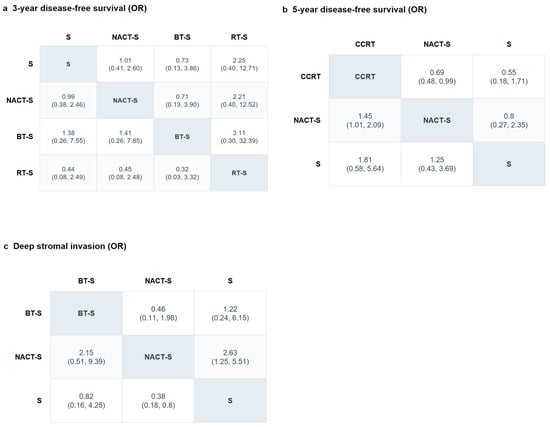
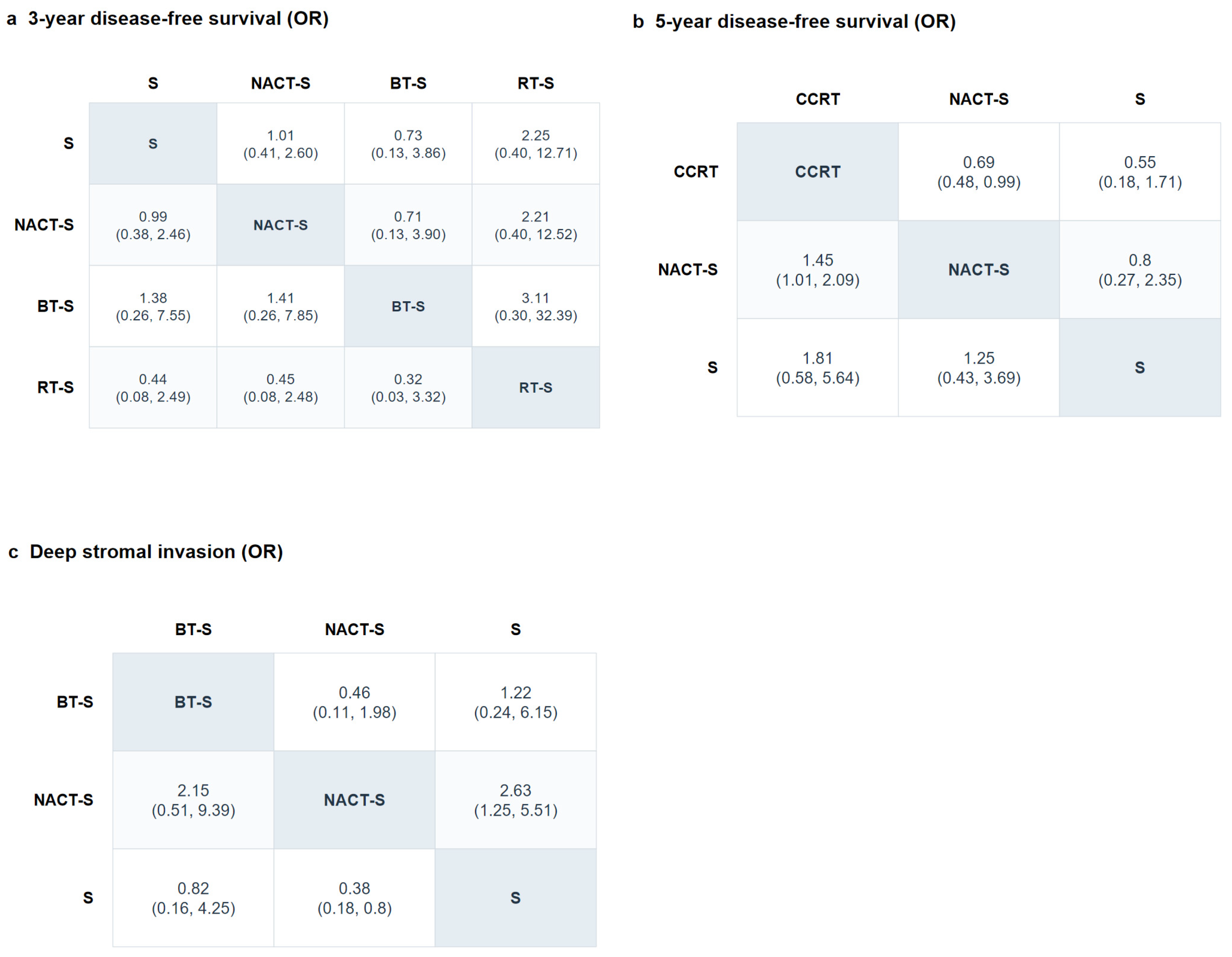
Four studies reported 3-year disease-free survival. Compared with S, preoperative radiotherapy followed by surgery showed no significant difference in 3-year disease-free survival (OR: 2.25, 95% CrI: 0.40–12.71), whereas neoadjuvant chemotherapy followed by radical surgery showed no significant difference (OR: 1.01, 95% CrI: 0.41–2.60 vs. S) and preoperative brachytherapy followed by surgery was associated with a nonsignificant reduction (OR: 0.73, 95% CrI: 0.13–3.86 vs. S) in 3-year disease-free survival. Three studies reported 5-year disease-free survival. Compared with S, neoadjuvant chemotherapy followed by radical surgery and concurrent chemoradiotherapy were associated with nonsignificant increases in 5-year disease-free survival (OR: 1.25, 95% CrI: 0.43–3.69 for neoadjuvant chemotherapy followed by radical surgery vs. S; and OR: 1.81, 95% CrI: 0.58–5.64 for concurrent chemoradiotherapy vs. S). Compared with neoadjuvant chemotherapy followed by radical surgery, concurrent chemoradiotherapy was associated with a significantly increased 5-year disease-free survival (OR: 1.45, 95% CrI: 1.01–2.09). Four studies reported deep cervical stromal invasion. Compared with S, neoadjuvant chemotherapy followed by radical surgery was associated with a significantly lower proportion of patients with deep cervical stromal invasion (OR: 0.38, 95% CrI: 0.18–0.80), whereas preoperative brachytherapy followed by surgery was associated with a nonsignificant reduction in the proportion with deep cervical stromal invasion (OR: 0.82, 95% CrI: 0.16–4.25) (Figure 2). The forest plots are shown in Figures S5 and S6.
Figure 2.
League tables for the secondary outcomes. (a) The 3-year disease-free survival (odds ratio); (b) 5-year disease-free survival (odds ratio); and (c) deep cervical stromal invasion (odds ratio), defined as tumor involvement of at least two-thirds of the cervical stroma. In each panel, the cell at the intersection of a row and a column shows the effect of the column-defining treatment relative to the row-defining treatment, with 95% credible intervals; the lower-left triangle mirrors the upper-right triangle and shows the reciprocal comparisons. For deep stromal invasion, an odds ratio above 1 indicates a higher proportion of patients with deep invasion. Only treatments contributing data to a given outcome are displayed, so the panels differ in size. Treatment coding and numerical estimates follow the original analysis outputs. CCRT denotes concurrent chemoradiotherapy; NACT-S, neoadjuvant chemotherapy followed by surgery; S, surgery alone; BT-S, preoperative brachytherapy followed by surgery; and RT-S, preoperative radiotherapy followed by surgery.
The network was sparse (Figure S7). Concurrent chemoradiotherapy appeared in two trials, both of which used neoadjuvant chemotherapy followed by radical surgery as the comparator (Gupta 2018; Kenter 2023) [13,14]; no trial compared it directly with surgery alone or with surgery preceded by radiotherapy. Every estimate comparing concurrent chemoradiotherapy with a surgery-based strategy other than neoadjuvant chemotherapy followed by radical surgery was therefore derived entirely by indirect comparison, with neoadjuvant chemotherapy followed by radical surgery as the sole bridging node (Figures S3 and S4 and Table S3). Because no closed loop connected the chemoradiotherapy and surgery-based nodes, the agreement between direct and indirect evidence could not be tested for these comparisons. The overall survival hazard ratio for concurrent chemoradiotherapy vs. surgery alone was 0.81 (95% CrI 0.39–1.62); this value is the product of the two contributing links, and its interval included no difference (Table S3).
3.4. Treatment Rankings
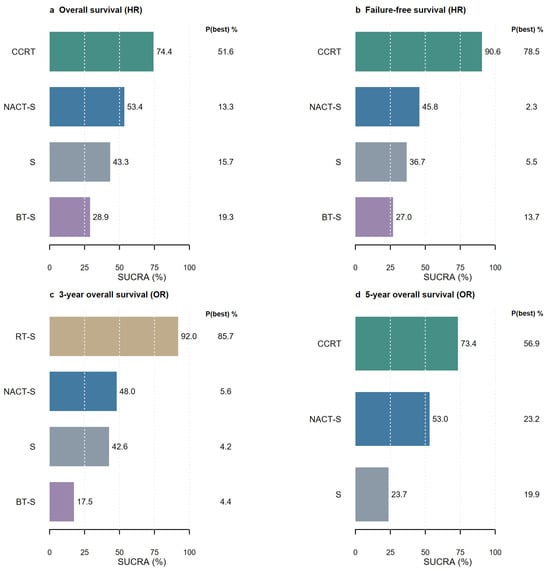
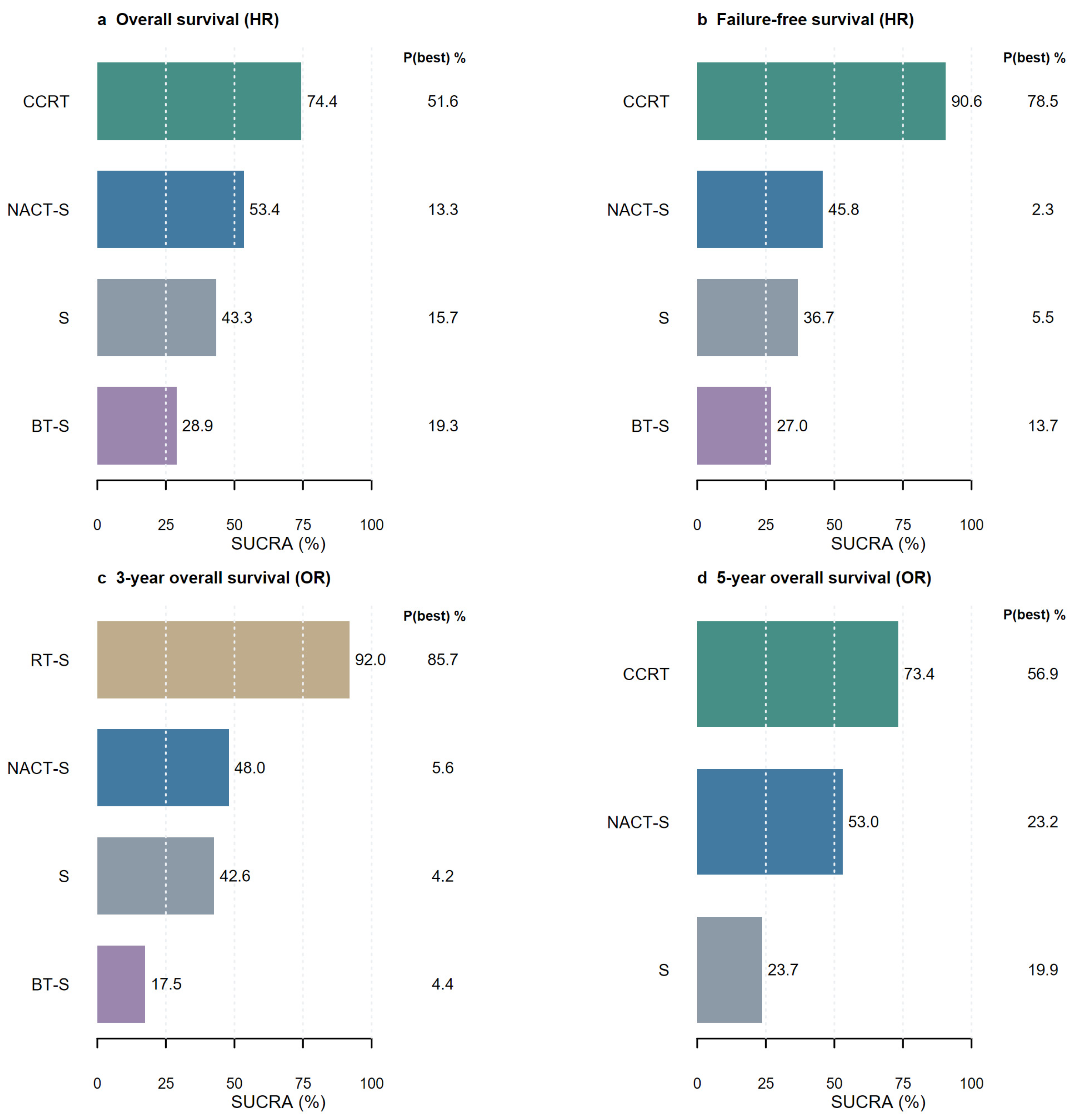
According to the Bayesian ranking analysis, concurrent chemoradiotherapy ranked first for overall survival (51.6% probability), and neoadjuvant chemotherapy followed by radical surgery ranked second (46.4% probability) (Figure 3 and Figure S8). Similarly, concurrent chemoradiotherapy ranked first for failure-free survival (78.5% probability) (Figure 3 and Figure S9). For 3-year overall survival, preoperative radiotherapy followed by surgery ranked first (85.7% probability) (Figure 3 and Figure S10). For 5-year overall survival, concurrent chemoradiotherapy ranked first (56.9% probability) (Figure 3 and Figure S11). Ranking probabilities summarize the distribution of probable ranks and do not by themselves quantify the magnitude of a treatment difference. All ranking results should therefore be read together with the relative-effect estimates and their credible intervals, and none of the differences reported in this section is large enough to establish statistical separation between the leading treatments.
Figure 3.
Ranking of treatments for the survival outcomes. (a) Overall survival; (b) failure-free survival; (c) 3-year overall survival; and (d) 5-year overall survival. Bar length shows the surface under the cumulative ranking curve (SUCRA, %); the white dashed line within each bar marks the probability of being the best treatment, P(best), on the same 0–100 scale, and P(best) is also given numerically in the right-hand column. SUCRA summarizes the whole cumulative ranking distribution, whereas P(best) refers to rank 1 only; the two are therefore not interchangeable. Treatments are ordered by SUCRA within each panel, and only treatments contributing data to that outcome are displayed. Rankings describe the probability of occupying a given rank under the original model and outcome direction; they do not quantify the magnitude of benefit or establish a credible difference between treatments and should be read together with the relative-effect estimates and their 95% credible intervals. CCRT denotes concurrent chemoradiotherapy; NACT-S, neoadjuvant chemotherapy followed by surgery; S, surgery alone; BT-S, preoperative brachytherapy followed by surgery; and RT-S, preoperative radiotherapy followed by surgery.
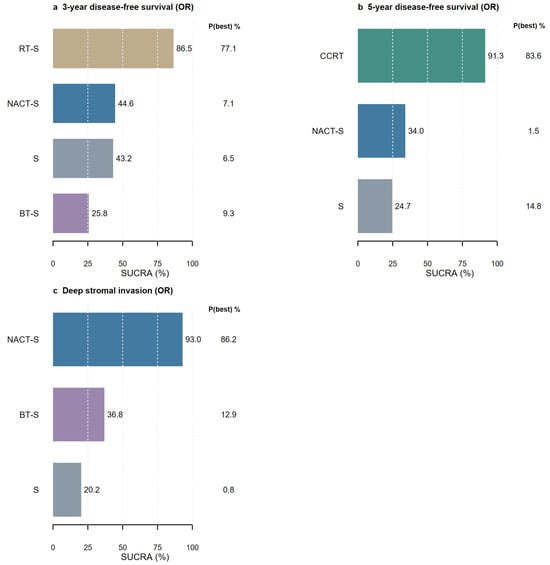
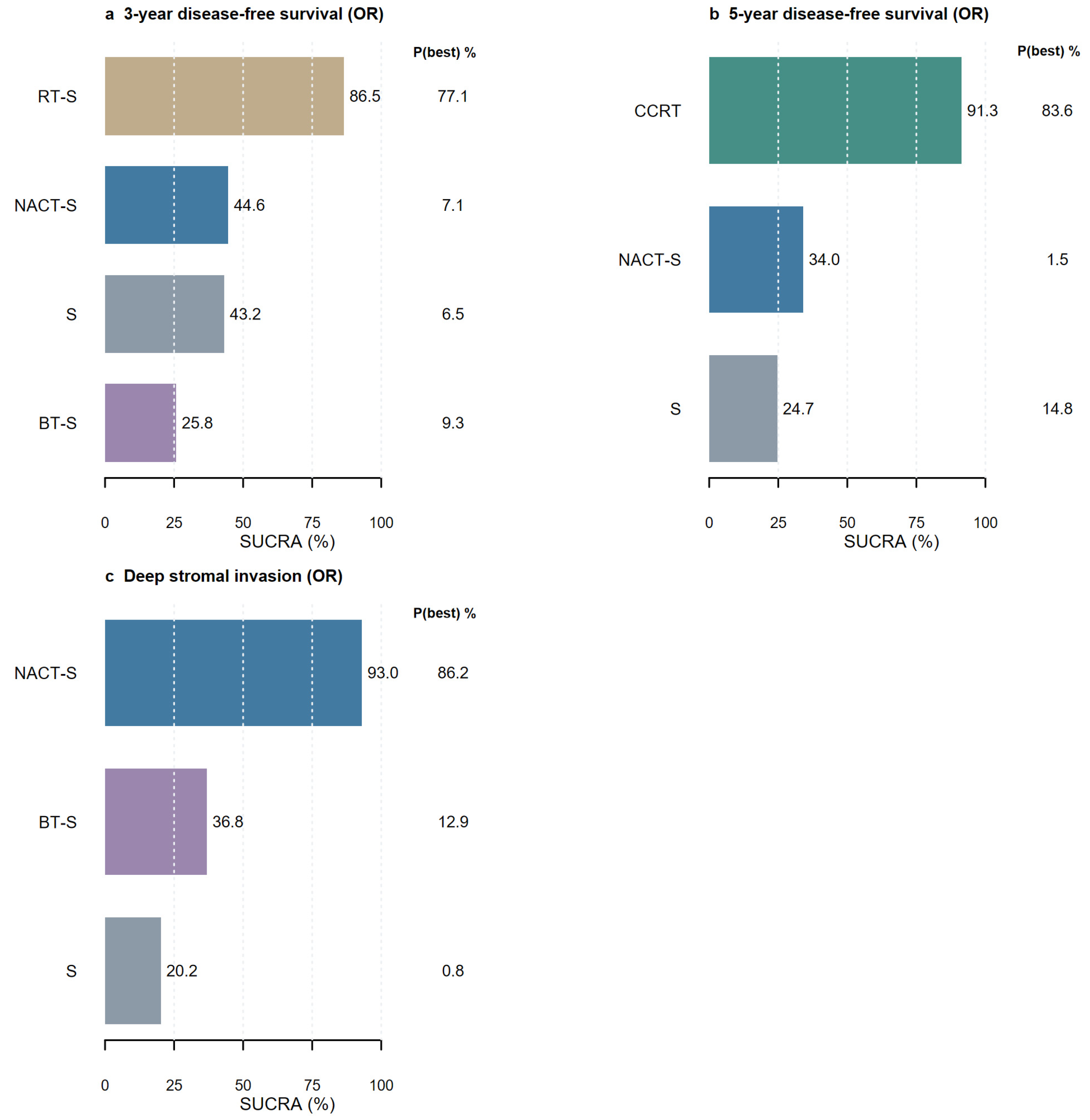
For 3-year disease-free survival, preoperative radiotherapy followed by surgery ranked first (77.1% probability) (Figure 4 and Figure S12). For 5-year disease-free survival, concurrent chemoradiotherapy ranked first (83.6% probability) (Figure 4 and Figure S13). For prevention of deep cervical stromal invasion, neoadjuvant chemotherapy followed by radical surgery ranked first (86.2% probability) (Figure 4 and Figure S14).
Figure 4.
Ranking of treatments for the secondary outcomes. (a) The 3-year disease-free survival; (b) 5-year disease-free survival; and (c) deep cervical stromal invasion, defined as tumor involvement of at least two-thirds of the cervical stroma. Bar length shows the surface under the cumulative ranking curve (SUCRA, %); the white dashed line within each bar marks the probability of being the best treatment, P(best), on the same 0–100 scale, and P(best) is also given numerically in the right-hand column. SUCRA summarizes the whole cumulative ranking distribution, whereas P(best) refers to rank 1 only; the two are therefore not interchangeable. Rankings are defined in the favorable direction of each outcome so that a higher SUCRA indicates a better rank, namely the lowest odds ratio in each panel. Treatments are ordered by SUCRA within each panel, and only treatments contributing data to that outcome are displayed. Rankings do not quantify the magnitude of benefit or establish a credible difference between treatments and should be read together with the relative-effect estimates and their 95% credible intervals. CCRT denotes concurrent chemoradiotherapy; NACT-S, neoadjuvant chemotherapy followed by surgery; S, surgery alone; BT-S, preoperative brachytherapy followed by surgery; and RT-S, preoperative radiotherapy followed by surgery.
3.5. Convergence, Consistency, Heterogeneity, and Sensitivity Analyses
All Markov chains showed good stability and reproducibility, indicating model convergence (Figures S15–S28).
Four trials included FIGO stage IIB disease, whereas three restricted eligibility to IB2–IIA/IIA2. Stage-specific proportions, histological distributions and detailed treatment protocols were not consistently recorded in the compiled dataset, so the balance of potential effect modifiers could not be established and transitivity remains uncertain. The I2 values of the consistency models ranged from 0% to 14%. Absolute DIC differences between consistency and inconsistency models ranged from 0.00 to 0.89, and between random-effects and fixed-effects models from 0.00 to 1.69. These findings indicate similar model fit but do not prove transitivity or robustness of effects and rankings. A parameter-wise numerical summary of convergence was not available for the primary models. Model-fit statistics for the consistency, inconsistency, random-effects, and fixed-effects models, together with the corresponding absolute DIC differences, are reported in Table S4.
After exclusion of the four trials rated as having some concerns, only Gupta 2018 [13] contributed an HR to the OS and FFS analyses, so the CCRT-vs.-S comparison and the complete-network rankings could not be estimated. The NACT-S-vs.-CCRT HR was 1.03 (95% CI 0.75–1.40) for OS and 1.38 (1.02–1.87) for FFS. In the two-trial restricted networks, the OR for NACT-S vs. S was 0.90 (95% CrI 0.16–4.74) for 3-year OS and 0.75 (95% CrI 0.14–3.88) for 3-year DFS; both intervals included 1. In the restricted three-treatment networks, RT-S retained the highest SUCRA (85.5% for 3-year OS and 81.9% for 3-year DFS), but all estimates rested on two trials and every interval included 1; complete-network rankings could not be re-estimated for OS or FFS because only one trial remained. The robustness of the complete-network rankings was therefore not established (Tables S5–S7 and Figure S29).
The NACT-S vs. S estimates for the fixed-time outcomes were insensitive to the specification of between-study heterogeneity and to the choice of random-effects or fixed-effects models (Table S7). For 3-year overall survival, the odds ratio was 1.06 (95% CrI 0.45–2.53) with τ ~ U(0, 2), 1.05 (0.52–2.13) with τ ~ U(0, 1), and 1.06 (0.62–1.81) under a fixed-effects model; for 3-year disease-free survival, the corresponding estimates were 1.01 (0.41–2.60), 1.02 (0.49–2.14) and 1.00 (0.58–1.71). Changing the heterogeneity prior therefore left the point estimates essentially unchanged, whereas the fixed-effects assumption narrowed the credible intervals without changing their direction or the inclusion of 1. Restriction to trials at low risk of bias moved the point estimates toward surgery (3-year overall survival OR 0.90, 95% CrI 0.16–4.74; 3-year disease-free survival OR 0.75, 0.14–3.88), but the intervals were very wide and included 1 under every model, so this subset provides no evidence of a difference in either direction. Convergence was adequate for all twelve models (maximum R-hat, 1.0006; minimum effective sample size, 7935), and DIC was numerically lowest for the fixed-effects models in all four strata, although no difference exceeded 1.7, so none indicates a meaningful difference in fit (Table S8).
4. Discussion
To our knowledge, this is the first Bayesian network meta-analysis to compare and rank five multimodal treatment strategies for FIGO stage IB2–IIB locally advanced cervical cancer. No strategy showed a clear advantage for overall survival. Both the comparison between concurrent chemoradiotherapy and surgery alone, which was derived entirely by indirect comparison, and that between neoadjuvant chemotherapy followed by radical surgery and surgery alone yielded credible intervals that included no difference. Two comparisons did yield intervals that excluded no difference: 5-year disease-free survival favored concurrent chemoradiotherapy over neoadjuvant chemotherapy followed by radical surgery, and deep cervical stromal invasion was less frequent after neoadjuvant chemotherapy followed by radical surgery than after surgery alone. Both rest on few trials, the latter is a pathological surrogate rather than a survival endpoint, and neither supports a claim of superiority for overall survival.
Our deliberate focus on FIGO stage IB2–IIB disease addresses the range in which management is most contested: tumors have grown beyond the point at which surgery alone is adequate, yet have not reached the stage at which definitive chemoradiation is the unequivocal choice [10]. Within this range our findings suggest that concurrent chemoradiotherapy and neoadjuvant chemotherapy followed by radical surgery may offer comparable overall survival, and we do not identify either as a preferred strategy. Neoadjuvant chemotherapy followed by radical surgery was associated with a lower proportion of patients with deep stromal invasion, defined as invasion of the outer third of the cervical stroma (≥2/3 of its depth), than surgery alone, but this pathological difference was not accompanied by a survival advantage. Deep stromal invasion is a recognized prognostic factor and one of the Sedlis criteria used to select patients for adjuvant radiotherapy after radical hysterectomy [32,33], which is why it was included as a secondary outcome; it is nonetheless a pathological intermediate endpoint rather than a patient-important outcome, and the estimate rested on a small number of trials [34]. We speculate that cytoreduction of the primary tumor does not by itself address micrometastatic disease, which would be consistent with the current practice of tailoring adjuvant (chemo)radiation to postoperative pathological risk factors [34]. This interpretation is not established by the present analysis.
The higher ranking of concurrent chemoradiotherapy for overall survival and failure-free survival is consistent with its established role in major international guidelines [35,36], and the biological rationale, namely radiosensitization for local control together with a systemic effect against micrometastatic disease, is well described [10]. We emphasize, however, that ranking probabilities summarize the ranking distribution and do not quantify the magnitude of benefit: for overall survival the two leading treatments were separated by only a narrow margin, and every survival estimate had a credible interval that included no difference. We therefore do not read these rankings as evidence that one strategy is superior. The lower rankings of surgery alone, preoperative brachytherapy followed by surgery and preoperative radiotherapy followed by surgery should be interpreted with particular caution, because these nodes are sparsely connected and their estimates rest largely on indirect evidence.
The geometry of the network limits how far these comparative estimates can be taken. The direct comparison that anchors the bridging node was itself close to the null for overall survival. Because the indirect estimate is obtained as the product of the two links, its uncertainty is compounded rather than reduced, which is why the interval around the concurrent chemoradiotherapy vs. surgery alone estimate spanned no difference despite a point estimate below unity. We therefore present this estimate as a description of what the randomized evidence implies, not as evidence of superiority. The clearest implication concerns trial design: a randomized comparison of concurrent chemoradiotherapy with primary surgery in FIGO stage IB2–IIB disease remains the single most informative missing study.
The therapeutic landscape is evolving rapidly with the integration of immunotherapy, which could affect the future management of locally advanced cervical cancer. Pioneering studies are now combining immune checkpoint inhibitors with both concurrent chemoradiotherapy and neoadjuvant chemotherapy followed by radical surgery. The landmark KEYNOTE-A18 trial demonstrated that, in patients with high-risk locally advanced cervical cancer, adding pembrolizumab to concurrent chemoradiotherapy significantly improved progression-free survival and overall survival compared with concurrent chemoradiotherapy alone, establishing a potential new standard of care [37]. However, the contrasting results of the CALLA trial, in which durvalumab did not improve progression-free survival when added to concurrent chemoradiotherapy, highlight the complexity of integrating immunotherapy and the need for biomarker-driven patient selection [38]. Concurrently, neoadjuvant immunochemotherapy is emerging as a distinct therapeutic approach, with phase II trials in patients with stage IB3–IIA2 locally advanced cervical cancer reporting high rates of pathological complete response with tislelizumab plus chemotherapy [39] and substantial pathological response with camrelizumab-based regimens [40]. Collectively, these trials suggest that neoadjuvant immunochemotherapy is a promising strategy. A central question for future research is not a binary choice between concurrent chemoradiotherapy and neoadjuvant chemotherapy followed by radical surgery, but how best to integrate novel systemic agents with established locoregional modalities to maximize the therapeutic effect while minimizing treatment-related toxicity. By comparing the effectiveness of conventional strategies, our analysis provides a benchmark against which such combinatorial regimens should be evaluated.
One recent randomized trial deserves comment even though it could not be incorporated into the present network. In the INTERLACE trial, induction chemotherapy before standard chemoradiotherapy improved 5-year overall survival and progression-free survival compared with chemoradiotherapy alone, at the cost of a higher rate of grade ≥ 3 adverse events [41]. INTERLACE differs from the trials contributing to our neoadjuvant chemotherapy followed by surgery node in one important respect: the local treatment in both arms was radiotherapy, not surgery. Taken together, these observations suggest that the survival benefit of induction chemotherapy may depend on the modality of the subsequent local treatment. This may help explain why, in our analysis, neoadjuvant chemotherapy followed by surgery produced pathological downstaging without a demonstrable overall-survival benefit, and it supports regarding induction chemotherapy followed by chemoradiotherapy as a distinct strategy, not as evidence for or against surgery-based approaches.
This study has several limitations. The number of eligible randomized trials and the total number of patients were modest, limiting the statistical power of pairwise comparisons, and the included studies were clinically heterogeneous in their chemotherapy regimens, radiotherapy techniques, and surgical approaches. Five of the seven trials were conducted in East Asia (four in China and one in Japan), one in India and one in Europe; the predominance of Asian centers may limit the generalizability of our findings to other populations, in which differences in human papillomavirus type distribution, screening intensity and access to radiotherapy may modify treatment effects. As with all network meta-analyses, our findings rely on the assumption of transitivity, and although strict inclusion criteria were applied, the balance of potential effect modifiers could not be established because stage substructure, histology and treatment details were not consistently reported. Finally, as reported in Section 2.1, safety was specified as a secondary outcome in the registered protocol, but because toxicity reporting was inconsistent and only one trial reported grade ≥ 3 adverse events, no safety outcome could be analyzed. For the same reason, quality of life could not be evaluated. Publication bias could not be formally assessed because of the small number of eligible studies.
The evidence network also contained structural gaps, which are themselves a limitation. The comparison between concurrent chemoradiotherapy and surgery alone rested entirely on indirect evidence and depended on the comparability of the trials connected through neoadjuvant chemotherapy followed by surgery. No closed loop involved the CCRT node, so the agreement between direct and indirect evidence could not be tested for any comparison involving it; the closed loops among the surgery-based nodes (NACT-S, S, and RT-S) were assessed by comparing consistency and inconsistency models, and all DIC differences were 0.89 or less, indicating no material inconsistency (Table S4). These structural features, rather than the precision of any single estimate, constitute the principal limitation of this review and preclude firm conclusions about the relative merit of the two treatment paradigms; treatment rankings should therefore be read together with the credible intervals and with the uncertainty about transitivity, rather than as proof of comparative superiority.
The included trials did not use a single edition of the FIGO classification: four applied the 1994 edition and three the 2009 edition. Because the two editions define stage IB2 (a tumor larger than 4 cm) and stage IIB (parametrial invasion that has not reached the pelvic wall) identically, we did not consider this a source of clinically meaningful heterogeneity, and the size of the network did not permit a sensitivity analysis restricted to a single edition. More importantly, under the 2018 revision stage IB2 is restricted to tumors of 2 to 4 cm and tumors of 4 cm or larger are classified as stage IB3 [3], so the population studied here would largely be reclassified as stage IB3 to IIB. Our findings therefore apply to bulky stage IB to IIB disease as defined by pre-2018 criteria and should not be extrapolated to the narrower stage IB2 category of the 2018 classification.
These findings have implications for clinical decision-making, although they must be interpreted in light of the strength of the available evidence. When long-term survival is the priority, no single strategy emerged as clearly superior: concurrent chemoradiotherapy and neoadjuvant chemotherapy followed by surgery produced similar overall survival, and the comparison between concurrent chemoradiotherapy and surgery alone rested entirely on indirect evidence. Concurrent chemoradiotherapy therefore remains a widely used and reasonable first-line option, but the present analysis does not provide statistical grounds for preferring it to the alternatives. Neoadjuvant chemotherapy followed by radical surgery remains an appropriate alternative where radiotherapy is contraindicated or where preservation of ovarian function is a priority, acknowledging that it may entail a multimodal pathway including adjuvant therapy. The 5-year disease-free survival advantage of concurrent chemoradiotherapy over neoadjuvant chemotherapy followed by radical surgery was derived from a limited number of trials and should be regarded as hypothesis-generating rather than definitive. Because restricting the analysis to trials at low risk of bias left the overall survival and failure-free survival rankings unestimable, and the remaining 3-year estimates rested on only two trials with intervals that all included no difference, the robustness of the rankings could not be established. These findings should therefore not be translated into ranking-based recommendations.
5. Conclusions
In this network meta-analysis of seven randomized trials of 1936 patients with FIGO stage IB2–IIB locally advanced cervical cancer, no treatment strategy demonstrated a clear overall-survival advantage over the others. The comparison between concurrent chemoradiotherapy and surgery alone rested entirely on indirect evidence through neoadjuvant chemotherapy followed by surgery, and its credible interval included no difference; when the analysis was restricted to trials at low risk of bias, only single-trial estimates remained for overall and failure-free survival and the complete-network rankings could not be re-estimated. The apparent disease-free survival benefit of concurrent chemoradiotherapy over neoadjuvant chemotherapy followed by surgery was derived from few trials and should be regarded as hypothesis-generating. These findings do not support ranking-based treatment recommendations and identify the absence of direct randomized comparisons between chemoradiotherapy and surgery-based strategies as the principal gap requiring a head-to-head trial.
Supplementary Materials
The following supporting information can be downloaded at https://www.mdpi.com/article/10.3390/cancers18233799/s1. Figure S1: The PRISMA flow diagram; Figure S2: Risk of bias summary for included randomized controlled trials; Figure S3: Outcome-specific networks based on the original analysis arm denominators. Node area represents sample size and line width represents trial count. Solid lines represent direct comparisons; CCRT versus S is entirely indirect. (a) overall survival; (b) failure-free survival; (c) 3-year overall survival; (d) 5-year overall survival; Figure S4: Outcome-specific networks based on the original analysis arm denominators. Node area represents sample size and line width represents trial count. Solid lines represent direct comparisons; CCRT versus S is entirely indirect. (a) 3-year disease-free survival; (b) 5-year disease-free survival; (c) deep cervical stromal invasion; Figure S5: Forest plots for overall survival and failure-free survival: Bayesian network estimates versus surgery alone (S). Hazard ratios below 1 favour the experimental treatment; Figure S6: Forest plots for 3-year and 5-year overall survival and disease-free survival, and for deep cervical stromal invasion: Bayesian network estimates versus surgery alone (S). Odds ratios greater than 1 favour the experimental treatment; Figure S7: Study-level network using the original treatment coding and recorded arm denominators. Node area is proportional to sample size; line width and k indicate the number of trials evaluating each direct comparison. No CCRT–S trial is present. The overview groups the recorded intra-arterial and intravenous NACT arms for descriptive node weighting only; outcome-specific networks use their original analysis inputs; Figure S8: Rank probabilities for overall survival, derived from the primary model. Ranks are defined in the favourable direction of the outcome, so that rank 1 corresponds to the treatment with the highest probability of being the most effective; Figure S9: Rank probabilities for failure-free survival, derived from the primary model. Ranks are defined in the favourable direction of the outcome, so that rank 1 corresponds to the treatment with the highest probability of being the most effective; Figure S10: Rank probabilities for 3-year overall survival, derived from the primary model. Ranks are defined in the favourable direction of the outcome, so that rank 1 corresponds to the treatment with the highest probability of being the most effective; Figure S11: Rank probabilities for 5-year overall survival, derived from the primary model. Ranks are defined in the favourable direction of the outcome, so that rank 1 corresponds to the treatment with the highest probability of being the most effective; Figure S12: Rank probabilities for 3-year disease-free survival, derived from the primary model. Ranks are defined in the favourable direction of the outcome, so that rank 1 corresponds to the treatment with the highest probability of being the most effective; Figure S13: Rank probabilities for 5-year disease-free survival, derived from the primary model. Ranks are defined in the favourable direction of the outcome, so that rank 1 corresponds to the treatment with the highest probability of being the most effective; Figure S14: Rank probabilities for deep cervical stromal invasion, derived from the primary model. Ranks are defined in the favourable direction of the outcome, so that rank 1 corresponds to the treatment with the highest probability of being the most effective; Figure S15: Trace and density plot for OS; Figure S16: Trace and density plot for FFS; Figure S17: Trace and density plot for 3-year OS; Figure S18: Trace and density plot for 5-year OS; Figure S19: Trace and density plot for 3-year DFS; Figure S20: Trace and density plot for 5-year DFS; Figure S21: Trace and density plot for deep cervical stromal invasion ≥ 2/3; Figure S22: Convergence plot for OS; Figure S23: Convergence plot for FFS; Figure S24: Convergence plot for 3-year OS; Figure S25: Convergence plot for 5-year OS; Figure S26: Convergence plot for 3-year DFS; Figure S27: Convergence plot for 5-year DFS; Figure S28: Convergence plot for deep cervical stromal invasion ≥ 2/3; Figure S29: Effects available after risk-of-bias restriction. Three-year OS and DFS are network estimates with 95% CrIs; other rows are single-trial effects with 95% CIs. Table S1: PRISMA NMA checklist of items to include when reporting a systematic review involving a network meta-analysis; Table S2: The Literature Search Strategy; Table S3: Evidence supporting the CCRT-versus-S comparison; Table S4: Summary of DIC differences between model specifications (consistency versus inconsistency; random-effects versus fixed-effects); Table S5: Risk-of-bias sensitivity using the original extraction dataset; Table S6: Conditional ranking summaries in the restricted three-node networks; Table S7: Sensitivity of the NACT-S versus S estimates to the heterogeneity prior, the choice of random- or fixed-effects, and restriction to trials at low risk of bias; Table S8: Convergence and model-fit diagnostics for the sensitivity models in Table S7.
Author Contributions
S.C. and S.W. conceived and designed the study, performed the systematic literature search, extracted and verified data, conducted the Bayesian network meta-analysis, and drafted the initial manuscript. J.Z. and T.G. participated in the literature screening, quality assessment, and data interpretation, and critically revised the manuscript for important intellectual content. L.B. and Y.L. assisted with statistical analyses, result visualization, and manuscript editing. Z.H. provided methodological guidance and technical support for the network meta-analysis. G.Y. supervised the entire project, acquired funding, coordinated the collaboration, and reviewed and approved the final manuscript. All authors have read and agreed to the published version of the manuscript.
Funding
This work was supported by grants from CAMS Innovation Fund for Medical Sciences (No. 2024-I2M-C&T-B-058).
Institutional Review Board Statement
Not applicable (this study was a systematic review and network meta-analysis of published data).
Informed Consent Statement
Not applicable.
Data Availability Statement
All data generated or analyzed during this study are included in this published article and its Supplementary Information Files.
Conflicts of Interest
The authors declare no conflicts of interest.
Abbreviations
The following abbreviations are used in this manuscript:
| BT | brachytherapy |
| BT-S | brachytherapy followed by surgery |
| CCRT | concurrent chemoradiotherapy |
| CENTRAL | Cochrane Central Register of Controlled Trials |
| CI | confidence interval |
| CrI | credible interval |
| DFS | disease-free survival |
| EORTC | European Organisation for Research and Treatment of Cancer |
| FFS | failure-free survival |
| FIGO | International Federation of Gynecology and Obstetrics |
| HR | hazard ratio |
| IACT | intra-arterial chemotherapy |
| IVCT | intravenous chemotherapy |
| MCMC | Markov chain Monte Carlo |
| MeSH | Medical Subject Headings |
| NACT-S | neoadjuvant chemotherapy followed by surgery |
| OR | odds ratio |
References
- Sahasrabuddhe, V.V. Cervical Cancer: Precursors and Prevention. Hematol. Oncol. Clin. North Am. 2024, 38, 771–781. [Google Scholar] [CrossRef] [Scilit] [PubMed]
- Bray, F.; Laversanne, M.; Sung, H.; Ferlay, J.; Siegel, R.L.; Soerjomataram, I.; Jemal, A. Global cancer statistics 2022: GLOBOCAN estimates of incidence and mortality worldwide for 36 cancers in 185 countries. CA Cancer J. Clin. 2024, 74, 229–263. [Google Scholar] [CrossRef] [Scilit] [PubMed]
- Soares, L.C.; de Souza, R.J.; Oliveira, M.A.P. Reviewing FIGO 2018 cervical cancer staging. Acta Obstet. Gynecol. Scand 2023, 102, 1757–1758. [Google Scholar] [CrossRef] [Scilit] [PubMed]
- Bhatla, N.; Aoki, D.; Sharma, D.N.; Sankaranarayanan, R. Cancer of the cervix uteri: 2025 update. Int. J. Gynaecol. Obstet. 2025, 171, 87–108. [Google Scholar] [CrossRef] [Scilit] [PubMed]
- Koh, W.J.; Abu-Rustum, N.R.; Bean, S.; Bradley, K.; Campos, S.M.; Cho, K.R.; Chon, H.S.; Chu, C.; Clark, R.; Cohn, D.; et al. Cervical Cancer, Version 3.2019, NCCN Clinical Practice Guidelines in Oncology. J. Natl. Compr. Canc. Netw. 2019, 17, 64–84. [Google Scholar] [CrossRef] [Scilit] [PubMed]
- Matsuzaki, S.; Klar, M.; Mikami, M.; Shimada, M.; Grubbs, B.H.; Fujiwara, K.; Roman, L.D.; Matsuo, K. Management of Stage IIB Cervical Cancer: An Overview of the Current Evidence. Curr. Oncol. Rep. 2020, 22, 28. [Google Scholar] [CrossRef] [Scilit] [PubMed]
- Keys, H.M.; Bundy, B.N.; Stehman, F.B.; Muderspach, L.I.; Chafe, W.E.; Suggs, C.L., 3rd; Walker, J.L.; Gersell, D. Cisplatin, radiation, and adjuvant hysterectomy compared with radiation and adjuvant hysterectomy for bulky stage IB cervical carcinoma. N. Engl. J. Med. 1999, 340, 1154–1161. [Google Scholar] [CrossRef] [Scilit] [PubMed]
- Morris, M.; Eifel, P.J.; Lu, J.; Grigsby, P.W.; Levenback, C.; Stevens, R.E.; Rotman, M.; Gershenson, D.M.; Mutch, D.G. Pelvic radiation with concurrent chemotherapy compared with pelvic and para-aortic radiation for high-risk cervical cancer. N. Engl. J. Med. 1999, 340, 1137–1143. [Google Scholar] [CrossRef] [Scilit] [PubMed]
- Chemoradiotherapy for Cervical Cancer Meta-Analysis, C. Reducing uncertainties about the effects of chemoradiotherapy for cervical cancer: A systematic review and meta-analysis of individual patient data from 18 randomized trials. J. Clin. Oncol. 2008, 26, 5802–5812. [Google Scholar] [CrossRef] [Scilit] [PubMed]
- Minig, L.; Patrono, M.G.; Romero, N.; Rodriguez Moreno, J.F.; Garcia-Donas, J. Different strategies of treatment for uterine cervical carcinoma stage IB2-IIB. World J. Clin. Oncol. 2014, 5, 86–92. [Google Scholar] [CrossRef] [Scilit] [PubMed]
- Rydzewska, L.; Tierney, J.; Vale, C.L.; Symonds, P.R. Neoadjuvant chemotherapy plus surgery versus surgery for cervical cancer. Cochrane. Database Syst. Rev. 2010, 12, CD007406. [Google Scholar] [CrossRef] [Scilit] [PubMed]
- Salman, L.; Covens, A. Fertility Preservation in Cervical Cancer-Treatment Strategies and Indications. Curr. Oncol. 2024, 31, 296–306. [Google Scholar] [CrossRef] [Scilit] [PubMed]
- Gupta, S.; Maheshwari, A.; Parab, P.; Mahantshetty, U.; Hawaldar, R.; Sastri Chopra, S.; Kerkar, R.; Engineer, R.; Tongaonkar, H.; Ghosh, J.; et al. Neoadjuvant Chemotherapy Followed by Radical Surgery Versus Concomitant Chemotherapy and Radiotherapy in Patients With Stage IB2, IIA, or IIB Squamous Cervical Cancer: A Randomized Controlled Trial. J. Clin. Oncol. 2018, 36, 1548–1555. [Google Scholar] [CrossRef] [Scilit] [PubMed]
- Kenter, G.G.; Greggi, S.; Vergote, I.; Katsaros, D.; Kobierski, J.; van Doorn, H.; Landoni, F.; van der Velden, J.; Reed, N.; Coens, C.; et al. Randomized Phase III Study Comparing Neoadjuvant Chemotherapy Followed by Surgery Versus Chemoradiation in Stage IB2-IIB Cervical Cancer: EORTC-55994. J. Clin. Oncol. 2023, 41, 5035–5043. [Google Scholar] [CrossRef] [Scilit] [PubMed]
- Sala, P.; Bogliolo, S.; Barra, F.; Fazio, A.; Maramai, M.; Cassani, C.; Gardella, B.; Babilonti, L.; Giannelli, F.; Mammoliti, S.; et al. Neoadjuvant Chemotherapy Followed by Radical Surgery versus Concurrent Chemo-Radiotherapy in the Treatment of Locally Advanced Cervical Cancer: A Multicenter Retrospective Analysis. J. Investig. Surg. 2022, 35, 308–314. [Google Scholar] [CrossRef] [Scilit] [PubMed]
- Gao, Y.; Wang, H.; Jiang, M. Comparative effectiveness of neoadjuvant chemotherapy plus surgery versus concurrent chemoradiotherapy in stages IB2 to IIB of cervical cancer: A meta-analysis. Front. Oncol. 2024, 14, 1426002. [Google Scholar] [CrossRef] [Scilit] [PubMed]
- Tonin, F.S.; Rotta, I.; Mendes, A.M.; Pontarolo, R. Network meta-analysis: A technique to gather evidence from direct and indirect comparisons. Pharm. Pract. 2017, 15, 943. [Google Scholar] [CrossRef] [Scilit] [PubMed]
- Cheng, J.; Liu, B.; Wang, B.; Long, X.; Li, Z.; Chen, R.; Wu, R.; Xu, L. Effectiveness comparisons of various therapies for FIGO stage IB2/IIA2 cervical cancer: A Bayesian network meta-analysis. BMC Cancer 2021, 21, 1078. [Google Scholar] [CrossRef] [Scilit] [PubMed]
- Hutton, B.; Salanti, G.; Caldwell, D.M.; Chaimani, A.; Schmid, C.H.; Cameron, C.; Ioannidis, J.P.; Straus, S.; Thorlund, K.; Jansen, J.P.; et al. The PRISMA extension statement for reporting of systematic reviews incorporating network meta-analyses of health care interventions: Checklist and explanations. Ann. Intern. Med. 2015, 162, 777–784. [Google Scholar] [CrossRef] [Scilit] [PubMed]
- Page, M.J.; McKenzie, J.E.; Bossuyt, P.M.; Boutron, I.; Hoffmann, T.C.; Mulrow, C.D.; Shamseer, L.; Tetzlaff, J.M.; Akl, E.A.; Brennan, S.E.; et al. The PRISMA 2020 statement: An updated guideline for reporting systematic reviews. BMJ 2021, 372, n71. [Google Scholar] [CrossRef] [Scilit] [PubMed]
- Guyot, P.; Ades, A.E.; Ouwens, M.J.; Welton, N.J. Enhanced secondary analysis of survival data: Reconstructing the data from published Kaplan-Meier survival curves. BMC Med. Res. Methodol. 2012, 12, 9. [Google Scholar] [CrossRef] [Scilit] [PubMed]
- Sterne, J.A.C.; Savovic, J.; Page, M.J.; Elbers, R.G.; Blencowe, N.S.; Boutron, I.; Cates, C.J.; Cheng, H.Y.; Corbett, M.S.; Eldridge, S.M.; et al. RoB 2: A revised tool for assessing risk of bias in randomised trials. BMJ 2019, 366, l4898. [Google Scholar] [CrossRef] [Scilit] [PubMed]
- van Valkenhoef, G.; Lu, G.; de Brock, B.; Hillege, H.; Ades, A.E.; Welton, N.J. Automating network meta-analysis. Res. Synth. Methods 2012, 3, 285–299. [Google Scholar] [CrossRef] [Scilit] [PubMed]
- Salanti, G.; Ades, A.E.; Ioannidis, J.P. Graphical methods and numerical summaries for presenting results from multiple-treatment meta-analysis: An overview and tutorial. J. Clin. Epidemiol. 2011, 64, 163–171. [Google Scholar] [CrossRef] [Scilit] [PubMed]
- Higgins, J.P.; Jackson, D.; Barrett, J.K.; Lu, G.; Ades, A.E.; White, I.R. Consistency and inconsistency in network meta-analysis: Concepts and models for multi-arm studies. Res. Synth. Methods 2012, 3, 98–110. [Google Scholar] [CrossRef] [Scilit] [PubMed]
- Chaimani, A.; Salanti, G. Using network meta-analysis to evaluate the existence of small-study effects in a network of interventions. Res. Synth. Methods 2012, 3, 161–176. [Google Scholar] [CrossRef] [Scilit] [PubMed]
- Yang, Z.; Chen, D.; Zhang, J.; Yao, D.; Gao, K.; Wang, H.; Liu, C.; Yu, J.; Li, L. The efficacy and safety of neoadjuvant chemotherapy in the treatment of locally advanced cervical cancer: A randomized multicenter study. Gynecol. Oncol. 2016, 141, 231–239. [Google Scholar] [CrossRef] [Scilit] [PubMed]
- Li, X.; Kong, W.M.; Han, C.; Yan, Z.; Zhao, H.; Zhang, W.Y.; Wang, J.D. Comparison of the clinical efficacy of different treatments based on radical surgery in stage I b2 and IIa2 cervical cancer: A prospective randomized control study. Zhonghua Fu Chan Ke Za Zhi 2016, 51, 524–529. [Google Scholar] [CrossRef] [Scilit] [PubMed]
- Katsumata, N.; Yoshikawa, H.; Kobayashi, H.; Saito, T.; Kuzuya, K.; Nakanishi, T.; Yasugi, T.; Yaegashi, N.; Yokota, H.; Kodama, S.; et al. Phase III randomised controlled trial of neoadjuvant chemotherapy plus radical surgery vs radical surgery alone for stages IB2, IIA2, and IIB cervical cancer: A Japan Clinical Oncology Group trial (JCOG 0102). Br. J. Cancer 2013, 108, 1957–1963. [Google Scholar] [CrossRef] [Scilit] [PubMed]
- Jing, H.; Xiuhong, W.; Ying, Y.; Zhenrong, L.; Xiyun, C.; Deping, L.; Changmei, S.; Qi, W.; Tao, P.; Yiyun, P. Neoadjuvant chemotherapy combined with radical surgery for stage IB2/IIA2 cervical squamous cell carcinoma: A prospective, randomized controlled study of 35 patients. World J. Surg. Oncol. 2021, 19, 209. [Google Scholar] [CrossRef] [Scilit] [PubMed]
- Wen, H.; Wu, X.; Li, Z.; Wang, H.; Zang, R.; Sun, M.; Huang, X.; Zhang, Z.; Cai, S. A prospective randomized controlled study on multiple neoadjuvant treatments for patients with stage IB2 to IIA cervical cancer. Int. J. Gynecol. Cancer 2012, 22, 296–302. [Google Scholar] [CrossRef] [Scilit] [PubMed]
- Delgado, G.; Bundy, B.; Zaino, R.; Sevin, B.U.; Creasman, W.T.; Major, F. Prospective surgical-pathological study of disease-free interval in patients with stage IB squamous cell carcinoma of the cervix: A Gynecologic Oncology Group study. Gynecol. Oncol. 1990, 38, 352–357. [Google Scholar] [CrossRef] [Scilit] [PubMed]
- Sedlis, A.; Bundy, B.N.; Rotman, M.Z.; Lentz, S.S.; Muderspach, L.I.; Zaino, R.J. A randomized trial of pelvic radiation therapy versus no further therapy in selected patients with stage IB carcinoma of the cervix after radical hysterectomy and pelvic lymphadenectomy: A Gynecologic Oncology Group Study. Gynecol. Oncol. 1999, 73, 177–183. [Google Scholar] [CrossRef] [Scilit] [PubMed]
- Chino, J.; Annunziata, C.M.; Beriwal, S.; Bradfield, L.; Erickson, B.A.; Fields, E.C.; Fitch, K.; Harkenrider, M.M.; Holschneider, C.H.; Kamrava, M.; et al. Radiation Therapy for Cervical Cancer: Executive Summary of an ASTRO Clinical Practice Guideline. Pract. Radiat. Oncol. 2020, 10, 220–234. [Google Scholar] [CrossRef] [Scilit] [PubMed]
- Abu-Rustum, N.R.; Campos, S.M.; Amarnath, S.; Arend, R.; Barber, E.; Bradley, K.; Brooks, R.; Chino, J.; Chon, H.S.; Crispens, M.A.; et al. NCCN Guidelines(R) Insights: Uterine Neoplasms, Version 3.2025. J. Natl. Compr. Canc. Netw. 2025, 23, 284–291. [Google Scholar] [CrossRef] [Scilit] [PubMed]
- Cibula, D.; Raspollini, M.R.; Planchamp, F.; Centeno, C.; Chargari, C.; Felix, A.; Fischerova, D.; Jahnn-Kuch, D.; Joly, F.; Kohler, C.; et al. ESGO/ESTRO/ESP Guidelines for the management of patients with cervical cancer—Update 2023. Int. J. Gynecol. Cancer 2023, 33, 649–666. [Google Scholar] [CrossRef] [Scilit] [PubMed]
- Lorusso, D.; Xiang, Y.; Hasegawa, K.; Scambia, G.; Leiva, M.; Ramos-Elias, P.; Acevedo, A.; Sukhin, V.; Cloven, N.; Pereira de Santana Gomes, A.J.; et al. Pembrolizumab or placebo with chemoradiotherapy followed by pembrolizumab or placebo for newly diagnosed, high-risk, locally advanced cervical cancer (ENGOT-cx11/GOG-3047/KEYNOTE-A18): A randomised, double-blind, phase 3 clinical trial. Lancet 2024, 403, 1341–1350. [Google Scholar] [CrossRef] [Scilit] [PubMed]
- Monk, B.J.; Toita, T.; Wu, X.; Vazquez Limon, J.C.; Tarnawski, R.; Mandai, M.; Shapira-Frommer, R.; Mahantshetty, U.; Del Pilar Estevez-Diz, M.; Zhou, Q.; et al. Durvalumab versus placebo with chemoradiotherapy for locally advanced cervical cancer (CALLA): A randomised, double-blind, phase 3 trial. Lancet Oncol. 2023, 24, 1334–1348. [Google Scholar] [CrossRef] [Scilit] [PubMed]
- Sheng, J.; Luo, H.; Liu, X.; Liu, C.; Zhou, W.; Zhao, Y.; Liu, R.; Li, D.; Xu, C.; Yang, B.; et al. Tislelizumab (anti-PD-1) plus chemotherapy as neoadjuvant therapy for patients with stage IB3/IIA2 cervical cancer (NATIC): A prospective, single-arm, phase II study. Signal Transduct. Target. Ther. 2025, 10, 215. [Google Scholar] [CrossRef] [Scilit] [PubMed]
- Li, K.; Chen, J.; Hu, Y.; Wang, Y.Z.; Shen, Y.; Chen, G.; Peng, W.; Fang, Z.; Xia, B.; Chen, X.; et al. Neoadjuvant chemotherapy plus camrelizumab for locally advanced cervical cancer (NACI study): A multicentre, single-arm, phase 2 trial. Lancet Oncol. 2024, 25, 76–85. [Google Scholar] [CrossRef] [Scilit] [PubMed]
- McCormack, M.; Eminowicz, G.; Gallardo, D.; Diez, P.; Farrelly, L.; Kent, C.; Hudson, E.; Panades, M.; Mathew, T.; Anand, A.; et al. Induction chemotherapy followed by standard chemoradiotherapy versus standard chemoradiotherapy alone in patients with locally advanced cervical cancer (GCIG INTERLACE): An international, multicentre, randomised phase 3 trial. Lancet 2024, 404, 1525–1535. [Google Scholar] [CrossRef] [Scilit] [PubMed]

Disclaimer/Publisher’s Note: The statements, opinions and data contained in all publications are solely those of the individual author(s) and contributor(s) and not of MDPI and/or the editor(s). MDPI and/or the editor(s) disclaim responsibility for any injury to people or property resulting from any ideas, methods, instructions or products referred to in the content. |
© 2026 by the authors. Licensee MDPI, Basel, Switzerland. This article is an open access article distributed under the terms and conditions of the Creative Commons Attribution (CC BY) license.