


Simple Summary
Rectal cancer treatment has evolved significantly with the introduction of total neoadjuvant therapy before surgery to improve tumor response. However, the exact role of adding locoregional hyperthermia—a specialized heating treatment designed to make tumors more sensitive to radiation and chemotherapy—within these modern protocols remains poorly understood. In this prospective real-world study of 190 patients, we investigated how deep regional hyperthermia interacts with different contemporary treatment strategies. Our findings reveal that the association between hyperthermia and tumor shrinkage depends heavily on the accompanying systemic treatment plan, showing different effects when combined with total neoadjuvant therapy. This research highlights the importance of personalizing hyperthermia use rather than applying it universally, providing valuable insights to help clinicians optimize multimodal therapies and improve organ-preservation pathways for patients with rectal cancer.
Abstract
Background/Objectives: Locoregional hyperthermia (HT) may enhance neoadjuvant efficacy in locally advanced rectal cancer (LARC), though its benefit with total neoadjuvant therapy (TNT) remains uncertain. We evaluated HT-associated response and survival in a prospective real-world LARC cohort. Methods: Overall, 190 rectal adenocarcinoma patients (cT2–4N0–2; March 2020–May 2025) received curative-intent short-course radiotherapy (SCRT) or long-course chemoradiotherapy (LCRT) ± TNT and optional HT. Primary endpoint: biological complete response (BCR: pathological [pCR] or clinical complete response [cCR] under watch-and-wait); secondary endpoints: overall survival (OS), local control (LC), and distant metastasis-free survival (DMFS). Multivariable logistic regression evaluated BCR predictors, including HT × TNT interaction. Results: HT (76/190, 40.0%) and TNT (118/190, 62.1%) were administered; 69/190 (36.3%) achieved BCR (69/186 [37.1%] evaluable): 48 pCR (25.3% [48/190] total; 29.1% [48/165] resected) and 21 cCR (11.1% [21/190] total; 11.3% [21/186] evaluable). Multivariable regression (n = 186) showed HT × TNT interaction (adjusted OR 4.607; 95% CI 1.162–18.262; p = 0.030): HT trended toward lower BCR without TNT (adjusted OR 0.350; 95% CI 0.117–1.045; p = 0.060; unadjusted OR 0.303, p = 0.022), without detriment under TNT (adjusted conditional OR 1.612; unadjusted OR 1.255, p = 0.567) or OS, LC, or DMFS impact. Conclusions: HT in the TNT era showed inconsistent response and survival associations, precluding definitive recommendations; larger randomized trials are warranted.
1. Introduction
Colorectal cancer remains one of the most frequently diagnosed malignancies and a leading cause of cancer-related mortality worldwide, with rectal adenocarcinoma accounting for approximately one-third of these cases [1]. Between 60% and 70% of patients present with locally advanced rectal cancer (LARC), defined as clinical stage II or III disease (T3–T4 and/or node-positive status) [2]. This substantial disease burden highlights the need for effective multidisciplinary treatment strategies capable of optimizing both oncological outcomes and long-term functional outcomes.
Neoadjuvant treatment has evolved into a key component of multidisciplinary care for this patient population. Preoperative conventional chemoradiotherapy (CRT) based on fluoropyrimidines and pelvic radiation established a significant reduction in local recurrence rates [3]. However, this strategy achieved modest pathological complete response (pCR) rates (10–15%) and demonstrated limited ability to reduce distant metastatic relapse rates. Total neoadjuvant therapy (TNT) emerged as a strategy to mitigate these limitations. Driven by the results of major randomized studies like PRODIGE-23 [4] and RAPIDO [5], TNT has become the frontline neoadjuvant regimen for eligible patients with high-risk disease.
This intensified approach integrates induction or consolidation chemotherapy with preoperative radiotherapy to facilitate enhanced systemic control of micrometastatic disease while maximizing local tumor response, resulting in pCR rates of approximately 25–30% in these phase III trials [4,5]. In this modern paradigm, pathological complete response has been associated with improved long-term oncological outcomes [6]. Moreover, maximizing tumor response has become particularly relevant with the adoption of organ-preservation strategies such as watch-and-wait (W&W) for selected patients achieving a clinical complete response (cCR). Long-term results from the OPRA trial demonstrated sustained organ preservation in more than half of patients treated with consolidation TNT [7]. However, although TNT has significantly reduced disease-related treatment failure and distant recurrence in randomized trials, distant metastatic relapse remains the leading cause of cancer-related mortality in patients with LARC [2,4,5,8].
Novel radiosensitizing approaches that can tumor-selectively even further enhance the efficacy of neoadjuvant treatment remain of considerable interest. Among these, deep regional hyperthermia has emerged as a particularly promising strategy, given its capacity to potentiate radiotherapy and chemotherapy efficacy with a favorable safety profile regarding normal tissue tolerance [9,10]. At the biological level, hyperthermia enhances the effects of radiotherapy by improving tumor oxygenation, inhibiting DNA damage repair, and increasing direct cytotoxicity in radioresistant cells [11]. In addition, it facilitates chemotherapy delivery by increasing tumor perfusion and cellular membrane permeability [12,13].
The clinical translation of these favorable radiobiological effects is supported by accumulating clinical evidence. The safety and feasibility of adding regional hyperthermia to preoperative pelvic radiation were initially established by the German cooperative group [14,15,16] and have subsequently been confirmed in contemporary studies using both short-course and long-course neoadjuvant radiotherapy [17]. Furthermore, several prospective studies from European and Asian groups have consistently shown that adding regional hyperthermia to neoadjuvant treatments enhances tumor regression and pathological response rates, with no detrimental effect on acute toxicity or surgical compliance [18,19,20,21,22,23,24].
Nevertheless, despite these encouraging results, most available studies are limited by small sample sizes, heterogeneous hyperthermia protocols, and a predominant focus on conventional CRT regimens, reflecting evidence generated largely before total neoadjuvant therapy became the contemporary standard of care in recent years. As a result, there are very limited contemporary clinical data specifically addressing its added clinical value when combined with intensified multi-agent neoadjuvant schedules. Accordingly, this study aimed to evaluate the clinical benefit of adding deep regional hyperthermia to neoadjuvant treatment (conventional schedules or TNT).
Having previously established the feasibility, safety, and excellent tolerance of deep regional hyperthermia in our institutional cohort [17], we now present the first prospective clinical evaluation of its efficacy when integrated with contemporary TNT protocols.
2. Materials and Methods
2.1. Study Design and Patient Population
A single-center prospective observational study was conducted between March 2020 and May 2025 at the Department of Radiation Oncology of the University Hospital of Gran Canaria Dr. Negrín.
All consecutive patients aged 18 years or older with histologically confirmed rectal adenocarcinoma, clinically staged as cT2–4N0–2 and considered candidates for neoadjuvant treatment according to multidisciplinary assessment, were screened through the institutional multidisciplinary tumor board. Although locally advanced rectal cancer is conventionally defined as cT3–T4 and/or node-positive disease, five patients (2.6%) with cT2N0 disease were included in the cohort. These patients presented with high-risk anatomical features—specifically distal/low-lying rectal location or threatened mesorectal fascia/sphincter proximity—for which neoadjuvant therapy was recommended by the multidisciplinary tumor board to facilitate downstaging or organ preservation. They received neoadjuvant treatment as part of the institutional treatment population and were retained in the analysis.
Clinical staging was performed using pelvic magnetic resonance imaging (MRI), thoracoabdominal computed tomography (CT), and endoscopic evaluation according to institutional protocols. Treatment allocation was not randomized. The choice of radiotherapy fractionation (SCRT versus LCRT) and the indication for total neoadjuvant therapy (TNT) reflected multidisciplinary decision-making based on tumor characteristics, patient fitness, comorbidities, and evolving standards of care.
Eligibility for deep regional hyperthermia was assessed according to institutional clinical criteria [17]. Contraindications included metallic implants or pacemakers in the treatment area, significant pleural or ascitic effusions, open wounds, abscesses, active bleeding, and pregnancy. Patient refusal and technical constraints were also documented as reasons for not administering HT, while cases without a documented specific reason were classified as not reported.
The specific reasons for HT non-administration were recorded at the individual-patient level in the study database; among the 114 patients in the HT− group, HT was not administered due to clinical contraindications in 53 patients (46.5%), patient decision/refusal in 44 (38.6%), technical reasons in 4 (3.5%), and unknown reasons in 13 (11.4%).
The study was approved by the Ethics Committee of the University Hospital of Gran Canaria Dr. Negrín (EUDRACT-2020-335-1). Written informed consent was obtained from all participants prior to treatment initiation.
2.2. Treatment Groups
Patients were classified according to three treatment intensification variables:
- Radiotherapy fractionation schedule: short-course radiotherapy (SCRT) versus long-course radiotherapy (LCRT).
- Deep regional hyperthermia administration: hyperthermia (HT+) versus no hyperthermia (HT−).
- Total neoadjuvant therapy administration: TNT+ versus TNT−.
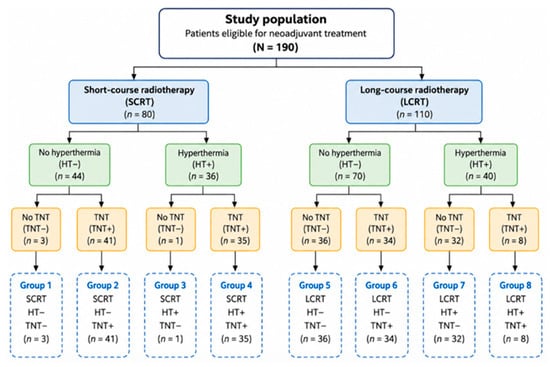
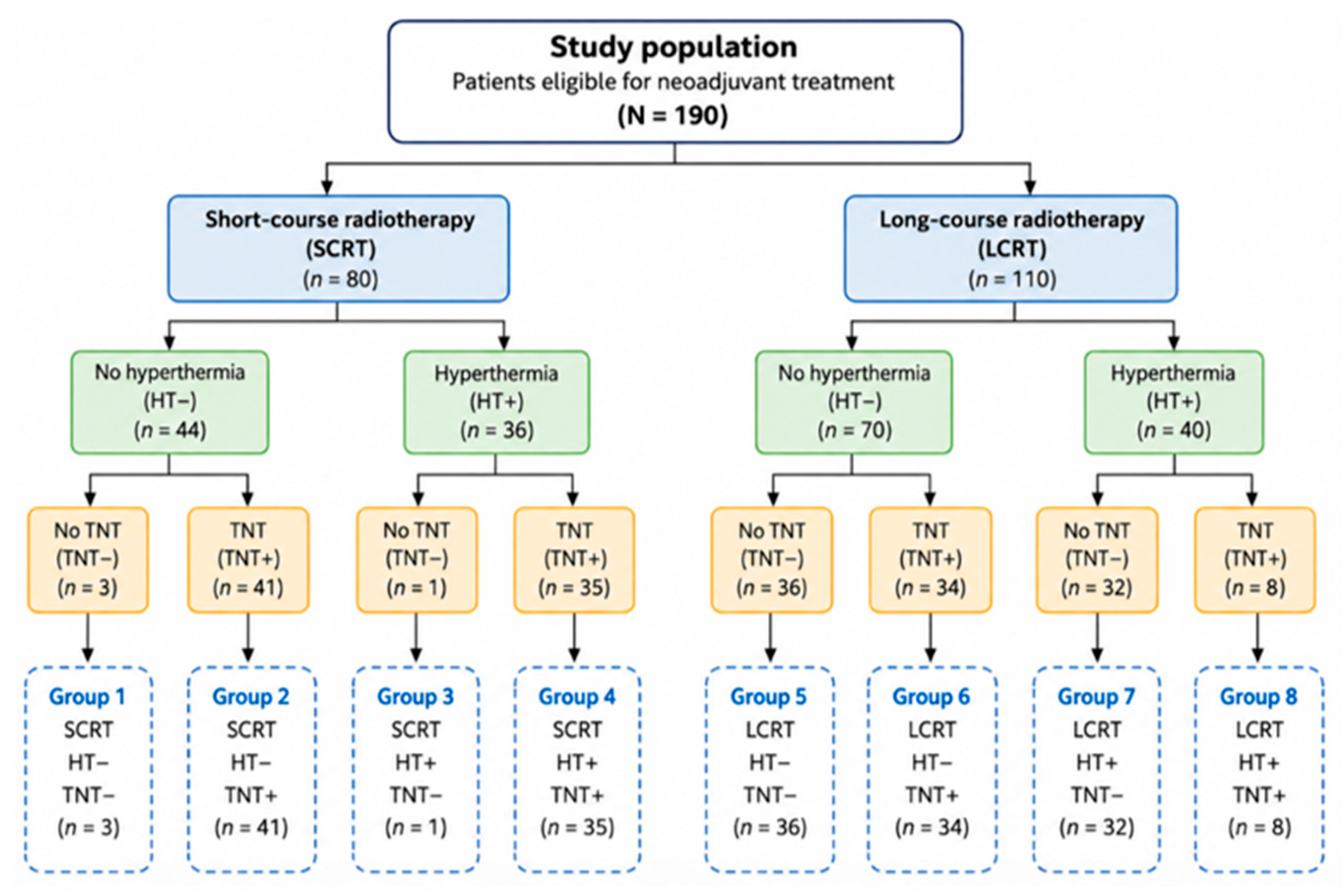
The combination of these variables generated eight predefined treatment groups, which were used for descriptive and comparative analyses of treatment response. The distribution of patients across these groups is shown in Figure 1.
Figure 1.
Study design and patient distribution across the eight predefined treatment groups according to radiotherapy fractionation schedule (SCRT vs. LCRT), deep regional hyperthermia administration (HT+ vs. HT−), and total neoadjuvant therapy (TNT+ vs. TNT−) (N = 190). The overall cohort includes four patients without evaluable biological complete response data.
2.3. Radiotherapy and Systemic Treatment
Radiotherapy consisted of either short-course radiotherapy (SCRT), delivered as 25 Gy in five fractions over one week, or long-course chemoradiotherapy (LCRT), delivered as 45–50.4 Gy in 25–28 fractions over five to six weeks. Radiotherapy was delivered using intensity-modulated radiotherapy (IMRT) or volumetric modulated arc therapy (VMAT) with daily image guidance (IGRT), according to institutional protocols.
Concurrent chemotherapy with oral capecitabine was routinely administered during LCRT. SCRT was delivered without concurrent chemotherapy.
Total neoadjuvant therapy (TNT) was progressively introduced into institutional practice during the study period. It consists of oxaliplatin-based induction or consolidation chemotherapy. Patients not considered suitable candidates for TNT could receive either SCRT alone or conventional LCRT with concurrent capecitabine depending on tumor characteristics, comorbidities and multidisciplinary team decision.
2.4. Deep Regional Hyperthermia
Deep regional hyperthermia was systematically offered to all patients according to the eligibility criteria previously described [17]. Hyperthermia was not administered in patients with clinical contraindications or in those who declined treatment, according to the institutional eligibility criteria described in Section 2.1. Patients who did not receive hyperthermia were included in the non-hyperthermia (HT−) group for analysis.
Deep regional hyperthermia was delivered using the ALBA 4D phased-array radiative radiofrequency system (Medlogix Srl, Rome, Italy), operating at 70 MHz. Each session consisted of a 10–30 min warming-up phase followed by 60 min of steady-state heating, aiming to maintain therapeutic temperatures ≥ 40 °C. Treatment was guided by real-time thermometry using 64 minimally invasive temperature sensors positioned in the target region [17].
Hyperthermia treatment planning was performed using dedicated software (EasyPlan V1.1.1 and Plan2Heat V1.0.7 research software,), allowing individualized optimization of energy deposition and minimization of treatment-limiting hotspots. Detailed technical aspects regarding hyperthermia treatment planning, thermometry, quality assurance procedures, and workflow integration have been previously reported [17].
Hyperthermia sessions were given every 72 h (twice weekly) and were administered immediately after radiotherapy on the same day in order to minimize the radiotherapy-to-hyperthermia interval, as shorter intervals have been associated with improved treatment outcomes [25].
The planned number of hyperthermia sessions reflected the timeline of the corresponding radiotherapy schedule: two hyperthermia sessions were prescribed in SCRT and ten sessions in LCRT. Detailed technical feasibility, session-by-session tolerance, and thermometric methodology of our institutional hyperthermia program were previously established and published in our initial consecutive cohort (n = 67 patients; 243 sessions) [17]. In the present expanded clinical outcomes cohort (N = 190; 76 HT+ patients: 36 SCRT and 40 LCRT), patient-level records of completed sessions, premature interruptions, radiotherapy-to-hyperthermia intervals, and summary thermometric parameters were extracted from the clinical database and summarized by radiotherapy schedule. Because integrated cumulative thermal-dose metrics (such as CEM43T90) were not recorded in this clinical dataset, hyperthermia was modeled as a binary exposure variable (HT+ vs. HT−) in the primary comparative and multivariable analyses. The present study focuses on oncological outcomes rather than technical feasibility or thermal-dose assessment.
2.5. Response Assessment and Surgery
Tumor response was assessed after completion of neoadjuvant treatment using pelvic MRI, endoscopy, digital rectal examination, and clinical evaluation. Response assessment was generally performed no earlier than 6 weeks after completion of radiotherapy or within one month after completion of consolidation chemotherapy.
Pathological complete response (pCR) was defined as the absence of residual viable tumor in both the rectal wall and regional lymph nodes (ypT0N0), confirmed by histopathological examination of the surgical specimen.
Clinical complete response (cCR) was assessed according to National Comprehensive Cancer Network (NCCN) recommendations using a combination of digital rectal examination, rectal endoscopy, and pelvic magnetic resonance imaging (MRI). The clinical assessment considered the absence of a palpable residual tumor, endoscopic findings consistent with complete response, and the absence of MRI findings suggestive of residual viable tumor. Patients considered to have achieved cCR were managed using a non-operative watch-and-wait strategy.
Patients without a clinical complete response underwent total mesorectal excision (TME), generally 8–12 weeks after completion of neoadjuvant treatment. In selected cases, nonoperative management was also adopted because of frailty, advanced age, or patient preference following multidisciplinary discussion.
2.6. Follow-Up and Toxicity Assessment
Patients undergoing surgical resection were followed according to our institutional surveillance protocol, including clinical assessment, tumor marker evaluation, contrast-enhanced CT, and pelvic MRI. Patients managed with a W&W strategy underwent intensified surveillance with additional colonoscopy with biopsy, in accordance with international recommendations [26].
Late treatment-related toxicity was assessed and graded according to the Common Terminology Criteria for Adverse Events (CTCAE), version 5.0 [27].
2.7. Study Endpoints
The primary endpoint of the study was biological complete response (BCR), defined as pathological complete response (pCR) or clinical complete response (cCR) in patients managed with a watch-and-wait strategy. pCR was defined as the absence of residual viable tumor in both the primary tumor and lymph nodes (ypT0N0). cCR was defined according to international W&W criteria as the absence of residual disease on clinical examination, endoscopy, and pelvic MRI.
Secondary endpoints included local control (LC), distant metastasis-free survival (DMFS), overall survival (OS), and organ preservation. An exploratory analysis was performed to assess whether the association between hyperthermia and BCR differed according to TNT administration.
2.8. Statistical Analysis
Categorical variables were summarized as frequencies and percentages and compared using Pearson’s chi-square test or Fisher’s exact test, as appropriate.
Continuous variables were summarized as mean ± standard deviation (SD) and median (interquartile range [IQR]) and compared using Student’s t-test.
The primary analysis evaluated the association between treatment intensification strategies and biological complete response (BCR). Analyses of BCR were restricted to patients with an evaluable response assessment. Multivariable logistic regression was used to identify factors independently associated with BCR. An interaction term between hyperthermia (HT) and total neoadjuvant therapy (TNT) was included to explore whether the association between HT and BCR differed according to TNT use. Stratified analyses according to TNT status were subsequently performed to further explore this interaction. Exploratory sensitivity analyses were performed using pCR and cCR as separate endpoints. Pathological complete response was analyzed among surgically resected patients, whereas cCR was analyzed in the overall cohort. Response rates were compared according to HT and TNT administration using Pearson’s chi-square test or Fisher’s exact test, as appropriate.
Overall survival and other time-to-event outcomes were estimated using the Kaplan–Meier method and compared using the log-rank test.
Multivariable Cox proportional hazards regression models were constructed to identify independent prognostic factors for overall survival. A clinical model included age and ECOG performance status, whereas a pathological and treatment-related model included lymphovascular invasion, perineural invasion, hyperthermia administration, and total neoadjuvant therapy. The proportional hazards assumption was assessed using Schoenfeld residuals.
Given the limited number of mortality events in the resected cohort (n = 165, 25 events), the full prespecified pathological and treatment-related Cox model was restricted to four covariates (6.25 events per variable) to minimize overfitting, and an additional parsimonious model was derived using Akaike information criterion (AIC)-based selection.
Because treatment allocation was not randomized and reflected real-world multidisciplinary clinical decision-making during a period of evolving treatment paradigms, all analyses were considered exploratory and hypothesis-generating. Furthermore, no formal statistical adjustments for multiple comparisons were applied, increasing the risk of Type I errors. Consequently, all p-values should be interpreted as exploratory.
Statistical analyses were performed using IBM SPSS Statistics version 26 (IBM Corp., Armonk, NY, USA) and R statistical software, version 4.5.3 (R Foundation for Statistical Computing, Vienna, Austria). Statistical significance was defined as a two-sided p-value < 0.05.
2.9. Generative Artificial Intelligence Disclosure
During the preparation of this work, the authors used generative artificial intelligence (AI: Gemini, Google) solely for generating graphics, language editing, grammar refinement, and improving the clarity of the English text. Following this assistance, the authors reviewed and edited the content as needed and take full responsibility for the content of the publication.
3. Results
3.1. Patient Population and Baseline Characteristics
A total of 190 consecutive patients with locally advanced rectal adenocarcinoma treated with curative intent were included in the study. Baseline demographic and clinical characteristics are summarized in Table 1.
Table 1.
Baseline demographic and clinical characteristics of the study population according to hyperthermia and total neoadjuvant therapy administration.
In the overall cohort, the mean age at diagnosis was 63.96 ± 10.42 years (median 64.5 years; IQR, 56.0–72.8; range, 34–85), and 111/190 patients (58.4%) were male. Most patients presented with ECOG performance status 0–1 (185/190, 97.4%, including 146 [76.8%] with ECOG 0), cT3 disease (124/190, 65.3%), and node-positive tumors (164/190, 86.3%). The median distance from the anal verge was 8 cm (range, 0–15), with most tumors located in the middle rectum (84/190, 44.2%). When stratified by treatment administration (Table 1), patients receiving HT were significantly younger than those in the HT− group (mean 61.89 ± 10.08 vs. 65.34 ± 10.45 years; median 61.0 vs. 66.0 years; p = 0.025), and none had an ECOG performance status ≥ 2 (0.0% vs. 4.4%, p = 0.159). No statistically significant differences were observed between HT− and HT+ in sex (p = 0.093), clinical T stage (p = 0.071), clinical N stage (p = 0.814), tumor location (p = 0.250), or baseline mrCRM status (p = 0.123), although a borderline trend toward higher mrCRM involvement was noted in the HT+ group when unknown cases were excluded (42.0% vs. 27.6%, p = 0.051). Conversely, marked baseline differences were evident according to TNT administration: patients in the TNT+ group were significantly younger (mean 61.13 ± 10.23 vs. 68.61 ± 9.00 years; median 61.0 vs. 70.0 years; p < 0.001), universally had ECOG 0–1 (100.0% vs. 93.1%, p = 0.007), and presented with significantly more advanced local and nodal disease, including higher proportions of cT4 tumors (33.9% vs. 6.9%, p < 0.001) and cN2 involvement (59.3% vs. 13.9%, p < 0.001).
3.2. Treatment Characteristics
Treatment characteristics are summarized in Table 2 and Figure 1. Short-course radiotherapy (SCRT) was administered to 80/190 patients (42.1%), whereas 110/190 (57.9%) received long-course chemoradiotherapy (LCRT). Deep regional hyperthermia was delivered to 76/190 patients (40.0%), and total neoadjuvant therapy (TNT) was administered to 118/190 patients (62.1%).
Table 2.
Treatment characteristics of the study population (N = 190).
Among the 114 patients who did not receive hyperthermia (HT−), the documented reasons for non-administration were clinical contraindications in 53 patients (46.5%), patient decision/refusal in 44 (38.6%), technical reasons in 4 (3.5%), and not reported/unknown in 13 (11.4%).
Among the 76 patients treated with deep regional hyperthermia (36 receiving SCRT and 40 receiving LCRT), treatment adherence, premature interruptions, and summary thermometric metrics for the expanded cohort are detailed in Supplementary Table S1, complementing our previously published technical feasibility series [17]. Individual completed session counts were documented in 66/76 HT+ patients (86.8%: 26/36 [72.2%] in SCRT and 40/40 [100.0%] in LCRT), totaling 274 delivered sessions (50 in SCRT and 224 in LCRT). Patients in the SCRT + HT+ group (n = 26) completed a median of 2.0 of 2 prescribed sessions (IQR 2.0–2.0; mean 1.92 ± 0.27; range 1–2), with 24/26 (92.3%) completing both prescribed sessions, whereas patients in the LCRT + HT+ group (n = 40) completed a median of 5.5 of 10 prescribed sessions (IQR 4.0–7.0; mean 5.60 ± 2.59; range 1–10), with 4/40 (10.0%) completing all 10 prescribed sessions and 27/40 (67.5%) completing ≥ 5 sessions. Among 74 evaluable HT+ patients (35 SCRT and 39 LCRT), 48 (64.9%) completed treatment without interruption and 26 (35.1%) experienced premature interruption, which was significantly more frequent in LCRT than in SCRT (22/39 [56.4%] vs. 4/35 [11.4%]; Fisher’s exact p < 0.001; Supplementary Table S1). Across patients with available thermometry (n = 65), average T50 across sessions (40.28 ± 0.74 °C in SCRT vs. 40.20 ± 1.89 °C in LCRT; p = 0.824), overall mean steady-state temperature (40.31 ± 0.65 °C vs. 40.27 ± 0.74 °C; p = 0.795), and radiotherapy beam-off to hyperthermia intervals for Session 1 (p = 0.409) and Session 2 (p = 0.777) were comparable between schedules, whereas best-session T50 was higher in LCRT (40.99 ± 0.59 °C vs. 40.47 ± 0.73 °C; p = 0.002).
Following completion of neoadjuvant treatment, 165/190 patients (86.8%) underwent surgical resection. Among the 25 patients who did not proceed to surgery, 21 (84.0%) underwent a W&W approach, representing 11.1% of the entire cohort.
The median follow-up for the overall cohort was 33.0 months (IQR, 20.0–46.8 months).
3.3. Tumor Response to Neoadjuvant Treatment
Of the 190 patients included in the study, 186 were evaluable for biological complete response (BCR), while four were classified as not evaluable. The overall BCR rate was 36.3% (69/190) and 37.1% among evaluable patients (69/186). Among the 165 patients who underwent surgical resection, 48 achieved a pathological complete response (pCR) (29.1%), corresponding to 25.3% of the overall cohort. The remaining 21 patients (11.1% of the overall cohort) achieved a clinical complete response (cCR).
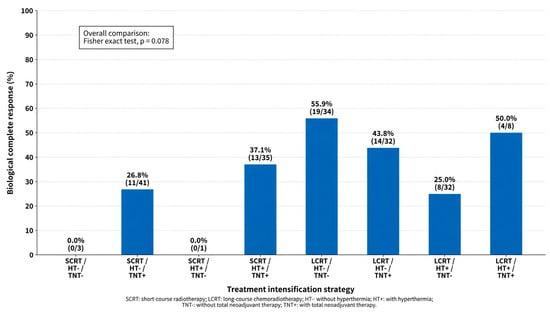
Figure 1 illustrates the distribution of the overall study cohort (N = 190), whereas Figure 2 presents biological complete response rates among the 186 patients with evaluable response data, excluding four patients without response assessment. These BCR rates according to the eight predefined treatment strategies are also summarized in Table 3. The overall comparison across the eight treatment groups was not statistically significant (Fisher’s exact test, p = 0.078).
Figure 2.
Biological complete response (BCR) rates according to the eight predefined treatment strategies among patients with evaluable response data (N = 186). Percentages are calculated using the number of evaluable patients within each treatment subgroup, as indicated in the figure.
Table 3.
Biological complete response according to the eight predefined treatment strategies among patients evaluable for response (n = 186).
Given the differences in group size, additional comparisons were performed between treatment groups with comparable therapeutic components. Among patients receiving TNT, BCR rates were numerically higher with the addition of HT both in those receiving SCRT (37.1% with HT vs. 26.8% without HT; p = 0.335) and LCRT (50.0% vs. 43.8%, respectively; Fisher’s exact p = 1.000), although neither difference reached statistical significance.
When radiotherapy course was compared within TNT-treated patients, BCR rates were numerically higher with LCRT than with SCRT both in the absence of HT (43.8% vs. 26.8%; p = 0.131) and with HT (50.0% vs. 37.1%; Fisher’s exact p = 0.692), without statistically significant differences in these subgroups.
Among patients treated with LCRT without TNT, BCR rates were significantly lower in the HT+ group than in the HT− group (25.0% vs. 55.9%; p = 0.011). Among patients receiving LCRT without HT, BCR rates were 55.9% without TNT and 43.8% with TNT (p = 0.325). Conversely, among those receiving LCRT with HT, BCR rates were 25.0% without TNT and 50.0% with TNT (Fisher’s exact p = 0.211).
When pathological and clinical complete responses were analyzed separately, pCR was observed in 48 of 165 resected patients (29.1%), representing 25.3% (48/190) of the overall cohort. Among resected patients, pCR rates were 29.8% (28/94) without HT and 28.2% (20/71) with HT (p = 0.821), and 30.6% (19/62) without TNT and 28.2% (29/103) with TNT (p = 0.734).
Clinical complete response was observed in 21 of 190 patients (11.1%), all of whom were managed with a watch-and-wait strategy. cCR rates were 14.0% (16/114) without HT and 6.6% (5/76) with HT (p = 0.108), and 11.1% (8/72) without TNT and 11.0% (13/118) with TNT (p = 0.984). No statistically significant differences were identified in these separate exploratory comparisons for which statistical tests were available. During the available follow-up, two of these patients (9.5%) experienced a recorded local recurrence, whereas 19 (90.5%) had no recorded local recurrence. These findings describe initial non-operative management and local recurrence status rather than confirmed sustained organ preservation.
When evaluated in unadjusted TNT-stratified analyses across the 186 response-evaluable patients, overall BCR rates among patients not receiving TNT (n = 70) were 24.2% (8/33) with HT+ versus 51.4% (19/37) with HT− (unadjusted OR 0.303; p = 0.022). Conversely, among patients receiving TNT (n = 116), unadjusted BCR rates were 39.5% (17/43) with HT+ versus 34.2% (25/73) with HT− (unadjusted OR 1.255; p = 0.567).
3.4. Multivariable Analysis of Biological Complete Response
A multivariable logistic regression analysis was performed among patients evaluable for response (n = 186) to assess the association between treatment characteristics and biological complete response (BCR). The model included radiotherapy fractionation, hyperthermia (HT), total neoadjuvant therapy (TNT), the HT × TNT interaction, age, clinical T stage, clinical N stage, and year of radiotherapy initiation (Table 4).
Table 4.
Multivariable logistic regression analysis of factors associated with biological complete response (BCR).
The adjusted overall model was statistically significant (Omnibus test p = 0.008). A significant HT × TNT interaction was observed (adjusted OR 4.607, 95% CI 1.162–18.262; p = 0.030), indicating that the adjusted association between HT and BCR differed according to TNT administration after controlling for radiotherapy fractionation, age, cT stage, cN stage, and treatment year. Within this adjusted interaction parameterization, the main-effect term for HT represents its conditional association with BCR in the reference stratum of patients not receiving TNT (TNT−), showing a non-significant trend toward lower odds of BCR (adjusted OR 0.350, 95% CI 0.117–1.045; p = 0.060). Conversely, among patients receiving TNT (TNT+), the corresponding multivariable-adjusted conditional HT odds ratio was 1.612, derived from the interaction model by multiplying the HT main-effect OR by the interaction OR (0.350 × 4.607 = 1.612).
Among the baseline clinical covariates and treatment characteristics included in the model, clinical N2 stage was independently associated with significantly lower odds of BCR compared with cN0-1 disease (OR 0.396, 95% CI 0.186–0.844; p = 0.017). Radiotherapy course (LCRT vs. SCRT, OR 1.876, 95% CI 0.793–4.438; p = 0.152), main-effect TNT (OR 0.817, 95% CI 0.282–2.366; p = 0.710), age (OR 0.980, 95% CI 0.948–1.014; p = 0.252), clinical T stage (cT4 vs. cT1-3, OR 0.925, 95% CI 0.404–2.120; p = 0.854), and year of radiotherapy initiation (OR 1.249, 95% CI 0.960–1.627; p = 0.098) were not significantly associated with BCR after adjusting for the other covariates.
3.5. Multivariable Overall Survival Analysis in Surgically Resected Patients
Overall survival (OS), local control (LC), and distant metastasis-free survival (DMFS) were evaluated according to the main treatment components: hyperthermia (HT), total neoadjuvant therapy (TNT), and radiotherapy course (SCRT vs. LCRT).
In the overall cohort, no significant differences were observed according to HT administration for OS (log-rank p = 0.973), LC (p = 0.934), or DMFS (p = 0.901). Similarly, no significant differences according to TNT administration were observed for OS (p = 0.206), LC (p = 0.194), or DMFS (p = 0.730). No significant differences were observed between SCRT and LCRT for OS (p = 0.734), LC (p = 0.084), or DMFS (p = 0.719).
To evaluate the association of HT within comparable treatment strategies, additional exploratory analyses were performed among TNT-treated patients, stratified by radiotherapy course. Among patients receiving SCRT plus TNT (n = 76), OS differed significantly according to HT administration (log-rank p = 0.039), with lower OS observed in the HT-treated group, whereas no significant differences were observed for LC (p = 0.202) or DMFS (p = 0.551).
Given the exploratory nature of these subgroup comparisons and the limited sample size, this finding should be interpreted cautiously.
Among patients receiving LCRT plus TNT (n = 42), no significant differences according to HT administration were observed for OS (p = 0.394), LC (p = 0.634), or DMFS (p = 0.984) (Table 5).
Table 5.
Survival outcomes according to treatment strategy.
3.6. Prognostic Factors for Overall Survival
A multivariable Cox proportional hazards regression analysis was performed to identify independent prognostic factors associated with overall survival.
In the clinical model (Table 6), increasing age at diagnosis (HR 1.04 per year; 95% CI 1.00–1.09; p = 0.036) and impaired baseline performance status (ECOG 1–3 vs. ECOG 0; HR 2.47; 95% CI 1.15–5.33; p = 0.021) were independently associated with worse overall survival.
Table 6.
Multivariable Cox proportional hazards regression analysis for overall survival. (A). Clinical prognostic factors associated with overall survival. (B). Pathological and treatment-related prognostic factors associated with overall survival.
In the pathological and treatment-related model (Table 6), perineural invasion was independently associated with worse overall survival (HR 3.84; 95% CI 1.45–10.15; p = 0.007). Lymphovascular invasion showed a non-significant trend toward worse overall survival (HR 2.44; 95% CI 0.86–6.90; p = 0.094). Hyperthermia (HR 0.84; 95% CI 0.36–1.98; p = 0.687) and total neoadjuvant therapy (HR 0.55; 95% CI 0.24–1.29; p = 0.170) were not independently associated with overall survival.
In an additional parsimonious Cox model derived via AIC selection (AIC 213.13 vs. 215.28 for the full four-variable model; concordance index 0.71 vs. 0.73; global Schoenfeld test p = 0.67), only perineural invasion (HR 3.88; 95% CI 1.47–10.28; p = 0.006) and lymphovascular invasion (HR 2.39; 95% CI 0.84–6.77; p = 0.101) were retained, whereas hyperthermia and TNT were excluded. Because the pathological and treatment-related Cox models were based on 25 mortality events among 165 resected patients (6.25 events per variable in the full four-variable model), statistical power was limited and confidence intervals were wide; accordingly, the nonsignificant hazard ratios for hyperthermia (HR 0.84; 95% CI 0.36–1.98; p = 0.687) and TNT (HR 0.55; 95% CI 0.24–1.29; p = 0.170) should be interpreted cautiously as inconclusive rather than as evidence of equivalence.
The proportional hazards assumption was verified using Schoenfeld residual testing, with no significant violations observed (global test p = 0.37).
4. Discussion
4.1. Principal Findings and Overall Interpretation
To our knowledge, this is one of the first prospective real-world studies evaluating the integration of deep regional hyperthermia within contemporary neoadjuvant treatment strategies, including total neoadjuvant therapy (TNT), in patients with locally advanced rectal cancer.
The principal findings of our study can be summarized as follows. First, the addition of deep regional hyperthermia was not associated with significant differences in long-term oncological outcomes in the overall cohort. Second, a significant interaction between hyperthermia and TNT was observed for biological complete response (BCR), with hyperthermia being associated with lower odds of BCR among patients who did not receive TNT, whereas no significant association was observed among those receiving TNT. Third, biological complete response was associated with the possibility of organ preservation through a watch-and-wait strategy. Finally, age and impaired baseline performance status were independently associated with worse overall survival in the clinical model, while perineural invasion was independently associated with worse overall survival in the pathological and treatment-related model.
These findings illustrate the complexity of evaluating local treatment-intensification strategies in the current era of multimodal rectal cancer management. Contemporary treatment strategies have substantially improved disease control, potentially reducing the additional effect that can be demonstrated for a single local intervention across an unselected population. In this context, the absence of significant differences in long-term oncological outcomes according to hyperthermia administration in the overall cohort should be considered alongside the observed interaction between hyperthermia and TNT for biological complete response.
From this perspective, our results support further investigation of the role of deep regional hyperthermia according to the therapeutic context in which it is delivered. Rather than considering hyperthermia as a universal adjunct to all neoadjuvant regimens, its potential contribution may differ according to the accompanying systemic treatment strategy and the therapeutic objective, particularly when tumor response and organ preservation are prioritized. This concept is consistent with the current evolution of rectal cancer management toward personalized treatment strategies based not only on tumor stage, but also on tumor biology, patient characteristics, and therapeutic objectives [2,4,5,7,8].
4.2. Clinical Relevance of Biological Complete Response
One of the most clinically relevant aspects of biological complete response in our study was its potential implication for organ preservation through a watch-and-wait strategy. In our cohort, 21 patients (11.1%) achieved a clinical complete response and were managed with a watch-and-wait strategy, thereby avoiding immediate radical surgery. This strategy may spare patients from permanent stoma formation and long-term bowel, urinary, and sexual dysfunction while maintaining excellent oncological outcomes. This finding highlights the clinical relevance of maximizing tumor response beyond conventional measures of disease control.
Over the past decade, complete response has evolved from being regarded solely as a marker of treatment efficacy to becoming a clinically relevant therapeutic objective with direct implications for organ preservation, quality of life, and functional outcomes. In particular, the OPRA trial demonstrated that neoadjuvant treatment sequencing can influence organ preservation rates while maintaining favorable oncological outcomes, supporting watch-and-wait as a management strategy for carefully selected patients who achieve a sustained clinical complete response [7].
Our findings should be interpreted within this evolving treatment paradigm. Although deep regional hyperthermia was not associated with significant differences in long-term oncological outcomes in the overall cohort, the multivariable analysis of BCR identified a significant interaction between hyperthermia and TNT. In the stratified analyses, hyperthermia was associated with lower odds of BCR among patients who did not receive TNT, whereas no significant association was observed among patients receiving TNT. These findings suggest that the association between hyperthermia and tumor response may vary according to the accompanying neoadjuvant treatment strategy. Given the observational nature of the study, these results should not be interpreted as evidence of a detrimental causal effect of hyperthermia, but rather as an exploratory finding requiring further investigation.
The clinical relevance of this observation lies in the increasing importance of tumor response as a therapeutic objective in rectal cancer. In patients achieving a sustained clinical complete response, avoidance of radical surgery may be possible within structured watch-and-wait programs, potentially reducing surgery-related morbidity and preserving anorectal function. However, our study was not designed to determine whether an increase in BCR directly translates into improved long-term oncological or functional outcomes.
This concept is particularly relevant in the era of total neoadjuvant therapy, in which maximizing tumor response and increasing opportunities for organ preservation have become important treatment objectives. BCR may therefore represent a clinically relevant endpoint when evaluating treatment-intensification strategies aimed at increasing tumor response and the possibility of organ preservation [4,5,7,8].
4.3. Deep Regional Hyperthermia in the Era of Total Neoadjuvant Therapy
The role of deep regional hyperthermia in locally advanced rectal cancer should be interpreted within the context of the evolving neoadjuvant treatment landscape. Most of the available clinical evidence on hyperthermia was generated before the widespread adoption of total neoadjuvant therapy (TNT) and therefore predominantly reflects treatment paradigms based on fluoropyrimidine-based chemoradiotherapy rather than contemporary multimodal treatment strategies. Consequently, the added value of hyperthermia in the modern TNT era remains insufficiently defined [10,28,29,30].
In our cohort, hyperthermia was not associated with significant differences in long-term oncological outcomes in the overall population. However, in the multivariable analysis of biological complete response, a significant interaction between hyperthermia and TNT was observed. Stratified analyses showed that, among patients who did not receive TNT, hyperthermia was associated with lower odds of achieving BCR, whereas no significant association was observed among patients treated with TNT. These findings should be interpreted cautiously given the limited number of patients in some treatment subgroups, particularly in specific HT and TNT combinations. Nevertheless, they suggest that the association between hyperthermia and tumor response may vary according to the accompanying neoadjuvant treatment strategy.
This finding is particularly relevant in the current treatment landscape, in which TNT has increased the intensity of neoadjuvant systemic treatment and improved tumor response rates. Among TNT-treated patients, BCR rates were numerically higher with HT both after SCRT (37.1% vs. 26.8%) and LCRT (50.0% vs. 43.8%), although neither comparison reached statistical significance. In contrast, among patients receiving LCRT without TNT, BCR was significantly lower with HT than without HT (25.0% vs. 55.9%; p = 0.011). Together with the significant HT × TNT interaction, these findings suggest a complex relationship between hyperthermia and the accompanying neoadjuvant treatment strategy. However, given the observational design, treatment heterogeneity, and limited sample size of some treatment subgroups, these results should not be interpreted as evidence of either benefit or harm from hyperthermia in a specific treatment setting, but rather as exploratory findings requiring prospective validation. In particular, baseline imbalances between groups—most notably a higher prevalence of baseline mrCRM involvement in the HT+ group than in the HT- group (39.2% vs. 25.0%)—together with non-randomized treatment allocation and unmeasured clinical selection factors may have confounded the lower odds of BCR observed with HT in patients not receiving TNT, further underscoring the exploratory and non-causal nature of this association.
Although no significant differences in OS, LC, or DMFS were observed according to HT administration in the overall cohort, an exploratory subgroup analysis showed lower OS among HT-treated patients receiving SCRT plus TNT. This finding was not accompanied by differences in LC or DMFS and was not observed among patients receiving LCRT plus TNT. Given the non-randomized treatment allocation, the limited sample size of some treatment subgroups, and the exploratory nature of these multiple subgroup comparisons, this isolated survival finding should be interpreted with caution and requires confirmation in larger prospective cohorts.
From a clinical perspective, these results support evaluating deep regional hyperthermia according to the therapeutic context in which it is delivered, rather than considering it a universal adjunct to all neoadjuvant regimens. The accompanying systemic treatment strategy and radiotherapy fractionation may be relevant when investigating its potential contribution to tumor response.
This interpretation is consistent with the ongoing evolution toward increasingly personalized treatment strategies in rectal cancer, in which therapeutic decisions are based not only on tumor stage, but also on disease biology, patient characteristics, concomitant treatments, and therapeutic objectives. Within this framework, deep regional hyperthermia may represent an additional local treatment-intensification strategy whose potential contribution should be investigated in relation to the other components of multimodal treatment [2,4,5,7,8].
4.4. Prognostic Relevance of Tumor Biology and Clinical Factors
Despite advances in the multimodal management of locally advanced rectal cancer, our findings highlight the prognostic relevance of patient characteristics and tumor biology. In the clinical model, increasing age and impaired baseline performance status (ECOG 1–3 vs. ECOG 0) were independently associated with worse overall survival. In the pathological and treatment-related model, perineural invasion was independently associated with worse overall survival, whereas lymphovascular invasion and treatment-related variables, including deep regional hyperthermia and TNT, were not. These findings are consistent with previous studies identifying perineural invasion as an adverse prognostic factor in rectal cancer [31].
Importantly, given that the pathological and treatment-related Cox model included only 25 overall survival events across four prespecified covariates (6.25 events per variable)—and neither hyperthermia nor TNT was retained in a parsimonious AIC-selected model—the absence of statistically significant survival associations for HT (HR 0.84) and TNT (HR 0.55) reflects limited statistical power and wide confidence intervals rather than definitive evidence of clinical equivalence.
In the context of contemporary rectal cancer management, advances in total mesorectal excision, radiotherapy, and intensified neoadjuvant strategies have improved disease control, while long-term outcomes remain influenced by patient characteristics, tumor biology, and systemic disease risk [4,5,8,32]. Local and systemic treatment-intensification strategies should therefore be considered complementary. In our cohort, hyperthermia was associated with lower odds of BCR among patients not receiving TNT, whereas no significant association was observed among patients receiving TNT. However, hyperthermia was not independently associated with overall survival, highlighting the distinction between associations with tumor response and long-term oncological outcomes.
Overall, these findings support increasingly personalized treatment strategies in locally advanced rectal cancer, integrating clinical and pathological prognostic factors with treatment context and individualized therapeutic objectives [2,7,29,30].
4.5. Strengths and Limitations
Although the present study provides novel insights into the integration of deep regional hyperthermia within contemporary neoadjuvant treatment strategies for locally advanced rectal cancer, several limitations should be acknowledged.
First, an important limitation of this prospective, single-center observational study is the lack of randomized treatment allocation, leading to potential selection bias. Only 76 of 190 patients (40.0%) received HT, whereas the remaining 114 patients (60.0%) constituted a non-randomized comparison group. Because HT administration depended on clinical eligibility (with contraindications accounting for 46.5% of non-treated cases), patient acceptance (38.6% refusal), technical feasibility (3.5%), and unrecorded factors (11.4%), patients who did not receive HT were not fully comparable to those who did. Although the multivariable analysis adjusted for relevant baseline clinical characteristics and treatment year, residual confounding cannot be completely excluded.
Specifically, baseline comparisons demonstrated that HT+ patients were significantly younger (p = 0.025) yet showed a trend toward higher baseline mrCRM involvement than HT− patients (42.0% vs. 27.6%; p = 0.051), alongside unrecorded clinical or patient-driven reasons for HT non-administration. Because unmeasured selection mechanisms could not be modeled via propensity-score sensitivity analyses, residual confounding may partly explain the lower odds of BCR observed with HT in the non-TNT setting. Additionally, the inclusion of five patients (2.6%) with cT2N0 tumors treated with neoadjuvant intent introduces minor staging heterogeneity, although no separate sensitivity exclusion was performed given their small number.
Consequently, causal relationships cannot be established, and the observed associations must be interpreted as exploratory. Similarly, the implementation of total neoadjuvant therapy progressively increased during the study period following the publication of the RAPIDO and PRODIGE-23 trials, reflecting the real-world evolution of rectal cancer management [4,5,8].
Second, although our cohort represents one of the largest prospective real-world experiences evaluating deep regional hyperthermia in locally advanced rectal cancer, some of the analyses were exploratory. A major limitation is the subdivision of the cohort into eight predefined strategies, resulting in small and highly imbalanced subgroups that render direct pairwise comparisons statistically unreliable. Although multivariable adjustment for baseline covariates was performed, the wide confidence intervals observed reflect substantial statistical uncertainty. This is particularly relevant to the interaction analysis between hyperthermia and TNT for biological complete response and the subsequent stratified analyses. Consequently, these findings should be interpreted cautiously, considered hypothesis-generating, and require confirmation in larger prospective multicenter studies.
Third, the study was not specifically designed or statistically powered to detect differences in long-term oncological outcomes according to hyperthermia administration. Furthermore, the number of events was limited for some endpoints, particularly local control, reducing the precision of the estimates obtained from the multivariable models. Although biological complete response represents a clinically relevant endpoint because of its relationship with the possibility of organ preservation, longer follow-up and larger patient cohorts will be required to determine the relationship between tumor response, organ preservation, and long-term oncological outcomes [6,7,33]. Although initial watch-and-wait management and local recurrence were documented, information regarding salvage surgery was not available in the analytical database, preventing a reliable assessment of sustained organ preservation. Furthermore, the absence of systematically analyzed functional outcomes and late toxicity by treatment group limits the evaluation of the long-term clinical benefits and potential morbidity of the different treatment strategies.
Fourth, the availability of certain pathological variables was dependent on surgery and on the availability of complete pathological information. Consequently, models incorporating lymphovascular and perineural invasion were restricted to patients with available data for these variables. This limitation should be considered when interpreting the observed prognostic associations.
Fifth, the composite BCR endpoint combines histopathologically confirmed pCR with clinically assessed cCR in patients managed with watch-and-wait. These outcomes differ in their methods of ascertainment and diagnostic certainty, which should be considered when interpreting the findings. The separate exploratory analyses of pCR and cCR should also be interpreted cautiously because of the limited number of events and the non-randomized treatment allocation.
Sixth, an important limitation is that hyperthermia was modeled as a binary treatment variable (HT+ vs. HT−) in the comparative and multivariable analyses despite differences between SCRT and LCRT in prescribed sessions (two vs. ten sessions) and treatment adherence. Although completed session counts, premature interruptions, and summary thermometric metrics for this expanded cohort are reported by radiotherapy schedule (Section 3.2 and Supplementary Table S1)—showing lower session completion (median 5.5 of 10 sessions) and a higher interruption rate (56.4%) in LCRT than in SCRT (92.3% full completion; 11.4% interruptions)—and detailed feasibility data from our institutional program have been previously published (Ferrera-Alayón et al. [17]), integrated cumulative thermal-dose parameters such as CEM43T90 were not recorded in this clinical outcomes database. Consequently, formal patient-level dose–response modeling could not be performed, and exposure heterogeneity may have attenuated the observed associations between hyperthermia and oncological outcomes.
Despite these limitations, our study has several important strengths. To our knowledge, it represents one of the largest prospective single-center real-world cohorts evaluating deep regional hyperthermia in patients with locally advanced rectal cancer and one of the first to investigate its integration within the contemporary era of total neoadjuvant therapy. The prospective design, standardized multidisciplinary management, and systematic collection of clinical, treatment, pathological, and follow-up data strengthen the consistency of the study. Furthermore, patients were managed according to standardized institutional protocols for radiotherapy, hyperthermia delivery, response assessment, imaging, surgery, and multidisciplinary decision-making, reducing technical and clinical variability within the cohort.
Finally, the present study reflects routine clinical practice in real-world patients rather than the highly selected populations typically included in randomized clinical trials. This real-world perspective increases the clinical applicability of our findings and provides relevant information regarding the integration of deep regional hyperthermia within contemporary personalized treatment strategies for locally advanced rectal cancer.
Taken together, these findings are hypothesis-generating and support future prospective multicenter studies to further evaluate the interaction between hyperthermia and contemporary neoadjuvant strategies and to better define the clinical settings in which hyperthermia may provide additional therapeutic value.
5. Conclusions
This prospective real-world study provides novel insights into the integration of deep regional hyperthermia within contemporary neoadjuvant treatment strategies for locally advanced rectal cancer. While hyperthermia was not associated with significant differences in long-term oncological outcomes in the overall cohort, a significant interaction with total neoadjuvant therapy (TNT) was observed for biological complete response (BCR). Specifically, hyperthermia was associated with lower odds of BCR among patients not receiving TNT, whereas no significant association was observed among those receiving TNT. Given the observational design and the limited number of patients in some subgroups, these exploratory findings should be interpreted cautiously and considered hypothesis-generating, suggesting that the association between hyperthermia and tumor response depends on the accompanying neoadjuvant context.
Long-term prognosis was primarily influenced by clinical and pathological factors, with increasing age, impaired baseline performance status, and perineural invasion independently associated with worse overall survival.
In this observational cohort, the association between locoregional hyperthermia and treatment response varied according to the administration of total neoadjuvant therapy. Given the small subgroup sizes, non-randomized design, and inconsistent survival outcomes, these findings do not demonstrate a definitive clinical advantage. The results are strictly exploratory and highlight the need for appropriately powered randomized trials to clarify the role of hyperthermia in the TNT era.
Further prospective multicenter studies with adequately sized treatment groups are warranted to clarify its precise role within specific multimodal strategies and organ-preservation protocols.
Supplementary Materials
The following supporting information can be downloaded at: https://www.mdpi.com/article/10.3390/cancers18233796/s1, Table S1: Hyperthermia treatment adherence, premature interruptions, thermometric parameters, and radiotherapy-to-hyperthermia time intervals among patients treated with deep regional hyperthermia overall and stratified by radiotherapy schedule.
Author Contributions
Conceptualization, M.L.S.-B. and H.C.; methodology, M.L.S.-B. and H.C.; investigation, B.S.-S., L.F.-A., A.A.-A., M.S.C., L.L.M. and R.A.H.S.; writing—original draft preparation, B.S.-S., L.F.-A., A.A.-A., M.S.C., L.L.M. and R.A.H.S.; supervision, M.L.S.-B. and H.C.; project administration, M.L.S.-B. and H.C. All authors have read and agreed to the published version of the manuscript.
Funding
This publication has been funded by the Fundación Instituto de Investigación Sanitaria de Canarias/Instituto de Investigación Sanitaria de Canarias (IISC-FIISC) through the Scientific Publications Grant Program (Programa de Ayudas a Publicaciones Científicas).
Institutional Review Board Statement
The study was conducted in accordance with the Declaration of Helsinki, and approved by the Ethics Committee of the University Hospital of Gran Canaria Dr. Negrín (protocol code 2020-335-1, approved on 4 September 2020).
Informed Consent Statement
All the persons gave their informed consent prior to their inclusion in the study and details that might disclose the identity of the subjects under study were omitted.
Data Availability Statement
The data presented in this study are available on reasonable request from the corresponding author. The data are not publicly available due to privacy and ethical restrictions.
Acknowledgments
During the preparation of this work, the authors used generative artificial intelligence (AI: Gemini, Google) solely for generating graphics, language editing, grammar refinement, and improving the clarity of the English text. Following this assistance, the authors reviewed and edited the content as needed and take full responsibility for the content of the publication.
Conflicts of Interest
The authors declare no conflicts of interest.
Abbreviations
The following abbreviations are used in this manuscript:
| AIC | Akaike Information Criterion |
| BCR | Biological Complete Response |
| cCR | Clinical Complete Response |
| CI | Confidence Interval |
| CRT | Chemoradiotherapy |
| CT | Computed Tomography |
| CTCAE | Common Terminology Criteria for Adverse Events |
| DMFS | Distant Metastasis-Free Survival |
| ECOG | Eastern Cooperative Oncology Group |
| HR | Hazard Ratio |
| HT | Hyperthermia |
| IGRT | Image-Guided Radiotherapy |
| IMRT | Intensity-Modulated Radiation Therapy |
| IQR | Interquartile Range |
| LARC | Locally Advanced Rectal Cancer |
| LC | Local Control |
| LCRT | Long-Course Radiotherapy |
| mrCRM | MRI-assessed Circumferential Resection Margin |
| MRI | Magnetic Resonance Imaging |
| OR | Odds Ratio |
| OS | Overall Survival |
| pCR | Pathological Complete Response |
| RT | Radiotherapy |
| SCRT | Short-Course Radiotherapy |
| TME | Total Mesorectal Excision |
| TNT | Total Neoadjuvant Therapy |
| VMAT | Volumetric Modulated Arc Therapy |
| W&W | Watch-and-Wait |
References
- Bray, F.; Laversanne, M.; Sung, H.; Ferlay, J.; Siegel, R.L.; Soerjomataram, I.; Jemal, A. Global cancer statistics 2022: GLOBOCAN estimates of incidence and mortality worldwide for 36 cancers in 185 countries. CA Cancer J. Clin. 2024, 74, 229–263. [Google Scholar] [CrossRef] [Scilit] [PubMed]
- Glynne-Jones, R.; Wyrwicz, L.; Tiret, E.; Brown, G.; Rödel, C.; Cervantes, A.; Arnold, D. Rectal cancer: ESMO Clinical Practice Guidelines for diagnosis, treatment and follow-up. Ann. Oncol. 2017, 28, iv22–iv40. [Google Scholar] [CrossRef] [Scilit] [PubMed]
- Sauer, R.; Becker, H.; Hohenberger, W.; Rödel, C.; Wittekind, C.; Fietkau, R.; Martus, P.; Gerber, E.; Tatchek, P.; Christl, P.; et al. Preoperative versus postoperative chemoradiotherapy for rectal cancer. N. Engl. J. Med. 2004, 351, 1731–1740. [Google Scholar] [CrossRef] [Scilit] [PubMed]
- Conroy, T.; Bosset, J.; Etienne, P.; Rio, E.; François, É.; Mesgouez-Nebout, N.; Vendrely, V.; Artignan, X.; Bouché, O.; Gargot, D.; et al. Neoadjuvant chemotherapy with FOLFIRINOX and preoperative chemoradiotherapy for patients with locally advanced rectal cancer (UNICANCER-PRODIGE 23): A multicentre, randomised, open-label, phase 3 trial. Lancet Oncol. 2021, 22, 702–715. [Google Scholar] [CrossRef] [Scilit] [PubMed]
- Bahadoer, R.R.; Dijkstra, E.A.; van Etten, B.; Marijnen, C.A.M.; Putter, H.; Meershoek-Klein Kranenbarg, E.; Roodvoets, A.G.H.; Nagtegaal, I.D.; Beets-Tan, R.G.H.; Blomqvist, L.K.; et al. Short-course radiotherapy followed by chemotherapy before total mesorectal excision (RAPIDO): A randomised, open-label, phase 3 trial. Lancet Oncol. 2021, 22, 29–42. [Google Scholar] [CrossRef] [Scilit] [PubMed]
- Maas, M.; Nelemans, P.J.; Valentini, V.; Das, P.; Rödel, C.; Kuo, L.J.; Calvo, F.A.; García-Aguilar, J.; Glynne-Jones, R.; Haustermans, K.; et al. Long-term outcome in patients with a pathological complete response after chemoradiotherapy for rectal cancer: A pooled analysis of individual patient data. Lancet Oncol. 2010, 11, 835–844. [Google Scholar] [CrossRef] [Scilit] [PubMed]
- Verheij, F.S.; Omer, D.M.; Williams, H.; Lin, S.T.; Qin, L.X.; Buckley, J.T.; Thompson, H.M.; Yuval, J.B.; Kim, J.K.; Dunne, R.F.; et al. Long-term results of organ preservation in patients with rectal adenocarcinoma treated with total neoadjuvant therapy: The randomized phase II OPRA trial. J. Clin. Oncol. 2024, 42, 500–506. [Google Scholar] [CrossRef] [Scilit] [PubMed]
- Dijkstra, E.A.; Nilsson, P.J.; Hospers, G.A.P.; Bahadoer, R.R.; Meershoek-Klein Kranenbarg, E.; Roodvoets, A.G.H.; Putter, H.; Berglund, Å.; Cervantes, A.; Crolla, R.M.P.H.; et al. Locoregional failure during and after short-course radiotherapy followed by chemotherapy and surgery compared with long-course chemoradiotherapy and surgery: A 5-year follow-up of the RAPIDO trial. Ann. Surg. 2023, 278, e766–e772. [Google Scholar] [CrossRef] [Scilit] [PubMed]
- Van der Zee, J. Heating the patient: A promising approach? Ann. Oncol. 2002, 13, 1173–1184. [Google Scholar] [CrossRef] [Scilit] [PubMed]
- Datta, N.R.; Ordóñez, S.G.; Gaipl, U.S.; Paulides, M.M.; Crezee, H.; Gellermann, J.; Marder, D.; Puric, E.; Bodis, S. Local hyperthermia combined with radiotherapy and-/or chemotherapy: Recent advances and promises for the future. Cancer Treat. Rev. 2015, 41, 742–753. [Google Scholar] [CrossRef] [Scilit] [PubMed]
- Oei, A.L.; Kok, H.P.; Oei, S.B.; Horsman, M.R.; Stalpers, L.J.A.; Franken, N.A.P.; Crezee, J. Molecular and biological rationale of hyperthermia as radio- and chemosensitizer. Adv. Drug Deliv. Rev. 2020, 163–164, 84–97. [Google Scholar] [CrossRef] [Scilit] [PubMed]
- Horsman, M.R.; Overgaard, J. Hyperthermia: A potent enhancer of radiotherapy. Clin. Oncol. 2007, 19, 418–426. [Google Scholar] [CrossRef] [Scilit] [PubMed]
- Kampinga, H.H. Cell biological effects of hyperthermia alone or combined with radiation or drugs: A short introduction to newcomers in the field. Int. J. Hyperth. 2006, 22, 191–196. [Google Scholar] [CrossRef] [Scilit] [PubMed]
- Rau, B.; Wust, P.; Tilly, W.; Gellermann, J.; Harder, C.; Riess, H.; Budach, V.; Felix, R.; Schlag, P. Preoperative radiochemotherapy in locally advanced or recurrent rectal cancer: Regional radiofrequency hyperthermia correlates with clinical parameters. Int. J. Radiat. Oncol. Biol. Phys. 2000, 48, 381–391. [Google Scholar] [CrossRef] [Scilit] [PubMed]
- Rau, B.; Wust, P.; Hohenberger, P.; Löffel, J.; Hünerbein, M.; Below, C.; Gellermann, J.; Speidel, A.; Vogl, T.; Riess, H.; et al. Preoperative Hyperthermia Combined with Radiochemotherapy in Locally Advanced Rectal Cancer. Ann. Surg. 1998, 227, 380–389. [Google Scholar] [CrossRef] [Scilit] [PubMed]
- Wust, P.; Rau, B.; Gellermann, J.; Pegios, W.; Löffel, J.; Riess, H.; Felix, R.; Schlag, P.M. Radiochemotherapy and Hyperthermia in the Treatment of Rectal Cancer. Recent Results Cancer Res. 1998, 146, 175–191. [Google Scholar] [CrossRef] [Scilit] [PubMed]
- Ferrera-Alayón, L.; Salas-Salas, B.; Alayón-Afonso, A.; Carrascal, M.S.; Molina, L.L.; Santana, R.A.H.; Crezee, H.; Sáez-Bravo, M.L. Neoadjuvant radiochemotherapy combined with locoregional hyperthermia in locally advanced rectal cancer: Feasibility and tolerance of short-course versus long-course radiotherapy schedules. Cancers 2025, 17, 3529. [Google Scholar] [CrossRef] [Scilit]
- Zwirner, K.; Bonomo, P.; Lamprecht, U.; Zips, D.; Gani, C. External validation of a rectal cancer outcome prediction model with a cohort of patients treated with preoperative radiochemotherapy and deep regional hyperthermia. Int. J. Hyperth. 2017, 34, 455–460. [Google Scholar] [CrossRef] [Scilit] [PubMed]
- Schem, B.; Pfeffer, F.; Ott, M.A.; Wiig, J.N.; Sletteskog, N.; Frøystein, T.; Myklebust, M.P.; Leh, S.; Dahl, O.; Mella, O. Long-Term Outcome in a Phase II Study of Regional Hyperthermia Added to Preoperative Radiochemotherapy in Locally Advanced and Recurrent Rectal Adenocarcinomas. Cancers 2022, 14, 705. [Google Scholar] [CrossRef] [Scilit] [PubMed]
- Gani, C.; Schroeder, C.; Heinrich, V.; Spillner, P.; Lamprecht, U.; Berger, B.; Zips, D. Long-term local control and survival after preoperative radiochemotherapy in combination with deep regional hyperthermia in locally advanced rectal cancer. Int. J. Hyperth. 2016, 32, 187–192. [Google Scholar] [CrossRef] [Scilit] [PubMed]
- Schroeder, C.; Gani, C.; Lamprecht, U.; Von Weyhern, C.H.; Weinmann, M.; Bamberg, M.; Berger, B. Pathological complete response and sphincter-sparing surgery after neoadjuvant radiochemotherapy with regional hyperthermia for locally advanced rectal cancer compared with radiochemotherapy alone. Int. J. Hyperth. 2012, 28, 707–714. [Google Scholar] [CrossRef] [Scilit] [PubMed]
- Maluta, S.; Romano, M.; Dall’oglio, S.; Genna, M.; Oliani, C.; Pioli, F.; Gabbani, M.; Marciai, N.; Palazzi, M. Regional hyperthermia added to intensified preoperative chemo-radiation in locally advanced adenocarcinoma of middle and lower rectum. Int. J. Hyperth. 2010, 26, 108–117. [Google Scholar] [CrossRef] [Scilit] [PubMed]
- Shoji, H.; Motegi, M.; Takakusagi, Y.; Asao, T.; Kuwano, H.; Takahashi, T.; Ogoshi, K. Chemoradiotherapy and concurrent radiofrequency thermal therapy to treat primary rectal cancer and prediction of treatment responses. Oncol. Rep. 2016, 37, 695–704. [Google Scholar] [CrossRef] [Scilit] [PubMed]
- Kang, M.K.; Kim, M.S.; Kim, J.H. Clinical outcomes of mild hyperthermia for locally advanced rectal cancer treated with preoperative radiochemotherapy. Int. J. Hyperth. 2011, 27, 482–490. [Google Scholar] [CrossRef] [Scilit] [PubMed]
- Gani, C.; Lamprecht, U.; Ziegler, A.; Moll, M.; Gellermann, J.; Heinrich, V.; Wenz, S.; Fend, F.; Königsrainer, A.; Bitzer, M.; et al. Deep regional hyperthermia with preoperative radiochemotherapy in locally advanced rectal cancer, a prospective phase II trial. Radiother. Oncol. 2021, 159, 155–160. [Google Scholar] [CrossRef] [Scilit] [PubMed]
- National Comprehensive Cancer Network. NCCN Clinical Practice Guidelines in Oncology (NCCN Guidelines®): Rectal Cancer (Version 2.2026). Available online: https://www.nccn.org (accessed on 27 September 2026).
- National Cancer Institute. Common Terminology Criteria for Adverse Events (CTCAE) Version 5.0; U.S. Department of Health and Human Services, National Institutes of Health: Bethesda, MD, USA, 2017.
- Fernandez-Martos, C.; Garcia-Albeniz, X.; Pericay, C.; Maurel, J.; Aparicio, J.; Montagut, C.; Safont, M.; Salud, A.; Vera, R.; Massuti, B.; et al. Chemoradiation, surgery and adjuvant chemotherapy versus induction chemotherapy followed by chemoradiation and surgery: Long-term results of the Spanish GCR-3 phase II randomized trial. Ann. Oncol. 2015, 26, 1722–1728. [Google Scholar] [CrossRef] [Scilit] [PubMed]
- Ott, O.J.; Gani, C.; Lindner, L.H.; Schmidt, M.; Lamprecht, U.; Abdel-Rahman, S.; Hinke, A.; Weissmann, T.; Hartmann, A.; Issels, R.D.; et al. Neoadjuvant Chemoradiation Combined with Regional Hyperthermia in Locally Advanced or Recurrent Rectal Cancer. Cancers 2021, 13, 1279. [Google Scholar] [CrossRef] [Scilit] [PubMed]
- De Haas-Kock, D.F.; Buijsen, J.; Pijls-Johannesma, M.; Lutgens, L.; Lammering, G.; Van Mastrigt, G.A.; De Ruysscher, D.K.M.; Lambin, P.; Van Der Zee, J. Concomitant hyperthermia and radiation therapy for treating locally advanced rectal cancer. Cochrane Database Syst. Rev. 2009, 2010, CD006269. [Google Scholar] [CrossRef] [Scilit] [PubMed]
- Knijn, N.; Mogk, S.C.; Teerenstra, S.; Simmer, F.; Nagtegaal, I.D. Perineural Invasion Is a Strong Prognostic Factor in Colorectal Cancer. Am. J. Surg. Pathol. 2015, 40, 103–112. [Google Scholar] [CrossRef] [Scilit] [PubMed]
- Jin, J.; Tang, Y.; Hu, C.; Jiang, L.M.; Jiang, J.; Li, N.; Liu, W.Y.; Chen, S.L.; Li, S.; Lu, N.N.; et al. Multicenter, randomized, phase III trial of short-term radiotherapy plus chemotherapy versus long-term chemoradiotherapy in locally advanced rectal cancer (STELLAR). J. Clin. Oncol. 2022, 40, 1681–1692. [Google Scholar] [CrossRef] [Scilit] [PubMed]
- van der Valk, M.J.M.; Hilling, D.E.; Bastiaannet, E.; Meershoek-Klein Kranenbarg, E.; Beets, G.L.; Figueiredo, N.L.; Habr-Gama, A.; Perez, R.O.; Renehan, A.G.; van de Velde, C.J.H.; et al. Long-term outcomes of clinical complete responders after neoadjuvant treatment for rectal cancer in the International Watch & Wait Database (IWWD): An international multicentre registry study. Lancet 2018, 391, 2537–2545. [Google Scholar] [CrossRef] [Scilit] [PubMed]

Disclaimer/Publisher’s Note: The statements, opinions and data contained in all publications are solely those of the individual author(s) and contributor(s) and not of MDPI and/or the editor(s). MDPI and/or the editor(s) disclaim responsibility for any injury to people or property resulting from any ideas, methods, instructions or products referred to in the content. |
© 2026 by the authors. Licensee MDPI, Basel, Switzerland. This article is an open access article distributed under the terms and conditions of the Creative Commons Attribution (CC BY) license.