


- Error in Figure
In the original publication [1], there was a mistake in the published Figure 7.
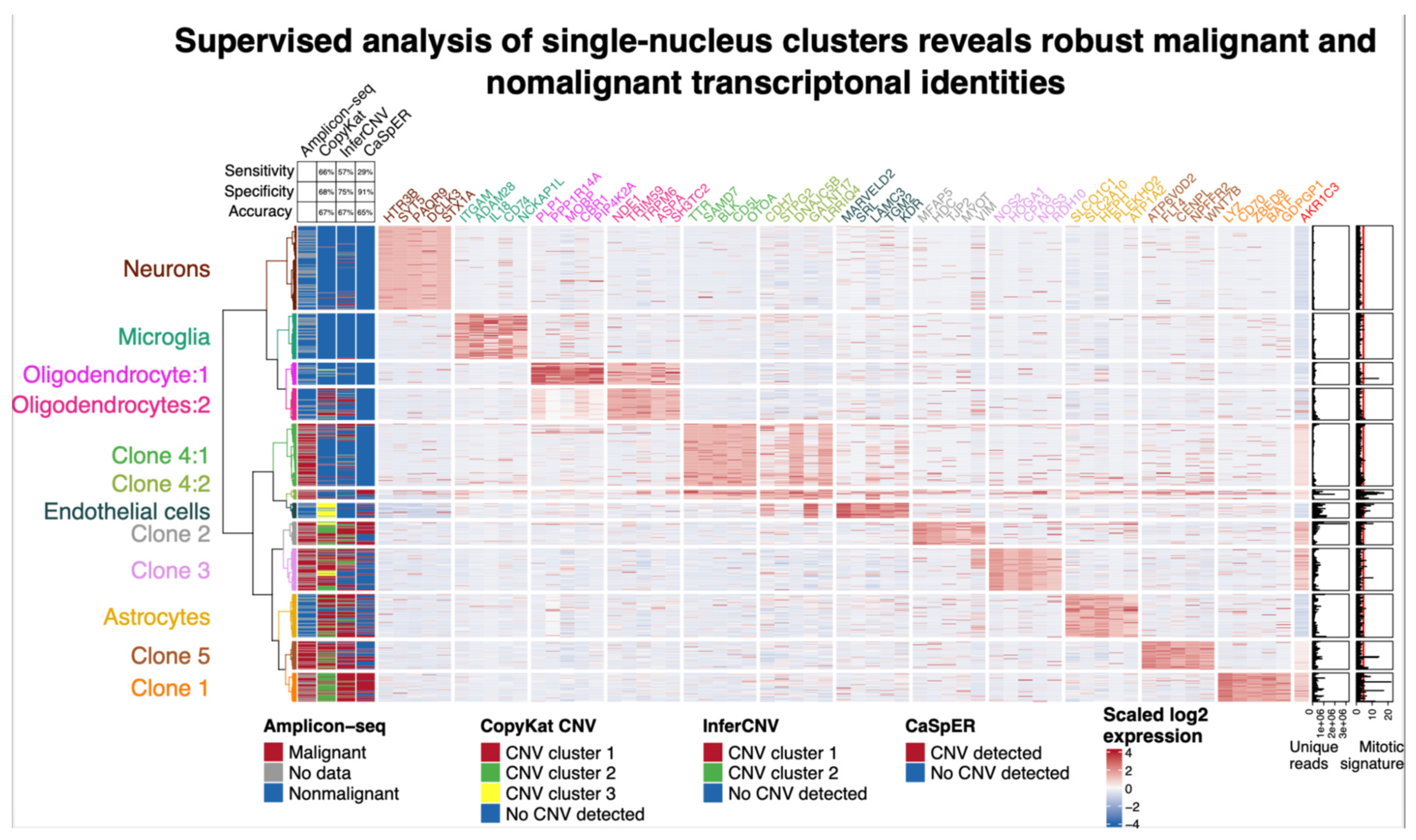
In Figure 7, the Accuracy numbers reported in the table above the top left corner of the heat map are incorrect. They should read: 67%, 67%, and 65%.
The corrected Figure 7 appears below.
Figure 7.
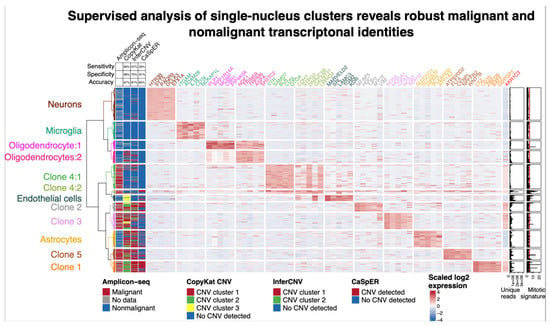
Genotyping nuclei profiled by snRNA-seq reveals the limitations of single-cell CNV-calling algorithms. Heatmap of scaled log2 expression vectors for the five most upregulated genes in each snRNA-seq cluster vs. all other clusters (one-sided Wilcoxon rank-sum test). Far left: malignancy vector determined by snAmp-seq of cDNA spanning mutations in the truncal clone. Left: malignancy vectors inferred from CNV analysis of snRNA-seq data using the CopyKat [49], InferCNV [25], or CaSpER [50] algorithms (blue = nonmalignant; all other colors = malignant). Right: bar plots depict the total number of unique reads (UMIs) for each nucleus and the average number of UMIs for genes comprising the Gene Ontology category ‘mitotic chromosome condensation’ (GO: 0030261). Red vertical line: max expression of mitotic genes in neurons, which presumably represents background noise.
- Text Correction
In the original publication, there was a mistake in two texts of Sections 2 and 3.
Original text 1 in Section 2.5:
“Overall, none of the algorithms for inferring malignancy from CNVs achieved accuracy > 61% (Figure 7).”
Original text 2 in Section 3:
“In our study, we found that popular algorithms for identifying cancer cells from inferred CNVs from gene expression data [25,49,50] were only ~60% accurate.”
A correction has been made to Section 2.5 Case 2: Analysis of Gene Expression and Section 3 Discussion:
Corrected text 1 in Section 2.5:
“Overall, none of the algorithms for inferring malignancy from CNVs achieved accuracy > 67% (Figure 7).”
Corrected text 2 in Section 3:
“In our study, we found that popular algorithms for identifying cancer cells from inferred CNVs from gene expression data [25,49,50] were only ~66% accurate.”
The authors state that the scientific conclusions are unaffected. This correction was approved by the Academic Editor. The original publication has also been updated.
Reference
- Schupp, P.G.; Shelton, S.J.; Brody, D.J.; Eliscu, R.; Johnson, B.E.; Mazor, T.; Kelley, K.W.; Potts, M.B.; McDermott, M.W.; Huang, E.J.; et al. Deconstructing Intratumoral Heterogeneity through Multiomic and Multiscale Analysis of Serial Sections. Cancers 2024, 16, 2429. [Google Scholar] [CrossRef] [Scilit] [PubMed]
Disclaimer/Publisher’s Note: The statements, opinions and data contained in all publications are solely those of the individual author(s) and contributor(s) and not of MDPI and/or the editor(s). MDPI and/or the editor(s) disclaim responsibility for any injury to people or property resulting from any ideas, methods, instructions or products referred to in the content. |
© 2026 by the authors. Licensee MDPI, Basel, Switzerland. This article is an open access article distributed under the terms and conditions of the Creative Commons Attribution (CC BY) license.