


Simple Summary
Multiple endocrine neoplasia type 2A (MEN 2A) is a rare hereditary cancer syndrome characterized by medullary thyroid carcinoma (MTC), pheochromocytoma (PHEO), primary hyperparathyroidism (PHPT), cutaneous lichen amyloidosis (CLA), and Hirschsprung’s disease. The syndrome is caused by pathogenic variants in the rearranged during transfection (RET) proto-oncogene. Phenotypic data on the pathogenic RET variant C611Y remain sparse. We therefore conducted a Danish nationwide study of all cases (n = 128). The C611Y variant is associated with a very high penetrance of MTC and a low penetrance of PHEO and PHPT. CLA and Hirschsprung’s disease were not observed. MTC seems moderately aggressive in comparison to other RET variants. Overall survival may be comparable to that of the general population.
Abstract
Background: Multiple endocrine neoplasia type 2A (MEN 2A) is a rare hereditary cancer syndrome caused by pathogenic variants in the rearranged during transfection (RET) gene and is characterized by medullary thyroid carcinoma (MTC), pheochromocytoma (PHEO), primary hyperparathyroidism (PHPT), cutaneous lichen amyloidosis (CLA), and Hirschsprung’s disease. Phenotypic data on the RET C611Y variant remain sparse. Consequently, we aimed to establish a clinical risk profile. Methods: We conducted a nationwide study of all cases (n = 128) born after 1 January 1930 and recognized as carrying the RET C611Y variant in Denmark before 1 April 2021. Results: The median follow-up after birth was 47 years (range, 3–92). Age-related penetrance at age 70 years for MTC was 98% (CI, 91–100), for PHEO 24% (CI, 16–37), and for PHPT 10% (CI, 5–20). None had CLA or Hirschsprung’s disease. The age-related progression of MTC was significant (p < 0.001). The mean age at T0N0M0 was 16 years (CI, 12–20), at T1-4N0M0 38 years (CI, 34–42), at TxN1M0 45 years (CI, 38–53) and at TxNxM1 49 years (CI, 36–61). At the last follow-up, 56% of thyroidectomized cases (n = 103) were biochemically cured. Overall survival at 70 years was 74% (CI, 59–84). Conclusions: RET C611Y is associated with a very high penetrance of MTC and a low penetrance of PHEO and PHPT. CLA and Hirschsprung’s disease almost never occur. MTC seems moderately aggressive, but large variability can be seen. Overall survival may be comparable to that of the general population.
1. Introduction
Multiple endocrine neoplasia type 2A (MEN 2A) (OMIM #171400) is a rare hereditary cancer syndrome with a point prevalence of 13–24 per million [1,2]. The syndrome predisposes carriers to the development of medullary thyroid cancer (MTC), pheochromocytoma (PHEO), primary hyperparathyroidism (PHPT), cutaneous lichen amyloidosis (CLA), and Hirschsprung’s disease [3,4,5].
MEN 2A is inherited in an autosomal dominant pattern. The syndrome is caused by activating germline mutations in the rearranged during transfection (RET) proto-oncogene. Shortly after this was discovered in 1993 [6,7], strong genotype–phenotype correlations were observed by the International RET Mutation Consortium [8,9]. Since then, solid clinical risk profiles have been established for various RET variants [10,11,12,13,14,15,16,17,18]. However, precise phenotypic data on carriers of variants in codon 611 and specifically for carriers of the C611Y variant remain sparse. Thus, the International RET Exon 10 Consortium investigated 50 carriers of codon 611 variants, 15 of whom harbored the C611Y variant [10]. Meanwhile, a Chinese study reported on a pedigree comprising 17 C611Y carriers [19]. The largest study of C611Y carriers to date, a German single center study, included 42 carriers of codon 611 variants, with 19 harboring the C611Y variant [20]. Likely due to a founder effect, the C611Y variant is the most common in Denmark, accounting for 128 of 216 MEN 2A cases [21,22,23]. This provides the perfect setting for a nationwide population-based study of C611Y carriers.
Consequently, we conducted the largest genotype–phenotype study on C611Y carriers to date, focusing exclusively on the C611Y variant, aiming to establish a risk profile for optimal clinical management.
2. Methods
2.1. Study Design and Setting
This investigation was a nationwide study of all cases (n = 128) born after 1 January 1930 and recognized as carrying the RET C611Y variant in Denmark before 1 April 2021 [2].
2.2. Data Sources
The Danish MEN 2 cohort 1901–2021 was used [21]. Once cases had been recognized as C611Y carriers, data were recorded both retrospectively and prospectively.
2.3. Participants
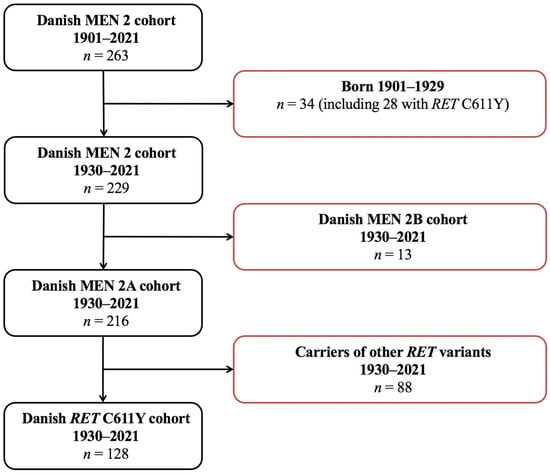
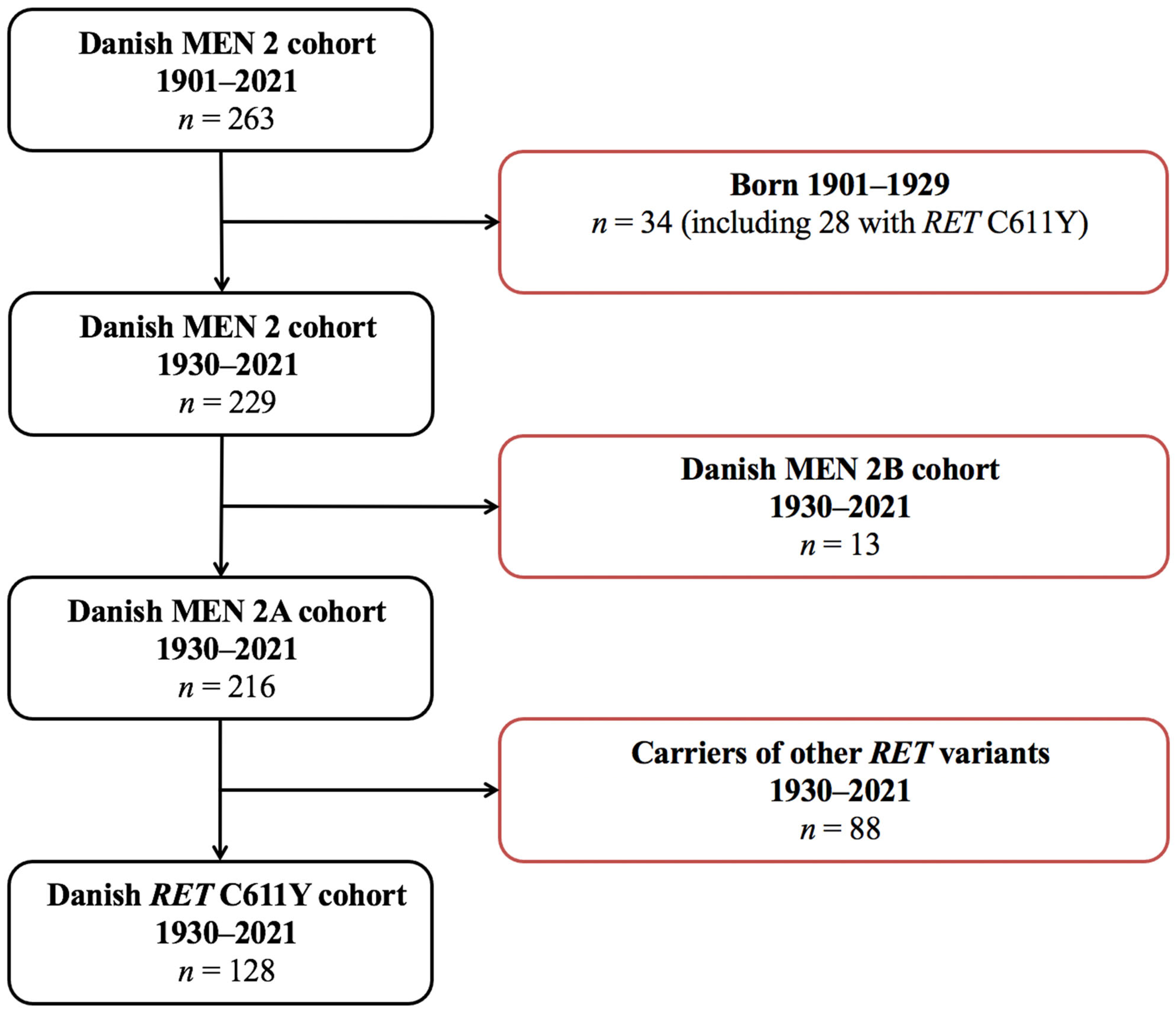
Between 1 January 1901 and 1 April 2021, 263 cases (250 MEN 2A, 13 MEN 2B) were registered in the Danish MEN 2 cohort [21]. Of these, 34 were born in 1901–1929 and excluded [21]. Among the remaining 229 cases, 13 had MEN 2B and were also excluded. This provided a Danish MEN 2A cohort for 1930–2021 with 216 cases. Of these, 88 carried other variants than the RET 611Y. Consequently, the Danish RET C611Y cohort for 1930–2021 contained 128 cases (Figure 1).
Figure 1.
Danish RET C611Y cohort for 1930–2021. Abbreviations: MEN, multiple endocrine neoplasia; RET, rearranged during transfection.
2.4. Variables
An index case was defined as a clinically affected individual through whom attention was first drawn to the presence of MEN 2A in a family [24]. In index cases, the date of MEN 2A diagnosis was recorded as the date where suspicion of MEN 2A was raised for the first time in the medical record. In non-index cases, it was recorded as the date of a positive RET test or the date of prophylactic thyroid surgery, according to whichever came first. MEN 2A cases (n = 6) in which the carrier was unaware of the syndrome before death or emigration were omitted from calculations of age at MEN 2A diagnosis.
Normal thyroid, C-cell hyperplasia (CCH), MTC, PHEO, CLA, and Hirschsprung’s disease were defined by histology. The date of surgery was recorded as the date of diagnosis. If diagnosis was conducted at autopsy, date of death was recorded as the date of diagnosis.
Prophylactic thyroidectomy was defined, in accordance with the 2015 American Thyroid Association (ATA) guidelines on MTC, as the removal of the thyroid before MTC develops or while it is clinically unapparent and confined to the gland [25], or as thyroidectomy in a clinically asymptomatic or presymptomatic carrier [26,27]. MTC staging was performed according to the AJCC TNM staging system (seventh and eighth edition) [28,29]. Distant metastases were considered by imaging and/or histology. A biochemical cure was established by basal serum calcitonin levels below the limit of detection or the limit of quantification at last biochemical follow-up [30].
For the assessment of the age-related progression of MTC, we created four groups: Group 1, normal thyroid/CCH, included carriers with a normal thyroid or CCH and the absence of MTC at initial thyroid surgery. Group 2, MTC T1-4N0M0, included carriers with MTC and no regional or distant metastases at initial thyroid surgery. Group 3, MTC TxN1M0, included carriers with regional lymph node metastases at initial thyroid surgery or any time during follow-up. Group 4, MTC TxNxM1, included carriers with distant metastases at initial thyroid surgery or any time during follow-up.
PHPT was defined as hypercalcemia and an elevated or inappropriately normal parathyroid hormone level [31]. Cured PHPT was defined as the reestablishment of normal calcium homeostasis lasting for a minimum of six months after parathyroidectomy. PHPT was considered to have persisted upon the failure to achieve normocalcemia within six months of parathyroidectomy, while recurrence was defined as the recurrence of hypercalcemia after a normocalcemic interval of more than six months after parathyroidectomy [32].
2.5. Statistical Analysis
Continuous data were displayed as median and range or mean and confidence interval where appropriate. Categorical data were shown with absolute and relative values. Cuzick’s test was used to evaluate trends in the age-related progression of MTC. The Kaplan–Meier method was used for estimating age-related penetrance and overall survival. All tests were two-sided, and p-values < 0.05 were considered statistically significant. All analyses were conducted using Stata 17.0 (StataCorp, College Station, TX, USA).
2.6. Ethics
The investigation was approved by the Region of Southern Denmark (21/20832) and the Danish Data Protection Agency (21/31449).
3. Results
3.1. Demographics
Overall characteristics of the 128 included RET C611Y carriers are shown in Table 1. The female–male ratio was 0.75. Median follow-up after birth was 47 years (range, 3–92). De novo variants were not observed.
Table 1.
RET C611Y carriers in Denmark 1930–2021.
3.2. Thyroid
The characteristics of carriers who had undergone thyroidectomy are shown in Table 2. The distribution across the TNM stages for the overall group was 0 (41%), I (40%), II (2%), III (12%), IVa (5%), IVb (0%), and IVc (2%). Comparison of distribution among index cases and non-index cases showed significantly lower stages in the non-index group (<0.001) (Fischer’s exact test).
Table 2.
Thyroid in RET C611Y carriers in Denmark 1930–2021.
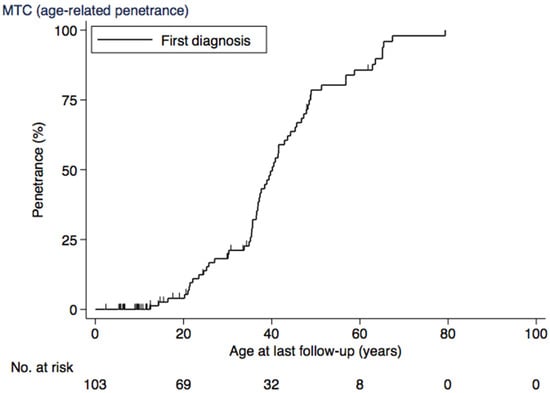
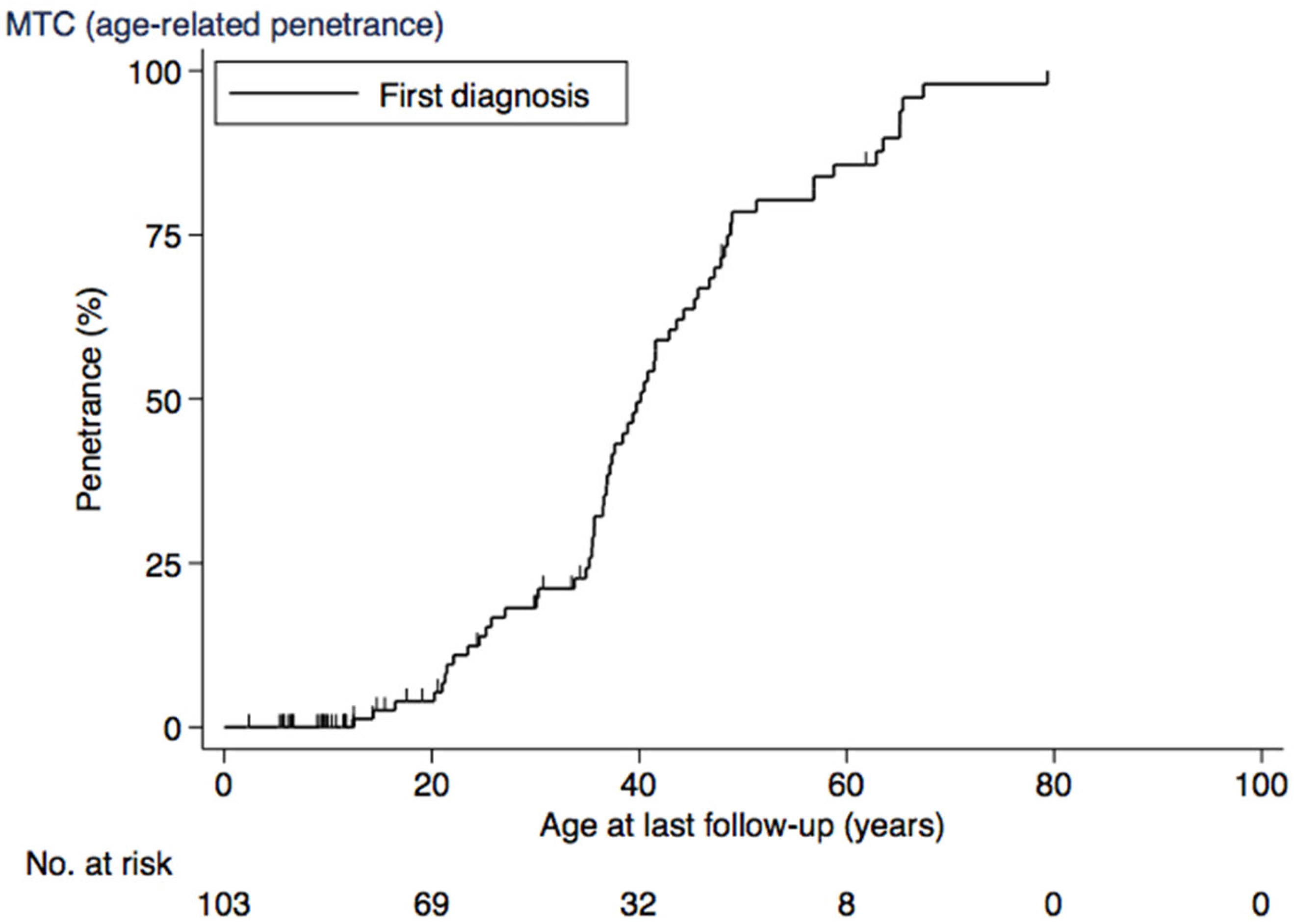
Analysis of the age-related progression of MTC is seen in Table 3. The age-related penetrance of MTC at 10 years was 0%, at 20 years was 4% (CI, 1–12), at 30 years was 18% (CI, 11–29), at 40 years was 50% (CI, 38–62), at 50 years was 79% (CI, 68–88), at 60 years was 86% (CI, 76–93), and at 70 years was 98% (CI, 91–100) (Figure 2).
Table 3.
Age-related progression of MTC in RET C611Y carriers in Denmark 1930–2021.
Figure 2.
Age-related penetrance of MTC. Abbreviations: MTC, medullary thyroic cancer.
3.3. PHEO
The characteristics of carriers with PHEO are presented in Table 4.
Table 4.
PHEO in RET C611Y carriers in Denmark 1930–2021.
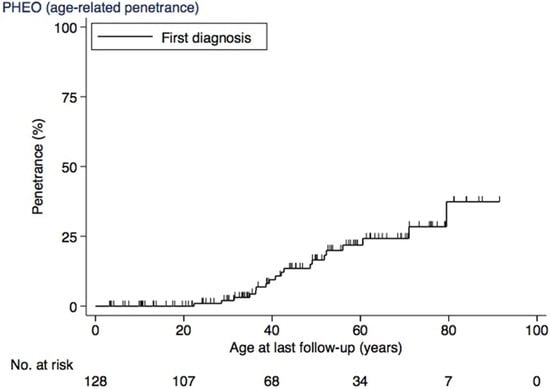
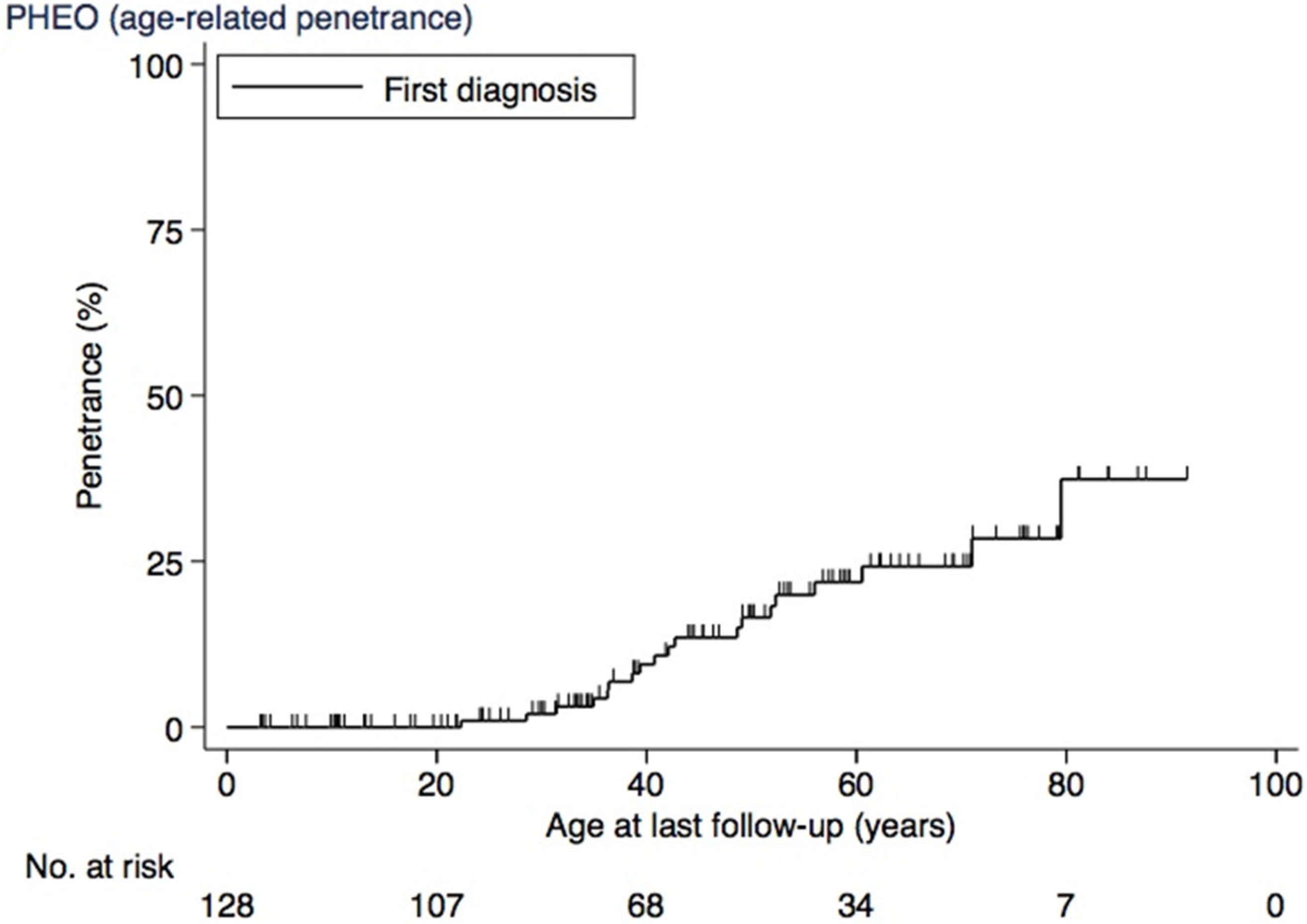
The age-related penetrance of PHEO at 20 years was 0%, at 30 years was 2% (CI, 1–8), at 40 years was 9% (CI, 5–18), at 50 years was 17% (CI, 10–27), at 60 years was 22% (CI, 14–34), and at 70 years was 24% (CI, 16–37) (Figure 3).
Figure 3.
Age-related penetrance of PHEO. Abbreviations: PHEO, pheochromocytoma.
3.4. PHPT
Among the 128 carriers, data on calcium level was available in 122 cases. The characteristics of those with PHPT are depicted in Table 5.
Table 5.
PHPT in RET C611Y carriers in Denmark 1930–2021.
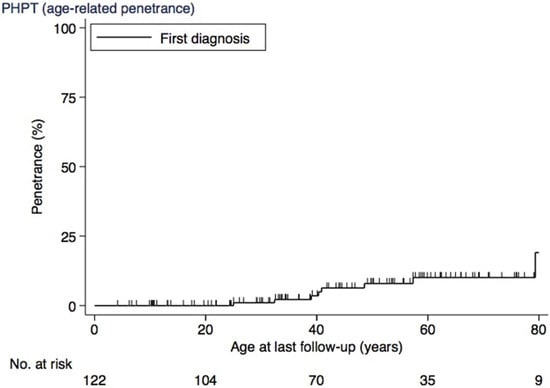
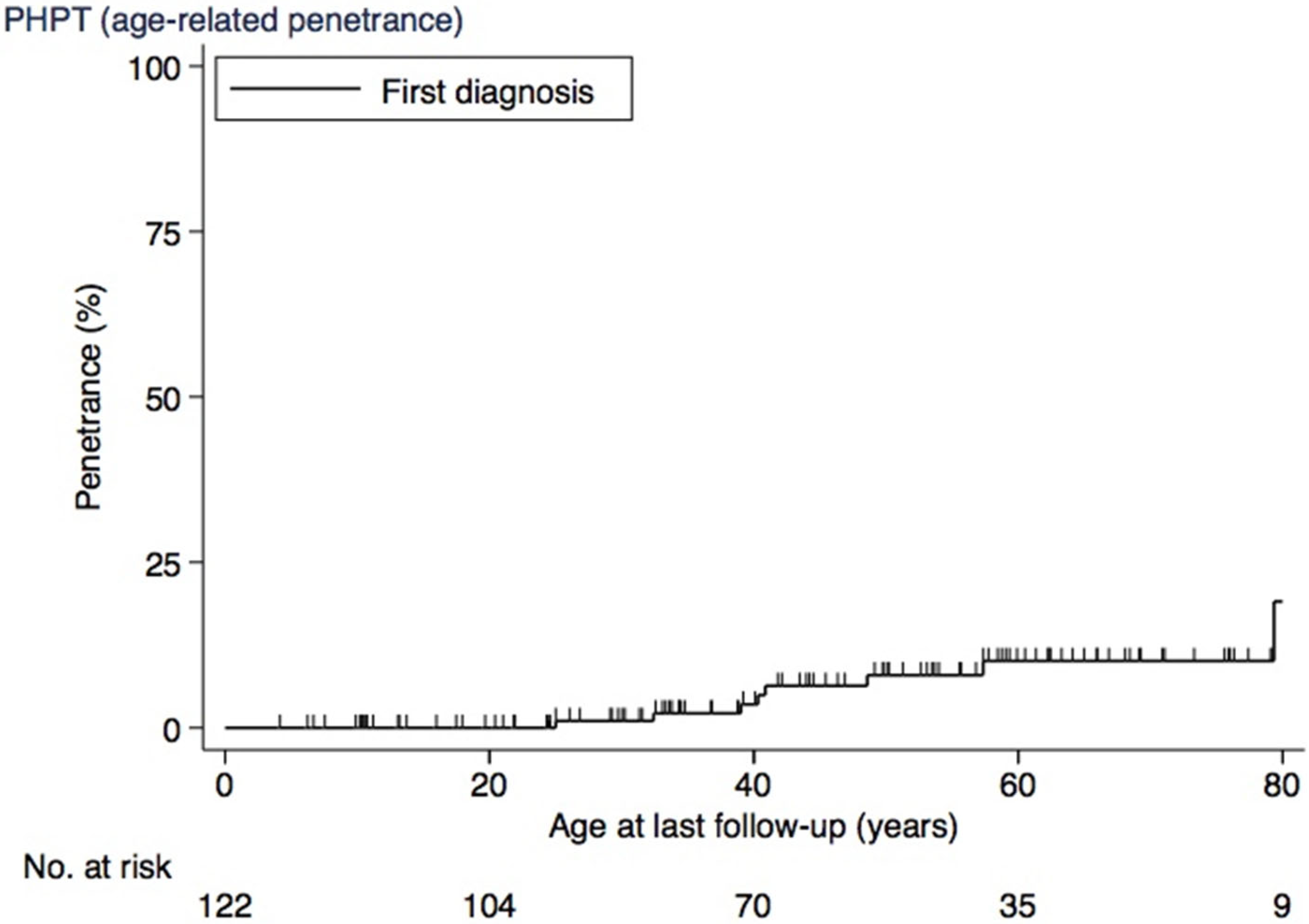
The age-related penetrance of PHPT at 20 years was 0%, at 30 years was 1% (CI, 0.2–7), at 40 years was 4% (CI, 1–11), at 50 years was 8% (CI, 4–17), at 60 years was 10% (CI, 5–20), and at 70 years was 10% (CI, 5–20) (Figure 4).
Figure 4.
Age-related penetrance of PHPT. Abbreviations: PHPT, primary hyperparathyroidism.
3.5. Other Manifestations
Neither CLA nor Hirschsprung’s disease were observed in this cohort.
3.6. Survival
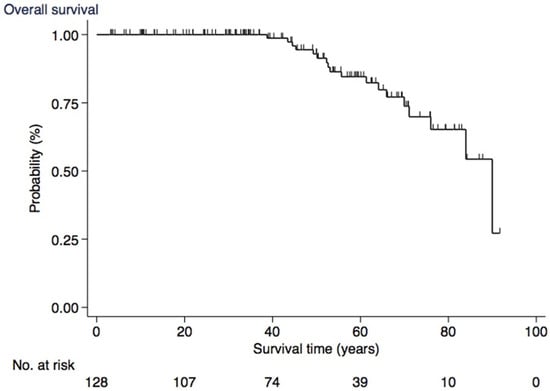
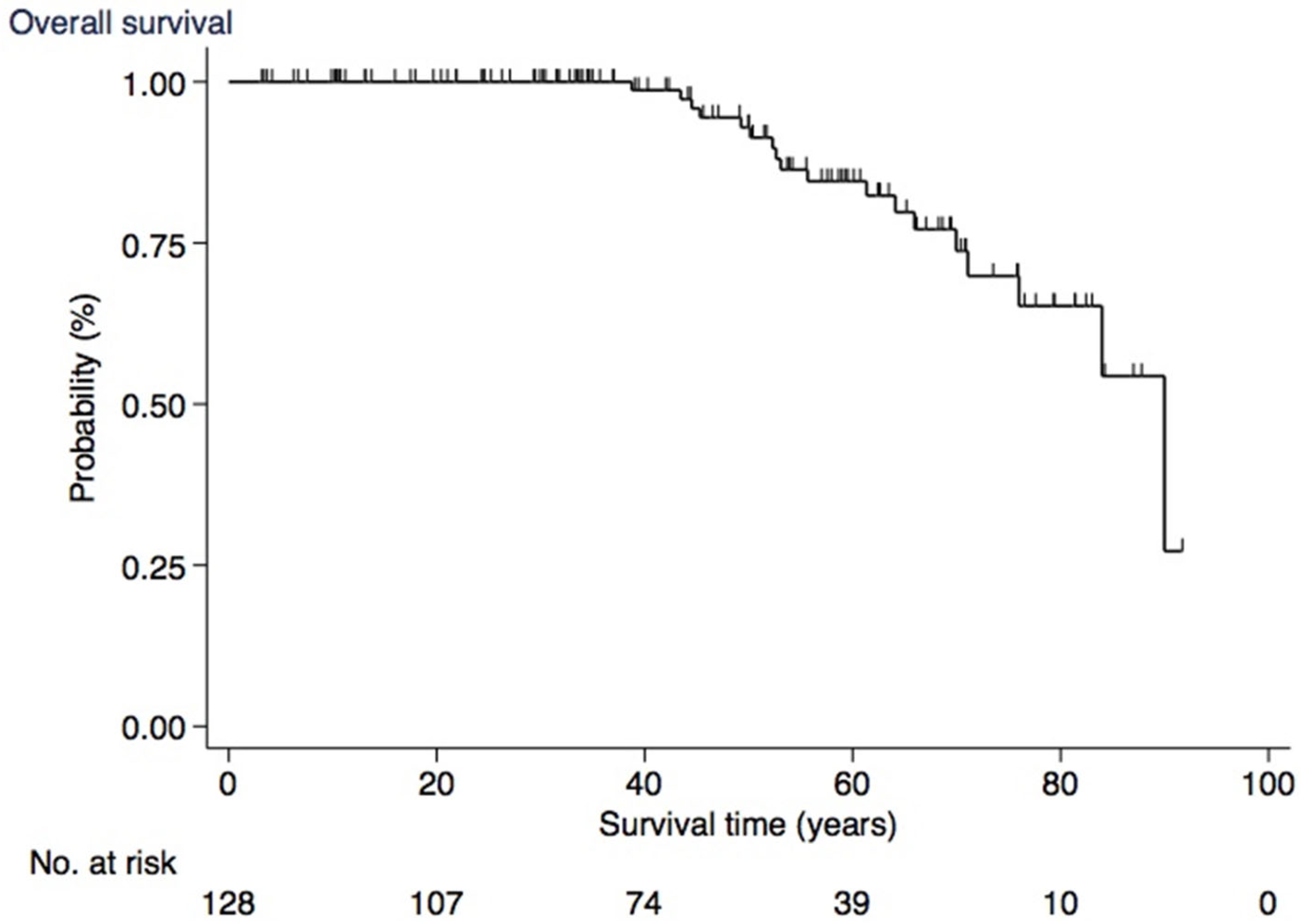
Overall survival at 30 years was 100%, at 40 years was 99% (CI, 91–100), at 50 years was 93% (CI, 84–97), at 60 years was 85% (CI, 73–91), at 70 years was 74% (CI, 59–84), and at 80 years was 65% (CI, 47–79) (Figure 5).
Figure 5.
Overall survival.
4. Discussion
In this national study of the largest RET C611Y cohort to date, we provided a detailed description of disease manifestations (MTC, PHEO, PHPT, CLA, and Hirschsprung’s disease) and survival.
4.1. Limitations
For full thyroid data, all carriers need to undergo a total thyroidectomy. In our cohort, 25 carriers had not undergone thyroid surgery at last follow-up. The reasons for this were normal calcitonin (n = 13), MEN 2 diagnosis unknown by the carrier (n = 5), refusal of MEN 2 work-up (n = 4), age younger than recommended for calcitonin screening (n = 2) [25], and carrier preference (n = 1). Thyroidectomy in these cases would be unethical and opposed to the guidelines [25].
PHPT data at last follow-up were missing in six carriers due to being aged younger than recommended for PHPT screening (n = 3) [25], MEN 2 diagnosis being unknown by the carrier (n = 2), or a missing medical record (n = 1). Given that data were missing in only 2% (n = 3) of relevant carriers, this is likely to be insignificant.
Our definition of PHEO may miss those cases where the carrier was not operated on. This proportion, however, is likely very small, as surgical resection is the cornerstone of therapy [33]. Histological definition also enables the inclusion of PHEO diagnosed by autopsy in carriers without prior surgery or biochemical or imaging work-up.
4.2. Demographics
The female–male ratio was comparable with previous studies [10,19]. While age at MEN 2A diagnosis has not previously been reported, median age at last follow-up was similar to a previous study [19]. To date, our study is the only to have reported the de novo variant frequency in C611Y carriers. of the rate of de novo variants found here (0%) is lower than that (9%) reported for MEN 2A overall [34].
4.3. Thyroid
MTC prevalence in our study (60%) was comparable to that of previous single- and multicenter studies (53–60%) [10,20]. A Chinese study reported a higher MTC prevalence (100%), which may reflect the higher median age at surgery (40 years) compared to ours (33 years) [19]. The proportion of carriers with normal thyroid or C-cell hyperplasia found here (40%) corresponds well with that of previous studies (40–47%) [10,20]. MTC N0M0 was more frequent in our cohort (41% vs. 21–27%), while MTC N1M0 was more frequent in other cohorts (17% vs. 27–32%) [10,20]. The low rate of distant metastases at time of initial surgery found here (2%) is similar to that seen in other studies (0–7%) [10,19,20]. The median follow-up after thyroidectomy in our study is significantly longer (20 years) than reported in a comparable study (0.33 years) [19]. Meanwhile, the cure rate found here (56%) corresponds well with that of the other study (55%) [19]. A higher cure rate (74%) was seen in a German-led multicenter study. An explanation for this discrepancy may be that the study included not only C611Y carriers but also carriers of the C611W and C611F variants, which may be phenotypically less aggressive. Also, the study did not explicitly define a cure or describe the duration until follow-up [10]. The age-related progression of MTC in C611Y carriers has only been reported once previously. Although our results are based on nationwide long-term follow-up and previous results were based on time at thyroidectomy in two single centers, the results are very similar [20]. The age-related penetrance of MTC has never been reported for C611Y carriers alone. However, when comparing with the multicenter study that included all codon 611 variant carriers, the age-related penetrance of MTC found here is only slightly higher than that seen in the multicenter study (34). This may reflect a difference in populations.
4.4. PHEO
The prevalence of PHEO (15%) found in our study corresponds well with that (12%) reported in a recent Chinese study [19] but is somewhat lower than that (27%) reported in a multicenter study by the International RET Exon 10 Consortium [10]. As our study was much larger (n = 128 vs. n = 15) and without selection bias, it is likely that the prevalence of PHEO is lower than that reported by the Exon 10 Consortium. The median age at PHEO diagnosis (42 years) in our cohort is markedly lower than that (53 years) seen in the Chinese study. However, the data from that study were only based on two C611Y carriers with PHEO [19]. We report for the first time on C611Y carriers with hypertensive crisis (11%) and malignant PHEO (5%), documenting that, although rare, this may occur. Also, we report for the first time on the C611Y-specific age-related penetrance of PHEO. The age-related penetrance found here largely corresponds with that found in two large studies looking at carriers of all 611 variants [10,35].
4.5. PHPT
The PHPT prevalence found in our study (7%) was comparable to that of previous studies (0–7%) [10,19]. We report for the first time C611Y-specific data on age at diagnosis, biochemistry, symptoms, hypercalcemic crisis, surgical procedure, histology, and follow-up for PHPT, hindering literature comparison. Similarly, we report on the C611Y-specific age-related penetrance of PHPT for the first time. However, the age-related penetrance found here is comparable to that reported on all 611 variant carriers by the International RET Exon 10 Consortium [10].
4.6. Other Manifestations
In our cohort, there were no carriers with CLA. This may to some extent be explained by our strict histological definition but likely represents real-world reality, as this manifestation has only been reported once in the C611Y literature [19]. Also, we found no carriers with Hirschsprung’s disease, pointing towards an extremely low likelihood of this manifestation in C611Y carriers. Similar results have been found in several smaller studies [10,19,36].
4.7. Survival
Our survival data are the first ever reported on C611Y carriers and among very little long-term survival data on MEN 2A in general. This hinders one-on-one comparison to the literature. However, if conducting a rough comparison with a large Danish reference population from another nationwide population-based study with a roughly similar female–male ratio, the overall survival of C611Y carriers seems comparable to that of the general population [37].
5. Conclusions
RET C611Y is associated with a very high penetrance of MTC and a low penetrance of PHEO and PHPT. CLA and Hirschsprung’s disease almost never occur. MTC seems moderately aggressive, but large variability can be seen. Overall survival may be comparable to that of the general population.
Author Contributions
J.S.M. conceptualized the study and collected data. J.S.M. and A.W.H. analyzed and interpreted data and drafted, revised, and gave final approval of the manuscript. P.V., M.M.P., Å.K.R., U.F.-R., M.M., R.W.N., D.H., K.M., H.B.P., S.C.L., L.R., C.H.H., K.B.R., C.M., H.H.N., M.G., M.R. and P.H. contributed and interpreted data and critically revised and gave final approval of the manuscript. All authors have read and agreed to the published version of the manuscript.
Funding
The work was supported by Odense University Hospital (grant number 142-A5632).
Institutional Review Board Statement
The investigation was approved by the Region of Southern Denmark (21/20832) and the Danish Data Protection Agency (21/31449).
Informed Consent Statement
Patient consent was waived due to the Danish law, that states that patient consent is not required when the Region of Southern Denmark and the Danish Data Protection Agency has approved the study.
Data Availability Statement
Data collected for this study will be made available by the corresponding author upon reasonable request.
Conflicts of Interest
The authors declare no conflicts of interest.
Correction Statement
This article has been republished with a minor correction in the Abstract. This change does not affect the scientific content of the article.
References
- Opsahl, E.M.; Brauckhoff, M.; Schlichting, E.; Helset, K.; Svartberg, J.; Brauckhoff, K.; Mæhle, L.; Engebretsen, L.F.; Sigstad, E.; Grøholt, K.K.; et al. A Nationwide Study of Multiple Endocrine Neoplasia Type 2A in Norway: Predictive and Prognostic Factors for the Clinical Course of Medullary Thyroid Carcinoma. Thyroid 2016, 26, 1225–1238. [Google Scholar] [CrossRef] [Scilit]
- Mathiesen, J.S.; Kroustrup, J.P.; Vestergaard, P.; Stochholm, K.; Poulsen, P.L.; Rasmussen, Å.K.; Feldt-Rasmussen, U.; Schytte, S.; Pedersen, H.B.; Hahn, C.H.; et al. Incidence and prevalence of multiple endocrine neoplasia 2A in Denmark 1901–2014: A nationwide study. Clin. Epidemiol. 2018, 10, 1479–1487. [Google Scholar] [CrossRef] [Scilit]
- Steiner, A.L.; Goodman, A.D.; Powers, S.R. Study of a kindred with pheochromocytoma, medullary thyroid carcinoma, hyperparathyroidism and Cushing’s disease: Multiple endocrine neoplasia, type 2. Medicine 1968, 47, 371–409. [Google Scholar] [CrossRef] [Scilit] [PubMed]
- Donovan, D.T.; Levy, M.L.; Furst, E.J.; Alford, B.R.; Wheeler, T.; Tschen, J.A.; Gagel, R.F. Familial cutaneous lichen amyloidosis in association with multiple endocrine neoplasia type 2A: A new variant. Henry Ford Hosp. Med. J. 1989, 37, 147–150. [Google Scholar] [PubMed]
- Verdy, M.; Weber, A.M.; Roy, C.C.; Morin, C.L.; Cadotte, M.; Brochu, P. Hirschsprung’s disease in a family with multiple endocrine neoplasia type 2. J. Pediatr. Gastroenterol. Nutr. 1982, 1, 603–608. [Google Scholar] [CrossRef] [Scilit]
- Donis-Keller, H.; Dou, S.; Chi, D.; Carlson, K.M.; Toshima, K.; Lairmore, T.C.; Howe, J.R.; Moley, J.F.; Goodfellow, P.; Wells, S.A. Mutations in the RET proto-oncogene are associated with MEN 2A and FMTC. Hum. Mol. Genet. 1993, 2, 851–856. [Google Scholar] [CrossRef] [Scilit] [PubMed]
- Mulligan, L.M.; Kwok, J.B.J.; Healey, C.S.; Elsdon, M.J.; Eng, C.; Gardner, E.; Love, D.R.; Mole, S.E.; Moore, J.K.; Papi, L.; et al. Germ-line mutations of the RET proto-oncogene in multiple endocrine neoplasia type 2A. Nature 1993, 363, 458–460. [Google Scholar] [CrossRef] [Scilit] [PubMed]
- Mulligan, L.M.; Marsh, D.J.; Robinson, B.G.; Schuffenecker, I.; Zedenius, J.; Lips, C.J.M.; Gagel, R.F.; Takai, S.; Noll, W.W.; Fink, M.; et al. Genotype-phenotype correlation in multiple endocrine neoplasia type 2: Report of the International RET Mutation Consortium. J. Intern. Med. 1995, 238, 343–346. [Google Scholar] [CrossRef] [Scilit]
- Eng, C.; Clayton, D.; Schuffenecker, I.; Lenoir, G.; Cote, G.; Gagel, R.F.; Van Amstel, H.K.; Lips, C.J.; Nishisho, I.; Takai, S.I.; et al. The relationship between specific RET proto-oncogene mutations and disease phenotype in multiple endocrine neoplasia type 2. International RET mutation consortium analysis. JAMA 1996, 276, 1575–1579. [Google Scholar] [CrossRef] [Scilit]
- Frank-Raue, K.; Rybicki, L.A.; Erlic, Z.; Schweizer, H.; Winter, A.; Milos, I.; Toledo, S.P.; Toledo, R.A.; Tavares, M.R.; Alevizaki, M.; et al. Risk profiles and penetrance estimations in multiple endocrine neoplasia type 2A caused by germline RET mutations located in exon 10. Hum. Mutat. 2011, 32, 51–58. [Google Scholar] [CrossRef] [Scilit]
- Machens, A.; Dralle, H. Variability in Penetrance of Multiple Endocrine Neoplasia 2A with Amino Acid Substitutions in RET Codon 634. Clin. Endocrinol. 2015, 84, 210–215. [Google Scholar] [CrossRef] [Scilit] [PubMed]
- Milos, I.N.; Frank-Raue, K.; Wohllk, N.; Maia, A.L.; Pusiol, E.; Patocs, A.; Robledo, M.; Biarnes, J.; Barontini, M.; Links, T.P.; et al. Age-related neoplastic risk profiles and penetrance estimations in multiple endocrine neoplasia type 2A caused by germ line RET Cys634Trp (TGC>TGG) mutation. Endocr.-Relat. Cancer 2008, 15, 1035–1041. [Google Scholar] [CrossRef] [Scilit] [PubMed]
- Valdés, N.; Navarro, E.; Mesa, J.; Casterás, A.; Alcázar, V.; Lamas, C.; Tébar, J.; Castaño, L.; Gaztambide, S.; Forga, L. RET Cys634Arg mutation confers a more aggressive multiple endocrine neoplasia type 2A phenotype than Cys634Tyr mutation. Eur. J. Endocrinol. 2015, 172, 301–307. [Google Scholar] [CrossRef] [Scilit]
- Bihan, H.; Murat, A.; Fysekidis, M.; Al-Salameh, A.; Schwartz, C.; Baudin, E.; Thieblot, P.; Borson-Chazot, F.; Guillausseau, P.-J.; Cardot-Bauters, C.; et al. The clinical spectrum of RET proto-oncogene mutations in codon 790. Eur. J. Endocrinol. 2013, 169, 271–276. [Google Scholar] [CrossRef] [Scilit]
- Mathiesen, J.S.; Habra, M.A.; Bassett, J.H.D.; Choudhury, S.M.; Balasubramanian, S.P.; Howlett, T.A.; Robinson, B.G.; Gimenez-Roqueplo, A.-P.; Castinetti, F.; Vestergaard, P.; et al. Risk Profile of the RET A883F Germline Mutation: An International Collaborative Study. J. Clin. Endocrinol. Metab. 2017, 102, 2069–2074. [Google Scholar] [CrossRef] [Scilit] [PubMed]
- Schulte, K.-M.; Machens, A.; Fugazzola, L.; McGregor, A.; Diaz-Cano, S.; Izatt, L.; Aylwin, S.; Talat, N.; Beck-Peccoz, P.; Dralle, H. The clinical spectrum of multiple endocrine neoplasia type 2a caused by the rare intracellular RET mutation S891A. J. Clin. Endocrinol. Metab. 2010, 95, E92–E97. [Google Scholar] [CrossRef] [Scilit]
- Giacché, M.; Panarotto, A.; Tacchetti, M.C.; Tosini, R.; Campana, F.; Mori, L.; Cappelli, C.; Pirola, I.; Lombardi, D.; Pezzola, D.C.; et al. p.Ser891Ala RET gene mutations in medullary thyroid cancer: Phenotypical and genealogical characterization of 28 apparently unrelated kindreds and founder effect uncovering in Northern Italy. Hum. Mutat. 2019, 40, 926–937. [Google Scholar] [CrossRef] [Scilit]
- Castinetti, F.; Waguespack, S.G.; Machens, A.; Uchino, S.; Hasse-Lazar, K.; Sanso, G.; Else, T.; Dvorakova, S.; Qi, X.P.; Elisei, R.; et al. Natural history, treatment, and long-term follow up of patients with multiple endocrine neoplasia type 2B: An international, multicentre, retrospective study. Lancet Diabetes Endocrinol. 2019, 7, 213–220. [Google Scholar] [CrossRef] [Scilit]
- Qi, X.-P.; Peng, J.-Z.; Yang, X.-W.; Cao, Z.-L.; Yu, X.-H.; Fang, X.-D.; Zhang, D.-H.; Zhao, J.-Q. The RET C611Y mutation causes MEN 2A and associated cutaneous. Endocr. Connect. 2018, 7, 998–1005. [Google Scholar] [CrossRef] [Scilit]
- Machens, A.; Lorenz, K.; Weber, F.; Dralle, H. Genotype-specific progression of hereditary medullary thyroid cancer. Hum. Mutat. 2018, 39, 860–869. [Google Scholar] [CrossRef] [Scilit]
- Holm, M.; Vestergaard, P.; Poulsen, M.M.; Rasmussen, Å.K.; Feldt-Rasmussen, U.; Bay, M.; Rolighed, L.; Londero, S.; Pedersen, H.B.; Hahn, C.H.; et al. Primary Hyperparathyroidism in Multiple Endocrine Neoplasia Type 2A in Denmark 1930–2021: A Nationwide Population-Based Retrospective Study in Denmark 1930–2021. Cancers 2023, 15, 2125. [Google Scholar] [CrossRef] [Scilit] [PubMed]
- Mathiesen, J.S.; Kroustrup, J.P.; Vestergaard, P.; Stochholm, K.; Poulsen, P.L.; Rasmussen, Å.K.; Feldt-Rasmussen, U.; Gaustadnes, M.; Ørntoft, T.F.; Hansen, T.v.O.; et al. Distribution of RET Mutations in Multiple Endocrine Neoplasia 2 in Denmark 1994–2014: A Nationwide Study. Thyroid 2017, 27, 215–223. [Google Scholar] [CrossRef] [Scilit] [PubMed]
- Mathiesen, J.S.; Kroustrup, J.P.; Vestergaard, P.; Stochholm, K.; Poulsen, P.L.; Rasmussen, Å.K.; Feldt-Rasmussen, U.; Gaustadnes, M.; Ørntoft, T.F.; Rossing, M.; et al. Founder Effect of the RETC611Y Mutation in Multiple Endocrine Neoplasia 2A in Denmark: A Nationwide Study. Thyroid 2017, 27, 1505–1510. [Google Scholar] [CrossRef] [Scilit]
- Porta, M.; Greenland, S.; Hernán, M.; dos Santos Silva, I.; Last, M. A Dictionary of Epidermiology, 6th ed.; Oxford University Press: New York, NY, USA, 2014. [Google Scholar]
- Wells, S.A.; Asa, S.L.; Dralle, H.; Elisei, R.; Evans, D.B.; Gagel, R.F.; Lee, N.; Machens, A.; Moley, J.F.; Pacini, F.; et al. Revised American Thyroid Association guidelines for the management of medullary thyroid carcinoma. Thyroid 2015, 25, 567–610. [Google Scholar] [CrossRef] [Scilit]
- Castinetti, F.; Moley, J.; Mulligan, L.M.; Waguespack, S.G. A comprehensive review on MEN2B. Endocrine-Related Cancer 2018, 25, T29–T39. [Google Scholar] [CrossRef] [Scilit]
- Raue, F.; Frank-Raue, K. Update on Multiple Endocrine Neoplasia Type 2: Focus on Medullary Thyroid Carcinoma. J. Endocr. Soc. 2018, 2, 933–943. [Google Scholar] [CrossRef] [Scilit]
- Amin, M.B.; Edge, S.B.; Greene, F.L.; Schilsky, R.L.; Gaspar, L.E.; Washington, M.K.; Sullivan, D.C.; Brierley, J.D.; Balch, C.M.; Compton, C.C.; et al. AJCC Cancer Staging Manual, 8th ed.; Springer: Berlin/Heidelberg, Germany, 2017. [Google Scholar]
- Edge, S.B.; Byrd, D.R.; Compton, C.C.; Fritz, A.G.; Greene, F.L.; Trotti, A. AJCC Cancer Staging Manual, 7th ed.; Springer: Berlin/Heidelberg, Germany, 2010. [Google Scholar]
- Fanget, F.; Demarchi, M.S.; Maillard, L.; Lintis, A.; Decaussin, M.; Lifante, J.C. Medullary thyroid cancer outcomes in patients with undetectable versus normalized postoperative calcitonin levels. Br. J. Surg. 2021, 108, 1064–1071. [Google Scholar] [CrossRef] [Scilit]
- Khan, A.A.; Hanley, D.A.; Rizzoli, R.; Bollerslev, J.; Young, J.; Rejnmark, L.; Thakker, R.; D’amour, P.; Paul, T.; Van Uum, S.; et al. Primary hyperparathyroidism: Review and recommendations on evaluation, diagnosis, and management. A Canadian and international consensus. Osteoporos. Int. 2017, 28, 1–19. [Google Scholar] [CrossRef] [Scilit]
- Wilhelm, S.M.; Wang, T.S.; Ruan, D.T.; Lee, J.A.; Asa, S.L.; Duh, Q.-Y.; Doherty, G.M.; Herrera, M.F.; Pasieka, J.L.; Perrier, N.D.; et al. The American Association of Endocrine Surgeons Guidelines for Definitive Management of Primary Hyperparathyroidism. JAMA Surg. 2016, 151, 959–968. [Google Scholar] [CrossRef] [Scilit]
- Neumann, H.P.H.; Young, W.F., Jr.; Eng, C. Pheochromocytoma and Paraganglioma. N. Engl. J. Med. 2019, 381, 552–565. [Google Scholar] [CrossRef] [Scilit]
- Schuffenecker, I.; Ginet, N.; Goldgar, D.; Eng, C.; Chambe, B.; Boneu, A.; Houdent, C.; Pallo, D.; Schlumberger, M.; Thivolet, C.; et al. Prevalence and parental origin of de novo RET mutations in multiple endocrine neoplasia type 2A and familial medullary thyroid carcinoma. Le Groupe d’Etude des Tumeurs a Calcitonine. Am. J. Hum. Genet. 1997, 60, 233–237. [Google Scholar]
- Imai, T.; Uchino, S.; Okamoto, T.; Suzuki, S.; Kosugi, S.; Kikumori, T.; Sakurai, A. High penetrance of pheochromocytoma in multiple endocrine neoplasia 2 caused by germ line RET codon 634 mutation in Japanese patients. Eur. J. Endocrinol. 2013, 168, 683–687. [Google Scholar] [CrossRef] [Scilit] [PubMed]
- Machens, A.; Lorenz, K.; Dralle, H. Kidney malformations and Hirschsprung’s disease in carriers of cysteine mutations in exon 10 of the RET proto-oncogene. Endocrine 2021, 73, 217–222. [Google Scholar] [CrossRef] [Scilit] [PubMed]
- Zhu, J.L.; Hasle, H.; Correa, A.; Schendel, D.; Friedman, J.; Olsen, J.; Rasmussen, S.A. Survival among people with Down syndrome: A nationwide population-based study in Denmark. Genet. Med. 2013, 15, 64–69. [Google Scholar] [CrossRef] [Scilit] [PubMed]

Disclaimer/Publisher’s Note: The statements, opinions and data contained in all publications are solely those of the individual author(s) and contributor(s) and not of MDPI and/or the editor(s). MDPI and/or the editor(s) disclaim responsibility for any injury to people or property resulting from any ideas, methods, instructions or products referred to in the content. |
© 2025 by the authors. Licensee MDPI, Basel, Switzerland. This article is an open access article distributed under the terms and conditions of the Creative Commons Attribution (CC BY) license (https://creativecommons.org/licenses/by/4.0/).