The Promise of Retinoids in the Treatment of Cancer: Neither Burnt Out Nor Fading Away


1
Department of Hematology, Kobe City Medical Center General Hospital, Kobe 650-0047, Hyogo, Japan
2
Department of Oncology, Sidney Kimmel Comprehensive Cancer Center, Johns Hopkins University School of Medicine, Baltimore, MD 21231, USA
*
Authors to whom correspondence should be addressed.
Cancers 2023, 15(14), 3535; https://doi.org/10.3390/cancers15143535
Submission received: 27 May 2023
/
Revised: 29 June 2023
/
Accepted: 3 July 2023
/
Published: 8 July 2023
(This article belongs to the Special Issue Acute Promyelocytic Leukemia (APML))
Simple Summary
In the realm of cancer treatment and prevention, the application of retinoids has led to unparalleled successes and humbling disappointments; all-trans retinoic acid (ATRA) has transformed APL (acute promyelocytic leukemia) into an eminently curable disease but has demonstrated little efficacy in acute myeloid leukemia (AML) more broadly. As a cancer prevention strategy, vitamin A supplementation was ineffective and appeared to increase lung cancer incidence, underscoring the complex relationship between retinoic acid signaling and carcinogenesis. This review aims to provide a survey of our current understanding of retinoic acid homeostasis and signaling, to reflect on prior successes and failures to deploy retinoids in the treatment and prevention of cancer, and to explore the unfulfilled potential of retinoids in cancer. New biological insights relating to the regulation of retinoid homeostasis and the discovery of biomarkers of retinoid sensitivity in subsets of non-APL AML have revived enthusiasm for the therapeutic potential of synthetic retinoids, and thus warrant a reacquaintance with retinoid biology.
Abstract
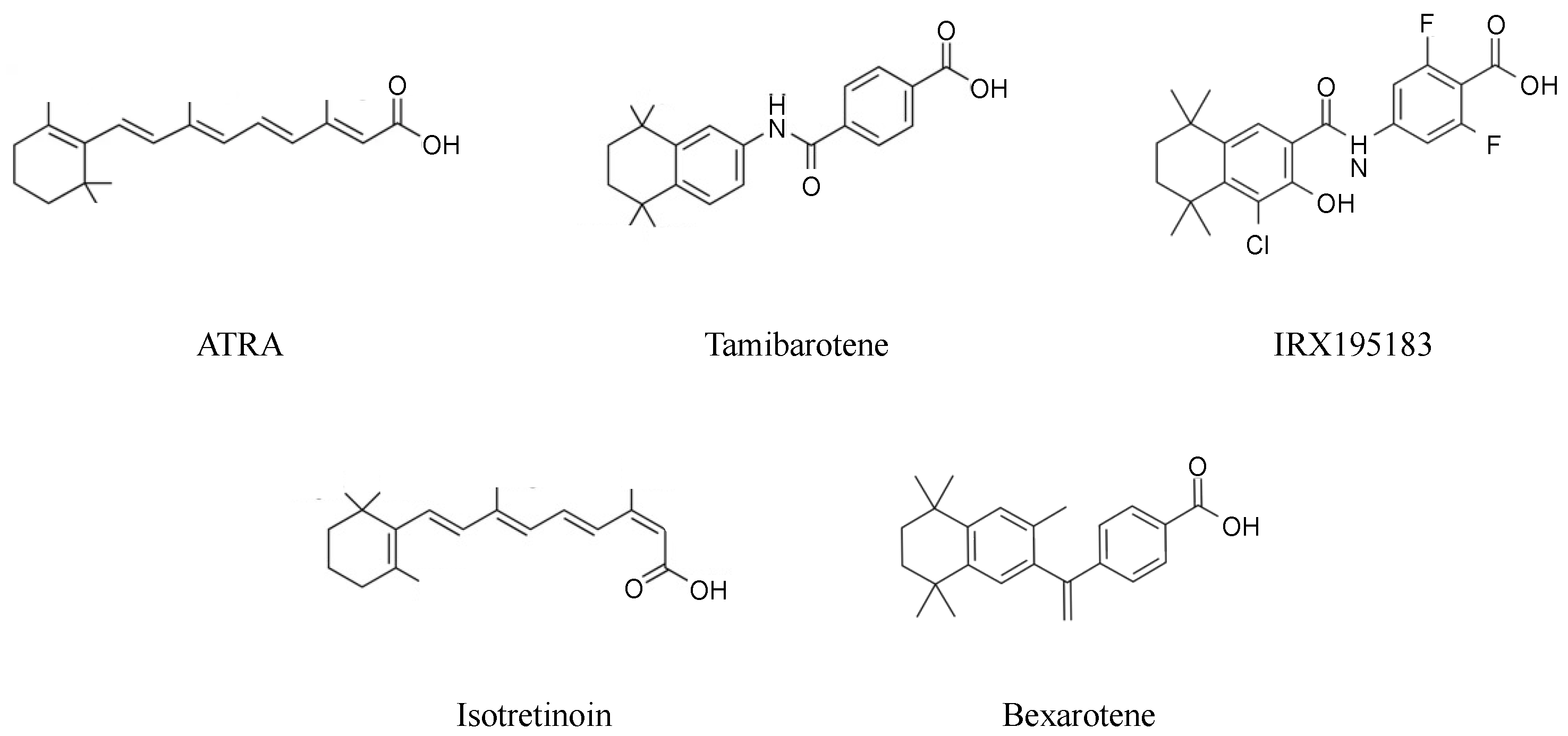
Since the introduction of all-trans retinoic acid (ATRA), acute promyelocytic leukemia (APL) has become a highly curable malignancy, especially in combination with arsenic trioxide (ATO). ATRA’s success has deepened our understanding of the role of the RARα pathway in normal hematopoiesis and leukemogenesis, and it has influenced a generation of cancer drug development. Retinoids have also demonstrated some efficacy in a handful of other disease entities, including as a maintenance therapy for neuroblastoma and in the treatment of cutaneous T-cell lymphomas; nevertheless, the promise of retinoids as a differentiating therapy in acute myeloid leukemia (AML) more broadly, and as a cancer preventative, have largely gone unfulfilled. Recent research into the mechanisms of ATRA resistance and the biomarkers of RARα pathway dysregulation in AML have reinvigorated efforts to successfully deploy retinoid therapy in a broader subset of myeloid malignancies. Recent studies have demonstrated that the bone marrow environment is highly protected from exogenous ATRA via local homeostasis controlled by stromal cells expressing CYP26, a key enzyme responsible for ATRA inactivation. Synthetic CYP26-resistant retinoids such as tamibarotene bypass this stromal protection and have shown superior anti-leukemic effects. Furthermore, recent super-enhancer (SE) analysis has identified a novel AML subgroup characterized by high expression of RARα through strong SE levels in the gene locus and increased sensitivity to tamibarotene. Combined with a hypomethylating agent, synthetic retinoids have shown synergistic anti-leukemic effects in non-APL AML preclinical models and are now being studied in phase II and III clinical trials.
Keywords:
retinoid; ATRA; tamibarotene; RARα; CYP26; differentiation therapy; APL; non-APL AML