


Simple Summary
Growing evidence shows that circRNAs are closely associated with the clinicopathological characteristics of pancreatic cancer (PC) patients and might facilitate the early diagnosis and prediction of prognosis after surgery. In this study, we reviewed a total of 48 studies to examine the clinical value of circRNAs in PC. We found that differentially expressed circRNAs are significantly correlated with the prognosis and clinicopathological features of PC patients and could assist the diagnosis, suggesting circRNAs as potent biomarkers in PC.
Abstract
Pancreatic cancer (PC) is a highly aggressive malignant tumor with a high mortality rate. It is urgent to find optimal molecular targets for the early diagnosis and treatment of PC. Here, we aimed to systematically analyze the prognostic, diagnostic, and clinicopathological significance of circular RNAs (circRNAs) in PC. Relevant studies were screened through PubMed, Web of Science, and other databases. The prognostic value of PC-associated circRNAs was assessed using the composite hazard ratio (HR), the diagnostic performance was assessed using the area under the summary receiver operator characteristic (SROC) curve (AUC), and the correlation with clinicopathological characteristics using the composite odds ratio (OR) was explored. In our study, 48 studies were included: 34 for prognosis, 11 for diagnosis, and 30 for correlation with clinicopathological characteristics. For prognosis, upregulated circRNAs were associated with poorer overall survival (OS) (HR = 2.02) and disease-free survival/progression-free survival (HR = 1.84) while downregulated circRNAs were associated with longer OS (HR = 0.55). Notably, the combination of circRNAs, including hsa_circ_0064288, hsa_circ_0000234, hsa_circ_0004680, hsa_circ_0071036, hsa_circ_0000677, and hsa_circ_0001460, was associated with worse OS (HR = 2.35). For diagnosis, the AUC was 0.83, and the pooled sensitivity and specificity were 0.79 and 0.73, respectively. For clinicopathologic characteristics, upregulated circRNAs were associated with poorer tumor differentiation, more nerve and vascular invasion, higher T stage, lymphatic metastasis, distant metastasis, advanced TNM stage, and higher preoperative CA19-9 level. In contrast, downregulated circRNAs were negatively associated with PC differentiation and lymphatic metastasis. Overall, our results showed that circRNAs are closely related to the prognosis and clinicopathological characteristics of PC patients and could be utilized for early diagnosis; thus, they are promising biomarkers for clinical application in PC.
1. Introduction
Pancreatic cancer (PC) is a highly malignant solid tumor with morbidity almost equal to fatality. Surgery is currently the only possible cure for PC, but less than 20% of patients are able to undergo surgery when their cancer is diagnosed [1,2]. This may be attributed to the fact that PC has an insidious onset and tends to metastasize at an early stage. As a result, the 5-year survival rate of PC patients is still lower than 8% despite the significant progress in surgical techniques, radiotherapy, chemotherapy, and other adjuvant therapies [3,4]. At present, with the introduction of the concept of precise and personalized treatment, early screening, early diagnosis, and early treatment, as well as the search for biological targets for postoperative adjuvant therapy, have become the key to extending the survival time of PC patients [5,6].
Circular RNAs (circRNAs), once considered to be the product of molecular fragments or RNA mis-splicing, originate from precursor mRNAs with low expression abundance [7]. Generated from the 5′ splice donor site and 3′ splice acceptor site of precursor mRNAs (pre-mRNAs), circRNAs are covalently linked in reverse order. Because circRNAs lack the 5’ cap and 3’ tail structures and contain covalent continuous closed-loop structures, they are able to resist exonuclease action with high stability [8]. The formation mechanism of circRNAs mainly includes the formation of lasso structures by exon skipping, the removal of introns by internal splicing, and finally, the formation of ring structures by complementary base pairing in the intron repeat region on both sides of exons, which has not yet been fully clarified [9]. Lariat-driven circularization and intron-pairing-driven circularization are common models of circRNA formation. Additionally, some RNA binding proteins (RBPs) might act as regulatory activators or inhibitors in circRNA biogenesis [10,11,12]. By far, there are four main categories of known circRNAs: exonic circRNAs, exon-intron circRNAs, circular intronic RNAs, and other types of circRNAs [13,14]. By competing with conventional splicing, acting as transcriptional modulators, serving as translation templates of proteins, functioning as competing endogenous RNAs (ceRNAs), and binding to proteins, circRNAs participate in multiple physiological and pathological processes at the transcriptional or posttranscriptional level [15]. Explicitly expressed in different cell types, tissues, and developmental stages, circRNAs have been reported to contribute to various diseases, such as cardiovascular diseases, diabetes, and neurological disorders [16,17]. Importantly, with the development of sequencing and bioinformatics technology, circRNAs have been shown to play essential roles in the occurrence, development, metastasis, drug resistance, and other biological behaviors of various tumors [18]. A large number of differentially expressed circRNAs in PC have also been verified by microarray studies [19]. In recent years, the role of circRNAs in PC has been gradually explored, and circRNAs have been proved to be involved in the regulation of PC progression through a variety of pathways. For example, circFOXK2 promotes PC growth and metastasis by absorbing miR-942 and forming a complex with Ybx1/hnRNPK [20]. Additionally, there is growing evidence showing that circRNAs are closely associated with the clinicopathological characteristics of PC patients, and circRNAs are also helpful in the early diagnosis and determination of patient survival after surgery. Therefore, this meta-analysis was designed to investigate the comprehensive value of circRNAs in the prognosis, diagnosis, and clinicopathological significance of PC.
2. Materials and Methods
2.1. Literature Search Strategy
Electronic databases, including PubMed, Web of Science, Embase, and the Cochrane Library, were searched for relevant studies using both Medical Subject Heading (MeSH) terms and free words, including the following: “Pancreatic Cancer”, “Cancer of Pancreas”, “Pancreas Cancer”, “pancreatic ductal adenocarcinoma”, “Carcinoma, Pancreatic Duct”, “circular RNA”, “circRNA”, and “RNA, Circular”. References of the publications were also screened to prevent the omission of any valuable data. All articles were published in English, and the latest article was updated in June 2022. This study was conducted following the Preferred Reporting Items for Systematic Reviews and Meta-Analyses (PRISMA) and was registered in the International Prospective Register of Systematic Reviews (PROSPERO; registration number 42022303048). The PRISMA checklist is shown in Table S1.
2.2. Inclusion Criteria and Exclusion Criteria
Two independent authors (Jiajia Li and Ziping Ye) screened the publications carefully to identify eligible studies. For inclusion, studies had to meet the following inclusion criteria: (1) a case-control study design was used; (2) pathological confirmation of PC diagnosis was reported for all patients; and (3) estimates (directly or indirectly extracted) of prognostic, the diagnostic accuracy of circRNAs in PC, or relationship of circRNAs with PC clinicopathological characteristics were provided. Exclusion criteria: (1) not related to PC or circRNAs; (2) letters, reviews, or duplicated publications; (3) studies lacking sufficient data for our analysis. In cases of discordance, a consensus was reached through discussion with another author (Sicong Hou).
2.3. Data Extraction and Quality Assessment
To ensure accuracy, two investigators extracted data from eligible studies independently. The following data was recorded in a standard form: name of the first author, name of the circRNA, year of publication, country, expression of circRNA, cut-off value, sample size, detected sample, detection method, follow-up time (months), survival outcomes including overall survival (OS), disease-free survival (DFS) or progression-free survival (PFS), survival analysis method (univariate or multivariate), and hazard ratio (HR) with 95% confidence interval (CI). Regarding the diagnostic value, the following data was collected: sample size, detected sample, area under the receiver operating characteristic (ROC) curve (AUC), sensitivity, specificity, number of true positive (TP), false positive (FP), true negative (TN), false negative (FN), positive likelihood ratio (PLR), negative likelihood ratio (NLR), and diagnostic odds ratio (DOR). Additionally, clinicopathological characteristics, including gender, age, CA19-9 level, location, nerve invasion, vascular invasion, duodenal invasion, differentiation, tumor size, T stage, lymphatic metastasis, distant metastasis, and TNM stage, were also recorded.
The Quality Assessment for Studies of Diagnostic Accuracy II (QUADAS II) checklist was used for the quality assessment of diagnostic studies, and the Newcastle-Ottawa score (NOS) quality assessment system was applied for prognostic studies [21,22]. Studies with a QUADAS II score ≥ 4 or a NOS score ≥ 7 were considered of high quality.
2.4. Statistical Analysis
This meta-analysis was carried out using Stata software (version 15.1). The rating results were visualized with the Review Manager software (version 5.4). Pooled HRs or odds ratios (ORs) with 95% CIs were calculated to evaluate the relationship between circRNAs and the prognosis as well as clinicopathological characteristics of PC. Engauge Digitizer software and GetData Graph Digitizer software were applied to extract data from the Kaplan-Meier curve or ROC curve when necessary [23]. A summary receiver operator characteristic (SROC) curve was generated to explore the pooled diagnostic value of circRNAs in PC. Fagan’s nomogram and scatter plots of PLR and NLR were used to assess their clinical application value. We evaluated heterogeneity using two methods (Cochran’s Q statistic and I2) under homozygous and recessive models. A p-value > 0.1 and I2 < 50% indicate that the heterogeneity is not statistically significant, and the fixed effects model should be chosen [24]. Otherwise, the random effects model would be more appropriate [25]. Additionally, a bivariate boxplot was utilized to analyze the heterogeneity of the diagnostic experiments. A sensitivity analysis was performed to assess the stability of studies on the pooled HRs by omitting one single study each time and calculating the outcome again. Publication bias was estimated with Deeks’ funnel plots, Begg’s funnel plots, and Egger’s test. A p < 0.05 indicates significant publication bias.
3. Results
3.1. Selection of Literatures
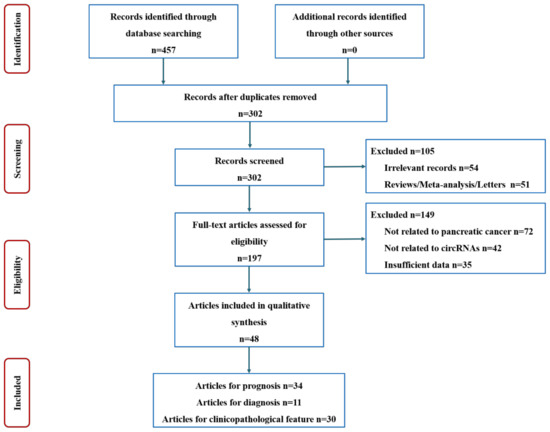
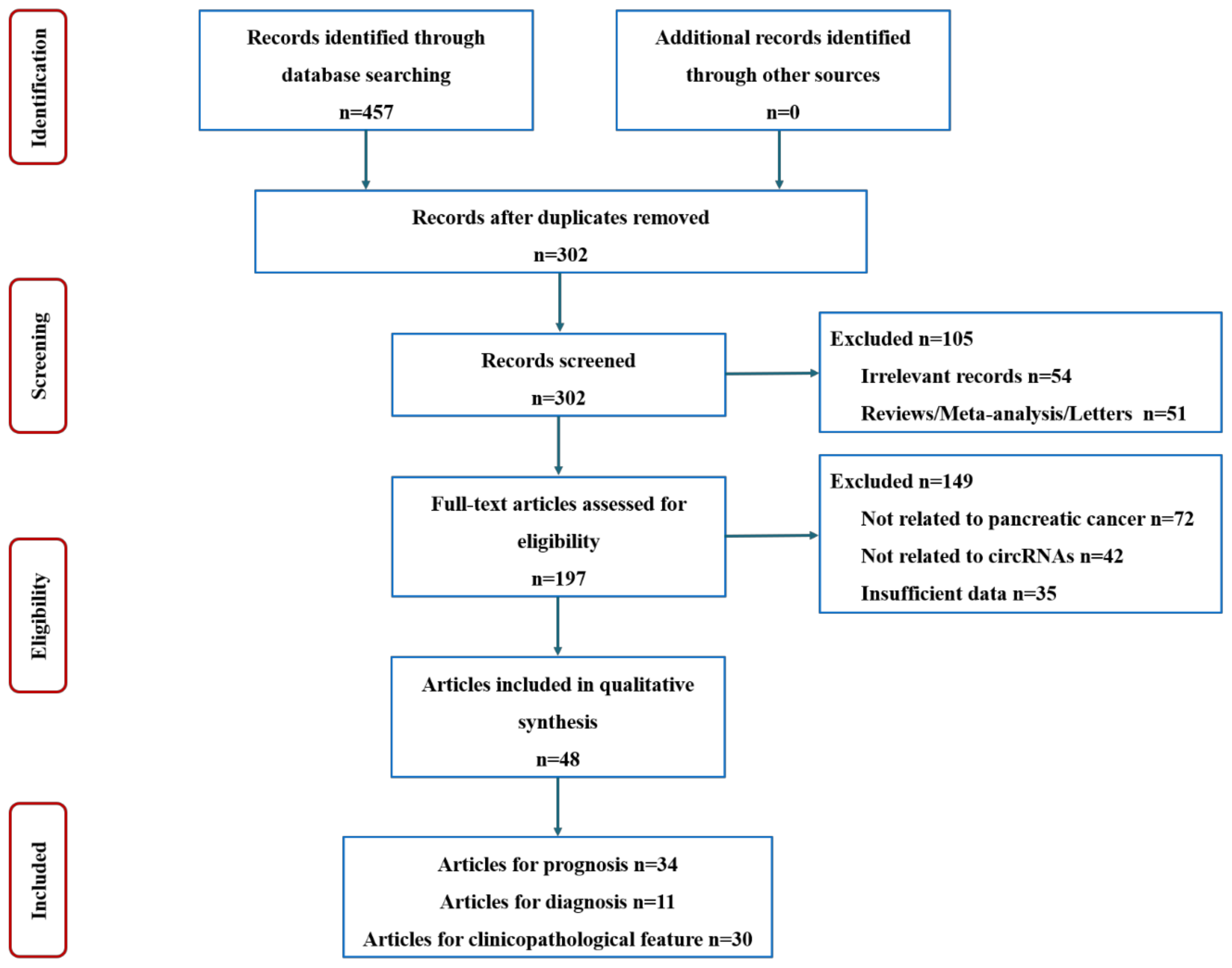
The procedure of literature selection is summarized in Figure 1. The search strategy yielded 457 articles. After the removal of 155 duplicates, 302 citations remained. Then, based on the title or abstract, 105 citations were excluded, and the remaining 197 articles were further scanned. Another 149 studies were removed for not being related to PC or circRNAs, or not providing sufficient data. Ultimately, a total of 48 papers were included in our meta-analysis, including 34 on prognosis [26,27,28,29,30,31,32,33,34,35,36,37,38,39,40,41,42,43,44,45,46,47,48,49,50,51,52,53,54,55,56,57,58,59], 11 on diagnosis [29,30,31,48,55,56,60,61,62,63,64], and 30 on relationship with clinicopathological features [28,29,30,31,32,33,34,35,39,41,42,43,44,45,46,48,50,51,55,56,58,59,62,64,65,66,67,68,69,70]. The characteristics of each study are shown in Table 1 and Table 2.
Figure 1.
Flow diagram of the study selection process.
Table 1.
Characteristics of prognostic studies included in the meta-analysis.
Table 2.
Characteristics of diagnostic studies included in the meta-analysis.
3.2. Association between Expression of circRNAs and Prognosis in PC
According to the literature, a total of 34 circRNAs were associated with PC prognosis, of which 28 were upregulated, and the remaining 6 were downregulated (Table 1). All the studies were published from 2018 to 2022, with follow-up periods ranging from 20 to 80 months. The sample size ranged from 26 to 209, and the median was adopted as the cut-off value for circRNA expression in most cases. Except for the studies by Xie, H.R. et al., Rong, Z.Y. et al., and Han, X. et al., which used the tissue microarray (TMA) RNA-in situ hybridization (ISH)/fluorescence in situ hybridization (FISH) methods for detection, the expression of circRNAs was detected by quantitative real-time polymerase chain reaction (qRT-PCR). The specimens were obtained from tumor tissue or plasma, and all PC diagnosis was pathologically confirmed. The NOS quality assessment system was used to evaluate the quality of the included studies, and all of the studies achieved a score ≥ 7 (Figure S1).
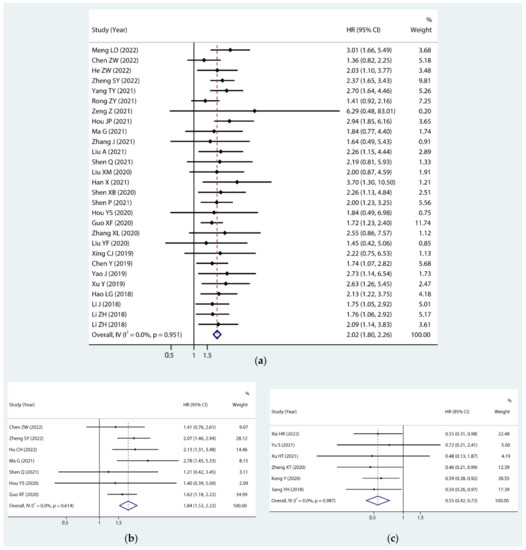
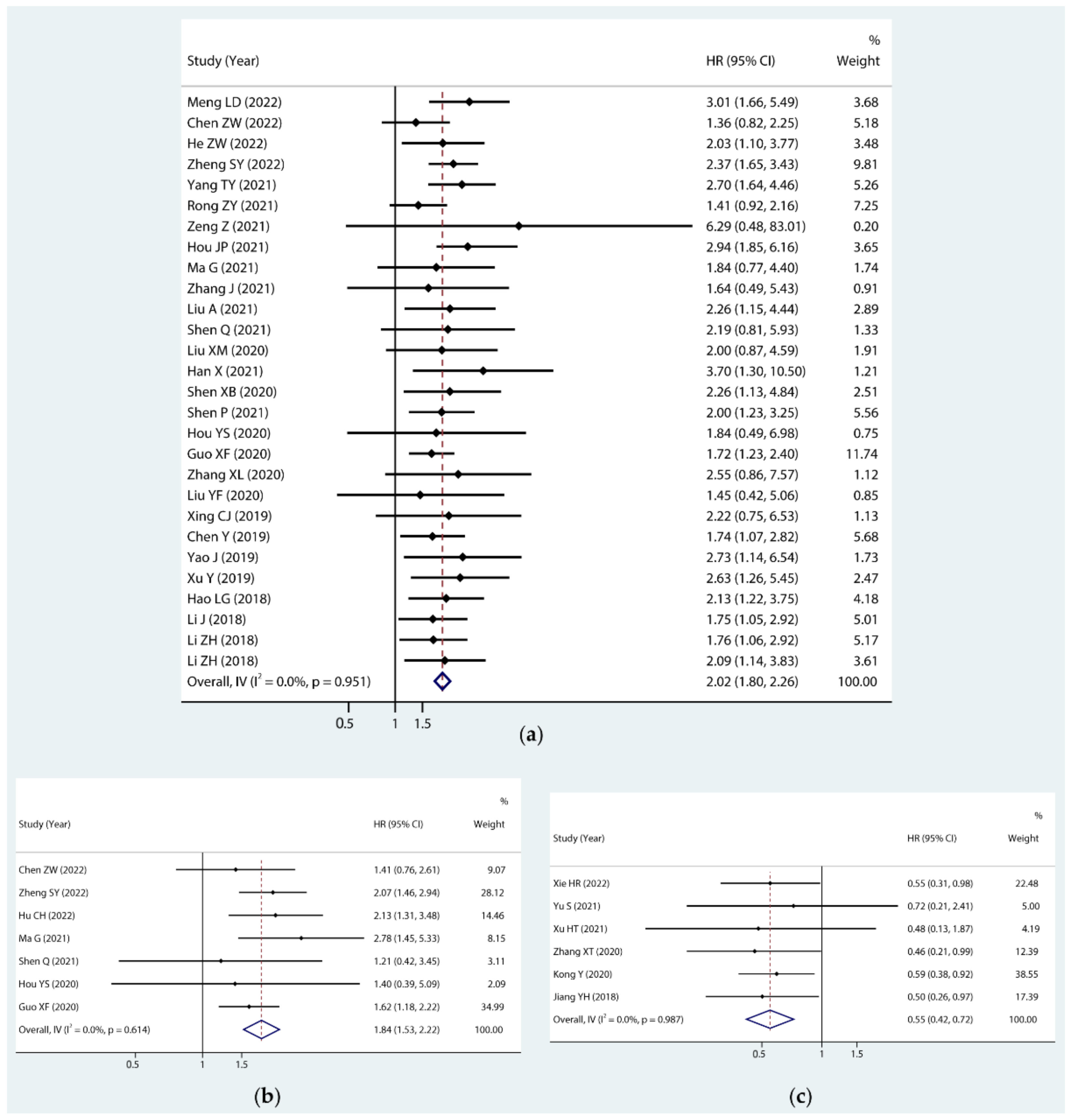
As shown in Figure 2, PC-associated upregulated circRNAs were correlated to a poorer OS (HR = 2.02, 95% CI: 1.80–2.26) and poorer DFS/PFS (HR = 1.84, 95% CI: 1.53–2.22). In contrast, patients with downregulated circRNAs had a better OS (HR = 0.55, 95% CI: 0.42–0.72). The statistical results showed that the circRNAs had no significant heterogeneity(I2 = 0.0%); thus, a fixed effects model was used for the analysis.
Figure 2.
Forest plots of the OS (a), DFS/PFS (b) for upregulated circRNAs, and OS (c) for downregulated circRNAs.
3.3. Association between Expression of circRNAs and Diagnosis in PC
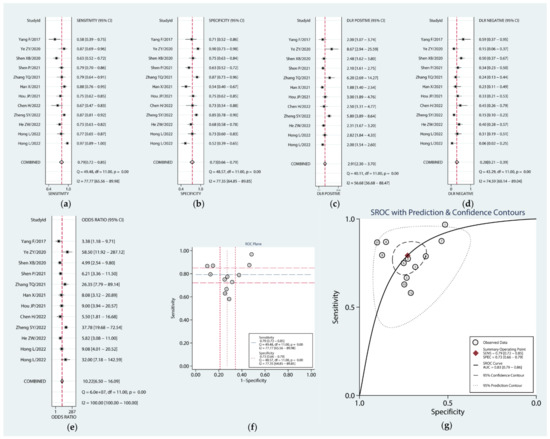
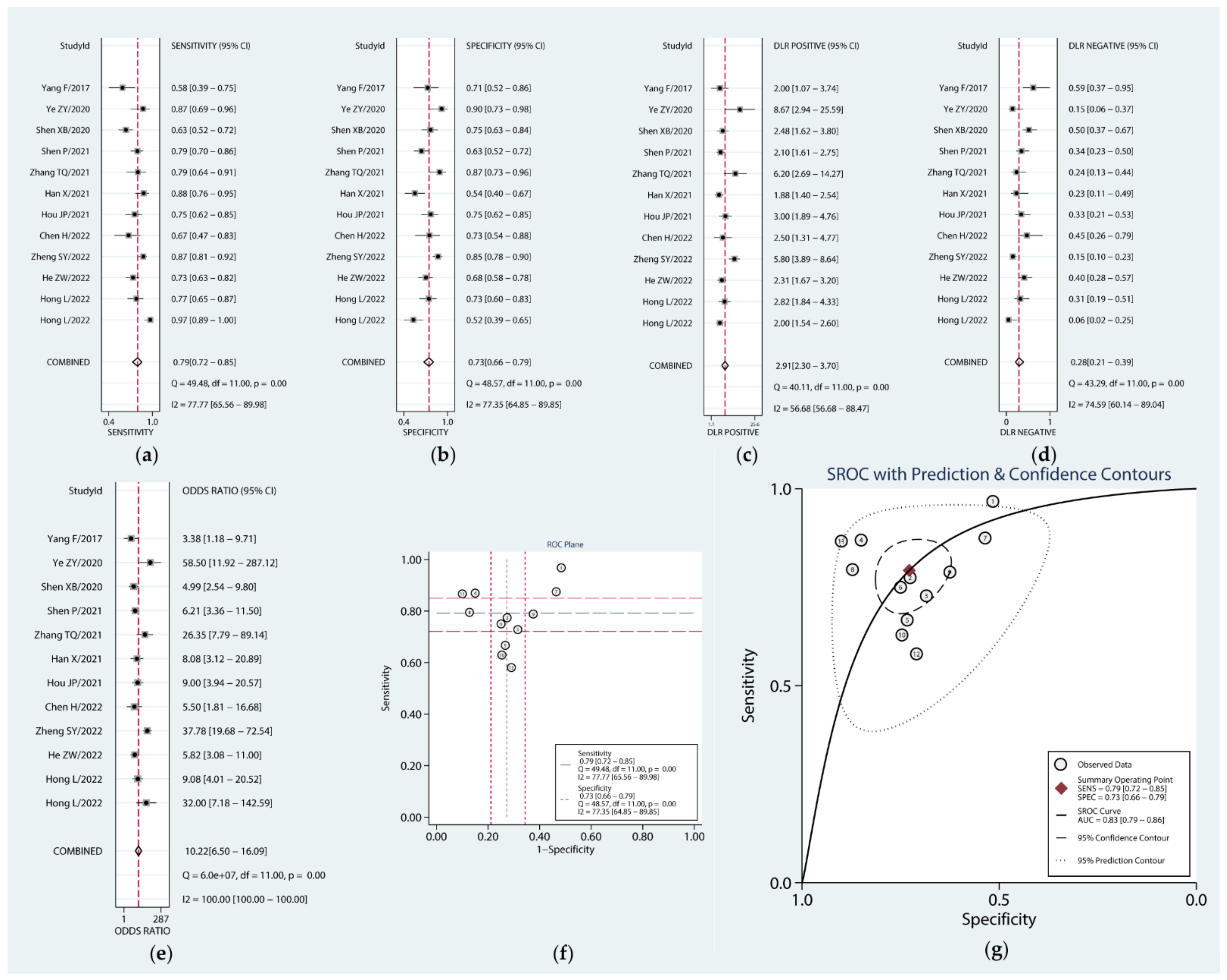
Twelve studies were eligible for our diagnostic meta-analysis, and the QUADAS II scores showed that all of the studies were of high quality (Figure S2). The forest plot (Figure 3a–e) showed that the combined sensitivity, specificity, PLR, NLR, and DOR were 0.79 (95% CI: 0.72–0.85), 0.73 (95% CI: 0.66–0.79), 2.91 (95% CI: 2.30–3.70), 0.28 (95% CI: 0.21–0.39), and 10.22 (95% CI: 6.50–16.09), respectively. The ROC plane diagram did not show a typical shoulder–arm distribution, suggesting no threshold effect (Figure 3f). Then, we plotted the SROC curve, which yielded an AUC of 0.83 (95% CI: 0.79–0.86) (Figure 3g). These results suggest that circRNAs can be utilized as ideal biomarkers for diagnosing PC.
Figure 3.
Forest plots of the combined sensitivity (a), specificity (b), PLR (c), NLR (d), DOR (e), ROC plane (f), and SROC curve (g) to illustrate the diagnostic value of circRNAs in pancreatic cancer.
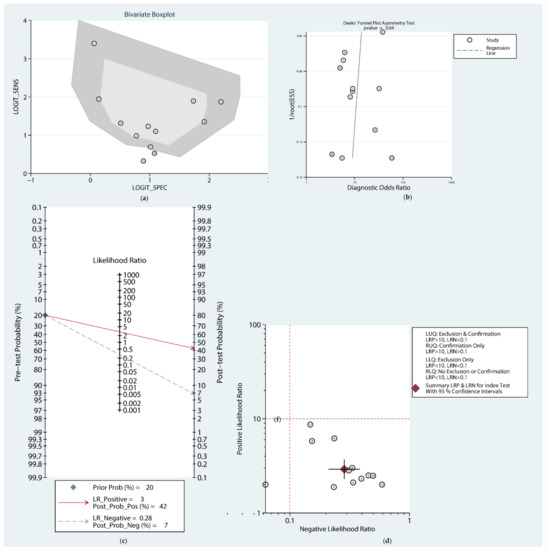
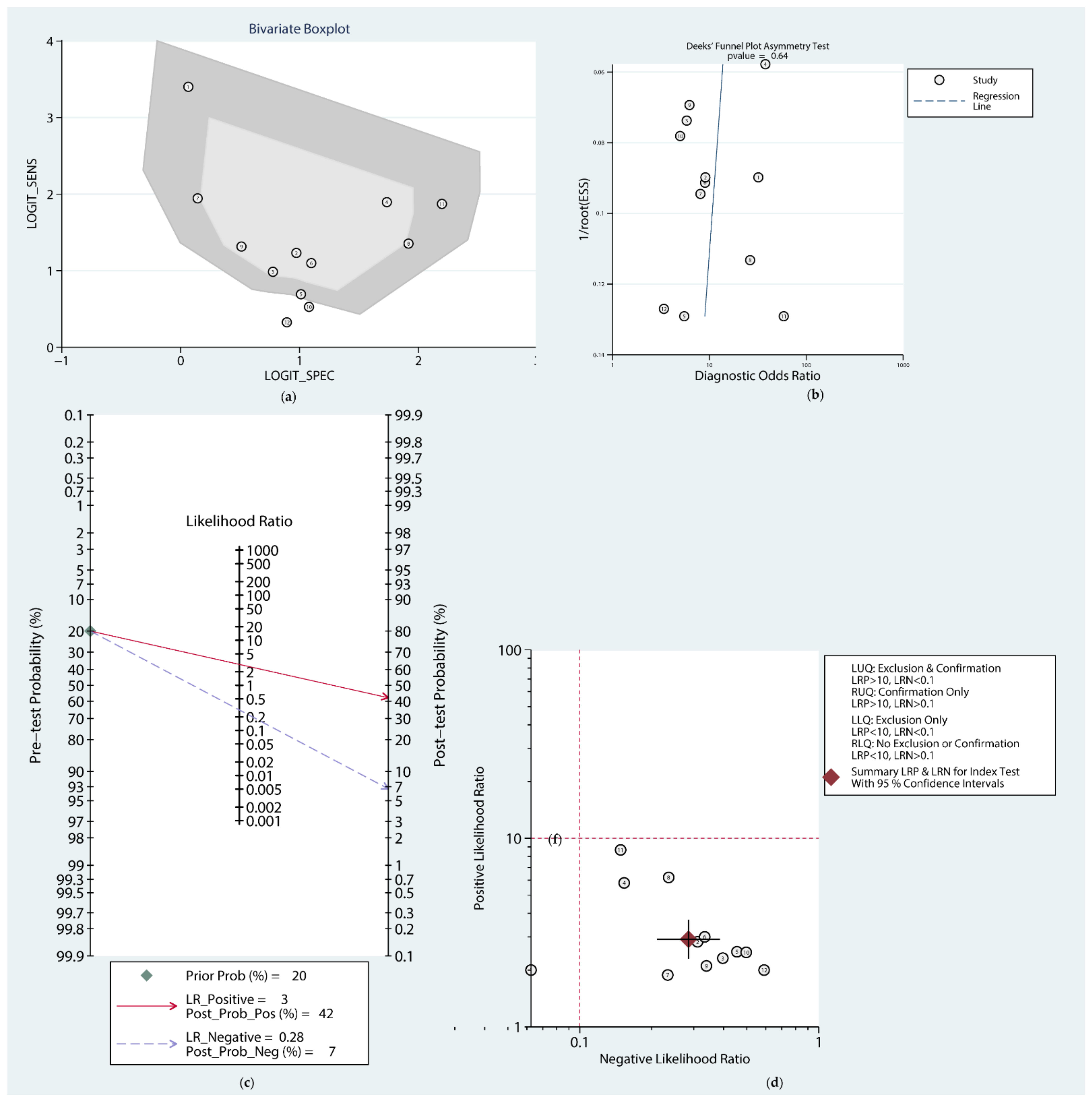
As shown in Figure 4a, the bivariate boxplot did not show any significantly heterogeneous data, and no significant publication bias was detected (Figure 4b). Although the bivariate boxplot did not show significantly heterogeneous data (Figure 4a), the overall sensitivity, specificity, PLR, NLR, and DOR were all highly heterogeneous (Figure 3). Therefore, a subgroup analysis and meta regression based on the detected sample, case size, and publication year were conducted (Tables S2 and S3). It turned out that no significant correlation between the covariates and the DOR was detected in the univariate meta-regression analysis. To further evaluate the clinical application capability of circRNAs, we constructed Fagan’s nomogram (Figure 4c) and a scattered plot of PLR and NLR (Figure 4d). It was found that with 20% as a prior probability, the PLR postposterior probability increased to 42% (PLR = 3) while the NLR postposterior probability decreased to 7% (NLR = 0.28). Therefore, circRNAs can be used as feasible and reliable diagnostic markers for PC.
Figure 4.
Bivariate boxplot (a), Deeks’ funnel plot (b), Fagan’s nomogram (c), and Scatter plot of PLR and NLR (d) to illustrate the diagnostic accuracy of circRNAs in pancreatic cancer. “LRP” and “LRN” in the text within Figure 4d refer to the labels of Y-axis (Positive Likelihood Ratio, PLR) and X-axis (Negative Likelihood Ratio, NLR), respectively.
3.4. Association between Expression of circRNAs and Clinicopathological Characteristics in PC
Table 3 displays the correlation between circRNAs and the clinicopathological characteristics of PC. Our analysis demonstrated that upregulated circRNAs were associated with higher preoperative CA19-9 levels (OR = 2.082, 95% CI: 1.462–2.966), more nerve and vascular invasion (OR = 1.637, 95% CI: 1.163–2.304 and OR = 2.006, 95% CI: 1.451–2.773), poorer tumor differentiation (OR = 1.914, 95% CI: 1.519–2.410), larger tumor size (OR = 2.442, 95% CI: 1.580–3.774), higher T stage (OR = 1.685, 95% CI: 1.317–2.156), lymphatic metastasis (OR = 3.404, 95% CI: 2.706–4.283), distant metastasis (OR = 4.394, 95% CI: 2.564–7.532), and advanced TNM stage (OR = 3.282, 95% CI: 2.463–4.374). There was no correlation between circRNA expression and other indicators, including gender, age, location, and duodenal invasion (Table 3). Fewer studies focused on downregulated circRNAs in PC, and downregulated circRNAs were associated with better differentiation (OR = 0.367, 95% CI: 0.220–0.611) and less lymphatic metastasis (OR = 0.121, 95% CI: 0.070–0.209). It is worth noting that the I2 index showed high heterogeneity; therefore, more studies need to be included for subgroup analysis in future research.
Table 3.
Meta-analysis of correlation between upregulated circRNAs and clinicopathological features of pancreatic cancer.
3.5. Sensitivity Analysis and Publication Bias
To assess the sensitivity of our meta-analysis, one single study was omitted from the analysis each time to calculate the pooled HRs or ORs again (Figures S3–S5). The detailed data suggest that the results are stable.
Possible publication bias was assessed using Begg’s funnel plot and Egger’s test (Figures S6–S9), and there was no significant publication bias in the results. Moreover, Deeks’ funnel plot asymmetry test (p = 0.64) suggested that no significant publication bias in the diagnostic analysis (Figure 4b).
3.6. Clinical Value Evaluation of Combined circRNAs
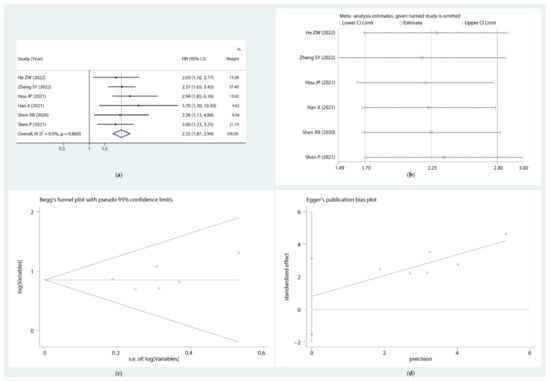
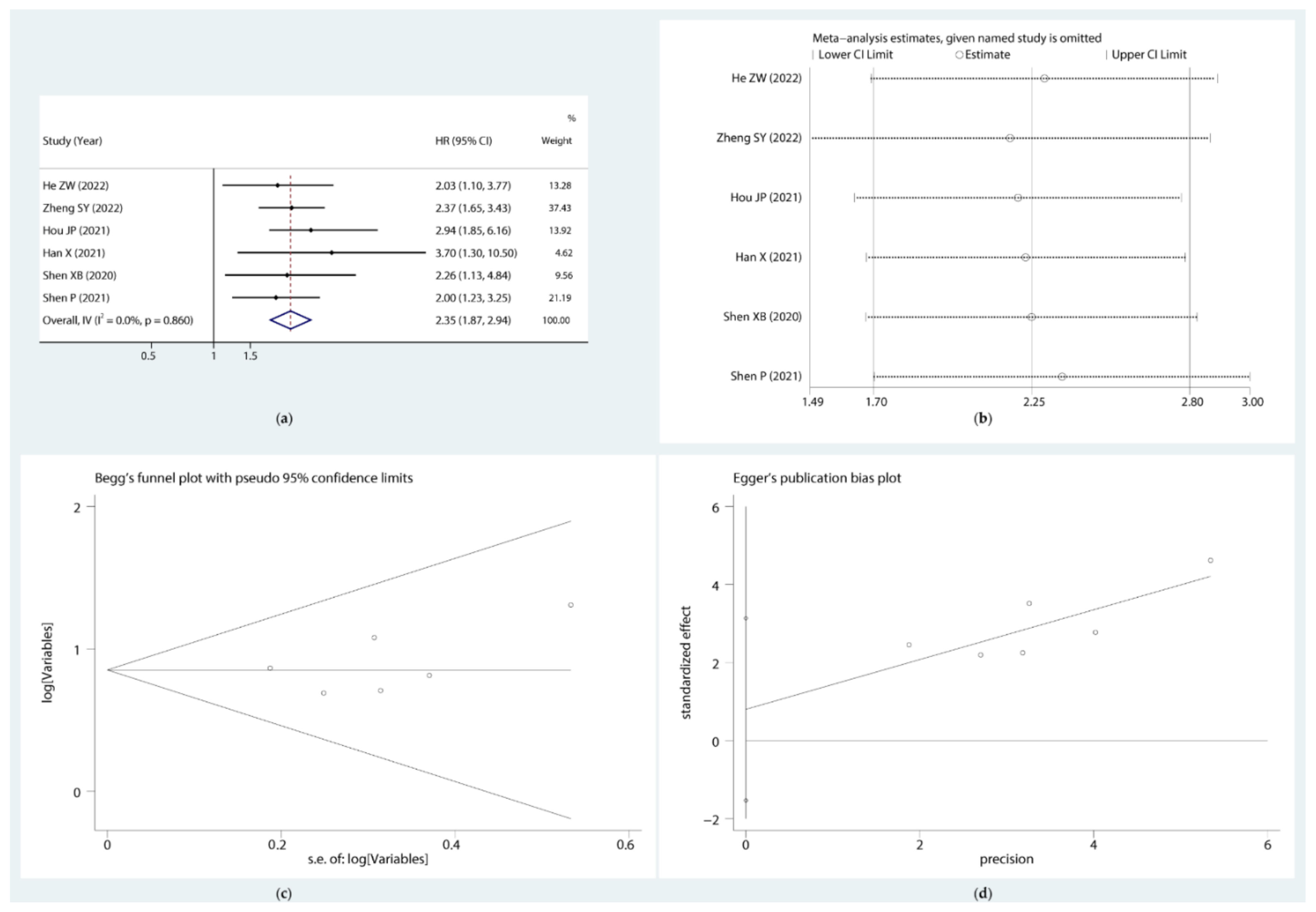
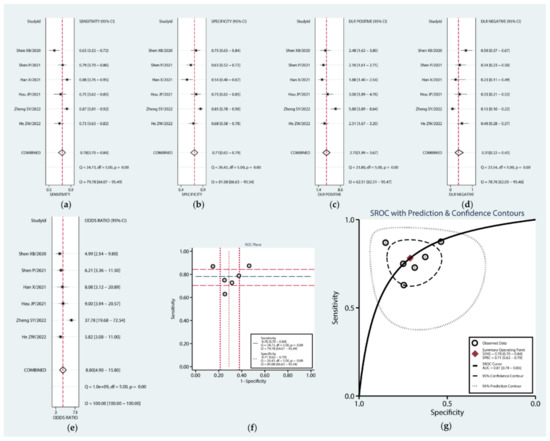
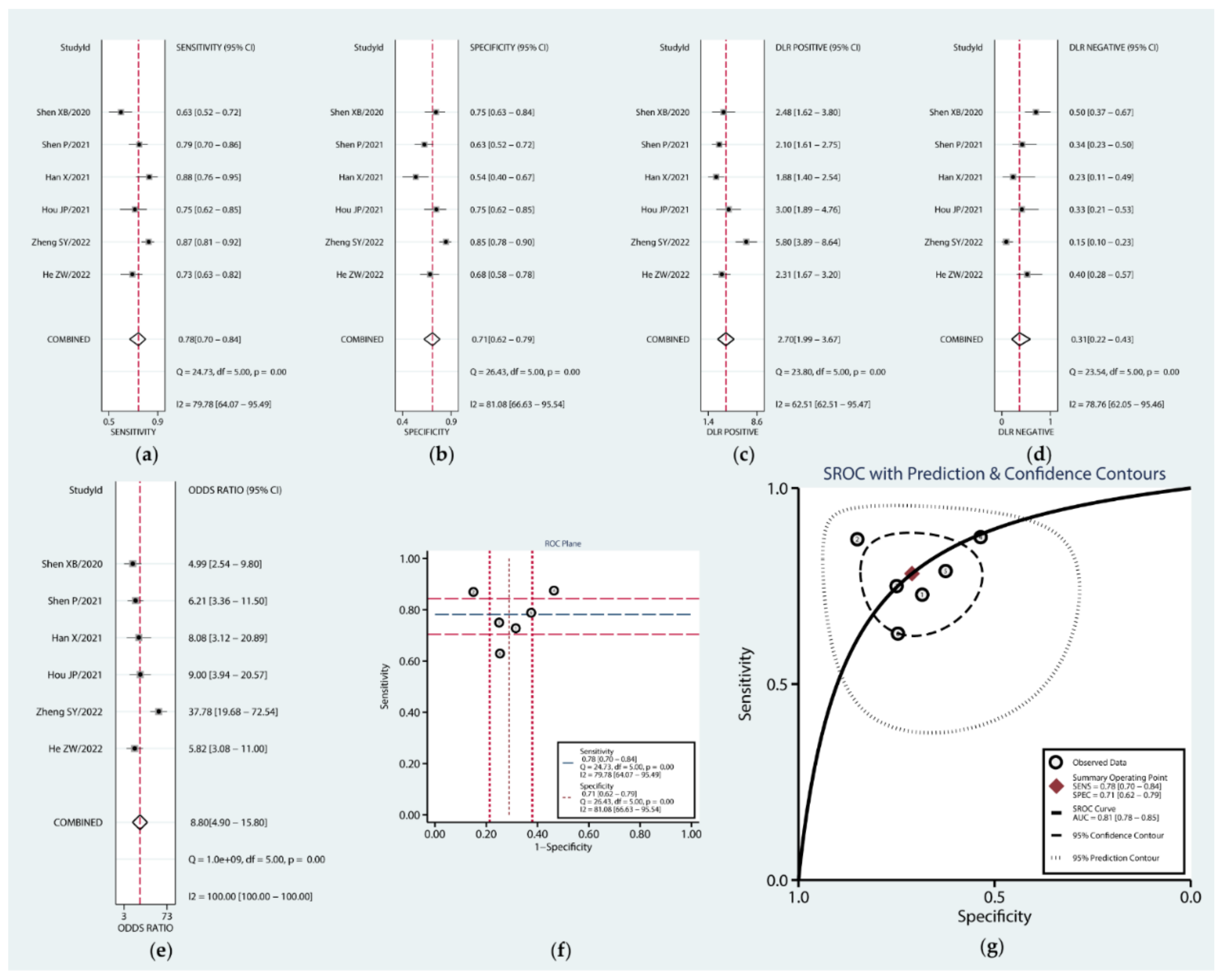
Among the 12 circRNAs with diagnostic value, we screened out 6 circRNAs with prognostic data to detect their combined prognostic and diagnostic value. They were hsa_circ_0064288, hsa_circ_0000234, hsa_circ_0004680, hsa_circ_0071036, hsa_circ_0000677, and hsa_circ_0001460, which were all higher in PC tissues than in para-cancer tissues. The results showed that combined circRNAs were significantly associated with poor OS (HR = 2.35, 95% CI: 1.87–2.94) with no significant bias (Figure 5). Moreover, the forest plot (Figure 6a,b) showed that the combined sensitivity and specificity of these 6 circRNAs was 0.78 (95% CI: 0.70–0.84) and 0.71 (95% CI: 0.62–0.79), respectively, and the SROC curve yielded an AUC of 0.81 (95% CI: 0.78–0.85) (Figure 6g).
Figure 5.
Forest plot of the OS (a), sensitivity analysis (b), and publication bias judged by Begg’s (c) and Egger’s (d) funnel plots of combined circRNAs in pancreatic cancer.
Figure 6.
Forest plots of the sensitivity (a), specificity (b), PLR (c), NLR (d), DOR (e), ROC plane (f), and SROC curve (g) of combined circRNAs in pancreatic cancer.
4. Discussion
PC is known to be the most aggressive tumor of the digestive system, and unlike the steady increase of survival rates observed in other cancers, the 5-year-survival rate of PC has barely changed in recent years [71,72]. The results of individualized therapy suggest that targeted therapy is feasible to improve the prognosis of PC patients. Therefore, identifying novel targets during the development and progression of PC is a prerequisite for improving the prognosis [73,74]. Non-coding RNAs (ncRNAs) are generated from human genomes without the ability to encode proteins. They are contained in cells and exosomes of body fluids, and they have broad application prospects in disease diagnosis. According to the length and shape of ncRNAs, they are generally classified as microRNAs (miRNAs), piwi-acting RNAs (piRNAs), long non-coding RNAs (lncRNAs), small nucleolar RNAs (snoRNAs), and circRNAs [75]. So far, numerous ncRNAs have been identified as oncogenic drivers and contribute to tumor proliferation or metastasis among a variety of cancers [76]. In PC, it has been reported that miRNA holds potential as biomarkers, prognostic markers, and clinical targets [77]. Another review confirmed the ability of lncRNAs to improve the early diagnosis, prognostic prediction, and personalized treatments of patients with PC [78]. However, the role of circRNAs in PC diagnosis and prognosis is still controversial. CircRNAs are closed circular RNA molecules that have drawn more and more attention in recent years [79]. They are not easy to hydrolyze with RNA enzymes and are highly abundant in expression [80]. In addition, circRNAs are highly conserved during the evolution in different species, and their expression profiles are tissue- and developmental stage-specific [81]. At the cellular level, a large number of circRNAs exist in the cytoplasm of eukaryotic cells. Most of these circRNAs act as competitive endogenous RNAs, bind to RNA-binding proteins, regulate gene transcription, and even encode proteins, which are the molecular basis for their biological functions [82,83]. Considering the wide distribution of circRNAs in tissues, serum, and urine, their expression levels have consistently been correlated with clinicopathological features of various tumors, suggesting their potential as biomarkers for cancer diagnosis and prognosis [84,85]. With the emergence of new research toward identifying circRNAs as diagnostic biomarkers and therapeutic targets for PC, we aimed to explore the comprehensive value of circRNAs in the prognosis, diagnosis, and clinicopathological significance of PC.
By reviewing PubMed, Web of Science, and other databases and performing quality assessments, we screened and filtered out 48 studies on PC-related circRNAs. For the relationship between circRNAs and PC prognosis, we included 34 studies with a cumulative total of 3524 patients. The results showed that upregulated circRNAs were positively correlated with the OS/DFS/PFS of patients. Although fewer studies focused on downregulated circRNAs, 3 studies showed that they are negatively associated with the OS of PC patients. To our knowledge, this is the first meta-analysis investigating the association of circRNAs with the prognosis, diagnosis, and clinicopathological characteristics in PC patients. Several previous articles have investigated the relationship between circRNAs and other tumors, including lung cancer, osteosarcoma, squamous cell carcinoma, esophageal squamous cell carcinoma, etc. [86,87,88]. Wang et al. have shown that the elevated expression of oncogenic circRNAs could predict poor survival outcomes (HR = 2.430 for OS; HR = 2.228 for DFS) in lung cancer, and similar results were obtained by Nie et al. in esophageal squamous cell carcinoma (HR = 2.25 for OS) [86,88]. The pooled results produced in this study are close to these previously reported cancers, indicating that circRNAs could also facilitate the prognosis estimation in PC. So far, due to the lack of a unified standard, the quantification of each circRNA is not precise enough. Additionally, there is a lack of more abundant evaluation indicators, such as the OS/DFS/PFS of chemotherapy-sensitive patients, so more refined studies must be carried out. Additionally, regarding the differences in circRNA origin and detection method, it would be better if subgroup analysis could be executed based on circRNA origin and detection method. However, as shown in Table 1, a total of 34 circRNAs were included for exploring their prognostic value in PC. Still, among them, only one circRNA (hsa_circ_0036627) was detected in plasma, which is inadequate for statistical analysis. There is a similar trend with the detection method. Among the 28 upregulated circRNAs, only 2 studies by Rong ZY et al. and Han X et al. used the tissue microarray (TMA) RNA-fluorescence in situ hybridization (FISH) method rather than the quantitative real-time polymerase chain reaction (qRT-PCR) for circRNA detection. Therefore, a data split based on origin and detection method is not feasible here. To further validate these results, large-scale follow-up studies are needed. In studies researching PC clinicopathologic features, upregulated circRNAs were significantly correlated with tumor differentiation, vascular invasion, and TNM stage, suggesting an indispensable role in promoting the development and progression of PC. In contrast, downregulated circRNAs were associated with better differentiation and lower TNM stage.
Regarding the diagnostic value of circRNAs in PC, we included 11 diagnostic studies with a total of 824 cases and 798 controls. The combined sensitivity, specificity, and AUC for diagnosis were 0.79, 0.73, and 0.83, implying that circRNAs were upregulated in 83% of PC patients compared to controls. At the same time, the overall DOR for circRNA diagnosis was 10.22, PLR was 2.91, and NLR was 0.28, suggesting that patients with high circRNA expression had a 2.91-fold higher risk of PC than the general population. In contrast, the risk of those with no differential expression was only 0.32 folds. Fagan’s nomogram was used to analyze the clinical value of circRNAs, and the results showed a significant increase in PLR and a significant decrease in NLR. These results were consistent with previous studies researching circRNAs’ diagnostic value in other cancers [89,90]. Moreover, we detected the prognostic value of the combined circRNAs composed of hsa_circ_0064288, hsa_circ_0000234, hsa_circ_0004680, hsa_circ_0071036, hsa_circ_0000677, and hsa_circ_0001460. The results showed that they demonstrated a higher prognostic value for PC patients. Compared with CA 19-9, the most classical and widely-used indicator of PC, which was reported to possess a sensitivity and specificity of 78.2% and 82.8%, it seems that circRNAs did not show much superiority over CA 19-9 on PC diagnosis [91]. In spite of this, circRNAs as biomarkers in PC still have the following advantages. First, some circRNAs, including hsa_circ_0004680 and hsa_circ_0001666, showed better discriminatory power in detecting PC patients from healthy controls, especially in PC with serum CA19-9 < 37 U/mL, suggesting that circRNAs might serve as a preferable biomarker for detecting PC [48,63]. Second, numerous reports have revealed the association between circRNA expression and chemotherapy resistance during PC treatment, implicating that the expression of circRNAs might have the potential to facilitate the selection of treatment options [92,93]. Lastly, considering that circRNAs play indispensable roles in cancer pathogenesis, it is promising to design potential diagnostic and therapeutic strategies targeting circRNAs to gain control of PC. Thus far, however, no treatment based on circRNAs has yet been approved in the clinic. With the continued emergence of more gratifying investigations, we believe that more characteristic circRNAs with diagnostic and therapeutic potency in PC will be identified.
To the best of our knowledge, this research is the first meta-analysis investigating the comprehensive role of circRNAs in PC. However, it should be noted that there were several limitations in this meta-analysis. First, the number of studies included was relatively small, which makes it infeasible to perform subgroup analysis based on circRNA origin or detection method. To further validate these results, large-scale follow-up studies are needed. Second, all the studies were performed in China, so more diverse populations should be studied in the future. Finally, the vast majority of the current studies were based on PC tissues, which means that more high-quality studies that use blood, which is easily accessible preoperative, are needed.
5. Conclusions
In conclusion, our study showed that the differentially expressed circRNAs in PC (especially the combined circRNAs- hsa_circ_0064288, hsa_circ_0000234, hsa_circ_0004680, hsa_circ_0071036, hsa_circ_0000677, and hsa_circ_0001460) are significantly correlated with the prognosis and clinicopathological characteristics of PC patients and could contribute to the diagnosis of PC. However, since this conclusion is based on a limited number of studies, more relevant research is needed to validate our results.
Supplementary Materials
The following supporting information can be downloaded at: https://www.mdpi.com/article/10.3390/cancers14246187/s1, Table S1: The PRISMA checklist; Table S2: Assessment of the diagnostic accuracy and heterogeneity in subgroup analysis; Table S3: Results of univariate meta-regression analysis of diagnostic odds ratio; Figure S1: Quality assessment by QUADAS II. (a) Each risk of bias item for each included study; (b) Each risk of bias item presented as percentages across all included studies; Figure S2: Quality assessment by NOS. (a) Each risk of bias item for each included study; (b) Each risk of bias item presented as percentages across all included studies; Figure S3: Sensitivity analysis of OS (a), DFS/PFS (b) for upregulated circRNAs and OS (c) for downregulated circRNAs in pancreatic cancer; Figure S4: Sensitivity analysis of upregulated circRNAs for CA19-9 (a), nerve invasion (b), vascular invasion(c), differentiation (d), tumor size (e), T stage (f), lymphatic metastasis (g), distant metastasis (h), and TNM stage (i) in pancreatic cancer; Figure S5: Sensitivity analysis of downregulated circRNAs for gender (a), differentiation (b), and lymphatic metastasis (c) in pancreatic cancer; Figure S6: Publication bias judged by Egger’s and Begg’s funnel plots of OS (a), DFS/PFS (b) for upregulated circRNAs and OS (c) for downregulated circRNAs in pancreatic cancer; Figure S7: Publication bias judged by Egger’s funnel plots of upregulated circRNAs for CA19-9 (a), nerve invasion (b), vascular invasion(c), differentiation (d), tumor size (e), T stage (f), lymphatic metastasis (g), distant metastasis (h), and TNM stage (i) in pancreatic cancer; Figure S8: Publication bias judged by Begg’s funnel plots of upregulated circRNAs for CA19-9 (a), nerve invasion (b), vascular invasion(c), differentiation (d), tumor size (e), T stage (f), lymphatic metastasis (g), distant metastasis (h), and TNM stage (i) in pancreatic cancer; Figure S9: Publication bias judged by Egger’s and Begg’s funnel plots of downregulated circRNAs for gender (a), differentiation (b), and lymphatic metastasis (c) in pancreatic cancer.
Author Contributions
J.L. and Q.H. conceived and designed the project. J.L. acquired the data and performed the data analysis with input from Z.Y., X.H. and S.H. performed the review and interpretation of data. J.L. and Q.H. wrote the manuscript that was edited and approved by all authors. Q.H. supervised the study. All authors have read and agreed to the published version of the manuscript.
Funding
This work was partly supported by grants from the National Natural Science Foundation of China (No. 31800675 to S.H.) and the Natural Science Foundation of Jiangsu Province (No. BK20221373 to S.H.).
Conflicts of Interest
The authors declare no conflict of interest.
References
- Chen, Q.; Shen, P.; Ge, W.; Yang, T.; Wang, W.; Meng, L.; Huang, X.; Zhang, Y.; Cao, S.; Miao, Y.; et al. Roundabout homolog 1 inhibits proliferation via the YY1-ROBO1-CCNA2-CDK2 axis in human pancreatic cancer. Oncogene 2021, 40, 2772–2784. [Google Scholar] [CrossRef] [Scilit] [PubMed]
- Traub, B.; Link, K.; Kornmann, M. Curing pancreatic cancer. Semin. Cancer Biol. 2021, 76, 232–246. [Google Scholar] [CrossRef] [Scilit] [PubMed]
- Siegel, R.; Miller, K.; Fuchs, H.; Jemal, A. Cancer Statistics. CA Cancer J. Clin. 2021, 71, 7–33. [Google Scholar] [CrossRef] [Scilit]
- Byrne, K.; Betts, C.; Mick, R.; Sivagnanam, S.; Bajor, D.; Laheru, D.; Chiorean, E.; O’Hara, M.; Liudahl, S.; Newcomb, C.; et al. Neoadjuvant selicrelumab, an agonist CD40 antibody, induces changes in the tumor microenvironment in patients with resectable pancreatic cancer. Clin. Cancer Res. 2021, 16, 4574–4586. [Google Scholar] [CrossRef] [Scilit] [PubMed]
- Herbst, B.; Zheng, L. Precision medicine in pancreatic cancer: Treating every patient as an exception. Lancet Gastroenterol. Hepatol. 2019, 4, 805–810. [Google Scholar] [CrossRef] [Scilit]
- Lei, Y.; Tang, R.; Xu, J.; Wang, W.; Zhang, B.; Liu, J.; Yu, X.; Shi, S. Applications of single-cell sequencing in cancer research: Progress and perspectives. J. Hematol. Oncol. 2021, 14, 91. [Google Scholar] [CrossRef] [Scilit]
- Li, J.; Sun, D.; Pu, W.; Wang, J.; Peng, Y. Circular RNAs in Cancer: Biogenesis, Function, and Clinical Significance. Trends Cancer 2020, 6, 319–336. [Google Scholar] [CrossRef] [Scilit]
- Nicolet, B.; Engels, S.; Aglialoro, F.; van den Akker, E.; von Lindern, M.; Wolkers, M. Circular RNA expression in human hematopoietic cells is widespread and cell-type specific. Nucleic Acids Res. 2018, 46, 8168–8180. [Google Scholar] [CrossRef] [Scilit]
- Barrett, S.; Wang, P.; Salzman, J. Circular RNA biogenesis can proceed through an exon-containing lariat precursor. eLife 2015, 4, e07540. [Google Scholar] [CrossRef] [Scilit]
- Ivanov, A.; Memczak, S.; Wyler, E.; Torti, F.; Porath, H.T.; Orejuela, M.R.; Piechotta, M.; Levanon, E.Y.; Landthaler, M.; Dieterich, C.; et al. Analysis of intron sequences reveals hallmarks of circular RNA biogenesis in animals. Cell Rep. 2015, 10, 170–177. [Google Scholar] [CrossRef] [Scilit]
- Aktaş, T.; Avşar Ilık, İ.; Maticzka, D.; Bhardwaj, V.; Pessoa Rodrigues, C.; Mittler, G.; Manke, T.; Backofen, R.; Akhtar, A. DHX9 suppresses RNA processing defects originating from the Alu invasion of the human genome. Nature 2017, 544, 115–119. [Google Scholar] [CrossRef] [Scilit] [PubMed]
- Jeck, W.R.; Sharpless, N.E. Detecting and characterizing circular RNAs. Nat. Biotechnol. 2014, 32, 453–461. [Google Scholar] [CrossRef] [Scilit] [PubMed]
- Li, Z.; Huang, C.; Bao, C.; Chen, L.; Lin, M.; Wang, X.; Zhong, G.; Yu, B.; Hu, W.; Dai, L.; et al. Exon-intron circular RNAs regulate transcription in the nucleus. Nat. Struct. Mol. Biol. 2015, 22, 256–264. [Google Scholar] [CrossRef] [Scilit] [PubMed]
- Zhang, Y.; Zhang, X.; Chen, T.; Xiang, J.; Yin, Q.; Xing, Y.; Zhu, S.; Yang, L.; Chen, L. Circular intronic long noncoding RNAs. Mol. Cell 2013, 51, 792–806. [Google Scholar] [CrossRef] [Scilit]
- Han, B.; Chao, J.; Yao, H. Circular RNA and its mechanisms in disease: From the bench to the clinic. Pharmacol. Ther. 2018, 187, 31–44. [Google Scholar] [CrossRef] [Scilit]
- Zeng, Z.; Xia, L.; Fan, S.; Zheng, J.; Qin, J.; Fan, X.; Liu, Y.; Tao, J.; Liu, Y.; Li, K.; et al. Circular RNA CircMAP3K5 Acts as a MicroRNA-22-3p Sponge to Promote Resolution of Intimal Hyperplasia Via TET2-Mediated Smooth Muscle Cell Differentiation. Circulation 2021, 143, 354–371. [Google Scholar] [CrossRef] [Scilit]
- Brozzi, F.; Regazzi, R. Circular RNAs as Novel Regulators of β-Cell Functions under Physiological and Pathological Conditions. Int. J. Mol. Sci. 2021, 22, 1503. [Google Scholar] [CrossRef] [Scilit]
- Wang, J.; Zhu, S.; Meng, N.; He, Y.; Lu, R.; Yan, G. ncRNA-Encoded Peptides or Proteins and Cancer. Mol. Ther. J. Am. Soc. Gene Ther. 2019, 27, 1718–1725. [Google Scholar] [CrossRef] [Scilit]
- Li, H.; Hao, X.; Wang, H.; Liu, Z.; He, Y.; Pu, M.; Zhang, H.; Yu, H.; Duan, J.; Qu, S. Circular RNA Expression Profile of Pancreatic Ductal Adenocarcinoma Revealed by Microarray. Cell. Physiol. Biochem. 2016, 40, 1334–1344. [Google Scholar] [CrossRef] [Scilit]
- Wong, C.; Lou, U.; Li, Y.; Chan, S.; Tong, J.; To, K.; Chen, Y. CircFOXK2 Promotes Growth and Metastasis of Pancreatic Ductal Adenocarcinoma by Complexing with RNA-Binding Proteins and Sponging MiR-942. Cancer Res. 2020, 80, 2138–2149. [Google Scholar] [CrossRef] [Scilit]
- Whiting, P.; Rutjes, A.; Westwood, M.; Mallett, S.; Deeks, J.; Reitsma, J.; Leeflang, M.; Sterne, J.; Bossuyt, P. QUADAS-2: A revised tool for the quality assessment of diagnostic accuracy studies. Ann. Intern. Med. 2011, 155, 529–536. [Google Scholar] [CrossRef] [Scilit] [PubMed]
- Stang, A. Critical evaluation of the Newcastle-Ottawa scale for the assessment of the quality of nonrandomized studies in meta-analyses. Eur. J. Epidemiol. 2010, 25, 603–605. [Google Scholar] [CrossRef] [Scilit] [PubMed]
- Tierney, J.; Stewart, L.; Ghersi, D.; Burdett, S.; Sydes, M. Practical methods for incorporating summary time-to-event data into meta-analysis. Trials 2007, 8, 16. [Google Scholar] [CrossRef] [Scilit]
- Petitti, D. Approaches to heterogeneity in meta-analysis. Stat. Med. 2001, 20, 3625–3633. [Google Scholar] [CrossRef] [Scilit]
- DerSimonian, R.; Laird, N. Meta-analysis in clinical trials revisited. Contemp. Clin. Trials 2015, 45, 139–145. [Google Scholar] [CrossRef] [Scilit]
- Shen, Q.; Zheng, G.; Zhou, Y.; Tong, J.; Xu, S.; Gao, H.; Zhang, X.; Fu, Q. viaCircRNA circ_0092314 Induces Epithelial-Mesenchymal Transition of Pancreatic Cancer Cells Elevating the Expression of S100P by Sponging miR-671. Front. Oncol. 2021, 11, 675442. [Google Scholar] [CrossRef] [Scilit] [PubMed]
- Liu, A.; Xu, J. Circ_03955 promotes pancreatic cancer tumorigenesis and Warburg effect by targeting the miR-3662/HIF-1alpha axis. Clin. Transl. Oncol. 2021, 23, 1905–1914. [Google Scholar] [CrossRef] [Scilit]
- Liu, X.; Zhong, L.; Jiang, W.; Wen, D. Repression of circRNA_000684 inhibits malignant phenotypes of pancreatic ductal adenocarcinoma cells via miR-145-mediated KLF5. Pancreatology 2021, 21, 406–417. [Google Scholar] [CrossRef] [Scilit]
- Han, X.; Fang, Y.; Chen, P.; Xu, Y.; Zhou, W.; Rong, Y.; Li, J.; Chen, W.; Lou, W. Upregulated circRNA hsa_circ_0071036 promotes tumourigenesis of pancreatic cancer by sponging miR-489 and predicts unfavorable characteristics and prognosis. Cell Cycle 2021, 20, 369–382. [Google Scholar] [CrossRef] [Scilit]
- Shen, X.; Chen, Y.; Li, J.; Huang, H.; Liu, C.; Zhou, N. Identification of Circ_001569 as a Potential Biomarker in the Diagnosis and Prognosis of Pancreatic Cancer. Technol. Cancer Res. Treat. 2021, 20, 1–9. [Google Scholar] [CrossRef] [Scilit]
- Shen, P.; Yang, T.; Chen, Q.; Yuan, H.; Wu, P.; Cai, B.; Meng, L.; Huang, X.; Liu, J.; Zhang, Y.; et al. CircNEIL3 regulatory loop promotes pancreatic ductal adenocarcinoma progression via miRNA sponging and A-to-I RNA-editing. Mol. Cancer 2021, 20, 51. [Google Scholar] [CrossRef] [Scilit] [PubMed]
- Hou, Y.; Li, X. Circ_0005273 induces the aggravation of pancreatic cancer by targeting KLF12. Eur. Rev. Med. Pharmacol. Sci. 2020, 24, 11578–11586. [Google Scholar] [CrossRef] [Scilit] [PubMed]
- Zhang, X.; Tan, P.; Zhuang, Y.; Du, L. hsa_circRNA_001587 upregulates SLC4A4 expression to inhibit migration, invasion, and angiogenesis of pancreatic cancer cells via binding to microRNA-223. Am. J. Physiol. Gastrointest. Liver Physiol. 2020, 319, G703–G717. [Google Scholar] [CrossRef] [Scilit] [PubMed]
- Guo, X.; Zhou, Q.; Su, D.; Luo, Y.; Fu, Z.; Huang, L.; Li, Z.; Jiang, D.; Kong, Y.; Li, Z.; et al. Circular RNA circBFAR promotes the progression of pancreatic ductal adenocarcinoma via the miR-34b-5p/MET/Akt axis. Mol. Cancer 2020, 19, 83. [Google Scholar] [CrossRef] [Scilit]
- Kong, Y.; Li, Y.; Luo, Y.; Zhu, J.; Zheng, H.; Gao, B.; Guo, X.; Li, Z.; Chen, R.; Chen, C. circNFIB1 inhibits lymphangiogenesis and lymphatic metastasis via the miR-486-5p/PIK3R1/VEGF-C axis in pancreatic cancer. Mol. Cancer 2020, 19, 82. [Google Scholar] [CrossRef] [Scilit]
- Shi, H.; Li, H.; Zhen, T.; Dong, Y.; Pei, X.; Zhang, X. hsa_circ_001653 Implicates in the Development of Pancreatic Ductal Adenocarcinoma by Regulating MicroRNA-377-Mediated HOXC6 Axis. Mol. Ther. Nucleic Acids 2020, 20, 252–264. [Google Scholar] [CrossRef] [Scilit]
- Liu, Y.; Xia, L.; Dong, L.; Wang, J.; Xiao, Q.; Yu, X.; Zhu, H. CircHIPK3 Promotes Gemcitabine (GEM) Resistance in Pancreatic Cancer Cells by Sponging miR-330-5p and Targets RASSF1. Cancer Manag. Res. 2020, 12, 921–929. [Google Scholar] [CrossRef] [Scilit]
- Xing, C.; Ye, H.; Wang, W.; Sun, M.; Zhang, J.; Zhao, Z.; Jiang, G. Circular RNA ADAM9 facilitates the malignant behaviours of pancreatic cancer by sponging miR-217 and upregulating PRSS3 expression. Artif. Cells Nanomed. Biotechnol. 2019, 47, 3920–3928. [Google Scholar] [CrossRef] [Scilit]
- Chen, Y.; Li, Z.; Zhang, M.; Wang, B.; Ye, J.; Zhang, Y.; Tang, D.; Ma, D.; Jin, W.; Li, X.; et al. Circ-ASH2L promotes tumor progression by sponging miR-34a to regulate Notch1 in pancreatic ductal adenocarcinoma. J. Exp. Clin. Cancer Res. CR 2019, 38, 466. [Google Scholar] [CrossRef] [Scilit]
- Yao, J.; Zhang, C.; Chen, Y.; Gao, S. Downregulation of circular RNA circ-LDLRAD3 suppresses pancreatic cancer progression through miR-137-3p/PTN axis. Life Sci. 2019, 239, 116871. [Google Scholar] [CrossRef] [Scilit]
- Xu, Y.; Yao, Y.; Gao, P.; Cui, Y. Upregulated circular RNA circ_0030235 predicts unfavorable prognosis in pancreatic ductal adenocarcinoma and facilitates cell progression by sponging miR-1253 and miR-1294. Biochem. Biophys. Res. Commun. 2019, 509, 138–142. [Google Scholar] [CrossRef] [Scilit] [PubMed]
- Hao, L.; Rong, W.; Bai, L.; Cui, H.; Zhang, S.; Li, Y.; Chen, D.; Meng, X. Upregulated circular RNA circ_0007534 indicates an unfavorable prognosis in pancreatic ductal adenocarcinoma and regulates cell proliferation, apoptosis, and invasion by sponging miR-625 and miR-892b. J. Cell. Biochem. 2019, 120, 3780–3789. [Google Scholar] [CrossRef] [Scilit] [PubMed]
- Li, J.; Li, Z.; Jiang, P.; Peng, M.; Zhang, X.; Chen, K.; Liu, H.; Bi, H.; Liu, X.; Li, X. Circular RNA IARS (circ-IARS) secreted by pancreatic cancer cells and located within exosomes regulates endothelial monolayer permeability to promote tumor metastasis. J. Exp. Clin. Cancer Res. 2018, 37, 177. [Google Scholar] [CrossRef] [Scilit] [PubMed]
- Jiang, Y.; Wang, T.; Yan, L.; Qu, L. A novel prognostic biomarker for pancreatic ductal adenocarcinoma: Hsa_circ_0001649. Gene 2018, 675, 88–93. [Google Scholar] [CrossRef] [Scilit] [PubMed]
- Li, Z.; Yanfang, W.; Li, J.; Jiang, P.; Peng, T.; Chen, K.; Zhao, X.; Zhang, Y.; Zhen, P.; Zhu, J.; et al. Tumor-released exosomal circular RNA PDE8A promotes invasive growth via the miR-338/MACC1/MET pathway in pancreatic cancer. Cancer Lett. 2018, 432, 237–250. [Google Scholar] [CrossRef] [Scilit] [PubMed]
- Zhang, J.; Zhang, Z. Mechanisms of circular RNA circ_0066147 on pancreatic cancer progression. Open Life Sci. 2021, 16, 495–510. [Google Scholar] [CrossRef] [Scilit]
- Ma, G.; Li, G.; Fan, W.; Xu, Y.; Song, S.; Guo, K.; Liu, Z. Circ-0005105 activates COL11A1 by targeting miR-20a-3p to promote pancreatic ductal adenocarcinoma progression. Cell Death Dis. 2021, 12, 656. [Google Scholar] [CrossRef] [Scilit]
- Hou, J.P.; Men, X.B.; Yang, L.Y.; Han, E.K.; Han, C.Q.; Liu, L.B. CircCCT3 Acts as a Sponge of miR-613 to Promote Tumor Growth of Pancreatic Cancer Through Regulating VEGFA/VEGFR2 Signaling. Balk. Med. J. 2021, 38, 229–238. [Google Scholar] [CrossRef] [Scilit]
- Zeng, Z.; Zhao, Y.; Chen, Q.; Zhu, S.; Niu, Y.; Ye, Z.; Hu, P.; Chen, D.; Xu, P.; Chen, J.; et al. Hypoxic exosomal HIF-1α-stabilizing circZNF91 promotes chemoresistance of normoxic pancreatic cancer cells via enhancing glycolysis. Oncogene 2021, 40, 5505–5517. [Google Scholar] [CrossRef] [Scilit]
- Rong, Z.; Shi, S.; Tan, Z.; Xu, J.; Meng, Q.; Hua, J.; Liu, J.; Zhang, B.; Wang, W.; Yu, X.; et al. Circular RNA CircEYA3 induces energy production to promote pancreatic ductal adenocarcinoma progression through the miR-1294/c-Myc axis. Mol. Cancer 2021, 20, 106. [Google Scholar] [CrossRef] [Scilit]
- Yang, T.; Shen, P.; Chen, Q.; Wu, P.; Yuan, H.; Ge, W.; Meng, L.; Huang, X.; Fu, Y.; Zhang, Y.; et al. FUS-induced circRHOBTB3 facilitates cell proliferation via miR-600/NACC1 mediated autophagy response in pancreatic ductal adenocarcinoma. J. Exp. Clin. Cancer Res. 2021, 40, 261. [Google Scholar] [CrossRef] [Scilit] [PubMed]
- Xu, H.; Chen, R.; Shen, Q.; Yang, D.; Peng, H.; Tong, J.; Fu, Q. Overexpression of Circular RNA circ_0013587 Reverses Erlotinib Resistance in Pancreatic Cancer Cells Through Regulating the miR-1227/E-Cadherin Pathway. Front. Oncol. 2021, 11, 754146. [Google Scholar] [CrossRef] [Scilit] [PubMed]
- Yu, S.; Wang, M.; Zhang, H.; Guo, X.; Qin, R. Circ_0092367 Inhibits EMT and Gemcitabine Resistance in Pancreatic Cancer via Regulating the miR-1206/ESRP1 Axis. Genes 2021, 12, 1701. [Google Scholar] [CrossRef] [Scilit] [PubMed]
- Hu, C.; Xia, R.; Zhang, X.; Li, T.; Ye, Y.; Li, G.; He, R.; Li, Z.; Lin, Q.; Zheng, S.; et al. circFARP1 enables cancer-associated fibroblasts to promote gemcitabine resistance in pancreatic cancer via the LIF/STAT3 axis. Mol. Cancer 2022, 21, 24. [Google Scholar] [CrossRef] [Scilit]
- Zheng, S.; Hu, C.; Lin, H.; Li, G.; Xia, R.; Zhang, X.; Su, D.; Li, Z.; Zhou, Q.; Chen, R. circCUL2 induces an inflammatory CAF phenotype in pancreatic ductal adenocarcinoma via the activation of the MyD88-dependent NF-κB signaling pathway. J. Exp. Clin. Cancer Res. 2022, 41, 71. [Google Scholar] [CrossRef] [Scilit]
- He, Z.; Cai, K.; Zeng, Z.; Lei, S.; Cao, W.; Li, X. Autophagy-associated circRNA circATG7 facilitates autophagy and promotes pancreatic cancer progression. Cell Death Dis. 2022, 13, 233. [Google Scholar] [CrossRef] [Scilit]
- Xie, H.; Zhao, Q.; Yu, L.; Lu, J.; Peng, K.; Xie, N.; Ni, J.; Li, B. Circular RNA circ_0047744 suppresses the metastasis of pancreatic ductal adenocarcinoma by regulating the miR-21/SOCS5 axis. Biochem. Biophys. Res. Commun. 2022, 605, 154–161. [Google Scholar] [CrossRef] [Scilit]
- Chen, Z.W.; Hu, J.F.; Wang, Z.W.; Liao, C.Y.; Kang, F.P.; Lin, C.F.; Huang, Y.; Huang, L.; Tian, Y.F.; Chen, S. Circular RNA circ-MTHFD1L induces HR repair to promote gemcitabine resistance via the miR-615-3p/RPN6 axis in pancreatic ductal adenocarcinoma. J. Exp. Clin. Cancer Res. 2022, 41, 153. [Google Scholar] [CrossRef] [Scilit]
- Meng, L.; Zhang, Y.; Wu, P.; Li, D.; Lu, Y.; Shen, P.; Yang, T.; Shi, G.; Chen, Q.; Yuan, H.; et al. CircSTX6 promotes pancreatic ductal adenocarcinoma progression by sponging miR-449b-5p and interacting with CUL. Mol. Cancer 2022, 21, 121. [Google Scholar] [CrossRef] [Scilit]
- Zhang, T.; Li, M.; Lu, H.; Peng, T. SLC7A11Up-Regulation of circEIF6 Contributes to Pancreatic Cancer Development Through Targeting miR-557//PI3K/AKT Signaling. Cancer Manag. Res. 2021, 13, 247–258. [Google Scholar] [CrossRef] [Scilit]
- Ye, Z.; Zhu, Z.; Xie, J.; Feng, Z.; Li, Y.; Xu, X.; Li, W.; Chen, W. Hsa_circ_0000069 Knockdown Inhibits Tumorigenesis and Exosomes with Downregulated hsa_circ_0000069 Suppress Malignant Transformation via Inhibition of STIL in Pancreatic Cancer. Int. J. Nanomed. 2020, 15, 9859–9873. [Google Scholar] [CrossRef] [Scilit] [PubMed]
- Yang, F.; Liu, D.; Guo, J.; Ge, N.; Zhu, P.; Liu, X.; Wang, S.; Wang, G.; Sun, S. Circular RNA circ-LDLRAD3 as a biomarker in diagnosis of pancreatic cancer. World J. Gastroenterol. 2017, 23, 8345–8354. [Google Scholar] [CrossRef] [Scilit] [PubMed]
- Hong, L.; Xu, L.; Jin, L.; Xu, K.; Tang, W.; Zhu, Y.; Qiu, X.; Wang, J. Exosomal circular RNA hsa_circ_0006220, and hsa_circ_0001666 as biomarkers in the diagnosis of pancreatic cancer. J. Clin. Lab. Anal. 2022, 36, e24447. [Google Scholar] [CrossRef] [Scilit] [PubMed]
- Hong, C.; Lishan, W.; Peng, X.; Zhengqing, L.; Yang, Y.; Fangfang, H.; Zeqian, Y.; Zhangjun, C.; Jiahua, Z. Hsa_circ_0074298 promotes pancreatic cancer progression and resistance to gemcitabine by sponging miR-519 to target SMOC. J. Cancer 2022, 13, 34–50. [Google Scholar] [CrossRef] [Scilit]
- Zhang, X.; Xue, C.; Cui, X.; Zhou, Z.; Fu, Y.; Yin, X.; Wu, S.; Gong, Y.; Liu, Y.; Zhu, C.; et al. Circ_0075829 facilitates the progression of pancreatic carcinoma by sponging miR-1287-5p and activating LAMTOR3 signalling. J. Cell. Mol. Med. 2020, 24, 14596–14607. [Google Scholar] [CrossRef] [Scilit]
- Guo, W.; Zhao, L.; Wei, G.; Liu, P.; Zhang, Y.; Fu, L. Blocking circ_0013912 Suppressed Cell Growth, Migration and Invasion of Pancreatic Ductal Adenocarcinoma Cells in vitro and in vivo Partially Through Sponging miR-7-5p. Cancer Manag. Res. 2020, 12, 7291–7303. [Google Scholar] [CrossRef] [Scilit]
- An, Y.; Cai, H.; Zhang, Y.; Liu, S.; Duan, Y.; Sun, D.; Chen, X.; He, X. circZMYM2 Competed Endogenously with miR-335-5p to Regulate JMJD2C in Pancreatic Cancer. Cell. Physiol. Biochem. 2018, 51, 2224–2236. [Google Scholar] [CrossRef] [Scilit]
- Guan, H.; Luo, W.; Liu, Y.; Li, M. Novel circular RNA circSLIT2 facilitates the aerobic glycolysis of pancreatic ductal adenocarcinoma via miR-510-5p/c-Myc/LDHA axis. Cell Death Dis. 2021, 12, 645. [Google Scholar] [CrossRef] [Scilit]
- Xu, K.; Qiu, Z.; Xu, L.; Qiu, X.; Hong, L.; Wang, J. Increased levels of circulating circular RNA (hsa_circ_0013587) may serve as a novel biomarker for pancreatic cancer. Biomark. Med. 2021, 15, 977–985. [Google Scholar] [CrossRef] [Scilit]
- He, Y.; Han, P.; Chen, C.; Xie, S.; Zhang, H.; Song, Y.; Hu, H.; Zhao, Q.; Lian, C. circPTPN22 attenuates immune microenvironment of pancreatic cancer via STAT3 acetylation. Cancer Gene Ther. 2021. [Google Scholar] [CrossRef] [Scilit]
- Chen, Q.; Wang, W.; Jia, Y.; Yuan, H.; Wu, P.; Ge, W.; Meng, L.; Huang, X.; Shen, P.; Yang, T.; et al. Effect of the transcription factor YY1 on the development of pancreatic endocrine and exocrine tumors: A narrative review. Cell Biosci. 2021, 11, 86. [Google Scholar] [CrossRef] [Scilit] [PubMed]
- Zhu, X.; Cao, Y.; Liu, W.; Ju, X.; Zhao, X.; Jiang, L.; Ye, Y.; Jin, G.; Zhang, H. Stereotactic body radiotherapy plus pembrolizumab and trametinib versus stereotactic body radiotherapy plus gemcitabine for locally recurrent pancreatic cancer after surgical resection: An open-label, randomised, controlled, phase 2 trial. Lancet Oncol. 2022, 23, e105–e115. [Google Scholar] [CrossRef] [Scilit] [PubMed]
- Pishvaian, M.; Blais, E.; Brody, J.; Lyons, E.; DeArbeloa, P.; Hendifar, A.; Mikhail, S.; Chung, V.; Sahai, V.; Sohal, D.; et al. Overall survival in patients with pancreatic cancer receiving matched therapies following molecular profiling: A retrospective analysis of the Know Your Tumor registry trial. Lancet Oncol. 2020, 21, 508–518. [Google Scholar] [CrossRef] [Scilit]
- Hosein, A.; Brekken, R.; Maitra, A. Pancreatic cancer stroma: An update on therapeutic targeting strategies. Nat. Reviews. Gastroenterol. Hepatol. 2020, 17, 487–505. [Google Scholar] [CrossRef] [Scilit]
- St Laurent, G.; Wahlestedt, C.; Kapranov, P. The Landscape of long noncoding RNA classification. Trends Genet. 2015, 31, 239–251. [Google Scholar] [CrossRef] [Scilit]
- Anastasiadou, E.; Jacob, L.S.; Slack, F.J. Non-coding RNA networks in cancer. Nat. Rev. Cancer 2018, 18, 5–18. [Google Scholar] [CrossRef] [Scilit]
- Daoud, A.Z.; Mulholland, E.J.; Cole, G.; McCarthy, H.O. MicroRNAs in Pancreatic Cancer: Biomarkers, prognostic, and therapeutic modulators. BMC Cancer 2019, 19, 1130. [Google Scholar] [CrossRef] [Scilit] [PubMed]
- Li, J.; Hou, S.; Ye, Z.; Wang, W.; Hu, X.; Hang, Q. Long Non-Coding RNAs in Pancreatic Cancer: Biologic Functions, Mechanisms, and Clinical Significance. Cancers 2022, 14, 2115. [Google Scholar] [CrossRef] [Scilit]
- Chen, L. The biogenesis and emerging roles of circular RNAs. Nat. Reviews. Mol. Cell Biol. 2016, 17, 205–211. [Google Scholar] [CrossRef] [Scilit]
- Kristensen, L.; Andersen, M.; Stagsted, L.; Ebbesen, K.; Hansen, T.; Kjems, J. The biogenesis, biology and characterization of circular RNAs. Nat. Rev. Genet. 2019, 20, 675–691. [Google Scholar] [CrossRef] [Scilit]
- Xu, T.; Wang, M.; Jiang, L.; Ma, L.; Wan, L.; Chen, Q.; Wei, C.; Wang, Z. CircRNAs in anticancer drug resistance: Recent advances and future potential. Mol. Cancer 2020, 19, 127. [Google Scholar] [CrossRef] [Scilit] [PubMed]
- Zhou, W.; Cai, Z.; Liu, J.; Wang, D.; Ju, H.; Xu, R. Circular RNA: Metabolism, functions and interactions with proteins. Mol. Cancer 2020, 19, 172. [Google Scholar] [CrossRef] [Scilit] [PubMed]
- Wu, P.; Mo, Y.; Peng, M.; Tang, T.; Zhong, Y.; Deng, X.; Xiong, F.; Guo, C.; Wu, X.; Li, Y.; et al. Emerging role of tumor-related functional peptides encoded by lncRNA and circRNA. Mol. Cancer 2020, 19, 22. [Google Scholar] [CrossRef] [Scilit] [PubMed]
- Zou, Y.; Zheng, S.; Deng, X.; Yang, A.; Kong, Y.; Kohansal, M.; Hu, X.; Xie, X. Diagnostic and prognostic value of circular RNA CDR1as/ciRS-7 for solid tumours: A systematic review and meta-analysis. J. Cell. Mol. Med. 2020, 24, 9507–9517. [Google Scholar] [CrossRef] [Scilit] [PubMed]
- Zhang, C.; He, J.; Qi, L.; Wan, L.; Wang, W.; Tu, C.; Li, Z. Diagnostic and Prognostic Significance of Dysregulated Expression of Circular RNAs in Osteosarcoma. Expert Rev. Mol. Diagn. 2021, 21, 235–244. [Google Scholar] [CrossRef] [Scilit]
- Yang, X.; Tian, W.; Wang, S.; Ji, X.; Zhou, B. CircRNAs as promising biomarker in diagnostic and prognostic of lung cancer: An updated meta-analysis. Genomics 2021, 113, 387–397. [Google Scholar] [CrossRef] [Scilit]
- Wang, M.; Zhang, L.; Ren, W.; Li, S.; Zhi, K.; Zheng, J.; Gao, L. Diagnostic Value of CircRNAs as Potential Biomarkers in Oral Squamous Cell Carcinoma: A Meta-Analysis. Front. Oncol. 2021, 11, 693284. [Google Scholar] [CrossRef] [Scilit]
- Guo, C.; Mi, J.; Li, H.; Su, P.; Nie, H. Dysregulated circular RNAs as novel biomarkers in esophageal squamous cell carcinoma: A meta-analysis. Cancer Med. 2021, 10, 7895–7908. [Google Scholar] [CrossRef] [Scilit]
- Huang, X.; Zhang, W.; Shao, Z. Prognostic and diagnostic significance of circRNAs expression in lung cancer. J. Cell. Physiol. 2019, 234, 18459–18465. [Google Scholar] [CrossRef] [Scilit]
- Yuan, J.; Guo, D.; Li, X.; Chen, J. Prognostic and diagnostic value of circRNA expression in colorectal carcinoma: A meta-analysis. BMC Cancer 2020, 20, 448. [Google Scholar] [CrossRef] [Scilit]
- Poruk, K.E.; Gay, D.Z.; Brown, K.; Mulvihill, J.D.; Boucher, K.M.; Scaife, C.L.; Firpo, M.A.; Mulvihill, S.J. The clinical utility of CA 19-9 in pancreatic adenocarcinoma: Diagnostic and prognostic updates. Curr. Mol. Med. 2013, 13, 340–351. [Google Scholar] [CrossRef] [Scilit] [PubMed]
- Shao, F.; Huang, M.; Meng, F.; Huang, Q. Circular RNA Signature Predicts Gemcitabine Resistance of Pancreatic Ductal Adenocarcinoma. Front. Pharmacol. 2018, 9, 584. [Google Scholar] [CrossRef] [Scilit] [PubMed]
- Xu, C.; Yu, Y.; Ding, F. Microarray analysis of circular RNA expression profiles associated with gemcitabine resistance in pancreatic cancer cells. Oncol. Rep. 2018, 40, 395–404. [Google Scholar] [CrossRef] [Scilit] [PubMed]

Disclaimer/Publisher’s Note: The statements, opinions and data contained in all publications are solely those of the individual author(s) and contributor(s) and not of MDPI and/or the editor(s). MDPI and/or the editor(s) disclaim responsibility for any injury to people or property resulting from any ideas, methods, instructions or products referred to in the content. |
© 2022 by the authors. Licensee MDPI, Basel, Switzerland. This article is an open access article distributed under the terms and conditions of the Creative Commons Attribution (CC BY) license (https://creativecommons.org/licenses/by/4.0/).