


You are currently viewing a new version of our website. To view the old version click .

Cancers, Volume 14, Issue 12

June-2 2022 - 218 articles

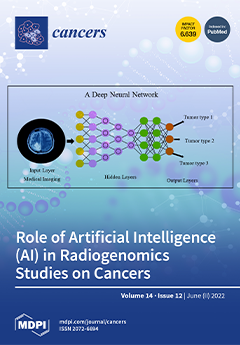
Cover Story: Recently, radiogenomics, a combination of “Radiomics” and “Genomics”, has played a significant role in and offered a new understanding of cancer’s biology and its behavior in response to standard therapies. It also provides a more precise prognosis, investigation, and analysis of a patient’s cancer. Over the years, artificial intelligence (AI) has provided significant strength to radiogenomics. It syndicates large-scale quantifiable data from radiological medical images enveloped with personalized genomic phenotypes and fabricates a prediction model through various AI methods to stratify patients’ risk, monitor therapeutic approaches, and assess clinical outcomes. This review offers the computational and oncological prospects, achievements, and limitations of AI in radiogenomics studies on cancer in the era of precision medicine. View this paper
  • Issues are regarded as officially published after their release is announced to the table of contents alert mailing list .
  • You may sign up for email alerts to receive table of contents of newly released issues.
  • PDF is the official format for papers published in both, html and pdf forms. To view the papers in pdf format, click on the "PDF Full-text" link, and use the free Adobe Reader to open them.

Articles (218)

  • Article
  • Open Access
10 Citations
3,032 Views
16 Pages

Can 18F-FDG PET/CT Radiomics Features Predict Clinical Outcomes in Patients with Locally Advanced Esophageal Squamous Cell Carcinoma?

  • Vetri Sudar Jayaprakasam,
  • Peter Gibbs,
  • Natalie Gangai,
  • Raazi Bajwa,
  • Ramon E. Sosa,
  • Randy Yeh,
  • Megan Greally,
  • Geoffrey Y. Ku,
  • Marc J. Gollub and
  • Viktoriya Paroder

20 June 2022

This study aimed to assess the usefulness of radiomics features of 18F-FDG PET/CT in patients with locally advanced esophageal cancers (ESCC) in predicting outcomes such as clinical tumor (cT) and nodal (cN) categories, PET response to induction chem...

  • Article
  • Open Access
18 Citations
3,520 Views
17 Pages

Biodegradable Ultrasmall-in-Nano Architectures Loaded with Cisplatin Prodrug in Combination with Ionizing Radiation Induces DNA Damage and Apoptosis in Pancreatic Ductal Adenocarcinoma

  • Pei Pei Che,
  • Ana Katrina Mapanao,
  • Alessandro Gregori,
  • Maria Laura Ermini,
  • Agata Zamborlin,
  • Mjriam Capula,
  • Danitsja Ngadimin,
  • Ben J. Slotman,
  • Valerio Voliani and
  • Peter Sminia
  • + 1 author

20 June 2022

Considering the dismal survival rate, novel therapeutic strategies are warranted to improve the outcome of pancreatic ductal adenocarcinoma (PDAC). Combining nanotechnology for delivery of chemotherapeutics—preferably radiosensitizing agents&md...

  • Article
  • Open Access
7 Citations
4,930 Views
17 Pages

Using the Prediction Model Risk of Bias Assessment Tool (PROBAST) to Evaluate Melanoma Prediction Studies

  • Isabelle Kaiser,
  • Sonja Mathes,
  • Annette B. Pfahlberg,
  • Wolfgang Uter,
  • Carola Berking,
  • Markus V. Heppt,
  • Theresa Steeb,
  • Katharina Diehl and
  • Olaf Gefeller

20 June 2022

Rising incidences of cutaneous melanoma have fueled the development of statistical models that predict individual melanoma risk. Our aim was to assess the validity of published prediction models for incident cutaneous melanoma using a standardized pr...

  • Article
  • Open Access
4 Citations
2,876 Views
13 Pages

A Novel 2-Metagene Signature to Identify High-Risk HNSCC Patients amongst Those Who Are Clinically at Intermediate Risk and Are Treated with PORT

  • Shivaprasad Patil,
  • Annett Linge,
  • Hannah Hiepe,
  • Marianne Grosser,
  • Fabian Lohaus,
  • Volker Gudziol,
  • Max Kemper,
  • Alexander Nowak,
  • Dominik Haim and
  • Inge Tinhofer
  • + 21 authors

20 June 2022

(1) Background: Patients with locally advanced head and neck squamous cell carcinoma (HNSCC) who are biologically at high risk for the development of loco–regional recurrences after postoperative radiotherapy (PORT) but at intermediate risk acc...

  • Review
  • Open Access
36 Citations
4,418 Views
19 Pages

Heterogeneity in Melanoma

  • Mei Fong Ng,
  • Jacinta L. Simmons and
  • Glen M. Boyle

20 June 2022

There is growing evidence that tumour heterogeneity has an imperative role in cancer development, evolution and resistance to therapy. Continuing advancements in biomedical research enable tumour heterogeneity to be observed and studied more critical...

  • Article
  • Open Access
15 Citations
2,834 Views
10 Pages

Clinical Benefits of Indocyanine Green Fluorescence in Robot-Assisted Partial Nephrectomy

  • Yu-Kuan Yang,
  • Ming-Li Hsieh,
  • Sy-Yuan Chen,
  • Chung-Yi Liu,
  • Po-Hung Lin,
  • Hung-Cheng Kan,
  • See-Tong Pang and
  • Kai-Jie Yu

20 June 2022

Background: To compare the intraoperative and postoperative outcomes of indocyanine green (ICG) administration in robot-assisted partial nephrectomy (RAPN) and report the differences in the results between patients with benign and malignant renal tum...

  • Article
  • Open Access
11 Citations
2,311 Views
12 Pages

Prompt Resumption of Screening Programme Reduced the Impact of COVID-19 on New Breast Cancer Diagnoses in Northern Italy

  • Lucia Mangone,
  • Pamela Mancuso,
  • Maria Barbara Braghiroli,
  • Isabella Bisceglia,
  • Cinzia Campari,
  • Stefania Caroli,
  • Massimiliano Marino,
  • Adele Caldarella,
  • Paolo Giorgi Rossi and
  • Carmine Pinto

20 June 2022

The aim of this study is to evaluate the real impact of COVID-19 during the entire 2020 period, compared with 2019. The data comes from a Cancer Registry in Northern Italy and we compared clinical and treatment characteristics of breast cancer by age...

  • Review
  • Open Access
16 Citations
4,279 Views
15 Pages

Neoadjuvant Chemoradiotherapy for Locally Advanced Gastric Cancer: Where Are We at?

  • Jen-Hao Yeh,
  • Yung-Sung Yeh,
  • Hsiang-Lin Tsai,
  • Ching-Wen Huang,
  • Tsung-Kun Chang,
  • Wei-Chih Su and
  • Jaw-Yuan Wang

20 June 2022

Locally advanced gastric cancer (LAGC) has a poor prognosis with surgical resection alone, and neoadjuvant treatment has been recommended to improve surgical and oncological outcomes. Although neoadjuvant chemotherapy has been established to be effec...

  • Review
  • Open Access
20 Citations
5,882 Views
23 Pages

The Liver Pre-Metastatic Niche in Pancreatic Cancer: A Potential Opportunity for Intervention

  • Peter Gumberger,
  • Bergthor Bjornsson,
  • Per Sandström,
  • Linda Bojmar and
  • Constantinos P. Zambirinis

20 June 2022

Cancer-related mortality is primarily a consequence of metastatic dissemination and associated complications. Pancreatic ductal adenocarcinoma (PDAC) is one of the most lethal malignancies and tends to metastasize early, especially in the liver. Emer...

  • Review
  • Open Access
14 Citations
4,823 Views
18 Pages

Target Definition in MR-Guided Adaptive Radiotherapy for Head and Neck Cancer

  • Mischa de Ridder,
  • Cornelis P. J. Raaijmakers,
  • Frank A. Pameijer,
  • Remco de Bree,
  • Floris C. J. Reinders,
  • Patricia A. H. Doornaert,
  • Chris H. J. Terhaard and
  • Marielle E. P. Philippens

20 June 2022

In recent years, MRI-guided radiotherapy (MRgRT) has taken an increasingly important position in image-guided radiotherapy (IGRT). Magnetic resonance imaging (MRI) offers superior soft tissue contrast in anatomical imaging compared to computed tomogr...

of 22

Get Alerted

Add your email address to receive forthcoming issues of this journal.

XFacebookLinkedIn
Cancers - ISSN 2072-6694