


You are currently on the new version of our website. Access the old version .

Cancers, Volume 13, Issue 5

March-1 2021 - 256 articles

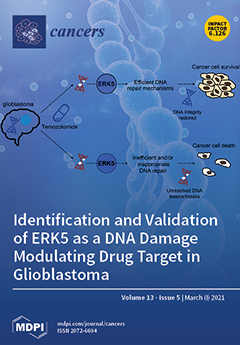
Cover Story: Brain tumours kill children and adults under 40 than any other cancer, with approximately half of primary brain tumours diagnosed as high-grade glioblastomas that account for ~190,000 deaths/year globally. The mean survival for these patients of ~15 months has improved little over the last 40 years, with less than 10% of patients surviving over 5 years, highlighting an urgent need to identify new drug targets for this disease. In this issue, Carmell et al. identify ERK5/MAPK7 as a previously unappreciated factor in the cellular response to standard-of-care chemotherapy drug temozolomide (TMZ). They further show that ERK5 promotes the efficient repair of TMZ-induced DNA damage and cell survival and that high levels of ERK5 are associated with high-grade tumours and poor survival rates. This work therefore identifies ERK5 as a potential novel drug target in this currently incurable disease. View this paper
  • Issues are regarded as officially published after their release is announced to the table of contents alert mailing list .
  • You may sign up for email alerts to receive table of contents of newly released issues.
  • PDF is the official format for papers published in both, html and pdf forms. To view the papers in pdf format, click on the "PDF Full-text" link, and use the free Adobe Reader to open them.

Articles (256)

  • Review
  • Open Access
170 Citations
11,017 Views
17 Pages

Stimuli-Responsive Hydrogels for Cancer Treatment: The Role of pH, Light, Ionic Strength and Magnetic Field

  • Fernanda Andrade,
  • Maria Mercé Roca-Melendres,
  • Esteban F. Durán-Lara,
  • Diana Rafael and
  • Simó Schwartz

9 March 2021

Cancer remains as the second leading cause of death, worldwide. Despite the enormous important advances observed in the last decades, advanced stages of the disease remain incurable. The severe side effects associated to systemic high doses of chemot...

  • Article
  • Open Access
31 Citations
5,163 Views
12 Pages

Epithelial to Mesenchymal Transition Regulates Surface PD-L1 via CMTM6 and CMTM7 Induction in Breast Cancer

  • Malina Xiao,
  • Meriem Hasmim,
  • Audrey Lequeux,
  • Kris Van Moer,
  • Tuan Zea Tan,
  • Christine Gilles,
  • Brett G. Hollier,
  • Jean Paul Thiery,
  • Guy Berchem and
  • Bassam Janji
  • + 1 author

9 March 2021

CMTM6 is a critical regulator of cell surface expression of PD-L1 in tumor cells, but little is known about the transcriptional regulation of CMTM6. Here we report that the expression of CMTM6 positively correlates with the epithelial to mesenchymal...

  • Article
  • Open Access
11 Citations
3,154 Views
17 Pages

Relevance of 2′-O-Methylation and Pseudouridylation for the Malignant Melanoma

  • Simon Jasinski-Bergner,
  • Juliane Blümke,
  • Claudia Wickenhauser and
  • Barbara Seliger

9 March 2021

The two RNA modifications 2′-O-methylation and pseudouridylation occur on several RNA species including ribosomal RNAs leading to an increased translation as well as cell proliferation associated with distinct functions. Using malignant melanoma (MM)...

  • Article
  • Open Access
47 Citations
5,856 Views
14 Pages

Variability in Breast Cancer Biomarker Assessment and the Effect on Oncological Treatment Decisions: A Nationwide 5-Year Population-Based Study

  • Balazs Acs,
  • Irma Fredriksson,
  • Caroline Rönnlund,
  • Catharina Hagerling,
  • Anna Ehinger,
  • Anikó Kovács,
  • Rasmus Røge,
  • Jonas Bergh and
  • Johan Hartman

9 March 2021

We compared estrogen receptor (ER), progesterone receptor (PR), human epidermal growth-factor receptor 2 (HER2), Ki67, and grade scores among the pathology departments in Sweden. We investigated how ER and HER2 positivity rates affect the distributio...

  • Review
  • Open Access
36 Citations
5,203 Views
16 Pages

The Role of microRNAs in the Cisplatin- and Radio-Resistance of Cervical Cancer

  • Rina Masadah,
  • Syahrul Rauf,
  • Muhammad Yogi Pratama,
  • Claudio Tiribelli and
  • Devis Pascut

9 March 2021

Cervical cancer is the fourth leading cause of cancer-related death among women worldwide. The chemotherapeutical agent cisplatin, a small platinum-based compound, is considered as the standard therapy for locally advanced cervical cancer or recurren...

  • Article
  • Open Access
18 Citations
6,049 Views
17 Pages

Preclinical Safety Evaluation of Intranasally Delivered Human Mesenchymal Stem Cells in Juvenile Mice

  • Yolanda Aguilera,
  • Nuria Mellado-Damas,
  • Laura Olmedo-Moreno,
  • Víctor López,
  • Concepción Panadero-Morón,
  • Marina Benito,
  • Hugo Guerrero-Cázares,
  • Catalina Márquez-Vega,
  • Alejandro Martín-Montalvo and
  • Vivian Capilla-González

9 March 2021

Mesenchymal stem cell (MSC)-based therapy is a promising therapeutic approach in the management of several pathologies, including central nervous system diseases. Previously, we demonstrated the therapeutic potential of human adipose-derived MSCs for...

  • Review
  • Open Access
22 Citations
7,068 Views
31 Pages

9 March 2021

Pancreatic ductal adenocarcinoma (PDAC) is a devastating malignancy with poor prognosis and a dismal survival rate, expected to become the second leading cause of cancer-related deaths in the United States. Oncolytic virus (OV) is an anticancer appro...

  • Review
  • Open Access
48 Citations
7,718 Views
17 Pages

9 March 2021

In the past few decades, the role of cancer-associated fibroblasts (CAFs) in resistance to therapies for gastrointestinal (GI) cancers has emerged. Clinical studies focusing on GI cancers have revealed that the high expression of CAF-related molecule...

  • Review
  • Open Access
20 Citations
4,520 Views
22 Pages

The Role of circRNAs in Human Papillomavirus (HPV)-Associated Cancers

  • Patrizia Bonelli,
  • Antonella Borrelli,
  • Franca Maria Tuccillo,
  • Franco Maria Buonaguro and
  • Maria Lina Tornesello

9 March 2021

Circular RNAs (circRNAs) are a new class of “non-coding RNAs” that originate from non-sequential back-splicing of exons and/or introns of precursor messenger RNAs (pre-mRNAs). These molecules are generally produced at low levels in a cell-type-specif...

  • Article
  • Open Access
39 Citations
5,018 Views
13 Pages

Carbonic Anhydrase IX Promotes Human Cervical Cancer Cell Motility by Regulating PFKFB4 Expression

  • Min-Chieh Hsin,
  • Yi-Hsien Hsieh,
  • Yi-Hsuan Hsiao,
  • Pei-Ni Chen,
  • Po-Hui Wang and
  • Shun-Fa Yang

9 March 2021

Carbonic anhydrase IX (CAIX) is a hypoxia-induced protein that is highly expressed in numerous human cancers. However, the molecular mechanisms involved in CAIX and human cervical cancer metastasis remain poorly understood. In this study, CAIX overex...

of 26

Get Alerted

Add your email address to receive forthcoming issues of this journal.

XFacebookLinkedIn
Cancers - ISSN 2072-6694