


You are currently viewing a new version of our website. To view the old version click .

Toxins, Volume 8, Issue 9

September 2016 - 23 articles

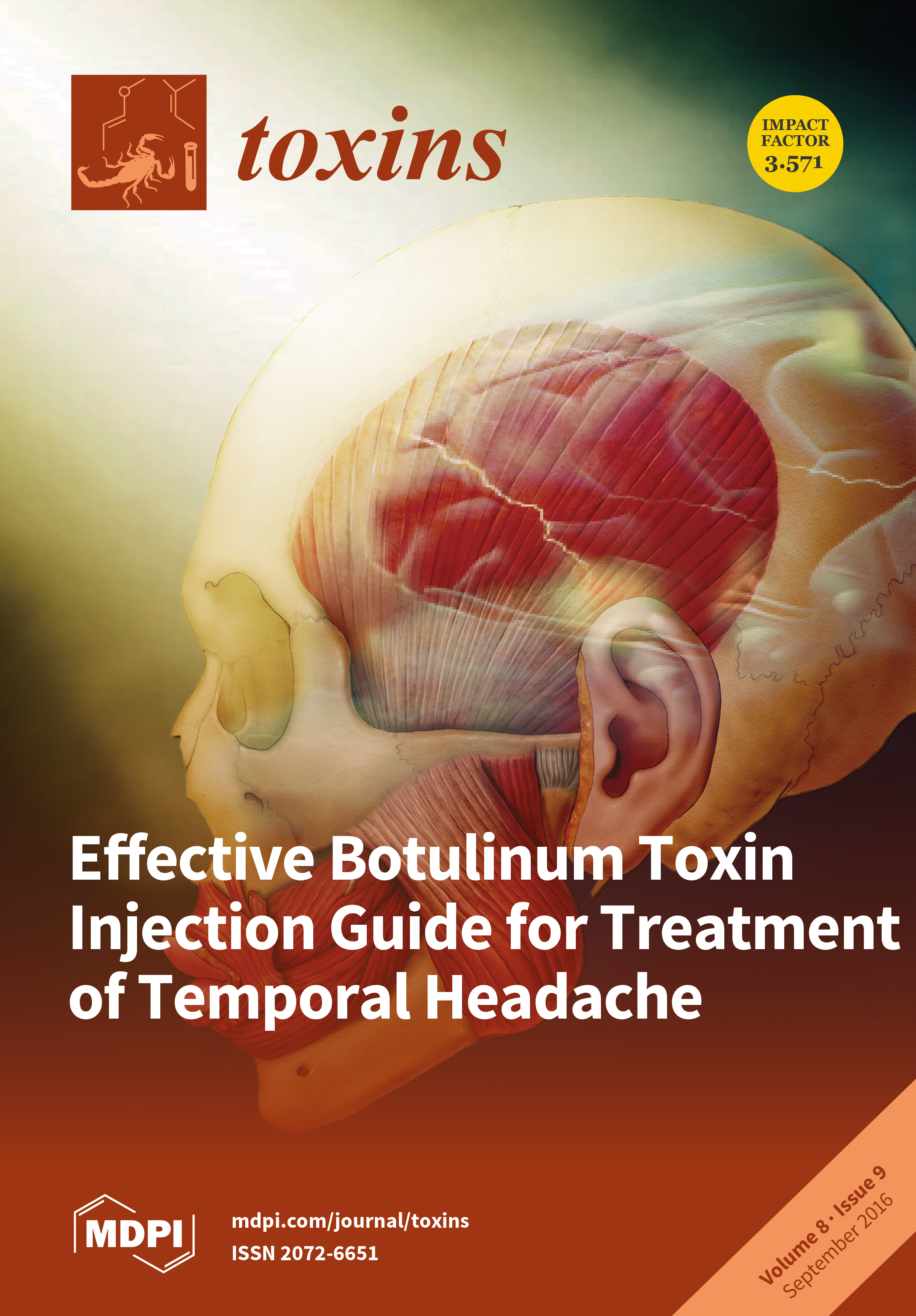
Cover Story: Injection of botulinum toxin type A (BoNT-A) is a popular treatment for temporal headache. Clinicians should have a detailed understanding of the temporalis anatomy before performing BoNT-A. We conducted a cadaveric study to better characterize the anatomy of the temporalis tendon and in turn improve the delivery of BoNT-A into this region. An easily identifiable and effective injection site for BoNT-A on the temporalis muscle has been suggested in this study.View this paper.
  • Issues are regarded as officially published after their release is announced to the table of contents alert mailing list .
  • You may sign up for email alerts to receive table of contents of newly released issues.
  • PDF is the official format for papers published in both, html and pdf forms. To view the papers in pdf format, click on the "PDF Full-text" link, and use the free Adobe Reader to open them.

Articles (23)

  • Article
  • Open Access
26 Citations
7,272 Views
14 Pages

Organization and ELISA-Based Results of the First Proficiency Testing to Evaluate the Ability of European Union Laboratories to Detect Staphylococcal Enterotoxin Type B (SEB) in Buffer and Milk

  • Yacine Nia,
  • Mélanie Rodriguez,
  • Reinhard Zeleny,
  • Sabine Herbin,
  • Frédéric Auvray,
  • Uwe Fiebig,
  • Marc-André Avondet,
  • Amalia Munoz and
  • Jacques-Antoine Hennekinne

13 September 2016

The aim of this work was to organize the first proficiency test (PT) dedicated to staphylococcal enterotoxin B (SEB) detection in milk and buffer solutions. This paper describes the organization of the PT trial according to EN ISO 17043 requirements....

  • Article
  • Open Access
14 Citations
7,978 Views
14 Pages

Neutralization of Botulinum Neurotoxin Type E by a Humanized Antibody

  • Yağmur Derman,
  • Katja Selby,
  • Sebastian Miethe,
  • André Frenzel,
  • Yvonne Liu,
  • Christine Rasetti-Escargueil,
  • Arnaud Avril,
  • Thibaut Pelat,
  • Remi Urbain and
  • Alexandre Fontayne
  • + 5 authors

12 September 2016

Botulinum neurotoxins (BoNTs) cause botulism and are the deadliest naturally-occurring substances known to humans. BoNTs have been classified as one of the category A agents by the Centers for Disease Control and Prevention, indicating their potentia...

  • Article
  • Open Access
23 Citations
6,311 Views
17 Pages

Bioactivation and Regioselectivity of Pig Cytochrome P450 3A29 towards Aflatoxin B1

  • Jun Wu,
  • Ruohong Chen,
  • Caihui Zhang,
  • Kangbai Li,
  • Weiying Xu,
  • Lijuan Wang,
  • Qingmei Chen,
  • Peiqiang Mu,
  • Jun Jiang and
  • Jikai Wen
  • + 1 author

12 September 2016

Due to unavoidable contaminations in feedstuff, pigs are easily exposed to aflatoxin B1 (AFB1) and suffer from poisoning, thus the poisoned products potentially affect human health. Heretofore, the metabolic process of AFB1 in pigs remains to be clar...

  • Article
  • Open Access
27 Citations
7,631 Views
22 Pages

Tetanus Neurotoxin Neutralizing Antibodies Screened from a Human Immune scFv Antibody Phage Display Library

  • Han Wang,
  • Rui Yu,
  • Ting Fang,
  • Ting Yu,
  • Xiangyang Chi,
  • Xiaopeng Zhang,
  • Shuling Liu,
  • Ling Fu,
  • Changming Yu and
  • Wei Chen

11 September 2016

Tetanus neurotoxin (TeNT) produced by Clostridium tetani is one of the most poisonous protein substances. Neutralizing antibodies against TeNT can effectively prevent and cure toxicosis. Using purified Hc fragments of TeNT (TeNT-Hc) as an antigen, th...

  • Article
  • Open Access
24 Citations
14,486 Views
10 Pages

Effective Botulinum Toxin Injection Guide for Treatment of Temporal Headache

  • You-Jin Choi,
  • Won-Jae Lee,
  • Hyung-Jin Lee,
  • Kang-Woo Lee,
  • Hee-Jin Kim and
  • Kyung-Seok Hu

8 September 2016

This study involved an extensive analysis of published research on the morphology of the temporalis muscle in order to provide an anatomical guideline on how to distinguish the temporalis muscle and temporalis tendon by observing the surface of the p...

  • Article
  • Open Access
49 Citations
7,146 Views
20 Pages

8 September 2016

Deoxynivalenol (DON), produced by the plant pathogens Fusarium graminearum and Fusarium culmorum, is one of the most common mycotoxins, contaminating cereal and cereal-derived products. Although worldwide contamination of food and feed poses health t...

  • Article
  • Open Access
14 Citations
6,068 Views
13 Pages

8 September 2016

Deoxynivalenol (DON) is a secondary fungal metabolite and contaminant mycotoxin that is widely detected in wheat and corn products cultivated around the world. Bio-remediation methods have been extensively studied in the past two decades and promisin...

  • Article
  • Open Access
35 Citations
8,492 Views
14 Pages

7 September 2016

The “function debate” in the philosophy of biology and the “venom debate” in the science of toxinology are conceptually related. Venom systems are complex multifunctional traits that have evolved independently numerous times throughout the animal kin...

  • Article
  • Open Access
15 Citations
6,336 Views
16 Pages

6 September 2016

Microcystin-leucine arginine (MC-LR) is a harmful cyanotoxin produced by cyanobacteria. MC-LR can exert endocrine-disrupting activities in many organisms. We have previously demonstrated that MC-LR exerts both acute and chronic reproductive toxicity...

  • Communication
  • Open Access
42 Citations
8,491 Views
9 Pages

The Contents of Ustiloxins A and B along with Their Distribution in Rice False Smut Balls

  • Xiaohan Wang,
  • Xiaoxiang Fu,
  • Fengke Lin,
  • Weibo Sun,
  • Jiajia Meng,
  • Ali Wang,
  • Daowan Lai,
  • Ligang Zhou and
  • Yang Liu

6 September 2016

Ustiloxins are cyclopeptide mycotoxins isolated from rice false smut balls (FSBs), the ball-like colonies transformed from the individual grains through the filament infection by the fungal pathogen Villosiclava virens. There were no obvious relation...

of 3

Get Alerted

Add your email address to receive forthcoming issues of this journal.

XFacebookLinkedIn
Toxins - ISSN 2072-6651