


Abstract
Long-term renal outcomes following snake envenomation may vary across regions, yet remain poorly characterized in South Korea. We investigated the long-term risk of chronic kidney disease (CKD) following snake envenomation and snakebite-related acute kidney injury (AKI). This nationwide population-based cohort study used data from the Korean National Health Information Database (2012–2023). We matched 729 adults hospitalized for snake envenomation who received antivenom to 2916 individuals without snake envenomation (1:4). Using a 1-year landmark design, we assessed incident CKD with Cox proportional hazards models and Kaplan–Meier analysis. CKD occurred in 48 patients with snake envenomation and in 156 controls, with incidence rates of 7.16 and 5.59 per 1000 person-years, respectively. Snake envenomation was not significantly associated with incident CKD (adjusted hazard ratio [aHR], 1.15; 95% confidence interval [CI], 0.85–1.55). Among patients with snake envenomation, 73 patients (10.0%) had coded AKI during the index hospitalization. Snakebite-related AKI was associated with incident CKD (aHR, 4.25; 95% CI, 2.15–8.40), whereas the association with severe envenomation did not reach statistical significance. CKD developed in 17 of the 73 patients with AKI (23.3%). Thus, no statistically significant association was detected between snake envenomation and incident CKD overall, whereas coded AKI was associated with subsequent CKD among envenomated patients. New CKD events continued to occur throughout follow-up.
Key Contribution:
In this nationwide Korean cohort with up to 10 years of follow-up, the association between snake envenomation and incident CKD was not statistically significant. Among patients with snake envenomation, snakebite-related AKI was the only covariate that reached statistical significance in the multivariable analysis.
1. Introduction
South Korea has three venomous Gloydius species (G. brevicaudus, G. saxatilis, and G. ussuriensis; family Viperidae) and Rhabdophis tigrinus (family Natricidae) [1]. Among these species, Gloydius species account for most of the clinically significant cases of snake envenomation. Local tissue damage, venom-induced consumption coagulopathy, and rhabdomyolysis have been commonly reported as acute manifestations of envenomation in South Korea. Beyond the acute manifestations of envenomation, increasing attention has been given to the long-term health consequences of snake envenomation, which can negatively affect the quality of life of snakebite survivors. Our recent nationwide Korean cohort study linked snake envenomation to a higher risk of stroke over the long term, with a particularly pronounced association for hemorrhagic stroke [2].
The association of acute kidney injury (AKI) with an increased risk of incident or progressive chronic kidney disease (CKD) is well established [3,4]. However, long-term renal risk following AKI varies across clinical settings, such as sepsis, surgery, malignancy, and envenomation, highlighting the importance of evaluating outcomes in specific clinical contexts [4].
In the context of snake envenomation, the World Health Organization (WHO) recognizes viper envenomation as an important cause of community-acquired AKI [5]. In Asian countries where Viperidae bites predominate, such as India, Sri Lanka, and Myanmar, AKI develops in up to 75% of patients following snake envenomation [6,7,8,9,10,11]. Furthermore, up to 50% of patients with snakebite-related AKI have been reported to develop CKD at various follow-up periods [12,13,14,15].
However, compared with reports from other countries, snakebite-related AKI in South Korea appears to follow a much milder clinical course, with a lower incidence (2.6–14% vs. >50%), a lower proportion of stage 3 cases (10% vs. 24–78.6%), and a reduced need for renal replacement therapy (0–1.4% vs. 25–100%) [16,17,18]. Differences in venom composition across snake species as well as variable access to care across countries may largely account for the distinct clinical features of snakebite-related AKI. Given the milder acute-phase manifestations of AKI in South Korea, long-term renal outcomes reported in other countries may not be directly generalizable to Korean patients. Additionally, our previous single-center study suggested that the association between AKI and subsequent CKD may differ among Korean patients with snake envenomation [17]. However, the very small number of patients with follow-up data (n = 41) precluded a definitive conclusion regarding this association.
The timing of renal assessment is another important consideration as kidney function may continue to improve after snakebite-related AKI. In a prospective follow-up study of 42 patients with snakebite-related AKI, the proportion with an estimated glomerular filtration rate (eGFR) below 60 mL/min/1.73 m2 decreased from 35.7% at two weeks after discharge to 11.9% at three months [19]. However, even rapid recovery of kidney function after AKI does not necessarily indicate complete resolution of renal injury, as residual structural damage may persist [3]. Therefore, a sufficiently long follow-up period is necessary to characterize the long-term risk of CKD. Nevertheless, very few studies of snakebite-related AKI have extended follow-up beyond two years, including the aforementioned study conducted in South Korea [13,17,20].
In addition, previous studies reporting long-term renal outcomes have primarily included patients who developed AKI following snake envenomation [13,15,21]. Thus, whether the long-term risk of CKD is associated with snake envenomation itself or is more closely linked to the established AKI-to-CKD continuum remains unclear.
Therefore, we conducted a nationwide population-based cohort study with long-term follow-up to compare the risk of incident CKD between patients with snake envenomation and nonenvenomated individuals and to evaluate the association between snakebite-related AKI and subsequent CKD.
2. Results
2.1. Patient Characteristics
A total of 3645 participants, comprising 729 patients with snake envenomation in the case group and 2916 matched controls, were included in this study. Because participants who developed CKD, died, or emigrated within 1 year after the index date were excluded before matching, all 3645 participants were alive, free of CKD, and under observation at the start of outcome follow-up. Cases and controls were matched at a 1:4 ratio according to age category, sex, and socioeconomic status. Consequently, the distributions of these matching variables were identical between the two groups (all p > 0.99).
At baseline, the prevalence of hypertension, diabetes mellitus, dyslipidemia, and coronary heart disease, and the Charlson Comorbidity Index did not significantly differ between the two groups.
With respect to lifestyle factors, compared with the controls, patients in the case group were more likely to consume alcohol heavily (29.5% vs. 24.5%, p < 0.01); patients in the case group also had a different distribution of body mass index categories (p = 0.01), with a greater proportion of normal-weight individuals (39.4% vs. 34.0%) and a lower proportion of individuals with obesity (32.4% vs. 37.8%). Smoking status and regular physical activity were comparable between the two groups.
After matching, the absolute standardized mean differences (SMDs) ranged from 0.000 to 0.113; values of 0.1 or more were observed for heavy alcohol consumption (0.113) and for the normal-weight (0.112) and obese (0.113) body mass index categories (Table 1).
Table 1.
Baseline Characteristics of the Study Population.
2.2. Association Between Snake Envenomation and the Risk of Incident CKD
During follow-up through 31 December 2023, 48 incident CKD events occurred in the case group and 156 occurred in the control group. The incidence rates were 7.16 and 5.59 per 1000 person-years, respectively. After adjustment for demographic characteristics, clinical comorbidities, and lifestyle factors, no statistically significant association between snake envenomation and incident CKD was detected in the overall cohort (aHR, 1.15 (95% CI, 0.85–1.55)).
In the analysis stratified by baseline diabetes mellitus, snake envenomation was not significantly associated with incident CKD among individuals without baseline diabetes (aHR, 1.08 (95% CI, 0.75–1.55)) (Table 2). Among individuals with baseline diabetes mellitus, the incidence rates of incident CKD were 14.05 and 9.50 per 1000 person-years in the diabetic case and diabetic control groups, respectively. Compared with the non-diabetic control group, the aHRs were 2.25 (95% CI, 1.15–4.40) for the diabetic case group and 1.85 (95% CI, 1.25–2.75; p < 0.001) for the diabetic control group. However, there was no significant interaction between snake envenomation and baseline diabetes mellitus with respect to the risk of incident CKD (p for interaction = 0.245).
Table 2.
Incidence Rates and Adjusted Hazard Ratios for Incident Chronic Kidney Disease for Snake Envenomation and Baseline Diabetes Mellitus Groups.
2.3. Risk Factors for Incident CKD Among Patients with Snake Envenomation
In the case group, coded AKI during the index hospitalization occurred in 73 patients (10.0%), and severe envenomation was observed in 94 (12.9%).
Multivariable Cox regression analysis showed that coded AKI during the index hospitalization was the only covariate with a statistically significant association with incident CKD (aHR, 4.25; 95% CI, 2.15–8.40), whereas older age, baseline diabetes mellitus, hypertension, and severe envenomation were not significantly associated with the risk of incident CKD (Table 3).
Table 3.
Multivariable-Adjusted Predictors of Incident Chronic Kidney Disease in the Snake Envenomation Cohort.
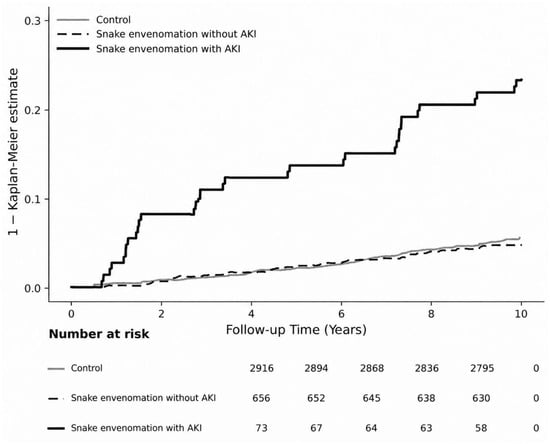
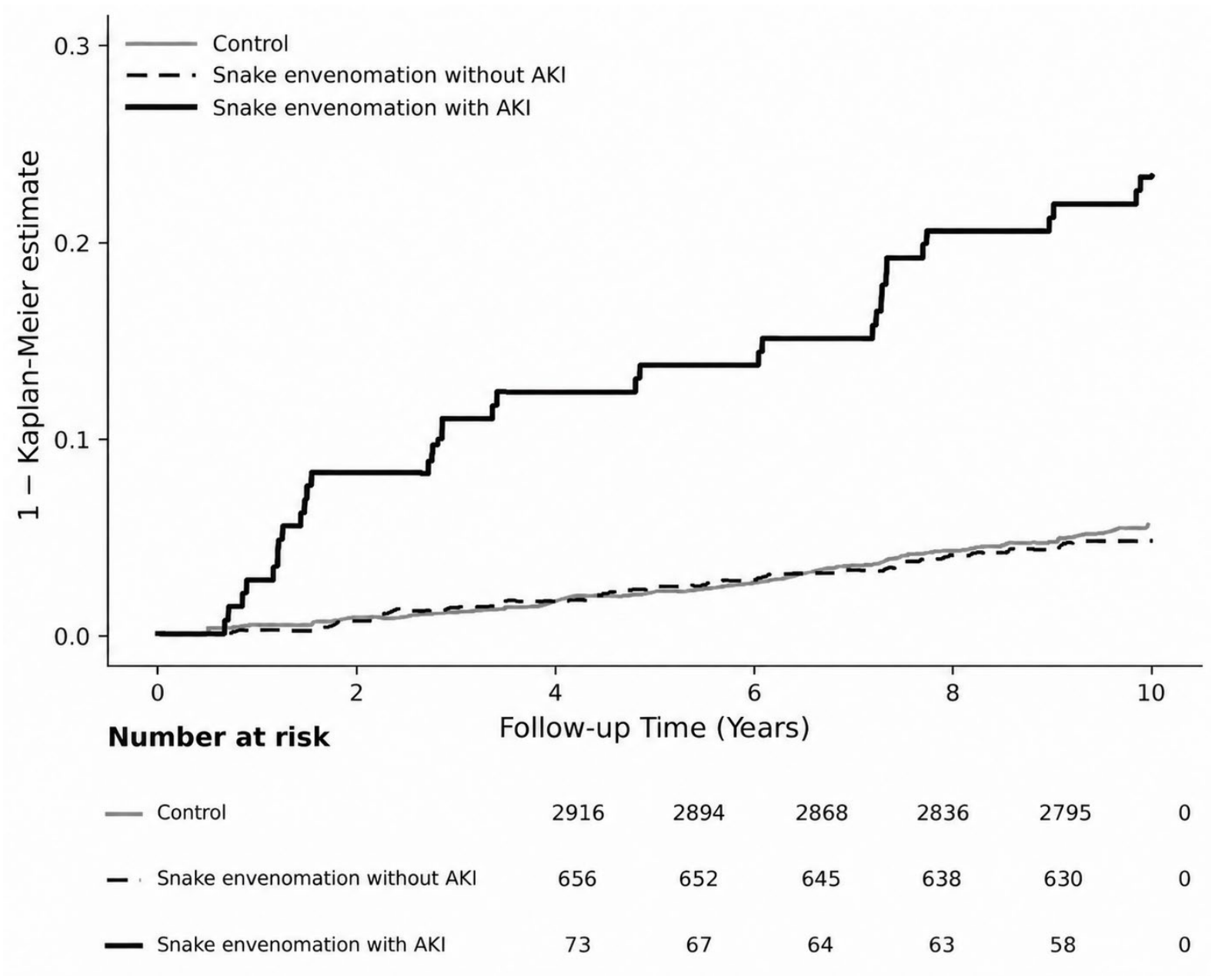
Kaplan–Meier analysis showed a higher estimated cumulative incidence of CKD among patients who developed AKI during the index hospitalization than among those without AKI, with new CKD events continuing to occur throughout long-term follow-up (Figure 1). During follow-up, CKD developed in 17 of the 73 patients with AKI (23.3%), 31 of the 656 patients without AKI (4.7%), and 156 of the 2916 controls (5.3%).
Figure 1.
One Minus the Kaplan–Meier Estimate for Chronic Kidney Disease According to Snake Envenomation and Snakebite-Related Acute Kidney Injury. Kaplan–Meier curves showing the cumulative incidence of CKD in the control group and in patients with snake envenomation with or without AKI. The numbers at risk are shown below the curves. The curves show one minus the Kaplan–Meier estimate with deaths censored and may therefore overestimate the cumulative probability of CKD in the presence of death as a competing event. Time zero corresponds to the start of outcome follow-up, 1 year after the index date. Because participants who developed CKD, died, or emigrated during the first year were excluded before matching, the numbers at risk at time zero (2916, 656, and 73) form the risk set for the outcome analysis. Abbreviations: AKI, acute kidney injury.
3. Discussion
To our knowledge, this is the first nationwide population-based cohort study in Korea to evaluate long-term renal outcomes after snake envenomation using matched nonenvenomated controls. The results showed that snake envenomation itself was not statistically significantly associated with incident CKD in the overall cohort. However, among patients with snake envenomation, coded AKI was associated with subsequent incident CKD. In contrast to most previous studies from other countries enrolling only patients with snakebite-related AKI [13,15,19,21], we included an overall snake envenomation population and a matched nonenvenomated population. In our study, snake envenomation was not significantly associated with incident CKD in either the overall cohort or the analysis restricted to individuals without baseline diabetes mellitus. The absence of a statistically significant association was consistent with findings from one previous study conducted in Sri Lanka [20]. Furthermore, no statistically significant association was observed between severe envenomation and incident CKD among patients with snake envenomation.
Among patients with dialysis-requiring AKI following Russell’s viper bites, the severity of local reactions, hypotension at presentation, and bleeding manifestations were not associated with subsequent CKD [13]. Similarly, the total dose of antivenom, which may serve as a surrogate for venom burden or the severity of envenomation, was not associated with long-term renal outcomes after snakebite-related AKI in previous Indian studies [13,15].
In this study, the incidence of coded AKI (10.0%) was comparable to the 2–14% reported in previous Korean single-center studies [16,17,18] and lower than the pooled incidence of approximately 23% reported worldwide over the past decade [23]. Despite its relatively low incidence, snakebite-related AKI was associated with long-term incident CKD. Importantly, an increased risk of CKD has also been observed after mild or short-duration AKI (<3 days), despite apparent initial recovery of kidney function, in other clinical settings, including surgery and sepsis [4]. This may be particularly relevant in Korea, where snakebite-related AKI generally has a relatively mild clinical course, with renal replacement therapy required in only 0–1.4% of affected patients and no reported mortality [16,17].
In our study, the statistically significant association of long-term incident CKD with snakebite-related AKI suggests that CKD may be better understood as part of the AKI-to-CKD continuum. Although the underlying mechanisms cannot be determined from our study, maladaptive renal repair following AKI may represent a potential mechanism linking snakebite-related AKI to subsequent CKD [24], which warrants further investigation in the context of snake envenomation.
The established risk factors for CKD following AKI in nonenvenomation clinical settings include greater AKI severity and duration, diabetes mellitus, hypertension, older age, and dialysis-requiring AKI [4]. In our study, the increased risk of CKD associated with baseline diabetes mellitus was evident when the case and control groups were further stratified according to diabetes status, supporting its established role as a risk factor for CKD. However, in the analysis restricted to patients with snake envenomation, AKI was the only covariate that reached statistical significance, whereas older age, diabetes mellitus, and hypertension did not. Nevertheless, the confidence intervals for older age and diabetes mellitus remained compatible with clinically meaningful increases in CKD risk. Therefore, the nonsignificant associations should be interpreted cautiously, particularly given the relatively small number of incident CKD events, and do not exclude potential associations with these traditional risk factors.
Notably, the extended follow-up in this study allowed us to examine renal outcomes over the decade following snake envenomation. The Kaplan–Meier curves showed a relatively rapid increase in estimated CKD incidence during early follow-up, followed by a more gradual increase thereafter. CKD developed in 17 of the 73 patients with AKI (23.3%) during follow-up, indicating that new CKD events continued to occur beyond the early period after AKI. This long-term pattern highlights the importance of sufficiently prolonged observation in characterizing the renal prognosis of snakebite-related AKI and may help inform future guidelines regarding the duration of renal monitoring in these patients. Differences in follow-up duration, along with differences in the responsible snake species and study populations, may also partly explain the considerable variation in CKD incidence reported across previous studies.
4. Limitations
This study has several limitations. First, AKI was identified using administrative claims data. Accordingly, its severity, duration, and recovery could not be evaluated. In addition, mild or transient episodes of AKI that were not clinically recognized or coded may have been missed, potentially resulting in misclassification. Administrative N17 coding has shown limited sensitivity in validation studies outside Korea, and we did not identify a Korean validation study (see Section 6); the AKI incidence in this study should therefore be interpreted as the incidence of coded AKI, and clinically or biochemically defined AKI may have been under-ascertained. Second, preexisting CKD was excluded on the basis of diagnostic codes rather than laboratory measures of kidney function. Therefore, undiagnosed or asymptomatic CKD present before snake envenomation may not have been completely excluded. In addition, because the available claims records began on 1 January 2012, the look-back period for excluding preexisting CKD was shorter than 2 years, and CKD diagnosed earlier but not recorded during this period may have been misclassified as incident CKD; excluding participants with CKD in the first year after the index date may have reduced, but cannot eliminate, such misclassification. Incident CKD was also identified from diagnostic codes, which have shown limited sensitivity in validation studies, so CKD may have been under-ascertained. Third, we could not identify the snake species involved, as a serologic test for this purpose is not commercially available for routine clinical practice in Korea. This prevented comparisons of long-term renal outcomes across species. Nevertheless, most venomous snakebites in South Korea have been attributed to Gloydius species [1]. Fourth, although we adjusted for major CKD risk factors, other unmeasured factors, such as diet and inherited susceptibility to CKD, may have influenced the observed associations. In addition, lifestyle factors and body mass index were missing for participants without a pre-index health examination; multiple imputation may not fully remove bias if the missingness depended on unobserved values, and residual confounding by these factors cannot be excluded. Fifth, only patients with snake envenomation who received antivenom treatment were included to increase the specificity for clinically meaningful envenomation and reduce the inclusion of possible dry bites. However, this approach may have excluded patients with milder envenomation who did not receive antivenom. In addition, detailed treatment-related information that could influence the development or course of AKI, such as the timing of antivenom administration and fluid therapy, was unavailable in the claims database. Therefore, the potential influence of these treatment-related factors could not be evaluated. Sixth, the relatively small number of incident CKD events, particularly among patients with snake envenomation, may have limited the statistical power to identify additional risk factors for CKD. Seventh, we could not estimate the cumulative incidence of CKD accounting for death as a competing event; the cumulative incidence curves, estimated as one minus the Kaplan–Meier estimate with deaths censored, may therefore overestimate the absolute risk of CKD, and the magnitude of this overestimation could not be assessed. In addition, we were unable to formally assess the proportional hazards assumption; the hazard ratios should be interpreted as cause-specific hazard ratios, which may obscure changes in the association over time if the hazards were not proportional. Moreover, because outcome follow-up began 1 year after the index date, our findings apply to individuals who survived without CKD for at least 1 year after the index date. Finally, because the study cohort consisted entirely of Koreans, the generalizability of our findings to other populations may be limited, particularly given geographic differences in snake species and venom composition.
5. Conclusions
In this nationwide Korean cohort, no statistically significant association between snake envenomation and incident CKD was detected in the overall cohort. However, among patients with snake envenomation, snakebite-related AKI was associated with subsequent incident CKD. One minus the Kaplan–Meier estimate for CKD among patients with snakebite-related AKI continued to increase during long-term follow-up, reaching approximately 23% by 10 years, without adjustment for the competing risk of death. These findings suggest that long-term renal risk following snake envenomation may be concentrated among patients who develop AKI and highlight the importance of long-term renal follow-up in this population. Further studies are needed to clarify the mechanisms underlying the progression from snakebite-related AKI to CKD.
6. Materials and Methods
6.1. Data Source and Ethics
This study used data from the National Health Information Database (NHID), maintained by the Korean National Health Insurance Service (NHIS), which is the single provider of mandatory health insurance for the entire Korean population. Additionally, the NHIS provides biennial national health examinations for eligible individuals, and the results are systematically incorporated into the NHID. Consequently, the anonymized NHID has an extensive database that contains sociodemographic information (e.g., age and sex), lifestyle factors (e.g., smoking status and alcohol consumption), and all hospital claims (inpatient, outpatient, and emergency department) coded according to the International Classification of Diseases, 10th revision (ICD-10), for the entire Korean population.
The NHIS supplied researchers with deidentified NHID records containing longitudinal health care utilization information linked by anonymized patient identifiers. Our institutional review board approved the research (IRB No. CNUH-EXP-2025-150) and waived the requirement for informed consent because of the retrospective study design and the use of deidentified administrative records.
6.2. Study Population
We assembled the cohort using NHID records spanning 1 January 2012 to 31 December 2023. Eligibility during 2012–2013 was restricted to adults aged ≥18 years with no previous diagnosis of snake venom toxicity (ICD-10 T63.0), CKD (ICD-10 N18.x), or AKI (ICD-10 N17). Cases were eligible adults admitted for snake envenomation (T63.0) between 1 January 2012 and 31 December 2013, who received antivenom during that admission. For cases, the index date was the date of admission for snake envenomation. Controls had no recorded T63.0 diagnosis at any time during the observation period. Each control was randomly assigned an index date to match the distribution of index dates among cases. Exact matching on age, sex, and socioeconomic status was performed at a 4:1 control-to-case ratio. Age was matched using the three categories reported in Table 1 (18–39, 40–64, and ≥65 years) rather than single years of age.
Because the NHID claims records used in this study began on 1 January 2012, the look-back period for the exclusion criteria (previous snake envenomation, CKD, or AKI) and for baseline comorbidities extended from 1 January 2012 to the index date and therefore ranged from 0 to almost 24 months, depending on the index date.
Baseline comparability was assessed using standardized mean differences, with values less than 0.1 indicating satisfactory balance. Follow-up began 1 year after the index date and continued until death, emigration, or the end of the observation period.
6.3. Primary Outcome
The primary outcome of this study was incident CKD occurring after snake envenomation. Incident CKD was defined using ICD-10 codes and confirmed as having at least 1 inpatient or 2 outpatient diagnoses recorded [25]. Specifically, incident CKD required ICD-10 code N18.x recorded as the principal or a secondary diagnosis on at least one inpatient claim or on outpatient claims on at least two separate dates, with no maximum interval between the two outpatient diagnoses. The requirement for at least one inpatient or two outpatient diagnoses has been used in a previous Korean NHIS-based study of kidney disease [25], which was not a validation study, and we did not identify a study validating this algorithm against laboratory criteria in the Korean NHIS. To evaluate long-term incident CKD, a 1-year lag period was applied as a landmark design: participants who developed CKD, died, or emigrated within the first year after the index date were excluded before matching, and outcome follow-up began 1 year after the index date. Consequently, all matched participants were alive, free of CKD, and under observation at the start of outcome follow-up.
6.4. Data Collection
Data on demographic characteristics (index date, age, sex, and socioeconomic status based on income level), clinical comorbidities (hypertension [ICD-10 codes I10–I15], diabetes mellitus [ICD-10 codes E10–E14], dyslipidemia [ICD-10 code E78], and coronary heart disease [ICD-10 codes I20–I25]) were extracted from the NHID. Data concerning lifestyle factors, including current smoking, heavy alcohol consumption, regular physical activity, and body mass index were obtained from each participant’s most recent national health examination before the index date, where available; health examination records from before 1 January 2012 were also used for this purpose. A pre-index health examination was not required for cohort inclusion, and these variables were missing for participants without one; missing values were handled by multiple imputation (see Statistical Analysis). Heavy alcohol consumption was defined as a self-reported alcohol intake of ≥30 g/day, while the criterion for regular physical activity was either ≥5 sessions of moderate-intensity exercise or ≥3 sessions of vigorous-intensity exercise per week. We quantified the burden of comorbid disease with the Charlson Comorbidity Index using claims-based diagnostic data from the NHID [26,27].
Additionally, in the case group, the occurrence of AKI (ICD-10 code N17) and the severity of envenomation during the index hospitalization were assessed. AKI was defined as any N17 code recorded as the principal or a secondary diagnosis on a claim during the index hospitalization; because administrative coding may miss clinically recognized or biochemically defined AKI, AKI in this study refers to coded AKI. Severe envenomation was defined as the presence of either hematologic severity (an ICD-10 code for DIC or the requirement for blood transfusion within 2 days of admission) or hemodynamic severity (an ICD-10 code for shock or the use of vasopressors within 1 day of admission). A Korean study examining venom-induced consumption coagulopathy after snake envenomation reported that the most extreme measurements of the international normalized ratio (INR), activated partial thromboplastin time (aPTT), and fibrinogen occurred within 16 h of arrival at the hospital. We therefore used a 2-day window for events defining severe hematological envenomation, aiming to capture clinically important early coagulopathy and avoid classifying later events unrelated to envenomation as manifestations of severity [28].
6.5. Statistical Analysis
Baseline characteristics were compared between the case and control groups. Categorical variables are presented as frequencies and percentages and were compared using the chi-square test. Continuous variables are expressed as the means with standard deviations and were compared using Student’s t test or the Wilcoxon rank-sum test, as appropriate.
We expressed incidence as the number of events per 1000 person-years of follow-up and estimated cumulative CKD incidence with the Kaplan–Meier method. Cox proportional hazards models provided hazard ratios (HRs) together with their 95% confidence intervals (CIs). For analyses of the full cohort, covariate adjustment included demographic characteristics (age, sex, and income level), lifestyle factors (current smoking, heavy alcohol consumption, regular physical activity, and body mass index), and clinical comorbidities (hypertension, diabetes mellitus, coronary heart disease, and dyslipidemia).
In the case group, the multivariable model for incident CKD was adjusted for older age, baseline diabetes mellitus, baseline hypertension, severe envenomation, and snakebite-related AKI. These factors were selected on the basis of their established or clinically relevant associations with CKD [29].
We examined subgroups defined by snake envenomation status and diabetes mellitus status at baseline, using controls without diabetes mellitus as the reference group. Given that diabetes mellitus is a major established risk factor for CKD, this analysis was performed to evaluate the association between snake envenomation and incident CKD according to baseline diabetes status and to assess whether this association differed according to the presence of diabetes mellitus. The interaction between snake envenomation and baseline diabetes mellitus was assessed by including a multiplicative interaction term in the Cox proportional hazards model. Missing covariate values (lifestyle factors and body mass index) were handled using multiple imputation by chained equations. Five imputed datasets were generated, and pooled estimates were used for the adjusted Cox proportional hazards models. Lifestyle factors and body mass index after imputation are presented in Table 1.
The hazard ratios from the Cox models, in which deaths were censored, are cause-specific hazard ratios; they describe the association with the rate of CKD among participants who were alive and free of CKD [30]. The cumulative incidence curves were estimated as one minus the Kaplan–Meier estimate with deaths censored and may overestimate the absolute risk of CKD in the presence of death as a competing event [30]; we therefore also report the observed proportion of participants in whom CKD developed during follow-up. Participants who died before developing CKD remained in the denominator without contributing an event, and these proportions do not account for differences in follow-up time. Standardized mean differences were calculated from the summary statistics, using proportions for categorical variables and pooled standard deviations for continuous variables [22]. Diagnostic codes for CKD and AKI have shown limited sensitivity in validation studies outside Korea: the median sensitivity of CKD codes was 41% in a systematic review [31], and the sensitivity of AKI codes was 37.4–61.6% for ICD-10 N17 against a ≥2-fold increase in serum creatinine [32] and 17.2% for ICD-9-CM billing codes against the creatinine-based Kidney Disease: Improving Global Outcomes criteria [33], with specificity above 95% in both studies.
We used SAS 9.4 (SAS Institute Inc., Cary, NC, USA) for all statistical computations and applied a two-sided significance threshold of p < 0.05.
Author Contributions
Conceptualization: B.C. and E.J.; Methodology: E.J.; Formal Analysis: D.K.; Investigation: Y.S.; Writing—Original Draft Preparation: J.M.; Writing—Review and Editing: J.M., D.K., Y.S., B.C. and E.J.; Supervision: B.C.; Project Administration: E.J.; Funding Acquisition: B.C. All authors have read and agreed to the published version of the manuscript.
Funding
This work was supported by a National Research Foundation of Korea (NRF) grant funded by the Korean government (MSIT) (RS-2022-NR070426) and supported by Chonnam National University Hwasun Biomedical Research Institute (HCRI26022).
Institutional Review Board Statement
The Institutional Review Board of Chonnam National University Hospital approved this study (IRB No. CNUH-EXP-2025-150, approved on 26 May 2025) and waived the requirement to obtain informed consent for secondary data use in accordance with local ethical guidelines. The research adhered to the Declaration of Helsinki.
Data Availability Statement
The Korean National Health Insurance Service (NHIS) maintains the National Health Information Database (NHID) from which the study data were drawn. These records are subject to access restrictions and cannot be made publicly available. Researchers may obtain access by submitting a data use application to the NHIS and receiving approval.
Conflicts of Interest
The authors declare no conflicts of interest.
References
- Shim, J.H.; Son, Y.J.; Lee, S.S.; Kim, J.H.; Park, H.S. Ecological study on poisonous snakes and investigation of venom characteristics and snakebite frequency in Korea. Korean J. Environ. Ecol. 1998, 12, 58–77. [Google Scholar]
- Moon, J.M.; Chun, B.J.; Jung, E.J.; Kim, D.K.; Seong, Y.J. Long-term risk of stroke after snake envenomation: A nationwide population-based cohort study in Korea. Toxins 2026, 18, 265. [Google Scholar] [CrossRef] [Scilit]
- Venkatachalam, M.A.; Griffin, K.A.; Lan, R.; Geng, H.; Saikumar, P.; Bidani, A.K. Acute kidney injury: A springboard for progression in chronic kidney disease. Am. J. Physiol. Ren. Physiol. 2010, 298, F1078–F1094. [Google Scholar] [CrossRef] [Scilit]
- Veltkamp, D.M.J.; Porras, C.P.; Gant, C.M.; Tiel Groenestege, W.M.; Kok, M.B.; Verhaar, M.C.; van Solinge, W.W.; Haitjema, S.; Vernooij, R.W.M. Long-term risks of adverse kidney outcomes after acute kidney injury: A systematic review and meta-analysis. Nephrol. Dial. Transplant. 2025, 40, 2143–2158. [Google Scholar] [CrossRef] [Scilit]
- World Health Organization. Guidelines for the Management of Snakebites, 2nd ed.; World Health Organization Regional Office for South-East Asia: New Delhi, India, 2016; Available online: https://www.who.int/publications/i/item/9789290225300 (accessed on 1 September 2026).
- Ariga, K.; Dutta, T.K.; Haridasan, S.; Puthenpurackal, P.S.P.; Harichandrakumar, K.T.; Parameswaran, S. Chronic kidney disease after snake envenomation induced acute kidney injury. Saudi J. Kidney Dis. Transplant. 2021, 32, 146–156. [Google Scholar] [CrossRef] [Scilit]
- David, S.; Matathia, S.; Christopher, S. Mortality predictors of snake bite envenomation in southern India—A ten-year retrospective audit of 533 patients. J. Med. Toxicol. 2012, 8, 118–123. [Google Scholar] [CrossRef] [Scilit]
- Aye, K.P.; Thanachartwet, V.; Soe, C.; Desakorn, V.; Thwin, K.T.; Chamnanchanunt, S.; Sahassananda, D.; Supaporn, T.; Sitprija, V. Clinical and laboratory parameters associated with acute kidney injury in patients with snakebite envenomation: A prospective observational study from Myanmar. BMC Nephrol. 2017, 18, 92. [Google Scholar] [CrossRef] [Scilit]
- Krishnamurthy, S.; Gunasekaran, K.; Mahadevan, S.; Bobby, Z.; Kumar, A.P. Russell’s viper envenomation-associated acute kidney injury in children in Southern India. Indian Pediatr. 2015, 52, 583–586. [Google Scholar] [CrossRef] [Scilit]
- Ali, G.; Kak, M.; Kumar, M.; Bali, S.K.; Tak, S.I.; Hassan, G.; Wadhwa, M.B. Acute renal failure following Echis carinatus (saw-scaled viper) envenomation. Indian J. Nephrol. 2004, 14, 177–181. [Google Scholar]
- Ratnayake, I.; Mohamed, F.; Buckley, N.A.; Gawarammana, I.B.; Dissanayake, D.M.; Chathuranga, U.; Munasinghe, M.; Maduwage, K.; Jayamanne, S.; Endre, Z.H.; et al. Early identification of acute kidney injury in Russell’s viper (Daboia russelii) envenoming using renal biomarkers. PLoS Negl. Trop. Dis. 2019, 13, e0007486. [Google Scholar] [CrossRef] [Scilit]
- Sarkar, S.; Sinha, R.; Ray Chaudhury, A.; Maduwage, K.; Abeyagunawardena, A.; Bose, N.; Pradhan, S.; Bresolin, N.L.; Garcia, B.A.; McCulloch, M. Snake bite associated with acute kidney injury. Pediatr. Nephrol. 2021, 36, 3829–3840. [Google Scholar] [CrossRef] [Scilit]
- Waikhom, R.; Sircar, D.; Patil, K.; Bennikal, M.; Das Gupta, S.; Pandey, R. Long-term renal outcome of snake bite and acute kidney injury: A single-center experience. Ren. Fail. 2012, 34, 271–274. [Google Scholar] [CrossRef] [Scilit]
- Golay, V.; Roychowdhary, A.; Pandey, R.; Singh, A.; Pasari, A.; Abraham, A. Acute interstitial nephritis in patients with viperine snake bite: Single center experience of a rare presentation. Saudi J. Kidney Dis. Transplant. 2012, 23, 1262–1267. [Google Scholar]
- Kumar, M.; Thanjan, M.A.; Gopalakrishnan, N.; Jeyachandran, D.; Thanigachalam, D.; Ramanathan, S. Snake envenomation-induced acute kidney injury: Prognosis and long-term renal outcomes. Postgrad. Med. J. 2022, 98, 264–268. [Google Scholar] [CrossRef] [Scilit]
- Kang, S.H.; Moon, J.M.; Chun, B.J. Does the traditional snakebite severity score correctly classify envenomated patients? Clin. Exp. Emerg. Med. 2016, 3, 34–40. [Google Scholar] [CrossRef] [Scilit]
- Moon, J.M.; Chun, B.J.; Cho, Y.S.; Park, K.H. Clinical characteristics of snake envenomation-related acute kidney injury in South Korea. Sci. Rep. 2024, 14, 23503. [Google Scholar] [CrossRef] [Scilit]
- Cha, Y.S.; Lee, K.H.; Lee, S.J.; Kwon, H.C.; Lee, J.W.; Kim, H.I.; Kim, O.H.; Cha, K.C.; Kim, H.; Hwang, S.O. Usefulness of delta neutrophil index for early prediction of overt disseminated intravascular coagulopathy in patients with venomous snakebite. Clin. Exp. Emerg. Med. 2018, 5, 76–83. [Google Scholar] [CrossRef] [Scilit]
- Jaswanth, C.; Priyamvada, P.S.; Zachariah, B.; Haridasan, S.; Parameswaran, S.; Swaminathan, R.P. Short-term changes in urine beta 2 microglobulin following recovery of acute kidney injury resulting from snake envenomation. Kidney Int. Rep. 2019, 4, 667–673. [Google Scholar] [CrossRef] [Scilit]
- Waiddyanatha, S.; Silva, A.; Weerakoon, K.; Siribaddana, S.; Isbister, G.K. Does snake envenoming cause chronic kidney disease? A cohort study in rural Sri Lanka. Clin. Toxicol. 2023, 61, 47–55. [Google Scholar] [CrossRef] [Scilit]
- Herath, H.M.N.J.; Wazil, A.W.M.; Abeysekara, D.T.D.J.; Jeewani, N.D.C.; Weerakoon, K.G.A.D.; Ratnatunga, N.V.I.; Bandara, E.H.C.K.; Kularatne, S.A.M. Chronic kidney disease in snake envenomed patients with acute kidney injury in Sri Lanka: A descriptive study. Postgrad. Med. J. 2012, 88, 138–142. [Google Scholar] [CrossRef] [Scilit]
- Austin, P.C. Balance diagnostics for comparing the distribution of baseline covariates between treatment groups in propensity-score matched samples. Stat. Med. 2009, 28, 3083–3107. [Google Scholar] [CrossRef] [Scilit]
- Goumboundi, I.A.; Taylor, S.; Ayerkain, N.L.; Asum, K.; Oti, M.G.; Afrifa, J.; Ephraim, R.K.D. Snake envenomation and acute kidney injury: A systematic review and meta-analysis. BMC Nephrol. 2026, 27, 220. [Google Scholar] [CrossRef] [Scilit]
- Huang, L.L.; Longano, A.; McMahon, L.P. Toxins and the kidneys: A two-way street. Toxins 2025, 17, 578. [Google Scholar] [CrossRef] [Scilit]
- Woo, J.; Choi, A.; Jung, J.; Shin, J.Y. COVID-19 infection and severe clinical outcomes in patients with kidney disease by vaccination status: A nationwide cohort study in Korea. Epidemiol. Health 2024, 46, e2024065. [Google Scholar] [CrossRef] [Scilit]
- Quan, H.; Sundararajan, V.; Halfon, P.; Fong, A.; Burnand, B.; Luthi, J.C.; Saunders, L.D.; Beck, C.A.; Feasby, T.E.; Ghali, W.A. Coding algorithms for defining comorbidities in ICD-9-CM and ICD-10 administrative data. Med. Care 2005, 43, 1130–1139. [Google Scholar] [CrossRef] [Scilit]
- Charlson, M.E.; Pompei, P.; Ales, K.L.; MacKenzie, C.R. A new method of classifying prognostic comorbidity in longitudinal studies: Development and validation. J. Chronic Dis. 1987, 40, 373–383. [Google Scholar] [CrossRef] [Scilit]
- Moon, J.M.; Chun, B.J.; Cho, Y.S.; Kim, J.C.; Koo, Y.J.; Park, K.H.; Lee, S.D.; Ahn, J.S.; Kim, D.K.; Ryu, S.J. Coagulopathy after snake envenomation in South Korea. Clin. Toxicol. 2021, 59, 905–912. [Google Scholar] [CrossRef] [Scilit]
- Park, J.I.; Baek, H.; Jung, H.H. Prevalence of chronic kidney disease in Korea: The Korean National Health and Nutritional Examination Survey 2011–2013. J. Korean Med. Sci. 2016, 31, 915–923. [Google Scholar] [CrossRef] [Scilit]
- Austin, P.C.; Lee, D.S.; Fine, J.P. Introduction to the analysis of survival data in the presence of competing risks. Circulation 2016, 133, 601–609. [Google Scholar] [CrossRef] [Scilit]
- Vlasschaert, M.E.O.; Bejaimal, S.A.D.; Hackam, D.G.; Quinn, R.; Cuerden, M.S.; Oliver, M.J.; Iansavichus, A.; Sultan, N.; Mills, A.; Garg, A.X. Validity of administrative database coding for kidney disease: A systematic review. Am. J. Kidney Dis. 2011, 57, 29–43. [Google Scholar] [CrossRef] [Scilit]
- Hwang, Y.J.; Shariff, S.Z.; Gandhi, S.; Wald, R.; Clark, E.; Fleet, J.L.; Garg, A.X. Validity of the International Classification of Diseases, Tenth Revision code for acute kidney injury in elderly patients at presentation to the emergency department and at hospital admission. BMJ Open 2012, 2, e001821. [Google Scholar] [CrossRef] [Scilit]
- Grams, M.E.; Waikar, S.S.; MacMahon, B.; Whelton, S.; Ballew, S.H.; Coresh, J. Performance and limitations of administrative data in the identification of AKI. Clin. J. Am. Soc. Nephrol. 2014, 9, 682–689. [Google Scholar] [CrossRef] [Scilit]

Disclaimer/Publisher’s Note: The statements, opinions and data contained in all publications are solely those of the individual author(s) and contributor(s) and not of MDPI and/or the editor(s). MDPI and/or the editor(s) disclaim responsibility for any injury to people or property resulting from any ideas, methods, instructions or products referred to in the content. |
© 2026 by the authors. Licensee MDPI, Basel, Switzerland. This article is an open access article distributed under the terms and conditions of the Creative Commons Attribution (CC BY) license.