

You are currently viewing a new version of our website. To view the old version click .

Toxins, Volume 14, Issue 11

November 2022 - 91 articles

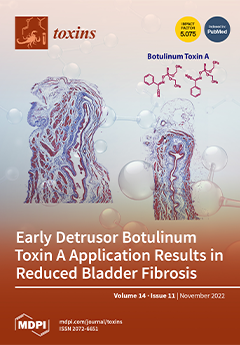
Cover Story: Approximately 80% of individuals who suffer spinal cord injury (SCI) will develop hypertrophic and neurogenic bladders resulting in complications including urinary incontinence, urinary tract infection and renal failure. In this study, the authors examined the effect of early bladder chemodenervation with botulinum toxin A on bladder histopathology and collagen deposition. They found that the bladders of SCI rats injected with botulinum toxin A had a significant reduction in detrusor hypertrophy and less fibrous collagen deposition compared to bladders from SCI animals injected with saline. These findings suggest that acute detrusor chemodenervation using botulinum toxin A after SCI can preserve bladder tissue integrity by reducing the development of detrusor fibrosis and hypertrophy associated with SCI. View this paper
  • Issues are regarded as officially published after their release is announced to the table of contents alert mailing list .
  • You may sign up for email alerts to receive table of contents of newly released issues.
  • PDF is the official format for papers published in both, html and pdf forms. To view the papers in pdf format, click on the "PDF Full-text" link, and use the free Adobe Reader to open them.

Articles (91)

  • Article
  • Open Access
9 Citations
3,375 Views
26 Pages

Fumonisin B Series Mycotoxins’ Dose Dependent Effects on the Porcine Hepatic and Pulmonary Phospholipidome

  • Omeralfaroug Ali,
  • Miklós Mézes,
  • Krisztián Balogh,
  • Melinda Kovács,
  • Janka Turbók and
  • András Szabó

18 November 2022

Male weaned piglets n = 6/group were fed Fumonisin B1+2+3 (FBs) mycotoxins at 0, 15, or 30 mg/kg diet for 3 weeks to assess the fatty acid (FA) composition of membrane lipid classes, lipid peroxidation, and histomorphological changes in the liver and...

  • Review
  • Open Access
41 Citations
6,666 Views
13 Pages

18 November 2022

Snakebite envenoming is a pathological condition which may occur in response to the injection of venom. Snake venoms contain a complex mixture of biologically active molecules which are responsible for a broad spectrum of clinical manifestations, ran...

  • Review
  • Open Access
23 Citations
10,477 Views
30 Pages

Superantigens, a Paradox of the Immune Response

  • Sofia Noli Truant,
  • Daniela María Redolfi,
  • María Belén Sarratea,
  • Emilio Luis Malchiodi and
  • Marisa Mariel Fernández

18 November 2022

Staphylococcal enterotoxins are a wide family of bacterial exotoxins with the capacity to activate as much as 20% of the host T cells, which is why they were called superantigens. Superantigens (SAgs) can cause multiple diseases in humans and cattle,...

  • Article
  • Open Access
5 Citations
4,055 Views
11 Pages

Detoxification of the Mycotoxin Citrinin by a Manganese Peroxidase from Moniliophthora roreri

  • Shuai Wang,
  • Xiaolu Wang,
  • Huoqing Huang,
  • Tao Tu,
  • Huiying Luo,
  • Yuhong Zhang,
  • Bo Liu,
  • Bin Yao,
  • Wei Zhang and
  • Xiaoyun Su

18 November 2022

Citrinin (CIT) is a mycotoxin found in foods and feeds and most commonly discovered in red yeast rice, a food additive made from ordinary rice by fermentation with Monascus. Currently, no enzyme is known to be able to degrade CIT effectively. In this...

  • Article
  • Open Access
6 Citations
3,041 Views
10 Pages

17 November 2022

Animal venoms are a rich source of pharmacological compounds with ecological and evolutionary significance, as well as with therapeutic and biotechnological potentials. Among the most promising venomous animals, cone snails produce potent neurotoxic...

  • Concept Paper
  • Open Access
3 Citations
2,713 Views
6 Pages

17 November 2022

In the last decade, a major dogma in the field of immunology has been called into question by the identification of a cell autonomous innate immune memory. This innate immune memory (also named trained immunity) was found to be mostly carried by inna...

  • Communication
  • Open Access
27 Citations
4,513 Views
10 Pages

17 November 2022

The use of chemical pesticides to control the occurrence of mycotoxigenic fungi in crops has led to environmental and human health issues, driving the agriculture sector to a more sustainable system. Biocontrol agents such as Bacillus strains and the...

  • Article
  • Open Access
4 Citations
3,263 Views
13 Pages

Identification and Characterization of Clostridium perfringens Atypical CPB2 Toxin in Cell Cultures and Field Samples Using Monoclonal Antibodies

  • Anna Serroni,
  • Claudia Colabella,
  • Deborah Cruciani,
  • Marcella Ciullo,
  • Silvia Crotti,
  • Paola Papa,
  • Antonella Di Paolo,
  • Marco Gobbi,
  • Katia Forti and
  • Martina Pellegrini
  • + 5 authors

17 November 2022

A direct sandwich enzyme-linked immunosorbent assay (sELISA) was developed for the detection of the atypical β2-toxin (CPB2) of Clostridium perfringens. Polyclonal (PAbs) and monoclonal (MAbs) antibodies were previously obtained employing recomb...

  • Review
  • Open Access
19 Citations
5,137 Views
32 Pages

16 November 2022

Mycotoxins pose significant risks to humans and livestock. In addition, contaminated food- and feedstuffs can only be discarded, leading to increased economic losses and potential ecological pollution. Mycotoxin removal and real-time toxin level moni...

  • Article
  • Open Access
5 Citations
2,733 Views
13 Pages

The Clinical Usefulness of Taiwan Bivalent Freeze-Dried Hemorrhagic Antivenom in Protobothrops mucrosquamatus- and Viridovipera stejnegeri-Envenomed Patients

  • Chih-Chuan Lin,
  • Chia-Pang Shih,
  • Chia-Cheng Wang,
  • Chun-Hsiang Ouyang,
  • Chien-Chun Liu,
  • Jau-Song Yu and
  • Chih-Hong Lo

15 November 2022

Snakebites from Protobothrops mucrosquamatus (Taiwan habus) and Viridovipera stejnegeri (green bamboo vipers) account for the most venomous snakebites in Taiwan. The bivalent freeze-dried hemorrhagic (FH) antivenom is employed to treat these two snak...

of 10

Get Alerted

Add your email address to receive forthcoming issues of this journal.

XFacebookLinkedIn
Toxins - ISSN 2072-6651