

You are currently viewing a new version of our website. To view the old version click .

Toxins, Volume 11, Issue 7

July 2019 - 60 articles

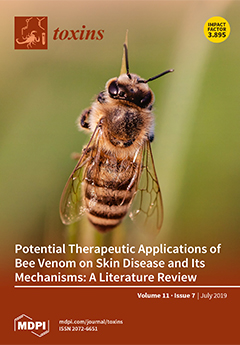
Cover Story: Corticosteroids and antimicrobial drugs are used as very effective treatments in many inflammatory and infectious skin diseases. However, there are growing concerns about the side effects of these therapies, especially during long-term use in relapsing or intractable diseases. Bee venom (BV) is an attractive alternative and complementary treatment because collective experiments and clinical reports show that BV exhibits anti-inflammatory, anti-apoptotic, anti-fibrotic, antibacterial, and antiviral effects. This review attempts to summarize the therapeutic applications of BV in skin diseases, including acne, alopecia, atopic dermatitis, melanoma, morphea, photoaging, psoriasis, wounds, wrinkles, and vitiligo. The killing effects of BV on skin disease-causing pathogens are also investigated. View this paper.
  • Issues are regarded as officially published after their release is announced to the table of contents alert mailing list .
  • You may sign up for email alerts to receive table of contents of newly released issues.
  • PDF is the official format for papers published in both, html and pdf forms. To view the papers in pdf format, click on the "PDF Full-text" link, and use the free Adobe Reader to open them.

Articles (60)

  • Article
  • Open Access
35 Citations
5,745 Views
15 Pages

Association of Nrf2, SOD2 and GPX1 Polymorphisms with Biomarkers of Oxidative Distress and Survival in End-Stage Renal Disease Patients

  • Djurdja Jerotic,
  • Marija Matic,
  • Sonja Suvakov,
  • Katarina Vucicevic,
  • Tatjana Damjanovic,
  • Ana Savic-Radojevic,
  • Marija Pljesa-Ercegovac,
  • Vesna Coric,
  • Aleksandra Stefanovic and
  • Jasmina Ivanisevic
  • + 4 authors

23 July 2019

The oxidative stress response via Nuclear factor (erythroid-derived 2)-like 2 (Nrf2) interlinks inflammation- and metabolism-related pathways in chronic kidney disease. We assessed the association between polymorphisms in Nrf2, superoxide dismutase (...

  • Article
  • Open Access
42 Citations
7,871 Views
14 Pages

Aflatoxin in Chili Peppers in Nigeria: Extent of Contamination and Control Using Atoxigenic Aspergillus flavus Genotypes as Biocontrol Agents

  • Chibundu N. Ezekiel,
  • Alejandro Ortega-Beltran,
  • Eniola O. Oyedeji,
  • Joseph Atehnkeng,
  • Philip Kössler,
  • Folasade Tairu,
  • Irmgard Hoeschle-Zeledon,
  • Petr Karlovsky,
  • Peter J. Cotty and
  • Ranajit Bandyopadhyay

22 July 2019

Across sub-Saharan Africa, chili peppers are fundamental ingredients of many traditional dishes. However, chili peppers may contain unsafe aflatoxin concentrations produced by Aspergillus section Flavi fungi. Aflatoxin levels were determined in chili...

  • Article
  • Open Access
6 Citations
4,710 Views
14 Pages

Mycotoxin Contamination of Edible Non-Timber Forest Products in Cameroon

  • Joseph Fovo Djeugap,
  • Sita Ghimire,
  • Immaculate Wanjuki,
  • Anne Muiruri and
  • Jagger Harvey

22 July 2019

The prevalence and concentrations of three major mycotoxins, total aflatoxin (AFs), fumonisin (F), and zearalenone (ZEN), were determined on seven edible non-timber forest products (ENTFP) in Cameroon. A total of 210 samples consiting of 30 samples f...

  • Article
  • Open Access
21 Citations
13,770 Views
14 Pages

21 July 2019

Pain is a natural bioassay for detecting and quantifying biological activities of venoms. The painfulness of stings delivered by ants, wasps, and bees can be easily measured in the field or lab using the stinging insect pain scale that rates the pain...

  • Article
  • Open Access
63 Citations
6,305 Views
15 Pages

Sclerostin as Regulatory Molecule in Vascular Media Calcification and the Bone–Vascular Axis

  • Annelies De Maré,
  • Stuart Maudsley,
  • Abdelkrim Azmi,
  • Jhana O. Hendrickx,
  • Britt Opdebeeck,
  • Ellen Neven,
  • Patrick C D’Haese and
  • Anja Verhulst

21 July 2019

Sclerostin is a well-known inhibitor of bone formation that acts on Wnt/β-catenin signaling. This manuscript considers the possible role of sclerostin in vascular calcification, a process that shares many similarities with physiological bone for...

  • Article
  • Open Access
35 Citations
6,281 Views
15 Pages

The Dual α-Amidation System in Scorpion Venom Glands

  • Gustavo Delgado-Prudencio,
  • Lourival D. Possani,
  • Baltazar Becerril and
  • Ernesto Ortiz

20 July 2019

Many peptides in scorpion venoms are amidated at their C-termini. This post-translational modification is paramount for the correct biological function of ion channel toxins and antimicrobial peptides, among others. The discovery of canonical amidati...

  • Article
  • Open Access
41 Citations
7,081 Views
26 Pages

20 July 2019

Listeria monocytogenes strains are known to harbour plasmids that confer resistance to sanitizers, heavy metals, and antibiotics; however, very little research has been conducted into how plasmids may influence L. monocytogenes’ ability to tole...

  • Article
  • Open Access
26 Citations
5,571 Views
17 Pages

19 July 2019

Dinoflagellates belonging to the genus Gambierdiscus produce ciguatoxins (CTXs), which are metabolized in fish to more toxic forms and subsequently cause ciguatera fish poisoning (CFP) in humans. Five species of Gambierdiscus have been described from...

  • Article
  • Open Access
34 Citations
5,538 Views
15 Pages

Virulence Characteristics and Antimicrobial Resistance Profiles of Shiga Toxin-Producing Escherichia coli Isolates from Humans in South Africa: 2006–2013

  • Musafiri Karama,
  • Beniamino T. Cenci-Goga,
  • Mogaugedi Malahlela,
  • Anthony M. Smith,
  • Karen H. Keddy,
  • Saeed El-Ashram,
  • Lawan M. Kabiru and
  • Alan Kalake

19 July 2019

Shiga toxin-producing Escherichia coli (STEC) isolates (N = 38) that were incriminated in human disease from 2006 to 2013 in South Africa were characterized by serotype, virulence-associated genes, antimicrobial resistance and pulsed-field gel electr...

  • Article
  • Open Access
14 Citations
6,303 Views
20 Pages

Daphnia magna Exudates Impact Physiological and Metabolic Changes in Microcystis aeruginosa

  • Gorenka Bojadzija Savic,
  • Christine Edwards,
  • Enora Briand,
  • Linda Lawton,
  • Claudia Wiegand and
  • Myriam Bormans

19 July 2019

While the intracellular function of many toxic and bioactive cyanobacterial metabolites is not yet known, microcystins have been suggested to have a protective role in the cyanobacterial metabolism, giving advantage to toxic over nontoxic strains und...

of 6

Get Alerted

Add your email address to receive forthcoming issues of this journal.

XFacebookLinkedIn
Toxins - ISSN 2072-6651