


Abstract
Background/Objectives: Digestive cancers are among the leading causes of death worldwide. Although their etiology is not fully understood, diet is an important modifiable risk factor. This scoping review aimed to explore the existing evidence on the association between adherence to various plant-based dietary (PBD) patterns and the risk of major digestive cancers. Methods: The scoping review followed the Arksey and O’Malley framework and Joanna Briggs Institute recommendations, and results were reported according to PRISMA-ScR guidelines. A systematic search was performed in PubMed/MEDLINE, Scopus, EMBASE, and Web of Science between January 2020 and May 2025. Original observational studies and clinical trials in English or Spanish examining the association between PBD patterns and digestive cancers were included. Results: A total of 24 studies were identified, including 16 prospective cohort studies and 8 hospital-based case–control studies, conducted mainly in Europe (n = 10), North America (n = 8), and Asia (n = 6). Most studies used food frequency questionnaires and predefined PBD indices, particularly the plant-based diet index (PDI), healthful (hPDI), and unhealthful (uPDI) (n = 13), while others assessed pro-vegetarian (n = 2) or EAT-Lancet dietary patterns (n = 3). Most studies reported protective associations with all digestive cancer localizations examined, particularly in relation to healthful PBD patterns: colorectal (13/15), pancreatic (6/7), liver (4/4), esophageal (4/5), stomach (3/4) and oropharyngeal (2/2) cancers. On the contrary, unhealthful PBD patterns were linked to a higher risk. Conclusions: Overall, the findings of this review highlight that the quality of PBD patterns is crucial for digestive cancer risk. PBD patterns emphasizing whole and minimally processed plant foods were protective, while those characterized by refined or ultra-processed plant products were deleterious. A future standardization of PBD indices would help to improve comparability among studies.
1. Introduction
Gastrointestinal cancers are defined as those cancers that mainly affect one or more organs of the digestive system. Among them, the most notable are cancers of the esophagus, stomach, pancreas, liver, and colon. According to data from the Global Cancer Observatory, in 2022, these cancers were among the top 10 deadliest, ranked in the following order: colorectal (2nd), liver (3rd), stomach (5th), pancreas (6th), and esophagus (7th) [1]. Although the etiology of some of them, such as pancreatic cancer, is still not well understood, there are several well-known risk factors, such as socioeconomic status [2] and certain lifestyle habits, including alcohol and tobacco consumption, as well as diet [3]. Notably, diet influences pancreatic cancer risk through multiple metabolic pathways, including insulin resistance, chronic hyperglycemia, obesity-related inflammation, and metabolic dysfunction [4].
Diet is one of the main modifiable risk factors for the prevention of non-communicable chronic diseases, including digestive cancers [5]. Traditionally, research has focused on specific macronutrients or individual foods. However, the study of dietary patterns has become more relevant over time [6], with a special focus on plant-based dietary (PBD) patterns, which have shown the most consistent health benefits [7]. Within these patterns, vegetarian diets are particularly relevant because they represent one of the most extensively studied and well-defined [8]. Vegetarian diets are exclusion-based patterns in which animal-derived foods such as meat, fish, eggs, and dairy are reduced or completely excluded [9]. A recent meta-analysis of observational studies included more than 600,000 participants and found that, compared to non-vegetarian diets, vegetarian diets were associated with a 59% lower risk of stomach cancer and a 15% lower risk of colorectal cancer (CRC), but were not related to other upper gastrointestinal cancers. In addition, these dietary patterns were associated with lower gastrointestinal tumorigenesis in men, but not in women [10].
Although vegetarian diets have also been linked to other health benefits, the prevalence of vegetarians in Western populations remains low [11], which has led to the development of more flexible dietary approaches, such as the so-called pro-vegetarian patterns (PVG) [12]. These PVG patterns focus on prioritizing plant foods rather than excluding animal-based ones. Also, because not all plant foods are equally healthy, healthful (hPVG) and unhealthful (uPVG) variants have been developed [13]. Greater adherence to these PVG patterns has also been associated with a lower risk of esophageal, stomach, and pancreatic cancers, although their role in other digestive cancers remains unknown [14,15]. In this context, new perspectives have also emerged, such as the use of PBDs, whose definition is not as straightforward as the previous ones. PBDs are qualitatively defined as a dietary pattern in which foods of animal origin are totally or mostly excluded, which means that other diets, such as flexitarian diets, could be considered part of this pattern [16].
The human diet not only influences human health but also has a critical impact on the environment and global ecosystems. As such, there is an urgent need to identify and promote dietary patterns that can better support sustainable food systems, simultaneously optimizing human and planetary health. Indeed, PBDs are linked to a consistently lower environmental burden [17], and currently are the best path forward for humanity and the planet as proposed by the recent EAT-Lancet Commission [18].
While PBD patterns could be a promising tool for the prevention of gastrointestinal cancers, there are still knowledge gaps regarding their association with certain subtypes of these cancers. Therefore, we aimed to carry out a scoping review to map the existing scientific evidence by answering the following research question: What is the existing evidence on the association between adherence to PBD patterns and the risk of digestive cancers (CRC, pancreatic, liver, esophageal and stomach)?
2. Materials and Methods
This review was conducted following the methodological framework established by Arksey and O’Malley [19], and guided by the Joanna Briggs Institute’s recommendations for scoping reviews [20]. The reporting of findings followed the PRISMA-ScR checklist [21]. The review protocol was registered in the Open Science Framework (OSF), available at: https://doi.org/10.17605/OSF.IO/5VQ4K.
2.1. Search Strategy
A systematic and comprehensive search was conducted across four databases: Pubmed/MEDLINE, Scopus, EMBASE, and Web of Science (WOS) on 27 May 2025. The search strategy combined controlled vocabulary terms (e.g., MeSH, Emtree) and free-text terms, organized into two thematic blocks: (1) PBD patterns and (2) gastrointestinal cancers or neoplasms.
We applied the following search strategy across all databases, using the same search terms and four different combinations. (1) We focused on PBD patterns: plant-based diet OR plant-based index OR plant-based indices OR PDI OR hPDI OR uPDI OR pro-vegetarian OR provegetarian OR PVG OR hPVG OR uPVG OR EAT-Lancet diet OR mediterranean diet OR vegetarian diet OR planetary health diet; (2) we targeted cancers of the gastrointestinal tract: gastrointestinal cancer OR digestive cancer OR pancreatic cancer OR esophageal cancer OR oesophageal cancer OR stomach cancer OR gastric cancer OR liver cancer OR colorectal cancer; and (3) we combined both sets of exposure and outcome terms using a Boolean AND operator. Finally, (4) we limited the search to studies published within the last 5 years. This time restriction was applied to capture the most recent evidence, given the rapid evolution of research on PBD indices in the last decade. The number of records retrieved from each database was as follows: MEDLINE (n = 234 in the last 5 years), Scopus (n = 396 in the last 5 years), EMBASE (n = 628 in the last 5 years), and WOS (n = 515 in the last 5 years). The full search strategies and detailed results for each database are presented in Table 1.
Table 1.
Databases, search strategy and number of records retrieved.
2.2. Inclusion and Exclusion Criteria
This scoping review included original research studies published in English or Spanish and available in full text. Eligible studies evaluated the association between PBD patterns and gastrointestinal cancers, specifically pancreatic, esophageal, gastric, liver, or CRC. Designs considered included observational studies (cross-sectional, cohort, case–control) and clinical trials.
Studies were excluded if they were published in languages other than English or Spanish, lacked full-text availability, focused on non-gastrointestinal cancers or non-cancer outcomes, or assessed dietary patterns not centered on plant-based components. Additionally, studies conducted in animals (e.g., rodent models), in vitro experiments, and non-original articles (such as systematic reviews, meta-analyses, editorials, letters, commentaries, and study protocols) were also excluded.
PBD patterns were defined based on the MeSH descriptor “Plant-Based Diets” (MeSH ID: D000095500), which refers to dietary approaches that emphasize the consumption of plant-derived foods (such as whole grains, vegetables, fruits, legumes, and nuts) while reducing or limiting the intake of animal-based foods. Eligible exposures included dietary patterns explicitly described as plant-based, pro-vegetarian dietary indices (e.g., plant-based diet index (PDI), healthful PDI (hPDI), unhealthful PDI (uPDI)), the EAT-Lancet planetary health diet, and other composite dietary patterns with a clearly stated plant-forward orientation. These patterns were generally measured using food frequency questionnaires (FFQs), dietary indices, or clustering approaches.
Studies examining isolated dietary components (e.g., intake of olive oil or legumes alone), substitution analyses (e.g., replacing legumes with meat), or focusing on ultra-processed plant-based products (e.g., meat analogs) rather than minimally processed plant foods were excluded. Dietary patterns evaluated only through general healthy eating scores (e.g., DASH, HEI) without a clear plant-based orientation were also excluded, unless the authors explicitly classified them as plant-based.
Although the initial search included the Mediterranean Diet (MD) to ensure comprehensive retrieval of plant-oriented dietary patterns, studies exclusively assessing the MD were excluded during the conceptual refinement phase. The MD does not fully meet our operational definition of PBDs since it incorporates moderate intakes of meat, fish, dairy, and eggs, being strongly shaped by cultural and regional culinary traditions [22,23]. This conceptual distinction has also been recognized in previous methodological papers and reviews, where the MD has been analyzed separately from plant-based indices such as the PDI, hPDI/uPDI, or PVG [16]. Thus, including MD-specific studies in this scoping review would have reduced the internal coherence of our framework.
2.3. Study Selection Process
Study selection was carried out in two stages: (1) screening of titles and abstracts, and (2) full-text review. Two authors independently (A.O.-C. and L.C.-A.) performed the screening using the Rayyan platform [24], and any discrepancies were resolved by a third author (I.C). Duplicate records were removed using a reference management tool (Zotero, v.7.0.24). The selection process was documented using the PRISMA-ScR flow diagram [25].
2.4. Data Extraction and Synthesis
A structured data extraction form was developed to collect the following information from each study, including the authors and year of publication, the country where the study was conducted, study design, sample size, participants’ characteristics, the dietary pattern evaluated, the type of gastrointestinal cancer examined, and the main findings with corresponding effect estimates.
Data were synthesized using a descriptive and narrative approach, with findings organized by type of dietary patterns and cancer, providing the most important information on study quality parameters.
2.5. Risk of Bias and Limitations
In line with previous recommendations for scoping reviews [20,25,26], we included a table on the risk of bias based on the Newcastle–Ottawa Scale adapted for cohort and case–control studies (Supplementary Materials File S1) and another table in the main material that contained information on the limitations, funding sources, and conflicts of interest reported by the included articles.
3. Results
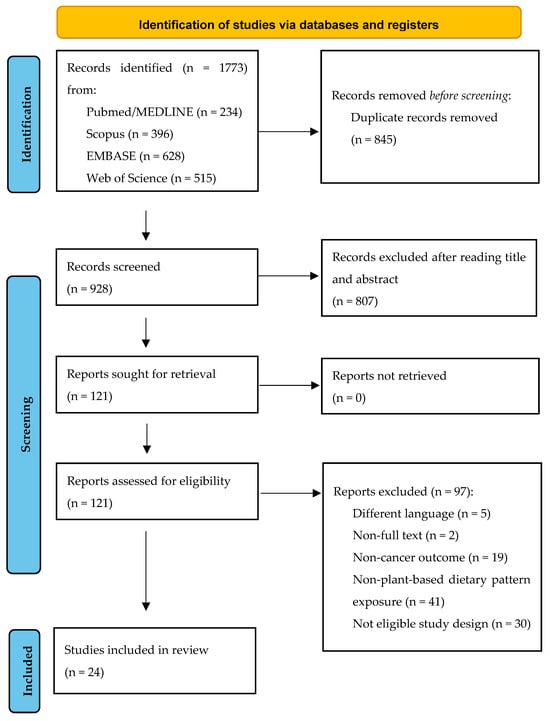
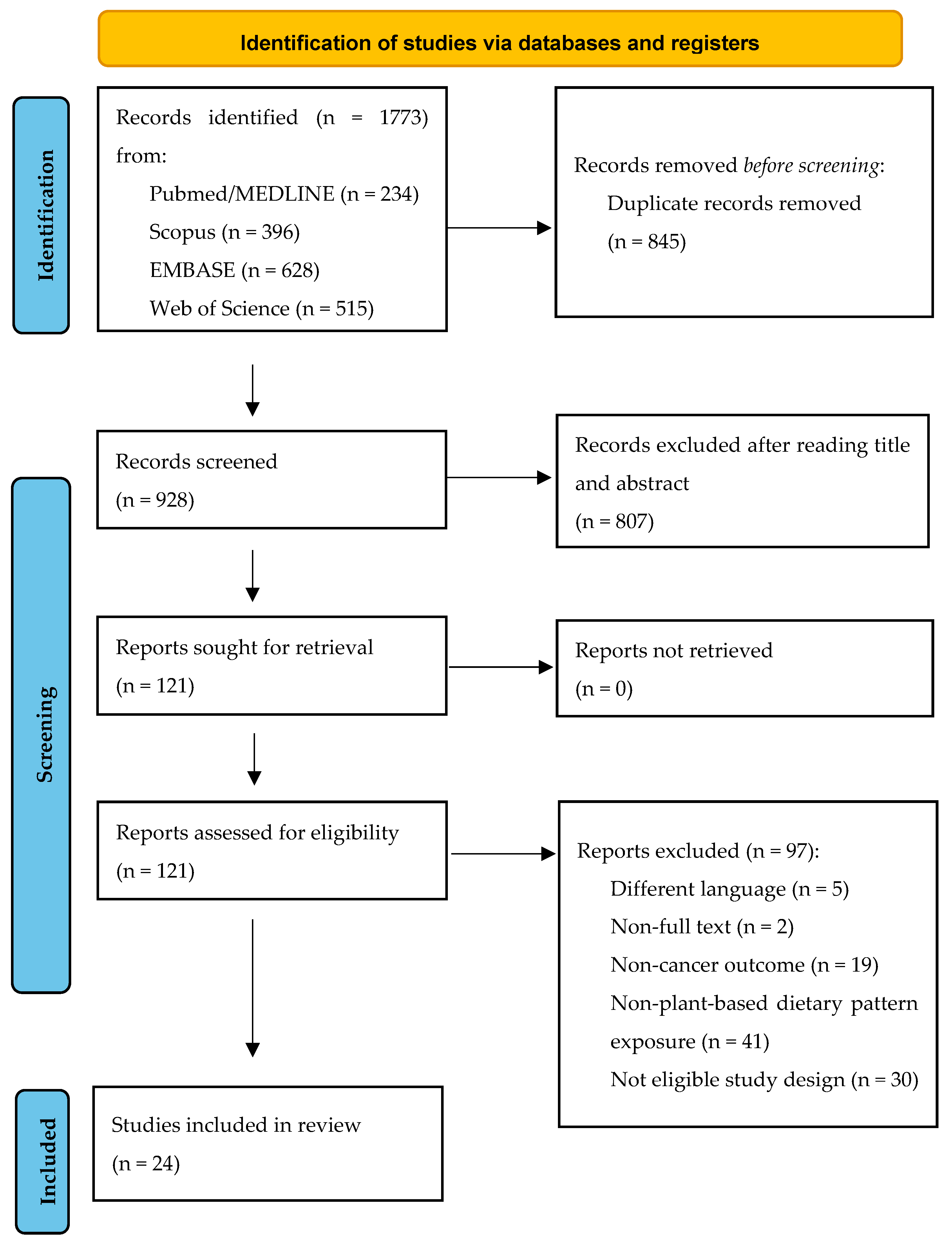
The flow diagram following PRISMA guidelines is presented in Figure 1. A total of 1773 studies were initially identified, of which 845 duplicates were removed, leaving 928 references to be examined. Subsequently, titles and abstracts were screened, and after applying exclusion and inclusion criteria, 121 studies were eligible for full-text assessment. After a detailed screening, 24 studies were finally selected for the review, analyzed and summarized in Table 2.
Figure 1.
PRISMA flowchart depicting the selection of studies.
Table 2.
Overview of the main characteristics of the studies included in this scoping review.
3.1. Characteristics of the Included Studies
The main characteristics of the included studies are summarized in Table 2. By geographic region, most studies were performed in Europe (n = 10), North America (n = 8) and Asia (n = 6). By country, the order was as follows: the United States (n = 8) [30,33,34,35,39,42,44,47], the United Kingdom (n = 6) [27,32,37,41,43,46], Italy (n = 3) [15,40,48], Iran (n = 3) [29,31,38], China (n = 2) [36,45], Malaysia (n = 1) [28], and Spain (n = 1) [14]. The majority were published in 2023 (n = 9) [15,28,29,30,37,39,41,42,47], followed by 2022 (n = 5) [14,27,34,35,36], 2024 (n = 5) [31,38,40,45,46], 2025 (n = 3) [32,43,48], and finally 2021 (n = 2) [33,44]. Regarding study design, a total of 16 cohort studies [15,27,30,32,33,34,35,37,39,41,42,43,44,45,46,47] with a follow-up range of 8.8 to 34 years, and eight hospital-based case–control studies [14,28,29,31,36,38,40,48] were included.
3.2. PBD Patterns Used in the Included Studies
The FFQ was the main dietary assessment tool used to calculate PBDs in the included studies (n = 18). Other dietary assessment methods included 24-hour dietary recalls (n = 4) [32,37,43,46], a touchscreen questionnaire (n = 1) [27], and a standardized dietary questionnaire (n = 1) [45]. The PDI, hPDI, and uPDI were used as reference dietary patterns in 13 studies; however, in one study, only hPDI and uPDI were applied without using the overall PDI [35], while another study only considered the hPDI [46]. Other PBD indices assessed across the studies were the PVGs (gPVG [29], hPVG and uPVG) [14,15], the EAT-Lancet diet with ELD-I [30,32] or PHDI [31], a low-carbohydrate PBD [44], a vegetarian diet [27,41], and a cholesterol-lowering dietary approach [40]. In addition, two studies used ‘a posteriori’ PBDs [28,41], that is, dietary patterns derived from actual consumption data through statistical analysis rather than predefined (Table 2).
3.3. Main Results of the Included Studies
As shown in Table 2, there is extensive literature on the reduction in the risk of most digestive tumors in relation to the consumption of PBDs. However, diet quality appears to be particularly relevant, as healthful PBD patterns (hPVG, ELD-I, hPDI) were associated with a lower risk of CRC [27,29,30,31,32,34,35,36,37,38,46,47,48], pancreatic [14,39,40,46,47], HCC [42,43,44,47], esophageal [14,45,46,47,48], stomach [14,46], and oropharyngeal tumors [47,48]. In contrast, unhealthful PBD patterns (uPDI, uPVG) were linked to a higher risk of these same tumors.
Regarding CRC, 13 out of the 15 retrieved studies reported that higher adherence to PBD patterns, particularly healthful ones, was associated with a decreased risk [27,29,30,31,32,34,35,36,37,46,47,48]. Among the two studies that found null associations, one only evaluated the PDI, but not hPDI or uPDI [33], and the other used statistically derived dietary patterns [28]. Notably, of the seven works that examined both the healthful and unhealthful PDIs, all found that higher adherence to the hPDI was a protective factor for CRC, while greater adherence to the uPDI was identified as a risk factor [34,35,36,37,38,47,48] (Table 2).
Pancreatic cancer was investigated in seven studies, of which six reported that higher adherence to PBDs, particularly healthful ones, was associated with a lower risk [14,39,40,46,47,48] (Table 2). The unique study reporting a null association used statistically derived dietary patterns [41]. All the studies that evaluated adherence to the hPDI (4/4) reported a lower pancreatic cancer risk [39,46,47,48], while 2 out of the 3 that evaluated the uPDI reported a higher risk [39,48].
All studies (4/4) investigating HCC reported protective associations [42,43,44,47] (Table 2). One study showed that a low-carbohydrate PBD was protective [44]. The remaining three studies also found protective associations with a higher adherence to the hPDI, although one study found associations only in men [43]. Of the three studies that tested adherence to the uPDI pattern, one reported a higher risk of HCC [43], while the others reported non-significant trends towards higher risk [42,47].
Esophageal cancer was examined in five studies [14,45,46,47,48], of which four reported protective associations with healthful PBD patterns [14,45,46,48]. Out of the four studies that examined the hPDI, three reported a lower risk of esophageal cancer in response to higher adherence [45,46,48].
Stomach cancer was investigated in four studies [14,46,47,48], of which three reported protective associations [14,46,48], two studies using the hPDI [46,48] and one examining the hPVG [14]. Out of the three studies that investigated adherence to unhealthful PBD patterns, all of them reported a higher risk of stomach cancer [14,46,48].
Oropharyngeal cancer was only investigated in two studies, both finding that greater adherence to the hPDI was protective [47,48], while adherence to the uPDI was associated with a higher risk in one study [48] and not associated in the other [47].
Consistent with the associations found for specific localizations, one study reported that the PDI and hPDI were associated with a lower risk of all gastrointestinal cancers [48], while the uPDI was borderline associated with a higher risk [47]. Additionally, another study showed that greater adherence to the gPVG and hPVG patterns was associated with a lower risk of hospitalization due to any type of digestive cancer [15].
3.4. Main Limitations of the Included Studies
The limitations, financial support, and conflicts of interest declared by the authors of the included studies are reported in Table 3. Based on the limitations reported by the authors, the most frequently cited limitation was dietary assessment-related measurement error or misclassification due to the use of self-reported tools such as FFQs or 24-hour recalls (n = 20) [15,27,28,29,30,31,32,35,36,37,38,39,40,41,43,44,45,46,47,48], followed by the potential for residual or unmeasured confounding inherent to observational designs (n = 16) [14,15,27,30,31,32,34,35,37,39,40,41,43,44,46,47]. Small sample size or limited statistical power in subgroup analyses was noted in several studies (n = 13) [14,15,27,28,29,30,31,33,34,35,41,42,44]. Limited generalizability of findings, often related to homogeneous study populations (e.g., predominantly White or health professional cohorts), was also commonly reported (n = 12) [15,27,30,32,33,35,37,39,40,43,44,47]. Additional limitations included potential selection bias (n = 7) [14,28,29,36,38,43,45], recall bias (n = 5) [29,36,38,43,48] and baseline-only dietary assessment (n = 4) [30,33,39,45]. Most studies reported no conflicts of interest (n = 19) [14,15,27,28,29,30,31,32,33,34,36,37,38,39,42,43,45,46,47], while a few studies (n = 5) [35,40,41,44,48] reported potential conflicts of interest.
Table 3.
Limitations and information on funding and conflicts of interest declared in the studies.
4. Discussion
This scoping review mapped the available epidemiological evidence on the association between adherence to PBD patterns and the risk of major digestive cancers. Overall, the evidence consistently supports that greater adherence to PBDs, particularly those emphasizing high-quality and minimally processed plant foods, is associated with a lower risk of most digestive cancers, whereas PBDs rich in refined carbohydrates, sugary foods, and ultra-processed products are associated with a higher risk.
Across prospective cohort and case–control studies conducted in Europe, North America, and Asia, healthful PBD indices, including the hPDI, gPVG, hPVG, the EAT-Lancet diet and plant-based low-carbohydrate or cholesterol-lowering patterns, showed the most consistent protective associations with colorectal, pancreatic, liver, and esophageal cancers, with more limited findings for gastric and oropharyngeal malignancies. In contrast, unhealthful PBD patterns (such as uPDI or uPVG) were positively associated with colorectal, pancreatic, esophageal, and gastric cancers. Although some studies also suggested effect modification by sex, tumor subsite, genetic susceptibility, and lifestyle factors, more studies are needed before firmer conclusions can be drawn.
Our findings are biologically plausible and consistent with previous reviews, where healthful dietary patterns were identified as protective factors, whereas unhealthful patterns were identified as risk factors [49,50,51]. The potential benefits of healthful PBDs may be attributed to a higher intake of fiber, antioxidants, and phytochemicals [6,8], which help reduce systemic inflammation, improve gut microbiota composition [52], and modulate metabolic pathways involved in the carcinogenesis of digestive tumors [53,54]. Conversely, unhealthful PBDs characterized by refined grains, added sugars, and ultra-processed plant foods may increase cancer risk through several mechanisms. These ultra-processed foods are typically rich in fructose, salt, hydrogenated or industrially processed vegetable oils, and food additives such as emulsifiers and artificial sweeteners [55]. These types of products have been associated with an increased risk of several digestive cancers, including colorectal [56], pancreatic [57], liver [58], esophageal [59], and gastric cancer [60]. Specifically, they may promote insulin resistance, oxidative stress, impaired intestinal barrier function, gut dysbiosis, chronic low-grade inflammation, pro-inflammatory signaling, and activation of the PI3K/Akt/mTOR pathway [61,62]. Therefore, the positive associations observed for uPDI indicate that a low intake of animal-derived foods does not necessarily confer protection against digestive cancers. Dietary quality and the degree of food processing appear to be more relevant determinants of cancer risk than the plant or animal origin of food, per se, suggesting that population and primary care recommendations should be made on this premise, supported by previous authors [63].
It is worth noting that, until recently, the most common analytical approach was to evaluate individual food groups, treating them either as risk factors (e.g., red or processed meat) or as protective factors (e.g., legumes) [54]. Indeed, in the latest updates for the primary prevention of CRC, recommendations based on isolated food groups have been progressively replaced by specific dietary patterns, with the hPDI being particularly emphasized [54]. Nevertheless, these analyses and recommendations have focused primarily on CRC, with very limited evidence available for other types of digestive tumors, a gap that this review has helped to address. Actually, our work supports that the protective associations of healthful PBDs do not only apply to CRC (15 studies retrieved), but may also extend to pancreatic (7 studies), esophageal (5 studies), hepatocellular carcinoma (4 studies), stomach (4 studies), and oropharyngeal (2 studies) malignancies. Our findings are supported by previous meta-analyses [10,51,54], including Zhao et al., 2022 [64], which found that plant-based or plant-forward dietary patterns were associated with a lower risk of CRC (25 studies included, adjusted RR = 0.76; 95%CI: 0.69–0.83), while emerging but limited evidence started to mount regarding other digestive cancer localizations including pancreatic cancer (9 cohort studies included, adjusted RR = 0.71; 95%CI: 0.59–0.86), gastric cancer (4 studies included, adjusted RR = 0.81; 95%CI: 0.68–0.97), and HCC (3 studies included, adjusted RR = 0.61; 95%CI: 0.47–0.80).
Beyond cancer prevention, PBDs offer additional benefits related to cardio-metabolic disease prevention [17,18] and environmental sustainability, as they reduce ecological burdens and align with global planetary health goals, such as those proposed by the EAT-Lancet Commission [18]. This positions PBDs as a strategic component of public health policies, integrating chronic disease prevention with environmental impact mitigation. Although sustainability is not a direct risk factor for digestive cancers and health outcomes [65], it is intrinsically linked to dietary quality. Sustainable food systems promote greater availability and consumption of whole plant foods, which are associated with reduced cancer risk, while discouraging reliance on ultra-processed products that may increase risk of all cancers and adverse health outcomes [17,66,67]. Thus, integrating sustainability into dietary recommendations aligns with both cancer prevention and planetary health objectives, consistent with the “One Health” approach.
Despite the clear potential of healthful PBDs, the literature is still scarce due to its novelty. Additionally, substantial heterogeneity was observed across studies in terms of dietary assessment methods and PBD pattern definitions. While some studies performed repeated evaluations, others only assessed diet at a single time point. Although this may not fully capture dietary changes over time, evidence from adult and older populations suggests that overall dietary patterns exhibit moderate to high stability over time, supporting their use as proxies for longer-term exposure [68,69]. Regarding PBD patterns, although 18 of the 24 included studies used FFQs, the length and item structure of these questionnaires varied across studies. However, for plant-based diet indices (PDI, hPDI, uPDI) and pro-vegetarian patterns (gPVG, hPVG, uPVG), the key issue is not the absolute number of items but rather the ability to group foods into the predefined components of each index [6,13]. Thus, FFQs with 70, 90, or 120 items can yield comparable estimates when they systematically cover the food groups (e.g., fruits, vegetables, legumes, whole grains, nuts) that constitute the 12 components of the gPVG/PDI or the 18 components of their complementary healthful and unhealthful scales [8,13]. Overall, this heterogeneity in dietary assessment tools may introduce nondifferential misclassification and attenuate true associations, but it does not invalidate comparability when the food groups required for index computation are adequately represented.
We acknowledge that our scoping review has several limitations. Firstly, evidence selection bias cannot be excluded, as the search was restricted to studies published in English or Spanish, with full-text availability, and published within the last five years, which may have led to the exclusion of evidence published in other languages or time periods. However, this approach allowed us to identify the most relevant evidence and show that healthful PBDs were consistently protective, while unhealthful PBDs were consistently identified as a risk factor for digestive cancer. Secondly, all included studies were observational, making the findings susceptible to residual confounding and measurement error, particularly due to self-reported dietary data. Nevertheless, the fact that consistent associations were observed across studies with different causal and confounding structures in Europe, North America, and Asia argues against this concern.
Our scoping review has several strengths. Firstly, this is one of the first reviews to specifically evaluate how adherence to PBDs, with a focus on dietary quality, influences the risk of digestive neoplasms, providing an up-to-date synthesis of the evidence. By focusing on digestive cancers, this review offers a targeted overview of a heterogeneous and growing field, helping to clarify current research trends and data gaps. Secondly, a systematic, structured, and reproducible search strategy was performed in four databases, and our screening and reporting process followed the methodological recommendations for scoping reviews [19,20,21]. Thirdly, we evaluated the quality of the selected studies, using the Newcastle–Ottawa Scale and reported studies’ limitations, funding, and potential conflicts of interest. Another strength of this review was the identification of important gaps in the literature, such as the limited number of studies conducted in certain geographical areas, the variability in the definition and assessment of PBDs, and the lack of long-term and intervention-based studies. By highlighting these gaps, this review provides valuable guidance for future research.
Future works should include other population groups (children, adolescents, and elders), as well as populations from low- and middle-income countries, to improve the external validity and generalizability of the findings. Future research should also clearly report the dietary components included in the PDI, hPDI, uPDI, and PVG indices, and adopt standardized versions of the EAT-Lancet-based indices (e.g., PHDI or ELD-I), to facilitate comparability across studies and enable the performance of meta-analyses. Finally, given that dietary patterns interact with other risk factors (such as physical inactivity, obesity, alcohol consumption, smoking, and genetic predisposition) to influence digestive cancer risk, comprehensive prevention strategies should integrate dietary guidance with broader lifestyle interventions.
5. Conclusions
Overall, the findings of this review highlight that the quality of PBDs is crucial for digestive cancer risk. PBD patterns emphasizing whole and minimally processed plant foods were protective, while those characterized by refined or ultra-processed plant products were deleterious. From a clinical perspective, these findings underscore the importance of prioritizing dietary quality in nutritional counseling, rather than focusing solely on the dichotomy between foods of animal or vegetable origin. Public health implications may differ across population groups: for the general population, encouraging greater consumption of whole plant foods (fruits, vegetables, whole grains, legumes, and nuts) while reducing the intake of red and processed meats appears warranted. For individuals at higher metabolic risk (e.g., those with obesity, type 2 diabetes, or metabolic syndrome), adopting high-quality plant-based patterns (hPDI/hPVG) may offer additional benefits beyond standard dietary recommendations. For those already following vegetarian diets, prioritizing whole over refined plant foods may be more relevant than further restriction of animal products, as current evidence of additional cancer risk reduction beyond overall dietary quality remains limited. Public health policies should consider incorporating plant-forward dietary patterns as part of primary prevention strategies for digestive cancers. Future research should prioritize long-term prospective studies and the development and use of standardized PBD indices to improve comparability, validate the protective effects observed to date, and better inform policy-making.
Supplementary Materials
The following supporting information can be downloaded at: https://www.mdpi.com/article/10.3390/nu18050756/s1. Table S1: Risk of bias assessment using Newcastle-Ottawa Scale adapted for case-control studies; Table S2: Risk of bias assessment using Newcastle-Ottawa Scale adapted for cohort studies.
Author Contributions
Conceptualization, A.O.-C., L.C.-A. and V.M.; methodology, A.O.-C., L.C.-A. and I.C.; software, A.O.-C., L.C.-A. and V.M.; validation, A.O.-C., L.C.-A. and I.C. and V.M.; formal analysis, A.O.-C., L.C.-A., I.C. and V.M.; investigation, A.O.-C., L.C.-A., I.C. and V.M.; resources, A.O.-C., L.C.-A., I.C. and V.M.; data curation, A.O.-C., L.C.-A. and I.C.; writing—original draft preparation, A.O.-C., L.C.-A. and I.C.; writing—review and editing, A.O.-C., L.C.-A., I.C. and V.M.; supervision, A.O.-C. and V.M. All authors have read and agreed to the published version of the manuscript.
Funding
This research received no external funding.
Data Availability Statement
The original contributions presented in this study are included in the article and Supplementary Materials. No new data were created in this study.
Conflicts of Interest
The authors declare no conflicts of interest.
Abbreviations
The following abbreviations are used in this manuscript:
| EDIH | Empirical Dietary Index for Hyperinsulinemia |
| ELIH | Empirical Lifestyle Index for Hyperinsulinemia |
| FFQ | Food frequency questionnaire |
| HCC | Hepatocellular carcinoma |
| hPDI | Healthful plant-based diet index |
| hPVG | Healthful pro-vegetarian pattern |
| LCD | Low-Carb Diet |
| MD | Mediterranean Diet |
| PBD | Plant-based dietary |
| PDI | Plant-based diet index |
| PDQS | Plant-based diet quality score |
| PVG | Pro-vegetarian |
| uPDI | Unhealthful plant-based diet index |
| uPVG | Unhealthful pro-vegetarian pattern |
References
- Bray, F.; Laversanne, M.; Sung, H.; Ferlay, J.; Siegel, R.L.; Soerjomataram, I.; Jemal, A. Global Cancer Statistics 2022: GLOBOCAN Estimates of Incidence and Mortality Worldwide for 36 Cancers in 185 Countries. CA A Cancer J. Clin. 2024, 74, 229–263. [Google Scholar] [CrossRef] [Scilit] [PubMed]
- Li, S.; He, Y.; Liu, J.; Chen, K.; Yang, Y.; Tao, K.; Yang, J.; Luo, K.; Ma, X. An Umbrella Review of Socioeconomic Status and Cancer. Nat. Commun. 2024, 15, 9993. [Google Scholar] [CrossRef] [Scilit] [PubMed]
- Key, T.J.; Bradbury, K.E.; Perez-Cornago, A.; Sinha, R.; Tsilidis, K.K.; Tsugane, S. Diet, Nutrition, and Cancer Risk: What Do We Know and What Is the Way Forward? BMJ 2020, 368, m511. [Google Scholar] [CrossRef] [Scilit]
- Ruze, R.; Song, J.; Yin, X.; Chen, Y.; Xu, R.; Wang, C.; Zhao, Y. Mechanisms of Obesity- and Diabetes Mellitus-Related Pancreatic Carcinogenesis: A Comprehensive and Systematic Review. Signal Transduct. Target. Ther. 2023, 8, 139. [Google Scholar] [CrossRef] [Scilit] [PubMed]
- Brauer, M.; Roth, G.A.; Aravkin, A.Y.; Zheng, P.; Abate, K.H.; Abate, Y.H.; Abbafati, C.; Abbasgholizadeh, R.; Abbasi, M.A.; Abbasian, M.; et al. Global Burden and Strength of Evidence for 88 Risk Factors in 204 Countries and 811 Subnational Locations, 1990–2021: A Systematic Analysis for the Global Burden of Disease Study 2021. Lancet 2024, 403, 2162–2203. [Google Scholar] [CrossRef] [Scilit] [PubMed]
- Tapsell, L.C.; Neale, E.P.; Satija, A.; Hu, F.B. Foods, Nutrients, and Dietary Patterns: Interconnections and Implications for Dietary Guidelines. Adv. Nutr. 2016, 7, 445–454. [Google Scholar] [CrossRef] [Scilit] [PubMed]
- Tessier, A.-J.; Wang, F.; Korat, A.A.; Eliassen, A.H.; Chavarro, J.; Grodstein, F.; Li, J.; Liang, L.; Willett, W.C.; Sun, Q.; et al. Optimal Dietary Patterns for Healthy Aging. Nat. Med. 2025, 31, 1644–1652. [Google Scholar] [CrossRef] [Scilit]
- Storz, M.A. What Makes a Plant-Based Diet? A Review of Current Concepts and Proposal for a Standardized Plant-Based Dietary Intervention Checklist. Eur. J. Clin. Nutr. 2022, 76, 789–800. [Google Scholar] [CrossRef] [Scilit]
- Melina, V.; Craig, W.; Levin, S. Position of the Academy of Nutrition and Dietetics: Vegetarian Diets. J. Acad. Nutr. Diet. 2016, 116, 1970–1980. [Google Scholar] [CrossRef] [Scilit]
- Bai, T.; Peng, J.; Zhu, X.; Wu, C. Vegetarian Diets and the Risk of Gastrointestinal Cancers: A Meta-Analysis of Observational Studies. Eur. J. Gastroenterol. Hepatol. 2023, 35, 1244–1252. [Google Scholar] [CrossRef] [Scilit] [PubMed]
- Greenwell, J.; Grant, M.; Young, L.; Mackay, S.; Bradbury, K.E. The Prevalence of Vegetarians, Vegans and Other Dietary Patterns That Exclude Some Animal-Source Foods in a Representative Sample of New Zealand Adults. Public. Health Nutr. 2024, 27, e5. [Google Scholar] [CrossRef] [Scilit]
- Martínez-González, M.A.; Sánchez-Tainta, A.; Corella, D.; Salas-Salvadó, J.; Ros, E.; Arós, F.; Gómez-Gracia, E.; Fiol, M.; Lamuela-Raventós, R.M.; Schröder, H.; et al. A Provegetarian Food Pattern and Reduction in Total Mortality in the Prevención Con Dieta Mediterránea (PREDIMED) Study. Am. J. Clin. Nutr. 2014, 100, 320S–328S. [Google Scholar] [CrossRef] [Scilit]
- Satija, A.; Bhupathiraju, S.N.; Rimm, E.B.; Spiegelman, D.; Chiuve, S.E.; Borgi, L.; Willett, W.C.; Manson, J.E.; Sun, Q.; Hu, F.B. Plant-Based Dietary Patterns and Incidence of Type 2 Diabetes in US Men and Women: Results from Three Prospective Cohort Studies. PLoS Med. 2016, 13, e1002039. [Google Scholar] [CrossRef] [Scilit]
- Oncina-Cánovas, A.; González-Palacios, S.; Notario-Barandiaran, L.; Torres-Collado, L.; Signes-Pastor, A.; de-Madaria, E.; Santibañez, M.; García-de La Hera, M.; Vioque, J. Adherence to Pro-Vegetarian Food Patterns and Risk of Oesophagus, Stomach, and Pancreas Cancers: A Multi Case–Control Study (The PANESOES Study). Nutrients 2022, 14, 5288. [Google Scholar] [CrossRef] [Scilit] [PubMed]
- Martínez, C.F.; Di Castelnuovo, A.; Costanzo, S.; Panzera, T.; Esposito, S.; Cerletti, C.; Donati, M.B.; de Gaetano, G.; Iacoviello, L.; Bonaccio, M.; et al. Pro-Vegetarian Food Patterns and Cancer Risk among Italians from the Moli-Sani Study Cohort. Nutrients 2023, 15, 3976. [Google Scholar] [CrossRef] [Scilit]
- Hargreaves, S.M.; Rosenfeld, D.L.; Moreira, A.V.B.; Zandonadi, R.P. Plant-Based and Vegetarian Diets: An Overview and Definition of These Dietary Patterns. Eur. J. Nutr. 2023, 62, 1109–1121. [Google Scholar] [CrossRef] [Scilit] [PubMed]
- Carey, C.N.; Paquette, M.; Sahye-Pudaruth, S.; Dadvar, A.; Dinh, D.; Khodabandehlou, K.; Liang, F.; Mishra, E.; Sidhu, M.; Brown, R.; et al. The Environmental Sustainability of Plant-Based Dietary Patterns: A Scoping Review. J. Nutr. 2023, 153, 857–869. [Google Scholar] [CrossRef] [Scilit] [PubMed]
- Willett, W.; Rockstrأ¶m, J.; Loken, B.; Springmann, M.; Lang, T.; Vermeulen, S.; Garnett, T.; Tilman, D.; DeClerck, F.; Wood, A.; et al. Food in the Anthropocene: The EAT—Lancet Commission on Healthy Diets from Sustainable Food Systems. Lancet 2019, 393, 447–492. [Google Scholar] [CrossRef] [Scilit]
- Arksey, H.; O’Malley, L. Scoping Studies: Towards a Methodological Framework. Int. J. Soc. Res. Methodol. 2005, 8, 19–32. [Google Scholar] [CrossRef] [Scilit]
- Peters, M.D.; Godfrey, C.; McInerney, P.; Munn, Z.; Tricco, A.C.; Khalil, H. Chapter 11: Scoping Reviews. In JBI Manual for Evidence Synthesis; JBI: London, UK, 2020. [Google Scholar]
- Page, M.J.; McKenzie, J.E.; Bossuyt, P.M.; Boutron, I.; Hoffmann, T.C.; Mulrow, C.D.; Shamseer, L.; Tetzlaff, J.M.; Akl, E.A.; Brennan, S.E.; et al. The PRISMA 2020 Statement: An Updated Guideline for Reporting Systematic Reviews. BMJ 2021, 372, n71. [Google Scholar] [CrossRef] [Scilit]
- Radd-Vagenas, S.; Kouris-Blazos, A.; Singh, M.F.; Flood, V.M. Evolution of Mediterranean Diets and Cuisine: Concepts and Definitions. Asia Pac. J. Clin. Nutr. 2017, 26, 749–763. [Google Scholar] [CrossRef] [Scilit]
- Mattavelli, E.; Olmastroni, E.; Bonofiglio, D.; Catapano, A.L.; Baragetti, A.; Magni, P. Adherence to the Mediterranean Diet: Impact of Geographical Location of the Observations. Nutrients 2022, 14, 2040. [Google Scholar] [CrossRef] [Scilit]
- Ouzzani, M.; Hammady, H.; Fedorowicz, Z.; Elmagarmid, A. Rayyan—A Web and Mobile App for Systematic Reviews. Syst. Rev. 2016, 5, 210. [Google Scholar] [CrossRef] [Scilit] [PubMed]
- Tricco, A.C.; Lillie, E.; Zarin, W.; O’Brien, K.K.; Colquhoun, H.; Levac, D.; Moher, D.; Peters, M.D.J.; Horsley, T.; Weeks, L.; et al. PRISMA Extension for Scoping Reviews (PRISMA-ScR): Checklist and Explanation. Ann. Intern. Med. 2018, 169, 467–473. [Google Scholar] [CrossRef] [Scilit]
- Peters, M.D.J.; Marnie, C.; Tricco, A.C.; Pollock, D.; Munn, Z.; Alexander, L.; McInerney, P.; Godfrey, C.M.; Khalil, H. Updated Methodological Guidance for the Conduct of Scoping Reviews. JBI Evid. Synth. 2020, 18, 2119. [Google Scholar] [CrossRef] [Scilit]
- Watling, C.Z.; Schmidt, J.A.; Dunneram, Y.; Tong, T.Y.N.; Kelly, R.K.; Knuppel, A.; Travis, R.C.; Key, T.J.; Perez-Cornago, A. Risk of Cancer in Regular and Low Meat-Eaters, Fish-Eaters, and Vegetarians: A Prospective Analysis of UK Biobank Participants. BMC Med. 2022, 20, 73. [Google Scholar] [CrossRef] [Scilit] [PubMed]
- Abd Rashid, A.A.; Ashari, L.S.; Shafiee, N.H.; Raja Ali, R.A.; Yeong Yeh, L.; Shahril, M.R.; Jan Mohamed, H.J. Dietary Patterns Associated with Colorectal Cancer Risk in the Malaysian Population: A Case-Control Study with Exploratory Factor and Regression Analysis. BMC Public. Health 2023, 23, 1386. [Google Scholar] [CrossRef] [Scilit] [PubMed]
- Nejad, E.T.; Moslemi, E.; Souni, F.; Mahmoodi, M.; Vali, M.; Vatanpour, M.; Nouri, M.; Ramezani, A.; Shateri, Z.; Rashidkhani, B. The Association between Pro-Vegetarian Dietary Pattern and Risk of Colorectal Cancer: A Matched Case-Control Study. BMC Res. Notes 2023, 16, 326. [Google Scholar] [CrossRef] [Scilit]
- Ren, X.; Yu, C.; Peng, L.; Gu, H.; Xiao, Y.; Tang, Y.; He, H.; Xiang, L.; Wang, Y.; Jiang, Y. Compliance with the EAT-Lancet Diet and Risk of Colorectal Cancer: A Prospective Cohort Study in 98,415 American Adults. Front. Nutr. 2023, 10, 1264178. [Google Scholar] [CrossRef] [Scilit]
- Mohammadi, F.; Alijani, S.; Abdollahi, N.; Mashoufi, A.; Nouri, M.; Soltanii, M.; Shateri, Z.; Rashidkhani, B. The Association between Planetary Health Diet Index and the Risk of Colorectal Cancer: A Case-Control Study. Sci. Rep. 2024, 14, 26546. [Google Scholar] [CrossRef] [Scilit]
- Hu, F.-L.; Liu, J.-C.; Li, D.-R.; Xu, Y.-L.; Liu, B.-Q.; Chen, X.; Zheng, W.-R.; Wei, Y.-F.; Liu, F.-H.; Li, Y.-Z.; et al. EAT-Lancet Diet Pattern, Genetic Risk, and Risk of Colorectal Cancer: A Prospective Study from the UK Biobank. Am. J. Clin. Nutr. 2025, 121, 1017–1024. [Google Scholar] [CrossRef] [Scilit] [PubMed]
- Yue, Y.; Hur, J.; Cao, Y.; Tabung, F.K.; Wang, M.; Wu, K.; Song, M.; Zhang, X.; Liu, Y.; Meyerhardt, J.A.; et al. Prospective Evaluation of Dietary and Lifestyle Pattern Indices with Risk of Colorectal Cancer in a Cohort of Younger Women. Ann. Oncol. 2021, 32, 778–786. [Google Scholar] [CrossRef] [Scilit] [PubMed]
- Kim, J.; Boushey, C.J.; Wilkens, L.R.; Haiman, C.A.; Le Marchand, L.; Park, S.-Y. Plant-Based Dietary Patterns Defined by a Priori Indices and Colorectal Cancer Risk by Sex and Race/Ethnicity: The Multiethnic Cohort Study. BMC Med. 2022, 20, 430. [Google Scholar] [CrossRef] [Scilit]
- Wang, F.; Ugai, T.; Haruki, K.; Wan, Y.; Akimoto, N.; Arima, K.; Zhong, R.; Twombly, T.S.; Wu, K.; Yin, K.; et al. Healthy and Unhealthy Plant-Based Diets in Relation to the Incidence of Colorectal Cancer Overall and by Molecular Subtypes. Clin. Transl. Med. 2022, 12, e893. [Google Scholar] [CrossRef] [Scilit]
- Wu, B.; Zhou, R.-L.; Ou, Q.-J.; Chen, Y.-M.; Fang, Y.-J.; Zhang, C.-X. Association of Plant-Based Dietary Patterns with the Risk of Colorectal Cancer: A Large-Scale Case-Control Study. Food Funct. 2022, 13, 10790–10801. [Google Scholar] [CrossRef] [Scilit]
- Liu, F.; Lv, Y.; Peng, Y.; Qiao, Y.; Wang, P.; Si, C.; Wang, X.; Gong, J.; Zhou, H.; Zhang, M.; et al. Plant-Based Dietary Patterns, Genetic Predisposition and Risk of Colorectal Cancer: A Prospective Study from the UK Biobank. J. Transl. Med. 2023, 21, 669. [Google Scholar] [CrossRef] [Scilit]
- Yarmand, S.; Rashidkhani, B.; Alimohammadi, A.; Shateri, Z.; Shakeri, M.; Sohrabi, Z.; Nouri, M. A Healthful Plant-Based Diet Can Reduce the Risk of Developing Colorectal Cancer: Case-Control Study. J. Health Popul. Nutr. 2024, 43, 111. [Google Scholar] [CrossRef] [Scilit]
- Zhong, G.-C.; Li, Z.; You, A.-J.; Zhu, Q.; Wang, C.-R.; Yang, P.-F. Plant-Based Diets and the Risk of Pancreatic Cancer: A Large Prospective Multicenter Study. Am. J. Clin. Nutr. 2023, 117, 235–242. [Google Scholar] [CrossRef] [Scilit] [PubMed]
- Di Maso, M.; Augustin, L.S.A.; Jenkins, D.J.A.; Crispo, A.; Toffolutti, F.; Negri, E.; La Vecchia, C.; Ferraroni, M.; Polesel, J. Adherence to a Cholesterol-Lowering Diet and the Risk of Pancreatic Cancer: A Case—Control Study. Nutrients 2024, 16, 2508. [Google Scholar] [CrossRef] [Scilit]
- Shyam, S.; Greenwood, D.C.; Mai, C.-W.; Tan, S.S.; Yusof, B.-N.M.; Moy, F.M.; Cade, J.E. Major Dietary Patterns in the United Kingdom Women’s Cohort Study Showed No Evidence of Prospective Association with Pancreatic Cancer Risk. Nutr. Res. 2023, 118, 41–51. [Google Scholar] [CrossRef] [Scilit]
- Kim, J.; Setiawan, V.W.; Wilkens, L.R.; Le Marchand, L.; Park, S.-Y. Healthful Plant-Based Dietary Pattern and Risk of Hepatocellular Carcinoma in a Multiethnic Population: A Cohort Study. Am. J. Clin. Nutr. 2023, 118, 194–200. [Google Scholar] [CrossRef] [Scilit]
- Dong, X.; Zhang, M.; Shu, J.; Li, Y.; Tan, P.; Peng, T.; Lu, J.; Zhang, Y.; Zhong, X.; Fang, A. The Quality of Plant-Based Diets and Liver Cancer Incidence and Liver Disease Mortality in the UK Biobank. Clin. Nutr. ESPEN 2025, 67, 541–548. [Google Scholar] [CrossRef] [Scilit]
- Liu, Y.; Yang, W.; VoPham, T.; Ma, Y.; Simon, T.G.; Gao, X.; Chan, A.T.; Meyerhardt, J.A.; Giovannucci, E.L.; Zhang, X. Plant-Based and Animal-Based Low-Carbohydrate Diets and Risk of Hepatocellular Carcinoma Among US Men and Women. Hepatology 2021, 73, 175–185. [Google Scholar] [CrossRef] [Scilit]
- Zhang, X.; He, F.; Li, J.; Chen, R.; Li, X.; Li, L.; Liu, F.; Wang, S.; Wei, W. Plant-Based Dietary Patterns and Risk of Esophageal Cancer: A Prospective Cohort Study Spanning 17 Years. Chin. J. Cancer Res. 2024, 36, 36–45. [Google Scholar] [CrossRef] [Scilit] [PubMed]
- Cai, Y.; Hong, C.; Han, J.; Fan, L.; Xiao, X.; Xiao, J.; Wei, Y.; Zhu, Y.; Tian, J.; Zhu, X.; et al. Healthy Dietary Patterns, Genetic Risk, and Gastrointestinal Cancer Incident Risk: A Large-Scale Prospective Cohort Study. Am. J. Clin. Nutr. 2024, 119, 406–416. [Google Scholar] [CrossRef] [Scilit] [PubMed]
- Kim, J.; Khil, J.; Kim, H.; Keum, N.N.; Zhang, X.; Giovannucci, E. Plant-Based Dietary Patterns and the Risk of Digestive System Cancers in 3 Large Prospective Cohort Studies. Eur. J. Epidemiol. 2023, 38, 617–627. [Google Scholar] [CrossRef] [Scilit]
- Turati, F.; Mignozzi, S.; Esposito, G.; Bravi, F.; D’Angelo, A.; Alicandro, G.; Garavello, W.; Augustin, L.S.A.; Vitale, S.; Giacosa, A.; et al. Indices of Healthy and Unhealthy Plant-Based Diets and the Risk of Selected Digestive Cancers. Clin. Nutr. 2025, 44, 76–85. [Google Scholar] [CrossRef] [Scilit]
- Steck, S.E.; Guinter, M.; Zheng, J.; Thomson, C.A. Index-Based Dietary Patterns and Colorectal Cancer Risk: A Systematic Review. Adv. Nutr. 2015, 6, 763–773. [Google Scholar] [CrossRef] [Scilit]
- Moazzen, S.; Cortes-Ibanez, F.O.; van der Vegt, B.; Alizadeh, B.Z.; de Bock, G.H. Diet Quality Indices and Gastrointestinal Cancer Risk: Results from the Lifelines Study. Eur. J. Nutr. 2022, 61, 317–327. [Google Scholar] [CrossRef] [Scilit]
- Xie, L.; Li, Y.; Song, Z.; Huang, Y.; Yao, Q. Plant-Based Diet and Colorectal Cancer: A Systematic Review and Meta-Analysis of Prospective Cohort Studies. J. Gastrointest. Surg. 2025, 29, 102232. [Google Scholar] [CrossRef] [Scilit] [PubMed]
- Madrigal-Matute, J.; Bañón-Escandell, S. Colorectal Cancer and Microbiota Modulation for Clinical Use. A Systematic Review. Nutr. Cancer 2023, 75, 123–139. [Google Scholar] [CrossRef] [Scilit] [PubMed]
- Hardt, L.; Mahamat-Saleh, Y.; Aune, D.; Schlesinger, S. Plant-Based Diets and Cancer Prognosis: A Review of Recent Research. Curr. Nutr. Rep. 2022, 11, 695–716. [Google Scholar] [CrossRef] [Scilit]
- Chu, A.H.; Lin, K.; Croker, H.; Kefyalew, S.; Becerra-Tomás, N.; Dossus, L.; González-Gil, E.M.; Ahmadi, N.; Park, Y.; Krebs, J.; et al. Dietary Patterns and Colorectal Cancer Risk: Global Cancer Update Programme (CUP Global) Systematic Literature Review. Am. J. Clin. Nutr. 2025, 121, 999–1016. [Google Scholar] [CrossRef] [Scilit] [PubMed]
- Monteiro, C.A.; Cannon, G.; Levy, R.B.; Moubarac, J.-C.; Louzada, M.L.; Rauber, F.; Khandpur, N.; Cediel, G.; Neri, D.; Martinez-Steele, E.; et al. Ultra-Processed Foods: What They Are and How to Identify Them. Public. Health Nutr. 2019, 22, 936–941. [Google Scholar] [CrossRef] [Scilit] [PubMed]
- Wang, L.; Du, M.; Wang, K.; Khandpur, N.; Rossato, S.L.; Drouin-Chartier, J.-P.; Steele, E.M.; Giovannucci, E.; Song, M.; Zhang, F.F. Association of Ultra-Processed Food Consumption with Colorectal Cancer Risk among Men and Women: Results from Three Prospective US Cohort Studies. BMJ 2022, 378, e068921. [Google Scholar] [CrossRef] [Scilit]
- Zhong, G.; Zhu, Q.; Cai, D.; Hu, J.; Dai, X.; Gong, J.; Sun, W. Ultra-processed Food Consumption and the Risk of Pancreatic Cancer in the Prostate, Lung, Colorectal and Ovarian Cancer Screening Trial. Intl J. Cancer 2023, 152, 835–844. [Google Scholar] [CrossRef] [Scilit]
- Zhao, L.; Zhang, X.; Yu, D.; Wang, L.; Shrubsole, M.J.; Zheng, W.; Sudenga, S.L.; Zhang, X. Ultra-Processed Products and Risk of Liver Cancer: A Prospective Cohort Study. Clin. Nutr. 2024, 43, 2298–2304. [Google Scholar] [CrossRef] [Scilit]
- Morales-Berstein, F.; Biessy, C.; Viallon, V.; Goncalves-Soares, A.; Casagrande, C.; Hémon, B.; Kliemann, N.; Cairat, M.; Blanco Lopez, J.; Al Nahas, A.; et al. Ultra-Processed Foods, Adiposity and Risk of Head and Neck Cancer and Oesophageal Adenocarcinoma in the European Prospective Investigation into Cancer and Nutrition Study: A Mediation Analysis. Eur. J. Nutr. 2024, 63, 377–396. [Google Scholar] [CrossRef] [Scilit]
- Meine, G.C.; Picon, R.V.; Espírito Santo, P.A.; Sander, G.B. Ultra-Processed Food Consumption and Gastrointestinal Cancer Risk: A Systematic Review and Meta-Analysis. Am. J. Gastroenterol. 2024, 119, 1056–1065. [Google Scholar] [CrossRef] [Scilit]
- Vithayathil, S.; Walizada, M.; Siddi, G.; Gumireddy, S.R.; Anto, M.; Elkashif, I.; Yu, A.K. Navigating Evidence on Ultra-Processed Foods and Cancer: A Narrative Review. Cureus 2025, 17, e96173. [Google Scholar] [CrossRef] [Scilit]
- Kantilafti, M.; Magiakou, E.; Chrysostomou, S. Ultra-Processed Foods and Cancer Risk: A Narrative Review of Epidemiological Findings and Biological Mechanisms. Int. J. Food Sci. Nutr. 2025, 76, 843–852. [Google Scholar] [CrossRef] [Scilit]
- Katz, D.L.; Meller, S. Can We Say What Diet Is Best for Health? Annu. Rev. Public. Health 2014, 35, 83–103. [Google Scholar] [CrossRef] [Scilit] [PubMed]
- Zhao, Y.; Zhan, J.; Wang, Y.; Wang, D. The Relationship Between Plant-Based Diet and Risk of Digestive System Cancers: A Meta-Analysis Based on 3,059,009 Subjects. Front. Public. Health 2022, 10, 892153. [Google Scholar] [CrossRef] [Scilit]
- Hemler, E.C.; Hu, F.B. Plant-Based Diets for Personal, Population, and Planetary Health. Adv. Nutr. 2019, 10, S275–S283. [Google Scholar] [CrossRef] [Scilit] [PubMed]
- Lane, M.M.; Gamage, E.; Du, S.; Ashtree, D.N.; McGuinness, A.J.; Gauci, S.; Baker, P.; Lawrence, M.; Rebholz, C.M.; Srour, B.; et al. Ultra-Processed Food Exposure and Adverse Health Outcomes: Umbrella Review of Epidemiological Meta-Analyses. BMJ 2024, 384, e077310. [Google Scholar] [CrossRef] [Scilit] [PubMed]
- Chang, K.; Gunter, M.J.; Rauber, F.; Levy, R.B.; Huybrechts, I.; Kliemann, N.; Millett, C.; Vamos, E.P. Ultra-Processed Food Consumption, Cancer Risk and Cancer Mortality: A Large-Scale Prospective Analysis within the UK Biobank. EClinicalMedicine 2023, 56, 101840. [Google Scholar] [CrossRef] [Scilit]
- Jankovic, N.; Steppel, M.T.; Kampman, E.; de Groot, L.C.; Boshuizen, H.C.; Soedamah-Muthu, S.S.; Kromhout, D.; Feskens, E.J. Stability of Dietary Patterns Assessed with Reduced Rank Regression; the Zutphen Elderly Study. Nutr. J. 2014, 13, 30. [Google Scholar] [CrossRef] [Scilit]
- Newby, P.K.; Weismayer, C.; Akesson, A.; Tucker, K.L.; Wolk, A. Long-Term Stability of Food Patterns Identified by Use of Factor Analysis among Swedish Women. J. Nutr. 2006, 136, 626–633. [Google Scholar] [CrossRef] [Scilit]

Disclaimer/Publisher’s Note: The statements, opinions and data contained in all publications are solely those of the individual author(s) and contributor(s) and not of MDPI and/or the editor(s). MDPI and/or the editor(s) disclaim responsibility for any injury to people or property resulting from any ideas, methods, instructions or products referred to in the content. |
© 2026 by the authors. Licensee MDPI, Basel, Switzerland. This article is an open access article distributed under the terms and conditions of the Creative Commons Attribution (CC BY) license.