Almond Supplementation Improves Acne Lesions and Skin Microbial Diversity in Adults with Mild to Moderate Acne Vulgaris

 ,
,  ,
,  ,
,
Abstract
1. Introduction
2. Materials and Methods
2.1. Study Design and Participants
2.2. Intervention Protocol
2.3. Sample Size
2.4. Outcomes
2.4.1. Acne Count
2.4.2. Sebum and Hydration Assessments
2.4.3. Skin Microflora
2.4.4. Biochemical Assessments
2.4.5. Anthropometry, Stress, Sleep, and Diet
2.4.6. Acne-Related Quality of Life
2.5. Statistical Analysis
3. Results
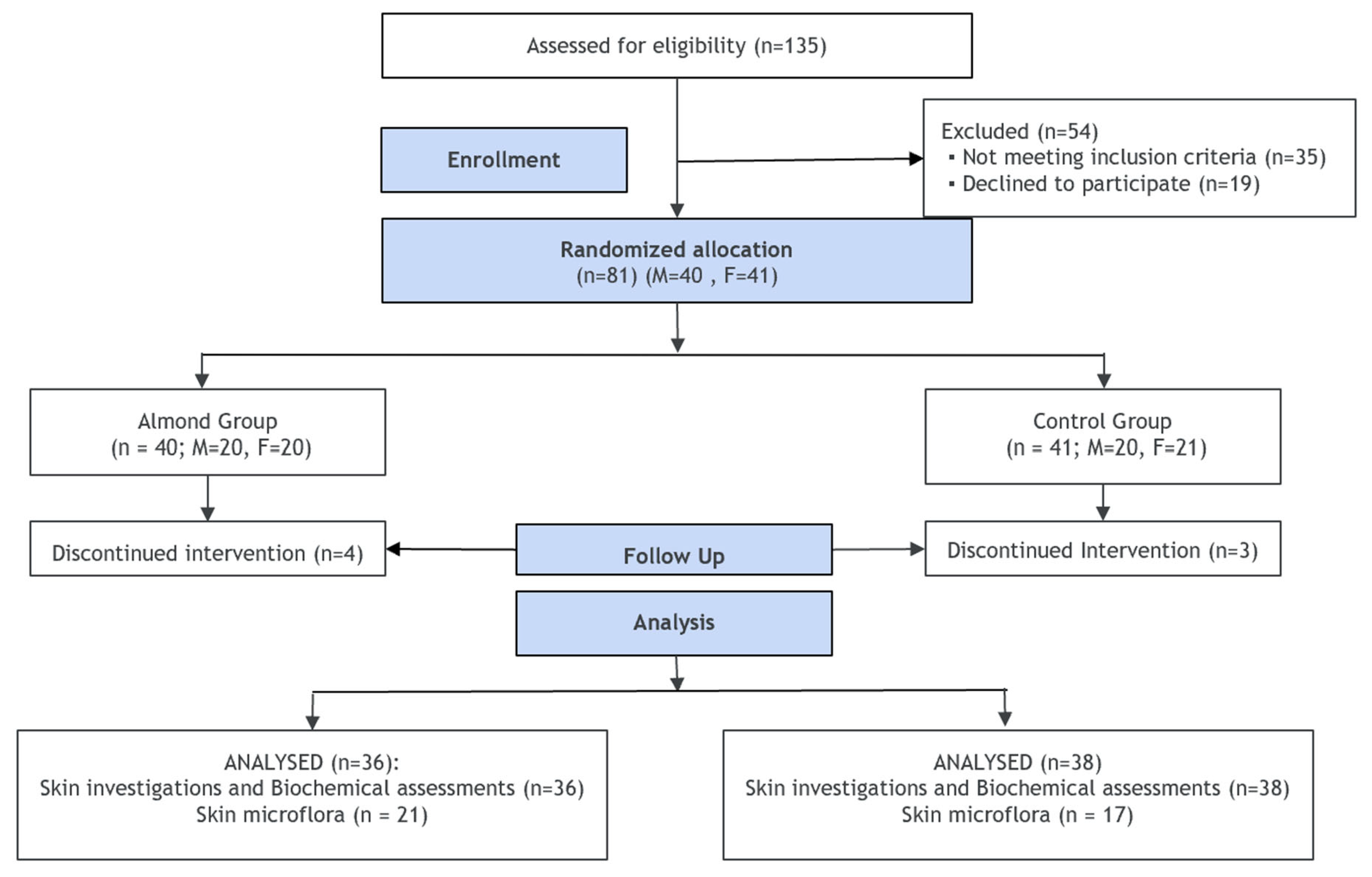
3.1. Participant Characteristics
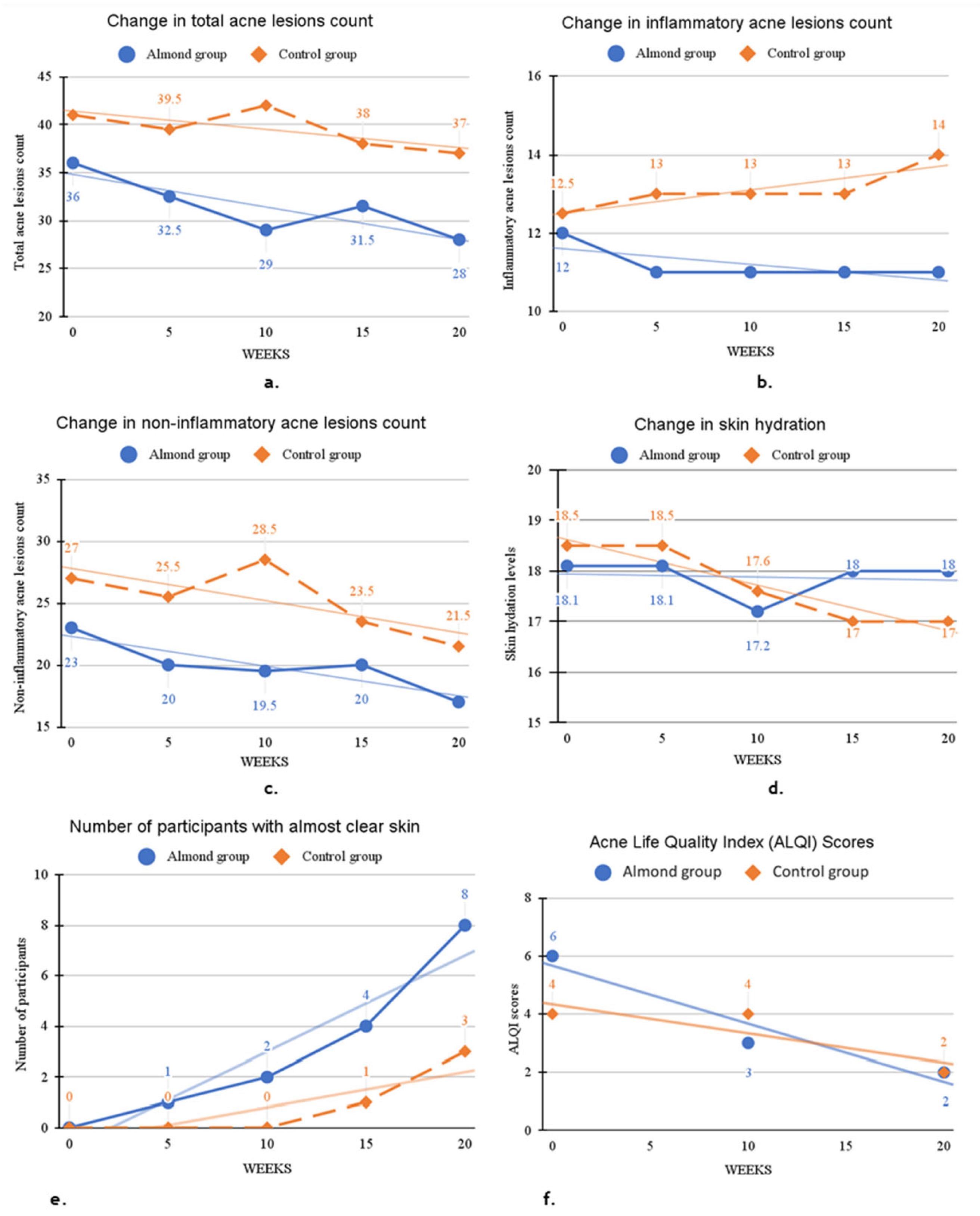
3.2. Changes in Acne Count, Skin Morphology, and Facial Microflora Indices
3.3. Changes in Metabolic, Inflammatory, Anthropometric, and Psychosocial Outcomes
3.4. Changes in Acne Lesion Count, Biochemical Markers, and Quality of Life Measures in Almond vs. Control Groups
4. Discussion
5. Conclusions
Supplementary Materials
Author Contributions
Funding
Institutional Review Board Statement
Informed Consent Statement
Data Availability Statement
Acknowledgments
Conflicts of Interest
References
- Shah, N.; Shukla, R.; Chaudhari, P.; Patil, S.; Patil, A.; Nadkarni, N.; Goldust, M. Prevalence of Acne Vulgaris and Its Clinico-Epidemiological Pattern in Adult Patients: Results of a Prospective, Observational Study. J. Cosmet. Dermatol. 2021, 20, 3672–3678. [Google Scholar] [CrossRef] [Scilit]
- Saurat, J.H.; Halioua, B.; Baissac, C.; Cullell, N.P.; Ben Hayoun, Y.; Saint Aroman, M.; Taieb, C.; Skayem, C. Epidemiology of Acne and Rosacea: A Worldwide Global Study. J. Am. Acad. Dermatol. 2024, 90, 1016–1018. [Google Scholar] [CrossRef] [Scilit] [PubMed]
- Budamakuntla, L.; Parasramani, S.; Dhoot, D.; Deshmukh, G.; Barkate, H. Acne in Indian Population: An Epidemiological Study Evaluating Multiple Factors. IP Indian J. Clin. Exp. Dermatol. 2020, 6, 237–242. [Google Scholar] [CrossRef] [Scilit]
- Bansal, P.; Sardana, K.; Vats, G.; Sharma, L.; Garga, U.C.; Khurana, A. A Prospective Study Examining Trigger Factors and Hormonal Abnormalities in Adult Female Acne. Ind. Dermatol. 2020, 11, 544–550. [Google Scholar] [CrossRef] [Scilit]
- Baldwin, H.; Tan, J. Effects of Diet on Acne and Its Response to Treatment. Am. J. Clin. Dermatol. 2021, 22, 55–65. [Google Scholar] [CrossRef] [Scilit]
- Di Landro, A.; Cazzaniga, S.; Parazzini, F.; Ingordo, V.; Cusano, F.; Atzori, L.; Cutrì, F.T.; Musumeci, M.L.; Zinetti, C.; Pezzarossa, E.; et al. Family History, Body Mass Index, Selected Dietary Factors, Menstrual History, and Risk of Moderate to Severe Acne in Adolescents and Young Adults. J. Am. Acad. Dermatol. 2012, 67, 1129–1135. [Google Scholar] [CrossRef] [Scilit]
- Melnik, B.C. Dietary Intervention in Acne: Attenuationof Increased MTORC1 Signaling Promoted by Western Diet. Dermato-Endocrinology 2012, 4, 20–32. [Google Scholar] [CrossRef] [Scilit]
- Kurokawa, I.; Nakase, K. Recent advances in understanding and managing acne. F1000Research 2020, 9, F1000 Faculty Rev-792. [Google Scholar] [CrossRef] [Scilit]
- Çerman, A.A.; Aktaş, E.; Altunay, I.K.; Arici, J.E.; Tulunay, A.; Ozturk, F.Y. Dietary Glycemic Factors, Insulin Resistance, and Adiponectin Levels in Acne Vulgaris. J. Am. Acad. Dermatol. 2016, 75, 155–162. [Google Scholar] [CrossRef] [Scilit]
- González-Mondragón, E.A.; Ganoza-Granados, L.D.C.; Toledo-Bahena, M.E.; Valencia-Herrera, A.M.; Duarte-Abdala, M.R.; Camargo-Sánchez, K.A.; Mena-Cedillos, C.A. Acne and Diet: A Review of Pathogenic Mechanisms. Bol. Med. Hosp. Infant. Mex. 2022, 79, 83–90. [Google Scholar] [CrossRef] [Scilit]
- Meixiong, J.; Ricco, C.; Vasavda, C.; Ho, B.K. Diet and Acne: A Systematic Review. JAAD Int. 2022, 7, 95–112. [Google Scholar] [CrossRef] [Scilit] [PubMed]
- Dodds, M.; Bodemer, A.; Shields, B.E. What’s Diet Got to Do with It? Basic and Clinical Science behind Diet and Acne. Cutis 2022, 110, 13–16. [Google Scholar] [CrossRef] [Scilit] [PubMed]
- Burris, J.; Shikany, J.M.; Rietkerk, W.; Woolf, K. A Low Glycemic Index and Glycemic Load Diet Decreases Insulin-like Growth Factor-1 among Adults with Moderate and Severe Acne: A Short-Duration, 2-Week Randomized Controlled Trial. J. Acad. Nutr. Diet. 2018, 118, 1874–1885. [Google Scholar] [CrossRef] [Scilit] [PubMed]
- Melnik, B.C. Linking Diet to Acne Metabolomics, Inflammation, and Comedogenesis: An Update. Clin. Cosmet. Investig. Dermatol. 2015, 8, 371–388. [Google Scholar] [CrossRef] [Scilit]
- Ryguła, I.; Pikiewicz, W.; Kaminiów, K. Impact of Diet and Nutrition in Patients with Acne Vulgaris. Nutrients 2024, 16, 1476. [Google Scholar] [CrossRef] [Scilit]
- Dall’Oglio, F.; Nasca, M.R.; Fiorentini, F.; Micali, G. Diet and Acne: Review of the Evidence from 2009 to 2020. Int. J. Dermatol. 2021, 60, 672–685. [Google Scholar] [CrossRef] [Scilit]
- Smith, R.N.; Mann, N.J.; Braue, A.; Mäkeläinen, H.; Varigos, G.A. A Low-Glycemic-Load Diet Improves Symptoms in Acne Vulgaris Patients: A Randomized Controlled Trial. Am. J. Clin. Nutr. 2007, 86, 107–115. [Google Scholar] [CrossRef] [Scilit]
- Goodarzi, A.; Mozafarpoor, S.; Bodaghabadi, M.; Mohamadi, M. The Potential of Probiotics for Treating Acne Vulgaris: A Review of Literature on Acne and Microbiota. Dermatol. Ther. 2020, 33, e13279. [Google Scholar] [CrossRef] [Scilit]
- Taha, S.; Shakhshir, M.; Zyoud, S.H. The Mediterranean Diet and Acne Vulgaris: A Systematic Review and Meta-Analysis. Nutr. Metab. 2025, 22, 132. [Google Scholar] [CrossRef] [Scilit]
- Burris, J.; Rietkerk, W.; Shikany, J.M.; Woolf, K. Differences in Dietary Glycemic Load and Hormones in New York City Adults with No and Moderate/Severe Acne. J. Acad. Nutr. Diet. 2017, 117, 1375–1383. [Google Scholar] [CrossRef] [Scilit]
- De Pessemier, B.; Grine, L.; Debaere, M.; Maes, A.; Paetzold, B.; Callewaert, C. Gut–Skin Axis: Current Knowledge of the Interrelationship between Microbial Dysbiosis and Skin Conditions. Microorganisms 2021, 9, 353. [Google Scholar] [CrossRef] [Scilit]
- Ellis, S.R.; Nguyen, M.; Vaughn, A.R.; Notay, M.; Burney, W.A.; Sandhu, S.; Sivamani, R.K. The Skin and Gut Microbiome and Its Role in Common Dermatologic Conditions. Microorganisms 2019, 7, 550. [Google Scholar] [CrossRef] [Scilit] [PubMed]
- Chen, C.Y.; Lapsley, K.; Blumberg, J. A Nutrition and Health Perspective on Almonds. J. Sci. Food Agric. 2006, 86, 2245–2250. [Google Scholar] [CrossRef] [Scilit]
- Madan, J.; Desai, S.; Moitra, P.; Salis, S.; Agashe, S.; Battalwar, R.; Mehta, A.; Kamble, R.; Kalita, S.; Phatak, A.G.; et al. Effect of Almond Consumption on Metabolic Risk Factors-Glucose Metabolism, Hyperinsulinemia, Selected Markers of Inflammation: A Randomized Controlled Trial in Adolescents and Young Adults. Front. Nutr. 2021, 8, 668622. [Google Scholar] [CrossRef] [Scilit]
- Rajaram, S.; Connell, K.M.; Sabaté, J. Effect of Almond-Enriched High-Monounsaturated Fat Diet on Selected Markers of Inflammation: A Randomised, Controlled, Crossover Study. Br. J. Nutr. 2010, 103, 907–912. [Google Scholar] [CrossRef] [Scilit] [PubMed]
- Li, S.C.; Liu, Y.H.; Liu, J.F.; Chang, W.H.; Chen, C.M.; Chen, C.Y.O. Almond Consumption Improved Glycemic Control and Lipid Profiles in Patients with Type 2 Diabetes Mellitus. Metabolism 2011, 60, 474–479. [Google Scholar] [CrossRef] [Scilit]
- Rybak, I.; Carrington, A.E.; Dhaliwal, S.; Hasan, A.; Wu, H.; Burney, W.; Maloh, J.; Sivamani, R.K. Prospective Randomized Controlled Trial on the Effects of Almonds on Facial Wrinkles and Pigmentation. Nutrients 2021, 13, 785. [Google Scholar] [CrossRef] [Scilit]
- Foolad, N.; Vaughn, A.R.; Rybak, I.; Burney, W.A.; Chodur, G.M.; Newman, J.W.; Steinberg, F.M.; Sivamani, R.K. Prospective Randomized Controlled Pilot Study on the Effects of Almond Consumption on Skin Lipids and Wrinkles. Phytother. Res. 2019, 33, 3212. [Google Scholar] [CrossRef] [Scilit]
- O’Brien, S.C.; Lewis, J.B.; Cunliffe, W.J. The Leeds Revised Acne Grading System. J. Dermatol. Treat. 1998, 9, 215–220. [Google Scholar] [CrossRef] [Scilit]
- Tan, J.K.L.; Jones, E.; Allen, E.; Pripotnev, S.; Raza, A.; Wolfe, B. Evaluation of Essential Clinical Components and Features of Current Acne Global Grading Scales. J. Am. Acad. Dermatol. 2013, 69, 754–761. [Google Scholar] [CrossRef] [Scilit]
- Ayogu, R.N.B.; Oshomegie, H.; Udenta, E.A. Energy Intake, Expenditure and Balance, and Factors Associated with Energy Balance of Young Adults (20–39 Years): A Retrospective Cross-Sectional Community-Based Cohort Study. BMC Nutr. 2022, 8, 142. [Google Scholar] [CrossRef] [Scilit]
- Sharma, M.; Kishore, A.; Roy, D.; Joshi, K. A Comparison of the Indian Diet with the EAT-Lancet Reference Diet. BMC Public Health 2020, 20, 812. [Google Scholar] [CrossRef] [Scilit]
- Misra, A.; Singhal, N.; Sivakumar, B.; Bhagat, N.; Jaiswal, A.; Khurana, L. Nutrition Transition in India: Secular Trends in Dietary Intake and Their Relationship to Diet-Related Non-Communicable Diseases. J. Diabetes 2011, 3, 278–292. [Google Scholar] [CrossRef] [Scilit] [PubMed]
- Liu, Y.; Jiang, W.; Tang, Y.; Zhang, Q.; Zhen, Y.; Wang, X.; Liu, W.; Wang, J.; Ma, Y.; Tan, Y. An Optimal Method for Quantifying the Facial Sebum Level and Characterizing Facial Sebum Features. Skin Res. Technol. 2023, 29, e13454. [Google Scholar] [CrossRef] [Scilit] [PubMed]
- Dobrev, H. Use of Cutometer to Assess Epidermal Hydration. Skin Res. Technol. 2000, 6, 239–244. [Google Scholar] [CrossRef] [Scilit] [PubMed]
- Berardesca, E.; Masson, P.; Rodrigues, L.; Gummer, C.L.; Lévêque, J.L.; Loden, M.; Piérard, G.; Rogiers, V.; Salter, D.; Sauermann, G.; et al. EEMCO Guidance for the Assessment of Stratum Corneum Hydration: Electrical Methods. Skin Res. Technol. 1997, 3, 126–132. [Google Scholar] [CrossRef] [Scilit]
- Feranchuk, S.; Belkova, N.; Potapova, U.; Kuzmin, D.; Belikov, S. Evaluating the Use of Diversity Indices to Distinguish between Microbial Communities with Different Traits. Res. Microbiol. 2018, 169, 254–261. [Google Scholar] [CrossRef] [Scilit]
- Aktürk, Z.; Hapfelmeier, A.; Fomenko, A.; Dümmler, D.; Eck, S.; Olm, M.; Gehrmann, J.; von Schrottenberg, V.; Rehder, R.; Dawson, S.; et al. Generalized Anxiety Disorder 7-Item (GAD-7) and 2-Item (GAD-2) Scales for Detecting Anxiety Disorders in Adults. Cochrane Database Syst. Rev. 2025, 3, CD015455. [Google Scholar] [CrossRef] [Scilit]
- Harris, K.M.; Gaffey, A.E.; Schwartz, J.E.; Krantz, D.S.; Burg, M.M. The Perceived Stress Scale as a Measure of Stress: Decomposing Score Variance in Longitudinal Behavioral Medicine Studies. Ann. Behav. Med. 2023, 57, 846. [Google Scholar] [CrossRef] [Scilit]
- Buysse, D.J.; Reynolds, C.F.; Monk, T.H.; Berman, S.R.; Kupfer, D.J. The Pittsburgh Sleep Quality Index: A New Instrument for Psychiatric Practice and Research. Psychiatry Res. 1989, 28, 193–213. [Google Scholar] [CrossRef] [Scilit]
- Raniti, M.B.; Waloszek, J.M.; Schwartz, O.; Allen, N.B.; Trinder, J. Factor Structure and Psychometric Properties of the Pittsburgh Sleep Quality Index in Community-Based Adolescents. Sleep 2018, 41, zsy066. [Google Scholar] [CrossRef] [Scilit]
- DietCal. Available online: http://dietcal.in/ (accessed on 12 November 2025).
- Kamamoto, C.D.S.L.; Hassun, K.M.; Bagatin, E.; Tomimori, J. Acne-Specific Quality of Life Questionnaire (Acne-QoL): Translation, Cultural Adaptation and Validation into Brazilian-Portuguese Language. An. Bras. Dermatol. 2014, 89, 83. [Google Scholar] [CrossRef] [Scilit]
- Ashour, L. A Review of User-Friendly Freely-Available Statistical Analysis Software for Medical Researchers and Biostatisticians. Res. Stat. 2024, 2, 2322630. [Google Scholar] [CrossRef] [Scilit]
- Kolahi, A.; Movahed, S.; Tejareh, F.; Saeedy, S.A.G.; Gholizadeh, M. The Impact of Almond Supplementation on Oxidative Stress Biomarkers: A Systematic Review and Meta-Analysis of Randomized Control Trials. Sci. Rep. 2025, 15, 29632. [Google Scholar] [CrossRef] [Scilit] [PubMed]
- Jamshed, H.; Arslan, J.; Sultan, F.A.; Siddiqi, H.S.; Qasim, M.; Gilani, A.H. Almond Protects the Liver in Coronary Artery Disease: A Randomized Controlled Clinical Trial. J. Pak. Med. Assoc. 2021, 71, 791–795. [Google Scholar] [CrossRef] [Scilit] [PubMed]
- Dréno, B.; Dagnelie, M.A.; Khammari, A.; Corvec, S. The Skin Microbiome: A New Actor in Inflammatory Acne. Am. J. Clin. Dermatol. 2020, 21, 518–524. [Google Scholar] [CrossRef] [Scilit] [PubMed]
- Deng, Y.; Wang, H.; Zhou, J.; Mou, Y.; Wang, G.; Xiong, X. Patients with Acne Vulgaris Have a Distinct Gut Microbiota in Comparison with Healthy Controls. Acta Derm-Venereol. 2018, 98, 783–790. [Google Scholar] [CrossRef] [Scilit]
- Lee, H.J.; Kim, M. Skin Barrier Function and the Microbiome. Int. J. Mol. Sci. 2022, 23, 13071. [Google Scholar] [CrossRef] [Scilit]
- Christensen, G.J.M.; Brüggemann, H. Bacterial Skin Commensals and Their Role as Host Guardians. Benef. Microb. 2014, 5, 201–215. [Google Scholar] [CrossRef] [Scilit]
- Siddiqui, R.; Makhlouf, Z.; Khan, N.A. The Increasing Importance of the Gut Microbiome in Acne Vulgaris. Folia Microbiol. 2022, 67, 825–835. [Google Scholar] [CrossRef] [Scilit]
- Rowland, I.; Gibson, G.; Heinken, A.; Scott, K.; Swann, J.; Thiele, I.; Tuohy, K. Gut Microbiota Functions: Metabolism of Nutrients and Other Food Components. Eur. J. Nutr. 2018, 57, 1–24. [Google Scholar] [CrossRef] [Scilit] [PubMed]
- Tahiri, M.; Gilbert, J.A. Examining the Potential Prebiotic Effect of Almonds. J. Appl. Microbiol. 2025, 136, lxaf078. [Google Scholar] [CrossRef] [Scilit] [PubMed]
- Binks, H.; Vincent, G.E.; Gupta, C.; Irwin, C.; Khalesi, S. Effects of Diet on Sleep: A Narrative Review. Nutrients 2020, 12, 936. [Google Scholar] [CrossRef] [Scilit] [PubMed]
- Godos, J.; Grosso, G.; Castellano, S.; Galvano, F.; Caraci, F.; Ferri, R. Association between Diet and Sleep Quality: A Systematic Review. Sleep Med. Rev. 2021, 57, 101430. [Google Scholar] [CrossRef] [Scilit]
- Godos, J.; Ferri, R.; Lanza, G.; Caraci, F.; Vistorte, A.O.R.; Yelamos Torres, V.; Grosso, G.; Castellano, S. Mediterranean Diet and Sleep Features: A Systematic Review of Current Evidence. Nutrients 2024, 16, 282. [Google Scholar] [CrossRef] [Scilit]
- Fenton, S.; Burrows, T.L.; Collins, C.E.; Rayward, A.T.; Murawski, B.; Duncan, M.J. Efficacy of a Multi-Component m-Health Diet, Physical Activity, and Sleep Intervention on Dietary Intake in Adults with Overweight and Obesity: A Randomised Controlled Trial. Nutrients 2021, 13, 2468. [Google Scholar] [CrossRef] [Scilit]
- Patel, A.; Cheung, J. The Effect of Mediterranean Diet and Chrononutrition on Sleep Quality: A Scoping Review. Nutr. J. 2025, 24, 31. [Google Scholar] [CrossRef] [Scilit]
- Chakkalakal, M.; Nadora, D.; Gahoonia, N.; Dumont, A.; Burney, W.; Pan, A.; Chambers, C.J.; Sivamani, R.K. Prospective Randomized Double-Blind Placebo-Controlled Study of Oral Pomegranate Extract on Skin Wrinkles, Biophysical Features, and the Gut-Skin Axis. J. Clin. Med. 2022, 11, 6724. [Google Scholar] [CrossRef] [Scilit]
- Eguren, C.; Navarro-Blasco, A.; Corral-Forteza, M.; Reolid-Pérez, A.; Setó-Torrent, N.; García-Navarro, A.; Prieto-Merino, D.; Núñez-Delegido, E.; Sánchez-Pellicer, P.; Navarro-López, V. A Randomized Clinical Trial to Evaluate the Efficacy of an Oral Probiotic in Acne Vulgaris. Acta Derm.-Venereol. 2024, 104, adv33206. [Google Scholar] [CrossRef] [Scilit]


| Almond Group (n = 36) | Control Group (n = 38) | p Value | |
|---|---|---|---|
| Sex, n (%) | |||
| Male | 17 (47.2) | 19 (50.0) | 0.811 |
| Female | 19 (52.8) | 19 (50.0) | |
| Socioeconomic status, n (%) | |||
| Upper (26–29) | 2.0 (5.6) | 2 (5.3) | 0.736 |
| Upper middle (16–25)/lower middle (11–15) | 28.0 (77.8) | 32 (84.2) | |
| Upper lower (5–10)/lower (<5) | 6.0 (16.7) | 4 (10.5) | |
| Regular menstrual cycle, n (%) | |||
| 21–35 days | 18 (94.7) | 17 (89.4) | 0.808 |
| Acne lesion counts, Median (IQR) | |||
| Inflammatory acne lesion count | 12.0 (11.0–15.2) | 12.5 (10.0–17.0) | 0.656 |
| Non-inflammatory acne lesion count | 23.0 (17.5–31.0) | 27.0 (20.2–35.8) | 0.150 |
| Total acne lesion count | 36.0 (29.0–47.0) | 41.0 (33.2–52.0) | 0.113 |
| Acne severity as per IGA, n (%) | |||
| Mild acne (IGA = 2) | 28 (77.8) | 28 (73.7) | 0.682 |
| Moderate acne (IGA = 3) | 8 (22.2) | 10 (26.3) | |
| Acne episode frequency, n (%) | |||
| Daily | 1 (2.9) | 1 (2.6) | 0.346 |
| Once every 2–3 days | 6 (17.1) | 13 (34.2) | |
| Once a week | 10 (28.6) | 11 (28.9) | |
| Less than once a week | 18 (51.4) | 13 (34.2) | |
| Duration of acne episodes, n (%) | |||
| ≤1 week | 15 (42.9) | 18 (47.4) | 0.882 |
| 1–2 weeks | 10 (28.6) | 9 (23.7) | |
| >2 weeks | 10 (28.6) | 11 (28.9) | |
| Acne quality of life, Median (IQR) | 6.0 (3.0–10.2) | 4.0 (2.0–6.8) | 0.065 |
| Anthropometry and lifestyle, Median (IQR) | |||
| Body mass index (kg/m2) | 23.2 (20.3–26.4) | 23. 2 (20.2–26.1) | 0.753 |
| Stress (PSS-10 scores) | 18.0 (16.0–24.2) | 20.0 (16.2–25.0) | 0.475 |
| Anxiety (GAD-7 scores) | 14.5 (10.8–18.2) | 14.5 (12.0–20.0) | 0.551 |
| Sleep quality (PSQI scores) | 3.5 (2.0–6.2) | 4.0 (1.2–6.8) | 0.926 |
| Energy intake (Kcal) | 2073.0 (1490.8–2505.3) | 1937.5(1535.0–2699.3) | 0.863 |
| Variables | Week 0 Median (IQR) | Week 10 Median (IQR) | p Value # | Week 20 Median (IQR) | p Value ^ |
|---|---|---|---|---|---|
| Inflammatory acne lesion count | 12.0 (11.0–15.2) | 11.0 (8.0–14.0) | 0.135 † | 11.0 (5.5–14.0) | 0.048 *† |
| Non-inflammatory acne lesion count | 23.0 (17.5–31.0) | 19.5 (14.0–23.3) | 0.007 *† | 17.0 (14.0–24.2) | <0.007 *† |
| Total lesion acne count | 36.0 (29.0–47.0) | 29.0 (22.0–37.3) | 0.007 *† | 28.0 (20.0–35.8) | <0.007 *† |
| Single Acne | |||||
| Volume of acne (mm3) | 2.7 (1.3–4.2) | 1.0 (0.1–2.5) | <0.001 ** | 0.7 (0.1–2.7) | <0.001 ** |
| Conforming area (mm2) | 21.7 (10.1–59.3) | 11.4 (1.8–39.1) | <0.001 ** | 8.0 (2.0–45.0) | <0.001 ** |
| Maximum height of acne (mm) | 0.3 (0.2–0.3) | 0.1 (0.1–0.2) | <0.001 * | 0.1 (0.1–0.2) | <0.001 ** |
| Cluster Acne | |||||
| Volume of acne (mm3) | 2.2 (0.9–7.5) | 0.8 (0.1–4.3) | <0.001 ** | 0.9 (0.1–2.5) | <0.001 ** |
| Conforming area (mm2) | 20.0 (9.6–83.4) | 10.8 (1.7–57.2) | <0.001 ** | 9.9 (2.7–39.5) | <0.001 ** |
| Maximum height of acne (mm) | 0.3 (0.2–0.3) | 0.1 (0.1–0.2) | <0.001 ** | 0.1 (0.1–0.2) | <0.001 ** |
| Facial sebum measurement (µg) | 22.0 (12.0–30.2) | 26.0 (15.0–32.3) | 0.302 | 22.0 (15.5–29.5) | 0.562 |
| Facial hydration (AU) | 18.1 (10.9–28.3) | 17.2 (12.2–28.7) | 0.305 | 18.1 (13.4–30.7) | 0.003 * |
| Alpha Diversity Indices of Facial Skin Microflora | |||||
| Shannon–Wiener index | 2.6 (2.1–2.8) | - | - | 3.4 (2.3–5.1) | 0.039 * |
| Chao1 index | 266.9 (126.1–548.4) | - | - | 835.2 (435.0–1332.8) | <0.001 ** |
| Total no. of genera | 77 (20.0–106.5) | - | - | 141 (94.8–231.3) | <0.001 ** |
| Acne quality of life (ALQI scores) | 6.0 (3.0–10.2) | 3.0 (1.0–5.0) | 0.011 * | 2.0 (0.0–4.2) | <0.001 ** |
| Variables | Week 0 Median (IQR) | Week 10 Median (IQR) | p Value # | Week 20 Median (IQR) | p Value ^ |
|---|---|---|---|---|---|
| LDL Cholesterol (mg/dL) | 100.3 (78.3–119.2) | 91.7 (77.8–119.6) | 0.358 | 88.4 (66.2–103.8) | 0.048 * |
| Cholesterol: HDL-C ratio | 3.7 (3.1–4.1) | 3.4 (3.2–3.9) | 0.177 | 3.3 (3–3.6) | 0.005 * |
| Non-HDL Cholesterol | 121.6 (93.0–132.0) | 104.2 (91.7–132.3) | 0.291 | 103.6 (79.3–121.8) | 0.003 * |
| Fasting Glucose (mg/dL) | 84.0 (79.5–89.0) | 82.0 (77.0–86.3) | 0.138 | 79.0 (74.5–85.0) | 0.007 * |
| Fasting Insulin (uIU/mL) | 7.9 (5.6–10.5) | 7.9 (5.7–11.4) | 0.730 | 7.1 (6.0–8.8) | 0.920 |
| Creatinine (mg/dL) | 0.7 (0.6–0.8) | 0.7 (0.5–0.8) | 0.944 | 0.6 (0.5–0.8) | 0.044 * |
| TNF-alpha (pg/mL) | 83.2 (57.4–159.5) | - | - | 53.7 (16.7–92.1) | 0.008 * |
| IL6 (pg/mL) | 0.1 (0.1–1.4) | - | - | 1.2 (0.1–2.1) | 0.117 |
| BMI (kg/m2) | 23.2 (20.3–26.4) | 23.4 (20.6–26.6) | 0.309 | 23.2 (20.5–26.8) | 0.238 |
| Body Fat % | 27.6 (20.1–39.3) | 29.6 (21.4–39.6) | 0.355 | 28.0 (21.5–39.2) | 0.276 |
| Muscle Mass (kg) | 40.5 (34.6–46.0) | 41.0 (34.7–46.7) | 0.214 | 40.9 (34.6–46.4) | 0.012 * |
| Fat-Free Mass (kg) | 42.9 (36.6–48.5) | 43.2 (36.8–49.3) | 0.197 | 43.2 (36.7–49.0) | 0.010 * |
| Stress (PSS-10 scores) | 18.0 (16.0–24.3) | - | - | 17.5 (16.0–21.0) | 0.056 |
| Anxiety (GAD-7 scores) | 14.5 (10.8–18.3) | - | - | 13.0 (10.0–15.0) | 0.016 * |
| Sleep Quality (PSQI scores) | 3.5 (2.0–6.3) | - | - | 9.5 (4.8–11.0) | <0.001 ** |
| Almond Group (n = 36) | Control Group (n = 38) | p Value # | |||||
|---|---|---|---|---|---|---|---|
| Week 0 Median (IQR) | Week 20 Median (IQR) | %Change, p Value ^ | Week 0 Median (IQR) | Week 20 Median (IQR) | %Change, p Value ^ | ||
| Inflammatory Acne Lesion | 12.0 (11.0–15.2) | 11.0 (5.5–14.0) | −8.3%, 0.048 *† | 12.5 (10.0–17.0) | 14.0 (9.0–16.0) | 12%, 0.912 † | 0.090 † |
| Non-Inflammatory Acne Lesion Count | 23.0 (17.5–31.0) | 17.0 (14.0–24.2) | −26.1%, 0.007 *† | 27.0 (20.2–35.8) | 21.5 (16.0–28.0) | −20.4%, 0.009 *† | 0.548 † |
| Total Acne Lesion Count | 36 (29–47) | 28 (20–35.8) | −22.2%, 0.007 *† | 41 (33.2–52) | 37 (26.2–42.5) | −9.8%, 0.060 † | 0.195 † |
| Facial Sebum Content (µg) | 22.0 (12.0–30.2) | 22.0 (15.5–29.5) | 0%, 0.562 | 19.0 (11.5–26.0) | 20.5 (14.0–25.0) | 7.9%, 0.785 | 0.820 |
| Facial Hydration Levels (AU) | 18.1 (10.9–28.3) | 18.1 (13.4–30.7) | 0%, 0.003 ** | 18.5 (13.5–26.5) | 17.0 (11.2–27.7) | −8.1%, 0.871 | 0.102 |
| Shannon Diversity Index | 2.6 (2.1–2.8) | 3.4 (2.3–5.1) | +30.8%, 0.039 * | 2.5 (1.3–3.2) | 2.8 (1.3–3.5) | +12%, 0.317 | 0.595 |
| Chao1 Diversity Index | 266.9 (126.1–548.4) | 835.2 (435.0–1332.8) | +219.3%, <0.001 ** | 223.0 (181.5–287.1) | 554.3 (436.6–840.8) | +148.5%, 0.317 | 0.263 |
| TNF-Alpha (pg/mL) | 83.2 (57.4–159.5) | 53.7 (16.7–92.1) | −35.5%, 0.008 * | 95.3 (62.5–197.3) | 69.8 (24.3–118.3) | −26.8%, 0.002 * | 0.480 |
| IL6 (pg/mL) | 0.1 (0.1–1.4) | 1.2 (0.1–2.1) | +110%, 0.117 | 1.2 (0.1–1.9) | 1.3 (1.0–1.9) | +8.3%, 0.732 | 0.109 |
| Acne Quality of Life | 6.0 (3.0–10.2) | 2.0 (0.0–4.2) | −66.7%, <0.001 ** | 4.0 (2.0–6.8) | 2.0 (0.2–7.0) | −50%, 0.628 | 0.047 * |
Disclaimer/Publisher’s Note: The statements, opinions and data contained in all publications are solely those of the individual author(s) and contributor(s) and not of MDPI and/or the editor(s). MDPI and/or the editor(s) disclaim responsibility for any injury to people or property resulting from any ideas, methods, instructions or products referred to in the content. |
© 2026 by the authors. Licensee MDPI, Basel, Switzerland. This article is an open access article distributed under the terms and conditions of the Creative Commons Attribution (CC BY) license.
Share and Cite
Moitra, P.; Madan, J.; Shah, K.; Mandavkar, P.; Joshi, R.; Kalita, S.; Udipi, S.A. Almond Supplementation Improves Acne Lesions and Skin Microbial Diversity in Adults with Mild to Moderate Acne Vulgaris. Nutrients 2026, 18, 625. https://doi.org/10.3390/nu18040625
Moitra P, Madan J, Shah K, Mandavkar P, Joshi R, Kalita S, Udipi SA. Almond Supplementation Improves Acne Lesions and Skin Microbial Diversity in Adults with Mild to Moderate Acne Vulgaris. Nutrients. 2026; 18(4):625. https://doi.org/10.3390/nu18040625
Chicago/Turabian StyleMoitra, Panchali, Jagmeet Madan, Krisha Shah, Pradnya Mandavkar, Rajiv Joshi, Soumik Kalita, and Shobha A. Udipi. 2026. "Almond Supplementation Improves Acne Lesions and Skin Microbial Diversity in Adults with Mild to Moderate Acne Vulgaris" Nutrients 18, no. 4: 625. https://doi.org/10.3390/nu18040625
APA StyleMoitra, P., Madan, J., Shah, K., Mandavkar, P., Joshi, R., Kalita, S., & Udipi, S. A. (2026). Almond Supplementation Improves Acne Lesions and Skin Microbial Diversity in Adults with Mild to Moderate Acne Vulgaris. Nutrients, 18(4), 625. https://doi.org/10.3390/nu18040625