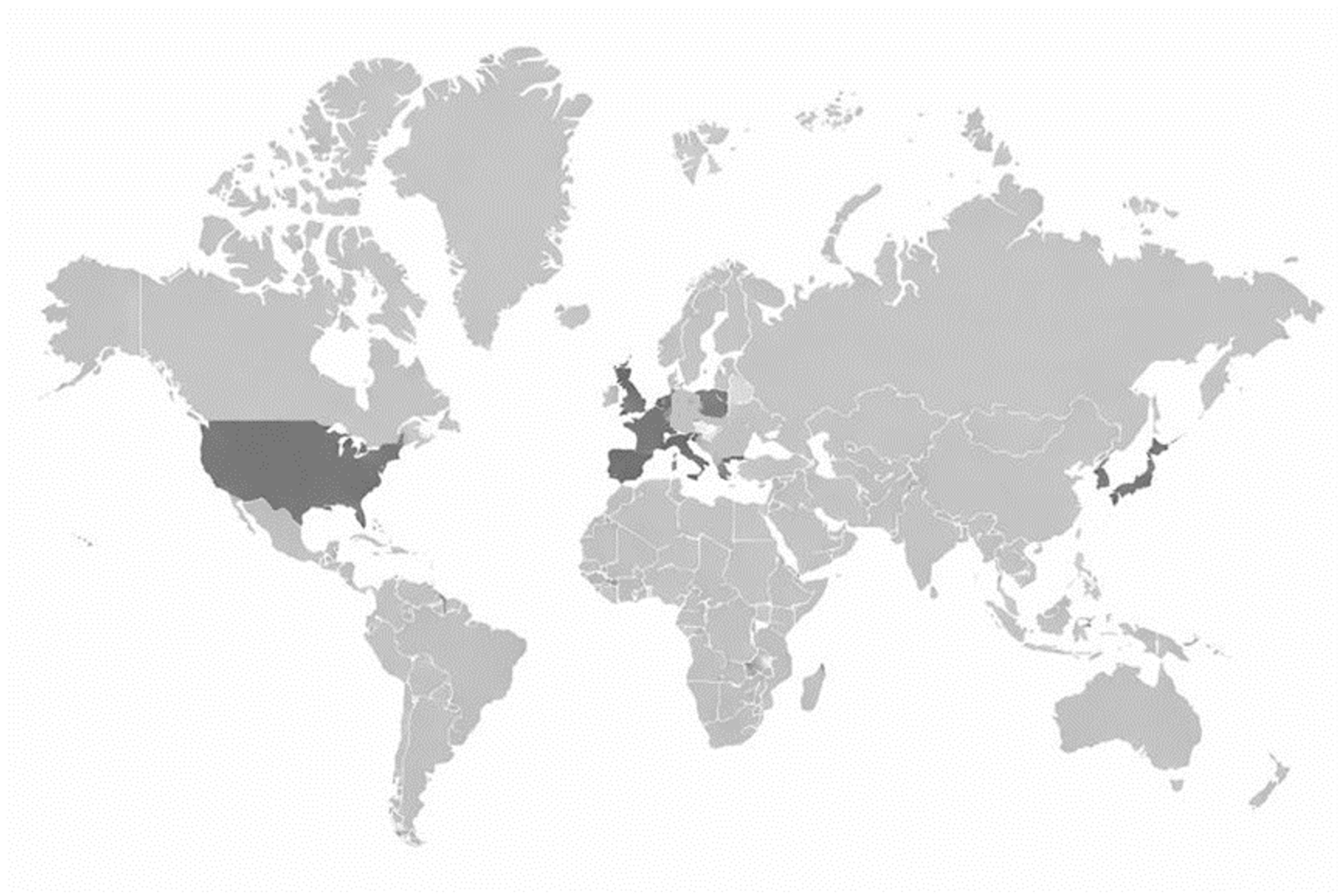
Adherence to the Mediterranean Diet and Dietary Potassium Intake: A Narrative Review of Epidemiological Evidence

 ,
,  ,
,  ,
,
Abstract
1. Introduction
2. Materials and Methods
3. Results
3.1. Epidemiological Evidence (Observational and Longitudinal)
3.1.1. Questionnaire/Recall-Based Potassium Assessment
3.1.2. Urinary Biomarker-Based Potassium Assessment (24 h Urine)
3.1.3. Longitudinal Evidence
3.1.4. Comparative Synthesis Across Observational and Longitudinal Studies
3.2. Evidence from Randomised Controlled Studies
4. Discussion
4.1. Heterogeneity by Assessment Method and Exposure Timeframe
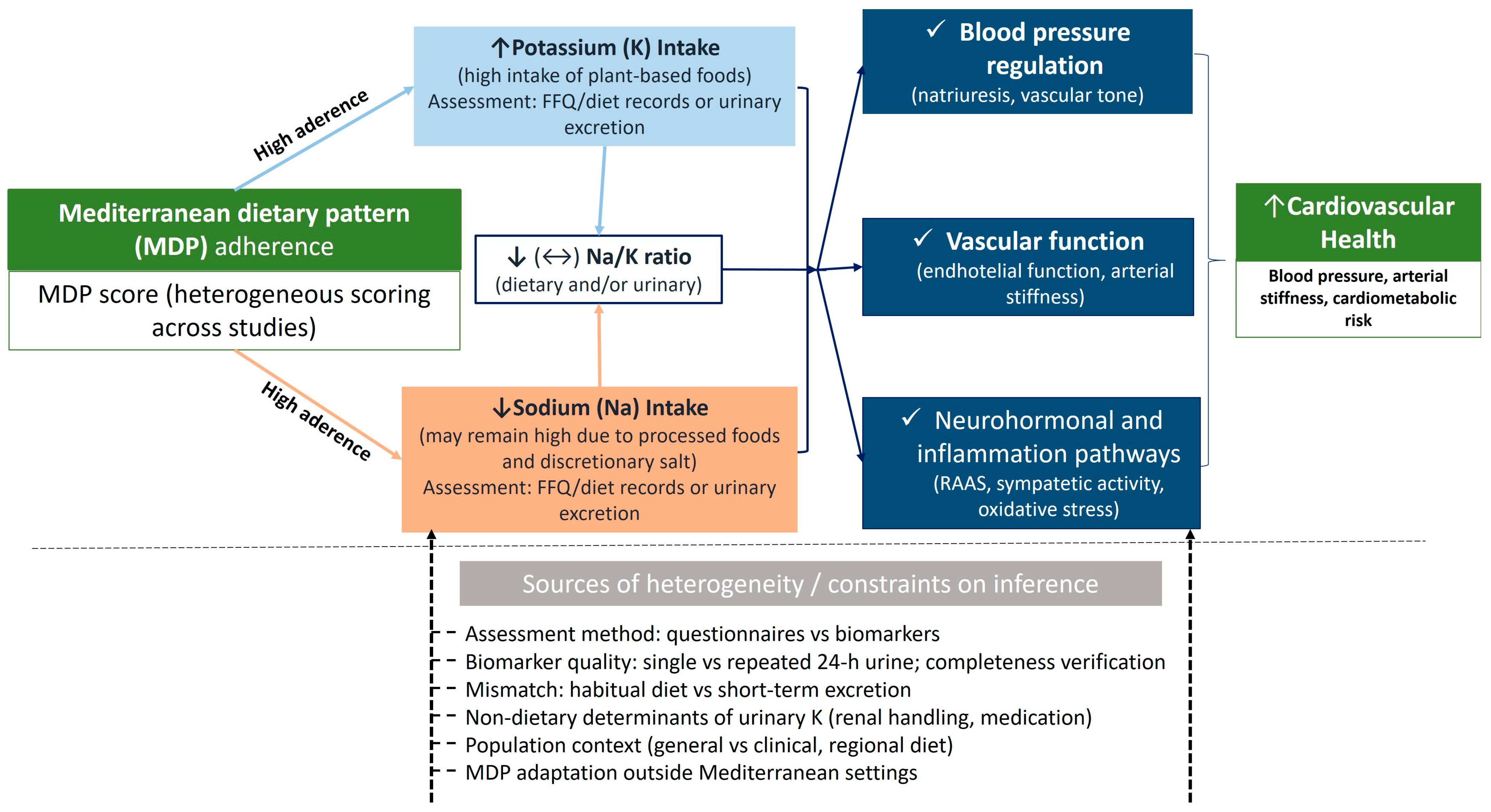
4.2. Sodium–Potassium Balance as the Mechanistically Relevant Exposure
4.3. Contemporary Adaptations of the MDP in Non-Mediterranean Settings
4.4. Potassium as Mediator Versus Marker of Diet Quality: Implications for Inference
4.5. Risk-of-Bias Considerations
4.6. Methodological Priorities and Practical Implementation
5. Conclusions
Author Contributions
Funding
Institutional Review Board Statement
Informed Consent Statement
Data Availability Statement
Conflicts of Interest
Abbreviations
| BDHQ | Brief-type Self-Administered Diet History Questionnaire |
| CKD | Chronic Kidney Disease |
| EPIC | European Prospective Investigation into Cancer |
| FFQ | Food Frequency Questionnaire |
| IMI | Italian Mediterranean Index |
| MDP | Mediterranean dietary pattern |
| MEDi-POB | Mediterranean Proper Optimal Balance |
| MIND | Mediterranean–DASH Intervention for Neurodegenerative Delay |
| NCDs | Non-Communicable Diseases |
| NU-AGE | New Dietary Strategies Addressing the Specific Needs of Elderly Population for Healthy Aging in Europe |
| PABA | Para-Aminobenzoic Acid |
| PICOS | Population, Intervention/Exposure, Comparison, Outcomes, Study Design |
| PREDIMED | Prevención con Dieta Mediterránea |
References
- Rees, K.; Takeda, A.; Martin, N.; Ellis, L.; Wijesekara, D.; Vepa, A.; Das, A.; Hartley, L.; Stranges, S. Mediterranean-Style Diet for the Primary and Secondary Prevention of Cardiovascular Disease: A Cochrane Review. Glob. Heart 2020, 15, 56. [Google Scholar] [CrossRef] [Scilit]
- Jayedi, A.; Soltani, S.; Abdolshahi, A.; Shab-Bidar, S. Healthy and Unhealthy Dietary Patterns and the Risk of Chronic Disease: An Umbrella Review of Meta-Analyses of Prospective Cohort Studies. Br. J. Nutr. 2020, 124, 1133–1144. [Google Scholar] [CrossRef] [Scilit]
- Seabrook, J.A.; Avan, A.; O’Connor, C.; Prapavessis, H.; Nagamatsu, L.; Twynstra, J.; Stranges, S.; MacDougall, A.; Hachinski, V. Dietary Patterns and Brain Health in Middle-Aged and Older Adults: A Narrative Review. Nutrients 2025, 17, 1436. [Google Scholar] [CrossRef] [Scilit] [PubMed]
- Keys, A. Mediterranean Diet and Public Health: Personal Reflections. Am. J. Clin. Nutr. 1995, 61, 1321S–1323S. [Google Scholar] [CrossRef] [Scilit] [PubMed]
- Karam, G.; Agarwal, A.; Sadeghirad, B.; Jalink, M.; Hitchcock, C.L.; Ge, L.; Kiflen, R.; Ahmed, W.; Zea, A.M.; Milenkovic, J.; et al. Comparison of Seven Popular Structured Dietary Programmes and Risk of Mortality and Major Cardiovascular Events in Patients at Increased Cardiovascular Risk: Systematic Review and Network Meta-Analysis. BMJ 2023, 380, e072003. [Google Scholar] [CrossRef] [Scilit]
- Sofi, F.; Martini, D.; Angelino, D.; Cairella, G.; Campanozzi, A.; Danesi, F.; Dinu, M.; Erba, D.; Iacoviello, L.; Pellegrini, N.; et al. Mediterranean Diet: Why a New Pyramid? An Updated Representation of the Traditional Mediterranean Diet by the Italian Society of Human Nutrition (SINU). Nutr. Metab. Cardiovasc. Dis. 2025, 35, 103919. [Google Scholar] [CrossRef] [Scilit]
- Willett, W.; Rockström, J.; Loken, B.; Springmann, M.; Lang, T.; Vermeulen, S.; Garnett, T.; Tilman, D.; DeClerck, F.; Wood, A.; et al. Food in the Anthropocene: The EAT-Lancet Commission on Healthy Diets from Sustainable Food Systems. Lancet 2019, 393, 447–492. [Google Scholar] [CrossRef] [Scilit]
- Farias-Pereira, R.; Zuk, J.B.; Khavaran, H. Plant Bioactive Compounds from Mediterranean Diet Improve Risk Factors for Metabolic Syndrome. Int. J. Food Sci. Nutr. 2023, 74, 403–423. [Google Scholar] [CrossRef] [Scilit]
- D’Elia, L. Potassium Intake and Human Health. Nutrients 2024, 16, 833. [Google Scholar] [CrossRef] [Scilit] [PubMed]
- Filippini, T.; Naska, A.; Kasdagli, M.I.; Torres, D.; Lopes, C.; Carvalho, C.; Moreira, P.; Malavolti, M.; Orsini, N.; Whelton, P.K.; et al. Potassium Intake and Blood Pressure: A Dose–Response Meta-Analysis of Randomized Controlled Trials. J. Am. Heart Assoc. 2020, 9, e015719. [Google Scholar] [CrossRef] [Scilit]
- D’Elia, L.; Iannotta, C.; Sabino, P.; Ippolito, R. Potassium-Rich Diet and Risk of Stroke: Updated Meta-Analysis. Nutr. Metab. Cardiovasc. Dis. 2014, 24, 585–587. [Google Scholar] [CrossRef] [Scilit]
- D’Elia, L.; Masulli, M.; Cappuccio, F.P.; Zarrella, A.F.; Strazzullo, P.; Galletti, F. Dietary Potassium Intake and Risk of Diabetes: A Systematic Review and Meta-Analysis of Prospective Studies. Nutrients 2022, 14, 4785. [Google Scholar] [CrossRef] [Scilit] [PubMed]
- D’Elia, L.; Cappuccio, F.P.; Masulli, M.; La Fata, E.; Rendina, D.; Galletti, F. Effect of Potassium Supplementation on Endothelial Function: A Systematic Review and Meta-Analysis of Intervention Studies. Nutrients 2023, 15, 853. [Google Scholar] [CrossRef] [Scilit]
- Wilson, D.K.; Sica, D.A.; Miller, S.B. Effects of Potassium on Blood Pressure in Salt-Sensitive and Salt-Resistant Black Adolescents. Hypertension 1999, 34, 181–186. [Google Scholar] [CrossRef] [Scilit]
- D’Elia, L.; Strazzullo, P. Dietary Salt Restriction and Adherence to the Mediterranean Diet: A Single Way to Reduce Cardiovascular Risk? J. Clin. Med. 2024, 13, 486. [Google Scholar] [CrossRef] [Scilit]
- Serra-Majem, L.; Bes-Rastrollo, M.; Román-Viñas, B.; Pfrimer, K.; Sánchez-Villegas, A.; Martínez-González, M.A. Dietary Patterns and Nutritional Adequacy in a Mediterranean Country. Br. J. Nutr. 2009, 101, S21–S28. [Google Scholar] [CrossRef] [Scilit]
- Feart, C.; Alles, B.; Merle, B.; Samieri, C.; Barberger-Gateau, P. Adherence to a Mediterranean Diet and Energy, Macro-, and Micronutrient Intakes in Older Persons. J. Physiol. Biochem. 2012, 68, 691–700. [Google Scholar] [CrossRef] [Scilit]
- Kanauchi, M.; Kanauchi, K. Development of a Mediterranean Diet Score Adapted to Japan and Its Relation to Obesity Risk. Food Nutr. Res. 2016, 60, 32172. [Google Scholar] [CrossRef] [Scilit]
- Vasara, E.; Marakis, G.; Breda, J.; Skepastianos, P.; Hassapidou, M.; Kafatos, A.; Rodopaios, N.; Koulouri, A.A.; Cappuccio, F.P. Sodium and Potassium Intake in Healthy Adults in Thessaloniki Greater Metropolitan Area—The Salt Intake in Northern Greece (SING) Study. Nutrients 2017, 9, 417. [Google Scholar] [CrossRef] [Scilit] [PubMed]
- Malavolti, M.; Naska, A.; Fairweather-Tait, S.J.; Malagoli, C.; Vescovi, L.; Marchesi, C.; Vinceti, M.; Filippini, T. Sodium and Potassium Content of Foods Consumed in an Italian Population and the Impact of Adherence to a Mediterranean Diet on Their Intake. Nutrients 2021, 13, 2681. [Google Scholar] [CrossRef] [Scilit] [PubMed]
- Viroli, G.; Gonçalves, C.; Pinho, O.; Silva-Santos, T.; Padrão, P.; Moreira, P. High Adherence to Mediterranean Diet Is Not Associated with an Improved Sodium and Potassium Intake. Nutrients 2021, 13, 4151. [Google Scholar] [CrossRef] [Scilit]
- Rumawas, M.E.; Dwyer, J.T.; McKeown, N.M.; Meigs, J.B.; Rogers, G.; Jacques, P.F. The Development of the Mediterranean-Style Dietary Pattern Score and Its Application to the American Diet in the Framingham Offspring Cohort. J. Nutr. 2009, 139, 1150–1156. [Google Scholar] [CrossRef] [Scilit]
- Cano-Ibáñez, N.; Bueno-Cavanillas, A.; Martínez-González, M.Á.; Salas-Salvadó, J.; Corella, D.; Freixer, G.L.; Romaguera, D.; Vioque, J.; Alonso-Gómez, Á.M.; Wärnberg, J.; et al. Effect of Changes in Adherence to Mediterranean Diet on Nutrient Density After 1-Year of Follow-Up: Results from the PREDIMED-Plus Study. Eur. J. Nutr. 2020, 59, 2395–2409. [Google Scholar] [CrossRef] [Scilit]
- Jennings, A.; Berendsen, A.M.; de Groot, L.C.P.G.M.; Feskens, E.J.M.; Brzozowska, A.; Sicinska, E.; Pietruszka, B.; Meunier, N.; Caumon, E.; Malpuech-Brugère, C.; et al. Mediterranean-Style Diet Improves Systolic Blood Pressure and Arterial Stiffness in Older Adults. Hypertension 2019, 73, 578–586. [Google Scholar] [CrossRef] [Scilit]
- Kwon, Y.J.; Joo, Y.S.; Yun, H.R.; Lim, L.R.; Yang, J.; Lee, H.S.; Kim, H.-M.; Lee, H.; Lee, J.E.; Lee, J.-W. Safety and Impact of the Mediterranean Diet in Patients with Chronic Kidney Disease: A Pilot Randomized Crossover Trial. Front. Nutr. 2024, 11, 1463502. [Google Scholar] [CrossRef] [Scilit] [PubMed]
- National Academies of Sciences, Engineering, and Medicine. Dietary Reference Intakes for Sodium and Potassium; National Academies Press: Washington, DC, USA, 2019. [Google Scholar] [CrossRef] [Scilit]
- EFSA NDA Panel; Turck, D.; Bresson, J.-L.; Burlingame, B.; Dean, T.; Fairweather-Tait, S.; Heinonen, M.; Hirsch-Ernst, K.-I.; Mangelsdorf, I.; McArdle, H.; et al. Scientific Opinion on Dietary Reference Values for Potassium. EFSA J. 2016, 14, 4592. [Google Scholar] [CrossRef] [Scilit]
- Higgins, J.P.T.; Morgan, R.L.; Rooney, A.A.; Taylor, K.W.; Thayer, K.A.; Silva, R.A.; Lemeris, C.; Akl, E.A.; Bateson, T.F.; Berkman, N.D.; et al. A tool to assess risk of bias in non-randomized follow-up studies of exposure effects (ROBINS-E). Environ. Int. 2024, 186, 108602. [Google Scholar] [CrossRef] [Scilit] [PubMed]
- Sterne, J.A.C.; Savović, J.; Page, M.J.; Elbers, R.G.; Blencowe, N.S.; Boutron, I.; Cates, C.J.; Cheng, H.-Y.; Corbett, M.S.; Eldridge, S.M.; et al. RoB 2: A revised tool for assessing risk of bias in randomised trials. BMJ 2019, 366, l4898. [Google Scholar] [CrossRef] [Scilit]
- Landolfo, M.; Stella, L.; Gezzi, A.; Spannella, F.; Turri, P.; Sabbatini, L.; Cecchi, S.; Lucchetti, B.; Petrelli, M.; Sarzani, R. Low-Calorie, High-Protein Ketogenic Diet Versus Low-Calorie, Low-Sodium, and High-Potassium Mediterranean Diet in Overweight Patients with High-Normal Blood Pressure or Grade I Hypertension: The Keto-Salt Pilot Study. Nutrients 2025, 17, 1739. [Google Scholar] [CrossRef] [Scilit]
- Rodrigues, J.; Costa, M.; Sousa, D.; Costa, A.R.; Lunet, N.; Cruz, V.T.; Padrão, P. Adherence to the Mediterranean Diet, Sodium and Potassium Intake in People at High Risk of Dementia. Nutrients 2024, 16, 1419. [Google Scholar] [CrossRef] [Scilit]
- Castro-Barquero, S.; Larroya, M.; Crispi, F.; Estruch, R.; Nakaki, A.; Paules, C.; Ruiz-León, A.M.; Sacanella, E.; Freitas, T.; Youssef, L.; et al. Diet Quality and Nutrient Density in Pregnant Women According to Adherence to Mediterranean Diet. Front. Public Health 2023, 11, 1144942. [Google Scholar] [CrossRef] [Scilit]
- Ma, Y.; He, F.J.; Sun, Q.; Yuan, C.; Kieneker, L.M.; Curhan, G.C.; MacGregor, G.A.; Bakker, S.J.L.; Campbell, N.R.C.; Wang, M.; et al. 24-Hour Urinary Sodium and Potassium Excretion and Cardiovascular Risk. N. Engl. J. Med. 2022, 386, 252–263. [Google Scholar] [CrossRef] [Scilit]
- Adebamowo, S.N.; Spiegelman, D.; Willett, W.C.; Rexrode, K.M. Association between intakes of magnesium, potassium, and calcium and risk of stroke: 2 cohorts of US women and updated meta-analyses. Am. J. Clin. Nutr. 2015, 101, 1269–1277, Erratum in: Am. J. Clin. Nutr. 2015, 102, 981–982. https://doi.org/10.3945/ajcn.115.121319. [Google Scholar] [CrossRef] [Scilit]
- Vinceti, M.; Filippini, T.; Crippa, A.; de Sesmaisons, A.; Wise, L.A.; Orsini, N. Meta-Analysis of Potassium Intake and the Risk of Stroke. J. Am. Heart Assoc. 2016, 5, e004210. [Google Scholar] [CrossRef] [Scilit]
- Nissaisorakarn, V.; Ormseth, G.; Earle, W.; Morales-Alvarez, M.C.; Hiremath, S.; Juraschek, S.P. Less sodium, more potassium, or both: Population-wide strategies to prevent hypertension. Am. J. Physiol. Renal Physiol. 2023, 325, F99–F104. [Google Scholar] [CrossRef] [Scilit]
- Okayama, A.; Okuda, N.; Miura, K.; Okamura, T.; Hayakawa, T.; Akasaka, H.; Ohnishi, H.; Saitoh, S.; Arai, Y.; Kiyohara, Y.; et al. Dietary sodium-to-potassium ratio as a risk factor for stroke, cardiovascular disease and all-cause mortality in Japan: The NIPPON DATA80 cohort study. BMJ Open 2016, 6, e011632. [Google Scholar] [CrossRef] [Scilit] [PubMed]
- Neal, B.; Wu, Y.; Feng, X.; Zhang, R.; Zhang, Y.; Shi, J.; Zhang, J.; Tian, M.; Huang, L.; Li, Z.; et al. Effect of Salt Substitution on Cardiovascular Events and Death. N. Engl. J. Med. 2021, 385, 1067–1077. [Google Scholar] [CrossRef] [Scilit] [PubMed]
- Bernabé-Ortiz, A.; Sal y Rosas, V.G.; Ponce-Lucero, V.; Cárdenas, M.K.; Carrillo-Larco, R.M.; Diez-Canseco, F.; Pesantes, M.A.; Sacksteder, K.A.; Gilman, R.H.; Miranda, J.J. Effect of Salt Substitution on Community-Wide Blood Pressure and Hypertension Incidence. Nat. Med. 2020, 26, 374–378. [Google Scholar] [CrossRef] [Scilit] [PubMed]
- Ding, X.; Zhang, X.; Huang, L.; Xiong, S.; Li, Z.; Zhao, Y.; Zhou, B.; Yin, X.; Xu, B.; Wu, Y.; et al. Salt Substitution and Recurrent Stroke and Death: A Randomized Clinical Trial. JAMA Cardiol. 2025, 10, 343–350. [Google Scholar] [CrossRef] [Scilit]
- Hoffman, R.; Gerber, M. Evaluating and adapting the Mediterranean diet for non-Mediterranean populations: A critical appraisal. Nutr. Rev. 2013, 71, 573–584. [Google Scholar] [CrossRef] [Scilit]
- Woodside, J.V.; Young, I.S.; McKinley, M.C. Culturally adapting the Mediterranean diet pattern—A way of promoting more “sustainable” dietary change? Br. J. Nutr. 2022, 128, 693–703. [Google Scholar] [CrossRef] [Scilit]
- Okuda, N.; Okayama, A.; Miura, K.; Yoshita, K.; Miyagawa, N.; Saitoh, S.; Nakagawa, H.; Sakata, K.; Chan, Q.; Elliott, P.; et al. Food Sources of Dietary Potassium in the Adult Japanese Population: The International Study of Macro-/Micronutrients and Blood Pressure (INTERMAP). Nutrients 2020, 12, 787. [Google Scholar] [CrossRef] [Scilit]
- Asakura, K.; Uechi, K.; Masayasu, S.; Sasaki, S. Sodium sources in the Japanese diet: Difference between generations and sexes. Public Health Nutr. 2016, 19, 2011–2023. [Google Scholar] [CrossRef] [Scilit] [PubMed]
- Reddin, C.; Ferguson, J.; Murphy, R.; Clarke, A.; Judge, C.; Griffith, V.; Alvarez, A.; Smyth, A.; Mente, A.; Yusuf, S.; et al. Global Mean Potassium Intake: A Systematic Review and Bayesian Meta-Analysis. Eur. J. Nutr. 2023, 62, 2027–2037. [Google Scholar] [CrossRef] [Scilit] [PubMed]
- Trichopoulou, A.; Martínez-González, M.A.; Tong, T.Y.; Forouhi, N.G.; Khandelwal, S.; Prabhakaran, D.; Mozaffarian, D.; de Lorgeril, M. Definitions and Potential Health Benefits of the Mediterranean Diet: Views from Experts Around the World. BMC Med. 2014, 12, 112. [Google Scholar] [CrossRef] [Scilit] [PubMed]


| Cross-Sectional Design | ||||||||
|---|---|---|---|---|---|---|---|---|
| Study Name, Year (Ref.) | Confounding | Selection of Participants in the Study | Measurement of Exposure | Post-Exposure Interventions | Missing Data | Measurement of the Outcome | Selection of the Reported Result | Overall Risk of Bias |
| Serra-Majem et al. (2009) [16] | Some concerns | Low risk | Some concerns | N/A | Low risk | High risk | Low risk | High risk |
| Feart et al. (2012) [17] | High risk | Low risk | Some concerns | N/A | Low risk | Some concerns | Low risk | High risk |
| Kanauchi et al. (2016) [18] | Some concerns | Some concerns | Some concerns | N/A | Low risk | High risk | Low risk | High risk |
| Malavolti et al. (2021) [20] | Some concerns | Some concerns | Some concerns | N/A | Low risk | High risk | Low risk | High risk |
| Rumawas et al. (2009) [22] | Some concerns | Some concerns | Some concerns | N/A | Low risk | High risk | Low risk | High risk |
| Vasara et al. (2017) [19] | High risk | Some concerns | Some concerns | N/A | Low risk | Low risk | Low risk | High risk |
| Viroli et al. (2021) [21] | Some concerns | Some concerns | Some concerns | N/A | Low risk | Low risk | Low risk | Some concerns |
| Longitudinal Design | ||||||||
| Cano-Ibáñez et al. (2020) [23] | Some concerns | Some concerns | Some concerns | Uncertain | Low risk | High risk | Low risk | High risk |
| Randomised Controlled Trial | ||||||||
| Study name, year [Ref.] | Bias arising from the randomisation process | Bias due to deviations from intended interventions | Bias due to missing outcome data | Bias in the measurement of the outcome | Bias in the selection of the reported result | Overall risk of bias | ||
| Jennings et al. (2019) [24] | Low risk | Some concerns | Some concerns | Low risk | Low risk | Some concerns | ||
| Kwon et al. (2024) [25] | Some concerns | Some concerns | Low risk | Some concerns | Low risk | Some concerns | ||
| Cross-Sectional Design | ||||||
|---|---|---|---|---|---|---|
| Potassium Intake Assessment by Questionnaire | ||||||
| First Author (Year) [Ref.] | Country | Participants (n) | MDP Adherence Assessment Method | Potassium Intake Assessment | Effect Metric (Potassium) and Adjustment | |
| Serra-Majem et al. (2009) [16] | Europe (Spain) | 17,197 | A posteriori MDP derived from FFQ (136 items) | Semi-quantitative FFQ (136 food items) | Dietary K (g/day) Q1 → Q5 3.7 → 6.1; Western Q1 → Q5 5.4 → 4.2; Adj: energy (residual method) | |
| Feart et al. (2012) [17] | Europe (France) | 1595 | FFQ (148 items, 40 food categories) | 24 h dietary recall with portion assessment | Dietary K (g/day) MDP 0–3/4–5/6–9: men 2.9 → 3.0 → 3.1 (p = 0.04), women 2.4 → 2.5 → 2.7 (p < 0.0001); Adj: none; Analysis: ANOVA (sex-stratified) | |
| Kanauchi et al. (2016) [18] | Asia (Japan) | 1048 | BDHQ (58 items) | BDHQ (58 items) | Dietary K (g/day) MDP 0–4/5–7/8–13: 2.5 → 3.0 → 3.5; Adj: none; Analysis: descriptive. | |
| Malavolti et al. (2021) [20] | Europe (Italy) | 719 | Semi-quantitative FFQ (EPIC—188 food items) | Semi-quantitative FFQ (EPIC—188 food items) | Dietary K (g/day) IMI < 4 vs. ≥4: 3.1 → 3.6; MIND < 7.5 vs. ≥7.5: 3.1 → 3.6 (both p < 0.001); Adj: none; Analysis: t-test. Dietary Na/K improved (Na ↔, K ↑) | |
| Rumawas et al. (2009) [22] | North America (USA) | 3021 | MDP-Style Score (0–100) derived from FFQ (126 items—13 food groups) | Semi-quantitative FFQ (126 items) | Dietary K (g/day) Q1 → Q5: 2.4 → 3.3 (P-trend < 0.001); Adj: age, sex, energy. | |
| Potassium Intake Assessment by Urine Collection | ||||||
| Vasara et al. (2017) [19] | Europe (Greece) | 252 | 11-item Mediterranean diet score | 24 h urine collection | U-K (mmol/24 h) quartiles: ns (K p = 0.735); mean 65.1 mmol/24 h; Adj: none; Analysis: ANOVA; QC: creatinine/time (no PABA); urinary Na/K: ns. | |
| Viroli et al. (2021) [21] | Europe (Portugal) | 102 | 9-item MDP score derived from FFQ (82 items) | 24 h urine collection | U-K (mmol/24 h) low/mod vs. high adherence: ns; mean 67.7 mmol/24 h; Adj: age, BMI, energy, Edu, HTN, PA; QC: creatinine/weight; urinary Na/K: ns. | |
| Longitudinal Design | ||||||
| Cano-Ibáñez et al. (2020) [23] | Europe (Spain) | 5777 | Energy-restricted MDP adherence questionnaire (17 items) | Semi-quantitative FFQ (143 food items) | K density (mg/1000 kcal) tertiles (≤2/3–5/≥6): %Δ +5.1/+14.3/+25.4; β +7.8/+17.4 mg/1000 kcal; Adj: multivariable. | |
| Randomised Controlled Trial | ||||||
| First author (year) [Ref.] | Country | Participants (n) | MDP adherence assessment method | Potassium intake assessment | Comparison | Effect Metric (potassium) and Adjustment |
| Jennings et al. (2019) [24] | Europe (Italy, UK, The Netherlands, Poland, France) | 1294 [1141 completers] Older adults | 7-day food diaries (NU-AGE index: 16 dietary components) | 24 h urine collection | RCT: MDP vs. habitual diet (12-month intervention) | U-K (mmol/24 h) BG Δ +12.4 (p = 0.01) (~+0.49 g/24 h); Adj: ANCOVA; QC: creatinine-screened (single 24 h). |
| Kwon et al. (2024) [25] | Asia (Korea) | 50 [46 completers] stage 3–4 CKD | FFQ (14 items) | 24 h dietary recall and spot urine | RCT: Korean-style MEDi-POB diet vs. conventional CKD diet (4-week intervention + 4-week washout) | Dietary K (g/day) within-diet Δ +0.09 vs. −0.17; between-diet Δ −0.26 (p = 0.053); Adj: LMM (sequence, period); spot U-K: ns. |
| First Author (Year) [Ref.] | Design/Setting | Urine Measure | Number of Collections | Completeness/Exclusion Criteria | Correction Applied | Notes |
|---|---|---|---|---|---|---|
| Vasara et al. (2017) [19] | Cross-sectional | 24 h | 1 | creatinine-based exclusions | ×1.3 (conversion to intake) | convenience sampling; exclusions by creatinine thresholds; no repeat collections; unadjusted |
| Viroli et al. (2021) [21] | Cross-sectional | 24 h | 1 | no recovery marker; creatinine-based screening only | ~77% recovery adjustment | convenience-based employees; analysis level NR |
| Jennings et al. (2019) [24] | Randomised controlled trial | 24 h | 1 | creatinine thresholds | None (excretion reported) | multicentre; inter-site variability possible; analysis level NR |
| Kwon et al. (2024) [25] | Randomised controlled trial | Spot | 1 | Not applicable | None reported | CKD stage 3–4; spot K not proxy for habitual intake; analysis level NR |
Disclaimer/Publisher’s Note: The statements, opinions and data contained in all publications are solely those of the individual author(s) and contributor(s) and not of MDPI and/or the editor(s). MDPI and/or the editor(s) disclaim responsibility for any injury to people or property resulting from any ideas, methods, instructions or products referred to in the content. |
© 2026 by the authors. Licensee MDPI, Basel, Switzerland. This article is an open access article distributed under the terms and conditions of the Creative Commons Attribution (CC BY) license.
Share and Cite
D’Elia, L.; Stranges, S.; Cappuccio, F.P.; Strazzullo, P.; Galletti, F. Adherence to the Mediterranean Diet and Dietary Potassium Intake: A Narrative Review of Epidemiological Evidence. Nutrients 2026, 18, 551. https://doi.org/10.3390/nu18040551
D’Elia L, Stranges S, Cappuccio FP, Strazzullo P, Galletti F. Adherence to the Mediterranean Diet and Dietary Potassium Intake: A Narrative Review of Epidemiological Evidence. Nutrients. 2026; 18(4):551. https://doi.org/10.3390/nu18040551
Chicago/Turabian StyleD’Elia, Lanfranco, Saverio Stranges, Francesco P. Cappuccio, Pasquale Strazzullo, and Ferruccio Galletti. 2026. "Adherence to the Mediterranean Diet and Dietary Potassium Intake: A Narrative Review of Epidemiological Evidence" Nutrients 18, no. 4: 551. https://doi.org/10.3390/nu18040551
APA StyleD’Elia, L., Stranges, S., Cappuccio, F. P., Strazzullo, P., & Galletti, F. (2026). Adherence to the Mediterranean Diet and Dietary Potassium Intake: A Narrative Review of Epidemiological Evidence. Nutrients, 18(4), 551. https://doi.org/10.3390/nu18040551