


Abstract
Background: Sports nutrition knowledge (SNK) is essential for collegiate athletes, yet evidence from Chinese populations remains limited. Whether SNK differs by sport type and academic year is unclear. Methods: A cross-sectional survey of 327 Chinese collegiate athletes (194 male, 133 female) assessed SNK using a 35-item questionnaire covering six domains (KR-20 = 0.78). One-way ANOVA, Kruskal–Wallis, Tukey’s Honestly Significant Difference (HSD) test and multiple regression were used. Results: Total SNK scores did not differ by sport type. In a multiple regression model that did not reach overall significance (F(6, 320) = 2.10, p = 0.053; R2 = 0.038), academic year showed a nominally significant coefficient (B = 0.96, SE = 0.39, p = 0.015). Exploratory analyses showed nominal academic year differences on the carbohydrate subscale (H = 10.23, p = 0.017, ε2 = 0.031) and the vitamin and mineral subscale (H = 7.91, p = 0.048, ε2 = 0.024). No significant academic year × domain interaction was observed (p = 0.178). No other subscale showed nominal significance. Conclusions: No significant differences were detected among sport types in this sample, and academic year was not significantly associated with overall sports nutrition knowledge.
1. Introduction
Adequate nutrition is widely recognized as a cornerstone of athletic performance, recovery, and overall health, particularly for collegiate athletes who must balance rigorous training demands with academic responsibilities [1,2]. Sports nutrition knowledge (SNK) serves as a foundational prerequisite for translating nutritional science into daily practice, enabling athletes to optimize energy availability, support training adaptations, and reduce injury risk. However, a substantial body of evidence indicates that collegiate athletes across diverse institutional contexts consistently demonstrate inadequate SNK, with mean accuracy scores frequently falling below 60% on validated assessment instruments [3,4].
Previous research examining the determinants of SNK among collegiate athletes has identified several contributing factors, yet findings remain inconsistent across studies. Formal nutrition education has emerged as one of the most robust predictors: athletes who have completed a college-level nutrition course consistently outperform those who have not on measures of total SNK, carbohydrate knowledge, and hydration knowledge [5,6]. Beyond coursework, the influence of sport type on SNK has yielded mixed results [7]. While some investigations report no significant differences across sport disciplines [8], others have documented variations based on institutional support structures. Previous research found that Division I athletes in revenue sports (football, basketball) scored significantly lower than those in non-revenue sports, potentially reflecting differential access to dedicated sports dietitians [9]. The role of academic progression has also received attention, with some studies reporting positive associations between academic year and SNK scores [10], though this relationship is not universally observed.
A critical gap in the existing literature concerns the nature of nutrition knowledge. The majority of studies report composite or total knowledge scores, which may obscure important variations across content areas [11]. Emerging evidence suggests that athletes exhibit uneven knowledge profiles: performance in carbohydrate-related domains may differ substantially from that in micronutrients, hydration, or supplement safety [12]. For instance, hydration and micronutrients have been identified as persistent knowledge gaps among NCAA Division III athletes, even when overall dietary practices appear prudent [13]. These findings imply that educational interventions may need to be tailored to specific knowledge rather than delivered as uniform programming.
In the Chinese collegiate athletic context, empirical evidence on SNK remains comparatively limited [14,15]. Chinese university athletes operate within a distinct educational and training environment, where sports nutrition coursework is typically offered in later years of study, and access to registered dietitians or dedicated nutrition support staff may be less consistent than in some Western institutions [16]. Furthermore, no study to date has investigated whether the academic year-level effect, if present, is uniform across SNK or concentrated in specific areas relevant to athletic performance.
The present study was designed to assess SNK across multiple domains. Our primary objectives were threefold: (1) to evaluate whether SNK differs by sport type, (2) to identify demographic and training-related predictors of SNK, and (3) to determine whether an association exists between academic year and SNK. By disaggregating knowledge into subscales, we sought to provide a more nuanced understanding of where educational gaps are most pronounced and which content areas are most responsive to cumulative academic exposure. The findings are intended to inform the design of targeted, evidence-based nutrition education programs for collegiate athletes in China and comparable contexts.
2. Materials and Methods
2.1. Study Design and Participants
This cross-sectional study was conducted between April and June 2026 via an online survey. Participants were collegiate athletes recruited from East China Normal University. Eligibility criteria included: (a) current enrollment as an undergraduate student, (b) active participation in organized athletic training, and (c) willingness to provide informed consent. A total of 327 valid responses were obtained. Ethical approval was obtained from the Ethics Committee of Jiaxing University (Approval No. YX-2026041). All participants provided informed consent prior to participation. The survey was anonymous, and no personally identifiable information was collected. Participants were informed of their right to withdraw at any time without consequence.
Athletes were identified through the university’s sports teams and training groups; a QR code of the survey was distributed via team coaches/managers and departmental channels to athletes currently enrolled in organized training. Eligibility was based on self-reported current enrollment and active participation in organized athletic training. Since the survey was distributed through a sharable QR code, the exact number of athletes who viewed the invitation cannot be determined; a true response rate therefore cannot be calculated. A response was considered valid if all questionnaire items were completed.
2.2. Measurements
2.2.1. Demographic and Training Information
A self-administered questionnaire collected demographic and training-related information, including gender, age group, academic year, height, weight, sport category, daily training duration, main training time, weekly training frequency, and whether participants underwent regular physical fitness testing. Sport category was self-reported by athletes, who selected one of four predefined options: endurance, speed, strength, or mixed. Specific sport names were not collected.
2.2.2. Nutrition for Sport Knowledge Questionnaire
Nutrition knowledge was assessed using the Nutrition for Sport Knowledge Questionnaire (NSKQ), a validated instrument originally developed by Trakman et al. [17]. The original NSKQ consists of 87 questions across six sub-sections: weight management, macronutrients, micronutrients, sports nutrition, supplementation, and alcohol. For the present study, 35 items were selected by the research team based on relevance to Chinese collegiate athletes and the study objectives, and the six domains were restructured to reflect the content of the retained items. Weight management and alcohol were not retained as separate domains because too few relevant items were selected to form reliable domains; the two alcohol-related items were retained only in the total score. The adopted questionnaire covered six content domains: macronutrients (7 items), vitamins and minerals (5 items), hydration (3 items), carbohydrate (5 items), protein and muscle gain (8 items), and supplements and doping (4 items). Items were presented in multiple-choice format (e.g., agree/disagree/unsure; high/low/unsure; or single-best-answer). Each correct response was scored as 1, and incorrect or “unsure” responses were scored as 0. The total possible score ranged from 0 to 35, with higher scores indicating greater nutrition knowledge. Internal consistency (KR-20) for the total scale was 0.78 in the present sample (KR-20 for each of the six subscales: macronutrients KR-20 = 0.52; vitamins and minerals KR-20 = 0.60; hydration KR-20 = 0.52; carbohydrate KR-20 = 0.53; protein and muscle gain KR-20 = 0.43; supplements and doping KR-20 = 0.34).
2.3. Data Collection Procedure
Participants accessed the survey via a link or QR code and completed it anonymously. The survey took approximately 15–20 min to complete. Prior to data collection, participants were informed of the study’s purpose, the voluntary nature of participation, and the anonymity of responses. Complete responses were retained for analysis.
2.4. Data Analysis
Subscale comparisons across academic years were conducted using Kruskal–Wallis tests, with epsilon-squared (ε2) as the effect size. Post hoc comparisons for the carbohydrate subscale were conducted using Dunn’s test with Bonferroni adjustment; Tukey’s HSD was additionally reported as a parametric sensitivity analysis. Levene’s test was used to assess homogeneity of variance, and the Shapiro–Wilk test was used to assess normality for the sport-type comparison. When assumptions were violated, the Kruskal–Wallis rank sum test was employed as a non-parametric alternative. To identify predictors of nutrition knowledge, a multiple linear regression model was fitted with total SNK score as the dependent variable and gender, age group, academic year, daily training duration, weekly training frequency, and regular fitness testing as predictors.
In the regression, academic year was coded ordinally (1–4) to test for a linear trend in total SNK score across increasing years, using 1 df rather than three group contrasts. In the subscale comparisons, the question is whether the four groups differ, with no assumption of ordering, so year was treated as a categorical factor. Effect sizes were eta-squared (η2) for the sport-type ANOVA and epsilon-squared (ε2) for Kruskal–Wallis tests; R2 was extracted from the fitted regression model. To test whether the academic-year effect differed across knowledge domains, a linear mixed-effects model was fitted with academic year and domain as fixed effects, their interaction term, and a random intercept for participant (lme4/lmerTest in R; Satterthwaite degrees of freedom). No correction for multiple comparisons was applied to the six subscale comparisons. All figures were generated using the ggplot2 package. Descriptive statistics (means, standard deviations, frequencies) were computed for all variables. All statistical analyses were performed using R version 4.3.1. The significance level was set at α = 0.05 (two-tailed).
3. Results
3.1. Descriptive Statistics
A total of 327 collegiate athletes (194 male, 133 female) completed the survey, comprising 116 freshmen, 150 sophomores, 37 juniors, and 24 seniors. Participants represented four sport types, with mixed sports accounting for the largest share (n = 232), followed by speed (n = 34), strength (n = 31), and endurance (n = 30). The mean total SNK score was 13.76 (SD = 5.13) out of a maximum of 35 (Table 1).
Table 1.
Participant characteristics (N = 327).
3.2. Sports Nutrition Knowledge by Sport Type
Total SNK scores did not differ significantly across sport types, F(3, 323) = 0.66, p = 0.576, η2 = 0.006 (Table 2). Homogeneity of variance was met [Levene’s test: F(3, 323) = 1.31, p = 0.272], and a non-parametric Kruskal–Wallis test corroborated this null finding, χ2(3) = 0.70, p = 0.874.
Table 2.
Descriptive statistics of nutrition knowledge score by sport type.
3.3. Predictors of Nutrition Knowledge
A multiple linear regression was conducted to identify predictors of total nutrition knowledge. The model included gender, age group, academic year, daily training duration, weekly training frequency, and regular fitness testing as predictors. Results are presented in Table 3. The overall model was not significant, F(6, 320) = 2.10, p = 0.053, R2 = 0.038, adjusted R2 = 0.020, indicating that the included variables accounted for only a small proportion of variance in nutrition knowledge.
Table 3.
Multiple linear regression predicting nutrition knowledge score.
Among the predictors, academic year was the only statistically significant predictor (B = 0.96, SE = 0.39, t = 2.44, p = 0.015), such that SNK score increased by approximately 0.96 points for each additional year of study. Daily training duration was not statistically significant (B = 0.79, SE = 0.42, t = 1.91, p = 0.057). Gender, age group, weekly training frequency, and regular fitness testing were not significantly associated with SNK (all p > 0.05).
3.4. Academic Year Differences Across Nutrition Knowledge Subscales
To examine whether the academic year was associated with nutrition knowledge, the 35 knowledge items were grouped into six subscales: macronutrients (7 items), vitamins and minerals (5 items), hydration (3 items), carbohydrate (5 items), protein and muscle gain (8 items), and supplements and doping (4 items). Kruskal–Wallis tests were conducted for each subscale with academic year as the independent variable. Results are presented in Table 4.
Table 4.
Descriptive statistics and academic year differences across nutrition knowledge subscales.
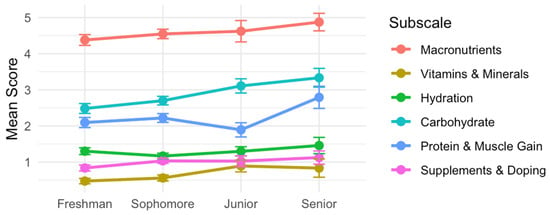
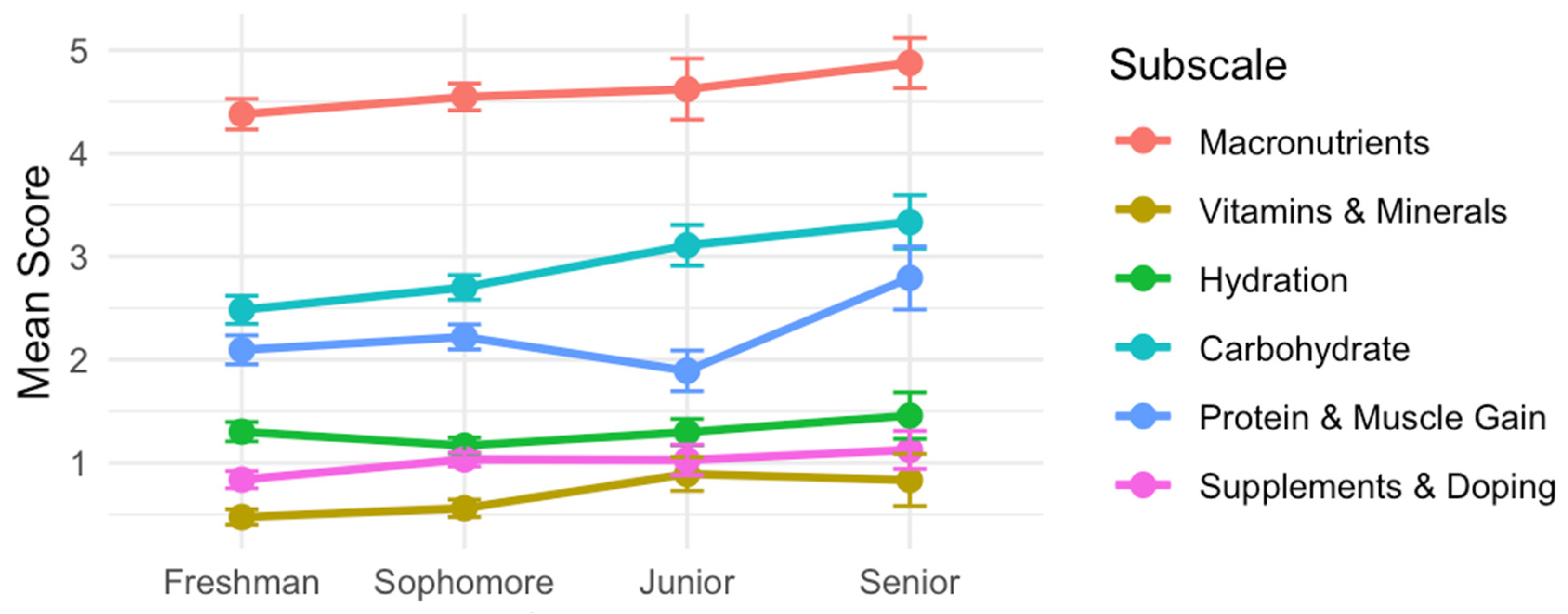
Academic year showed a small, exploratory difference on carbohydrate (H = 10.23, p = 0.017, ε2 = 0.031) and vitamin and mineral subscale (H = 7.91, p = 0.048, ε2 = 0.024) without correction for multiple comparisons. No significant academic-year effects were observed for macronutrients (p = 0.400), hydration (p = 0.477), protein and muscle gain (p = 0.320), or supplements and doping (p = 0.110). The academic year trends across all six subscales are illustrated in Figure 1. A linear mixed-effects model was fitted to test whether the academic-year effect differed across knowledge domains; the academic year × domain interaction was not significant (F(15, 1615) = 1.33, p = 0.178; Table S3), indicating that the academic-year effect did not differ significantly across domains.
Figure 1.
Academic year trends across six nutrition knowledge subscales. Note. N = 327. Lines represent mean scores for each subscale across the four academic year levels (freshman, sophomore, junior, senior). Error bars represent standard errors of the mean.
3.5. Post Hoc Comparisons on Carbohydrate Knowledge
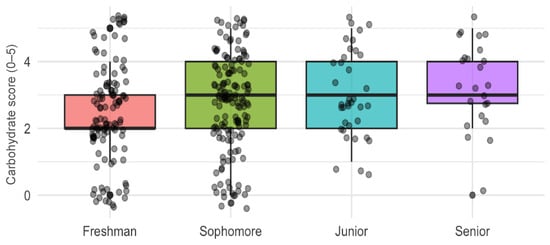
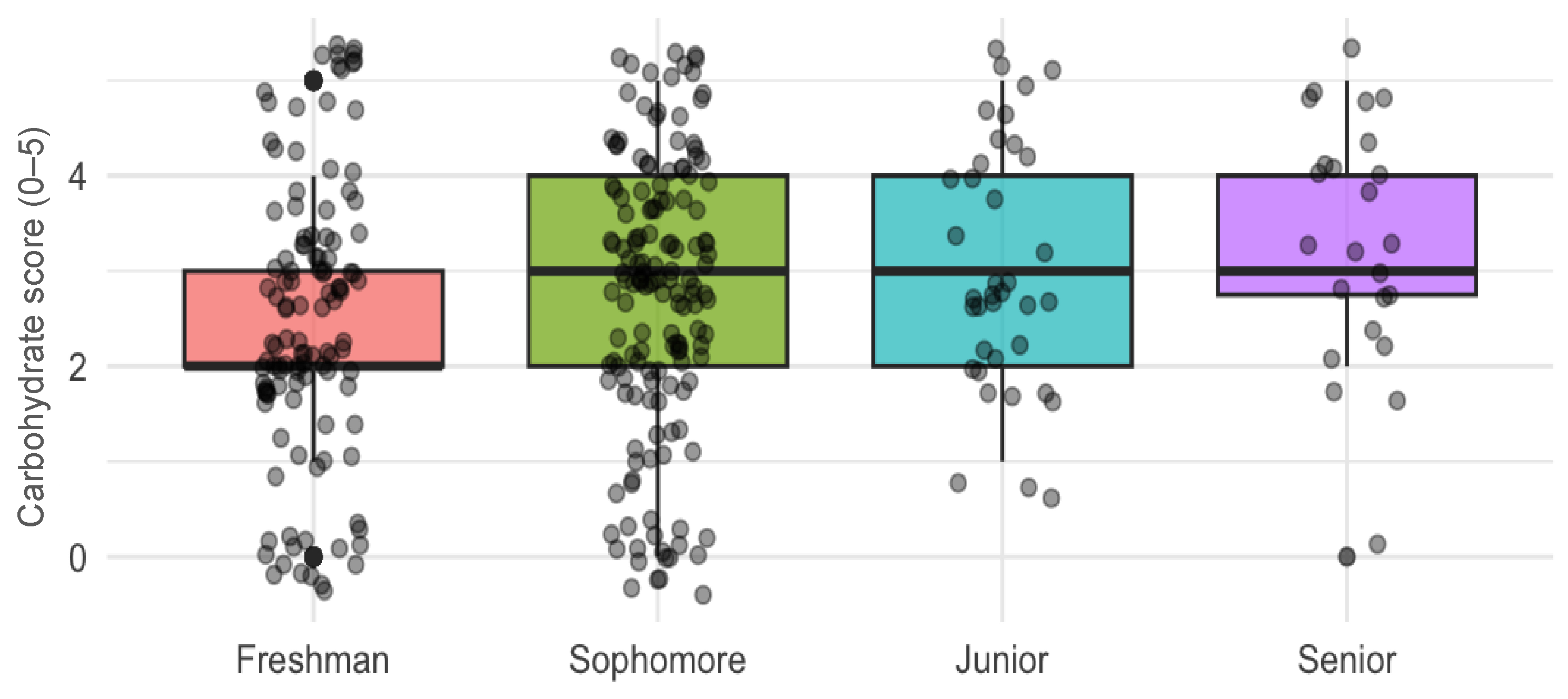
Given the significant academic-year effect on carbohydrate knowledge, Tukey HSD post hoc comparisons were performed. Pairwise comparisons are reported in Table 5. Carbohydrate knowledge was progressively higher across academic years. Seniors scored significantly higher than freshmen (mean difference = 0.85, 95% CI [0.03, 1.67], p = 0.040). All remaining pairwise comparisons were non-significant. The distribution of carbohydrate knowledge scores by academic year is shown in Figure 2.
Table 5.
Tukey HSD post hoc comparisons for carbohydrate knowledge score by academic year.
Figure 2.
Distribution of carbohydrate knowledge scores by academic year. Note. N = 327. Boxes represent interquartile ranges (IQRs); horizontal lines within boxes indicate medians; whiskers extend to the most extreme data points within 1.5 × IQR; individual points represent individual participants. Maximum possible score = 5.
3.6. Sensitivity Analysis
We conducted sensitivity analyses collapsing the smallest groups. For sport type, the three smaller categories were combined (n = 95) and compared with mixed-sport athletes (n = 232); no comparison approached significance (all p ≥ 0.297; total score p = 0.703), indicating the null sport-type finding was not an artifact of the category split (Supplementary Table S1). For academic year, juniors and seniors were combined into an upper-year group (n = 61) and compared with lower-year athletes (n = 266). The total knowledge score did not differ significantly (χ2 = 3.28, df = 1, p = 0.070). Carbohydrate and vitamins/minerals showed significant differences (both p = 0.006) (Supplementary Table S2).
4. Discussion
4.1. Sport Type and Sport Nutrition Knowledge
The present study found no significant differences in SNK among athletes participating in different sport types. This finding is consistent with some previous studies suggesting that sport classification alone may not be a primary determinant of athletes’ SNK. For example, a study involving physical education students in Turkey reported no significant differences in SNK between team- and individual-sport participants or across academic years [18]. However, previous findings remain inconsistent. Higher hydration and micronutrient knowledge among individual-sport athletes compared with team-sport athletes has been reported in NCAA Division III athletes [13], whereas other research found that athletes in revenue sports (football, basketball) had lower nutrition knowledge than those in non-revenue sports, possibly due to differences in nutrition support and resource availability [9]. These discrepancies suggest that sport type may be less important than the surrounding sporting environment, including access to nutrition education and professional support [19,20].
In the present study, the lack of significant differences may also be related to the uneven distribution of sport types with mixed-type athletes accounting for 70.9% of the sample, which may have reduced the ability to detect small between-group differences. Future research with more balanced samples and explicit measurement of nutrition resource access is needed to clarify this relationship.
4.2. Academic Year and Nutrition Knowledge
The positive association between academic year and SNK observed in this study is consistent with a growing body of evidence. In a study of NCAA Division III athletes, A-NSKQ scores differed significantly by class rank, with seniors scoring higher than freshmen and sophomores [21]. Similarly, a study of university athletes in Jordan reported significant differences in SNK according to academic year [10]. The consistency of these findings across diverse institutional contexts suggests that accumulated educational exposure may contribute to SNK development.
A critical moderator identified in prior work is formal nutrition education. This pattern is further supported by a recent Irish cohort in which athletes who had studied nutrition or dietetics at university level scored substantially higher on sports nutrition knowledge than their peers [5]. These findings suggest a possible explanation for the academic-year pattern: seniors may have greater opportunities to encounter nutrition-related coursework, but because prior nutrition education was not measured in the present study, this remains a hypothesis rather than a demonstrated mechanism. The present study extends this body of literature by describing how total SNK and its subscales varied across academic years; however, these patterns should not be interpreted as evidence that coursework has differential effects across content areas.
4.3. Knowledge Gaps of Collegiate Students
The finding that carbohydrate and vitamins/minerals showed nominal academic year differences provides additional insight into SNK development, though neither survived correction for multiple comparisons. Previous studies have highlighted different areas of nutrition knowledge deficits. For example, among university student-athletes, behavioral intention to eat healthfully was predicted primarily by attitude rather than by perceived behavioral control or subjective norms [22], suggesting that knowledge alone may not be sufficient to drive behavior. Similarly, among US collegiate athletes, knowledge gaps have been reported regarding hydration guidelines and appropriate use of sports drinks [23]. American football players’ hydration knowledge was moderately high (69.4% correct) but only 24% reported drinking enough fluids before, during, immediately after, and 2 h after practice [24]. Unlike the cohort in which hydration knowledge was relatively high but practice was poor [25], our sample performed consistently poorly on hydration knowledge across all academic years, with no significant academic year differences.
One possible explanation for the nominal carbohydrate difference is that carbohydrate-related topics receive greater emphasis in sports nutrition education and practice. A recent narrative review found that athletes typically score higher on topics related to dehydration and dietary sources of nutrients while showing gaps in micronutrients, fluid intake, and supplement use [26]. However, because the year × domain interaction was not significant (p = 0.178) and educational exposure was not measured, this remains a hypothesis rather than evidence that carbohydrate knowledge is differentially responsive to education. In addition, other demographic and training-related characteristics examined in this study, including age group, training frequency, and regular fitness testing, were not significantly associated with SNK. This finding is consistent with the previous literature suggesting that demographic and training variables may be weaker predictors of SNK compared with educational exposure [10,27].
4.4. Limitations
Several limitations of this study should be acknowledged. First, the cross-sectional design precludes causal inferences; although academic year was significantly associated with SNK, it remains unclear whether this association reflects the influence of formal nutrition education, age-related differences, or accumulated educational and life experiences. Longitudinal studies tracking athletes’ knowledge across academic years would provide stronger evidence for the role of education. Second, the sample was unevenly distributed across sport types, with mixed-type athletes comprising 70.9% of the sample. This imbalance may have reduced the statistical power to detect small between-group differences and limits the generalizability of the null sport-type finding. Third, all data were self-reported, which may introduce social desirability bias, particularly for items related to supplement use and doping. In addition, the study was conducted at a single university in China, and the findings may not generalize to athletes in other institutions, regions, or cultural contexts with different nutrition education systems. Fourth, internal consistency was low for all six subscales. This likely reflects the short length of the subscales, floor effects, and heterogeneous content within domains. Fifth, several potentially important confounders such as prior nutrition education, field of study (e.g., sports science vs. other majors), access to a dietitian, and competition level were not measured. Each of these could plausibly influence sports nutrition knowledge and may partly explain the observed academic-year pattern. Sixth, sport category was self-reported from four predefined options, and specific sport names were not collected; the specific sports comprising each category therefore cannot be verified from the survey data, which limits the transparency of the sport-type comparisons. Seventh, six subscale comparisons were conducted without correction for multiple comparisons. The nominal carbohydrate and vitamin/mineral differences would not survive Bonferroni correction, and these findings should therefore be regarded as exploratory. Eighth, the assignment of items to domains followed the structure of the original NSKQ rather than a content-based reclassification; some items (e.g., fat as fuel, pre-competition food) may not align optimally with their assigned domains, which should be considered when interpreting subscale-level findings. Ninth, the adapted questionnaire was translated into Chinese by the research team but did not undergo formal forward–backward translation, independent expert review, or pilot testing. Finally, although the six-domain structure provided a more nuanced picture than a composite score alone, the relatively small number of items per subscale (3–8 items) may limit the precision of subscale-level estimates.
5. Conclusions
In summary, total SNK did not differ significantly across academic-year groups, although academic year showed a nominally significant linear coefficient in the regression model; however, given the non-significant overall model and the absence of a significant academic year × domain interaction, neither finding is interpreted as a confirmed academic-year effect. Carbohydrate and vitamins/minerals showed nominal differences across academic years, but these did not survive correction for multiple comparisons and should be regarded as exploratory. Because prior nutrition education was not assessed, these patterns cannot be attributed to the effectiveness of nutrition education and may reflect cohort or other unmeasured factors.
Supplementary Materials
The following supporting information can be downloaded at https://www.mdpi.com/article/10.3390/nu18233959/s1, Table S1: Sensitivity analysis for sport type: Kruskal Wallis comparisons of mixed-sport (n = 232) versus non-mixed (n = 95) athletes; Table S2: Sensitivity analysis for academic year: Kruskal–Wallis comparisons of lower-year (n = 266) versus upper-year (n = 61) athletes; Table S3: Linear mixed-effects model testing the academic year × knowledge domain interaction for sports nutrition knowledge; Table S4: The 35-item adapted Nutrition for Sport Knowledge Questionnaire (NSKQ): item list, response options, and scoring.
Author Contributions
Conceptualization, methodology, formal analysis, F.W.; investigation, data curation, writing—original draft preparation, W.Y.; writing—review and editing, D.X.; data curation, writing—review and editing, supervision, S.B. All authors have read and agreed to the published version of the manuscript.
Funding
This research received no external funding.
Institutional Review Board Statement
This study was conducted in accordance with the Declaration of Helsinki and approved by the Ethics Committee of Jiaxing University (Approval No. YX-2026041, approval date: 10 April 2026).
Informed Consent Statement
Informed consent was obtained from all participants involved in the study.
Data Availability Statement
The data presented in this study are available on request from the first author. The data are not publicly available due to privacy restrictions.
Acknowledgments
The authors thank all participating athletes for their time and cooperation.
Conflicts of Interest
The authors declare no conflicts of interest.
References
- Hopper, C.; Mooney, E.; Mc Cloat, A. Nutritional Intake and Dietary Knowledge of Athletes: A Scoping Review. Nutrients 2025, 17, 207. [Google Scholar] [CrossRef] [Scilit] [PubMed]
- Singleton, K.M.; Jagim, A.R.; McAllister-Deitrick, J.; Daou, M.; Kerksick, C.M. Differences in perceived energy and macronutrient requirements across divisions in NCAA athletes. J. Int. Soc. Sports Nutr. 2024, 21, 2365307. [Google Scholar] [CrossRef] [Scilit] [PubMed]
- Andrews, A.; Wojcik, J.R.; Boyd, J.M.; Bowers, C.J. Sports Nutrition Knowledge among Mid-Major Division I University Student-Athletes. J. Nutr. Metab. 2016, 2016, 3172460. [Google Scholar] [CrossRef] [Scilit] [PubMed]
- Gulleyan, S.; Lemieux, C.; Margut, M.; Werlau, E.; McAllister-Deitrick, J.; Singleton, K.M. Sports nutrition knowledge as a predictor of food choices in NCAA division I athletes. J. Int. Soc. Sports Nutr. 2025, 22, 2550165. [Google Scholar] [CrossRef] [Scilit]
- Smith, B.L.; Carey, C.C.; O’connell, K.; Twomey, S.; McCarthy, E.K. Nutrition knowledge, supplementation practices and access to nutrition supports of collegiate student athletes in Ireland. Eur. J. Nutr. 2025, 64, 172. [Google Scholar] [CrossRef] [Scilit] [PubMed]
- Mitchell, L.; Lehane, P.; McCarthy, M.; O’sHea, K.; Tracey, M.; Whyte, T.; Neville, R. Nutrition knowledge of elite and non-elite Gaelic footballers. Sci. Med. Footb. 2022, 6, 159–163. [Google Scholar] [CrossRef] [Scilit] [PubMed]
- Janiczak, A.; Devlin, B.L.; Forsyth, A.; Trakman, G.L. A systematic review update of athletes’ nutrition knowledge and association with dietary intake. Br. J. Nutr. 2022, 128, 1156–1169. [Google Scholar] [CrossRef] [Scilit] [PubMed]
- Vázquez-Espino, K.; Rodas-Font, G.; Farran-Codina, A. Sport Nutrition Knowledge, Attitudes, Sources of Information, and Dietary Habits of Sport-Team Athletes. Nutrients 2022, 14, 1345. [Google Scholar] [CrossRef] [Scilit] [PubMed]
- Werner, E.N.; Guadagni, A.J.; Pivarnik, J.M. Assessment of nutrition knowledge in division I college athletes. J. Am. Coll. Health J. ACH 2022, 70, 248–255. [Google Scholar] [CrossRef] [Scilit] [PubMed]
- Amawi, A.T.; Alkasasbeh, W.J.; Ali, H.A.; Orhan, B.E. Social and demographic factors associated with sports nutrition knowledge and food habits among university athletes. Front Nutr. 2026, 13, 1838485. [Google Scholar] [CrossRef] [Scilit] [PubMed]
- Trakman, G.L.; Forsyth, A.; Devlin, B.L.; Belski, R. A Systematic Review of Athletes’ and Coaches’ Nutrition Knowledge and Reflections on the Quality of Current Nutrition Knowledge Measures. Nutrients 2016, 8, 570. [Google Scholar] [CrossRef] [Scilit] [PubMed]
- McCrink, C.M.; McSorley, E.M.; Grant, K.; McNeilly, A.M.; Magee, P.J. An investigation of dietary intake, nutrition knowledge and hydration status of Gaelic Football players. Eur. J. Nutr. 2021, 60, 1465–1473. [Google Scholar] [CrossRef] [Scilit] [PubMed]
- Klein, D.J.; Eck, K.M.; Walker, A.J.; Pellegrino, J.K.; Freidenreich, D.J. Assessment of Sport Nutrition Knowledge, Dietary Practices, and Sources of Nutrition Information in NCAA Division III Collegiate Athletes. Nutrients 2021, 13, 2962. [Google Scholar] [CrossRef] [Scilit] [PubMed]
- Deng, S.-J.; Yu, J.; Shu, M.-Y.; Li, G.; Liu, Y.; Wang, L.; Ma, M.; Yushan, G.; Li, Y.; Tan, Y.; et al. Associations of dietary intake and nutrition knowledge with body composition and performance in table tennis athletes: A cross-sectional study. Front. Nutr. 2026, 13, 1858347. [Google Scholar] [CrossRef] [Scilit] [PubMed]
- Veloso-Pulgar, M.; Farran-Codina, A. Effect of a nutrition education intervention on sports nutrition knowledge, dietary intake, and body composition in female athletes: A randomized controlled trial. Front Nutr. 2026, 13, 1821345. [Google Scholar] [CrossRef] [Scilit] [PubMed]
- Yuan, Y.; Liu, X.; Yang, S.; Liu, Y. Investigation and countermeasure of the dietary nutrition status of college students from the perspective of healthy China. Sci. Rep. 2026, 16, 5579. [Google Scholar] [CrossRef] [Scilit] [PubMed]
- Trakman, G.L.; Forsyth, A.; Hoye, R.; Belski, R. The nutrition for sport knowledge questionnaire (NSKQ): Development and validation using classical test theory and Rasch analysis. J. Int. Soc. Sports Nutr. 2017, 14, 26. [Google Scholar] [CrossRef] [Scilit] [PubMed]
- Çakir, Z.; Coşkuntürk, O.S. Beden Eğitimi ve Spor Yüksekokulunda Öğrenim Gören Öğrencilerin Sporcu Beslenme Bilgi Düzeylerinin Bazı Değişkenler Açısından İncelenmesi. Ulus. Spor Bilim Derg. 2022, 6, 105–118. [Google Scholar] [CrossRef] [Scilit]
- Boidin, A.; Tam, R.; Mitchell, L.; Cox, G.R.; O’Connor, H. The effectiveness of nutrition education programmes on improving dietary intake in athletes: A systematic review. Br. J. Nutr. 2021, 125, 1359–1373. [Google Scholar] [CrossRef] [Scilit] [PubMed]
- Hull, M.V.; Jagim, A.R.; Oliver, J.M.; Greenwood, M.; Busteed, D.R.; Jones, M.T. Gender differences and access to a sports dietitian influence dietary habits of collegiate athletes. J. Int. Soc. Sports Nutr. 2016, 13, 38. [Google Scholar] [CrossRef] [Scilit] [PubMed]
- Berends, K.; Wierenga, M.J.; Frens, M. An evaluation of sports nutrition knowledge and influencing factors in NCAA Division III athletes. J. Exerc Nutr. 2025, 8, 1–6. [Google Scholar] [CrossRef] [Scilit]
- Karpinski, C.A.; Milliner, K. Assessing Intentions to Eat a Healthful Diet Among National Collegiate Athletic Association Division II Collegiate Athletes. J. Athl. Train. 2016, 51, 89–96. [Google Scholar] [CrossRef] [Scilit] [PubMed]
- Nichols, P.E.; Jonnalagadda, S.S.; Rosenbloom, C.A.; Trinkaus, M. Knowledge, attitudes, and behaviors regarding hydration and fluid replacement of collegiate athletes. Int. J. Sport Nutr. Exerc Metab. 2005, 15, 515–527. [Google Scholar] [CrossRef] [Scilit] [PubMed]
- Judge, L.W.; Kumley, R.F.; Bellar, D.M.; Pike, K.L.; Pierson, E.E.; Weidner, T.; Pearson, D.; Friesen, C.A. Hydration and Fluid Replacement Knowledge, Attitudes, Barriers, and Behaviors of NCAA Division 1 American Football Players. J. Strength Cond. Res. 2016, 30, 2972–2978. [Google Scholar] [CrossRef] [Scilit] [PubMed]
- Scanlon, S.; Norton, C. Investigating Nutrition and Hydration Knowledge and Practice among a Cohort of Age-Grade Rugby Union Players. Nutrients 2024, 16, 533. [Google Scholar] [CrossRef] [Scilit] [PubMed]
- Riviere, A.J.; Leach, R.; Mann, H.; Robinson, S.; Burnett, D.O.; Babu, J.R.; Frugé, A.D. Nutrition Knowledge of Collegiate Athletes in the United States and the Impact of Sports Dietitians on Related Outcomes: A Narrative Review. Nutrients 2021, 13, 1772. [Google Scholar] [CrossRef] [Scilit] [PubMed]
- Song, G.; Yan, Y.; Zhao, H.; Chen, J.; Deng, Y.; Zhu, W.; Sun, L.; Ma, G. A questionnaire study on the knowledge, attitudes, and practices of fluid replacement and urination among Chinese elite athletes. PLoS ONE 2022, 17, e0275685. [Google Scholar] [CrossRef] [Scilit] [PubMed]

Disclaimer/Publisher’s Note: The statements, opinions and data contained in all publications are solely those of the individual author(s) and contributor(s) and not of MDPI and/or the editor(s). MDPI and/or the editor(s) disclaim responsibility for any injury to people or property resulting from any ideas, methods, instructions or products referred to in the content. |
© 2026 by the authors. Licensee MDPI, Basel, Switzerland. This article is an open access article distributed under the terms and conditions of the Creative Commons Attribution (CC BY) license.