


Abstract
Background/Objectives: Food supplements are frequently used by patients with rheumatic diseases, but rheumatologists’ knowledge, attitudes, and recommendation practices regarding these products remain poorly characterized. This study aimed to assess these aspects among a sample of Italian rheumatologists and to explore their relationship with clinical recommendation practices. Methods: A cross-sectional survey was conducted among 257 members of the Italian College of Rheumatologists within the IntegraRE project. A structured questionnaire assessed knowledge, attitudes, and practices. Adequate knowledge was defined as ≥11 correct answers. Descriptive and regression analysis explored associations between knowledge, personal supplement use, and clinical attitudes and practices. Results: Overall, 37.4% of respondents demonstrated adequate knowledge, with substantial gaps in supplement regulation, intended uses, and adverse-reaction reporting. Knowledge level was not significantly associated with personal supplement use (p = 0.131). Rheumatologists with adequate knowledge were more likely to report official/institutional websites (p < 0.05) and scientific databases (p < 0.01) as preferred sources for updating their knowledge. Notably, 72.5% of physicians recommended supplements because they considered them free of adverse effects. In multivariable analyses, adequate knowledge was associated with lower odds of recommending supplements on this basis (aOR = 0.44, 95% CI: 0.22–0.85). Vitamins were the most frequently recommended category (30.2%), especially those of the B group and vitamin D. Conclusions: The Italian rheumatologists surveyed showed substantial knowledge gaps regarding food supplements, particularly in regulatory and vigilance-related aspects. Targeted education and access to reliable, evidence-based information may promote informed recommendations and safer supplement use in rheumatological practice.
1. Introduction
According to Directive 2002/46/EC, food supplements are foodstuffs intended to complement the normal diet by providing concentrated sources of nutrients or other substances with a nutritional or physiological effect, including vitamins, minerals, and botanicals [1]. Their role is to support normal physiological functions and homeostasis [2], rather than to treat or prevent diseases, which are purposes falling within the therapeutic scope of medicinal products [3]. Nevertheless, consumers may perceive food supplements as products with therapeutic benefits, potentially contributing to their widespread use [4].
The perception that food supplements are inherently safe, partly reinforced by their availability without a prescription, may further encourage their use [5]. However, these products can cause adverse reactions, particularly when used inappropriately or in combination with medications [6,7]. For example, excessive vitamin D intake may lead to severe hypercalcemia [8], while botanical ingredients such as Curcuma longa and Hypericum perforatum have been associated with hepatotoxicity and clinically relevant drug interactions, respectively [9,10]. These concerns highlight the importance of adverse reaction reporting and appropriate professional counselling to promote the safe and informed use of food supplements.
Healthcare professionals play a key role in guiding patients regarding food supplement use, yet studies have identified gaps in their knowledge of regulation, potential benefits and risks, and adverse reaction reporting procedures [11,12,13]. Limited formal education and the lack of standardized training may contribute to these shortcomings, potentially affecting the provision of evidence-based recommendations.
These considerations are particularly relevant in rheumatology. Rheumatic and musculoskeletal diseases comprise a heterogeneous group of more than 200 conditions, frequently characterized by chronic pain, functional limitations, disability, and reduced quality of life [5,14]. Examples of rheumatic and musculoskeletal diseases with a substantial global burden include osteoarthritis (7.6%), gout (~0.7%), spondyloarthritis (~0.55%), and rheumatoid arthritis (~0.2%) [15,16,17,18,19]. In addition, some inflammatory rheumatic diseases are associated with systemic complications, comorbidities, and premature mortality [14,17,18]. Therefore, the chronic and often debilitating nature of rheumatic and musculoskeletal diseases may encourage patients to seek additional strategies to manage symptoms alongside conventional treatments, including the use of food supplements.
A recent survey reported daily food supplement use in 54.5% of patients attending rheumatology clinics, frequently alongside conventional medications [5]. Similarly, 60.5% of Japanese patients with rheumatoid arthritis [20] and 85% of Norwegian patients with fibromyalgia [21] reported taking supplements. This widespread consumption raises concerns because patients with rheumatic and musculoskeletal diseases often receive long-term pharmacological treatments, potentially increasing the risk of clinically relevant interactions with supplement ingredients [22,23,24].
Rheumatologists are therefore well positioned to provide informed counselling on food supplement use [25]. However, their recommendations may be influenced by knowledge, personal experience, attitudes, and access to reliable scientific information. Although previous studies have investigated these aspects among general practitioners and other healthcare professionals [11,12,13], evidence specifically addressing rheumatologists remains limited, with existing research focusing predominantly on patients’ supplement use.
To address this gap, the IntegraRE project (https://www.iss.it/en/integrare accessed on 22 October 2026), coordinated by the Italian National Institute of Health (Istituto Superiore di Sanità, ISS), was designed to investigate food supplement use in rheumatology from both physician and patient perspectives [26]. The present study reports the findings of its first phase, which specifically focused on rheumatologists, and aims to: evaluate their personal supplement use; assess their objective and self-perceived knowledge of food supplements, including regulatory and vigilance-related aspects; describe their information sources, attitudes, and recommendation practices; explore associations between objective knowledge, personal supplement use, and clinical attitudes and practices.
2. Materials and Methods
2.1. Study Design
The present study was a cross-sectional, online survey conducted among Italian rheumatologists as Phase 1 of the IntegraRE project. The study was designed as a Knowledge, Attitudes and Practices (KAP) survey and conducted in accordance with the STROBE guidelines for cross-sectional studies [27]. A detailed description of the study design and methodology has been reported in the previously published study protocol [26].
2.2. Population and Data Collection
The target population consisted of rheumatologists practicing in Italy in hospital, community, and university settings, within both the public and private healthcare sectors, who were registered members of the Italian College of Rheumatologists (CReI), a non-profit scientific society representing rheumatology specialists nationwide. Data were collected using an ad hoc online questionnaire developed by ISS and distributed via e-mail by CReI to all 1134 eligible members. Participation was voluntary, and informed consent was obtained electronically before questionnaire completion.
Participant recruitment and data collection started on 9 October 2024 and were conducted over a one-year period. The recruitment period was extended beyond the six months originally planned in the study protocol because of the lower-than-expected response rate [26].
2.3. Questionnaire
The questionnaire was specifically developed for the IntegraRE study and consisted of sections covering socio-demographic, lifestyle, and professional characteristics, as well as knowledge, attitudes, and clinical practices regarding food supplements. The questionnaire was administered online using Microsoft Forms (Microsoft Corporation, Redmond, WA, USA).
The first section included age class (<30, 30–39, 40–49, 50–59, 60–69, 70–79, ≥80), gender, smoking status, physical activity, presence of food-related conditions (allergies, intolerances, or celiac disease), personal use of food supplements, primary practice setting (hospital-based, private practice, community-based practice, or academic/university setting), practice location (Italian macro-area), years of professional experience (<1, 1–5, 6–10, >10), and average number of patients treated annually (<750, 750–1000, 1001–1250, 1251–1500, >1500 patients). Weekly physical activity was categorized using a cut-off of 2.5 h per week (150 min/week), corresponding to the minimum amount of moderate-intensity aerobic physical activity recommended by the World Health Organization for adults [28].
To investigate rheumatologists’ knowledge of food supplements, the second section included 20 statements rated on a five-point Likert scale (1 = strongly disagree to 5 = strongly agree). Depending on the statement, either “Strongly disagree”/”Disagree” or “Agree”/”Strongly agree” was considered the correct response. Neutral responses (“Neither agree nor disagree”) were considered incorrect. For each item, responses were therefore dichotomized as correct or incorrect, and the proportion of correct responses was calculated using the number of valid (non-missing) responses as the denominator. In addition, an overall knowledge score ranging from 0 to 20 was obtained by assigning one point to each correct answer and zero points to incorrect responses; missing responses were also assigned a score of zero. The distribution of the overall knowledge score was described using summary statistics, including the mean, standard deviation, median, and interquartile range. For descriptive purposes and to examine associations with physicians’ attitudes and clinical practices, the score was dichotomized into inadequate knowledge (score < 11) and adequate knowledge (score ≥ 11), according to the predefined threshold of more than half of the items answered correctly [26].
In the third section, rheumatologists’ attitudes towards food supplements were assessed. According to the FAO definition [29], attitude refers to the emotional, motivational, perceptive, and cognitive beliefs that positively or negatively influence an individual’s behavior or practice. Given their potential influence on clinical practice, 17 items assessed rheumatologists’ perceived knowledge, attitudes, and views related to the clinical use of food supplements, including aspects concerning medical history taking and recommendation. Responses were recorded on a five-point Likert (1 = strongly disagree to 5 = strongly agree), with 3 indicating a neutral response (“Neither agree nor disagree”). For each item, responses were dichotomized into “Yes” (“Agree” or “Strongly agree”) and “No” (“Strongly disagree”, “Disagree”, or “Neither agree nor disagree”). Percentages were calculated using the number of valid (non-missing) responses for each item as the denominator.
The final section assessed the use of food supplements in clinical practice and included 19 questions on rheumatologists’ propensity to recommend these products, the specific supplements recommended, and the conditions for which they were recommended. Items assessing the frequency of clinical practices were rated on a five-point scale ranging from 1 (Never) to 5 (Always). Responses were dichotomized into “No” (Never, score 1) and “Yes” (at least occasional practice, scores 2–5). For each supplement, information on category, trade name, and manufacturer was collected, with the latter being optional. Conditions were classified as rheumatological or non-rheumatological; for rheumatological conditions, the specific disease was also recorded. Each reported food supplement was then disaggregated into its individual ingredients, which were considered separate analytical units and classified according to their nature.
The questionnaire had not undergone formal psychometric validation. Although a test–retest reliability assessment was planned, it could not be completed because of the limited number of responses to the second administration.
2.4. Statistical Analysis
Data are reported as absolute frequencies (N) and percentages (%). In the tables, results are presented as n/N (%), where n represents the number of participants with the specified response and N represents the total number of participants with non-missing data for the corresponding variable. The overall knowledge score was described as a quantitative variable using mean and standard deviation (SD), as well as median and interquartile range (IQR). The dichotomous classification (score ≥ 11) was retained as a complementary approach for descriptive and association analyses. Categorical variables were compared between groups (e.g., supplement users and non-users) using Pearson’s chi-square test or Fisher’s exact test, as appropriate. Yates’ continuity correction was automatically applied to 2 × 2 tables. The geographical distribution of respondents was compared with the national distribution of rheumatologists reported in the ISTAT database using a chi-square goodness-of-fit test. Univariable logistic regression models were used to estimate odds ratios (ORs) and 95% confidence intervals (CI) for the association between physicians’ knowledge of food supplements (adequate vs. inadequate) and each clinical attitude and practice variable. To further investigate the associations between physicians’ knowledge and selected clinical practices, multivariable logistic regression models were fitted for two outcomes: recommending food supplements because they were considered free of adverse effects and recommending food supplements upon patients’ request. Adequate versus inadequate knowledge was included as the main explanatory variable. Models were adjusted for age group, years of professional experience, workplace setting, personal use of food supplements, and the use of official/institutional websites and scientific databases as information sources. Age and professional experience were grouped into broader categories to limit sparse data in individual categories. Complete-case analysis was performed for each model, and adjusted odds ratios (aORs) with 95% CIs were estimated. Missing data were not imputed. Multicollinearity was assessed using the generalized variance inflation factor (GVIF), adjusted for the degrees of freedom (GVIF^(1/(2 × Df))). To assess the robustness of the multivariable estimates, sensitivity analyses were conducted by excluding age group or years of professional experience, one at a time, while retaining the same complete-case sample for each outcome. Two additional sensitivity analyses were performed to assess the robustness of the findings. First, to evaluate whether the association between knowledge level and reporting suspected adverse reactions to the Italian Phytovigilance System (VigiErbe) was affected by the inclusion of VigiErbe-related items in the original knowledge score, the association was reassessed using a revised 14-item knowledge score, excluding those items. Each item was scored as 1 for a correct response and 0 for an incorrect or missing response. For this revised score, adequate knowledge was defined as a score ≥ 8 (approximately corresponding to the original cut-off of ≥11 on the 20-item score). The association was reassessed using univariable logistic regression, with knowledge classified as adequate or inadequate according to the revised cut-off. Second, to account for the unequal number of items for which agreement and disagreement represented the correct responses (12 and 8, respectively), an alternative balanced knowledge score was calculated. The proportion of correct responses was computed separately for the two groups of items, and the resulting proportions were assigned equal weight. Associations with the selected clinical outcomes were then re-evaluated using univariable logistic regression models, with the balanced score included as a quantitative explanatory variable. Given the exploratory nature of the study, no adjustment for multiple comparisons was applied. A p value < 0.05 was considered statistically significant. All data were exported from Microsoft Forms and processed using R software (version 4.4.2; R Foundation for Statistical Computing, Vienna, Austria), with appropriate packages for data management, data visualization, and statistical analyses.
3. Results
Of the 1134 rheumatologists invited to participate, 301 questionnaires were received (response rate: 26.5%), exceeding the target sample size of 287 specified in the study protocol [26]. Following data cleaning, 44 questionnaires were excluded because they were largely incomplete or had implausibly short completion times, potentially indicating insufficient engagement with the questionnaire. Thus, 257 questionnaires were retained in the final analytical dataset, corresponding to 22.7% of the invited rheumatologists and falling below the originally established target sample size. The geographical distribution of participants’ place of practice was compared with the national distribution of rheumatologists in Italy based on ISTAT data. A significant difference was observed between the two distributions (p < 0.001). At the regional level, Abruzzo was not represented in the sample, while Lazio and Apulia were over-represented, and Emilia-Romagna, Lombardy, and Tuscany were under-represented (Figure S1).
Women accounted for 48.4% of respondents (123/254) and 56.0% over 50 years old (Table 1).
Table 1.
Sociodemographic and professional characteristics of rheumatologists according to personal food supplement use. Data are presented as n (%), with percentages calculated within each category using valid (non-missing) responses (N) as the denominator.
About 69.8% of rheumatologists were non-smokers, while 58.8% were engaged in physical activity. Of these, 58.7% (N = 88) practiced at least 2.5 h per week. Only a minority of respondents (21.9%) reported a food allergy, food intolerance, or celiac disease. Among these, approximately one third (33.9%) reported following a specific dietary pattern. Overall, 45.1% of rheumatologists reported using food supplements. Regarding their primary workplace setting, 44.3% worked in a hospital. Questionnaires were mainly collected from rheumatologists working in the Italian macro-areas “Centre” (N = 86; 36.9%) and “South and Islands” (N = 86; 33.9%). A total of 67.1% of physicians had more than 10 years of work experience, while 21.2% managed more than 1500 patients per year.
3.1. Use of Food Supplements Among Rheumatologists
To explore potential differences between users and non-users, participants were then stratified according to personal use of food supplements. As shown in Table 1, a statistically significant association was observed between food-related conditions, considered as a four-level categorical variable, and food supplement use (p < 0.05). No statistically significant associations were observed for the other variables analyzed.
3.2. Physicians’ Knowledge of Food Supplements
Overall, physicians showed heterogeneous knowledge regarding food supplements. The highest proportion of correct responses was observed for the item stating that food supplements may contain vitamins, minerals, and other ingredients (91.0%), as shown in Table 2. More than 70% of respondents correctly recognized the potential for food supplements to interact with drugs and foods, cause adverse effects related to individual sensitivity, and pose risks when consumed at excessive doses.
Table 2.
Rheumatologists’ knowledge of food supplements. Data are presented as n/N (%), where n represents the number of respondents who answered correctly and N represents the total number of valid (non-missing) responses for each item.
Knowledge was less consistent regarding regulatory aspects. Only 33.5% of respondents correctly identified food supplements as food products, while 63.2% correctly recognized the requirement for notification to the Ministry of Health before commercialization. Furthermore, correct knowledge that marketing authorization and demonstration of efficacy and safety are not required for commercialization was reported by only 18.9% and 29.4% of respondents, respectively. Similarly, only 52.7% correctly identified the meaning of the term “botanical”. Concerning the role of food supplements, 70.3% correctly recognized their contribution to maintaining normal physiological functions, while 72.1% correctly identified that they are not intended to treat specific diseases. However, fewer than half correctly recognized that food supplements are not intended to prevent disease development (45.7%), while only 10.3% correctly answered the item concerning their potential role in supporting pharmacological treatment. Finally, knowledge regarding adverse-event reporting and the VigiErbe system was generally limited. Half of respondents were aware that suspected adverse effects related to food supplement use can be reported voluntarily to the competent authority (50.7%) or through the Italian Phytovigilance System (49.8%). Similarly, only 47.0% correctly identified VigiErbe as an online platform for the spontaneous reporting of suspected adverse reactions to products of natural origin, and 43.7% were aware that reports can be submitted by both healthcare professionals and citizens.
The total knowledge score ranged from 1 to 16, with a mean of 9.28 (SD = 3.12) and a median of 9 (IQR = 5). Overall, 96 participants (37.4%) achieved a score ≥ 11, corresponding to the a priori defined threshold for adequate knowledge of food supplements (Figure S2). To explore whether personal use of food supplements was associated with knowledge, responses were stratified by supplement use. No statistically significant differences were observed in the proportion of correct responses to any knowledge-related item between users and non-users (Table S1). Consistently, the proportion of physicians achieving the predefined threshold for adequate knowledge did not differ significantly between non-users and users (41.8% vs. 31.9%, respectively; p = 0.131).
3.3. Perceived Knowledge and Information Sources
Alongside objective knowledge, participants’ self-perceived knowledge of food supplements was also assessed. Overall, less than half of respondents perceived themselves as sufficiently knowledgeable about food supplements (35.6–42.9%). Information was obtained mainly through pharmaceutical representatives (55.3%) and personal interest (52.6%), while only 17.8% reported formal training. Approximately two-thirds of participants indicated training courses, scientific conferences, institutional websites, and scientific databases as preferred sources for updating their knowledge, whereas a lower proportion (59.6%) selected informational materials provided by pharmaceutical representatives (Table 3).
Table 3.
Self-perceived knowledge, sources of information, and preferred sources for updating knowledge among respondents, overall and stratified by objectively assessed knowledge level (inadequate: score < 11; adequate: score ≥ 11). Data are presented as n/N (%), where n represents the number of respondents whose answers were classified as “Yes” and N represents the total number of valid (non-missing) responses for each item.
When stratified by objectively assessed knowledge level, rheumatologists with adequate knowledge were significantly more likely to report official/institutional websites (75.0% vs. 59.7%, p < 0.05) and scientific databases (76.8% vs. 56.8%, p < 0.01) as preferred sources for updating their knowledge. No statistically significant differences were observed for pharmaceutical representatives or training courses/scientific conferences.
3.4. Clinical Attitudes and Practices
Almost all rheumatologists reported routinely asking patients about food supplement use during medical history (98.8%), reminding them of the importance of a balanced diet (97.7%), investigating their medical history before recommending supplements (98.8%), and informing patients about possible adverse effects (98.4%). Moreover, 96.4% of rheumatologists reported recommending supplements based on confidence in their efficacy, while 98.0% considered supplements beneficial for patients. In contrast, 72.5% reported recommending supplements because they were considered free of adverse effects, and 74.0% reported recommending them upon patients’ request. Overall, 39.0% recommended food supplements based on personal interest. Vitamins and minerals were the most frequently recommended types of food supplements (97.2%), followed by prebiotics/probiotics (92.3%), other substances with nutritional or physiological effects (81.8%), and botanicals (77.7%). Regarding the recommended dosage of food supplements, 98.0% of rheumatologists reported advising patients to follow that indicated on the product label. In addition, 99.2% believed that the supplements they recommended provided benefits to patients. Among rheumatologists who managed suspected adverse reactions, 41.6% reported them to the Italian Phytovigilance System (VigiErbe). The suspected adverse reactions were attributed to inappropriate use, such as excessive dosage, by 68.6% of respondents, and to food supplement–drug interactions by 64.2%. Following a suspected adverse reaction, 79.6% reported discontinuing the food supplement, while 72.1% indicated that they changed the type of supplement (Table S2).
No statistically significant associations were observed between physicians’ personal use of food supplements and their recommendation practices, including the categories of supplements recommended to patients.
To investigate whether clinical attitudes and practices differed according to the level of knowledge, responses were stratified by objectively assessed knowledge score. As shown in Table 4, physicians with adequate knowledge of food supplements were significantly less likely to recommend food supplements because they considered them free of adverse effects (OR = 0.42, CI: 0.23–0.74) and upon patients’ request (OR = 0.52, CI: 0.29–0.94) compared with those with lower knowledge. In addition, they were less likely to report having submitted suspected adverse reactions to the Italian Phytovigilance System (VigiErbe) (OR = 0.51, CI: 0.29–0.89), although reporting was uncommon in both knowledge groups. For the multivariable analyses, age was grouped into four categories (<40, 40–49, 50–59, and ≥60 years), while years of professional experience were grouped into three categories (≤5, 6–10, and >10 years). In multivariable logistic regression analyses, the association between adequate knowledge and recommending food supplements because they were considered free of adverse effects remained statistically significant after adjustment for age group, years of professional experience, workplace setting, personal use of food supplements, and information sources (aOR = 0.44, 95% CI: 0.22–0.85; p = 0.016; N = 218). Conversely, the association with recommending food supplements upon patients’ request was no longer statistically significant after adjustment (aOR = 0.62, 95% CI: 0.32–1.21; p = 0.162; N = 212). The adjusted GVIF values were low in both multivariable models (all GVIF^(1/(2 × Df)) values below 1.5), indicating no evidence of substantial multicollinearity. To assess the robustness of these findings, the multivariable models were refitted after excluding age group or years of professional experience, one at a time, while retaining the same complete-case samples. The resulting estimates were like those obtained in the primary models.
Table 4.
Clinical attitudes and practices according to physicians’ objectively assessed knowledge level (inadequate: score < 11; adequate: score ≥ 11). Data are presented as n/N (%), where n represents the number of participants reporting the indicated attitude or practice and N represents the number of participants with valid (non-missing) responses for the corresponding item within each knowledge group.
3.5. Sensitivity Analyses
Two sensitivity analyses were performed to assess the robustness of the associations observed in the primary analyses. First, the association between knowledge level and reporting suspected adverse reactions to the Italian Phytovigilance System (VigiErbe) was reassessed using a revised 14-item knowledge score, excluding the six VigiErbe-related items. Adequate knowledge was defined as a score ≥ 8 (approximately corresponding to the original cut-off of ≥11 on the 20-item score). The association remained statistically significant: the proportion of physicians reporting suspected adverse reactions was lower among those with adequate knowledge than among those with inadequate knowledge (34.0% vs. 49.1%; OR = 0.54, 95% CI: 0.30–0.96; p = 0.027). Second, an alternative balanced knowledge score was used to account for the unequal number of items for which agreement and disagreement represented the correct responses. Higher balanced knowledge scores were associated with lower odds of recommending food supplements because they were considered free of adverse effects (OR = 0.59, 95% CI: 0.47–0.74; p < 0.001) and of recommending supplements upon patients’ request (OR = 0.68, 95% CI: 0.54–0.84; p < 0.001).
No statistically significant associations were observed between physicians’ knowledge and the remaining clinical attitudes or practices, including recommendations based on perceived efficacy or patient benefit, recommendations of vitamins and minerals or prebiotics/probiotics, adherence to the dosage reported on the product label, perceived patient benefit, or other aspects of the clinical management of suspected adverse reactions, such as their attribution to food supplement–drug interactions or inappropriate use, and the discontinuation or replacement of food supplements. The only statistically significant association in this latter domain concerned reporting suspected adverse reactions to the Italian Phytovigilance System (VigiErbe) (Table 4).
3.6. Most Frequently Recommended Food Supplements
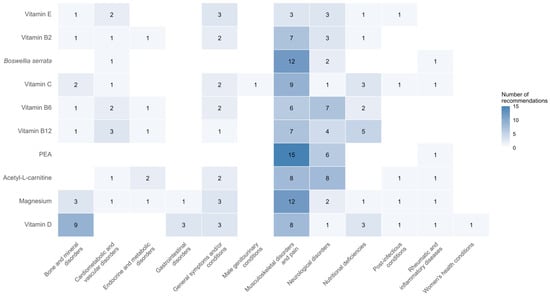
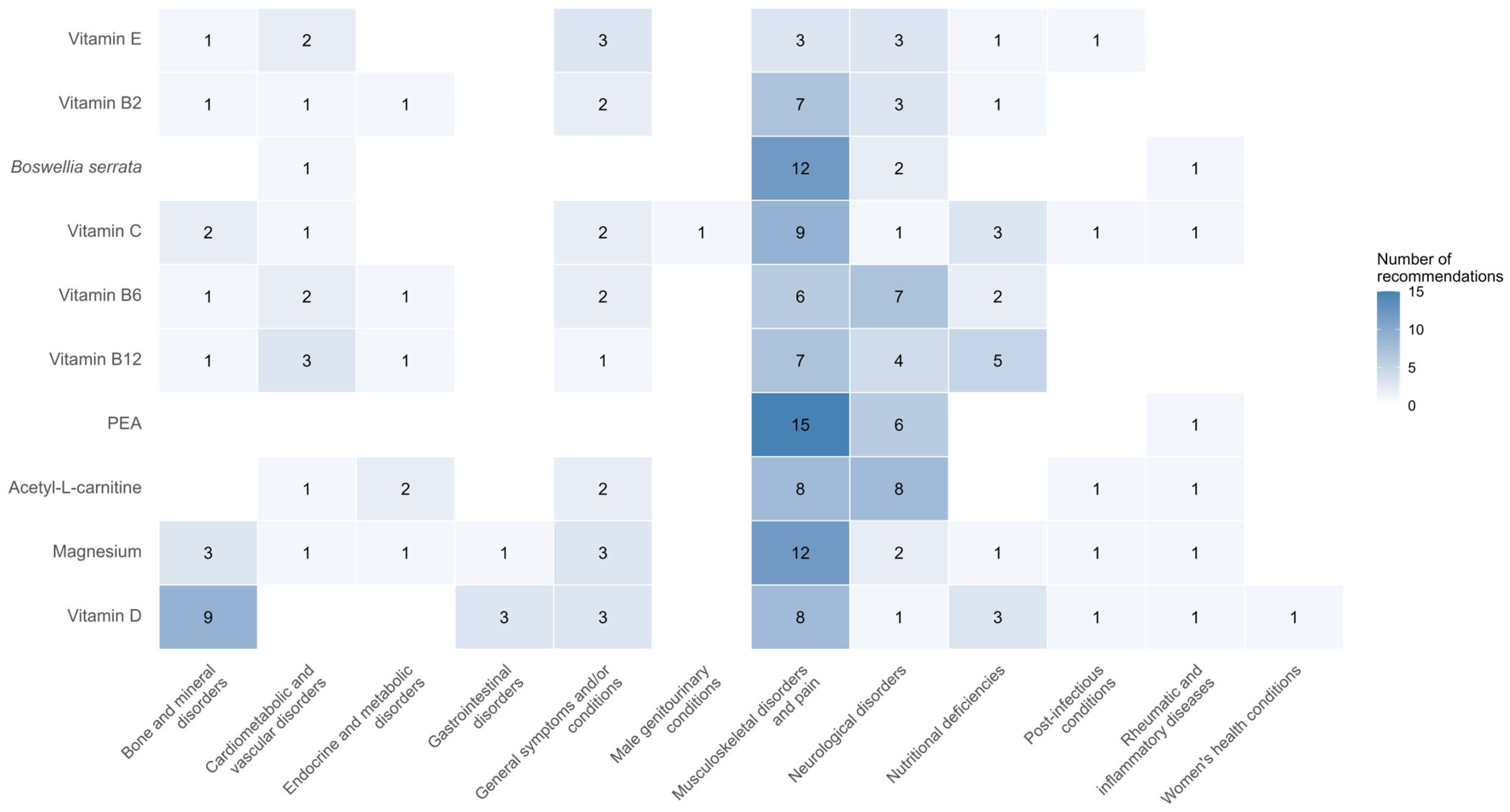
Most respondents (94.0%; n/N = 235/250) reported recommending food supplements for rheumatological conditions. Of these, 180 (76.6%) also reported recommending supplements for non-rheumatological conditions. Among the 130 physicians (50.6%) who provided information on the specific food supplements they recommended for rheumatic and other conditions, 343 supplements were reported, containing a total of 590 ingredient occurrences. Excluding the heterogeneous group of other substances (35.7%), vitamins were the most represented category (30.2%), followed by botanicals (15.3%), minerals (12.0%), and prebiotics and probiotics (6.8%). In particular, the most frequently recommended supplement ingredients across the different clinical condition categories included B-group vitamins (N = 59), vitamin D (N = 30), magnesium (N = 26), acetyl-L-carnitine (N = 23), palmitoylethanolamide (PEA; N = 22), vitamin C (N = 21), Boswellia serrata Roxb. ex Colebr. (N = 16), and vitamin E (N = 14) (Figure 1). Considering these most frequently ingredients, the largest number of recommendations was associated with musculoskeletal disorders and pain (N = 87), mainly for fibromyalgia and osteoarthritis, followed by neurological disorders (N = 38), primarily for peripheral neuropathies and neuropathic pain.
Figure 1.
Heatmap of the top 10 most frequently recommended supplement ingredients by clinical condition category. Cell values represent the number of reported recommendations, with darker shading indicating higher frequencies.
4. Discussion
To the best of our knowledge, this is the first study to investigate food supplement-related knowledge, attitudes, and practices among a sample of Italian rheumatologists. Overall, the findings provide useful insights into the personal and professional factors that may shape rheumatologists’ approach to these products.
Regarding personal supplement use, nearly half of rheumatologists reported using them. Although no significant association was observed with gender, supplement use was numerically more frequent among women than men, consistent with previous studies reporting higher use among women [30,31,32,33]. However, opposite patterns have been described in selected populations, such as athletes [34,35]. In the present study, the relatively limited sample size may have reduced the ability to detect modest gender-related differences, and this association should be explored further in larger samples. Interestingly, personal food supplement use was not significantly associated with physicians’ recommendation practices or with the categories of supplements recommended to patients. This suggests that personal use may not necessarily translate into corresponding clinical recommendation patterns, although modest associations cannot be excluded.
In contrast, a significant association was observed between food-related conditions and personal supplement use, when considering the categorical variable as a whole. A higher proportion of supplement users was observed among physicians reporting food intolerance than among those reporting none of these conditions. This pattern may partly reflect greater attention to nutritional issues among individuals following restricted diets or at risk of nutrient deficiencies [36]. However, the available literature does not consistently support higher supplement use in these populations. For example, a study in patients with chronic inflammatory bowel disease reported frequent food intolerances and dietary restrictions but relatively limited supplement use [37].
One of the main findings of this study was the heterogeneous level of rheumatologists’ knowledge regarding food supplements. Substantial gaps emerged in key regulatory aspects, including the recognition that food supplements are classified as foods, do not require marketing authorization before being placed on the market, and are not required to demonstrate efficacy and safety prior to commercialization. These features are fundamental to distinguishing food supplements from medicinal products and may have important implications for clinical practice [1,3]. Therefore, the low proportion of correct responses to these items suggests that many respondents may attribute to food supplements a level of pre-market regulatory evaluation comparable to that required for medicinal products.
Additional gaps concerned the intended use of food supplements, as many respondents believed that these products could prevent disease or support pharmacological treatment. According to the homeostasis model, food supplements are intended to maintain or support normal physiological functions rather than to treat or prevent disease [2]. The particularly low proportion of correct responses to the item concerning the use of food supplements to support pharmacological treatment further suggests some uncertainty regarding the distinction between nutritional or physiological support and therapeutic use. However, this item may also have been interpreted in light of rheumatological practice, in which some nutrients are routinely co-prescribed with pharmacological treatments, such as folic acid with methotrexate or calcium and vitamin D with glucocorticoid or anti-osteoporotic therapy [38,39].
Beyond these regulatory aspects, important gaps also emerged in vigilance-related knowledge, whereas awareness of more general safety issues, such as potential interactions and adverse effects associated with excessive intake, was comparatively higher. Similar shortcomings have been reported across professional healthcare groups for more than two decades. Kemper et al. [40] identified deficiencies in knowledge of food supplements, particularly regarding adverse effects, reporting, and patient communication, while Ashar et al. [41] reported physicians’ limited understanding of supplement regulation and adverse-event reporting, although knowledge improved after a brief educational intervention. More recent studies have documented comparable gaps in regulation, efficacy and safety requirements, and adverse-event reporting [11,13]. Consistent with these findings, Pascale et al. [42] also reported physicians’ limited knowledge of adverse-event reporting for food supplements, underscoring the need for targeted education on vigilance procedures. Although direct comparisons across studies are limited by differences in populations and assessment methods, the recurrence of these findings suggests that regulatory and surveillance knowledge remains an unresolved issue in clinical practice.
Alongside objective knowledge, self-perceived knowledge was also limited, indicating that rheumatologists themselves recognize gaps in their preparation. In an Italian survey of general practitioners, only 66.3% considered their training on food supplements adequate, despite almost all respondents acknowledging an important professional role in this area [43]. Likewise, German general practitioners expressed a strong need for improved medical education and more standardized guidance on food supplements [12].
Consistent with this perceived lack of formal preparation, formal training was rarely reported as a source of information, whereas pharmaceutical representatives and personal interest were among the most frequently cited sources. Pharmaceutical representatives have also been reported as a source of information on food supplements among other healthcare professionals [11]. Given the potential influence of promotional priorities, reliance on pharmaceutical representatives as a source of information deserves attention [44].
Interestingly, rheumatologists with adequate objective knowledge were more likely to identify official or institutional websites and scientific databases as preferred sources for updating their knowledge. This finding suggests an association between greater knowledge of food supplements and a stronger orientation toward authoritative and evidence-based sources. Similarly, Strocka et al. [11] highlighted the importance of information sources, reporting frequent use of scientific articles, but limited use of official institutional resources among healthcare professionals.
Overall, these findings underscore the need for targeted, evidence-based educational initiatives aimed at strengthening healthcare professionals’ understanding of the regulatory framework, appropriate use, and safety monitoring of food supplements.
Clinical attitudes and practices generally reflected a cautious approach to food supplement use. However, this caution was not always consistent with perceptions of food supplement safety and efficacy, as almost all respondents considered them beneficial, and a substantial proportion reported recommending them because they were considered free of adverse effects. Similar favorable perceptions have been reported among physicians in other settings, including German general practitioners, who frequently considered food supplements effective and safe [12]. The high proportion of respondents (>95%) reporting adherence to several good-practice recommendations also suggests a possible ceiling effect and social desirability bias, potentially limiting the ability of these items to discriminate between respondents. Importantly, rheumatologists with adequate knowledge had significantly lower odds of recommending food supplements because they considered them free of adverse effects compared with those with inadequate knowledge, even after adjustment for potential confounders. This finding suggests that greater knowledge may be associated with a more cautious approach to food supplement recommendations, particularly regarding perceptions of safety.
A further area of concern was the limited reporting of suspected adverse reactions through VigiErbe, the online platform used by the Italian phytovigilance system, coordinated by the Italian National Institute of Health, to collect spontaneous reports of suspected adverse reactions to food supplements and other products of natural origin [45]. Although reporting was uncommon in both knowledge groups, rheumatologists with adequate knowledge were less likely to report suspected adverse reactions, a finding that should be interpreted cautiously. Underreporting of supplement-related adverse events has also been documented in other settings. Cellini et al. [46] reported that, although many physicians had observed adverse events associated with food supplements, only a small proportion had reported them, with limited knowledge of reporting procedures representing an important barrier. More broadly, studies on adverse reaction reporting have identified lack of awareness, uncertainty regarding reporting requirements and procedures, and organizational barriers as recurring factors contributing to underreporting [47,48]. These findings suggest that general knowledge of food supplements may not necessarily translate into familiarity with vigilance procedures, highlighting the need for targeted training on the recognition and reporting of suspected adverse reactions.
Finally, regarding the most frequently recommended ingredients, vitamins and minerals were particularly prominent, including B-group vitamins, vitamin D, magnesium, vitamin C, and vitamin E. This pattern is consistent with previous reports in rheumatology patients, in whom vitamin D, multivitamins, vitamin C, B-group vitamins, calcium, and magnesium were among the most used supplements [5]. However, clinical evidence supporting their use in rheumatic diseases varies considerably according to the specific nutrient and indication. For example, vitamin D supplementation is well established for correcting deficiency and supporting bone health. However, although vitamin D has potential immunomodulatory properties, evidence of additional benefits in inflammatory rheumatic diseases remains heterogeneous, with modest and inconsistent findings observed mainly in patients with low baseline vitamin D levels [49]. Vitamin C plays an essential role in collagen synthesis and antioxidant defense, with preclinical studies suggesting potential anti-inflammatory and protective effects on joint tissues. However, despite some favorable observational findings, clinical evidence regarding vitamin C supplementation across rheumatic diseases, including osteoarthritis, rheumatoid arthritis, systemic lupus erythematosus, systemic sclerosis, and gout, remains limited and inconsistent, with its independent contribution to clinical outcomes yet to be established [50,51,52]. Evidence regarding B-group vitamin supplementation in rheumatic diseases remains limited and varies according to the specific vitamin and clinical condition, with no consistent benefits demonstrated for disease-related outcomes. Similarly, although vitamin E plays an important role in antioxidant defense, evidence supporting additional benefits from its supplementation in rheumatic diseases remains limited and inconsistent, with no clear improvements in pain or physical function in osteoarthritis and mixed findings in rheumatoid arthritis [51,53]. Regarding minerals, calcium supplementation is mainly supported in the context of maintaining bone health and preventing or managing osteoporosis, particularly when dietary intake is inadequate, whereas evidence for magnesium supplementation in rheumatic diseases remains limited and largely observational [54,55].
Acetyl-L-carnitine and palmitoylethanolamide (PEA) were also among the most frequently recommended ingredients. Acetyl-L-carnitine has been investigated for its potential effects on pain modulation, with some studies reporting beneficial findings in patients with fibromyalgia and neuropathic pain, although the available evidence remains limited [56,57]. Similarly, PEA, an endogenous lipid mediator with anti-inflammatory and antinociceptive properties, has been investigated in chronic pain conditions, including musculoskeletal pain. Although systematic reviews suggest potential benefits, differences in the clinical conditions investigated, formulations used, and study designs limit the generalizability of these findings to rheumatological practice [56,58].
Boswellia serrata was also frequently recommended, which is of particular interest in rheumatology given the anti-inflammatory effects demonstrated in preclinical studies and the emerging clinical evidence suggesting potential benefits in osteoarthritis, particularly for pain and joint function. However, the available clinical evidence remains heterogeneous, with limitations related to variability in extract composition, insufficient characterization of the extracts, differences in treatment duration and study design, and relatively small sample sizes in several trials [59,60,61]. Overall, these findings highlight the relevance of critically appraising the strength and clinical relevance of the evidence supporting commonly recommended food supplement ingredients in rheumatological practice.
Despite the valuable insights provided by this study, some limitations should be acknowledged. First, the relatively low response rate (22.7%) raises concerns about potential non-response and self-selection bias, as already anticipated in the study protocol [26]. Particularly, rheumatologists with a stronger interest in food supplements may have been more likely to participate, which could have influenced estimates of recommendation practices. However, relatively low participation rates have also been reported in large population-based surveys conducted in Italy; for example, the INRAN-SCAI 2005–06 National Food Consumption Survey reported a participation rate of 33% [62]. In addition, despite adjustment for selected potential confounders in the multivariable analyses, residual confounding due to unmeasured or unaccounted factors cannot be excluded. Furthermore, the low response rate and non-probability sampling approach limit the representativeness and generalizability of the findings. The geographical distribution of respondents across macro-areas differed significantly from that of Italian rheumatologists according to national ISTAT data (p < 0.001). However, given the non-probability sampling approach and the lack of information on the geographical distribution of invited rheumatologists and non-respondents, these differences cannot be attributed solely to differences in response rates across macro-areas. Therefore, the findings should be interpreted as describing the responding rheumatologists and may not be generalizable to the entire population of Italian rheumatologists. Moreover, the findings cannot be directly generalized to other countries, as previous studies have documented geographical differences in food supplement use, potentially influenced by cultural, socioeconomic, and educational factors [63]. Second, the cross-sectional design precludes causal inference regarding the relationships between knowledge, information sources, attitudes, and clinical practices. Third, the self-reported nature of attitudes and practices may have introduced recall and social desirability bias, particularly for behaviors perceived as consistent with appropriate clinical practice [26,64]. Fourth, the questionnaire was developed specifically for this study and was not based on a previously validated instrument, which may have introduced some variability in item interpretation. Although questionnaire validation was planned in the study protocol, the test–retest procedure could not be completed due to the limited number of participants who responded to the second administration. Consequently, the reliability and validity of the questionnaire were not formally established. In addition, the overall knowledge score primarily reflects the domains assessed by the questionnaire, including regulatory aspects, intended uses, and adverse reaction reporting procedures, and should not be interpreted as a comprehensive measure of all aspects of food supplement knowledge, particularly clinical safety. Further validation of the questionnaire is therefore warranted. Finally, the relatively small number of participants in some subgroup analyses may have limited ability to detect modest associations.
5. Conclusions
This study highlights important gaps in rheumatologists’ knowledge of food supplements, particularly regarding regulation and vigilance, despite self-reported cautious clinical practices. The findings support the need for more structured, evidence-based education on food supplements during medical training and continuing professional development, with particular emphasis on regulatory aspects, safety, interactions, and adverse-reaction reporting. Greater use of authoritative and evidence-based information sources should be encouraged to support informed clinical decision-making and patient counselling. Future research should evaluate the effectiveness of targeted educational interventions and further investigate barriers to the reporting of suspected adverse reactions. Finally, validation of the questionnaire developed for this study could support its use in larger samples and its adaptation to other medical specialties, contributing to a more comprehensive understanding of physicians’ knowledge, attitudes, and practices regarding food supplements.
Supplementary Materials
The following supporting information can be downloaded at https://www.mdpi.com/article/10.3390/nu18233932/s1: Figure S1: Regional distribution of rheumatologists’ place of practice: comparison between the IntegraRE sample and ISTAT data; Figure S2: Frequency distribution of the knowledge scores among participating rheumatologists; Table S1: Responses (%) to knowledge questions on food supplements according to supplements use; Table S2: Clinical attitudes and practices; Table S3: STROBE Statement—Checklist of items that should be included in reports of cross-sectional studies.
Author Contributions
Conceptualization, S.D.G. and F.I.; methodology, validation, and data curation, F.I.; investigation, resources, R.L., D.M. and N.C.; writing—original draft preparation, S.D.G. and F.I.; writing—review and editing, S.D.G., F.I., R.G. and A.P.; visualization, L.R., P.S. and U.A.; supervision and project administration, S.D.G. All authors have read and agreed to the published version of the manuscript.
Funding
This research received no external funding.
Institutional Review Board Statement
The study was conducted in accordance with the Declaration of Helsinki and approved by the National Ethics Committee based at the Italian National Institute of Health (approval no. AOO 0032395 on 24 July 2024).
Informed Consent Statement
Informed consent was obtained from all subjects involved in the study.
Data Availability Statement
The data are not publicly available due to privacy restrictions.
Acknowledgments
The authors acknowledge all rheumatologists who completed the questionnaire for their participation.
Conflicts of Interest
The authors declare no conflicts of interest.
References
- European Parliament and Council; Official Journal of the European Communities. Directive 2002/46/EC of 10 June 2002 on the Approximation of the Laws of the Member States Relating to Food Supplements; 2002/46/EC; Office for Official Publications of the European Communities: Luxembourg, 2002. [Google Scholar]
- Council of Europe. Homeostasis, a Model to Distinguish Between Foods (Including Food Supplements) and Medicinal Products; Public Health Committee: Strasbourg, France, 2008. [Google Scholar]
- European Parliament and Council; Official Journal of the European Communities. Directive 2001/83/EC of 6 November 2001 on the Community Code Relating to Medicinal Products for Human Use; 2001/83/EC; Office for Official Publications of the European Communities: Luxembourg, 2001. [Google Scholar]
- Wierzejska, R.; Jarosz, M.; Siuba, M.; Rambuszek, M. Assessing Patients’ Attitudes towards Dietary Supplements. Rocz. Panstw. Zakl. Hig. 2014, 65, 317–323. [Google Scholar] [PubMed]
- Soomro, M.; Lyons, S.; Bravo, R.; McBeth, J.; Lunt, M.; Dixon, W.G.; Jani, M. Use of Over-the-Counter Supplements, Sleep Aids and Analgesic Medicines in Rheumatology: Results of a Cross-Sectional Survey. Rheumatol. Adv. Pract. 2024, 8, rkae129. [Google Scholar] [CrossRef] [Scilit] [PubMed]
- Srisuwatchari, W.; Norchai, P. Hypersensitivity Reactions Associated with Nutraceuticals and Dietary Supplements: A Narrative Review. Asian Pac. J. Allergy Immunol. 2026, 44, 283–296. [Google Scholar] [CrossRef] [Scilit] [PubMed]
- Ippoliti, I.; Menniti-Ippolito, F.; Mazzanti, G.; Di Giacomo, S. Suspected Adverse Reactions to Performance Enhancing Dietary Supplements: Spontaneous Reports from the Italian Phytovigilance System. Phytother. Res. PTR 2021, 35, 3246–3261. [Google Scholar] [CrossRef] [Scilit] [PubMed]
- Alkundi, A.; Momoh, R.; Musa, A.; Nwafor, N. Vitamin D Intoxication and Severe Hypercalcaemia Complicating Nutritional Supplements Misuse. BMJ Case Rep. 2022, 15, e250553. [Google Scholar] [CrossRef] [Scilit] [PubMed]
- Lombardi, N.; Crescioli, G.; Maggini, V.; Ippoliti, I.; Menniti-Ippolito, F.; Gallo, E.; Brilli, V.; Lanzi, C.; Mannaioni, G.; Firenzuoli, F.; et al. Acute Liver Injury Following Turmeric Use in Tuscany: An Analysis of the Italian Phytovigilance Database and Systematic Review of Case Reports. Br. J. Clin. Pharmacol. 2021, 87, 741–753. [Google Scholar] [CrossRef] [Scilit] [PubMed]
- Soleymani, S.; Bahramsoltani, R.; Rahimi, R.; Abdollahi, M. Clinical Risks of St John’s Wort (Hypericum Perforatum) Co-Administration. Expert Opin. Drug Metab. Toxicol. 2017, 13, 1047–1062. [Google Scholar] [CrossRef] [Scilit] [PubMed]
- Strocka, J.; Religioni, U.; Plagens-Rotman, K.; Drab, A.; Merks, P.; Kaźmierczak, J.; Blicharska, E.; Pinkas, J. Knowledge and Practices Regarding Dietary Supplements Among Healthcare Professionals in Poland. Nutrients 2024, 16, 3691. [Google Scholar] [CrossRef] [Scilit]
- Wagner, S.; Eickmann, S.; Baurecht, H.; Herrmann, A. A Cross-Sectional Study Exploring General Practitioners’ Views on Dietary Supplements. BMC Prim. Care 2024, 25, 401. [Google Scholar] [CrossRef] [Scilit] [PubMed]
- Azar, L.; Neola, M.; Tran, J.; Budd, S. Knowledge Gaps and Educational Interventions in Dietary Supplement Regulations Among Resident Physicians. Cureus 2025, 17, e79425. [Google Scholar] [CrossRef] [Scilit] [PubMed]
- Van Der Heijde, D.; Daikh, D.I.; Betteridge, N.; Burmester, G.R.; Hassett, A.L.; Matteson, E.L.; Van Vollenhoven, R.; Lakhanpal, S. Common Language Description of the Term Rheumatic and Musculoskeletal Diseases (RMDs) for Use in Communication with the Lay Public, Healthcare Providers and Other Stakeholders Endorsed by the European League Against Rheumatism (EULAR) and the American College of Rheumatology (ACR). Ann. Rheum. Dis. 2018, 77, 829–832. [Google Scholar] [CrossRef] [Scilit] [PubMed]
- Steinmetz, J.D.; Culbreth, G.T.; Haile, L.M.; Rafferty, Q.; Lo, J.; Fukutaki, K.G.; Cruz, J.A.; Smith, A.E.; Vollset, S.E.; Brooks, P.M.; et al. Global, Regional, and National Burden of Osteoarthritis, 1990–2020 and Projections to 2050: A Systematic Analysis for the Global Burden of Disease Study 2021. Lancet Rheumatol. 2023, 5, e508–e522. [Google Scholar] [CrossRef] [Scilit] [PubMed]
- Cross, M.; Ong, K.L.; Culbreth, G.T.; Steinmetz, J.D.; Cousin, E.; Lenox, H.; Kopec, J.A.; Haile, L.M.; Brooks, P.M.; Kopansky-Giles, D.R.; et al. Global, Regional, and National Burden of Gout, 1990–2020, and Projections to 2050: A Systematic Analysis of the Global Burden of Disease Study 2021. Lancet Rheumatol. 2024, 6, e507–e517. [Google Scholar] [CrossRef] [Scilit] [PubMed]
- Black, R.J.; Cross, M.; Haile, L.M.; Culbreth, G.T.; Steinmetz, J.D.; Hagins, H.; Kopec, J.A.; Brooks, P.M.; Woolf, A.D.; Ong, K.L.; et al. Global, Regional, and National Burden of Rheumatoid Arthritis, 1990–2020, and Projections to 2050: A Systematic Analysis of the Global Burden of Disease Study 2021. Lancet Rheumatol. 2023, 5, e594–e610. [Google Scholar] [CrossRef] [Scilit] [PubMed]
- Stolwijk, C.; Van Onna, M.; Boonen, A.; Van Tubergen, A. Global Prevalence of Spondyloarthritis: A Systematic Review and Meta-Regression Analysis. Arthritis Care Res. 2016, 68, 1320–1331. [Google Scholar] [CrossRef] [Scilit] [PubMed]
- Reveille, J.D.; Eder, L.; Ziade, N.; Sampaio-Barros, P.D.; Kim, T.-H.; Akkoç, N.; Brown, M.A. Global Epidemiology of Spondyloarthritis. Nat. Rev. Rheumatol. 2025, 21, 580–598. [Google Scholar] [CrossRef] [Scilit] [PubMed]
- Ikuyama, S.; Imamura-Takase, E.; Tokunaga, S.; Oribe, M.; Nishimura, J. Sixty Percent of Patients with Rheumatoid Arthritis in Japan Have Used Dietary Supplements or Health Foods. Mod. Rheumatol. 2009, 19, 253–259. [Google Scholar] [CrossRef]
- Kvæl, L.A.H.; Løchting, I.; Molin, M. Use of Dietary Supplements and Perceived Knowledge among Adults Living with Fibromyalgia in Norway: A Cross-Sectional Study. Nutrients 2021, 14, 5. [Google Scholar] [CrossRef] [Scilit] [PubMed]
- Fraenkel, L.; Bathon, J.M.; England, B.R.; Clair, E.W.; Arayssi, T.; Carandang, K.; Deane, K.D.; Genovese, M.; Huston, K.K.; Kerr, G.; et al. 2021 American College of Rheumatology Guideline for the Treatment of Rheumatoid Arthritis. Arthritis Rheumatol. 2021, 73, 1108–1123. [Google Scholar] [CrossRef] [Scilit] [PubMed]
- Fanouriakis, A.; Kostopoulou, M.; Andersen, J.; Aringer, M.; Arnaud, L.; Bae, S.-C.; Boletis, J.; Bruce, I.N.; Cervera, R.; Doria, A.; et al. EULAR Recommendations for the Management of Systemic Lupus Erythematosus: 2023 Update. Ann. Rheum. Dis. 2024, 83, 15–29. [Google Scholar] [CrossRef] [Scilit] [PubMed]
- Tektonidou, M.G.; Andreoli, L.; Limper, M.; Amoura, Z.; Cervera, R.; Costedoat-Chalumeau, N.; Cuadrado, M.J.; Dörner, T.; Ferrer-Oliveras, R.; Hambly, K.; et al. EULAR Recommendations for the Management of Antiphospholipid Syndrome in Adults. Ann. Rheum. Dis. 2019, 78, 1296–1304. [Google Scholar] [CrossRef] [Scilit] [PubMed]
- Hall, J.J.; Dissanayake, T.D.; Lau, D.; Katz, S.J. Self-reported Use of Natural Health Products among Rheumatology Patients: A Cross-sectional Survey. Musculoskelet. Care 2017, 15, 345–349. [Google Scholar] [CrossRef] [Scilit] [PubMed]
- Iacoponi, F.; Cardamone, E.; Pastorelli, A.; Rosetti, M.; Agrimi, U.; Silano, M.; Stacchini, P.; Laurenti, R.; Marotto, D.; Gargiulo, R.; et al. Cross-Sectional Survey Investigating Knowledge, Attitudes and Reasons for Use of Food Supplements in Rheumatological Diseases: The IntegraRE Study Protocol. BMJ Open 2025, 15, e100219. [Google Scholar] [CrossRef] [Scilit] [PubMed]
- Von Elm, E.; Altman, D.G.; Egger, M.; Pocock, S.J.; Gøtzsche, P.C.; Vandenbroucke, J.P. The STROBE Initiative The Strengthening the Reporting of Observational Studies in Epidemiology (STROBE) Statement: Guidelines for Reporting Observational Studies. PLoS Med. 2007, 4, e296. [Google Scholar] [CrossRef] [Scilit] [PubMed]
- WHO. Guidelines on Physical Activity and Sedentary Behaviour, 1st ed.; World Health Organization: Geneva, Switzerland, 2020; ISBN 978-92-4-001512-8. [Google Scholar]
- Fautsch Macías, Y.; Glasauer, P. Guidelines for Assessing Nutrition-Related Knowledge, Attitudes and Practices: KAP Manual; FAO: Rome, Italy, 2014; ISBN 978-92-5-108097-9. [Google Scholar]
- Giammarioli, S.; Boniglia, C.; Carratù, B.; Ciarrocchi, M.; Chiarotti, F.; Mosca, M.; Sanzini, E. Use of Food Supplements and Determinants of Usage in a Sample Italian Adult Population. Public Health Nutr. 2013, 16, 1768–1781. [Google Scholar] [CrossRef] [Scilit] [PubMed]
- Del Balzo, V.; Vitiello, V.; Germani, A.; Donini, L.M.; Poggiogalle, E.; Pinto, A. A Cross-Sectional Survey on Dietary Supplements Consumption among Italian Teen-Agers. PLoS ONE 2014, 9, e100508. [Google Scholar] [CrossRef] [Scilit] [PubMed]
- Soukiasian, P.-D.; Kyrana, Z.; Gerothanasi, K.; Kiranas, E.; Kokokiris, L.E. Prevalence, Determinants, and Consumer Stance towards Dietary Supplements According to Sex in a Large Greek Sample: A Cross-Sectional Study. Nutrients 2022, 14, 5131. [Google Scholar] [CrossRef] [Scilit] [PubMed]
- Gallè, F.; Valeriani, F.; De Giorgi, A.; Angelillo, S.; Bargellini, A.; Bianco, A.; Bianco, L.; Caggiano, G.; Colucci, M.E.; Coniglio, M.A.; et al. Assessment of Dietary Supplement Consumption among Italian University Students: The Multicenter DiSCo Study. Nutrition 2023, 107, 111902. [Google Scholar] [CrossRef] [Scilit] [PubMed]
- Aguilar-Navarro, M.; Baltazar-Martins, G.; Brito De Souza, D.; Muñoz-Guerra, J.; Del Mar Plata, M.; Del Coso, J. Gender Differences in Prevalence and Patterns of Dietary Supplement Use in Elite Athletes. Res. Q. Exerc. Sport 2021, 92, 659–668. [Google Scholar] [CrossRef] [Scilit] [PubMed]
- Daher, J.; Mallick, M.; El Khoury, D. Prevalence of Dietary Supplement Use among Athletes Worldwide: A Scoping Review. Nutrients 2022, 14, 4109. [Google Scholar] [CrossRef] [Scilit] [PubMed]
- Aldahash, R.; Alturki, H.; Dabbour, J.; Aldossari, S.; Alonazi, S.; Aldhfayan, S. Micronutrient Supplementation among Adults Following Restrictive Diets in Riyadh: A Cross-Sectional Study. Front. Nutr. 2026, 13, 1686609. [Google Scholar] [CrossRef] [Scilit] [PubMed]
- Hoteit, M.; Ftouni, N.; Olayan, M.; Hallit, S.; Karam, J.M.; Hallal, M.; Hotayt, S.; Hotayt, B. Self-Reported Food Intolerance, Dietary Supplement Use and Malnutrition in Chronic Inflammatory Bowel Diseases: Findings from a Cross-Sectional Study in Lebanon. PLoS ONE 2024, 19, e0305352. [Google Scholar] [CrossRef] [Scilit] [PubMed]
- Smolen, J.S.; Landewé, R.B.M.; Bijlsma, J.W.J.; Burmester, G.R.; Dougados, M.; Kerschbaumer, A.; McInnes, I.B.; Sepriano, A.; Van Vollenhoven, R.F.; De Wit, M.; et al. EULAR Recommendations for the Management of Rheumatoid Arthritis with Synthetic and Biological Disease-Modifying Antirheumatic Drugs: 2019 Update. Ann. Rheum. Dis. 2020, 79, 685–699. [Google Scholar] [CrossRef] [Scilit] [PubMed]
- Smolen, J.S.; Edwards, C.J.; Konzett, V.; Laskou, F.; Aletaha, D.; Caporali, R.; Dörner, T.; Hyrich, K.L.; Mateus, E.; Pope, J.E.; et al. EULAR Recommendations for the Management of Rheumatoid Arthritis with Synthetic and Biologic Disease-Modifying Antirheumatic Drugs: 2025 Update. Ann. Rheum. Dis. 2026, 85, 991–1009. [Google Scholar] [CrossRef] [Scilit] [PubMed]
- Kemper, K.J.; Amata-Kynvi, A.; Dvorkin, L.; Whelan, J.S.; Woolf, A.; Samuels, R.C.; Hibberd, P. Herbs and Other Dietary Supplements: Healthcare Professionals’ Knowledge, Attitudes, and Practices. Altern. Ther. Health Med. 2003, 9, 42–49. [Google Scholar] [PubMed]
- Ashar, B.H. Physicians’ Understanding of the Regulation of Dietary Supplements. Arch. Intern. Med. 2007, 167, 966. [Google Scholar] [CrossRef] [Scilit] [PubMed]
- Pascale, B.; Steele, C.; Attipoe, S.; O’Connor, F.G.; Deuster, P.A. Dietary Supplements: Knowledge and Adverse Event Reporting Among American Medical Society for Sports Medicine Physicians. Clin. J. Sport Med. 2016, 26, 139–144. [Google Scholar] [CrossRef] [Scilit] [PubMed]
- Driutti, M.; Cozzarin, F.; Celotto, S.; Arnoldo, L.; Brunelli, L.; Menis, D. Knowledge, Attitudes and Practices of Italian General Practitioners on Food Supplements. Eur. J. Public Health 2024, 34, ckae144.867. [Google Scholar] [CrossRef] [Scilit]
- Fickweiler, F.; Fickweiler, W.; Urbach, E. Interactions between Physicians and the Pharmaceutical Industry Generally and Sales Representatives Specifically and Their Association with Physicians’ Attitudes and Prescribing Habits: A Systematic Review. BMJ Open 2017, 7, e016408. [Google Scholar] [CrossRef] [Scilit] [PubMed]
- Menniti-Ippolito, F.; Ippoliti, I.; Di Giacomo, S.; Da Cas, R.; Marano, G.; Ruggeri, P.; Salvi, E.; Annunziata, A.; Gargiulo, R.; Pastorelli, A.A.; et al. The Phytovigilance System in Italy: Activities, Results and Future Perspectives; Rapporti ISTISAN; Istituto Superiore di Sanità: Roma, Italy, 2025; p. 66. [Google Scholar]
- Cellini, M.; Attipoe, S.; Seales, P.; Gray, R.; Ward, A.; Stephens, M.; Deuster, P.A. Dietary Supplements: Physician Knowledge and Adverse Event Reporting. Med. Sci. Sports Exerc. 2013, 45, 23–28. [Google Scholar] [CrossRef] [Scilit] [PubMed]
- Anbeo, Z.G.; Abacioğlu, N. A Systematic Review of Healthcare Professionals’ Knowledge, Attitudes, and Practices Regarding Adverse Drug Reaction Reporting in Ethiopia. Turk. J. Pharm. Sci. 2023, 20, 198–209. [Google Scholar] [CrossRef] [Scilit] [PubMed]
- García-Abeijon, P.; Costa, C.; Taracido, M.; Herdeiro, M.T.; Torre, C.; Figueiras, A. Factors Associated with Underreporting of Adverse Drug Reactions by Health Care Professionals: A Systematic Review Update. Drug Saf. 2023, 46, 625–636. [Google Scholar] [CrossRef] [Scilit] [PubMed]
- Messina, O.D.; Clark, P.; Torres, J.M.; Dankers, W.; Cruz-Priego, G.-A.; Neira, L.F.V.; Raterman, H.; Giselle, M.; Adami, G.; Molina, F.C.; et al. Vitamin D in Inflammatory Rheumatic Diseases: Still a Challenge. Osteoporos. Int. 2026, 37, 1221–1231. [Google Scholar] [CrossRef] [Scilit] [PubMed]
- Dunlap, B.; Patterson, G.T.; Kumar, S.; Vyavahare, S.; Mishra, S.; Isales, C.; Fulzele, S. Vitamin C Supplementation for the Treatment of Osteoarthritis: Perspectives on the Past, Present, and Future. Ther. Adv. Chronic Dis. 2021, 12, 20406223211047026. [Google Scholar] [CrossRef] [Scilit] [PubMed]
- Gwinnutt, J.M.; Wieczorek, M.; Rodríguez-Carrio, J.; Balanescu, A.; Bischoff-Ferrari, H.A.; Boonen, A.; Cavalli, G.; de Souza, S.; de Thurah, A.; Dorner, T.E.; et al. Effects of Diet on the Outcomes of Rheumatic and Musculoskeletal Diseases (RMDs): Systematic Review and Meta-Analyses Informing the 2021 EULAR Recommendations for Lifestyle Improvements in People with RMDs. RMD Open 2022, 8, e002167. [Google Scholar] [CrossRef] [Scilit] [PubMed]
- Liu, X.; Chen, B.; Feng, Q.; Wang, S.; Fu, Z.; Wu, J.; Chen, X.; Zhang, X. Insights into Vitamin C in Musculoskeletal Physiology and Disorders: Mechanisms and Translational Perspectives. Front. Immunol. 2026, 17, 1899148. [Google Scholar] [CrossRef] [Scilit] [PubMed]
- Nguyen, Y.; Sigaux, J.; Letarouilly, J.-G.; Sanchez, P.; Czernichow, S.; Flipo, R.-M.; Soubrier, M.; Semerano, L.; Seror, R.; Sellam, J.; et al. Efficacy of Oral Vitamin Supplementation in Inflammatory Rheumatic Disorders: A Systematic Review and Meta-Analysis of Randomized Controlled Trials. Nutrients 2020, 13, 107. [Google Scholar] [CrossRef] [Scilit] [PubMed]
- Humphrey, M.B.; Russell, L.; Danila, M.I.; Fink, H.A.; Guyatt, G.; Cannon, M.; Caplan, L.; Gore, S.; Grossman, J.; Hansen, K.E.; et al. 2022 American College of Rheumatology Guideline for the Prevention and Treatment of Glucocorticoid-Induced Osteoporosis. Arthritis Care Res. 2023, 75, 2405–2419. [Google Scholar] [CrossRef] [Scilit] [PubMed]
- Wu, Z.; Yang, J.; Liu, J.; Lian, K. The Relationship between Magnesium and Osteoarthritis of Knee: A MOOSE Guided Systematic Review and Meta-Analysis. Medicine 2019, 98, e17774. [Google Scholar] [CrossRef] [Scilit] [PubMed]
- Devigili, G.; Di Stefano, G.; Donadio, V.; Frattale, I.; Grazzi, L.; Mantovani, E.; Nolano, M.; Provitera, V.; Quitadamo, S.G.; Tamburin, S.; et al. Therapeutic Approach to Fibromyalgia: A Consensus Statement on Pharmacological and Non-Pharmacological Treatment from the Neuropathic Pain Special Interest Group of the Italian Neurological Society. Neurol. Sci. 2025, 46, 2263–2288. [Google Scholar] [CrossRef] [Scilit] [PubMed]
- Lowry, E.; Marley, J.; McVeigh, J.G.; McSorley, E.; Allsopp, P.; Kerr, D. Dietary Interventions in the Management of Fibromyalgia: A Systematic Review and Best-Evidence Synthesis. Nutrients 2020, 12, 2664. [Google Scholar] [CrossRef] [Scilit] [PubMed]
- Scuteri, D.; Guida, F.; Boccella, S.; Palazzo, E.; Maione, S.; Rodríguez-Landa, J.F.; Martínez-Mota, L.; Tonin, P.; Bagetta, G.; Corasaniti, M.T. Effects of Palmitoylethanolamide (PEA) on Nociceptive, Musculoskeletal and Neuropathic Pain: Systematic Review and Meta-Analysis of Clinical Evidence. Pharmaceutics 2022, 14, 1672. [Google Scholar] [CrossRef] [Scilit] [PubMed]
- Yu, G.; Xiang, W.; Zhang, T.; Zeng, L.; Yang, K.; Li, J. Effectiveness of Boswellia and Boswellia Extract for Osteoarthritis Patients: A Systematic Review and Meta-Analysis. BMC Complement. Med. Ther. 2020, 20, 225. [Google Scholar] [CrossRef] [Scilit] [PubMed]
- Liu, X.; Machado, G.C.; Eyles, J.P.; Ravi, V.; Hunter, D.J. Dietary Supplements for Treating Osteoarthritis: A Systematic Review and Meta-Analysis. Br. J. Sports Med. 2018, 52, 167–175. [Google Scholar] [CrossRef] [Scilit] [PubMed]
- Dalmonte, T.; Andreani, G.; Rudelli, C.; Isani, G. Efficacy of Extracts of Oleogum Resin of Boswellia in the Treatment of Knee Osteoarthritis: A Systematic Review and Meta-Analysis. Phytother. Res. PTR 2024, 38, 5672–5689. [Google Scholar] [CrossRef] [Scilit] [PubMed]
- Leclercq, C.; Arcella, D.; Piccinelli, R.; Sette, S.; Le Donne, C.; Aida Turrini on behalf of the INRAN-SCAI 2005–06 Study Group. The Italian National Food Consumption Survey INRAN-SCAI 2005–06: Main Results in Terms of Food Consumption. Public Health Nutr. 2009, 12, 2504–2532. [Google Scholar] [CrossRef] [Scilit] [PubMed]
- Papatesta, E.M.; Kanellou, A.; Peppa, E.; Trichopoulou, A. Is Dietary (Food) Supplement Intake Reported in European National Nutrition Surveys? Nutrients 2023, 15, 5090. [Google Scholar] [CrossRef] [Scilit] [PubMed]
- Tellis, G.J.; Chandrasekaran, D. Extent and Impact of Response Biases in Cross-National Survey Research. Int. J. Res. Mark. 2010, 27, 329–341. [Google Scholar] [CrossRef] [Scilit]

Disclaimer/Publisher’s Note: The statements, opinions and data contained in all publications are solely those of the individual author(s) and contributor(s) and not of MDPI and/or the editor(s). MDPI and/or the editor(s) disclaim responsibility for any injury to people or property resulting from any ideas, methods, instructions or products referred to in the content. |
© 2026 by the authors. Licensee MDPI, Basel, Switzerland. This article is an open access article distributed under the terms and conditions of the Creative Commons Attribution (CC BY) license.