


Abstract
Background: Long COVID (LC) is associated with persistent cognitive symptoms, frequently described as brain fog, and with inflammatory, immunometabolic, and energetic mechanisms potentially involved in cognitive functioning. Vitamins participate in biological processes relevant to brain function, but the relationship between habitual dietary vitamin intake and cognitive performance in LC remains poorly studied. Objective: To analyze the relationship between dietary vitamin intake and cognitive performance in adults with LC, considering both objective performance and self-reported cognition. Methods: A cross-sectional study was conducted in 304 adults with LC. Vitamin intake from foods and beverages was estimated using the EVIDENT seven-day dietary record, previously compared with a validated food-frequency questionnaire. Objective cognitive performance was assessed using normative scores from the Montreal Cognitive Assessment (MoCA) and the Memory Index Score (MIS), as well as MoCA domains and items. Self-reported cognition was assessed using the 30-item Memory Failures of Everyday Questionnaire (MFE-30) and the cognitive subscale of the Modified Fatigue Impact Scale (MFIS). Primary global associations were examined using multiple linear regression with HC3 robust standard errors, whereas bounded MoCA domains were analyzed using proportional-odds ordinal regression and binary item-level outcomes using logistic regression. Benjamini–Hochberg correction was applied within prespecified families of contrasts. Results: No associations between vitamin intake and global normative cognitive performance remained significant after false discovery rate (FDR) correction. Median MoCA and MIS scores were 24.00 (IQR, 21.00–26.00) and 11.00 (IQR, 9.00–13.00), respectively. Normative MoCA and MIS scores showed medians of −0.32 (IQR, −0.82 to 0.19) and −0.32 (IQR, −0.76 to 0.14), respectively. Most participants (95.1%) met the dietary reference value for vitamin B3. In secondary ordinal analyses, higher vitamin B3 intake was associated with better MoCA language performance in the fully adjusted model (OR per 1 SD = 2.18, 95% CI 1.45–3.27, p < 0.001, q = 0.0116). No associations remained significant after FDR correction for everyday cognitive complaints, cognitive fatigue, or MoCA Memory and MoCA Multiple scores. Conclusions: In adults with LC, the primary analyses did not identify FDR-significant associations between habitual dietary vitamin intake and global normative cognitive performance. The secondary vitamin B3–language association requires independent confirmation and does not establish a cognitive benefit of higher intake or supplementation. These findings require confirmation in longitudinal studies incorporating nutritional biomarkers, information on supplementation, and broader neuropsychological assessment.
1. Introduction
Long COVID (LC) is a complex post-acute condition characterized by the persistence of symptoms following SARS-CoV-2 infection that cannot be explained by an alternative diagnosis [1,2]. Its clinical presentation is heterogeneous and may include fatigue, dyspnea, pain, sleep disturbances, affective symptoms, functional limitations, and persistent cognitive symptoms [3,4]. Within this spectrum, so-called “brain fog” is one of the most disabling manifestations reported by individuals with LC and is commonly described as difficulty concentrating, slowed thinking, memory failures, word-finding difficulties, and reduced efficiency in cognitively demanding activities. These difficulties may interfere with everyday functioning, return to work, social functioning, and quality of life [5,6]. Recent systematic reviews and meta-analyses indicate that these manifestations are frequent, with pooled estimates of approximately 30–32% for brain fog and around 24–28% for persistent memory, concentration, or broader cognitive difficulties, although prevalence varies according to case definition and assessment method [7,8,9,10].
The interpretation of cognitive symptoms in LC remains complex. Available evidence points to several partially overlapping mechanisms, including persistent inflammation, immunometabolic alterations, endothelial or microvascular dysfunction, blood–brain barrier disruption, oxidative stress, and alterations in energy metabolism [11,12]. Recent studies have also shown that cognitive symptoms do not occur in isolation but rather within broader clinical profiles characterized by differing burdens of affective, physical, functional, and quality-of-life impairment [13]. This heterogeneity suggests that cognitive dysfunction in LC may arise from multiple, partially overlapping mechanisms. Because several nutrients participate in mitochondrial energy metabolism, redox regulation, immune signaling, and neuronal function, these pathophysiological alterations provide a rationale for investigating potentially modifiable nutritional factors in LC, without implying an established therapeutic effect of nutritional intervention [14,15].
Among these factors, diet and nutritional status have received increasing attention. Vitamins are involved in processes related to energy metabolism, mitochondrial function, redox regulation, immune responses, neurotransmitter synthesis, and the maintenance of neuronal integrity [16,17]. Within the B-vitamin group, several vitamins contribute to energy production, methylation reactions, and homocysteine metabolism, with potential implications for brain function [16,18,19]. Thiamine and riboflavin act as cofactors in cerebral energy metabolism, whereas vitamins B6, B9, and B12 participate in one-carbon metabolism, methylation, and homocysteine regulation, pathways implicated in cognitive aging [16,19]. Vitamin A, through retinoic-acid signaling, contributes to synaptic plasticity and memory-related processes [20]; vitamin C has antioxidant and neuromodulatory functions [21]; and vitamin D has been linked to neuroimmune and neuroprotective pathways [22]. Vitamin B3, in particular, serves as a precursor of NAD+ and NADP+, coenzymes involved in mitochondrial processes, redox signaling, and cellular repair [16,23]. However, mechanistic evidence involving NAD+ precursors, supplementation, or low nutrient status should not be assumed to imply additional cognitive benefit from higher habitual food-derived niacin-equivalent intake when dietary reference values are already met. Antioxidant vitamins such as vitamin C and fat-soluble vitamins such as vitamins A and D may also participate in immunoinflammatory and oxidative processes [24,25]. Evidence from animal models and from observational and intervention studies in non-COVID populations further supports a possible relationship between vitamin status or intake and cognitive function, although findings differ across vitamins, populations, and study designs and do not demonstrate a uniform cognitive benefit [22,26,27,28].
Clinical evidence regarding micronutrients in general, and vitamins in particular, remains limited and heterogeneous in LC. Available reviews have examined nutritional interventions, vitamin supplementation, multivitamins, nutrient combinations, and dietary patterns, with substantial differences in study design, populations, methods used to assess nutritional exposure, and outcomes evaluated [15,29,30]. Within the BioICOPER cohort, a previous study examined dietary vitamin intake from foods and beverages in relation to central and peripheral arterial stiffness and found no consistent associations between vitamin intake and vascular parameters [31]. Taken together, these findings indicate that research on vitamins in LC remains at an early stage, particularly with regard to cognitive performance.
Outside the context of LC, the literature on vitamins and cognition likewise does not show a consistent pattern. Trials and meta-analyses of B vitamins have shown that reductions in homocysteine are not necessarily accompanied by consistent improvements in global cognition, memory, processing speed, or executive functions, particularly in the absence of clearly established baseline deficiencies [32,33]. Similarly, reviews of vitamin and mineral supplementation in cognitively healthy adults or individuals with mild cognitive impairment have not provided sufficient evidence of sustained cognitive benefit [34,35]. Some observational studies based on dietary intake have reported associations between specific nutrients and performance on multidomain cognitive instruments; however, these findings derive from populations and clinical contexts that differ from LC [36]. For example, higher dietary niacin intake has been associated with lower cognitive decline and better performance on verbal-fluency tasks in older adults, whereas recent trials of NAD+ precursors in individuals with cognitive impairment have produced more heterogeneous cognitive results [28,37,38,39].
Cognitive assessment in LC has involved heterogeneous approaches, ranging from comprehensive neuropsychological batteries to brief screening instruments [5,40,41]. Among the latter, the Montreal Cognitive Assessment (MoCA) has been frequently used in post-COVID and LC studies because it provides a multidomain assessment encompassing visuospatial and executive processes, attention, language, memory, and orientation [41,42]. In the Spanish population, available evidence supports its psychometric properties, including internal consistency, criterion validity, and recent evidence regarding its internal structure, and updated normative data are also available [43,44,45].
Despite this growing interest, evidence regarding the relationship between habitual dietary vitamin intake and cognitive performance in adults with LC remains scarce. Moreover, most evidence linking vitamins with cognition derives from older adults, cognitively impaired populations, or neurodegenerative conditions and may not be directly generalizable to LC, given its distinctive combination of immune, vascular, metabolic, autonomic, and symptom-related disturbances [3,4,12,14]. Most of the literature has focused on general symptoms, supplementation, or broader clinical outcomes, without specifically integrating objective cognitive performance and self-reported cognitive complaints. This distinction is relevant because cognitive difficulties in LC may be expressed both through performance on cognitive tests and through the subjective perception of everyday cognitive failures, and these two levels do not always correspond directly.
Accordingly, the present study aimed to analyze the relationship between dietary vitamin intake and cognitive performance in adults with LC. We hypothesized that higher habitual dietary intake of vitamins involved in neurometabolic, antioxidant, and energy-related processes would be associated with better cognitive performance. This relationship was examined at two complementary levels: objective cognitive performance, including global performance, specific domains, and individual items; and self-reported cognition, assessed through everyday cognitive complaints and cognitive fatigue.
2. Materials and Methods
2.1. Study Design and Participants
The present study is a secondary cross-sectional analysis of the BioICOPER cohort. Participants were assessed at the Primary Care Research Unit of Salamanca (APISAL), Spain, and were recruited between 9 March 2023 and 10 September 2024. The BioICOPER project was registered at ClinicalTrials.gov in April 2023 under the identifier NCT05819840. The study protocol has been published previously [46].
The sample comprised 304 adults diagnosed with Long COVID according to the World Health Organization criteria [1], who were consecutively recruited after providing written informed consent.
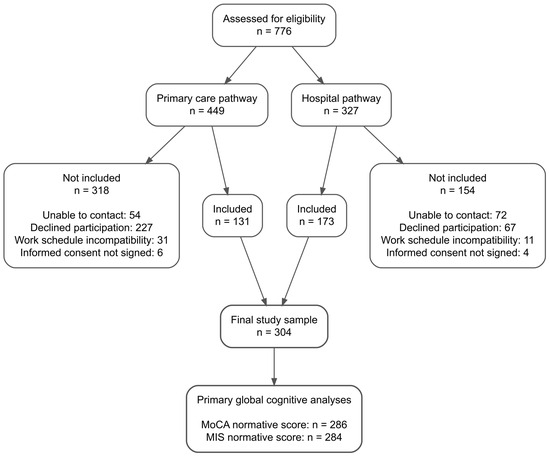
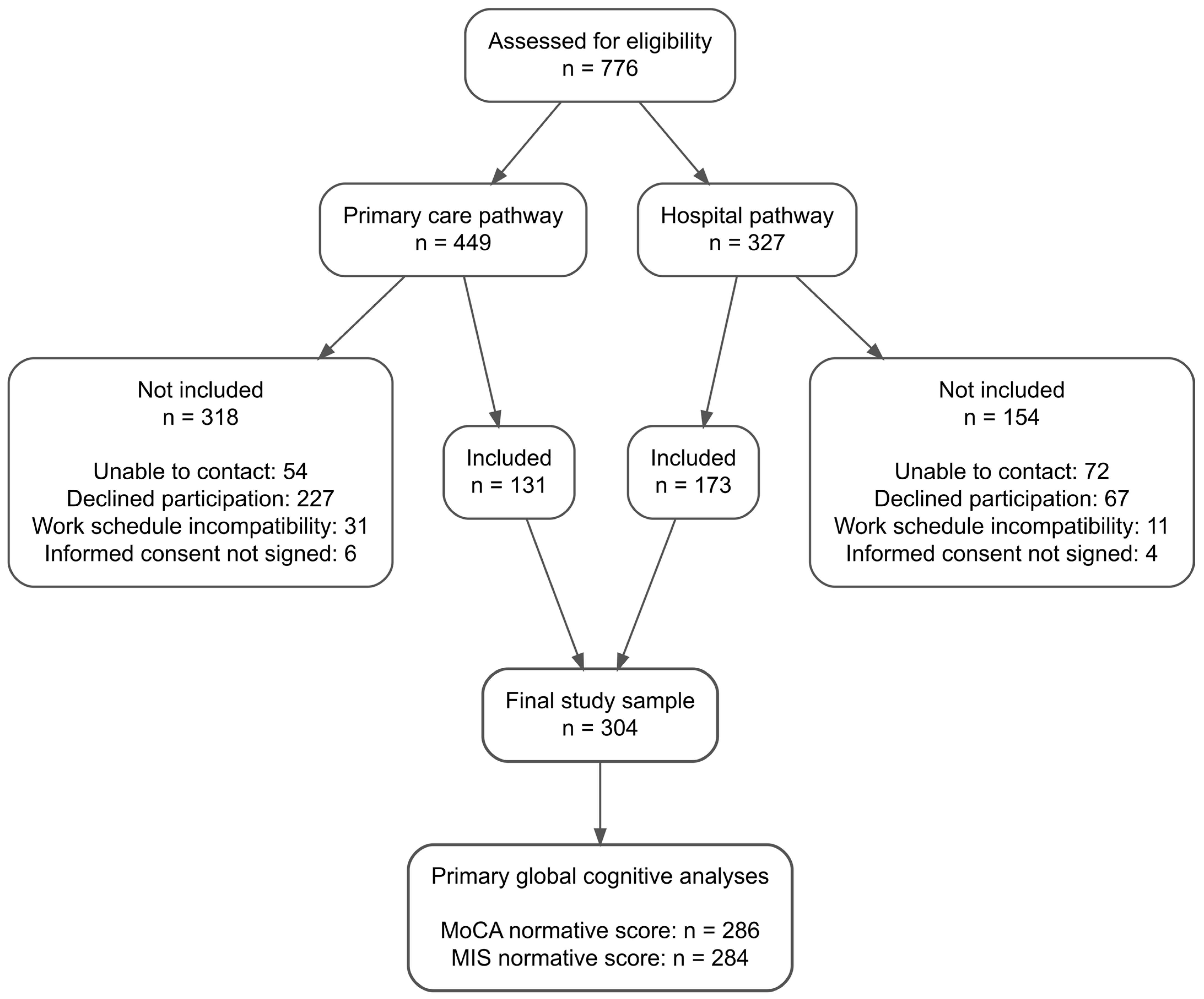
Exclusion criteria were terminal illness, inability to attend the primary care center for assessment, a history of cardiovascular disease, or an estimated glomerular filtration rate below 30 mL/min/1.73 m2. The participant selection process is shown in Figure 1.
Figure 1.
Participant selection process for the BioICOPER study. The flow diagram summarizes the number of participants assessed through each recruitment pathway, the reasons for non-inclusion, the final study sample, and the outcome-specific analytical sample sizes for the primary global cognitive analyses. The analytical sample sizes were n = 286 for the MoCA normative score and n = 284 for the MIS normative score in both Model 1 and Model 2.
A post hoc minimum detectable-effect sensitivity analysis indicated that, with approximately 80% power and α = 0.05, the study could detect an incremental effect of approximately f2 = 0.028–0.029, corresponding to a partial R2 of approximately 0.027–0.028.
The study followed the STROBE recommendations for observational studies [47]. The STROBE checklist is provided as Supplementary Table S1.
2.2. Variables and Measurement Instruments
Study assessments were conducted following previously standardized procedures. Before the start of data collection, the healthcare professionals responsible for data collection received specific training to standardize instrument administration, clinical measurements, and data recording.
Information collected during the baseline assessment was entered into an electronic database specifically designed for the project using REDCap (Research Electronic Data Capture), hosted at the Biomedical Research Institute of Salamanca (IBSAL). The platform was used for study data entry, storage, and management. Data quality review and oversight of record consistency were performed by an independent researcher [46].
2.3. Dietary Intake Assessment
Dietary intake was recorded using the EVIDENT mobile application [48], which was previously compared with a validated food-frequency questionnaire in Spanish adults, and registered under intellectual property number 00/2014/2207. For seven consecutive days, participants in the BioICOPER study recorded all foods and beverages consumed, including portion sizes and preparation methods. The application classifies foods into predefined groups and allows daily nutrient intake to be estimated using the Spanish food composition tables incorporated into the tool. For micronutrients, the published correlations between EVIDENT and the food-frequency questionnaire during the first week of recording ranged from r = 0.092 to r = 0.262; vitamin-specific coefficients are provided in Supplementary Table S2.
Based on the seven-day dietary record, daily intakes of vitamin A, B-complex vitamins, vitamin C, and vitamin D were estimated and expressed in the corresponding units for each micronutrient [48]. Vitamin A was expressed as retinol equivalents (RE), whereas folate adequacy was evaluated using dietary folate equivalents (DFE). Vitamin B3 intake was expressed as niacin equivalents (NE); 1 mg NE corresponds to 1 mg of preformed niacin or the niacin equivalent derived from 60 mg of dietary tryptophan. Adequacy of vitamin intake was assessed by comparing the estimated mean daily intake with dietary reference values for adults, using sex-specific cut-off values when applicable [49,50,51]. Participants were considered to meet the corresponding dietary reference value if they consumed at least 750 µg/day of retinol equivalents in men and 650 µg/day in women for vitamin A; 1.2 and 0.9 mg/day for thiamine; 1.6 and 1.3 mg/day for riboflavin; 16 and 14 mg/day for niacin equivalents; 1.7 and 1.6 mg/day for vitamin B6; and 110 and 95 mg/day for vitamin C, respectively. For vitamins with common recommendations for both sexes, the cut-off values were 330 µg/day of dietary folate equivalents for vitamin B9, 4.0 µg/day for vitamin B12, and 15 µg/day for vitamin D.
2.4. Cognitive Measures, Fatigue, and Affective Symptoms
To capture complementary dimensions of cognitive functioning, the assessment included measures of global objective performance, episodic memory, everyday cognitive complaints, and perceived cognitive fatigue. Cognitive performance was assessed using the official Spanish version 8.1 of the Montreal Cognitive Assessment (MoCA) [52]. The MoCA is a brief cognitive assessment instrument comprising tasks that assess visuospatial/executive functioning, naming, attention, language, abstraction, memory, and orientation, with a total score ranging from 0 to 30 points. The Memory Index Score (MIS) is a specific index of episodic memory derived from the MoCA memory domain, with a score ranging from 0 to 15 points, and can be used as an independently scored subtest of the instrument. In the Spanish population, available evidence has shown adequate psychometric properties of the MoCA [43]. In a Spanish community sample, a 12-item internal structure organized into two correlated factors, MoCA Memory and MoCA Multiple, has also been described [44]. Updated normative data for both the MoCA and MIS are also available for Spanish adults [45].
Everyday cognitive complaints were assessed using the 30-item Memory Failures of Everyday Questionnaire (MFE-30) [53]. Cognitive fatigue was assessed using the cognitive subscale of the Modified Fatigue Impact Scale (MFIS) [54]. Anxiety and depressive symptoms were assessed using the Spanish version of the Goldberg Anxiety and Depression Scale (GADS) [55,56]. Higher scores indicate greater impairment on the MFE-30, MFIS, and GADS. Cognitive assessments were completed before nutrient intakes were derived from the dietary records; therefore, the assessors administering the cognitive instruments were unaware of participants’ subsequently calculated vitamin intake.
2.5. Sociodemographic, Clinical, and Lifestyle Variables
Sociodemographic, clinical, and lifestyle variables were collected using standardized questionnaires, study-specific forms, and review of medical records. Age, sex, educational level, and duration of LC were recorded. Duration of LC was calculated as the interval, in months, between the onset of persistent symptoms and the baseline assessment. Hospitalization during the acute phase of COVID-19 was recorded as an indicator of acute disease severity. Long COVID symptom burden and persistent taste or olfactory dysfunction were also recorded.
Body weight was measured using an InBody 230 body composition analyzer (InBody Co., Ltd., Seoul, Republic of Korea), and height was measured using a Seca 222 stadiometer (seca GmbH & Co. KG, Hamburg, Germany), with participants barefoot. Body mass index (BMI) was calculated as weight (kg)/height (m)2, and obesity was defined as BMI ≥ 30 kg/m2. Systolic and diastolic blood pressure were measured in accordance with the recommendations of the European Society of Hypertension [57], and mean arterial pressure was calculated from these values. Hypertension was defined as blood pressure ≥ 140/90 mmHg, a previous diagnosis, or current antihypertensive treatment.
Fasting blood samples were obtained to determine fasting glucose, total cholesterol, HDL cholesterol, LDL cholesterol, and triglycerides. Diabetes mellitus was defined as fasting glucose ≥ 126 mg/dL, a previous diagnosis, or current antidiabetic treatment. Dyslipidemia was defined as a previous diagnosis, lipid-lowering treatment, or an abnormal lipid profile at assessment.
Current pharmacological treatment was obtained using a standardized data collection form and review of medical records. The use of psychotropic medications, including antidepressants, benzodiazepines, and hypnotics, was recorded in accordance with the previously published BioICOPER protocol [46]. The number of SARS-CoV-2 vaccine doses received before the baseline assessment was also recorded. Dietary supplement use was also recorded.
Alcohol consumption was recorded in grams per week based on self-reported intake during the previous seven days. Tobacco use was assessed using a standardized questionnaire adapted from the WHO MONICA project [58]. Adherence to the Mediterranean diet was assessed using the 14-item Mediterranean Diet Adherence Screener (MEDAS), with higher scores indicating greater adherence to the Mediterranean dietary pattern [59]. Physical activity was assessed using the Global Physical Activity Questionnaire (GPAQ) and expressed as metabolic equivalent minutes per week [60]. In addition, physical activity was objectively recorded over seven days using an Omron HJ-321-E digital pedometer (Omron Healthcare Co., Ltd., Kyoto, Japan), a model previously evaluated for step-count validity [61], which provided total steps, aerobic steps, distance traveled, and estimated energy expenditure.
2.6. Statistical Analysis
The distribution of continuous variables was assessed using the Shapiro–Wilk test, skewness and kurtosis coefficients, and graphical inspection of histograms, box plots, and quantile–quantile plots. Continuous variables were described as mean ± standard deviation or median and interquartile range, according to their distribution, and categorical variables as absolute frequencies and percentages. Descriptive comparisons by sex were performed using Student’s t-test, with Welch’s correction when appropriate, or the Mann–Whitney U test for continuous variables, and the χ2 test or Fisher’s exact test for categorical variables.
Missing data were examined by variable and by model. Multivariable models were estimated using complete cases. Participants included in the primary fully adjusted normative cognitive models were compared with those excluded because of incomplete data. Multiple imputation was additionally performed as a sensitivity analysis.
Nutritional adequacy was described for descriptive purposes only as the proportion of participants meeting the dietary recommendations for each vitamin. Associations between vitamin intake and cognitive indicators were estimated using separate models for each micronutrient, with each vitamin entered as a continuous exposure. Vitamins were not entered simultaneously in the same model because the study aimed to estimate vitamin-specific associations separately and because mutual adjustment for correlated nutrient intakes may yield unstable or difficult-to-interpret coefficients.
MoCA and MIS scores were transformed into normative z scores according to the reference data available for Spanish adults [45]. Associations with continuous scores were estimated using multivariable linear regression with HC3 robust standard errors. This approach was applied to normative MoCA and MIS scores, the MFE-30, and the cognitive subscale of the MFIS. MoCA domain scores were analyzed primarily using proportional-odds ordinal regression because of their discrete and bounded distributions. Vitamin intakes were standardized, and estimates from ordinal models are reported as odds ratios per 1 SD higher intake. The proportional-odds assumption was assessed using the Brant test. Quasibinomial and linear HC3 models were examined as sensitivity analyses. When item-level outcomes were binary, associations were estimated using logistic regression and reported as odds ratios with 95% confidence intervals. Where applicable, adjusted probabilities were estimated at the 25th and 75th percentiles of the exposure by averaging predictions from the fully adjusted logistic model over the observed covariate distribution of the analytical sample. Absolute probability differences and their 95% confidence intervals were calculated using the delta method, treating the selected exposure levels and observed covariate distribution as fixed.
Two prespecified adjustment models were estimated. For normative MoCA and MIS scores, Model 1 included total energy intake, and Model 2 additionally included BMI and Mediterranean diet adherence. For MoCA domains and items, the MFE-30, and the cognitive subscale of the MFIS, Model 1 included age, sex, educational level, and total energy intake, and Model 2 additionally included BMI and Mediterranean diet adherence. Covariate selection was informed by a directed acyclic graph (Supplementary Figure S1) and prior evidence on demographic, nutritional, metabolic, and Long COVID-related determinants of dietary intake and cognition. Because normative MoCA and MIS scores already incorporate age, sex, and education within the published β-GAM normative procedure [45], these variables were not additionally included in these models; their omission was intended to avoid duplicate demographic adjustment and should not be interpreted as evidence that all possible demographic effects were completely residualized. These variables were included directly in models of non-normative cognitive outcomes.
Sensitivity analyses evaluated the stability of the observed associations through additional adjustment for alcohol and tobacco consumption, anxiety and depressive symptoms, psychotropic medication use, and physical activity. Additional models considered acute-phase hospitalization, Long COVID duration, protein intake, and dietary supplement use, and analyses excluding supplement users were also performed. Alternative nutritional specifications were also evaluated, including winsorized exposure, energy-residualized exposure, and exposure expressed as nutrient density per 1000 kcal. Energy-reporting plausibility was evaluated using the Goldberg approach [62]. In addition, models excluding potentially influential observations according to Cook’s distance, leverage, and studentized residuals were estimated. As an additional sensitivity analysis, models were repeated using the MoCA Memory and MoCA Multiple scores derived from the Spanish two-factor MoCA solution [44].
Model assumptions were evaluated by inspection of residuals, fitted values, and quantile–quantile plots. Multicollinearity was examined using correlation matrices and the variance inflation factor. Influential observations were evaluated using leverage, Cook’s distance, and studentized residuals.
Correction for multiple comparisons was performed using the Benjamini–Hochberg procedure to control the false discovery rate within prespecified families of contrasts: normative MoCA/MIS scores, MoCA domains, and self-reported cognition (MFE-30 and the MFIS cognitive subscale). These families comprised 36, 126, and 36 contrasts, respectively. Associations with q values < 0.05 were considered statistically significant after correction for multiplicity. Item-level analyses were conducted, when appropriate, as secondary follow-up analyses of associations observed at the domain level.
All analyses were performed using R version 4.5.0 [63], with a two-sided significance level of α = 0.05. Multiple imputation was implemented using the mice package [64], with estimates pooled according to Rubin’s rules. Model diagnostics were conducted using the car package [65], and robust standard errors were calculated using the lmtest [66] and sandwich [67] packages.
2.7. Ethical Considerations
This study was approved on 27 June 2022, by the Ethics Committee for Research with Medicines of the Salamanca Health Area (CEIm; Ref. PI 2022 06 1048). The study was conducted in accordance with the principles of the Declaration of Helsinki and applicable WHO ethical guidance [68,69]. Participant confidentiality was maintained throughout the study in accordance with Organic Law 3/2018 and Regulation (EU) 2016/679 on the protection of personal data. All participants provided written informed consent before inclusion in the study, after receiving detailed information about the study procedures.
2.8. Use of Artificial Intelligence Tools
During the preparation of this manuscript, ChatGPT (GPT-5.5; OpenAI) was used to assist with English-language editing. Generative AI was not used to generate data, perform statistical analyses, interpret the results, create scientific images, or alter the study findings. All AI-assisted outputs were checked against the original manuscript and study results by the authors. The authors reviewed and approved all AI-assisted edits and take full responsibility for the final content of the manuscript.
3. Results
3.1. Participant Characteristics at Study Inclusion
The sample comprised 304 participants, of whom 207 were women (68.1%). Compared with women, men were older (p = 0.004) and had a less favorable cardiometabolic profile, with higher blood pressure, fasting glucose, triglyceride, and BMI values, lower HDL-c concentrations, and a higher prevalence of hypertension, diabetes mellitus, and obesity (all p ≤ 0.001). Men also reported higher alcohol consumption and a lower frequency of alcohol abstinence (both p < 0.001), as well as a greater number of cigarettes smoked per day among participants with available smoking data (p = 0.001). They also showed more frequent acute-phase hospitalization (p < 0.001), lower anxiety and depressive symptom scores (both p < 0.001), and less frequent use of psychotropic medication (p = 0.008). Sociodemographic, clinical, and lifestyle characteristics are presented in Table 1.
Table 1.
Sociodemographic, clinical, and lifestyle characteristics of the study population overall and by sex.
Median MoCA, MIS, MFE-30, and MFIS cognitive subscale scores were 24.00 (IQR, 21.00–26.00), 11.00 (IQR, 9.00–13.00), 31.50 (IQR, 16.00–53.00), and 19.50 (IQR, 7.00–29.00), respectively. No statistically significant sex differences were observed in MoCA scores (p = 0.059), whereas MIS scores and the MoCA delayed recall domain were lower in men (both p < 0.001), and MFE-30 and MFIS cognitive subscale scores were higher in women (p = 0.002 and p = 0.001, respectively). Normative MoCA and MIS scores showed medians of −0.32 (IQR, −0.82 to 0.19) and −0.32 (IQR, −0.76 to 0.14), respectively, with no differences by sex (p = 0.475 and p = 0.715). Table 2 presents MoCA and MIS scores, their normative scores, MoCA domains, everyday cognitive complaints, and cognitive fatigue. MoCA items and MoCA Memory and MoCA Multiple scores are described in Supplementary Table S3.
Table 2.
Cognitive performance, everyday cognitive complaints, and cognitive fatigue overall and by sex.
3.2. Vitamin Intake and Dietary Adequacy
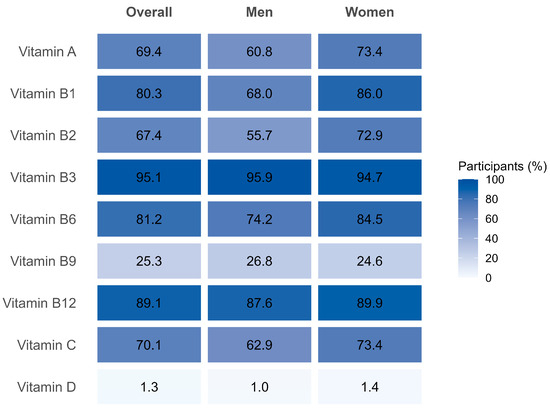
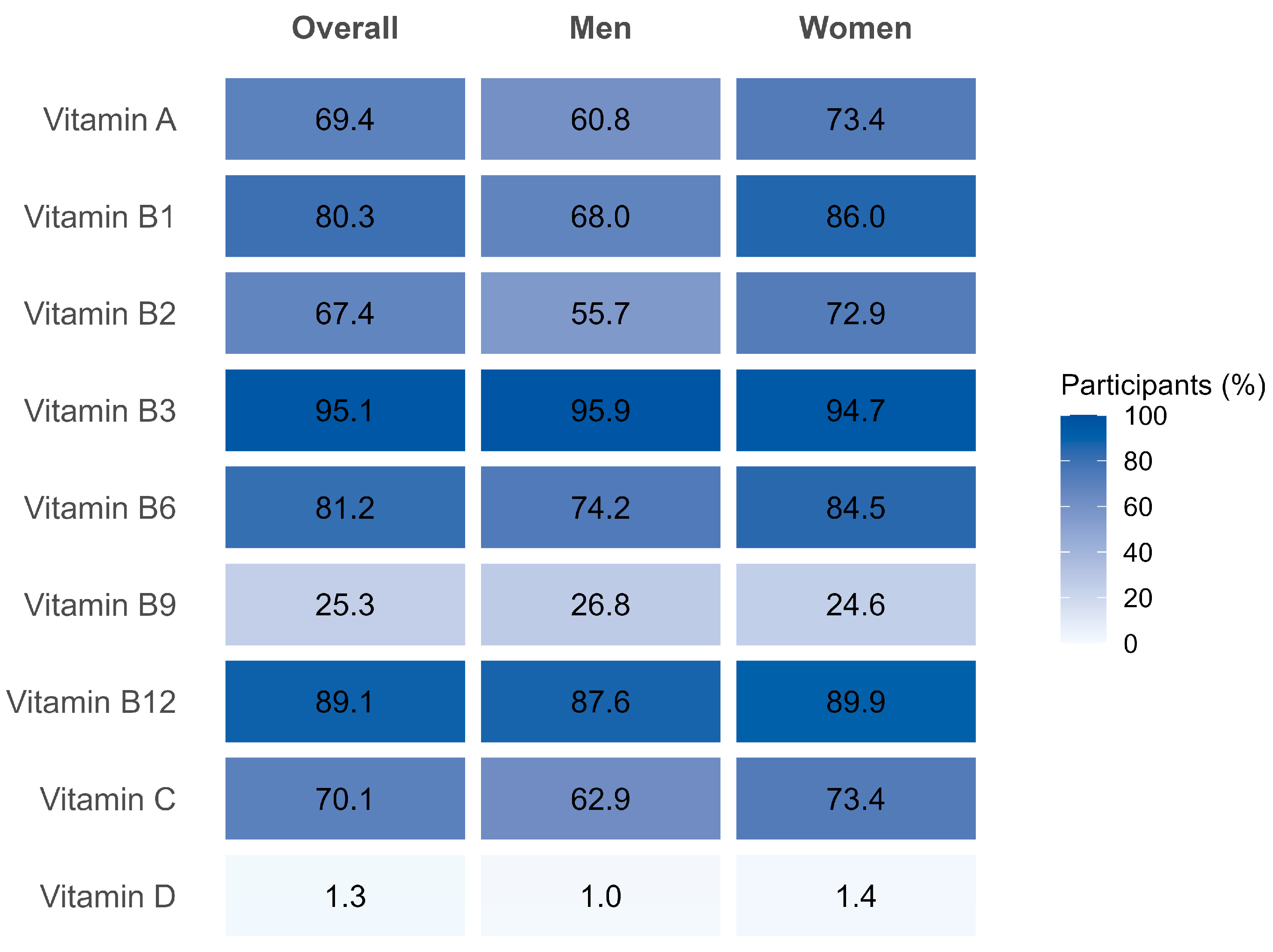
No statistically significant sex differences were observed in the distribution of any of the vitamins analyzed (all p > 0.05). However, the proportion of participants meeting dietary reference values was higher among women for vitamin A (p = 0.014), vitamin B1 (p < 0.001), vitamin B2 (p = 0.001), and vitamin B6 (p = 0.011). Vitamin B3 intake had a median of 33.16 mg NE/day (IQR, 27.46–38.35), and 95.1% of participants met the corresponding dietary reference value. In contrast, vitamin D had the lowest proportion meeting the dietary reference value (1.3%). Vitamin intake values are presented in Table 3, and the proportion of participants meeting dietary reference values is shown in Figure 2.
Table 3.
Dietary vitamin intake overall and by sex.
Figure 2.
Proportion of participants meeting dietary reference values for each vitamin, overall and by sex. Values inside cells indicate the percentage of participants meeting the corresponding dietary reference value for each vitamin. Percentages represent dietary intake from recorded foods and beverages only; vitamin intake from dietary supplements was not included in these estimates. Adequacy variables were used for descriptive purposes only.
3.3. Primary Associations Between Vitamin Intake and Normative Cognitive Performance
The comparison between participants included in and excluded from the primary fully adjusted normative cognitive models is presented in Supplementary Table S4. Within the primary family of 36 contrasts, continuous vitamin intake showed no associations with global normative cognitive performance that remained statistically significant after Benjamini–Hochberg correction. Across the primary models, the maximum R2 values were 0.039 for the MoCA normative z score and 0.053 for the MIS normative z score (Supplementary Table S6).
Before correction for multiple comparisons, inverse associations were observed between normative MIS scores and vitamin B12 in Model 1, β = −0.011, 95% CI −0.020 to −0.002, p = 0.014, and in Model 2, β = −0.011, 95% CI −0.020 to −0.002, p = 0.015. Inverse associations were also observed between normative MIS scores and vitamin C in Model 1, β = −0.002, 95% CI −0.004 to −0.001, p = 0.008, and in Model 2, β = −0.002, 95% CI −0.004 to −0.001, p = 0.010. After FDR correction, none of these associations remained statistically significant. Complete results of the primary models are presented in Table 4, FDR-adjusted q values in Supplementary Table S5, and model diagnostics in Supplementary Table S6.
Table 4.
Multivariable linear regression models of continuous vitamin intake and normative cognitive performance.
3.4. Secondary Analyses of MoCA Domains and Items
In proportional-odds ordinal models, higher vitamin B3 intake was associated with better performance in the MoCA language domain in both adjustment models. Across the prespecified family of 126 domain-level contrasts, the vitamin B3–language association was the only association that remained statistically significant after FDR correction in both models. Several MoCA domains and items showed substantial ceiling effects, as detailed in Supplementary Table S3.
For each 1 SD increase in vitamin B3 intake, the odds of a higher language-domain score were 2.19 (95% CI 1.46–3.28; p < 0.001; q = 0.0116) in Model 1 and 2.18 (95% CI 1.45–3.27; p < 0.001; q = 0.0116) in Model 2. The Brant tests did not detect evidence against the proportional-odds assumption for the vitamin B3–language models. Quasibinomial and HC3 linear sensitivity estimates, together with additional sensitivity analyses, are reported in Supplementary Tables S7 and S8.
To further characterize the vitamin B3–language association, verbal fluency was examined post hoc using logistic regression. In the fully adjusted model, each 1 SD increase in vitamin B3 intake (approximately 9.14 mg/day) was associated with higher odds of meeting the MoCA verbal-fluency criterion (OR = 2.59, 95% CI 1.61–4.17; p < 0.001); the corresponding OR per 5 mg/day increase was 1.69 (95% CI 1.30–2.19). At vitamin B3 intakes of 27.46 and 38.61 mg/day, corresponding to the 25th and 75th percentiles in the analytical sample, the adjusted probabilities of meeting the verbal-fluency criterion were 40.0% and 65.3%, respectively. The absolute difference was 25.2 percentage points (95% CI 14.7–35.8). The item-level analysis was exploratory (Supplementary Table S7 and Figure S2).
3.5. Self-Reported Cognition and Sensitivity Analyses
Vitamin intake was not associated with MFE-30 scores or the MFIS cognitive subscale (Supplementary Table S9). Models using MoCA Memory and MoCA Multiple scores showed no associations with vitamin intake after correction for multiplicity (Supplementary Table S10).
In sensitivity analyses of the vitamin B3–language association, the OR per 1 SD was 2.24 (95% CI 1.53–3.28; p < 0.001) after additional adjustment for acute-phase hospitalization, Long COVID duration, and GADS anxiety and depression scores, and 2.31 (95% CI 1.56–3.41; p < 0.001) after further adjustment for symptom burden and persistent taste/olfactory dysfunction. Additional models adjusting for psychotropic medication use yielded similar estimates.
Vitamin B3 intake was correlated with total energy intake (Spearman ρ = 0.797) and protein intake (ρ = 0.354). Among participants with the data required for Goldberg classification, 38.5% were classified as under-reporters, 60.8% as plausible energy reporters, and 0.7% as over-reporters. Additional adjustment for protein intake, restriction to plausible energy reporters according to the Goldberg approach, adjustment for dietary supplement use, exclusion of supplement users, and multiple-imputation analyses were also performed. Results of these sensitivity analyses are reported in Supplementary Table S8.
4. Discussion
The present study examined the relationship between dietary vitamin intake and cognitive performance in adults with LC. Overall, the results do not support a relationship between vitamin intake and global cognitive performance. In secondary ordinal analyses, vitamin B3 intake was associated with better performance in the MoCA language domain after FDR correction in both adjustment models. The post hoc verbal-fluency analysis showed an association in the same direction but remains exploratory and hypothesis-generating. No associations were observed with everyday cognitive complaints, cognitive fatigue, or MoCA Memory and MoCA Multiple scores.
Evidence on micronutrients and cognition in LC remains limited and heterogeneous [29,30,31], and studies in other clinical and community populations have likewise not shown a uniform cognitive benefit. Trials and meta-analyses of B vitamins indicate that homocysteine reduction does not consistently translate into improvement in global cognition or specific domains [32,33], while evidence for vitamins C and D is also heterogeneous [21,22,34,35]. Interpretation must also consider the exposure range in the present sample: 95.1% of participants met the dietary reference value for vitamin B3, whereas only 1.3% met the dietary vitamin D reference value from recorded foods and beverages. The latter is descriptive and cannot be interpreted as biological vitamin D deficiency because supplement exposure was incompletely captured and sun exposure was not assessed.
The observed association between vitamin B3 and the MoCA language domain is compatible with several biologically plausible pathways. Vitamin B3 acts as a precursor of NAD+ and NADP+, coenzymes involved in energy metabolism, mitochondrial function, redox balance, and cellular repair [16,23]. However, this biological rationale should be interpreted in the context of the exposure observed in the present study. The median vitamin B3 intake was 33.16 mg/day (IQR, 27.46–38.35), and 95.1% of participants met the dietary reference value; therefore, the analyses primarily reflect variation within a range of dietary intake that generally met the reference value rather than a comparison between deficient and sufficient states. Accordingly, evidence derived from NAD-precursor supplementation or low nutritional status is not directly equivalent to the habitual dietary exposure assessed here. Previous observational studies provide more directly comparable evidence: higher dietary niacin intake has been associated with slower cognitive decline and lower Alzheimer disease risk [28], better cognitive performance including the Animal Fluency Test [37], and, more recently, with cognitive performance in NHANES analyses identifying niacin as a prominent B-vitamin contributor [70].
Interpretation of this association nevertheless requires consideration of protein and tryptophan. Vitamin B3 intake was moderately correlated with protein intake in the present sample, and niacin-equivalent intake incorporates the metabolic contribution of tryptophan [71]. Evidence relating dietary protein and specific amino acids to cognition remains heterogeneous: a meta-analysis found no overall association between protein intake and global cognition in older adults [72], while the literature on tryptophan and cognition remains limited and context dependent [71]. The persistence of the B3 estimate after additional adjustment for protein reduces, but does not eliminate, the possibility that correlated dietary exposures contributed to the observed association.
These pathways may be relevant in LC, in which mechanisms related to mitochondrial dysfunction, immunometabolic alterations, and persistent fatigue have been proposed [14,15]. Interest in the NAD pathway in LC has also increased following studies of NAD precursors; in a recent randomized trial, nicotinamide riboside increased NAD+ levels but did not produce differences from placebo in the primary cognitive outcomes [73]. Similarly, randomized studies of nicotinamide or nicotinamide riboside in mild cognitive impairment, subjective cognitive decline, and early Alzheimer disease have altered NAD-related measures or biomarkers without demonstrating consistent benefits on conventional cognitive outcomes [38,39,74]. These intervention studies provide mechanistic context but are not directly comparable with habitual dietary niacin-equivalent intake in a population in which most participants met the dietary reference value. This evidence provides a biological context for interpreting the B3–language association but does not allow the observed finding to be attributed to a specific metabolic mechanism or justify supplementation recommendations.
The association with the verbal fluency task is of neuropsychological interest because such tasks occupy an intermediate position between language and executive functioning. Producing words under a time constraint requires lexical access, rapid retrieval, maintenance of task rules, inhibition of irrelevant responses, strategic switching, and monitoring of repetitions [75,76,77,78]. Interpretation of the domain-specific finding should also consider the restricted distributions of several MoCA components. Marked ceiling effects were observed for some items and domains, including naming and clock-contour performance, which reduced the available variability for detecting associations in those outcomes. The language domain therefore provided comparatively greater usable variability, although this does not establish that the B3 association is specific to language. However, because verbal fluency was examined post hoc using a single MoCA item, this finding should be considered exploratory rather than independent confirmation of the domain-level association.
No evidence of association was observed between vitamin intake and MFE-30 scores or the MFIS cognitive subscale. This distinction is relevant in LC, where subjective cognitive complaints may overlap with fatigue, sleep disturbances, affective symptoms, and functional burden and do not always correspond directly to performance on brief cognitive tests [5,79]. In addition, the MFE-30 assesses memory failures in everyday situations, whereas the MFIS captures the perceived impact of fatigue, including its cognitive dimension; therefore, the two instruments assess dimensions that are related to, but not equivalent to, objective cognitive performance [53,54]. The B3 association was also not reproduced for MoCA Memory or MoCA Multiple scores [44], and the inverse nominal associations of vitamins B12 and C with normative MIS scores did not survive FDR correction and should not be interpreted as evidence of detrimental effects. Given their counterintuitive direction and the cross-sectional design, these nominal associations may reflect chance, residual dietary confounding, or reverse causation.
From a clinical perspective, the predominantly null findings do not support supplementation specifically to improve cognition in LC. Because the B3 association occurred largely within an intake range meeting the dietary reference value, it should not be interpreted as evidence that increasing niacin-equivalent intake above recommended levels would improve cognitive performance. The secondary B3–language association and post hoc verbal-fluency finding require independent confirmation.
Strengths and Limitations
Several limitations directly affect interpretation of the findings. The cross-sectional design precludes causal inference and does not exclude reverse causation. Dietary intake was self-reported, and differential recording error is possible if cognitive symptoms, fatigue, or other LC manifestations affected completion of the seven-day record. Although EVIDENT provides detailed dietary information, its validation was against another self-report instrument and vitamin-specific correlations were modest [48]. Dietary records did not quantify vitamin exposure from supplements; supplement-use information was unavailable for 107 participants, and preformed niacin could not be separated from niacin equivalents. Dietary intake also does not necessarily reflect biological vitamin status because no nutritional biomarkers or NAD-related metabolites were available. For vitamin D specifically, sun exposure was not assessed, further limiting interpretation of the low proportion of participants meeting the dietary reference value from foods and beverages alone.
Some LC-specific characteristics were incompletely captured at the individual level, including recruitment pathway, and residual confounding related to disease characteristics may therefore remain despite sensitivity adjustment for acute hospitalization, LC duration, anxiety and depressive symptoms, symptom burden, persistent taste/olfactory dysfunction, and psychotropic medication use. Psychotropic medication itself may contribute residual confounding. Seasonality of dietary intake was not modeled, and residual confounding from unmeasured dietary, socioeconomic, metabolic, or clinical factors cannot be excluded. Complete-case comparisons also showed that included participants were older than those excluded, although most cognitive and dietary variables were broadly similar. In addition, individual-level data were unavailable for persons who declined participation, precluding formal comparison with enrolled participants, and the exclusion of individuals with established cardiovascular disease or severe renal impairment may limit generalizability to the broader Long COVID population. Finally, MoCA is a screening instrument [52]; its bounded domain scores and single-item verbal-fluency measure cannot substitute for comprehensive neuropsychological assessment. Marked ceiling effects in several MoCA domains and items may also have reduced between-participant variability and the ability to detect domain-specific associations.
Strengths include the seven-day dietary record, normative MoCA and MIS scoring, complementary objective and self-reported cognitive outcomes, prespecified multiplicity correction, outcome-appropriate ordinal modeling of bounded MoCA domains, model diagnostics, and extensive sensitivity analyses addressing protein intake, energy-reporting plausibility, LC-related covariates, psychotropic medication, supplement use, and missing data.
5. Conclusions
In this cross-sectional study of adults with LC, habitual dietary vitamin intake from foods and beverages showed no consistent relationship with global cognitive performance. A secondary association between higher vitamin B3 intake and better MoCA language performance remained statistically significant after FDR correction in both ordinal adjustment models. The post hoc verbal-fluency finding should be considered exploratory and hypothesis-generating. These findings did not extend to global normative cognitive scores, everyday cognitive complaints, cognitive fatigue, or MoCA Memory and MoCA Multiple scores. Overall, the data do not support a general relationship between vitamin intake and cognitive performance in LC. Because most participants met the dietary reference value for vitamin B3, the secondary association was observed predominantly within a dietary-intake range in which most participants met the reference value and should not be interpreted as evidence that intake above recommended levels or supplementation would improve cognition. The secondary vitamin B3 finding requires independent confirmation in longitudinal studies incorporating nutritional biomarkers and comprehensive neuropsychological assessment.
Supplementary Materials
The following supporting information can be downloaded at: https://www.mdpi.com/article/10.3390/nu18203370/s1. Table S1: STROBE checklist; Table S2: Published correlations between vitamin intake estimated using the EVIDENT application during the first week of recording and the food-frequency questionnaire; Table S3: Descriptive statistics for MoCA domain, item-level, and MoCA-derived scores; Table S4: Complete-case comparison for the primary fully adjusted normative cognitive models; Table S5: FDR-adjusted results for the primary normative cognitive models; Table S6: Diagnostic summary of the primary normative cognitive regression models and correlations among dietary vitamin intakes; Table S7: Vitamin B3 associations with the MoCA language domain and verbal fluency; Table S8: Sensitivity analyses of the vitamin B3 associations with the MoCA language domain and verbal fluency; Table S9: Multivariable models of continuous vitamin intake with everyday cognitive complaints and cognitive fatigue; Table S10: Sensitivity analyses using MoCA Memory and MoCA Multiple scores; Figure S1: Directed acyclic graph (DAG) informing covariate selection for analyses of vitamin B3 intake and cognitive performance; Figure S2: Adjusted association between vitamin B3 intake and verbal fluency.
Author Contributions
Conceptualization, D.A., M.A.G.-M., A.N.-C. and N.S.-M.; methodology, D.A., M.A.G.-M. and A.D.-M.; formal analysis, D.A. and M.A.G.-M.; investigation, S.A.-R., A.N.-C., N.S.-M., S.A.-R.,E.N.-M., D.R.G. and the BioICOPER Investigators Group; visualization, D.A.; writing—original draft preparation, D.A., S.A.-R. and N.S.-M.; writing—review and editing, D.A., S.A.-R., A.N.-C., S.A.-R., N.S.-M., E.N.-M., L.G.-S., M.G.-S., A.D.-M. and M.A.G.-M.; supervision, M.A.G.-M.; project administration, M.A.G.-M.; funding acquisition, M.A.G.-M. All authors have read and agreed to the published version of the manuscript.
Funding
This study was funded by the Spanish Ministry of Science and Innovation, Instituto de Salud Carlos III (ISCIII), through RD21/0016/0018 (Network for Research on Chronicity, Primary Care, and Health Promotion [RICAPPS]), funded by the European Union–Next Generation EU, Recovery and Resilience Facility, and PI25/00071, funded by Instituto de Salud Carlos III (ISCIII) and cofunded by the European Union. Additional funding was provided by the Government of Castilla y León through research projects GRS/3231/C/2025, GRS/3279/C/2025, GRS 2976/C/2024, GRS 3007/C/2024, GRS 2714/C/2023 and GRS 2501/B/22, and by the Institute of Biomedical Research of Salamanca (IBSAL) through project IBYAP23_00001. Additional support was provided by CIBER CB22/06/00035 from the area of Respiratory Diseases. The funders had no role in the study design, data analysis, interpretation of the results, manuscript preparation, or the decision to submit the manuscript for publication.
Institutional Review Board Statement
The study was conducted in accordance with the Declaration of Helsinki, and approved by the Drug Research Ethics Committee of the Salamanca Health Area (CEIm: Ref. PI 2022 06 1048; dates of approval: 27 June 2022).
Informed Consent Statement
Informed consent was obtained from all subjects involved in the study.
Data Availability Statement
The data supporting the findings of this study are available on ZENODO at: https://doi.org/10.5281/zenodo.14282873.
Acknowledgments
We would like to thank all members of the BioICOPER study group. We would also like to thank the patient advisers who collaborated with the study investigators.
Conflicts of Interest
The authors declare no conflicts of interest.
Abbreviations
The following abbreviations are used in this manuscript:
| LC | Long COVID |
| APISAL | Primary Care Research Unit of Salamanca |
| WHO | World Health Organization |
| STROBE | Strengthening the Reporting of Observational Studies in Epidemiology |
| REDCap | Research Electronic Data Capture |
| IBSAL | Biomedical Research Institute of Salamanca |
| MoCA | Montreal Cognitive Assessment |
| MIS | Memory Index Score |
| MFE-30 | Memory Failures of Everyday Questionnaire, 30-item version |
| MFIS | Modified Fatigue Impact Scale |
| GADS | Goldberg Anxiety and Depression Scale |
| MEDAS | Mediterranean Diet Adherence Screener |
| GPAQ | Global Physical Activity Questionnaire |
| BMI | Body mass index |
| FPG | Fasting plasma glucose |
| HDL-c | High-density lipoprotein cholesterol |
| LDL-c | Low-density lipoprotein cholesterol |
| RE | Retinol equivalents |
| DFE | Dietary folate equivalents |
| β-GAM | Bayesian beta generalized additive model |
| HC3 | Heteroskedasticity-consistent covariance estimator type 3 |
| OR | Odds ratio |
| SD | Standard deviation |
| DAG | Directed acyclic graph |
| FDR | False discovery rate |
| CI | Confidence interval |
| VIF | Variance inflation factor |
References
- Soriano, J.B.; Murthy, S.; Marshall, J.C.; Relan, P.; Diaz, J.V. WHO Clinical Case Definition Working Group on Post-COVID-19 Condition. A clinical case definition of post-COVID-19 condition by a Delphi consensus. Lancet Infect. Dis. 2022, 22, e102–e107. [Google Scholar] [CrossRef] [Scilit] [PubMed]
- World Health Organization. A Clinical Case Definition of Post COVID-19 Condition by a Delphi Consensus, 6 October 2021; World Health Organization: Geneva, Switzerland, 2021. [Google Scholar]
- Davis, H.E.; McCorkell, L.; Vogel, J.M.; Topol, E.J. Long COVID: Major findings, mechanisms and recommendations. Nat. Rev. Microbiol. 2023, 21, 133–146, Correction in Microbiol. 2023, 21, 408.. [Google Scholar] [CrossRef] [Scilit] [PubMed]
- Greenhalgh, T.; Sivan, M.; Perlowski, A.; Nikolich, J.Ž. Long COVID: A clinical update. Lancet 2024, 404, 707–724. [Google Scholar] [CrossRef] [Scilit] [PubMed]
- Crivelli, L.; Calandri, I.; Corvalán, N.; Carello, M.A.; Keller, G.; Martínez, C.; Arruabarrena, M.; Allegri, R.F. Cognitive consequences of COVID-19: Results of a cohort study from South America. Arq. Neuropsiquiatr. 2023, 81, 240–247. [Google Scholar] [CrossRef] [Scilit] [PubMed]
- Panagea, E.; Messinis, L.; Petri, M.C.; Liampas, I.; Anyfantis, E.; Nasios, G.; Patrikelis, P.; Kosmidis, M. Neurocognitive impairment in Long COVID: A systematic review. Arch. Clin. Neuropsychol. 2025, 40, 125–149. [Google Scholar] [CrossRef] [Scilit] [PubMed]
- Premraj, L.; Kannapadi, N.V.; Briggs, J.; Seal, S.M.; Battaglini, D.; Fanning, J.; Suen, J.; Robba, C.; Fraser, J.; Cho, S.-M. Mid and long-term neurological and neuropsychiatric manifestations of post-COVID-19 syndrome: A meta-analysis. J. Neurol. Sci. 2022, 434, 120162. [Google Scholar] [CrossRef] [Scilit] [PubMed]
- van der Feltz-Cornelis, C.M.; Turk, F.; Sweetman, J.; Khunti, K.; Gabbay, M.; Shepherd, J.; Montgomery, H.; Strain, W.D.; Lip, G.Y.; Wootton, D.; et al. Prevalence of mental health conditions and brain fog in people with long COVID: A systematic review and meta-analysis. Gen. Hosp. Psychiatry 2024, 88, 10–22, Correction in Gen. Hosp. Psychiatry 2015, 92, 112.. [Google Scholar] [CrossRef] [Scilit] [PubMed]
- Elboraay, T.; Ebada, M.A.; Elsayed, M.; Aboeldahab, H.A.; Salamah, H.M.; Rageh, O.; Elmallahy, M.; AboElfarh, H.E.; Mansour, L.S.; Nabil, Y.; et al. Long-term neurological and cognitive impact of COVID-19: A systematic review and meta-analysis in over 4 million patients. BMC Neurol. 2025, 25, 250. [Google Scholar] [CrossRef] [Scilit] [PubMed]
- Faseeh, A.; Rida, M.; Karim, N.E.; Zafar, A.; Shah, A.; Perveen, A. Prevalence and long-term outcomes of brain fog and cognitive impairment in individuals with long COVID: A systematic review. Medicine 2026, 105, e49022. [Google Scholar] [CrossRef] [Scilit] [PubMed]
- Greene, C.; Connolly, R.; Brennan, D.; Laffan, A.; O’keeffe, E.; Zaporojan, L.; O’callaghan, J.; Thomson, B.; Connolly, E.; Argue, R.; et al. Blood–brain barrier disruption and sustained systemic inflammation in individuals with long COVID-associated cognitive impairment. Nat. Neurosci. 2024, 27, 421–432, Correction in Nat. Neurosci. 2024, 27, 1019. [Google Scholar] [CrossRef] [Scilit] [PubMed]
- Popa, E.; Popa, A.E.; Poroch, M.; Poroch, V.; Ungureanu, M.I.; Slanina, A.M.; Bacusca, A.; Coman, E.A. The molecular mechanisms of cognitive dysfunction in Long COVID: A narrative review. Int. J. Mol. Sci. 2025, 26, 5102. [Google Scholar] [CrossRef] [Scilit] [PubMed]
- Arjol, D.; Gómez-Sánchez, L.; Arroyo-Romero, S.; Suárez-Moreno, N.; Navarro-Cáceres, A.; Domínguez-Martín, A.; Ortega, A.; Lugones-Sánchez, C.; González-Sánchez, S.; Gómez-Marcos, M.A.; et al. Clinical-cognitive profiles in long COVID and their associations with inflammatory-endothelial biomarkers and vascular measures. Sci. Rep. 2026. advance online publication. [Google Scholar] [CrossRef] [Scilit]
- Molnar, T.; Lehoczki, A.; Fekete, M.; Varnai, R.; Zavori, L.; Erdo-Bonyar, S.; Simon, D.; Berki, T.; Csecsei, P.; Ezer, E.; et al. Mitochondrial dysfunction in long COVID: Mechanisms, consequences, and potential therapeutic approaches. GeroScience 2024, 46, 5267–5286. [Google Scholar] [CrossRef] [Scilit] [PubMed]
- Maison, D.P.; Khadka, V.S.; Mohd-Ibrahim, I.; Peluso, M.J.; Henrich, T.J.; Deng, Y.; Gerschenson, M. Peripheral immune progression to long COVID is associated with mitochondrial gene transcription: A meta-analysis. Mitochondrion 2025, 85, 102072. [Google Scholar] [CrossRef] [Scilit] [PubMed]
- Kennedy, D.O. B vitamins and the brain: Mechanisms, dose and efficacy—A review. Nutrients 2016, 8, 68. [Google Scholar] [CrossRef] [Scilit] [PubMed]
- Huskisson, E.; Maggini, S.; Ruf, M. The role of vitamins and minerals in energy metabolism and well-being. J. Int. Med. Res. 2007, 35, 277–289. [Google Scholar] [CrossRef] [Scilit] [PubMed]
- Lyon, P.; Strippoli, V.; Fang, B.; Cimmino, L. B vitamins and one-carbon metabolism: Implications in human health and disease. Nutrients 2020, 12, 2867. [Google Scholar] [CrossRef] [Scilit] [PubMed]
- Smith, A.D.; Refsum, H. Homocysteine, B vitamins, and cognitive impairment. Annu. Rev. Nutr. 2016, 36, 211–239. [Google Scholar] [CrossRef] [Scilit] [PubMed]
- Moramarco, F.; McCaffery, P. Retinoic acid regulation of homoeostatic synaptic plasticity and its relationship to cognitive disorders. J. Mol. Endocrinol. 2024, 72, e220177. [Google Scholar] [CrossRef] [Scilit] [PubMed]
- Travica, N.; Ried, K.; Sali, A.; Scholey, A.; Hudson, I.; Pipingas, A. Vitamin C status and cognitive function: A systematic review. Nutrients 2017, 9, 960. [Google Scholar] [CrossRef] [Scilit] [PubMed]
- Chen, W.-Y.; Cheng, Y.-C.; Chiu, C.-C.; Liu, H.-C.; Huang, M.-C.; Tu, Y.-K.; Kuo, P.-H. Effects of vitamin D supplementation on cognitive outcomes: A systematic review and meta-analysis. Neuropsychol. Rev. 2024, 34, 568–580. [Google Scholar] [CrossRef] [Scilit] [PubMed]
- Covarrubias, A.J.; Perrone, R.; Grozio, A.; Verdin, E. NAD+ metabolism and its roles in cellular processes during ageing. Nat. Rev. Mol. Cell Biol. 2021, 22, 119–141. [Google Scholar] [CrossRef] [Scilit] [PubMed]
- Carr, A.C.; Maggini, S. Vitamin C and immune function. Nutrients 2017, 9, 1211. [Google Scholar] [CrossRef] [Scilit] [PubMed]
- Prietl, B.; Treiber, G.; Pieber, T.R.; Amrein, K. Vitamin D and immune function. Nutrients 2013, 5, 2502–2521. [Google Scholar] [CrossRef] [Scilit] [PubMed]
- Green, K.N.; Steffan, J.S.; Martinez-Coria, H.; Sun, X.; Schreiber, S.S.; Thompson, L.M.; LaFerla, F.M. Nicotinamide restores cognition in Alzheimer’s disease transgenic mice via a mechanism involving sirtuin inhibition and selective reduction of Thr231-phosphotau. J. Neurosci. 2008, 28, 11500–11510. [Google Scholar] [CrossRef] [Scilit] [PubMed]
- Xie, X.; Gao, Y.; Zeng, M.; Wang, Y.; Wei, T.F.; Lu, Y.B.; Zhang, W.P. Nicotinamide ribose ameliorates cognitive impairment of aged and Alzheimer’s disease model mice. Metab. Brain Dis. 2019, 34, 353–366. [Google Scholar] [CrossRef] [Scilit] [PubMed]
- Morris, M.C.; Evans, D.A.; Bienias, J.L.; Scherr, P.A.; Tangney, C.C.; Hebert, L.E.; Bennett, D.A.; Wilson, R.S.; Aggarwal, N. Dietary niacin and the risk of incident Alzheimer’s disease and of cognitive decline. J. Neurol. Neurosurg. Psychiatry 2004, 75, 1093–1099. [Google Scholar] [CrossRef] [Scilit] [PubMed]
- Sinopoli, A.; Isonne, C.; Santoro, M.M.; Baccolini, V. The efficacy of multivitamin, vitamin A, vitamin B, vitamin C, and vitamin D supplements in the prevention and management of COVID-19 and Long-COVID: An updated systematic review and meta-analysis of randomized clinical trials. Nutrients 2024, 16, 1345. [Google Scholar] [CrossRef] [Scilit] [PubMed]
- Bigman, G.; Rusu, M.E.; Shelawala, N.; Sorkin, J.D.; Beamer, B.A.; Ryan, A.S. A comprehensive scoping review on diet and nutrition in relation to Long COVID-19 symptoms and recovery. Nutrients 2025, 17, 1802. [Google Scholar] [CrossRef] [Scilit] [PubMed]
- Arjol, D.; Arroyo-Romero, S.; Navarro-Matías, E.; Navarro-Cáceres, A.; Suárez-Moreno, N.; Domínguez-Martín, A.; Gómez-Marcos, M.A.; Gómez-Sánchez, M.; Gómez-Sánchez, L.; BioICOPER Investigators Group. Dietary vitamin intake and central and peripheral arterial stiffness in patients with Long COVID: The BioICOPER Study. Nutrients 2026, 18, 2336. [Google Scholar] [CrossRef] [Scilit] [PubMed]
- Suh, S.W.; Kim, H.S.; Han, J.H.; Bae, J.B.; Oh, D.J.; Han, J.W.; Kim, K.W. Efficacy of vitamins on cognitive function of non-demented people: A systematic review and meta-analysis. Nutrients 2020, 12, 1168. [Google Scholar] [CrossRef] [Scilit] [PubMed]
- Berg, J.; Grant, R.; Siervo, M.; Stephan, B.C.M.; Tully, P.J. Efficacy of B vitamin supplementation on global cognitive function in older adults: A systematic review and meta-analysis. Nutr. Rev. 2025, 83, 2256–2267. [Google Scholar] [CrossRef] [Scilit] [PubMed]
- McCleery, J.; Abraham, R.P.; Denton, D.A.; Rutjes, A.W.S.; Chong, L.Y.; Al-Assaf, A.S.; Griffith, D.J.; Rafeeq, S.; Yaman, H.; Malik, M.A.; et al. Vitamin and mineral supplementation for preventing dementia or delaying cognitive decline in people with mild cognitive impairment. Cochrane Database Syst. Rev. 2018, 11, CD011905. [Google Scholar] [CrossRef] [Scilit] [PubMed]
- Rutjes, A.W.S.; Denton, D.A.; Di Nisio, M.; Chong, L.Y.; Abraham, R.P.; Al-Assaf, A.S.; Anderson, J.L.; Malik, M.A.; Vernooij, R.W.M.; Martínez, G.; et al. Vitamin and mineral supplementation for maintaining cognitive function in cognitively healthy people in mid and late life. Cochrane Database Syst. Rev. 2018, 12, CD011906. [Google Scholar] [CrossRef] [Scilit] [PubMed]
- Tao, L.; Liu, K.; Chen, S.; Yu, H.; An, Y.; Wang, Y.; Yu, Y.; Wang, Y.; Zhang, X.; Xu, X.; et al. Dietary intake of riboflavin and unsaturated fatty acid can improve the multi-domain cognitive function in middle-aged and elderly populations: A 2-year prospective cohort study. Front. Aging Neurosci. 2019, 11, 226. [Google Scholar] [CrossRef] [Scilit] [PubMed]
- Shen, X.; Yang, L.; Liu, Y.Y.; Jiang, L.; Huang, J.F. Association between dietary niacin intake and cognitive function in the elderly: Evidence from NHANES 2011–2014. Food Sci. Nutr. 2023, 11, 4651–4664. [Google Scholar] [CrossRef] [Scilit] [PubMed]
- Orr, M.E.; Kotkowski, E.; Ramirez, P.; Bair-Kelps, D.; Liu, Q.; Brenner, C.; Schmidt, M.S.; Fox, P.T.; Larbi, A.; Tan, C.; et al. A randomized placebo-controlled trial of nicotinamide riboside in older adults with mild cognitive impairment. GeroScience 2024, 46, 665–682. [Google Scholar] [CrossRef] [Scilit] [PubMed]
- Wu, C.-Y.; Kupferschmid, A.C.; Chen, L.; McManus, A.J.; Kivisäkk, P.; Galler, J.A.; Schwab, N.A.; DesRuisseaux, L.A.; Williams, V.J.; Gerber, J.; et al. Cognitive and Alzheimer’s disease biomarker effects of oral nicotinamide riboside supplementation in older adults with subjective cognitive decline and mild cognitive impairment. Alzheimers Dement. 2025, 11, e70023. [Google Scholar] [CrossRef] [Scilit] [PubMed]
- Ceban, F.; Ling, S.; Lui, L.M.W.; Lee, Y.; Gill, H.; Teopiz, K.M.; Rodrigues, N.B.; Subramaniapillai, M.; Di Vincenzo, J.D.; Cao, B.; et al. Fatigue and cognitive impairment in Post-COVID-19 Syndrome: A systematic review and meta-analysis. Brain Behav. Immun. 2022, 101, 93–135. [Google Scholar] [CrossRef] [Scilit] [PubMed]
- Crivelli, L.; Palmer, K.; Calandri, I.; Guekht, A.; Beghi, E.; Carroll, W.; Frontera, J.; García-Azorín, D.; Westenberg, E.; Winkler, A.S.; et al. Changes in cognitive functioning after COVID-19: A systematic review and meta-analysis. Alzheimers Dement. 2022, 18, 1047–1066. [Google Scholar] [CrossRef] [Scilit] [PubMed]
- Masserini, F.; Pomati, S.; Cucumo, V.; Nicotra, A.; Maestri, G.; Cerioli, M.; Giacovelli, L.; Scarpa, C.; Larini, L.; Cirnigliaro, G.; et al. Assessment of cognitive and psychiatric disturbances in people with post-COVID-19 condition: A cross-sectional observational study. CNS Spectr. 2024, 29, 640–651. [Google Scholar] [CrossRef] [Scilit] [PubMed]
- Arjol, D.; Unzueta-Arce, J.; Mora-Simón, S.; Ferasati, M.; Rodríguez-Sánchez, E.; Gómez-Marcos, M.A.; García-Ortiz, L.; Maderuelo-Fernández, J.A.; Lugones-Sánchez, C. Use and psychometric properties of the MoCA in Spain: A systematic review with meta-analysis and meta-regression. Neuropsychol. Rev. 2026. advance online publication. [Google Scholar] [CrossRef] [Scilit] [PubMed]
- Arjol, D.; Mora-Simón, S.; Rodríguez-Sánchez, E.; Gómez-Marcos, M.A.; García-Ortiz, L.; Maderuelo-Fernández, J.A.; Lugones-Sánchez, C.; Unzueta-Arce, J. Psychometric properties of the Montreal Cognitive Assessment (MoCA) in Spanish adults. Psicothema 2026, 38, 161–172. [Google Scholar] [CrossRef] [Scilit] [PubMed]
- Arjol, D.; Patino-Alonso, C.; Ferasati, M.; Rodríguez-Sánchez, E.; Maderuelo-Fernández, J.A.; Gómez-Marcos, M.A.; García-Ortiz, L.; Lugones-Sánchez, C. Normative data for the Montreal Cognitive Assessment 8.1 in community-dwelling Spanish population. BMC Psychol. 2026. advance online publication. [Google Scholar] [CrossRef] [Scilit]
- Gómez-Sánchez, L.; Tamayo-Morales, O.; Suárez-Moreno, N.; Bermejo-Martín, J.F.; Domínguez-Martín, A.; Martín-Oterino, J.A.; Martín-González, J.I.; González-Calle, D.; García-García, Á.; Lugones-Sánchez, C.; et al. Relationship between the structure, function and endothelial damage, and vascular ageing and the biopsychological situation in adults diagnosed with persistent COVID (BioICOPER study): A research protocol of a cross-sectional study. Front. Physiol. 2023, 14, 1236430. [Google Scholar] [CrossRef] [Scilit] [PubMed]
- von Elm, E.; Altman, D.G.; Egger, M.; Pocock, S.J.; Gøtzsche, P.C.; Vandenbroucke, J.P.; STROBE Initiative. The Strengthening the Reporting of Observational Studies in Epidemiology (STROBE) statement: Guidelines for reporting observational studies. PLoS Med. 2007, 4, e296. [Google Scholar] [CrossRef] [Scilit] [PubMed]
- Recio-Rodríguez, J.I.; Rodríguez-Martín, C.; González-Sánchez, J.; Rodríguez-Sánchez, E.; Martín-Borràs, C.; Martínez-Vizcaíno, V.; Arietaleanizbeaskoa, M.S.; Magdalena-González, O.; Fernández-Alonso, C.; Maderuelo-Fernández, J.A.; et al. EVIDENT Smartphone App, a new method for the dietary record: Comparison with a food frequency questionnaire. JMIR Mhealth Uhealth 2019, 7, e11463. [Google Scholar] [CrossRef] [Scilit] [PubMed]
- Martínez, J.A.; Cámara, M.; Giner, R.M.; González, E.; López, E.; Mañes, J.; Portillo, M.P.; Rafecas, M.; Estruch, R.; Ros, G.; et al. Ingestas nutricionales de referencia (INR) de minerales y vitaminas para la población española (2019). Rev. Esp. Salud Pública 2022, 96, e202203034. [Google Scholar]
- EFSA NDA Panel. Dietary reference values for nutrients: Summary report. EFSA Support. Publ. 2017, 14, e15121. [Google Scholar] [CrossRef] [Scilit]
- Ortega, R.M.; Requejo, A.M.; Navia, B.; López-Sobaler, A.M.; Aparicio, A. Ingestas Diarias Recomendadas de Energía y Nutrientes para la Población Española; Departamento de Nutrición, Universidad Complutense de Madrid: Madrid, Spain, 2019. [Google Scholar]
- Nasreddine, Z.S.; Phillips, N.A.; Bédirian, V.; Charbonneau, S.; Whitehead, V.; Collin, I.; Cummings, J.L.; Chertkow, H. The Montreal Cognitive Assessment, MoCA: A brief screening tool for mild cognitive impairment. J. Am. Geriatr. Soc. 2005, 53, 695–699, Correction in J. Am. Geriatr. Soc. 2005, 67, 1991. [Google Scholar] [CrossRef] [Scilit] [PubMed]
- Montejo Carrasco, P.; Montenegro Peña, M.; Sueiro, M.J. The Memory Failures of Everyday (MFE) Test: Normative Data in Adults. Span. J. Psychol. 2012, 15, 1424–1431. [Google Scholar] [CrossRef] [Scilit] [PubMed]
- Kos, D.; Kerckhofs, E.; Carrea, I.; Verza, R.; Ramos, M.; Jansa, J. Evaluation of the Modified Fatigue Impact Scale in four different European countries. Mult. Scler. 2005, 11, 76–80. [Google Scholar] [CrossRef] [Scilit] [PubMed]
- Goldberg, D.; Bridges, K.; Duncan-Jones, P.; Grayson, D. Detecting anxiety and depression in general medical settings. BMJ 1988, 297, 897–899. [Google Scholar] [CrossRef] [Scilit] [PubMed]
- Montón, C.; Pérez-Echeverría, M.J.; Campos, R.; García-Campayo, J.; Lobo, A. Escalas de ansiedad y depresión de Goldberg: Una guía de entrevista eficaz para la detección del malestar psíquico. Aten. Primaria 1993, 12, 345–349. [Google Scholar] [PubMed]
- Williams, B.; Mancia, G.; Spiering, W.; Agabiti Rosei, E.; Azizi, M.; Burnier, M.; Clement, D.L.; Coca, A.; de Simone, G.; Dominiczak, A.; et al. 2018 ESC/ESH Guidelines for the management of arterial hypertension. Eur. Heart J. 2018, 39, 3021–3104, Correction in Eur. Heart J. 2019, 40, 475. [Google Scholar] [CrossRef] [Scilit] [PubMed]
- WHO MONICA Project Principal Investigators. The World Health Organization MONICA Project (Monitoring trends and determinants in cardiovascular disease): A major international collaboration. J. Clin. Epidemiol. 1988, 41, 105–114. [Google Scholar] [CrossRef] [Scilit] [PubMed]
- Schröder, H.; Fitó, M.; Estruch, R.; Martínez-González, M.A.; Corella, D.; Salas-Salvadó, J.; Lamuela-Raventós, R.; Ros, E.; Salaverría, I.; Fiol, M.; et al. A short screener is valid for assessing Mediterranean diet adherence among older Spanish men and women. J. Nutr. 2011, 141, 1140–1145. [Google Scholar] [CrossRef] [Scilit] [PubMed]
- World Health Organization. Global Physical Activity Questionnaire (GPAQ): Analysis Guide; World Health Organization: Geneva, Switzerland, 2012. [Google Scholar]
- Karaca, A.; Demirci, N.; Hazır Aytar, S.; Can, S.; Yılmaz, V.; Ünver, E. Validity of three hip-worn pedometers for step counts in a laboratory setting. Health Probl. Civiliz. 2023, 17, 76–83. [Google Scholar] [CrossRef] [Scilit]
- Goldberg, G.R.; Black, A.E.; Jebb, S.A.; Cole, T.J.; Murgatroyd, P.R.; Coward, W.A.; Prentice, A.M. Critical evaluation of energy intake data using fundamental principles of energy physiology: 1. Derivation of cut-off limits to identify under-recording. Eur. J. Clin. Nutr. 1991, 45, 569–581. [Google Scholar] [PubMed]
- R Core Team. R: A Language and Environment for Statistical Computing; R Foundation for Statistical Computing: Vienna, Austria, 2025; Available online: https://www.R-project.org/ (accessed on 12 September 2026).
- van Buuren, S.; Groothuis-Oudshoorn, K. Mice: Multivariate imputation by chained equations in R. J. Stat. Softw. 2011, 45, 1–67. [Google Scholar] [CrossRef] [Scilit]
- Fox, J.; Weisberg, S. An R Companion to Applied Regression, 3rd ed.; Sage: Thousand Oaks, CA, USA, 2019. [Google Scholar]
- Zeileis, A.; Hothorn, T. Diagnostic checking in regression relationships. R News 2002, 2, 7–10. [Google Scholar]
- Zeileis, A.; Köll, S.; Graham, N. Various versatile variances: An object-oriented implementation of clustered covariances in R. J. Stat. Softw. 2020, 95, 1–36. [Google Scholar] [CrossRef] [Scilit]
- World Medical Association. World Medical Association Declaration of Helsinki: Ethical principles for medical research involving human subjects. JAMA 2013, 310, 2191–2194. [Google Scholar] [CrossRef] [Scilit] [PubMed]
- Council for International Organizations of Medical Sciences. International Ethical Guidelines for Health-Related Research Involving Humans, 4th ed.; Council for International Organizations of Medical Sciences: Geneva, Switzerland, 2016. [Google Scholar]
- Chen, Q.; Huang, J.; Shi, X.; Peng, Y.; Chen, A.; Huang, L.; Zhang, Y.; Chen, X. Associations between dietary B vitamin intakes and cognitive function among elderly individuals: An observational study. Nutrition 2025, 134, 112716. [Google Scholar] [CrossRef] [Scilit] [PubMed]
- van de Rest, O.; van der Zwaluw, N.L.; de Groot, L.C.P.G.M. Literature review on the role of dietary protein and amino acids in cognitive functioning and cognitive decline. Amino Acids 2013, 45, 1035–1045. [Google Scholar] [CrossRef] [Scilit] [PubMed]
- Coelho-Júnior, H.J.; Calvani, R.; Landi, F.; Picca, A.; Marzetti, E. Protein intake and cognitive function in older adults: A systematic review and meta-analysis. Nutr. Metab. Insights 2021, 14, 11786388211022373. [Google Scholar] [CrossRef] [Scilit] [PubMed]
- Wu, C.-Y.; Reynolds, W.C.; Abril, I.; McManus, A.J.; Brenner, C.; González-Irizarry, G.; Gutiérrez-Martínez, L.; Sun, O.; Rosand, J.; Tanzi, R.E.; et al. Effects of nicotinamide riboside on NAD+ levels, cognition, and symptom recovery in long-COVID: A randomized controlled trial. EClinicalMedicine 2025, 89, 103633. [Google Scholar] [CrossRef] [Scilit] [PubMed]
- Grill, J.D.; Tam, S.; Thai, G.; Vides, B.; Pierce, A.L.; Green, K.; Gillen, D.L.; Teng, E.; Kremen, S.; Beigi, M.; et al. Phase 2A Proof-of-Concept Double-Blind, Randomized, Placebo-Controlled Trial of Nicotinamide in Early Alzheimer Disease. Neurology 2025, 104, e210152. [Google Scholar] [CrossRef] [Scilit] [PubMed]
- Shao, Z.; Janse, E.; Visser, K.; Meyer, A.S. What do verbal fluency tasks measure? Predictors of verbal fluency performance in older adults. Front. Psychol. 2014, 5, 772. [Google Scholar] [CrossRef] [Scilit] [PubMed]
- Amunts, J.; Camilleri, J.A.; Eickhoff, S.B.; Heim, S.; Weis, S. Executive functions predict verbal fluency scores in healthy participants. Sci. Rep. 2020, 10, 11141. [Google Scholar] [CrossRef] [Scilit] [PubMed]
- Amunts, J.; Camilleri, J.A.; Eickhoff, S.B.; Patil, K.R.; Heim, S.; von Polier, G.G.; Weis, S. Comprehensive verbal fluency features predict executive function performance. Sci. Rep. 2021, 11, 6929. [Google Scholar] [CrossRef] [Scilit] [PubMed]
- Lehtinen, S.; Ngandu, T.; Solomon, A.; Levälahti, E.; Ahtiluoto, S.; Antikainen, R.; Laatikainen, T.; Lindström, J.; Paajanen, T.; Peltonen, M.; et al. Systematic administration and analysis of verbal fluency tasks: Preliminary evidence for reliable exploration of processes underlying task performance. Appl. Neuropsychol. Adult 2023, 30, 748–758. [Google Scholar] [CrossRef] [Scilit] [PubMed]
- Delgado-Alonso, C.; Díez-Cirarda, M.; Pagán, J.; Pérez-Izquierdo, C.; Oliver-Mas, S.; Fernández-Romero, L.; Martínez-Petit, Á.; Valles-Salgado, M.; Gil-Moreno, M.J.; Yus, M.; et al. Unraveling brain fog in post-COVID syndrome: Relationship between subjective cognitive complaints and cognitive function, fatigue, and neuropsychiatric symptoms. Eur. J. Neurol. 2025, 32, e16084. [Google Scholar] [CrossRef] [Scilit] [PubMed]

Disclaimer/Publisher’s Note: The statements, opinions and data contained in all publications are solely those of the individual author(s) and contributor(s) and not of MDPI and/or the editor(s). MDPI and/or the editor(s) disclaim responsibility for any injury to people or property resulting from any ideas, methods, instructions or products referred to in the content. |
© 2026 by the authors. Licensee MDPI, Basel, Switzerland. This article is an open access article distributed under the terms and conditions of the Creative Commons Attribution (CC BY) license.