


Abstract
(1) Background: A healthy lifestyle has a protective role against the onset and management of asthma and chronic obstructive pulmonary disease (COPD). Therefore, combined lifestyle interventions (CLIs) are a potentially valuable prevention approach. This review aims to provide an overview of existing CLIs for the prevention and management of asthma or COPD. (2) Methods: A systematic literature search was conducted using PubMed, EMBASE, and PsycInfo. Studies were included if CLIs targeted at least two lifestyle factors. (3) Results: Among the 56 included studies, 9 addressed asthma and 47 addressed COPD management, with no studies focusing on prevention. For both conditions, the most prevalent combination of lifestyle targets was diet and physical activity (PA), often combined with smoking cessation in COPD. The studied CLIs led to improvements in quality of life, respiratory symptoms, body mass index/weight, and exercise capacity. Behavioural changes were only measured in a limited number of studies and mainly showed improvements in dietary intake and PA level. (4) Conclusions: CLIs are effective within asthma and COPD management. Next to optimising the content and implementation of CLIs, these positive results warrant paying more attention to CLIs for persons with an increased risk profile for these chronic respiratory diseases.
1. Introduction
Chronic respiratory diseases (CRDs) are among the most common non-communicable diseases worldwide [1]. Two of the most prevalent CRDs are asthma and chronic obstructive pulmonary disease (COPD). The increasing prevalence of asthma and COPD is an alarming public health concern in low- and middle-income countries as well as in high-income countries [2,3]. In 2019, globally there were 262 million and 212 million cases of asthma and COPD, respectively, with COPD being the third leading cause of death [4]. While both asthma and COPD are treatable, they are not curable. Therefore, early diagnosis as well as prevention of onset and progression of disease are key.
Asthma and COPD are characterised by chronic airway inflammation leading to narrowing of the airways and respiratory symptoms including cough, wheezing, and dyspnea [5,6]. Respiratory impairment in COPD often co-exists with extra-pulmonary manifestations, adversely affecting disease progression and quality of life (QoL), including muscle wasting, bone loss, cardiovascular disease, anxiety, depression, and decreased cognitive function [7,8,9]. In asthma, common extra-pulmonary manifestations associated with a decreased QoL include overweight and psychopathologies [10]. Many of these manifestations are linked to lifestyle-related risk factors [11,12].
Smoking is a primary risk factor for COPD, but it is also an important risk factor for the development of asthma [13]. Additionally, a recent systematic review has emphasised the beneficial effects of physical activity (PA) on asthma control, lung function, and QoL [14]. Moreover, PA may reduce adult-onset asthma risk [15]. PA has also been shown to slow the progression of COPD and reduce COPD risk in active smokers [16]. Diet and nutrition have been shown to play a role in both the prevention as well as the progression of COPD [17]. An unhealthy Western eating pattern (high intakes of saturated fat, red and processed meat, and refined grains and low intakes of fruits, vegetables, whole grains, and fish) has been linked to COPD risk and a decline in lung function, while a diet rich in dietary fibre and certain nutrients, including vitamins C and E, polyphenols, and β-carotene, has been associated with a decreased risk of COPD [17]. A plant-based diet, rich in fruits and vegetables, may also provide protection against the development of asthma and a reduction in asthma symptoms [18]. Additionally, excessive alcohol use has been associated with pulmonary function decline and increased risk of asthma [17,19]. Furthermore, psychological stress and poor sleep quality have been associated with worse outcomes in asthma and COPD [20,21,22,23], making them important targets for intervention.
As a combination of various lifestyle factors may influence asthma and COPD onset and progression, a comprehensive approach (simultaneously) targeting behavioural changes in multiple lifestyle factors could be beneficial for high-risk groups and patients with asthma or COPD. This approach is also defined as a ‘combined lifestyle intervention’ (CLI). CLIs can be implemented by a combination of different healthcare professionals, including dieticians, physiotherapists, and psychologists, or by lifestyle coaches who are trained to coach individuals on changing various lifestyle factors. Advising, educating, training, and counselling are the methods often used in the implementation of CLIs, where counselling is the most effective method for increased and long-lasting behavioural change [24]. According to the official definition of pulmonary rehabilitation (PR), a PR programme can be considered a CLI [25]. However, in many PR programmes, exercise training is still the cornerstone and less attention is given to other lifestyle factors [26].
There is growing interest in the effectiveness of CLIs worldwide, particularly in the management of overweight and obesity for the prevention of cardiometabolic diseases [27,28]. However, the extent of existing CLIs for the prevention and management of CRDs, as well as evidence of their effects, have not been systematically investigated and documented. The aim of this systematic review is, therefore, to give an overview of existing CLIs that target a behavioural change in at least two lifestyle factors, including PA level, dietary intake, smoking behaviour, alcohol consumption, stress level, or sleeping behaviour, for the prevention and management of asthma or COPD in adults. Additionally, this review aims to assess the effects of these CLIs on behavioural and physiological outcomes.
2. Materials and Methods
This systematic review is reported in accordance with PRISMA guidelines [29] and pre-registered in the PROSPERO database (CRD42022382321) [30]. Detailed methods are presented in the Supplementary Materials.
2.1. Data Source and Search Strategy
A systematic literature search was conducted in MEDLINE via PubMed, EMBASE via OVID, and PsycInfo. The initial search was performed on 22 June 2022 and repeated on 24 August 2023 to check whether new articles had been published in the past year. In order to obtain a complete overview of the available literature, no publication date limit was implemented. The search strategy included relevant terms for the population, intervention, and study design (PICOS) (Table S1). Details on the search strategy and the search strategy for each database are presented in the Supplementary Materials.
2.2. Study Selection and Eligibility Criteria
Articles obtained with the search were first screened based on the title and abstract for relevance, after which relevant full-text articles were assessed for eligibility. Two researchers (C.D.C. Born and R. Bhadra) independently performed the screening of the obtained articles in Rayyan [31]. Studies that targeted the prevention and management of asthma or COPD, and as such included patients diagnosed with asthma or COPD or individuals at high risk of developing asthma or COPD (> 18 years old), were eligible for inclusion (Table S1). Additionally, articles were considered for inclusion when they reported on CLIs that targeted a behavioural change in at least two of the following lifestyle factors: PA level, dietary intake, smoking behaviour, alcohol consumption, stress level, or sleeping behaviour. Moreover, in the cases of RCTs and non-randomised controlled trial studies, the intervention group had to differ from the control group in at least two lifestyle factors being targeted. Studies were excluded when they focused on environmental changes to modify behaviour (e.g., constructing more bicycle lanes to stimulate PA), included CLIs in combination with pharmacological treatment, primarily focused on the effects of nutritional supplementation or physical exercise training, and when they were conducted in an inpatient setting. The CLIs needed to be delivered human-to-human, via physical or digital contact, and could be implemented either as individual or group interventions. Only publications in the English language and research articles for which results were available were included. Single group pre–post studies, RCTs, and non-randomised controlled trial studies were eligible for inclusion. In the cases of RCTs and non-randomised controlled trial studies, between group differences needed to be reported.
2.3. Data Extraction and Synthesis
Data extraction was performed by two reviewers (C.D.C. Born and R. Bhadra) who crosschecked each other’s extraction (data extraction form available on https://osf.io/vw9ej). See the Supplementary Materials for a detailed description of the extracted data. The data were analysed separately based on the reported CRD. Effects of the CLIs on outcomes were presented in a table using colour coding. The colour green was used to signify a significant desired effect on the outcome, grey was used to signify no change in outcome (non-significant effects), and red was used to signify a significant undesired effect on the outcome. Desired effects were interpreted as improvements in the reported outcomes from a health perspective, which was sometimes dependent on the study population and aim of the specific study (e.g., weight gain could be desired in patients who were underweight while weight loss could be desired in patients who were overweight). Regarding the time points for which the outcomes were reported, the first measurement after the end of the intervention was reported, as well as all additional follow-up measurements. For RCTs and non-randomised controlled clinical trials, between group effects were reported, and for single group pre–post studies, within group differences were reported.
2.4. Risk of Bias (Quality) Assessment
The quality of the included studies was assessed using the Quality Assessment Tool for Quantitative Studies, developed by the Effective Public Health Practice Project at McMaster University [32]. This tool was used to evaluate the quality (indicated as “strong”, “moderate”, or “weak”) of selected studies in eight different domains. See the Supplementary Materials for a detailed description of the quality assessment.
3. Results
3.1. Study Selection
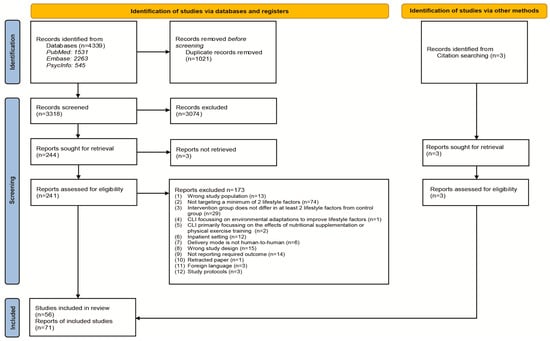
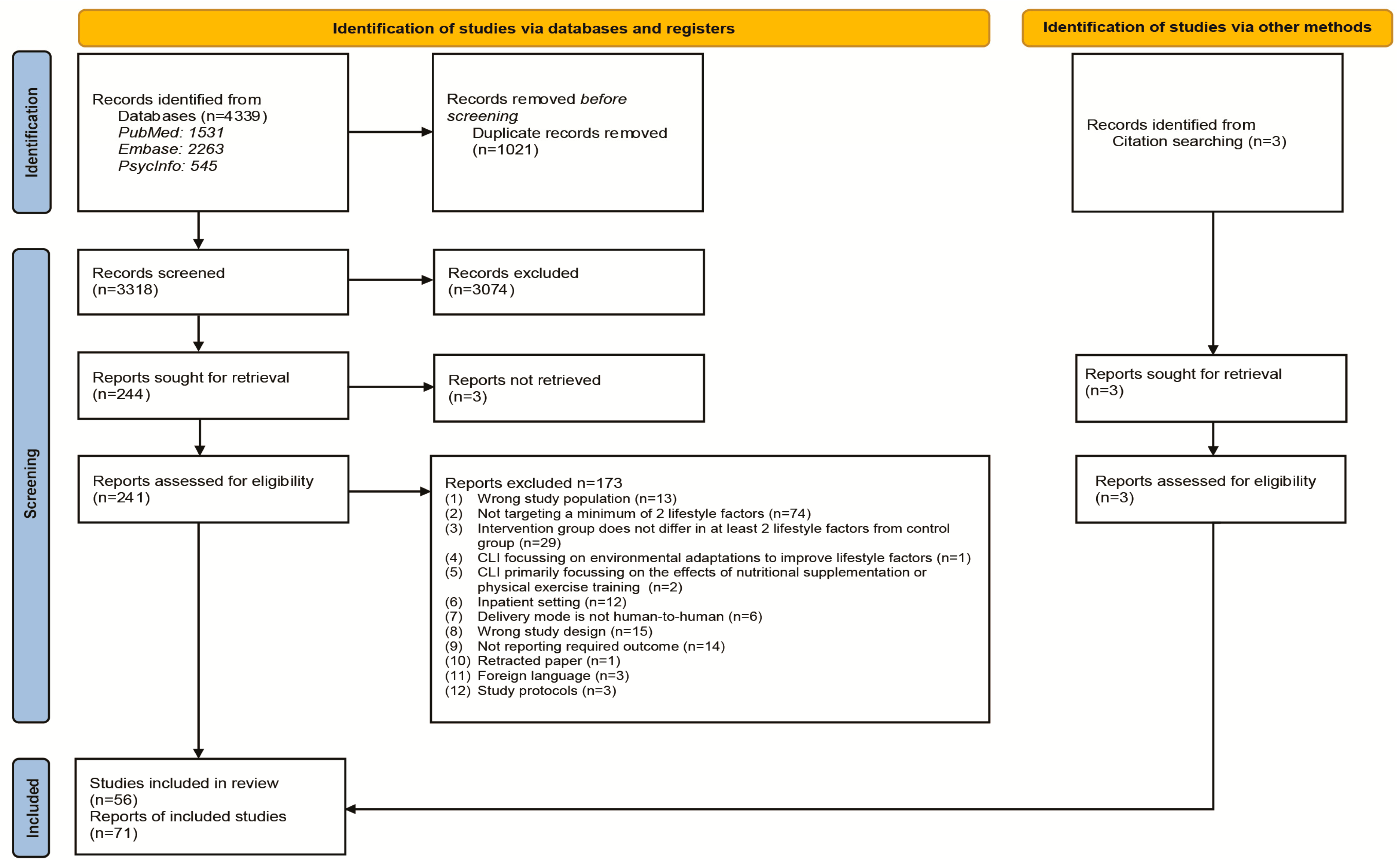
A total of 4339 research articles were identified from the various databases and three from citation searching; subsequently, 3318 articles were screened based on the title and abstract after removing duplicate records (Figure 1). Two hundred forty-seven potentially eligible articles were considered for full-text screening, of which full texts of three articles were not retrieved after approaching the authors. The full texts of 244 articles were reviewed, and 71 articles describing 56 intervention studies were included based on the predefined inclusion and exclusion criteria. All three articles identified from citation searching [33,34,35] were identified from protocols found with the search [36,37,38].
Figure 1.
Prisma flowchart: selection of included studies. CLI: combined lifestyle intervention.
The characteristics of the 56 quantitative studies are summarised in Table 1. In addition, four qualitative studies were identified, which were embedded into large RCTs conducted among patients with COPD, are included in Table 1 [39,40,41,42]. These qualitative studies described patients’ experiences of participating in the intervention trials and the impact of the interventions on behavioural outcomes. The most frequently reported changes in health behaviour were increased PA, reported by all four studies, followed by improved dietary intake reported in two studies, and one study reported perceived improvement in smoking behaviour. Twelve protocols fit the inclusion criteria, nine of which the actual studies were included in the review [36,37,38,43,44,45,46,47,48] and three of which the results were not available yet and were therefore excluded [49,50,51].
The systematic review of the literature only provided articles describing CLIs for the management of asthma and COPD. No CLIs in high-risk groups to prevent the onset of asthma or COPD were obtained.
3.2. COPD
3.2.1. Study Characteristics
A total of 47 studies were included, of which 26 were RCTs [33,35,52,53,54,55,56,57,58,59,60,61,62,63,64,65,66,67,68,69,70,71,72,73,74,75], 3 were non-randomised controlled trials [76,77,78], and 18 were single group pre–post studies [34,79,80,81,82,83,84,85,86,87,88,89,90,91,92,93,94,95]. The methodological quality of the studies ranged from strong to weak, with the majority being moderate and strong (Figure S1, quality assessment table available on https://osf.io/2jcm7). Quality seemed to be independent of study design; RCTs of both high and low quality were included. There was heterogeneity in the number of recruited participants across the studies, which ranged from 11 to 8217 participants (Table 1). The mean age of the participants ranged between 56.2 years to 75.0 years and the mean body mass index (BMI) ranged from 17.8 kg/m2 to 36.1 kg/m2, but there was only one study including participants with a mean BMI > 30 kg/m2 [86]. A higher male to female ratio was reported in the majority of the studies. The percentage of current smokers varied widely across the studies, ranging from 5.5% to 69.2%. Based on the mean levels of forced expiratory volume in 1 s (FEV1) reported across the studies, the majority of the patients had moderate COPD according to the Global Initiative for Chronic Obstructive Lung Disease (GOLD) [6]. The majority of the studies reported on interventions with a duration of 8–12 weeks [52,53,56,57,60,69,72,73,77,78,79,80,81,82,83,84,86,87,88,90,91,93,94,95], but also very short-term (3–6 weeks [54,62]) and longer term (i.e., 4 months to 1 year [34,35,55,59,61,64,65,67,70,71,74,75,85,89] and extending beyond 1 year [58,63,66]) interventions were included. Sixteen studies (34%) investigated a pulmonary rehabilitation programme that targeted more than one lifestyle factor [52,54,58,60,65,74,77,78,79,80,81,82,83,88,93,94].
As shown in Table 1 and Figure S3, the majority of studies were implemented in Europe (n = 19, 40%), followed by Asian countries (n = 9, 19%), the USA (n = 8, 17%), and Australia (n = 6, 13%). Other studies were conducted in Canada (n = 1, 2%), Brazil (n = 2, 4%), and South Africa (n = 1, 2%). For one study, the location of implementation was not specified [94].
3.2.2. Investigated Lifestyle Factors and Reported Outcomes
Lifestyle Factor Targets in CLIs
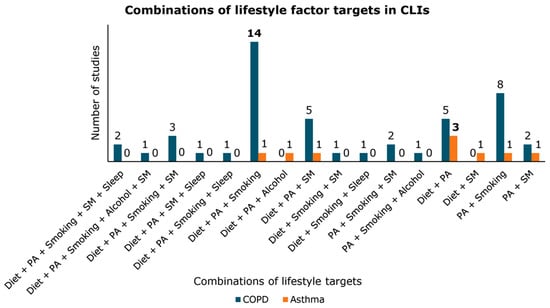
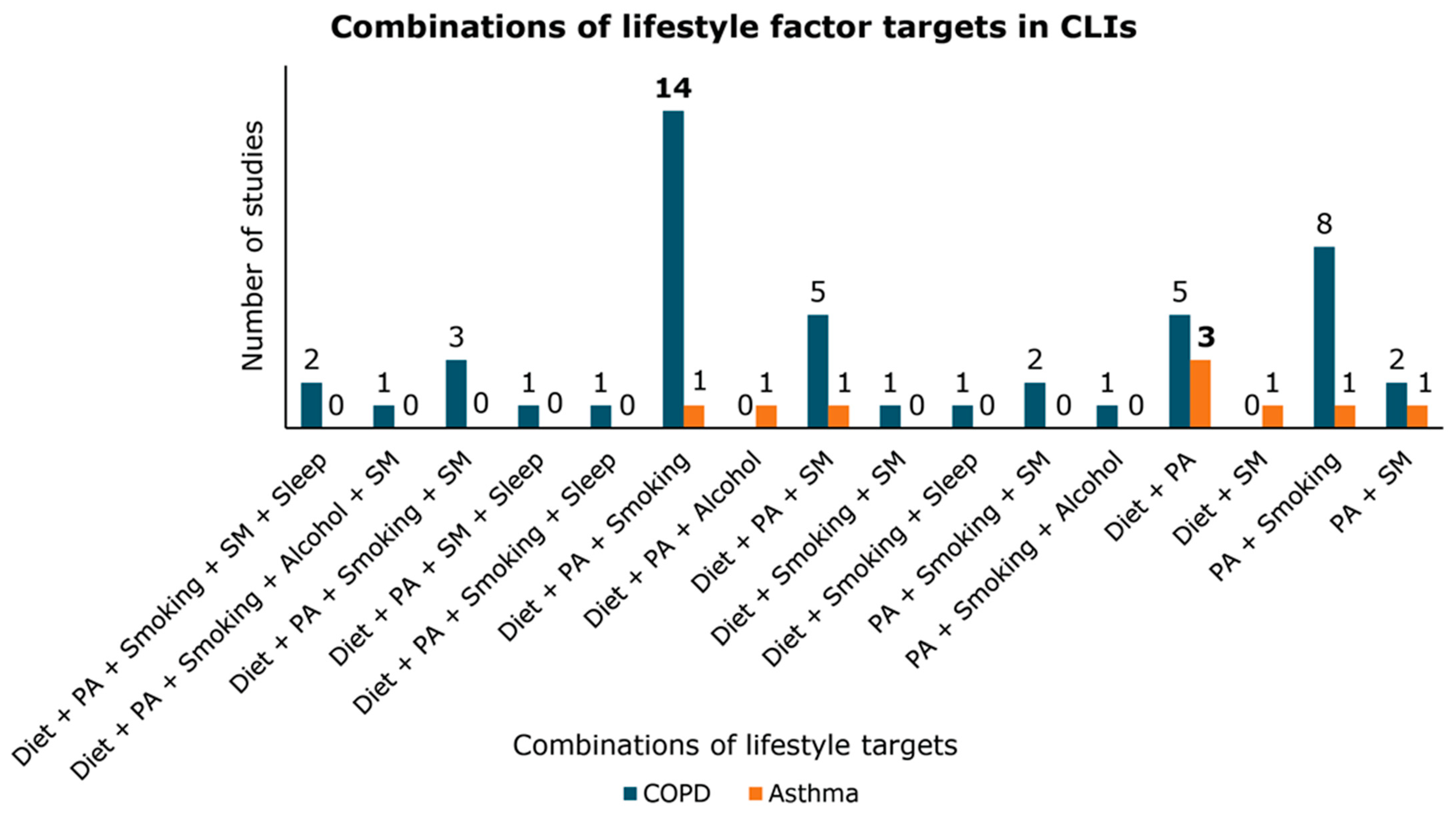
Forty-five CLIs were described across the 47 included studies. Bourne et al., 2022 and Mitchell et al., 2014 studied the same CLI, but with a difference in the mode of delivery (group-based approach versus individual level, respectively). Furthermore, Benzo et al., 2013 and Benzo et al., 2016 studied the same CLI, the former in a pilot study with a smaller study population. The majority of CLIs targeted a combination of three lifestyle factors (n = 23, 49%; Table 2) [35,52,55,57,58,59,62,63,69,73,74,75,76,77,78,79,83,84,85,87,88,90,91,92]. Furthermore, there were 15 (32%) CLIs focusing on a combination of two lifestyle targets [33,34,53,60,64,66,68,70,71,72,80,81,86,93,95], five (11%) focusing on a combination of four lifestyle targets [54,65,67,82,94], and three (6%) focusing on a combination of five lifestyle targets [56,61,89]. The highest number of CLIs targeted the combination of diet + PA + smoking (n = 14, 30%), followed by the combination of PA + smoking (n = 8, 17%; Figure 2 & Table 2). Diet and PA were, however, the most frequently occurring lifestyle targets across all CLIs (n = 32, 68%). From these studies, five (16%) CLIs targeted the combination of just diet and PA [60,80,81,86,93], while in 27 (84%) studies, they were targeted in combination with additional lifestyle factors [35,52,54,55,56,57,58,59,61,62,63,65,67,73,75,76,77,78,79,82,83,85,87,88,89,90,94]. In 21 (78%) of these 27 studies, smoking cessation was included [35,52,55,56,57,58,59,61,63,65,67,73,76,78,82,83,85,87,89,90,94], and in 12 (44%) studies, stress management was targeted [54,56,61,62,65,75,77,79,82,88,89,94]. Except for one study [92], stress management always occurred in combination with targeting PA (n = 16, 34%). Six combinations of lifestyle factor targets, including (1) PA + smoking + alcohol, (2) diet + smoking + sleep, (3) diet + smoking + stress management, (4) diet + PA + stress management + sleep, (5) diet + PA + smoking + sleep, and (6) diet + PA + smoking + alcohol + stress management, only occurred once [54,61,67,74,91,92]. Sleeping behaviour and alcohol consumption were targeted least frequently in combination with other lifestyle factors, in five (11%) [54,56,67,89,91] and two (4%) CLIs [61,74], respectively.
Figure 2.
Combinations of lifestyle factor targets in CLIs. CLI: combined lifestyle intervention, COPD: chronic obstructive pulmonary disease, PA: physical activity, SM: stress management.
3.2.3. Reported Outcomes and Possible Effects of CLIs
Behavioural Outcomes
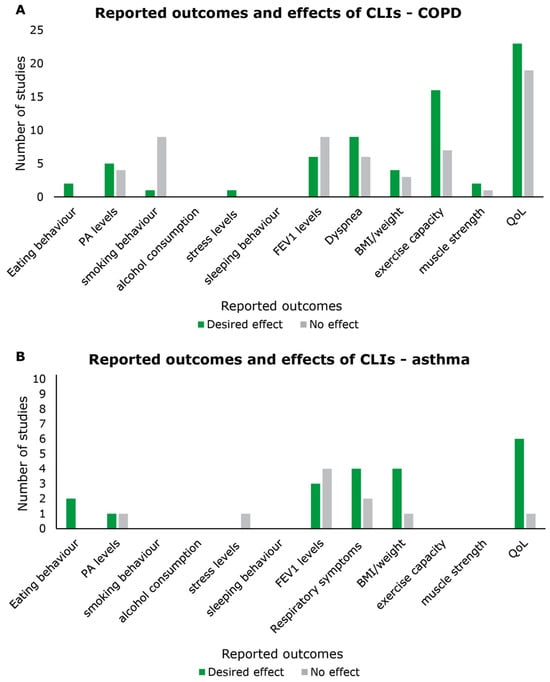
Only two (4%) studies reported on eating behaviour and both found improvements, described as a decrease in total energy intake and increase in protein intake [86] and an increase in eating a balanced diet [76] (Figure 3A). Nine (19%) studies reported on PA levels, of which five found an increase in PA level [64,67,70,76,96] and four found no effect [63,65,69,95]. Out of 10 (21%) studies reporting an outcome on smoking cessation, only one found a decrease in the number of current smokers [66], while the other nine studies did not find any effect [35,59,63,70,71,76,89,90,95]. No studies measured the effects on alcohol consumption or sleeping behaviour and only one study reported a decrease in stress level [94].
Figure 3.
(A) Reported outcomes and effects of CLIs for COPD management; (B) Reported outcomes and effects of CLIs for asthma management; BMI: body mass index, CLI: combined lifestyle intervention, FEV1: forced expiratory volume in 1 s, PA: physical activity, QoL: quality of life.
Physiological Outcomes
The number of studies reporting physiological outcomes (n = 35, 74%) was higher than that reporting behavioural outcomes (n = 16, 34%; Table 2). Fifteen (32%) studies reported on lung function (FEV1), of which nine found no effect [35,53,55,59,64,71,82,83,86] and six reported a desired effect (Figure 3A). In five cases, this was an increase in FEV1 level [73,81,87,88,93], and in one case, this was a less severe decrease in FEV1 level compared to the control group [66]. The majority of studies reporting the effects on dyspnoea reported an improvement (n = 9) [60,66,73,78,80,83,91,93,94], while six studies found no change in dyspnoea [63,70,76,85,89,95]. One of these studies reported the effects separately for ex-smokers and current smokers, and it only found an improvement in dyspnoea in current-smokers [83]. Of the seven (15%) studies reporting on BMI/weight [58,60,65,66,83,86,93], four found a desired effect. In three studies, this was an increase in weight [58,60,66], and in one study, including patients with obesity and COPD, this was a decrease in weight [86]. One of the studies that did not find an effect on BMI did report improvements in body composition (improved fat free mass and reduced fat mass) [93]. Twenty-three (49%) studies reported the effect on exercise capacity, with 16 showing an improvement [52,54,60,62,64,66,73,78,79,81,82,83,86,89,93,94] and seven showing no effects [57,58,65,71,75,77,87]. Three studies (6%) measured muscle strength [57,58,93], of which two showed an improvement [58,93].
Quality of Life
Follow-Up Measurements
Thirteen studies also conducted follow-up measurements after completion of the intervention. In three studies, the CLI included a maintenance phase in which participants still received intervention components, but on a less frequent basis, to encourage adherence to the targeted lifestyle behaviours [58,65,73]. Follow-up measurements after the maintenance phase remained the same compared to the effects measured at the end of the intervention, only the beneficial effects on weight were not maintained after 24 months in the study by van Wetering et al., 2010 (Table 2). The other studies did not include a maintenance phase but did report follow-up outcome measurements [52,54,56,62,68,69,70,75,91,94] (See Table 2 for follow-up durations). Most effects on the reported outcomes remained the same after follow-up. However, in some studies, the effects after follow-up were no longer detectable on exercise capacity [54], PA level [70], stress level, and symptoms [94]. One study found no effect on QoL after the end of the intervention (12 weeks) but did find a desired effect after follow-up (24 weeks) [52].
3.3. Asthma
3.3.1. Study Characteristics
A total of nine studies were identified, including six RCTs [97,98,99,100,101,102] and three single group pre–post studies [103,104,105] (Table 1). The number of participants across the studies ranged from 27 to 330 participants. The methodological quality varied between the studies (strong n = 2 [103,104], moderate n = 3 [100,101,102], and weak n = 4 [97,98,99,105]) (Figure S2). The mean age of the participants across the studies ranged from 33.4 years to 55.0 years. The mean BMI across the studies ranged from normal weight to obese (from 22.6 to 37.6 kg/m2). The majority of the studies reported a higher female to male ratio and ≤7% of current smokers, except one study that had 36.7% current smokers [104]. The FEV1 levels ranged from 62.5% to 82.6% percentage predicted volume. The intervention duration in five of the studies was 8–12 weeks [97,99,101,102,103]. There was one study with a 7-week duration [98], two studies had a duration of six months [104,105], and one study had a duration of 12 months [100].
3.3.2. Investigated Lifestyle Factors and Reported Outcomes
Lifestyle Factor Targets in CLIs
The studies that described CLIs for the management of asthma targeted a combination of two (n = 6, 67%) [98,99,100,101,102,104] and three (n = 3, 33%) lifestyle factors [97,103,105] (Table 2). Again, the combination of diet and PA as lifestyle targets occurred most frequently across all studies. The combination diet + PA was targeted in the highest number of studies (n = 3, 33%) [100,101,102] (Figure 2). Moreover, three (33%) studies targeted diet and PA in combination with another lifestyle factor, namely smoking (n = 1) [103], alcohol consumption (n = 1) [105], and stress management (n = 1) [97]. The lifestyle target combinations of (1) PA + smoking, (2) PA + SM, and (3) diet + stress management also only occurred once [98,99,104].
3.3.3. Reported Outcomes and Possible Effects of CLIs
Behavioural Outcomes
Two (22%) studies reported desired effects on dietary intake, described as a reduction in total caloric, fat, and carbohydrate intake and an increase in the percentage of protein in the participants’ diets [105] and an increase in protein intake and reduction in the dietary glycaemic index [101] (Figure 3B). Two (22%) studies reported on PA levels [98,100], of which one showed an increase in PA level [98]. One study reported on stress levels but found no effect [98]. No studies reported any outcomes on smoking behaviour, alcohol consumption, or sleeping behaviour.
Physiological Outcomes
There was a higher number of studies reporting physiological outcomes (n = 8, 89%) [97,99,100,101,102,103,104,105] than behavioural outcomes (n = 4, 44%) [98,100,101,105] (Table 2). Of seven (78%) studies reporting the effect on lung function (FEV1) [97,99,100,101,103,104,105], three found an improvement [97,99,104] (Figure 3B). Four [99,101,103,104] out of six (67%) [99,100,101,103,104,105] studies reporting an effect on respiratory symptoms found improvements. Five studies (56%) reported on BMI/weight, and only one study found no effect [103], while the other four studies found a decrease in weight [100,101,102,105]. None of the studies reported outcomes related to exercise capacity or muscle strength.
Quality of Life
Besides lung function, QoL was the most frequently reported outcome, reported in seven (78%) studies. The majority of studies evaluating the effect on QoL found an improvement (n = 6) [97,98,99,101,103,105], and only one study found no effect [100] (Figure 3B).
Follow-Up Measurements
Two studies conducted follow-up measurements after completion of the intervention (Table 2). In the study by Pokladnikova et al., 2013 [99], the effects after six months stayed the same as those measured after 2 months. Bentzon et al., 2019 [106] could no longer find an improvement in respiratory symptoms at the one-year follow-up, which was detected in the EFFORT trial by Toennesen et al., 2018 [101] after an 8-week intervention.
Table 1.
Descriptive table including details of the included studies and the described combined lifestyle interventions. Studies are reported based on the number of lifestyle factors targeted (high to low) and ordered according to study design. A more detailed version of the descriptive table, including patient characteristics, is provided in the Supplementary Materials (Table S2).
Table 2.
Reported lifestyle factor targets and outcomes of the described combined lifestyle interventions in the included studies. The colour green was used to signify a significant desired effect on the outcome and grey was used to signify no change in outcome (non-significant effects). Studies are reported based on the number of lifestyle factors targeted (high to low) and ordered according to study design.
4. Discussion
This systematic review provides a comprehensive overview of existing CLIs for the management of asthma and COPD. Quite some research has already been performed on CLIs for the management of these conditions, but no studies on CLIs were identified for the prevention of the onset of asthma or COPD. The combination of diet and PA was identified as the most frequent target in CLIs for both asthma and COPD management, and in the case of COPD, this was often combined with smoking cessation. QoL was the most frequently reported outcome in CLIs for COPD management, and in CLIs for asthma management, both QoL and lung function (FEV1) were most frequently reported. The existing CLIs were shown to have beneficial effects on QoL and physiological outcomes, including respiratory symptoms, BMI/weight, and in the case of COPD, also exercise capacity. Lung function was shown to be retained after participation in CLIs. The influence of CLIs in terms of behavioural change was less well established because many studies did not report behavioural outcomes. If they did, improvements were mainly seen in dietary intake and PA level. None of the studies reported an undesired effect on any of the outcomes.
Besides the combination of diet, PA, and in the case of COPD, also smoking cessation, being targeted most frequently, there was less attention paid to other lifestyle factors (i.e., alcohol consumption, stress level, and sleeping behaviour) in the studied CLIs. There was less evidence for the relationship between these lifestyle behaviours and asthma or COPD development/progression; however, they are receiving increasing attention in public health, particularly in the prevention of other diseases [108,109,110]. Furthermore, studies that targeted alcohol consumption, stress management, or sleeping behaviour in this review often found improvements in QoL. It is therefore important that studies also include these lifestyle factors in their CLIs to make sure health is targeted in the most comprehensive way.
Pulmonary rehabilitation programmes showed the most promising results in COPD management. PR programmes are effective; however, these effects are often not maintained in the long term [111]. The PR programmes included in this review had a maximum duration of 3 months. It is therefore questionable whether the included PR programmes would have led to actual sustained behavioural changes. In general, it would be expected that in longer lasting interventions, in which individuals continue performing the behaviour for a longer amount of time, there would be a smaller chance of relapse. In this regard, it is also important to check whether behavioural change is maintained once participants are let loose of any type of intervention contact. Consequently, research in recent years has focused increasingly on maintenance PR, which is implemented after an initial PR programme [111], but the current review showed that the effects are still inconsistent [58,65]. This review shows the limited availability of long-term interventions as well as studies measuring follow-up outcomes, especially related to behavioural outcomes, after interventions end. During the search, even more articles on PR were obtained; however, many were excluded since exercise training was often the only targeted component. Based on the definition of PR, these programmes could potentially be considered CLIs. However, in reality, the focus of these programmes is often only on exercise training [26]. For asthma management, the most effective studies usually included dietary interventions, often also combined with a PA component. As study participants in all of these studies, except one, were overweight or obese, the observed effects on physiological outcomes and QoL could be attributed to improvements in weight, but weight was not measured in all of these studies.
Our literature search demonstrated that CLIs evaluating the effects on physiological outcomes clearly outran those reporting behavioural outcomes. Furthermore, those that did report effects on behavioural outcomes often did not seem to find effects. Smoking cessation was one of the most frequently targeted lifestyle factors, in combination with diet and PA for COPD management, but available CLIs may not be sufficient to induce a change in smoking behaviour; 90% of the included CLIs were ineffective in this regard. While smoking cessation is one of the most effective ways to reduce COPD morbidity, successful quitting in patients with COPD is difficult [112]. The percentage of current smokers among asthma patients was considerably lower compared to patients with COPD, which may reflect why smoking cessation was only targeted in one study for asthma management. A recent umbrella review, however, highlighted smoking as a risk factor for adult-onset asthma [13].
The effects of CLIs on physiological outcomes were more robust. More than half of the studies reporting on FEV1 levels in COPD found no effect, as expected, since it was unlikely that participation in a CLI would improve irreversible airflow obstruction. It was therefore unexpected that some studies did find improvements in FEV1 level, and the reasons for this are unknown. Stable FEV1 levels can also be considered desired, as FEV1 levels in patients with COPD usually worsen over time [113]. Throughout the duration of most CLIs, major decreases in FEV1 level were, however, not expected [114]. The majority of studies in both asthma and COPD management found improvements in BMI/weight. One study that did not find an effect on BMI, did find positive effects on fat free mass and fat mass change. Future studies should therefore consider reporting on different body composition parameters, besides BMI, as fat-free mass and fat mass are partly independently related to extra-pulmonary features. Exercise capacity was one of the most frequently reported outcomes for COPD, whereas it was not prioritised in the studies for asthma management. A plausible explanation for this could be that a decrease in exercise capacity is less prominent in patients with asthma compared to COPD [115]. The implementation of CLIs was shown to improve QoL in patients; both for asthma and COPD, the majority of studies reported a desired effect on QoL.
Overall, the methodological quality of the asthma studies was low, with the majority of studies rated as weak and only two studies rated as strong, even though 67% of studies were RCTs. Taken together with the lower number of CLIs available for asthma management, more studies are needed in order to draw more firm conclusions about their effects. For COPD, the majority of studies were also RCTs, but again, the methodological quality was independent of study design. More than half of the studies with a pre–post design were rated as strong, but no causal effects could be drawn from these studies. Even though many CLIs for COPD management have been studied, RCTs of higher methodological quality are needed, specifically paying attention to the prevention of selection bias and confounding.
The number of CLIs available for COPD management was considerably higher than that for asthma management. CLIs for asthma management increased in number mostly from the beginning of the last decade, with the first paper being published in 2009, while for COPD, it was published in 1997. Twenty-five percent of the studies were performed in Asia, South America, and Africa. Studies in low- and middle-income countries are important, as mortality and morbidity of asthma and COPD in these countries are highest [116,117].
An extensive search of the existing literature yielded no studies describing CLIs for the prevention of the onset of asthma or COPD. The primary focus of the CLIs was on secondary and tertiary prevention, even though the existing literature suggests an optimal lifestyle not only slows lung function decline in patients but can also play a role in reducing asthma and COPD risk [13,14,15,16,17,18,19,20,21,22,23]. As this review showed that CLIs are effective in asthma and COPD management, one could question whether the implementation of CLIs would not already be beneficial at an earlier stage. Perhaps a lack of awareness needs to be addressed first, both for high-risk groups being unaware of their risks and intermediaries being unaware of the possible benefits CLIs can have in this target group. A great deal may be gained by implementing CLIs in high-risk groups for the prevention of onset of asthma and COPD.
This comprehensive overview of existing CLIs for asthma and COPD management provides insight into what types of interventions already exist and which outcomes they affect positively (QoL, respiratory symptoms, BMI, exercise capacity (in COPD), and possibly lung function). This is helpful for the development and implementation of new interventions and helps to identify relevant intervention targets. Furthermore, intervention targets for which few data are available, including alcohol consumption, stress management, and sleeping behaviour, as well as the effects on outcomes about which little is known, especially behavioural outcomes, warrant further investigation.
The extensive scope of this review led to many articles and the wide variation among the selected studies, including heterogeneity in intervention types, implementation methods, and outcome variables, did not support the possibility of conducting a meta-analysis. The aim of this review was, however, to obtain an overview of which CLIs exist and conducting a meta-analysis would require comparable studies or groups. Furthermore, due to the wide scope, outcomes related to healthcare use (e.g., exacerbations, hospitalisations, drug use) were not included.
5. Conclusions
A substantial amount of CLIs are available that target behavioural changes in at least two lifestyle factors for the management of COPD, but fewer so for asthma management.
Despite the methodological limitations of individual studies, the effects of these CLIs on QoL and physiological outcomes were robust, leading to improvements in QoL, respiratory symptoms, BMI/weight, exercise capacity (COPD), and retained lung function. It is therefore recommended that more attention is given to the implementation of CLIs in clinical practice. However, no firm conclusions can be drawn about the effects on behavioural changes. Future studies should consider aiming for and reporting the effects on long-term behavioural lifestyle changes. Furthermore, CLIs should be implemented before disease onset in high-risk groups to study their effectiveness in the prevention of asthma and COPD.
Supplementary Materials
The following supporting information can be downloaded at: https://www.mdpi.com/article/10.3390/nu16101515/s1, Supplementary methods, Table S1: PICOS criteria for inclusion of studies, Table S2: Descriptive table including details of the included studies and the described combined lifestyle interventions, Figure S1: Quality plot for COPD studies, Figure S2: Quality plot for asthma studies, and Figure S3: Locations of CLI implementation for asthma and COPD management.
Author Contributions
Conceptualisation and methodology: C.D.C.B., R.C., S.P.J.K., A.M.W.J.S. and R.J.H.C.G.B.; investigation, data curation and formal analysis: C.D.C.B., R.B. and R.J.H.C.G.B.; visualisation: C.D.C.B., R.B., R.C. and R.J.H.C.G.B.; writing-original draft preparation: C.D.C.B., R.B. and R.J.H.C.G.B.; writing—review and editing and supervision: R.C., S.P.J.K., G.D., S.S., A.M.W.J.S. and R.J.H.C.G.B.; funding acquisition: A.M.W.J.S. and R.J.H.C.G.B. All authors have read and agreed to the published version of the manuscript.
Funding
This research was funded by the Partners in the Precision Medicine for more Oxygen (P4O2) consortium, which includes the Amsterdam UMC, Leiden University Medical Center, Maastricht UMC+, Maastricht University, UMC Groningen, UMC Utrecht, Utrecht University, TNO, Abbvie, Aparito, Boehringer Ingelheim, Breathomix, Clear, Danone Nutricia Research, Fluidda, Ncardia, Olive, Ortec Logiqcare, Philips, Proefdiervrij, Quantib-U, RespiQ, Roche, Smartfish, SODAQ, Thirona, TopMD, Lung Alliance Netherlands (LAN), and the Lung Foundation Netherlands (Longfonds). The consortium is additionally funded by the PPP Allowance made available by Health Holland, Top Sector Life Sciences & Health (LSHM20104; LSHM20068) to stimulate public-private partnerships and by Novartis.
Data Availability Statement
All data relevant for this study are available in this manuscript or the Supplementary Material. The data extraction form and quality assessment table are available on https://osf.io/2quxa/.
Conflicts of Interest
C. Born, A. Schols, and R. Beijers are part of the P4O2 consortium, which is financially supported by a public and private partnership sponsored by Health Holland. No conflicts of interest exist for the other authors.
References
- World Health Organization. Global Status Report on Noncommunicable Diseases 2010; World Health Organization: Geneva, Switzerland, 2011.
- Forum of International Respiratory Societies. The Global Impact of Respiratory Disease; Forum of International Respiratory Societies: Lausanne, Switzerland, 2021. [Google Scholar]
- Safiri, S.; Carson-Chahhoud, K.; Noori, M.; Nejadghaderi, S.A.; Sullman, M.J.; Heris, J.A.; Ansarin, K.; Mansournia, M.A.; Collins, G.S. Burden of chronic obstructive pulmonary disease and its attributable risk factors in 204 countries and territories, 1990–2019: Results from the Global Burden of Disease Study 2019. BMJ 2022, 378, e069679. [Google Scholar] [CrossRef] [Scilit] [PubMed]
- GBD 2019 Diseases and Injuries Collaborators. Global burden of 369 diseases and injuries in 204 countries and territories, 1990–2019: A systematic analysis for the Global Burden of Disease Study 2019. Lancet 2020, 396, 1204–1222. [Google Scholar] [CrossRef] [PubMed]
- Global Initiative for Asthma. Global Strategy for Asthma Management and Prevention (2022 Update); Global Initiative for Asthma: Fontana, WI, USA, 2022. [Google Scholar]
- Global Initiative for Chronic Obstructive Lung Disease. Global Strategy for the Diagnosis, Management, and Prevention of Chronic Obstructive Pulmonary Disease (2023 Report). 2022. Available online: https://goldcopd.org/wp-content/uploads/2023/03/GOLD-2023-ver-1.3-17Feb2023_WMV.pdf (accessed on 7 May 2023).
- Agusti, A.; Sobradillo, P.; Celli, B. Addressing the complexity of chronic obstructive pulmonary disease: From phenotypes and biomarkers to scale-free networks, systems biology, and P4 medicine. Am. J. Respir. Crit. Care Med. 2011, 183, 1129–1137. [Google Scholar] [CrossRef] [Scilit] [PubMed]
- Dodd, J.W. Lung disease as a determinant of cognitive decline and dementia. Alzheimer’s Res. Ther. 2015, 7, 32. [Google Scholar] [CrossRef] [Scilit] [PubMed]
- Kunik, M.E.; Roundy, K.; Veazey, C.; Souchek, J.; Richardson, P.; Wray, N.P.; Stanley, M.A. Surprisingly high prevalence of anxiety and depression in chronic breathing disorders. Chest 2005, 127, 1205–1211. [Google Scholar] [CrossRef] [Scilit]
- Janssen, S.M.; van Helvoort, H.A.; Tjalma, T.A.; Antons, J.C.; Djamin, R.S.; Simons, S.O.; Spruit, M.A.; van’t Hul, A.J. Impact of Treatable Traits on Asthma Control and Quality of Life. J. Allergy Clin. Immunol. Pract. 2023, 11, 1823–1833.e4. [Google Scholar] [CrossRef] [Scilit]
- Parletta, N.; Zarnowiecki, D.; Cho, J.; Wilson, A.; Bogomolova, S.; Villani, A.; Itsiopoulos, C.; Niyonsenga, T.; Blunden, S.; Meyer, B.; et al. A Mediterranean-style dietary intervention supplemented with fish oil improves diet quality and mental health in people with depression: A randomized controlled trial (HELFIMED). Nutr. Neurosci. 2019, 22, 474–487. [Google Scholar] [CrossRef] [Scilit] [PubMed]
- Zhang, Y.B.; Pan, X.F.; Chen, J.; Cao, A.; Xia, L.; Zhang, Y.; Wang, J.; Li, H.; Liu, G.; Pan, A. Combined lifestyle factors, all-cause mortality and cardiovascular disease: A systematic review and meta-analysis of prospective cohort studies. J. Epidemiol. Community Health 2021, 75, 92–99. [Google Scholar] [CrossRef] [Scilit] [PubMed]
- Holtjer, J.C.S.; Bloemsma, L.D.; Beijers, R.J.; Cornelissen, M.E.; Hilvering, B.; Houweling, L.; Vermeulen, R.C.; Downward, G.S.; Maitland-Van der Zee, A.H. Identifying risk factors for COPD and adult-onset asthma: An umbrella review. Eur. Respir. Rev. 2023, 32, 230009. [Google Scholar] [CrossRef] [Scilit]
- Kuder, M.M.; Clark, M.; Cooley, C.; Prieto-Centurion, V.; Danley, A.; Riley, I.; Siddiqi, A.; Weller, K.; Kitsiou, S.; Nyenhuis, S.M. A Systematic Review of the Effect of Physical Activity on Asthma Outcomes. J. Allergy Clin. Immunol. Pract. 2021, 9, 3407–3421.e8. [Google Scholar] [CrossRef] [Scilit]
- Garcia-Aymerich, J.; Varraso, R.; Danaei, G.; Camargo, C.A., Jr.; Hernán, M.A. Incidence of adult-onset asthma after hypothetical interventions on body mass index and physical activity: An application of the parametric g-formula. Am. J. Epidemiol. 2014, 179, 20–26. [Google Scholar] [CrossRef] [Scilit] [PubMed]
- Watz, H.; Pitta, F.; Rochester, C.L.; Garcia-Aymerich, J.; ZuWallack, R.; Troosters, T.; Vaes, A.W.; Puhan, M.A.; Jehn, M.; Polkey, M.I.; et al. An official European Respiratory Society statement on physical activity in COPD. Eur. Respir. J. 2014, 44, 1521–1537. [Google Scholar] [CrossRef] [Scilit] [PubMed]
- van Iersel, L.E.J.; Beijers, R.J.; Gosker, H.R.; Schols, A.M. Nutrition as a modifiable factor in the onset and progression of pulmonary function impairment in COPD: A systematic review. Nutr. Rev. 2022, 80, 1434–1444. [Google Scholar] [CrossRef] [Scilit] [PubMed]
- Alwarith, J.; Kahleova, H.; Crosby, L.; Brooks, A.; Brandon, L.; Levin, S.M.; Barnard, N.D. The role of nutrition in asthma prevention and treatment. Nutr. Rev. 2020, 78, 928–938. [Google Scholar] [CrossRef] [Scilit]
- Yang, W.; Yang, Y.; He, L.; Zhang, M.; Sun, S.; Wang, F.; Han, B. Dietary factors and risk for asthma: A Mendelian randomization analysis. Front. Immunol. 2023, 14, 1126457. [Google Scholar] [CrossRef] [Scilit]
- Toskala, E.; Kennedy, D.W. Asthma risk factors. Int. Forum Allergy Rhinol. 2015, 5 (Suppl. S1), S11–S16. [Google Scholar] [CrossRef] [Scilit] [PubMed]
- Kavanagh, J.; Jackson, D.J.; Kent, B.D. Sleep and asthma. Curr. Opin. Pulm. Med. 2018, 24, 569–573. [Google Scholar] [CrossRef] [Scilit] [PubMed]
- Baugh, A.; Buhr, R.G.; Quibrera, P.; Barjaktarevic, I.; Barr, R.G.; Bowler, R.; Han, M.K.; Kaufman, J.D.; Koch, A.L.; Krishnan, J.; et al. Risk of COPD exacerbation is increased by poor sleep quality and modified by social adversity. Sleep 2022, 45, zsac107. [Google Scholar] [CrossRef] [Scilit] [PubMed]
- Zeidler, M.R.; Martin, J.L.; Kleerup, E.C.; Schneider, H.; Mitchell, M.N.; Hansel, N.N.; Sundar, K.; Schotland, H.; Basner, R.C.; Wells, J.M.; et al. Sleep disruption as a predictor of quality of life among patients in the subpopulations and intermediate outcome measures in COPD study (SPIROMICS). Sleep 2018, 41, zsy044. [Google Scholar] [CrossRef] [Scilit]
- Williams, M.T.; Effing, T.W.; Paquet, C.; Gibbs, C.A.; Lewthwaite, H.; Li, L.S.K.; Phillips, A.C.; Johnston, K.N. Counseling for health behavior change in people with COPD: Systematic review. Int. J. Chronic Obstr. Pulm. Dis. 2017, 12, 2165–2178. [Google Scholar] [CrossRef] [Scilit]
- Spruit, M.A.; Singh, S.J.; Garvey, C.; ZuWallack, R.; Nici, L.; Rochester, C.; Hill, K.; Holland, A.E.; Lareau, S.C.; Man, W.D.C.; et al. An official American Thoracic Society/European Respiratory Society statement: Key concepts and advances in pulmonary rehabilitation. Am. J. Respir. Crit. Care Med. 2013, 188, e13–e64. [Google Scholar] [CrossRef] [Scilit] [PubMed]
- Holland, A.E.; Wageck, B.; Hoffman, M.; Lee, A.L.; Jones, A.W. Does pulmonary rehabilitation address treatable traits? A systematic review. Eur. Respir. Rev. 2022, 31, 220042. [Google Scholar] [CrossRef] [Scilit] [PubMed]
- Lv, N.; Azar, K.M.J.; Rosas, L.G.; Wulfovich, S.; Xiao, L.; Ma, J. Behavioral lifestyle interventions for moderate and severe obesity: A systematic review. Prev. Med. 2017, 100, 180–193. [Google Scholar] [CrossRef] [Scilit] [PubMed]
- van Namen, M.; Prendergast, L.; Peiris, C. Supervised lifestyle intervention for people with metabolic syndrome improves outcomes and reduces individual risk factors of metabolic syndrome: A systematic review and meta-analysis. Metabolism 2019, 101, 153988. [Google Scholar] [CrossRef] [Scilit] [PubMed]
- Page, M.J.; McKenzie, J.E.; Bossuyt, P.M.; Boutron, I.; Hoffmann, T.C.; Mulrow, C.D.; Shamseer, L.; Tetzlaff, J.M.; Akl, E.A. The PRISMA 2020 statement: An updated guideline for reporting systematic reviews. BMJ 2021, 372, n71. [Google Scholar] [CrossRef] [Scilit] [PubMed]
- University of York-Centre for Reviews and Dissemination. PROSPERO International Prospective Register of Systematic Reviews. Available online: https://www.crd.york.ac.uk/PROSPERO/#aboutregpage (accessed on 23 December 2022).
- Ouzzani, M.; Hammady, H.; Fedorowicz, Z.; Elmagarmid, A. Rayyan—A web and mobile app for systematic reviews. Syst. Rev. 2016, 5, 210. [Google Scholar] [CrossRef] [Scilit] [PubMed]
- McMaster University. Effective Public Health Practice Project (EPHPP). Available online: https://merst.healthsci.mcmaster.ca/ephpp/ (accessed on 19 August 2022).
- Markun, S.; Rosemann, T.; Dalla-Lana, K.; Steurer-Stey, C. Care in Chronic Obstructive Lung Disease (CAROL): A randomised trial in general practice. Eur. Respir. J. 2018, 51, 1701873. [Google Scholar] [CrossRef] [Scilit] [PubMed]
- Ansari, S.; Hosseinzadeh, H.; Dennis, S.; Zwar, N. Activating primary care COPD patients with multi-morbidity through tailored self-management support. NPJ Prim. Care Respir. Med. 2020, 30, 12. [Google Scholar] [CrossRef] [Scilit] [PubMed]
- Zwar, N.A.; Bunker, J.M.; Reddel, H.K.; Dennis, S.M.; Middleton, S.; van Schayck, O.C.; Crockett, A.J.; Hasan, I.; Hermiz, O.; Vagholkar, S.; et al. Early intervention for chronic obstructive pulmonary disease by practice nurse and GP teams: A cluster randomized trial. Fam. Pract. 2016, 33, 663–670. [Google Scholar] [CrossRef] [Scilit]
- Bunker, J.M.; Reddel, H.K.; Dennis, S.M.; Middleton, S.; Van Schayck, C.P.; Crockett, A.J.; Hasan, I.; Hermiz, O.; Vagholkar, S.; Marks, G.B.; et al. A pragmatic cluster randomized controlled trial of early intervention for chronic obstructive pulmonary disease by practice nurse-general practitioner teams: Study Protocol. Implement. Sci. 2012, 7, 83. [Google Scholar] [CrossRef] [Scilit]
- Steurer-Stey, C.; Markun, S.; Lana, K.D.; Frei, A.; Held, U.; Wensing, M.; Rosemann, T. The improving care in chronic obstructive lung disease study: CAROL improving processes of care and quality of life of COPD patients in primary care: Study protocol for a randomized controlled trial. Trials 2014, 15, 96. [Google Scholar] [CrossRef] [Scilit]
- Ansari, S.; Hosseinzadeh, H.; Dennis, S.; Zwar, N. Activating primary care COPD patients with multi-morbidity (APCOM) pilot project: Study protocol. NPJ Prim. Care Respir. Med. 2017, 27, 12. [Google Scholar] [CrossRef] [Scilit]
- Apps, L.D.; Harrison, S.L.; Mitchell, K.E.; Williams, J.E.; Hudson, N.; Singh, S.J. A qualitative study of patients’ experiences of participating in SPACE for COPD: A Self-management Programme of Activity, Coping and Education. ERJ Open Res. 2017, 3, 00017–02017. [Google Scholar] [CrossRef] [Scilit]
- Benzo, R.P. Mindfulness and motivational interviewing: Two candidate methods for promoting self-management. Chronic Respir. Dis. 2013, 10, 175–182. [Google Scholar] [CrossRef] [Scilit]
- Walters, J.A.; Cameron-Tucker, H.; Courtney-Pratt, H.; Nelson, M.; Robinson, A.; Scott, J.; Turner, P.; Walters, E.H.; Wood-Baker, R. Supporting health behaviour change in chronic obstructive pulmonary disease with telephone health-mentoring: Insights from a qualitative study. BMC Fam. Pract. 2012, 13, 55. [Google Scholar] [CrossRef] [Scilit]
- Wang, L.; Mårtensson, J.; Zhao, Y.; Nygårdh, A. Experiences of a health coaching self-management program in patients with COPD: A qualitative content analysis. Int. J. Chronic Obstr. Pulm. Dis. 2018, 13, 1527–1536. [Google Scholar] [CrossRef] [Scilit]
- Blumenthal, J.A.; Keefe, F.J.; Babyak, M.A.; Fenwick, C.V.; Johnson, J.M.; Stott, K.; Funk, R.K.; McAdams, M.J.; Palmer, S.; Martinu, T.; et al. Caregiver-assisted coping skills training for patients with COPD: Background, design, and methodological issues for the INSPIRE-II study. Clin. Trials 2009, 6, 172–184. [Google Scholar] [CrossRef] [Scilit]
- Huang, B.; Willard-Grace, R.; De Vore, D.; Wolf, J.; Chirinos, C.; Tsao, S.; Hessler, D.; Su, G.; Thom, D.H. Health coaching to improve self-management and quality of life for low income patients with chronic obstructive pulmonary disease (COPD): Protocol for a randomized controlled trial. BMC Pulm. Med. 2017, 17, 90. [Google Scholar] [CrossRef] [Scilit]
- Pagano, L.; McKeough, Z.; Wootton, S.; Crone, S.; Pallavicini, D.; Chan, A.S.; Mahadev, S.; Zwar, N.; Dennis, S. The feasibility of an innovative GP-physiotherapist partnership to identify and manage chronic obstructive pulmonary disease (INTEGRATED): Study protocol. Pilot Feasibility Stud. 2020, 6, 138. [Google Scholar] [CrossRef] [Scilit] [PubMed]
- Ma, J.; Strub, P.; Camargo, C.A., Jr.; Xiao, L.; Ayala, E.; Gardner, C.D.; Buist, A.S.; Haskell, W.L.; Lavori, P.W.; Wilson, S.R. The Breathe Easier through Weight Loss Lifestyle (BE WELL) Intervention: A randomized controlled trial. BMC Pulm. Med. 2010, 10, 16. [Google Scholar] [CrossRef] [Scilit] [PubMed]
- Sidhu, M.S.; Daley, A.; Jordan, R.; Coventry, P.A.; Heneghan, C.; Jowett, S.; Singh, S.; Marsh, J.; Adab, P.; Varghese, J.; et al. Patient self-management in primary care patients with mild COPD—Protocol of a randomised controlled trial of telephone health coaching. BMC Pulm. Med. 2015, 15, 16. [Google Scholar] [CrossRef] [Scilit] [PubMed]
- Valero, C.; Monteagudo, M.; Llagostera, M.; Bayona, X.; Granollers, S.; Acedo, M.; Ferro, J.J.; Rodríguez-Latre, L.; Almeda, J.; Munoz, L.; et al. Evaluation of a combined strategy directed towards health-care professionals and patients with chronic obstructive pulmonary disease (COPD): Information and health education feedback for improving clinical monitoring and quality-of-life. BMC Public Health 2009, 9, 442. [Google Scholar] [CrossRef] [Scilit] [PubMed]
- Smith, T.A.; Roberts, M.M.; Cho, J.G.; Klimkeit, E.; Luckett, T.; McCaffrey, N.; Kirby, A.; Wheatley, J.R. Protocol for a Single-Blind, Randomized, Parallel-Group Study of a Nonpharmacological Integrated Care Intervention to Reduce the Impact of Breathlessness in Patients with Chronic Obstructive Pulmonary Disease. Palliat. Med. Rep. 2020, 1, 296–306. [Google Scholar] [CrossRef] [Scilit] [PubMed]
- Alqahtani, K.A.; Gerlis, C.; Nolan, C.M.; Gardiner, N.; Szczepura, A.; Man, W.; Singh, S.J.; Houchen-Wolloff, L. SPACE FOR COPD delivered as a maintenance programme on pulmonary rehabilitation discharge: Protocol of a randomised controlled trial evaluating the long-term effects on exercise tolerance and mental well-being. BMJ Open 2022, 12, e055513. [Google Scholar] [CrossRef] [Scilit] [PubMed]
- Adhikari, T.B.; Neupane, D.; Karki, A.; Drews, A.; Cooper, B.; Högman, M.; Sigsgaard, T.; Kallestrup, P. Community-based intervention for prevention and management of chronic obstructive pulmonary disease in Nepal (COBIN-P trial): Study protocol for a cluster-randomized controlled trial. Trials 2021, 22, 474. [Google Scholar] [CrossRef] [Scilit] [PubMed]
- Bendstrup, K.E.; Jensen, J.I.; Holm, S.; Bengtsson, B. Out-patient rehabilitation improves activities of daily living, quality of life and exercise tolerance in chronic obstructive pulmonary disease. Eur. Respir. J. 1997, 10, 2801–2806. [Google Scholar] [CrossRef] [Scilit] [PubMed]
- Emery, C.F.; Schein, R.L.; Hauck, E.R.; MacIntyre, N.R. Psychological and cognitive outcomes of a randomized trial of exercise among patients with chronic obstructive pulmonary disease. Health Psychol. 1998, 17, 232–240. [Google Scholar] [CrossRef]
- Finnerty, J.P.; Keeping, I.; Bullough, I.; Jones, J. The effectiveness of outpatient pulmonary rehabilitation in chronic lung disease: A randomized controlled trial. Chest 2001, 119, 1705–1710. [Google Scholar] [CrossRef] [Scilit] [PubMed]
- Dheda, K.; Crawford, A.; Hagan, G.; Roberts, C.M. Implementation of British Thoracic Society guidelines for acute exacerbation of chronic obstructive pulmonary disease: Impact on quality of life. Postgrad. Med. J. 2004, 80, 169–171. [Google Scholar] [CrossRef] [Scilit]
- Kheirabadi, G.R.; Keypour, M.; Attaran, N.; Bagherian, R.; Maracy, M.R. Effect of add-on “Self management and behavior modification” education on severity of COPD. Tanaffos 2008, 7, 23–30. [Google Scholar]
- Theander, K.; Jakobsson, P.; Jörgensen, N.; Unosson, M. Effects of pulmonary rehabilitation on fatigue, functional status and health perceptions in patients with chronic obstructive pulmonary disease: A randomized controlled trial. Clin. Rehabil. 2009, 23, 125–136. [Google Scholar] [CrossRef] [Scilit] [PubMed]
- van Wetering, C.R.; Hoogendoorn, M.; Broekhuizen, R.; Geraerts-Keeris, G.J.; De Munck, D.R.; Rutten-van Mölken, M.P.; Schols, A.M. Efficacy and Costs of Nutritional Rehabilitation in Muscle-Wasted Patients with Chronic Obstructive Pulmonary Disease in a Community-Based Setting: A Prespecified Subgroup Analysis of the INTERCOM Trial. J. Am. Med. Dir. Assoc. 2010, 11, 179–187. [Google Scholar] [CrossRef] [Scilit] [PubMed]
- Zwar, N.A.; Hermiz, O.; Comino, E.; Middleton, S.; Vagholkar, S.; Xuan, W.; Wilson, S.F.; Marks, G.B. Care of patients with a diagnosis of chronic obstructive pulmonary disease: A cluster randomised controlled trial. Med. J. Aust. 2012, 197, 394–398. [Google Scholar] [CrossRef] [Scilit] [PubMed]
- Gurgun, A.; Deniz, S.; Argın, M.; Karapolat, H. Effects of nutritional supplementation combined with conventional pulmonary rehabilitation in muscle-wasted chronic obstructive pulmonary disease: A prospective, randomized and controlled study. Respirology 2013, 18, 495–500. [Google Scholar] [CrossRef] [Scilit] [PubMed]
- Walters, J.; Cameron-Tucker, H.; Wills, K.; Schüz, N.; Scott, J.; Robinson, A.; Nelson, M.; Turner, P.; Wood-Baker, R.; Walters, E.H. Effects of telephone health mentoring in community-recruited chronic obstructive pulmonary disease on self-management capacity, quality of life and psychological morbidity: A randomised controlled trial. BMJ Open 2013, 3, e003097. [Google Scholar] [CrossRef] [Scilit] [PubMed]
- Mitchell, K.E.; Johnson-Warrington, V.; Apps, L.D.; Bankart, J.; Sewell, L.; Williams, J.E.; Rees, K.; Jolly, K.; Steiner, M.; Morgan, M.; et al. A self-management programme for COPD: A randomised controlled trial. Eur. Respir. J. 2014, 44, 1538–1547. [Google Scholar] [CrossRef] [Scilit] [PubMed]
- Kruis, A.L.; Boland, M.R.; Assendelft, W.J.; Gussekloo, J.; Tsiachristas, A.; Stijnen, T.; Blom, C.; Sont, J.K.; Rutten-van Mölken, M.P.; Chavannes, N.H. Effectiveness of integrated disease management for primary care chronic obstructive pulmonary disease patients: Results of cluster randomised trial. BMJ 2014, 349, g5392. [Google Scholar] [CrossRef] [Scilit] [PubMed]
- Blumenthal, J.A.; Emery, C.F.; Smith, P.J.; Keefe, F.J.; Welty-Wolf, K.; Mabe, S.; Martinu, T.; Johnson, J.J.; Babyak, M.A.; O’Hayer, V.F.; et al. The effects of a telehealth coping skills intervention on outcomes in chronic obstructive pulmonary disease: Primary results from the INSPIRE-II study. Psychosom. Med. 2014, 76, 581–592. [Google Scholar] [CrossRef] [Scilit] [PubMed]
- Wilson, A.M.; Browne, P.; Olive, S.; Clark, A.; Galey, P.; Dix, E.; Woodhouse, H.; Robinson, S.; Wilson, E.C.; Staunton, L. The effects of maintenance schedules following pulmonary rehabilitation in patients with chronic obstructive pulmonary disease: A randomised controlled trial. BMJ Open 2015, 5, e005921. [Google Scholar] [CrossRef] [Scilit]
- Lou, P.; Chen, P.; Zhang, P.; Yu, J.; Wang, Y.; Chen, N.; Zhang, L.; Wu, H.; Zhao, J. A COPD health management program in a community-based primary care setting: A randomized controlled trial. Respir. Care 2015, 60, 102–112. [Google Scholar] [CrossRef] [Scilit]
- Jonsdottir, H.; Amundadottir, O.R.; Gudmundsson, G.; Halldorsdottir, B.S.; Hrafnkelsson, B.; Ingadottir, T.S.; Jonsdottir, R.; Jonsson, J.S.; Sigurjonsdottir, E.D.; Stefansdottir, I.K. Effectiveness of a partnership-based self-management programme for patients with mild and moderate chronic obstructive pulmonary disease: A pragmatic randomized controlled trial. J. Adv. Nurs. 2015, 71, 2634–2649. [Google Scholar] [CrossRef] [Scilit] [PubMed]
- Suhaj, A.; Manu, M.K.; Unnikrishnan, M.K.; Vijayanarayana, K.; Mallikarjuna Rao, C. Effectiveness of clinical pharmacist intervention on health-related quality of life in chronic obstructive pulmonary disorder patients—A randomized controlled study. J. Clin. Pharm. Ther. 2016, 41, 78–83. [Google Scholar] [CrossRef] [Scilit] [PubMed]
- Benzo, R.; Vickers, K.; Novotny, P.J.; Tucker, S.; Hoult, J.; Neuenfeldt, P.; Connett, J.; Lorig, K.; McEvoy, C. Health Coaching and Chronic Obstructive Pulmonary Disease Rehospitalization. A Randomized Study. Am. J. Respir. Crit. Care Med. 2016, 194, 672–680. [Google Scholar] [CrossRef] [Scilit] [PubMed]
- Jolly, K.; Sidhu, M.S.; Hewitt, C.A.; Coventry, P.A.; Daley, A.; Jordan, R.; Heneghan, C.; Singh, S.; Ives, N.; Adab, P.; et al. Self management of patients with mild COPD in primary care: Randomised controlled trial. BMJ 2018, 361, k2241. [Google Scholar] [CrossRef] [Scilit] [PubMed]
- Thom, D.H.; Willard-Grace, R.; Tsao, S.; Hessler, D.; Huang, B.; DeVore, D.; Chirinos, C.; Wolf, J.; Donesky, D.; Garvey, C.; et al. Randomized Controlled Trial of Health Coaching for Vulnerable Patients with Chronic Obstructive Pulmonary Disease. Ann. Am. Thorac. Soc. 2018, 15, 1159–1168. [Google Scholar] [CrossRef] [Scilit] [PubMed]
- Aboumatar, H.; Naqibuddin, M.; Chung, S.; Chaudhry, H.; Kim, S.W.; Saunders, J.; Bone, L.; Gurses, A.P.; Knowlton, A.; Pronovost, P.; et al. Effect of a Hospital-Initiated Program Combining Transitional Care and Long-term Self-management Support on Outcomes of Patients Hospitalized with Chronic Obstructive Pulmonary Disease: A Randomized Clinical Trial. JAMA 2019, 322, 1371–1380. [Google Scholar] [CrossRef] [Scilit] [PubMed]
- Zhang, A.; Wang, L.; Long, L.; Yan, J.; Liu, C.; Zhu, S.; Wang, X. Effectiveness and Economic Evaluation of Hospital-Outreach Pulmonary Rehabilitation for Patients with Chronic Obstructive Pulmonary Disease. Int. J. Chronic Obstr. Pulm. Dis. 2020, 15, 1071–1083. [Google Scholar] [CrossRef] [Scilit] [PubMed]
- Zhu, Y.; Ren, Q.; Zhou, T. An analysis of the dynamic changes in the self-efficacy and quality of life of elderly patients with chronic obstructive pulmonary disease following community-based rehabilitation. Am. J. Transl. Res. 2021, 13, 2745–2751. [Google Scholar] [PubMed]
- Bourne, C.; Houchen-Wolloff, L.; Patel, P.; Bankart, J.; Singh, S. Self-management programme of activity coping and education-SPACE for COPD(C)-In primary care: A pragmatic randomised trial. BMJ Open Respir. Res. 2022, 9, 001443. [Google Scholar] [CrossRef] [Scilit]
- Monteagudo, M.; Rodriguez-Blanco, T.; Llagostera, M.; Valero, C.; Bayona, X.; Granollers, S.; Ferro, J.J.; Acedo, M.; Almeda, J.; Rodriguez-Latre, L.; et al. Effect of health professional education on outcomes of chronic obstructive pulmonary disease in primary care: A non randomized clinical trial. Respirology 2013, 18, 718–727. [Google Scholar] [CrossRef] [Scilit]
- Zakrisson, A.B.; Engfeldt, P.; Hägglund, D.; Odencrants, S.; Hasselgren, M.; Arne, M.; Theander, K. Nurse-led multidisciplinary programme for patients with COPD in primary health care: A controlled trial. Prim. Care Respir. J. 2011, 20, 427–433. [Google Scholar] [CrossRef] [Scilit]
- da Silva, G.P.; Nascimento, F.A.; Macedo, T.P.; Morano, M.T.; Mesquita, R.; Pereira, E.D. Religious coping and religiosity in patients with COPD following pulmonary rehabilitation. Int. J. Chronic Obstr. Pulm. Dis. 2018, 13, 175–181. [Google Scholar] [CrossRef] [Scilit] [PubMed]
- Boueri, F.M.V.; Bucher-Bartelson, B.L.; Glenn, K.A.; Make, B.J. Quality of life measured with a generic instrument (Short Form-36) improves following pulmonary rehabilitation in patients with COPD. Chest 2001, 119, 77–84. [Google Scholar] [CrossRef] [Scilit]
- Kaplan, R.M.; Ries, A.L.; Reilly, J.; Mohsenifar, Z. National Emphysema Treatment Trial Research Group Measurement of health-related quality of life in the national emphysema treatment trial. Chest 2004, 126, 781–789. [Google Scholar] [CrossRef] [Scilit] [PubMed]
- Ngaage, D.L.; Hasney, K.; Cowen, M.E. The functional impact of an individualized, graded, outpatient pulmonary rehabilitation in end-stage chronic obstructive pulmonary disease. Heart Lung 2004, 33, 381–389. [Google Scholar] [CrossRef] [Scilit]
- von Leupoldt, A.; Hahn, E.; Taube, K.; Schubert-Heukeshoven, S.; Magnussen, H.; Dahme, B. Effects of 3-week outpatient pulmonary rehabilitation on exercise capacity, dyspnea, and quality of life in COPD. Lung 2008, 186, 387–391. [Google Scholar] [CrossRef] [Scilit]
- Santana, V.T.S.; Squassoni, S.D.; Neder, J.A.; Fiss, E. Influence of current smoking on adherence and responses to pulmonary rehabilitation in patients with COPD. Braz. J. Phys. Ther. 2010, 14, 16–23. [Google Scholar] [CrossRef] [Scilit]
- Benzo, R.; Vickers, K.; Ernst, D.; Tucker, S.; McEvoy, C.; Lorig, K. Development and feasibility of a self-management intervention for chronic obstructive pulmonary disease delivered with motivational interviewing strategies. J. Cardiopulm. Rehabil. Prev. 2013, 33, 113–123. [Google Scholar] [CrossRef] [Scilit]
- Van Boven, J.F.M.; Stuurman-Bieze, A.G.G.; Hiddink, E.G.; Postma, M.J. Effects of targeting disease and medication management interventions towards patients with COPD. Curr. Med. Res. Opin. 2016, 32, 229–239. [Google Scholar] [CrossRef] [Scilit] [PubMed]
- McDonald, V.M.; Gibson, P.G.; Scott, H.A.; Baines, P.J.; Hensley, M.J.; Pretto, J.J.; Wood, L.G. Should we treat obesity in COPD? The effects of diet and resistance exercise training. Respirology 2016, 21, 875–882. [Google Scholar] [CrossRef] [Scilit]
- Clarke, H.; Voss, M. The role of a multidisciplinary student team in the community management of chronic obstructive pulmonary disease. Prim. Health Care Res. Dev. 2016, 17, 415–420. [Google Scholar] [CrossRef] [Scilit] [PubMed]
- Sahin, H.; Varol, Y.; Naz, I.; Aksel, N.; Tuksavul, F.; Ozsoz, A. The effect of pulmonary rehabilitation on COPD exacerbation frequency per year. Clin. Respir. J. 2016, 12, 165–174. [Google Scholar] [CrossRef] [Scilit] [PubMed]
- Carron, T.; Bridevaux, P.O.; Lörvall, K.; Parmentier, R.; Moix, J.B.; Beytrison, V.; Pernet, R.; Rey, C.; Roberfroid, P.Y.; Chhajed, P.N.; et al. Feasibility, acceptability and effectiveness of integrated care for COPD patients: A mixed methods evaluation of a pilot community-based programme. Swiss Med. Wkly. 2017, 147, w14567. [Google Scholar] [CrossRef] [Scilit] [PubMed]
- Lewis, A.; Dullaghan, D.; Townes, H.; Green, A.; Potts, J.; Quint, J.K. An observational cohort study of exercise and education for people with chronic obstructive pulmonary disease not meeting criteria for formal pulmonary rehabilitation programmes. Chronic Respir. Dis. 2019, 16, 1479973119838283. [Google Scholar] [CrossRef] [Scilit]
- Helvaci, A.; Gok Metin, Z.; Ozdemir, L.; Ergun, P. The effects of a nurse-led education and counseling program on dyspnea, health status, and care dependency in patients with chronic obstructive pulmonary disease: A feasibility study. Home Health Care Manag. Pract. 2019, 31, 249–256. [Google Scholar] [CrossRef] [Scilit]
- Gagné, M.; Lauzier, S.; Babineau-Therrien, J.; Hamel, C.; Penney, S.E.; Bourbeau, J.; Moisan, J.; Boulet, L.P. COPD-Specific Self-Management Support Provided by Trained Educators in Everyday Practice is Associated with Improved Quality of Life, Health-Directed Behaviors, and Skill and Technique Acquisition: A Convergent Embedded Mixed-Methods Study. Patient 2020, 13, 103–119. [Google Scholar] [CrossRef] [Scilit]
- Korkmaz, C.; Demirbas, S.; Vatansev, H.; Yildirim, E.; Teke, T.; Zamani, A. Effects of comprehensive and intensive pulmonary rehabilitation and nutritional support on quality of life and functional status in patients with chronic obstructive pulmonary disease. J. Int. Med. Res. 2020, 48, 300060520919567. [Google Scholar] [CrossRef] [Scilit]
- Yohannes, A.M.; Dryden, S.; Casaburi, R.; Hanania, N.A. Long-Term Benefits of Pulmonary Rehabilitation in Patients With COPD: A 2-Year Follow-Up Study. Chest 2021, 159, 967–974. [Google Scholar] [CrossRef] [Scilit]
- Pagano, L.; Dennis, S.; Wootton, S.; Chan, A.S.; Zwar, N.; Mahadev, S.; Pallavicini, D.; McKeough, Z. The effects of an innovative GP-physiotherapist partnership in improving COPD management in primary care. BMC Prim. Care 2023, 24, 142. [Google Scholar] [CrossRef] [Scilit]
- McLoughlin, R.F.; McDonald, V.M.; Gibson, P.G.; Scott, H.A.; Hensley, M.J.; MacDonald-Wicks, L.; Wood, L.G. The impact of a weight loss intervention on diet quality and eating behaviours in people with obesity and COPD. Nutrients 2017, 9, 1147. [Google Scholar] [CrossRef] [Scilit]
- Vempati, R.; Bijlani, R.; Deepak, K.K. The efficacy of a comprehensive lifestyle modification programme based on yoga in the management of bronchial asthma: A randomized controlled trial. BMC Pulm. Med. 2009, 9, 37. [Google Scholar] [CrossRef] [Scilit] [PubMed]
- Tousman, S.A.; Zeitz, H.; Bond, D.; Stewart, D.; Rackow, R.; Greer, R.; Hatfield, S.; Layman, K.; Ganjwala, P. A randomized controlled behavioral trial of a new adult asthma self-management program. J. Asthma Allergy Educ. 2011, 2, 91–96. [Google Scholar] [CrossRef] [Scilit]
- Pokladnikova, J.; Selke-Krulichova, I. Effectiveness of a comprehensive lifestyle modification program for asthma patients: A randomized controlled pilot trial. J. Asthma 2013, 50, 318–326. [Google Scholar] [CrossRef] [Scilit]
- Ma, J.; Strub, P.; Xiao, L.; Lavori, P.W.; Camargo, C.A., Jr.; Wilson, S.R.; Gardner, C.D.; Buist, A.S.; Haskell, W.L.; Lv, N. Behavioral weight loss and physical activity intervention in obese adults with asthma. A randomized trial. Ann. Am. Thorac. Soc. 2015, 12, 1–11. [Google Scholar] [CrossRef] [Scilit] [PubMed]
- Toennesen, L.L.; Meteran, H.; Hostrup, M.; Geiker, N.R.W.; Jensen, C.B.; Porsbjerg, C.; Astrup, A.; Bangsbo, J.; Parker, D.; Backer, V. Effects of Exercise and Diet in Nonobese Asthma Patients—A Randomized Controlled Trial. J. Allergy Clin. Immunol. Pract. 2018, 6, 803–811. [Google Scholar] [CrossRef] [Scilit]
- Al-Sharif, F.M.; Abd El-Kader, S.M.; Neamatallah, Z.A.; AlKhateeb, A.M. Weight reduction improves immune system and inflammatory cytokines in obese asthmatic patients. Afr. Health Sci. 2020, 20, 897–902. [Google Scholar] [CrossRef] [Scilit] [PubMed]
- Rasulnia, M.; Burton, B.S.; Ginter, R.P.; Wang, T.Y.; Pleasants, R.A.; Green, C.L.; Lugogo, N. Assessing the impact of a remote digital coaching engagement program on patient-reported outcomes in asthma. J. Asthma 2018, 55, 795–800. [Google Scholar] [CrossRef] [Scilit]
- Mammen, J.R.; Schoonmaker, J.D.; Java, J.; Halterman, J.; Berliant, M.N.; Crowley, A.; Reznik, M.; Feldman, J.M.; Fortuna, R.J.; Frey, S.M.; et al. Going mobile with primary care: Smartphone-telemedicine for asthma management in young urban adults (TEAMS). J. Asthma 2022, 59, 132–144. [Google Scholar] [CrossRef] [Scilit] [PubMed]
- Johnson, O.; Gerald, L.B.; Harvey, J.; Roy, G.; Hazucha, H.; Large, C.; Burke, A.; McCormack, M.; Wise, R.A.; Holbrook, J.T.; et al. An Online Weight Loss Intervention for People With Obesity and Poorly Controlled Asthma. J. Allergy Clin. Immunol. Pract. 2022, 10, 1577–1586.e3. [Google Scholar] [CrossRef] [Scilit] [PubMed]
- Bentzon, A.K.; Loehde, L.W.; Backer, V.; Toennesen, L. The long-term effect of an exercise and diet intervention in asthma patients: A 1-year follow-up on a randomised controlled trial. ERJ Open Res. 2019, 5, 00032–02019. [Google Scholar] [CrossRef] [Scilit]
- Kruis, A.L.; Smidt, N.; Assendelft, W.J.; Gussekloo, J.; Boland, M.R.; Rutten-van Mölken, M.; Chavannes, N.H. Cochrane corner: Is integrated disease management for patients with COPD effective? Thorax 2014, 69, 1053–1055. [Google Scholar] [CrossRef] [Scilit]
- Budreviciute, A.; Damiati, S.; Sabir, D.K.; Kodzius, R. Management and Prevention Strategies for Non-communicable Diseases (NCDs) and Their Risk Factors. Front. Public Health 2020, 8, 574111. [Google Scholar] [CrossRef] [Scilit]
- Irish, L.A.; Kline, C.E.; Gunn, H.E.; Buysse, D.J.; Hall, M.H. The role of sleep hygiene in promoting public health: A review of empirical evidence. Sleep Med. Rev. 2015, 22, 23–36. [Google Scholar] [CrossRef] [Scilit]
- Joseph-Shehu, E.M.; Ncama, B.P.; Mooi, N.; Mashamba-Thompson, T.P. The use of information and communication technologies to promote healthy lifestyle behaviour: A systematic scoping review. BMJ Open 2019, 9, e029872. [Google Scholar] [CrossRef] [Scilit]
- Rochester, C.L.; Spruit, M.A. Maintaining the Benefits of Pulmonary Rehabilitation. The Holy Grail. Am. J. Respir. Crit. Care Med. 2017, 195, 548–551. [Google Scholar] [CrossRef] [Scilit] [PubMed]
- van Eerd, E.A.; van der Meer, R.M.; van Schayck, O.C.; Kotz, D. Smoking cessation for people with chronic obstructive pulmonary disease. Cochrane Database Syst. Rev. 2016, 2016, Cd010744. [Google Scholar] [CrossRef] [Scilit]
- Vestbo, J.; Agusti, A.; Wouters, E.F.; Bakke, P.; Calverley, P.M.; Celli, B.; Coxson, H.; Crim, C.; Edwards, L.D.; Locantore, N.; et al. Should we view chronic obstructive pulmonary disease differently after ECLIPSE? A clinical perspective from the study team. Am. J. Respir. Crit. Care Med. 2014, 189, 1022–1030. [Google Scholar] [CrossRef] [Scilit] [PubMed]
- Lange, P.; Celli, B.; Agustí, A.; Boje Jensen, G.; Divo, M.; Faner, R.; Guerra, S.; Marott, J.L.; Martinez, F.D.; Martinez-Camblor, P.; et al. Lung-Function Trajectories Leading to Chronic Obstructive Pulmonary Disease. N. Engl. J. Med. 2015, 373, 111–122. [Google Scholar] [CrossRef] [Scilit]
- Şahin, M.E.; Satar, S.; Ergün, P. Long-term efficiency of pulmonary rehabilitation in patients with chronic obstructive pulmonary disease, bronchiectasis, and asthma: Does it differ? Turk. J. Med. Sci. 2023, 53, 814–823. [Google Scholar] [CrossRef] [Scilit] [PubMed]
- Ruvuna, L.; Sood, A. Epidemiology of Chronic Obstructive Pulmonary Disease. Clin. Chest Med. 2020, 41, 315–327. [Google Scholar] [CrossRef] [Scilit]
- Mortimer, K.; Reddel, H.K.; Pitrez, P.M.; Bateman, E.D. Asthma management in low and middle income countries: Case for change. Eur. Respir. J. 2022, 60, 2103179. [Google Scholar] [CrossRef] [Scilit] [PubMed]
Disclaimer/Publisher’s Note: The statements, opinions and data contained in all publications are solely those of the individual author(s) and contributor(s) and not of MDPI and/or the editor(s). MDPI and/or the editor(s) disclaim responsibility for any injury to people or property resulting from any ideas, methods, instructions or products referred to in the content. |
© 2024 by the authors. Licensee MDPI, Basel, Switzerland. This article is an open access article distributed under the terms and conditions of the Creative Commons Attribution (CC BY) license (https://creativecommons.org/licenses/by/4.0/).