


Highlights
What are the main findings?
- Cross-domain distribution discrepancies and category misalignment increase predictive uncertainty in remote sensing scene classification, motivating an uncertainty-aware cross-domain (UACD) framework.
- High-uncertainty target samples contain richer semantic cues, leading to knowledge mining from uncertain predictions.
What are the implications of the main findings?
- Extensive experiments demonstrate that the proposed framework improves robustness, generalization, and stability in cross-domain few-shot classification.
- The framework provides guidance for designing future few-shot learning methods for remote sensing applications.
Abstract
Cross-Domain Few-Shot Scene Classification (CDFSSC) aims to transfer knowledge from a source domain to a target domain for few-shot classification tasks, and is essential for remote sensing applications involving diverse platforms and dynamic environments. However, distribution discrepancies and category misalignment across domains often introduce high predictive uncertainty, significantly degrading model performance. To address these challenges, an uncertainty-aware cross-domain (UACD) framework is proposed to enhance model reliability by systematically mining uncertainty-related information. Specifically, in the cross-domain training process, a feature-decision consistency regularization (FDCR) structure is designed to stabilize cross-domain training by enforcing consistency at both feature and decision levels. Furthermore, an uncertainty-aware knowledge mining (UKM) policy is introduced to effectively exploit high-uncertainty target samples, mitigating the negative impact of unreliable pseudo-labels and improving representation learning. In the few-shot adaptation stage, an uncertainty-aware predictor is developed to enhance adaptability and decision-making in target tasks. Extensive experiments on 12 cross-domain scenarios demonstrate that the proposed UACD framework consistently achieves superior or competitive performance, with strong robustness and generalization capability across diverse CDFSSC tasks.
1. Introduction
Cross-Domain Few-Shot Scene Classification (CDFSSC) aims to transfer knowledge from a labeled source domain to a target domain with different distributions and novel categories, enabling few-shot classification in the target domain [1,2]. Unlike traditional remote sensing (RS) scene classification methods, where the training and testing sets are independently and identically distributed, with abundant labeled data available [3], CDFSSC tackles more complex challenges in RS applications:
- (1)
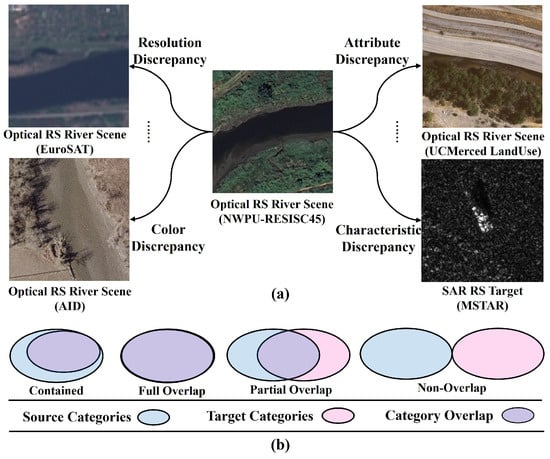
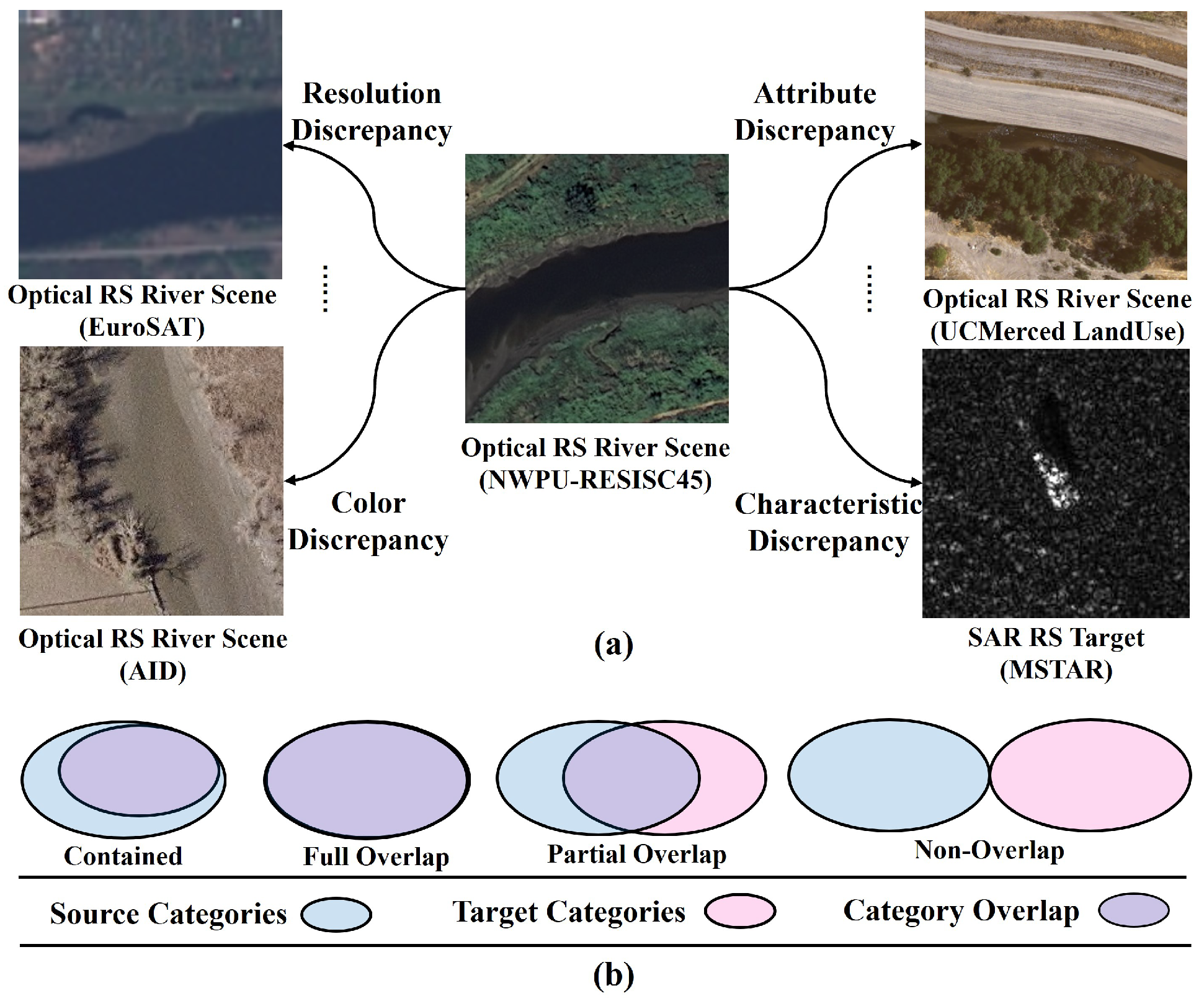
- Distribution Discrepancy: RS images from diverse platforms and locations vary in resolution, color, and attributes due to differences in sensors, angles, seasons, and imaging conditions [4]. Moreover, greater disparities in image characteristics emerge from heterogeneous imaging methods, such as optical camera and synthetic aperture radar (SAR), as shown in Figure 1a.Figure 1. Illustration of two core challenges in cross-domain RS classification. (a) Distribution Discrepancy: Visualization of heterogeneous RS data. (b) Category Misalignment: Schematic of four category overlap scenarios between source and target category sets.
- (2)
- Category Misalignment: Different RS datasets contain various categories [5], presenting four categorical relationships: contained, full overlap, partial overlap, and non-overlap, as shown in Figure 1b. While contained and full overlap allow straightforward adaptation, partial overlap and non-overlap challenge adaptation due to the absence of prior knowledge of novel categories.
Recent research primarily addresses these challenges from three perspectives. First, transfer learning methods attempt to reduce distribution gaps by aligning feature representations across domains. For example, MKJDM [6] introduces a multi-kernel domain adaptation strategy to capture transferable structures from heterogeneous RS data. While such methods improve cross-domain consistency, they rely on global distribution alignment and may struggle when category-level misalignment is severe.
Second, semi-supervised teacher–student frameworks exploit unlabeled target data to alleviate domain shift. STARTUP (STA) [7] utilizes a teacher model pre-trained on the source dataset to generate pseudo-labels for the unlabeled target data, then learns a new student model by combining supervised loss on the source data and SimCLR [8] loss on the target data, while Dynamic Distillation (DD) [9] trains a model on the labeled source data first, then continues training in a teacher–student manner, employing supervised loss on the labeled source data and distillation loss between pseudo-labels and predictions on the unlabeled target data. However, their performance is sensitive to pseudo-label quality and may degrade when predictive uncertainty is high.
Third, contrastive and self-supervised learning (SSL) approaches aim to learn domain-invariant representations without explicit alignment. MSL [10] empirically analyze the impact of domain similarity and few-shot difficulty on pre-training selection, showing that self-supervised pre-training yields greater performance gains than supervised pre-training when the target domain is dissimilar to the source domain or has low few-shot difficulty. CLD [11] aims to enhance feature learning in the target domain by introducing a cross-level distillation mechanism, which guides shallow layers to capture high-level semantic information for more discriminative representations. In addition, other self-supervised strategies, such as rotation-based [12] and reconstruction-based methods [13,14,15] further strengthen generalization by leveraging auxiliary self-supervised tasks. However, these approaches primarily focus on improving representation quality through auxiliary learning signals, but lack explicit mechanisms for rapid adaptation to novel categories and for capturing fine-grained, category-specific variations in cross-domain scenarios.
While these methods partially exploit domain-invariant features to mitigate domain discrepancies, their performance deteriorates when severe domain shift and limited labeled target samples coexist. Figure 2 illustrates how these limitations manifest in real RS datasets.
Figure 2.
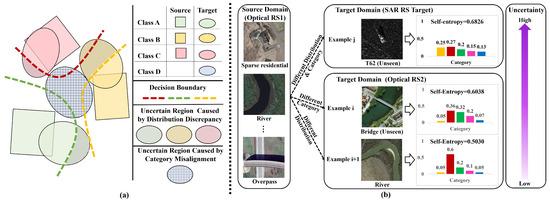
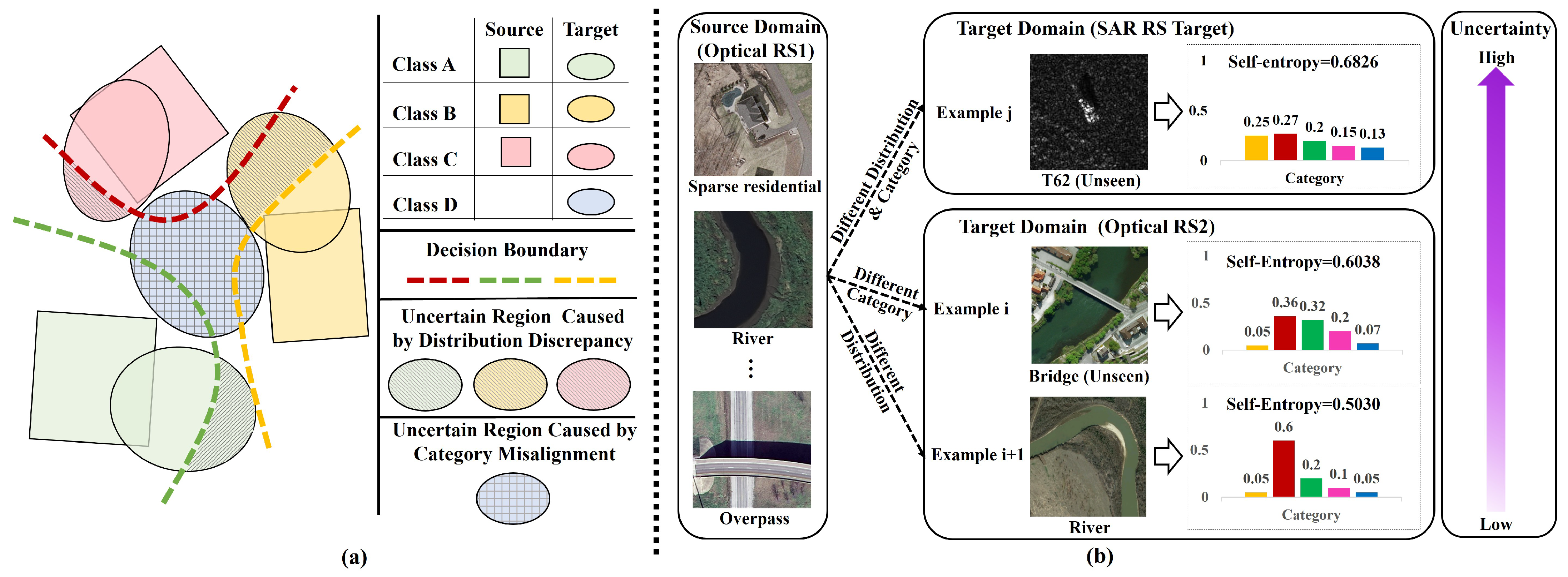
Visualization of predictive uncertainty in cross-domain RS image classification. (a) Schematic illustration in the feature space: Distribution discrepancies and category misalignment between source and target domains generate ambiguous uncertainty regions, where decision boundaries fail to reliably discriminate target samples. (b) Real RS examples: Uncertainty is quantified by the self-entropy of model predictions. Larger domain disparities (e.g., from optical to SAR modalities) result in higher uncertainty and less reliable predictions.
As shown in Figure 2b, when classifying the “Bridge” category from two different optical RS datasets (Optical RS1 → Optical RS2), pseudo-labels for target data become uncertain, as this category is absent in the source domain, with the appearance discrepancy further exacerbating uncertainty. When involving optical and SAR RS datasets (Optical RS1 → SAR RS Target), the combined effect of feature distribution differences and category misalignment leads to even higher uncertainty, as reflected by smoother probability distributions and increased self-entropy. Figure 2a summarizes the overall effect: when distribution discrepancies and category misalignment coexist, target features frequently fall near decision boundaries, resulting in pervasive predictive uncertainty. Such high-uncertainty pseudo-labels tend to accumulate errors during cross-domain training, highlighting the need to properly handle predictive uncertainty for reliable learning in CDFSSC tasks. Notably, these uncertain samples often lie near decision boundaries and contain critical information for refining discriminative boundaries across domains. Therefore, rather than discarding them, it is important to effectively exploit these samples for more discriminative representation learning.
Motivated by the high predictive uncertainty arising from distribution discrepancies and category misalignment in CDFSSC, an uncertainty-aware cross-domain (UACD) framework is proposed. The core idea is to explicitly model uncertainty and leverage it to improve both representation learning and few-shot adaptation. Specifically, during cross-domain training, a feature-decision consistency regularization (FDCR) structure is introduced to jointly enforce consistency at both feature and decision levels, which enables the model to learn stable cross-domain representations while effectively leveraging unlabeled target data under distribution shifts. In addition, an Uncertainty-Aware Knowledge Mining (UKM) policy is designed to identify and exploit informative target samples with high uncertainty, thereby refining decision boundaries under domain shift. During few-shot adaptation, an uncertainty-aware predictor that incorporates stochastic inference and uncertainty-guided aggregation is further developed to improve prediction reliability under limited labeled data and task variability.
Extensive experiments are conducted on 12 cross-domain scenarios constructed based on cross-domain difficulty, where the difficulty is quantified using the Wasserstein distance [16]. The results demonstrate that the proposed UACD framework achieves state-of-the-art performance with superior generalization ability across diverse and challenging cross-domain settings.
The main contributions of this article are as follows:
- (1)
- A UACD framework is proposed to address predictive uncertainty caused by distribution discrepancies and category misalignment in CDFSSC. The framework explicitly models and leverages uncertainty to improve both cross-domain representation learning and few-shot adaptation.
- (2)
- Within the UACD framework, a FDCR structure is introduced under a teacher–student paradigm to enforce consistency at both feature and decision levels, enabling stable cross-domain representation learning. In addition, a UKM policy is designed to mine informative knowledge from uncertain target samples via high-uncertainty re-training, thereby mitigating representation and classification uncertainty under domain shift.
- (3)
- An uncertainty-aware predictor is developed for few-shot adaptation to correct predictive uncertainty caused by limited labeled samples and episodic randomness. By incorporating stochastic multi-pass inference and residual aggregation, it stabilizes decision boundaries and improves prediction reliability. Extensive experiments further demonstrate that the proposed UACD achieves greater performance improvements under more challenging cross-domain scenarios.
The remainder of this article is organized as follows. In Section 2, related works on cross-domain few-shot learning and uncertainty estimation are reviewed. In Section 3, the proposed UACD framework is described in detail. In Section 4, the description of datasets, cross-domain difficulty measurement, experimental results, and parameter analysis are provided. Finally, the discussions and conclusions are drawn in Section 5 and Section 6.
2. Related Works
2.1. Cross-Domain Few-Shot Learning
Traditional RS scene classification methods [3,17] assume identical data distributions, but performance decreases with domain shifts. Although domain adaptation methods [18,19] reduce the domain gap by distribution alignment, they struggle with large domain and category differences, leading to suboptimal results. To address this, cross-domain few-shot learning (CDFSL) has gained attention, particularly with the Broader Study of Cross-Domain Few-Shot Learning (BSCD-FSL) benchmark [20]. CDFSL follows two main approaches: meta-learning and transfer learning.
Meta-learning-based methods [21,22,23,24,25] learn a rapid adaptation capability from source-domain episodic tasks, enabling effective generalization in the target domain. For example, FWT [26] introduces a feature-wise transform layer to simulate various distributions by affine transforms. However, under substantial cross-domain distribution shift, testing tasks may deviate significantly from those observed during meta-training, rendering the learned adaptation strategy less reliable and leading to increased predictive uncertainty.
In contrast, transfer-learning-based methods [7,9,10,20,27] typically follow a pre-training and fine-tuning paradigm, where a model is first pre-trained on a large-scale dataset (e.g., MiniImageNet [28]) or a source-domain dataset and then fine-tuned on the target domain to improve cross-domain performance. Existing works mainly focus on designing more effective adaptation strategies during the fine-tuning stage to mitigate domain shift. For example, UDL [29] enhances the fine-tuning process by introducing an uncertainty-aware dynamic threshold to partition unlabeled target samples into positive and negative sets for separate learning. CDPCR [30] develops a semi-supervised fine-tuning strategy with a pseudo-centroid contrastive representation module to learn more discriminative representations for novel target categories. UICD [31] improves adaptation by assuming that feature statistics follow a multivariate Gaussian distribution to synthesize diverse variants, thereby enhancing feature diversity and robustness.
While meta-learning uncertainty arises from task-level distribution shift, where the structure and composition of individual tasks may differ from those seen during meta-training, transfer learning uncertainty stems from domain-level distribution shift, in which the overall feature or label statistics of the target domain differ from the source domain. Under such domain-level discrepancies, the learned representations or decision boundaries may no longer align with the target data, resulting in increased predictive uncertainty and degraded classification performance. Therefore, addressing both distributional discrepancy and category misalignment is crucial to reducing uncertainty in feature representations and classification decisions, thereby enhancing CDFSSC performance.
2.2. Uncertainty Estimation
Uncertainty estimation in deep learning is crucial, as the model may struggle to generalize to new domains and output predictions with high uncertainty if novel samples have not been seen in the training process. Such uncertainty can be divided into two main types: aleatoric uncertainty and epistemic uncertainty [32]. Aleatoric uncertainty represents the inherent noise or variability in the data that cannot be reduced, such as measurement errors or ambiguous inputs. Epistemic uncertainty arises from limited training data, where the model has not fully learned the underlying data distribution, and can be mitigated by acquiring more data or improving the model. Although stochastic techniques (e.g., dropout) can enhance feature representation and robustness, models still tend to produce high-uncertainty predictions for noisy or previously unseen inputs [33], particularly under cross-domain conditions with large distribution shifts.
To address such uncertainty in semi-supervised learning, recent studies focus on data-dependent uncertainty estimation to enhance the reliability of pseudo-labels. Xie et al. [34] injected dropout, stochastic depth, and strong data augmentation into the student model to improve generalization from teacher-generated pseudo-labels. Arazo et al. [35] addressed confirmation bias in naive pseudo-labeling and showed that mixup and maintaining a minimum number of labeled samples per batch effectively reduce overfitting to incorrect pseudo-labels. Interpolation Consistency Training (ICT) [36] enforces prediction consistency at interpolated points between unlabeled samples, moving decision boundaries toward low-density regions and preventing overconfident misclassification.
Beyond these approaches, some methods explicitly quantify uncertainty to guide learning. Zhang et al. [37] computed Bayesian uncertainty across multiple 3D views and weighted each pseudo-label according to its confidence, enhancing supervision from unlabeled data. Similarly, Zheng et al. [38] modeled prediction variance in domain-adaptive segmentation to rectify noisy pseudo-labels and dynamically adjust confidence thresholds, mitigating errors caused by domain shift.
These studies demonstrate that explicitly leveraging uncertainty through variance estimation or confidence weighting can significantly improve prediction reliability, particularly under limited labeled data or cross-domain scenarios. Therefore, this paper focuses on the uncertainty involved in more challenging CDFSSC tasks in RS fields, aiming to enhance performance under distribution discrepancy and category misalignment.
3. Methodology
3.1. Preliminary
CDFSSC aims to learn transferable knowledge from a source domain and adapt it for a target domain with very limited labeled samples. Formally, the source-domain dataset is defined as , which contains labeled images. The target-domain dataset is denoted as , which is divided into three subsets: unlabeled set with images, support set with labeled images, and query set with unlabeled images. Following [9], accounts for 20% of , while and together account for the remaining 80%.
During training, both the labeled source dataset and the unlabeled target set are utilized to learn cross-domain representations. For evaluation, few-shot tasks are conducted in the target domain using and . Specifically, contains K labeled samples from each of N classes for an N-way K-shot task (typically with and ), while consists of query samples drawn from the same N classes. The goal is to correctly classify the query samples in based on the limited labeled samples in . Overall, given and , the objective is to learn a model that generalizes well to the few-shot classification task defined on and in the target domain.
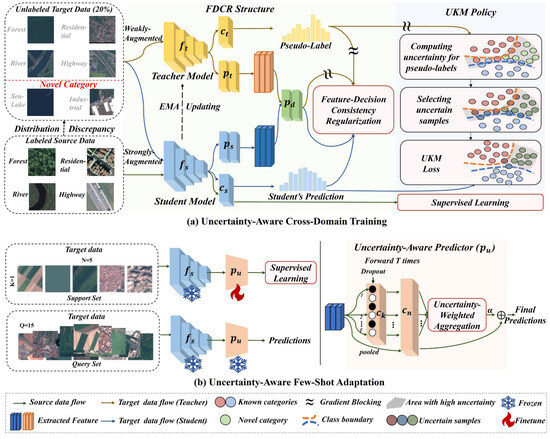
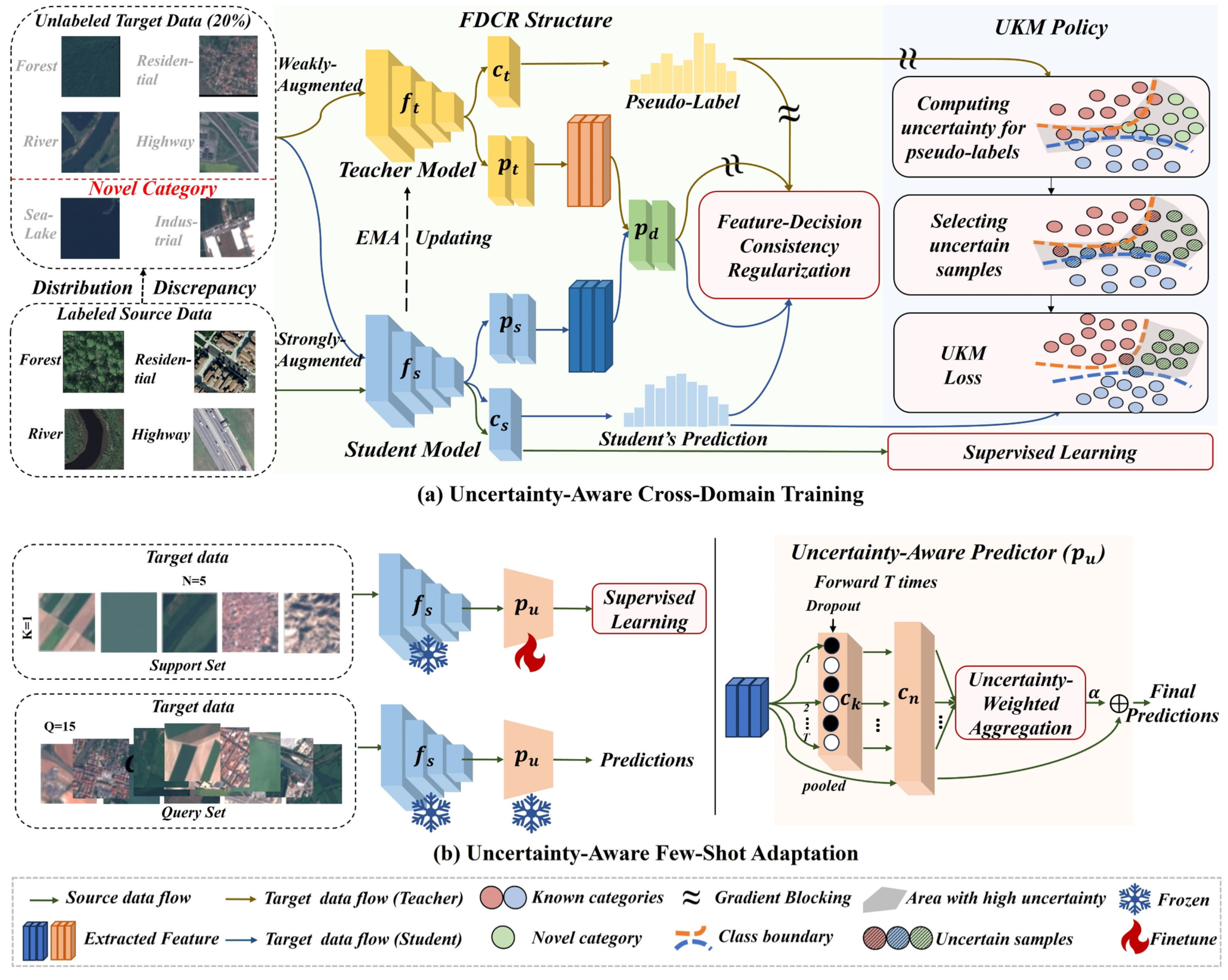
The UACD framework consists of two stages: uncertainty-aware cross-domain training and uncertainty-aware few-shot adaptation, as shown in Figure 3. The following sections detail the overall pipeline of the proposed framework.
Figure 3.
Overview of the proposed UACD framework, consisting of two key stages. (a) Uncertainty-aware cross-domain training: The labeled source domain and 20% unlabeled target domain data are jointly trained via the FDCR structure and UKM policy. (b) Uncertainty-aware few-shot adaptation: The backbone is frozen, and a novel uncertainty-aware predictor is fine-tuned on the support set. Subsequently, both and are frozen to generate predictions for the query set.
3.2. Uncertainty-Aware Cross-Domain Training
In the uncertainty-aware cross-domain training stage, a semi-supervised training mechanism is adopted to achieve efficient and stable cross-domain representation learning. Both and are jointly utilized, as illustrated in Figure 3a. To effectively leverage unlabeled target data while mitigating the impact of predictive uncertainty, two key mechanisms are introduced: FDCR and UKM.
3.2.1. FDCR Structure
To address feature instability and prediction inconsistency, FDCR is proposed to integrate feature-level and decision-level consistency regularization within a teacher–student framework.
As illustrated in Figure 3a, the student and teacher models share a common backbone, each consisting of a feature extractor ( and ), a projector ( and ), and a classifier ( and ). Based on this backbone, a feature-level consistency branch is constructed using the MLP projectors and together with an additional predictor , while a decision-level consistency branch is formed by the classifiers to enforce prediction alignment.
During training, heterogeneous perturbations are introduced to simulate distributional discrepancies between domains, which encourages the model to learn consistent cross-domain representations. Specifically, for an unlabeled target image , weak (e.g., resize–crop and horizontal flip) and strong (e.g., color jitter, Gaussian blur, and random grayscale) augmentations are performed to generate two perturbed views. The weakly augmented sample is fed into to obtain relatively stable representations, whereas the strongly augmented sample is fed into to enhance robustness under harder perturbations. The resulting teacher feature and student feature are given by
Next, feature-level consistency regularization is applied to reduce domain-induced representation discrepancies. As the first step, and are projected by and to obtain the teacher projection and the student projection as
Then, the projections are passed through , yielding transformed representations used for subsequent consistency optimization and :
Following, the loss of the feature-level branch is defined as to quantify the consistency between feature representations obtained from the two augmentation strategies:
where is the negative cosine similarity, which is computed as
Meanwhile, and are fed into the decision-level branch to achieve stable model predictions for the same input under different perturbations, where and generate predictions and . To enhance the discriminative strength of the consistency constraint, the teacher prediction is sharpened via a learnable temperature parameter before being used as a soft pseudo-label , producing a more concentrated distribution that provides a clearer directional alignment signal for the student model:
Here, compared with hard pseudo-labels that retain only the maximum-probability class, soft pseudo-labels preserve the complete prediction distribution, providing richer alignment signals for decision-level consistency learning. The loss for the decision-level branch is optimized between the soft pseudo-label and the student’s prediction , which is calculated by the cross-entropy as
In addition to the unlabeled target data described above, supervised learning on the labeled source dataset is applied to the student model, which helps the model preserve knowledge from the source domain. The loss is computed using cross-entropy between the student’s predictions and ground-truth labels as
where .
Finally, based on the mean-teacher parameter update mechanism [39], the student and teacher models are initialized with the same pre-trained weights. During training, the student model is optimized via back-propagation, while the teacher model does not receive gradient updates, as illustrated by ‘≈’ in Figure 3a. Instead, the teacher parameters at step a are updated as the exponential moving average (EMA) of the student parameters :
where m is the momentum parameter and it is fixed as 0.99. By maintaining the teacher model as the EMA of successive student models, it provides more stable and temporally smoothed targets, which alleviates the effect of noisy updates and improves the reliability of consistency learning.
Through the FDCR framework, the model achieves both feature-level and decision-level consistency, effectively mitigating representation instability and prediction inconsistency under CDFSSC settings. Feature-level consistency encourages the model to learn similar representations from different augmentations of the same input, enhancing feature robustness. Decision-level consistency ensures stable predictions between the teacher and student models, thereby leveraging unlabeled target data for cross-domain representation learning. The former provides a solid foundation for the latter, as improved feature representations yield more reliable decisions. By jointly promoting these complementary consistencies, FDCR encourages the model to learn more stable cross-domain representations, thereby enhancing robustness and generalization across domains. These stable representations make predictive uncertainty estimation more reliable, enabling the model to accurately identify informative yet uncertain samples for subsequent knowledge mining.
3.2.2. UKM Policy
In the FDCR framework, the teacher model inevitably produces uncertain pseudo-labels for unlabeled target samples, which may accumulate errors and destabilize training. Existing methods, such as FixMatch [40], mitigate this issue by selecting only high-confidence pseudo-labels using a predefined threshold. However, such strategies are less effective in CDFSSC due to severe domain shift across target domains, where many informative samples exhibit high uncertainty. Notably, high-uncertainty samples tend to induce larger optimization gradients and provide stronger corrective signals for model adaptation. Therefore, instead of discarding uncertain samples, a UKM policy is designed to explicitly quantify pseudo-label uncertainty and selectively exploit high-uncertainty samples, thereby improving cross-domain feature discriminability.
After performing consistency regularization in FDCR, the UKM policy first estimates the uncertainty of each target sample’s pseudo-label using self-entropy, chosen for its simplicity and effectiveness. Specifically, given a target sample , the teacher’s prediction is . The uncertainty of is computed as
Higher self-entropy indicates greater classification ambiguity, reflecting higher pseudo-label uncertainty, as illustrated in Figure 2b.
Then, for each mini-batch (with batch size ), the samples are sorted by from high to low by the function , and the indexes of the sorted samples are as
When the source and target domains differ significantly in distribution and categories, reliable knowledge from valid target samples is limited in cross-domain training. However, substantial target-domain-specific information is embedded in samples with high-uncertainty pseudo-labels, which is crucial for representation learning. Therefore, selecting these uncertain samples and further mining knowledge from them is essential to enhance the model’s adaptation and generalization on the target domain.
Here, the top number of samples with higher-uncertainty pseudo-labels are taken as uncertain samples, where r is a learnable selection ratio, and their corresponding index is denoted as . Additional back-propagation is performed on the consistency regularization computed over these uncertain samples. The loss for uncertain sample learning is computed as
Here, B denotes the total batch number, and represents the number of uncertain samples per batch. The introduction of encourages the model to produce more confident predictions on ambiguous samples, thereby enhancing its generalization on the target domain.
Finally, the total loss function L of the training process is
where the coefficient is designed to balance training stability and the utilization of uncertain samples. In early stages, predictions on target data are less reliable due to domain discrepancy, and overly emphasizing uncertain samples may introduce noisy supervision. Therefore, a smaller helps maintain stable optimization. As training progresses and the model becomes more reliable, increasing allows the model to gradually focus on decision-level consistency and uncertain samples, facilitating more effective boundary refinement.
In the uncertainty-aware cross-domain training stage, the FDCR structure and UKM policy work collaboratively to enhance cross-domain representation learning. FDCR serves as a stabilization mechanism that reduces noise and ambiguity, enabling UKM to focus on high-uncertainty samples and refine feature boundaries, thereby improving feature discrimination in ambiguous regions of the target-domain feature space. This synergy results in a model that is better equipped to learn stable and reliable cross-domain representations, effectively mitigating distribution discrepancies.
3.3. Uncertainty-Aware Few-Shot Adaptation
After uncertainty-aware cross-domain training, few-shot adaptation is performed to adapt the model to target domain tasks and assess its performance. In this stage, following the pre-training and fine-tuning paradigm, the student feature extractor is finally used, and its parameters are frozen. To adapt to the few-shot classification tasks in the target domain and address the category misalignment issue, an uncertainty-aware predictor is designed to mitigate category misalignment by accounting for predictive uncertainty for classification calibration, enhancing decision-making and improving the model’s adaptability to novel categories with limited labeled data.
As shown in Figure 3b, incorporates a residual structure with a fully connected (FC) layer and an uncertainty calibration mechanism based on Monte Carlo (MC) dropout [41], followed by a classifier .
During this stage, data from the support set is first fed into the student feature extractor to obtain features a. These features are then passed through for T times, producing T outputs that fine-tune them for the target-domain few-shot classification task, where dropout is enabled on :
which are then fed into the classifier to generate predictions:
The value of T controls the quality of uncertainty calibration: multiple predictions are averaged to reduce variance and improve robustness, while increasing T also increases computational overhead.
For each sampled prediction , the mean and variance are computed as in (16) and (17):
where measures uncertainty. Predictions with lower uncertainty are assigned higher weight using an exponential decay function as
where is a small constant for numerical stability. The weight is then normalized to ensure the consistency and numerical stability of the weighted averaging process across T predictions, while avoiding excessive influence of overly large or small weights on the final result. Then, the multiple predictions are aggregated as
Each forward pass, enabled by MC-dropout, introduces randomness into the predictor by activating dropout layers, simulating different network configurations. It captures the model’s variability and outputs a distribution of predictions. By doing so, the predictor can assess the confidence of its predictions and adjust outputs accordingly. The final predictions are fused from and the original predictions by
where is a learnable parameter to balance the two kinds of predictions.
Such a residual-like uncertainty-aware predictor provides a mechanism for task-specific adaptation: it refines features extracted by the student model while retaining the general knowledge encoded in its pre-trained representations. The aggregated outputs are then used to compute a supervised cross-entropy loss, and back-propagation is performed to optimize . By leveraging a few labeled target-domain samples, calibrates predictions and enhances model robustness, ultimately improving reliability in decision-making for target-domain few-shot classification tasks. Finally, the few-shot performance of the feature extractor and predictor is evaluated on the query set , with both and frozen and dropout still enabled on the FC layer in .
4. Experiments
This section evaluates the proposed UACD on 12 cross-domain scenarios for CDFSSC tasks using RS imagery, including Optical-Optical and Optical-SAR, with five representative datasets: EuroSAT (ES), NWPU-RESISC45 (NWPU), AID, UCMerced LandUse (UCM), and MSTAR. Detailed dataset information is provided in Table 1. First, cross-domain difficulty is measured. Then, comparisons with other CDFSL methods are presented. Ablation experiments, including visualizations and uncertainty analysis, assess the impact of each factor. Finally, different approaches for treating uncertain samples are compared and analyzed.
Table 1.
Detailed information about datasets used in experiments.
4.1. Cross-Domain Difficulty Measurement
The degree of difference between various datasets determines the challenge of cross-domain representation learning. To assess the cross-domain difficulties (CDDs) of various scenarios explicitly, quantitative analysis is required. CDD is determined by domain discrepancy and domain scale. Domain discrepancy refers to the gap between the source and target domains, while domain scale includes the number of categories and the number of images per category. This definition follows the commonly adopted assumption in cross-domain learning that larger domain discrepancy generally implies higher transfer difficulty. CDD can be estimated using the Wasserstein distance [16], inspired by the works of Cui et al. [47], as it provides a stable measure for discrepancies between distributions with limited overlap.
Specifically, let the source domain be and the target domain be , where denotes the i-th category in S, similarly for in T. Here, m and n are the total number of categories in S and T, respectively.
First, feature representations of images in both domains are extracted using a network pre-trained on the source dataset, yielding for source images and for target images. To reduce computational cost, each category is represented by the mean of its image features, denoted as and . Each category is assigned a weight or :
where and denote the number of images in and . By this definition, the weights are automatically normalized within each domain, so that . Then, the distance between a source category and a target category is defined as the Euclidean distance between their mean feature representations:
Finally, the Wasserstein distance between S and T is defined as
where the optimal flow represents the minimum total work between and under Wasserstein distance constraints. A larger Wasserstein distance between S and T indicates a greater domain shift, resulting in a higher CDD, which is then formulated as
where is set as 0.1.
The CDD values for the experimental scenarios are listed in Table 2 and key points are summarized as follows:
Table 2.
Wasserstein distance () and CDD ().
- (1)
- Optical-Optical: The NWPU and AID datasets, both sourced from Google Earth, exhibit minimal distribution differences, resulting in the lowest CDD. Conversely, the ES dataset, with fewer categories and notable distribution gaps, presents greater challenges as a target domain. The UCM dataset, due to its small scale and limited data, poses the greatest difficulty when used as the source domain.
- (2)
- Optical-SAR: The differing imaging mechanisms cause significant domain differences in distribution and categories between optical and SAR data. This large distribution discrepancy leads to the highest CDD when the MSTAR dataset is used as target data.
4.2. Experimental Setup
In our experiments, three RS scene datasets—NWPU, AID, and UCM—are sequentially used as source datasets, with the remaining datasets serving as corresponding target datasets. Five-way one-shot and five-way five-shot few-shot classification tasks are performed, and the top-1 accuracy and 95% confidence interval over 600 runs are used for the evaluation metric. We adopt the small-scale CNN ResNet-10 [48] as the backbone network in our UACD framework to reduce computational cost and improve generalization under limited labeled samples. Since only 20% of target-domain data is available, larger models tend to overfit and fail to achieve robust cross-domain transfer, making a lightweight backbone more suitable.
During the cross-domain training phase, the backbone is trained for 100 epochs, with the weight (Equation (13)) linearly increasing from 0 to 1 until epoch 60 to stabilize early training and gradually strengthen the effect of consistency regularization and uncertain sample learning. For the few-shot adaptation stage, the number of MC-dropout iterations is fixed at in all experiments to balance calibration quality and computational efficiency. All experiments were implemented in PyTorch 1.7.1 on a Tesla V100 GPU (NVIDIA, Santa Clara, CA, USA).
4.3. Comparison to State-of-the-Art Methods
4.3.1. Comparison Methods
(1) Meta-learning-based (ML) methods: four methods for natural images: AFA [49], ATA+DSD-LS [50], LDP-Net [23], and StyleAdv [22]; and two recent methods for RS images: DMN [24], and MVP [51]. (2) Transfer-learning-based (TL) methods: FixMatch (FM) [40], STA [7], DD [9], mixed-supervised learning (MSL) [10] and cross-level distillation (CLD) [11], Bidirectional Sample-Class Alignment (BSCA) [18], Uncertainty-Aware Dynamic Learning (UDL) [29], Cross-Domain Pseudo-Centroid Representation (CDPCR) [30], and Uncertainty-Injected Cross-Domain (UICD) [31]. They share the same settings of leveraging the labeled source data and part of the unlabeled target data during cross-domain training.
All the comparison methods except MVP use the ResNet-10 as the backbone, and MVP uses the ViT-tiny [52] as the backbone. All the backbones are pre-trained on the MiniImageNet [28] dataset.
4.3.2. Results Analysis
The results are shown in Table 3, Table 4, Table 5 and Table 6, demonstrating the superiority of the UACD framework. In 12 cross-domain scenarios, UACD achieves the best or second-best results in 10 cases for both five-way one-shot tasks and five-shot tasks, with partially different scenarios.
Table 3.
Evaluation on Optical-Optical cross-domain scenarios (source: NWPU, Avg CDD: 0.52). Results are reported as the average classification accuracy (%) with 95% confidence intervals (bold: best; underline: second best).
Table 4.
Evaluation on Optical-Optical cross-domain scenarios (source: AID, Avg CDD: 0.53). Results are reported as the average classification accuracy (%) with 95% confidence intervals (bold: best; underline: second best).
Table 5.
Evaluation on Optical-Optical cross-domain scenarios (source: UCM, Avg CDD: 0.67). Results are reported as the average classification accuracy (%) with 95% confidence intervals (bold: best; underline: second best).
Table 6.
Evaluation of performance on Optical-SAR cross-domain scenarios. Target: MSTAR. Average CDD: 0.71. Results are reported as the average classification accuracy (%) with 95% confidence intervals (bold: best; underline: second best).
In comparison with ML methods, UACD outperforms most approaches under the five-way one-shot setting. It is worth noting that when the number of support examples increases to five, some ML methods become more competitive and achieve performance comparable to or slightly better than UACD. This is likely because ML approaches are explicitly designed to leverage multiple support samples for rapid task adaptation, enabling them to benefit more substantially from increased supervision within each task.
UACD also demonstrates strong performance compared with multiple state-of-the-art TL methods, achieving competitive or superior results. Using DD as a representative method, we further analyze how UACD performs under varying CDD in five-way one-shot tasks. In Optical–Optical scenarios, when the source domain is NWPU (with the lowest average CDD of 0.52), UACD outperforms DD by an average of . When the source domain shifts to UCM (average CDD of 0.67), the performance gain increases to . In the more challenging Optical–SAR scenarios (with the highest CDD of 0.71), UACD achieves the largest improvement, surpassing DD by .
This phenomenon can be attributed to the fact that larger CDD values imply more severe distribution discrepancies and category misalignment between source and target domains, thereby substantially increasing predictive uncertainty. During the meta-training stage of meta-learning and the fine-tuning stage of transfer learning, these cross-domain inconsistencies reduce the transferability of learned representations and undermine the reliability of decision boundaries. Consequently, predictive uncertainty is further amplified as domain discrepancy increases. Since UACD explicitly models and mitigates such uncertainty, its advantage becomes more pronounced under higher CDD conditions, where uncertainty-aware adaptation plays a more critical role in stabilizing decisions and correcting unreliable predictions.
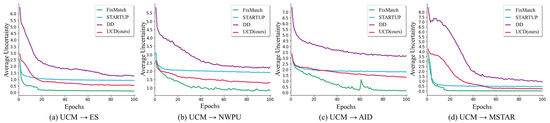
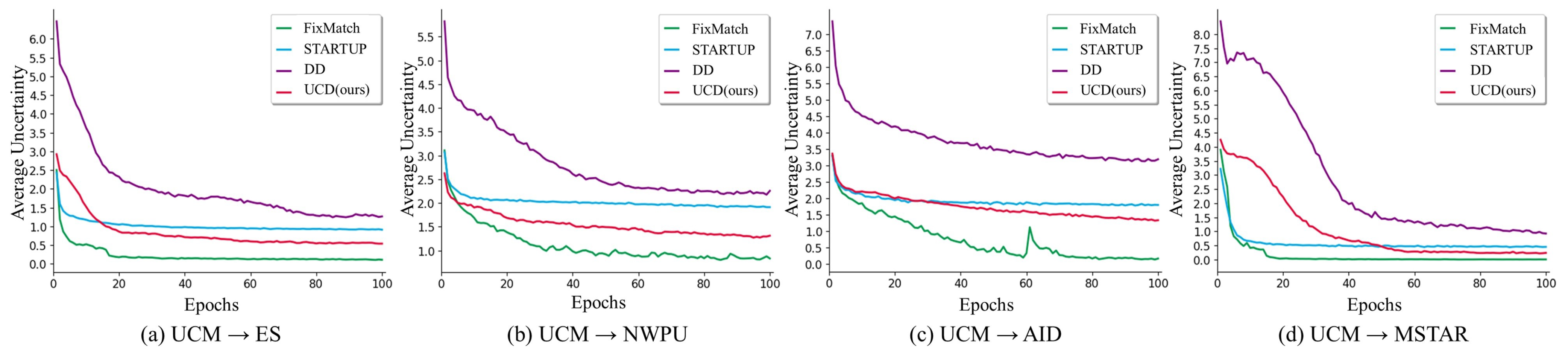
To assess the effectiveness of UACD in reducing predictive uncertainty, we visualize the batch-wise average self-entropy of different teacher–student-based TL methods in Figure 4, which quantifies the uncertainty of the student model’s predictions.
Figure 4.
Comparison of average predictive uncertainty of the student model across TL methods in 4 challenging cross-domain scenarios, measured by self-entropy.
As shown in Figure 4, UACD consistently maintains lower uncertainty across all four cross-domain scenarios and exhibits a noticeably faster convergence rate. Specifically, UACD significantly reduces self-entropy at the early stage of training and stabilizes at a low level in later epochs, indicating more reliable prediction confidence and enhanced representation robustness. In contrast, DD and STA show slower uncertainty reduction and larger fluctuations during training, suggesting less stable adaptation under domain shifts. Although FM achieves the lowest uncertainty values, this is mainly because it retains only high-confidence pseudo-labels for training while discarding uncertain samples. Such a selective strategy underutilizes target-domain information and restricts effective knowledge transfer, ultimately leading to inferior classification performance despite lower entropy.
4.3.3. Computational Efficiency Analysis
In real-world RS applications, computational efficiency is also a critical requirement alongside classification performance. To provide a clearer evaluation, we conduct a comparative analysis of the training cost of UACD against representative baselines, including the DD method as the primary baseline and a transferring-based method (ResNet-10 pre-trained on the source domain), under identical experimental settings.
As shown in Table 7, the training time of UACD is generally comparable to that of DD, and in several cases, even slightly lower. Although DD and UACD involve additional teacher–student interactions, they do not incur higher computational cost. Instead, they achieve lower training time in most cross-domain scenarios. These results demonstrate that UACD achieves improved cross-domain generalization performance without sacrificing computational efficiency, highlighting its suitability for practical RS applications where both accuracy and efficiency are required.
Table 7.
The training time for 100 epochs (Hour) of each method on different cross-domain scenarios.
4.4. Ablation Study
Extensive ablation studies are conducted to assess the impact of each component in the proposed UACD. This study spans all 12 cross-domain scenarios, with average performance results presented in Table 8. In the header row, “T-S” refers to the teacher–student structure with consistency regularization; “DL” denotes decision-level consistency regularization (using hard (H) or soft (S) pseudo-labeling); “EMA” refers to mean-teacher parameter updating; “FL” represents the feature-level consistency regularization branch; “UKM” refers to the uncertainty-aware knowledge mining policy; and “UP” represents the uncertainty-aware predictor . All the ablation experiments are under the same settings.
Table 8.
Ablation study on 12 cross-domain scenarios. Results are reported as the average classification accuracy (%) with 95% confidence intervals.
The ablation results reveal a clear progressive improvement as key components are gradually introduced into the framework. Comparing configurations 1 and 2, combining soft pseudo-labeling with the mean-teacher structure better leverages unlabeled target data. Configuration 4 outperforms configuration 3 by adding the feature-level branch, which enforces feature-level consistency to improve robustness and generalization. The UKM policy improves performance by 2.09% (configuration 3 vs. 5) through focusing on uncertain samples, thereby increasing training reliability. The UACD without UP shows a 4.15% improvement over configuration 3, demonstrating the benefits of FDCR and UKM in stabilizing and strengthening cross-domain representation learning. Finally, incorporating UP in the few-shot adaptation stage further enhances performance, improving adaptability and decision-making.
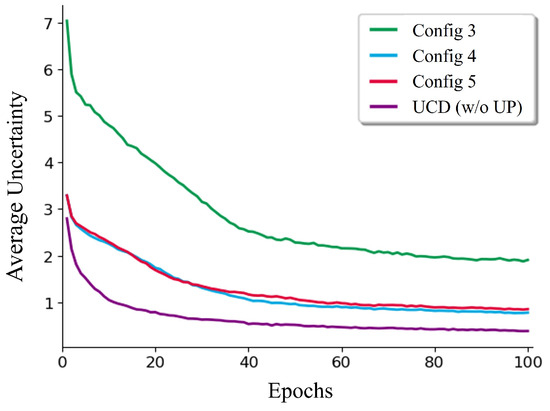
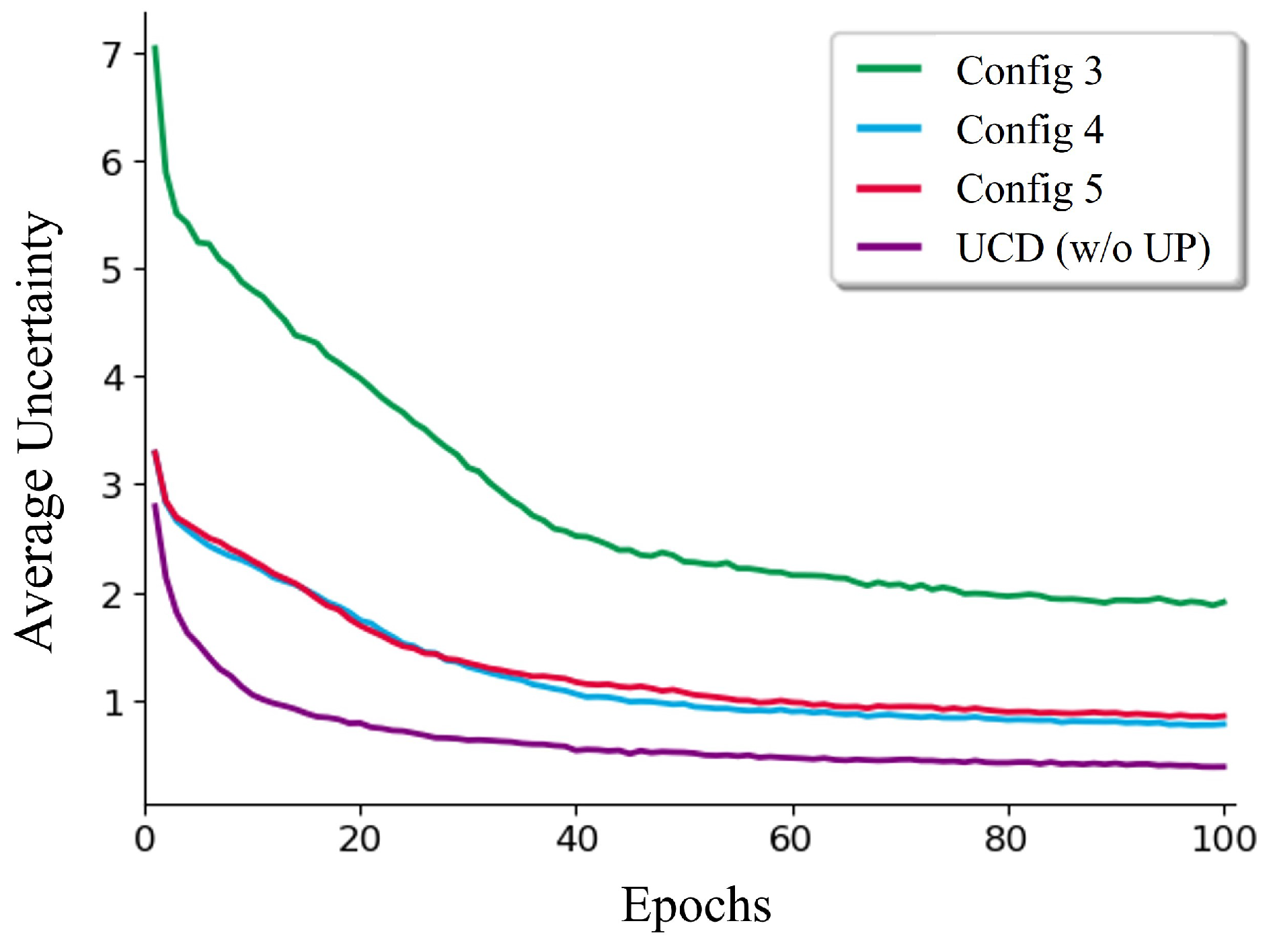
To better understand the performance gains brought by each component, we further examine their impact on predictive uncertainty by visualizing the average uncertainty throughout training, as shown in Figure 5. Across all scenarios, configurations 4 and 5 consistently exhibit lower uncertainty levels than configuration 3 and demonstrate faster convergence. Specifically, uncertainty decreases more rapidly in the early training stages and stabilizes at a lower level in later epochs. Furthermore, the UACD framework without UP, which integrates both FDCR and UKM, achieves an even greater reduction in predictive uncertainty, maintaining the lowest entropy throughout training.
Figure 5.
Ablation study on average predictive uncertainty of the student model for unlabeled target data over training epochs, measured by self-entropy.
These findings indicate that FDCR and UKM contribute to cross-domain adaptation in a complementary manner. By enforcing feature-decision consistency, FDCR encourages consistent predictions on unlabeled target data, which makes high-uncertainty target samples easier to identify under domain shift. Leveraging this property, UKM further improves adaptation by selectively exploiting these uncertain samples. Together, the two components complement each other, stabilizing the optimization process and yielding more robust cross-domain generalization.
4.4.1. Visualization Analysis of Feature Embeddings
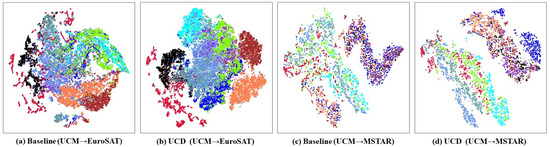
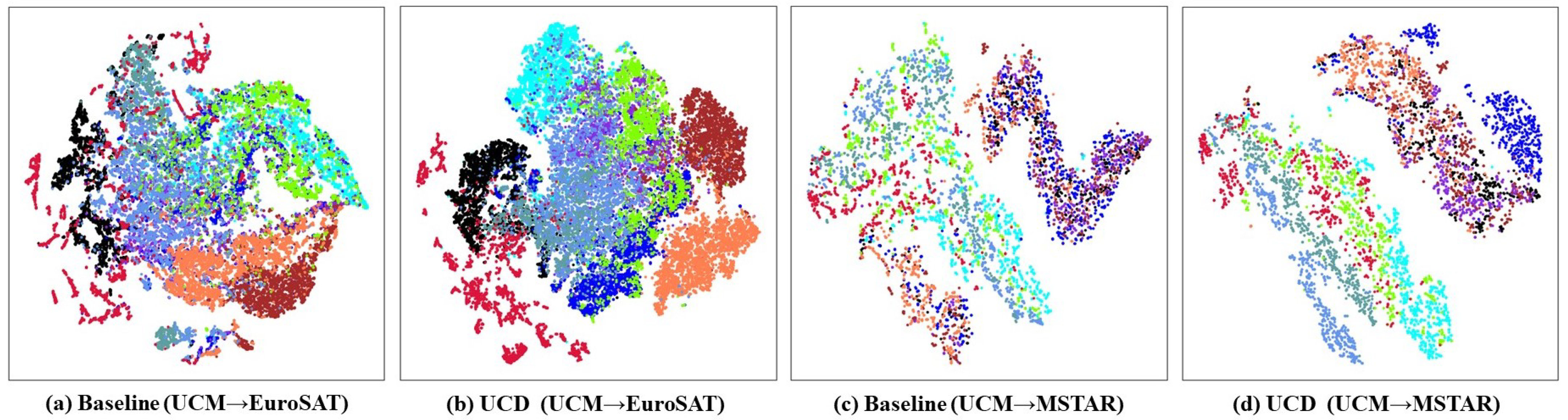
To further validate the representation capability of UACD in challenging cross-domain scenarios, we visualize the feature distributions using t-SNE [53] for the two most difficult settings, UCM → ES and UCM → MSTAR, as shown in Figure 6.
Figure 6.
T-SNE visualization of target-domain feature embeddings for two challenging cross-domain scenarios. Subfigures (a,b) compare the Baseline and UACD on UCM → ES, respectively, while (c,d) provide the corresponding comparison on UCM → MSTAR. Each point represents a target-domain sample, and colors denote different categories.
As illustrated in Figure 6, the Baseline produces relatively scattered and disordered feature distributions, with substantial overlap across different categories and blurred class boundaries, indicating its difficulty in forming well-structured intra-class clusters. In contrast, under the same task settings, UACD generates more compact intra-class clusters and clearer inter-class separation. This improved structural organization reflects stronger representation stability and enhanced discriminative capability in cross-domain scenarios.
4.4.2. Visualization Analysis of Model’s Attention
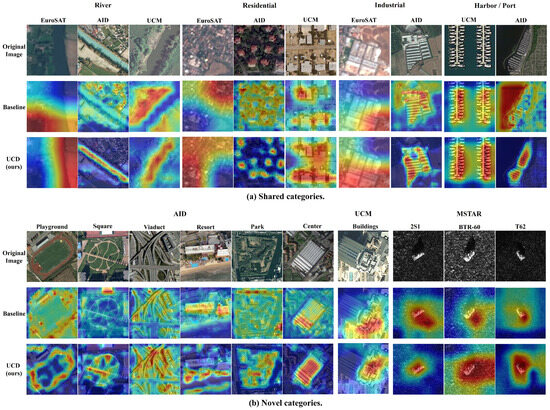
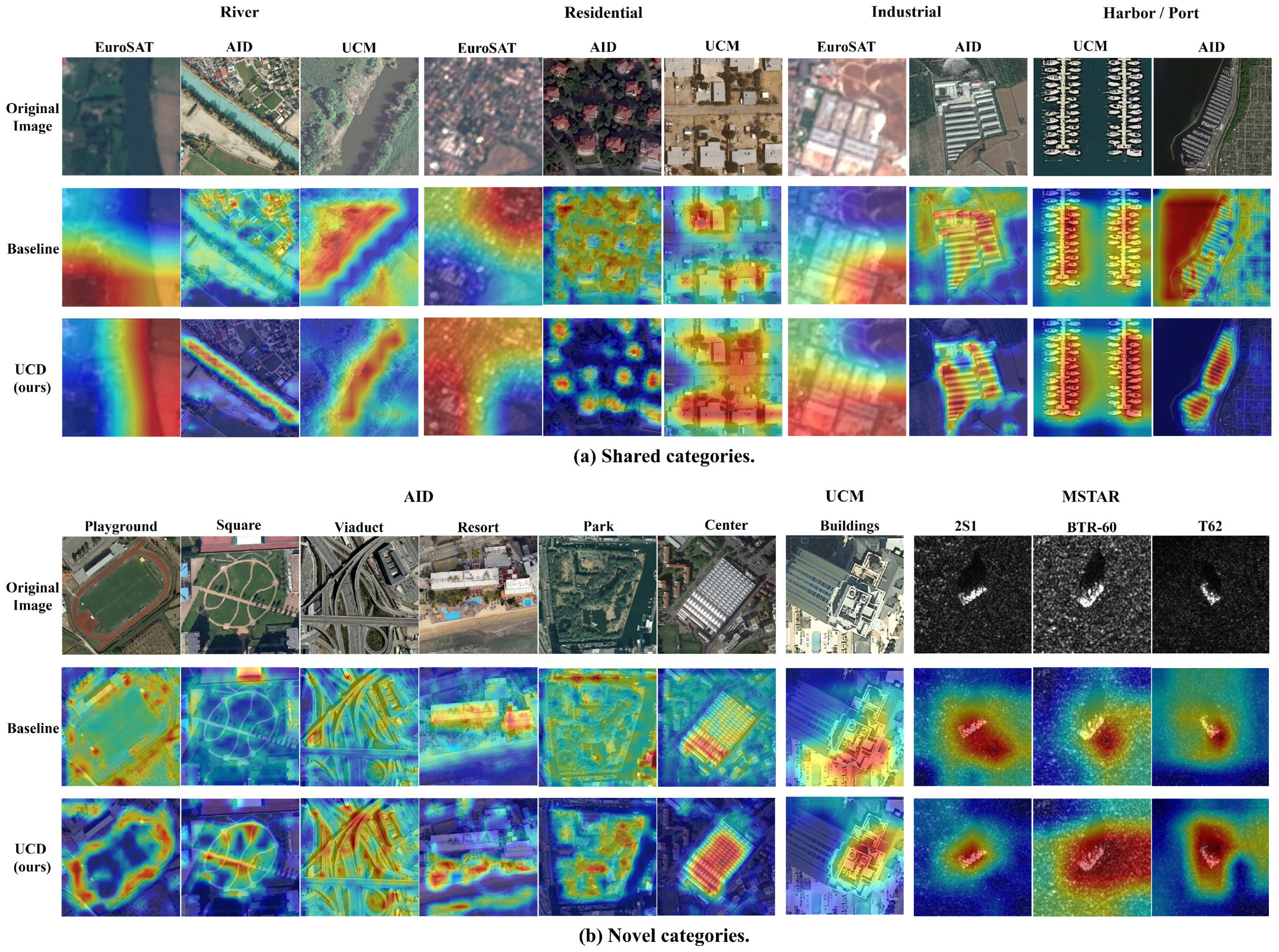
To visually compare the cross-domain attention behaviors of the Baseline and UACD, we conduct experiments where the NWPU dataset serves as the source domain. Figure 7 presents representative attention distributions for shared and novel categories, respectively. The Baseline is selected due to its architectural similarity, enabling a more interpretable analysis of the proposed components.
Figure 7.
Grad-CAM [54] visual comparisons of attention maps between the Baseline and UACD under cross-domain settings with NWPU as the source domain. Warmer colors (e.g., deep red) denote higher activation scores, indicating regions that contribute more strongly to the model’s prediction, whereas cooler colors correspond to lower responses.
In Figure 7a, for shared categories between source and target domains, UACD maintains robust feature representation despite discrepancies in resolution and color, consistently focusing on key semantic regions. In contrast, the Baseline exhibits more dispersed attention, with activations extending to irrelevant areas. In Figure 7b, for novel categories, UACD demonstrates stronger cross-domain capability by accurately highlighting discriminative regions, such as the playground oval, square pathways, viaduct shadows, and beach structures in resort scenes. Meanwhile, the Baseline’s attention remains scattered and less semantically aligned with the target objects.
Notably, the rightmost column of Figure 7b illustrates an extreme scenario: the source domain consists of NWPU optical images, while the target domain is MSTAR SAR imagery, introducing both distribution discrepancy and category misalignment. Even under these challenging conditions, UACD effectively concentrates attention on the target objects, whereas the Baseline’s activations remain diffuse. These results provide qualitative evidence that UACD improves attention localization and feature interpretability under cross-domain settings, complementing the quantitative results reported in the Experimental Section.
4.5. Parameter Analysis
4.5.1. Effect of the Selection Ratio r
In UACD with the UKM policy, the selection ratio controls the proportion of target samples identified as uncertain and subsequently emphasized during training. Intuitively, means UKM policy is not activated, while means all target samples are selected as uncertain, which degenerates UKM into redundant re-training of the entire target set.
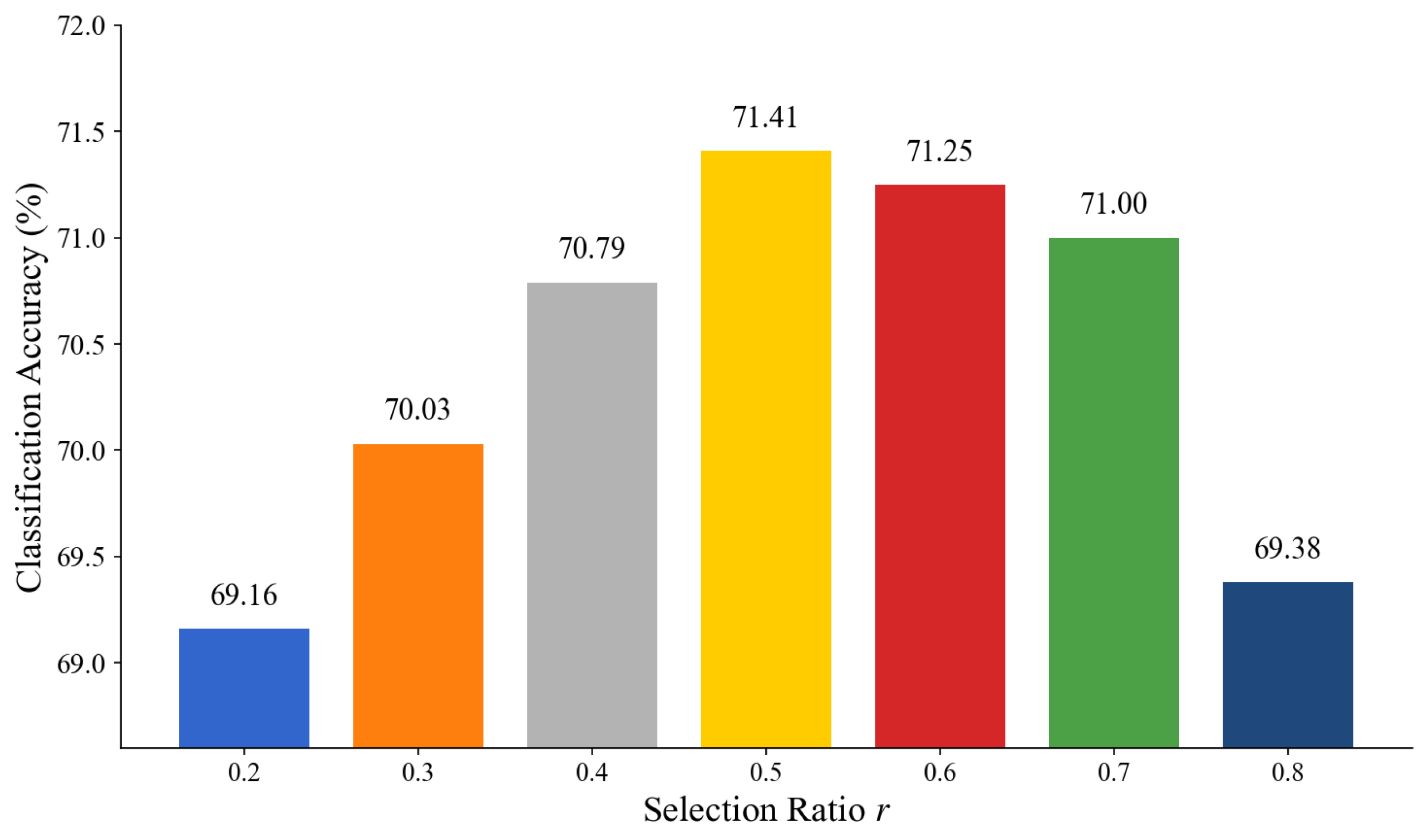
To investigate the impact of r, we conduct experiments across all 12 cross-domain scenarios under the five-way one-shot setting, varying r within the range , as an excessively small r limits the exploitation of informative uncertain samples, and an overly large r introduces many easy samples with confident pseudo-labels, both of which reduce the effectiveness of selective mining.
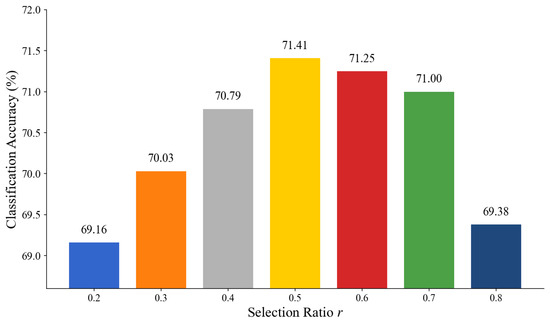
As shown in Figure 8, the proposed method achieves the best performance when , indicating that a moderate proportion of uncertain samples allows UKM to effectively focus on informative and boundary-relevant instances under high cross-domain discrepancy. For each cross-domain scenario, the final value of r is selected individually within this range to maximize performance.
Figure 8.
Sensitivity analysis of selection ratio r on average 5-way 1-shot classification accuracy (%) for UACD across 12 cross-domain scenarios ().
4.5.2. Effect of the Temperature Sharpening
The experiments on the sharpening temperature for the teacher model’s predictions are also conducted. Specifically, a lower temperature produces a more peaked distribution, while a higher temperature leads to a smoother distribution. Unlike conventional knowledge distillation, where is often adopted, such a setting is not suitable here, as overly smooth pseudo-labels weaken discriminative consistency. Therefore, we constrain within the range of 0.1, 0.3, 0.5, 0.8, and 1.0, as shown in Table 9.
Table 9.
Effect of the temperature sharpening for UACD. Results are reported as the average classification accuracy (%) with 95% confidence intervals (source domain: UCM, under ).
The results suggest that for most cross-domain scenarios, a lower sharpening temperature () achieves better performance, as it allows the soft pseudo-labels to retain a certain level of category relationship information, enabling the model to fully utilize the target-domain information and learn robust representations. For each cross-domain scenario, the final value of is individually chosen within this range to optimize cross-domain adaptation.
5. Discussion
Although the proposed UACD demonstrates clear improvements in CDFSSC, several aspects merit further discussion.
By incorporating uncertainty at both cross-domain training and few-shot adaptation stages, UACD enhances cross-domain stability, enables more reliable exploitation of target samples with higher predictive uncertainty, and improves few-shot adaptability through uncertainty-aware prediction. These strengths collectively contribute to its robust performance across various scenarios with different kinds of distribution discrepancy and category misalignment. However, the current framework primarily models overall predictive uncertainty and does not explicitly distinguish between different types of epistemic uncertainty, such as parameter or structural uncertainty, which may limit its effectiveness under severe heterogeneity. Additionally, UACD applies a fixed adaptation strength across tasks, without accounting for varying difficulty levels among cross-domain scenarios.
Future work may therefore focus on integrating multi-level uncertainty modeling, coupling uncertainty estimation with domain-difficulty assessment for adaptive cross-domain learning, and extending the framework to more complex settings such as multi-source adaptation and large-scale RS foundation models. These directions could further unlock the potential of uncertainty-driven methods for robust and scalable cross-domain scene classification.
6. Conclusions
In this article, a novel uncertainty-aware cross-domain (UACD) framework is proposed for Cross-Domain Few-Shot Scene Classification from remote sensing (RS) imagery. The framework integrates uncertainty estimation throughout both cross-domain training and few-shot adaptation, allowing the model to account for predictive uncertainty and mitigate its influence on classification outcomes.
During cross-domain training, UACD simultaneously leverages labeled source data and partially unlabeled target data. This stage incorporates two key components: a feature-decision consistency regularization (FDCR) structure and an uncertainty-aware knowledge mining (UKM) policy. Specifically, FDCR enforces consistency at both the feature and decision levels across differently augmented unlabeled target samples, thereby enhancing model generalization and stabilizing training, providing a reliable basis for uncertainty estimation. Building upon this, UKM evaluates the predictive uncertainty of pseudo-labeled target samples via self-entropy and selectively extracts informative knowledge from high-uncertainty samples, effectively focusing on ambiguous instances. In the few-shot adaptation stage, an uncertainty-aware predictor is designed using a residual structure combined with Monte Carlo dropout. The residual structure preserves the generalizable features learned during training, ensuring that the model’s pre-trained knowledge from the source domain is not disrupted, while Monte Carlo dropout mitigates classification uncertainty. Together, they enhance the model’s adaptability and address category misalignment in few-shot target tasks.
Extensive experiments demonstrate UACD’s superior performance, robustness, and generalization, with greater improvements observed in more challenging cross-domain scenarios. Future work will explore advanced uncertainty-based techniques for cross-domain challenges and generalization in RS imagery.
Author Contributions
Conceptualization, Z.N., C.L. and G.Z.; methodology, Z.N., C.L. and G.Z.; software, Z.N.; validation, Z.N. and C.L.; formal analysis, C.L. and G.Z.; investigation, Z.N.; resources, C.L. and G.Z.; data curation, C.L.; writing—original draft preparation, Z.N. and C.L.; writing—review and editing, Z.N.; visualization, C.L.; supervision, S.Z. and L.L.; project administration, Y.Z.; funding acquisition, H.C. All authors have read and agreed to the published version of the manuscript.
Funding
This research was funded in part by the Ye Qisun Science Foundation of the National Natural Science Foundation of China under Grant U2341202, in part by the General Program of the National Natural Science Foundation of China under Grant 62371048.
Institutional Review Board Statement
Not applicable.
Informed Consent Statement
Not applicable.
Data Availability Statement
The data presented in this study are available on request from the corresponding author. The data are not publicly available due to privacy.
Conflicts of Interest
The authors declare no conflicts of interest. The funders had no role in the design of the study; in the collection, analyses, or interpretation of data; in the writing of the manuscript; or in the decision to publish the results.
References
- Zhang, X.; Yao, X.; Feng, X.; Cheng, G.; Han, J. DFENet for domain adaptation-based remote sensing scene classification. IEEE Trans. Geosci. Remote Sens. 2021, 60, 5611611. [Google Scholar] [CrossRef] [Scilit]
- Zheng, J.; Wu, W.; Yuan, S.; Zhao, Y.; Li, W.; Zhang, L.; Dong, R.; Fu, H. A two-stage adaptation network (TSAN) for remote sensing scene classification in single-source-mixed-multiple-target domain adaptation (S2M2T DA) scenarios. IEEE Trans. Geosci. Remote Sens. 2021, 60, 5609213. [Google Scholar] [CrossRef] [Scilit]
- Xie, J.; He, N.; Fang, L.; Plaza, A. Scale-free convolutional neural network for remote sensing scene classification. IEEE Trans. Geosci. Remote Sens. 2019, 57, 6916–6928. [Google Scholar] [CrossRef] [Scilit]
- Yan, L.; Zhu, R.; Mo, N.; Liu, Y. Cross-domain distance metric learning framework with limited target samples for scene classification of aerial images. IEEE Trans. Geosci. Remote Sens. 2019, 57, 3840–3857. [Google Scholar] [CrossRef]
- Lu, X.; Gong, T.; Zheng, X. Multisource compensation network for remote sensing cross-domain scene classification. IEEE Trans. Geosci. Remote Sens. 2019, 58, 2504–2515. [Google Scholar] [CrossRef] [Scilit]
- Liu, W.; Qin, R. A multikernel domain adaptation method for unsupervised transfer learning on cross-source and cross-region remote sensing data classification. IEEE Trans. Geosci. Remote Sens. 2020, 58, 4279–4289. [Google Scholar] [CrossRef] [Scilit]
- Phoo, C.P.; Hariharan, B. Self-training for few-shot transfer across extreme task differences. In Proceedings of the 9th International Conference on Learning Representations, Virtual, 3–7 May 2021. [Google Scholar]
- Chen, T.; Kornblith, S.; Swersky, K.; Norouzi, M.; Hinton, G. A Simple Framework for Contrastive Learning of Visual Representations. In Proceedings of the ICML’20: Proceedings of the 37th International Conference on Machine Learning, Virtual, 12–18 July 2020; Volume 119, pp. 1597–1607. [Google Scholar]
- Islam, A.; Chen, C.F.R.; Panda, R.; Karlinsky, L.; Feris, R.; Radke, R.J. Dynamic distillation network for cross-domain few-shot recognition with unlabeled data. Proc. Adv. Neural Inf. Process. Syst. 2021, 34, 3584–3595. [Google Scholar]
- Oh, J.; Kim, S.; Ho, N.; Kim, J.H.; Song, H.; Yun, S.Y. Understanding cross-domain few-shot learning based on domain similarity and few-shot difficulty. Adv. Neural Inf. Process. Syst. 2022, 35, 2622–2636. [Google Scholar]
- Zheng, H.; Wang, R.; Liu, J.; Kanezaki, A. Cross-Level Distillation and Feature Denoising for Cross-Domain Few-Shot Classification. In Proceedings of the Eleventh International Conference on Learning Representations, Kigali, Rwanda, 1–5 May 2023. [Google Scholar]
- Yao, F. Cross-domain few-shot learning with unlabelled data. arXiv 2021, arXiv:2101.07899. [Google Scholar]
- Liang, H.; Zhang, Q.; Dai, P.; Lu, J. Boosting the generalization capability in cross-domain few-shot learning via noise-enhanced supervised autoencoder. In Proceedings of the IEEE/CVF International Conference on Computer Vision, Montreal, BC, Canada, 11–17 October 2021; pp. 9424–9434. [Google Scholar]
- He, K.; Chen, X.; Xie, S.; Li, Y.; Dollár, P.; Girshick, R. Masked autoencoders are scalable vision learners. In Proceedings of the IEEE/CVF Conference on Computer Vision and Pattern Recognition, New Orleans, LA, USA, 18–24 June 2022; pp. 16000–16009. [Google Scholar]
- Xie, Z.; Zhang, Z.; Cao, Y.; Lin, Y.; Bao, J.; Yao, Z.; Dai, Q.; Hu, H. Simmim: A simple framework for masked image modeling. In Proceedings of the IEEE/CVF Conference on Computer Vision and Pattern Recognition, New Orleans, LA, USA, 18–24 June 2022; pp. 9653–9663. [Google Scholar]
- Villani, C. The wasserstein distances. In Optimal Transport: Old and New; Springer: Berlin/Heidelberg, Germany, 2009; pp. 93–111. [Google Scholar]
- Li, C.; Zhuang, Y.; Liu, W.; Dong, S.; Du, H.; Chen, H.; Zhao, B. Effective multiscale residual network with high-order feature representation for optical remote sensing scene classification. IEEE Geosci. Remote Sens. Lett. 2021, 19, 6003105. [Google Scholar] [CrossRef] [Scilit]
- Huang, W.; Shi, Y.; Xiong, Z.; Wang, Q.; Zhu, X.X. Semi-supervised bidirectional alignment for remote sensing cross-domain scene classification. ISPRS J. Photogramm. Remote Sens. 2023, 195, 192–203. [Google Scholar] [CrossRef] [Scilit]
- Zheng, Z.; Zhong, Y.; Su, Y.; Ma, A. Domain adaptation via a task-specific classifier framework for remote sensing cross-scene classification. IEEE Trans. Geosci. Remote Sens. 2022, 60, 5620513. [Google Scholar] [CrossRef] [Scilit]
- Guo, Y.; Codella, N.C.; Karlinsky, L.; Codella, J.V.; Smith, J.R.; Saenko, K.; Rosing, T.; Feris, R. A broader study of cross-domain few-shot learning. In Proceedings of the Computer Vision—ECCV 2020: 16th European Conference, Glasgow, UK, 23–28 August 2020; Springer: Berlin/Heidelberg, Germany, 2020; pp. 124–141. [Google Scholar]
- Snell, J.; Swersky, K.; Zemel, R. Prototypical networks for few-shot learning. In Proceedings of the NIPS’17: Proceedings of the 31st International Conference on Neural Information Processing System, Long Beach, CA, USA, 4–9 December 2017; Volume 30. [Google Scholar]
- Fu, Y.; Xie, Y.; Fu, Y.; Jiang, Y.G. StyleAdv: Meta Style Adversarial Training for Cross-Domain Few-Shot Learning. In Proceedings of the 2023 IEEE/CVF Conference on Computer Vision and Pattern Recognition (CVPR), Vancouver, BC, Canada, 17–24 June 2023; pp. 24575–24584. [Google Scholar]
- Zhou, F.; Wang, P.; Zhang, L.; Wei, W.; Zhang, Y. Revisiting prototypical network for cross domain few-shot learning. In Proceedings of the IEEE/CVF Conference on Computer Vision and Pattern Recognition, Vancouver, BC, Canada, 17–24 June 2023; pp. 20061–20070. [Google Scholar]
- Lu, X.; Gong, T.; Zheng, X. Domain Mapping Network for Remote Sensing Cross-Domain Few-Shot Classification. IEEE Trans. Geosci. Remote Sens. 2024, 62, 5606411. [Google Scholar] [CrossRef] [Scilit]
- Li, W.H.; Liu, X.; Bilen, H. Cross-domain few-shot learning with task-specific adapters. In Proceedings of the IEEE/CVF Conference on Computer Vision and Pattern Recognition, New Orleans, LA, USA, 18–24 June 2022; pp. 7161–7170. [Google Scholar]
- Tseng, H.Y.; Lee, H.Y.; Huang, J.B.; Yang, M.H. Cross-domain few-shot classification via learned feature-wise transformation. arXiv 2020, arXiv:2001.08735. [Google Scholar]
- Tian, Y.; Wang, Y.; Krishnan, D.; Tenenbaum, J.B.; Isola, P. Rethinking few-shot image classification: A good embedding is all you need? In Proceedings of the European Conference on Computer Vision; Springer: Berlin/Heidelberg, Germany, 2020; pp. 266–282. [Google Scholar]
- Vinyals, O.; Blundell, C.; Lillicrap, T.; Wierstra, D. Matching networks for one shot learning. In Proceedings of the NIPS’16: Proceedings of the 30th International Conference on Neural Information Processing System, Barcelona, Spain, 5–10 December 2016; Volume 29. [Google Scholar]
- Li, C.; Chen, H.; Zhuang, Y.; Zhang, S. Uncertainty-Aware Dynamic Learning for Cross-Domain Few-Shot Scene Classification from Remote Sensing Imagery. In Proceedings of the IGARSS 2023—IEEE International Geoscience and Remote Sensing Symposium, Pasadena, CA, USA, 16–21 July 2023; pp. 5778–5781. [Google Scholar]
- Li, C.; Xie, J.; Chen, H.; Zhuang, Y.; Li, J.; Chen, L. Pseudo-Centroid Representation Learning for Cross-domain Few-shot Classification from Remote Sensing Imagery. In Proceedings of the 2024 IEEE International Conference on Signal, Information and Data Processing (ICSIDP); IEEE: Piscataway, NJ, USA, 2024; pp. 1–5. [Google Scholar]
- Li, C.; Chen, H.; Li, J.; Zhuang, Y.; Chen, L. Uncertainty-Injected Cross-Domain Few-Shot Scene Classification From Remote Sensing Imagery. In Proceedings of the IGARSS 2024–2024 IEEE International Geoscience and Remote Sensing Symposium; IEEE: Piscataway, NJ, USA, 2024; pp. 8522–8525. [Google Scholar]
- Kendall, A.; Gal, Y. What uncertainties do we need in bayesian deep learning for computer vision? In Proceedings of the NIPS’17: Proceedings of the 31st International Conference on Neural Information Processing System, Long Beach, CA, USA, 4–9 December 2017; Volume 30. [Google Scholar]
- Zhang, Z.; Lan, C.; Zeng, W.; Chen, Z.; Chang, S.F. Uncertainty-aware few-shot image classification. arXiv 2020, arXiv:2010.04525. [Google Scholar]
- Xie, Q.; Luong, M.T.; Hovy, E.; Le, Q.V. Self-training with noisy student improves imagenet classification. In Proceedings of the IEEE/CVF Conference on Computer Vision and Pattern Recognition, Seattle, WA, USA, 13–19 June 2020; pp. 10687–10698. [Google Scholar]
- Arazo, E.; Ortego, D.; Albert, P.; O’Connor, N.E.; McGuinness, K. Pseudo-labeling and confirmation bias in deep semi-supervised learning. In Proceedings of the 2020 International Joint Conference on Neural Networks (IJCNN); IEEE: Piscataway, NJ, USA, 2020; pp. 1–8. [Google Scholar]
- Verma, V.; Kawaguchi, K.; Lamb, A.; Kannala, J.; Solin, A.; Bengio, Y.; Lopez-Paz, D. Interpolation consistency training for semi-supervised learning. Neural Netw. 2022, 145, 90–106. [Google Scholar] [CrossRef] [Scilit]
- Xia, Y.; Liu, F.; Yang, D.; Cai, J.; Yu, L.; Zhu, Z.; Xu, D.; Yuille, A.; Roth, H. 3d semi-supervised learning with uncertainty-aware multi-view co-training. In Proceedings of the 2020 IEEE Winter Conference on Applications of Computer Vision (WACV), Snowmass, CO, USA, 1–5 March 2020; pp. 3646–3655. [Google Scholar]
- Zheng, Z.; Yang, Y. Rectifying Pseudo Label Learning via Uncertainty Estimation for Domain Adaptive Semantic Segmentation. Int. J. Comput. Vision 2021, 129, 1106–1120. [Google Scholar] [CrossRef] [Scilit]
- Tarvainen, A.; Valpola, H. Mean teachers are better role models: Weight-averaged consistency targets improve semi-supervised deep learning results. In Proceedings of the NIPS’17: Proceedings of the 31st International Conference on Neural Information Processing System, Long Beach, CA, USA, 4–9 December 2017; Volume 30. [Google Scholar]
- Sohn, K.; Berthelot, D.; Carlini, N.; Zhang, Z.; Zhang, H.; Raffel, C.A.; Cubuk, E.D.; Kurakin, A.; Li, C.L. Fixmatch: Simplifying semi-supervised learning with consistency and confidence. Proc. Adv. Neural Inf. Process. Syst. 2020, 33, 596–608. [Google Scholar]
- Gal, Y.; Ghahramani, Z. Dropout as a bayesian approximation: Representing model uncertainty in deep learning. In Proceedings of the International Conference on Machine Learning, PMLR, New York, NY, USA, 20–22 June 2016; pp. 1050–1059. [Google Scholar]
- Helber, P.; Bischke, B.; Dengel, A.; Borth, D. Eurosat: A novel dataset and deep learning benchmark for land use and land cover classification. IEEE J. Sel. Top. Appl. Earth Obs. Remote Sens. 2019, 12, 2217–2226. [Google Scholar] [CrossRef] [Scilit]
- Cheng, G.; Han, J.; Lu, X. Remote sensing image scene classification: Benchmark and state of the art. Proc. IEEE 2017, 105, 1865–1883. [Google Scholar] [CrossRef] [Scilit]
- Xia, G.S.; Hu, J.; Hu, F.; Shi, B.; Bai, X.; Zhong, Y.; Zhang, L.; Lu, X. AID: A benchmark data set for performance evaluation of aerial scene classification. IEEE Trans. Geosci. Remote Sens. 2017, 55, 3965–3981. [Google Scholar] [CrossRef] [Scilit]
- Yang, Y.; Newsam, S. Bag-of-visual-words and spatial extensions for land-use classification. In Proceedings of the GIS ’10: Proceedings of the 18th SIGSPATIAL International Conference on Advances in Geographic Information Systems, San Jose, CA, USA, 2–5 November 2010; pp. 270–279. [Google Scholar]
- Diemunsch, J.R.; Wissinger, J.W. Moving and stationary target acquisition and recognition (MSTAR) model-based automatic target recognition: Search technology for a robust ATR. In Proceedings of the Aerospace/Defense Sensing and Controls, Orlando, FL, USA, 13–17 April 1998. [Google Scholar]
- Cui, Y.; Song, Y.; Sun, C.; Howard, A.; Belongie, S. Large scale fine-grained categorization and domain-specific transfer learning. In Proceedings of the 2018 IEEE/CVF Conference on Computer Vision and Pattern Recognition (CVPR), Salt Lake City, UT, USA, 18–23 June 2018; pp. 4109–4118. [Google Scholar]
- He, K.; Zhang, X.; Ren, S.; Sun, J. Deep residual learning for image recognition. In Proceedings of the 2016 IEEE Conference on Computer Vision and Pattern Recognition (CVPR), Las Vegas, NV, USA, 27–30 June 2016; pp. 770–778. [Google Scholar]
- Hu, Y.; Ma, A.J. Adversarial feature augmentation for cross-domain few-shot classification. In Proceedings of the Computer Vision—ECCV 2022: 17th European Conference, Tel Aviv, Israel, 23–27 October 2022; Springer: Berlin/Heidelberg, Germany, 2022; pp. 20–37. [Google Scholar]
- Ji, F.; Chen, Y.; Liu, L.; Yuan, X.T. Cross-Domain Few-Shot Classification via Dense-Sparse-Dense Regularization. IEEE Trans. Circuits Syst. Video Technol. 2023, 34, 1352–1363. [Google Scholar] [CrossRef] [Scilit]
- Zhu, J.; Li, Y.; Yang, K.; Guan, N.; Fan, Z.; Qiu, C.; Yi, X. MVP: Meta visual prompt tuning for few-shot remote sensing image scene classification. IEEE Trans. Geosci. Remote Sens. 2024, 62, 5610413. [Google Scholar] [CrossRef] [Scilit]
- Dosovitskiy, A.; Beyer, L.; Kolesnikov, A.; Weissenborn, D.; Zhai, X.; Unterthiner, T.; Dehghani, M.; Minderer, M.; Heigold, G.; Gelly, S.; et al. An image is worth 16x16 words: Transformers for image recognition at scale. arXiv 2020, arXiv:2010.11929. [Google Scholar]
- Van der Maaten, L.; Hinton, G. Visualizing high-dimensional data using t-sne. J. Mach. Learn. Res. 2008, 9, 2579–2605. [Google Scholar]
- Selvaraju, R.R.; Cogswell, M.; Das, A.; Vedantam, R.; Parikh, D.; Batra, D. Grad-cam: Visual explanations from deep networks via gradient-based localization. In Proceedings of the IEEE International Conference on Computer Vision, Venice, Italy, 22–29 October 2017; pp. 618–626. [Google Scholar]

Disclaimer/Publisher’s Note: The statements, opinions and data contained in all publications are solely those of the individual author(s) and contributor(s) and not of MDPI and/or the editor(s). MDPI and/or the editor(s) disclaim responsibility for any injury to people or property resulting from any ideas, methods, instructions or products referred to in the content. |
© 2026 by the authors. Licensee MDPI, Basel, Switzerland. This article is an open access article distributed under the terms and conditions of the Creative Commons Attribution (CC BY) license.