Multi-Temporal Canopy Gaps Assessment Using Airborne Laser Scanning Data: The Case of the Protected Forests in the Carpathian Montane Ecosystem in Poland



Highlights
- Multiple canopy gap properties derived from aerial laser scanning data revealed common patterns of development regardless of forest types and sites, and identified specific variations in some of the gap properties at the same time.
- Multi-temporal gap dynamic assessment revealed that gap transitions between periods were driven by the interplay of four gap types: recovered or closed gaps, persistent gaps, expanded gaps, or new openings; the balance thereof is determined by the level of disturbance.
- The combination of different gap properties provided a comprehensive explanation of gap dynamics in its disturbance regime and restoration process.
- This approach offers important insights for forest managers in emulating natural disturbance patterns to achieve a near-natural or closer-to-nature forest management strategy.
Abstract
1. Introduction
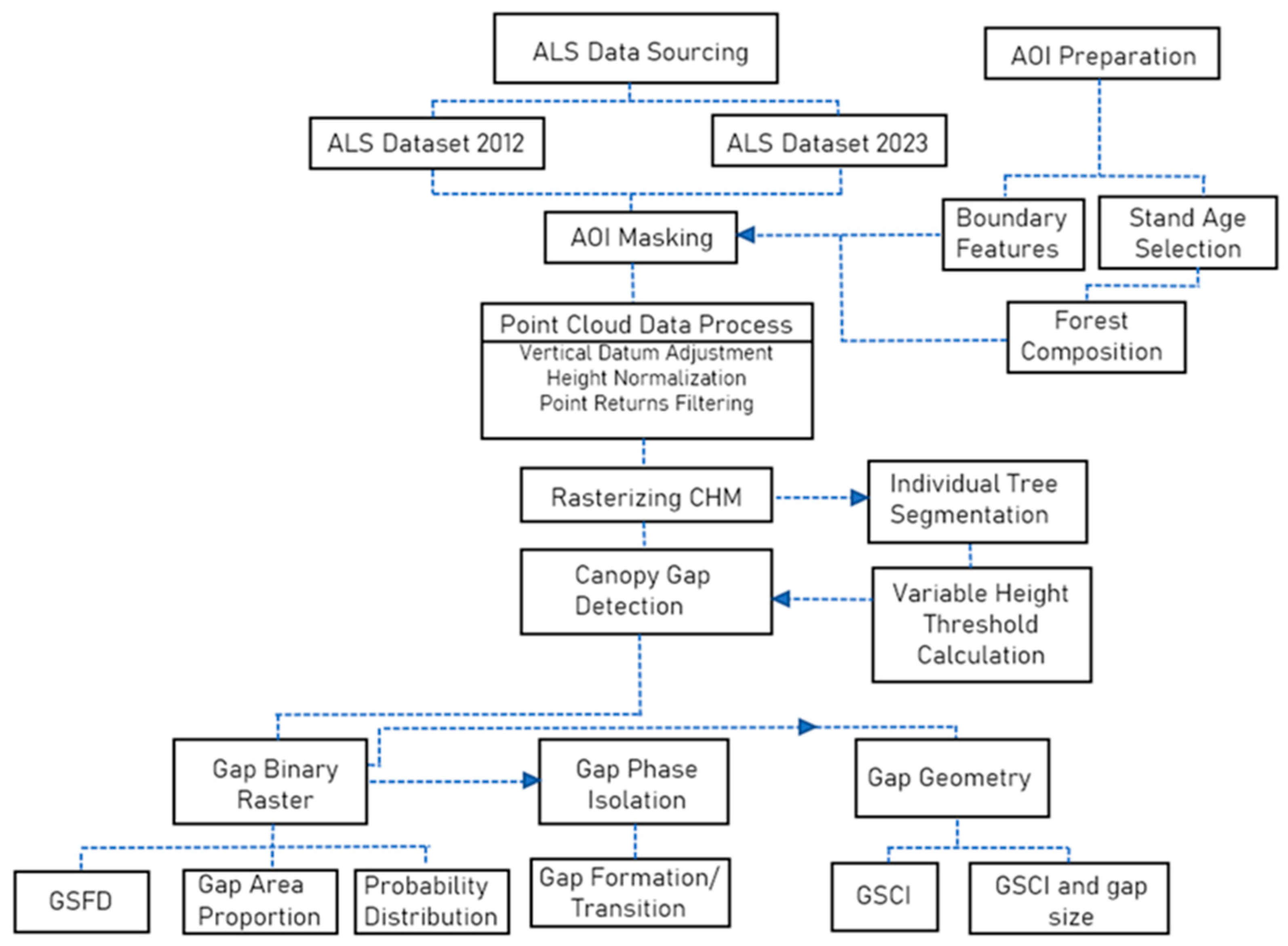
2. Materials and Methods
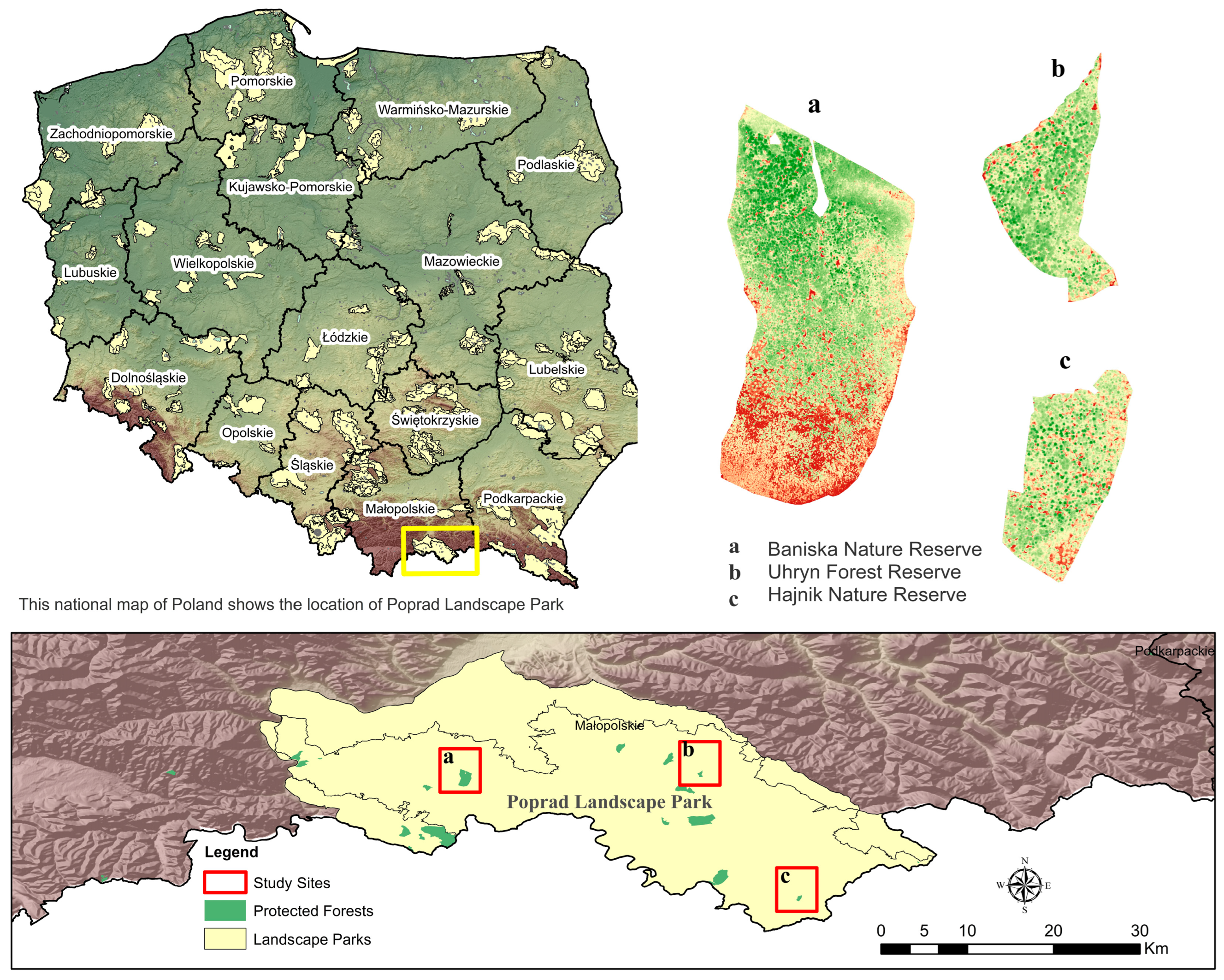
2.1. Study Area
2.2. ALS Data
2.3. Point Cloud Processing
2.3.1. AOI Preparation
2.3.2. Vertical Datum
2.3.3. Height Normalization
2.3.4. Point Cloud Selection
2.3.5. Canopy Height Model
2.3.6. Individual Tree Segmentation
2.4. Canopy Gap Detection
Canopy Height and Gap Size Threshold
2.5. Gap Phases Isolation
2.6. Gap Shape Extraction
2.7. Statistical Analyses
2.7.1. Gap Size Frequency Distribution
2.7.2. Gap Area Proportion
2.7.3. Gap Size
2.7.4. Gap Shape Complexity Index
2.7.5. Gap Size and Shape Complexity Relationship
- where a pair and is concordant if the ranks of both variables increase or decrease together, discordant if one increases while the other decreases.
3. Results
3.1. Gap Characterization
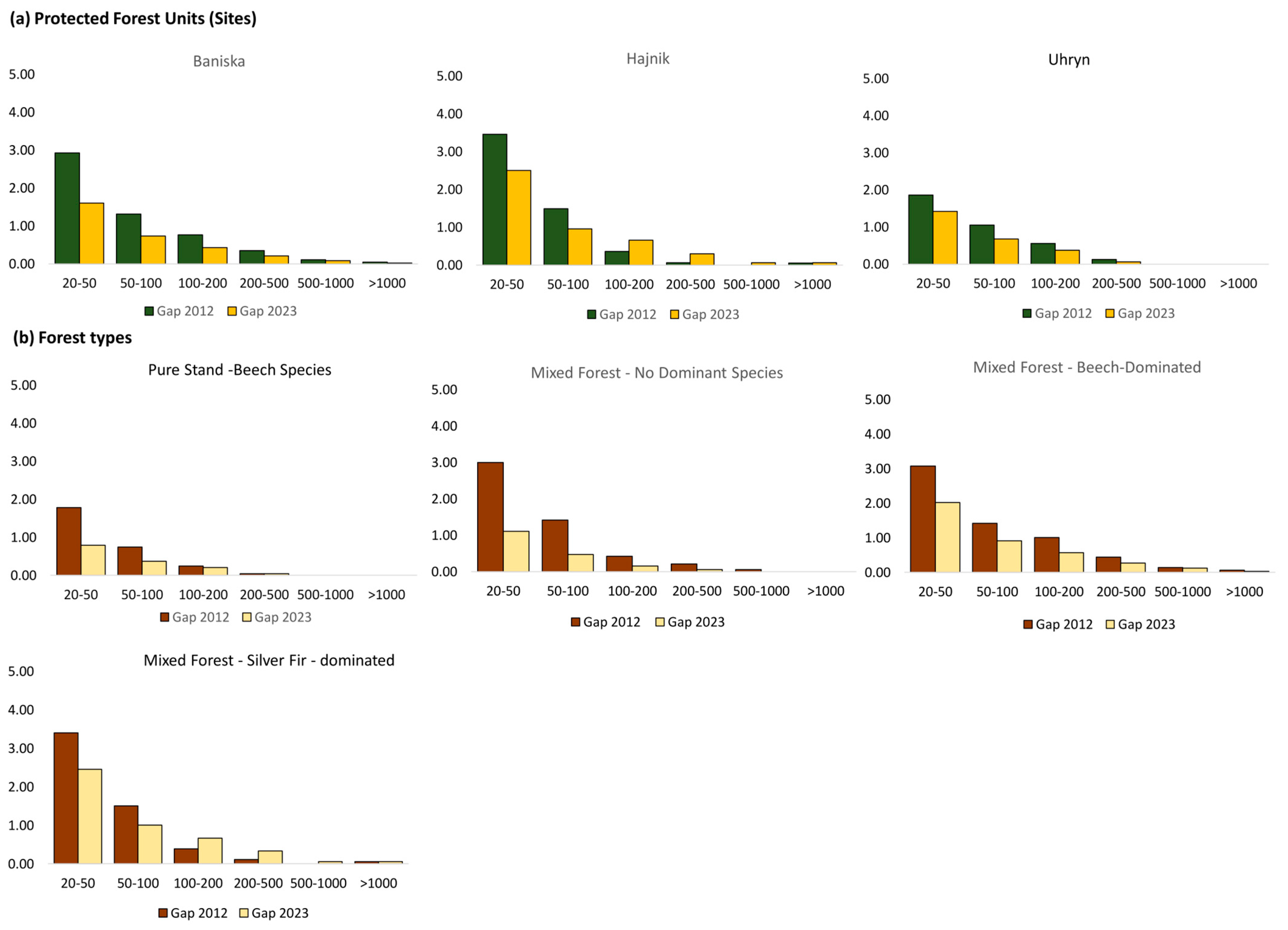
3.2. Gap Size Frequency Distribution and Gap Drivers
3.3. Gap Size Probability Distribution
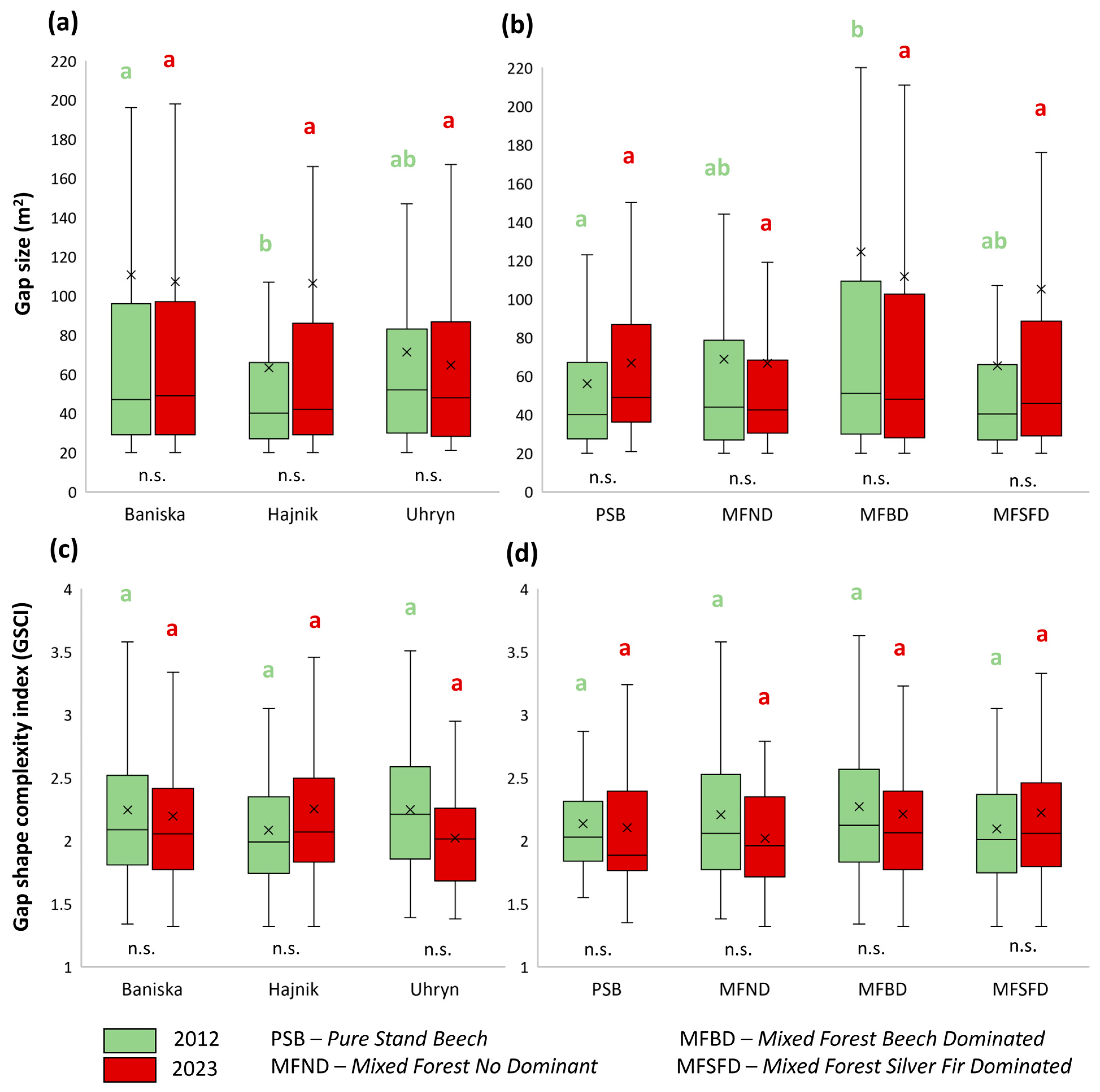
3.4. Gap Size and Shape Metrics
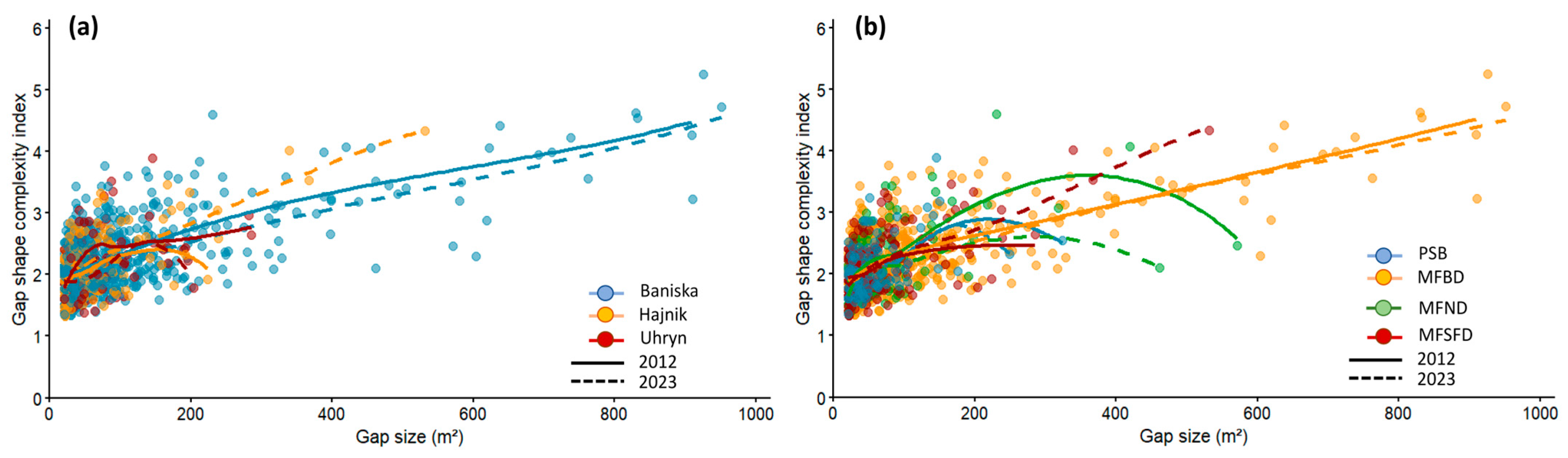
3.5. Gap Size and Shape Complexity
3.6. Gap Formation and Closure
4. Discussion
5. Conclusions
Supplementary Materials
Author Contributions
Funding
Data Availability Statement
Conflicts of Interest
Abbreviations
| ALS | Aerial Laser Scanning |
| LiDAR | Light detection and ranging |
| TLE | Terrestrial laser scanning |
| GSFD | Gap size frequency distribution |
| GSCI | Gap shape complexity index |
| PSB | Pure Stand Beech |
| MFBD | Mixed Forest Beech-Dominated |
| MFSFD | Mixed Forest Silver Fir-Dominated |
| MFND | Mixed Forest No Dominant |
References
- Fischer, A.; Marshall, P.; Camp, A. Disturbances in Deciduous Temperate Forest Ecosystems of the Northern Hemisphere: Their Effects on Both Recent and Future Forest Development. Biodivers. Conserv. 2013, 22, 1863–1893. [Google Scholar] [CrossRef] [Scilit]
- Nagel, T.A.; Svoboda, M. Gap Disturbance Regime in an Old-Growth Fagus-Abies Forest in the Dinaric Mountains, Bosnia-Herzegovina. Can. J. For. Res. 2008, 38, 2728–2737. [Google Scholar] [CrossRef] [Scilit]
- Whitmore, T.C. Canopy Gaps and the Two Major Groups of Forest Trees. Ecology 1989, 70, 536–538. [Google Scholar] [CrossRef] [Scilit]
- Abd Latif, Z.; Blackburn, G.A. The Effects of Gap Size on Some Microclimate Variables during Late Summer and Autumn in a Temperate Broadleaved Deciduous Forest. Int. J. Biometeorol. 2010, 54, 119–129. [Google Scholar] [CrossRef] [Scilit] [PubMed]
- Wagner, S.; Fischer, H.; Huth, F. Canopy Effects on Vegetation Caused by Harvesting and Regeneration Treatments. Eur. J. For. Res. 2011, 130, 17–40. [Google Scholar] [CrossRef] [Scilit]
- Johnson, D.J.; Magee, L.; Pandit, K.; Bourdon, J.; Broadbent, E.N.; Glenn, K.; Kaddoura, Y.; Machado, S.; Nieves, J.; Wilkinson, B.E.; et al. Canopy Tree Density and Species Influence Tree Regeneration Patterns and Woody Species Diversity in a Longleaf Pine Forest. For. Ecol. Manag. 2021, 490, 119082. [Google Scholar] [CrossRef] [Scilit]
- Jucker, T. Deciphering the Fingerprint of Disturbance on the Three-dimensional Structure of the World’s Forests. New Phytol. 2022, 233, 612–617. [Google Scholar] [CrossRef] [Scilit] [PubMed]
- Kern, C.C.; Burton, J.I.; Raymond, P.; D’Amato, A.W.; Keeton, W.S.; Royo, A.A.; Walters, M.B.; Webster, C.R.; Willis, J.L. Challenges Facing Gap-Based Silviculture and Possible Solutions for Mesic Northern Forests in North America. Forestry 2017, 90, 4–17. [Google Scholar] [CrossRef] [Scilit]
- Larsen, J.B.; Angelstam, P.; Bauhus, J.; Carvalho, J.F.; Diaci, J.; Dobrowolska, D.; Gazda, A.; Gustafsson, L.; Krumm, F.; Knoke, T.; et al. Closer-to-Nature Forest Management; From Science to Policy; European Forest Institute: Barcelona, Spain, 2022. [Google Scholar]
- Naka, K. Community Dynamics of Evergreen Broadleaf Forests in Southwestern Japan. I. Wind Damaged Trees and Canopy Gaps in an Evergreen Oak Forest. Bot. Mag. Tokyo 1982, 95, 385–399. [Google Scholar] [CrossRef] [Scilit]
- Brokaw, N.V.L. Gap-Phase Regeneration in a Tropical Forest. Ecology 1985, 66, 682–687. [Google Scholar] [CrossRef] [Scilit]
- Koukoulas, S.; Blackburn, G.A. Quantifying the Spatial Properties of Forest Canopy Gaps Using LiDAR Imagery and GIS. Int. J. Remote Sens. 2004, 25, 3049–3072. [Google Scholar] [CrossRef] [Scilit]
- Dietmaier, A.; McDermid, G.J.; Rahman, M.M.; Linke, J.; Ludwig, R. Comparison of LiDAR and Digital Aerial Photogrammetry for Characterizing Canopy Openings in the Boreal Forest of Northern Alberta. Remote Sens. 2019, 11, 1919. [Google Scholar] [CrossRef] [Scilit]
- Chung, C.-H.; Wang, J.; Deng, S.-L.; Huang, C. Analysis of Canopy Gaps of Coastal Broadleaf Forest Plantations in Northeast Taiwan Using UAV Lidar and the Weibull Distribution. Remote Sens. 2022, 14, 667. [Google Scholar] [CrossRef] [Scilit]
- Brunig, E.F. Some Further Evidence on the Amount of Damage Attributed to Lightning and Wind-Throw in Shorea Albida-Forest in Sarawak. Commonw. For. Rev. 1973, 52, 260–265. [Google Scholar]
- Souza, C. Mapping Forest Degradation in the Eastern Amazon from SPOT 4 through Spectral Mixture Models. Remote Sens. Environ. 2003, 87, 494–506. [Google Scholar] [CrossRef] [Scilit]
- Dalagnol, R.; Phillips, O.L.; Gloor, E.; Galvão, L.S.; Wagner, F.H.; Locks, C.J.; Aragão, L.E.O.C. Quantifying Canopy Tree Loss and Gap Recovery in Tropical Forests under Low-Intensity Logging Using VHR Satellite Imagery and Airborne LiDAR. Remote Sens. 2019, 11, 817. [Google Scholar] [CrossRef] [Scilit]
- Östersund, M.; Honkavaara, E.; Oliveira, R.A.; Näsi, R.; Hakala, T.; Koivumäki, N.; Pelto-Arvo, M.; Tuviala, J.; Nevalainen, O.; Lyytikäinen-Saarenmaa, P. Exploring Forest Changes in an Ips typographus L. Outbreak Area: Insights from Multi-Temporal Multispectral UAS Remote Sensing. Eur. J. For. Res. 2024, 143, 1871–1892. [Google Scholar] [CrossRef] [Scilit]
- White, J.C.; Tompalski, P.; Coops, N.C.; Wulder, M.A. Comparison of Airborne Laser Scanning and Digital Stereo Imagery for Characterizing Forest Canopy Gaps in Coastal Temperate Rainforests. Remote Sens. Environ. 2018, 208, 1–14. [Google Scholar] [CrossRef] [Scilit]
- LaRue, E.; Wagner, F.; Fei, S.; Atkins, J.; Fahey, R.; Gough, C.; Hardiman, B. Compatibility of Aerial and Terrestrial LiDAR for Quantifying Forest Structural Diversity. Remote Sens. 2020, 12, 1407. [Google Scholar] [CrossRef] [Scilit]
- Goodbody, T.R.H.; Tompalski, P.; Coops, N.C.; White, J.C.; Wulder, M.A.; Sanelli, M. Uncovering Spatial and Ecological Variability in Gap Size Frequency Distributions in the Canadian Boreal Forest. Sci. Rep. 2020, 10, 6069. [Google Scholar] [CrossRef] [Scilit]
- Rodes-Blanco, M.; Ruiz-Benito, P.; Silva, C.A.; García, M. Canopy Gap Patterns in Mediterranean Forests: A Spatio-Temporal Characterization Using Airborne LiDAR Data. Landsc. Ecol. 2023, 38, 3427–3442. [Google Scholar] [CrossRef] [Scilit]
- Gaulton, R.; Malthus, T.J. LiDAR Mapping of Canopy Gaps in Continuous Cover Forests: A Comparison of Canopy Height Model and Point Cloud-Based Techniques. Int. J. Remote Sens. 2010, 31, 1193–1211. [Google Scholar] [CrossRef] [Scilit]
- St-Onge, B.; Vepakomma, U.; Sénécal, J.-F.; Kneeshaw, D.; Doyon, F. Canopy Gap Detection and Analysis with Airborne Laser Scanning. In Forestry Applications of Airborne Laser Scanning; Maltamo, M., Næsset, E., Vauhkonen, J., Eds.; Managing Forest Ecosystems; Springer: Dordrecht, The Netherlands, 2014; Volume 27, pp. 419–437. [Google Scholar]
- Leclère, L.; Latte, N.; Candaele, R.; Ligot, G.; Lejeune, P. Estimation of Within-Gap Regeneration Height Growth in Managed Temperate Deciduous Forests Using Bi-Temporal Airborne Laser Scanning Data. Ann. For. Sci. 2024, 81, 36. [Google Scholar] [CrossRef] [Scilit]
- Vehmas, M.; Packalén, P.; Maltamo, M.; Eerikäinen, K. Using airborne laser scanning data for detecting canopy gaps and their understory type in mature boreal forest. Ann. For. Sci. 2011, 68, 825–835. [Google Scholar] [CrossRef] [Scilit]
- Vepakomma, U.; St-Onge, B.; Kneeshaw, D. Response of a Boreal Forest to Canopy Opening: Assessing Vertical 850 and Lateral Tree Growth with Multi-Temporal Lidar Data. Ecol. Appl. 2011, 21, 99–121. [Google Scholar] [CrossRef] [Scilit] [PubMed]
- Asner, G.P.; Kellner, J.R.; Kennedy-Bowdoin, T.; Knapp, D.E.; Anderson, C.; Martin, R.E. Forest Canopy Gap Distributions in the Southern Peruvian Amazon. PLoS ONE 2013, 8, e60875. [Google Scholar] [CrossRef] [Scilit]
- Krüger, K.; Senf, C.; Jucker, T.; Pflugmacher, D.; Seidl, R. Gap Expansion Is the Dominant Driver of Canopy Openings in a Temperate Mountain Forest Landscape. J. Ecol. 2024, 112, 1501–1515. [Google Scholar] [CrossRef] [Scilit]
- Dalagnol, R.; Wagner, F.H.; Galvão, L.S.; Streher, A.S.; Phillips, O.L.; Gloor, E.; Pugh, T.A.M.; Ometto, J.P.H.B.; Aragão, L.E.O.C. Large-Scale Variations in the Dynamics of Amazon Forest Canopy Gaps from Airborne Lidar Data and Opportunities for Tree Mortality Estimates. Sci. Rep. 2021, 11, 1388. [Google Scholar] [CrossRef] [Scilit]
- Mielcarek, M.; Kurpiewska, S.; Guderski, K.; Dobrowolska, D.; Zin, E.; Kuberski, Ł.; Erfanifard, Y.; Stereńczak, K. Remote Sensing of Forest Gap Dynamics in the Białowieża Forest: Comparison of Multitemporal Airborne Laser Scanning and High-Resolution Aerial Imagery Point Clouds. Remote Sens. 2025, 17, 1149. [Google Scholar] [CrossRef] [Scilit]
- Fisher, J.I.; Hurtt, G.C.; Thomas, R.Q.; Chambers, J.Q. Clustered Disturbances Lead to Bias in Large-scale Estimates Based on Forest Sample Plots. Ecol. Lett. 2008, 11, 554–563. [Google Scholar] [CrossRef] [Scilit]
- Spies, T.A.; Johnson, K.N.; Burnett, K.M.; Ohmann, J.L.; McComb, B.C.; Reeves, G.H.; Bettinger, P.; Kline, J.D.; Garber-Yonts, B. Cumulative ecological and socioeconomic effects of forest policies in coastal Oregon. Ecol. Appl. 2007, 17, 5–17. [Google Scholar] [CrossRef] [Scilit]
- Guyon, L.; Strassman, A.C.; Oines, A.; Meier, A.; Thomsen, M.; Sattler, S.R.; DeJager, N.R.; Hoy, E.E.; Vandermyde, B.; Cosgriff, R. Forest Canopy Gap Dynamics: Quantifying Forest Gaps and Understanding Gap—Level Forest Regeneration in Upper Mississippi River Floodplain Forests; USGS: Reston, VA, USA, 2023; p. 73.
- Gorgens, E.B.; Keller, M.; Jackson, T.; Marra, D.M.; Reis, C.R.; De Almeida, D.R.A.; Coomes, D.; Ometto, J.P. Out of 832 Steady State: Tracking Canopy Gap Dynamics across Brazilian Amazon. Biotropica 2023, 55, 755–766+833. [Google Scholar] [CrossRef] [Scilit]
- Wu, C.-D.; Cheng, C.-C.; Chang, C.-C.; Lin, C.; Chang, K.-C.; Chuang, Y.-C. Gap Shape Classification Using Landscape Indices and Multivariate Statistics. Sci. Rep. 2016, 6, 38217. [Google Scholar] [CrossRef] [Scilit] [PubMed]
- Zhang, B.; Fischer, F.J.; Coomes, D.A.; Jucker, T. Logging Leaves a Fingerprint on the Number, Size, Spatial Configuration and Geometry of Tropical Forest Canopy Gaps. Biotropica 2023, 55, 354–367. [Google Scholar] [CrossRef] [Scilit]
- Solano, F.; Modica, G.; Praticò, S.; Box, O.F.; Piovesan, G. Unveiling the Complex Canopy Spatial Structure of a Mediterranean Old-Growth Beech (Fagus sylvatica L.) Forest from UAV Observations. Ecol. Indic. 2022, 138, 108807. [Google Scholar] [CrossRef] [Scilit]
- Reis, C.R.; Jackson, T.D.; Gorgens, E.B.; Dalagnol, R.; Jucker, T.; Nunes, M.H.; Ometto, J.P.; Aragão, L.E.O.C.; Rodriguez, L.C.E.; Coomes, D.A. Forest Disturbance and Growth Processes Are Reflected in the Geographical Distribution of Large Canopy Gaps across the Brazilian Amazon. J. Ecol. 2022, 110, 2971–2983. [Google Scholar] [CrossRef] [Scilit]
- Bottero, A.; Garbarino, M.; Dukic, V.; Govedar, Z.; Lingua, E.; Nagel, T.; Motta, R. Gap-Phase Dynamics in the Old-Growth Forest of Lom, Bosnia and Herzegovina. Silva Fenn. 2011, 45, 76. [Google Scholar] [CrossRef] [Scilit]
- Hobi, M.L.; Commarmot, B.; Bugmann, H. Pattern and Process in the Largest Primeval Beech Forest of Europe (Ukrainian C Arpathians). J. Veg. Sci. 2015, 26, 323–336. [Google Scholar] [CrossRef] [Scilit]
- Główny Urząd Geodezji i Kartografii (GUGiK). Nazwa Zbioru Danych [ALS Data]. 2023. Available online: https://mapy.geoportal.gov.pl/imap/Imgp_2.html?gpmap=gp0 (accessed on 15 December 2023).
- R Core Team. R: A Language and Environment for Statistical Computing, Version 4.5.1; R Foundation for Statistical Computing: Vienna, Austria, 2025.
- ArcGIS Pro, Version 3.5.2; Esri: Redlands, CA, USA, 2023.
- General Directorate of State Forests and Statistics Poland. Forest Data for Poland; GUS: Warshaw, Poland, 2025. [Google Scholar]
- Dyba, K.; Nowosad, J. Rgugik: Search and Retrieve Spatial Data from the Polish Head Office of Geodesy and Cartography in R. J. Open Source Softw. 2021, 6, 2948. [Google Scholar] [CrossRef] [Scilit]
- American Society for Photogrammetry and Remote Sensing. ASPRS Positional Accuracy Standards for Digital Geospatial Data; American Society for Photogrammetry and Remote Sensing: Baton Rouge, LA, USA, 2015; Volume 81, pp. 1–26. [Google Scholar] [CrossRef] [Scilit]
- Roussel, J.-R.; Auty, D. LidR: Airborne LiDAR Data Manipulation and Visualization for Forestry Applications. Available online: https://rdrr.io/cran/lidR/ (accessed on 15 December 2025).
- Dalponte, M.; Coomes, D.A. Tree-Centric Mapping of Forest Carbon Density from Airborne Laser Scanning and Hyperspectral Data. Methods Ecol. Evol. 2016, 7, 1236–1245. [Google Scholar] [CrossRef] [Scilit]
- Rugani, T.; Diaci, J.; Hladnik, D. Gap Dynamics and Structure of Two Old-Growth Beech Forest Remnants in Slovenia. PLoS ONE 2013, 8, e52641. [Google Scholar] [CrossRef] [Scilit]
- Garbarino, M.; Borgogno Mondino, E.; Lingua, E.; Nagel, T.A.; Dukić, V.; Govedar, Z.; Motta, R. Gap Disturbances and Regeneration Patterns in a Bosnian Old-Growth Forest: A Multispectral Remote Sensing and Ground-Based Approach. Ann. For. Sci. 2012, 69, 617–625. [Google Scholar] [CrossRef] [Scilit]
- Silva, C.A.; Valbuena, R.; Pinagé, E.R.; Mohan, M.; De Almeida, D.R.A.; North Broadbent, E.; Jaafar, W.S.W.M.; De Almeida Papa, D.; Cardil, A.; Klauberg, C. ForestGap R: An r Package for Forest Gap Analysis from Canopy Height Models. Methods Ecol. Evol. 2019, 10, 1347–1356. [Google Scholar] [CrossRef] [Scilit]
- Pearson, K.X. On the Criterion That a given System of Deviations from the Probable in the Case of a Correlated System of Variables Is Such That It Can Be Reasonably Supposed to Have Arisen from Random Sampling. Lond. Edinb. Dublin Philos. Mag. J. Sci. 1900, 50, 157–175. [Google Scholar] [CrossRef] [Scilit]
- Fisher, R.A. On the Interpretation of χ2 from Contingency Tables, and the Calculation of P. J. R. Stat. Soc. 1922, 85, 87. [Google Scholar] [CrossRef] [Scilit]
- Bolker, B.M. Ecological Models and Data in R; Princeton University Press: Princeton, NJ, USA, 2008. [Google Scholar]
- Mann, H.B.; Whitney, D.R. On a Test of Whether One of Two Random Variables Is Stochastically Larger than the Other. Ann. Math. Stat. 1947, 18, 50–60. [Google Scholar] [CrossRef] [Scilit]
- Kendall, M.G. A New Measure of Rank Correlation. Biometrika 1938, 30, 81. [Google Scholar] [CrossRef] [Scilit]
- Nakashizuka, T.; Numata, M. Regeneration Process of Climax Beech Forests I: Structure of a Beech Forest with Sasa Understory. Jpn. J. Ecol. 1982, 32, 57–67. [Google Scholar]
- Nakashizuka, T. Regeneration Process of Climax Beech Forests IV: Gap Formation. Jpn. J. Ecol. 1984, 38, 62–66. [Google Scholar]
- Dobrowolska, D.; Piasecka, Ż.; Kuberski, Ł.; Stereńczak, K. Canopy Gap Characteristics and Regeneration Patterns in the Białowieża Forest Based on Remote Sensing Data and Field Measurements. For. Ecol. Manag. 2022, 511, 120123. [Google Scholar] [CrossRef] [Scilit]
- Brokaw, N.V.L. The Definition of Treefall Gap and Its Effect on Measures of Forest Dynamics. Biotropica 1982, 14, 158. [Google Scholar] [CrossRef] [Scilit]
- Feldmann, E.; Drößler, L.; Hauck, M.; Kucbel, S.; Pichler, V.; Leuschner, C. Canopy Gap Dynamics and Tree Understory Release in a Virgin Beech Forest, Slovakian Carpathians. For. Ecol. Manag. 2018, 415–416, 38–46. [Google Scholar] [CrossRef] [Scilit]
- Stevens-Rumann, C.S.; Kemp, K.B.; Higuera, P.E.; Harvey, B.J.; Rother, M.T.; Donato, D.C.; Morgan, P.; Veblen, T.T. 919 Evidence for Declining Forest Resilience to Wildfires under Climate Change. Ecol. Lett. 2018, 21, 243–252+920. [Google Scholar] [CrossRef] [Scilit] [PubMed]
- Hunter, M.O.; Keller, M.; Morton, D.; Cook, B.; Lefsky, M.; Ducey, M.; Saleska, S.; De Oliveira, R.C.; Schietti, J. 922 Structural Dynamics of Tropical Moist Forest Gaps. PLoS ONE 2015, 10, e0132144. [Google Scholar] [CrossRef] [Scilit] [PubMed]
- Lu, D.; Zhu, J.; Sun, Y.; Hu, L.; Zhang, G. Gap Closure Process by Lateral Extension Growth of Canopy Trees and 925 Its Effect on Woody Species Regeneration in a Temperate Secondary Forest, Northeast China. Silva Fenn. 2015, 49, 926. [Google Scholar] [CrossRef] [Scilit]
- Worrall, J.J.; Lee, T.D.; Harrington, T.C. Forest Dynamics and Agents That Initiate and Expand Canopy Gaps in Picea–Abies Forests of Crawford Notch, New Hampshire, USA. J. Ecol. 2005, 93, 178–190. [Google Scholar] [CrossRef] [Scilit]
- Yamamoto, S.-I. Forest Gap Dynamics and Tree Regeneration. J. For. Res. 2000, 5, 223–229. [Google Scholar] [CrossRef] [Scilit]
- Runkle, J.R. Patterns of Disturbance in Some Old-Growth Mesic Forests of Eastern North America. Ecology 1982, 63, 1533–1546. [Google Scholar] [CrossRef] [Scilit]
- Jaloviar, P.; Sedmáková, D.; Pittner, J.; Jarčušková Danková, L.; Kucbel, S.; Sedmák, R.; Saniga, M. Gap Structure and Regeneration in the Mixed Old-Growth Forests of National Nature Reserve Sitno, Slovakia. Forests 2020, 11, 81. [Google Scholar] [CrossRef] [Scilit]
- Strzyżowski, D. The Role of Topography, Canopy Gaps, and Forest Edges in the Distribution of Windthrow Damage in the Western Tatra Mountains, Poland. Geogr. Pol. 2019, 92, 173–187. [Google Scholar] [CrossRef] [Scilit]
- Ochtyra, A. Forest Disturbances in Polish Tatra Mountains for 1985–2016 in Relation to Topography, Stand Features, and Protection Zone. Forests 2020, 11, 579. [Google Scholar] [CrossRef] [Scilit]
- Holeksa, J.; Zielonka, T.; Żywiec, M. Modeling the Decay of Coarse Woody Debris in a Subalpine Norway Spruce Forest of the West Carpathians, Poland. Can. J. For. Res. 2008, 38, 415–428. [Google Scholar] [CrossRef] [Scilit]
- Ciocirlan, M.; Câmpu, V.R. Characteristics of Forest Windthrow Produced in Eastern Carpathians in February 2020. Forests 2024, 15, 176. [Google Scholar] [CrossRef] [Scilit]
- Asner, G.P. Tropical Forest Carbon Assessment: Integrating Satellite and Airborne Mapping Approaches. Environ. Res. Lett. 2009, 4, 034009. [Google Scholar] [CrossRef] [Scilit]
- Lobo, E.; Dalling, J.W. Spatial Scale and Sampling Resolution Affect Measures of Gap Disturbance in a Lowland Tropical Forest: Implications for Understanding Forest Regeneration and Carbon Storage. Proc. R. Soc. B Biol. Sci. 2014, 281, 20133218. [Google Scholar] [CrossRef] [Scilit] [PubMed]
- Muscolo, A.; Bagnato, S.; Sidari, M.; Mercurio, R. A Review of the Roles of Forest Canopy Gaps. J. For. Res. 2014, 25, 725–736. [Google Scholar] [CrossRef] [Scilit]
- Filotas, E.; Parrott, L.; Burton, P.J.; Chazdon, R.L.; Coates, K.D.; Coll, L.; Haeussler, S.; Martin, K.; Nocentini, S.; Puettmann, K.J.; et al. Viewing Forests through the Lens of Complex Systems Science. Ecosphere 2014, 5, 1–23. [Google Scholar] [CrossRef] [Scilit]
- Nakashizuka, T.; Katsuki, T.; Tanaka, H. Forest Canopy Structure Analyzed by Using Aerial Photographs. Ecol. Res. 1995, 10, 13–18. [Google Scholar] [CrossRef] [Scilit]
- Rolo, V.; Olivier, P.I.; Van Aarde, R.J. Determinants of Canopy Gap Characteristics in Rehabilitating Coastal Dune Forests. Appl. Veg. Sci. 2018, 21, 451–460. [Google Scholar] [CrossRef] [Scilit]
- Blackburn, G.A.; Abd Latif, Z.; Boyd, D.S. Forest Disturbance and Regeneration: A Mosaic of Discrete Gap Dynamics and Open Matrix Regimes? J. Veg. Sci. 2014, 25, 1341–1354. [Google Scholar] [CrossRef] [Scilit]
- Kucbel, S.; Jaloviar, P.; Saniga, M.; Vencurik, J.; Klimaš, V. Canopy Gaps in an Old-Growth Fir-Beech Forest Remnant of Western Carpathians. Eur. J. For. Res. 2010, 129, 249–259. [Google Scholar] [CrossRef] [Scilit]
- Bianchi, L.; Bottacci, A.; Calamini, G.; Maltoni, A.; Mariotti, B.; Quilghini, G.; Salbitano, F.; Tani, A.; Zoccola, A.; Paci, M. Structure and Dynamics of a Beech Forest in a Fully Protected Area in the Northern Apennines (Sasso Fratino, Italy). iForest-Biogeosciences For. 2011, 4, 136–144. [Google Scholar] [CrossRef] [Scilit]
- Stiers, M.; Willim, K.; Seidel, D.; Ammer, C.; Kabal, M.; Stillhard, J.; Annighöfer, P. Analyzing Spatial Distribution Patterns of European Beech (Fagus sylvatica L.) Regeneration in Dependence of Canopy Openings. Forests 2019, 10, 637. [Google Scholar] [CrossRef] [Scilit]
- Zhu, C.; Zhu, J.; Wang, G.G.; Zheng, X.; Lu, D.; Gao, T. Dynamics of Gaps and Large Openings in a Secondary Forest of Northeast China over 50 Years. Ann. For. Sci. 2019, 76, 72. [Google Scholar] [CrossRef] [Scilit]
- Ordway, E.M.; Asner, G.P. Carbon Declines along Tropical Forest Edges Correspond to Heterogeneous Effects on Canopy Structure and Function. Proc. Natl. Acad. Sci. USA 2020, 117, 7863–7870. [Google Scholar] [CrossRef] [Scilit]


| Mission | Acquisition Year | Point Density | Vertical Datum | Elevation Returns | Resolution |
|---|---|---|---|---|---|
| ISOK 2012 | 2012 | 4 pts/m2 | PL-KRON86-NH | First, Last, Multiple Returns | 0.5 m |
| ISOK 2023 | 2023 | 4 pts/m2 | PL-EVRF2007-NH | Full waveform, Multiple Returns | 0.25 m |
| Forest Type | 100 Ha × Total Area | Maximum Height (100 Ha × Total Area of Stand) | Height Threshold | ||
|---|---|---|---|---|---|
| 2012 | 2023 | 2012 | 2023 | ||
| Pure Stand (Beech) | |||||
| B1 | 1189 | 30.69 | 34.49 | 10 | 11 |
| B6 | 566 | 31.38 | 33.27 | 10 | 11 |
| U2 | 333 | 34.4 | 36.68 | 11 | 12 |
| B10 | 228 | 22.95 | 28.75 | 8 | 9 |
| U1 | 94 | 24.93 | 29.23 | 8 | 10 |
| Mixed Forest—No dominant | |||||
| B3 | 1901 | 37.82 | 33.43 | 12 | 11 |
| Mixed Forest (Beech-dominated) | |||||
| B4 | 72 | 31.06 | 34 | 10 | 11 |
| B5 | 391 | 26.44 | 27.62 | 9 | 9 |
| B11 | 3431 | 35.77 | 37.57 | 12 | 12 |
| B12 | 1366 | 30.69 | 32.22 | 10 | 11 |
| U3 | 1072 | 36.44 | 37.89 | 12 | 13 |
| Mixed Forest (Silver Fir-dominated) | |||||
| H1 | 563 | 31.37 | 33.93 | 10 | 11 |
| H2 | 307 | 31.02 | 34.14 | 10 | 11 |
| H3 | 807 | 34.78 | 35.89 | 11 | 12 |
| U4 | 114 | 32.55 | 35.38 | 11 | 12 |
| SITE | Baniska (88.44 ha) | Hajnik (16.77 ha) | Uhryn (15.19 ha) | |||||||||
|---|---|---|---|---|---|---|---|---|---|---|---|---|
| Gap Size Class | Freq. 2012 | Area (m2) | Freq. 2023 | Area (m2) | Freq. 2012 | Area (m2) | Freq. 2023 | Area (m2) | Freq. 2012 | Area (m2) | Freq. 2023 | Area (m2) |
| 20–50 | 263 | 8187 | 145 | 4561 | 58 | 1821 | 42 | 1302 | 26 | 817 | 22 | 732 |
| 51–100 | 120 | 8731 | 67 | 4738 | 25 | 1767 | 16 | 1087 | 16 | 1111 | 11 | 784 |
| 101–200 | 69 | 9660 | 39 | 5542 | 6 | 839 | 11 | 1662 | 9 | 1285 | 6 | 865 |
| 201–500 | 32 | 9887 | 19 | 5570 | 1 | 224 | 4 | 1182 | 2 | 567 | 1 | 204 |
| 501–1000 | 10 | 6669 | 8 | 6318 | 1 | 532 | ||||||
| >1000 | 5 | 12,154 | 2 | 3309 | 1 | 1097 | 1 | 2210 | ||||
| n, total | 499 | 55,288 | 280 | 30,038 | 91 | 5748 | 75 | 7975 | 53 | 3780 | 40 | 2585 |
| n, ha−1 | 5.6 | 3.2 | 5.4 | 4.5 | 3.5 | 2.6 | ||||||
| Mean size, m2 | 111.0 | 107.0 | 63.2 | 106.0 | 71.3 | 64.6 | ||||||
| Median size, m2 | 47.0 | 49.0 | 40.0 | 42.0 | 52.0 | 48.0 | ||||||
| Gap, % | 6.3 | 3.4 | 3.3 | 4.8 | 2.5 | 1.7 | ||||||
| Forest Type | Pure Stand—B (20.88 ha) | Mixed Forest ND (19.01 ha) | Mixed Forest BD (62.6 ha) | Mixed Forest SFD (17.91 ha) | ||||||||||||
|---|---|---|---|---|---|---|---|---|---|---|---|---|---|---|---|---|
| Gap Size Class | Freq. 2012 | Area (m2) | Freq. 2023 | Area (m2) | Freq. 2012 | Area (m2) | Freq. 2023 | Area (m2) | Freq. 2012 | Area (m2) | Freq. 2023 | Area (m2) | Freq. 2012 | Area (m2) | Freq. 2023 | Area (m2) |
| 20–50 | 35 | 1078 | 17 | 609 | 57 | 1823 | 21 | 703 | 194 | 6025 | 127 | 3890 | 61 | 1899 | 44 | 1393 |
| 51–100 | 17 | 1167 | 9 | 636 | 27 | 1969 | 9 | 646 | 90 | 6582 | 58 | 4106 | 27 | 1891 | 18 | 1221 |
| 101–200 | 5 | 682 | 5 | 644 | 8 | 1116 | 3 | 455 | 64 | 8981 | 36 | 5203 | 7 | 1005 | 12 | 1767 |
| 201–500 | 1 | 324 | 1 | 249 | 4 | 1187 | 1 | 462 | 28 | 8658 | 17 | 4859 | 2 | 509 | 5 | 1386 |
| 501–1000 | 1 | 571 | 9 | 6098 | 8 | 6318 | 1 | 532 | ||||||||
| >1000 | 5 | 12,154 | 2 | 3309 | 1 | 10,097 | 1 | 2210 | ||||||||
| n, total | 58 | 3251 | 32 | 2138 | 97 | 6666 | 34 | 2266 | 390 | 48,498 | 248 | 27,685 | 98 | 15,401 | 81 | 8509 |
| n, ha−1 | 2.8 | 1.5 | 5.1 | 1.8 | 6.2 | 4.0 | 5.5 | 4.5 | ||||||||
| Mean size, m2 | 56.1 | 66.8 | 68.7 | 66.6 | 124.0 | 112.0 | 65.3 | 105.0 | ||||||||
| Median size, m2 | 40.0 | 49.0 | 44.0 | 42.5 | 51.0 | 48.0 | 40.5 | 46.0 | ||||||||
| Gap, % | 1.6 | 1.0 | 3.5 | 1.2 | 7.8 | 4.4 | 8.6 | 4.8 | ||||||||
| Summary | ||||||||||||||||
| Total | 2012 | 2023 | ||||||||||||||
| No. of gaps | 643 | 395 | ||||||||||||||
| Gap area, m2 | 64,816 | 40,598 | ||||||||||||||
| Ha equivalent | 6.48 | 4.06 | ||||||||||||||
| Overall site area | 120.4 | |||||||||||||||
| Group | Year | Probability Distribution | n | α | λ | μ | σ | xmin | KS | p_gof |
|---|---|---|---|---|---|---|---|---|---|---|
| Site | ||||||||||
| Baniska | 2012 | Log-normal | 499 | 4.07 | 0.9 | |||||
| 2023 | Log-normal | 280 | 4.09 | 0.92 | ||||||
| Hajnik | 2012 | Log-normal | 91 | 3.8 | 0.66 | |||||
| 2023 | Power-law | 75 | 1.97 | 20 | 0.054 | 0.684 | ||||
| Uhryn | 2012 | Log-normal | 53 | 4.01 | 0.69 | |||||
| 2023 | Log-normal | 40 | 3.95 | 0.64 | ||||||
| Forest Type | ||||||||||
| MFBD | 2012 | Log-normal | 390 | 4.14 | 0.94 | |||||
| 2023 | Log-normal | 248 | 4.1 | 0.94 | ||||||
| MFND | 2012 | Log-normal | 97 | 3.9 | 0.72 | |||||
| 2023 | Power-law | 34 | 2.12 | 20 | 0.069 | 0.823 | ||||
| MFSFD | 2012 | Log-normal | 98 | 3.82 | 0.69 | |||||
| 2023 | Power-law | 81 | 1.95 | 20 | 0.061 | 0.431 | ||||
| PSB | 2012 | Log-normal | 58 | 3.8 | 0.61 | |||||
| 2023 | Exponential | 32 | 0.01 | |||||||
| Close | Expanding | New Opening | Persistent | Balance | Status | ||
|---|---|---|---|---|---|---|---|
| Site Group | |||||||
| Baniska | % | 53 | 9 | 5 | 32 | 7 | Recovering |
| m2 ha−1 yr−1 | 35 | 6 | 3 | 21 | |||
| Hajnik | % | 31 | 38 | 12 | 19 | −39 | Opening |
| m2 ha−1 yr−1 | 19 | 24 | 8 | 12 | |||
| Uhryn | % | 50 | 10 | 17 | 23 | 0 | Steady-state |
| m2 ha−1 yr−1 | 15 | 3 | 5 | 7 | |||
| Forest type Group | |||||||
| PSB | % | 51 | 11 | 14 | 25 | 1 | Recovering |
| m2 ha−1 yr−1 | 10 | 2 | 3 | 5 | |||
| MFBD | % | 51 | 10 | 5 | 34 | 3 | Recovering |
| m2 ha−1 yr−1 | 43 | 8 | 4 | 28 | |||
| MFND | % | 70 | 5 | 7 | 18 | 40 | Recovering |
| m2 ha−1 yr−1 | 25 | 2 | 2 | 7 | |||
| MFSFD | % | 32 | 35 | 13 | 20 | −37 | Opening |
| m2 ha−1 yr−1 | 20 | 22 | 8 | 13 | |||
Disclaimer/Publisher’s Note: The statements, opinions and data contained in all publications are solely those of the individual author(s) and contributor(s) and not of MDPI and/or the editor(s). MDPI and/or the editor(s) disclaim responsibility for any injury to people or property resulting from any ideas, methods, instructions or products referred to in the content. |
© 2026 by the authors. Licensee MDPI, Basel, Switzerland. This article is an open access article distributed under the terms and conditions of the Creative Commons Attribution (CC BY) license.
Share and Cite
Marapao, G.; Keren, S.; Miszczyszyn, J. Multi-Temporal Canopy Gaps Assessment Using Airborne Laser Scanning Data: The Case of the Protected Forests in the Carpathian Montane Ecosystem in Poland. Remote Sens. 2026, 18, 1045. https://doi.org/10.3390/rs18071045
Marapao G, Keren S, Miszczyszyn J. Multi-Temporal Canopy Gaps Assessment Using Airborne Laser Scanning Data: The Case of the Protected Forests in the Carpathian Montane Ecosystem in Poland. Remote Sensing. 2026; 18(7):1045. https://doi.org/10.3390/rs18071045
Chicago/Turabian StyleMarapao, Garry, Srdjan Keren, and Jakub Miszczyszyn. 2026. "Multi-Temporal Canopy Gaps Assessment Using Airborne Laser Scanning Data: The Case of the Protected Forests in the Carpathian Montane Ecosystem in Poland" Remote Sensing 18, no. 7: 1045. https://doi.org/10.3390/rs18071045
APA StyleMarapao, G., Keren, S., & Miszczyszyn, J. (2026). Multi-Temporal Canopy Gaps Assessment Using Airborne Laser Scanning Data: The Case of the Protected Forests in the Carpathian Montane Ecosystem in Poland. Remote Sensing, 18(7), 1045. https://doi.org/10.3390/rs18071045