


Highlights
What are the main findings?
- The proposed MambaLIC framework integrates the SSM module with dynamic convolution. This method facilitates the effective interaction between local and global information, thereby enhancing compression performance.
- Experimental results on three remote sensing image datasets (UC-Merced, LoveDA, xView) demonstrate that MambaLIC outperforms VVC (VTM-17.0) with BD-rate improvements of 14.22%, 18.48%, and 17.47%, respectively. Additionally, MambaLIC achieves superior computational efficiency and significantly lower memory consumption compared to existing Mamba-based methods.
What are the implications of the main findings?
- MambaLIC provides an efficient architectural design for remote sensing image compression and is particularly suitable for handling high-resolution remote sensing images. By reducing memory consumption and computational complexity, MambaLIC achieves superior performance and resource utilization compared to current methods.
- The framework offers new insights into the field of remote sensing image compression and demonstrates the potential of SSMs in image compression, especially in handling large-scale, high-resolution images.
Abstract
Remote sensing (RS) images, characterized by their large size and rich texture, require algorithms capable of effectively integrating both global and local features for compression. However, existing Learned Image Compression (LIC) approaches face distinct bottlenecks. While Transformer-based architectures typically suffer from heavy computational loads, standard State Space Models (SSMs) often incur prohibitive memory costs when processing high-resolution inputs. To address these limitations, we propose MambaLIC, a novel RS image compression network that integrates the efficient long-range modeling of SSMs with the local modeling ability of CNNs. In this paper, we introduce an innovative Remote Sensing State Space Model (RS-SSM) module, which combines visual SSM with dynamic convolution for remote sensing image compression. This integration facilitates effective interaction between local and global information, thereby enhancing the performance of RS image compression. Furthermore, we propose an SSM attention-based (SSA-based) spatial-channel context model for better entropy modeling. Compared to Transformer-CNN mixed architectures, MambaLIC reduces computational complexity by 63.9% and achieves superior rate-distortion (RD) performance. Consequently, compared to the latest SS2D-based method MambaIC, MambaLIC achieves substantial efficiency gains, saving 78.8% in memory usage. Experimental results demonstrate that MambaLIC achieves state-of-the-art (SOTA) performance, outperforming VVC (VTM-17.0) by 14.22%, 18.48%, and 17.47% in BD-rate on UC-Merced, LoveDA, and xView datasets, respectively.
1. Introduction
With the rapid growth of commercial aerospace [1], the number of on-orbit satellites has surged, leading to an exponential increase in remote sensing (RS) images [2]. This massive data volume brings significant pressure to limited satellite downlink bandwidth [3], making efficient image compression increasingly necessary for transmission and on-orbit storage.
Recently, Learned Image Compression (LIC) [4,5,6,7,8,9] has achieved great success by jointly optimizing the whole framework, including transformation, quantization, entropy coding, and other components. Therefore, many LIC approaches [7,8,9,10] have outperformed the best traditional codecs, including VVC [11] and BPG [12], on both Peak Signal-to-Noise Ratio (PSNR) and Multi-Scale Structural Similarity (MS-SSIM), offering a new solution for on-orbit RS image compression.
Most LIC approaches are primarily categorized into Convolutional Neural Network-based (CNN-based) and transformer-based methods. Following the pioneering work by Ballé et al. [4,5], which introduced the first end-to-end image compression framework using the variational auto-encoder (VAE), many researchers have focused on CNN-based methods. These methods utilize enhanced nonlinear transform modules and efficient entropy models to improve rate-distortion (RD) performance. For instance, Cheng et al. [7] incorporated residual blocks to increase network depth, while Ghorbel et al. [13] employed ConvNeXt [14] to balance performance and complexity. To achieve more accurate entropy estimation, some works [6,15,16] introduced various context models to capture dependencies in images.
However, despite these advancements, most CNN-based methods only capture local information. Their small effective receptive fields (ERFs) [17] fundamentally limit long-range dependency modeling, thereby constrain the RD performance. Inspired by the non-local modeling ability of transformers [18,19], researchers have explored its potential in image compression [10,16,20,21,22]. Zhu et al. [20] proposed a swin-transformer-based architecture which outperforms CNN-based methods. Furthermore, Liu et al. [16] combined transformers and CNNs to propose the Transformer-CNN Mixture (TCM) block, which utilizes CNNs’ local modeling efficiency and transformers’ non-local modeling ability to enhance performance.
Compared to natural images, RS images have higher spatial resolution and exhibit lower correlation as well as richer texture information, leading to substantial local and non-local redundancy [23]. These unique characteristics require compression methods that can effectively capture long-range dependencies while preserving fine local details. In high-resolution image compression, large ERFs are crucial for modeling such long-range dependencies and preserving textural information [24]. Based on these considerations, some researchers have developed specialized transform modules to enhance RD performance. Xiang et al. [25] preserve texture information by decomposing images into high-frequency and low-frequency components via discrete wavelet transforms. Fu and Du [23] reduce redundancy by jointly modeling local and non-local dependencies. Despite these advancements, existing methods still face challenges in simultaneously capturing global features and preserving local details. Thus, an ideal learning-based RS image compression algorithm should integrate both a global receptive field and robust local feature extraction capabilities.
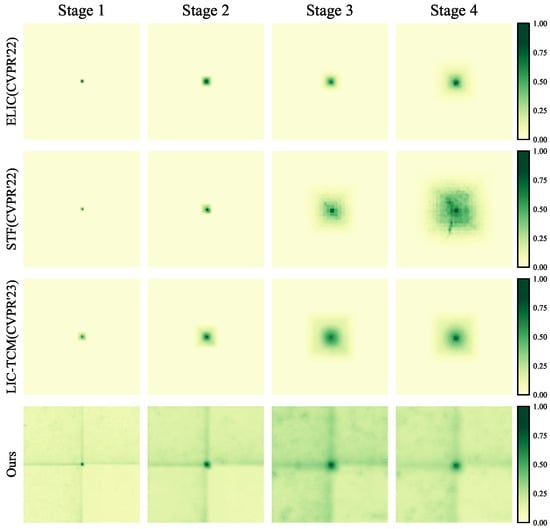
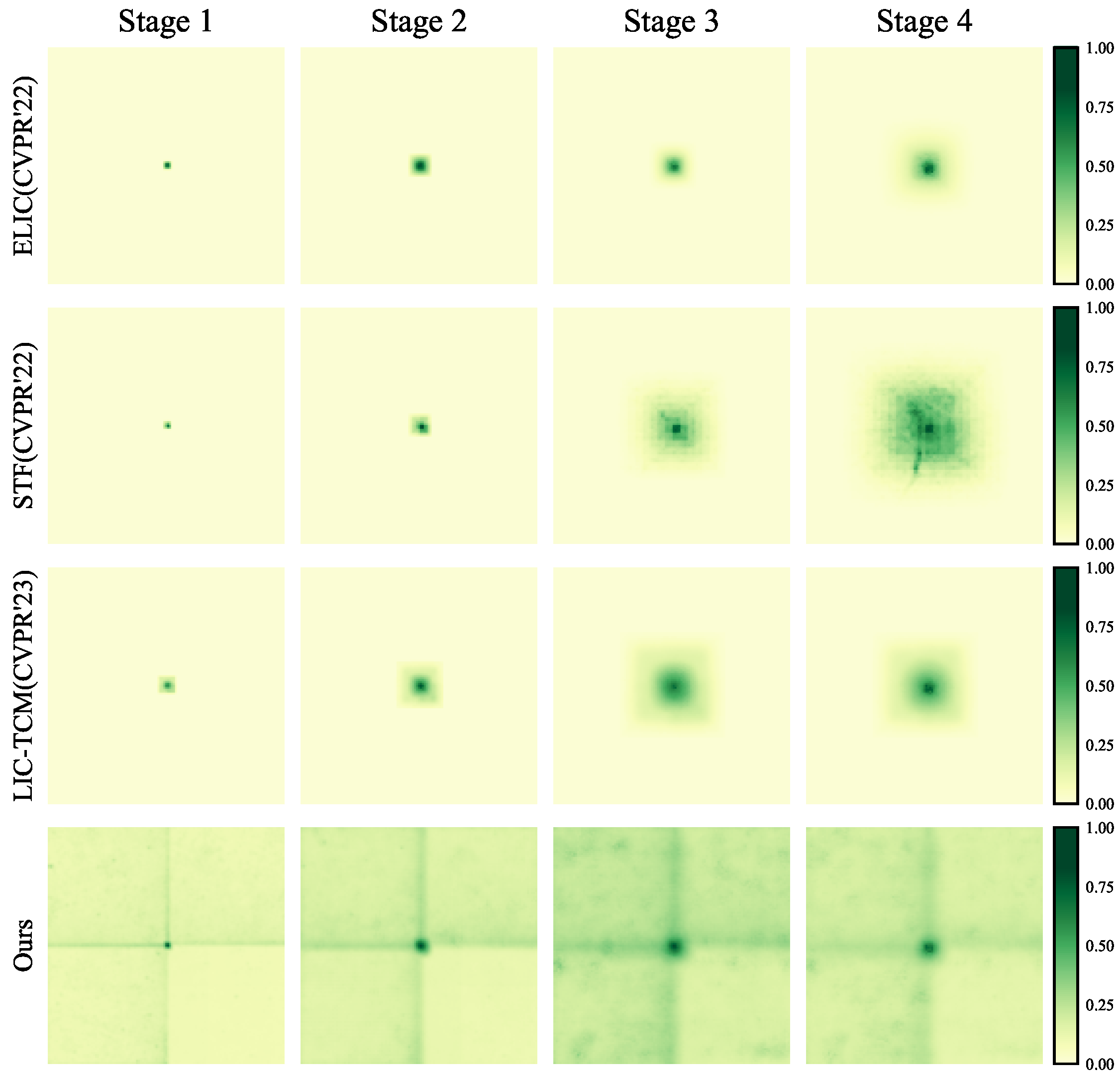
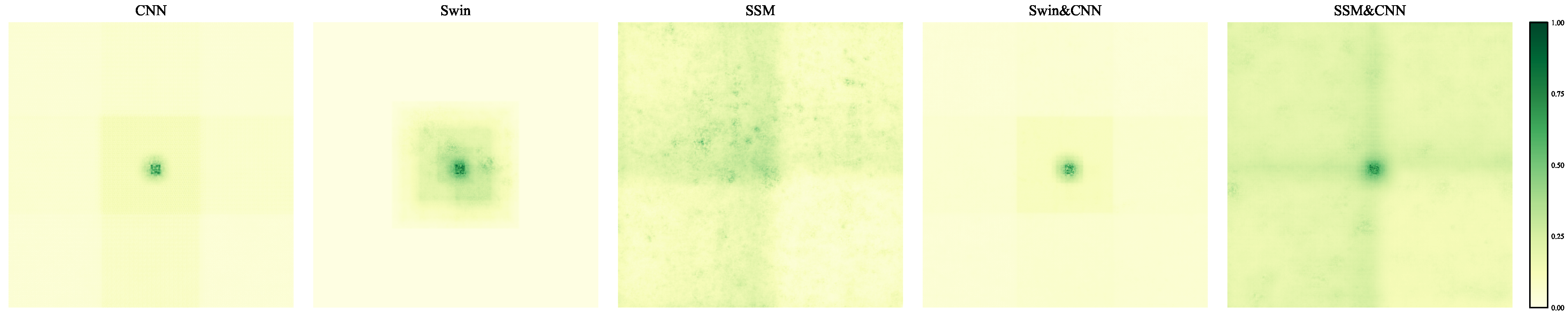
While the Swin Transformer [18,19] theoretically has a global receptive field, it exhibits a local ERF in image compression. Figure 1 shows that both the Swin-based and Transformer-CNN mixed architectures have local ERFs, albeit larger than the CNN-based method. Due to the limited ERF of CNN-based and Transformer-based methods, they struggle to capture the global information that is essential for high-resolution images (e.g., RS data). Additionally, the Transformer-CNN mixed method [16] introduces substantial computational overhead [26], thereby restricting its practicability. Hence, effectively modeling global information with low complexity remains a crucial challenge in image compression.
Figure 1.
ERF of analysis transforms of CNN-based method (ELIC), Transformer-based method (STF), mixed method (LIC-TCM) and our proposed model on 100 LoveDA images. The ERF is visualized by computing the gradient magnitudes at the central position in the latent representation (with respect to the input image). The stage 1–4 is divided by the last three downsampling modules of the analysis transforms .
Recent advances in State Space Models (SSMs) [27,28,29,30,31,32,33,34,35,36,37] have demonstrated remarkable potential in visual tasks, providing a new solution for high-resolution image compression [38]. SSMs can match the performance of transformers in vision tasks with lower computational overhead [31]. Their global receptive fields with linear complexity are well aligned with the requirements of RS image compression, where long-range dependencies must be modeled under constrained computational and memory budgets. However, directly applying SSMs to RS image compression presents a dilemma. Multi-path scanning (e.g., VMamba [31]) imposes substantial memory overhead on large-scale RS images, often causing Out-Of-Memory (OOM) errors. Conversely, efficient variants utilizing strided scanning (e.g., EfficientVMamba [39]) reduce complexity and memory consumption but inevitably suffer from detailed information degradation. This loss is particularly detrimental to RS imagery, which is characterized by dense small objects and intricate textures. Consequently, a straightforward application of existing SSMs fails to satisfy the dual requirements of efficiency and fidelity, necessitating a specialized architectural design.
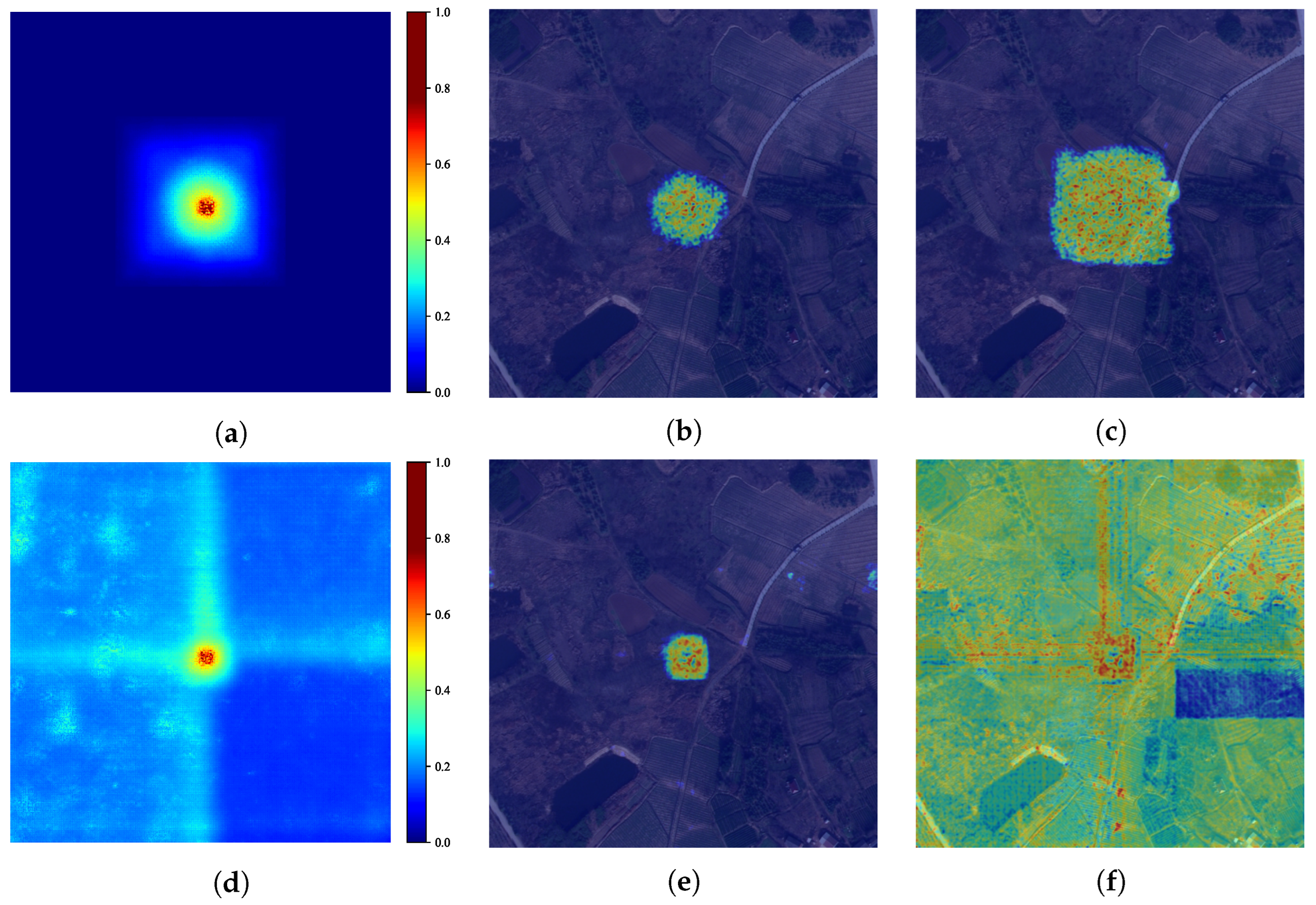
To address these challenges, we propose an efficient RS-SSM module, specifically designed for RS image compression. This module integrates a dynamic CNN branch for local feature extraction with our proposed Remote Sensing Visual State Space (RSVSS) block for global context modeling. Within the RSVSS block, we introduce a gated detail-compensation module to overcome the degradation caused by efficient scanning. Specifically, we augment the SSM utilizing strided scanning with a parallel deformable convolution branch, which is modulated by a multi-scale dynamic gating module. This design facilitates the effective capture of long-range dependencies while concurrently enabling the adaptive recovery of fine-grained details and irregular geometric features that are typically compromised by strided scanning. In comparison with Transformers [18,19], the proposed RSVSS block demonstrates superior capability in capturing long-range dependencies while maintaining low computational complexity. As shown in Figure 1, our method maintains the global ERF across all stages, enabling robust modeling of long-range dependencies that are critical for RS image compression. Furthermore, we propose an SSM-based spatial-channel context model that leverages the global modeling ability of SSMs to expand the receptive field of the entropy model.
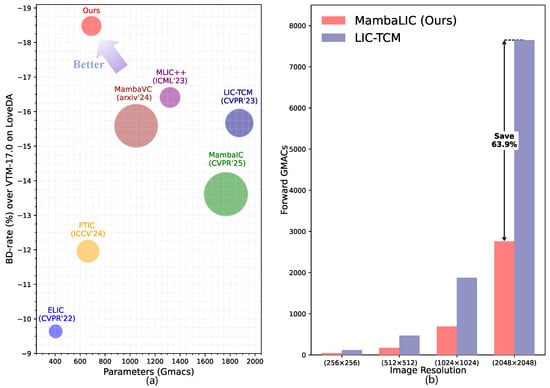
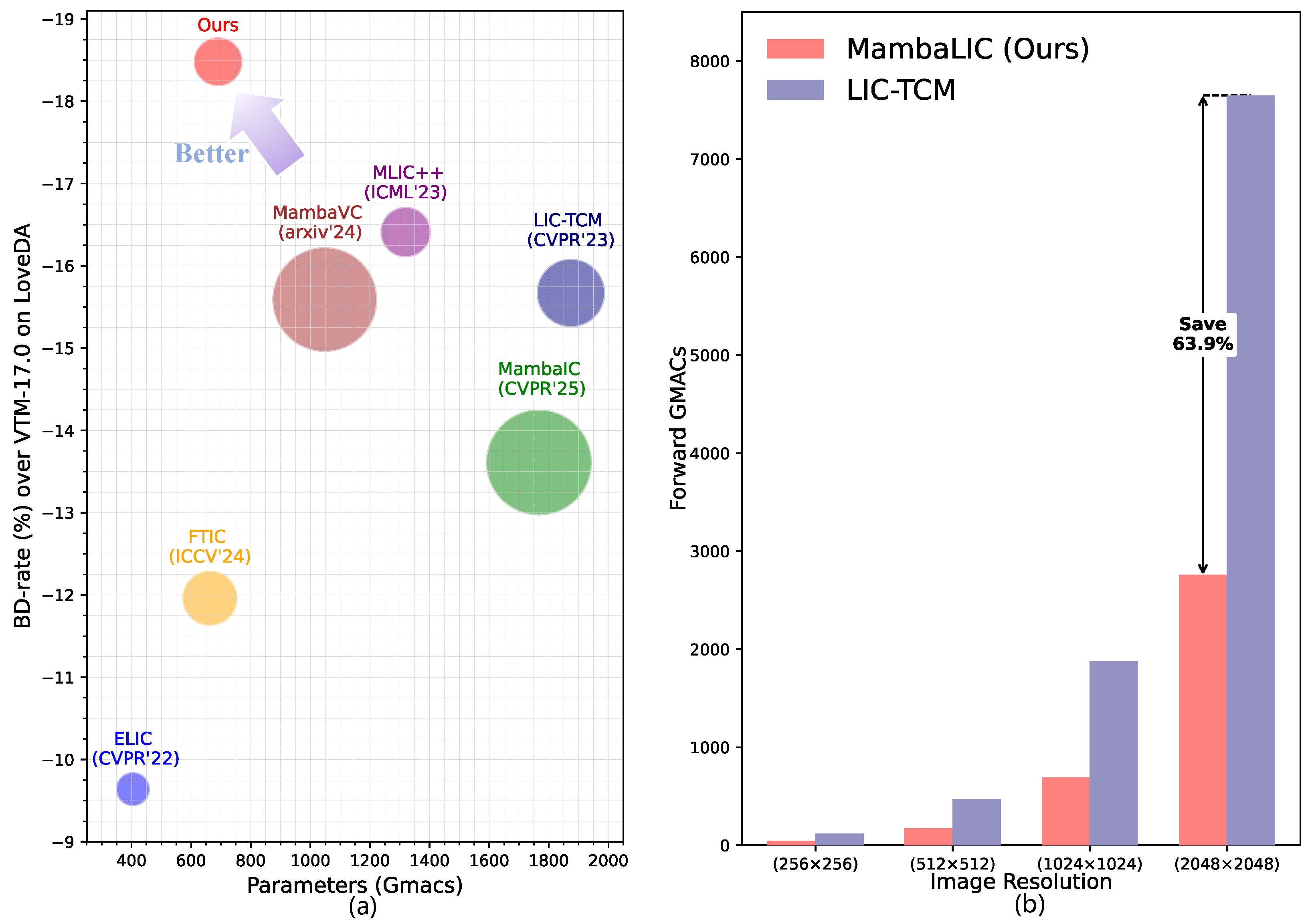
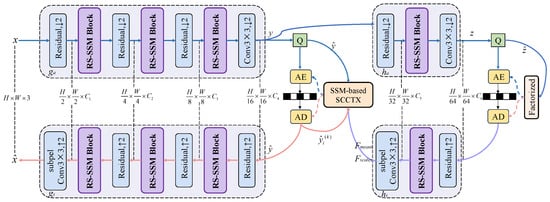
Building upon these architectural innovations, we propose MambaLIC, an end-to-end SSM-based framework tailored for RS image compression. As illustrated in Figure 2, MambaLIC not only surpasses the advanced Transformer-CNN mixed architecture [16] in rate-distortion (RD) performance but also significantly reduces computational complexity by 63.9%.
Figure 2.
(a) BD-rate (%) over VTM-17.0 [11] vs. complexity (Gmacs) on LoveDA [40]. The radius of circle indicates the model’s GPU memory usage. BD-rate [41] shows the bitrate savings at the same quality, lower is better. (b) Complexity comparison between our algorithm and LIC-TCM at various resolutions, MACs refer to Multiply-Accumulate operations.
To rigorously validate the effectiveness of the proposed network, we conducted extensive experiments on three datasets with resolutions spanning from to . Empirical results demonstrate that MambaLIC achieves state-of-the-art (SOTA) performance, confirming its efficacy and robustness across diverse remote sensing scenes. Notably, our method exhibits exceptional scalability and efficiency when processing ultra-high-resolution RS images (e.g., exceeding ), addressing the bottleneck of existing methods in large-scale scenarios.
The main contributions can be summarized as follows:
- We propose an innovative Remote Sensing State Space Model (RS-SSM) module. It specifically integrates a dynamic CNN branch for local feature extraction with a novel Remote Sensing Visual State Space (RSVSS) block for global context modeling. Crucially, within the RSVSS block, we introduce a gated detail-compensation module to resolve the detailed information degradation caused by strided scanning. This design achieves high computational efficiency while preserving fine-grained details critical for RS imagery.
- We propose an SSM-based Spatial-Channel Context Model (SSCM) that leverages the global modeling capability of SSMs. This expands the receptive field for entropy estimation, enabling the effective capture of long-range dependencies across the image.
- Based on these advancements, we propose MambaLIC, an SSM-based RS image compression framework. Experimental results on three widely used RS image datasets (UC-Merced, LoveDA, and xView) demonstrate that MambaLIC achieves state-of-the-art performance, outperforming VVC (VTM-17.0) by 14.22%, 18.48%, and 17.47% in BD-rate, respectively. Furthermore, it demonstrates superior computational efficiency and lower memory consumption compared to Transformer-based methods and existing Mamba-based approaches (e.g., 78.8% memory saving vs. MambaIC), proving its suitability for ultra-high-resolution RS imagery.
2. Related Work
2.1. RS Image Compression
The field of remote-sensing (RS) image compression has evolved from traditional handcrafted algorithms, such as JPEG [42], JPEG2000 [43,44], and CCSDS standards [45], towards deep-learning based methods. While the former were effective at reducing redundancy, they have been largely surpassed in RD performance by LIC. The success of LIC on natural images [8,9,46] has directly motivated its adaptation to address the unique challenges of RS data.
Adapting LIC to RS images requires addressing their distinct properties, namely vast scale variations and fine-grained textures. Some studies employ specialized modules to preserve detailed information. For instance, Han et al. [2] used GANs to preserve edges and textures while Xiang and Liang [25] designed a frequency-domain module to retain details. Other studies aim to make the model more efficient and to capture complex dependencies. Fu and Du [23], for instance, introduced a hybrid hyper-prior to minimize both local and non-local redundancies.
More recently, generative models, particularly diffusion models, have emerged as a powerful tool for enhancement. Zhang et al. [47] paired a lightweight encoder with a diffusion-based restoration module to achieve high compression ratios while maintain the high quality. Li et al. [48] used a latent diffusion model to improve decoding quality by utilizing the generate distortion prior from a LDM.
While these methods demonstrate remarkable progress, they do not fully exploit the unique properties of RS images. Thus, an end-to-end compression framework that simultaneously captures large-scale context and fine-grained details remains essential.
2.2. Learned Image Compression
Recent LIC research extensively adopts the VAE-based architecture introduced by Ballé et al. [4,5]. Early LIC research was primarily based on CNNs. Ballé et al. [5] first introduced a hyper-prior model to capture spatial dependencies in the latent. Then Minnen et al. [8] proposed an autoregressive model to improve reconstruction quality via capturing contextual information. However, this approach significantly increased the coding time. To address this issue, Minnen and Singh [9] introduced channel-wise context, and He et al. [15] developed a checkerboard context designed to improve efficiency. Meanwhile, other works have focused on improving the core components of the framework. For example, Cheng et al. [7,8] incorporated Gaussian mixture models and residual blocks, and Ghorbel et al. [13] used ConvNeXt as the transform block, which led to a more efficient model.
Further advancements continued to refine both the context model and the network architecture. He et al. [49] introduced a spatial–channel context model (SCCTX) that exploits both spatial and channel information in the latent representation, improving the entropy model’s rate estimation accuracy and producing higher-quality compressed images. Later, Jiang et al. [50] proposed a linear complexity attention-based multi-reference entropy model, efficiently capturing spatial and channel-wise context. Separately, to address the limited effective receptive field of earlier CNNs, Jiang et al. [24] used large-kernel convolutions to expand the effective receptive field. With these novel nonlinear transforms and advanced entropy models, CNN-based methods have outperformed traditional algorithms.
Different from CNN-based approaches, several studies have turned to the Swin Transformer [18,19] for improved compression. In the transform module, Zhu et al. [20] built a Swin Transformer–based nonlinear transform that delivered higher compression efficiency, and Zou et al. [10] further boosted performance by inserting absolute Transformer blocks into both encoder and decoder. In the entropy model, Qian et al. [21] introduced a Transformer-based design to capture long-range dependencies in probability estimation, while Koyuncu et al. [22] proposed a grouped context Transformer for parallel context modeling and faster decoding.
Specifically, Liu et al. [16] proposed a TCM block that integrates the advantages of transformers and CNN, enhancing the interaction between local and non-local information and achieving superior compression performance. This approach of integrating local and non-local information demonstrates significant potential in LIC.
2.3. SSM-Based Image Compression
Mamba [27], a type of State Space Model (SSM), has been incorporated into visual compression [26,38,51,52], leading to the development of SSM-based image compression frameworks. Among the pioneering efforts, Qin et al. [38] first proposed a learned image compression framework based on state-space models, demonstrating its advantages for high-resolution imagery. Arezki et al. [26] introduced a lightweight SSMIC model that uses SSM to balance compression performance and computational cost. Zeng et al. [52] leveraged the ability of SSMs to capture long-range dependencies to introduce a novel learned image compression method with refined context modeling, effectively reducing spatial redundancy during compression.
While these studies showcase SSMs’ ability in reducing computational complexity, especially for large images, the optical RS data introduce distinct challenges. RS data have abundant high-frequency edges (for example, roads and rooftops) and span scales from sub-pixel details to vast landscapes, unlike natural images with smoother textures and more uniform object sizes. As a result, RS compression must both preserve fine-grained details and capture broad contextual information in a single framework.
However, existing SSM-based frameworks [26,38] predominantly focus on global modeling while neglecting local feature extraction, resulting in constrained texture fidelity for RS image compression.
To address this challenge, we propose an efficient remote-sensing image compression framework based on an SSM-hybrid module that integrates local inductive biases with SSM’s long-range modeling capabilities. This design effectively captures both high-frequency details and global context in RS imagery, while striking a balance between computational efficiency and reconstruction fidelity.
3. Materials and Methods
3.1. Preliminaries
State Space Models (SSMs) [27,28] have emerged as a powerful backbone for long-sequence modeling. Specifically, the discretized SSM maps an input sequence to an output through a hidden state via the recurrence:
where are the discretized parameters derived from the continuous form [29]. Mamba [27] further optimizes this by introducing a selective scan mechanism and hardware-aware algorithms, enabling efficient modeling of long sequences.
To adapt 1D SSMs to 2D images, the Cross-Scan Mechanism (CSM) [31] was introduced to unfold images into sequences along four directions. However, this scanning necessitates storing intermediate feature maps proportional to the image size, resulting in a memory consumption of . Consequently, although CSM achieves linear computational complexity, it incurs prohibitive memory overhead for ultra-high-resolution images. To address this, recent efficient variants (e.g., EfficientVMamba [39]) utilize strided scanning strategies (ES2D) to reduce sequence length. This approach achieves a complexity of , effectively lowering computational requirements while simultaneously reducing memory consumption. However, such strided sampling approaches inherently risk spatial aliasing and detailed information loss. To address this, we propose a novel Remote Sensing State Space Model (RS-SSM) module. This design is engineered to maintain the high efficiency of strided scanning strategies, while efficiently preserving the fine-grained local textures critical for RS image.
3.2. Proposed MambaLIC
3.2.1. Overview
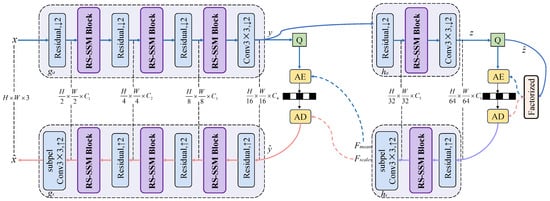
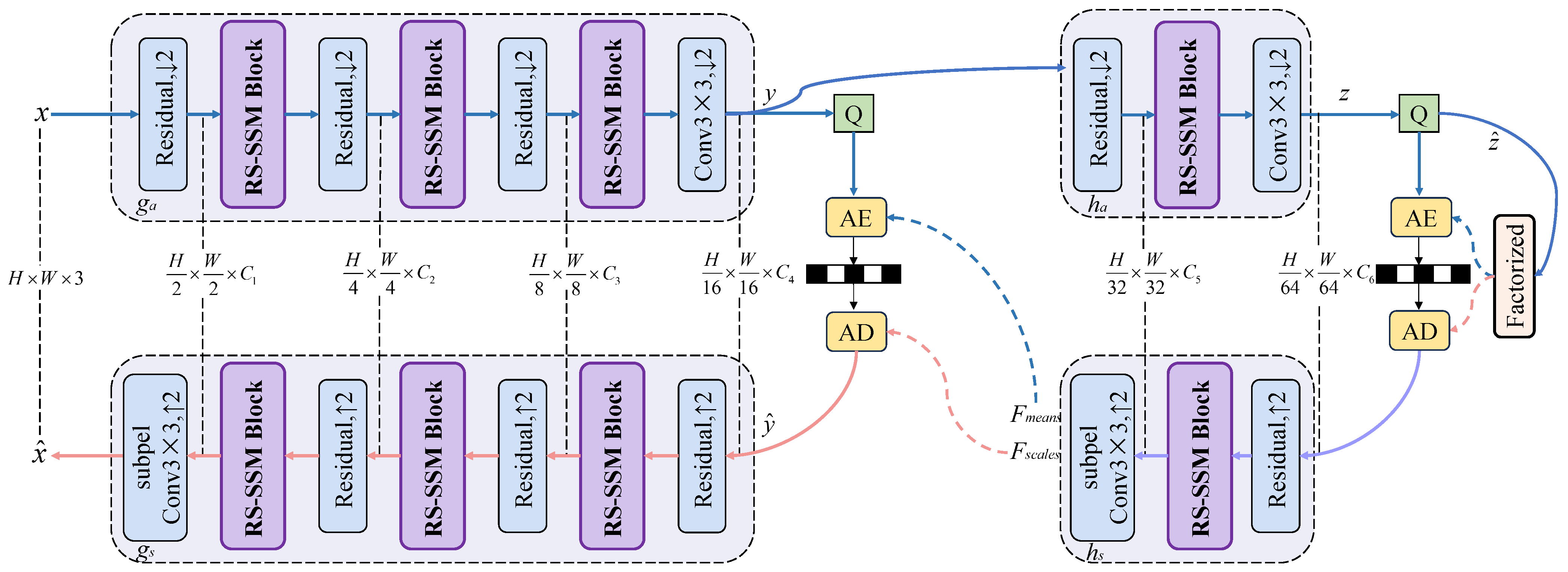
The overall architecture of the proposed MambaLIC framework is illustrated in Figure 3. Following the standard end-to-end learned image compression paradigm [5,6], the complete image coding process is formulated as follows:
Figure 3.
Overview of our method. ↓2 means that the feature is downsampled by a factor of 2, ↑2 means 2× upsampling. We use the SSM-based Spatial-Channel Context Model to accurately model the spatial and channel dependencies of . The residual blocks, proposed by Cheng [8], increase network depth, and sub-pixel convolution is used for upsampling.
As depicted in Figure 3, the input image x is first transformed into a latent representation y through the encoder . Subsequently, y is quantized into using the quantization function . Finally, the reconstructed image is obtained by passing through the decoder . To efficiently compress the quantized latent representation , we employ a hyper-prior mechanism combined with a context model to estimate the probability distribution . The hyper-prior workflow is described as:
where z denotes the hyper-prior variable. The hyper-prior decoder generates initial distribution parameters . These parameters are then refined by our proposed SSM-based Spatial-Channel Context Model (SSCM) to accurately model the spatial and channel dependencies of for arithmetic coding. In our design, both the main encoder and decoder are constructed using stacked Remote Sensing State Space Model (RS-SSM) blocks. As detailed in Section 3.2.2, the RS-SSM block is specifically designed to effectively capture global context while preserving local details.
The entire network is optimized end-to-end by minimizing the rate-distortion Lagrangian loss function:
where represents the distortion (e.g., MSE) between x and , and denotes the estimated bitrates of and . is the hyperparameter balancing the rate-distortion trade-off.
3.2.2. Remote Sensing State Space Model (RS-SSM) Module
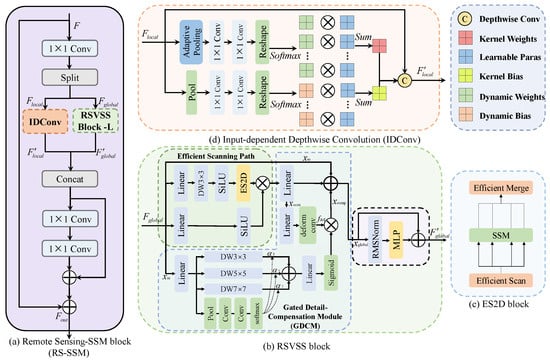
The distinctive attributes of RS imagery, particularly the coexistence of large scale geographic contexts and dense fine-grained textures, pose a substantial challenge for single stream architectures. In order to effectively model these dual characteristics, the Remote Sensing State Space Model (RS-SSM) module is proposed. As illustrated in Figure 4, the RS-SSM module adopts a synergistic dual stream design that explicitly couples global context modeling with local detail compensation.
Figure 4.
The architecture of the proposed RS-SSM block. RS-SSM employs CNNs for local feature extraction and stacked RSVSS blocks for global modeling, with channel-squeezing and channel-expansion convolution for feature fusion.
Macro-Architecture. Given an input tensor , the module first employs a convolution for channel interaction. The features are then split along the channel dimension into two sub-tensors, and , which are processed in parallel:
where denotes our proposed global modeling block, and refers to the dynamic depthwise convolution [53], which is utilized here as a lightweight operator to capture local inductive biases. Finally, the outputs are fused via channel concatenation followed by sequential convolutions (channel-squeezing and channel-expansion) to reduce the redundancy, with a residual connection to the input:
RSVSS Block. The core innovation lies within the Remote Sensing Visual State Space (RSVSS) block. While standard EfficientVmamba [39] utilizes strided scanning (ES2D) to reduce computational complexity, this operation inevitably leads to the aliasing and loss of high frequency information. This degradation is unacceptable for RS images rich in fine-grained textures. To resolve this dilemma, we design the RSVSS block with a synergistic dual path structure, where a novel Gated Detail Compensation Module (GDCM) is integrated to explicitly repair the information loss caused by the efficient scanning branch.
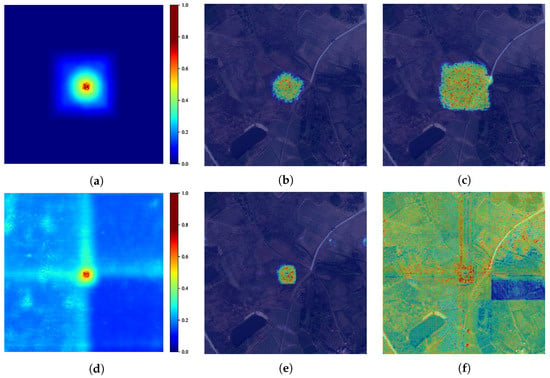
As shown in Figure 4b, the RSVSS block consists of two primary pathways working in coordination. A visualization of the effective receptive fields is provided in Figure 5.
Figure 5.
ERF of the proposed MambaLIC and [16]. The gradient values exceeding the threshold are clipped. The ERF is obtained by measuring the output of . (a) TCM; (b) TCM (); (c) TCM (); (d) Ours; (e) Ours (); (f) Ours (). (a,d) are derived from the LoveDA test set, while (b,c,e,f) are measured from 734.png.
The Efficient Scanning Path employs the strided-scanning mechanism [39] to capture long-range dependencies with a complexity of . Let be the input to the RSVSS block. The output of the scanning path, , is obtained via the SSM formulation.
In parallel, the Detail-Compensation Path is introduced to recover the texture details compromised by strided scanning. Specifically, to handle the irregular geometry of RS objects (e.g., winding roads), we employ a Deformable Convolution (DCN) [54] to extract shape-adaptive features:
Simultaneously, to address the extreme scale variation in RS images, we construct a dynamic gate using a multi-branch depth-wise convolution structure (kernel sizes ). To adaptively fuse these multi scale features, we introduce a selection mechanism that computes attention weights based on the global context. Consequently, the gate generation is formulated as a weighted summation:
where denotes the Sigmoid activation function and represents the adaptive attention weights generated by a parallel path comprising global average pooling, two convolution layers, and a Softmax function. This design allows the model to dynamically adjust the receptive field focus according to the input content.
The compensated detailed features are then generated by modulating the deformable features with the dynamic gate:
Then, the compensated features are injected into the main scanning stream to produce the aggregated global feature:
where Proj represents the linear projection. Through this design, the RSVSS block effectively maintains the efficiency of strided scanning while robustly preserving fine-grained details through the gated compensation mechanism.
Finally, the output feature is generated by a feedforward neural network. The input is processed through two parallel branches. One branch applies root mean square normalization (RMSNorm) [55] followed by a multilayer perceptron for nonlinear transformation, and the other branch performs an identity mapping. The two branches are combined by elementwise addition:
3.2.3. Information Fidelity Analysis of Strided Scanning
To further clarify the design rationale of the strided scanning and detail compensation mechanisms, we provide a brief analysis in terms of information fidelity. The strided scanning strategy reorganizes the feature map with stride p and applies selective scanning to the resulting sequence. Given the input feature x, the scanning process can be written as
where represents the sampling and rearrangement operation based on stride. When with four-directional scanning, each spatial position is included in one selective scan path. Nevertheless, stride-based sampling modifies the spatial ordering of neighboring pixels in the constructed sequence. As a result, pixels that are adjacent in the original spatial arrangement may be separated after reordering and are not processed consecutively within the same scan. In the full SS2D setting, spatial adjacency is preserved during sequence construction, enabling local structural variations to directly influence subsequent positions along the scan. In contrast, strided scanning alters the ordering of spatial positions, weakening the direct interaction between neighboring pixels. Consequently, while strided scanning facilitates modeling of cross-region structural patterns, fine-grained local details are comparatively weakened in the resulting representation.
To mitigate this effect, we introduce a parallel detail compensation pathway that operates at full spatial resolution. The final output is formulated as
The compensation branch preserves the original spatial arrangement and maintains local structural continuity, enabling neighboring information to interact during feature fusion. Therefore, while strided scanning reduces computational complexity, the explicit preservation of local structural information alleviates potential degradation in representation fidelity. This design achieves a practical balance between efficiency and information preservation.
3.2.4. SSA-Based SCCTX
Entropy models constitute fundamental components in LIC by estimating latent representation distributions. While existing autoregressive approaches utilize decoded data for probability estimation, their restricted receptive fields, often limited to small local windows, inadequately model the long-range dependencies in high-resolution RS images. To address this, we propose the SSM-based Spatial-Channel Context Model (SSCM).
The proposed SSCM leverages three distinct dependencies for conditional probability estimation, specifically hyper-prior information, inter-slice channel dependencies, and intra-slice spatial dependencies. The latent representation y comprising 320 channels is evenly divided into 10 slices denoted as , with each slice containing 32 channels. Furthermore, a checkerboard scheme is utilized to partition each slice into anchor and nonanchor components.
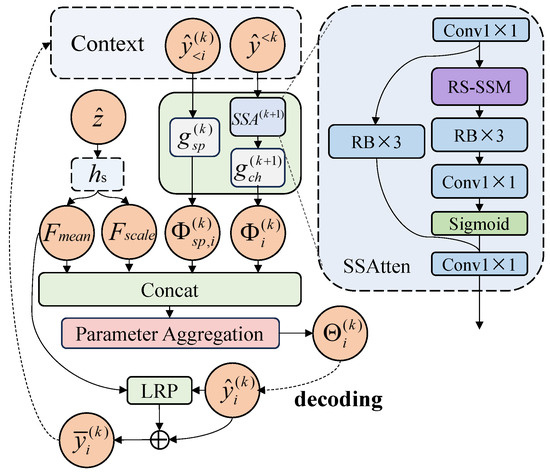
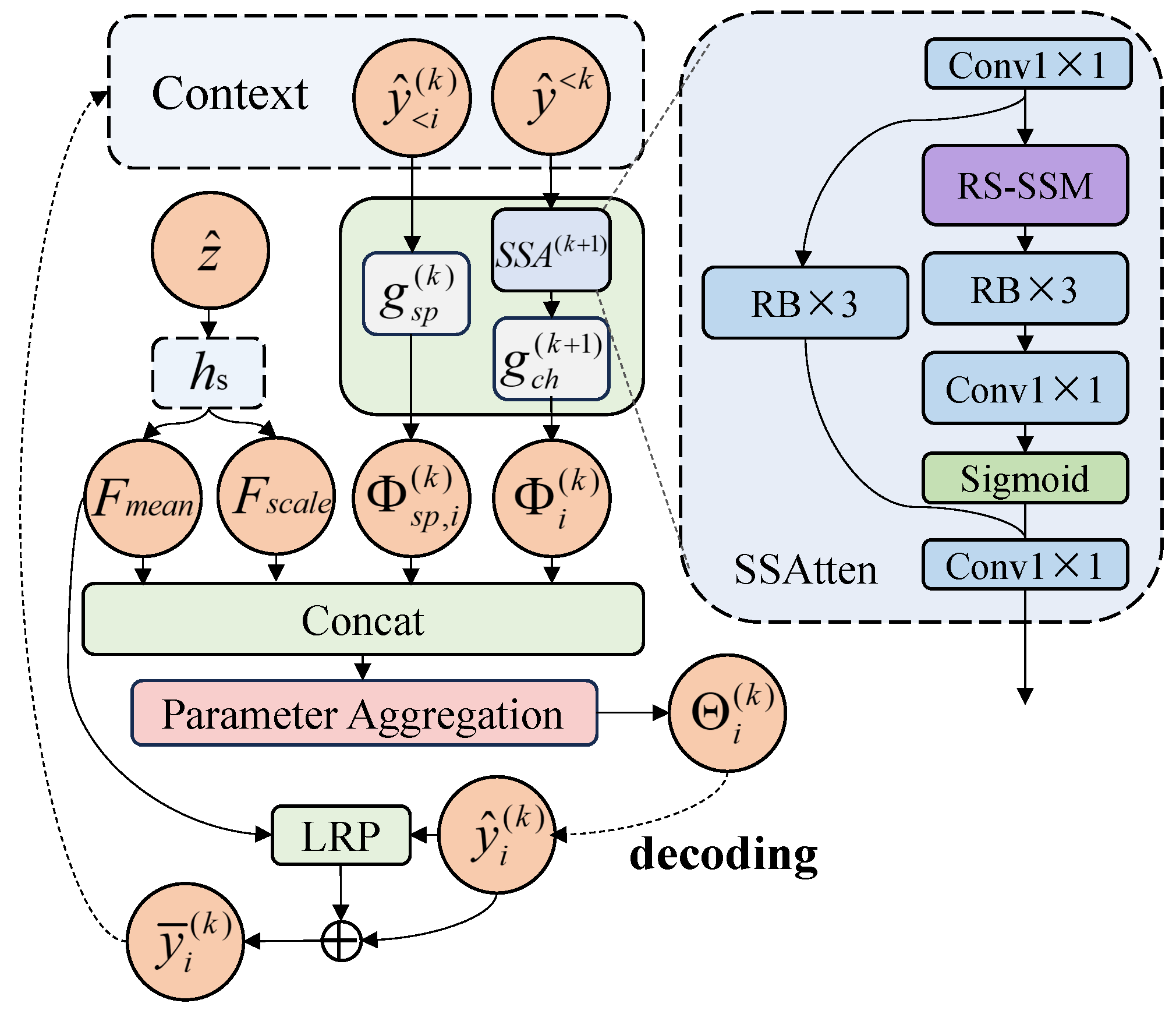
As shown in Figure 6, for slice k, the SSA module extracts channel context from previously decoded slices . By leveraging the global modeling capabilities of SSMs, this module efficiently captures long range correlations. The extracted features undergo transformation through a channel network . Concurrently, a checkerboard masked convolution models the spatial context conditioned on the decoded anchor elements.
Figure 6.
SSM-based Spatial-Channel Context Model (SSCM).
The hyperprior features (, ), channel context, and spatial context are fused via the parameter aggregation network to generate the mean and scale parameters for the conditional Gaussian entropy model.
Encoding proceeds in two stages. Anchor elements are encoded first using hyper-prior and channel context. After quantization, Latent Residual Prediction (LRP) compensates the reconstructed anchor features, which are then used to produce spatial context for encoding non-anchor elements. The compensated anchor and non-anchor components are combined to obtain the reconstructed slice. After all slices are decoded sequentially, they are passed to the synthesis transform to reconstruct the image . By integrating these multi-scale dependencies, the SSCM significantly reduces information redundancy.
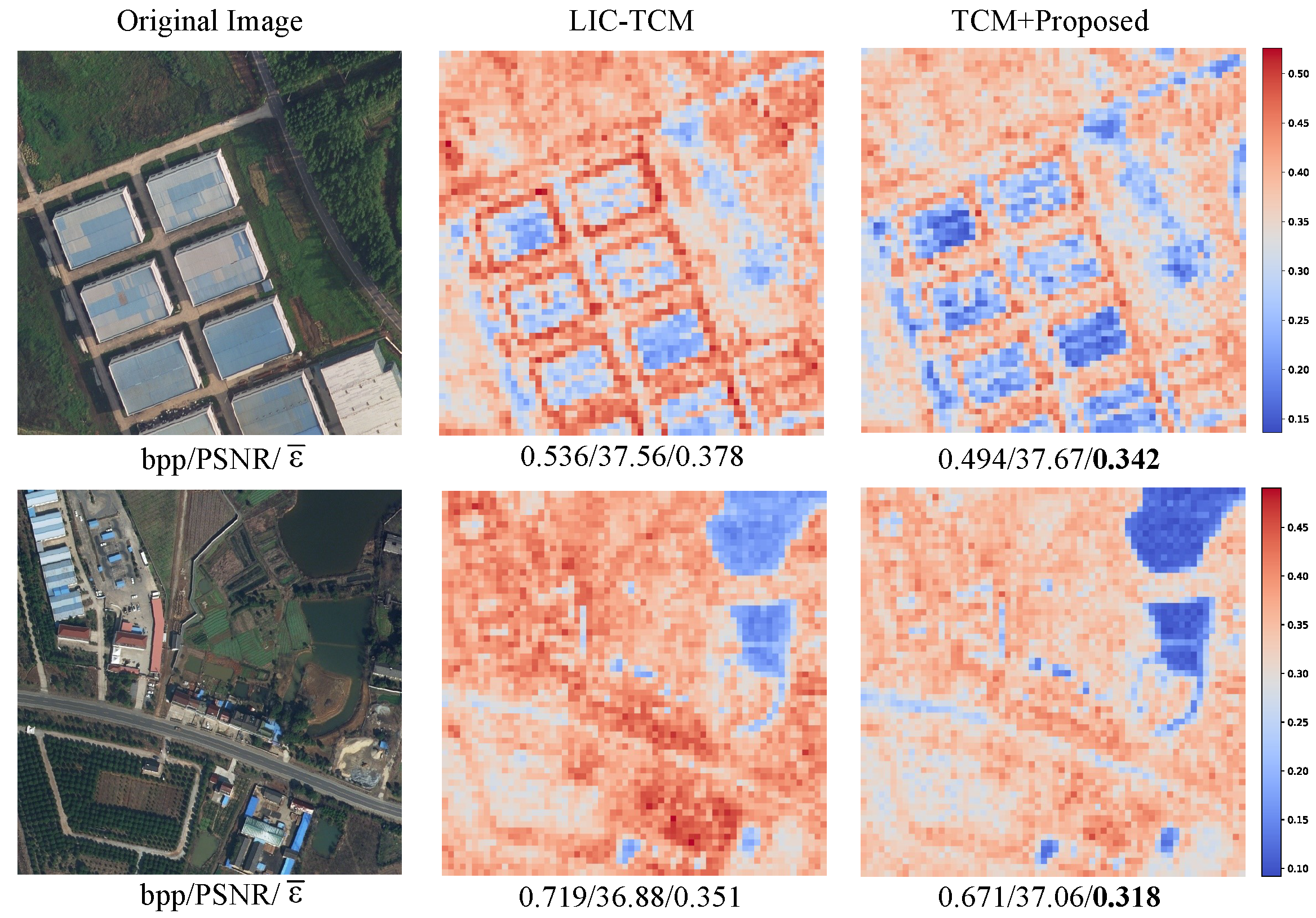
To visualize the effectiveness of this design, we calculated the quantization deviation following [38]. As shown in Figure 7, the proposed entropy module yields a lower average deviation compared to the baseline, indicating better preservation of high-fidelity details in RS images.
Figure 7.
Quantization deviation maps of 593.png and 694.png in LoveDA dataset. To avoid the potential influence of the global receptive field of the proposed RS-SSM module, we used TCM as the baseline.
4. Experiments and Results
4.1. Experimental Setup
4.1.1. Model Configuration
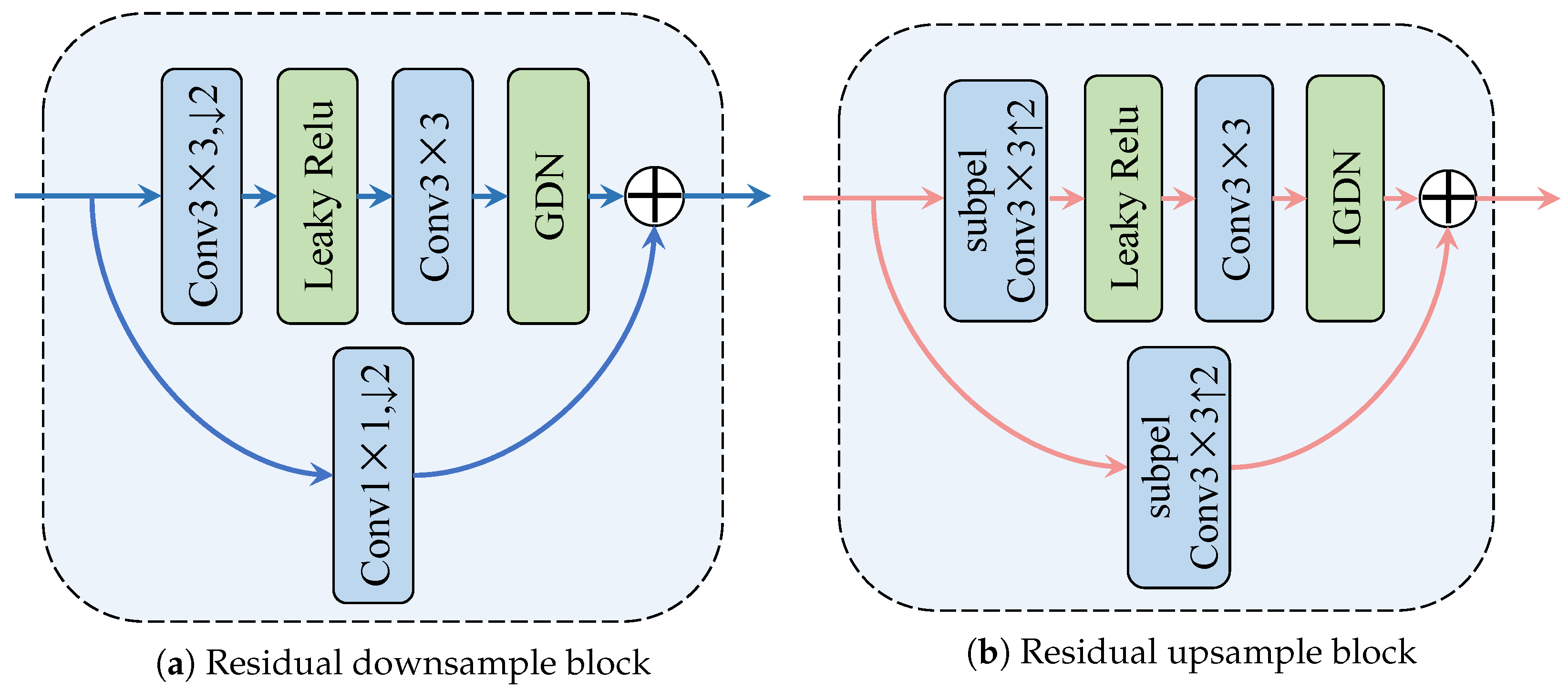
The overall architecture of our proposed MambaLIC is presented in Figure 3. It utilizes the residual blocks from Cheng et al. [8], which is detailed in Figure 8.
Figure 8.
Structure of residual block.
For the main network, the channel dimensions C are configured as to . In addition, the latent channel M and the hyperprior z are set to 320 and 192, respectively.
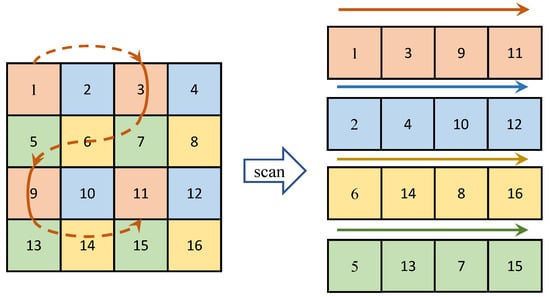
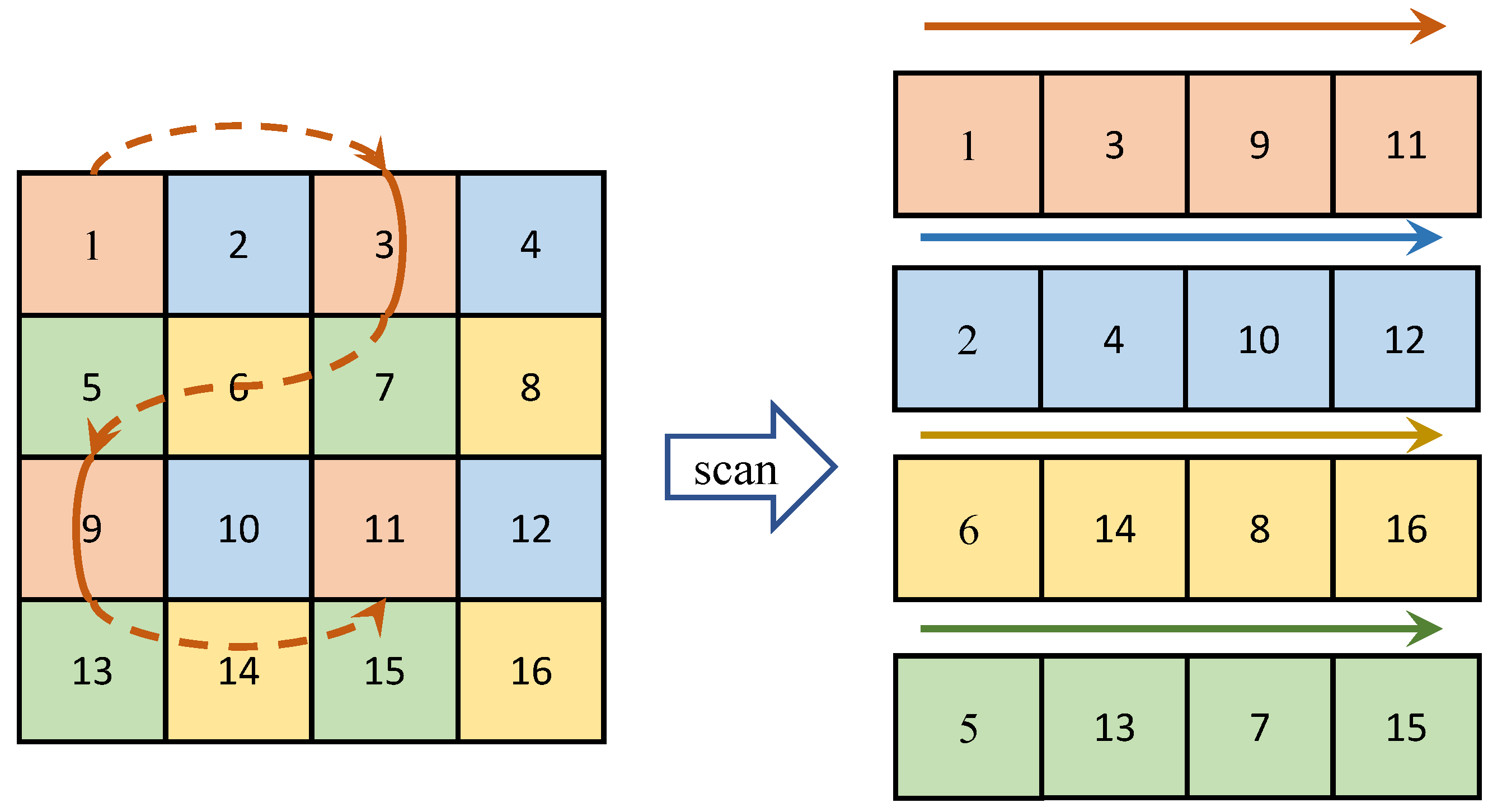
The proposed RS-SSM module is constructed by stacking RS-VSS blocks. Within each block, the ES2D submodule [39] is configured with a state dimension (d-state) of 16, a expansion factor (ssm-ratio) of 2.0, and an MLP expansion ratio (mlp-ratio) of 4.0. To accelerate processing, the skip sampling step p is set to 2, and the scanning pathway is visualized in Figure 9.
Figure 9.
Given an image block, ES2D traverses four paths within the image with a step size of 2, achieving a global receptive field while reducing complexity. The figure shows the traversal order of one path.
4.1.2. Training Details
During the training, we randomly partitioned the DOTA dataset [56] into training and validation sets at an 8:2 ratio. All models were optimized using the Adam optimizer with a batch size of 8. Our models were optimized using Equation (8), with representing the Mean Squared Error (MSE) and .
We trained the proposed MambaLIC for 3.2M steps using a multi-stage training strategy (following Zhu [20]). First, we trained a hyper-prior model and subsequently trained the proposed MambaLIC. The procedure was outlined below:
Stage 1: The hyper-prior model (as shown in Figure 10) was trained for 2M steps using a fixed learning rate of 1 × 10⁻⁴.
Figure 10.
The framework trained in Stage 1. In this stage, our MambaLIC employs the hyper-prior model as the entropy model.
Stage 2: The transform weights obtained from the hyper-prior model were loaded, and the proposed MambaLIC model was trained for an additional 1M steps at the learning rate 1 × 10⁻⁴.
Stage 3: The learning rate was reduced to 1 × 10⁻⁵, and the model was trained for a final 200 K steps.
All experiments were conducted on the DOTA dataset. In Stages 1 and 2, each batch comprised 8 randomly cropped patches of size 256 × 256 pixels, while in Stage 3, larger patches (384 × 384) were used to enhance performance.
All the experiments were conducted on the CompressAI [57] and PyTorch 2.0.1.
4.1.3. Evaluation Metrics
To evaluate our method’s performance, we selected three RS image benchmarks at different resolutions: UC-Merced (UC-M) [58] benchmark has 21 land-use categories and provides 2100 samples with 256 × 256 pixels at 0.3 m resolution; LoveDA [40] benchmark contains 5987 images with 1024 × 1024 pixels. The xView dataset is a large-scale dataset that includes 60 object classes and maintains 0.3 m spatial resolution.
During the evaluation, we randomly selected 10% of the images of the UC-M, LoveDA and the xView datasets for testing (For the xView dataset, all selected images exceed 2560 × 2560 pixels and have an average resolution of 3200 × 2900 pixels). For evaluation, peak signal-to-noise ratio (PSNR) and multi-scale structural similarity (MS-SSIM) were used to measure reconstruction quality, while bits per pixel (bpp) was used to evaluate bitrates.
4.1.4. Traditional Codec Settings
We evaluated the performance of traditional algorithms using VTM 17.0 (All-Intra configuration) and BPG v0.9.8. To ensure reproducibility and fairness, all evaluations were conducted using the standard benchmarking scripts provided by CompressAI.
4.2. Performance Comparison
To comprehensively verify the effectiveness of MambaLIC, we conducted a comparison against state-of-the-art (SOTA) learned image compression algorithms and traditional codecs. These selected learned methods cover a wide range of mainstream architectural paradigms, including CNN-based algorithms such as ELIC [49], MLIC++ [50], and HL [25], alongside Transformer-based approaches like FTIC [59] and the hybrid model LIC-TCM [16]. Furthermore, we incorporated emerging Mamba-based methods, specifically MambaVC [38] and MambaIC [52], as well as the emerging direction represented by diffusion-based method, LDM-RSIC [48].
For traditional benchmarks, VTM-17.0 [11], VTM-23.14, BPG444 [12] and JPEG-AI [60] were evaluated for reference.
4.2.1. Rate-Distortion Performance
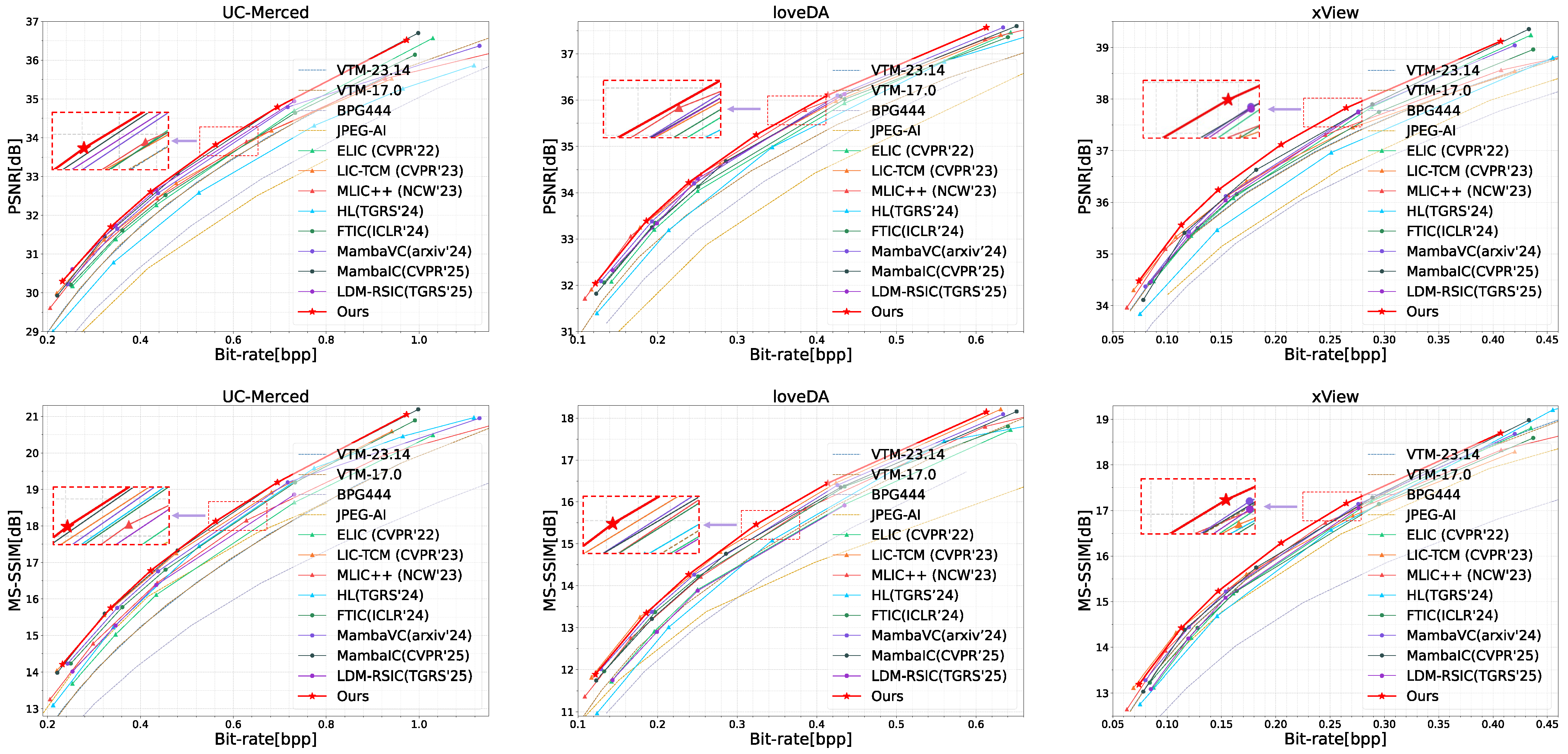
The Rate-Distortion (RD) curves for the UC-Merced, LoveDA, and xView datasets are presented in Figure 11. To facilitate a clear comparison following prior works [16], we converted the MS-SSIM to dB using the formula . As illustrated in the curves, the proposed MambaLIC achieves state-of-the-art performance in terms of both PSNR and MS-SSIM across these widely used datasets.
Figure 11.
Performance evaluation on the UC-Merced [58], LoveDA [40], and xView [61] datasets. The first row reports MSE results, and the second row reports MS-SSIM results. MS-SSIM is converted to dB for clarity.
To quantify the performance gains, we utilized the BD-rate metric with VVC (VTM-17.0) serving as the anchor. Table 1 demonstrates that MambaLIC outperforms all competing algorithms. Specifically, in terms of PSNR, our method achieves BD-rate reductions of 14.22%, 18.48%, and 17.47% on the three datasets, respectively. For MS-SSIM, MambaLIC reduces the BD-rate by 23.55% and 14.57% on UC-M and LoveDA, respectively, and by 7.30% on xView.
Table 1.
BD-rate (%) comparison for PSNR (dB). The anchor is VTM-17.0, BD-rate shows the bitrate savings at the same quality, lower BD-rate indicates better performance.
Overall, compared to the second-best method, MambaLIC achieves an average BD-rate reduction of 4.15% in PSNR and 2.38% in MS-SSIM across the three datasets.
These substantial gains underscore the algorithm’s robustness and the effectiveness of state-space models in capturing the unique feature representations of RS images. Moreover, the comparison with the diffusion-based compression LDM-RSIC further highlights the superiority of our method.
Furthermore, we also include the latest VVC reference software, VTM 23.14, and the JPEG-AI standard for comparison. Table 1 and Table 2 indicate that VTM 23.14 provides only a marginal improvement over VTM 17.0. In addition, since JPEG-AI is trained on natural images, it performs worse on remote sensing images than methods specifically trained for remote sensing images.
Table 2.
BD-rate (%) comparison for MS-SSIM. The anchor is VTM-17.0, BD-rate shows the bitrate savings at the same quality, lower BD-rate indicates better performance.
4.2.2. Computational Complexity and Efficiency
Beyond the superior rate-distortion performance, a critical advantage of MambaLIC lies in its computational efficiency, which addresses the dual challenges of computational burden in Transformers and memory consumption in existing Mamba models. First, regarding computational complexity, Transformer-based methods (e.g., LIC-TCM [16]) typically achieve SOTA performance but suffer from heavy computational loads. As shown in Table 3, compared to LIC-TCM, our method alleviates this burden significantly, reducing computational complexity (MACs) by 63.2% and encoding time by 16.8%.
Table 3.
Complexity comparison on the LoveDA dataset. Inference speed is measured on an NVIDIA GeForce RTX 4090.
Simultaneously, simply applying standard VMamba (SS2D) introduces another bottleneck: excessive memory consumption. Existing state-space-based methods like MambaVC [38] and MambaIC [52] rely on the standard multi-path scanning mechanism (SS2D), which imposes a severe memory burden (consuming 11.77 GB and 12.02 GB, respectively), effectively hindering their deployment on resource-constrained devices for high-resolution RS imagery.
In contrast, MambaLIC resolves this issue by incorporating the proposed RSVSS module. By utilizing p-step strided scanning to capture coarse global information and gated detail-compensation module for fine-grained textures, our method drastically lowers memory requirements without sacrificing global modeling capability. Consequently, compared to the latest SS2D-based method, MambaIC [52], MambaLIC achieves substantial efficiency gains, saving 78.8% in memory usage, 60.9% in computational costs (MACs), 66.3% in encoding time, and 41.5% in decoding time. These results underscore the superiority of the proposed RSVSS module in terms of both performance and complexity, demonstrating that our approach achieves highly efficient image compression suitable for large-scale RS imagery.
4.3. Qualitative Comparison
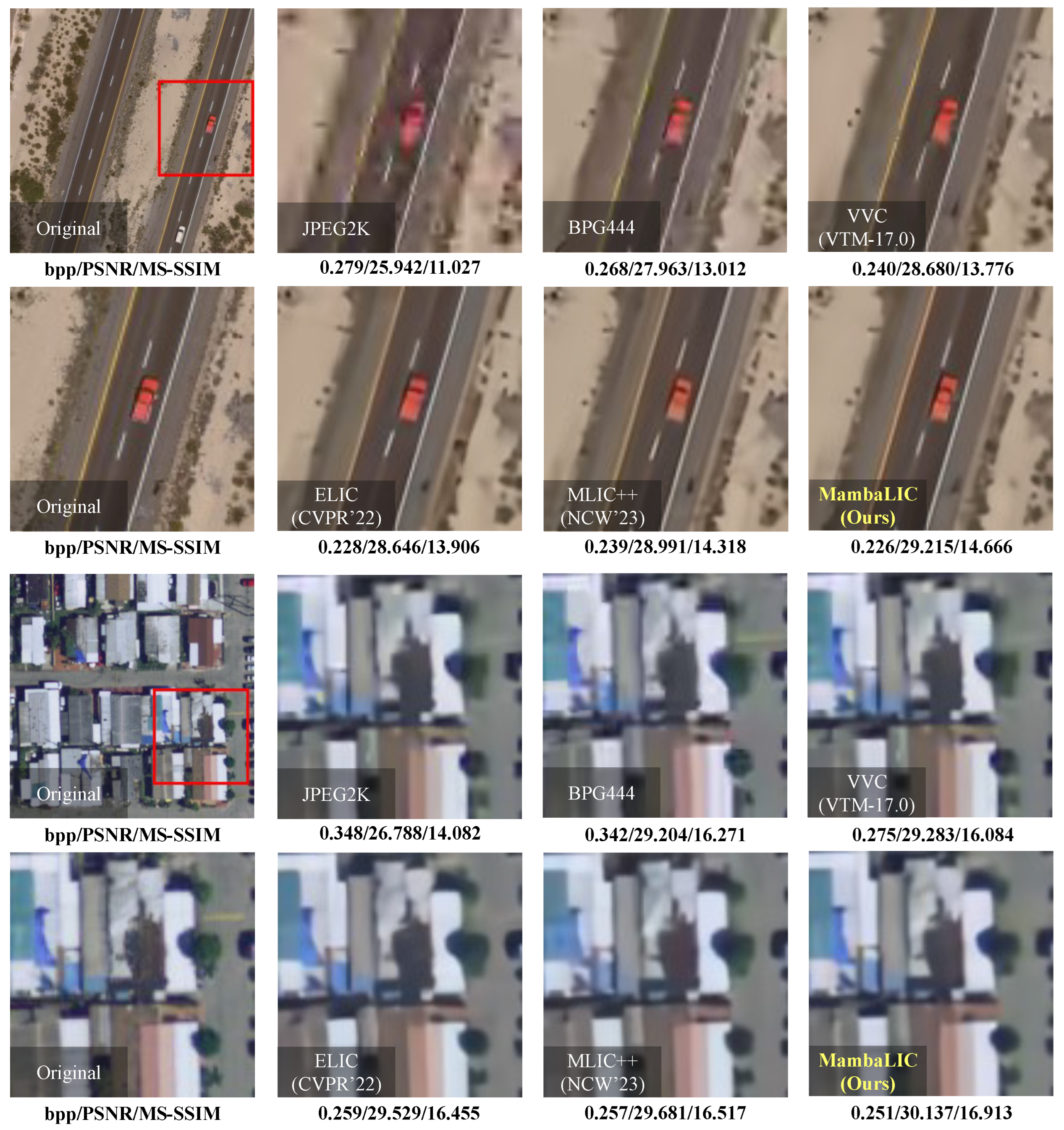
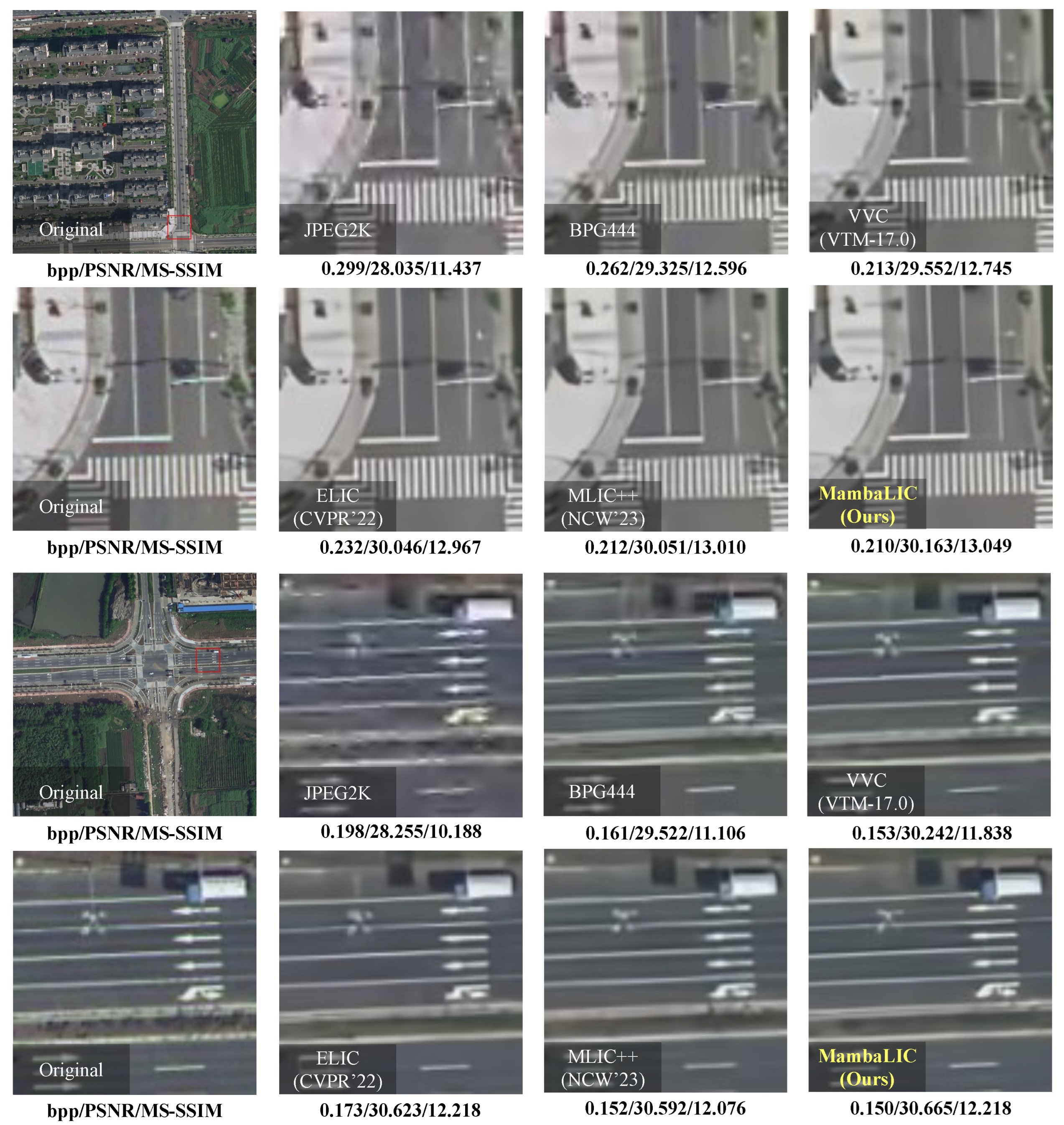
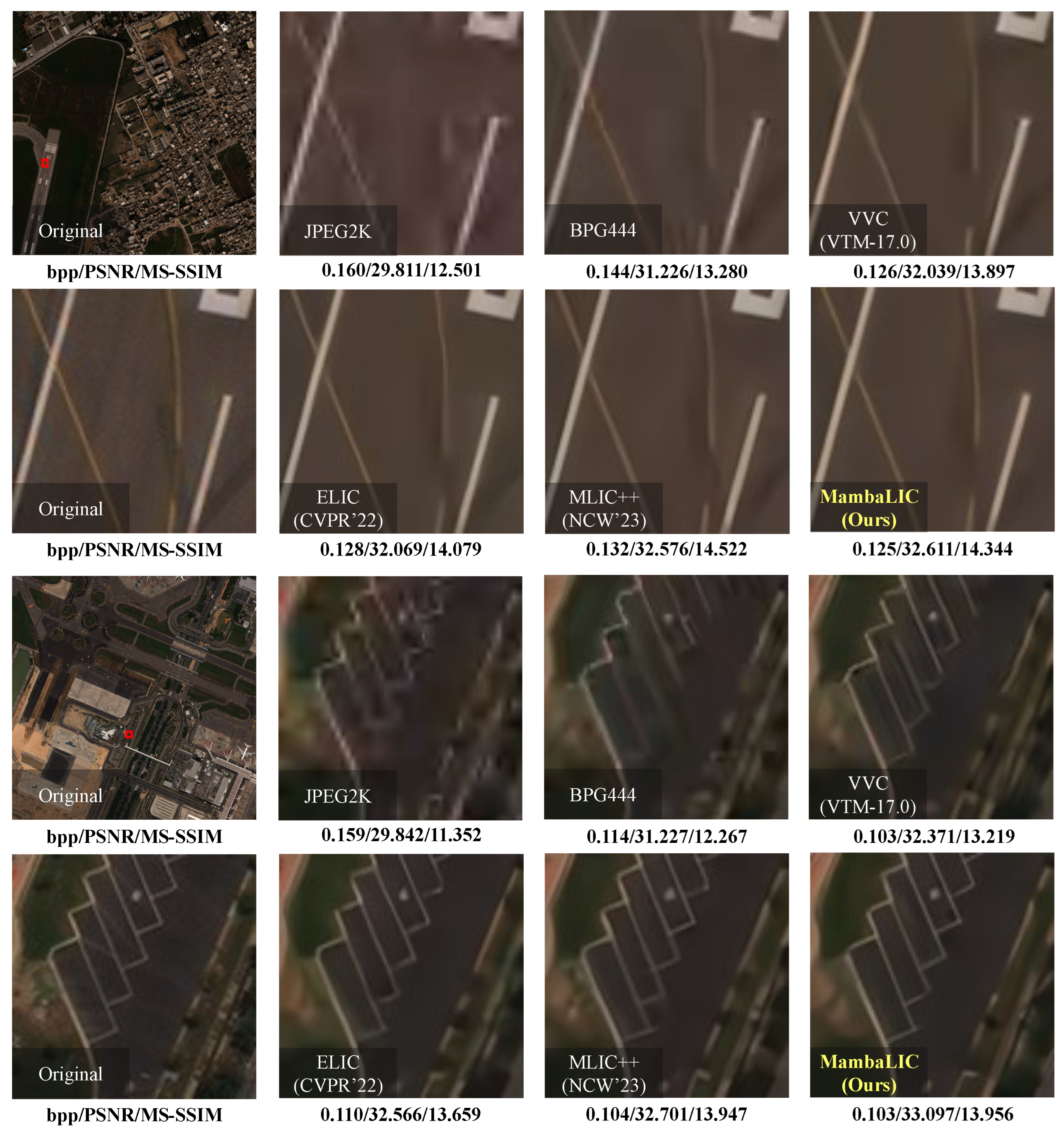
To visualize the performance of our algorithm, we present visual comparisons of decoded images from the UC-M, LoveDA, and xView datasets in Figure 12, Figure 13 and Figure 14, respectively.
Figure 12.
Decoded images from different methods on the “freeway63” and “mobilehomepark50” test images from the UC-M set, cropped into patches for clearer comparison. Bitrate, PSNR, and MS-SSIM are displayed beneath each patch, with MS-SSIM values converted to dB for clarity. In the image “freeway63”, MambaLIC better preserves the detailed texture features of the red car with clearer lines. In the image “mobilehomepark50”, our method retains texture more effectively and achieves a 0.854 dB PSNR gain over VVC.
Figure 13.
Decoded images from different methods on the “3786” and “3526” test images from the LoveDA set, cropped into patches for clearer comparison. Bitrate, PSNR, and MS-SSIM are displayed beneath each patch, with MS-SSIM values converted to dB for clarity. In the image “3786”, our method produces the sharpest details, such as zebra crossings and traffic markings. In the image “3526”, MambaLIC achieves the highest fidelity, particularly in maintaining the color and fine details of the blue truck head.
Figure 14.
Decoded images from different methods on the “98” and “1064” test images from the xView set, cropped into patches for clearer comparison. Bitrate, PSNR, and MS-SSIM are displayed beneath each patch, with MS-SSIM values converted to dB for clarity. In the image “98”, MambaLIC better preserves the texture and color of the yellow guide lines compared to other methods. In the image “1064”, our algorithm highlights its advantage in preserving the edge details of parking spaces.
4.3.1. Results on UC-M (Small-Resolution Dataset)
As illustrated in the image “freeway63” of Figure 12, images decoded by traditional codecs (such as JPEG2000 and BPG) exhibit significant artifacts and blurring. In contrast, LIC methods demonstrate superior texture preservation, outperforming even the state-of-the-art traditional codec, VVC. Furthermore, VVC, ELIC, and MLIC++ struggle to reconstruct the detailed textures of the red car faithfully, whereas our MambaLIC better preserves the texture features with clearer lines. Similarly, in the “mobilehomepark50” image, MambaLIC not only retains texture more effectively but also achieves a 0.854 dB PSNR gain over VVC at a lower bitrate.
4.3.2. Results on LoveDA (Medium-Resolution Dataset)
To further demonstrate the generalizability of our method, we evaluated it on the medium-resolution LoveDA dataset. As shown in the “3786” image of Figure 13, learning-based methods achieve higher compression quality than traditional codecs, with higher PSNR values and clearer textures (e.g., sharper zebra crossings and traffic markings). At low bitrates, traditional codecs suffer from severe artifacts and blurring. For example, JPEG2000 introduces blocking artifacts, while BPG and VVC obscure fine texture details. Among learning-based approaches, our method produces the sharpest details and achieves a 0.611 dB improvement in PSNR over VVC. In the “3526” image, traditional codecs like BPG and VVC suffer from detail loss. Although MLIC++ preserves texture slightly better, MambaLIC achieves the highest fidelity, particularly in maintaining the color and fine details of the blue truck head. These results indicate that MambaLIC excels at preserving the fine details and edges crucial for RS image compression.
4.3.3. Results on xView (High-Resolution Dataset)
Next, we evaluated our method on the high-resolution xView dataset. Notably, the selected images have a resolution exceeding pixels. The “98” image in Figure 14 showcases the superior subjective quality of MambaLIC. While other methods suffer from degradation, such as color fading and artifacts, MambaLIC better preserves the texture and color of the yellow guide lines. Similarly, the “1064” image highlights the advantage of our algorithm in preserving the edge details of parking spaces. Moreover, our method achieves a PSNR gain of 0.726 dB over the VVC codec, demonstrating its competitiveness on high-resolution datasets.
4.3.4. Summary
In summary, our qualitative evaluations across a range of resolutions confirm the practicality and robustness of MambaLIC. The visual results consistently show that MambaLIC surpasses both traditional and learning-based compression methods in texture preservation.
4.4. Ablation Evaluation
In this section, ablation experiments were conducted to demonstrate the effectiveness of the proposed nonlinear transformation module and entropy model.
4.4.1. Macro Architecture
To evaluate the influence of distinct architectures on RD performance and computational complexity, we conducted an ablation study on the RS-SSM module. Specifically, we constructed five variants by replacing the RS-SSM module with alternative components: Pure CNN using IDConv only, Pure Swin using Swin-Transformer blocks, Pure SSM using the RSVSS module, Hybrid Swin-CNN combining Swin-Transformer with IDConv, and Hybrid SSM-CNN (Ours) employing the proposed RS-SSM module. For these variants, we consistently employed SCCTX [49] with LRP as the entropy module to ensure a fair comparison.
As shown in Table 4, the Hybrid SSM-CNN variant achieves the best performance, demonstrating the superiority of the proposed RS-SSM module. Specifically, the SSM-based and Swin-based variants obtain better results than the CNN-based variant. Meanwhile, the SSM-based variant outperforms the Swin-based variant with similar resource consumption. Furthermore, the hybrid architectures consistently outperform single architectures, highlighting the importance of combining local and global information.
Table 4.
Comparative analysis of different architectures on the LoveDA Dataset. The anchor is VTM-17.0.
To further verify this interaction mechanism, we visualized the effective receptive fields (ERFs) of these variants in Figure 15, following the strategy in [20]. As shown in the figure, the CNN-based variant, which employs dynamic convolution, demonstrates a large receptive field with low gradient values. In contrast, the Swin-based variant exhibits a local receptive field, while the SSM-based variant produces a global receptive field. Moreover, the Swin&CNN-based variant shows a larger receptive field than the Swin-based variant, albeit with lower gradient values. Notably, the SSM&CNN-based variant not only maintains a global receptive field but also exhibits higher central gradient values, indicating stronger local modeling ability. This integration facilitates the interaction between local and global information, directly explaining the improved performance, as a large receptive field helps reduce spatial correlations [24] and strong local modeling ability is crucial for the reconstruction of textures [16].
Figure 15.
The effective receptive fields (ERFs) of analysis transforms of five variants on LoveDA test set. The ERF is visualized by computing the gradient magnitudes at the central position in the latent representation (with respect to the input image).
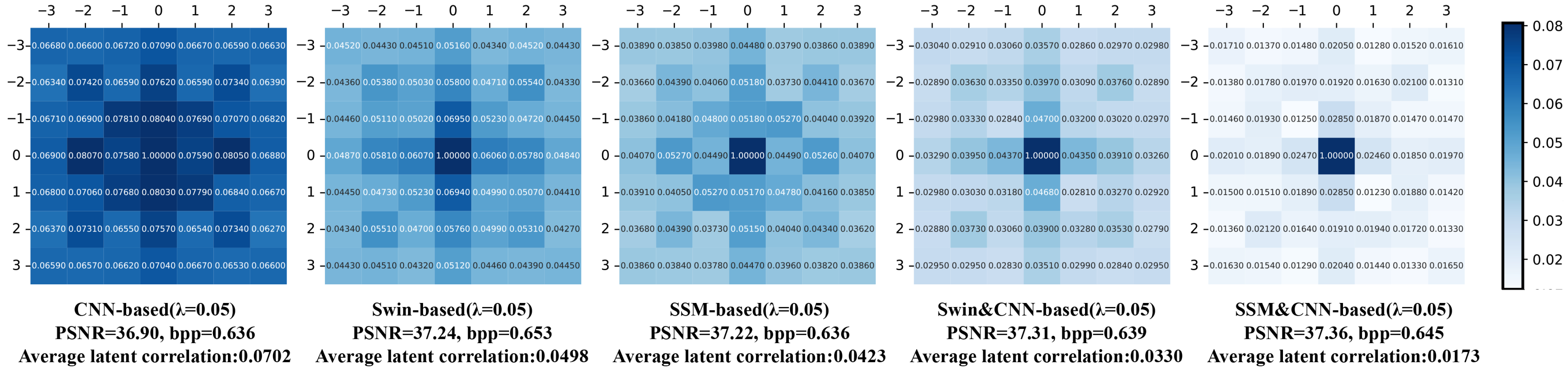
Complementing the visual ERF analysis, we followed the procedure in [20,38] to measure the normalized spatial correlation of the latent representation on the LoveDA test set. As shown in Figure 16, we observe a clear correspondence between the spatial correlation and the performance analyzed above. The Pure CNN variant exhibits the highest average latent correlation, reflecting significant spatial redundancy. The Pure Swin and Pure SSM variants show reduced correlation, while the Hybrid Swin-CNN variant further lowers the correlation by combining local and non-local modeling. Finally, the Hybrid SSM-CNN variant exhibits the lowest latent spatial correlation. This result aligns with its superior BD-rate, proving that the proposed RS-SSM module effectively reduces spatial redundancy in RS images to produce more compact latent representations.
Figure 16.
The latent correlation map of with models trained at = 0.05. The value at position indicate the normalized cross-correlation between the position and , calculated by average the cross-correlation across all images on LoveDA test set. Lower average latent correlations indicate the lower spatial redundancy.
4.4.2. Analysis of RS-SSM Module
To analyze the internal mechanisms of the RS-SSM module, we conducted an ablation study on the hybrid architecture and the Gated Detail Compensation Module (GDCM). The results are presented in Table 5. The IDConv-only variant yielded a BD-rate of −12.50%, serving as a local baseline. When employing the pure RSVSS module (w/o GDCM), the model achieved a BD-rate of −15.72% but consumed 3.524 GB of GPU memory. By integrating the IDConv branch and splitting the feature channels, the hybrid variant (RSVSS w/o GDCM + IDConv) reduced memory usage to 2.446 GB while improving the BD-rate to −16.61%. This significant memory reduction was attributed to the channel splitting strategy, which halved the input channels for the SSM branch. Finally, incorporating GDCM into the hybrid architecture further boosted the BD-rate to −17.02% with negligible computational cost. Notably, compared to the standard 2DSS mechanism which typically incurs prohibitive memory costs (e.g., exceeding 11 GB for high-resolution images [38]), our RS-SSM module achieved a superior trade-off. It utilized the strided scanning strategy and hybrid architecture to minimize the memory footprint to 2.497 GB, while employing GDCM to effectively compensate for information loss, thereby maintaining high performance with low resource consumption.
Table 5.
Component-wise ablation of the RS-SSM module on the LoveDA dataset. The anchor is VTM-17.0.
4.4.3. Analysis of Scanning Strategies
To evaluate the effect of different scanning strategies, an ablation study was conducted comparing the adopted four-directional strided scanning with bidirectional scanning [30]. The full four-directional scanning strategy was excluded due to its excessive memory consumption. By setting the step to two, the adopted strided scanning method maintains a similar number of MACs to full bidirectional scanning, ensuring a fair comparison.
As shown in Table 6, the strided scanning achieves a superior BD-rate while requiring less memory than bidirectional scanning. Although the strided operation may introduce information loss, the increased number of scanning directions provides richer spatial context and plays a more critical role in enhancing image compression performance.
Table 6.
Ablation of scanning strategies on the LoveDA dataset. The anchor is VTM-17.0.
4.4.4. Entropy Model
To verify the effectiveness of the proposed entropy model, we compared it with the SCCTX baseline and a window-based attention variant. As shown in Table 7, the SCCTX baseline utilized standard checkerboard and channel-wise contexts, yielding a BD-rate of −17.02%. Integrating the SWAttention module [16] improved the BD-rate to −18.04% by enhancing local modeling capabilities. Outperforming these methods, the proposed SCCTX+SSAtten variant achieved the best performance of −18.48%. This confirms that the global context captured by SSA offers superior coding efficiency compared to the local window-based mechanism.
Table 7.
Comparative analysis of entropy model on the LoveDA dataset. The anchor is VTM-17.0.
4.4.5. Generalization and Robustness Analysis
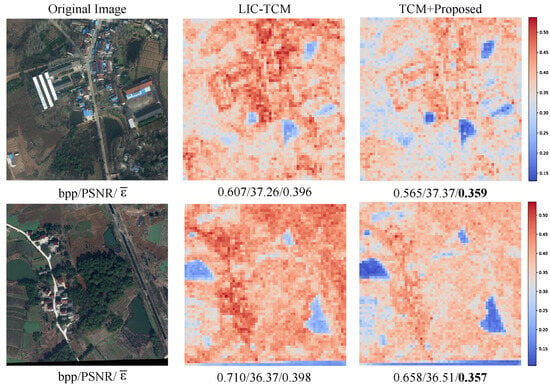
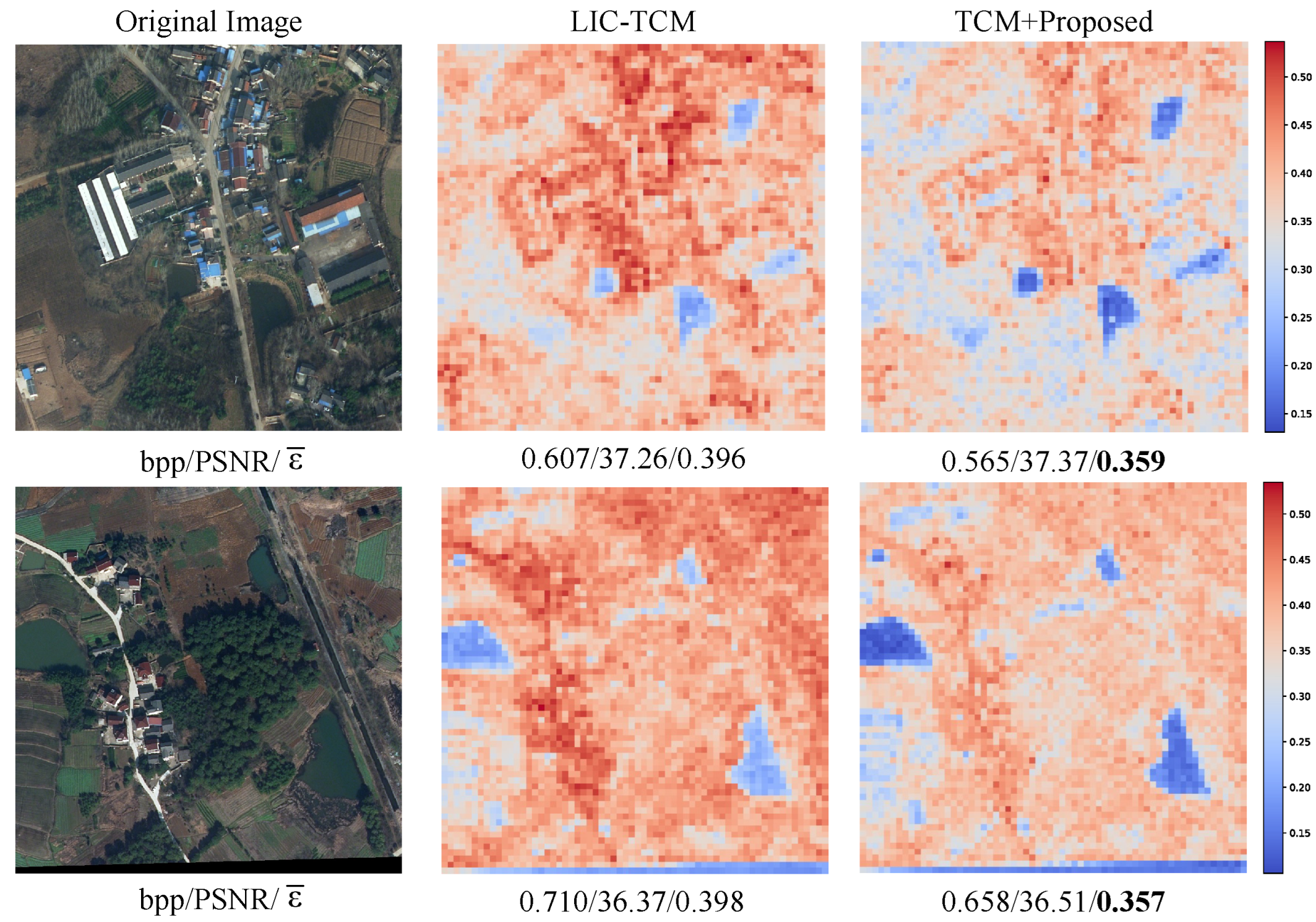
To further demonstrate the robustness and generalization capability of the proposed entropy model, we evaluated its performance when integrated into a different transform module. Specifically, we employed the TCM [16] as the backbone and replaced its original entropy module with ours. Table 8 compares the RD performance against three representative entropy models. The results indicate that our entropy model consistently delivers superior performance even within a different architecture. To provide a deeper insight, Figure 17 presents the absolute quantization deviation between the latent features y and the quantized . As depicted in the figure, our method exhibited significantly lower quantization deviation compared to the original TCM on LoveDA test images. For instance, on images and , the average quantization deviation decreased from 0.396 and 0.398 to 0.359 and 0.357, respectively. These results suggest that our model is more effective at minimizing information loss during quantization, further attesting to its robustness and potential for broader application across various compression frameworks.
Table 8.
Comparative analysis on the LoveDA dataset. The anchor is VTM-17.0.
Figure 17.
Quantization deviation map of 850.png and 1174.png in LoveDA dataset.
4.5. Model Complexity
This section provides detailed information about the computational complexity of the proposed MambaLIC. All experiments were conducted on a GeForce RTX 4090 GPU with 24 GB RAM and an Intel Xeon Silver 4310 CPU. For cases where the GPU memory requirement exceeds 24 GB, we computed the forward MACs layer by layer.
4.5.1. Analysis of Different Variants
In this section, we analyzed the computational complexity of the transform module and hyper-prior path. As shown in Table 9, the Pure CNN variant exhibited the lowest complexity and memory consumption but suffered from inferior RD performance. In contrast, the Pure SSM variant achieved better RD performance than the Pure Swin variant but incurred higher computational costs and parameter counts. However, given that high resolution RS image compression demands strict constraints on complexity and memory usage, the high resource requirements of both Pure Swin and Pure SSM methods become a bottleneck. To address this, we combined the lightweight IDConv with non local modules to construct hybrid architectures. Consequently, our Hybrid SSM CNN variant effectively balanced RD performance and complexity. Notably, compared to the Hybrid Swin CNN variant, our method achieved superior BD-rate performance with lower memory consumption, demonstrating the effectiveness of the proposed hybrid design.
Table 9.
RD performance and complexity of different variants on LoveDA dataset. All the experiments were conducted on a platform with a GeForce RTX 4090 GPU (24 GB RAM) and an Intel Xeon Silver 4310 CPU @ 2.10 GHz.
4.5.2. GPU Peak Memory Consumption
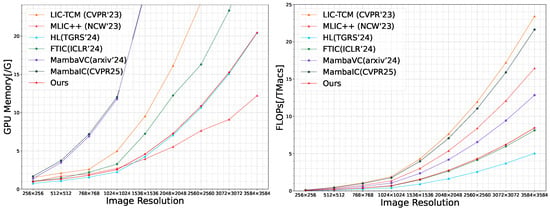
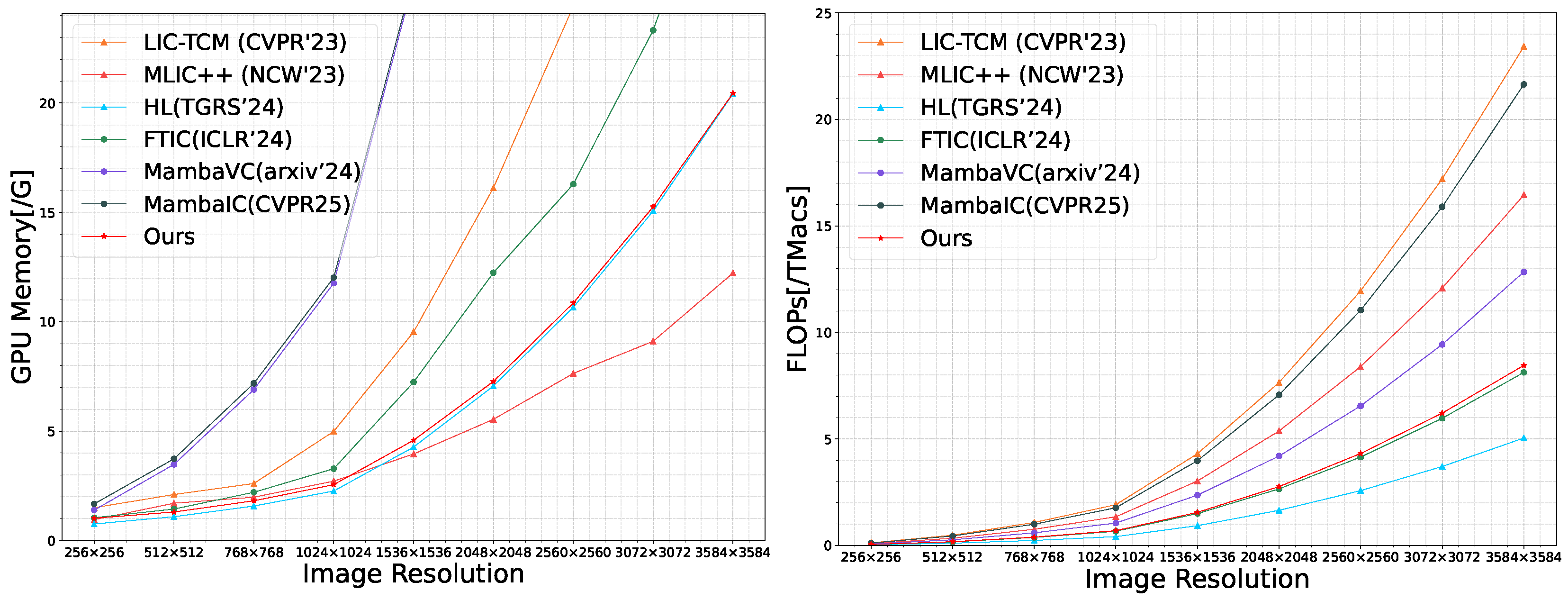
Although SSM-based architectures such as MambaVC [38] and MambaIC [52] achieved promising results on RS images, their high memory consumption limited their practicality for high-resolution tasks. Specifically, these methods encountered Out-of-Memory (OOM) errors even when processing images with resolutions of on a 24 GB GPU. In contrast, our proposed RS-SSM module incorporated a lightweight convolution branch and a strided scanning strategy, achieving an approximate 78% reduction in memory consumption compared to these Mamba-based methods. Consequently, our algorithm allowed for processing images with dimensions of up to using only 20.4 GB of memory, making it highly suitable for large-scale RS imagery. As shown in Figure 18, our method exhibited a competitive memory footprint compared to the existing approaches.
Figure 18.
Computational complexity comparison of different methods.
4.5.3. Forward MAC Consumption
The proposed MambaLIC algorithm demonstrated significantly lower MACs compared to recent methods such as LIC-TCM [16], MLIC++ [50], and MambaVC [38]. This improvement was attributed to the low complexity of our RS-SSM module and the optimized architecture design. As illustrated in Figure 18, our method exhibited a relatively low forward MAC consumption compared to other state-of-the-art methods.
4.6. Analysis of Practical Deployability
To assess the practical deployability of the proposed method, we measure inference time and memory consumption on four hardware platforms: RTX 4090, L40 48G, V100, and RTX 2080 Ti 22G. Experiments are conducted at three image resolutions, (256 × 256), (1024 × 1024), and (2560 × 2560). Encoding time, decoding time, and memory usage are reported. The results are summarized in Table 10.
Table 10.
Efficiency analysis of different methods across various hardware platforms and image resolutions.
Across all configurations, the proposed method demonstrates stable and efficient performance. Compared with HL [25], it maintains competitive inference time at high resolutions. Compared with MambaIC [52], it achieves substantial reductions in both inference time and memory consumption. In particular, when processing (2560 × 2560) images, MambaIC encounters out-of-memory (OOM) errors on all evaluated platforms. In contrast, the proposed method runs reliably within available memory budgets while preserving efficient encoding and decoding speed. These results indicate its suitability for deployment in high-resolution remote sensing scenarios.
5. Discussion
5.1. Interpretation of Results
RS image compression requires the simultaneous modeling of large-scale structures and fine-grained textures, demanding a careful balance between long-range dependencies and local details. Convolution-based methods [7,8,9] are constrained by limited receptive fields and therefore struggle to eliminate long-distance redundancy. Approaches that incorporate Transformers or state space models [10,20,21,26,38] extend the receptive field, but incur substantial computational and memory overhead when applied to high-resolution RS imagery, and often inadequately preserve local texture information.
ERF analysis indicates that purely local operators exhibit responses concentrated within neighborhoods and fail to capture distant structures, whereas global modeling achieves broad spatial coverage at the cost of markedly weakened responses to neighborhoods. When global state modeling is jointly designed with local feature extraction, the spatial correlation of latent representations is further reduced while texture information is preserved. This observation is consistent with the ablation studies, confirming that global–local cooperation is crucial for enhancing compression efficiency and reconstruction quality.
For the implementation of a state space model, multi-directional scanning captures global dependencies but incurs rapidly increasing memory cost with resolution. Strided scanning is more efficient, yet sacrifices fine details. A lightweight compensation module mitigates this loss, yielding a better balance between efficiency and reconstruction quality.
5.2. Limitations and Future Directions
This work is limited to single-frame RGB images. Multispectral, hyperspectral, and temporal remote sensing data exhibit coupled spatial–spectral–temporal dependencies, and the generalization of the proposed architecture to these modalities remains to be systematically studied. Although the memory cost is substantially reduced compared with standard state space models, inference throughput and long-term stability remain challenges for satellite-borne and embedded platforms. Future work will investigate hardware-aware design and quantization-aware training to enhance practical deployability.
6. Conclusions
This paper introduces MambaLIC, an RS image compression framework based on state-space models. To effectively handle the large size and rich textures of RS images, we propose an RS-SSM module that provides a global receptive field and strong local modeling ability while reducing complexity. Furthermore, we introduce a new entropy model that leverages SSM-based scanning to enhance the receptive field. Experimental results indicate that MambaLIC achieves superior RD performance compared to Transformer–CNN mixed architectures. Notably, compared to recent Mamba-based compression algorithms, our method reduces GPU memory consumption by approximately 78%, enabling the processing of large-scale images that exceed the capacity of previous methods. Extensive evaluations on the UC-M, LoveDA, and xView datasets confirm that MambaLIC achieves state-of-the-art performance. These results substantiate the efficacy of the proposed hybrid architecture and highlight the significant potential of efficient state-space models for remote sensing image compression.
Author Contributions
Conceptualization, H.X. (Haobo Xiong) and C.D.; methodology, H.X. (Haobo Xiong); software, H.X. (Huachao Xiao) and F.W.; validation, H.X. (Haobo Xiong), F.W. and C.D.; formal analysis, K.L.; investigation, H.X. (Huachao Xiao); resources, H.X. (Haobo Xiong); data curation, H.X. (Haobo Xiong); writing—original draft preparation, H.X. (Huachao Xiao); writing—review and editing, H.X. (Huachao Xiao); visualization, H.X. (Huachao Xiao); supervision, K.L.; project administration, K.L.; funding acquisition, K.L. and C.D. All authors have read and agreed to the published version of the manuscript.
Funding
This research was supported in part by the National Natural Science Foundation of China under Grant 62171342, and the China Postdoctoral Science Foundation (2024M752531).
Data Availability Statement
The data that support the findings of this study are available from the corresponding author upon reasonable request.
Conflicts of Interest
The authors declare no conflicts of interest.
Abbreviations
The following abbreviations are used in this manuscript;
| RS | Remote Sensing |
| UC-M | UC Merced Land Use Dataset |
| LIC | Learned Image Compression |
| RD | Rate-Distortion |
| ERF | Effective Receptive Field |
| RS-SSM | Remote Sensing State Space Model |
| RSVSS | Remote Sensing Visual State Space |
| GDCM | Gated Detail Compensation Module |
References
- Dreyer, L. Latest developments on SpaceX’s Falcon 1 and Falcon 9 launch vehicles and Dragon spacecraft. In Proceedings of the 2009 IEEE Aerospace Conference, Big Sky, MT, USA, 7–14 March 2009; pp. 1–15. [Google Scholar]
- Han, P.; Zhao, B.; Li, X. Edge-Guided Remote-Sensing Image Compression. IEEE Trans. Geosci. Remote Sens. 2023, 61, 3314012. [Google Scholar] [CrossRef] [Scilit]
- Wang, H.; Liao, L.; Xiao, J.; Lin, W.; Wang, M. Uplink-Assist Downlink Remote-Sensing Image Compression via Historical Referencing. IEEE Trans. Geosci. Remote Sens. 2023, 61, 3315725. [Google Scholar] [CrossRef] [Scilit]
- Ballé, J.; Laparra, V.; Simoncelli, E.P. End-to-end Optimized Image Compression. In Proceedings of the 5th International Conference on Learning Representations, Toulon, France, 24–26 April 2017. [Google Scholar]
- Ballé, J.; Minnen, D.; Singh, S.; Hwang, S.J.; Johnston, N. Variational image compression with a scale hyperprior. In Proceedings of the International Conference on Learning Representations, Vancouver, BC, Canada, 30 April–3 May 2018. [Google Scholar]
- Minnen, D.; Ballé, J.; Toderici, G.D. Joint Autoregressive and Hierarchical Priors for Learned Image Compression. Adv. Neural Inf. Process. Syst. 2018, 31, 10794–10803. [Google Scholar]
- Cheng, Z.; Sun, H.; Takeuchi, M.; Katto, J. Deep Residual Learning for Image Compression. In Proceedings of the CVPR Workshops, Long Beach, CA, USA, 16–17 June 2019. [Google Scholar]
- Cheng, Z.; Sun, H.; Takeuchi, M.; Katto, J. Learned Image Compression with Discretized Gaussian Mixture Likelihoods and Attention Modules. In Proceedings of the IEEE/CVF Conference on Computer Vision and Pattern Recognition, Seattle, WA, USA, 13–19 June 2020; pp. 7939–7948. [Google Scholar]
- Minnen, D.; Singh, S. Channel-Wise Autoregressive Entropy Models for Learned Image Compression. In Proceedings of the 2020 IEEE International Conference on Image Processing (ICIP), Abu Dhabi, United Arab Emirates, 25–28 October 2020; pp. 3339–3343. [Google Scholar]
- Zou, R.; Song, C.; Zhang, Z. The devil is in the details: Window-based attention for image compression. In Proceedings of the IEEE/CVF Conference on Computer Vision and Pattern Recognition, New Orleans, LA, USA, 19–24 June 2022; pp. 17492–17501. [Google Scholar]
- Bross, B.; Wang, Y.K.; Ye, Y.; Liu, S.; Chen, J.; Sullivan, G.J.; Ohm, J.R. Overview of the Versatile Video Coding (VVC) Standard and its Applications. IEEE Trans. Circuits Syst. Video Technol. 2021, 31, 3736–3764. [Google Scholar] [CrossRef] [Scilit]
- Sullivan, G.J.; Ohm, J.R.; Han, W.J.; Wiegand, T. Overview of the High Efficiency Video Coding (HEVC) Standard. IEEE Trans. Circuits Syst. Video Technol. 2012, 22, 1649–1668. [Google Scholar] [CrossRef] [Scilit]
- Ghorbel, A.; Hamidouche, W.; Morin, L. ConvNeXt-ChARM: ConvNeXt-based Transform for Efficient Neural Image Compression. In Proceedings of the 2023 11th European Workshop on Visual Information Processing (EUVIP), Gjovik, Norway, 11–14 September 2023; pp. 1–6. [Google Scholar]
- Liu, Z.; Mao, H.; Wu, C.Y.; Feichtenhofer, C.; Darrell, T.; Xie, S. A convnet for the 2020s. In Proceedings of the IEEE/CVF Conference on Computer Vision and Pattern Recognition, New Orleans, LA, USA, 19–24 June 2022; pp. 11976–11986. [Google Scholar]
- He, D.; Zheng, Y.; Sun, B.; Wang, Y.; Qin, H. Checkerboard Context Model for Efficient Learned Image Compression. In Proceedings of the IEEE/CVF Conference on Computer Vision and Pattern Recognition, Nashville, TN, USA, 19–25 June 2021; pp. 14771–14780. [Google Scholar]
- Liu, J.; Sun, H.; Katto, J. Learned image compression with mixed transformer-cnn architectures. In Proceedings of the IEEE/CVF Conference on Computer Vision and Pattern Recognition, Vancouver, BC, Canada, 18–22 June 2023; pp. 14388–14397. [Google Scholar]
- Luo, W.; Li, Y.; Urtasun, R.; Zemel, R. Understanding the effective receptive field in deep convolutional neural networks. Adv. Neural Inf. Process. Syst. 2016, 29, 4905–4913. [Google Scholar]
- Dosovitskiy, A.; Beyer, L.; Kolesnikov, A.; Weissenborn, D.; Zhai, X.; Unterthiner, T.; Dehghani, M.; Minderer, M.; Heigold, G.; Gelly, S.; et al. An Image is Worth 16 × 16 Words: Transformers for Image Recognition at Scale. arXiv 2021, arXiv:2010.11929. [Google Scholar] [CrossRef] [Scilit]
- Liu, Z.; Lin, Y.; Cao, Y.; Hu, H.; Wei, Y.; Zhang, Z.; Lin, S.; Guo, B. Swin transformer: Hierarchical vision transformer using shifted windows. In Proceedings of the IEEE/CVF International Conference on Computer Vision, Montreal, QC, Canada, 11–17 October 2021; pp. 10012–10022. [Google Scholar]
- Zhu, Y.; Yang, Y.; Cohen, T. Transformer-based transform coding. In Proceedings of the International Conference on Learning Representations, Virtual, 25–29 April 2022. [Google Scholar]
- Qian, Y.; Lin, M.; Sun, X.; Tan, Z.; Jin, R. Entroformer: A transformer-based entropy model for learned image compression. In Proceedings of the International Conference on Learning Representations, Virtual, 25–29 April 2022. [Google Scholar]
- Koyuncu, A.B.; Gao, H.; Boev, A.; Gaikov, G.; Alshina, E.; Steinbach, E. Contextformer: A transformer with spatio-channel attention for context modeling in learned image compression. In Proceedings of the European Conference on Computer Vision, Tel Aviv, Israel, 23–27 October 2022; pp. 447–463. [Google Scholar]
- Fu, C.; Du, B. Remote sensing image compression based on the multiple prior information. Remote Sens. 2023, 15, 2211. [Google Scholar] [CrossRef] [Scilit]
- Jiang, W.; Ning, P.; Yang, J.; Zhai, Y.; Gao, F.; Wang, R. Llic: Large receptive field transform coding with adaptive weights for learned image compression. IEEE Trans. Multimed. 2024, 26, 10937–10951. [Google Scholar] [CrossRef] [Scilit]
- Xiang, S.; Liang, Q. Remote sensing image compression based on high-frequency and low-frequency components. IEEE Trans. Geosci. Remote Sens. 2024, 62, 5604715. [Google Scholar] [CrossRef] [Scilit]
- Arezki, B.; Mokraoui, A.; Feng, F. Efficient Image Compression Using Advanced State Space Models. In Proceedings of the International Workshop on Multimedia Signal Processing, West Lafayette, IN, USA, 2–4 October 2024. [Google Scholar]
- Gu, A.; Dao, T. Mamba: Linear-time sequence modeling with selective state spaces. arXiv 2023, arXiv:2312.00752. [Google Scholar] [CrossRef] [Scilit]
- Gu, A.; Johnson, I.; Goel, K.; Saab, K.; Dao, T.; Rudra, A.; Ré, C. Combining recurrent, convolutional, and continuous-time models with linear state space layers. Adv. Neural Inf. Process. Syst. 2021, 34, 572–585. [Google Scholar]
- Gu, A.; Goel, K.; Ré, C. Efficiently Modeling Long Sequences with Structured State Spaces. In Proceedings of the International Conference on Learning Representations (ICLR), Virtual, 25–29 April 2022. [Google Scholar]
- Zhu, L.; Liao, B.; Zhang, Q.; Wang, X.; Liu, W.; Wang, X. Vision Mamba: Efficient Visual Representation Learning with Bidirectional State Space Model. In Proceedings of the Forty-First International Conference on Machine Learning, Vienna, Austria, 21–27 July 2024. [Google Scholar]
- Liu, Y.; Tian, Y.; Zhao, Y.; Yu, H.; Xie, L.; Wang, Y.; Ye, Q.; Jiao, J.; Liu, Y. Vmamba: Visual state space model. In Proceedings of the Thirty-Eighth Annual Conference on Neural Information Processing Systems, Vancouver, BC, Canada, 10–15 December 2024. [Google Scholar]
- Zhao, S.; Chen, H.; Zhang, X.; Xiao, P.; Bai, L.; Ouyang, W. Rs-mamba for large remote sensing image dense prediction. arXiv 2024, arXiv:2404.02668. [Google Scholar] [CrossRef] [Scilit]
- Ma, X.; Zhang, X.; Pun, M.O. RS 3 Mamba: Visual State Space Model for Remote Sensing Image Semantic Segmentation. IEEE Geosci. Remote Sens. Lett. 2024, 21, 6011405. [Google Scholar] [CrossRef] [Scilit]
- Chen, K.; Chen, B.; Liu, C.; Li, W.; Zou, Z.; Shi, Z. Rsmamba: Remote sensing image classification with state space model. IEEE Geosci. Remote Sens. Lett. 2024, 21, 8002605. [Google Scholar] [CrossRef] [Scilit]
- Zhou, J.; Liu, Y.; Peng, B.; Liu, L.; Li, X. MaDiNet: Mamba Diffusion Network for SAR Target Detection. IEEE Trans. Circuits Syst. Video Technol. 2025, 35, 10787–10800. [Google Scholar] [CrossRef] [Scilit]
- Guo, H.; Guo, Y.; Zha, Y.; Zhang, Y.; Li, W.; Dai, T.; Xia, S.T.; Li, Y. Mambairv2: Attentive state space restoration. In Proceedings of the Computer Vision and Pattern Recognition Conference, Nashville, TN, USA, 11–15 June 2025; pp. 28124–28133. [Google Scholar]
- He, H.; Zhang, J.; Cai, Y.; Chen, H.; Hu, X.; Gan, Z.; Wang, Y.; Wang, C.; Wu, Y.; Xie, L. Mobilemamba: Lightweight multi-receptive visual mamba network. In Proceedings of the Computer Vision and Pattern Recognition Conference, Nashville, TN, USA, 11–15 June 2025; pp. 4497–4507. [Google Scholar]
- Qin, S.; Wang, J.; Zhou, Y.; Chen, B.; Luo, T.; An, B.; Dai, T.; Xia, S.; Wang, Y. MambaVC: Learned Visual Compression with Selective State Spaces. arXiv 2024, arXiv:2405.15413. [Google Scholar] [CrossRef] [Scilit]
- Pei, X.; Huang, T.; Xu, C. EfficientVMamba: Atrous Selective Scan for Light Weight Visual Mamba. arXiv 2024, arXiv:2403.09977. [Google Scholar] [CrossRef] [Scilit]
- Wang, J.; Zheng, Z.; Ma, A.; Lu, X.; Zhong, Y. LoveDA: A Remote Sensing Land-Cover Dataset for Domain Adaptive Semantic Segmentation. In Proceedings of the Neural Information Processing Systems Track on Datasets and Benchmarks; Vanschoren, J., Yeung, S., Eds.; Curran Associates, Inc.: Red Hook, NY, USA, 2021; Volume 1. [Google Scholar]
- Bjontegaard, G. Calculation of Average PSNR Differences Between RD-Curves. VCEG-M33. 2001. Available online: https://api.semanticscholar.org/CorpusID:61598325 (accessed on 10 March 2026).
- Wallace, G.K. The JPEG Still Picture Compression Standard. Commun. ACM 1991, 34, 30–44. [Google Scholar] [CrossRef] [Scilit]
- Skodras, A.; Christopoulos, C.; Ebrahimi, T. The JPEG 2000 Still Image Compression Standard. IEEE Signal Process. Mag. 2001, 18, 36–58. [Google Scholar] [CrossRef] [Scilit]
- Rane, S.D.; Sapiro, G. Evaluation of JPEG-LS, the New Lossless and Controlled-Lossy Still Image Compression Standard, for Compression of High-Resolution Elevation Data. IEEE Trans. Geosci. Remote Sens. 2001, 39, 2298–2306. [Google Scholar] [CrossRef]
- Hernández-Cabronero, M.; Kiely, A.B.; Klimesh, M.; Blanes, I.; Ligo, J.; Magli, E.; Serra-Sagrista, J. The CCSDS 123.0-B-2 “Low-Complexity Lossless and Near-Lossless Multispectral and Hyperspectral Image Compression” Standard: A comprehensive review. IEEE Geosci. Remote Sens. Mag. 2021, 9, 102–119. [Google Scholar] [CrossRef] [Scilit]
- Agustsson, E.; Minnen, D.; Toderici, G.; Mentzer, F. Multi-realism image compression with a conditional generator. In Proceedings of the IEEE/CVF Conference on Computer Vision and Pattern Recognition, Vancouver, BC, Canada, 18–22 June 2023; pp. 22324–22333. [Google Scholar]
- Zhang, Z.; Qiu, H.; Zhang, M.; Liu, J.; Chen, B.; Zhang, T.; Li, H. Cosmic: Compress satellite images efficiently via diffusion compensation. In Proceedings of the Thirty-Eighth Annual Conference on Neural Information Processing Systems, Vancouver, BC, Canada, 10–15 December 2024; pp. 91951–91982. [Google Scholar]
- Li, J.; Li, J.; Hou, X.; Wang, H. Exploring Distortion Prior with Latent Diffusion Models for Remote Sensing Image Compression. IEEE Trans. Geosci. Remote Sens. 2025, 63, 5623713. [Google Scholar] [CrossRef] [Scilit]
- He, D.; Yang, Z.; Peng, W.; Ma, R.; Qin, H.; Wang, Y. Elic: Efficient learned image compression with unevenly grouped space-channel contextual adaptive coding. In Proceedings of the IEEE/CVF Conference on Computer Vision and Pattern Recognition, New Orleans, LA, USA, 19–24 June 2022; pp. 5718–5727. [Google Scholar]
- Jiang, W.; Wang, R. MLIC++: Linear Complexity Multi-Reference Entropy Modeling for Learned Image Compression. In Proceedings of the ICML 2023 Workshop Neural Compression: From Information Theory to Applications, Honolulu, HI, USA, 23–29 July 2023. [Google Scholar]
- Wu, Z.; Du, H.; Wang, S.; Lu, M.; Sun, H.; Guo, Y.; Yu, X. CMamba: Learned Image Compression with State Space Models. arXiv 2025, arXiv:2502.04988. [Google Scholar] [CrossRef] [Scilit]
- Zeng, F.; Tang, H.; Shao, Y.; Chen, S.; Shao, L.; Wang, Y. MambaIC: State Space Models for High-Performance Learned Image Compression. In Proceedings of the Computer Vision and Pattern Recognition Conference, Nashville, TN, USA, 11–15 June 2025; pp. 18041–18050. [Google Scholar]
- Lou, M.; Zhou, H.Y.; Yang, S.; Yu, Y. TransXNet: Learning both global and local dynamics with a dual dynamic token mixer for visual recognition. arXiv 2023, arXiv:2310.19380. [Google Scholar] [CrossRef] [Scilit]
- Zhu, X.; Hu, H.; Lin, S.; Dai, J. Deformable convnets v2: More deformable, better results. In Proceedings of the IEEE/CVF Conference on Computer Vision and Pattern Recognition, Long Beach, CA, USA, 16–20 June 2019; pp. 9308–9316. [Google Scholar]
- Zhang, B.; Sennrich, R. Root mean square layer normalization. Adv. Neural Inf. Process. Syst. 2019, 32, 12381–12392. [Google Scholar]
- Xia, G.S.; Bai, X.; Ding, J.; Zhu, Z.; Belongie, S.; Luo, J.; Datcu, M.; Pelillo, M.; Zhang, L. DOTA: A large-scale dataset for object detection in aerial images. In Proceedings of the IEEE Conference on Computer Vision and Pattern Recognition, Salt Lake City, UT, USA, 18–22 June 2018; pp. 3974–3983. [Google Scholar]
- Bégaint, J.; Racapé, F.; Feltman, S.; Pushparaja, A. CompressAI: A PyTorch library and evaluation platform for end-to-end compression research. arXiv 2020, arXiv:2011.03029. [Google Scholar]
- Yang, Y.; Newsam, S. Bag-of-visual-words and spatial extensions for land-use classification. In Proceedings of the 18th Sigspatial International Conference on Advances in Geographic Information Systems, San Jose, CA, USA, 2–5 November 2010; pp. 270–279. [Google Scholar]
- Li, H.; Li, S.; Dai, W.; Li, C.; Zou, J.; Xiong, H. Frequency-Aware Transformer for Learned Image Compression. arXiv 2023, arXiv:2310.16387. [Google Scholar]
- Ascenso, J.; Alshina, E.; Ebrahimi, T. The JPEG AI standard: Providing efficient human and machine visual data consumption. Ieee Multimed. 2023, 30, 100–111. [Google Scholar] [CrossRef] [Scilit]
- Lam, D.; Kuzma, R.; McGee, K.; Dooley, S.; Laielli, M.; Klaric, M.; Bulatov, Y.; McCord, B. xview: Objects in context in overhead imagery. arXiv 2018, arXiv:1802.07856. [Google Scholar] [CrossRef] [Scilit]

Disclaimer/Publisher’s Note: The statements, opinions and data contained in all publications are solely those of the individual author(s) and contributor(s) and not of MDPI and/or the editor(s). MDPI and/or the editor(s) disclaim responsibility for any injury to people or property resulting from any ideas, methods, instructions or products referred to in the content. |
© 2026 by the authors. Licensee MDPI, Basel, Switzerland. This article is an open access article distributed under the terms and conditions of the Creative Commons Attribution (CC BY) license.