


Highlights
What are the main findings?
- Proposes a dual-channel passive limb imager (DUALIS) for the first simultaneous retrieval of CO2 column density and line-of-sight wind speed in the Martian 60–180 km altitude range.
- Implements a compact, lens array-based static Michelson interferometer optimized for Doppler wind measurements using the O(1S) 557.7 nm airglow.
- End-to-end radiative transfer and instrument-response simulations demonstrate the feasibility of simultaneously observing CO2 column density (partial column over the 60–180 km limb emission region) and LOS wind speed from co-registered limb observations.
- The simulations indicate achievable retrieval precisions of approximately 6–8% for the partial CO2 column (60–180 km) and better than ±5 m/s for wind speed within the primary emission layer under representative Martian dayside conditions.
What are the implications of the main findings?
- This work provides a feasible instrumental concept to fill the long-standing gap in simultaneous, vertically resolved observations of composition and dynamics in the Martian mesosphere–lower thermosphere.
- The validated measurement approach can deliver critical data for constraining Mars Global Circulation Models and supporting atmospheric forecasting for future entry, descent, and landing missions.
Abstract
Characterizing both the CO2 distribution and wind dynamics in the Martian mesosphere and lower thermosphere is vital for planetary atmospheric science and mission planning. In this work, we propose a novel dual-channel passive limb-viewing imaging system designed to simultaneously observe partial CO2 column density and line-of-sight (LOS) wind speed from ultraviolet and visible airglow emissions under dayside and terminator illumination conditions. A dichroic beam splitter separates the ultraviolet and visible channels, ensuring high optical throughput and independent optimization of both subsystems. The ultraviolet channel targets O(1S) 297.2 nm emission, a well-established Martian limb emission driven by CO2 photodissociation under solar Lyman-α flux. By applying narrow-band imaging and brightness inversion, this channel provides quantitative constraints on CO2 column density with a stable and well-defined response function. In the visible channel, we introduce a lens array-based compact static Michelson interferometer optimized for the O(1S) 557.7 nm green line emission, which has been observed in the Martian dayside limb, providing Doppler wind measurements in the 60–180 km altitude range. Radiative transfer simulations using Mars Climate Database indicate retrieval precisions of ±6~8% for CO2 column density and better than ±5 m/s for wind speed within the primary emission layer (approximately 60–160 km) under representative dayside limb conditions. This dual-parameter remote sensing concept simultaneously constrains the composition and dynamics of the Martian mesosphere and lower thermosphere region, addressing a long-standing observational gap. The compact and modular design of the system makes it well suited for future Mars orbiter payloads under nominal dayside and terminator observation geometries, providing critical data for validating global circulation models and supporting future entry, descent, and landing system design.
1. Introduction
The Martian mesosphere and lower thermosphere (ranging from approximately 60–180 km) constitute a critical region for planetary aeronomy, where fundamental transitions in atmospheric composition, energy balance, and dynamics take place [1,2,3,4]. In this altitude range, solar extreme ultraviolet (EUV) radiation interacts strongly with the background CO2 atmosphere, driving photochemical reactions and energy deposition that generate characteristic airglow emissions. These emissions not only provide sensitive tracers of constituent abundances, but also respond to dynamical processes including planetary waves, global circulation, and thermal tides, which regulate the transport of energy and momentum [2,5,6]. Moreover, this region acts as a gateway for atmospheric escape, linking the lower atmosphere to the exosphere and thereby influencing long-term climate evolution [6,7,8,9]. Precise measurements of CO2 column density and wind speed in the 60–180 km altitude range are thus indispensable for advancing our understanding of Martian thermospheric dynamics, constraining and validating global circulation models (GCMs), quantifying escape processes, and providing essential inputs for trajectory design and entry, descent, and landing (EDL) operations in future Mars exploration missions [6,9,10,11].
Despite their importance, direct observations of both CO2 column density and mesosphere-lower thermosphere winds remain sparse. Instruments such as SPICAM on Mars Express and IUVS on MAVEN have provided valuable insights into airglow emissions and vertical profiles, yet CO2 has typically been constrained indirectly through models or by proxy measurements. Wind observations in the mesosphere and lower thermosphere are even more scarce [1,5,10,12,13,14]. Orbital measurements of Martian winds have so far relied primarily on in situ techniques, exemplified by the Neutral Gas and Ion Mass Spectrometer (NGIMS) on the MAVEN spacecraft [1,4,15]. While providing invaluable data, such in situ methods are constrained by the spacecraft trajectory, resulting in limited spatial and temporal coverage. Remote sensing in a limb viewing geometry offers a promising alternative to overcome these limitations, enabling global monitoring and vertically resolved profiling.
Airglow emissions provide a unique passive diagnostic of this region. The O(1S) 297.2 nm emission arises from the photodissociation of CO2 by solar Lyman-α photons and has been demonstrated as the only currently established passive emission that enables quantitative retrieval of CO2 column density [16,17]. In contrast, the O(1S) 557.7 nm green line, produced by electron impact excitation of atomic oxygen, is a narrow atomic transition highly sensitive to Doppler shifts, enabling wind retrievals with meter-per-second precision [17,18,19,20]. Observing these emissions in limb viewing geometry enhances sensitivity through long atmospheric path lengths and enables vertical profiling of both composition and winds. The concept of using spaceborne Michelson interferometry to measure winds via the Doppler shift in airglow lines is well-established for Earth observation [21,22,23,24]. For Mars, several instrument concepts targeting wind detection in specific airglow layers have been proposed [4,15,25,26,27]. However, a dedicated instrument capable of simultaneous, co-registered retrieval of both CO2 column density and wind speed from complementary ultraviolet and visible airglow emissions has not yet been developed or deployed. While Previous missions, such as MAVEN, have confirmed the existence and radiative mechanisms of these emissions, but dedicated instrumentation for simultaneous retrieval of CO2 column density and wind speed has not yet been deployed [1,17,18,20,28]. Most ultraviolet spectrometers focus on nadir or disk-integrated observations, while Doppler wind measurements in the visible range are typically limited to Earth’s thermosphere. For Mars, a combined measurement strategy has the potential to significantly advance our understanding of thermospheric processes.
In this study, we propose a dual-channel passive limb imaging system (DUALIS) designed specifically for simultaneous CO2 and wind retrievals in the Martian lower thermosphere. It should be noted that in this study, the term “CO2 column density” specifically refers to the partial column integrated over the 60–180 km altitude range corresponding to the limb-viewing sensitivity region, rather than the total atmospheric column. Unlike previous ultraviolet or visible instruments that operated in single-channel configurations, DUALIS integrates both UV and VIS airglow diagnostics into a compact, co-aligned optical system, enabling simultaneous retrieval of CO2 column density and LOS winds. The system employs a shared reflective telescope with a dichroic beam splitter to separate ultraviolet and visible signals into two optimized subsystems. The UV channel measures the 297.2 nm emission for CO2 column retrieval, while the visible channel incorporates a compact static Michelson interferometer to resolve Doppler shifts in the 557.7 nm line. The proposed system is primarily designed for limb observations under nominal dayside illumination conditions. The targeted solar zenith angle range (approximately 20–80°) ensures sufficient photochemical production of O(1S) emissions while maintaining manageable background levels. Preliminary radiative transfer simulations based on Mars Climate Database [29] suggest potential retrieval precisions of ±6~8% for CO2 column density and better than ±5 m/s for wind speed. Simultaneous limb observations of the O(1S) 297.2 nm and 557.7 nm emissions have the potential to provide complementary information on the Martian mesosphere and lower thermosphere. If successfully implemented, such joint measurements could be used to constrain both composition and dynamics, which would help fill a critical observational gap and offer valuable validation data for global circulation models.
The remainder of this paper is organized as follows: Section 2 describes the scientific principles underlying the two emissions and the limb viewing geometry. Section 3 presents the instrument concept and optical design. Section 4 outlines the retrieval methodology and radiative transfer simulations. Section 5 discusses expected performance and potential applications. Finally, Section 6 summarizes the main findings and highlights future developments.
2. Scientific Principles
2.1. The O(1S) 297.2 nm and CO2 Column Density
The O(1S) 297.2 nm emission in the Martian dayglow originates primarily from the photodissociation of CO2 molecules under solar Lyman-α (121.6 nm) radiation:
The excited oxygen atoms in the metastable O(1S) state subsequently radiatively decay to O(1D), producing a strong emission line at 297.2 nm:
The intensity of this emission is directly governed by the abundance of CO2 along the LOS and the penetration depth of solar Lyman-α photons, which is itself controlled by CO2 optical depth. Consequently, the 297.2 nm dayglow serves as a natural tracer of CO2 column density in the 80–120 km altitude range. MAVEN/IUVS observations and radiative transfer models confirm that this emission layer exhibits a stable Chapman-like profile, peaking near 80–100 km [16,17]. The vertical integral of the emission brightness is therefore a robust diagnostic of CO2 abundance, making O(1S) 297.2 nm the only currently established passive emission line suitable for quantitative retrieval of Martian CO2 in the lower thermosphere.
2.2. The O(1S) 557.7 nm Airglow and Winds
The O(1S) 557.7 nm green line emission is a well-known diagnostic of upper atmospheric dynamics, widely studied on Earth and recently identified on Mars. Recent NOMAD/UVIS limb observations have confirmed that the 557.7 nm emission is detectable in the Martian dayside atmosphere, with peak intensities near 80–90 km [18]. It originates mainly from electron impact excitation of atomic oxygen in the ground state O(3P):
followed by the radiative decay:
Because this emission arises from a narrow atomic transition, its spectral profile is highly sensitive to Doppler shifts induced by LOS winds. Interferometric techniques can resolve wavelength shifts corresponding to only a few meters per second, enabling precise wind retrievals in the 60–180 km region of the Martian atmosphere. Limb observations of the 557.7 nm line therefore provide a unique means of constraining thermospheric dynamics, including tides, planetary waves, and global circulation patterns, which are otherwise poorly constrained by direct measurements.
Although the O(1S) 297.2 nm emission is directly linked to CO2 photodissociation and is therefore well suited for composition diagnostics, its application to Doppler wind measurements is constrained by both spectral and radiometric factors. Doppler shift scales linearly with wavelength; thus, for identical wind speeds, the wavelength displacement at 297.2 nm is approximately half that at 557.7 nm, reducing interferometric phase sensitivity. Furthermore, published theoretical and observational studies indicate that the Martian 557.7 nm airglow intensity is approximately an order of magnitude stronger (≈16.5×) than that of the 297.2 nm emission [18]. Under identical exposure conditions, this radiance contrast yields an intrinsic SNR advantage of about a factor of four for the visible channel, even before accounting for the higher detector quantum efficiency in the visible range. Since Doppler precision scales inversely with SNR, achieving comparable wind sensitivity at 297.2 nm would require substantially longer integration times or increased optical throughput. In addition, ultraviolet interferometric systems impose stricter material and stability constraints. Consequently, separating composition and wind diagnostics into optimized ultraviolet and visible channels provides improved robustness and measurement precision relative to a single-channel ultraviolet design.
2.3. Limb Viewing Observation Geometry
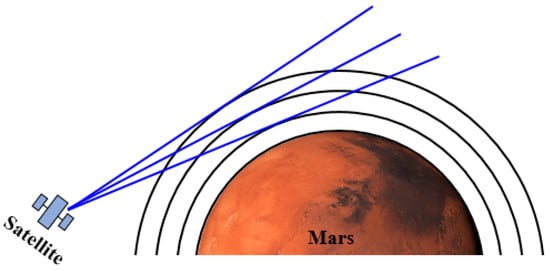
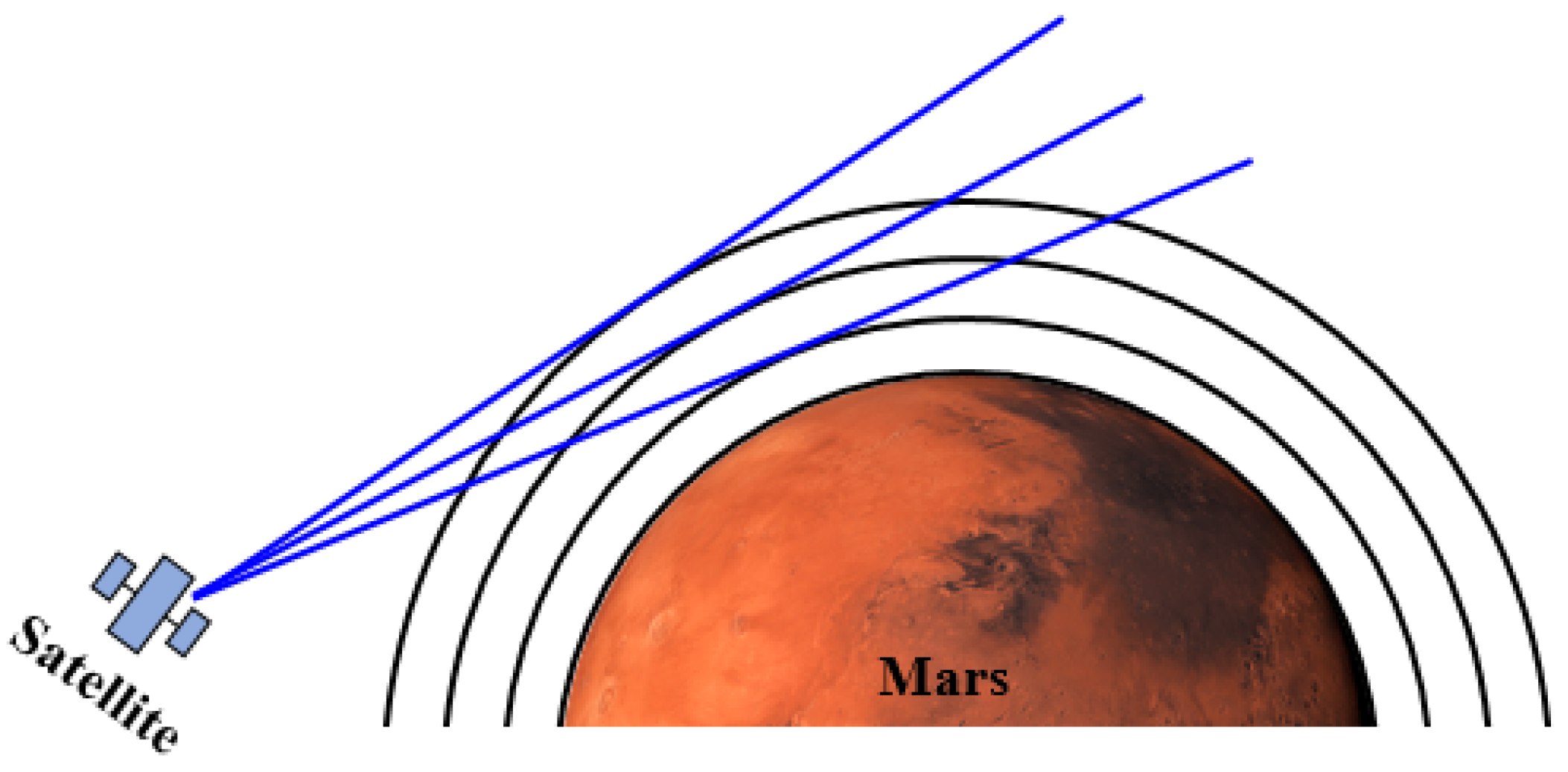
Limb viewing geometry is particularly effective for probing tenuous planetary atmospheres, as it maximizes atmospheric path length and thereby enhances the signal from optically thin emissions. In this configuration, the LOS grazes the atmosphere tangentially, with each tangent altitude corresponding to a specific sampling layer. The observed brightness results from integration of the volume emission rate along the slant path, providing sensitivity to both composition and dynamics. Figure 1 is a schematic diagram of DUALIS performing limb observation of the Martian atmosphere.
Figure 1.
Schematic diagram of DUALIS conducting limb observation of the Martian atmosphere.
For O(1S) 297.2 nm, the confined emission layer in the lower thermosphere benefits strongly from limb geometry, which boosts signal-to-noise (SNR) while maintaining sensitivity to CO2 column density. For O(1S) 557.7 nm, the same geometry increases photon statistics, enabling precise detection of Doppler shifts. By scanning across tangent altitudes, vertical emission profiles can be reconstructed, yielding critical information on CO2 distribution and wind speed as a function of altitude.
Thus, limb viewing observation provides the optimal balance of signal enhancement and vertical resolution, enabling simultaneous retrieval of composition and dynamics in the Martian lower thermosphere. The instrument concept is based on limb viewing geometry, in which the LOS passes tangentially through the Martian atmosphere. This configuration significantly enhances airglow signal detection by integrating emission along extended atmospheric columns while providing altitude-dependent information through the tangent height. Compared with nadir viewing, limb observations offer higher sensitivity to vertical gradients in both composition and dynamics, making them particularly suitable for retrieving CO2 column density from the 297.2 nm emission and LOS winds from the 557.7 nm emission. The well-defined tangent-point geometry also facilitates direct comparison with atmospheric models, allowing accurate mapping of the mesosphere and lower thermosphere structure in the 60–180 km altitude range. Nominal operation is intended for dayside conditions, with possible extension to terminator observations when orbital geometry permits. These physical principles establish the scientific foundation for DUALIS.
3. Instrument Concept
3.1. System Overview
The Dual-Channel Passive Limb Imaging System (DUALIS) is designed to simultaneously measure the CO2 column density and LOS wind speed in the Martian mesosphere and lower thermosphere. Based on the radiative characteristics of the O(1S) airglow at 297.2 nm and 557.7 nm, the instrument employs an integrated optical configuration that combines two spectral channels—ultraviolet (UV) and visible (VIS)—to enable co-spatial and co-temporal observations of atmospheric composition and dynamics. From a scientific perspective, the O(1S) 297.2 nm ultraviolet emission arises from the photodissociation of CO2 by solar Lyman-α photons and serves as a quantitative tracer of the CO2 column abundance. In contrast, the O(1S) 557.7 nm visible emission originates from electron impact excitation of atomic oxygen, exhibiting a narrow atomic transition that is highly sensitive to Doppler shifts, thereby allowing precise retrievals of wind speed in the Martian upper atmosphere.
In the optical design, DUALIS utilizes a shared reflective telescope to collect limb viewing airglow emissions, with a dichroic beam splitter separating the incoming light by wavelength. The column UV channel is dedicated to CO2 column imaging, while the VIS channel incorporates a static Michelson interferometer to extract Doppler phase information related to wind speed. This dual-channel configuration maintains high optical throughput while achieving a compact and modular structure suitable for resource-constrained Mars orbiter payloads.
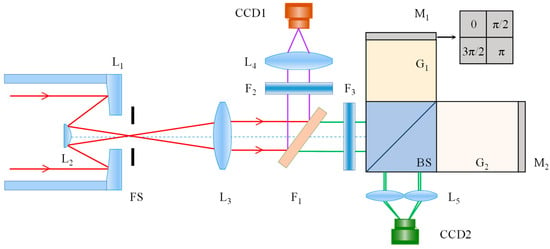
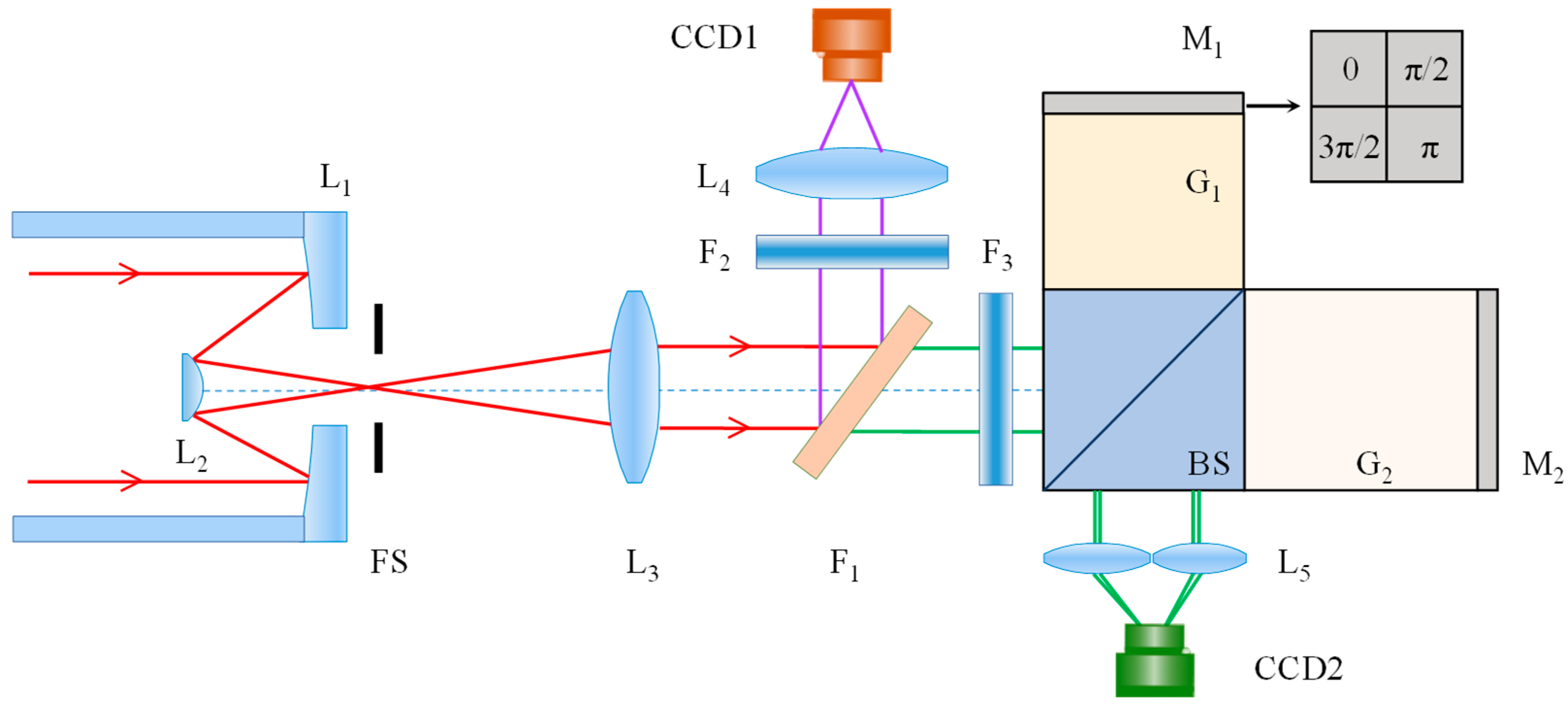
Figure 2 illustrates the overall optical layout of the DUALIS. Airglow emissions from the Martian atmosphere, including the O(1S) 297.2 nm ultraviolet and O(1S) 557.7 nm visible green line emissions, are first collected and imaged by a reflective telescope consisting of the primary mirror (L1) and secondary mirror (L2). The field stop (FS) located at the focal plane defines the instrument’s field of view. The light is then collimated by lens L3 to produce a parallel beam for subsequent spectral separation and imaging. The collimated beam passes through a dichroic mirror (DM), which spectrally separates the radiation into two channels. The reflected beam constitutes the UV channel, while the transmitted beam forms the VIS channel. In the UV channel, the reflected light passes through a narrow-band interference filter (F2) centered at 297.2 nm (bandwidth ≈ 1 nm) to isolate the O(1S) ultraviolet airglow, and is then focused by an imaging lens (L4) onto a UV-sensitive CCD detector (CCD1). This channel provides quantitative measurements of CO2 column density through the integrated airglow brightness. In the VIS channel, the transmitted light passes through a 1.5 nm bandwidth filter (F3) centered at 557.7 nm, isolating the O(1S) green line emission, and then enters a compact static wind imaging Michelson interferometer developed in this study for Doppler wind retrieval. The interferometer comprises a beam-splitter (BS), two glass arms (G1, G2), a four-quadrant mirror (M1), a plane mirror (M2), a relay lens array (L5), and the visible CCD detector (CCD2).The four-quadrant mirror M1 introduces relative phase shifts of 0, π/2, π, and 3π/2 among its quadrants through controlled coating thickness, thereby producing four phase-stepped interferogram simultaneously on the CCD2 detector. After passing through the narrow-band filter F3, the 557.7 nm emission is modulated by the static Michelson interferometer to produce four simultaneous interferograms with relative phase steps of 0, π/2, π, and 3π/2 on the CCD. The phase variations between these interferogram encode the Doppler shift in the O(1S) green line emission, enabling quantitative retrieval of LOS wind speed via the four-intensity phase-shifting method.
Figure 2.
Optical layout of the DUALIS.
By sharing the optical path, the system ensures strict alignment of the two fields of view, and simultaneous sampling of the same atmospheric volume, reduces mechanical complexity, and improves both radiometric and geometric calibration consistency. The compactness and modularity of the system make it suitable for future Mars orbiter missions, where payload resources are often limited. This architecture enables truly simultaneous sensing of the compositional and dynamical state of the Martian upper atmosphere.
3.2. Dual-Channel Architecture
Building upon the overall concept described above, the DUALIS instrument is organized into two spectrally distinct yet optically co-aligned subsystems: a UV channel dedicated to CO2 column retrieval from the O(1S) 297.2 nm emission, and a VIS channel optimized for Doppler wind measurements using the O(1S) 557.7 nm line. Both channels share a common telescope and collimation stage to ensure identical limb viewing geometry and temporal synchronization, while subsequent optical paths are independently optimized for their respective wavelength ranges.
The UV channel operates in an intensity-based mode. After reflection by the dichroic beam splitter, the ultraviolet beam passes through a interference filter centered at 297.2 nm to isolate the O(1S) airglow produced by CO2 photo-dissociation. The filtered radiation is then re-imaged by a fused-silica lens onto a UV-enhanced CCD detector (CCD1). The measured brightness, once corrected for instrument response, provides a quantitative proxy for the CO2 column abundance along the LOS. The observed limb radiance LUV(ht) at a given tangent height ht is expressed as the LOS integral of the volume emission rate , as
Under the optically thin assumption, the volume emission rate is directly proportional to the local CO2 number density and the photo-dissociation rate coefficient (which depends on solar Lyman-α flux and the CO2 absorption cross-section) and is given by
where kph is the photochemical reaction rate coefficient for the process represented by Equation (1), with units of s−1; nCO2 is the number density of carbon dioxide, with units of cm−3.
Thus, the measured limb brightness provides a quantitative proxy for the CO2 column density along the observational path. After radiometric calibration and correction for instrumental response, the CO2 column abundance can be retrieved through forward radiative-transfer modeling, using atmospheric background profiles from the Mars Climate Database (MCD) [29] as input.
The VIS channel receives the transmitted portion of the beam and performs wind retrieval through Doppler interferometry. After a filter centered at 557.7 nm, the light enters a compact static Michelson interferometer designed in an equal-inclination configuration with a fixed optical path difference (OPD) of several centimeters. The interferometer encodes the spectral shift in the narrow atomic oxygen line (induced by atmospheric wind) into phase variations in four simultaneously recorded interferograms. These are produced by a four-quadrant mirror introducing relative phase steps of 0, π/2, π, and 3π/2. The intensity distribution recorded on the detector can be written as
where Ii (i = 1, 2, 3, 4) denotes the interferogram, I0 is the mean intensity, U is the instrument visibility, V is the line visibility, σ0 represents the central wavenumber of the airglow spectral line, Δ corresponds to the OPD between two arms of interferometer in units of centimeters, is the Doppler phase, and denotes the relative phase steps among the four interferograms, which take the values of 0, π/2, π, and 3π/2.
The Doppler phase is related to LOS wind speed vlos and can be expressed as
where c is the speed of light.
The Doppler wind speed phase can be determined from four interferograms Ii (i = 1, 2, 3, 4) with different phases using the “Four-intensity method” with detailed descriptions available in references [3,15]. The expression is given as shown in Equation (9). Consequently, the LOS wind speed can be derived from Equations (8) and (9).
This dual-channel configuration combines complementary diagnostics within a single optical framework. The UV channel constrains the vertical CO2 distribution, while the VIS channel measures the dynamical state through Doppler shifts, together yielding simultaneous insight into the composition and circulation of the Martian mesosphere and lower thermosphere. The modular design allows separate calibration of each subsystem, while the shared optical front end guarantees strict spatial alignment and efficient resource utilization—key advantages for compact payloads on future Mars orbital missions.
3.3. Optical Layout and Key Design Parameters
To achieve high-precision constraints on the thermodynamic and dynamic states of the Martian atmosphere, this study defines its core observational objectives as: obtaining vertical profiles of atmospheric wind fields and CO2 concentration within this altitude range, with a vertical resolution better than 2 km and a wind speed measurement uncertainty of less than 5 m/s. The 2 km vertical resolution is a prerequisite for resolving the key vertical structures of atmospheric gravity waves, tidal waves, and boundary layer processes. Meanwhile, the 5 m/s wind speed precision serves as the cornerstone for quantitatively characterizing atmospheric momentum and energy transport, thereby improving the parameterization schemes within the dynamical framework of circulation models. To realize these objectives through limb observations and to provide the models with continuous, reliable, and direct observational constraints for the middle and upper atmosphere—data historically scarce—optimizing the orbital configuration of the observation platform is a priority.
Accordingly, the DUALIS adopts a near-circular orbit with a mean altitude of 420 km and an inclination of 70°. This altitude is designed to optimally balance the SNR for limb observations of the 60–180 km atmospheric layer (particularly targeting the 557.7 nm and 297.2 nm airglow emissions of atomic oxygen) against long-term orbital stability. Its engineering feasibility has been validated by successful missions operating at similar orbital altitudes. Concurrently, the 70° mid-to-high inclination ensures systematic coverage of key atmospheric process-active regions at low-to-mid Martian latitudes, enabling effective observation of the zonal structures in atmospheric composition and dynamics while avoiding the extreme environmental challenges associated with polar orbits. This set of orbital parameters provides the optimal foundational platform guarantee for achieving the aforementioned precise detection goals. The corresponding relationships between the observational requirements and the orbital design parameters are summarized in Table 1.
Table 1.
Atmospheric sensing metrics design for the DUALIS.
The overall parameters of the DUALIS optical system are determined based on comprehensive considerations of the target atmospheric vertical resolution, altitude coverage, orbital altitude, and detector pixel characteristics. In the present design, both CCD1 and CCD2 have a pixel size of 15 μm, with pixel arrays of 512 × 512 and 1024 × 1024, respectively. Due to the four-aperture division implemented in the visible channel, the final image size for both the ultraviolet and visible channels is identical, measuring 512 × 512 pixels. To improve the SNR, pixel binning is applied to both CCDs: an 8 × 512 binning scheme is used for one detector and an 8 × 8 scheme for the other. The binning configurations were selected by taking into account the SNR requirements for the detection of the two spectral lines at 297.2 nm and 557.7 nm. The finalized optical system parameters are summarized in Table 2. The overall optical configuration of DUALIS features an effective focal length of 88.4 mm, a F-number of 2, and field of view of 2.32° × 2.32°. The front telescope optical system employs a Cassegrain-type reflective-refractive hybrid configuration, efficiently collecting airglow radiation across both the ultraviolet and visible spectral bands. All transmissive components are fabricated from fused silica to ensure high transmittance across the broad spectral range from 290 to 560 nm, along with excellent radiation hardness and thermal stability. A dichroic beam splitter positioned near the system pupil reflects wavelengths below 320 nm toward the UV channel and transmits wavelengths above 500 nm into the VIS channel. The coating is optimized to achieve high reflectance (>90%) in the UV and high transmittance (>95%) in the visible, while minimizing polarization-dependent losses.
Table 2.
Overall optical parameters of the DUALIS.
The OPD of wind-imaging interferometer is closely related to the uncertainty in wind-speed measurements. For the standard four-intensity algorithm, the measurement uncertainty of wind speed can be expressed as [4,15,25]
Assuming the visible oxygen 557.7 nm airglow line shape can be described by a Gaussian profile (which is generally valid for upper-Martian atmospheric emission lines), the fringe visibility can be expressed as [4,15,25]
Here, T refers to the atmospheric temperature, Q is a quantity related to the central wavenumber and the molecular mass M of the emitting particles, which can be expressed as
The SNR can be expressed as
where N is the number of pixels included in a bin, Ds is the dark current per pixel (in electrons), ηR denotes the RMS readout noise of the CCD (in electrons), and S is the total signal per bin accumulated on the detector (in electrons), given by [4,15,25]
where E0 represents the incident irradiance expressed in Rayleigh (R), A denotes the area of the aperture stop (in cm2), Ωbin is the solid angle corresponding to each bin on the detector, t indicates the overall optical transmission coefficient of the system, η refers to the quantum efficiency of the CCD detector at the target emission wavelength, and δt stands for the integration time.
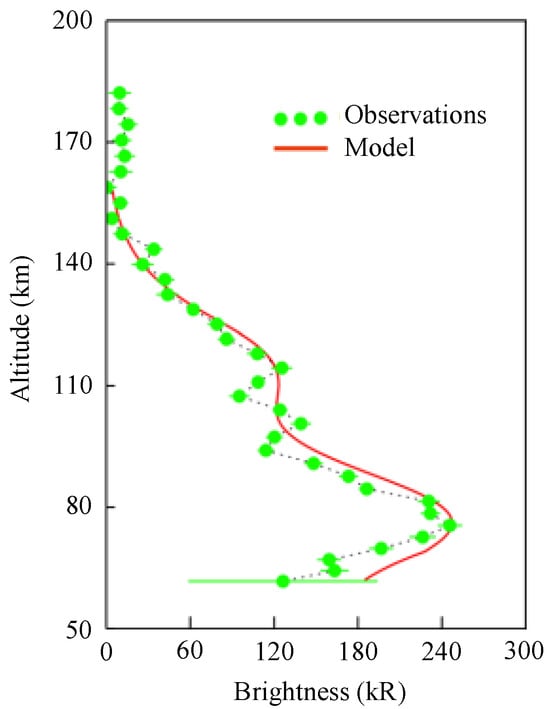
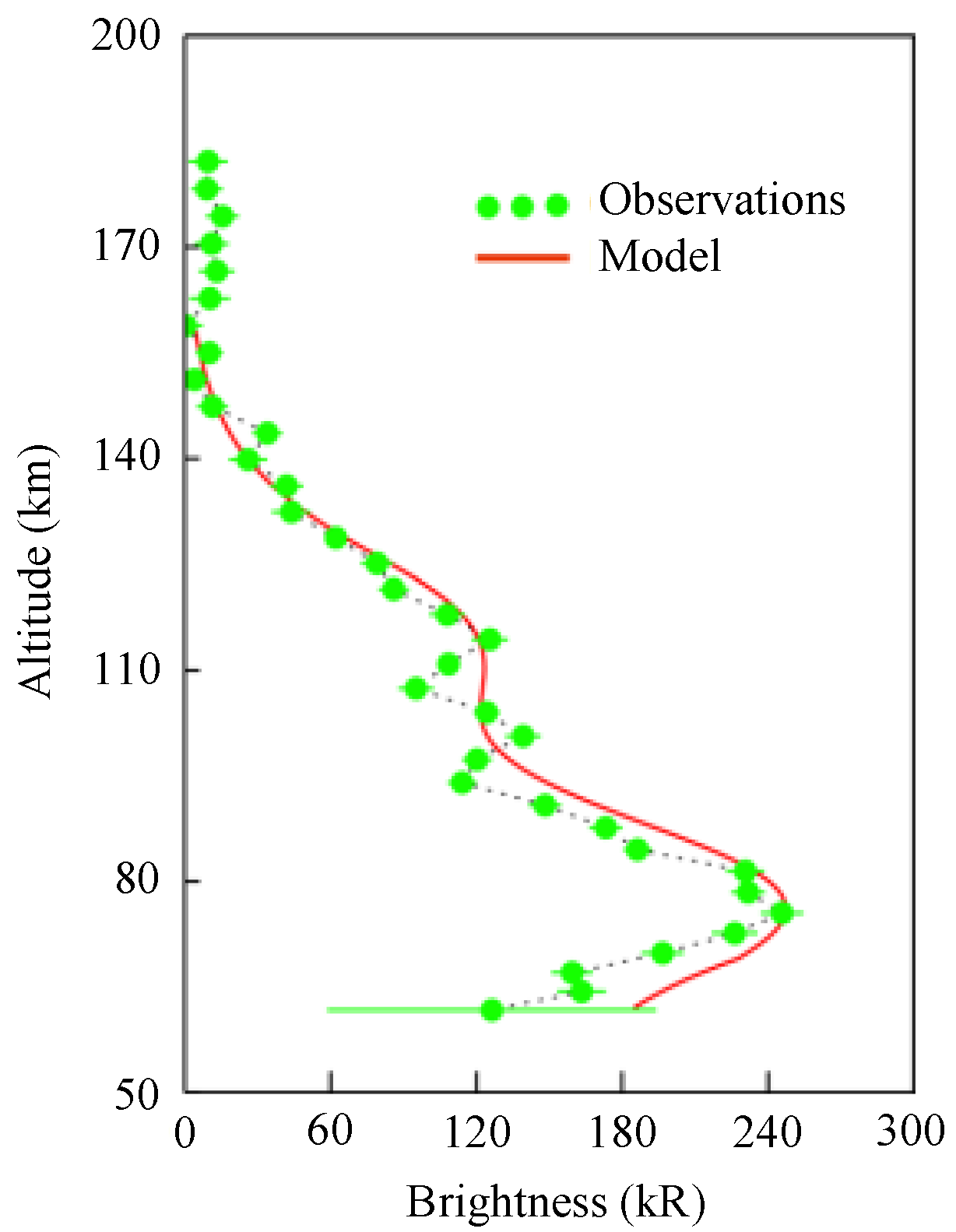
The limb airglow intensity profile of the atomic oxygen 557.7 nm emission, as observed by UVIS in the Martian mesosphere and lower thermosphere, is presented in Figure 3. The profile shows a peak intensity of approximately 230 kR near 80 km altitude, with an average intensity of about 96 kR across the 60–180 km altitude range [15,19]. Using this mean radiance value, along with the system parameters provided in Table 1 and Table 2 and the specifications of the selected CCD, Table 3 lists the key parameters adopted for the SNR calculation. Substituting these parameters into Equations (13) and (14) results in an average instrumental SNR of approximately 340.
Figure 3.
The limb profiles of [Oi] 557.7 nm dayglow intensity observed with UVIS on 28 April 2019 (green dots) [15,19].
Table 3.
Related parameters for calculating the SNR.
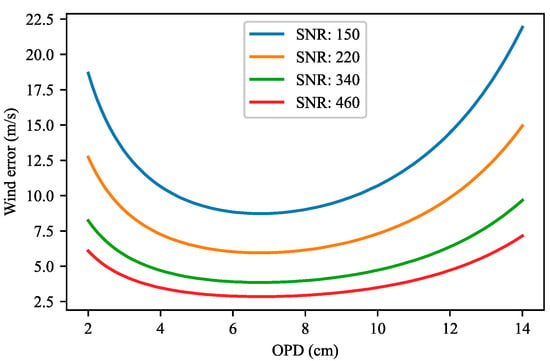
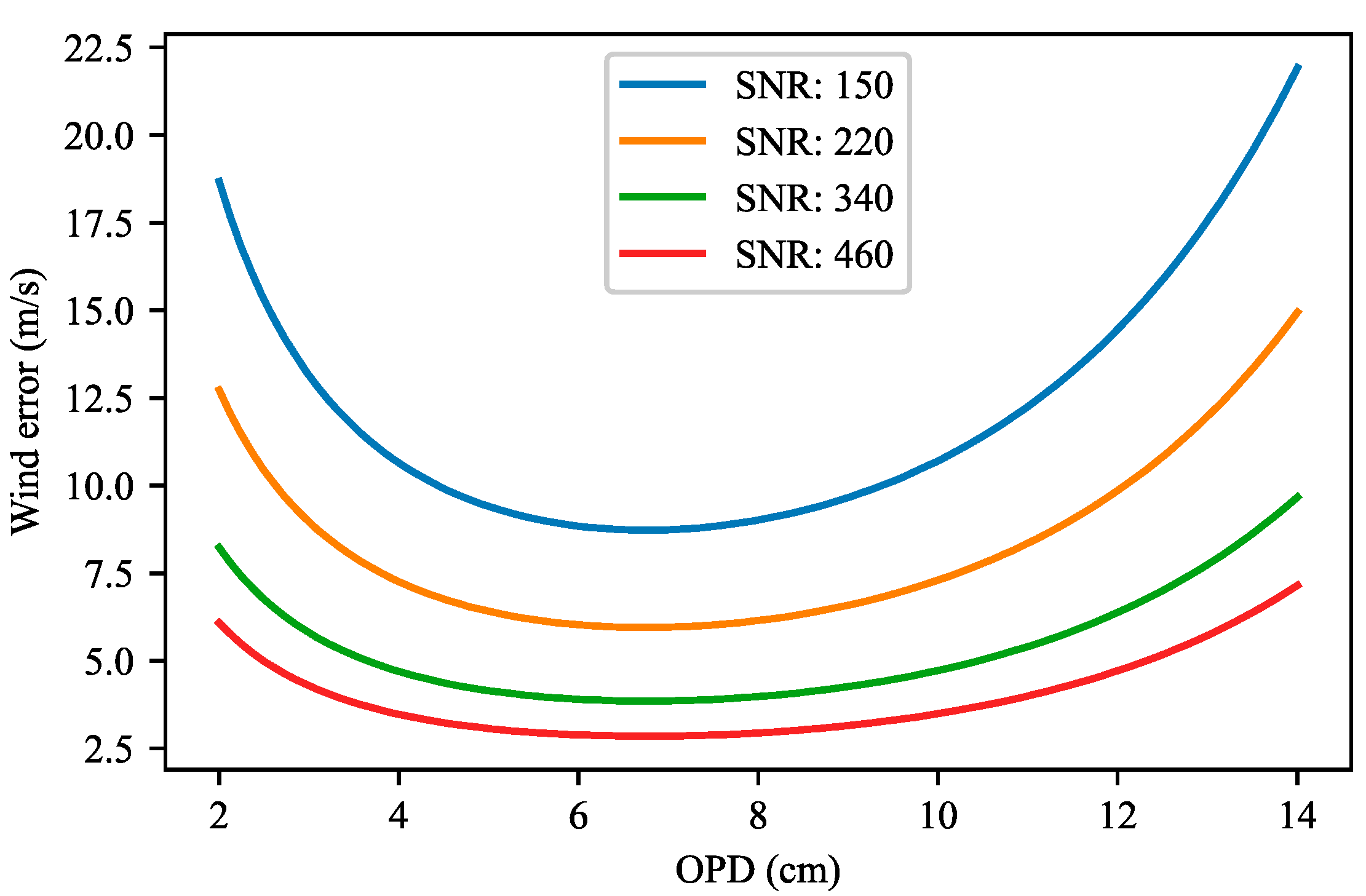
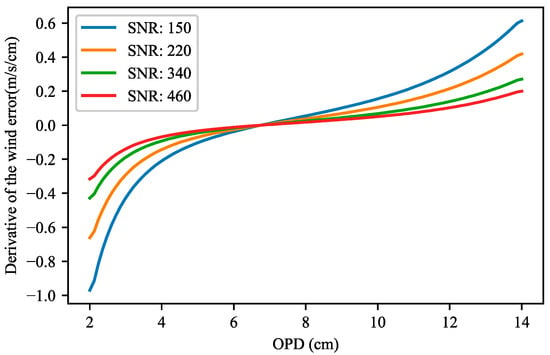
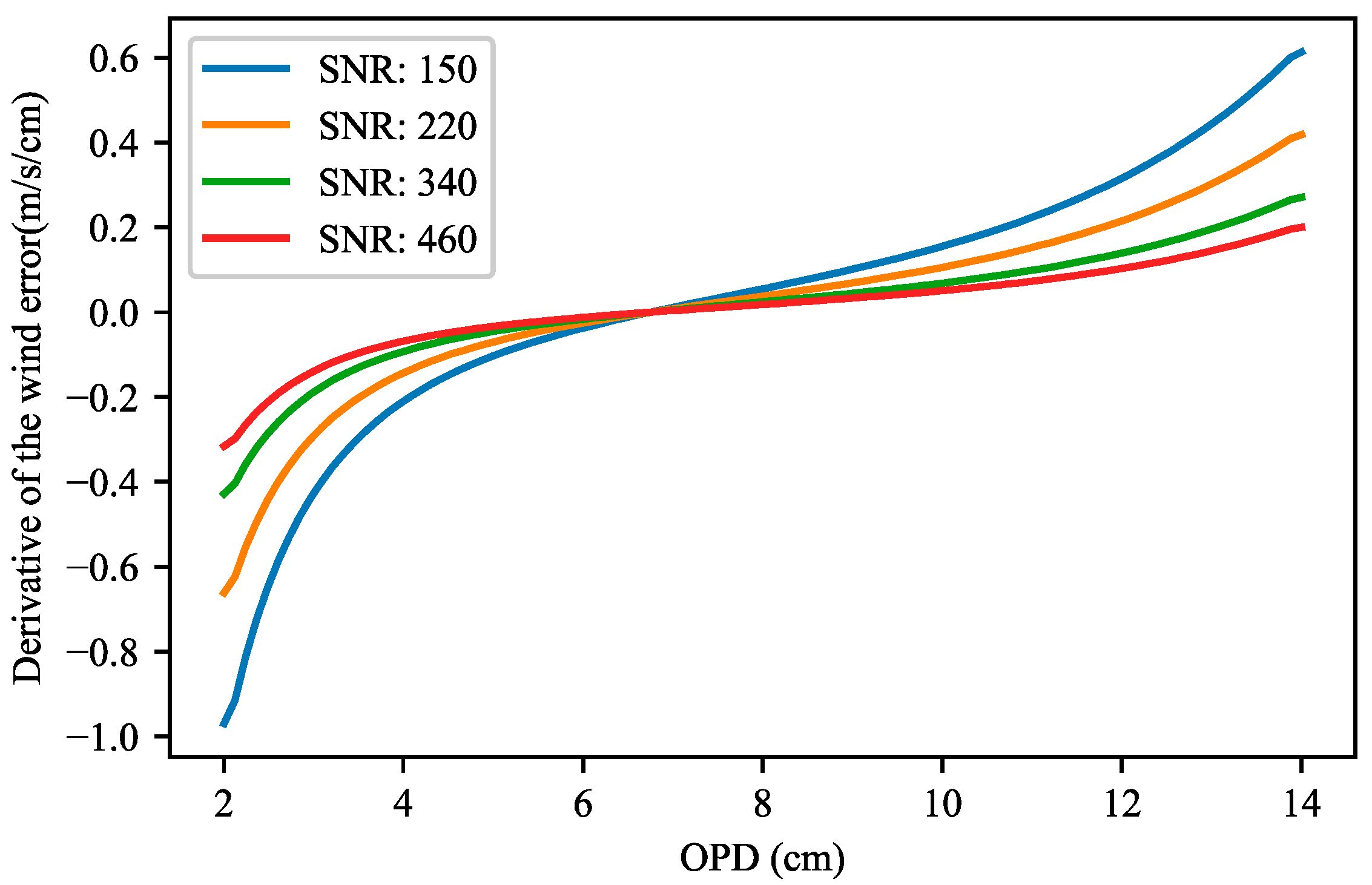
Based on Equations (10)–(12), the relationship between the wind speed measurement uncertainty and the interferometer’s OPD under different SNRs is plotted in Figure 4. As shown, the wind speed uncertainty first decreases and then increases as the OPD rises from small values, reaching a minimum around 6.75 cm. By differentiating the curves in Figure 4, we obtain Figure 5. It can be seen that when the OPD lies in the range of 6.25–7.25 cm, the derivative values are very small (less than ±0.01). Considering that a smaller OPD helps reduce the instrument’s volume and mass, a baseline OPD of 6.25 cm was selected for the interferometer. The selected OPD corresponds to an equivalent resolving power of approximately R ≈ Δ/λ, yielding R ≈ 105 at 557.7 nm. It should be noted that the instrument does not operate as a scanning spectrometer; instead, wind information is retrieved through phase discrimination at this fixed OPD. The chosen OPD therefore represents an optimal compromise between Doppler sensitivity and mechanical feasibility. Accordingly, the arm glasses were optimized during the design process, taking into account requirements such as wide-field compensation and temperature stability. The glass pairing and thickness configuration were designed to minimize OPD drift under temperature variations, and the underlying principles are provided in Reference [15]. The final selection and key parameters of the interferometer arm glasses are listed in Table 4.
Figure 4.
Wind speed uncertainty versus interferometer OPD under different SNR conditions.
Figure 5.
Derivative of wind speed uncertainty with respect to OPD for different SNR values.
Table 4.
Optimized the combination results of the arm glass.
In summary, the optical design of DUALIS realizes a compact, dual-channel, limb viewing system capable of simultaneous measurements of CO2 column density and thermospheric winds. The system employs a lens array-based static detection architecture in the VIS channel, eliminating the need for moving parts and ensuring robust, phase-stable interferometric measurements. Additionally, pixel binning is implemented on both CCDs to achieve high SNRs, thereby enhancing retrieval precision under low-flux limb viewing conditions. The careful pairing of arm glasses in the Michelson interferometer not only minimizes wind speed uncertainty but also provides inherent temperature compensation and field-widening capability. Together with its reflective-refractive hybrid layout, optimized coatings, and shared telescope front-end, DUALIS ensures high optical efficiency, precise channel co-registration, and strong adaptability to the challenging environment of planetary orbits. The effective instrument line shape (ILS) is determined by the convolution of the narrowband interference filter transmission profile and the cosine modulation function at the selected OPD. Because the retrieval relies on differential phase measurement rather than full spectral reconstruction, accurate knowledge of OPD stability and fringe visibility is more critical than detailed sidelobe characterization. From the Doppler phase relation v∝Δ, a relative OPD uncertainty propagates linearly into wind retrieval error such that δv/v = δd/d. For the selected OPD of 6.25 cm, a 1% OPD uncertainty would therefore induce a 1% wind bias. Considering typical Martian mesospheric winds of 100–200 m/s, this corresponds to a bias of approximately 1–2 m/s. Such tolerance is significantly larger than the expected thermally induced OPD drift for low-expansion optical materials, indicating that the system is not critically sensitive to realistic temperature variations. Such stability requirements are compatible with low thermal expansion optical spacer materials combined with dedicated spacecraft thermal control. Although the sensitivity analysis indicates that the system is not critically sensitive to small OPD variations, maintaining stable thermal conditions remains necessary to ensure long-term interferometric phase stability in orbit. Key design and performance parameters of the current DUALIS concept are summarized in Table 5 to provide a system-level overview.
Table 5.
Summary of key design and performance parameters of the DUALIS instrument concept.
4. Simulation and Principle Validation
The purpose of this section is to evaluate the physical feasibility and measurement sensitivity of the proposed dual-channel limb viewing instrument through forward modeling and retrieval analysis. The simulations are designed to assess signal detectability, Doppler phase response, and altitude-dependent retrieval precision under representative Martian atmospheric conditions. Rather than attempting to reproduce detailed mesospheric dynamics, the modeling framework focuses on verifying that realistic variations in CO2 column density and wind speed produce measurable and distinguishable signatures in the ultraviolet and visible channels, respectively. This approach enables quantitative assessment of instrument performance, retrieval stability, and error propagation within the targeted altitude range of 60–180 km.
The atmospheric inputs used in this study are derived from representative profiles provided by the MCD [29]. While MCD [29] provides physically consistent large-scale climatological fields, it does not fully resolve gravity waves, tides, or small-scale dynamical variability in the mesosphere and lower thermosphere. Accordingly, the present analysis is intended to evaluate measurement sensitivity under typical atmospheric conditions rather than to reproduce detailed short-scale variability. Since both the ultraviolet brightness retrieval and Doppler wind sensing rely on local emission properties and interferometric phase response, enhanced small-scale variability would not invalidate the underlying measurement principle, although it may increase natural spatial gradients in the retrieved fields.
4.1. UV Channel Simulation and Validation
To validate the feasibility of the proposed UV channel for CO2 column density retrieval, an end-to-end numerical simulation was conducted based on the physical principles outlined in Section 2 and the instrument concept described in Section 3. This simulation evaluates the sensitivity of the limb viewing brightness to realistic variations in CO2 column density, serving as a forward-model validation prior to the development of a full retrieval algorithm.
The Martian atmosphere is assumed to be spherically symmetric within the altitude range of interest (60–180 km), and the 297.2 nm emission is treated as optically thin. Accordingly, the limb radiance at a tangent height ht is given by the LOS integral of the local volume emission rate ε (Equation (5)). The emission rate is modeled as a superposition of two layers representing the characteristic double-peaked vertical structure of the dayglow. The lower layer (peak near 80–100 km) scales linearly with the local CO2 number density nCO2(h), driven by CO2 photo-dissociation under solar Lyman-α flux. The upper layer (peak near 120–140 km) is parameterized as a CO2-insensitive Gaussian background, providing an offset to the total signal.
Instrumental effects are incorporated through a simplified radiometric response model as Equation (14), which is employed to convert the simulated limb radiance into the corresponding detector signal. The simulation is implemented on a discrete altitude grid with a 2 km vertical resolution. For each tangent height, the LOS integral is evaluated numerically using trapezoidal integration. Three CO2 scenarios are considered: a reference profile obtained from the MCD [29], and two perturbed profiles with uniform ±5% variations in CO2 number density—representative of typical variability in the Martian mesosphere–lower thermosphere. Solar-scattered ultraviolet background is treated as an additive noise term in the SNR evaluation, consistent with previous UVIS limb analyses.
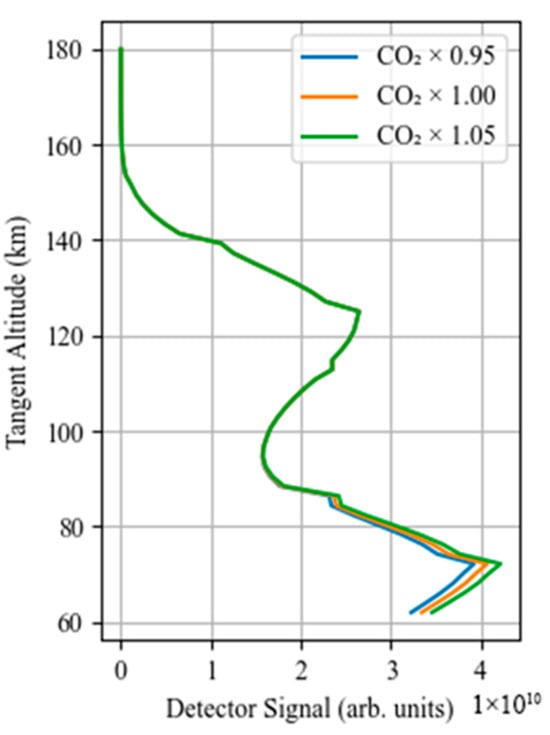
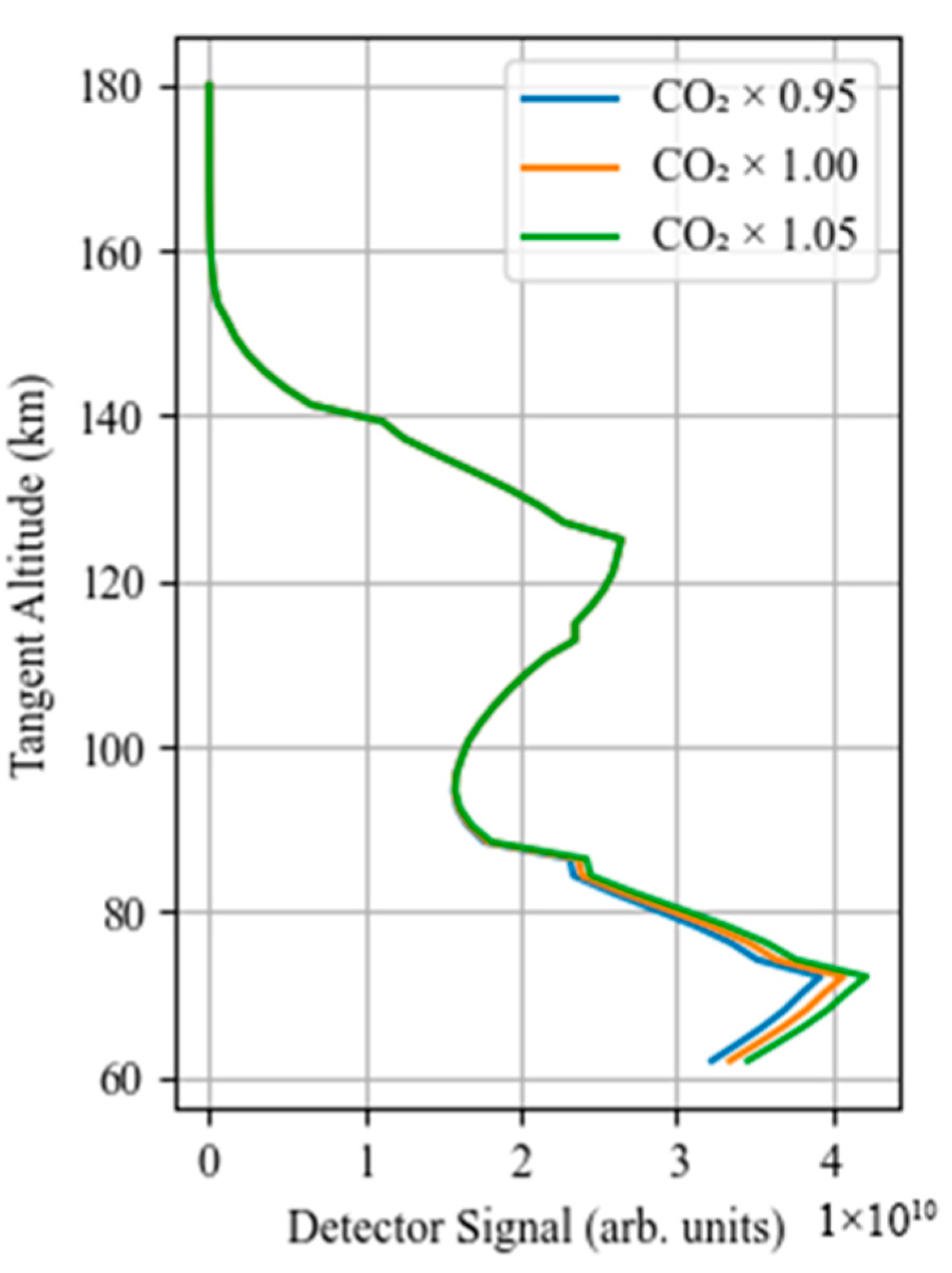
The results, illustrated in Figure 6, demonstrate that a ±5% variation in CO2 column density produces a clearly discernible change in the modeled 297.2 nm limb signal. This sensitivity is most pronounced within the altitude range of the lower emission peak (80–100 km) and remains robust after accounting for LOS integration and instrumental effects. The simulation thus confirms that the UV imaging channel is capable of detecting realistic CO2 column-density variations without requiring high spectral resolution. The above results demonstrate signal detectability, while the retrievability and uncertainty closure are further quantified in Section 4.3.
Figure 6.
Simulated limb detector signals of the O(1S) 297.2 nm emission for a reference CO2 atmosphere and for ±5% perturbations in CO2 column density. The UV limb signal exhibits a clear and systematic response to CO2 variations, especially in the altitude range of the lower emission peak.
Although the present study focuses primarily on forward radiative transfer modeling and sensitivity assessment, the CO2 retrieval framework can be formulated as a limb-brightness inversion problem. The ultraviolet channel measures the integrated O(1S) 297.2 nm emission along the line of sight, which is directly linked to CO2 column density through photodissociation-driven production rates. In practical implementation, a constrained inversion scheme—such as optimal estimation or regularized least-squares fitting—can be employed to retrieve the partial CO2 column density within the 60–180 km sensitivity range. The retrieval would incorporate a forward emission model, instrumental response characterization, and prior atmospheric constraints. A full implementation of the inversion algorithm is beyond the scope of the present proof-of-concept study and will be addressed in future work.
4.2. VIS Channel Simulation and Validation
4.2.1. Zero-Wind Interferogram Simulation
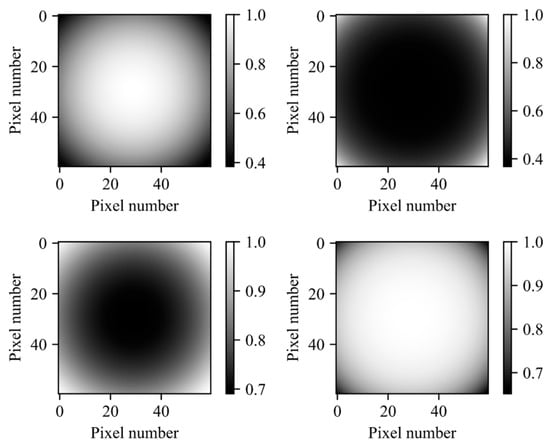
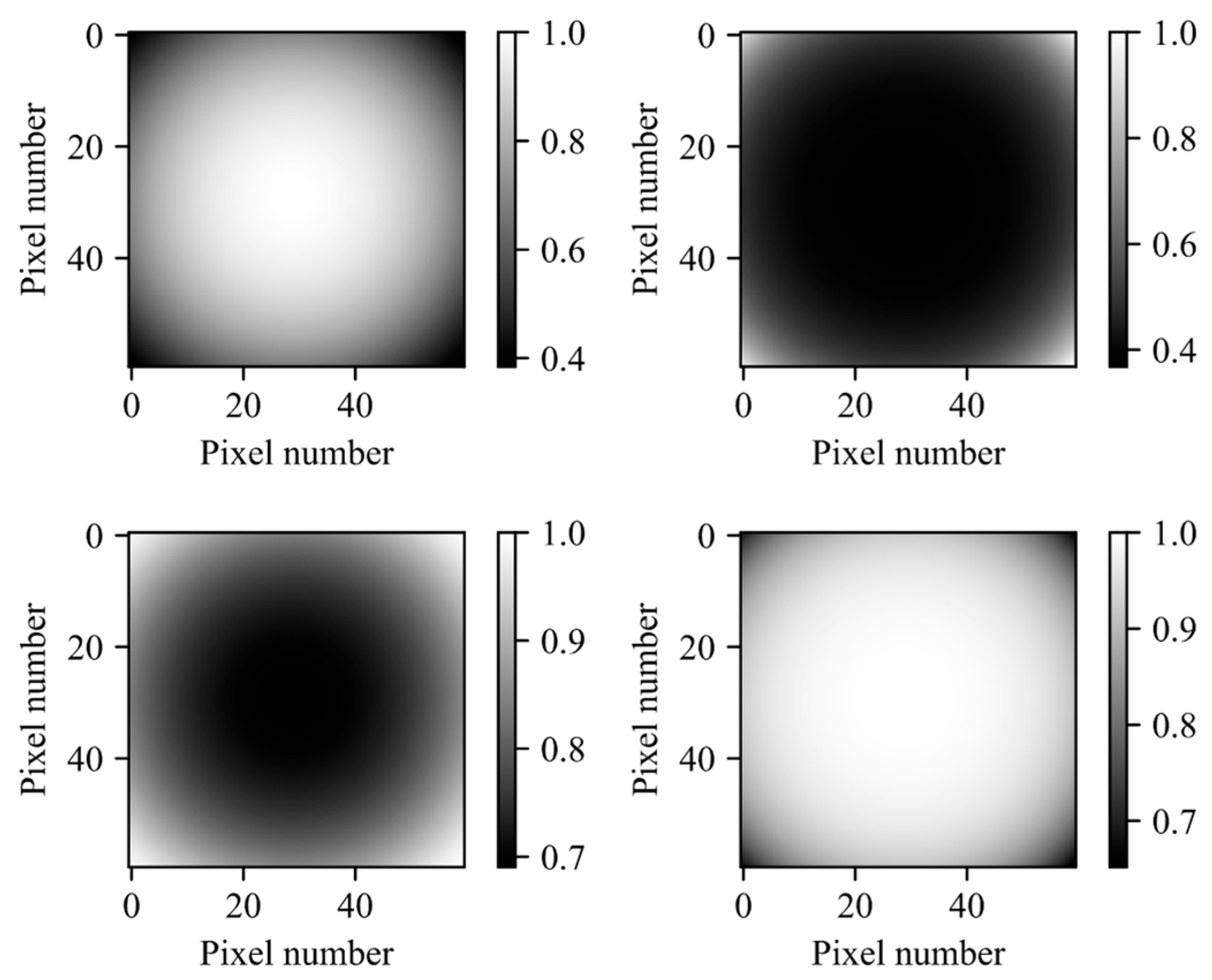
A zero-wind scenario was simulated to quantify the intrinsic phase bias of the interferometer and to establish a reference “background” interferogram for subsequent wind retrievals. Using the interferometric model described by Equation (7) and the optical design parameters listed in Section 3.3, the normalized interference intensity under zero wind was simulated, as shown in Figure 7. In the simulation, the incidence angle varies from 0° at the image center to 4.64° at the edge, taking into account the 2× magnification provided by the fore-telescope system. The atmospheric temperature was set to 150 K. The calculated OPD from the center to the edge of each sub-image in Figure 7 is less than one-tenth of the wavelength, confirming the good field-widening performance of the visible channel.
Figure 7.
Simulated zero-wind interferograms for the O(1S) 557.7 nm emission under a static atmospheric temperature of 150 K. The four panels correspond to the phase-stepped intensities with relative shifts of 0°, 90°, 180°, and 270°, generated by the field-widened Michelson interferometer. The incidence angle across the field of view ranges from 0° (center) to 4.64° (edge).
4.2.2. Wind Retrieval Uncertainty Under Finite SNR
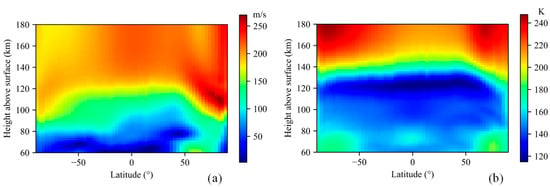
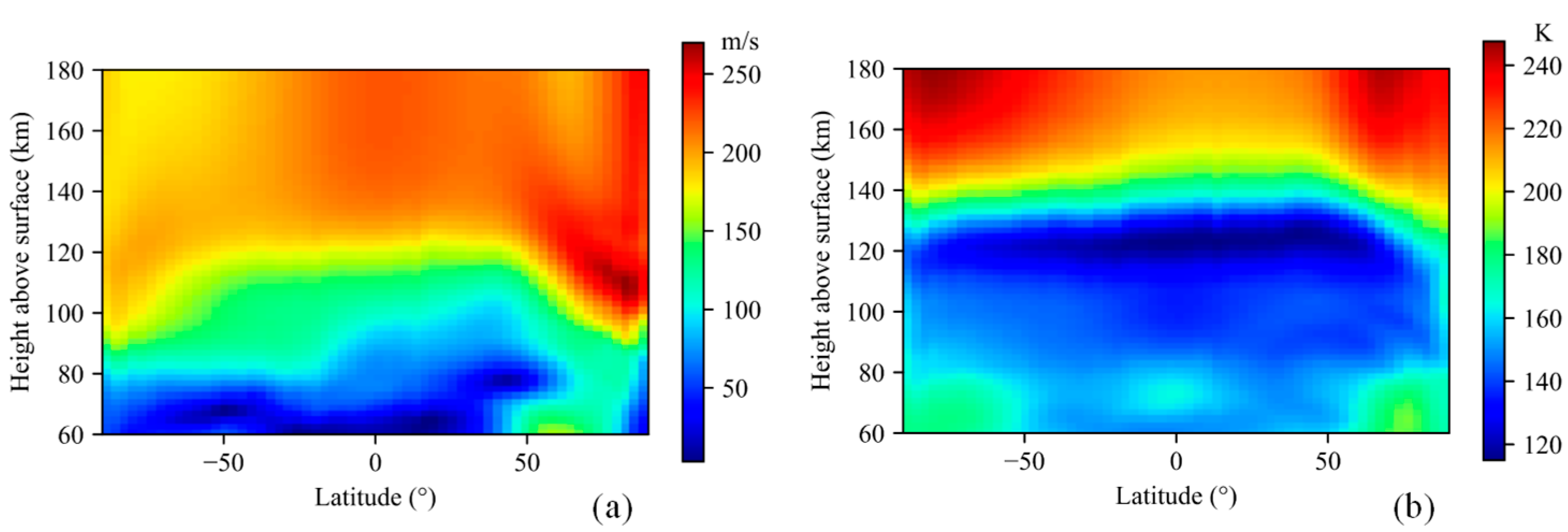
To simulate the wind-imaging interferograms, typical Martian atmospheric wind and temperature profiles were extracted from the MCD [29] and used as input to the DUALIS interferometer model. As illustrated in Figure 8, these profiles represent characteristic conditions in the Martian mesosphere and upper atmosphere, corresponding to Martian year 38 at solar longitude Ls = 205°, local time 12:00, longitude 0°, and a latitudinal coverage from 90° S to 90° N across altitudes of 60–180 km.
Figure 8.
Characteristic atmospheric profiles from the Mars Climate Database (MCD) [29] used as the input for DUALIS simulations: (a) wind speed and (b) temperature. The profiles correspond to Martian Year 38, solar longitude Ls = 205°, local time 12:00, longitude 0°, and latitudes spanning 90° S to 90° N.
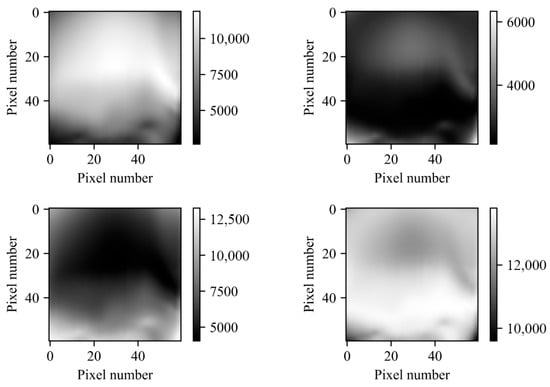
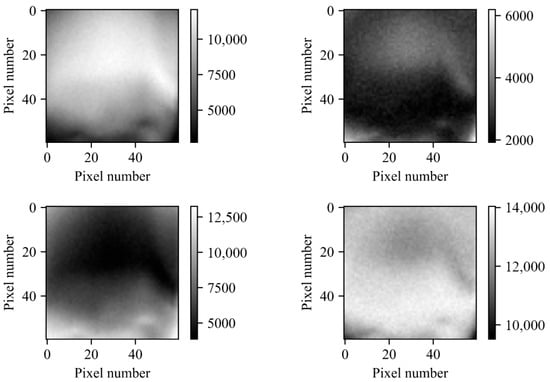
Based on the interferometric forward model described by Equation (7) and the detector signal formulation in Equation (14), synthetic interferograms of the O(1S) 557.7 nm airglow emission were generated for the visible channel. Figure 9 presents the four ideal phase-stepped interferograms obtained under noise-free conditions, whereas Figure 10 illustrates the corresponding interferograms for a representative case with an effective SNR of approximately 100.
Figure 9.
Four-phase stepping wind imaging interferograms for the 557.7 nm airglow spectral lines.
Figure 10.
Four-phase stepping wind imaging interferograms for the 557.7 nm airglow spectral lines (SNR ≈ 100).
The wind-induced phase displacement is clearly observable in the simulated interferograms. Figure 7 presents the four phase-shifted interferograms under zero-wind conditions, serving as a baseline reference. When a prescribed wind field is introduced (Figure 9), the corresponding phase modulation becomes evident in all four quadrature interferograms, demonstrating the sensitivity of the selected OPD to Doppler shifts.
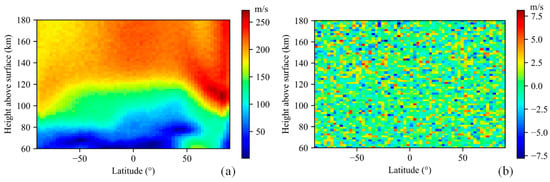
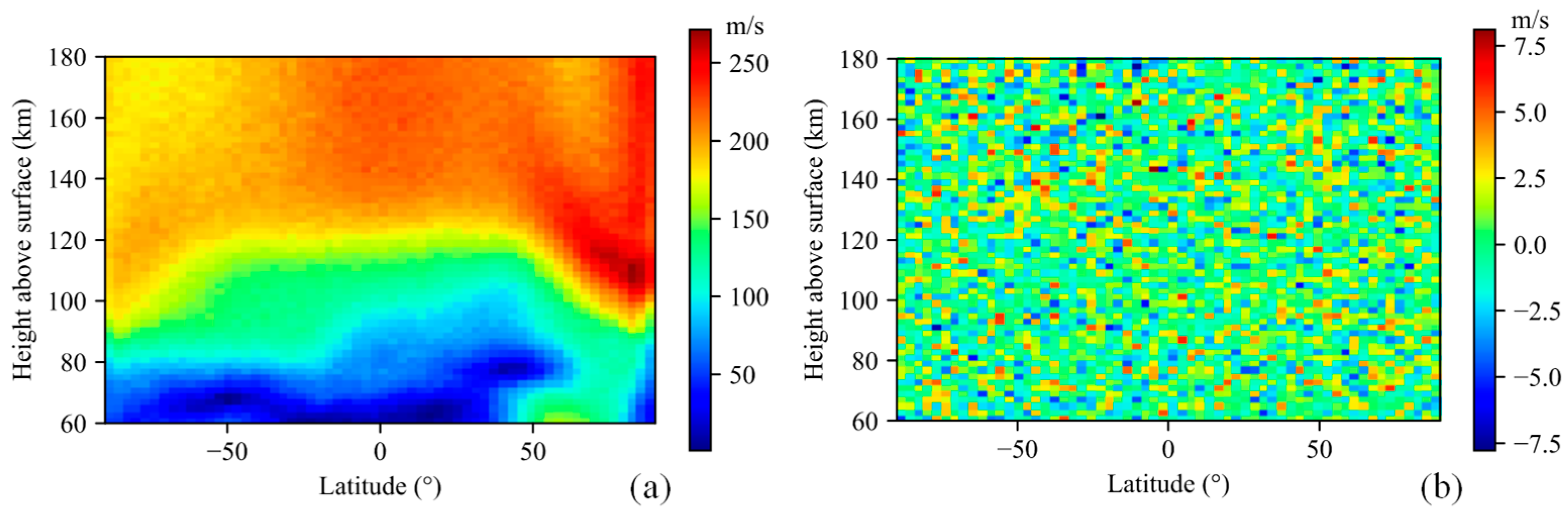
To further evaluate robustness under realistic observational conditions, photon noise was added to generate the noisy interferograms shown in Figure 10. Despite visible intensity fluctuations, the phase structure remains discernible. The imposed ideal Martian wind field (Figure 8) was then retrieved from the noisy interferograms, yielding the reconstructed wind map shown in Figure 11. For each prescribed SNR level, 5000 independent Monte Carlo realizations were analyzed using the standard four-intensity phase-shifting algorithm. The retrieved wind velocity uncertainty exhibits a monotonic decrease with increasing SNR. At an effective SNR of about 100, the standard deviation of the retrieved LOS wind speed reaches approximately ±3 m/s, as shown in Figure 11. Further improvements in SNR lead to sub-3 m/s retrieval precision. This behavior is consistent with theoretical expectations for phase-based Doppler interferometry and demonstrates that the proposed visible channel is capable of achieving the targeted wind measurement accuracy under realistic Gaussian noise conditions.
Figure 11.
Retrieved LOS wind speed and its uncertainty from 557.7 nm interferograms at SNR ≈ 100: (a) wind-speed map; (b) associated error map.
A comparison between Figure 7 and Figure 9 confirms the systematic phase displacement induced by wind, while the comparison between Figure 10 and Figure 11 demonstrates that the retrieval algorithm accurately recovers the imposed wind distribution without introducing systematic bias. The overall agreement between the ideal wind field (Figure 8) and the reconstructed result (Figure 11) confirms that the phase extraction procedure is robust under the expected SNR for Martian limb observations.
4.2.3. Limb-Integrated Wind Profile Analysis
To approximate realistic limb viewing observations, the altitude-dependent volume emission rate of the O(1S) 557.7 nm airglow was combined with a spherical LOS integration model. The Martian atmosphere was discretized into 60 concentric layers spanning 60–180 km, each assumed to have a uniform volume emission rate within the layer. For a given tangent height, the observed limb signal was calculated as the sum of the contributions from all intersected layers, weighted by the corresponding LOS path length determined from the limb geometry.
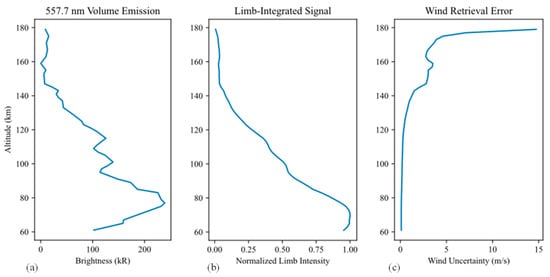
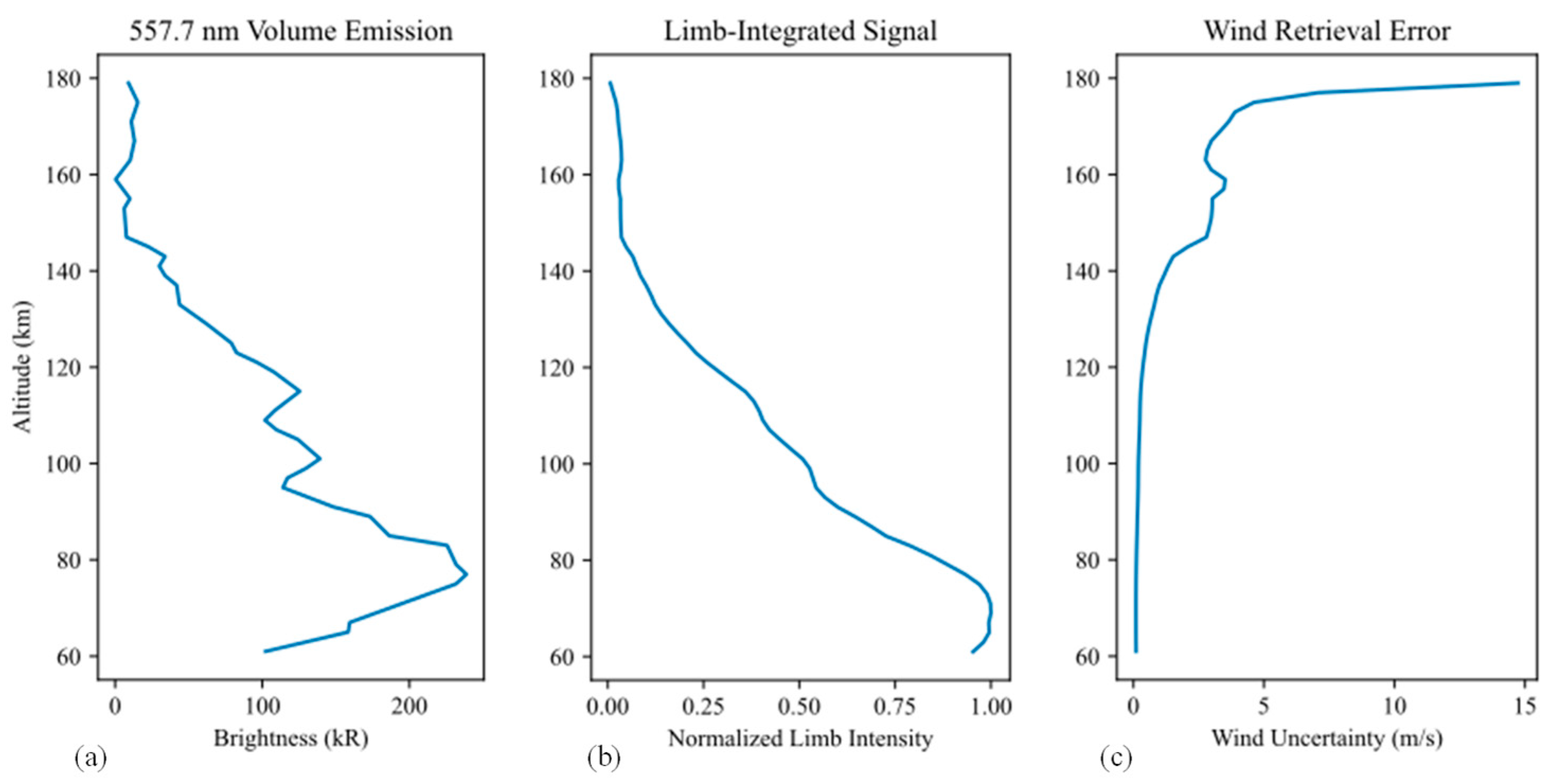
Figure 12 summarizes the key limb viewing characteristics and retrieval performance: panel (a) depicts the limb radiance profile of the 557.7 nm airglow (interpolated from Figure 3), peaking at approximately 230 kR near 80 km altitude; panel (b) presents the normalized LOS integrated intensity, which shows a distinct maximum between 60 and 80 km due to the highest intrinsic airglow emission and the longest atmospheric path length in this region; and panel (c) provides the estimated wind speed measurement uncertainty derived from the model described in Section 3. The results indicate that in the core altitude range of 60–160 km, where limb brightness is high and the SNR is favorable, a wind measurement precision better than ±5 m/s can be achieved within the core altitude range of approximately 60–160 km under representative limb brightness conditions. Above approximately 140 km, the uncertainty increases markedly as limb brightness drops rapidly and SNR decreases, whereas at lower altitudes the retrieval remains robust owing to the strong airglow signal. These results demonstrate that the limb viewing geometry, combined with the proposed static Doppler interferometer, enables vertically resolved wind measurements in the Martian mesosphere and lower thermosphere, and clearly delineates the altitude region over which the instrument delivers optimal performance. It should be noted that the retrieval precision is fundamentally governed by local limb brightness and SNR rather than by assumptions regarding background dynamical smoothness, and therefore varies with altitude and atmospheric conditions.
4.3. Retrieval Sensitivity and Error Budget
To assess whether the atmospheric state can be reliably recovered from noisy limb measurements, a first-order retrieval sensitivity and error propagation analysis was performed. Instead of implementing a full optimal estimation framework, the forward model was linearized around a reference state to quantify the propagation of measurement and model uncertainties into the retrieved parameters.
For the UV channel, the limb radiance I depends on the CO2 column density NCO2 and airglow production parameters. Linearizing the forward model yields
where σI includes photo noise, detector noise, and background uncertainty. Under representative dayside limb brightness conditions, the effective SNR ≈ 50–100 corresponds to a measurement-driven CO2 uncertainty of approximately 3–4%. For the VIS interferometric channel, wind retrieval is derived from phase estimation. The propagated wind uncertainty is
where σΦ accounts for photon noise and interferometric phase instability. Monte Carlo simulations indicate that for SNR ≥ 100, the wind precision remains better than ±5 m/s, consistent with the forward modeling results.
Beyond instrumental noise, uncertainties in the airglow production mechanism were also evaluated. The dominant contributors include solar Lyman-α irradiance variability (~3–5%), CO2 absorption cross-section uncertainty (~2–3%), and O(1S) production yield and quenching coefficients (~5%). Assuming statistical independence, the total CO2 retrieval uncertainty can be approximated using the root-sum-square (RSS) combination shown as
This yields an overall expected CO2 column density precision of approximately 6–8% under nominal dayside conditions. The originally reported ±5% sensitivity, therefore, represents a near measurement-limited scenario, while inclusion of physical parameter uncertainty leads to a more conservative yet realistic performance estimate. Importantly, relative spatial variations are less sensitive to absolute calibration uncertainties, as multiplicative production factors partially cancel in differential retrieval. Table 6 summarizes the principal uncertainty contributions for both channels. These results demonstrate that both CO2 column density and wind speed can be robustly retrieved from noisy limb radiances within realistic instrumental and physical uncertainty bounds.
Table 6.
Error Budget for CO2 Column Density and Wind Retrieval under Nominal Limb-Viewing Conditions.
5. Discussion
The simulation study demonstrates the physical feasibility of a dual-channel passive limb imaging system for the simultaneous retrieval of CO2 column density and wind speed in the Martian mesosphere and lower thermosphere. The instrument concept is intended for limb viewing observations under nominal dayside illumination conditions, with a representative solar zenith angle (SZA) range of approximately 20–80°, where both the O(1S) 297.2 nm and 557.7 nm emissions have been observationally confirmed in the Martian atmosphere. By combining the diagnostic strengths of the O(1S) 297.2 nm and 557.7 nm airglow emissions, the proposed architecture enables co-registered observations of atmospheric composition and dynamics using a common optical front-end. The UV channel operates on integrated limb brightness, whereas the visible channel extracts wind information through static Doppler interferometry—a separation that allows each spectral branch to be optimized independently while maintaining system compactness.
In addition to forward signal simulations, a first-order retrieval sensitivity and error budget analysis has been incorporated to assess inverse consistency. Linearized uncertainty propagation indicates that the originally reported ±5% CO2 sensitivity corresponds to a measurement-limited scenario, while inclusion of physical parameter uncertainties (e.g., solar Lyman-α variability, CO2 absorption cross sections, and O(1S) production yield) results in a more conservative overall precision of approximately 6–8% under nominal dayside conditions. For the visible interferometric channel, Monte Carlo phase simulations confirm wind retrieval precision better than ±5 m/s within the primary emission layer under representative SNRs. These results demonstrate that the atmospheric state can be robustly recovered from noisy limb radiances within quantified instrumental and model uncertainty bounds.
Several limitations of the current study and directions for future development should be noted. The present work focuses on forward model validation and does not yet address full inversion schemes, three-dimensional wind reconstruction, or detailed uncertainty propagation. Furthermore, practical implementation would face additional challenges: (1) on-orbit calibration and long term stability of optical components, such as the interferometer arm mirrors and the dichroic beamsplitter, could be affected by the pronounced thermal cycling and radiation environment at Mars, potentially leading to gradual response drift; (2) the limb viewing geometry, while enhancing signal integration, inherently smears vertical fine-structure due to the extended LOS integration, which may limit the ability to resolve sharp atmospheric layers; (3) The full implementation and validation of the CO2 inversion algorithm represent an important technical challenge, requiring the integration of detailed photochemical emission modeling, instrument response characterization, and regularized inversion strategies within a unified retrieval framework; (4) temporal and spatial variability of the airglow emission rates, driven by solar activity, seasonality, and local photochemistry, could introduce additional uncertainty in the retrieval of both CO2 and winds. In particular, variability in solar irradiance and excitation conditions must be accounted for in future retrieval frameworks, potentially through auxiliary solar monitoring and calibration strategies. Extreme atmospheric conditions, such as global dust storms or strong seasonal variability, may modify thermospheric heating rates and airglow production efficiencies. Such changes would primarily affect emission brightness and, therefore, retrieval precision through SNR variations. However, the Doppler phase sensing mechanism remains physically valid, and the altitude-dependent uncertainty analysis (Figure 12) already captures the direct relationship between brightness and wind precision. The dual-channel architecture may further assist in identifying anomalous photochemical conditions through cross-consistency between composition and dynamical signals. Factors such as stray light, long-term calibration stability, and variability in airglow excitation conditions likewise warrant careful consideration in future mission design and data processing schemes.
It should also be emphasized that DUALIS directly measures the LOS component of the neutral wind. Reconstruction of full horizontal wind vectors can be operationally achieved through several feasible strategies. A dual-field limb-viewing configuration, observing the same tangent altitude from two separated azimuth directions, would provide simultaneous multi-directional LOS measurements enabling in-orbit vector recovery from a single platform. Alternatively, coordinated multi-spacecraft observations could obtain independent LOS components of the same atmospheric volume from different viewing geometries, allowing geometric vector reconstruction. In addition, temporally accumulated LOS measurements may be assimilated into global circulation models to further constrain the horizontal wind field. Given that horizontal winds dominate in the Martian mesosphere–lower thermosphere, LOS measurements nevertheless provide meaningful dynamical constraints even without instantaneous vector recovery. Moreover, although the detector sampling corresponds to a fine angular resolution, the effective vertical resolution is fundamentally governed by the limb-viewing weighting function and LOS integration geometry rather than by pixel spacing alone. Consequently, vertical smoothing is inherent to limb techniques and has been considered in the interpretation of the altitude-dependent uncertainty analysis. Compared with alternative approaches such as radio occultation or stellar occultation, which primarily provide temperature or constituent density profiles, the proposed dual-channel passive limb concept uniquely enables simultaneous and co-located retrieval of atmospheric composition and wind dynamics. Thermospheric density and composition measurements from MAVEN can provide in situ constraints for validating limb-derived wind and CO2 retrievals, while limb and occultation observations from TGO offer complementary vertical profiling capabilities. This complementary and cross-validation capability positions DUALIS as a valuable addition to existing and future Mars observation strategies. Together, these considerations indicate that DUALIS provides a technically feasible and scientifically complementary approach for advancing composition–dynamics diagnostics in the Martian mesosphere–lower thermosphere.
6. Conclusions
In this study, a dual-channel passive limb imaging system (DUALIS) has been proposed for the simultaneous observation of CO2 column density and wind speed in the Martian mesosphere and lower thermosphere (60–180 km). The instrument concept exploits the complementary diagnostic capabilities of the O(1S) 297.2 nm and 557.7 nm airglow emissions, combining a UV imaging channel for CO2 column density retrieval with a visible static Doppler interferometry channel for LOS wind measurements. A shared reflective telescope and a dichroic beam-splitting architecture enable co-aligned, co-temporal observations while maintaining a compact and modular optical configuration suitable for resource-constrained Mars orbital missions.
To validate the measurement principle, end-to-end radiative transfer and instrument response simulations were performed. The results indicate that under representative Martian atmospheric conditions, variations of ±6–8% in CO2 column density and ±5m/s in wind speed produce measurable signatures in the simulated limb radiances. The altitude-dependent uncertainty analysis further demonstrates that wind precision better than ±5 m/s is achievable within the primary emission layer (approximately 60–160 km), where limb brightness and SNR are favorable. These findings confirm the physical feasibility and sensitivity of the proposed concept within the defined operating regime.
In terms of technology readiness, the current DUALIS design resides at Technology Readiness Level (TRL) 3–4, supported by detailed optical design and numerical performance validation. To advance toward flight implementation, the following steps are envisaged: (1) development and testing of a laboratory prototype to validate optical throughput, interferometric stability, and calibration procedures under simulated Martian thermal-vacuum conditions; (2) refinement of retrieval algorithms to handle real-world effects such as stray light, detector non-linearity, and airglow variability; (3) integration of the instrument concept with a candidate Mars orbiter platform, including detailed mechanical, thermal, and data-interface design; and (4) execution of observation-system simulation experiments to quantify the impact of DUALIS measurements on global circulation model assimilation.
The proposal and validation of the DUALIS concept address the potential to fill a longstanding observational gap in the simultaneous remote sensing of composition and dynamics in the Martian mesosphere-lower thermosphere, and provide a promising framework for improving understanding of photochemical–dynamical coupling, atmospheric escape processes, and model validation in future Mars orbital missions.
Author Contributions
Conceptualization, Y.W., methodology, Y.W.; software, Z.C. and Y.H.; validation, Y.W. and T.Y.; formal analysis, S.Z. and S.G.; investigation, Y.W. and Y.H.; resources, S.G. and S.Z.; data curation, Y.H. and S.G.; writing—original draft preparation, Y.W. and Y.L.; writing—review and editing, Y.W. and Z.C.; visualization, T.Y. and S.G.; supervision, S.G. and T.Y.; project administration, S.Z. and Y.L.; funding acquisition, Y.W., S.G. and Z.C. All authors have read and agreed to the published version of the manuscript.
Funding
This work was supported by the Scientific Research Program Funded by Education Department of Shaanxi Provincial Government (Program No. 25JK0497), the National Key R&D Program of China (Grant No.2023YFB3906000), the Open Fund of the State Key Laboratory of Ultrafast Optical Science and Technology (Grant No. 2025SKL-uFAST-KF21), the National Natural Science Foundation of China (Grant No.62505354).
Data Availability Statement
The original contributions presented in this study are included in the article. Further inquiries can be directed to the corresponding author.
Acknowledgments
The authors are thankful to the providers for all the datasets used in this study. We also thankful the anonymous reviewers and editors for their constructive comments to improve this paper.
Conflicts of Interest
The authors declare no conflicts of interest.
References
- Roeten, K.J.; Bougher, S.W.; Benna, M.; Mahaffy, P.R.; Lee, Y.; Pawlowski, D.; González-Galindo, F.; López-Valverde, M.Á. MAVEN/NGIMS Thermospheric Neutral Wind Observations: Interpretation Using the M-GITM General Circulation Model. J. Geophys. Res. Planets 2019, 124, 3283–3303. [Google Scholar] [CrossRef] [Scilit]
- Zhou, X.; Wei, Y.; Wu, Z.; Ren, Z.; Tan, N.; Fan, S.; He, F.; Rong, Z.; Yan, L.; Wang, Y.; et al. Martian Whole Atmosphere Model and Dust Activities: Review and Prospect. Chin. Sci. Bull. 2024, 69, 1058–1067. (In Chinese) [Google Scholar] [CrossRef] [Scilit]
- Zhang, C.; Wang, Y.; Zhang, B.; Yan, T.; Chen, Z.; Chen, Z. Novel Compact Polarized Martian Wind Imaging Interferometer. Remote Sens. 2023, 15, 4881. [Google Scholar] [CrossRef] [Scilit]
- Rong, P.; Zhang, C.; Ward, W.E.; Zhu, H.; Dai, H. Compensation Optimization for a Static Mars Wind Imaging Michelson Interferometer. Opt. Lasers Eng. 2021, 142, 106589. [Google Scholar] [CrossRef] [Scilit]
- Guzewich, S.; Abshire, J.B.; Baker, M.M.; Battalio, J.M.; Bertrand, T.; Brown, A.J.; Colaprete, A.; Cook, A.M.; Cremons, D.R.; Crismani, M.M.; et al. Measuring Mars Atmospheric Winds from Orbit. Bull. of the AAS 2020, 53, 35. [Google Scholar] [CrossRef] [Scilit]
- Kahn, R. Some Observational Constraints on the Global-scale Wind Systems of Mars. J. Geophys. Res. 1983, 88, 10189–10209. [Google Scholar] [CrossRef] [Scilit]
- Kleinböhl, A.; Willacy, K.; Slipski, M.J.; Poncin, L.; Halekas, J.S.; Mayyasi, M. Hydrogen Escape on Mars Dominated by Water Vapour Photolysis above the Hygropause. Nat. Astron. 2024, 8, 827–837. [Google Scholar] [CrossRef] [Scilit]
- He, F. Remote sensing of planetary space environment. Chin. Sci. Bull. 2020, 65, 1305–1319. [Google Scholar] [CrossRef] [Scilit]
- Montlaur, A.; Arias, S.; Rojas, J.I. Thermally Driven Winds on Mars: A Review and a Slope Effect Numerical Study. J. Geophys. Res. Planets 2024, 129, e2023JE007987. [Google Scholar] [CrossRef] [Scilit]
- Peter, K.; Sánchez-Cano, B.; Němec, F.; González-Galindo, F.; Kopf, A.J.; Lester, M.; Pätzold, M.; Regan, C.E.; Holmström, M. The Ionosphere of Mars After 20 Years of Mars Express Contributions. Space Sci. Rev. 2024, 220, 41. [Google Scholar] [CrossRef] [Scilit]
- Almatroushi, H.; AlMazmi, H.; AlMheiri, N.; AlShamsi, M.; AlTunaiji, E.; Badri, K.; Lillis, R.J.; Lootah, F.; Yousuf, M.; Amiri, S.; et al. Emirates Mars Mission Characterization of Mars Atmosphere Dynamics and Processes. Space Sci. Rev. 2021, 217, 89. [Google Scholar] [CrossRef] [Scilit]
- Gérard, J.-C.; Soret, L.; Thomas, I.R.; Ristic, B.; Willame, Y.; Depiesse, C.; Vandaele, A.C.; Daerden, F.; Hubert, B.; Mason, J.P.; et al. Observation of the Mars O2 Visible Nightglow by the NOMAD Spectrometer Onboard the Trace Gas Orbiter. Nat. Astron. 2023, 8, 77–81. [Google Scholar] [CrossRef] [Scilit]
- Fedorova, A.; Korablev, O.; Perrier, S.; Bertaux, J.; Lefevre, F.; Rodin, A. Observation of O2 1.27 Μm Dayglow by SPICAM IR: Seasonal Distribution for the First Martian Year of Mars Express. J. Geophys. Res. 2006, 111, E09S07. [Google Scholar] [CrossRef] [Scilit]
- Roeten, K.J. Winds in the Thermosphere of Mars: Exploring the Behavior of the Neutral Winds in the Upper Atmosphere and Examining Connections to the Lower Atmosphere. Ph.D. Thesis, University of Michigan, Ann Arbor, MI, USA, 2022. [Google Scholar]
- Wang, Y.; Zhang, B.; Zhang, C.; Guo, S.; Yan, T.; He, Y.; Ward, W. Dual-Wavelength Interferometric Detection Technology for Wind and Temperature Fields in the Martian Middle and Upper Atmosphere Based on LCTF. Remote Sens. 2024, 16, 3591. [Google Scholar] [CrossRef] [Scilit]
- Gkouvelis, L.; Gérard, J.-C.; Ritter, B.; Hubert, B.; Schneider, N.M.; Jain, S.K. The O(1 S) 297.2-nm Dayglow Emission: A Tracer of CO2 Density Variations in the Martian Lower Thermosphere. JGR Planets 2018, 123, 3119–3132. [Google Scholar] [CrossRef] [Scilit]
- Gérard, J.-C.; Aoki, S.; Gkouvelis, L.; Soret, L.; Willame, Y.; Thomas, I.R.; Depiesse, C.; Ristic, B.; Vandaele, A.C.; Hubert, B.; et al. First Observation of the Oxygen 630 nm Emission in the Martian Dayglow. Geophys. Res. Lett. 2021, 48, e2020GL092334. [Google Scholar] [CrossRef] [Scilit]
- Gérard, J.-C.; Aoki, S.; Willame, Y.; Gkouvelis, L.; Depiesse, C.; Thomas, I.R.; Ristic, B.; Vandaele, A.C.; Daerden, F.; Hubert, B.; et al. Detection of Green Line Emission in the Dayside Atmosphere of Mars from NOMAD-TGO Observations. Nat. Astron. 2020, 4, 1049–1052. [Google Scholar] [CrossRef] [Scilit]
- Soret, L.; Robin, H.; Gérard, J.-C.; Gkouvelis, L.; Thomas, I.; Ristic, B.; Willame, Y.; Hubert, B.; Vandaele, A.C.; Mason, J.P.; et al. The Martian Oxygen Green Line Dayglow: Response to Solar Activity. Icarus 2025, 441, 116707. [Google Scholar] [CrossRef] [Scilit]
- Soret, L.; Gérard, J.-C.; Aoki, S.; Gkouvelis, L.; Thomas, I.R.; Ristic, B.; Hubert, B.; Willame, Y.; Depiesse, C.; Vandaele, A.C.; et al. The Mars Oxygen Visible Dayglow: A Martian Year of NOMAD/UVIS Observations. JGR Planets 2022, 127, e2022JE007220. [Google Scholar] [CrossRef] [Scilit]
- Shepherd, G.G.; Thuillier, G.; Gault, W.A.; Solheim, B.H.; Hersom, C.; Alunni, J.M.; Brun, J.-F.; Brune, S.; Charlot, P.; Cogger, L.L.; et al. WINDII, the Wind Imaging Interferometer on the Upper Atmosphere Research Satellite. J. Geophys. Res. 1993, 98, 10725–10750. [Google Scholar] [CrossRef] [Scilit]
- Shepherd, G.G.; Thuillier, G.; Cho, Y.-M.; Duboin, M.-L.; Evans, W.F.J.; Gault, W.A.; Hersom, C.; Kendall, D.J.W.; Lathuillère, C.; Lowe, R.P.; et al. The Wind Imaging Interferometer (WINDII) on the Upper Atmosphere Research Satellite: A 20 Year Perspective. Rev. Geophys. 2012, 50, 2012RG000390. [Google Scholar] [CrossRef] [Scilit]
- Shepherdl, G.G.; McDade, I.C.; Gaultl, W.A.; Rochon, Y.J.; Scott, A.; Rowlands, N.; Buttner, G. The Stratospheric Wind Interferometer for Transport Studies (Swift). In IGARSS 2001. Scanning the Present and Resolving the Future. Proceedings. IEEE 2001 International Geoscience and Remote Sensing Symposium (Cat. No.01CH37217); IEEE: Piscataway, NJ, USA, 2001. [Google Scholar] [CrossRef] [Scilit]
- Ward, W.E. The Design and Implementation of the Wide-Angle Michelson Interferometer to Observe Thermospheric Winds. Ph.D. Thesis, York University, Toronto, ON, Canada, 1988. [Google Scholar]
- Ward, W.E.; Gault, W.A.; Rowlands, N.; Wang, S.; Shepherd, G.G.; Mcdade, I.C.; McConnell, J.C.; Michelangeli, D.V.; Caldwell, J.J. An imaging interferometer for satellite observations of wind and temperature on Mars, the Dynamic Atmosphere Mars Observer (DYNAMO). In Proceedings of the SPIE, Applications of Photonic Technology 5, Quebec, QC, Canada, 2–6 June 2002. [Google Scholar]
- Yang, N.; Xia, C.; Yu, T.; Zuo, X.; Sun, Y.; Yan, X.; Zhang, J.; Wang, J.; Le, H.; Liu, L.; et al. Measurement of Martian Atmospheric Winds by the O2 1.27 Μm Airglow Observations Using Doppler Michelson Interferometry: A Concept Study. Sci. China Earth Sci. 2021, 64, 2027–2042. [Google Scholar] [CrossRef] [Scilit]
- Zhang, R.; Ward, W.E.; Zhang, C. O2 Nightglow Snapshots of the 1.27 Μm Emission at Low Latitudes on Mars with a Static Field-Widened Michelson Interferometer. J. Quant. Spectrosc. Radiat. Transf. 2017, 203, 565–571. [Google Scholar] [CrossRef] [Scilit]
- Altieri, F.; Zasova, L.; D’Aversa, E.; Bellucci, G.; Carrozzo, F.G.; Gondet, B.; Bibring, J.-P. O2 1.27μm Emission Maps as Derived from OMEGA/MEx Data. Icarus 2009, 204, 499–511. [Google Scholar] [CrossRef] [Scilit]
- Millour, E.; Forget, F.; Spiga, A.; Pierron, T.; Bierjon, A.; Montabone, L.; Lefèvre, F.; Montmessin, F.; Chaufray, J.-Y.; Lopez-Valverde, M.; et al. The Mars Climate Database, MCD Version 6; EGU: Vienna, Austria, 2017. [Google Scholar]

Disclaimer/Publisher’s Note: The statements, opinions and data contained in all publications are solely those of the individual author(s) and contributor(s) and not of MDPI and/or the editor(s). MDPI and/or the editor(s) disclaim responsibility for any injury to people or property resulting from any ideas, methods, instructions or products referred to in the content. |
© 2026 by the authors. Licensee MDPI, Basel, Switzerland. This article is an open access article distributed under the terms and conditions of the Creative Commons Attribution (CC BY) license.