


Highlights
What are the main findings?
- FVE enables unified vision–language reasoning for UAV fire-event assessment, jointly performing smoke/fire cue confirmation, real-fire verification, event-type attribution, and response-priority assessment.
- FVE achieves 1.000 recall for real fires and 0.833 accuracy for response-priority assessment, while effectively limiting severe priority errors through fire-management-aligned reasoning.
What are the implications of the main findings?
- The proposed framework bridges the gap between visual smoke/fire detection and operational fire-event understanding, enabling UAV observations to support automated verification and response prioritization.
- Fire-management-aligned vision–language reasoning provides a practical pathway for adapting compact multimodal models to safety-critical remote-sensing emergency applications and local deployment.
Abstract
Existing unmanned aerial vehicle fire monitoring methods primarily recognize visible smoke or flame cues but cannot reliably determine whether an observed anomaly is an uncontrolled fire requiring intervention. This study reformulates UAV fire monitoring from a conventional visual-recognition problem into an event-level reasoning and decision task. We propose Fire-Verify-Expert (FVE), a compact vision–language model that jointly performs smoke and fire cue confirmation, real-fire verification, event-type attribution, and ordered response-priority assessment. FVE incorporates fire-management logic into multimodal preference alignment through a multidimensional Group Relative Policy Optimization objective. Its reward mechanism constrains determination correctness, event-type consistency, rationale–decision consistency, and reasoning quality, while imposing asymmetric penalties on operationally costly errors, particularly missed real fires and severe underestimation of response priority. To support this task, we establish a UAV-oriented dataset of 600 images spanning varied environmental contexts and viewing perspectives, including real fires and visually similar controlled or currently non-actionable smoke/fire events. The dataset provides structured reasoning annotations and ordered response-priority labels. FVE achieves an accuracy/F1-score of 0.917/0.915 for real-fire verification, with a recall of 1.000 for real fires, and an accuracy/F1-score of 0.833/0.706 for response-priority assessment. These results demonstrate the effectiveness of FVE in aligning multimodal vision–language reasoning with fire-management requirements, providing a feasible approach for automated fire-event verification and response prioritization in frontline UAV fire-monitoring workflows.
1. Introduction
Climate change and human activity are reshaping wildfire regimes [1], while an emerging human influence on global extreme fire weather reinforces the need for rapid monitoring and response [2]. UAVs provide maneuverable, high-resolution, and near-real-time observations for fire patrols [3]. Most existing models, however, remain focused on detecting, classifying, or segmenting visible smoke and flames. A detected cue does not necessarily indicate an actionable fire: wildfires can resemble controlled burning, domestic fire use, industrial emissions, or thermal interference (Figure 1), yet these events require different responses [4,5]. Consequently, operational monitoring must determine whether an anomaly is a real fire, identify its event type, and assign an appropriate response priority. Current workflows typically combine automated screening with manual verification, which limits scalability and increases operator workload when benign events are frequent [6]. An assessment model that integrates visual evidence, scene semantics, and operational rules is therefore required.
Figure 1.
Representative imagery of real fire events and visually confusing controlled or currently non-actionable smoke/flame events.
Recent advancements in vision–language models (VLMs) have opened novel pathways for advancing fire monitoring from low-level feature recognition to high-order scene understanding. Existing studies have integrated traditional detectors with VLMs for candidate region description, visual question answering (VQA), and scene interpretation [7], or utilized multimodal fusion and instruction fine-tuning for tasks like intensity analysis and propagation prediction [8]. While these efforts highlight the potential of VLMs in transitioning from “target perception” to “event understanding”, two major limitations persist. First, most solutions focus on static scene description, lacking explicit modeling for the operational logic of real-fire verification, event-type identification, and response priority. In this study, “real fire” is an operational label referring specifically to an uncontrolled and actionable fire event that requires emergency intervention, rather than to the mere physical presence of combustion. Second, general-purpose VLMs remain highly susceptible to “hallucinations” in domain-specific fire scenarios, frequently exhibiting factual inconsistencies, risk over-extrapolation, and a lack of professional interpretability [9].
To address these challenges, we propose Fire–Verify–Expert (FVE), a compact vision–language model tailored for UAV-based fire anomaly assessment. Designed to process suspected anomalies detected by front-end algorithms, FVE performs deep semantic reasoning across four core tasks (Figure 2): smoke/fire cue confirmation, real-fire verification, event type classification, and response priority assessment. Built upon Qwen3-VL-2B-Instruct, FVE uses a task-specific Chain-of-Thought (CoT) prompting template and a structured-output paradigm [10]. Methodologically, we first inject domain expertise and standardized decision criteria via LoRA-based supervised fine-tuning [11]. Subsequently, Group Relative Policy Optimization (GRPO) is applied for post-training preference alignment [12]. A multi-dimensional reward mechanism—evaluating verification correctness, event consistency, logical coherence, and reasoning quality—guides the model to form an evidence-driven analytical loop aligned with practical fire management operations. To support this framework, we constructed a specialized dataset encompassing 600 images representing varied fire-event contexts, complete with fine-grained response priority annotations and diagnostic rationales.
Figure 2.
Functional workflow of the proposed Fire-Verify-Expert model for UAV-based fire-event verification and response-priority assessment.
The main contributions of this study are summarized as follows:
- (1)
- Formulation of UAV fire monitoring as an event-level assessment task: We reformulate UAV fire monitoring from isolated smoke/flame recognition into a unified decision-oriented task comprising smoke/fire cue confirmation, real-fire verification, event-type attribution, and ordered response-priority assessment. This formulation connects front-end anomaly discovery with event-level interpretation and operational prioritization, addressing the gap between visual cue detection and fire-management decision support.
- (2)
- Development of fire-management-aligned vision–language reasoning: We develop a multimodal reasoning framework that embeds fire-management rules into vision–language learning through supervised fine-tuning and GRPO-based preference alignment. The multidimensional reward mechanism jointly optimizes determination correctness, event-type consistency, rationale–decision consistency, and reasoning quality, while imposing asymmetric penalties on operationally costly errors, particularly missed real fires and severe underestimation of response priority.
- (3)
- Establishment of a decision-oriented UAV fire-event benchmark: We construct a dataset containing 600 images covering varied fire-related and visually confounding settings, including real fires and visually similar controlled or currently non-actionable smoke/fire events. The benchmark provides expert-reviewed structured-reasoning annotations and ordered response-priority labels, enabling evaluation with both conventional classification metrics and ordinal and cost-sensitive measures.
2. Related Work
2.1. UAV Fire Monitoring
UAV fire monitoring has progressed from handcrafted color, texture, and motion rules to deep models for fire detection, classification, and segmentation [3,13]. CNNs, YOLO-type detectors, encoder–decoder networks, attention mechanisms, and Transformers have improved smoke/flame recognition for small targets and under low-light, occluded, and cluttered conditions [14,15], providing capabilities such as flame extraction, smoke-contour tracking, and thermal-anomaly detection [16,17]. Nevertheless, most methods remain at the perception level and do not jointly model visual cues, scene semantics, operational rules, or decision logic [18,19]. Operators must still verify alarms, determine whether warning thresholds are exceeded, and decide whether intervention is necessary [20]. The central challenge has therefore shifted from detecting smoke or flames to converting those cues into event verification, response prioritization, and intervention-oriented support. Recent field-oriented work has made deployment constraints more explicit: Wang et al. developed an RGB–thermal UAV detector with temporal consistency for transmission-corridor fires and evaluated real-time operation on an edge computing platform [21]. Such methods strengthen timely smoke/flame perception, but a visual detection alone cannot establish whether combustion is uncontrolled, who or what caused the event, or how urgently an intervention is required.
2.2. Vision–Language Models and Domain Fine-Tuning
Domain adaptation of VLMs commonly combines parameter-efficient fine-tuning, instruction tuning, and structured multimodal supervision. LoRA and QLoRA reduce adaptation cost by updating a small subset of parameters while retaining much of the performance of full fine-tuning [11,22]. Instruction tuning improves task following through supervised demonstrations and preference alignment [23,24], while domain-specific designs strengthen spatial and cross-modal representations [25]. These approaches still face limitations in complex domain-specific tasks: shallow adaptation may underuse infrequent but important features [26], and direct input–output mapping can produce spatial errors, factual inconsistencies, and hallucinations [25,27,28]. Therefore, recent work moves from parameter adaptation toward structured-reasoning alignment [12,29]. Recent geospatial research has further shown that reinforcement fine-tuning can improve few-shot spatial-language reasoning [30]. CoT-supervised fine-tuning can improve task decomposition and intermediate reasoning, while PPO, DPO, SimPO, and GRPO align outputs with preferences such as factual consistency, logical coherence, and evidence traceability [12,31,32,33]. Combining domain data, explicit reasoning traces, and reward-driven optimization is increasingly important for reliable vertical-domain models [34,35]. At the broader remote-sensing foundation-model level, GeoLLaVA-8K introduces object-centric token selection to enable vision–language interpretation of ultra-high-resolution imagery with reduced token redundancy [36]. Improved visual grounding and scalability, however, do not by themselves establish the domain-specific verification rules and consequence-sensitive reasoning required for fire-management decisions.
2.3. Large-Model-Driven Fire Monitoring
Large-model-based fire monitoring has developed along three main directions. First, CLIP-style vision–language pretraining and prompt adaptation improve low-supervision fire recognition under pseudo-smoke interference, long-tailed class distributions, and cross-domain shifts. Multimodal prompt tuning and LLM-generated prompts have accordingly been used to strengthen fire-cue discrimination in few-shot and zero-shot settings [37,38]. Second, detector-VLM cascades combine high-recall candidate screening with semantic verification and scene interpretation, balancing real-time processing with robustness in complex environments [7]. Third, large models increasingly support higher-order functions beyond category or coordinate prediction, including semantic image interpretation, disaster assessment, situational-report generation, and emergency-response planning [39,40,41]. These trajectories progressively extend fire monitoring from isolated perception toward event-level understanding and operational decision support. Recent evaluations also identify important boundaries: SmokeBench shows that multimodal large language models can recognize conspicuous smoke while still struggling to localize faint early-stage plumes [42]. Seidel et al. fine-tuned ForestFireVLM-7B to generate structured descriptions of UAV-observed forest and fire conditions [43], whereas ContextFireAgent combines multi-role consensus with selective detector invocation for RGB wildfire monitoring [44]. These studies improve early perception and contextual interpretation, but primarily assess cue recognition, scene characterization, or verification of image-level predictions.
Recent fire-specific models further illustrate this transition. FireMM-IR integrates RGB-IR encoding with instruction-guided reasoning to jointly analyze fire appearance, intensity, and propagation [8]. WildfireVLM converts remote-sensing detections into context-aware risk assessments and response protocols [45], whereas KG-DS combines visual evidence with fire-investigation knowledge graphs to improve cross-modal reasoning and recommendation traceability [9]. Related vision–language-guided reinforcement learning systems have also optimized UAV fire-front tracking in physics-grounded digital twins [46], addressing navigation and continued observation rather than the authenticity, origin, and urgency of a suspected incident. Collectively, these studies demonstrate the value of multimodal, multi-task, and knowledge-constrained reasoning. Nevertheless, explicit modeling of UAV anomaly verification, event-type attribution, and ordered response-priority assessment remains limited. Existing models rarely unify these functions within a compact, locally deployable model or encode asymmetric operational costs and evidence-consistency constraints during post-training. This gap motivates the proposed FVE framework, which links visual cues to interpretable event verification and response-priority decisions under practical resource constraints in frontline fire-management settings.
3. Materials and Methods
3.1. Overall Framework
Figure 3 illustrates the overall FVE framework, built upon Qwen3-VL-2B-Instruct. The model is adapted in two stages. First, LoRA-based supervised fine-tuning aligns the foundation model with expert-reviewed fire-event reasoning annotations while keeping the visual encoder and language backbone frozen. Second, GRPO performs fire-management-oriented preference alignment using four reward components: determination correctness, event type, logical consistency, and reasoning quality. The visual encoder is unfrozen during GRPO to enable joint optimization of visual representations and decision behavior. FVE produces four structured outputs covering smoke/fire cues, real-fire verification, event type, and response priority. Detailed training procedures and reward definitions are provided in Section 3.3 and Section 3.4.
Figure 3.
Overall architecture of Fire-Verify-Expert. Q, K, and V denote the query, key, and value projection matrices in the self-attention module, respectively. Up, Gate, and Down represent the projection matrices in the feed-forward network. LoRA introduces a low-rank update ΔW = BA, where A and B are trainable low-rank matrices, and the original weights remain frozen.
3.2. Foundation Model
Qwen3-VL-2B-Instruct is selected as the foundation model for its visual understanding capabilities and relatively compact parameter scale. Its Interleaved-MRoPE and DeepStack designs support multimodal and fine-grained visual representations [47]. The 2B-scale architecture also offers a practical balance between reasoning capacity, adaptation cost, and local deployment requirements.
3.3. Supervised Fine-Tuning
FVE is fine-tuned with LLaMA-Factory (version 0.9.4) using LoRA [11,48]. Backbone parameters are frozen, and only low-rank adapters are optimized, reducing memory and training cost while preserving domain adaptability. The SFT dataset pairs UAV anomaly images with expert-reviewed structured rationales. The model follows six steps—environmental and seasonal perception, smoke/flame perception, feature analysis, reference measurement, determination and classification, and response-priority assessment—and returns a structured response. Specifically, the generated content includes six core components:
- (1)
- Anomaly target detection: Determining the presence of flames, smoke, or false positives within the frame.
- (2)
- Scene description: Summarizing the visual environment and target status.
- (3)
- Reasoning process: Providing diagnostic rationales based on visual evidence.
- (4)
- Real-fire verification: Distinguishing real fires from highly confusing smoke/flame events.
- (5)
- Event classification: Categorizing the anomaly into types such as forest fires, agricultural burning, industrial emissions, or domestic fire sources.
- (6)
- Response priority and contributing factors: Assessing the operational response priority of the event and identifying the visual and contextual factors that determine the assigned priority.
SFT establishes the domain-specific reasoning and structured-output capabilities used as the starting point for subsequent GRPO optimization.
3.4. Reinforcement Learning Post-Training
After SFT, GRPO is used for preference alignment [12]. For each anomaly image, the policy samples four candidate responses and updates the policy using the relative rewards of the sampled responses, reinforcing higher-quality outputs. A Kullback–Leibler divergence term limits policy drift. The overall objective combines four rewards for correctness, event type, logical self-consistency, and reasoning quality:
where Rcorr, Revent, Rlogic, and Rreason represent the determination correctness reward, event type reward, logical self-consistency reward, and reasoning quality reward, respectively. The comparatively higher weight assigned to the correctness reward prioritizes the reliability of smoke/fire cue recognition and response priority assessment.
R = 0.5Rcorr + 0.2Revent + 0.2Rlogic + 0.1Rreason
The reward coefficients prioritize correctness and operationally costly errors, while event-type, logical-consistency, and reasoning-quality rewards provide complementary supervision. Four configurations (7:1:1:1, 6:2:1:1, 5:2:2:1, and 4:2:2:2) were compared, with 5:2:2:1 achieving the best performance among the evaluated settings. The resulting weights are 0.5, 0.2, 0.2, and 0.1, respectively.
3.4.1. Fire Correctness Reward
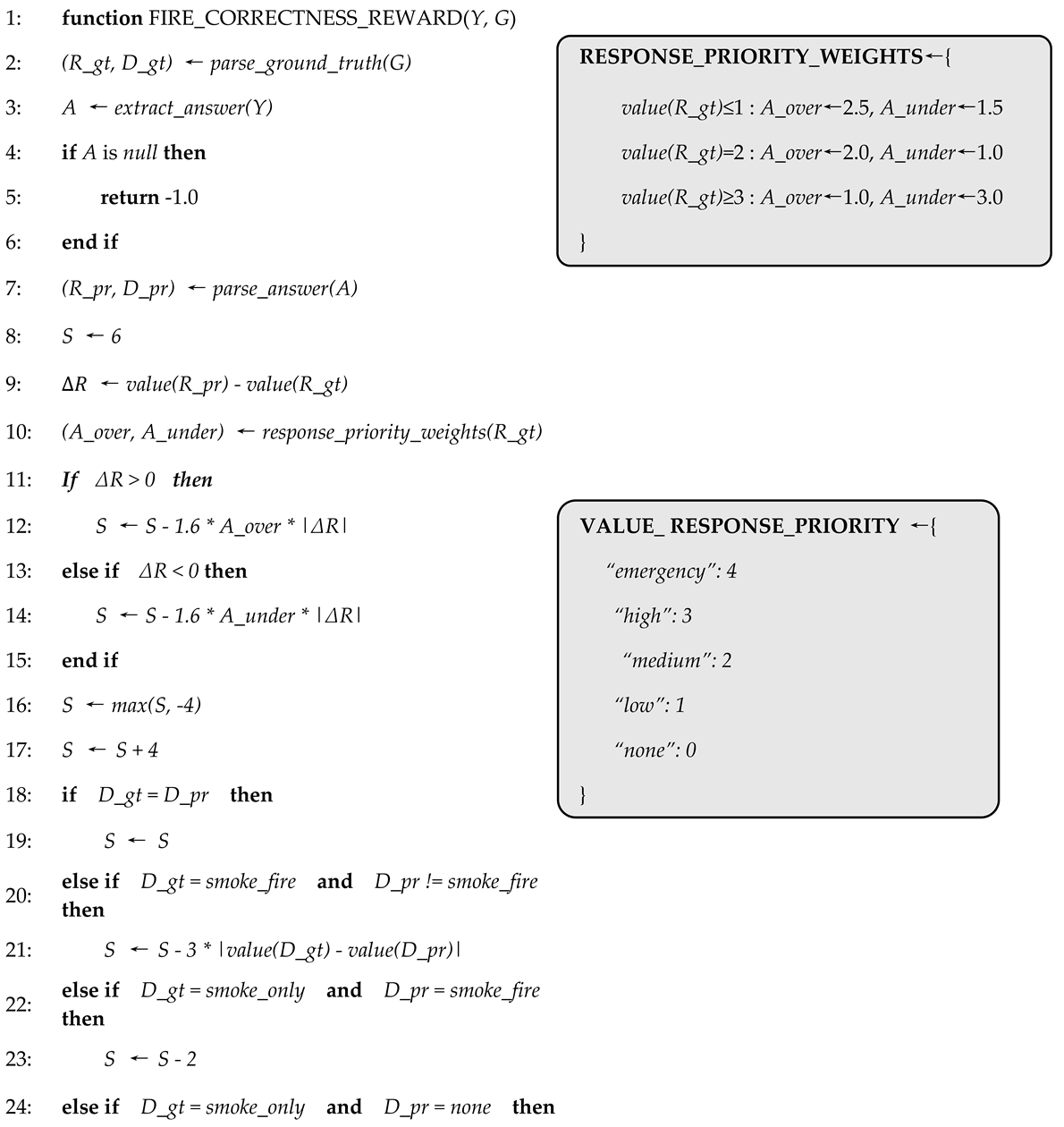
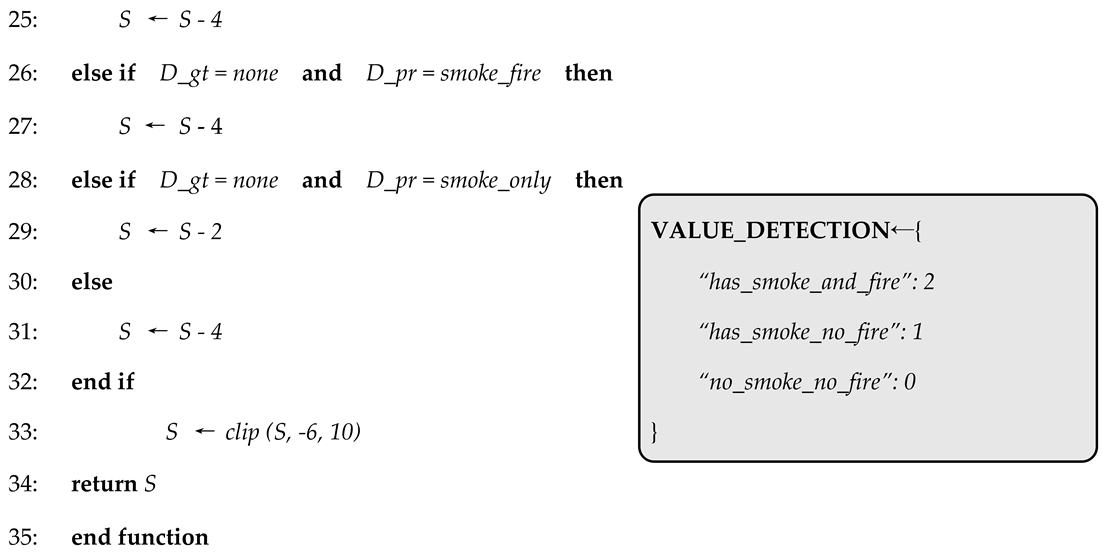
The fire correctness reward jointly evaluates response priority and smoke/fire detection accuracy. To account for the asymmetric operational consequences of different prediction errors, it is formulated as:
where Δr denotes the difference between the predicted and ground-truth response priority levels, α represents the risk-dependent asymmetric penalty coefficient, and Pd denotes the penalty associated with smoke/fire detection errors. The detailed penalty assignments and boundary conditions are provided in Algorithm 1. It extracts the ground-truth and predicted priority and detection fields, scores exact matches, and applies asymmetric penalties according to operational cost. Underestimating high-priority or emergency cases is penalized more heavily than ordinary overestimation, whereas false alarms receive stronger penalties in low-priority or non-actionable scenes. Detection predictions are normalized to has_smoke_and_fire, has_smoke_no_fire, and no_smoke_no_fire; missing visible fire or smoke incurs larger penalties than conservative overestimation (false positives). Under the adopted operational annotation criteria, real-fire events are assigned the Emergency priority, whereas non-real-fire events are classified into High, Medium, Low, or None according to their potential risks and management requirements. This relationship reflects the operational definitions of the labels, while real-fire verification and response-priority assessment are represented as separate outputs in the model’s structured response. Consequently, underestimating an Emergency event represents a critical response-priority error, while incorrectly identifying a non-real-fire event as a real fire constitutes a binary false positive. Therefore, the reward prioritizes missed fires and omitted early smoke cues while clipping extreme negative values for stable optimization.
Rcorr = clip[−6,10](max{6 − 1.6α(r,Δr)|Δr|, − 4} + 4 − Pd)
| Algorithm 1 Fire Correctness Reward Implementation | ||
  | ||
3.4.2. Event Type Reward
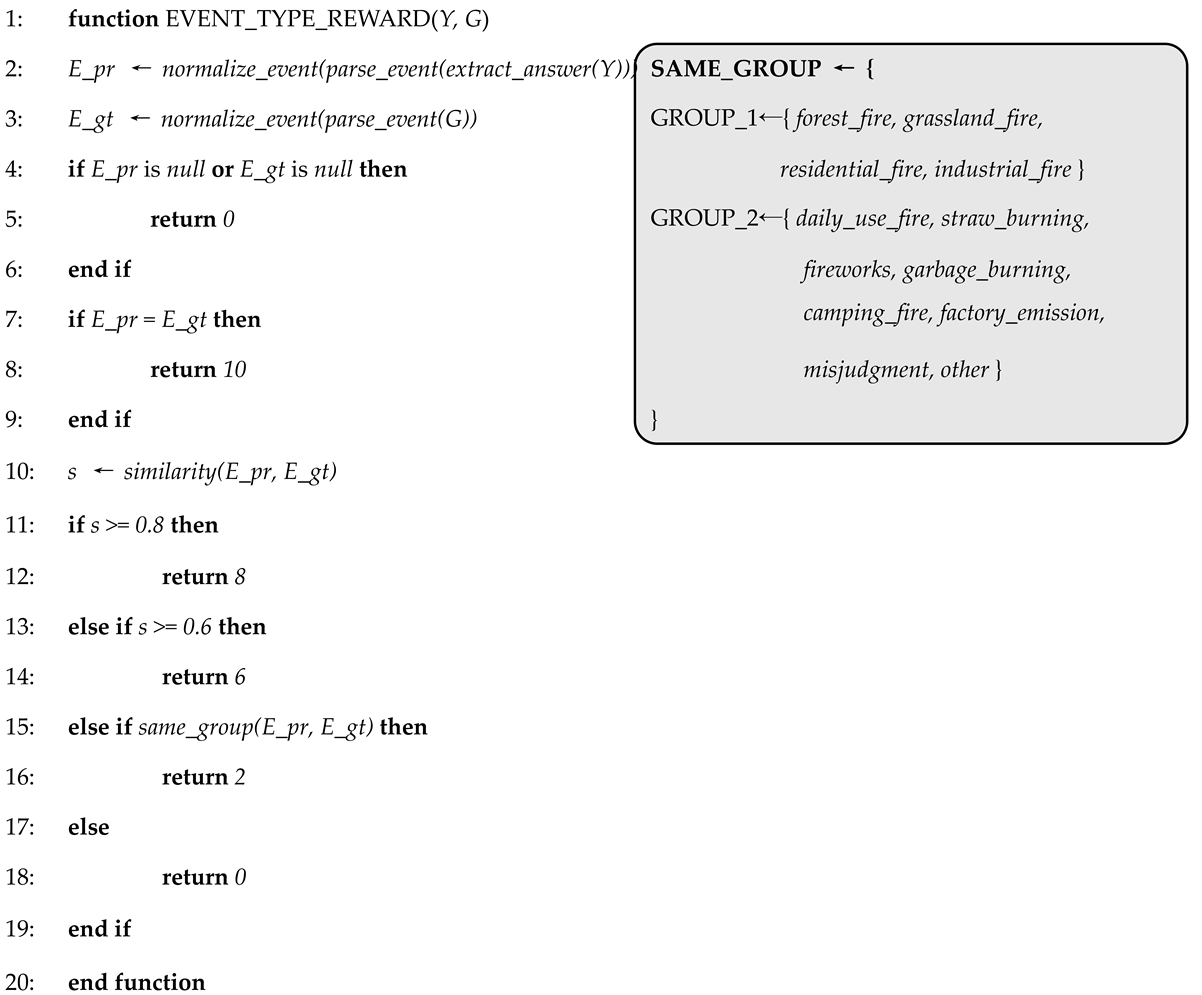
The event type reward adopts a hierarchical scoring strategy that considers exact category matching, semantic similarity, and coarse-grained event consistency. It is defined as:
where e and denote the ground-truth and predicted event types, respectively, measures the similarity between the corresponding category representations, and G(∙) denotes the coarse-grained semantic group. The category normalization procedure and detailed matching rules are presented in Algorithm 2. The reward function initially normalizes both the model’s generated output and the ground-truth labels, mapping them onto a predefined, standardized category set (denoted as SAME_GROUP). Regarding the scoring protocol, a tiered reward mechanism is implemented:
Exact Match: A maximum reward is granted if the normalized predicted category strictly aligns with the ground truth.
High Similarity: A partial reward is allocated if the raw string similarity between the output and the label is exceptionally high.
Coarse-Grained Alignment: A marginal reward is provided even if the specific categories do not perfectly match, provided they belong to the same overarching semantic group.
Specifically, the evaluation framework partitions real-fire incidents and other non-disaster smoke/fire events into two distinct coarse semantic groups. Predictions that fall into the correct coarse group receive a minor baseline score, whereas severe cross-group misclassifications yield a strict score of 0. This hierarchical relaxation design effectively mitigates the excessive rigidity of binary reward functions. Consequently, it facilitates progressive and stable policy optimization, particularly for complex samples characterized by ambiguous or highly proximate categorical boundaries.
| Algorithm 2 Event Type Reward Implementation | ||
 | ||
3.4.3. Logical Self-Consistency Reward
The logical self-consistency reward evaluates whether the evidence presented in the reasoning process supports the final response priority and smoke/fire detection results. It is formulated as:
where T represents the generated reasoning trajectory, E(T) denotes the evidence intensity extracted from the reasoning text, and rs(E(T)) is the suggested response priority derived from this evidence. represents the final response priority value predicted by the model. Plogic represents the cumulative penalties for contradictions between the reasoning evidence and the final predictions. The evidence assessment and contradiction penalty rules are detailed in Algorithm 3. It counts terms associated with strong or weak smoke/flame evidence, spread, scale, exposed targets, and uncertainty, and combines them into an evidence-intensity score. Strong flames and dense smoke receive the largest positive weights; spread, scale, and exposure provide secondary support; uncertainty reduces the score; and an explicit no-smoke/no-fire statement without countervailing evidence triggers a strong penalty. The resulting score implies a response priority that is compared with the generated answer. The reward also penalizes contradictions between the CoT, detection field, and priority—for example, reporting no smoke or fire while assigning a high priority. The final value is clipped and normalized to [0, 10].
| Algorithm 3 Logical Self-Consistency Reward Implementation | ||
| 1: | function FIRE_LOGIC_REWARD(Y) | |
| 2: | T←extract_think(Y); A←extract_answer(Y) | EVIDENCE_SCORE←{ |
| 3: | if T is null or A is null then | FIRE_STRONG ← { flames, fire_glow, severe_fire, |
| 4: | return 0 | tongues_of_flame, burning, ignition, large_fire } |
| 5: | end if | SMOKE_STRONG ← { dense_smoke, black_smoke, |
| 6: | (R_pr, D_pr)←parse_answer(A) | large_amount_of_smoke, smoke_filled, |
| 7: | E←evidence_score(T) | smoke_column, billowing_smoke, heavy_smoke } |
| 8: | R_sug←map_to_response_priority(E) | SMOKE_WEAK ← { white_smoke, light_smoke, |
| 9: | S←4.6 - 0.9 * |value(R_pr) - R_sug| | slight_smoke, thin_smoke, smoke_present, smoke } |
| 10: | if R_sug <= 1 and value(R_pr) >= 2 then | SPREAD ← { spreading, diffusion, fire_expansion, |
| 11: | S←S - (1.2 + 0.5 * (value(R_pr) - 1)) | range_expansion, out_of_control, growing_fire } |
| 12: | else if R_sug >= 3 and value(R_pr) <= 1 then | SCALE ← {large_area, wide_range, towering, |
| 13: | S←S - (2.6 + 0.7 * (3 - value(R_pr))) | rising_straight_up, tall_smoke_column, |
| 14: | end if | covers(buildings|forest|vegetation) } |
| 15: | if has_fire_cue(T) and not fire_detected(D_pr) then | EXPOSURE←{ near_buildings, residential_areas, |
| 16: | S←S - 1.8 | near(buildings|houses|factories|oil_tanks|warehouses), |
| 17: | end if | factories,crowd, densely_populated, near_vehicles } |
| 18: | if negates_fire(T) and (value(R_pr) >= 2 or fire_detected(D_pr)) then | UNCERTAIN ← { far_away, unclear, not_obvious, |
| 19: | S←S - 1.6 | difficult_to_judge, blurry, possible, suspected } |
| 20: | end if | NO_SMOKE_FIRE ← {no_smoke, without_smoke, |
| 21: | S←clip(S, 0, 10) | no_visible_smoke, no_open_flame, no_fire, no_visible_fire } |
| 22: | return S | } |
| 23: | end function | |
3.4.4. Reasoning Quality Reward
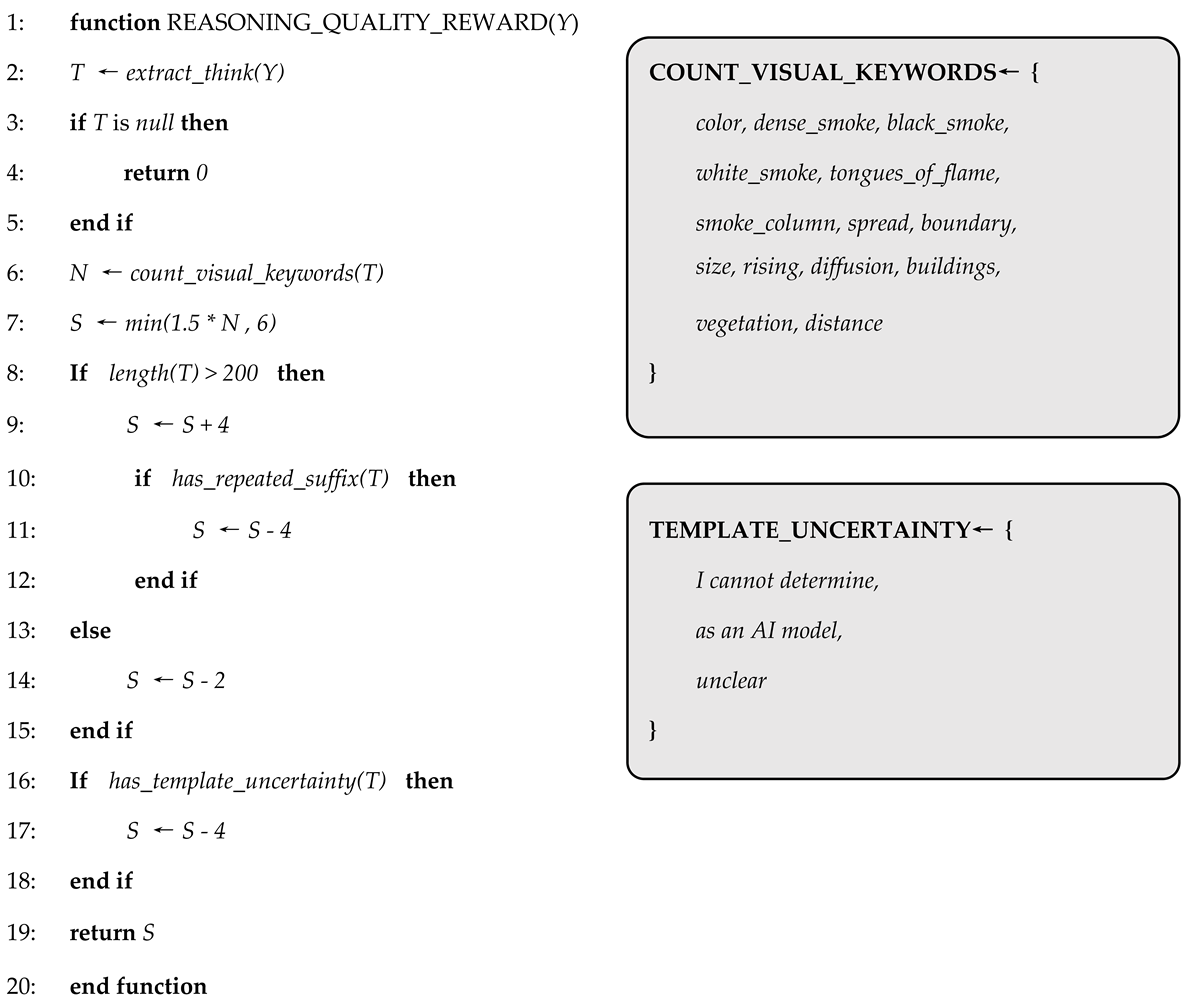
The reasoning quality reward evaluates the informativeness and structural quality of the generated reasoning trajectory while discouraging repetitive or uninformative responses. It is expressed as:
where N(T) denotes the number of distinct visual evidence keywords identified in the reasoning text, Plength represents the length-dependent reward adjustment, and Prepeat and Ptemplate denote penalties for repetitive and template-like reasoning, respectively. As outlined in Algorithm 4, its implementation first quantifies the hit count (N) of core visual analysis keywords within the <think> trajectory to construct a carefully capped baseline score. Concurrently, the function enforces strict heuristic constraints on the length and redundancy of the reasoning process: Length Dynamics: insufficient reasoning length incurs an immediate score deduction, whereas an appropriately expansive and detailed trajectory yields a supplementary bonus; Redundancy Clawback: if cyclical or repetitive text patterns are detected in the trailing segments of the output, the accrued length bonus is strictly revoked (a clawback penalty); Evasion Penalty: A bounded penalty is applied to selected noncommittal or evasive expressions to discourage overly conservative responses. This soft constraint encourages the model to make informative assessments from available visual evidence rather than defaulting to uninformative uncertainty. Fundamentally, this reward mechanism incentivizes the model to articulate comprehensive, non-repetitive, and non-templated analyses anchored strictly in observable visual evidence, actively discouraging the mere enumeration of fire-related jargon. These two rewards encourage internal reasoning consistency and informative explanations.
Rreason = min(1.5N(T),6) + Plength − Prepeat − Ptemplate
| Algorithm 4 Reasoning Quality Reward Implementation | ||
 | ||
3.5. Evaluation Metrics
The four tasks investigated in this study, namely smoke and fire detection, real-fire verification, event type classification, and response priority assessment, can all be formulated as classification tasks. Therefore, to ensure a consistent evaluation protocol across different tasks, we first adopt commonly used classification metrics, including accuracy, precision, recall, and F1-score. For each task, accuracy measures the proportion of correctly classified samples, whereas precision, recall, and F1-score are computed to evaluate class-level discrimination performance, especially under class imbalance. Response priorities are ordinal rather than nominal: none < low < medium < high < emergency. Because distant errors are operationally more serious than adjacent errors, we additionally use ordinal-aware and cost-sensitive metrics following Gutiérrez et al. [49].
Let N denote the number of test samples; yi and denote the ground-truth and predicted response priority labels of the i-th sample, respectively; and ri = f(yi), denote their corresponding ordinal scores. The mapping function f(∙) assigns the five ordered response-priority labels to numerical scores as follows:
f( none ) = 0, f( low ) = 1, f( medium ) = 2, f( high ) = 3, f(emergency) = 4
First, quadratic weighted Cohen’s kappa (QWK) is used to measure the agreement between predicted and ground-truth response priorities while assigning larger penalties to more distant ordinal errors. Weighted kappa was originally introduced to measure nominal-scale agreement with partial credit for scaled disagreement [50], and it is particularly suitable for ordered categories. Let K = 5 denote the number of response priorities, Oab denote the observed confusion matrix between the ground-truth class a and predicted class b, and Eab denote the expected matrix estimated from the product of the marginal distributions. The quadratic weight between classes a and b is defined as:
The QWK score is calculated as:
A higher QWK indicates stronger ordinal agreement between the predicted and true response priorities after accounting for chance agreement and the distance between ordered classes.
Second, we report the mean absolute ordinal error (MAOE), which measures the average absolute distance between the predicted and ground-truth response priorities. MAE-type metrics are widely used in ordinal regression and ordinal classification because they directly quantify the distance between ordered labels [49]. In this study, MAOE is defined as
A lower MAOE indicates that the model produces smaller response priority deviations on average.
Third, we define the severe error rate (SER) to quantify the proportion of predictions whose ordinal distance from the ground truth is two or more priority levels:
where 1(∙) is the indicator function. It returns 1 when the specified condition is true and 0 otherwise. SER captures large-distance response priority misclassifications, such as predicting an emergency event as medium, low, or none. Compared with nominal accuracy, SER better reflects whether a model avoids severe response priority deviations.
Finally, considering the operational priority of fire management, we define the critical miss rate (CMR) to measure the proportion of high-priority or emergency events that are underestimated as medium or lower:
CMR reflects a task-specific and cost-sensitive failure mode in fire-response priority assessment, namely failing to identify events that require urgent attention or potential intervention. Lower values of MAOE, SER, and CMR indicate better ordinal and operational performance, whereas a higher QWK indicates stronger agreement with the ground-truth ordered response-priority labels.
Accordingly, the response-priority assessment task is evaluated from two complementary perspectives. The conventional classification metrics, including accuracy, precision, recall, and F1-score, are used to ensure comparability with the other three tasks. The ordinal-aware metrics, including QWK, MAOE, SER, and CMR, are further used to assess whether the model reduces large-distance response-priority errors and critical underestimation. This dual evaluation protocol provides a more faithful assessment of fire response-priority prediction than nominal classification metrics alone.
3.6. Dataset Construction and Annotation
FVE-600 comprises 600 images compiled from existing fire and smoke datasets and supplementary web images. The dataset sources include Boreal Forest Fire [3], UAV-StrawFire [17], FASDD [51], the RGB–thermal wildfire dataset of Rui et al. [52], FLAME [53], FLAME 2 [54], and D-Fire [55]. These resources encompass aerial fire observations, prescribed burning, agricultural burning, and broader fire and smoke imagery. The resulting collection includes aerial, elevated, and ground-level views. All images are stored at 768 × 768 pixels. Supplementary web images were selected to broaden the range of visual appearances and fire-related scene context. Visual inspection of the collection identifies variation in environmental context, viewing geometry, illumination, and smoke/flame appearance. The images depict wooded slopes and valleys, grasslands and cropland, residential areas and forest–settlement interfaces, industrial facilities, roads, and waterside settings. Views range from overhead and oblique perspectives to ground-level close-ups and distant panoramas. The collection includes daylight, low-light, and nighttime scenes, with snow-covered ground, green vegetation, dry grass, and leaf litter. Smoke and flame cues range from small isolated combustion sites and faint plumes to extended flame fronts and dense smoke that partly obscures vegetation or structures. Visually confusing examples include fog or low cloud, chimney and industrial plumes, small outdoor fires, and artificial lighting. The label distributions and representative examples of FVE-600 are shown in Figure 4.
Figure 4.
Label distributions and representative images in FVE-600. Examples illustrate variation in environmental context, viewing geometry, illumination, and smoke/flame appearance, including forest and built environments, small combustion sites and larger fire scenes, fog, snow-covered ground, and nighttime observations.
Because the proposed dataset supports not only smoke/fire cue recognition but also real-fire verification and response priority assessment, explicit annotation definitions were established before labeling. The annotation criteria were developed with reference to existing wildfire risk assessment frameworks, emergency-response guidelines, and operational practices in forest-fire management [56,57,58], while being adapted to the characteristics of UAV-based fire-event verification. Table 1 summarizes the operational criteria used to distinguish real fire events from non-real fire events and to assign the five ordered response priorities. These criteria were used consistently during LLM-assisted pre-annotation and fire-expert review, ensuring that the labels reflect both visual evidence and fire-management intervention logic. Although real-fire verification and response-priority assessment share a common operational annotation framework, they are implemented as two separate prediction tasks. The model generates independent outputs for binary real-fire verification and five-level response-priority assessment, without deriving one prediction from the other. Each task is evaluated separately against its corresponding ground-truth labels.
Table 1.
Annotation criteria for real-fire verification and fire-response priorities.
Each image was annotated with multi-dimensional semantic fields to support the CoT-based expert reasoning process. The annotation followed an “LLM pre-annotation + expert cross-review” workflow. First, ChatGPT 5.2 [59] and Gemini-3-Pro [60] independently generated initial annotations using the same standardized CoT prompts, covering detection results, scene descriptions, reasoning trajectories, real-fire verification, event-type classification, response priority, and response-priority rationale. These machine-generated annotations were then reviewed by domain experts with practical experience in forest-fire prevention and fire emergency management. To reduce subjective bias, each annotation was reviewed by two domain experts and independently cross-checked by a third expert; inconsistent labels were further discussed and finalized by consensus. The expert review mainly focused on event attribution, real-fire verification, response priority stratification, and the logical validity of visual evidence. This workflow improves annotation efficiency while maintaining semantic consistency and operational reliability. For images without complete incident-level records, the real-fire and response-priority labels represent expert-reviewed assessments based on visual evidence rather than independently verified operational states. The standardized prompts and representative annotations are shown in Figure 5. Finally, the dataset was divided into 480, 60, and 60 images for training, validation, and testing, respectively. The split was arranged with the aim of preserving the task-class distributions across training, validation, and test subsets. Most images were collected from distinct events, resulting in limited event-level overlap. For sources with identifiable event or video-sequence information, at most two or three visually distinct images were retained per event. These images were assigned a common group identifier, and group assignments were checked to ensure that no identifiable event or sequence appeared across different subsets. It is worth noting that while the test set comprises 60 representative images, each sample was thoroughly verified and annotated with fine-grained multi-stage reasoning rationales by domain experts. Given the extreme rarity of real-fire escalations observed during high-altitude UAV patrols, the evaluation prioritizes operational depth and cross-task consistency over brute-force sample volume, which is aligned with the practical deployment constraints of localized fire units.
Figure 5.
Standardized annotation prompt and representative structured labels for the constructed dataset.
3.7. Experimental Settings
SFT was performed using LLaMA-Factory and LoRA on an NVIDIA GeForce RTX 3090 (24 GB, NVIDIA Corporation, Santa Clara, CA, USA) with bf16 precision, a batch size of 2, four gradient-accumulation steps, AdamW optimization, an initial learning rate of 1 × 10⁻⁴, cosine scheduling, and 10 epochs. The maximum sequence length was 2048 tokens. The visual encoder and multimodal projector were frozen, with only LoRA parameters updated. GRPO was implemented using verl on an NVIDIA L20 (48 GB, NVIDIA Corporation, Santa Clara, CA, USA) for 2 epochs. The visual encoder was unfrozen during this stage. Training used AdamW with bf16 precision, a learning rate of 1 × 10⁻⁶, weight decay of 1 × 10⁻², and KL coefficient of 1 × 10⁻². Maximum prompt and response lengths were both 1024 tokens. The reward coefficients were set to 0.5, 0.2, 0.2, and 0.1, as described in Section 3.4.
3.8. Comparative Models
To comprehensively evaluate the effectiveness of the proposed FVE framework, 15 baseline models are selected for comparative analysis, with additional CoT-prompted variants incorporated for MLLMs. These baselines encompass three distinct technological paradigms.
Category I: General Visual Representation and Efficient Visual Modeling architectures. This group includes VSSD [61], ViT-5 [62], RALA [63], LSNet [64], iFormer [65], GmNet [66], EfficientViM [67], and DINOv3 [68].
Category II: Task-Oriented or Domain-Adaptive Models. This category comprises specialized frameworks optimized for specific target tasks, represented by PSA-MIL [69], Hi-RWKV [70], and FedMedCLIP [71].
Category III: State-of-the-Art Multimodal Large Language Models (MLLMs). This group represents frontier foundational models, including Gemini-3-Pro [60], ChatGPT-5.4 [72], Kimi-K2.5 [73], and Qwen3.5-Plus [74].
To systematically isolate and evaluate the explicit impact of structured reasoning on the UAV smoke and fire analysis task, two prompt variations are applied to the MLLMs.
Standard Configuration (_CoT suffix omitted): Models are evaluated using a minimalist baseline prompt: “Please analyze the fire risk in the image”.
Chain-of-Thought Configuration (_CoT suffix appended): Models utilize the structured, multi-stage CoT prompts elaborated in Figure 5, guiding the model through explicit step-by-step reasoning.
To enable a broad cross-paradigm comparison, distinct implementation boundaries are enforced based on model architecture:
- (1)
- Trainable discriminative baselines (Categories I & II)
All models in this cohort are subjected to an identical, standardized multi-task learning configuration to concurrently predict smoke/fire detection statuses, ground-truth fire labels, event type, and operational response priorities. All trainable visual baseline models, except DINOv3, were initialized with pretrained weights and subsequently fine-tuned on the task-specific training set. For DINOv3, the pretrained weights could not be obtained due to restrictions under the official model access policy; therefore, it was trained from scratch. The training settings are summarized in Table 2.
Table 2.
Hyperparameter settings for trainable discriminative baseline models.
- (2)
- Multimodal foundation models (Category III)
The MLLMs are evaluated in a definition-aware zero-shot setting via their official, proprietary APIs. To ensure fair task interpretation, the label definitions and response priority criteria summarized in Table 1 are injected as system prompts for all closed-source models during testing. No additional parameter fine-tuning, weight adjustment, or task-specific demonstration examples are applied. Therefore, these models serve as benchmarks for the out-of-the-box generalization capability of closed-source foundation models under the same task semantics as FVE.
4. Results
4.1. Experimental Results for Smoke and Fire Detection
In the smoke and fire monitoring task, the test set comprises 60 images, including 39 has_smoke_and_fire samples, 14 has_smoke_no_fire samples, and seven no_smoke_no_fire samples. The test results are presented in Table 3, where the optimal and second-best results for each metric are indicated in bold and underlined, respectively. Among trainable visual baselines, Hi-RWKV achieves the highest overall accuracy (0.867), followed by VSSD and GmNet (both 0.850). While many visual baselines recognize concurrent smoke and flames effectively, their performance remains less consistent for smoke-only and no-smoke/no-fire cases. Frontier multimodal large language models significantly enhance the performance of smoke and fire status recognition, with the overall accuracies of Gemini-3-Pro, ChatGPT-5.4, and Qwen3.5-Plus_CoT all reaching 0.983. FVE similarly achieves an accuracy of 0.983, while obtaining the highest overall F1-score (0.984) and the highest recall (0.991). FVE achieves a recall of 1.000 and an F1-score of 0.966 in the has_smoke_no_fire category, and achieves perfect precision, recall, and F1-score values of 1.000 in the no_smoke_no_fire category, demonstrating its capability to reliably distinguish highly confounding states such as fire-present, smoke-without-fire, and no-smoke-no-fire.
Table 3.
Quantitative results for smoke and fire detection.
4.2. Experimental Results of the Real-Fire Verification Task
In the real-fire verification task, the test set comprises a total of 32 real-fire samples and 28 non-real-fire samples. Table 4 shows that GmNet achieves the highest accuracy among visual baselines (0.917), followed by Hi-RWKV (0.883) and iFormer (0.850), with differing trade-offs between missed fires and false alarms. Frontier multimodal large language models demonstrate a pronounced characteristic of “high sensitivity and low specificity”; they universally achieve a recall of 1.000 in the Real category, but exhibit a lower recall in the Non-real category, indicating that general-purpose large models tend to overclassify smoke and fire anomalies—such as domestic fire usage, agricultural straw burning, and industrial factory emissions—as real fires. FVE achieves the joint-highest accuracy (0.917) and the highest macro-precision (0.932), with macro-recall and F1-score of 0.911 and 0.915, respectively; GmNet slightly leads in macro-recall (0.917) and macro-F1 (0.916). Specifically, FVE achieves a recall of 1.000 and an F1-score of 0.928 in the Real category, while securing a precision of 1.000, a recall of 0.821, and an F1-score of 0.902 in the Non-real category. This result demonstrates that FVE not only inherits the high sensitivity of multimodal large language models toward smoke and fire cues, but also enhances its discriminative capability regarding event semantics, scene contexts, and response-priority logic through supervised fine-tuning and GRPO preference optimization, thereby enabling a more reliable distinction between real fires and non-real smoke/fire events.
Table 4.
Quantitative results for real-fire verification.
4.3. Experimental Results of the Event-Type Classification Task
Table 5 evaluates event-type classification. Among visual baselines, Hi-RWKV performs best, with accuracy/F1-score of 0.650/0.515, although fine-grained event attribution remains challenging. MLLMs perform markedly better; Kimi-K2.5_CoT ranks first with accuracy, precision, recall, and F1-score of 0.767, 0.791, 0.817, and 0.774. Standard Kimi-K2.5 reaches 0.733 accuracy and 0.738 F1-score. Overall, the integration of CoT prompting improved the F1-score of Gemini-3-Pro, ChatGPT-5.4, and Kimi-K2.5, but reduced that of Qwen3.5-Plus; the effect was therefore model-dependent. For instance, compared to the standard Kimi-K2.5, Kimi-K2.5_CoT improved accuracy from 0.733 to 0.767 and the F1-score from 0.738 to 0.774. This improvement underscores that explicit, step-by-step reasoning effectively helps models synthesize smoke morphology, flame characteristics, environmental context, and signs of human activity during event attribution. The proposed FVE achieved an accuracy of 0.750, precision of 0.736, recall of 0.697, and an F1-score of 0.682 on the event classification task. This performance exceeds all trainable visual baselines and remains competitive with several larger MLLMs, although it trails the strongest closed-source models. Thus, FVE provides competitive event attribution with a locally deployable 2B backbone.
Table 5.
Quantitative results for event-type classification.
4.4. Experimental Results of the Fire Response-Priority Assessment Task
Table 6 and Table 7 report nominal and ordinal response-priority results. Among visual baselines, GmNet achieves the highest QWK (0.754), while Hi-RWKV obtains the lowest MAOE (0.433). MLLMs preserve the ordered labels more effectively, although CoT prompting does not consistently improve calibration. FVE achieves the best nominal accuracy (0.833) and F1-score (0.706), with recall of 1.000 for Emergency and perfect results for None. Its QWK is 0.906, and its MAOE of 0.233 is the lowest among all models; SER and CMR are 0.050 and 0.054. Thus, errors are usually adjacent to the ground truth, and severe underestimation is uncommon. The High category remains difficult, but FVE provides competitive ordinal performance in a locally deployable 2B model.
Table 6.
Nominal classification results for fire response-priority assessment.
Table 7.
Ordinal-aware and cost-sensitive evaluation results for fire response priority assessment.
4.5. Qualitative Analysis of MLLM Reasoning Results
To verify alignment with practical operational logic, we qualitatively evaluated FVE against frontier MLLMs using representative samples (Figure 6). The results indicate that FVE’s reasoning processes are highly coherent and closely match human annotations. In Case 1 (a forest fire with an emergency-response priority), FVE correctly identifies the visual states, event type, and response priority. Its reasoning explicitly grounds these labels in visual cues, noting a “clear fire line spreading toward unburned dense woodland”. In contrast, while several MLLMs detect the fire, they downgrade the response priority to high, failing to account for immediate threats like fire expansion and personnel exposure. This suggests FVE’s capacity to evaluate situational urgency independently of superficial smoke intensity. For Case 2 (a controlled straw-burning event with medium response priority), FVE accurately determines the attributes, noting that the fire is “controllable and small” but retains the potential to spread. Conversely, general MLLMs overreact to the thick smoke, misclassifying the controlled burn as high-priority. In Case 3 (a non-actionable false-alarm case), FVE correctly recognizes the lack of an active fire. Notably, its reasoning distinguishes between the “absence of an active fire” and the “presence of potential fuel loads” (e.g., dry grass and timber). This differentiation prevents the model from conflating latent hazards with imminent risks, aligning with hierarchical patrol operations. These examples highlight two common biases in general MLLMs: the tendency to inflate risk based solely on smoke presence, and the semantic overgeneralization of complex events. In contrast, FVE strictly follows the required operational workflow: cue identification, attribute verification, and response-priority assessment integrating fuel and exposure conditions. By transparently mapping visual evidence to final judgments, these qualitative results suggest that the SFT and GRPO constraints effectively improve evidence alignment and decision interpretability in UAV fire monitoring.
Figure 6.
Qualitative comparison of reasoning results produced by FVE and representative multimodal large language models. Bold text denotes the reasoning results of FVE, while orange highlights indicate inconsistencies between the reasoning results and the ground-truth labels.
Despite these strengths, FVE still exhibits several limitations, as illustrated by Cases 4–6 in Figure 7. In Case 4, FVE correctly identifies a real fire and its emergency-response priority but misclassifies a grassland fire as a forest fire. In Case 5, garbage burning is incorrectly identified as a real forest fire, resulting in an overestimated response priority (emergency instead of high). In Case 6, FVE correctly recognizes straw burning as a non-real-fire event but assigns a medium rather than low response priority. Across these cases, the initial smoke/fire detection remains correct, while errors occur in subsequent event verification, source classification, and priority assessment. These failures suggest that surrounding vegetation and potential fire-spread risks may sometimes be overemphasized, leading to semantic confusion and overly conservative priority estimates.
Figure 7.
Qualitative analysis of representative FVE failure cases (Cases 4–6). The cases illustrate errors in event source classification, real-fire verification, and response-priority assessment. Bold text indicates FVE predictions, while orange highlights denote inconsistencies between model predictions and ground-truth labels.
4.6. Ablation Study Results
To assess the effects of training stages and reward components, Table 8, Table 9, Table 10, Table 11 and Table 12 compare Base, After SFT, FVE, four leave-one-out reward variants, and Full FVE (Frozen Vision). Each reward ablation removes one weighted component without redistributing the remaining coefficients; the frozen-vision control retains the full reward. Bold and underlined values indicate the best and second-best results among the listed configurations, including ties. In Table 8, Base obtains an accuracy/F1-score of 0.767/0.635, with only 0.071 recall for smoke-only cases. Following SFT, the model’s overall accuracy increases to 0.967, and its F1-score improves to 0.950. This substantial gain demonstrates that supervised fine-tuning significantly bolsters the model’s adaptability to the specific smoke and fire label taxonomy and the required structured-output format. Building upon this foundation, the complete FVE further elevates the overall F1-score to 0.984. Notably, it achieves a recall of 1.000 and an F1-score of 0.966 for the has_smoke_no_fire category, alongside perfect scores (1.000) across precision, recall, and F1 for the no_smoke_no_fire category. These outcomes illustrate that the GRPO stage further hones the model’s discriminative capabilities regarding easily confusable states, particularly augmenting recognition stability in scenarios characterized by smoke without visible flames.
Table 8.
Ablation results for the smoke and fire detection task.
Table 9.
Ablation results for the real-fire verification task.
Table 10.
Ablation results for the event-type classification task.
Table 11.
Ablation results for nominal fire response-priority assessment.
Table 12.
Ablation results for ordinal-aware and cost-sensitive fire response-priority assessment.
Table 9 shows that SFT improves real-fire verification accuracy from 0.467 (Base) to 0.950. FVE achieves 0.917 accuracy and 1.000 real-fire recall, recovering two fires missed by SFT but increasing false positives from one to five. This reflects a sensitivity–false-alarm trade-off rather than a uniform improvement. Each reward-ablated variant and the frozen-vision control achieve 0.900 accuracy.
Table 10 shows that event-type macro-F1 increases from 0.431 (Base) to 0.587 (SFT) and 0.682 (FVE). Removing the Event Type or Logical Consistency reward reduces F1 to 0.672 or 0.678, respectively, whereas removing Reasoning Quality retains an F1 of 0.682. These effects are modest and depend on the evaluated metric.
Table 11 and Table 12 show that SFT raises priority accuracy from 0.150 to 0.833. FVE retains 0.833 accuracy and improves QWK from 0.871 to 0.906, while reducing MAOE from 0.267 to 0.233. However, macro-F1 decreases from 0.731 to 0.706, High-priority recall falls from 0.600 to 0.200, and CMR remains 0.054. Removing Correctness or Logical Consistency increases CMR to 0.108, despite relatively small changes in nominal accuracy.
The reward ablations indicate complementary but nonuniform contributions. Removing Correctness reduces smoke/fire macro-F1 from 0.984 to 0.954 and priority macro-F1 from 0.706 to 0.688. Without Reasoning Quality, smoke/fire macro-F1 decreases to 0.973, whereas event-type F1 remains 0.682. Freezing the visual encoder reduces smoke/fire macro-F1 to 0.969 and priority macro-F1 to 0.702; QWK remains 0.906, but CMR increases from 0.054 to 0.081. These findings suggest metric-dependent benefits from reward components and vision-encoder updates rather than uniform improvements.
4.7. Deployment Feasibility Evaluation
To evaluate the practical deployability of FVE, we further encapsulated the fine-tuned model into a local inference service and tested it on a single NVIDIA GeForce RTX 3090 GPU. The detailed deployment configuration, model size, memory consumption, and inference efficiency are summarized in Table 13. Under FP16 inference, FVE contains approximately 2.13B parameters, with a weight file size of about 4.88 GB. The complete inference process requires less than 6 GB of GPU memory, indicating that the model can be deployed on common workstation-level GPUs without relying on proprietary cloud APIs.
Table 13.
Deployment configuration and inference efficiency of FVE.
In terms of inference efficiency, FVE achieves an average latency of 35.92 s per image under the current setting, generating an average of 386.1 tokens at 10.75 tokens/s. This result suggests that FVE is not intended to replace compact real-time onboard detectors. Instead, it is more suitable as a secondary verification and decision-support module, where suspicious frames detected by front-end models are submitted for deeper semantic analysis, real-fire verification, event-type classification, and response-priority assessment. Therefore, the deployment test verifies the feasibility of local use while also indicating that future acceleration can be achieved through quantization, shorter structured outputs, reduced generation length, and asynchronous edge–cloud collaboration.
5. Discussion
5.1. Advantages of the Model
The experimental results highlight the value of explicitly modeling the operational chain: “smoke/fire cues, event authenticity, event type, response priority”. In the smoke and fire detection task, FVE achieved an accuracy of 0.983, an F1-score of 0.984, and a leading overall recall of 0.991, performing on par with frontier multimodal large language models (MLLMs) like Gemini-3-Pro and ChatGPT-5.4. While general MLLMs are highly proficient at identifying salient smoke and flame targets, several visual baselines remain less consistent on minority classes (e.g., “smoke-only” or “no-smoke/no-fire” scenarios) due to an over-reliance on prominent flame features. This degradation aligns with known limitations of conventional deep learning in complex UAV scenarios [3,75,76].
In the real-fire verification task, general MLLMs exhibit “high sensitivity, low specificity”. Models like Gemini-3-Pro and ChatGPT-5.4 achieved perfect recall for real fires but frequently misclassified controlled anomalies (e.g., domestic fires, industrial emissions) as real fires. This tendency to “prefer false alarms”—often driven by vision–language hallucinations and semantic over-extension [77,78]—significantly increases the manual verification burden in real-world operations. Conversely, FVE achieved an accuracy of 0.917 and an F1-score of 0.915. Crucially, it maintained a 1.000 recall for real fires while substantially improving the F1-score for non-real fires (0.902), suggesting that fire-management-oriented adaptation can mitigate the over-warning tendency observed in general-purpose MLLMs.
The event-type classification task reveals that FVE (F1-score: 0.682) significantly outperforms traditional visual baselines but trails behind the most powerful closed-source MLLMs, such as Kimi-K2.5_CoT (0.774). This gap indicates that fine-grained event-type identification inherently relies more on open-world knowledge and scene commonsense than foundational fire detection, a process known to benefit from CoT prompting in larger models [10]. Nevertheless, FVE demonstrates useful event-level discrimination with a compact 2B backbone under local deployment constraints.
Finally, the response-priority assessment task highlights FVE’s operational value in synthesizing complex scene factors. FVE achieved the best nominal performance (accuracy: 0.833, precision: 0.890, F1-score: 0.706), securing a 1.000 recall for emergency events and perfect metrics for scenes requiring no response. In ordinal evaluation, FVE demonstrated strong agreement with the ordered response-priority structure (QWK: 0.906) and the lowest average response-priority deviation (MAOE: 0.233). With severe ordinal errors (SER) and critical underestimation (CMR) limited to 0.050 and 0.054, respectively, FVE provides a balanced solution of strong nominal classification, competitive ordinal calibration, and local deployability.
FVE extends UAV fire monitoring from visual detection to structured event-level decision support. Its compact architecture and local inference capability provide a potential pathway for operator-assisted fire-event verification and response prioritization.
5.2. Limitations and Future Work
Although FVE has achieved promising results across multiple tasks, this study still presents three main limitations. First, the dataset contains 600 images from heterogeneous visual contexts, but several event types and response-priority categories remain underrepresented. The High category is particularly limited and overlaps visually with both Medium and Emergency cases, which contributes to weak boundary discrimination. The 60 test images represent visually distinct scenes and are treated as approximately independent observations for confidence interval estimation. The two-sided exact 95% confidence intervals are 89.1–100% for real-fire recall (32/32) and 0.5–71.6% for High-priority recall (1/5), highlighting the uncertainty associated with the limited sample size. Future work should expand the dataset with more diverse regions, seasons, sensors, and transitional cases, especially events near the Medium–High and High–Emergency boundaries. Second, the current evaluation is based on static images and therefore cannot exploit temporal cues such as smoke persistence, fire-line movement, changes in active fire spots, or ongoing intervention. These cues are important for concealed, smoldering, and slowly spreading fires. Extending FVE to video-level reasoning and multi-temporal evidence fusion would enable more reliable assessment of event persistence, spread trends, and changing response priorities. Repeated training runs and larger external test sets covering different regions, sensors, and operating conditions are needed to establish reliable operational generalization. Third, the present deployment evaluation demonstrates local workstation-level feasibility but not real-time, onboard operation or end-to-end performance in the field. On a GeForce RTX 3090, FP16 inference requires an average of 35.92 s per image while producing approximately 386 tokens; thus, its latency is not suitable for continuous frame-by-frame airborne monitoring or immediate autonomous dispatch. Although the measured GPU memory usage is below 6 GB, inference on embedded UAV processors, under intermittent communication links, and with multiple simultaneous alarms, has not yet been validated. In practice, FVE is better positioned as an offboard secondary-verification and decision-support module triggered by a lightweight real-time detector, with consequential responses reviewed by an operator. Future work will investigate quantization, distillation, shorter constrained outputs, and event-triggered frame selection to reduce computational and communication costs. Asynchronous processing between the UAV and a ground station, together with local buffering during connectivity interruptions, will also be explored. Prospective field trials should assess alarm latency, missed-fire and false-alarm rates, response-priority reliability, and operator workload, accounting for incident prevalence and the relative costs of missed fires and unnecessary alerts. Confidence calibration, out-of-distribution detection, and human review of uncertain cases are further priorities for safety-critical use.
6. Conclusions
This study presents FVE, a compact vision–language framework for UAV-based fire-event assessment that integrates smoke/fire recognition, real-fire verification, event attribution, and response-priority assessment. Through supervised fine-tuning and fire-management-aligned GRPO, FVE incorporates domain-specific reasoning and asymmetric error costs into structured visual assessment. On the constructed 600-image dataset, FVE achieves 0.917 accuracy and 1.000 real-fire recall for real-fire verification, together with 0.833 accuracy and 0.906 QWK for response-priority assessment. These results demonstrate its potential for preliminary fire-event verification and operational decision support. Nevertheless, the current deployment evidence is limited to workstation-based, single-image inference. Future work will investigate inference acceleration and uncertainty-aware, human-supervised integration into operational UAV workflows, followed by prospective multi-region field validation.
Author Contributions
Conceptualization, P.C. and J.L.; methodology, P.C. and B.W.; validation, P.C.; formal analysis, P.C.; data curation, P.C.; writing—original draft preparation, P.C.; writing—review and editing, B.W. and J.L.; visualization, P.C.; supervision, H.S.; funding acquisition, H.S. All authors have read and agreed to the published version of the manuscript.
Funding
This research was funded by the National Key Research and Development Program of China, grant numbers 2024YFC3015600 and 2024YFC3015601, and the Hubei Provincial Technology Innovation Plan Project, grant number 2024BCB103.
Data Availability Statement
The datasets presented in this article are not readily available because they are part of an ongoing research project and are currently being further curated and expanded. Requests to access the datasets should be directed to the corresponding author.
Acknowledgments
During the preparation of the dataset, the authors used ChatGPT 5.2 (OpenAI) and Gemini 3 Pro (Google) to assist with preliminary structured annotations. These annotations were subsequently reviewed, corrected, and finalized by domain experts, as described in the Section 3. During manuscript preparation, Gemini 3 Pro (Google) was used solely for language polishing. The authors reviewed and edited the AI-assisted outputs as appropriate and take full responsibility for the content of this publication.
Conflicts of Interest
The authors declare no conflicts of interest. The funders had no role in the design of the study; in the collection, analyses, or interpretation of data; in the writing of the manuscript; or in the decision to publish the results.
References
- Haas, O.; Prentice, I.C.; Harrison, S.P. Wildfires on a changing planet. Nat. Commun. 2026, 17, 1599. [Google Scholar] [CrossRef] [Scilit] [PubMed]
- Turco, M.; Moreno, A.; Garnés-Morales, G.; Torres-Vázquez, M.Á.; Di Giuseppe, F.; Bedia, J.; Herrera, S.; Provenzale, A.; Abatzoglou, J.T. The emerging human fingerprint on global extreme fire weather. Sci. Adv. 2026, 12, eadx9845. [Google Scholar] [CrossRef] [Scilit] [PubMed]
- Pesonen, J.; Raita-Hakola, A.-M.; Joutsalainen, J.; Hakala, T.; Akhtar, W.; Koivumäki, N.; Markelin, L.; Suomalainen, J.; de Oliveira, R.A.; Pölönen, I.; et al. Boreal Forest Fire: UAV-collected wildfire detection and smoke segmentation dataset. Sci. Data 2025, 12, 1419. [Google Scholar] [CrossRef] [Scilit] [PubMed]
- Chaturvedi, S.; Khanna, P.; Ojha, A. A survey on vision-based outdoor smoke detection techniques for environmental safety. ISPRS J. Photogramm. Remote Sens. 2022, 185, 158–187. [Google Scholar] [CrossRef] [Scilit]
- Jin, S.; Wang, T.; Huang, H.; Zheng, X.; Li, T.; Guo, Z. A self-adaptive wildfire detection algorithm by fusing physical and deep learning schemes. Int. J. Appl. Earth Obs. Geoinf. 2024, 127, 103671. [Google Scholar] [CrossRef] [Scilit]
- Sun, Y.; Pan, J.; Jiang, L.; Tian, Y.; Zhang, J.; Liu, K. A physics-based remote sensing framework for forest fire smoke detection toward early fire warning. Int. J. Appl. Earth Obs. Geoinf. 2026, 146, 105124. [Google Scholar] [CrossRef] [Scilit]
- Gragnaniello, D.; Greco, A.; Sansone, C.; Vento, B. Video fire recognition using zero-shot vision-language models guided by a task-aware object detector. ACM Trans. Multimed. Comput. Commun. Appl. 2025, 21, 1–24. [Google Scholar] [CrossRef] [Scilit]
- Cao, J.; Liu, X.; Xue, R. FireMM-IR: An infrared-enhanced multi-modal large language model for comprehensive scene understanding in remote sensing forest fire monitoring. Sensors 2026, 26, 390. [Google Scholar] [CrossRef] [Scilit] [PubMed]
- Tao, J.; Wang, P.; Jiang, H.; Han, Y. A knowledge-formalization and vision-language-model system for fire emergency decision support. Adv. Eng. Inform. 2026, 71, 104409. [Google Scholar] [CrossRef] [Scilit]
- Wei, J.; Wang, X.; Schuurmans, D.; Bosma, M.; Ichter, B.; Xia, F.; Chi, E.; Le, Q.V.; Zhou, D. Chain-of-thought prompting elicits reasoning in large language models. Adv. Neural Inf. Process. Syst. 2022, 35, 24824–24837. [Google Scholar] [CrossRef] [Scilit]
- Hu, E.J.; Shen, Y.; Wallis, P.; Allen-Zhu, Z.; Li, Y.; Wang, S.; Wang, L.; Chen, W. LoRA: Low-rank adaptation of large language models. In Proceedings of the International Conference on Learning Representations, Virtual Conference, 25–29 April 2022; Available online: https://openreview.net/forum?id=nZeVKeeFYf9 (accessed on 15 January 2026).
- Guo, D.; Yang, D.; Zhang, H.; Song, J.; Wang, P.; Zhu, Q.; Xu, R.; Zhang, R.; Ma, S.; Bi, X.; et al. DeepSeek-R1 incentivizes reasoning in LLMs through reinforcement learning. Nature 2025, 645, 633–638. [Google Scholar] [CrossRef] [Scilit] [PubMed]
- Yar, H.; Ullah, W.; Khan, Z.A.; Baik, S.W. An effective attention-based CNN model for fire detection in adverse weather conditions. ISPRS J. Photogramm. Remote Sens. 2023, 206, 335–346. [Google Scholar] [CrossRef] [Scilit]
- Özel, B.; Alam, M.S.; Khan, M.U. Review of modern forest fire detection techniques: Innovations in image processing and deep learning. Information 2024, 15, 538. [Google Scholar] [CrossRef] [Scilit]
- Danish, S.; Piran, M.J.; Khan, S.U.; Khan, M.A.; Dang, L.M.; Zweiri, Y.; Song, H.-K.; Moon, H. Vision-based fire management system using autonomous unmanned aerial vehicles: A comprehensive survey. Artif. Intell. Rev. 2026, 59, 16. [Google Scholar] [CrossRef] [Scilit]
- Cheng, J.; Deng, C.; Su, Y.; An, Z.; Wang, Q. Methods and datasets on semantic segmentation for unmanned aerial vehicle remote sensing images: A review. ISPRS J. Photogramm. Remote Sens. 2024, 211, 1–34. [Google Scholar] [CrossRef] [Scilit]
- Hu, X.; Jiang, Y.; Xia, X.; Chen, C.; Liu, W.; Wan, P.; Bin, K.; Zhong, P. UAV-StrawFire: A visible and infrared dataset for real-time straw-fire monitoring with deep learning and image fusion. Int. J. Appl. Earth Obs. Geoinf. 2025, 141, 104586. [Google Scholar] [CrossRef] [Scilit]
- Li, J.; Wan, J.; Sun, L.; Hu, T.; Li, X.; Zheng, H. Intelligent segmentation of wildfire region and interpretation of fire front in visible light images from the viewpoint of an unmanned aerial vehicle (UAV). ISPRS J. Photogramm. Remote Sens. 2025, 220, 473–489. [Google Scholar] [CrossRef] [Scilit]
- Xu, Z.; Li, J.; Cheng, S.; Rui, X.; Zhao, Y.; He, H.; Guan, H.; Sharma, A.; Erxleben, M.; Chang, R.; et al. Deep learning for wildfire risk prediction: Integrating remote sensing and environmental data. ISPRS J. Photogramm. Remote Sens. 2025, 227, 632–677. [Google Scholar] [CrossRef] [Scilit]
- De la Fuente, R.; Aguayo, M.M.; Contreras-Bolton, C. An optimization-based approach for an integrated forest fire monitoring system with multiple technologies and surveillance drones. Eur. J. Oper. Res. 2024, 313, 435–451. [Google Scholar] [CrossRef] [Scilit]
- Wang, B.; Huang, D.; Lin, Y.; He, X.; Guo, Z.; Hong, B. Edge-Deployable RGB–Thermal UAV Monitoring for Wildfires in Power Transmission Corridors. Remote Sens. 2026, 18, 1869. [Google Scholar] [CrossRef] [Scilit]
- Dettmers, T.; Pagnoni, A.; Holtzman, A.; Zettlemoyer, L. QLoRA: Efficient finetuning of quantized LLMs. Adv. Neural Inf. Process. Syst. 2023, 36, 10088–10115. [Google Scholar] [CrossRef] [Scilit]
- Ouyang, L.; Wu, J.; Jiang, X.; Almeida, D.; Wainwright, C.; Mishkin, P.; Zhang, C.; Agarwal, S.; Slama, K.; Ray, A.; et al. Training language models to follow instructions with human feedback. Adv. Neural Inf. Process. Syst. 2022, 35, 27730–27744. [Google Scholar] [CrossRef] [Scilit]
- Liu, H.; Li, C.; Li, Y.; Lee, Y.J. Improved baselines with visual instruction tuning. In Proceedings of the IEEE/CVF Conference on Computer Vision and Pattern Recognition (CVPR), Seattle, WA, USA, 16–22 June 2024; pp. 26296–26306. [Google Scholar] [CrossRef] [Scilit]
- Li, Z.; Muhtar, D.; Gu, F.; He, Y.; Zhang, X.; Xiao, P.; He, G.; Zhu, X. LHRS-Bot-Nova: Improved multimodal large language model for remote sensing vision-language interpretation. ISPRS J. Photogramm. Remote Sens. 2025, 227, 539–550. [Google Scholar] [CrossRef] [Scilit]
- Feng, X.; Lu, X. ISLoRA: A fine-tuning method for forest fire detection by dual-path information supplement. In Proceedings of the 8th International Conference on Big Data and Artificial Intelligence (BDAI), Taicang, China, 22–24 August 2025; pp. 440–445. [Google Scholar] [CrossRef] [Scilit]
- Hu, Y.; Yuan, J.; Wen, C.; Lu, X.; Liu, Y.; Li, X. RSGPT: A remote sensing vision language model and benchmark. ISPRS J. Photogramm. Remote Sens. 2025, 224, 272–286. [Google Scholar] [CrossRef] [Scilit]
- Zhou, Y.; Feng, L.; Lan, M.; Yang, X.; Li, Q.; Ke, Y.; Jiang, X.; Zhang, W. Multimodal mathematical reasoning embedded in aerial vehicle imagery: Benchmarking, analysis, and exploration. ISPRS J. Photogramm. Remote Sens. 2025, 230, 289–303. [Google Scholar] [CrossRef] [Scilit]
- Qiu, H.; Jin, S.; Zuo, Z.; Wang, Z.; She, Q.; Shao, L.; Lu, S. Multimodal reasoning with explicit reasoning patterns and rewards. In Proceedings of the IEEE/CVF Conference on Computer Vision and Pattern Recognition (CVPR) Findings, Denver, CO, USA, 3–7 June 2026; pp. 9542–9551. Available online: https://openaccess.thecvf.com/content/CVPR2026F/html/Qiu_Multimodal_Reasoning_with_Explicit_Reasoning_Patterns_and_Rewards_CVPRF_2026_paper.html (accessed on 21 June 2026).
- Zhang, Z.; Guan, Z.; Zhao, T.; Shen, H.; Cai, Y.; Su, Z.; Shang, Y.; Liu, Z.; Yin, J.; Li, X. Geo-R1: Improving few-shot geospatial referring expression understanding with reinforcement fine-tuning. ISPRS J. Photogramm. Remote Sens. 2026, 237, 113–129. [Google Scholar] [CrossRef] [Scilit]
- Schulman, J.; Wolski, F.; Dhariwal, P.; Radford, A.; Klimov, O. Proximal policy optimization algorithms. arXiv 2017, arXiv:1707.06347. [Google Scholar] [CrossRef] [Scilit]
- Rafailov, R.; Sharma, A.; Mitchell, E.; Manning, C.D.; Ermon, S.; Finn, C. Direct preference optimization: Your language model is secretly a reward model. Adv. Neural Inf. Process. Syst. 2023, 36, 53728–53741. [Google Scholar] [CrossRef] [Scilit]
- Meng, Y.; Xia, M.; Chen, D. SimPO: Simple preference optimization with a reference-free reward. Adv. Neural Inf. Process. Syst. 2024, 37, 124198–124235. [Google Scholar] [CrossRef] [Scilit]
- Köksal, A.; Alatan, A.A. SAMChat: Introducing chain-of-thought reasoning and GRPO to a multimodal small language model for small-scale remote sensing. IEEE J. Sel. Top. Appl. Earth Obs. Remote Sens. 2026, 19, 795–804. [Google Scholar] [CrossRef] [Scilit]
- Wu, K.; Zhang, Y.; Ru, L.; Dang, B.; Lao, J.; Yu, L.; Luo, J.; Zhu, Z.; Sun, Y.; Zhang, J.; et al. A semantic-enhanced multi-modal remote sensing foundation model for Earth observation. Nat. Mach. Intell. 2025, 7, 1235–1249. [Google Scholar] [CrossRef] [Scilit]
- Wang, F.; Chen, M.; Li, Y.; Wang, D.; Wang, H.; Guo, Z.; Wang, Z.; Shan, B.; Lan, L.; Wang, Y.; et al. GeoLLaVA-8K: Scaling Remote-Sensing Multimodal Large Language Models to 8K Resolution. Adv. Neural Inf. Process. Syst. 2025, 38, 176673–176706. [Google Scholar] [CrossRef] [Scilit]
- Wu, S.; Qiao, Y.; He, S.; Zhou, J.; Wang, Z.; Li, X.; Wang, F. FireCLIP: Enhancing forest fire detection with multimodal prompt tuning and vision-language understanding. Fire 2025, 8, 237. [Google Scholar] [CrossRef] [Scilit]
- Zhao, H.; Liu, Y.; Han, Y.; Li, X.; Guo, Y.; Jin, J. A zero-shot high-performance fire detection framework based on large language models. Neurocomputing 2025, 657, 131403. [Google Scholar] [CrossRef] [Scilit]
- Alkhammash, E.H. Leveraging large language models for enhanced classification and analysis: Fire incidents case study. Fire 2025, 8, 7. [Google Scholar] [CrossRef] [Scilit]
- Luo, G.; Weng, L.; Li, Y.; Sun, Y.; Hong, Y.; Wu, Y.; Luo, R.; Wang, L.; Wang, C.; Chen, L. FireExpert: Fire event identification and assessment leveraging cross-domain knowledge and large language model. IEEE Trans. Mob. Comput. 2025, 24, 4794–4810. [Google Scholar] [CrossRef] [Scilit]
- Yang, R.; Fang, Y.; Jin, B.; Yang, J.; Huang, X.; Zhang, Z. On multimodal large model-driven generation of forest fire situation quick report. In Proceedings of the 2nd IEEE International Conference on Deep Learning and Computer Vision (DLCV), Jinan, China, 6–8 June 2025; pp. 1–10. [Google Scholar] [CrossRef] [Scilit]
- Qi, T.; Li, W.; Barnes, N. SmokeBench: Evaluating Multimodal Large Language Models for Wildfire Smoke Detection. In Proceedings of the IEEE/CVF Winter Conference on Applications of Computer Vision (WACV), Tucson, AZ, USA, 6–10 March 2026; pp. 1043–1053. Available online: https://openaccess.thecvf.com/content/WACV2026/html/Qi_SmokeBench_Evaluating_Multimodal_Large_Language_Models_for_Wildfire_Smoke_Detection_WACV_2026_paper.html (accessed on 22 March 2026).
- Seidel, L.; Gehringer, S.; Raczok, T.; Ivens, S.-N.; Eckardt, B.; Maerz, M. Advancing Early Wildfire Detection: Integration of Vision Language Models with Unmanned Aerial Vehicle Remote Sensing for Enhanced Situational Awareness. Drones 2025, 9, 347. [Google Scholar] [CrossRef] [Scilit]
- Shi, B.; Zhu, Y.; Li, J.; Wu, X.; Wang, J.; Li, Z.; Liu, H. ContextFireAgent: A Multi-Role Consensus Agent for RGB Wildfire Monitoring. Remote Sens. 2026, 18, 3066. [Google Scholar] [CrossRef] [Scilit]
- Ayanzadeh, A.; Dixit, P.; Kamal, S.; Halem, M. WildfireVLM: AI-powered analysis for early wildfire detection and risk assessment using satellite imagery. arXiv 2026, arXiv:2602.13305. [Google Scholar] [CrossRef] [Scilit]
- Webb, C.; Habibpour, M.; Raha, M.H.; Tavakkoli, A.R.; Coen, J.; Afghah, F. FIRE-VLM: A Vision-Language-Driven Reinforcement Learning Framework for UAV Wildfire Tracking in a Physics-Grounded Fire Digital Twin. In Proceedings of the IEEE/CVF Winter Conference on Applications of Computer Vision (WACV) Workshops, Tucson, AZ, USA, 6–10 March 2026; pp. 1493–1502. Available online: https://openaccess.thecvf.com/content/WACV2026W/CV4EO/html/Webb_FIRE-VLM_A_Vision-Language-Driven_Reinforcement_Learning_Framework_for_UAV_Wildfire_Tracking_WACVW_2026_paper.html (accessed on 22 March 2026).
- Bai, S.; Cai, Y.; Chen, R.; Chen, K.; Chen, X.; Cheng, Z.; Deng, L.; Ding, W.; Gao, C.; Ge, C.; et al. Qwen3-VL technical report. arXiv 2025, arXiv:2511.21631. [Google Scholar] [CrossRef] [Scilit]
- Zheng, Y.; Zhang, R.; Zhang, J.; Ye, Y.; Luo, Z. LlamaFactory: Unified efficient fine-tuning of 100+ language models. In Proceedings of the 62nd Annual Meeting of the Association for Computational Linguistics (Volume 3: System Demonstrations), Bangkok, Thailand, 11–16 August 2024; pp. 400–410. [Google Scholar] [CrossRef] [Scilit]
- Gutiérrez, P.A.; Pérez-Ortiz, M.; Sánchez-Monedero, J.; Fernández-Navarro, F.; Hervás-Martínez, C. Ordinal regression methods: Survey and experimental study. IEEE Trans. Knowl. Data Eng. 2016, 28, 127–146. [Google Scholar] [CrossRef] [Scilit]
- Cohen, J. Weighted kappa: Nominal scale agreement with provision for scaled disagreement or partial credit. Psychol. Bull. 1968, 70, 213–220. [Google Scholar] [CrossRef] [Scilit] [PubMed]
- Wang, M.; Yue, P.; Jiang, L.; Yu, D.; Tuo, T.; Li, J. An open flame and smoke detection dataset for deep learning in remote sensing based fire detection. Geo-Spat. Inf. Sci. 2025, 28, 511–526. [Google Scholar] [CrossRef] [Scilit]
- Rui, X.; Li, Z.; Zhang, X.; Li, Z.; Song, W. A RGB-Thermal based adaptive modality learning network for day–night wildfire identification. Int. J. Appl. Earth Obs. Geoinf. 2023, 125, 103554. [Google Scholar] [CrossRef] [Scilit]
- Shamsoshoara, A.; Afghah, F.; Razi, A.; Zheng, L.; Fulé, P.Z.; Blasch, E. Aerial imagery pile burn detection using deep learning: The FLAME dataset. Comput. Netw. 2021, 193, 108001. [Google Scholar] [CrossRef] [Scilit]
- Hopkins, B.; O’Neill, L.; Afghah, F.; Razi, A.; Rowell, E.; Watts, A.; Fulé, P.; Coen, J. FLAME 2: Fire detection and modeling: Aerial multispectral image dataset. In IEEE DataPort; IEEE: NewYork, NY, USA, 2022. [Google Scholar] [CrossRef]
- de Venâncio, P.V.A.B.; Lisboa, A.C.; Barbosa, A.V. An automatic fire detection system based on deep convolutional neural networks for low-power, resource-constrained devices. Neural Comput. Appl. 2022, 34, 15349–15368. [Google Scholar] [CrossRef] [Scilit]
- Joint Research Centre, European Commission. European Forest Fire Information System (EFFIS): Technical Background; Publications Office of the European Union: Luxembourg, 2021. [Google Scholar]
- National Wildfire Coordinating Group. Incident Response Pocket Guide (IRPG); PMS 461; National Wildfire Coordinating Group: Boise, ID, USA, 2024. [Google Scholar]
- ISO 31000:2018; Risk Management—Guidelines. International Organization for Standardization: Geneva, Switzerland, 2018.
- OpenAI. Introducing GPT-5.2. OpenAI 2025. 11 December. Available online: https://openai.com/index/introducing-gpt-5-2/ (accessed on 23 April 2026).
- Google Cloud. Gemini 3 Pro. Google Cloud Documentation 2025. 18 November. Available online: https://cloud.google.com/vertex-ai/generative-ai/docs/models/gemini/3-pro (accessed on 4 April 2026).
- Shi, Y.; Li, M.; Dong, M.; Xu, C. VSSD: Vision Mamba with non-causal state space duality. In Proceedings of the IEEE/CVF International Conference on Computer Vision (ICCV), Honolulu, HI, USA, 19–23 October 2025; pp. 10819–10829. [Google Scholar] [CrossRef] [Scilit]
- Wang, F.; Ren, S.; Zhang, T.; Neskovic, P.; Bhattad, A.; Xie, C.; Yuille, A. ViT-5: Vision transformers for the mid-2020s. arXiv 2026, arXiv:2602.08071. [Google Scholar] [CrossRef] [Scilit]
- Fan, Q.; Huang, H.; He, R. Breaking the low-rank dilemma of linear attention. In Proceedings of the IEEE/CVF Conference on Computer Vision and Pattern Recognition (CVPR), Nashville, TN, USA, 11–15 June 2025; pp. 25271–25280. [Google Scholar] [CrossRef] [Scilit]
- Wang, A.; Chen, H.; Lin, Z.; Han, J.; Ding, G. LSNet: See large, focus small. In Proceedings of the IEEE/CVF Conference on Computer Vision and Pattern Recognition (CVPR), Nashville, TN, USA, 11–15 June 2025; pp. 9718–9729. [Google Scholar] [CrossRef] [Scilit]
- Zheng, C. IFormer: Integrating ConvNet and Transformer for mobile application. In Proceedings of the International Conference on Learning Representations, Singapore, 24–28 April 2025; Available online: https://openreview.net/forum?id=4ytHislqDS (accessed on 11 March 2026).
- Wang, Y.; Ma, X.; Zhang, Y.; Wang, Y.; Wang, Z.; Kim, S.-C.; Mirjalili, V.; Renganathan, V.; Fu, Y. GmNet: Revisiting gating mechanisms from a frequency view. In Proceedings of the International Conference on Learning Representations, Rio de Janeiro, Brazil, 23–27 April 2026; Available online: https://openreview.net/forum?id=dkfEwHobXq (accessed on 29 April 2026).
- Lee, S.; Choi, J.; Kim, H.J. EfficientViM: Efficient vision Mamba with hidden state mixer based state space duality. In Proceedings of the IEEE/CVF Conference on Computer Vision and Pattern Recognition (CVPR), Nashville, TN, USA, 11–15 June 2025; pp. 14923–14933. [Google Scholar] [CrossRef] [Scilit]
- Siméoni, O.; Vo, H.V.; Seitzer, M.; Baldassarre, F.; Oquab, M.; Jose, C.; Khalidov, V.; Szafraniec, M.; Yi, S.; Ramamonjisoa, M.; et al. DINOv3. arXiv 2025, arXiv:2508.10104. [Google Scholar] [CrossRef] [Scilit]
- Peled, S.; Maruvka, Y.E.; Freiman, M. PSA-MIL: A probabilistic spatial attention-based multiple instance learning for whole slide image classification. In Proceedings of the IEEE/CVF Winter Conference on Applications of Computer Vision (WACV), Tucson, AZ, USA, 6–10 March 2026; pp. 1211–1220. [Google Scholar] [CrossRef] [Scilit]
- Wang, Y.; Yu, D.; Tao, Y.; Niu, H.; Xiao, D.; Liu, L.; Xiao, J. Hi-RWKV: Hierarchical RWKV modeling for hyperspectral image classification. IEEE Trans. Image Process. 2026, 35, 361–375. [Google Scholar] [CrossRef] [Scilit] [PubMed]
- Wu, Y.; Chaddad, A. Federated CLIP for resource-efficient heterogeneous medical image classification. Proc. AAAI Conf. Artif. Intell. 2026, 40, 26992–27000. [Google Scholar] [CrossRef] [Scilit]
- OpenAI. Introducing GPT-5.4. OpenAI 2026. 5 March. Available online: https://openai.com/index/introducing-gpt-5-4/ (accessed on 4 April 2026).
- Kimi Team. Kimi K2.5: Visual agentic intelligence. arXiv 2026, arXiv:2602.02276. [Google Scholar] [CrossRef] [Scilit]
- Qwen Team. Qwen3.5: Towards Native Multimodal Agents. Qwen Blog 2026. 17 February. Available online: https://qwenlm.github.io/blog/qwen3.5/ (accessed on 23 April 2026).
- Saleh, A.; Zulkifley, M.A.; Harun, H.H.; Gaudreault, F.; Davison, I.; Spraggon, M. Forest fire surveillance systems: A review of deep learning methods. Heliyon 2024, 10, e23127. [Google Scholar] [CrossRef] [Scilit] [PubMed]
- Kumar, A.; Perrusquía, A.; Al-Rubaye, S.; Guo, W. Wildfire and smoke early detection for drone applications: A light-weight deep learning approach. Eng. Appl. Artif. Intell. 2024, 136, 108977. [Google Scholar] [CrossRef] [Scilit]
- Lan, W.; Chen, W.; Chen, Q.; Pan, S.; Zhou, H.; Pan, Y. A survey of hallucination in large visual language models. arXiv 2024, arXiv:2410.15359. [Google Scholar] [CrossRef] [Scilit]
- Sahoo, P.; Meharia, P.; Ghosh, A.; Saha, S.; Jain, V.; Chadha, A. A comprehensive survey of hallucination in large language, image, video and audio foundation models. In Findings of the Association for Computational Linguistics: EMNLP 2024; Association for Computational Linguistics: Miami, FL, USA, 2024; pp. 11709–11724. [Google Scholar] [CrossRef] [Scilit]
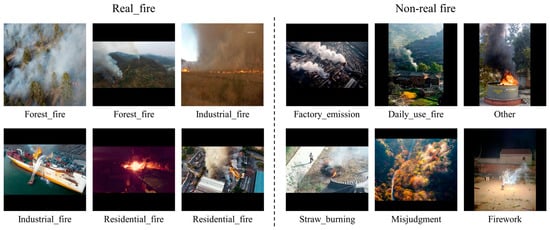
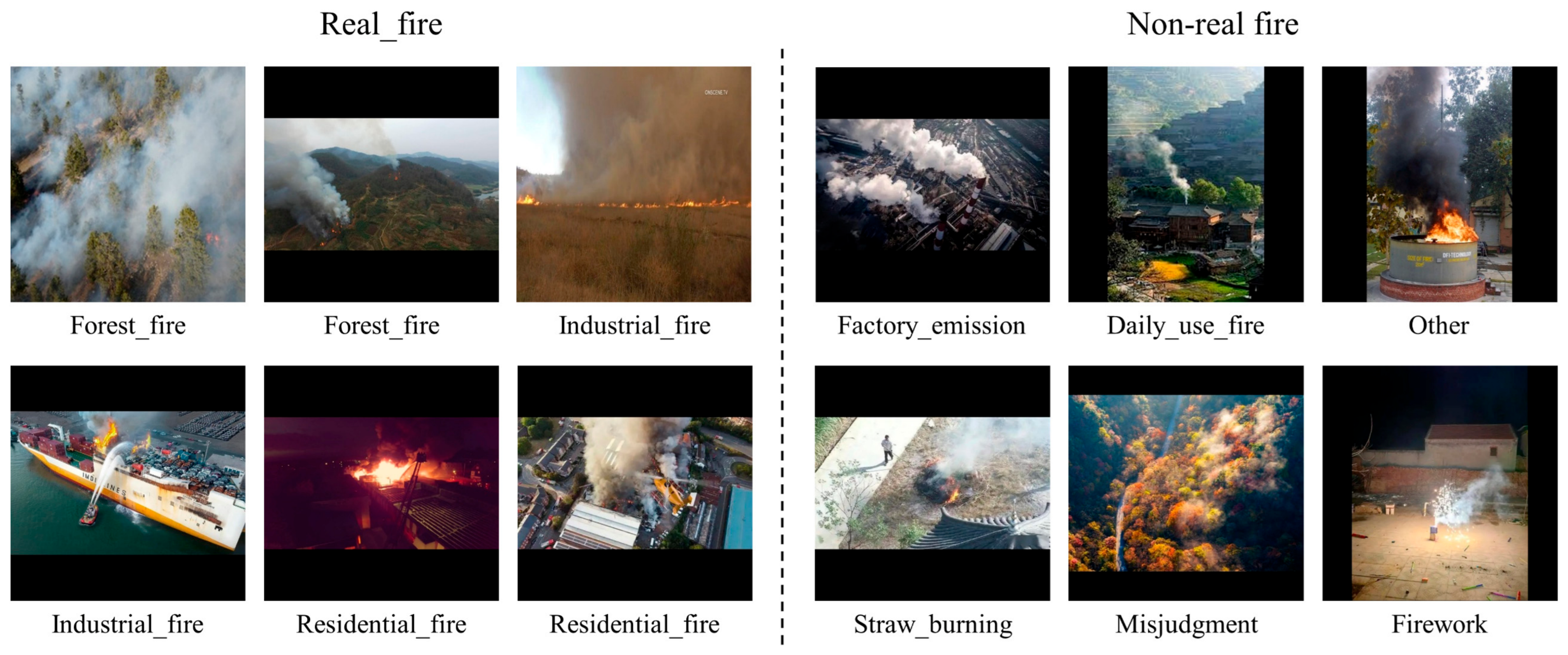
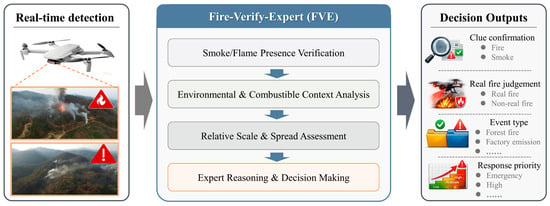
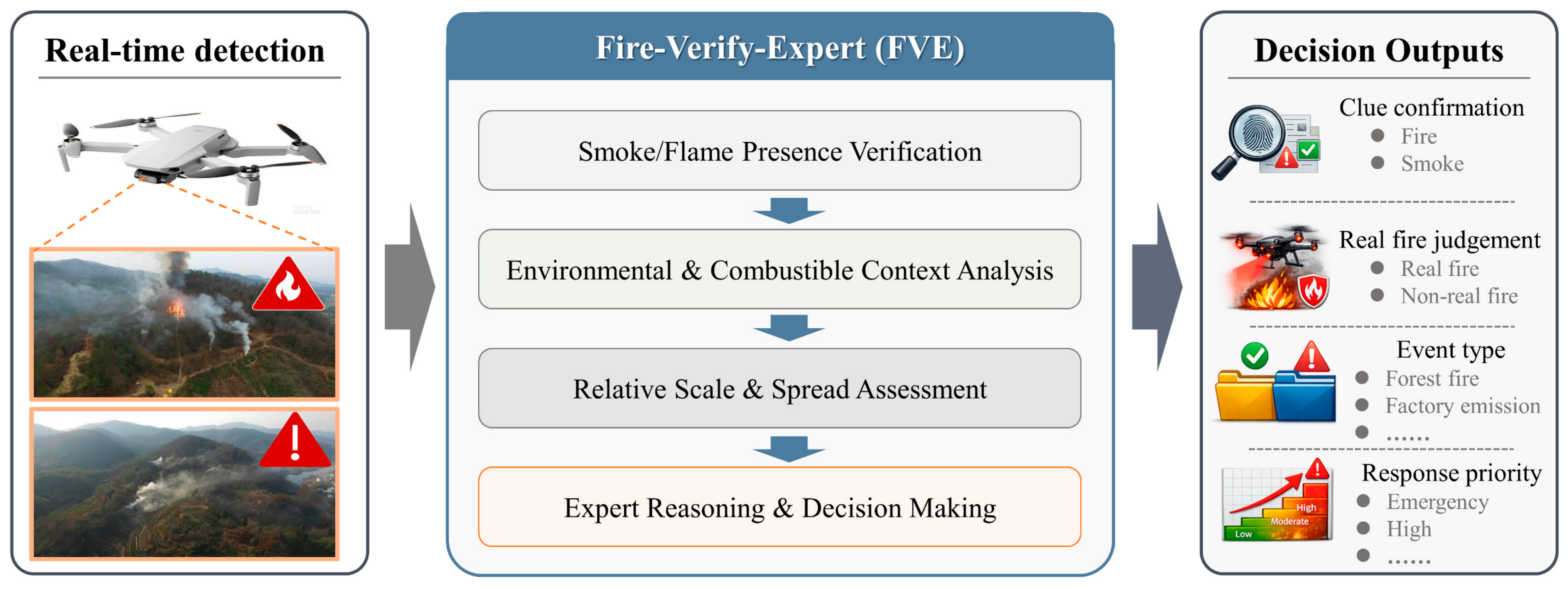
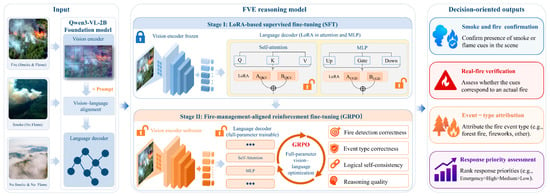
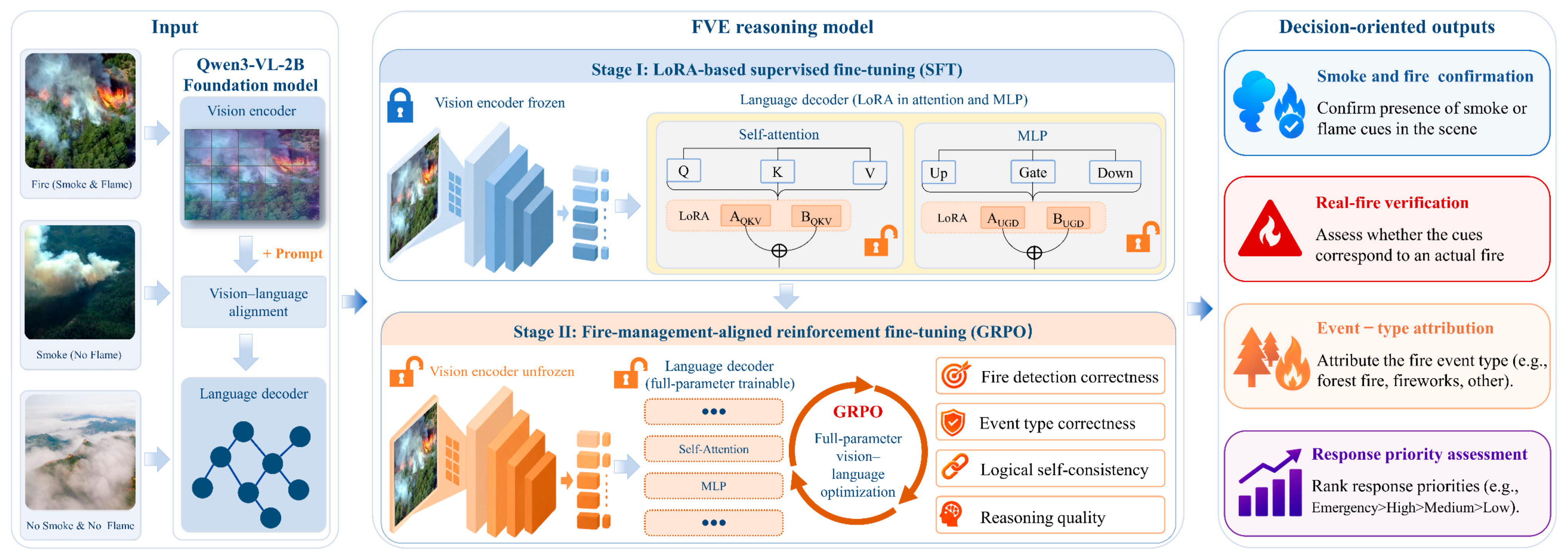
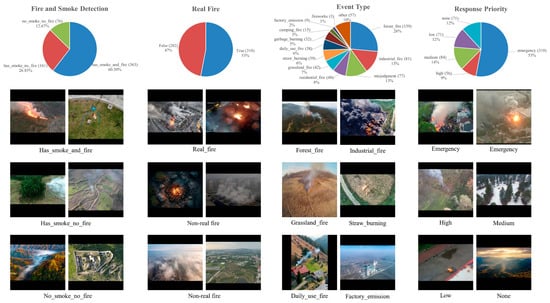
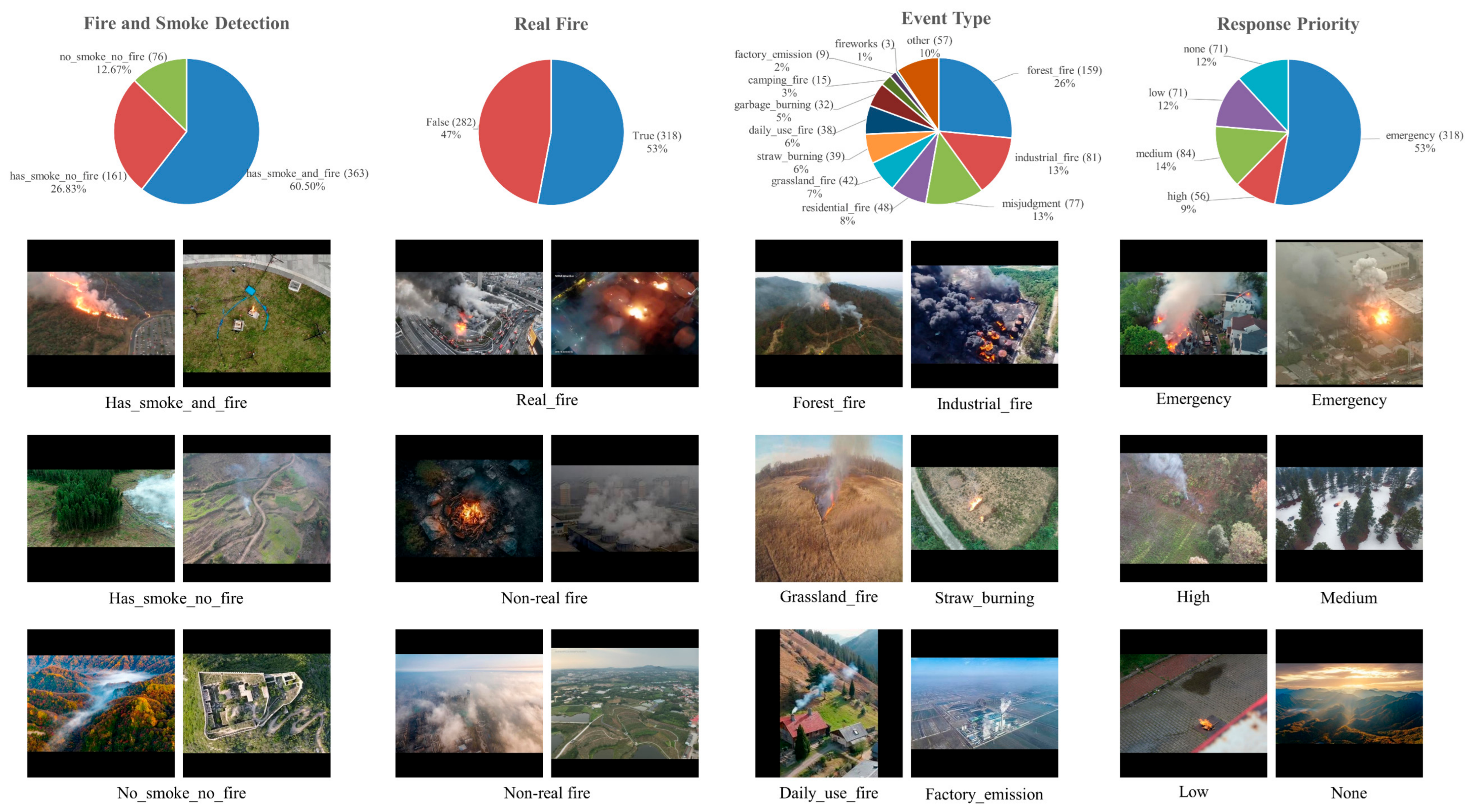
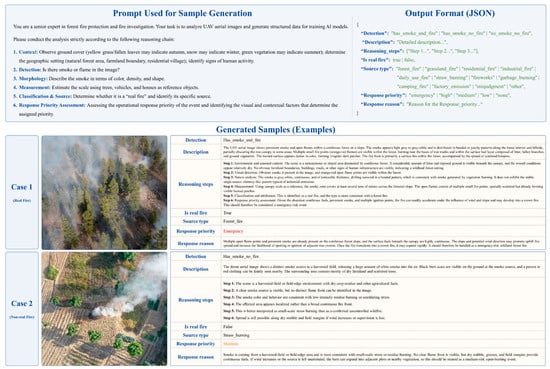
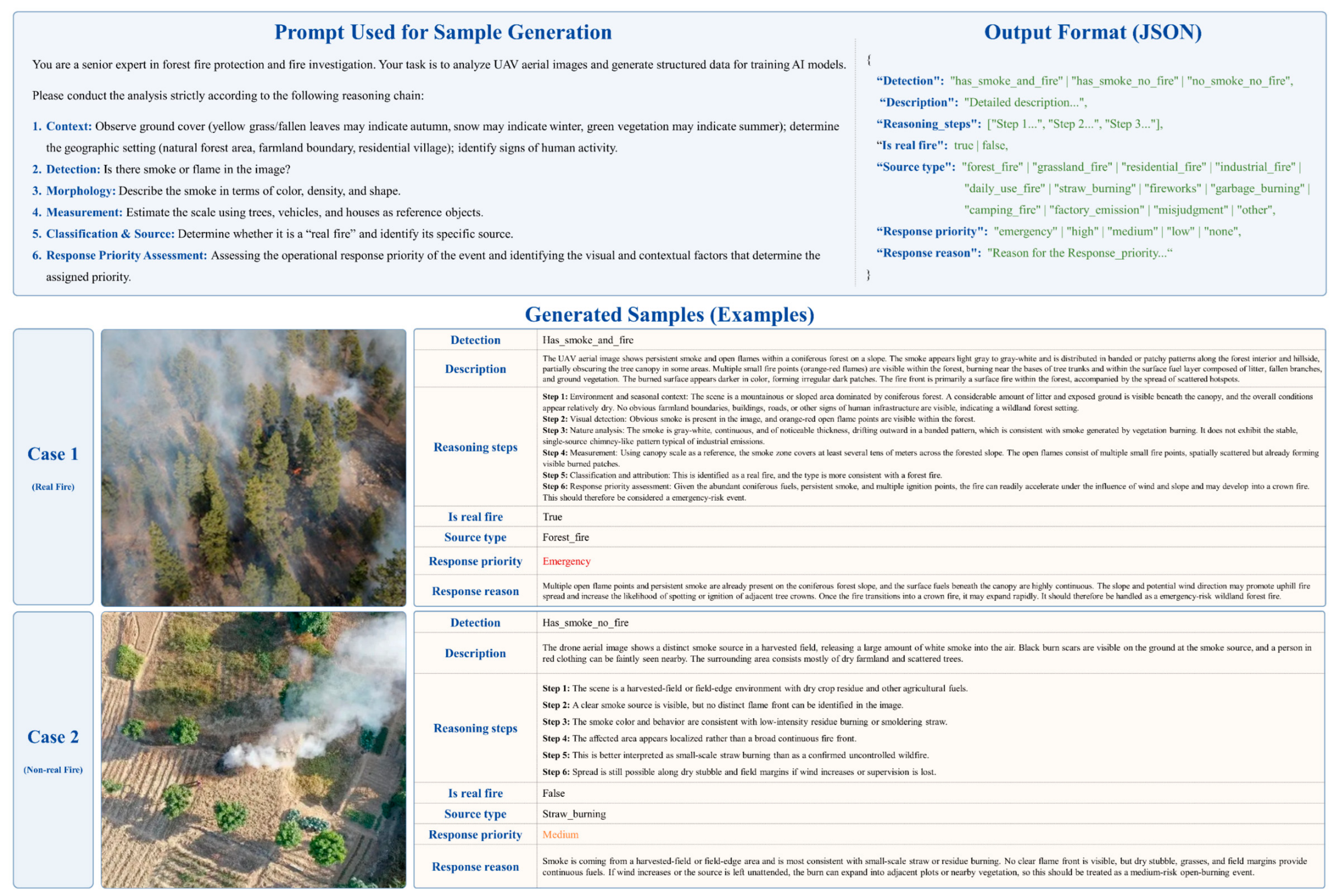
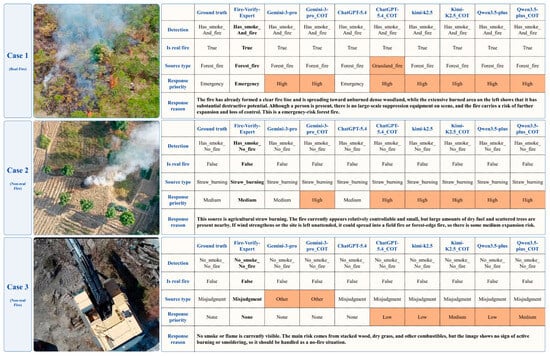
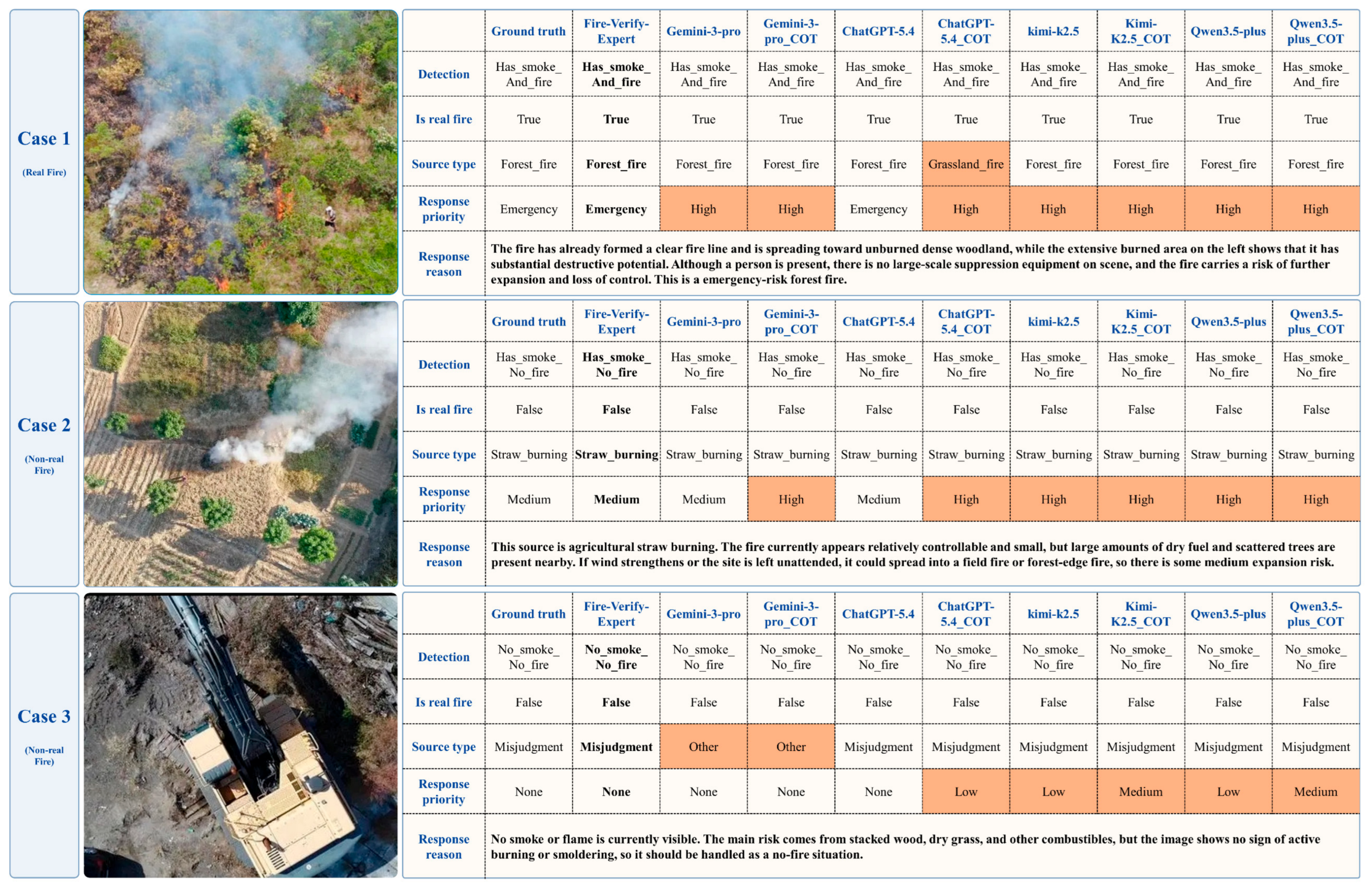
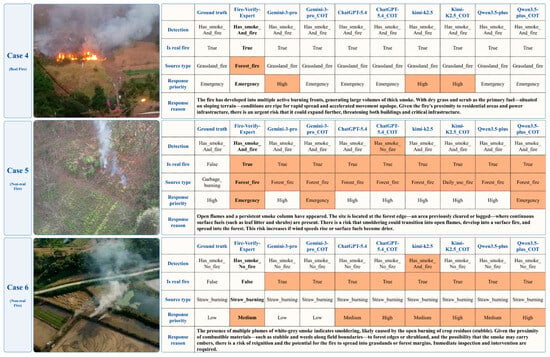
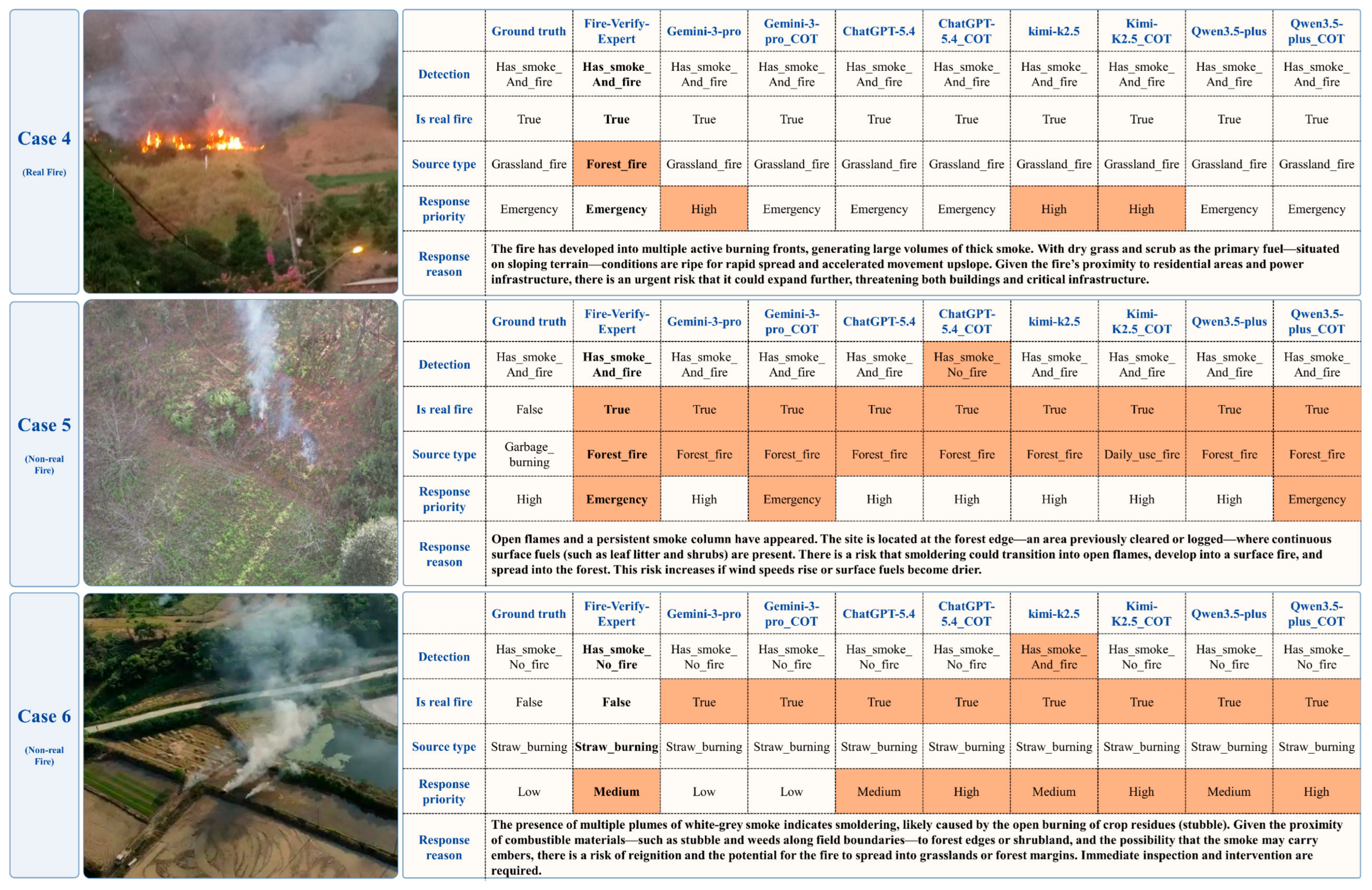

Disclaimer/Publisher’s Note: The statements, opinions and data contained in all publications are solely those of the individual author(s) and contributor(s) and not of MDPI and/or the editor(s). MDPI and/or the editor(s) disclaim responsibility for any injury to people or property resulting from any ideas, methods, instructions or products referred to in the content. |
© 2026 by the authors. Licensee MDPI, Basel, Switzerland. This article is an open access article distributed under the terms and conditions of the Creative Commons Attribution (CC BY) license.