


Highlights
What are the main findings?
- A physics-aware diffusion framework is proposed to reconstruct high-fidelity HRRPs by explicitly modeling electromagnetic scattering centers and global resonance strucures in the frequency domain.
- A spectral-guided progressive reconstruction strategy is developed to align the generative process with radar imaging mechanisms, effectively suppressing non-physical noise artifacts.
What are the implications of the main findings?
- Integrating spectral physics constraints mitigates the interpretability gap in datadriven models, ensuring realistic radar characteristics.
- The method offers a robust data augmentation solution for RATR, boosting recognition accuracy by 19.24% in severe data-limited scenarios.
Abstract
High-Resolution Range Profile (HRRP) represents the electromagnetic backscattering distribution of targets and plays a pivotal role in remote-sensing-based Automatic Target Recognition (RATR). However, in non-cooperative sensing scenarios, acquiring sufficient measured data is severely constrained by operational costs and physical limitations, leading to data scarcity that hampers model robustness. To overcome this, we propose SpecM-DDPM, a spectral-aware Denoising Diffusion Probabilistic Models (DDPM) tailored for generating high-fidelity HRRPs that preserve physical scattering properties. Unlike generic generative models, SpecM-DDPM incorporates radar signal physics into the diffusion process. Specifically, a parallel multi-scale block is designed to adaptively capture both local scattering centers and global target resonance structures. To ensure spectral fidelity, a spectral gating mechanism serves as a physics-constrained filter to calibrate the energy distribution in the frequency domain. Furthermore, a Frequency-Aware Curriculum Learning (FACL) strategy is introduced to guide the progressive reconstruction from low-frequency structural components to high-frequency scattering details. Experiments on measured aircraft data demonstrate that SpecM-DDPM generates samples with high physical consistency, significantly enhancing the generalization performance of radar recognition systems in data-limited environments.
1. Introduction
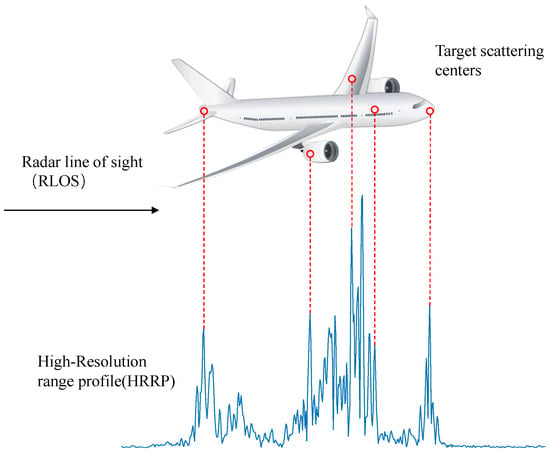
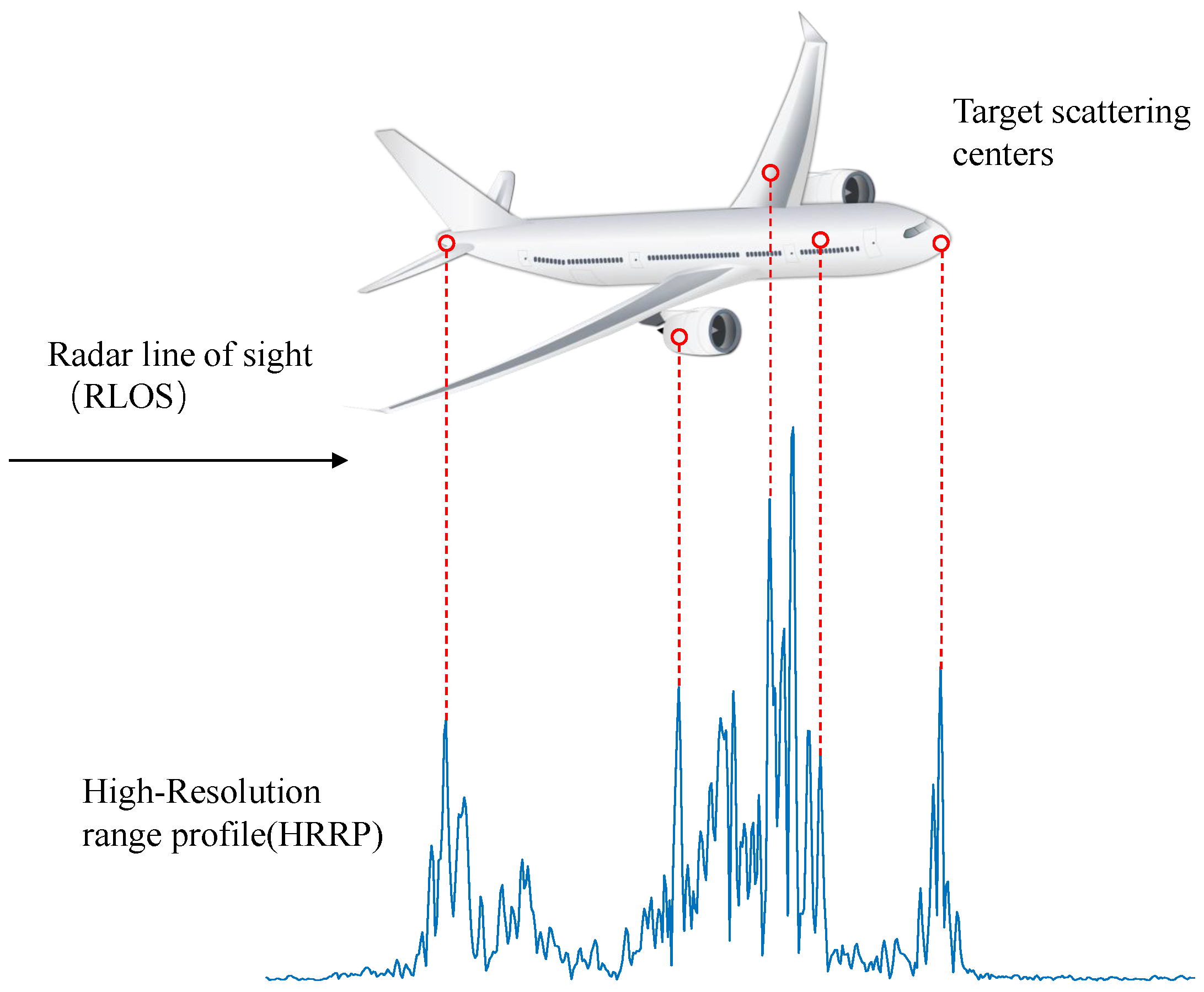
High-Resolution Range Profile (HRRP) represents the one-dimensional coherent summation of target scatterer echoes projected onto the radar line-of-sight (LOS). As a fundamental signature in Radar Automatic Target Recognition (RATR), HRRP is generated via wideband radar signals to achieve fine range resolution [1,2,3,4,5,6,7]. As illustrated in Figure 1, the profile effectively characterizes the spatial distribution of electromagnetic scattering intensities corresponding to key structural components, such as the fuselage, engines, wings, and stabilizers. By encapsulating essential geometric features and scattering topological information into a 1D amplitude vector, HRRP serves as a robust electromagnetic “fingerprint” of the target. Furthermore, compared to two-dimensional images such as Synthetic Aperture Radar (SAR) and Inverse Synthetic Aperture Radar (ISAR) [8,9,10,11,12,13], HRRP offers distinct advantages including lower data dimensionality, reduced acquisition dwell time, and lighter computational burdens, making it exceptionally suitable for time-critical applications such as battlefield surveillance, unmanned aerial vehicle (UAV) identification, and border security [14,15,16].
Figure 1.
Illustration of the High-Resolution Range Profile (HRRP) generation mechanism. The red circles highlighted on the aircraft structure denote dominant scattering centers (e.g., nose, engines, and wings), which correspond to the high-intensity peaks in the range profile along the radar line-of-sight.
However, the acquisition of measured HRRP data is often hindered by logistical constraints and prohibitive costs [17,18]. This challenge is exacerbated for non-cooperative targets due to complex airspace environments and unpredictable target maneuvers, which preclude the continuous collection of high-quality, multi-aspect samples. Data acquisition typically relies on dedicated radar platforms and controlled experimental settings, necessitating extensive resource coordination and protracted execution cycles. Furthermore, measured echoes are inherently susceptible to environmental noise, clutter, occlusion, and variations in radar parameters (e.g., frequency band, bandwidth, polarization, and waveform) [19,20]. This leads to inter-batch distribution shifts and increased annotation complexity. Consequently, the resulting data scarcity and distribution bias render deep learning models prone to overfitting specific measurement conditions, thereby significantly compromising their generalization capability and robustness in complex real-world scenarios [21,22].
To address the issues of HRRP data generation and augmentation, early research primarily relied on electromagnetic (EM) scattering mechanism modeling [23] or simple geometric transformations (e.g., noise addition, time shifting, and amplitude scaling). Although EM computational methods can generate samples with clear physical significance, they suffer from high computational complexity and a heavy dependence on precise 3D target models. Conversely, simple geometric transformations struggle to simulate the complex scattering characteristics of real-world environments, resulting in limited diversity of the generated samples.
As deep learning evolves, deep generative models—epitomized by Generative Adversarial Networks (GANs) [24]—have superseded traditional methods in HRRP data generation, owing to their superior capacity for distribution fitting. For an extended period, GANs have been the prevailing paradigm for HRRP data generation. In essence, a GAN conceptualises learning as an adversarial game between two neural networks. The generator is responsible for mapping random noise to candidate radar echoes, while the discriminator is tasked with distinguishing between synthesized samples and real measured signals. It is posited that through the utilisation of min–max optimization, the generator gradually learns the underlying data distribution and produces HRRP samples that are increasingly consistent with real measurements in both amplitude patterns and structural characteristics. While Song et al. [25] pioneered the use of 1D DCGANs to address class imbalance, standard GANs trained on limited data frequently suffer from mode collapse and fail to capture the physical essence of radar signals. Consequently, recent scholarship has focused on refining architectures and loss landscapes to enhance sample quality. Addressing the loss of physical attributes, Song et al. [26] introduced FWA-GAN, a method that synergizes manual physical features with deep representations to improve generalization. Concurrently, focusing on semantic fidelity, Huang et al. [27] proposed Rec-Aware GAN, which leverages a content-style disentanglement mechanism and auxiliary classification to guarantee the discriminative power of synthesized samples. In scenarios characterized by extreme data scarcity, such as one-shot learning, Shi et al. [28] successfully applied unsupervised GAN inversion to extract diverse samples from a single reference. Moreover, Wang et al. [29] advanced the theoretical framework by employing disentangled representation learning (TADN) to isolate class-specific features from aspect-dependent variations, thereby enabling the generation of robust, high-fidelity HRRP signals.
Nevertheless, despite their widespread adoption, GANs exhibit well-known training pathologies stemming from their inherently adversarial objective [30]. The primary challenge is training instability. GAN training necessitates the co-evolution of the generator and discriminator towards a Nash equilibrium—a state notoriously difficult to achieve in practice. Imbalanced learning rates often render gradients uninformative, leading to oscillatory behavior, poor convergence, or complete failure. A second critical issue is mode collapse. For data augmentation, this is particularly detrimental as the generator may converge to a degenerate solution, producing a narrow subset of samples that consistently fool the discriminator. Instead of modeling the full data distribution, the model exploits a shortcut by repeatedly generating highly similar HRRP signals, failing to capture the diversity of real measurements.
Recently, Denoising Diffusion Probabilistic Models (DDPMs) [31] have emerged as a powerful alternative. Unlike the adversarial game of GANs, diffusion models operate on a robust thermodynamic principle: they gradually corrupt data with noise and learn to reverse this process to reconstruct clean samples. This mechanism inherently ensures training stability and improves distributional coverage, effectively mitigating the mode collapse problem.
While DDPMs have revolutionized image generation, their application to HRRP remains relatively unexplored. A few initial studies [32] have attempted to adapt diffusion models for radar signals. However, these works typically perform a direct adaptation of image-based U-Net architectures to 1D data, treating HRRP merely as a generic time series. Crucially, they often neglect the unique physical properties of radar echoes, such as the multi-scale distribution of scatterers and specific electromagnetic backscattering characteristics. We argue that the standard convolution operations employed in such baselines are insufficient for HRRP, as they struggle to capture strong scattering centers that are distributed globally across the range profile. Consequently, these existing methods often fail to produce the high-fidelity signals required for rigorous recognition tasks.
To bridge the gap between generative diversity and physical fidelity, this paper proposes SpecM-DDPM, a novel Spectral-Aware Multi-Scale Denoising Diffusion Probabilistic Model tailored for HRRP generation.SpecM-DDPM distinguishes itself from existing paradigms through explicit physical modeling. Unlike GAN-based baselines [25,26,27,28,29], which often suffer from mode collapse and fail to capture the diverse scattering modes of non-cooperative targets, and unlike generic diffusion formulations [32] that rely on standard engineering adaptations without physical constraints, our framework is fundamentally designed around the electromagnetic scattering mechanism. Specifically, we identify the Spectral Gating Block (SGB) and Frequency-Aware Curriculum Learning (FACL) as essential components for radar signal synthesis: the former addresses the global dependency of discrete scatterers via the Fourier domain, while the latter enforces strict physical consistency during the noise removal process. The framework incorporates these mechanisms through three key innovations:
- Parallel Multi-Scale Block: Captures heterogeneous scattering features by adaptively fusing convolutional branches with varying receptive fields.
- Spectral Gating: Embedded in the bottleneck to calibrate global energy distribution and model long-range dependencies.
- Frequency-Aware Curriculum Learning: Dynamically aligns the generation process with the physical progression of signal recovery, enabling a coarse-to-fine synthesis from low-frequency contours to high-frequency details.
The remainder of this paper is structured as follows. Section 2 elaborates on the methodology, detailing the HRRP preprocessing pipeline and the architectural intricacies of the proposed SpecM-DDPM. Section 3 validates the model’s efficacy through comprehensive experiments, including comparative benchmarks against state-of-the-art methods and in-depth ablation studies. Section 4 provides a discussion on the findings and their implications, followed by concluding remarks in Section 5.
2. Proposed Method
2.1. HRRP Construction Pipeline and Preprocessing Details
2.1.1. Mathematical Modeling of HRRP Acquisition
Throughout the derivation, the conventional stop-and-go assumption within a pulse is adopted (i.e., the target motion during is negligible). Furthermore, Doppler effects are either neglected or assumed sufficiently small such that the residual Doppler-induced phase terms do not significantly distort the range-compressed envelope [33].
Let the transmitted waveform be a linear frequency-modulated (LFM) pulse with duration , bandwidth B, chirp rate , and carrier frequency . Its complex passband form is:
where equals 1 for and 0 otherwise.
In accordance with the principles of the scattering-centre model, the complex radar target can be simplified as a discrete set of physically independent isotropic point scatterers. When the radar’s range resolution is sufficiently fine, the target is effectively resolved into multiple range cells along the LOS. The target at a fixed range cell is approximated by K point scatterers. The k-th scatterer has complex coefficient and round-trip delay , where denotes its radial range and c is the speed of light. The received complex echo is modeled as:
After demodulation by and low-pass filtering, the received signal becomes:
Range compression is performed via a matched filter , which is the time-reversed complex conjugate of the transmitted baseband chirp:
Theoretically, the range-compressed output is the convolution of the received baseband signal and the matched filter:
In practical engineering implementations, to efficiently handle the pulse compression (de-chirping), this convolution is executed in the frequency domain using Fast Fourier Transform (FFT) and Inverse FFT (IFFT) operations.
Neglecting the residual video phase (RVP) and higher-order cross-coupling terms, the explicit time-domain expression of the output approximates a superposition of weighted Sinc functions [34]. The final discretized HRRP, , is obtained by taking the magnitude:
where denotes the range cell index with N being the number of sampling points. Here, represents the complex scattering coefficient (incorporating the processing gain), is the sampling rate, and the function characterizes the point spread function with a range resolution of .
2.1.2. HRRP Process
The HRRP obtained at this stage, however, cannot be directly used for subsequent tasks such as target recognition, because it still suffers from various sensitivities [1].
Firstly, translational sensitivity arises from the uncertainty in target positioning within the sampling window. HRRP samples are typically extracted from the echo data using a finite range window centered by narrow-band pulse ranging. Due to unavoidable ranging errors, the target’s relative position within this window fluctuates, leading to misalignment among HRRP vectors of the same target. To eliminate this variation, centroid alignment is commonly employed. This method calculates thes centroid and shifts the HRRP sequence to align its center of mass with the window’s center. The centroid is calculated as:
Then, amplitude sensitivity constitutes the second challenge. According to the radar equation, the intensity of the received echo is influenced by factors extrinsic to the target’s shape, such as radar transmit power, antenna gain, and the target’s radial distance. Consequently, HRRPs measured under different conditions exhibit varying intensity scales. Energy normalization (typically -normalization) is standardly applied to standardize the feature vectors [35]:
Finally, aspect sensitivity poses the most significant challenge. As the target’s attitude changes, the radial distribution of scatterers relative to the radar LOS varies. Due to the coherent summation of echoes from these scatterers, slight aspect variations can cause drastic fluctuations in the HRRP envelope (often referred to as scintillation). In practice, the target’s attitude is characterized by the aspect angle (azimuth) and the elevation angle (pitch). To deal with the target-aspect sensitivity, the equal interval partition approach can be adopted [36]. Furthermore, it is evident that the procurement of data with comprehensive angular coverage has the capacity to markedly diminish sensitivity.
2.2. Overall Architecture and Module Composition of SpecM-DDPM
2.2.1. Overall Architecture Description
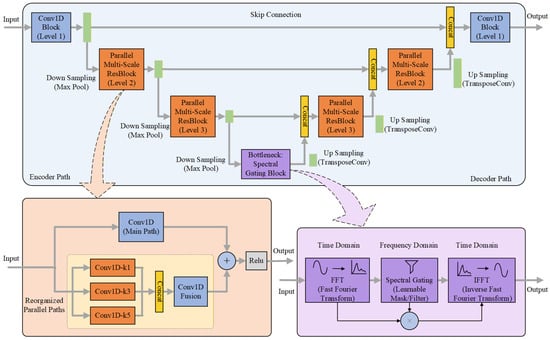
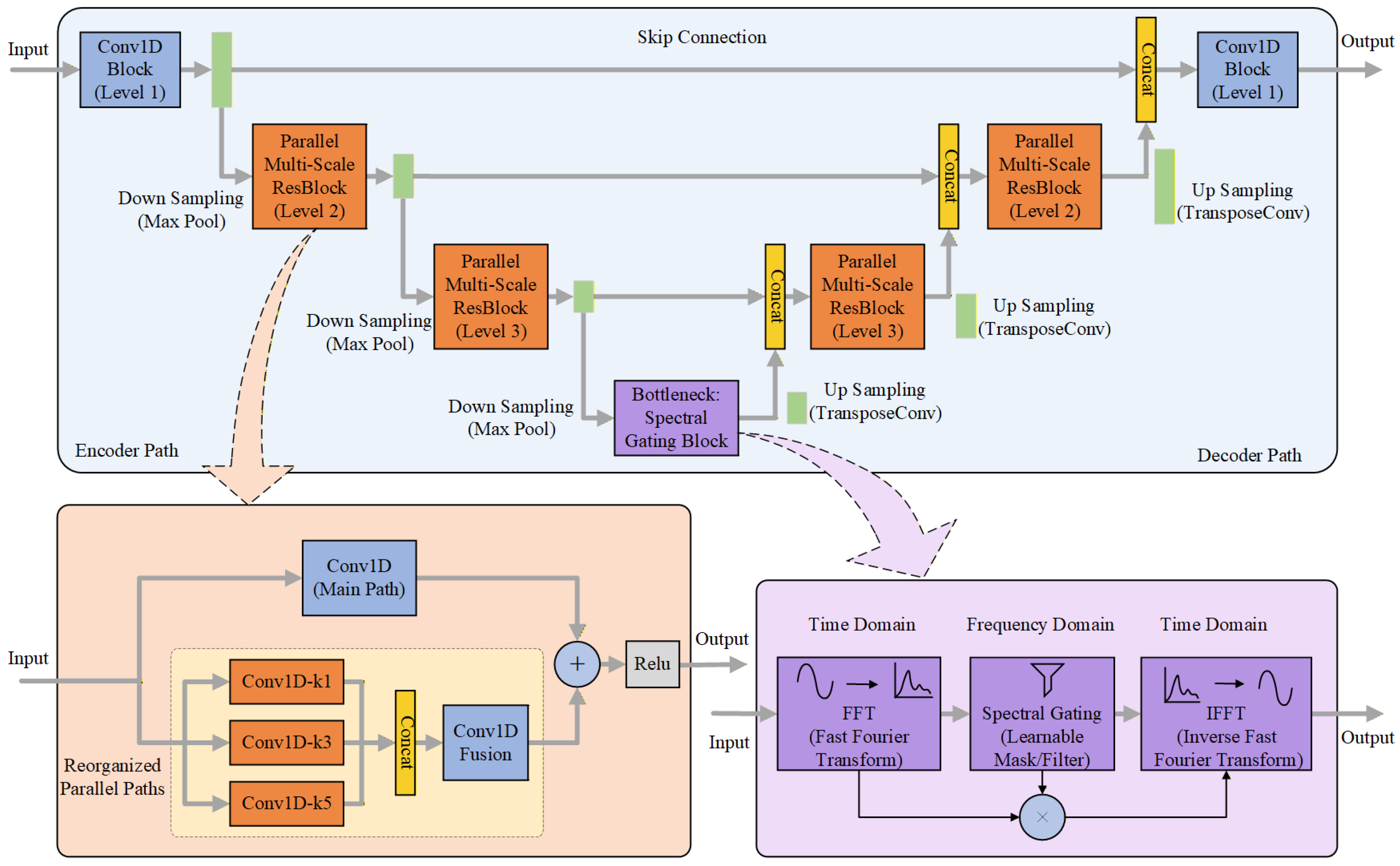
As illustrated in Figure 2, the proposed SpecM-DDPM employs a tailored one-dimensional U-Net [37] backbone to approximate the noise component within the diffusion process. Conventional convolutional architectures often struggle to simultaneously capture the high-frequency variations of local scatterers and the low-frequency dependencies of the global target structure. To address the non-stationary nature of HRRP signals, our architecture is designed with a hierarchical topology that explicitly integrates multi-scale feature extraction with global spectral awareness.
Figure 2.
Schematic overview of the proposed SpecM-DDPM framework. The model adopts a conditional 1D U-Net backbone. The encoder and decoder utilize Parallel Multi-Scale ResBlocks (PMS-Blocks) to capture features at varying receptive fields, while the bottleneck incorporates a Spectral Gating Block to model global long-range dependencies in the frequency domain.
The framework is structurally organized into three functionally distinct stages:
- Hierarchical Encoder (Multi-Scale Feature Abstraction): The encoder aims to progressively compress the temporal dimension while expanding the semantic channel capacity. Conditioned on the timestep t and class label c, the noisy input traverses a series of downsampling levels. While the initial level employs standard convolutions for shallow feature extraction, subsequent deeper levels are equipped with Parallel Multi-Scale ResBlocks (PMS-Blocks) followed by Max Pooling operations. This design facilitates the extraction of features at varying granularities, transitioning from fine-grained local details to abstract high-level semantics.
- Spectral-Aware Bottleneck (Global Context Calibration): At the lowest resolution, relying solely on local convolutions limits the effective receptive field. To mitigate this, we introduce a Spectral Gating Block (SGB) at the bottleneck. Unlike spatial operations, the SGB transforms the latent features into the Fourier domain, enabling the model to capture global long-range dependencies and periodic patterns across the entire range profile with minimal computational overhead.
- Symmetrical Decoder (Signal Reconstruction): The decoder reconstructs the clean signal profile through symmetrical upsampling layers (Transpose Convolution). To prevent the loss of fine structural details caused by downsampling, skip connections are employed to fuse high-resolution features from the encoder directly with the upsampled features in the decoder. These fused representations are further refined by PMS-Blocks and convolutional blocks before the final convolution projects them to the output noise space.
2.2.2. Parallel Multi-Scale ResBlock
Standard Convolutional Neural Networks (CNNs) typically utilize fixed-size kernels (e.g., ), which imposes a fundamental limitation when processing radar signals: the fixed receptive field cannot adaptively match the diverse physical scales of scattering centers (e.g., strong specular reflections from a fuselage versus discrete flashes from engine blades). To overcome this limitation, we propose the PMS-Block, detailed in the bottom-left panel of Figure 2. The core innovation of the PMS-Block lies in its ability to decouple feature representation across different scales through a multi-branch topology, effectively acting as a dynamic feature selector.
Specifically, the PMS-Block is constructed with a dual-path architecture:
- Stabilization Path (Main Branch): A standard convolutional branch with a kernel is retained to preserve baseline local feature continuity and ensure stable gradient propagation during the deep network training.
- Multi-Granularity Branch (Parallel Paths): This auxiliary branch is designed to broaden the network’s width rather than depth. The input features are split into three independent sub-streams processed by kernels of varying sizes: (point-wise features), (local context), and (regional structural context).
The outputs from these heterogeneous scales are concatenated and fused via a convolution to enforce inter-channel interaction. Finally, the fused multi-scale features are added to the stabilization path via a residual connection, followed by a ReLU activation function. This mechanism allows the network to adaptively weigh and integrate information from different receptive fields, significantly enhancing the representation of complex target structures.
2.2.3. Spectral Gating Block
While the PMS-Block enhances multi-scale feature extraction, standard CNNs inherently suffer from locality bias. They struggle to capture long-range dependencies and global geometric correlations (e.g., the relative positioning of distant scattering centers) unless the network is extremely deep. Although Transformer-based attention mechanisms can address this, they incur quadratic computational complexity, which is often prohibitive for high-resolution signal generation.
To reconcile the need for global context with computational efficiency, we embed the SGB at the bottleneck of the U-Net, as depicted in Figure 2. The core innovation of the SGB lies in leveraging the Fourier domain properties. According to the convolution theorem, a point-wise multiplication in the frequency domain is mathematically equivalent to a global circular convolution in the time domain. This allows the SGB to achieve a global receptive field with quasi-linear complexity (), effectively filtering non-physical noise while preserving the global topological structure of the HRRP signal.
The SGB operates explicitly through the following spectral processing pipeline:
- 1.
- Spectral Transformation: The input feature map is projected into the frequency domain via a FFT. This orthogonal transformation, , decomposes the signal into its constituent frequency components, exposing global periodic patterns that are invisible to local spatial convolutions.
- 2.
- Parametric Spectral Modulation: To selectively emphasize dominant structural frequencies, a learnable complex-valued modulation is applied. This is implemented as an element-wise product between the spectrum and a learnable weighting tensor :where ⊙ denotes the Hadamard product. This step acts as an adaptive global filter, effectively filtering out spectral noise while enhancing essential structural components.
- 3.
- Temporal Reconstruction: Finally, the modulated spectrum is mapped back to the time domain via an IFFT. Taking the real part of the reconstructed signal yields the refined feature map with calibrated global context:
By integrating this spectral calibration, the SGB ensures that the generated HRRP signals maintain global energy consistency.
2.3. Conditional Information Injection
To enable controllable generation of specific aircraft types, we incorporate class information c jointly with the diffusion timestep t into the network. In contrast to conventional approaches that simply concatenate class labels to the input signal, we adopt a more efficient Time-Class Additive Fusion strategy combined with Adaptive Group Normalization (AdaGN) to modulate the feature maps dynamically [38].
Embedding and Fusion: First, the discrete timestep t is mapped to a continuous vector using sinusoidal position embeddings followed by a Multi-Layer Perceptron (MLP). Simultaneously, the class label c is projected into a class embedding vector via a learnable lookup table. To support Classifier-Free Guidance (CFG) during inference, a null token Ø is assigned to a specific embedding entry, allowing the model to learn both conditional and unconditional distributions. The global condition vector is obtained by the element-wise addition of the time and class embeddings:
where encapsulates both the noise level intensity and the semantic target identity.
Feature Modulation via AdaGN: This global condition vector is propagated to every residual block in the U-Net. Within each block, we employ a spatially adaptive modulation mechanism. Let denote the intermediate feature map after the first convolution. The vector is projected through a linear layer to predict channel-wise scale and shift parameters. The feature map is then modulated as follows:
Here, the scaling factor allows the network to selectively amplify or suppress specific frequency channels based on the target class (e.g., enhancing high-frequency details for complex targets like BY777), while the shift term adjusts the feature baseline. This mechanism ensures that class-specific structural constraints are enforced hierarchically across all scales of the generation process.
2.4. Optimization Objective: Frequency-Aware Curriculum Learning
Standard diffusion models typically optimize a reweighted variational lower bound, which simplifies to a time-domain Mean Squared Error (MSE) loss. However, relying solely on time-domain MSE treats all frequency components uniformly. This contradicts the inherent generative behavior of diffusion models, which naturally reconstruct low-frequency global structures before refining high-frequency details. This misalignment often causes the model to hallucinate high-frequency noise in the early reverse steps, impeding convergence.
To bridge this gap, we propose a Frequency-Aware Curriculum Learning (FACL) strategy. By enforcing a coarse-to-fine spectral constraint, FACL guides the model to focus on fundamental geometries when the Signal-to-Noise Ratio (SNR) is low, and progressively unleash constraints on high-frequency details as SNR improves.
2.4.1. Dynamic Spectral Cutoff
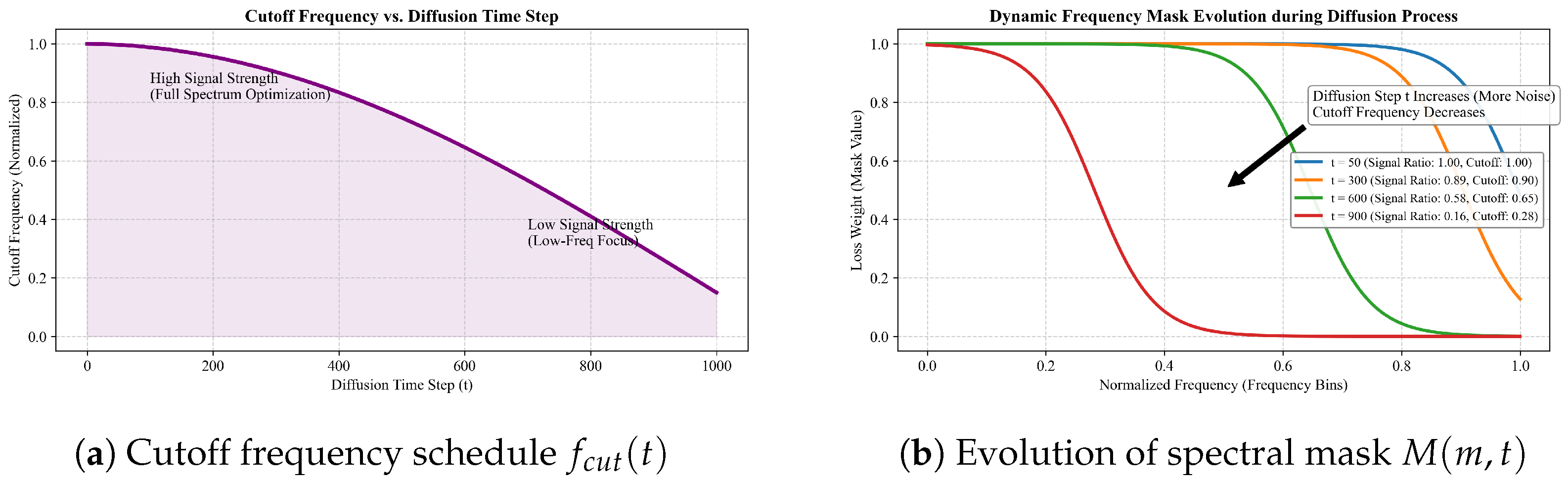
The foundation of our strategy is a time-dependent bandwidth controller. As illustrated in Figure 3a, we define a cutoff frequency that decays monotonically with the diffusion timestep t. The schedule is governed by the signal strength :
where and . Figure 3a clearly demonstrates two distinct optimization regimes:
Figure 3.
Visualization of the proposed Frequency-Aware Curriculum Learning (FACL) strategy. (a) The cutoff frequency is modulated by the signal strength, enforcing a strict low-frequency constraint in the noise-dominated regime (large t). (b) As the diffusion timestep t decreases (signal recovery progresses), the spectral mask dynamically expands its passband, illustrating a coarse-to-fine generation process.
- Noise-Dominated Regime (Right side, large t): When the signal strength is low, is restricted to the lower frequency band. This forces the model to prioritize the recovery of the global energy envelope while ignoring unreliable high-frequency noise.
- Signal-Dominated Regime (Left side, small t): As the signal strength recovers, the bandwidth expands to cover the full spectrum, allowing the model to refine fine-grained scattering details.
2.4.2. Soft Spectral Masking
To implement this cutoff without introducing ringing artifacts (Gibbs phenomenon), we employ a differentiable soft mask. As shown in Figure 3b, the mask for the m-th frequency bin is shaped by a sigmoid function:
where represents the frequency bin index, and N denotes the total number of frequency points (matching the HRRP signal length). The term represents the normalized frequency. The scaling factor is introduced to control the sharpness of the spectral cutoff. The evolution of in Figure 3b visualizes the curriculum process:
- At (red curve), the mask acts as a strict low-pass filter, suppressing all components above normalized frequency 0.3.
- As the process advances to (blue curve), the mask “opens up”, permitting the gradient flow to update high-frequency features.
This smooth transition ensures stable gradient propagation and prevents the model from overfitting to high-frequency Gaussian noise in the early stages.
2.4.3. Frequency-Domain Objective
Finally, the frequency loss is computed on the estimated clean signal (reconstructed via Tweedie’s formula) rather than the noise , ensuring physical consistency:
where denotes the Discrete Fourier Transform (DFT) operator. The term N represents the total dimensionality of the signal, and m indexes the specific spectral component. The operator computes the magnitude (modulus) of the complex spectral difference, ensuring the loss focuses on the structural intensity of the scatterers, while represents the expectation operator over the input data distribution. Additionally, serves as the curriculum weighting mask that dynamically adjusts the penalty weight for the m-th frequency component at diffusion timestep t.
2.4.4. Total Hybrid Objective
To ensure both time-domain fidelity and spectral structural consistency, we integrate the proposed frequency constraint into the standard diffusion training framework. The final optimization objective is formulated as a weighted combination of the standard time-domain Mean Squared Error (MSE) and the frequency-domain curriculum loss:
Here, represents the standard noise prediction loss, which is essential for accurate point-wise signal reconstruction. The hyperparameter serves as a trade-off coefficient that balances the two objectivesm. In this instance, the value of is set to 0.2. It controls the magnitude of the spectral penalty, ensuring that the FACL strategy effectively guides the generation of global structures without dominating the gradient or disrupting the fine-grained refinement provided by the MSE term.
3. Experiments
3.1. Datasets and Experimental Setup
3.1.1. Dataset Introduction
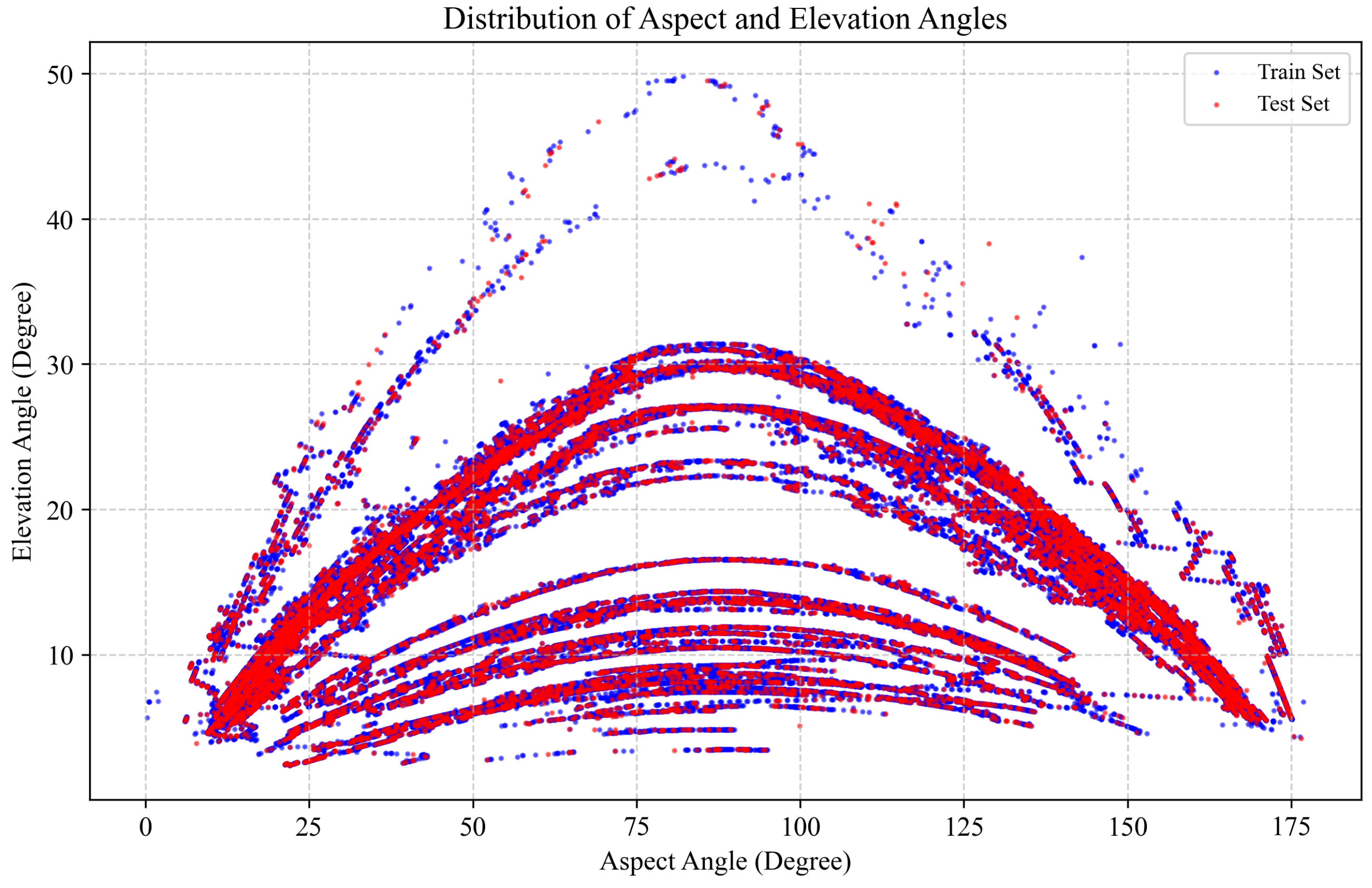
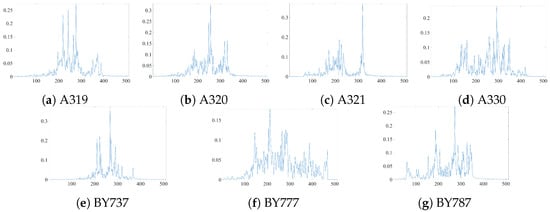
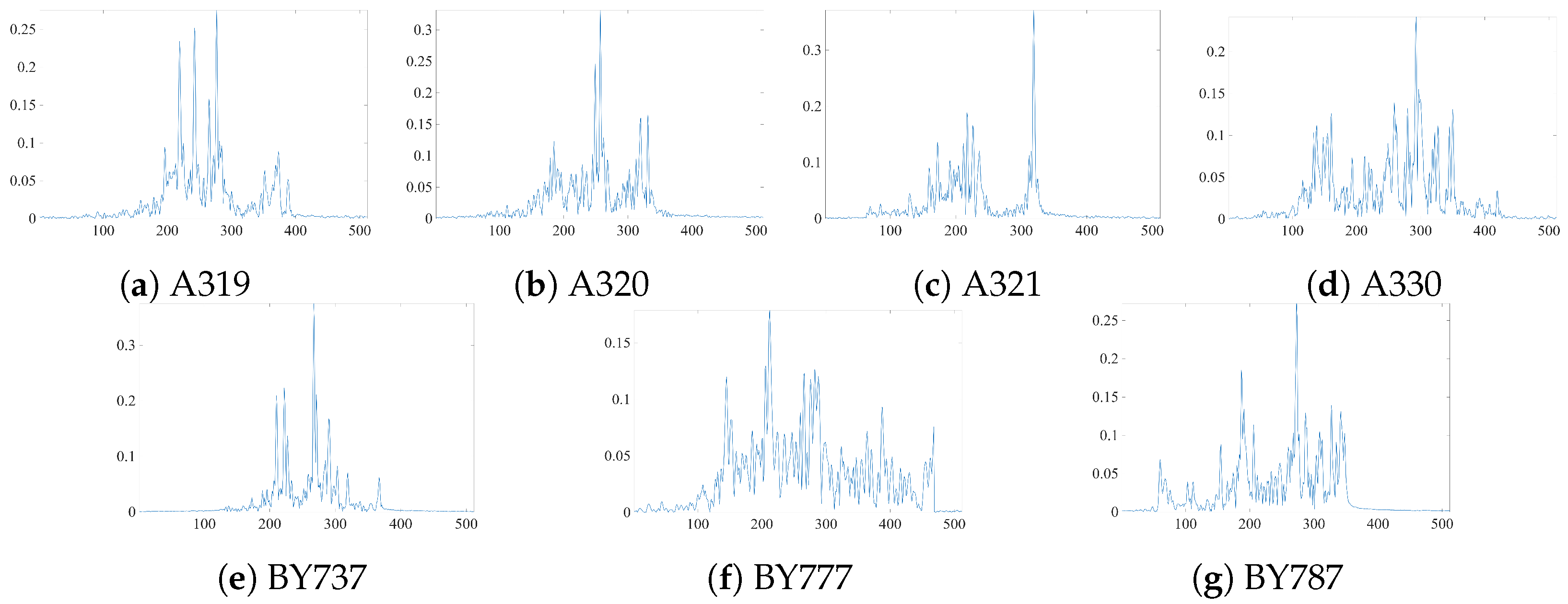
The experimental validation was conducted on a measured HRRP dataset acquired via a newly developed X-band ISAR system. Operating at a carrier frequency of 9.51 GHz with a 600 MHz bandwidth, the system provides a theoretical range resolution of 0.25 m, enabling the capture of fine-grained scattering structures. Unlike synthetic datasets with discrete angular sampling, our dataset is derived from real-world continuous tracking. As visualized in Figure 4, the data covers a broad operational envelope with Azimuth angles spanning ∼ and Elevation angles ranging from ∼. This wide coverage is critical for training generative models to capture the complex, non-linear evolution of scattering centers. The dataset encompasses seven distinct non-cooperative civil aircraft types: Airbus A319/A320/A321/A330 and Boeing 737/777/787. Example HRRPs of seven target classes are shown in Figure 5. To mitigate signal degradation from long-range detection (30–150 km), raw echoes underwent coherent pulse integration, energy normalization, and centroid alignment. Reflecting real-world constraints, the dataset exhibits class imbalance, with sample sizes ranging from approximately 7800 to 11,900 per category (detailed in Table 1). All samples were formatted to 512 range cells.
Figure 4.
Distribution of Aspect and Elevation angles for the training (blue) and testing (red) sets. The data exhibits a continuous trajectory structure covering a wide angular span (Azimuth ∼, Elevation ∼). The interleaved split ensures that the test set evaluates the model’s capability to interpolate within the target’s scattering manifold.
Figure 5.
Example HRRPs of the seven civil aircraft target classes used in this study: (a) Airbus A319, (b) Airbus A320, (c) Airbus A321, (d) Airbus A330, (e) Boeing 737, (f) Boeing 777, and (g) Boeing 787. The horizontal axis (x-axis) represents the range cells (spanning 0 to 512), which correspond to the relative spatial distribution of scattering centers along the radar line-of-sight. The vertical axis denotes the normalized amplitude of the radar echo, reflecting the scattering intensity of different structural components.
Table 1.
Radar System Parameters and Target Specifications.
To ensure rigorous evaluation, the dataset was randomly partitioned into a training set and a testing set with a ratio of 8:2. Strict isolation was enforced to prevent data leakage: the proposed SpecM-DDPM and comparative models were trained solely on the training split. Furthermore, downstream recognition tasks—used to quantify the quality of synthesized data—were trained on the augmented training set and evaluated exclusively on the held-out real testing set. This protocol ensures that all reported metrics authentically represent the model’s generalization capability in unseen scenarios.
3.1.2. Experimental Setup
Hardware and Software Platform: All experiments were conducted on a desktop workstation equipped with an Intel Core i9-10850K CPU (3.60 GHz) (Intel Corporation, Santa Clara, CA, USA), 32 GB of RAM, and a single NVIDIA GeForce RTX 2080 Ti GPU (11 GB VRAM) (NVIDIA Corporation, Santa Clara, CA, USA). The proposed framework was implemented using the PyTorch (v2.2.1) deep learning library with CUDA (v11.8) acceleration.
Training Hyperparameters: The SpecM-DDPM was trained in an end-to-end manner for 500 epochs with a batch size of 64. We utilized the AdamW optimizer with an initial learning rate of . A Cosine Annealing scheduler was employed to gradually decay the learning rate to a minimum of over the course of training, ensuring smooth convergence. To mitigate gradient explosion, we applied gradient clipping with a maximum norm of 1.0. Furthermore, to enhance model robustness and stability, we maintained an Exponential Moving Average (EMA) of the model parameters with a decay rate of 0.9999, which was used for final sampling.
Diffusion Configuration: The diffusion model was trained with discrete timesteps using a linear noise schedule, where the variance linearly increases from to . For conditional generation, we implemented CFG. During training, the class labels were randomly dropped with a probability of to jointly learn the conditional and unconditional score estimates. To accelerate the inference process, we employed the Denoising Diffusion Implicit Models (DDIM) [39] sampling algorithm. By adopting a strided sampling schedule, we reduced the number of inference steps from 1000 to 50. A guidance scale of was applied to strictly balance sample diversity and class fidelity.
3.2. Comparative Results with State-of-the-Art Methods
To rigorously evaluate the performance of the proposed SpecM-DDPM, we compare it against five representative generative models, covering three categories: classical GAN baselines, state-of-the-art HRRP-specific GANs, and emerging diffusion-based approaches. The implementation details for each method are as follows:
- DCGAN [25]: As a pioneering work applying deep generative models to HRRP, the 1D Deep Convolutional GAN serves as a fundamental baseline. Since DCGAN is inherently unconditional, we adopted a class-specific training strategy: separate generators and discriminators were trained independently for each of the seven aircraft classes to ensure label consistency.
- ACGAN [40]: The Auxiliary Classifier GAN extends the standard GAN by adding a class prediction branch to the discriminator. This allows a single generator to synthesize multi-class HRRP signals conditioned on class labels, serving as a benchmark for conditional generation stability.
- cVAE-GAN [41]: The Conditional Variational Autoencoder-GAN combines the probabilistic grounding of VAEs with the adversarial training of GANs. It is included to evaluate the trade-off between sample diversity (VAE characteristic) and signal sharpness (GAN characteristic).
- RAGAN [27]: The Reconstruction-Aware GAN is a specialized architecture designed for radar signals. It incorporates a content-style disentanglement mechanism and auxiliary classification constraints to enhance semantic fidelity. We implemented this method to benchmark our model against top-tier adversarial approaches focused on physical feature retention.
- HRRP-DDPM [32]: This is the current state-of-the-art diffusion method for HRRP, which employs a two-stage domain-adaptive framework. The first stage generates rough skeletons, and the second stage refines them using a style-transfer mechanism. Following the original protocol, we randomly selected 20 real samples per class from the test set to serve as style references for the generation process during inference.
Finally, Ours (SpecM-DDPM) is trained end-to-end using the proposed parallel multi-scale architecture and frequency-aware curriculum loss, without relying on any external reference samples during the inference phase. In order to provide a comprehensive comparison of the performance of the aforementioned algorithms, a dual approach is employed, encompassing both qualitative and quantitative analysis.
3.2.1. Visual Inspection and Feature Manifold Analysis
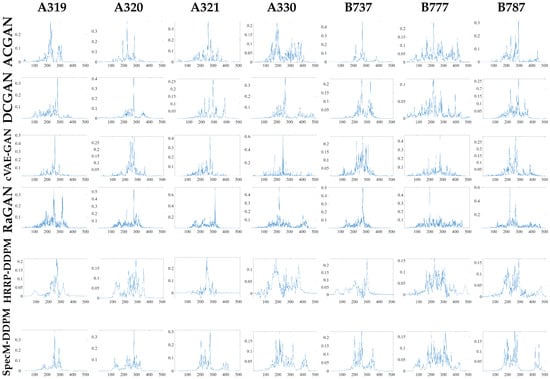
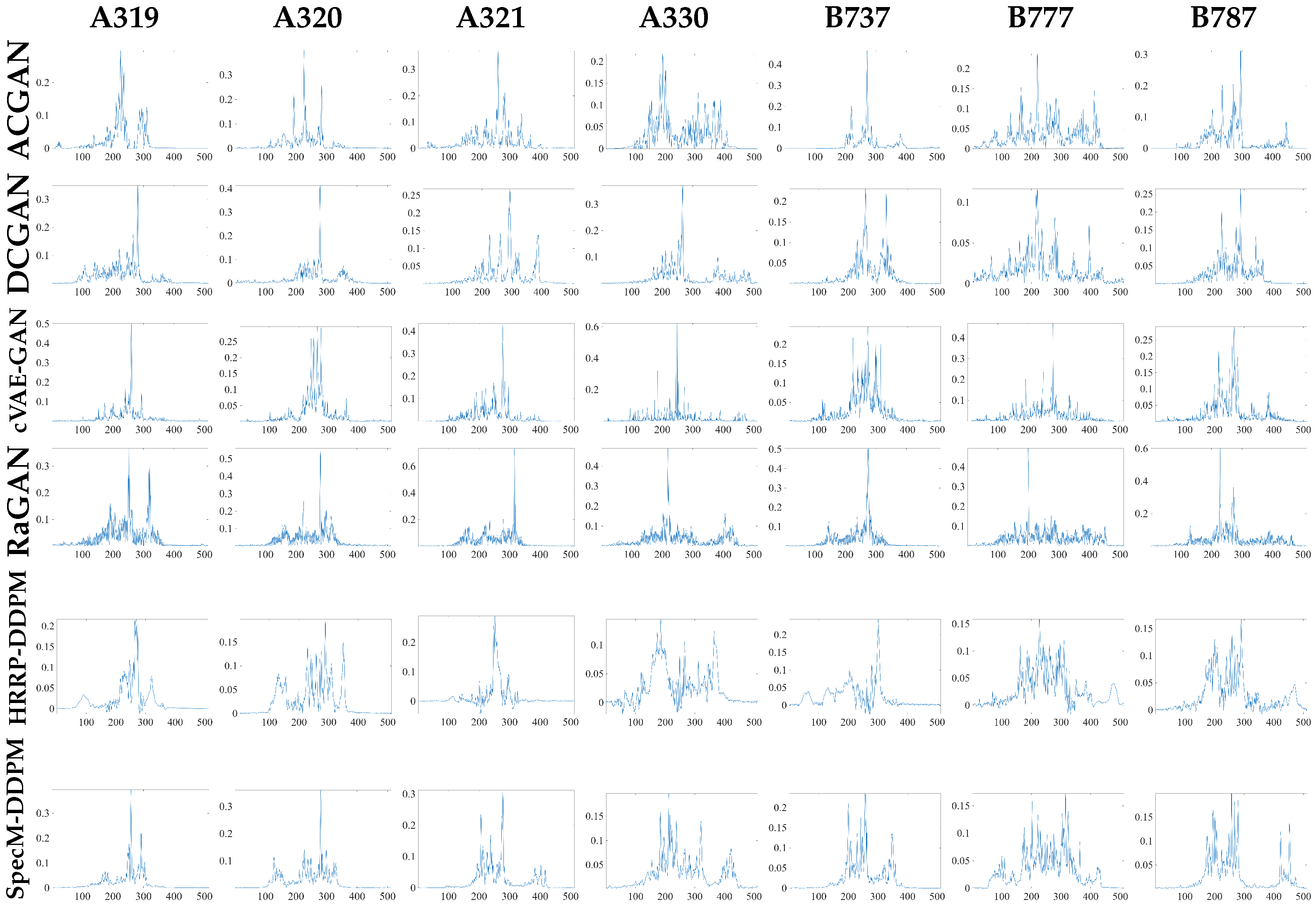
To intuitively assess the generation quality, we first visualize the time-domain waveforms of the synthesized HRRP signals. As shown in Figure 6, the samples generated by SpecM-DDPM exhibit sharp peaks and clear structural signatures that closely resemble the real measured data (Figure 5). While classical GAN-based models (ACGAN and DCGAN) generate samples that are visually plausible with preserved structural contours, their primary limitation lies in a lack of distributional diversity rather than individual sample fidelity. In contrast, other generative baselines exhibit distinct morphological defects that violate physical scattering mechanisms. Specifically, cVAE-GAN samples suffer from discontinuous “glitches”, characterized by numerous isolated, spurious small peaks that fail to reflect the continuity of target scattering centers. Similarly, RaGAN, while capturing strong amplitudes, fails to model the inherent sparsity of high-frequency radar signals; it produces unnaturally dense peaks that contradict the physical reality of discrete spatial scatterers. Finally, the baseline HRRP-DDPM, despite utilizing a diffusion backbone, exhibits amplitude scaling inconsistencies and tends to over-smooth structural components. This results in “widened” peaks and a loss of fine-grained range resolution, limiting its ability to resolve closely spaced scatterers.
Figure 6.
Visual comparison of generated HRRP samples across seven target classes. The rows correspond to different generative models (ACGAN, DCGAN, cVAE-GAN, RaGAN, HRRP-DDPM, and our proposed SpecM-DDPM), while the columns represent the target categories. Our method (bottom row) demonstrates superior fidelity in capturing sharp scattering peaks and reducing background noise compared to baselines.
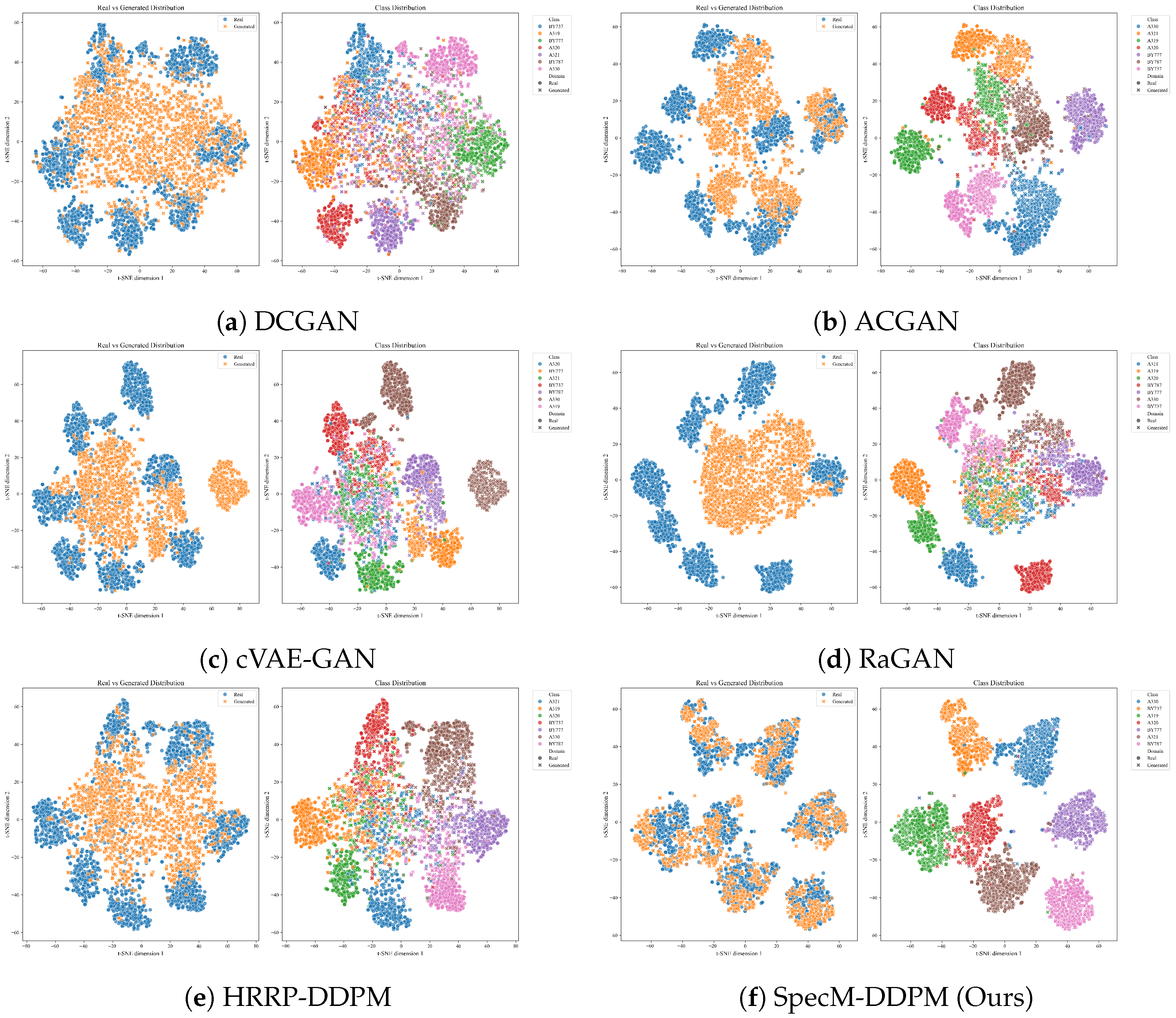
Furthermore, to evaluate whether the generative model captures the complex manifold of the real data distribution, we visualize the feature space using t-Distributed Stochastic Neighbor Embedding (t-SNE) [42]. We extract high-dimensional features from both real and generated samples using a pre-trained ResNet-18 classifier and project them into a 2D plane.
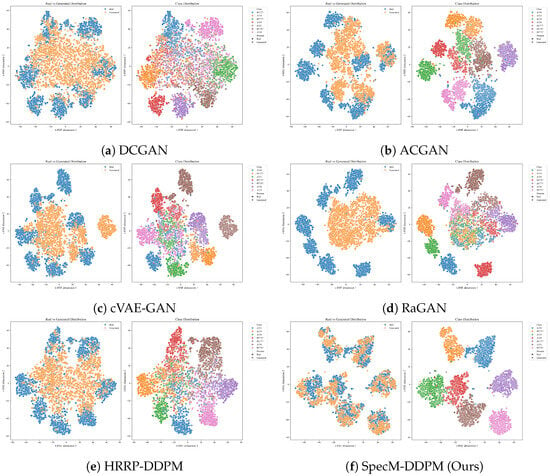
As illustrated in Figure 7, the visualization reveals distinct quality gaps across the methods. Specifically, cVAE-GAN and RaGAN exhibit severe mode collapse and distributional shifts, characterized by isolated clusters or centralized blobs that fail to cover the full geometric support of the real data. While classical models like DCGAN and ACGAN achieve broader coverage, their generated distributions appear “looser” and tend to drift into low-density inter-class regions, implying the generation of ambiguous samples that lack precise physical features. In sharp contrast, our proposed SpecM-DDPM demonstrates superior manifold alignment, where the synthesized samples (orange) almost perfectly overlay the real data distribution (blue) across all categories. This high degree of overlap confirms that SpecM-DDPM has successfully captured both the global semantic separability and the fine-grained intra-class diversity of the non-cooperative targets, effectively mitigating the mode dropping issues prevalent in baseline methods.
Figure 7.
The t-SNE visualization of feature distributions generated by different models. Blue points represent real samples, while red points represent generated samples. (a) DCGAN; (b) ACGAN; (c) cVAE-GAN; (d) RaGAN; (e) HRRP-DDPM; (f) SpecM-DDPM (Ours). Our method demonstrates the best overlap with the real data manifold.
3.2.2. Quantitative Assessment of Physical Consistency
While visual inspection provides an intuitive assessment, it is insufficient to rigorously verify the electromagnetic characteristics of radar signals. To address this, we employ a comprehensive set of physics-oriented metrics to evaluate the generative quality from three dimensions: spectral fidelity, structural sparsity, and distributional alignment.
Implementation Details of Evaluation Metrics
To ensure reproducibility and rigorous physical benchmarking, we provide the specific implementation details for the adopted metrics based on our open-source evaluation script:
- Fréchet Inception Distance (FID): Unlike the standard image-based FID, which uses InceptionV3, we have adapted this metric for use with 1D radar signals. We use a ResNet-18 classifier that has been pre-trained on the real HRRP dataset to extract features. Feature vectors are extracted from the penultimate layer (with the final classification head removed) in order to compute the Fréchet distance between the Gaussian-approximated distributions of the real and generated features.
- Range-Wise Adaptive KL Divergence (RW-AKLD): This metric quantifies the discrepancy in amplitude statistical distributions between generated and real HRRP data. Unlike global measures, RW-AKLD computes the Kullback-Leibler divergence independently for each range resolution cell. To ensure the robustness of probability density estimation, we adopt a skewness-based adaptive binning strategy. Specifically, the optimal binning rule is automatically selected based on the data skewness: the Freedman-Diaconis rule [43] is employed for skewed distributions to account for interquartile ranges, while Scott’s rule [44] is used for quasi-Gaussian distributions. Joint histograms are constructed using these adaptive bins, and the final metric is derived by averaging the divergence scores across all range cells. Lower values indicate that the generated data possesses statistical properties closer to the real measurements at each range bin.
- 1D Structural Similarity (1D-SSIM): This metric measures the similarity of local structural features between generated and real HRRP data. To eliminate the influence of absolute amplitude variations, each HRRP signal is first independently normalized to the range . Subsequently, a one-dimensional Gaussian-weighted sliding window is employed to compute local statistics, including luminance (mean), contrast (variance), and structure (covariance). The final SSIM value is a comprehensive measure derived from these local statistics, ranging from 0 to 1. A value closer to 1 indicates that the generated data more accurately reproduces the waveform structures and texture details of the real targets [45].
- Auto-Correlation Similarity (ACS): ACS evaluates the fidelity of the radar signal’s impulse response properties and sidelobe structures. We compute the normalized autocorrelation sequence for both real and generated HRRPs (after mean subtraction) up to a maximum lag of 50 range cells. The consistency is quantified by the cosine similarity between the resulting autocorrelation vectors. A score closer to 1 signifies that the generated signals strictly replicate the intrinsic temporal correlation patterns and point spread functions of the physical scatterers.
- Spectral Difference (SD): To evaluate global energy preservation in the frequency domain, we employ the Spectral Difference metric. The time-domain HRRP signals are transformed into the spectral domain via Fast Fourier Transform (FFT). The metric is defined as the mean absolute error ( distance) between the magnitude spectra of the real and synthesized signals. A lower SD value indicates precise reconstruction of the global target resonance structure and frequency-domain energy distribution.
- Wavelet Energy Divergence (WED): This metric captures physical consistency across multiple resolution scales. Using a Discrete Wavelet Transform (DWT) with the Daubechies ’db4’ wavelet and 4 decomposition levels, we decompose the signals into distinct frequency sub-bands. We then calculate the relative energy proportion of each coefficient vector and compute the distance between the multi-scale energy distributions of real and generated data. Lower values imply that the model correctly reproduces the heterogeneous scattering features that vary across different physical scales [46].
To ensure a rigorous and unbiased benchmarking, we adopt a class-wise evaluation protocol. Specifically, for each target class c, we randomly sample a set of generated HRRPs equal in size to the corresponding real test set. This sample matching strategy eliminates statistical biases arising from sample size disparities. All physics-oriented metrics are first computed independently within each category to capture class-specific generative quality. The final reported results are the macro-averages across all seven aircraft classes, thereby preventing majority classes from dominating the global performance metrics. The quantitative results are presented in Table 2. As observed, our SpecM-DDPM achieves the best overall performance, particularly in distributional metrics.
Table 2.
Quantitative Comparison of Physical Consistency and Generation Quality (↑ indicates higher is better, ↓ indicates lower is better; the best results are emboldened).
- Distributional Alignment (Manifold Learning): SpecM-DDPM achieves a dominant performance in distributional metrics, with a FID of 5.78 and RW-AKLD of 0.207. Notably, our method reduces the FID score by over 70% compared to the nearest competitor (HRRP-DDPM, 20.26) and outperforms GAN baselines by a large margin. This indicates that our diffusion-based framework successfully captures the complex, multi-modal probability distribution of real radar echoes, avoiding the mode collapse issues that plague adversarial training.
- Structural Integrity (Peak Reconstruction): In terms of structural fidelity, SpecM-DDPM attains the highest scores in both 1D-SSIM (0.445) and ACS (0.941). This superiority confirms that the proposed Parallel Multi-Scale Block effectively preserves the sharpness of discrete scattering centers and the coherence of sidelobes. In contrast, baseline diffusion models (e.g., HRRP-DDPM with SSIM 0.159) tend to generate over-smoothed profiles, failing to retain the high-frequency structural details critical for target recognition.
- Spectral Consistency vs. Diversity Trade-off: Regarding spectral energy metrics, we observe an interesting phenomenon: DCGAN achieves the lowest WED (0.262), and HRRP-DDPM achieves the lowest SD (0.255), marginally outperforming our SpecM-DDPM (WED 0.286, SD 0.257). However, this must be interpreted with caution. Generative models suffering from mode collapse (evidenced by DCGAN’s poor FID of 20.27) tend to produce repetitive “average” profiles. These averaged samples mathematically minimize -based spectral errors but lack physical variation. SpecM-DDPM, conversely, maintains highly competitive spectral fidelity while delivering superior diversity (lowest FID). This suggests our model achieves a more physically meaningful equilibrium: it generates diverse, realistic samples that respect the scattering physics, rather than overfitting to a mean spectral template.
3.2.3. Data Augmentation Utility in Downstream Recognition
To verify the practical value of SpecM-DDPM in addressing the data scarcity bottleneck characteristic of non-cooperative RATR, we designed a data augmentation experiment under a simulated low-data regime.
We randomly selected only 10% of the original real training set to serve as a “seed” dataset, simulating a scenario where labeled measurement data is severely limited. The baseline performance was established by training the classifier solely on this limited seed data. Subsequently, different generative models were employed to synthesize supplementary samples, expanding the training set back to its original size (while maintaining the same total number of samples for a fair comparison). The augmented datasets were then used to train the classifier, which was evaluated on the held-out real test set. For this downstream recognition task, we adopted a modified ResNet-18 architecture adapted for one-dimensional signal processing (1D-ResNet18). Specifically, the standard 2D convolutional layers were replaced with 1D convolutions to accommodate the vector-based nature of HRRP data. Considering the slight class imbalance in the measured dataset (sample sizes ranging from 1571 to 2387), relying solely on accuracy might be biased towards majority classes. Therefore, we additionally report the Macro F1-Score, which treats all classes equally regardless of their sample size, to rigorously evaluate the balanced performance of the model across all aircraft types. To minimize the impact of randomness, all experiments were repeated five times, with the final results being obtained by averaging the outcomes.
The comparative results are presented in Table 3. The baseline classifier, severely impacted by data scarcity, achieves an average accuracy of only 65.44%. As shown in Table 3, augmenting the dataset with samples generated by SpecM-DDPM yields the most substantial performance improvement. Our method boosts the recognition accuracy to 84.68%, representing an impressive increase of +19.24% over the baseline. The F1-Score also rises to 0.8459, further confirming that the augmentation benefits all classes, including the minority ones.
Table 3.
Comparison of Data Augmentation Performance (Training with 10% Real Data + Synthetic Data). The improvement is calculated relative to the Baseline.
When compared to other generative models, SpecM-DDPM demonstrates superior data quality. While ACGAN provides a respectable improvement (reaching 78.95%), it still lags behind our method by more than 5.7%. This suggests that although ACGAN-generated samples offer some benefit, they may lack the fine-grained spectral diversity required to fully complement the real data distribution. Our method outperforms the domain-specific HRRP-DDPM (77.63%) by approximately 7%. This highlights that our FACL strategy generates samples that are more complementary to the real data, effectively smoothing decision boundaries rather than simply adding redundant noise.
In conclusion, SpecM-DDPM proves to be a highly effective tool for data augmentation, transforming a weak classifier (65%) into a robust one (85%) even when starting with minimal real data.
3.3. Ablation Study
To disentangle the contribution of each proposed component and verify the effectiveness of the SpecM-DDPM framework, we conducted a comprehensive ablation study. Using a conditional DDPM (cDDPM) without the three key modules—PMS, SGB, and FACL—as the baseline, we progressively integrated these modules into the model while maintaining consistent elements across all configurations. This includes the same conditioning injection method, EMA for stable training, and other foundational components. The baseline thus represents the performance of the cDDPM architecture without the proposed enhancements, providing a reference point for evaluating the impact of each added module.
3.3.1. Evaluation Metrics for Ablation
To rigorously assess the trade-off between the diversity and fidelity of the generated HRRP signals, we adopt two complementary validation protocols:
- TSTR (Train on Synthetic, Test on Real)—Utility Metric: A classifier is trained exclusively on synthetic data and evaluated on real data. High TSTR accuracy indicates that the generated samples possess sufficient intra-class diversity and discriminative semantic features to support downstream recognition tasks.
- TRTS (Train on Real, Test on Synthetic)—Fidelity Metric: A classifier is trained on real data and evaluated on synthetic data. High TRTS accuracy implies that the generated distribution falls strictly within the decision boundaries of the real manifold, reflecting high physical realism and minimal artifacts.
All results were obtained by repeating each experiment five times and averaging the outcomes. This approach was adopted to minimize the impact of randomness and reduce the potential for imbalance caused by occasional fluctuations in the results.
3.3.2. Quantitative Results and Analysis
The quantitative results of the ablation study are presented in Table 4. We adopted an incremental strategy to analyze how the PMS, SGB, and FACL modules progressively contribute to the final performance.
Table 4.
Ablation study on the progressive effectiveness of each component. PMS: Parallel Multi-Scale Block; SGB: Spectral Gating Block; FACL: Frequency-Aware Curriculum Learning. The symbol ✓ indicates the presence of the corresponding module. We observe that PMS enhances utility (TSTR), while SGB and FACL are crucial for restoring fidelity (TRTS). The best performance is shown in bold.
Impact of Multi-Scale Features (Baseline → Model A)
Integrating the PMS block into the baseline yields the most significant boost in utility, increasing TSTR accuracy from 77.26% to 79.24%. This confirms that the multi-branch architecture successfully captures diverse scattering features, enriching the semantic variety of the generated samples. However, this diversity comes at a cost: the TRTS score drops to 92.46%, indicating that without physical constraints, the complex architecture may introduce unrealistic artifacts (noise) that deviate from the real data manifold.
Restoring Fidelity via Physical Constraints (Model A → Full)
To mitigate the artifacts introduced by PMS, we progressively incorporate physical constraints.
- Effect of SGB (Model B): Adding the Spectral Gating Block improves the TRTS score to 93.33%. This suggests that calibrating the global energy distribution helps to regularize the spatial features.
- Effect of FACL (Full Model): The integration of FACL provides the critical final optimization. It propels the TRTS score to a peak of 95.61%, significantly outperforming the baseline.
Diversity-Fidelity Trade-Off
Although Model A (+PMS) achieves a marginally higher TSTR than the Full model (79.24% vs. 78.60%), its low fidelity makes it unsuitable for high-precision radar applications. The Full model achieves the optimal equilibrium: it retains high recognition utility (+1.34% over Baseline) while ensuring the generated signals are physically indistinguishable from real data (Highest Fidelity).
3.4. Hyperparameter Sensitivity Analysis
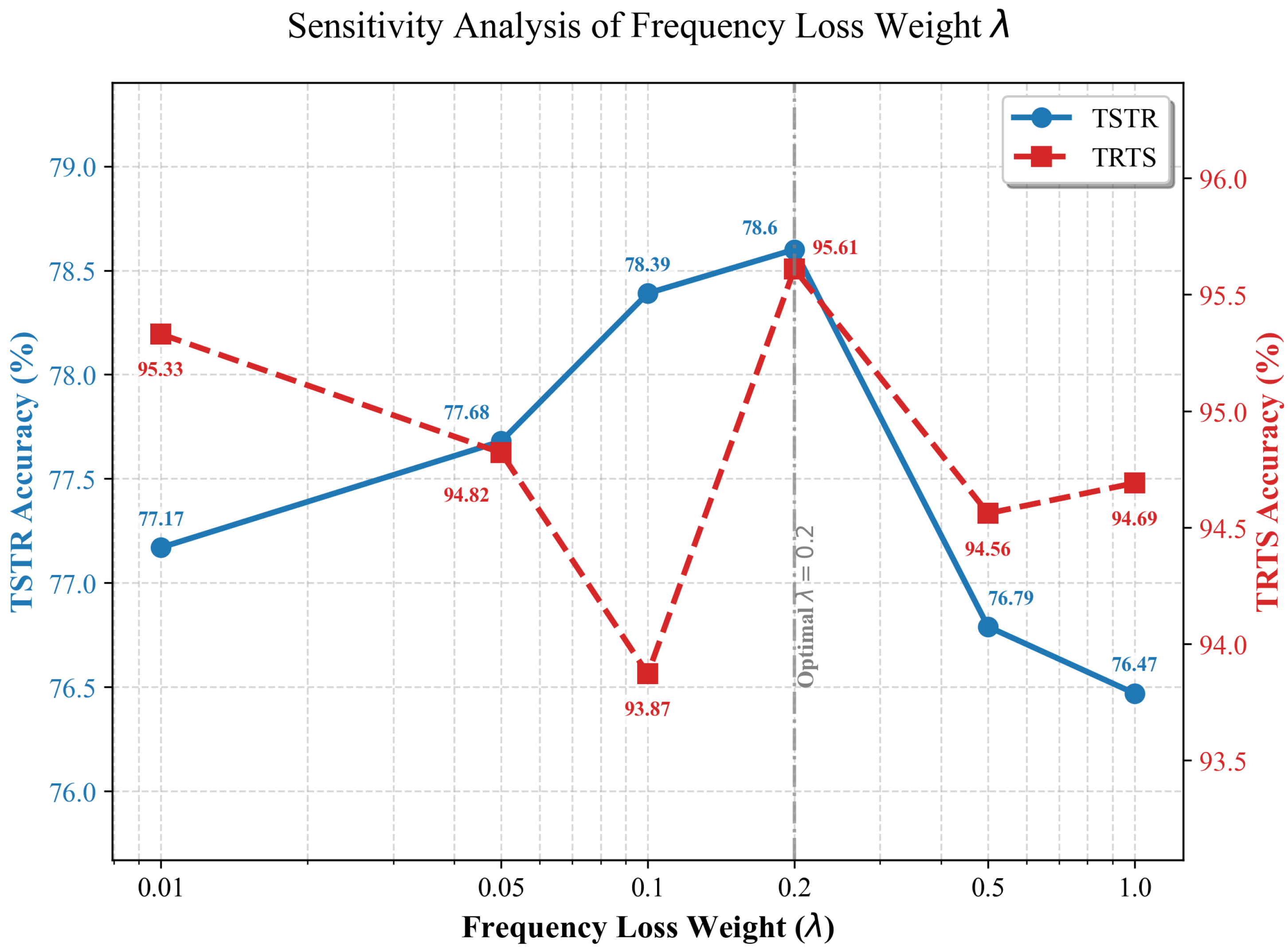
To determine the optimal strength of the spectral constraint, we conducted a fine-grained sensitivity analysis on the frequency loss weight defined in Equation (16). We evaluated the model’s performance across a range of values . Two key metrics were employed to assess the trade-off between fidelity and generalization: TSTR and TRTS Accuracy.
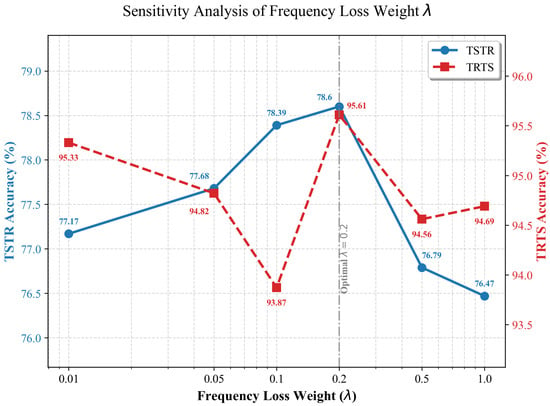
The quantitative results are visualized in Figure 8. We observe a distinct “inverted U-shape” trend in performance as increases:
Figure 8.
Sensitivity analysis of frequency loss weight . The dual-axis plot compares generalization (TSTR, blue, left) and fidelity (TRTS, red, right). The distinct “inverted U-shape” indicates that achieves the optimal equilibrium, avoiding both insufficient spectral constraints (at low ) and excessive diversity restriction (at high ).
- Under-constrained Regime (): When is negligible (e.g., 0.01), the spectral constraint provides weaker guidance to the diffusion process. This results in slightly lower TSTR scores (), suggesting that the model is **less effective at attenuating** high-frequency noise and spectral artifacts compared to the optimal setting. Consequently, a **marginal domain gap** remains between the synthesized and real HRRPs.
- Optimal Balance (): The performance peaks at , achieving the highest scores in both TSTR (78.60%) and TRTS (95.61%). At this sweet spot, the frequency-aware loss effectively enforces spectral consistency without overpowering the time-domain reconstruction loss. This ensures that the generated signals possess both realistic scattering centers and accurate frequency responses.
- Over-constrained Regime (): As exceeds the optimal range, performance degrades (TSTR drops to ≈76.5%). We attribute this to the fact that an excessively large weight causes the auxiliary frequency loss to overshadow the primary time-domain reconstruction objective. In this regime, the spectral constraint dominates the optimization landscape, forcing the model to overfit to global spectral magnitudes at the expense of fine-grained temporal variations. This imbalance stifles the generation of diverse structural details, thereby reducing the effectiveness of data augmentation.
Based on this empirical evidence, we fix as the default hyperparameter for all subsequent experiments, as it yields the most robust equilibrium between physical consistency and generation diversity. It is noteworthy that utilizing an inappropriate weight (particularly in the over-constrained regime, e.g., ) causes the performance to deteriorate even below that of the ablation baseline Model B (which excludes FACL entirely). It significantly enhances representation capability only when the frequency-domain loss is carefully balanced against the time-domain reconstruction objective.
4. Discussion
4.1. Robustness to Data Scarcity and Training Efficiency
In non-cooperative RATR scenarios, acquiring large-scale, high-quality labeled measurements is often prohibitively expensive or operationally infeasible. Therefore, the ability of a generative model to learn robust feature representations from limited data is a critical performance indicator. To evaluate the data efficiency of SpecM-DDPM, we conducted a sensitivity analysis by training the model on randomly sampled subsets of the original dataset, ranging from 10% to 100%, and assessing its performance using the TSTR (Utility) and TRTS (Fidelity) protocols.
The quantitative results are illustrated in Table 5. Two significant trends can be observed from the data:
Table 5.
Performance sensitivity to training data volume. TSTR and TRTS accuracies are reported for SpecM-DDPM trained on 10%, 20%, 50%, and 100% of the original dataset. The best performance is shown in bold.
- Performance Saturation at Low Data Regimes: Remarkably, the model exhibits rapid performance convergence. With only 50% of the training data, SpecM-DDPM achieves a TSTR accuracy of 77.12%, which is merely 1.48% lower than the performance obtained with the full 100% dataset (78.60%). This “early saturation” phenomenon suggests that our FACL strategy enables the model to efficiently capture the core spectral semantics of targets without requiring excessive redundant samples.
- Superior Feature Purification Capability: Most notably, in the extreme low-data regime (10% ratio), the synthetic data generated by SpecM-DDPM achieves a TSTR accuracy of 67.74%. This figure effectively surpasses the baseline recognition accuracy of the classifier trained directly on the limited real data (65.44%, as reported in Table 3). This counter-intuitive result implies that SpecM-DDPM acts as a feature purifier: instead of merely memorizing the limited and potentially noisy training samples, the diffusion process learns the underlying manifold and generates “cleaner”, more representative samples. This property validates the model’s exceptional robustness to data scarcity, making it highly suitable for deployment in data-constrained battlefield environments. While SpecM-DDPM demonstrates superior performance in generating high-fidelity HRRP signals compared to existing baselines, several limitations remain that warrant further investigation.
4.2. Complexity and Computational Cost Analysis
To verify that the performance gains of SpecM-DDPM stem from architectural efficacy rather than brute-force scaling, we conducted a comprehensive benchmarking of model capacity and computational budget. All experiments were performed on a consistent hardware platform, which is showm in Section 3.1.2. The quantitative results regarding parameter count, floating-point operations (FLOPs), and training speed are summarized in Table 6.
Table 6.
Comparison of Model Complexity and Computational Cost. Measured on an NVIDIA GeForce RTX 2080 Ti GPU.
Parameter Efficiency: As shown in Table 6, our SpecM-DDPM achieves state-of-the-art generation quality with only 6.49 M parameters. Remarkably, this represents a 37% reduction in model size compared to the baseline diffusion model (HRRP-DDPM, 10.29 M). This result strongly evidences that our proposed Parallel Multi-Scale Block and Spectral Gating Mechanism provide efficient inductive biases for radar signals, allowing the model to capture complex scattering characteristics without inflating the parameter space.
Computational Density and Speed: In terms of computational density, SpecM-DDPM incurs 39.83 G FLOPs per inference step, which is slightly higher than the baseline’s 32.79 G. Consequently, the average training time per step is approximately 135 ms. While this is higher than lightweight GAN baselines (e.g., DCGAN at ∼17 ms), it remains comparable to the standard diffusion baseline. We consider this moderate increase in computational cost a necessary and justifiable trade-off for the substantial improvements in distributional alignment (FID reduced from 20.26 to 5.78) and physical consistency.
Analysis of Architecture Types: It is worth noting the unique profile of cVAE-GAN, which exhibits high parameter count (7.63 M) but extremely low FLOPs (0.04 G). This discrepancy arises from its MLP-heavy architecture, which relies on dense matrix multiplications rather than sliding-window convolutions. While computationally inexpensive, the lack of convolutional inductive bias limits its ability to capture local high-frequency structural details, resulting in the poorest generation performance among all baselines. In contrast, SpecM-DDPM effectively balances parameter efficiency with the necessary computational depth to model the non-linear manifold of HRRP data.
4.3. Limitations and Future Directions
Despite the superior performance of SpecM-DDPM in generating high-fidelity HRRP signals, two primary limitations remain that warrant further investigation.
- The “Fidelity–Utility” Gap in Downstream Recognition: Although our model achieves a state-of-the-art TSTR accuracy of 78.60%, the absolute performance still trails behind the upper bound established by training solely on real data (approximately 92%). This indicates a persistent domain gap between the synthetic manifold and the real-world distribution. While the generated samples are visually realistic and statistically aligned (as evidenced by the high TRTS score of 95.61%), they may still lack certain subtle, high-frequency discriminative features. These features are critical for defining decision boundaries in deep classifiers but might be treated as “noise” or “texture” by the generative model during the diffusion process. Consequently, in its current form, the synthetic data serves best as a powerful auxiliary augmentation source (boosting performance from 65% to 85% in low-data regimes) rather than a complete substitute for measured data. Future work could explore classifier-guidance or discriminator-guided diffusion to explicitly optimize the semantic distinctiveness of the generated features during the sampling process.
- Dependence on Comprehensive Aspect Coverage: The current experimental setup relies on the assumption of a “complete” dataset, where the training data covers the full range of aspect angles for each target. However, in practical non-cooperative scenarios, radar observations are often sparse and fragmented, limited to specific trajectories (e.g., only tail-chase or head-on views). Our current SpecM-DDPM models the class-conditional distribution but does not explicitly decouple the aspect angle variable . Consequently, the model cannot perform controllable generation for specific missing angles (i.e., estimating given only ). Extending the framework to aspect-conditional generation or exploring few-shot extrapolation for unseen view angles represents a critical direction for deploying generative models in dynamic battlefield environments.
5. Conclusions
In this paper, we presented SpecM-DDPM, a novel generative framework designed to alleviate the data scarcity bottleneck in non-cooperative RATR. By integrating Parallel Multi-Scale Blocks and a Spectral Gating mechanism into the diffusion backbone, the proposed model effectively captures the heterogeneous scattering characteristics and long-range dependencies inherent in HRRP signals. Furthermore, the introduction of a Frequency-Aware Curriculum Learning strategy ensures physical fidelity by strictly aligning the generation process with the spectral evolution of radar echoes. Comprehensive experiments on measured aircraft data demonstrate that SpecM-DDPM significantly outperforms state-of-the-art GAN-based and diffusion-based baselines in both statistical distribution alignment and downstream recognition utility. Future research will focus on narrowing the remaining fidelity–utility gap and extending the framework to few-shot aspect extrapolation to better adapt to dynamic battlefield scenarios.
Author Contributions
Conceptualization, S.L. and B.T.; methodology, S.L. and Y.W.; software, S.L. and Y.W.; validation, S.L., Y.W. and J.X.; formal analysis, S.L. and J.X.; investigation, S.L.; resources, B.T.; data curation, S.L. and J.X.; writing—original draft preparation, S.L.; writing—review and editing, J.X. and B.T.; visualization, S.L.; supervision, B.T.; project administration, B.T.; funding acquisition, B.T. All authors have read and agreed to the published version of the manuscript.
Funding
This work was supported in part by National Natural Science Foundation of China (No. 62371477), Guangdong Science and Technology Program (No. 2019ZT08X751), and Shenzhen Science and Technology Program (No. KQTD20190929172704911).
Data Availability Statement
For data contact the corresponding author.
Conflicts of Interest
The authors declare no conflicts of interest.
References
- Du, L.; Liu, H.; Bao, Z.; Xing, M. Radar HRRP target recognition based on higher order spectra. IEEE Trans. Signal Process. 2005, 53, 2359–2368. [Google Scholar] [CrossRef] [Scilit]
- Chen, W.; Chen, B.; Peng, X.; Liu, J.; Yang, Y.; Zhang, H.; Liu, H. Tensor RNN with Bayesian Nonparametric Mixture for Radar HRRP Modeling and Target Recognition. IEEE Trans. Signal Process. 2021, 69, 1995–2009. [Google Scholar] [CrossRef] [Scilit]
- Zhang, Y.P.; Zhang, L.; Kang, L.; Wang, H.; Luo, Y.; Zhang, Q. Space Target Classification with Corrupted HRRP Sequences Based on Temporal–Spatial Feature Aggregation Network. IEEE Trans. Geosci. Remote Sens. 2023, 61, 5100618. [Google Scholar] [CrossRef] [Scilit]
- Li, W.; Li, S.; Tian, B.; Huang, P.; Zheng, M.; Xu, S. Regularization-Based Region Learning for Radar HRRP Open Set Recognition. IEEE Trans. Instrum. Meas. 2025, 74, 2512615. [Google Scholar] [CrossRef] [Scilit]
- Chen, J.; Li, W.; Li, S.; Tian, B.; Chen, Z. ECAPL: Open Set Recognition on HRRP Through Expansive Consistency-Aware Prototypes. IEEE Trans. Aerosp. Electron. Syst. 2025, 61, 17377–17397. [Google Scholar] [CrossRef] [Scilit]
- Liu, Y.; Long, T.; Zhang, L.; Wang, Y.; Zhang, X.; Li, Y. SDHC: Joint Semantic-Data Guided Hierarchical Classification for Fine-Grained HRRP Target Recognition. IEEE Trans. Aerosp. Electron. Syst. 2024, 60, 3993–4009. [Google Scholar] [CrossRef] [Scilit]
- Li, W.; Li, S.; Chen, J.; Tian, B.; Xu, S.; Chen, Z. Spatial Distribution Learning with Multivariate Extreme Value Boundary for Radar HRRP Open set Recognition. IEEE Trans. Aerosp. Electron. Syst. 2025, 61, 6444–6459. [Google Scholar] [CrossRef] [Scilit]
- Zhang, H.; Wang, W.; Deng, J.; Guo, Y.; Liu, S.; Zhang, J. MASFF-Net: Multiazimuth Scattering Feature Fusion Network for SAR Target Recognition. IEEE J. Sel. Top. Appl. Earth Obs. Remote Sens. 2025, 18, 19425–19440. [Google Scholar] [CrossRef] [Scilit]
- Li, H.L.; Chen, S.W. General Polarimetric Correlation Pattern: A Visualization and Characterization Tool for Target Joint-Domain Scattering Mechanisms Investigation. IEEE Trans. Geosci. Remote Sens. 2025, 64, 5200417. [Google Scholar] [CrossRef] [Scilit]
- Li, H.L.; Chen, S.W. Polyhedral Corner Reflectors Multidomain Joint Characterization with Fully Polarimetric Radar. IEEE Trans. Antennas Propag. 2025, 73, 10679–10693. [Google Scholar] [CrossRef] [Scilit]
- Li, H.L.; Liu, S.W.; Chen, S.W. PolSAR Ship Characterization and Robust Detection at Different Grazing Angles with Polarimetric Roll-Invariant Features. IEEE Trans. Geosci. Remote Sens. 2024, 62, 5225818. [Google Scholar] [CrossRef] [Scilit]
- Song, J.; Kim, D.j.; Hwang, J.H.; Kim, H.; Li, C.; Han, S.; Kim, J. Effective Vessel Recognition in High Resolution SAR Images Using Quantitative and Qualitative Training Data Enhancement From Target Velocity Phase Refocusing. IEEE Trans. Geosci. Remote Sens. 2024, 62, 5201714. [Google Scholar] [CrossRef] [Scilit]
- Zhou, X.; Bai, X.; Wang, L.; Zhou, F. Robust ISAR target recognition based on ADRISAR-Net. IEEE Trans. Aerosp. Electron. Syst. 2022, 58, 5494–5505. [Google Scholar] [CrossRef] [Scilit]
- Liu, Q.; Zhang, X.; Liu, Y. A prior-knowledge-guided neural network based on supervised contrastive learning for radar HRRP recognition. IEEE Trans. Aerosp. Electron. Syst. 2024, 60, 2854–2873. [Google Scholar] [CrossRef] [Scilit]
- Li, J.; Guo, W.; Wei, F.; Zhang, T.; Yu, W. Prior Information-Assisted Few-Shot HRRP Recognition Based on Task-Wise Shrinkage Quadratic Discriminant Analysis. IEEE Trans. Aerosp. Electron. Syst. 2024, 60, 9354–9368. [Google Scholar] [CrossRef] [Scilit]
- Zhang, F.; Bi, X.; Zhang, Z.; Xu, Y. HIFR-Net: A HRRP-Infrared Fusion Recognition Network Capable of Handling Modality Missing and Multisource Data Misalignment. IEEE Sens. J. 2025, 25, 5769–5781. [Google Scholar] [CrossRef] [Scilit]
- Guo, Z.; Liu, Z.; Xie, R.; Ran, L. HRRP Few-Shot Target Recognition for Full Polarimetric Radars via SCs Optimal Matching. IEEE Trans. Aerosp. Electron. Syst. 2025, 61, 4526–4541. [Google Scholar] [CrossRef] [Scilit]
- Li, S.; Li, W.; Huang, P.; Zheng, M.; Tian, B.; Xu, S. MTBC: Masked Vision Transformer and Brown Distance Covariance Classifier for Cross-domain Few-shot HRRP Recognition. IEEE Sens. J. 2025, 25, 16440–16454. [Google Scholar] [CrossRef] [Scilit]
- Liu, M.; Gao, X.; Qiu, X.; Liu, Y. Deep Gaussian Hidden Markov Network for Robust HRRP Sequence Modeling and Target Recognition. IEEE Trans. Aerosp. Electron. Syst. 2025, 61, 19068–19083. [Google Scholar] [CrossRef] [Scilit]
- Xia, Z.; Wang, P.; Dong, G.; Liu, H. Radar HRRP Open Set Recognition Based on Extreme Value Distribution. IEEE Trans. Geosci. Remote Sens. 2023, 61, 5102416. [Google Scholar] [CrossRef] [Scilit]
- Liu, X.; Wang, L.; Bai, X. End-to-end radar HRRP target recognition based on integrated denoising and recognition network. Remote Sens. 2022, 14, 5254. [Google Scholar] [CrossRef] [Scilit]
- Li, X.; Hou, Y.; Xu, Z.; Jin, X.; Su, F.; Li, H. A Multiscale Hybrid Perception Network with Granularity Decoupling and Spectral Enhancement for HRRP Target Recognition. IEEE Trans. Radar Syst. 2025, 3, 1183–1194. [Google Scholar] [CrossRef] [Scilit]
- Fernandez-Recio, R.; Bocanegra, D.E.; Poyatos-Martinez, D.; Jurado-Lucena, A.; Errasti-Alcala, B.; Montiel-Sanchez, I. Application of FDTD to HRRP Generation of a Cavity Model for NCTI Purposes. IEEE Trans. Aerosp. Electron. Syst. 2011, 47, 1685–1695. [Google Scholar] [CrossRef] [Scilit]
- Goodfellow, I.J.; Pouget-Abadie, J.; Mirza, M.; Xu, B.; Warde-Farley, D.; Ozair, S.; Courville, A.; Bengio, Y. Generative adversarial nets. Adv. Neural Inf. Process. Syst. 2014, 27, 2672–2680. [Google Scholar]
- Song, Y.; Li, Y.; Wang, Y.; Hu, C. Data Augmentation for Imbalanced HRRP Recognition Using Deep Convolutional Generative Adversarial Network. IEEE Access 2020, 8, 201686–201695. [Google Scholar] [CrossRef] [Scilit]
- Song, Y.; Zhang, L.; Wang, Y. Limited Sample Radar HRRP Recognition Using FWA-GAN. Remote Sens. 2024, 16, 2963. [Google Scholar] [CrossRef] [Scilit]
- Huang, Y.; Wen, Y.; Shi, L.; Ding, X. Recognition-Aware HRRP Generation with Generative Adversarial Network. IEEE Geosci. Remote Sens. Lett. 2022, 19, 3503705. [Google Scholar] [CrossRef] [Scilit]
- Shi, L.; Liang, Z.; Wen, Y.; Zhuang, Y.; Huang, Y.; Ding, X. One-Shot HRRP Generation for Radar Target Recognition. IEEE Geosci. Remote Sens. Lett. 2022, 19, 3504405. [Google Scholar] [CrossRef] [Scilit]
- Wang, Y.; Ma, Y.; Zhang, Z.; Zhang, X.; Zhang, L. Type-Aspect Disentanglement Network for HRRP Target Recognition with Missing Aspects. IEEE Geosci. Remote Sens. Lett. 2023, 20, 3509305. [Google Scholar] [CrossRef] [Scilit]
- Arjovsky, M.; Bottou, L. Towards principled methods for training generative adversarial networks. arXiv 2017, arXiv:1701.04862. [Google Scholar] [CrossRef] [Scilit]
- Ho, J.; Jain, A.; Abbeel, P. Denoising Diffusion Probabilistic Models. Adv. Neural Inf. Process. Syst. 2020, 33, 6840–6851. [Google Scholar]
- Zhou, Q.; Wang, Y.; Zhang, X.; Zhang, L.; Long, T. Domain-Adaptive HRRP Generation Using Two-Stage Denoising Diffusion Probability Model. IEEE Geosci. Remote Sens. Lett. 2024, 21, 3504305. [Google Scholar] [CrossRef] [Scilit]
- Cumming, I.G.; Wong, F.H. Digital Processing of Synthetic Aperture Radar Data: Algorithms and Implementation; Artech House: Norwood, MA, USA, 2005. [Google Scholar]
- Richards, M.A. Fundamentals of Radar Signal Processing; Mcgraw-hill: New York, NY, USA, 2005; Volume 1. [Google Scholar]
- Du, L.; Liu, H.; Bao, Z. Radar HRRP statistical recognition: Parametric model and model selection. IEEE Trans. Signal Process. 2008, 56, 1931–1944. [Google Scholar] [CrossRef] [Scilit]
- Du, L.; Liu, H.; Bao, Z.; Zhang, J. A two-distribution compounded statistical model for Radar HRRP target recognition. IEEE Trans. Signal Process. 2006, 54, 2226–2238. [Google Scholar] [CrossRef] [Scilit]
- Ronneberger, O.; Fischer, P.; Brox, T. U-net: Convolutional networks for biomedical image segmentation. In Medical Image Computing and Computer-Assisted Intervention–MICCAI 2015; Springer: Cham, Switzerland, 2015; pp. 234–241. [Google Scholar]
- Dhariwal, P.; Nichol, A. Diffusion models beat gans on image synthesis. Adv. Neural Inf. Process. Syst. 2021, 34, 8780–8794. [Google Scholar]
- Song, J.; Meng, C.; Ermon, S. Denoising diffusion implicit models. arXiv 2020, arXiv:2010.02502. [Google Scholar]
- Odena, A.; Olah, C.; Shlens, J. Conditional image synthesis with auxiliary classifier gans. In Proceedings of the 34th International Conference on Machine Learning, Sydney, NSW, Australia, 6–11 August 2017; pp. 2642–2651. [Google Scholar]
- Li, X.; Ouyang, W.; Pan, M.; Lv, S.; Ma, Q. Continuous Learning Method of Radar HRRP Based on CVAE-GAN. IEEE Trans. Geosci. Remote Sens. 2023, 61, 5107819. [Google Scholar] [CrossRef] [Scilit]
- van der Maaten, L.; Hinton, G. Visualizing data using t-SNE. J. Mach. Learn. Res. 2008, 9, 2579–2605. [Google Scholar]
- Freedman, D.; Diaconis, P. On the histogram as a density estimator: L 2 theory. Z. Wahrscheinlichkeitstheorie Verwandte Geb. 1981, 57, 453–476. [Google Scholar] [CrossRef] [Scilit]
- Scott, D.W. On optimal and data-based histograms. Biometrika 1979, 66, 605–610. [Google Scholar] [CrossRef]
- Wang, Z.; Bovik, A.; Sheikh, H.; Simoncelli, E. Image quality assessment: From error visibility to structural similarity. IEEE Trans. Image Process. 2004, 13, 600–612. [Google Scholar] [CrossRef] [Scilit] [PubMed]
- Mallat, S.G. A Wavelet Tour of Signal Processing; Academic Press: Cambridge, MA, USA, 1999. [Google Scholar]

Disclaimer/Publisher’s Note: The statements, opinions and data contained in all publications are solely those of the individual author(s) and contributor(s) and not of MDPI and/or the editor(s). MDPI and/or the editor(s) disclaim responsibility for any injury to people or property resulting from any ideas, methods, instructions or products referred to in the content. |
© 2026 by the authors. Licensee MDPI, Basel, Switzerland. This article is an open access article distributed under the terms and conditions of the Creative Commons Attribution (CC BY) license.