


Highlights
What are the main findings?
- Spatiotemporal analysis from 2017 to 2025 identifies the SNWD canal as a critical hydrogeological boundary, where synchronized groundwater recharge and the 2021 “7.20” rainstorm induced localized poroelastic rebound up to ~15 mm/yr.
- Integrated observations suggest that the interplay between NNE-trending faults and the SNWD canal creates semi-closed units, where low-permeability fault barriers impede lateral flow and concentrate hydraulic loading.
What are the implications of the main findings?
- The study suggests that the restorative capacity of extreme precipitation is strongly influenced by local soil composition and compaction history: highly permeable alluvial plains exhibit elastic resilience, while chronically overexploited clay-rich zones suffer irreversible plastic compaction.
- These findings underscore the necessity of integrating artificial diversion infrastructures with natural geological features to optimize land subsidence mitigation and enhance water security in megalopolises under changing climates.
Abstract
Long-term groundwater overexploitation in the North China Plain has triggered severe land subsidence. Meanwhile, the implementation of the Middle Route of the South-to-North Water Diversion (SNWD) project and extreme precipitation events driven by climate change are exerting profound impacts on the regional hydrogeological environment. However, the localized deformation response mechanisms at a sub-kilometer to kilometer scale under the combined influence of large-scale hydraulic engineering and extreme weather events remain unclear. In this study, we utilized ascending Sentinel-1A SAR data from 2017 to 2025. By employing the Small Baseline Subset InSAR (SBAS-InSAR) technique, coupled with the Generic Atmospheric Correction Online Service (GACOS) and multi-track mosaicking, we acquired high-spatiotemporal-resolution vertical land deformation fields in the piedmont of the Taihang Mountains (Northern Henan to Southern Hebei section). Furthermore, we analyzed these deformation fields by integrating deformation pattern classification with the spatial distribution of geological structures and water diversion projects. Through this approach, we explored the controlling factors and impacts of heavy rainfall events and the SNWD project on regional land deformation.
1. Introduction
Driven by rapid population growth and escalating agricultural and industrial water demands, groundwater overexploitation and the ensuing land subsidence have been widely documented worldwide [1,2,3]. As one of the world’s largest groundwater depression cones, the North China Plain (NCP) experiences particularly severe subsidence [4,5,6]. Long-term groundwater depletion not only causes regional land deformation but also triggers a cascade of geological hazards and environmental issues. These include damage to critical infrastructure (e.g., high-speed railways and bridges) resulting from differential settlement, the development of earth fissures, and the irreversible loss of aquifer storage capacity [7,8,9,10].
To balance water resource demands and ecological conservation in the North China Plain (NCP), China implemented the inter-basin water transfer initiative: the South-to-North Water Diversion (SNWD) project. The middle route of the SNWD originates from the Danjiangkou Reservoir, and traverses Henan and Hebei provinces, ultimately reaching the Beijing-Tianjin metropolitan region [11]. The main canal integrates open channels, covered conduits, and tunnels to bypass dense urban cores, ensuring efficient water delivery while minimizing construction costs [12,13]. Since its commissioning, the SNWD project has significantly alleviated water scarcity in the receiving regions and played a pivotal role in ecological water replenishment [14,15]. Recent studies reveal that reduced groundwater pumping has led to the recovery of groundwater levels in parts of the NCP [15,16,17]. Consequently, land subsidence rates have decelerated, and localized surface rebound has been detected [16,17,18]. Investigating the spatiotemporal variations in groundwater levels and the associated land deformation provides a critical basis for evaluating the environmental benefits of such water-diversion infrastructure and groundwater-restriction policies [19].
Furthermore, extreme weather events exacerbated by climate change introduce new uncertainties into regional groundwater systems, exerting profound impacts on hydrogeological dynamics and land deformation beyond merely triggering surface floods [20,21]. A prominent example occurred on 20 July 2021, when Zhengzhou and its surrounding areas experienced an unprecedented extreme rainfall event, commonly referred to as the “7.20” rainstorm [22]. During this event, Zhengzhou recorded a historical maximum hourly precipitation of 201.9 mm, and the cumulative rainfall over a three-day period exceeded 600 mm—a staggering volume roughly equivalent to the region’s average annual precipitation. This catastrophic precipitation not only caused devastating inundation but also significantly perturbed the regional land deformation field [23]. Studies indicate that such extreme rainfall can trigger intense, short-term fluctuations in surface displacement [24,25]. Globally, while the isolated land deformation impacts of major inter-basin water transfers and extreme precipitation events have been extensively documented independently, empirical studies investigating their combined, coupled hydro-mechanical effects remain remarkably scarce. Therefore, the response characteristics of aquifer systems under the dual influence of long-term engineered water replenishment and abrupt extreme precipitation warrant in-depth investigation.
Despite extensive research on land subsidence in the NCP, certain limitations remain. Many studies focus on regional-scale deformation trends [26,27,28], lacking detailed characterization of time-series deformation features driven by interactions between local geological structures and large-scale engineering infrastructure. Furthermore, our understanding of the long-term impacts and the mechanisms of spatial heterogeneity of extreme rainstorms on deep hydro-geomechanical processes remains insufficient. In particular, whether extreme rainfall can reverse long-term subsidence trends—and how this response is governed by local geomorphology and lithology—represents a critical research gap that needs to be addressed.
Interferometric Synthetic Aperture Radar (InSAR) technology, particularly the Small Baseline Subset (SBAS-InSAR) technique, has been widely applied in monitoring urban subsidence, mining areas, groundwater system dynamics, and landslides, owing to its high spatiotemporal resolution [29,30,31,32,33]. However, the piedmont of the Taihang Mountains is characterized by rugged topography and dense vegetation cover. Consequently, long-term time-series InSAR observations in this region are highly susceptible to atmospheric delay artifacts. Shortly after the “7.20” rainstorm, Lan et al. (2024) extracted flood inundation areas using Sentinel-1 intensity data and analyzed the short-term impacts of the rainstorm on both groundwater levels and ground subsidence from 2020 to 2023 [23]. Similarly, Zhang et al. (2025) characterized the regional ground subsidence evolution along the middle route of the SNWD project [15]. Despite these valuable contributions, a long-term analytical framework capable of decoupling the cumulative recharge effect of the SNWD project from the transient impact of extreme rainfall remains lacking.
Here, we conduct a time-series analysis using Sentinel-1 data spanning 2017 to 2025 to characterize the spatiotemporal evolution of land deformation in the piedmont of the Taihang Mountains (Northern Henan to Southern Hebei section). To ensure the accuracy in deformation monitoring within such a complex environment, we adopt advanced processing strategies, including the Generic Atmospheric Correction Online Service (GACOS) [34,35] and track mosaicking based on overlapping regions [36]. Rather than focusing on regional trends, we investigate the fine-scale coupled structural control. We hypothesize and demonstrate that the deeply excavated SNWD main canal interacts with natural tectonic faults, which alter localized groundwater flow and surface rebound patterns. Finally, we delve into the geomechanical mechanisms, linking the kinematic surface response directly to local lithological memory—elucidating why extreme rainfall triggers elastic recovery in alluvial plains while failing to reverse plastic compaction in severely overexploited clay-rich zones. The specific objectives are to: (1) evaluate the long-term recharge and recovery effects of the Middle Route of the SNWD project on land deformation; (2) reveal the spatial control mechanisms exerted by geological faults and the main diversion canal on the deformation field; (3) decouple and analyze the transient response and long-term deformation pattern transitions induced by the 2021 “7.20” extreme rainstorm; and (4) elucidate the spatial heterogeneity of the groundwater system’s response based on geomorphological and soil property statistics. The findings of this study may provide a scientific basis for regional groundwater management and geological hazard mitigation in the context of climate change.
2. Study Area and Methods
2.1. Study Area
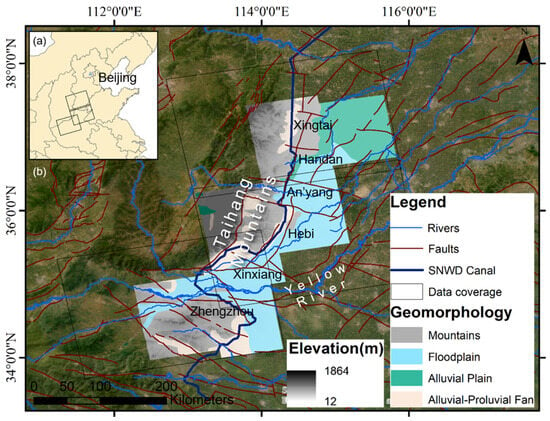
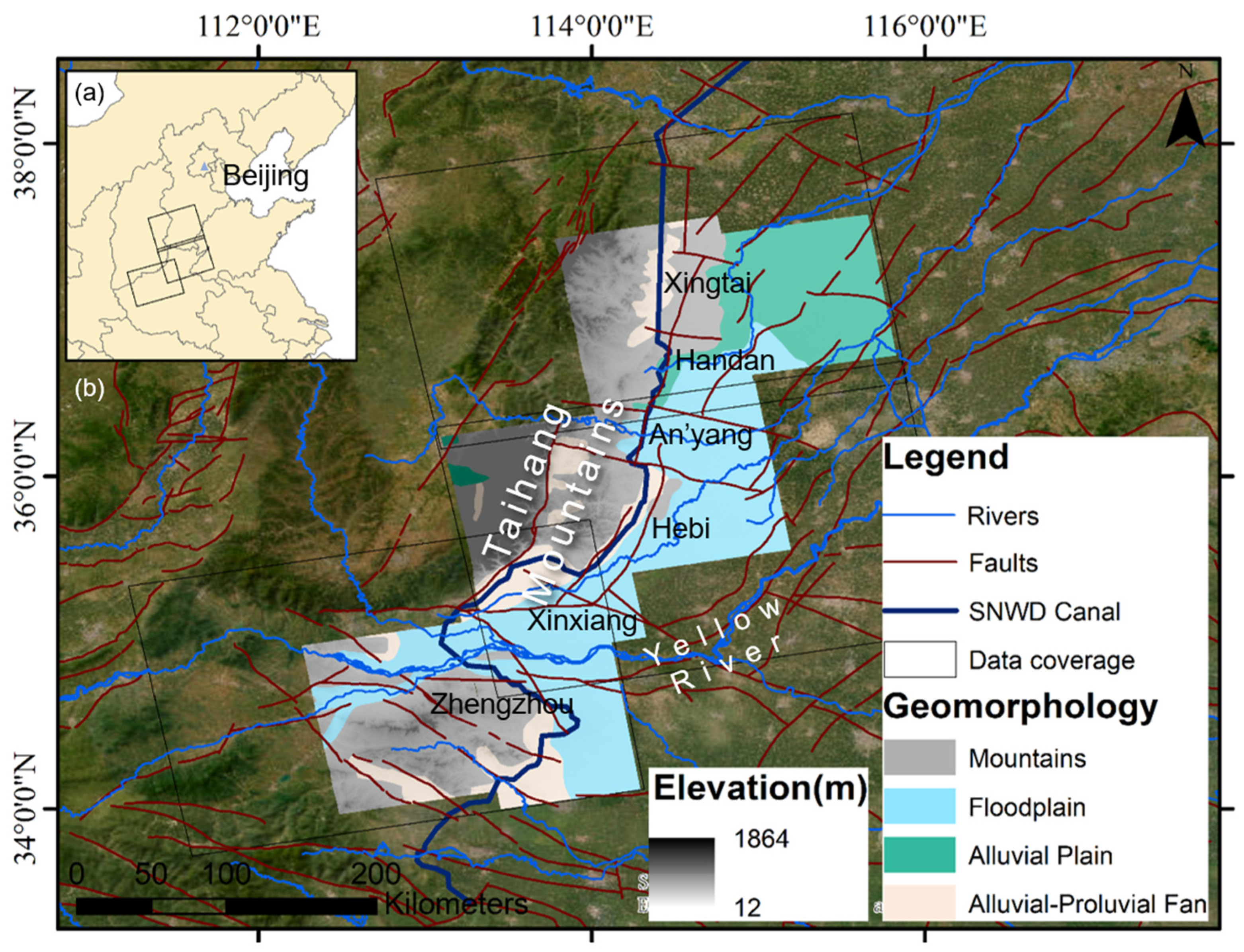
The study area is located along the eastern foot of the Taihang Mountains, in the transition zone between the Taihang Mountains and the North China Plain [37,38]. Administratively, it covers northern Henan and southern Hebei provinces, encompassing seven core cities, namely, Xingtai, Handan, Anyang, Hebi, Xinxiang, Jiaozuo, and Zhengzhou. The regional topography is higher in the west and lower in the east, with geomorphological units exhibiting distinct strip-like distribution patterns: mountainous areas in the west, piedmont alluvial–proluvial fans in the central part, and broad alluvial plains in the east (Figure 1) [39,40]. The region possesses a complex geological structure, characterized by multiple North-Northeast (NNE)-trending buried faults, most of which strike parallel to the Taihang Mountains [41]. In terms of soil and lithology, the western foothills are predominantly covered by semi-luvisols and entisols. The sediments here are coarse-grained and highly permeable, serving as the primary groundwater recharge zone. Conversely, the eastern alluvial plains and floodplains are dominated by semi-hydromorphic soils, primarily consisting of interbedded silt and clay. Notably, the floodplain areas constitute the highly permeable sections within the plain interior [42]. Based on extensive historical borehole explorations in this region, the subsurface stratigraphy exhibits a well-documented transition [43,44]. The proximal piedmont zones are dominated by highly permeable, coarse-grained sand and gravel deposits, which gradually transition into deeply incised, multi-layered aquifer–aquitard systems. These distal plains are dominated by thick, highly compressible clay and silt aquitards, where historical groundwater drawdowns have been most severe.
Figure 1.
Overview of the study area. (a) Geographical location of the study area within the North China Plain, where the black rectangular box indicates the spatial coverage of the Sentinel-1 SAR data used in this study. (b) Topographic, geomorphological, and tectonic background. The base map is a satellite image. The colored layers display four major geomorphological units: mountainous areas, alluvial–proluvial fans, floodplains, and alluvial plains. Red solid lines indicate the distribution of major faults; the thick dark blue line represents the route of the main canal of the South-to-North Water Diversion (SNWD) Middle Route; light blue lines denote the primary river systems flowing through the region.
The study area features a warm-temperate semi-arid continental monsoon climate, characterized by an uneven seasonal distribution of precipitation. In recent years, extreme precipitation events have become more frequent, including the catastrophic rainstorm in the summer of 2021 [22]. Hydrologically, the Yellow River flows north of Zhengzhou, while the Weihe River flows through Xinxiang. Historically, surface water diversion projects existed connecting the Yellow River to the Weihe River [6]. The main canal of the SNWD Middle Route traverses the entire study area from south to north. Because it is primarily routed along the edges of the piedmont alluvial fans, it constitutes the largest artificial linear hydrogeological boundary in the region [13].
2.2. Data Sources
To investigate the long-term recharge effects of the Middle Route of the SNWD project and the transient impact of the 2021 “7.20” extreme rainstorm, this study utilized ascending Sentinel-1A SAR data spanning from 2017 to 2025. The dataset covers the eastern piedmont of the Taihang Mountains (northern Henan to southern Hebei section) within the North China Plain. To ensure complete spatial coverage of the study area, data from three consecutive frames were acquired, comprising 675 Single Look Complex (SLC) images.
Furthermore, the 30 m resolution Shuttle Radar Topography Mission (SRTM) Digital Elevation Model (DEM) was used to simulate and remove the topographic phase [45]. Meanwhile, tropospheric delay products from the Generic Atmospheric Correction Online Service (GACOS) were used for atmospheric phase correction [35]. Daily precipitation data were extracted from the Climate Hazards Group InfraRed Precipitation with Station data (CHIRPS) global dataset [46]. Ancillary datasets, including the vector map of the SNWD main canal and geomorphological and soil classification maps of the study area, were sourced from the Resource and Environment Science and Data Center (https://www.resdc.cn/).
2.3. InSAR Processing Strategy
Using an improved SBAS-InSAR technical framework, we generated interferograms with the Sentinel-1 Processor software (v1.1) [36]. To mitigate phase closure errors and ensure reliable phase unwrapping, we configured the temporal baseline thresholds using a combined strategy of short (60–90 days) and interannual (340–380 days) baselines. Specifically, the 60–90-day window was selected to balance deformation signal accumulation against temporal decorrelation. Given the region’s slow deformation, this window effectively improves the signal-to-noise ratio against tropospheric delay, while the dense urban infrastructure ensures sufficient coherence [47]. Additionally, the interannual baselines (340–380 days) exploit seasonal coherence recovery to constrain the propagation of unwrapping errors. In total, we generated a total of 4063 interferograms. A multi-looking ratio of 8 in range and 2 in azimuth was applied to suppress speckle noise. Following interferogram generation, Goldstein filtering was applied to further enhance the signal-to-noise ratio [48]. Phase unwrapping was then performed using the Minimum Cost Flow (MCF) algorithm. Prior to time-series inversion, given that atmospheric delay is a primary source of error in land deformation observations [34,49], we applied atmospheric phase correction to each interferogram using GACOS products to mitigate the impact of tropospheric delay on long-wavelength deformation signals. Subsequently, time-series inversion and velocity estimation were conducted using the LiCSBAS package [50]. During this process, to ensure the reliability of the deformation signal and mitigate severe decorrelation noise (e.g., from dense vegetation and water bodies), we applied a mean coherence threshold of 0.1 for pixel selection. Consequently, a total of 8,442,169 pixels were retained in the final analysis. Furthermore, based on the applied multi-looking ratio, the spatial resolution of the final derived deformation maps is approximately 30 m × 30 m.
Since this study focuses on vertical land deformation, it was necessary to project the Line-of-Sight (LOS) velocities into the vertical direction. SAR side-looking geometry is inherently most sensitive to vertical motion, and the regional deformation is overwhelmingly dominated by groundwater-driven vertical aquifer compaction. Previous geodetic studies in the North China Plain have demonstrated that horizontal tectonic movements are typically an order of magnitude smaller compared with the severe vertical subsidence rate [18,27]. Based on this established regional characteristic, the horizontal contribution to the broad-scale LOS phase was assumed to be negligible. Therefore, the vertical velocity field was computed directly by dividing the LOS displacement by the cosine of the pixel-specific incidence angle (which ranges from approximately 27° to 37° across the swath) to compute the vertical velocity field [51].
Because the study area spans multiple tracks and single-track InSAR results represent only relative deformation with respect to a local reference point, direct mosaicking would introduce significant datum offsets. Therefore, a mosaicking approach based on overlapping regions was employed. By utilizing phase differences in the overlapping regions of adjacent tracks, systematic biases were estimated and eliminated, thereby unifying all tracks into a consistent spatial reference frame. To address temporal inconsistencies in image acquisitions across different tracks, a linear interpolation method was applied in the temporal domain to resample the time series for all pixels to uniform temporal nodes. Initial InSAR results typically contain residual orbital errors and global datum shifts. Using geomorphological data, we extracted 23,493 high-coherence pixels (mean coherence > 0.7) widely distributed across the western bedrock mountainous areas as stable control points. These points, representing a cumulative effective area of approximately 21 km2, provided a robust geometric foundation for accurately estimating and removing regional datum shifts and orbital planes through first-order plane fitting [52], ensuring the physical correctness of the final deformation field. Finally, an internal accuracy assessment was conducted under the assumption of bedrock stability. Statistical results indicate that in the calibrated bedrock areas (mean coherence > 0.7), the mean deformation velocity was 0.03 mm/yr with a standard deviation (STD) of 4.4 mm/yr. This relatively high scatter in the bedrock region is primarily attributed to unmodeled high-frequency turbulent atmospheric residuals over the Taihang Mountains, compounded by minor phase unwrapping anomalies caused by dense vegetation cover. However, this localized scatter does not compromise the interpretation of the regional deformation patterns.
2.4. Spatiotemporal Analysis and Deformation Pattern Classification Model
To decouple long-term deformation trends from abrupt event-driven responses, we developed a comprehensive spatiotemporal analysis framework. A 5 × 5 spatial moving window filter was applied to the calibrated cumulative deformation time series. This approach effectively eliminates high-frequency spatial noise while preserving the sharp gradient features associated with fault zones and the margins of subsidence bowls [53,54].
Specifically targeting the impacts of the 2021 “7.20” extreme rainstorm, we constructed a two-step classification model. Initially, piecewise linear fitting was performed on the deformation time series of each pixel, segmenting the data into pre- and post-storm periods. To distinguish the long-term pattern transition from short-term disturbances and time-lagged hydrological responses, our comparative analysis relied on calculating multi-year average velocities rather than evaluating immediate post-event displacements. By comparing the stabilized interannual velocity prior to the fixed 20 July 2021, breakpoint with that of the subsequent extended period, this long-term temporal aggregation inherently absorbs initial transient lags and residual seasonal variability. Consequently, the derived velocity difference reflects the sustained kinematic shift of the aquifer system into a new hydro-mechanical equilibrium, rather than a mere temporary hydrological pulse. If the velocity offset between the two fitted segments exceeded a predefined threshold (empirically set to 15 mm/year in this study), the corresponding pixel was classified as exhibiting a “rainstorm-responsive” pattern. This specific threshold was rigorously determined based on the background noise statistics. Given the 4.4 mm/yr standard deviation derived from the stable bedrock assessment, a 15 mm/yr threshold exceeds the three-sigma confidence interval. For pixels lacking such abrupt transitions, stability was assessed based on their deformation velocity and its trend. Pixels with an absolute average velocity of less than 3 mm/yr were defined as stable points. This conventional geodetic threshold is geologically meaningful and widely adopted in regional studies to represent natural structural stability, as it effectively isolates the undisturbed bedrock and proluvial fans from the severe, anthropogenically driven subsidence zones in the eastern plains. For the remaining dynamic pixels, polynomial fitting was used to assess their deformation acceleration. Based on the sign of the determined acceleration, we subdivided them into four categories: accelerating subsidence, decelerating subsidence, accelerating uplift, and decelerating uplift.
3. Results
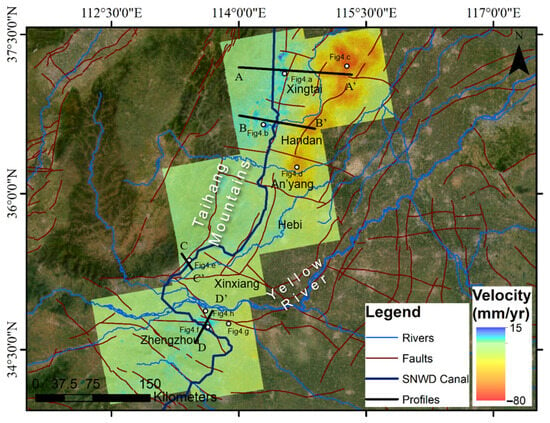
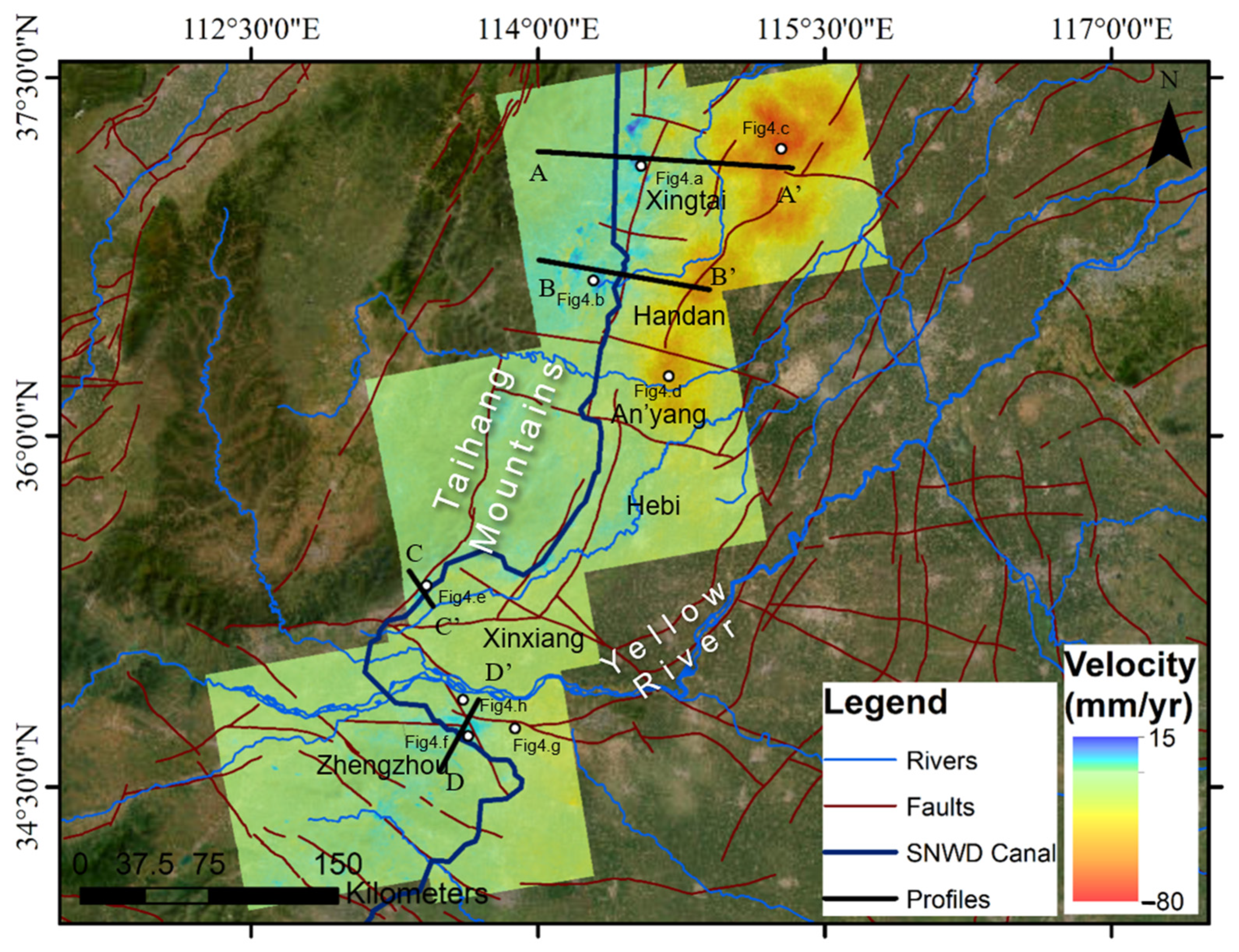
Based on the Sentinel-1 time-series InSAR observations from 2017 to 2025 (Figure 2), the study area exhibits a pronounced east-west spatial dichotomy in land deformation. It is important to note that this velocity field has been rigorously masked using the aforementioned coherence threshold to exclude unreliable pixels, ensuring that the signals represent high-confidence kinematic trends. The vertical velocities range from −70 mm/yr to 15 mm/yr. In the piedmont plain west of the main SNWD canal, the area is generally stable. Localized uplift is primarily observed in the northern cities of Xingtai and Handan, with a maximum uplift velocity of approximately 15 mm/yr. This uplift signal exhibits a gradual westward attenuation trend within a distance of ~40 km from the canal. The velocity in the western mountainous area is close to zero, indicating that the bedrock region remains relatively stable. Conversely, east of the main canal, the deformation is dominated by subsidence. Particularly in the eastern parts of Xingtai and Handan in the north, significant subsidence persists. For example, in Nangong City, an industrial hub for textiles and food processing [41], the maximum subsidence velocity at the center exceeds −70 mm/yr. While the eastern region is largely characterized by such severe subsidence, minor localized uplift signals (approx. 10 mm/yr) are also exceptionally detected east of the canal in Zhengzhou City and west of the canal in Xinxiang City, indicating a highly complex and spatially heterogeneous local hydrological response.
Figure 2.
Vertical velocity field in the piedmont plain of the Taihang Mountains from 2017 to 2025. Colors represent the vertical velocity (mm/yr): red indicates land subsidence, while blue indicates land uplift. The thick dark blue line represents the main canal of the Middle Route of the SNWD project, and the thin dark red lines indicate the distribution of major faults. White dots in the figure denote specific locations selected for subsequent time-series analysis and rainfall–response characterization, and the thick solid black lines indicate the four cross-canal profiles (A–A′ to D–D′), which are shown in Figure 3.
The primary objective of constructing the Middle Route of the SNWD project was to address water demands in the surrounding regions. Following the commissioning of this major engineering project, the local reliance on groundwater extraction has decreased substantially [55,56]. Furthermore, the main canal facilitates ecological water replenishment to nearby rivers, and auxiliary diversion channels have been established to expand its service coverage. As illustrated in Figure 2, the areas experiencing significant uplift are primarily concentrated within approximately 40 km of the main canal. Given that the structural control exerted by the main canal and adjacent faults on the deformation field is crucial for understanding groundwater dynamics, we further investigate these mechanisms by integrating profile lines across the main canal.
3.1. Cross-Canal Deformation Velocity Profile Analysis
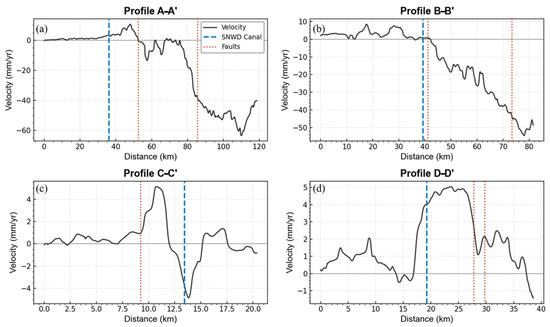
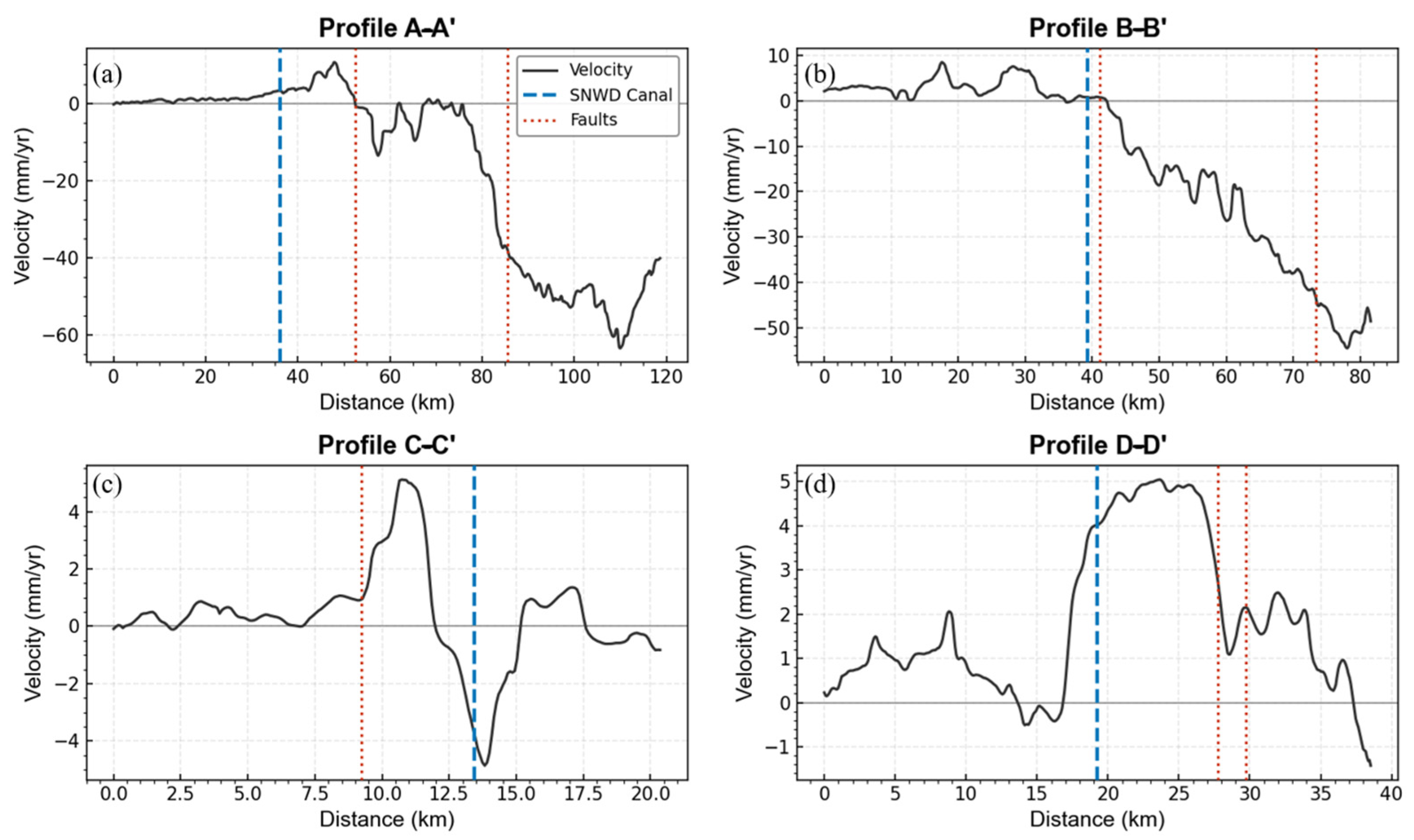
To further investigate the deformation trends adjacent to the SNWD main canal, we extracted four profile lines to observe the structural control exerted by faults and the canal on surface velocities. To ensure the transparency and representativeness of our analysis, the time-series points and spatial profiles were explicitly selected based on three primary criteria: (1) typical deformation behaviors; (2) varying distances to the SNWD canal; and (3) orthogonal intersections with regional concealed faults or canal. Because the strikes of the canal and the faults are not entirely consistent, the profiles were designed to be as perpendicular to the canal as possible. Along these four profiles, diverse controlling effects of the SNWD canal are distinct (Figure 3).
Figure 3.
Vertical velocity profile analysis across the main canal of the SNWD project. (a–d) show the variations in deformation velocity along the four profiles. The solid black lines represent the InSAR-derived vertical deformation velocities, the dashed blue lines indicate the location of the SNWD main canal, and the dotted lines denote the surface projections of concealed bedrock faults beneath the thick Quaternary sedimentary cover.
Along profiles A–A′ and B–B′, the main canal serves as a deformation-pattern boundary. The western side of the canal remains stable, with a negligible velocity, whereas on the eastern side, the subsidence rate accelerates rapidly with increasing distance from the canal. Contrary to the canal acting as the sole boundary, these profiles reveal that the sharp velocity gradients align explicitly with the fault lines—most notably in Profile B–B′—indicating a strong structural control exerted by the faults on the regional subsidence patterns. Conversely, profiles C–C′ and D–D′ exhibit a more complex deformation pattern, characterized by a constraining effect between the faults and the canal. Particularly within the narrow corridor (within a 4–9 km buffer) bounded by the fault and the canal, a localized uplift velocity significantly higher than that of the surrounding areas (by approximately 5 mm/yr) is observed.
3.2. Time-Series Deformation Response to the “7.20” Extreme Rainstorm
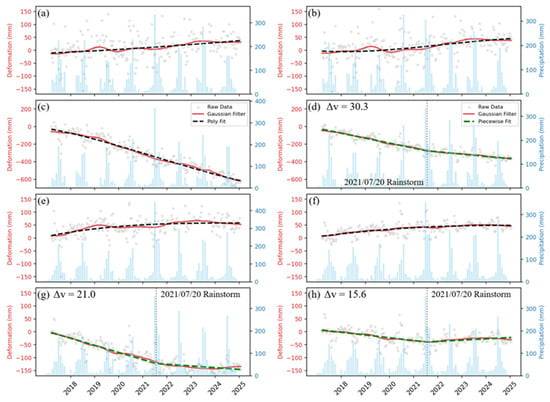
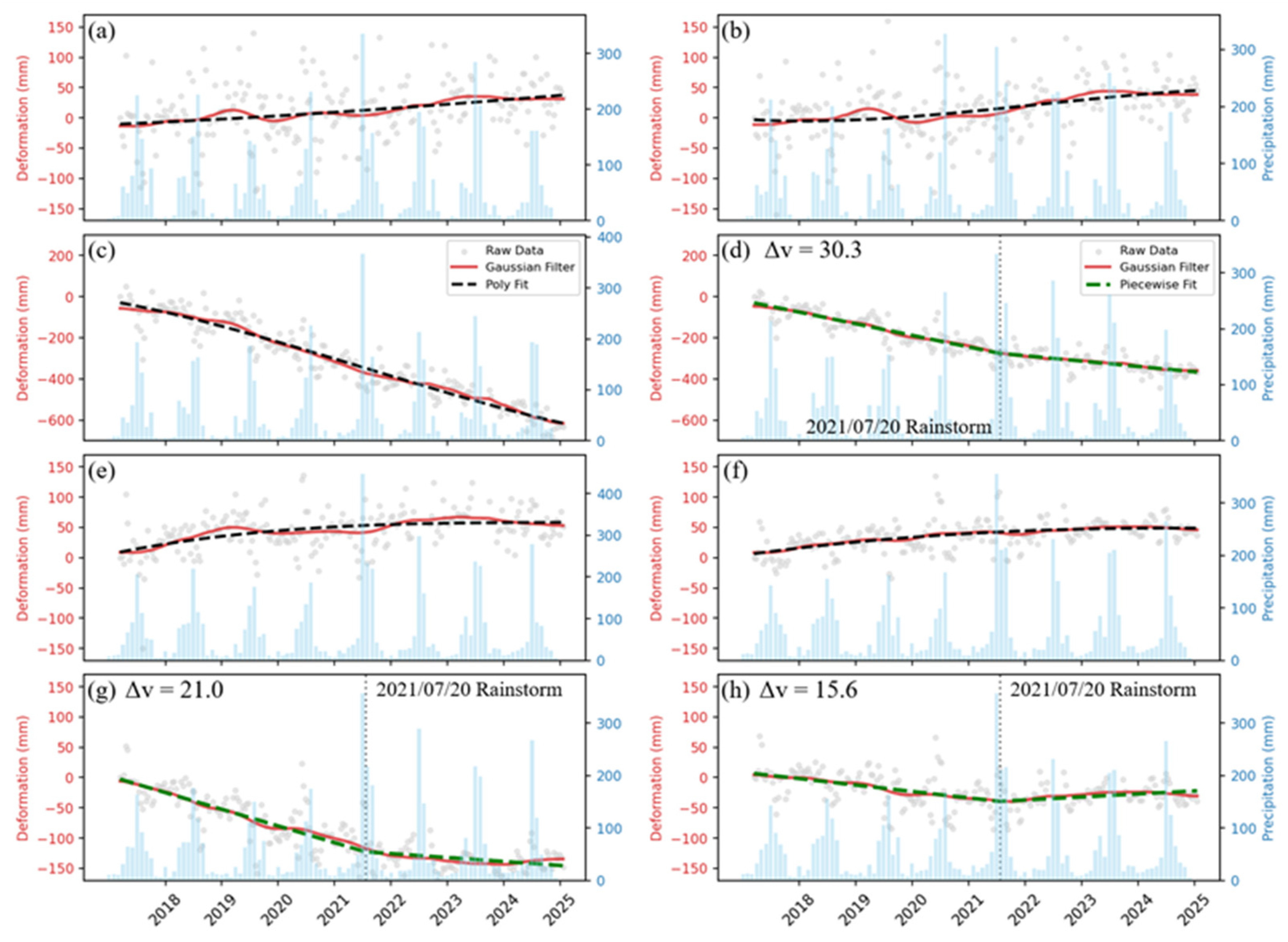
To investigate the localized impacts of the extreme rainstorm in July 2021, we selected several representative feature points and plotted their deformation time series alongside monthly precipitation data (Figure 4). Figure 4a,b illustrate a continuous uplift pattern. Throughout the observation period, these two points, located in close proximity to the SNWD main canal, experienced sustained uplift. Furthermore, a transient acceleration signal was superimposed during the rainstorm, reflecting the combined hydrogeological effects of long-term canal recharge and abrupt infiltration of meteoric water.
Figure 4.
Time-series deformation and rainfall response at typical feature points from 2017 to 2025. The plots display the deformation time series for eight representative locations ((a–h); see Figure 2). The left vertical axis represents cumulative deformation (mm), where gray dots denote the raw InSAR observations, and the solid red lines represent the Gaussian-filtered smoothed curves. The dashed black lines indicate the polynomial fitting trends for the entire period. The right vertical axis represents monthly precipitation (mm), illustrated by light blue bars. In panels (d,g,h), the thin vertical dashed black lines mark the extreme rainstorm event on 20 July 2021; the thick dashed green lines represent the piecewise linear fitting results based on this event, and the values in the boxes (Δv) denote the change in deformation velocity (mm/yr) before and after the rainstorm. (a,b) Continuous uplift pattern; (c,d) Continuous subsidence pattern; (e,f) Decelerating uplift pattern; (g,h) Significant trend reversal pattern in response to the rainstorm.
Figure 4c,d both exhibit an overall continuous subsidence pattern, yet they reveal fundamentally different responses to the extreme rainstorm. Figure 4c represents areas with an insignificant response, where the velocity change following the rainstorm was typically less than 15 mm/yr. This robustly demonstrates that the deep cohesive layers in these chronically overexploited areas have met irreversible plastic compaction, permanently losing their elastic sensitivity to hydraulic recharge. In contrast, Figure 4d illustrates a significant deceleration in subsidence. The piecewise linear analysis before and after July 2021 reveals a pronounced velocity reduction of 30.3 mm/yr, confirming a strong response to the extreme rainfall. However, because the baseline subsidence rate driven by long-term overexploitation was exceptionally high in these specific zones, the massive positive hydraulic loading could only partially mitigate the subsidence rate rather than fully reverse it to uplift.
Figure 4e,f demonstrate a decelerating uplift phenomenon, exemplified by towns west of Xinxiang City and the urban area of Zhengzhou City. In these locations, the overall uplift velocity gradually diminished, and the elastic response to the rainstorm event was notably short-lived, lasting only a few months. From a long-term perspective, the uplift rate progressively attenuates and tends toward stabilization. In stark contrast, Figure 4g,h reveal a pronounced transition in trend. Prior to July 2021, these locations were dominated by ongoing subsidence. However, following the extreme rainstorm, a distinct shift in deformation velocity occurred, yet it did not reverse into a slow uplift phase. Crucially, this altered velocity trajectory persisted until the end of the observation period, characterizing a long-term hydro-geomechanical pattern shift rather than a mere transient seasonal fluctuation.
3.3. Deformation Pattern Classification Based on Spatiotemporal Features
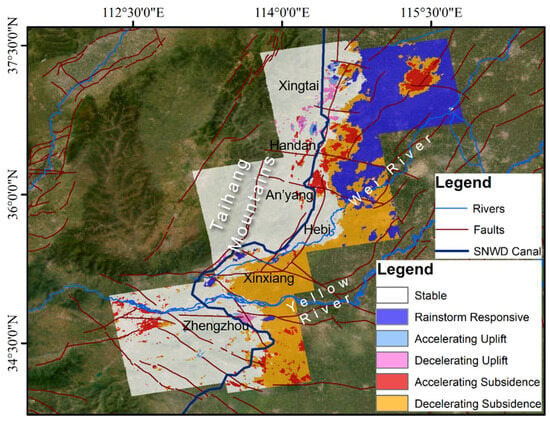
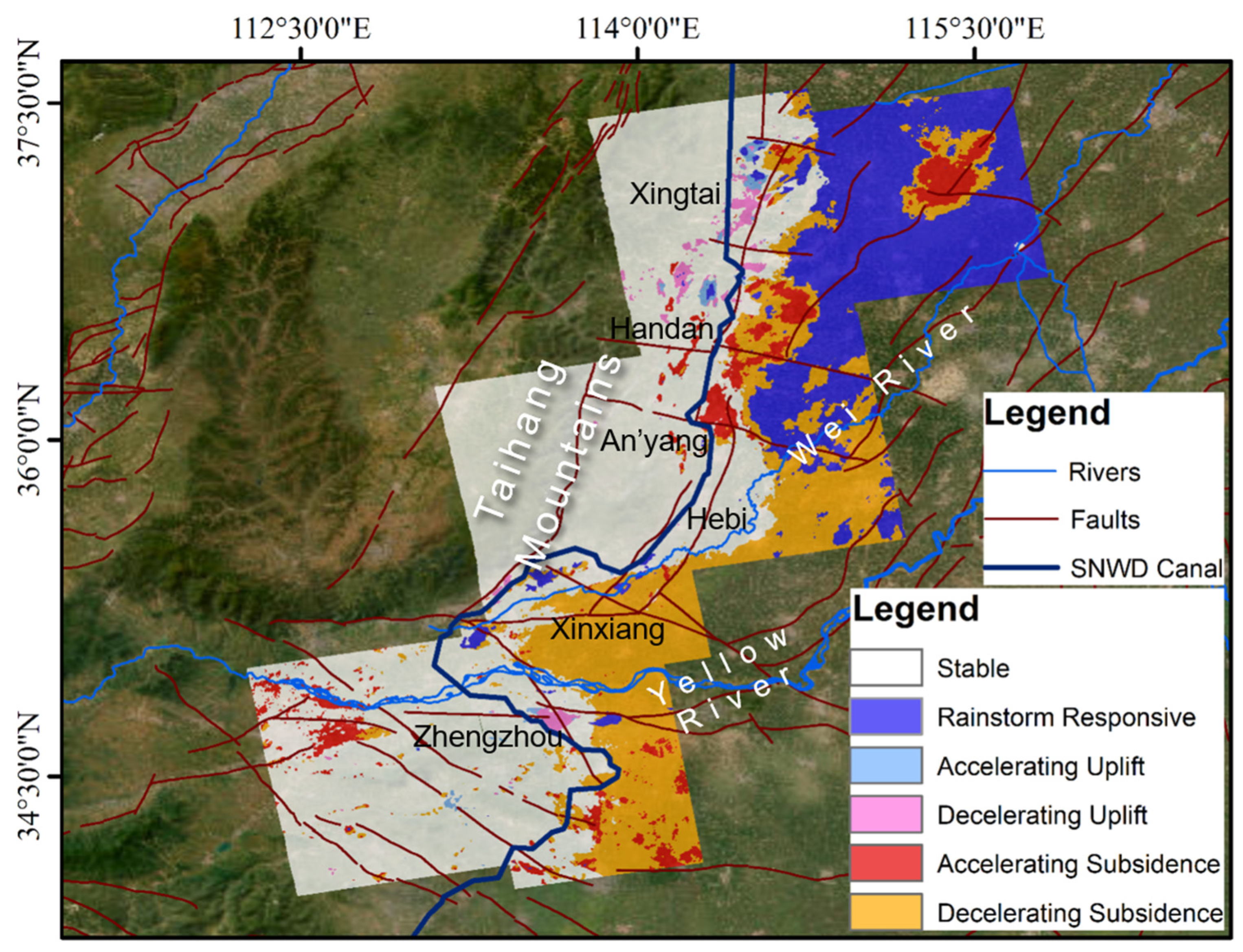
Leveraging the high spatial resolution of SBAS-InSAR time series, we classified the diverse deformation patterns to investigate their spatial distribution characteristics (Figure 5). In this framework, pixels with an absolute average velocity below 3 mm/yr are defined as stable points. Meanwhile, pixels exhibiting a fitted velocity difference (Δv) exceeding 15 mm/yr before and after July 2021 are identified as points where a kinematic inflection occurred due to the extreme rainstorm event.
Figure 5.
Classification map of land deformation patterns in the piedmont plain of the Taihang Mountains based on spatiotemporal evolution characteristics. Based on the 2017–2025 Sentinel-1 time-series data and the kinematic response characteristics to the 2021 “7.20” extreme rainstorm, the study area is categorized into six deformation patterns. Classification criteria: “Stable area” (absolute velocity < 3 mm/yr); “Rainstorm response area” (velocity change Δv > 15 mm/yr before and after the rainstorm); the remaining regions are subdivided into accelerating or decelerating uplift or subsidence based on their long-term accelerations.
Regarding the macroscopic spatial distribution, the western region is predominantly characterized by stable points, interspersed with localized signals of uplift and subsidence. In contrast, the distribution of deformation patterns in the eastern region is significantly more complex. In the northeastern part of the study area—specifically, the eastern parts of Xingtai and Handan cities—intricate subsidence signals are observed. The core of these subsidence bowls consists of both accelerating and decelerating subsidence patterns, bounded by extensive clusters of rainstorm-responsive areas. Notably, the zones of accelerating subsidence are frequently enveloped by areas of decelerating subsidence. In the Henan Province sector, the area east of the main canal is largely dominated by decelerating subsidence signals, with decelerating uplift and rainstorm-controlled patterns appearing only in localized patches. Furthermore, the boundaries of certain decelerating subsidence zones exhibit a distinct spatial consistency with the strike of the Weihe River.
From a localized perspective, the profound influence of fault strikes and the main canal on deformation patterns becomes evident. Apart from the rainstorm-responsive zones surrounding the northeastern subsidence bowls, the rainstorm-responsive patterns are generally localized and predominantly concentrated within a 20 km buffer zone of the SNWD main canal. Moreover, the localized deformation zones adjacent to the main canal frequently exhibit geometric confinement bounded by nearby faults. This bounding effect is particularly prominent in the urban area of Zhengzhou, western Xinxiang, and northern Handan. Consequently, the interplay between the faults and the SNWD main canal exerts a complex structural control, effectively partitioning the diverse deformation patterns across the study area.
4. Discussion
4.1. Structural and Engineering Control on Groundwater Recovery
As demonstrated by the velocity profiles (Figure 3) and the deformation pattern classification map (Figure 5), specific faults and the *SNWD main canal strictly constrain the spatial distribution of land deformation. Particularly along profiles C–C′ and D–D′, substantial velocity gradients are observed across the faults. In these instances, the faults might act as low-permeability hydrogeological barriers, effectively impeding lateral groundwater flow [7,57]. However, we acknowledge that without direct in situ hydrogeological evidence—such as cross-fault pumping tests or dense piezometric monitoring networks—this barrier effect remains an inference derived from surface kinematic observations. An alternative, equally plausible interpretation is the structural juxtaposition of contrasting aquifer properties across the fault [58]. For instance, geological faulting may have created a configuration where a thick, highly compressible sedimentary sequence on the downthrown block lies adjacent to a thinner, stiffer sequence on the upthrown block. Under this alternative mechanism, even if the fault is fully permeable and the hydraulic head recovers uniformly across it, the profound differences in skeletal compressibility and aquifer thickness would intrinsically result in the sharp differential rebound observed at the surface. Future hydrogeological investigations are essential to definitively decouple these mechanisms [59]. Furthermore, the SNWD main canal itself constitutes a barrier. The deep excavation and impermeable concrete lining of the canal essentially function as a continuous cutoff wall within the shallow aquifer system, severing pre-existing lateral hydraulic connections of the phreatic water.
Consequently, regardless of the precise dominant mechanism at the faults, groundwater recharge originating from the SNWD project or extreme rainstorms may become confined within a semi-closed hydrogeological unit bounded by the main canal and the fault zones, preventing its eastward transmission into the broader plain [12,13]. This localized accumulation of pore-water pressure induces a pronounced rebound relative to the surrounding areas [60,61]. The regional groundwater flow field might be reshaped, transitioning from a continuous, unified system into fragmented sub-basins. Such phenomena, jointly governed by the fragmentation of aquifer networks by artificial engineering infrastructure and natural geological structures, highlight the profound spatial heterogeneity inherent in groundwater recovery across the North China Plain [14,62].
4.2. Heterogeneity in Deformation Patterns Induced by Extreme Rainfall
Taking July 2021 as a crucial temporal anchor within the observation period, the study area exhibited highly heterogeneous responses to extreme rainfall [22,23]. In Figure 4a,b,e,f, a transient uplift lasting for several months immediately following the rainstorm is evident. However, the extreme precipitation also exerted prolonged impacts. Notably, as depicted in Figure 4g,h, the overarching deformation trajectory shifted fundamentally before and after the event. In these specific regions, the rainstorm-induced recharge effectively reversed years of anthropogenic subsidence trends [16,17].
In regions experiencing chronic subsidence, particularly those with inherently high subsidence velocities, the mitigating effect of the extreme rainstorm was notably limited. This subdued response is likely attributed to the irreversible plastic deformation (compaction) that has already occurred within the cohesive soil layers (aquitards) [63,64]. Conversely, the marginal zones of these subsidence bowls typically remain in an elastic or elasto-plastic transitional state. Consequently, these peripheral areas are more susceptible to variations in hydraulic head, leading to a pronounced poroelastic deformation response following intense rainfall infiltration [65].
This localized lithological control also highlights the distinct advancements of our study compared with recent works. For instance, while Lan et al. (2024) successfully utilized Sentinel-1 intensity data to map flood inundation and observed the short-term ground subsidence fluctuations surrounding the “7.20” event (2020–2023), their findings primarily focused on the phenomenological, transient hydraulic response [23]. Methodologically, our study leverages an 8-year continuous phase-based InSAR time series (2017–2025) to achieve sub-centimeter vertical deformation accuracy. More importantly, in terms of findings, our prolonged observation window allows us to advance beyond transient responses to unveil the underlying mechanisms. Through this extended temporal perspective, our results confirm that while extreme precipitation can induce transient elastic rebound in permeable alluvial zones, it fundamentally fails to mitigate the irreversible plastic compaction deeply embedded within overexploited cohesive clay layers.
4.3. Geomorphological and Lithological Controls on Deformation Responses
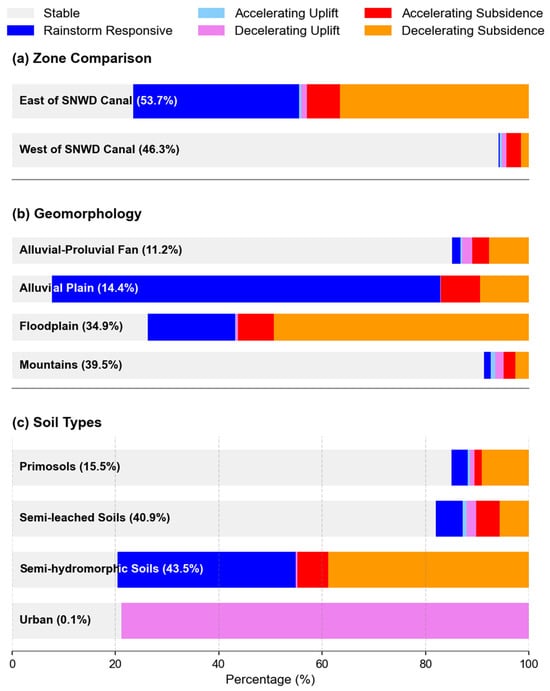
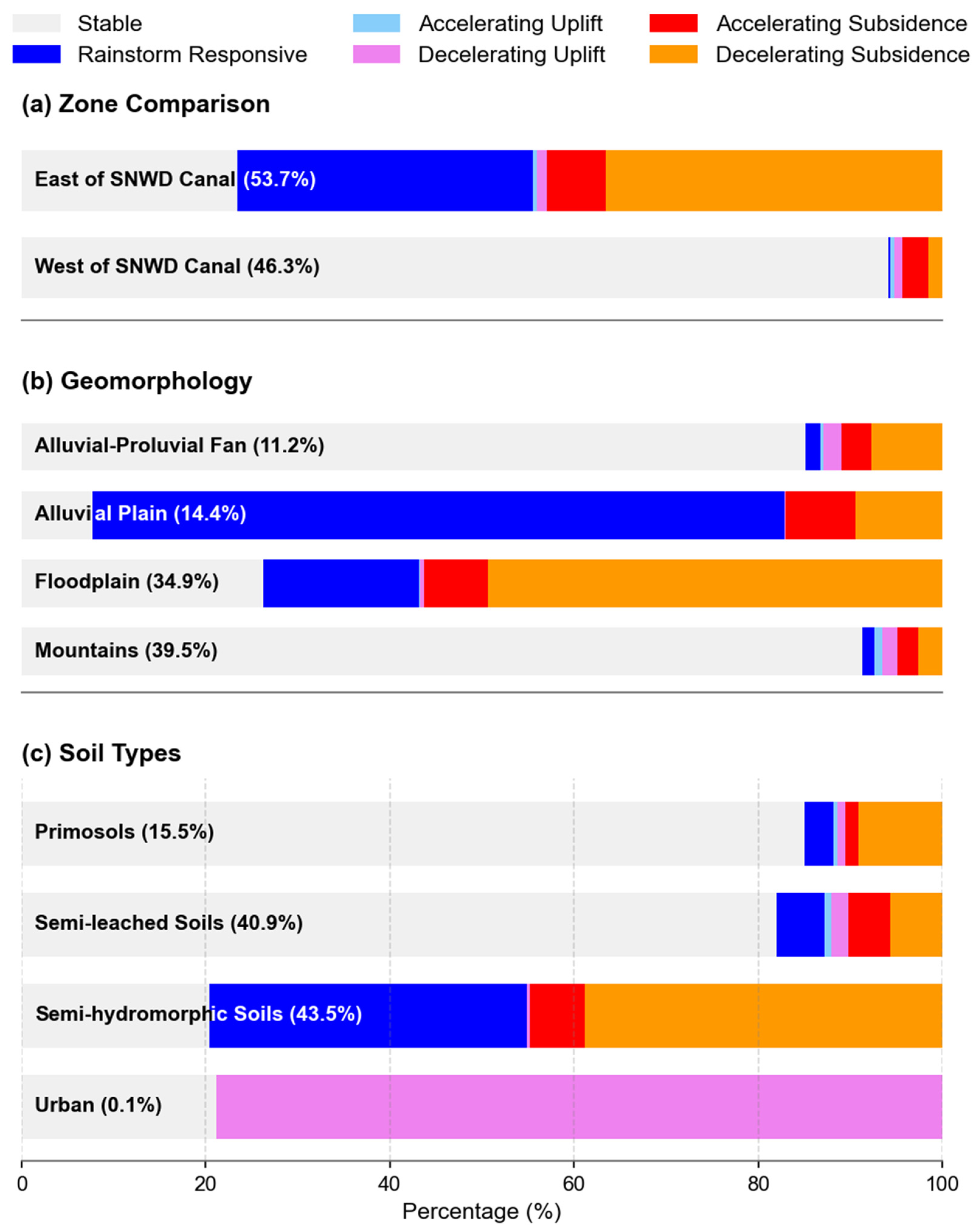
To correlate the InSAR-derived deformation patterns with the geological background, a pixel-by-pixel spatial matching procedure was conducted. The regional geomorphological and soil vector maps were rasterized and resampled to a 30 m resolution to align with the InSAR velocity grid. Spatial overlay analysis was then performed to assign corresponding geomorphological and lithological attributes to each classified pixel. The detailed pixel counts and area proportions for each deformation category are summarized in Figure 6 and Table 1. Regional statistics show that deformation is concentrated overwhelmingly east of the main canal, whereas the western side remains largely stable. As illustrated in Figure 6b, alluvial plains are the most sensitive to extreme rainstorms. This high sensitivity is attributed to the excellent hydraulic connectivity and moderate skeletal stiffness of their sedimentary layers, which allow extreme precipitation infiltration to rapidly translate into pore-water pressure and trigger surface rebound [66,67]. In contrast, floodplains respond slowly; even when extreme rainstorms induce robust hydraulic head variations, the resulting surface deformation occurs gradually. Meanwhile, mountainous areas and proluvial fans generally remain stable overall [68,69].
Figure 6.
Statistical distribution of deformation patterns across different sub-regions and geological backgrounds. (a) Regional comparison: The area west of the SNWD main canal is predominantly stable, whereas the eastern side exhibits complex deformation responses, including significant subsidence and rainstorm-responsive characteristics. (b) Geomorphological units: Alluvial plains are the most sensitive to extreme rainstorms, while mountainous areas remain the most stable. (c) Soil types: Regions with semi-hydromorphic soils display the strongest rainstorm response and subsidence features; urban areas are primarily characterized by decelerating uplift.
Table 1.
Summary of the key characteristics of the six classified land deformation patterns.
Different soil types also dictate varying degrees of response to surface deformation and groundwater fluctuations [70]. Among the soil categories, semi-hydromorphic soils are the most deformation-sensitive, primarily distributed in the eastern part of the study area. Despite the mitigating influences of the SNWD project and groundwater restriction policies, deformation within this soil type remains predominantly subsidence-driven. From a geotechnical perspective, the distinct behavioral contrast between these regions and the alluvial plains is fundamentally governed by the principles of aquitard consolidation [7]. In the deep, clay-rich zones (aquitards), decades of severe groundwater overexploitation have caused the clay skeleton to undergo inelastic rearrangement. This irreversible plastic compaction permanently diminishes the porosity and elastic storage capacity of the aquitards, physically preventing any significant volumetric expansion even when subjected to extreme transient recharge. In contrast, the coarse-grained sand and gravel deposits dominating the highly permeable alluvial plains primarily endure stress fluctuations within their elastic limits. Their deformation remains structurally reversible, enabling the rapid and robust rebound observed following the immense infiltration from the ‘7.20’ rainstorm.
Remarkably, nearly 80% of urban areas—delineated based on the classification from the RESDC dataset—exhibit a decelerating uplift pattern. This finding corroborates the significant socioeconomic and environmental benefits of the SNWD project and groundwater pumping bans in urbanized regions [11,71]. Following the substitution of water sources, cities like Zhengzhou have experienced pronounced surface uplift since 2014 [72]. As urban areas rely most heavily on the SNWD supply and enforce the strictest groundwater-extraction bans, urban aquifers undergo elastic rebound. However, as pore-water pressure gradually approaches hydrostatic pressure, the expansion of the aquifer skeleton approaches its physical limit, thereby decelerating the uplift rate. Persistent groundwater pumping in the peripheral peri-urban and agricultural zones maintains a regional cone of depression, creating a lateral hydraulic gradient. This gradient drives the outward dissipation of the replenished urban groundwater, further restricting the magnitude of the long-term urban rebound. This combined mechanism also elucidates why urban areas lack a long-term deformation response to extreme rainstorms, exhibiting only a transient uplift: the local aquifer is already highly saturated, while peripheral dissipation prevents sustained accumulation.
4.4. Limitations and Future Perspectives
Although this study elucidates the dual control mechanisms of the South-to-North Water Diversion (SNWD) project and extreme rainfall on land deformation in the Taihang Mountains piedmont, several limitations remain to be addressed in future research.
First, constrained by the limited availability of high-spatiotemporal-resolution in situ groundwater piezometric data, this study primarily relies on surface kinematic features derived from time-series InSAR data to provide qualitative and spatial statistical mechanistic interpretations. The scarcity of dense hydrogeological borehole data makes it challenging to precisely correlate surface deformation with pore-water pressure variations in specific aquifer systems (e.g., shallow unconfined versus deep confined aquifers).
Second, our data processing assumed that the land deformation is predominantly vertical, thereby projecting the Line-of-Sight (LOS) displacements into the vertical direction. However, near active fault zones and at the margins of severe subsidence bowls, horizontal deformation gradients may not be negligible. Relying on a single-track LOS conversion might locally underestimate or overestimate the true structural deformation in these specific areas. As horizontal movements can reflect localized strain partitioning and hydro-mechanical coupling, ignoring them obscures valuable directional information that is critical for understanding deformation mechanisms near structural boundaries. To address these geometric limitations, future studies should integrate ascending and descending SAR imagery from diverse multi-sensor missions (e.g., L-band ALOS-2 or high-resolution X-band TerraSAR-X) or continuous GNSS observations to resolve the three-dimensional surface deformation field, thereby providing a more comprehensive depiction of the strain characteristics under hydrological-tectonic coupling. Furthermore, regarding data processing uncertainties, while the bedrock evaluation confirms regional stability, interpreting relatively small-amplitude local signals requires an accounting of processing uncertainties. Regarding multi-track mosaicking, minor residual offsets may persist in overlapping areas; however, the primary localized signals observed in this study do not spatially correlate with track boundaries, confirming they are genuine hydro-mechanical responses rather than mosaicking artifacts. Additionally, considering the baseline time-series uncertainty (standard deviation of 4.4 mm/yr), our empirically established classification threshold of 15 mm/yr rigorously adheres to the three-sigma confidence interval. This statistical margin effectively ensures that the identified kinematic shifts confidently exceed the combined uncertainties from mosaicking, geometric projection, and residual atmospheric noise.
Finally, the current discussion predominantly focuses on geostatistical analysis and phenomenological observations. In future endeavors, we aim to simulate the stress-strain responses of the aquifer system under complex hydraulic loading—encompassing both anthropogenic engineering recharge and extreme meteorological events. Such modeling will furnish more granular scientific support for the sustainable management of groundwater resources in the North China Plain and the safe operation of critical infrastructures.
5. Conclusions
By coupling time-series InSAR techniques with geostatistical analysis, this study evaluated land deformation characteristics in the piedmont of the Taihang Mountains under the influence of recharge from the SNWD project and perturbations due to extreme rainfall. We identify a pronounced east-west spatial dichotomy in land deformation across the eastern foot of the Taihang Mountains. West of the SNWD canal, the land surface is predominantly stable and even exhibits localized uplift (with a maximum rate of approximately 15 mm/yr in northern Xingtai and Handan), and the bedrock mountainous areas show near-zero deformation rates; in contrast, significant land subsidence dominates the eastern side of the canal in the Hebei province, where the maximum subsidence rate exceeds −70 mm/yr in Nangong City (eastern Xingtai and Handan), with only sporadic minor uplift observed in eastern Zhengzhou of Henan province. Furthermore, the spatial alignments suggest that the fault-canal system likely acts as a semi-closed hydrogeological boundary, although future multi-track 3D InSAR observations are required to fully decouple the complex boundary kinematics and overcome the geometric limitations of single-track projections.
Geomorphological units and soil types are fundamental intrinsic factors that dictate the sensitivity of deformation responses. Due to their higher permeability and moderate skeletal compressibility, alluvial plains and semi-hydromorphic soil regions exhibit the strongest elastic response capacity to variations in hydraulic loading. In contrast, bedrock mountainous areas and proluvial fans maintain long-term geological stability. The response of the 2021 “7.20” extreme rainstorm on land deformation exhibits pronounced spatial heterogeneity. In alluvial plains characterized by excellent hydraulic connectivity, the rainstorm triggered a transient surge in pore water pressure and subsequent surface uplift. Conversely, in cohesive soil regions subjected to severe long-term overexploitation, continuous subsidence persists despite short-term rainfall recharge, owing to the irreversible plastic deformation (compaction) of the soil matrix. This discrepancy indicates that the restorative capacity of extreme weather events on groundwater systems is fundamentally governed by local lithology and compaction history.
The findings provide critical insights into the coupling relationship between inter-basin water transfer projects, regional groundwater dynamics, and land deformation in typical piedmont alluvial–proluvial fan aquifer systems, offering valuable hydrogeological and geodetic perspectives for regional groundwater resource management and geo-hazard prevention in the study area. Based on these perspectives, we practically recommend that managed aquifer recharge (MAR) initiatives within the highly permeable alluvial plains, leveraging their robust elastic resilience, should be prioritized. Furthermore, spatially partitioned groundwater extraction controls should be implemented specifically within fault-bounded compartments to mitigate localized structural deformation hazards.
Author Contributions
Conceptualization, T.W.; methodology, W.S.; formal analysis, W.S.; investigation, N.L. and X.Z.; writing—original draft preparation, W.S.; writing—review and editing, T.W.; supervision, T.W.; funding acquisition, T.W. All authors have read and agreed to the published version of the manuscript.
Funding
This work was supported by the Scientific Research Special Fund of Hongshan Field Station under the Spark Program of Hebei Province: Study on the Development Mechanism and Risk Assessment of Ground Fissures in the Xingtai Earthquake Area through Grant DZ2024052200003 and Analysis of Land Subsidence and Groundwater Storage Changes using GRACE and InSAR: A Case Study of Southern Hebei Province through Grant DZ2024121900001.
Data Availability Statement
The Sentinel-1 SAR data were provided by the European Space Agency (ESA) through the Copernicus Open Access Hub. The GACOS atmospheric correction data are available at http://www.gacos.net/. The precipitation data can be accessed via the CHIRPS dataset. All other data generated during this study are available from the corresponding author upon reasonable request.
Conflicts of Interest
The authors declare no conflicts of interest.
Abbreviations
The following abbreviations are used in this manuscript:
| InSAR | Interferometric Synthetic Aperture Radar |
| SBAS | Small Baseline Subset |
| SNWD | South-to-North Water Diversion |
| GACOS | Generic Atmospheric Correction Online Service for InSAR |
| MCF | Minimum Cost Flow |
| LOS | Line-of-Sight |
| STD | Standard Deviation |
References
- de Graaf, I.E.M.; Gleeson, T.; van Beek, L.P.H.; Sutanudjaja, E.H.; Bierkens, M.F.P. Environmental flow limits to global groundwater pumping. Nature 2019, 574, 90–94. [Google Scholar] [CrossRef] [Scilit]
- Doell, P.; Mueller Schmied, H.; Schuh, C.; Portmann, F.T.; Eicker, A. Global-scale assessment of groundwater depletion and related groundwater abstractions: Combining hydrological modeling with information from well observations and GRACE satellites. Water Resour. Res. 2014, 50, 5698–5720. [Google Scholar] [CrossRef] [Scilit]
- Stramondo, S.; Bozzano, F.; Marra, F.; Wegmuller, U.; Cinti, F.R.; Moro, M.; Saroli, M. Subsidence induced by urbanisation in the city of Rome detected by advanced InSAR technique and geotechnical investigations. Remote Sens. Environ. 2008, 112, 3160–3172. [Google Scholar] [CrossRef] [Scilit]
- Bai, L.; Jiang, L.; Zhao, Y.; Li, Z.; Cao, G.; Zhao, C.; Liu, R.; Wang, H. Quantifying the influence of long-term overexploitation on deep groundwater resources across Cangzhou in the North China Plain using InSAR measurements. J. Hydrol. 2022, 605, 127368. [Google Scholar] [CrossRef] [Scilit]
- Guo, H.L.; Yuan, Y.H.; Wang, J.Y.; Cui, J.; Zhang, D.J.; Zhang, R.R.; Cao, Q.Z.R.; Li, J.; Dai, W.H.; Bao, H.M.; et al. Large-Scale Land Subsidence Monitoring and Prediction Based on SBAS-InSAR Technology with Time-Series Sentinel-1A Satellite Data. Remote Sens. 2023, 15, 2843. [Google Scholar] [CrossRef] [Scilit]
- Yang, H.; Cao, W.; Zhi, C.; Li, Z.; Bao, X.; Ren, Y.; Liu, F.; Fan, C.; Wang, S.; Wang, Y. Evolution of groundwater level in the North China Plain in the past 40 years and suggestions on its overexploitation treatment. Geol. China 2021, 48, 1142–1155. [Google Scholar]
- Galloway, D.L.; Burbey, T.J. Review: Regional land subsidence accompanying groundwater extraction. Hydrogeol. J. 2011, 19, 1459–1486. [Google Scholar] [CrossRef] [Scilit]
- He, Q.; Yang, H.; Fang, Y.; Wang, B.; Liu, S.; Han, L. Correlation analysis of surface deformation and groundwater level in Zhengzhou city. Prog. Geophys. 2017, 32, 2636–2641. [Google Scholar]
- Saowiang, K.; Giao, P.H. Numerical analysis of subsurface deformation induced by groundwater level changes in the Bangkok aquifer system. Acta Geotech. 2021, 16, 1265–1279. [Google Scholar] [CrossRef] [Scilit]
- Zhou, C.; Gong, H.; Chen, B.; Gao, M.; Cao, Q.; Cao, J.; Duan, L.; Zuo, J.; Shi, M. Land Subsidence Response to Different Land Use Types and Water Resource Utilization in Beijing-Tianjin-Hebei, China. Remote Sens. 2020, 12, 457. [Google Scholar] [CrossRef] [Scilit]
- Long, D.; Yang, W.; Scanlon, B.R.; Zhao, J.; Liu, D.; Burek, P.; Pan, Y.; You, L.; Wada, Y. South-to-North Water Diversion stabilizing Beijing’s groundwater levels. Nat. Commun. 2020, 11, 3665. [Google Scholar] [CrossRef] [Scilit] [PubMed]
- Liu, F.; Hu, X.Z.; Zhen, P.N.; Zou, J.W.; Zhang, J.K. Characterizing groundwater recharge sources within reduced pumped aquifers in the Heilonggang region, North China Plain. J. Geochem. Explor. 2023, 247, 107176. [Google Scholar] [CrossRef] [Scilit]
- Xiong, S.; Deng, Z.; Zhang, B.; Wang, C.; Qin, X.; Li, Q. Deformation Evaluation of the South-to-North Water Diversion Project (SNWDP) Central Route over Handan in Hebei, China, Based on Sentinel-1A, Radarsat-2, and TerraSAR-X Datasets. Remote Sens. 2023, 15, 3516. [Google Scholar] [CrossRef] [Scilit]
- Zhang, C.; Duan, Q.; Yeh, P.J.F.; Pan, Y.; Gong, H.; Gong, W.; Di, Z.; Lei, X.; Liao, W.; Huang, Z.; et al. The Effectiveness of the South-to-North Water Diversion Middle Route Project on Water Delivery and Groundwater Recovery in North China Plain. Water Resour. Res. 2020, 56, e2019WR026759. [Google Scholar] [CrossRef] [Scilit]
- Zhang, R.; Wang, T.; Liu, G.X.; Shama, A.; Liu, A.M.Y.; Wang, X.W.; Deng, L.; Mao, W.F. Ground subsidence evolution and groundwater variation in the middle route of south to north water diversion project. Sci. Rep. 2025, 15, 19220. [Google Scholar] [CrossRef] [Scilit]
- Long, D.; Xu, Y.; Cui, Y.; Cui, Y.; Butler, J.J.; Dong, L.; Wang, L.; Liu, D.; Wada, Y.; Hu, L.; et al. Unprecedented large-scale aquifer recovery through human intervention. Nat. Commun. 2025, 16, 7296. [Google Scholar] [CrossRef] [Scilit]
- Xu, H.; Li, M.; Wang, T.; Ge, D.; Pan, Y. Decadal water management measures moderated the subsidence of North China Plain. Sci. Bull. 2025, 70, 1538–1541. [Google Scholar] [CrossRef] [Scilit]
- Yang, Y.; Li, Q.; Gu, Y. Analysis of surface vertical load deformation in the North China Plain from 2002 to 2023 using GRACE and GPS. Sci. Surv. Mapp. 2024, 49, 9–21. [Google Scholar]
- Wu, Q.F.; Si, B.C.; He, H.L.; Wu, P.T. Determining Regional-Scale Groundwater Recharge with GRACE and GLDAS. Remote Sens. 2019, 11, 154. [Google Scholar] [CrossRef] [Scilit]
- Buzzanga, B.; Bekaert, D.P.S.; Hamlington, B.D.; Kopp, R.E.; Govorcin, M.; Miller, K.G. Localized uplift, widespread subsidence, and implications for sea level rise in the New York City metropolitan area. Sci. Adv. 2023, 9, eadi8259. [Google Scholar] [CrossRef] [Scilit] [PubMed]
- Dixon, T.H.; Amelung, F.; Ferretti, A.; Novali, F.; Rocca, F.; Dokka, R.; Sella, G.; Kim, S.W.; Wdowinski, S.; Whitman, D. Subsidence and flooding in New Orleans. Nature 2006, 441, 587–588. [Google Scholar] [CrossRef] [Scilit]
- Li, J.; Jin, G.; Xiong, X.; Zhou, L.; Ye, H.; Shi, Q.; Yang, H. Surface Time Series Response and Deformation Cause Analysis in 2021 Zhengzhou Extreme Weather, China. Earth Space Sci. 2024, 11, e2024EA003643. [Google Scholar] [CrossRef] [Scilit]
- Lan, Q.; Dong, J.; Lai, S.; Wang, N.; Zhang, L.; Liao, M. Flood Inundation Extraction and its Impact on Ground Subsidence Using Sentinel-1 Data: A Case Study of the “7.20” Rainstorm Event in Henan Province, China. IEEE J. Sel. Top. Appl. Earth Obs. Remote Sens. 2024, 17, 2927–2938. [Google Scholar] [CrossRef] [Scilit]
- Eskandari, R.; Scaioni, M. Spatiotemporal Pattern Detection of Ground Deformations Induced by Extreme Rainfall using InSAR EGMS: The case of Cortina d’Ampezzo after Vaia Storm. In Proceedings of the 2024 Mid-Term Symposium on Beyond the canopy-Technologies and Applications of Remote Sensing, Belem, Brazil, 4–8 November 2024; pp. 131–138. [Google Scholar]
- Liang, X.Y.; Zhan, H.B.; Schilling, K. Spatiotemporal Responses of Groundwater Flow and Aquifer-River Exchanges to Flood Events. Water Resour. Res. 2018, 54, 1513–1532. [Google Scholar] [CrossRef] [Scilit]
- Nan, T.; Cao, W.; Wang, Z.; Gao, Y.; Zhao, L.; Sun, X.; Na, J. Evaluation of shallow groundwater dynamics after water supplement in North China Plain based on attention-GRU model. J. Hydrol. 2023, 625, 130085. [Google Scholar] [CrossRef] [Scilit]
- Wang, J.; Ding, K.; Chen, X.; Guo, R.; Sun, H. Influence of South-to-North Water Diversion on Land Subsidence in North China Plain Revealed by Using Geodetic Measurements. Remote Sens. 2024, 16, 162. [Google Scholar] [CrossRef] [Scilit]
- Zhang, C.; Duan, Q.Y.; Yeh, P.J.F.; Pan, Y.; Gong, H.L.; Moradkhani, H.; Gong, W.; Lei, X.H.; Liao, W.H.; Xu, L.; et al. Sub-regional groundwater storage recovery in North China Plain after the South-to-North water diversion project. J. Hydrol. 2021, 597, 126156. [Google Scholar] [CrossRef] [Scilit]
- Ferretti, A.; Prati, C.; Rocca, F. Permanent scatterers in SAR interferometry. IEEE Trans. Geosci. Remote Sens. 2001, 39, 8–20. [Google Scholar] [CrossRef] [Scilit]
- Li, S.W.; Xu, W.B.; Li, Z.W. Review of the SBAS InSAR Time-series algorithms, applications, and challenges. Geod. Geodyn. 2022, 13, 114–126. [Google Scholar] [CrossRef] [Scilit]
- Neely, W.R.; Borsa, A.A.; Burney, J.A.; Levy, M.C.; Silverii, F.; Sneed, M. Characterization of Groundwater Recharge and Flow in California’s San Joaquin Valley From InSAR-Observed Surface Deformation. Water Resour. Res. 2021, 57, e2020WR028451. [Google Scholar] [CrossRef] [Scilit]
- Peng, M.M.; Lu, Z.; Zhao, C.Y.; Motagh, M.; Bai, L.; Conway, B.D.; Chen, H.Y. Mapping land subsidence and aquifer system properties of the Willcox Basin, Arizona, from InSAR observations and independent component analysis. Remote Sens. Environ. 2022, 271, 112894. [Google Scholar] [CrossRef] [Scilit]
- Perissin, D.; Wang, T. Time-Series InSAR Applications Over Urban Areas in China. IEEE J. Sel. Top. Appl. Earth Obs. Remote Sens. 2011, 4, 92–100. [Google Scholar] [CrossRef] [Scilit]
- Li, Z.H.; Muller, J.P.; Cross, P.; Fielding, E.J. Interferometric synthetic aperture radar (InSAR) atmospheric correction: GPS, moderate resolution Imaging spectroradiometer (MODIS), and InSAR integration-art. no. B03410. J. Geophys. Res.-Solid Earth 2005, 110, B03410. [Google Scholar] [CrossRef] [Scilit]
- Xiao, R.; Yu, C.; Li, Z.; He, X. Statistical assessment metrics for InSAR atmospheric correction: Applications to generic atmospheric correction online service for InSAR (GACOS) in Eastern China. Int. J. Appl. Earth Obs. Geoinf. 2021, 96, 102289. [Google Scholar] [CrossRef] [Scilit]
- Jiang, H.; Feng, G.; Wang, T.; Bürgmann, R. Toward full exploitation of coherent and incoherent information in Sentinel-1 TOPS data for retrieving surface displacement: Application to the 2016 Kumamoto (Japan) earthquake. Geophys. Res. Lett. 2017, 44, 1758–1767. [Google Scholar] [CrossRef] [Scilit]
- Li, Y.F.; Zuo, X.Q.; Xiong, P.; Chen, Z.T.; Yang, F.; Li, X.X. Monitoring Land Subsidence in North-central Henan Plain using the SBAS-InSAR Method with Sentinel-1 Imagery Data. J. Indian Soc. Remote Sens. 2022, 50, 635–655. [Google Scholar] [CrossRef] [Scilit]
- Yang, P.; Guo, B.; Yuan, J.; Xing, H.; Yuan, W. Influencing factors analysis of surface deformation in Xingtai city using technology of InSAR time series. Sci. Surv. Mapp. 2025, 50, 133–143. [Google Scholar] [CrossRef] [Scilit]
- Li, M.; Sun, J.; Xue, L.; Shen, Z. Wide-area InSAR Time Series Analysis Technique for Monitoring of Surface Deformation in the North China Plain. Acta Sci. Nat. Univ. Pekin. 2023, 59, 934–944. [Google Scholar] [CrossRef] [Scilit]
- Liu, M.; Pei, H.; Shen, Y. Evaluating dynamics of GRACE groundwater and its drought potential in Taihang Mountain Region, China. J. Hydrol. 2022, 612, 128156. [Google Scholar] [CrossRef] [Scilit]
- Song, S.; Bai, L.; Yang, C. Characterization of the Land Deformation Induced by Groundwater Withdrawal and Aquifer Parameters Using InSAR Observations in the Xingtai Plain, China. Remote Sens. 2022, 14, 4488. [Google Scholar] [CrossRef] [Scilit]
- Zhou, Z.; Hu, J.; Wang, J.; Wang, L.; Qiao, T.; Li, Z.; Cheng, S. Identifying spatiotemporal pattern and trend prediction of land subsidence in Zhengzhou combining MT-InSAR, XGBoost and hydrogeological analysis. Sci. Rep. 2025, 15, 3848. [Google Scholar] [CrossRef] [Scilit]
- Cao, G.; Zheng, C.; Scanlon, B.R.; Liu, J.; Li, W. Use of flow modeling to assess sustainability of groundwater resources in the North China Plain. Water Resour. Res. 2013, 49, 159–175. [Google Scholar] [CrossRef] [Scilit]
- Guo, H.; Wang, L.; Cheng, G.; Zhang, Z. Groundwater-abstraction induced land subsidence and groundwater regulation in the North China Plain. Proc. Int. Assoc. Hydrol. Sci. 2015, 372, 17–21. [Google Scholar] [CrossRef] [Scilit]
- Bürgmann, R.; Rosen, P.A.; Fielding, E.J. Synthetic aperture radar interferometry to measure Earth’s surface topography and its deformation. Annu. Rev. Earth Planet. Sci. 2000, 28, 169–209. [Google Scholar] [CrossRef] [Scilit]
- Funk, C.; Peterson, P.; Landsfeld, M.; Pedreros, D.; Verdin, J.; Shukla, S.; Husak, G.; Rowland, J.; Harrison, L.; Hoell, A.; et al. The climate hazards infrared precipitation with stations—A new environmental record for monitoring extremes. Sci. Data 2015, 2, 150066. [Google Scholar] [CrossRef] [Scilit] [PubMed]
- Liu, H.; Zhao, W.; Qin, Z.; Wang, T.; Li, G.; Zhu, M. Time-Series InSAR Deformation Monitoring of High Fill Characteristic Canal of South-North Water Diversion Project in China. Appl. Sci. 2023, 13, 6415. [Google Scholar] [CrossRef] [Scilit]
- Goldstein, R.M.; Werner, C.L. Radar interferogram filtering for geophysical applications. Geophys. Res. Lett. 1998, 25, 4035–4038. [Google Scholar] [CrossRef] [Scilit]
- Zebker, H.A.; Rosen, P.A.; Hensley, S. Atmospheric effects in interferometric synthetic aperture radar surface deformation and topographic maps. J. Geophys. Res.-Solid Earth 1997, 102, 7547–7563. [Google Scholar] [CrossRef] [Scilit]
- Morishita, Y.; Lazecky, M.; Wright, T.J.; Weiss, J.R.; Elliott, J.R.; Hooper, A. LiCSBAS: An Open-Source InSAR Time Series Analysis Package Integrated with the LiCSAR Automated Sentinel-1 InSAR Processor. Remote Sens. 2020, 12, 424. [Google Scholar] [CrossRef] [Scilit]
- Pepe, A.; Calò, F. A Review of Interferometric Synthetic Aperture RADAR (InSAR) Multi-Track Approaches for the Retrieval of Earth’s Surface Displacements. Appl. Sci. 2017, 7, 1264. [Google Scholar] [CrossRef] [Scilit]
- Maghsoudi, Y.; Hooper, A.J.; Wright, T.J.; Lazecky, M.; Ansari, H. Characterizing and correcting phase biases in short-term, multilooked interferograms. Remote Sens. Environ. 2022, 275, 113022. [Google Scholar] [CrossRef] [Scilit]
- Bui, L.K.; Featherstone, W.E.; Filmer, M.S. Disruptive influences of residual noise, network configuration and data gaps on InSAR-derived land motion rates using the SBAS technique. Remote Sens. Environ. 2020, 247, 111941. [Google Scholar] [CrossRef] [Scilit]
- Zhang, Y.J.; Fattahi, H.; Amelung, F. Small baseline InSAR time series analysis: Unwrapping error correction and noise reduction. Comput. Geosci. 2019, 133, 104331. [Google Scholar] [CrossRef] [Scilit]
- Liu, R.L.; Zhong, B.; Li, X.P.; Zheng, K.Y.; Liang, H.; Cao, J.M.; Yan, X.; Lyu, H.X. Analysis of groundwater changes (2003–2020) in the North China Plain using geodetic measurements. J. Hydrol.-Reg. Stud. 2022, 41, 101085. [Google Scholar] [CrossRef] [Scilit]
- Ma, Z.T.; Wang, W.K.; Hou, X.Y.; Wang, J.X.; Duan, L.; Wang, Y.; Zhao, M.; Li, J.; Jing, J.N.; Li, L.S. Examining the change in groundwater flow patterns: A case study from the plain area of the Baiyangdian Lake Watershed, North China. J. Hydrol. 2023, 625, 130160. [Google Scholar] [CrossRef] [Scilit]
- Li, H.X.; Wang, X.S. A Preliminary Study on a Pumping Well Capturing Groundwater in an Unconfined Aquifer with Mountain-Front Recharge from Segmental Inflow. Water 2019, 11, 1243. [Google Scholar] [CrossRef] [Scilit]
- Qu, F.; Lu, Z.; Zhang, Q.; Bawden, G.W.; Kim, J.-W.; Zhao, C.; Qu, W. Mapping ground deformation over Houston–Galveston, Texas using multi-temporal InSAR. Remote Sens. Environ. 2015, 169, 290–306. [Google Scholar] [CrossRef] [Scilit]
- Lu, Z.; Danskin, W.R. InSAR analysis of natural recharge to define structure of a ground-water basin, San Bernardino, California. Geophys. Res. Lett. 2001, 28, 2661–2664. [Google Scholar] [CrossRef] [Scilit]
- Coda, S.; Tessitore, S.; Di Martire, D.; Calcaterra, D.; De Vita, P.; Allocca, V. Coupled ground uplift and groundwater rebound in the metropolitan city of Naples (southern Italy). J. Hydrol. 2019, 569, 470–482. [Google Scholar] [CrossRef] [Scilit]
- Hoffmann, J.; Galloway, D.L.; Zebker, H.A. Inverse modeling of interbed storage parameters using land subsidence observations, Antelope Valley, California-art. no. 1031. Water Resour. Res. 2003, 39, 1031. [Google Scholar] [CrossRef] [Scilit]
- Wang, Y.; Chen, X.; Wang, Z.; Gao, M.; Wang, L. Integrating SBAS-InSAR and Random Forest for Identifying and Controlling Land Subsidence and Uplift in a Multi-Layered Porous System of North China Plain. Remote Sens. 2024, 16, 830. [Google Scholar] [CrossRef] [Scilit]
- Medici, C.; Del Soldato, M.; Fibbi, G.; Bini, L.; Confuorto, P.; Mannori, G.; Mucci, A.; Pellegrineschi, V.; Bianchini, S.; Raspini, F.; et al. InSAR data for detection and modelling of overexploitation-induced subsidence: Application in the industrial area of Prato (Italy). Sci. Rep. 2024, 14, 17950. [Google Scholar] [CrossRef] [Scilit]
- Shi, X.G.; Zhu, T.T.; Tang, W.; Jiang, M.; Jiang, H.J.; Yang, C.; Zhan, W.; Ming, Z.T.; Zhang, S.C. Inferring decelerated land subsidence and groundwater storage dynamics in Tianjin-Langfang using Sentinel-1 InSAR. Int. J. Digit. Earth 2022, 15, 1526–1546. [Google Scholar] [CrossRef] [Scilit]
- Murray, K.D.; Lohman, R.B. Short-lived pause in Central California subsidence after heavy winter precipitation of 2017. Sci. Adv. 2018, 4, eaar8144. [Google Scholar] [CrossRef] [Scilit]
- Lu, X.H.; Jin, M.G.; van Genuchten, M.T.; Wang, B.G. Groundwater Recharge at Five Representative Sites in the Hebei Plain, China. Ground Water 2011, 49, 286–294. [Google Scholar] [CrossRef] [Scilit]
- Zhang, X.; Chen, B.B.; Gong, H.L.; Lei, K.C.; Zhou, C.F.; Lu, Z.Z.; Zhao, D.N. Inversion of Groundwater Storage Variations Considering Lag Effect in Beijing Plain, from RadarSat-2 with SBAS-InSAR Technology. Remote Sens. 2022, 14, 991. [Google Scholar] [CrossRef] [Scilit]
- Liu, J.; Tsujimura, M.; Zhang, J.; Yi, Z. Utilizing Stable Isotopes and Major Ions to Isolate the Recharge Regime of an Alluvial-Proluvial Fan Aquifer in the Piedmont Region of the South Taihang Mountains, North China Plain. Water Resour. 2023, 50, 969–985. [Google Scholar] [CrossRef] [Scilit]
- Wu, Q.; Wang, G.; Lin, W.; Zhang, F. Estimating Groundwater Recharge of Taihang Mountain Piedmont in Luancheng County, Hebei Province, China. Geol. Sci. Technol. Inf. 2012, 31, 99–105. [Google Scholar]
- Liu, Z.Y.; Ng, A.H.M.; Wang, H.; Chen, J.W.; Du, Z.Y.; Ge, L.L. Land subsidence modeling and assessment in the West Pearl River Delta from combined InSAR time series, land use and geological data. Int. J. Appl. Earth Obs. Geoinf. 2023, 118, 103228. [Google Scholar] [CrossRef] [Scilit]
- Yuan, Y.; Zhang, D.; Cui, J.; Zeng, T.; Zhang, G.; Zhou, W.; Wang, J.; Chen, F.; Guo, J.; Chen, Z.; et al. Land subsidence prediction in Zhengzhou’s main urban area using the GTWR and LSTM models combined with the Attention Mechanism. Sci. Total Environ. 2024, 907, 167482. [Google Scholar] [CrossRef] [Scilit] [PubMed]
- Zhang, Z.; Wang, C.; Wang, M.; Wang, Z.; Zhang, H. Surface Deformation Monitoring in Zhengzhou City from 2014 to 2016 Using Time-Series InSAR. Remote Sens. 2018, 10, 1731. [Google Scholar] [CrossRef] [Scilit]

Disclaimer/Publisher’s Note: The statements, opinions and data contained in all publications are solely those of the individual author(s) and contributor(s) and not of MDPI and/or the editor(s). MDPI and/or the editor(s) disclaim responsibility for any injury to people or property resulting from any ideas, methods, instructions or products referred to in the content. |
© 2026 by the authors. Licensee MDPI, Basel, Switzerland. This article is an open access article distributed under the terms and conditions of the Creative Commons Attribution (CC BY) license.