


Abstract
China’s urban size distribution has increasingly shifted toward concentration in large cities amid global urbanization and the restructuring of urban development patterns. This trend has intensified governance and spatial pressures in major cities while exposing weaker growth momentum in small and medium-sized cities and reducing overall urban system coordination. Existing studies mainly explain this pattern through market forces such as agglomeration economies, housing prices, and migration, while others examine the consequences of local land practices from the perspectives of land finance, local competition, and institutional change. However, there is still no systematic explanation of why centrally imposed aggregate land constraints, operating through heterogeneous local land allocation, generate uneven urban outcomes. Against the background of the 2004 strict land management reform, this paper develops a theory-oriented conceptual framework linking central land constraints, local land allocation, and urban size structure. It clarifies how uniform central constraints may be translated into uneven urban outcomes through differentiated local land-allocation practices. Local land allocation is identified as the key transmission mechanism through which development opportunities are reshaped across cities and, under specific institutional conditions, the upper tiers of the urban hierarchy are reinforced. This paper therefore offers a bounded explanation of how central–local land governance shapes China’s urban size structure, while also underscoring the relevance of land governance to more balanced, resource-efficient, and sustainable urban development.
1. Introduction
Against the backdrop of ongoing global urbanization and the continued expansion of large cities reshaping national urban hierarchies, issues of urban growth, spatial inequality, and hierarchical differentiation have remained central to academic debate [1,2,3]. In China, the urban size distribution has likewise exhibited a persistent tendency toward concentration in large cities [4,5,6,7]. As shown in Figure 1, this pattern is characterized by an upward concentration, with the relative weight of high-tier cities increasing while that of small and medium-sized cities declines. This trend has intensified governance and spatial pressures in large cities while exposing weaker development momentum in smaller cities. More importantly, despite the long-standing policy objective of “controlling the size of large cities while promoting the rational development of small and medium-sized cities,” China’s urban evolution has not moved toward a more balanced structure, but has instead continued to display a strong upward concentration [4,7,8]. Explaining why higher-tier cities continue to strengthen under institutional regulation has therefore become a key entry point for interpreting both China’s urbanization process and the logic of its spatial governance.
Figure 1.
The evolution of China’s urban size structure.
Existing research on the formation and evolution of urban size structure has broadly followed two approaches. The first emphasizes market mechanisms, explaining differences in population distribution and urban development through agglomeration economies, congestion costs, migration, and city-size efficiency [9,10]. The second focuses on China’s distinctive land institutions and local government behavior, arguing that land transfer, land-based finance, land regulation, and interjurisdictional competition have profoundly shaped local fiscal capacity, industrial development, and patterns of urban expansion [11,12,13,14,15]. Recent interdisciplinary research has also highlighted a broader sustainability-oriented perspective, showing that land use, urban planning, and the built environment—including green-building strategies—can shape urban development trajectories and longer-term urban resilience. This perspective is relevant here because it suggests that land-allocation choices matter not only for short-term growth and competition but also for the sustainability profile of urban development over time [16].
Yet an important question remains unresolved. If market forces alone cannot fully explain the persistent concentration of China’s urban size structure in large cities, and if land-institution research has mainly examined consequences for growth, finance, and expansion, why have centrally imposed aggregate land-supply constraints not led to more balanced development, but instead generated uneven structural outcomes across cities? In other words, while market-based and institutional explanations each capture part of the story, neither adequately explains how uniform central land constraints are translated into uneven urban outcomes through differentiated local land allocation [8,17]. This issue is also relevant to sustainability, because when land governance systematically reproduces unequal development opportunities across cities, it may weaken coordinated urban development, reduce the efficiency of land use at the system level, and intensify long-term spatial and social imbalance. What remains missing is not simply another description of central regulation, local response, and land-related consequences, but a framework that explains how these elements are institutionally connected and why their interaction may reinforce, rather than mitigate, urban hierarchy under common constraint. Table 1 is used here as a descriptive background device rather than as direct empirical proof. Its purpose is to summarize the broader structural pattern that motivates the theoretical puzzle addressed in this paper, namely the continued upward concentration of China’s urban size structure rather than balanced diffusion.
Table 1.
Descriptive summary of structural trends across city-size categories in China.
In the statistical presentation above, city-size categories are distinguished more finely. Specifically, the classification follows China’s official city-size standard based on urban permanent population in built-up areas (chengqu changzhu renkou). Under this standard, cities with fewer than 500,000 urban permanent residents are classified as small cities, those with 500,000 to 1 million as medium-sized cities, those with 1 to 5 million as large cities, those with 5 to 10 million as super-large cities, and those with more than 10 million as megacities. In the conceptual discussion that follows, megacities, super-large cities, and large cities are, where appropriate, discussed more broadly as higher-tier cities in order to capture their shared structural advantages within the urban hierarchy. No other characteristics—such as administrative rank, economic strength, or land dependence—are used as the formal criteria for the size classification itself; those factors are introduced later only as explanatory conditions within the analytical framework. The trend labels in Table 1 are therefore not intended to indicate exact growth rates but to summarize directional structural tendencies. More specifically, the interpretation is based on the combined movement of the number of cities, overall population scale, and population share within each city-size category as summarized in Figure 1 and the supporting literature. Where a category shows simultaneous expansion in city number, population scale, and population share, it is interpreted as strengthening its structural position; where population share is stable or relatively declining despite limited numerical increase, the category is interpreted as weakening in relative structural weight. In this sense, “continued concentration at the top of the urban hierarchy” refers to the persistent upward concentration of population and structural weight in higher-tier cities, rather than to a separate statistical coefficient reported in Table 1. Based on this observation, it is necessary to place central land constraints, local land allocation, and urban size structure within a unified institutional framework. At first glance, aggregate land-supply control appears to be a macro-regulatory instrument uniformly imposed across regions, intended to curb the expansion of construction land and guide a more orderly spatial allocation overall [18,19]. In practice, however, such constraints do not operate identically across cities, because cities differ substantially in their dependence on land, development orientation, and existing patterns of land allocation [14,20]. Where local governments have already developed an industry-biased logic of land allocation, tightening aggregate supply may not weaken that bias, but instead reinforce existing priorities under intensifying resource constraints [15,21]. The interaction between uniform central constraints and heterogeneous local land allocation therefore provides a key institutional clue to understanding the continued upward concentration of China’s urban size structure. Figure 2 is not intended merely as an illustration but as a schematic map of the paper’s analytical logic. The propositions in Section 2.3 and the mechanism elaboration in Section 3 follow and unpack the sequence summarized in this figure.
Figure 2.
Conceptual mechanism linking central land constraints, local land allocation, and urban size structure.
In this sense, the Decision of the State Council on Deepening Reform and Strengthening Land Management, issued in 2004, marked not only a further tightening of central control over the expansion of construction land and the order of land use but also a critical institutional turning point at which the logic of central land governance shifted from general regulation to a more binding form of control [22]. This reform did not emerge in isolation. Rather, it was introduced against the backdrop of excessively rapid growth in construction land, frequent illegal land use, the expansion of low-cost industrial land, and mounting pressure on farmland protection, reflecting the central government’s determination to strengthen macro-level regulation and enforce the strictest possible land management regime [23]. Examining this institutional turning point helps frame three closely related questions. First, why is tighter land supply not a neutral policy instrument? Second, why does local land allocation become the key transmission channel through which central constraints are translated into urban outcomes? Third, why does the central–local interaction ultimately result in a further concentration of the urban size structure?
This paper should be read from the outset as a theory-oriented and conceptual institutional framework study, rather than as an empirically grounded research article. It does not provide strict causal identification of the effects of land regulation across all cities. Instead, its purpose is to develop an explanatory framework that clarifies how uniform central land constraints may be translated into differentiated urban outcomes through local land-allocation practices. Methodologically, the study combines four linked steps: institutional interpretation of a critical reform juncture, synthesis of policy and research literature, formulation of conditional theoretical propositions, and mechanism elaboration across sequential analytical stages. This approach is appropriate for the present research because the central problem addressed here is not simply whether land regulation matters, but how uniform central constraints are translated into differentiated urban outcomes through local land allocation. Where that institutional process remains under-specified in the literature, conceptual mechanism-building is a necessary first step before stricter empirical testing can be undertaken. The novelty of the paper lies not simply in bringing together the familiar elements of central regulation, local response, land allocation, and urban structure, but in specifying how these elements are institutionally connected within a single mechanism of translation. More specifically, the paper makes three contributions: it repositions urban size structure within a central–local land-governance perspective, identifies local land allocation as the key transmission mechanism, and advances a conditional explanation of why tighter land supply may, under particular institutional circumstances, reinforce rather than soften urban hierarchy. The conclusions advanced here should therefore be read as bounded theoretical inferences concerning institutional conditions, transmission pathways, and likely structural consequences, rather than as fully verified causal claims.
2. Policy Background and Theoretical Propositions
The evolution of China’s urban size structure cannot be understood solely as the cumulative outcome of market forces; it must also be examined through the institutional logic shaped by the interaction between state spatial governance and local development strategies. With this in mind, this section does not seek to provide empirical verification of specific policy effects. Instead, it develops the paper’s conceptual institutional framework by returning to the 2004 reform of strict land management as a critical institutional turning point and showing how central land governance shifted from general regulation toward a more binding regime of aggregate control. Methodologically, this section performs three linked tasks: it anchors the argument in a specific institutional reform context, distills that context into theoretical propositions, and clarifies what kind of evidence would be relevant for later empirical examination. This approach is effective for the present study because the paper seeks to explain an under-theorized process of institutional translation rather than estimate a net policy effect with a single empirical model. By proceeding from institutional background to propositions and then to mechanism elaboration, the analysis makes explicit why the framework is suitable for drawing bounded conceptual conclusions. On this basis, it formulates the paper’s core theoretical claim: tighter land supply is not a neutral policy instrument, because its effects depend on how uniform central constraints are incorporated into local governance and translated, through local land allocation practices, into differentiated urban outcomes. Building on this logic, the paper advances three central theoretical propositions concerning the relationship among central land constraints, local land allocation, and urban size structure. These propositions are intended to clarify the paper’s explanatory logic and to identify the main channels through which the proposed mechanism may operate, rather than to serve as empirically verified conclusions in their own right.
2.1. The 2004 Strict Land Management Reform
The 2004 reform of strict land management did not emerge in isolation. Rather, it took shape against the backdrop of intensifying local incentives for land expansion, growing pressure to protect cultivated land, and the continued strengthening of central macroeconomic regulation. Following the 1994 tax-sharing reform, the fiscal relationship between the central and local governments changed markedly. As local governments faced relatively reduced fiscal authority alongside expanding expenditure responsibilities, they became increasingly dependent on land transfers, land development, and land-related revenues to finance local construction and sustain economic growth [13]. At the same time, under pressures of growth competition and investment promotion, local governments generally sought to build local development advantages through the supply of low-cost industrial land, the expansion of construction land, and outward urban spatial development. This in turn led to the cumulative worsening of such problems as excessive expansion of construction land, inefficient land use, illegal land conversion, and rising pressure on cultivated land protection.
To assess the institutional significance of the 2004 reform, it is first necessary to place it within the longer trajectory of China’s urban development policy. At the national level, the state has long emphasized controlling the excessive expansion of higher-tier cities, promoting coordinated development across cities of different sizes, and optimizing the urban size structure through planning and policy guidance. Table 2 summarizes the major policy orientations embedded in this long-term trajectory. Yet this policy orientation did not automatically produce a more balanced urban structure. Instead, it coexisted with the continued upward concentration of China’s urban size distribution. Against this backdrop, the 2004 reform should be understood not as an isolated policy tightening, but as a critical institutional turning point.
Table 2.
Evolution of China’s urban development policy orientation.
The 2004 reform did not represent a policy tightening from scratch but rather a further strengthening built upon an existing legal and institutional framework for land governance. The 1998 revision of the Land Administration Law of the People’s Republic of China, together with the subsequent reinforcement of the basic farmland protection system [24,25], had already established a stricter framework for land-use regulation, construction land approval, and cultivated land protection, thereby providing the legal and institutional foundation for stronger central land governance. Against this backdrop, the 2004 Decision of the State Council on Deepening Reform and Strengthening Land Management [22] further tightened requirements for aggregate control over construction land, the implementation of overall land-use planning, and the enforcement of annual land-use plans, pushing the logic of central land governance from general regulation toward a more binding regime of aggregate control. Figure 3 is used here not simply to provide historical background but to support the paper’s conceptual claim that the 2004 reform marked a shift in the institutional intensity of central land governance. By situating the reform within a longer policy sequence, the figure helps justify why the paper treats 2004 as the key institutional turning point from which the subsequent propositions are developed.
Figure 3.
Evolution of China’s land governance framework (1994–2008).
The 2004 reform did not end with a one-off tightening of policy; rather, it marked an important starting point for the continued strengthening of land regulation in subsequent years. The 2006 Notice of the State Council on Issues Concerning the Strengthening of Land Regulation further emphasized aggregate control over construction land and the implementation of regulatory responsibilities [23], while the 2008 Notice of the State Council on Promoting Economical and Intensive Land Use extended the logic of land governance beyond controlling expansion to stressing economical and intensive land use [26]. Taken together, these developments suggest that the 1998 reform laid the institutional foundation for stronger central land governance, the 2004 reform constituted the key moment of its marked intensification, and the policies introduced in 2006 and 2008 further demonstrated the continuity and institutional extension of this governance logic.
Accordingly, the 2004 reform of strict land management should not be understood as an isolated episode of policy tightening, but rather as a critical institutional turning point in the marked strengthening of central land governance. Its direct policy purposes included protecting cultivated land, curbing disorderly construction-land expansion, and strengthening macro-level land control, rather than directly promoting urban development itself. When situated within the longer trajectory of China’s urban development policy, the issue is not simply whether the central government strengthened land constraints, but why these uniform constraints did not automatically produce more balanced urban outcomes. Instead, they gradually revealed a structural tension intertwined with differentiated local responses. In this sense, the 2004 reform provides the essential institutional background for the following discussion of why tighter land supply does not function as a neutral instrument of governance.
2.2. Why Land Supply Tightening Is Not Neutral
Tightening land supply is not a neutral policy instrument that operates uniformly across all cities. Although the 2004 reform of strict land management strengthened the central framework of land constraints, this tightening neither implies that all cities would be affected to the same degree nor that its consequences would naturally lead to balanced outcomes. At first glance, the central government’s uniform strengthening of aggregate control over construction land seems to place all cities under the same institutional rules, suggesting that the result should be a general contraction of expansion rather than a marked structural divergence. Yet this view overlooks a basic fact: uniform institutional constraints do not operate in homogeneous local settings. Cities differ substantially in fiscal pressure, industrial competition, dependence on land, stage of development, and existing patterns of land allocation. As a result, once tighter land supply enters the decision-making process of different local governments, it is neither absorbed nor implemented in the same way [27,28]. In other words, uniform constraint does not automatically produce balanced outcomes, because it does not equalize cities’ starting conditions nor the ways in which scarce land is reallocated under pressure.
More broadly, experience in urban governance shows that spatial controls, land-use regulation, and urban growth policies do not naturally produce balanced outcomes. In many countries and regions, land-use regulation is mediated by local governing capacity, existing development advantages, and socioeconomic disparities, and is often translated into uneven urban consequences that may even reinforce spatial division and inequality [29,30]. The distinctiveness of the Chinese case, therefore, does not lie in the existence of such non-neutrality itself, but in the fact that it is expressed through the institutional translation and sustained amplification of uniform central land constraints within the process of local land allocation.
The key consequence of tighter land supply lies not simply in a reduction in the quantity of land, but in the reordering of land-use priorities and the redistribution of development opportunities. Although tighter central control over land supply constrains the ability of local governments to sustain outward expansion through incremental construction land, it does not eliminate preexisting developmental disparities across regions. On the contrary, under stronger resource constraints, these disparities may become even more pronounced. For cities that are highly dependent on land, strongly growth-oriented, and already characterized by biased patterns of land allocation, tighter land supply does not necessarily interrupt their established development logic. Instead, such cities are more likely to respond to central constraints by reallocating limited land quotas through negotiation, adjustment, and reprioritization [28,31,32]. In this process, local governments rarely compress all land-use categories equally. Rather, they tend to restructure the supply of industrial and residential land in ways that prioritize uses they perceive as more beneficial to growth, competition, and fiscal support [33]. Aggregate control over land supply, therefore, does not directly determine urban size structure. It first reshapes the constraints under which local governments make allocation choices across land uses, and then influences urban development opportunities through these selective adjustments. Some examples help illustrate these consequences more concretely. After the 2004 reform, construction-land quotas in many places did not simply operate as fixed numerical ceilings; rather, they became objects of negotiation, adjustment, and selective implementation between different levels of government [27,28]. At the same time, local governments under tightened land constraints often continued to prioritize those land uses most closely tied to growth objectives, especially industrial and development-oriented uses, instead of compressing all land categories evenly [33]. As a consequence, the effects of tightening were often transmitted into more concrete urban outcomes, such as differentiated conditions for industrial agglomeration, variations in housing supply and housing-cost pressure, and uneven access to development opportunities across cities.
As a result, the effects of tighter land supply are ultimately expressed not as uniform compression, but as differentiated development opportunities. Where local governments have already adopted an industry-biased land allocation logic, aggregate tightening does not automatically weaken that bias. Instead, under more restrictive resource conditions, local authorities may become even more inclined to protect those land uses they regard as most conducive to growth, competition, and fiscal support. Consequently, development opportunities do not converge across cities under tighter constraints; rather, they may diverge further. Some cities, especially higher-tier cities with stronger development foundations and greater capacity to mobilize resources, may be able to preserve or even reinforce their relative advantages under constraint. By contrast, many small and medium-sized cities are more likely to face restricted development space and weaker capacity to attract population and productive factors. Uniform central land-supply constraints should therefore not be assumed to lead naturally to balanced development. Rather, under differentiated local land-allocation practices, they may be translated into uneven urban development outcomes and may contribute to a further concentration of the urban size structure.
Although this paper does not provide independent causal testing, several stylized empirical observations in the existing literature are consistent with this expectation. First, studies on quota governance and planning implementation show that the consequences of tightened land regulation often appear in the form of strategic bargaining, delayed adjustment, and differentiated quota absorption across local governments, rather than in uniform compliance [27,28]. Second, research on land-supply structure suggests that one important consequence of the reform era was the continued reprioritization of industrial, residential, and related land uses under constraint, which in turn affected industrial location, housing conditions, and the relative attractiveness of different cities [21,33]. Third, migration and urban growth in China have continued to display directional concentration toward higher-ranking cities, suggesting that when land-allocation adjustments are filtered through an already differentiated hierarchy, the consequences of common central constraints may be cumulative rather than equalizing. These stylized patterns do not constitute direct proof of the framework, but they provide empirical anchors consistent with the mechanism developed here.
This indicates that the non-neutrality of tighter land supply lies not in whether the policy text itself is uniform, but in how that uniform constraint is reinterpreted once it enters local governance processes through existing development models, fiscal incentives, and land allocation logics, thereby generating differentiated structural consequences. What is equalized by central regulation is mainly the aggregate boundary of land expansion, not the local capacity to use scarce land or the allocation structure through which development opportunities are distributed. For this reason, uniform central land constraints should not be expected to yield more balanced urban outcomes automatically. Following this logic, the relationship among central land constraints, local land allocation, and urban size structure needs to be further distilled into a set of clearer theoretical propositions.
2.3. Theoretical Propositions
Under the central land-governance framework reinforced by the 2004 reform of strict land management, aggregate control over construction land has become a major institutional constraint shaping local development trajectories and urban structural change. Yet this constraint does not operate in homogeneous local settings; instead, it is embedded in governance processes marked by differences in fiscal pressure, growth competition, land dependence, and existing allocation patterns. Accordingly, the relationship among central land constraints, local land allocation, and urban size structure should be understood not as a simple linear one, but as a process of institutional translation. On this basis, this paper distills that relationship into three core theoretical propositions. These propositions are intended not merely as interpretive summaries, but as conditional analytical claims that specify the proposed mechanism more precisely. Table 3 therefore performs an argument-building function rather than a purely illustrative one. It clarifies the conceptual distinctiveness of each proposition, indicates the type of evidence that would be relevant to future empirical inquiry, and links the propositions to the subsequent analytical development of the paper.
Table 3.
Sharpened theoretical propositions and their analytical role.
Proposition 1.
Land supply tightening produces non-neutral structural consequences.
Proposition 1 claims that tighter land supply should be understood not as a neutral arrangement that affects all cities uniformly, but as an institutional constraint whose consequences are conditioned by heterogeneous local settings. More specifically, the proposition expects that a uniform strengthening of aggregate control over construction land will not generate uniform urban responses, because cities differ in fiscal pressure, growth orientation, land dependence, resource-mobilization capacity, and existing development foundations. This proposition differs from a general interpretive statement in that it specifies a conditional expectation: under a common central tightening regime, heterogeneous local conditions should generate differentiated adjustment rather than uniform compression. This proposition would be supported by evidence showing that cities subject to the same tightening regime display systematically different patterns of land-use reprioritization, quota absorption, or development adjustment depending on their institutional and developmental conditions [12,28,34].
Proposition 2.
Local land allocation constitutes the key transmission mechanism through which central constraints are translated into urban outcomes.
Proposition 2 claims that local land allocation constitutes the key transmission mechanism through which central constraints are translated into urban outcomes. Central land constraints do not directly determine urban size structure; instead, they first reshape the conditions under which local governments allocate land and prioritize development goals. What links central constraints to urban structural outcomes, therefore, is not simply the existence of the constraint itself, but the land-allocation choices made under that constraint. This proposition differs from a general interpretive statement because it identifies a specific analytical pathway within the framework: the mechanism operates through the reprioritization of land uses rather than through central regulation alone. This proposition would be supported by evidence showing that changes in industrial, residential, and related land-supply structure under common central constraints are associated with subsequent differences in industrial agglomeration, housing conditions, amenity formation, or population attraction across cities [35,36,37].
Proposition 3.
Central constraints combined with differentiated local responses may reinforce urban hierarchy and further concentrate the urban size structure.
Proposition 3 claims that when uniform central constraints are retranslated through differentiated local land-allocation practices in a context of preexisting hierarchical inequality, development opportunities across cities are more likely to diverge than converge. More specifically, higher-tier cities with stronger development foundations, greater capacity for resource mobilization, and a stronger ability to maintain advantageous allocation strategies under constraint are more likely to preserve or reinforce their relative advantages, whereas many small and medium-sized cities are more likely to face shrinking opportunities and increasingly constrained development paths [38,39,40,41]. This proposition differs from a general interpretive statement because it specifies a particular structural expectation: the interaction between common central constraints and differentiated local responses may reinforce urban hierarchy rather than simply produce unspecified variation across cities. This proposition would be supported by evidence showing heterogeneous effects across city tiers, including divergent changes in factor attraction, housing conditions, public-resource concentration, or relative urban structural position under comparable conditions of constraint.
Taken together, these three propositions constitute the theoretical starting point of this paper’s analytical framework. Their analytical roles are distinct but sequential: Proposition 1 establishes why common constraints should not be assumed to produce uniform effects; Proposition 2 identifies local land allocation as the key transmission mechanism through which differentiated effects are generated; and Proposition 3 specifies the structural consequence that may follow when this mechanism operates across an already differentiated urban hierarchy. The purpose of the next chapter is therefore not to restate these claims, but to unpack them at a different analytical level—first by explaining why central constraints elicit strategic local responses, then by showing through which channels land allocation reshapes development opportunities, and finally by clarifying why these differentiated opportunities are amplified across the existing urban hierarchy.
3. Analytical Framework
Section 3 moves from the level of theoretical propositions to the level of mechanism elaboration. Rather than repeating the claims already stated in Section 2.3, it explains how the proposed institutional process may operate in practice. The analytical focus is therefore no longer on whether common central constraints can generate differentiated outcomes in principle, but on the internal links through which this may occur. More specifically, the discussion proceeds in three steps: why central constraints may give rise to strategic local responses, through which channels land allocation reshapes development opportunities, and why these differentiated opportunities may ultimately be amplified across the existing urban hierarchy. Figure 4 summarizes the basic structure of this analytical framework.
Figure 4.
Analytical framework linking central land constraints, local strategic responses, land allocation, and urban structural outcomes.
3.1. Central Constraints and Local Strategic Responses
Uniform central land constraints do not automatically translate into homogeneous implementation at the local level. Rather, under the combined influence of local development objectives, fiscal pressures, and competitive incentives, they tend to elicit strategic responses. The 2004 reform of strict land management strengthened central control over the total amount of construction land, land-use regulation, and approval procedures. Its core purpose was to curb disorderly expansion, protect cultivated land, and redefine the boundaries of local land development. Yet once this uniform constraint entered the process of local governance, it did not operate in a purely compliance-based institutional environment. Local governments were required to enforce central land constraints, but at the same time faced practical pressures to sustain economic growth, expand fiscal revenues, attract investment, and enhance regional competitiveness. Land was therefore not merely a spatial resource; it had long functioned as a tool of financing and development. Under such conditions, central constraints were more likely to be understood by local governments as a framework within which limited land resources had to be reallocated, rather than simply as a technical requirement to reduce land supply [42,43].
The reason local governments respond strategically to central constraints lies first in the fact that central governance objectives and local development goals are not fully aligned. For the central government, the priority of strict land management is to control the expansion of construction land, protect cultivated land, and improve land-use efficiency; its governance logic emphasizes aggregate control, land-use restrictions, and institutional discipline. For local governments, however, land simultaneously serves as an instrument of economic growth, investment promotion, and fiscal revenue generation. As long as growth competition and performance-based incentives continue to exert real pressure, local governments are unlikely to accept the passive contraction implied by tighter land supply. Instead, they are more inclined to seek new room for maneuver within the given constraints [44,45]. Central constraints therefore do not eliminate local expansionary impulses; rather, they push local governments to reorganize land development, reorder development priorities, and redirect resources within a stricter institutional boundary.
The core of this strategic response lies not in whether local governments implement central constraints, but in how they reorder limited land resources under those constraints. For many local governments, quotas for construction land are not merely quantitative limits; they are critical resources directly tied to future development capacity and competitive position. For this reason, when aggregate land supply is tightened, local governments rarely compress all land-use categories evenly. Instead, they tend to make new allocation choices around which land uses must be prioritized and which can be reduced. In regions with stronger growth orientation and greater industrial competition, industrial land and related supporting uses are often still treated as priorities. In areas more dependent on real estate or more strongly shaped by the inertia of urban expansion, residential and development-oriented land may likewise remain embedded in local growth strategies [35,46]. Local responses, therefore, do not take the form of simple compliance, but rather of selective allocation and strategic adjustment under uniform constraints.
The importance of strategic response lies in the fact that it alters how common central constraints are actually absorbed and implemented at the local level. Once local governments respond selectively, the practical consequence is no longer a simple general contraction, but a differentiated reordering of scarce land resources across cities. In this sense, the interaction between central constraints and strategic local responses is best understood as the institutional setting within which land-allocation structure is reshaped [47,48]. The next section therefore turns directly to the channels through which this reshaped allocation structure affects urban development opportunities [49,50].
3.2. Land Allocation as the Transmission Mechanism
This section focuses on how land allocation operates once common central constraints have been absorbed through strategic local response. The analytical issue is not simply that land allocation matters, but through which channels it reshapes urban development opportunities under common central constraints. In this framework, central regulation tightens the overall boundary of land supply, while local governments respond by redistributing scarce land across uses, locations, and priorities. What matters, therefore, is not the constraint alone, but how local governments choose which land uses and development priorities to protect, compress, or reprioritize under that constraint. These choices then reshape the concrete conditions under which cities attract industry, population, public resources, and broader development opportunities [35,51]. Figure 5 should therefore be read not as a general illustration, but as the analytical map of the mechanism developed in this section. It separates the transmission process into three linked channels: an industrial-agglomeration channel, a housing and living-conditions channel, and an amenities/public-resource channel. Together, these channels explain how selective land allocation under common constraint is translated into unequal development opportunities across cities.
Figure 5.
Pathways through which local land allocation reshapes urban development opportunities.
As Figure 5 shows, the effects of local land allocation extend well beyond changes in land-use proportions themselves. Through such mediating channels as industrial agglomeration, housing costs, and urban amenities, it continuously reshapes unequal development opportunities across cities. First, land allocation influences cities’ capacity for industrial agglomeration by altering the supply of industrial land and the conditions for firm entry. When local governments continue to prioritize industrial land and related spaces under tightened aggregate constraints, such allocation can sustain or reinforce agglomeration advantages by providing low-cost land and more favorable conditions for industrial entry. Where such land cannot be secured, a city’s ability to attract industry and investment is more likely to weaken [52,53].
Second, land allocation affects the conditions under which cities attract population and productive factors by influencing residential land supply, land values, and housing costs. Once central constraints tighten, local governments’ relative prioritization of residential, commercial, and industrial land directly affects housing supply and residents’ costs of urban entry. In this sense, local land allocation reshapes not only production space but also living space; it affects not only whether firms are willing to enter but also whether workers are able to remain [54,55].
Third, by reshaping urban amenities and broader development conditions, land allocation translates uniform central constraints into shifts in the relative advantages of different cities. Its consequences are not limited to adjustments in land-use proportions, but extend to a wider reconfiguration of urban socioeconomic conditions, including whether industrial agglomeration is strengthened, whether housing costs rise, and whether public services and urban amenities become more attractive [37,56]. What local land allocation ultimately transmits, therefore, is not simply the technical issue of how land is distributed, but the structural question of what development opportunities remain available to different cities under constraint.
For this reason, land allocation constitutes a key transmission mechanism because it determines which cities can continue to accumulate advantages and which are more likely to face shrinking opportunities under constraint. What remains to be explained is why these differentiated opportunities do not remain merely local variations, but become amplified across the broader urban hierarchy.
3.3. Urban Hierarchy and Uneven Structural Outcomes
The key issue at this stage is no longer whether local land allocation produces differentiated opportunities, but why those opportunities are amplified through the existing urban hierarchy rather than distributed more evenly across cities. Under common central constraints, cities with different administrative ranks, population sizes, and development foundations do not enter the process from equivalent positions. What land allocation reshapes is not merely the distribution of land uses but also the conditions for industrial entry, population agglomeration, public-resource concentration, and urban amenities. The analytical consequence is therefore not a homogeneous contraction, but a hierarchy-mediated redistribution of development opportunities across cities at different structural levels [5,57].
Higher-tier cities are more likely to preserve or even strengthen their relative advantages under constraint—not simply because they are larger, but because they are better positioned to continue converting limited land resources into conditions conducive to the agglomeration of industry, population, and other productive factors. Within the existing urban hierarchy, higher-tier cities typically possess stronger industrial bases, higher administrative status, more concentrated public resources, and greater capacity for resource mobilization. These advantages allow them to maintain favorable development conditions through selective land allocation even under uniform constraints. Existing research has shown that urban growth in China is closely associated with administrative rank, with higher-ranking cities generally better able to sustain expansionary advantages and occupy more favorable positions within the urban system [58]. At the same time, population migration in China is far from random; it has persistently exhibited a directional concentration toward larger and higher-ranking cities, which means that these cities are more likely to retain their attractiveness to population, capital, and industry even under tighter constraints [59,60,61].
By contrast, small and medium-sized cities are more likely to experience a contraction of development opportunities under such constraints. This contraction is not merely a matter of scale; rather, it reflects the further amplification of their relative disadvantages in resource allocation, population attraction, and functional accumulation. Under uniform constraints, if local governments prioritize land uses that are seen as more conducive to growth and competition, then smaller cities with weaker development foundations, lower capacity for resource integration, and lower administrative rank are more likely to find themselves at a disadvantage in industrial attraction, population absorption, and the improvement of public resources. Existing studies have shown that China’s rapid urbanization has not automatically produced a more balanced urban system; instead, it has continued to display pronounced tendencies toward polarization and differentiation, with leading cities consolidating their advantages while lower-tier cities lag behind [62]. At the same time, cities at different hierarchical levels do not perform equally in functional transformation or development capacity. Higher-tier cities are generally better positioned to achieve functional upgrading and structural adjustment, whereas lower- and middle-tier cities are more likely to remain in relatively disadvantaged positions in terms of industry, function, and spatial conditions [63,64].
Accordingly, the combination of uniform central constraints and differentiated local responses does not naturally lead to a more balanced urban system. On the contrary, it may further reinforce uneven urban outcomes on the basis of the existing urban hierarchy. When large cities are better able to continue transforming limited land resources into advantages in industry, population, and public resources, and while small and medium-sized cities are more likely to face restricted development space and weakened absorptive capacity, the urban hierarchy is progressively reinforced through this process. The result is not simply local variation in growth rates, but a broader upward concentration of the urban size structure, widening functional disparities across cities, and a further divergence in development trajectories across different levels of the urban system.
This suggests that the divergence in development opportunities driven by land allocation may not remain confined to a meso-level reshuffling of resources, but may accumulate further into the strengthening of the urban hierarchy and increasingly uneven urban outcomes. In this sense, the interaction among central constraints, local responses, and land allocation is better understood not merely as a set of localized adjustments within the process of policy implementation, but as a proposed institutional mechanism that may shape the direction of urban-system evolution. On this basis, the next chapter turns to the scope, boundary conditions, and policy implications of this explanatory framework.
4. Discussion
The preceding sections have developed a conceptual explanation of why uniform central land constraints should not be assumed to produce homogeneous urban outcomes. More specifically, this paper has argued that, through strategic local responses and land-allocation practices, such constraints may be translated into differentiated development opportunities and may, under specific institutional conditions, reinforce the urban hierarchy and uneven urban outcomes. The purpose of the Discussion section is therefore threefold: to synthesize the central argument more explicitly, to position the paper’s contribution within broader theoretical debates on land governance and urban development, and to reflect on the possible implications and limits of the framework beyond the Chinese context. The discussion that follows therefore does not seek to extend the causal reach of this framework, but rather to clarify three different levels of implication. First, it revisits the institutional meaning of the 2004 reform at the conceptual level. Second, it considers what the framework suggests interpretively for understanding China’s urban size structure beyond purely market-based accounts and within the wider literature on governance and urban inequality. Third, it discusses what may follow as possible policy implications, while recognizing that these remain conditional and do not carry the status of empirically verified prescriptions.
4.1. Reframing the 2004 Reform
The 2004 reform of strict land management should be understood not merely as a tightening of construction-land control, but as a major institutional turning point in the evolution of central land governance in China. Beyond quota control, cultivated-land protection, and approval procedures, it redefined the institutional boundaries within which local development could proceed. By pushing central land governance from general regulation toward a more binding regime of aggregate control, the reform re-embedded local land development within the broader objectives of state spatial governance and compelled local governments to reorder land uses, development trajectories, and resource allocation under tighter constraints. In this sense, the reform is better interpreted as an institutional node through which the central and local governments reorganized the logic of land governance, rather than as a one-off contractionary policy.
Accordingly, a proper reinterpretation of the 2004 reform should move beyond the surface-level conclusion that “the central government strengthened land control.” More importantly, the reform altered the space for local development through uniform institutional constraints, while also reshaping the actual effects of those constraints through differentiated local responses. In other words, the 2004 reform was both the starting point of stronger central governance and the precondition for the strategic local translation discussed above. For that reason, it is better understood as an institutional node through which the central and local governments reorganized the logic of land governance, rather than as a one-directional episode of policy tightening.
4.2. Beyond Market-Based Explanations
The continued upward concentration of China’s urban size structure cannot, of course, be understood apart from market mechanisms. Agglomeration economies, returns to scale, congestion costs, migration, and housing prices have long been treated as core variables in explaining the evolution of urban size structure. Classic studies have already shown that China’s urban system is not determined entirely by free market adjustment; relatively small city size, constraints on population mobility, and the relationship between agglomeration benefits and congestion costs all exert important effects on urban growth. At the same time, subsequent research has consistently demonstrated that government policy and institutional arrangements significantly shape both the degree to which the urban size distribution deviates from market outcomes and the direction of its evolution.
Yet a purely market-based explanation remains insufficient to address the key question examined in this paper: why, after the central state imposed aggregate constraints on land supply, did cities not move toward more balanced development, but instead in some cases diverge even further? Market-based explanations can clarify why certain cities enjoy stronger agglomeration advantages and why population and capital tend to flow toward places with greater opportunities. What they cannot adequately explain is an equally important issue: why those opportunities themselves are redistributed under a uniform institutional constraint. The added value of the framework developed here lies not in restating that market and institutional factors both matter but in specifying an institutional translation account of how common central constraints are selectively absorbed, reworked through local land allocation, and converted into differentiated urban opportunities. Put differently, market forces explain why resources flow toward advantaged cities, whereas the framework proposed in this paper explains why those cities may be better able to preserve or even strengthen their advantages under a common regime of constraint.
To move beyond a market-based explanation, therefore, is not to deny the role of market mechanisms, but to relocate market processes within their institutional setting. Under China’s land-governance structure, market forces do not operate in an institutional vacuum; they are reorganized through the joint effects of uniform central constraints, local developmental incentives, and the logic of land allocation. In this sense, the contribution of the paper is relevant not only to the China literature but also to wider debates on how land governance, spatial regulation, and institutional mediation shape urban inequality and differentiated development under formally uniform policy regimes. It is in this sense that this paper does not seek to replace market explanations with institutional ones. Rather, it argues that without incorporating central land constraints and local land-allocation behavior into the analysis, market-based accounts cannot fully explain why China’s urban size structure has continued to display a pronounced upward concentration even under institutional regulation.
4.3. The Scope and Limits of the Argument
Beyond redefining the institutional significance of the 2004 reform and clarifying why the argument advanced here cannot be reduced to a purely market-based account, it is also necessary to specify the scope of applicability and theoretical boundaries of this explanatory framework. The framework proposed in this paper is not a universal proposition applicable to all forms of land regulation. Rather, it is a conditional explanation grounded in a specific central–local structure of land governance. More precisely, uniform central land constraints do not automatically lead, under all circumstances, to a reinforced urban hierarchy and a further concentration of urban size structure. Such outcomes are more likely only when those constraints enter a governance environment characterized by strong local developmental incentives, high dependence on land, and preexisting biases in land allocation. Relevant studies likewise suggest that construction land quotas in China are not enforced with equal stringency everywhere, and that local governments engage in clear strategic interaction over planning quotas and construction land indicators. This further indicates that the mechanism identified here is most applicable to cases in which both central constraints and local developmental pressures are relatively strong [27,28,47,48].
The conditional nature of this explanation also lies in the fact that it is more likely to hold in institutional settings where existing land-allocation biases have already taken shape and where significant disparities in development foundations exist across cities. As emphasized above, the key mechanism is not that central constraints directly determine urban outcomes, but that once uniform constraints enter local governance, they are retranslated through strategic local responses and land-allocation practices, thereby reshaping the distribution of development opportunities across cities. Accordingly, where reliance on land development and land-based revenues is relatively weak, or where local developmental competition is less intense, uniform land constraints may not generate similarly strong effects of structural differentiation. Likewise, where preexisting differences in urban hierarchy, resource-mobilization capacity, and development opportunities are not especially pronounced, even uniform central constraints may not reinforce the urban hierarchy through differentiated local allocation in the way discussed here. In this sense, the framework is best suited to explaining why tighter land supply may intensify, rather than mitigate, urban differentiation under conditions marked by the coexistence of strong central constraints, strong local incentives, and strong preexisting disparities.
At the same time, the argument of this paper has clear theoretical limits. First, it does not imply that market forces cease to matter in the evolution of urban size structure. Agglomeration economies, housing costs, migration, industrial linkages, and urban networks continue to shape the development opportunities and population flows of different cities [9,10,59,60,61]. What this paper emphasizes is that these market processes do not unfold in an institutional vacuum, but are reorganized through the combined effects of uniform central constraints, local developmental incentives, and land-allocation logics. Second, this paper does not claim that all changes in urban hierarchy should be attributed to land-supply constraints. Land institutions are an important component of the evolution of China’s urban size structure, but not its sole determinant; administrative rank, industrial foundations, infrastructure, public services, migration patterns, and local governance or managerial capacity also shape the developmental trajectories of different cities [17]. Accordingly, some territories may indeed perform better under similar land constraints because local governments differ in their capacity to coordinate development priorities, manage scarcity, and implement land-allocation decisions more effectively. Third, the analytical framework developed here is grounded primarily in China’s specific central–local structure of land governance. Its explanatory power should therefore be applied with caution in countries or regions where land institutions, central–local relations, and urban governance mechanisms differ substantially. What may nevertheless travel beyond the Chinese case is not the specific institutional configuration itself, but the broader analytical insight that formally uniform land or spatial constraints may generate differentiated urban consequences when they are reworked through heterogeneous local governance settings. In this sense, the framework may also offer a useful reference point for comparative research on land governance, spatial inequality, and urban hierarchy in other institutional contexts.
Methodologically, this paper remains a theory-oriented study. As stated earlier in both the Abstract and the Introduction, the manuscript is not intended to provide strict causal identification but to construct an institutional mechanism and advance conditional propositions. Accordingly, the judgments made here about the relationship among central land constraints, local land allocation, and the consequences for urban hierarchy are best understood as an explanatory framework. Their value lies in showing why uniform constraints may be translated into uneven urban outcomes through differentiated local allocation, rather than in offering an empirical conclusion that applies directly to all regions, all periods, and all types of land-regulation policy. This method is effective for the present study for two reasons. First, it allows the paper to identify the institutional conditions under which uniform central constraints are more likely to generate differentiated outcomes. Second, it allows the paper to distinguish among three analytical levels—non-neutrality condition, transmission mechanism, and hierarchy-related structural consequence—without overstating causal reach. The conclusions are therefore intended as bounded theoretical inferences grounded in policy interpretation, existing research, stylized empirical observations, and mechanism specification, rather than as universally verified empirical findings. For this reason, what the paper presents is not a context-free general law, but an analytical framework with clear institutional boundaries, conditions of applicability, and substantial room for further empirical testing. Future empirical research could examine this framework more directly by tracing variation in local land-allocation responses under common central constraints, comparing heterogeneous effects across city tiers, or testing whether differences in land-supply structure are associated with divergent trajectories of industrial agglomeration, housing conditions, and population concentration. In this paper, “institutional translation” refers to the process through which a common central constraint is reworked through heterogeneous local land-allocation practices, while “development opportunities” refers to the uneven conditions under which cities attract industry, population, public resources, and broader urban advantages.
4.4. Policy Interpretation
After clarifying the scope and theoretical boundaries of this argument, it is possible to return to the policy level and reconsider how the 2004 reform of strict land management may be interpreted. Its significance cannot be reduced to the simple claim that “the central government tightened land supply.” Rather, the conceptual framework developed here suggests that the differentiated urban consequences of uniform land regulation arise not simply from the compression of aggregate land supply, but from the way such constraints, once embedded in local governance, are translated into different distributions of development opportunities through local governments’ selective allocation of scarce land resources. Existing research shows that government intervention in China’s land market is reflected not only in the scale of land supply, but also in its structure, transfer modes, and strategic use by local governments [14,18,19]. From this interpretive perspective, the significance of the 2004 reform lies not merely in “strengthened land control,” but in the fact that the central state redefined the boundary conditions of local development, while local governments reorganized allocation and development trajectories within those boundaries. As Figure 5 illustrates, the key analytical issue is not simply whether aggregate control is imposed, but whether selective allocation under uniform constraint reshapes the distribution of development opportunities across cities. One policy implication that may follow from this interpretation is that land regulation should be evaluated not only in terms of quantity control, but also in terms of how scarce land is prioritized across uses, projects, and city types under constraint [33,35,36]. If this structural dimension is overlooked, uniform regulation may formally achieve aggregate-control objectives while still reproducing or even amplifying preexisting disparities.
As the mechanism summarized earlier in Figure 5 suggests, the key analytical issue is not simply whether aggregate control is imposed, but whether selective allocation under uniform constraint reshapes the distribution of development opportunities across cities. More fundamentally, the framework developed here suggests that local land-allocation logic needs to be incorporated into policy interpretation, because policy effects are not generated automatically by central directives; they are concretely shaped through central–local interaction. Existing research shows that construction land quotas, land-use planning, and spatial regulation in China are not merely technical instruments of administration, but governance mechanisms that operate through continuous interaction between central control and local negotiation, implementation, and adjustment [27,28,47,48]. From this perspective, the reason a uniform policy produces different outcomes across cities is not that the policy itself explicitly differentiates among regions, but that local governments, under varying developmental incentives, fiscal pressures, and competitive logics, absorb, interpret, and respond to the same constraint in different ways. More specifically, they do so by making different choices over which land uses and development priorities should be maintained, reduced, or reprioritized under scarcity. An important interpretive implication is that, if regulatory design focuses only on aggregate quotas and approval intensity while overlooking local allocation behavior and its incentive foundations, uniform land regulation may in practice evolve into a mechanism for differentiated opportunity distribution, thereby intensifying the developmental divide between higher-tier cities and small and medium-sized cities.
Against this background, one possible policy question is how uniform regulation might avoid generating unintended divergence. This paper does not argue for weakening aggregate control itself. In the context of farmland protection, ecological constraints, and the need to curb extensive expansion, aggregate control remains necessary. What the framework suggests, however, is that aggregate control may need to be considered together with local allocation behavior. One possible implication is that land regulation could move beyond a sole emphasis on scale constraints toward a framework that gives greater attention to the relationship between aggregate quantity and allocation structure. In this sense, “coordinated governance of quantity” refers not to relaxing quantity control, but to governing total land supply together with clearer guidance over how scarce land is allocated across uses, projects, and city types. In addition to controlling the expansion of construction land, such an approach might pay closer attention to whether the structure of land supply across uses continues to favor short-term growth objectives. At the same time, such coordination may also carry risks if it relies excessively on discretionary adjustment. If allocation decisions are not governed by transparent criteria, standardized procedures, and effective oversight, greater room for selective interpretation may result in biased decision-making, local favoritism, or even rent-seeking and corruption. For this reason, any attempt to strengthen coordinated governance should remain rule-based, transparent, and accountable, rather than dependent on ad hoc case-by-case discretion. A further possible implication is that policy adjustment may also need to address local governments’ dependence on land development and land-based revenues, thereby weakening the incentives to preserve existing growth paths through biased land allocation under conditions of constraint [13,50]. Likewise, the issue is not that land regulation is entirely disconnected from industrial policy, housing supply, public service provision, or development support within China’s broader governance system. Rather, the framework suggests that these linkages are often partial or insufficiently aligned with local land-allocation behavior under aggregate constraints. Better synchronization across these policy spheres, especially for cities at different hierarchical levels, may help reduce the risk that preexisting urban inequalities become further institutionalized. This may be especially relevant for small and medium-sized cities with weaker development foundations and more limited capacity to attract factors of production [37,56,62].
Accordingly, the policy interpretation of the 2004 reform of strict land management should not stop at asking whether the central government successfully tightened land supply. It should also consider how local governments reallocated land resources under conditions of scarcity, and how such reallocation may have reshaped the distribution of development opportunities across cities. In this sense, the reform can be interpreted as both a macro-regulatory measure that strengthened the state’s capacity for land governance and an institutional arrangement capable of generating structural consequences through differentiated local translation. From this conceptual perspective, a possible policy implication is that closer alignment among aggregate central control, attention to local allocation behavior, and the broader goal of coordinated urban-system development may improve the prospects for a more balanced and sustainable restructuring of the urban system.
5. Conclusions
5.1. Main Argument
This paper examined the persistent concentration of China’s urban size structure in large cities and asked how uniform central land constraints may, under specific institutional conditions, fail to produce more balanced urban outcomes and instead reinforce the urban hierarchy through differentiated local land-allocation practices. Taking the 2004 reform of strict land management as a critical institutional turning point, it brought central land constraints, local land allocation, and urban size structure into a unified analytical framework.
This paper proposes that tighter land supply should not be treated as a neutral governance instrument. Instead, within a central–local governance structure characterized by heterogeneous fiscal pressures, developmental incentives, and competitive strategies, uniform land constraints may be retranslated through selective local land-allocation practices. Under such conditions, development opportunities may become increasingly differentiated across cities, allowing some higher-tier cities to preserve or reinforce their relative advantages while constraining the development space of many small and medium-sized cities. In this sense, the paper suggests that China’s urban size structure can be more fully understood when market processes are interpreted together with the institutional interaction between state spatial governance and local development strategies.
5.2. Theoretical Contributions
The contribution of this paper is primarily theoretical and conceptual rather than empirical. More specifically, it makes three related contributions.
First, it repositions the question of China’s urban size structure within an institutional framework of land governance and central–local relations, thereby showing that market processes do not unfold in an institutional vacuum.
Second, it develops a conceptual mechanism in which local land allocation functions as the key transmission channel linking central constraints to urban structural outcomes. Rather than merely assembling the already familiar elements of central constraints, local responses, land allocation, and urban structure into a coherent narrative, this paper specifies how these elements are connected within a single mechanism of institutional translation.
Third, it advances a conditional institutional explanation of why strict land management does not necessarily generate a more balanced urban system. Under conditions of strong local developmental incentives, land dependence, and preexisting allocation bias, uniform constraints may instead reinforce the urban hierarchy and sustain the upward concentration of the urban size structure.
Taken together, these contributions should be understood as part of a theory-building and conceptual institutional framework, rather than as an empirically grounded claim to causal identification. Their broader significance lies in showing how a framework developed from the Chinese case can also contribute to wider debates on land governance, uneven urban development, and the institutional mediation of urban hierarchy under formally uniform policy regimes. They are also relevant to sustainability debates, because the way land governance redistributes development opportunities may shape whether urban growth becomes more balanced, resource-efficient, and socially sustainable over time.
5.3. Policy Implications, Limitations, and Future Research
At the conceptual level, this paper shows that policy understanding of land regulation should not be limited to whether aggregate land supply has been tightened. The framework developed here highlights that, once uniform constraints enter local governance, differentiated land-allocation practices may reshape the distribution of development opportunities across cities.
At the interpretive level, this suggests that land governance may be better understood not only in terms of aggregate control but also in terms of the logic and incentives through which local governments allocate scarce land resources under constraint.
At the level of possible policy implication, aggregate control remains important, but its operation may need to be considered together with closer attention to allocation structure. One possible implication is that land regulation could move beyond a narrow emphasis on quantitative restraint toward a framework that combines quantity control with greater structural guidance. This, in turn, suggests that more attention may need to be paid to whether the land-supply structure continues to favor short-term growth objectives, and whether existing coordination between land regulation and the local fiscal system, industrial policy, housing supply, and development-support policies for cities at different hierarchical levels is sufficiently aligned with land-allocation behavior under constraint.
The framework also has clear limitations. More specifically, it has three main boundaries. First, this paper is a theory-oriented and conceptual institutional framework study. Its purpose is to clarify a possible institutional mechanism and advance conditional propositions, rather than to provide rigorous causal identification of specific policy effects. Its explanatory force therefore lies in specifying an analytical logic, rather than in establishing a universally verified empirical conclusion.
Second, the framework is conditional rather than universal. It is grounded in China’s particular central–local structure of land governance and is most relevant to institutional settings in which strong central constraints interact with strong local developmental incentives, land dependence, and preexisting differences in land-allocation logic. Its explanatory power should therefore be applied with caution to countries or regions with markedly different land institutions, central–local relations, and urban governance mechanisms.
Third, the framework is not intended to replace other explanations of urban structural change. Although this paper emphasizes how uniform central constraints may affect urban hierarchy through local land allocation, this does not mean that market forces, administrative rank, industrial foundations, infrastructure, and migration dynamics cease to matter. These factors remain important co-determinants of urban structural change.
Future research can build on this framework in at least three ways. First, empirical studies could operationalize central constraints through indicators such as land quota tightening, planning restrictions, approval intensity, or changes in land-supply regulation over time. Second, they could operationalize local land allocation through changes in the structure of industrial, residential, commercial, and public-service land supply, as well as through the strategic reprioritization of land uses under conditions of constraint. Third, they could operationalize urban development opportunities and hierarchy-related outcomes through indicators such as industrial agglomeration, housing conditions, population attraction, public-resource concentration, functional upgrading, and shifts in relative urban position across city tiers. Comparative research could further examine whether similar processes appear in other countries or regions where formally uniform land or spatial constraints are mediated through heterogeneous local governance settings. In this way, future studies could move from conceptual specification to more systematic empirical testing and comparative evaluation of the framework proposed here.
Author Contributions
Conceptualization, X.Y. and M.L.; methodology, H.D. and X.W.; software, C.Q.; validation, H.D. and X.W.; data curation, H.D.; writing—original draft preparation, X.Y., H.D., X.W., C.Q., X.T. and Y.L.; writing—review and editing, H.D., M.L. and X.W.; visualization, C.Q.; project administration, X.Y. and M.L.; funding acquisition, M.L. All authors have read and agreed to the published version of the manuscript.
Funding
This research was funded by the “Research on the Comfort of Public Spaces in Low-Carbon Cities” project, grant number 704023. The grantee is Mingliang Li.
Institutional Review Board Statement
Not applicable.
Informed Consent Statement
Not applicable.
Data Availability Statement
The original contributions presented in this study are included in the article. Further inquiries can be directed to the corresponding author.
Acknowledgments
This research was supported by the grant for Research on the Comfort of Public Spaces in Low-Carbon Cities (Grant No. 704023), for which Mingliang Li is the grantee. The authors also gratefully acknowledge the academic inspiration and valuable insights gained from the course Introduction to Urban and Architectural Ecology, taught by Mingliang Li.
Conflicts of Interest
The authors declare no conflicts of interest.
References
- Henderson, V. The urbanization process and economic growth: The so-what question. J. Econ. Growth 2003, 8, 47–71. [Google Scholar] [CrossRef] [Scilit]
- Sun, B.; Zhang, T.; Wang, Y.; Zhang, L.; Li, W. Are mega-cities wrecking urban hierarchies? A cross-national study on the evolution of city-size distribution. Cities 2021, 108, 102999. [Google Scholar] [CrossRef] [Scilit]
- Li, M.; Duan, H.; Wang, Y.; Lin, Z.; Yu, X.; Zhao, H. From Brundtland to net-zero buildings: Governing sustainable development in the built environment. Buildings 2026, 16, 789. [Google Scholar] [CrossRef] [Scilit]
- Deng, Z.; Qin, M.; Song, S. Re-study on Chinese city size and policy formation. China Econ. Rev. 2020, 60, 101390. [Google Scholar] [CrossRef] [Scilit]
- Li, H.; Wei, Y.; Ning, Y. Spatial and temporal evolution of urban systems in China during rapid urbanization. Sustainability 2016, 8, 651. [Google Scholar] [CrossRef] [Scilit]
- Song, S.; Zhang, K.H. Urbanisation and city size distribution in China. Urban Stud. 2002, 39, 2317–2327. [Google Scholar] [CrossRef] [Scilit]
- Zhou, S.; Dai, J.; Bu, J. City size distributions in China 1949 to 2010 and the impacts of government policies. Cities 2013, 32, S51–S57. [Google Scholar] [CrossRef] [Scilit]
- Fang, L.; Li, P.; Song, S. China’s development policies and city size distribution: An analysis based on Zipf’s law. Urban Stud. 2017, 54, 2818–2834. [Google Scholar] [CrossRef] [Scilit]
- Au, C.-C.; Henderson, J.V. Are Chinese cities too small? Rev. Econ. Stud. 2006, 73, 549–576. [Google Scholar] [CrossRef] [Scilit]
- Soo, K.T. Zipf, Gibrat and geography: Evidence from China, India and Brazil. Pap. Reg. Sci. 2014, 93, 159–182. [Google Scholar] [CrossRef] [Scilit]
- Fang, Y.; Pal, A. Drivers of urban sprawl in urbanizing China—A political ecology analysis. Environ. Urban. 2016, 28, 599–616. [Google Scholar] [CrossRef] [Scilit]
- Hsu, W.-T.; Li, X.; Tang, Y.; Wu, J. Determinants of urban land supply in the people’s republic of China: How do political factors matter? Asian Dev. Rev. 2017, 34, 152–183. [Google Scholar] [CrossRef] [Scilit]
- Tao, R.; Su, F.; Liu, M.; Cao, G. Land leasing and local public finance in China’s regional development: Evidence from prefecture-level cities. Urban Stud. 2010, 47, 2217–2236. [Google Scholar] [CrossRef] [Scilit]
- Wu, J.; Guo, Q.; Hewings, G.J.D. Land regulating economy as a policy instrument in urban China. Cities 2019, 94, 225–234. [Google Scholar] [CrossRef] [Scilit]
- Zhou, J.; Yu, X.; Jin, X.; Mao, N. Government competition, land supply structure and semi-urbanization in China. Land 2021, 10, 1371. [Google Scholar] [CrossRef] [Scilit]
- Angelaki, E.; Garefalakis, A.; Sitzimis, I.; Rompogiannakis, I.; Passas, I. Greener cities, brighter future: The critical role of green buildings. In Futureproofed Sustainability Amidst Climate Change Polycrisis; Vardopoulos, I., Passas, I., Eds.; IGI Global Scientific Publishing: Hershey, PA, USA, 2025; pp. 137–174. [Google Scholar] [CrossRef] [Scilit]
- Rodríguez-Pose, A.; Zhang, M. Government institutions and the dynamics of urban growth in China. J. Reg. Sci. 2019, 59, 633–668. [Google Scholar] [CrossRef] [Scilit]
- Su, X.; Qian, Z. State intervention in land supply and its impact on real estate investment in China: Evidence from prefecture-level cities. Sustainability 2020, 12, 1019. [Google Scholar] [CrossRef] [Scilit]
- Yan, S.; Ge, X.J.; Wu, Q. Government intervention in land market and its impacts on land supply and new housing supply: Evidence from major Chinese markets. Habitat Int. 2014, 44, 517–527. [Google Scholar] [CrossRef] [Scilit]
- Zhou, L.; Tian, L.; Gao, Y.; Ling, Y.; Fan, C.; Hou, D.; Shen, T.; Zhou, W. How did industrial land supply respond to transitions in state strategy? An analysis of prefecture-level cities in China from 2007 to 2016. Land Use Policy 2019, 87, 104009. [Google Scholar] [CrossRef] [Scilit]
- Fan, J.; Zhou, L.; Yu, X.; Zhang, Y. Impact of land quota and land supply structure on China’s housing prices: Quasi-natural experiment based on land quota policy adjustment. Land Use Policy 2021, 106, 105452. [Google Scholar] [CrossRef] [Scilit]
- State Council of the People’s Republic of China. Decision of the State Council on Deepening Reform and Strict Land Management (Guo Fa [2004] No. 28) [Internet]. 2004. Available online: https://www.moj.gov.cn/pub/sfbgw/flfggz/flfggzxzfg/200504/t20050427_350468.html (accessed on 17 March 2026).
- State Council of the People’s Republic of China. Notice of the State Council on Issues Concerning the Strengthening of Land Control [Internet]; Report No.: Guo Fa [2006] No. 31. State Council of the People’s Republic of China: Beijing, China, 2006. Available online: https://www.shanghai.gov.cn/nw16610/20200820/0001-16610_9278.html (accessed on 17 March 2026).
- Standing Committee of the National People’s Congress of the People’s Republic of China. Land Administration Law of the People’s Republic of China [Internet]. 2019. Available online: https://www.mee.gov.cn/ywgz/fgbz/fl/201904/t20190428_701293.shtml (accessed on 17 March 2026).
- State Council of the People’s Republic of China. Basic Farmland Protection Regulation [Internet]. 1998. Available online: https://xzfg.moj.gov.cn/front/law/detail?LawID=1218 (accessed on 17 March 2026).
- State Council of the People’s Republic of China. Notice of the State Council on Promoting Economical and Intensive Land Use [Internet]. 2008. Available online: https://www.gov.cn/zhengce/content/2008-01/07/content_8125.htm (accessed on 17 March 2026).
- Wang, J.; Wu, Q.; Yan, S.; Guo, G.; Peng, S. China’s local governments breaking the land use planning quota: A strategic interaction perspective. Land Use Policy 2020, 92, 104434. [Google Scholar] [CrossRef] [Scilit]
- Zhu, J.; Tang, W. Conflict and compromise in planning decision-making: How does a Chinese local government negotiate its construction land quota with higher-level governments? Environ. Urban. 2018, 30, 155–174. [Google Scholar] [CrossRef] [Scilit]
- Lens, M.C. Zoning, land use, and the reproduction of urban inequality. Annu. Rev. Sociol. 2022, 48, 421–439. [Google Scholar] [CrossRef] [Scilit]
- Trounstine, J. The geography of inequality: How land use regulation produces segregation. Am. Political Sci. Rev. 2020, 114, 443–455. [Google Scholar] [CrossRef] [Scilit]
- Huang, Z.; Du, X. Hometown favoritism and land allocation: Evidence from China. Land Use Policy 2022, 123, 106431. [Google Scholar] [CrossRef] [Scilit]
- Nie, L.; Ren, Z.; Wu, Y.; Luo, Q. Urban industrial land misallocation and green total factor productivity: Evidence from China’s Yellow River Basin regions. Aust. Econ. Pap. 2024, 63, 646–666. [Google Scholar] [CrossRef] [Scilit]
- Fang, L.; Tian, C.; Yin, X.; Song, Y. Political Cycles and the Mix of Industrial and Residential Land Leasing. Sustainability 2018, 10, 3077. [Google Scholar] [CrossRef] [Scilit]
- Zhao, A.; Ploegmakers, H.; Rouwendal, J.; Ma, X. Land investment regulation and allocative efficiency: Evidence from the Chinese manufacturing sector. J. Econ. Geogr. 2025, 25, 151–174. [Google Scholar] [CrossRef] [Scilit]
- Li, X.; Zhu, J.; Liu, T.; Yin, X.; Yao, J.; Jiang, H.; Bu, B.; Yan, J.; Li, Y.; Chen, Z. Quota and Space Allocations of New Urban Land Supported by Urban Growth Simulations: A Case Study of Guangzhou City, China. Land 2023, 12, 1262. [Google Scholar] [CrossRef] [Scilit]
- Zhang, S.; Zhang, W.; Xu, J.; Zhang, Y. Does the Differentiation of China’s Land Policy Promote Regional Economic Development? Sustainability 2023, 15, 8737. [Google Scholar] [CrossRef] [Scilit]
- Zhang, S.; Zheng, H.; Zhou, H.; Shao, Q.; Wu, Q. Sustainable land urbanization, urban amenities, and population urbanization: Evidence from city-level data in China. Soc. Sci. Q. 2021, 102, 1686–1698. [Google Scholar] [CrossRef] [Scilit]
- Hao, P.; Tang, S. Migration destinations in the urban hierarchy in China: Evidence from Jiangsu. Popul. Space Place 2018, 24, e2083. [Google Scholar] [CrossRef] [Scilit]
- Ding, C.; Wang, M.; Guo, Z.; Chen, N. City size, administrative rank, and Rural–Urban migration in China. J. Urban Manag. 2024, 13, 3–15. [Google Scholar] [CrossRef] [Scilit]
- Dong, G.; Li, R.; Li, F.; Liu, Z.; Wu, H.; Xiang, L.; Yu, W.; Jiang, J.; Zhang, H.; Li, F. Differences in Urban Development in China from the Perspective of Point of Interest Spatial Co-Occurrence Patterns. ISPRS Int. J. Geo-Inf. 2024, 13, 24. [Google Scholar] [CrossRef] [Scilit]
- Zhang, J.; Li, C.; Zhang, B.; Hu, Y.; Wang, H.; Li, Z.; Zhang, Q. Spatiotemporal Evolution and Rank–Size Pattern of Chinese Urban Settlements. Remote Sens. 2023, 16, 19. [Google Scholar] [CrossRef] [Scilit]
- Feng, Y.; Wu, F.; Zhang, F. Turning land into assets: Local government borrowing through land assetization in China. Urban Geogr. 2025, 46, 1303–1324. [Google Scholar] [CrossRef] [Scilit]
- Liu, H.; Guo, X.-H.; Chou, L.-C.; Cai, H.; Ye, X.-X. Public land sales and the political cycle in China. Econ. Res.-Ekon. Istraž. 2023, 36, 2288127. [Google Scholar] [CrossRef] [Scilit]
- Wang, Z.; Wu, F. Regional and urban planning for growth in China. In International Encyclopedia of Geography, 1st ed.; Richardson, D., Castree, N., Goodchild, M.F., Kobayashi, A., Liu, W., Marston, R.A., Eds.; Wiley: Hoboken, NJ, USA, 2020; pp. 1–8. [Google Scholar] [CrossRef] [Scilit]
- Xu, J. The changing role of land-use planning in the land-development process in Chinese cities: The case of Guangzhou. Third World Plan. Rev. 2001, 23, 229–248. [Google Scholar] [CrossRef] [Scilit]
- Zhong, W.; Zheng, M. How the Marketization of Land Transfer Affects High-Quality Economic Development: Empirical Evidence from 284 Prefecture-Level Cities in China. Sustainability 2022, 14, 12639. [Google Scholar] [CrossRef] [Scilit]
- Li, L.; Wang, J.; Yang, C.; Wei, C. Implementation Process of General Land-Use Planning and Its Adjustment—A Case Study of Rongchang District in Chongqing, China. Int. J. Environ. Res. Public Health 2021, 18, 5639. [Google Scholar] [CrossRef] [Scilit]
- Zhou, T. Central–Local Relations in Land Planning Governance in Contemporary China: A Review from the Structural, Process, and Cultural Perspectives. Land 2022, 11, 1669. [Google Scholar] [CrossRef] [Scilit]
- Zhou, T.; Hu, R. Why the Central government prefers to centralize spatial planning approval authority in China? An explanation based on land risk. J. Environ. Plan. Manag. 2023, 66, 2832–2853. [Google Scholar] [CrossRef] [Scilit]
- Fan, X.; Qiu, S.; Sun, Y. Land finance dependence and urban land marketization in China: The perspective of strategic choice of local governments on land transfer. Land Use Policy 2020, 99, 105023. [Google Scholar] [CrossRef] [Scilit]
- Huang, Z.; Du, X. Government intervention and land misallocation: Evidence from China. Cities 2017, 60, 323–332. [Google Scholar] [CrossRef] [Scilit]
- Wu, Y.; Zhang, X.; Skitmore, M.; Song, Y.; Hui, E.C.M. Industrial land price and its impact on urban growth: A Chinese case study. Land Use Policy 2014, 36, 199–209. [Google Scholar] [CrossRef] [Scilit]
- Tu, F.; Zou, S.; Ding, R. How do land use regulations influence industrial land prices? Evidence from China. Int. J. Strateg. Prop. Manag. 2020, 25, 76–89. [Google Scholar] [CrossRef] [Scilit]
- Han, W.; Zhang, X.; Zheng, X. Land use regulation and urban land value: Evidence from China. Land Use Policy 2020, 92, 104432. [Google Scholar] [CrossRef] [Scilit]
- Gu, G.; Michael, L.; Cheng, Y. Housing supply and its relationships with land supply. Int. J. Hous. Mark. Anal. 2015, 8, 375–395. [Google Scholar] [CrossRef] [Scilit]
- Cheng, Y.; Geng, X.; Tian, W. Do land supply restrictions promote structural transformation and urban sustainability in Chinese megacities? A quasi-experimental analysis. Urban Stud. 2025, 62, 2046–2068. [Google Scholar] [CrossRef] [Scilit]
- Chan, R.C.K.; Zhao, X.B. The relationship between administrative hierarchy position and city size development in China. GeoJournal 2002, 56, 97–112. [Google Scholar] [CrossRef] [Scilit]
- Wei, H. The administrative hierarchy and growth of urban scale in China. Chin. J. Urban Environ. Stud. 2015, 3, 1550001. [Google Scholar] [CrossRef] [Scilit]
- Wang, N. Changing trend of population migration in China and its spatial pattern. Chin. J. Urban Environ. Stud. 2016, 4, 1650032. [Google Scholar] [CrossRef] [Scilit]
- Yu, Z.; Zhang, H.; Tao, Z.; Liang, J. Amenities, economic opportunities and patterns of migration at the city level in China. Asian Pac. Migr. J. 2019, 28, 3–27. [Google Scholar] [CrossRef] [Scilit]
- Deng, X.; Gong, L.; Gao, Y.; Cui, X.; Xu, K. Internal differentiation within the rural migrant population from the sustainable urban development perspective: Evidence from China. Sustainability 2018, 10, 4839. [Google Scholar] [CrossRef] [Scilit]
- Hu, Y.; Connor, D.S.; Stuhlmacher, M.; Peng, J.; Turner, B.L., II. More urbanization, more polarization: Evidence from two decades of urban expansion in China. npj Urban Sustain. 2024, 4, 33. [Google Scholar] [CrossRef] [Scilit]
- Cao, G.; Peng, R.; Liu, T. Urban functional transformation in (de)industrializing China: The heterogeneous roles of state and market. Growth Change 2022, 53, 1813–1833. [Google Scholar] [CrossRef] [Scilit]
- Liu, W.; Tong, Y.; Zhang, J.; Ma, Z.; Zhou, G.; Liu, Y. Hierarchical correlates of the shrinkage of cities and towns in northeast China. Land 2022, 11, 2208. [Google Scholar] [CrossRef] [Scilit]


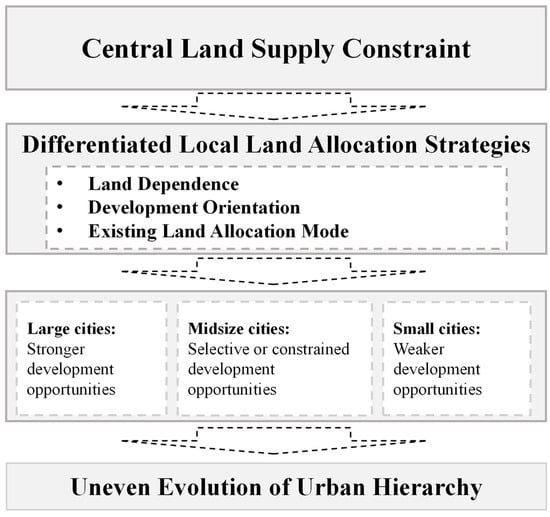
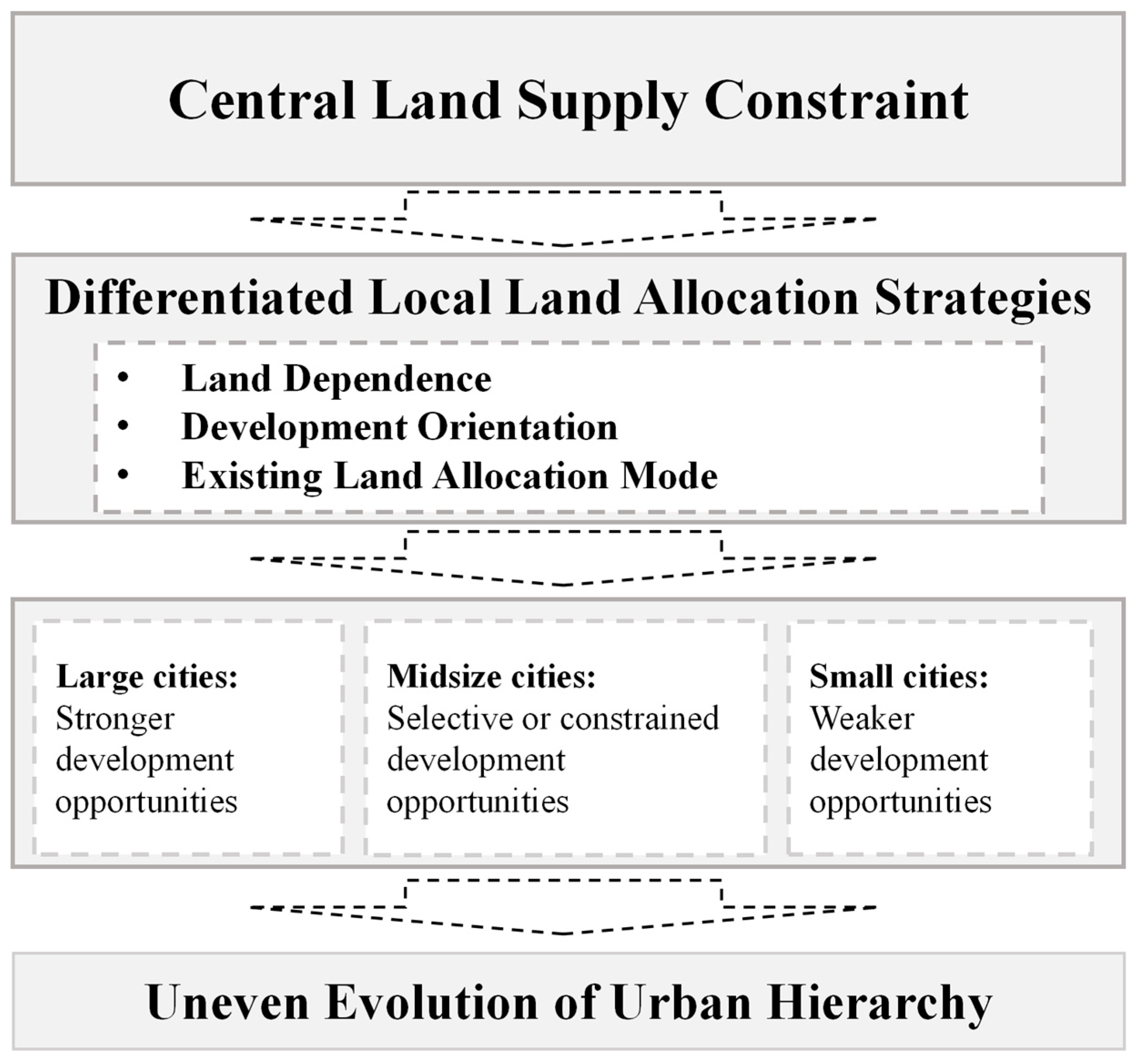
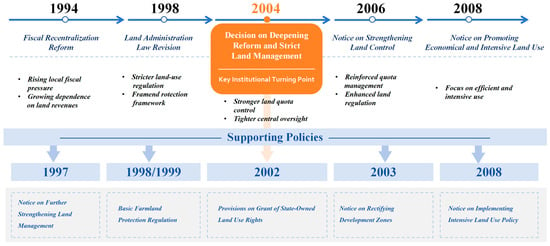
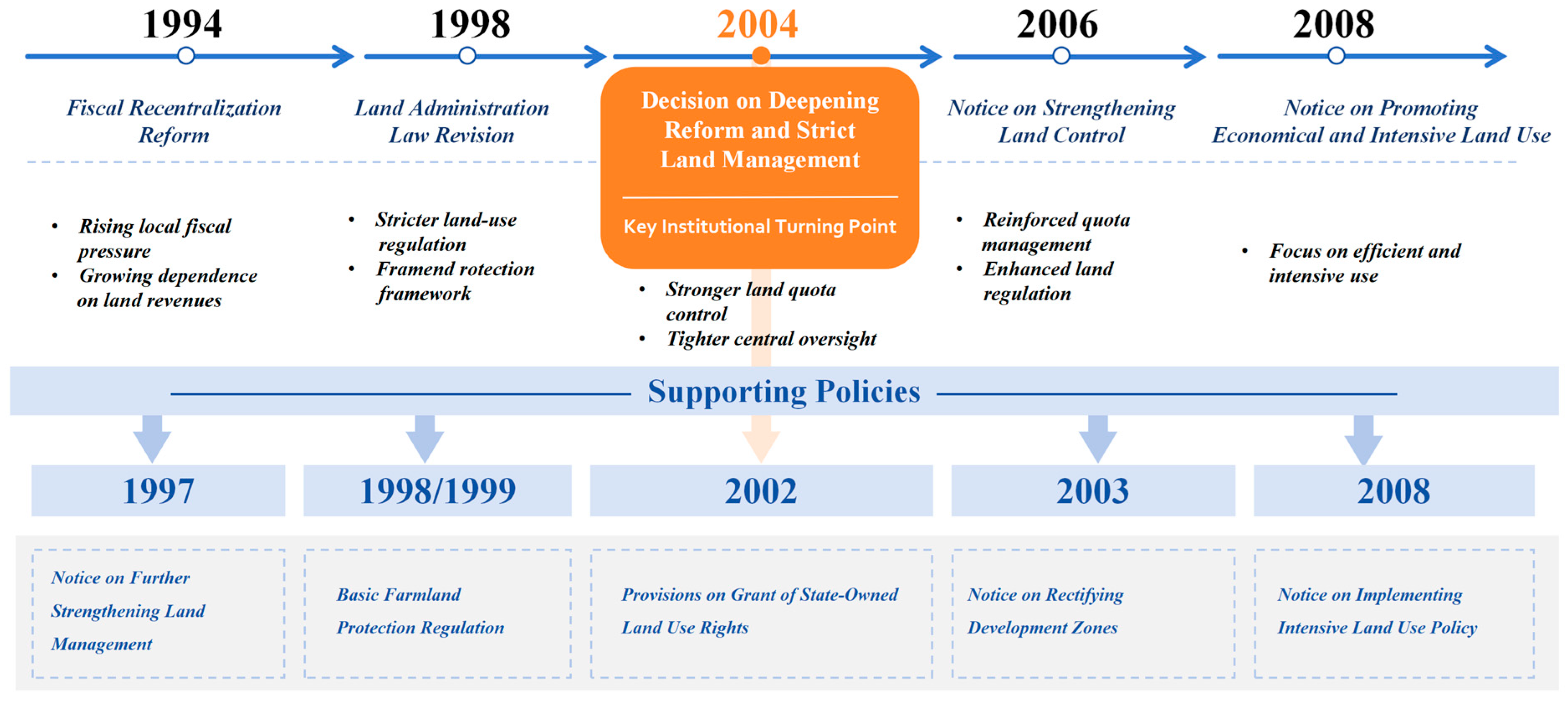
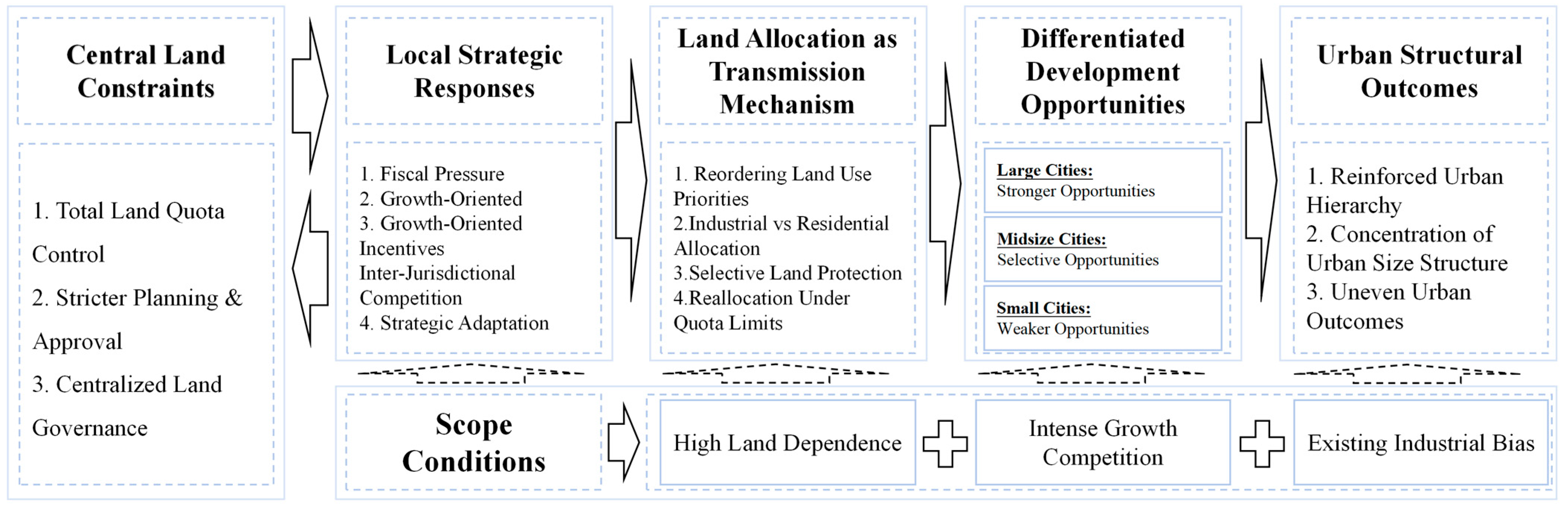
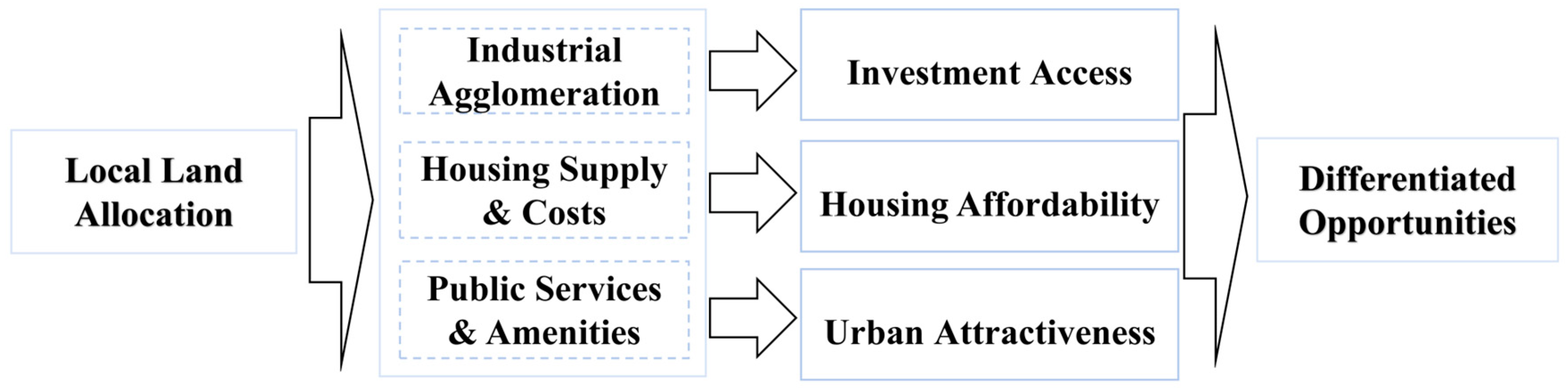

Disclaimer/Publisher’s Note: The statements, opinions and data contained in all publications are solely those of the individual author(s) and contributor(s) and not of MDPI and/or the editor(s). MDPI and/or the editor(s) disclaim responsibility for any injury to people or property resulting from any ideas, methods, instructions or products referred to in the content. |
© 2026 by the authors. Licensee MDPI, Basel, Switzerland. This article is an open access article distributed under the terms and conditions of the Creative Commons Attribution (CC BY) license.