Waste 4.0: Blockchain-Enabled Peer-to-Peer Communication Among Medical Waste Stakeholders


Abstract
1. Introduction
1.1. Challenges to Stakeholders’ Communication
1.2. Objectives of Study
- What are the critical parameters for monitoring waste procedures effectively?
- What is the current method for monitoring medical waste management?
- How can decentralised network digitisation enhance waste monitoring?
2. Medical Waste Monitoring
2.1. Traditional Method of Waste Monitoring
2.2. Digitisation in Monitoring Waste Management
2.3. Blockchain Communication
2.3.1. Blockchain
2.3.2. Smart Contract
2.3.3. Blockchain in Waste Management
3. Medical Waste Supervision Model with Blockchain
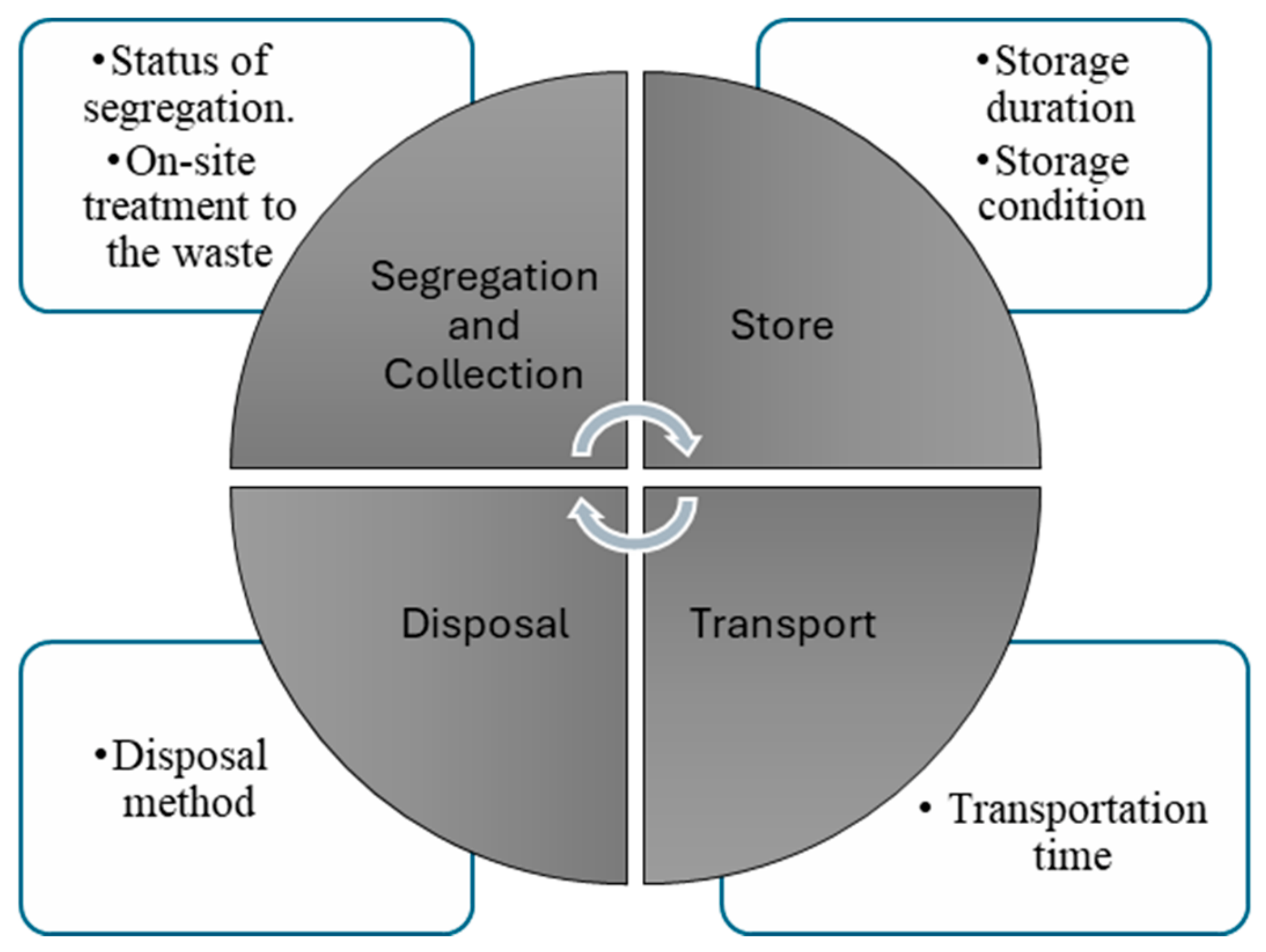
3.1. Monitoring Parameter
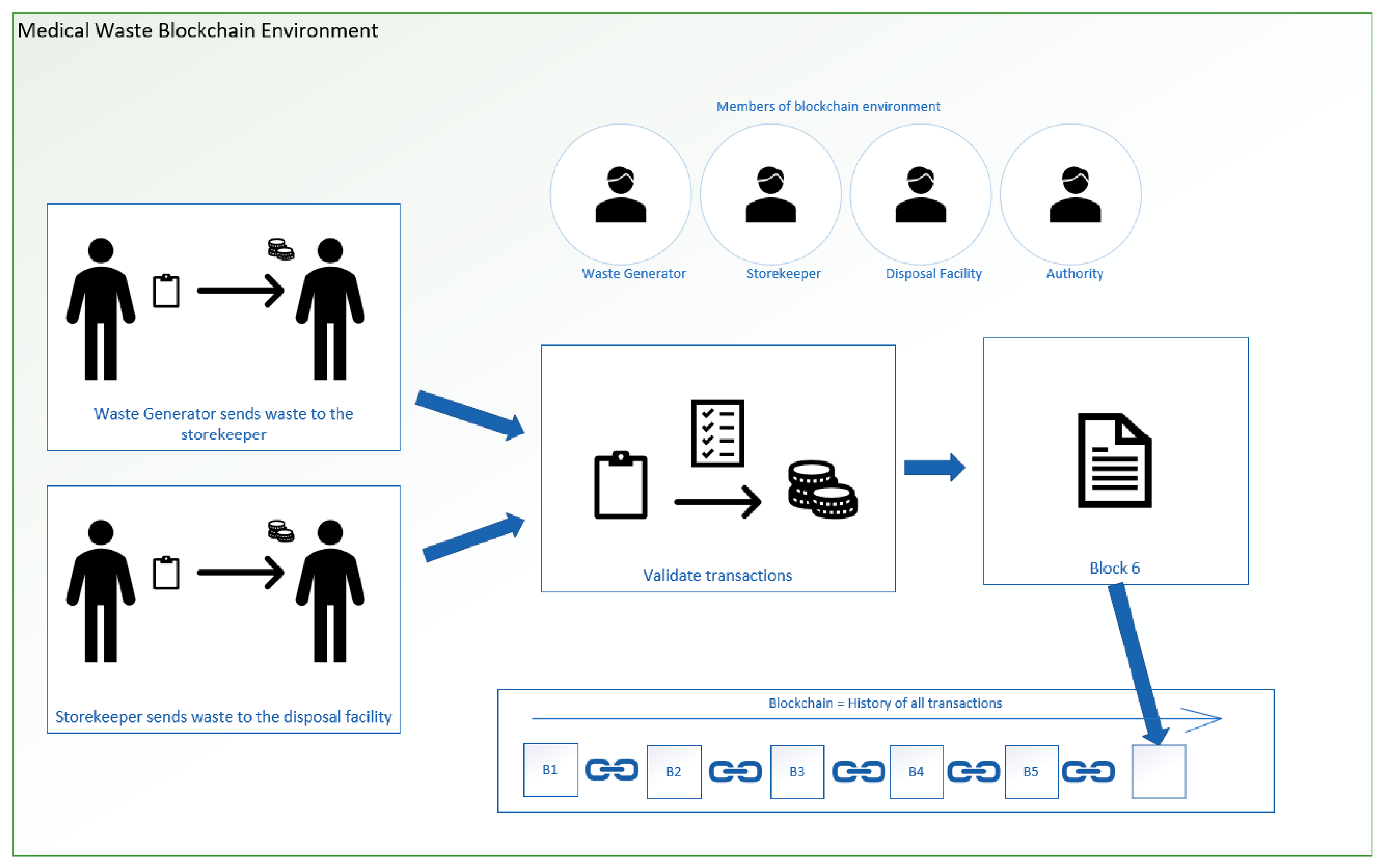
- (1)
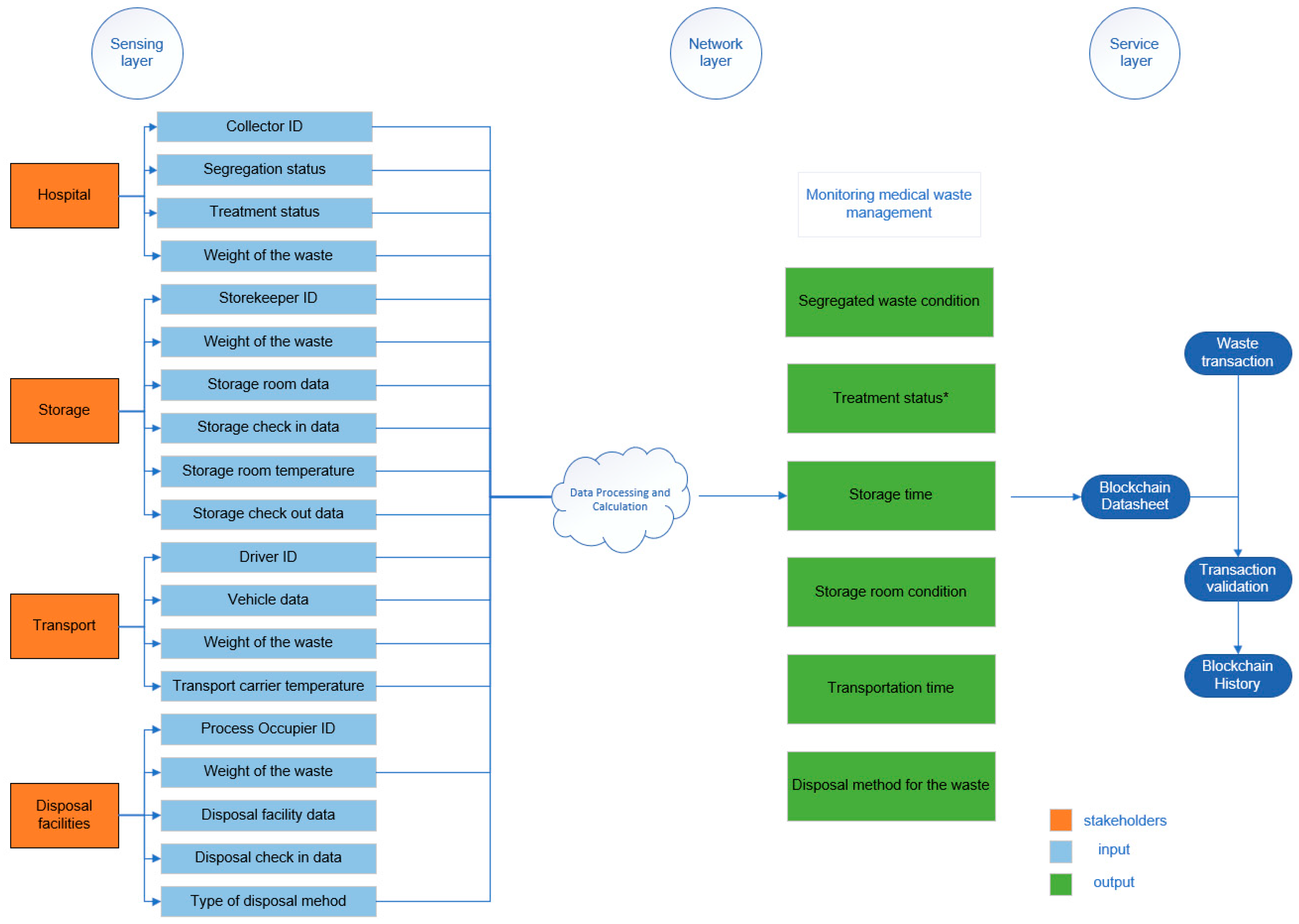
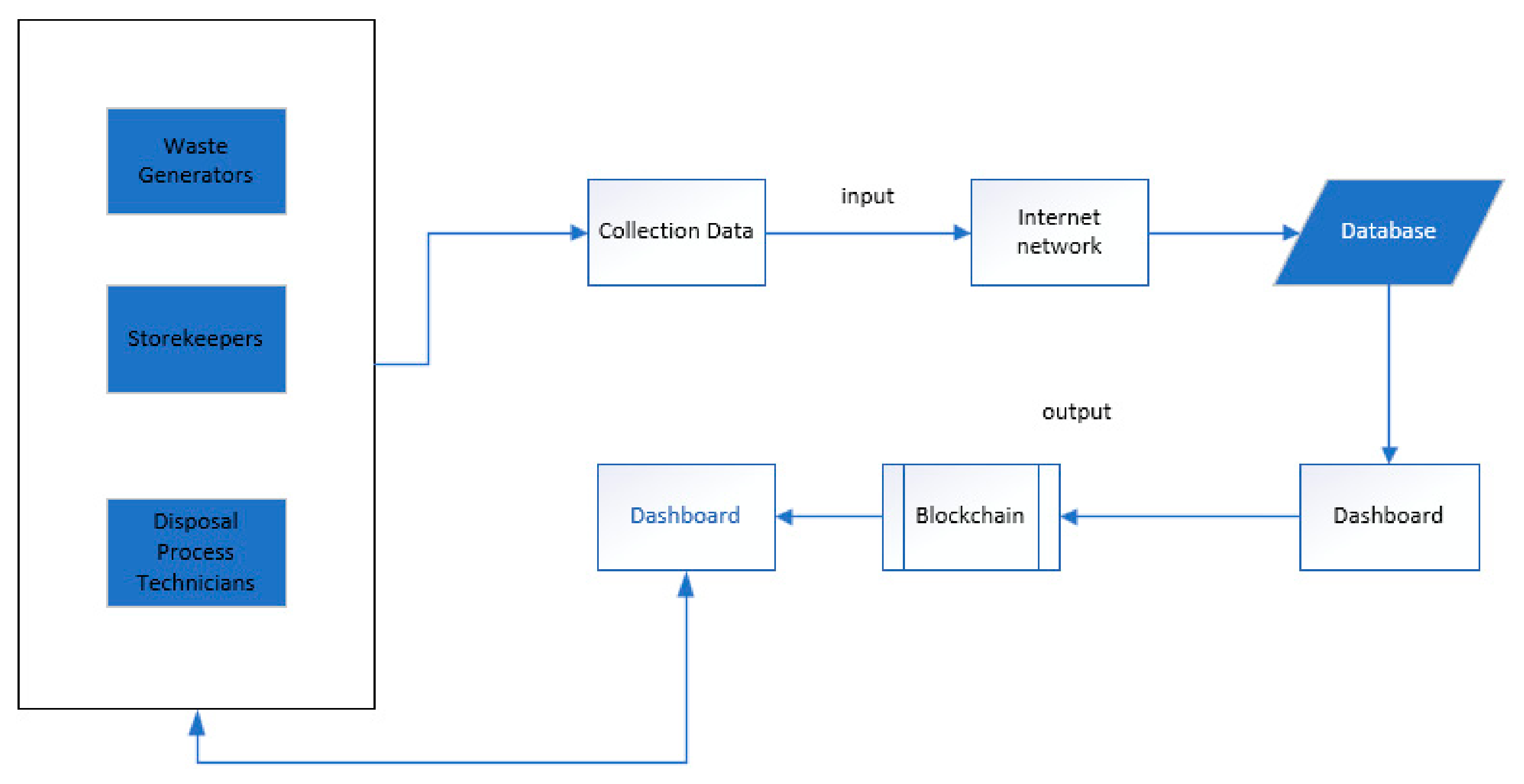
- A transaction will be issued to transfer the waste from one party to another. The condition of the waste during collection will be recorded on the dashboard by referring to the waste bag barcode.
- (2)
- Additional data on waste will be collected through sensor readings, barcode scanning on the bags, and staff credentials. This information will be automatically transferred to the blockchain system to update stakeholders regarding the quality of the waste and the status of any treatment done to the waste.
- (3)
- The transaction will need to be verified by a member of the blockchain environment, and waste mishandling will be reported and highlighted back to the transaction sender. The condition of waste will be used as a guide to understand the quality of waste and treatment done.
- (4)
- Verified transactions will be recorded on the dashboard and can easily be used for tracking and tracing.
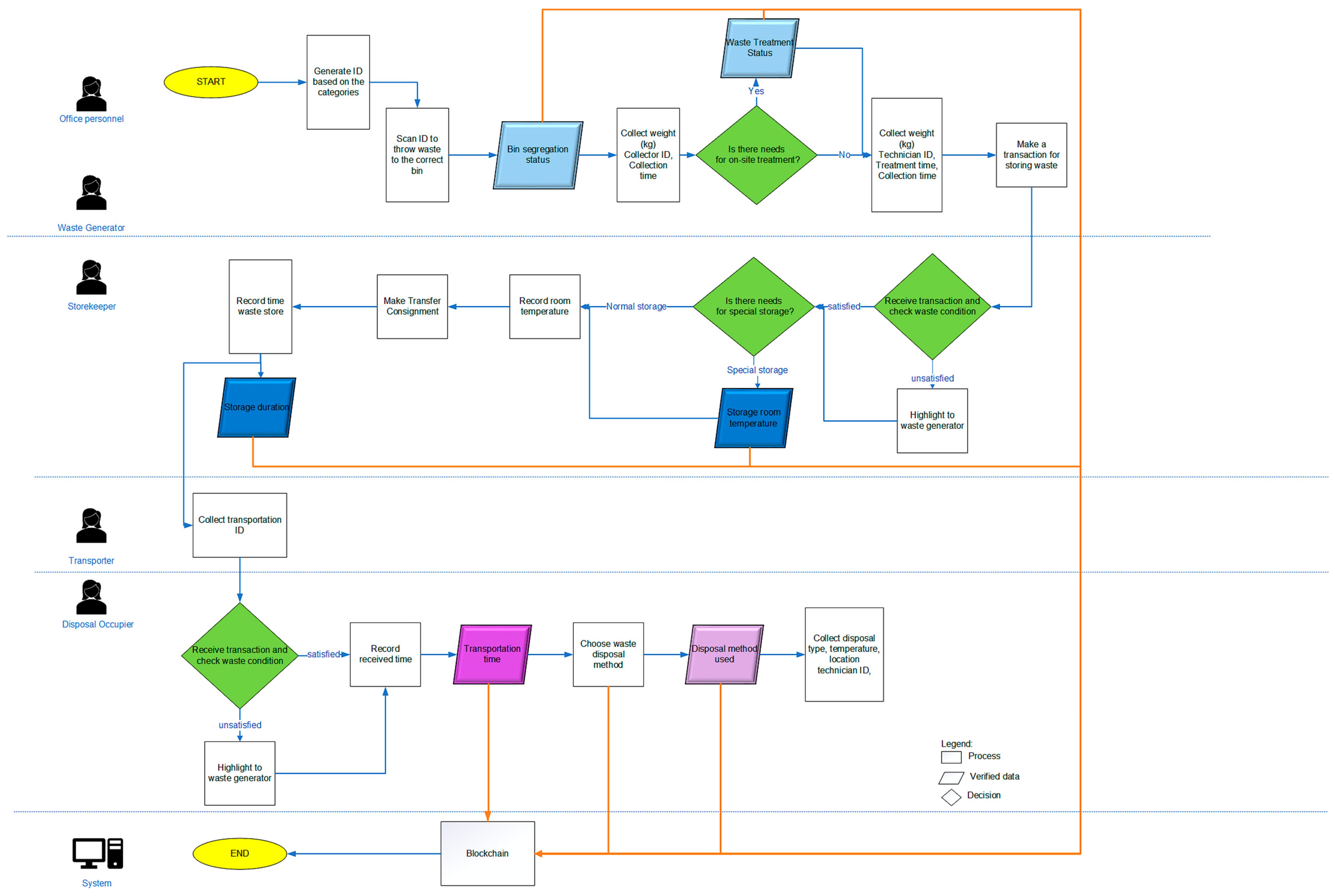
3.2. Implementation of Automated Data and Analysis
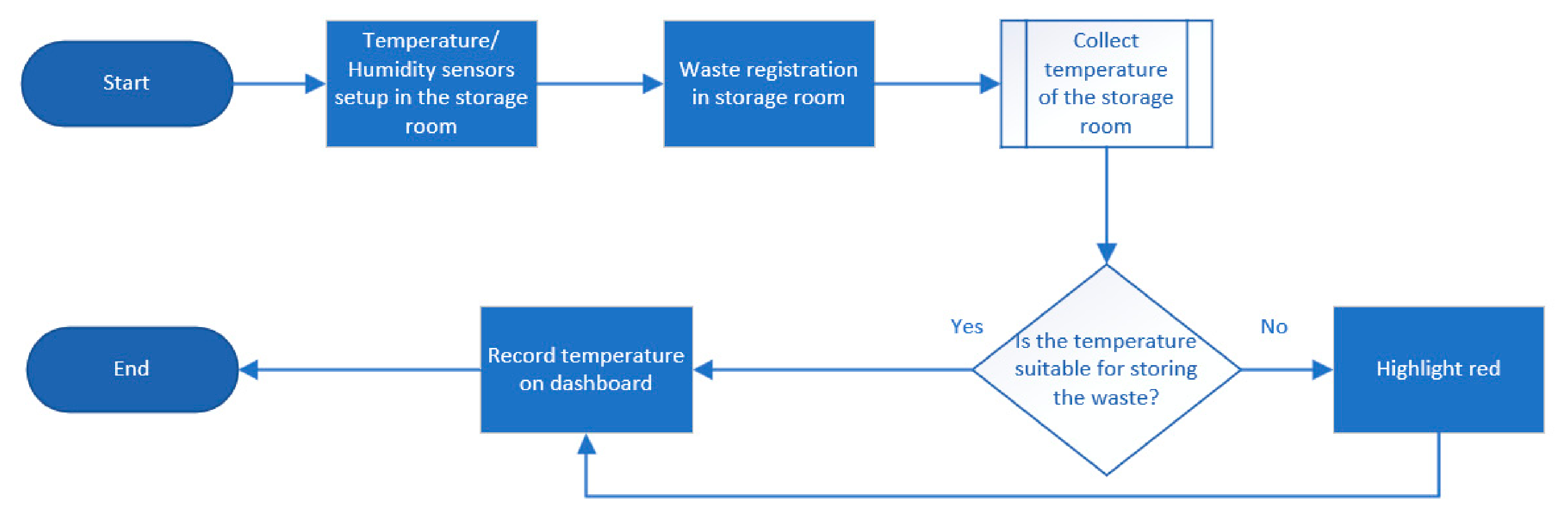
- SCO = storage check-out time
- SCI = storage check-in time
- RI = disposal facilities received time
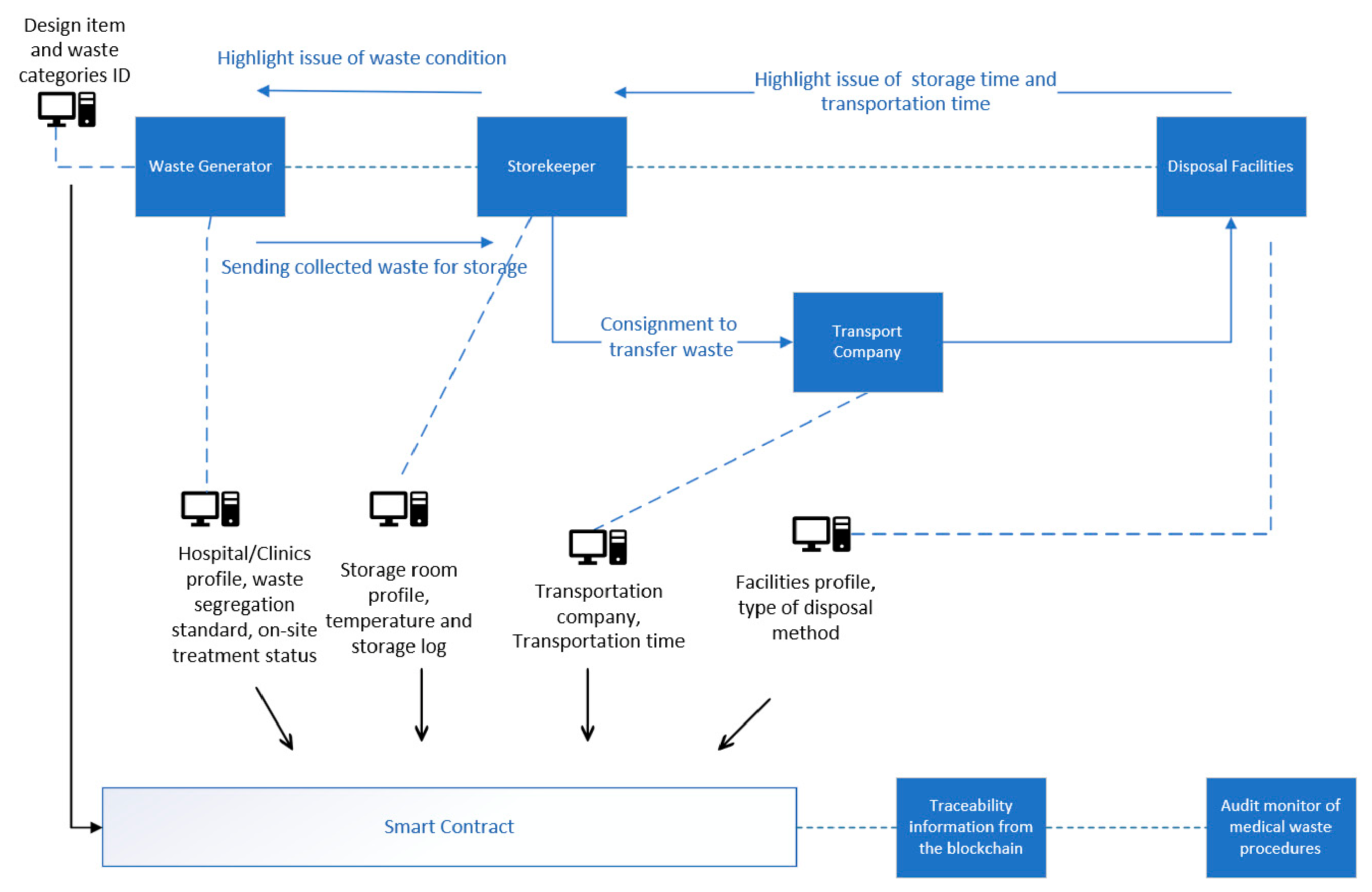
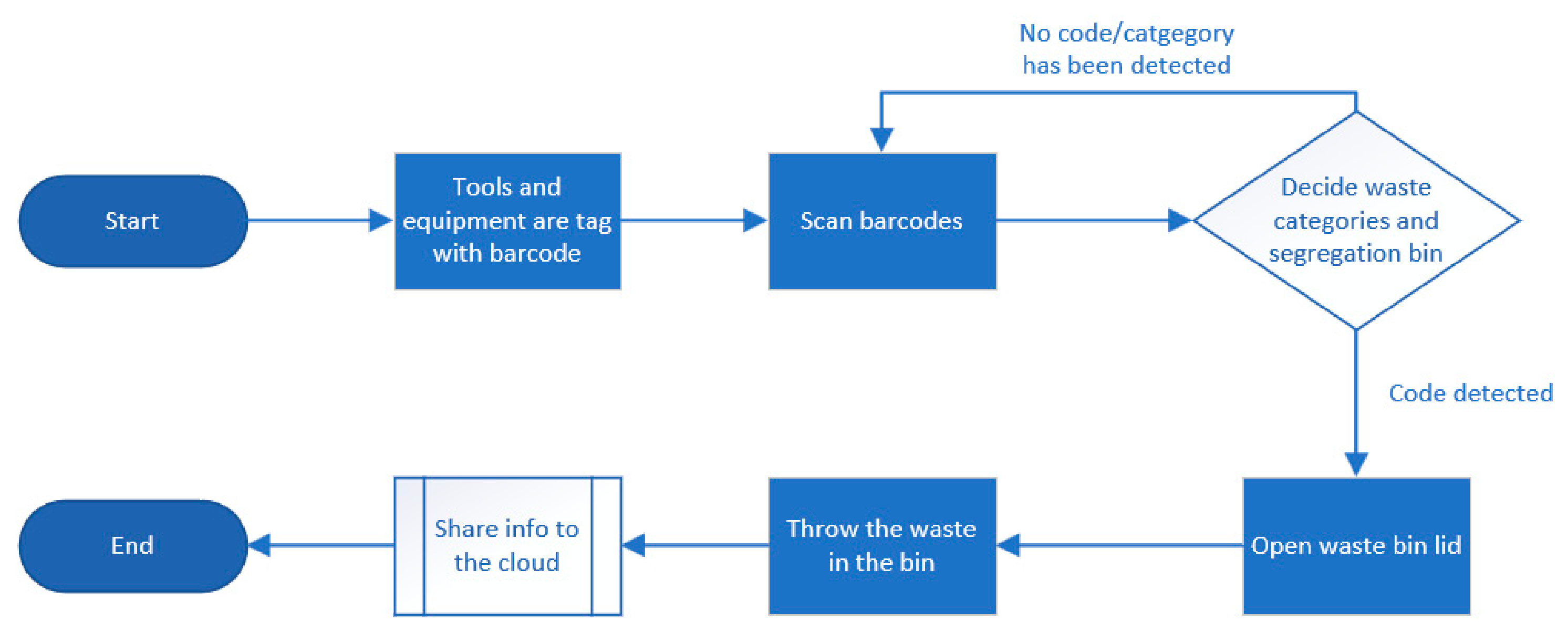
3.3. Implementation of Digitisation
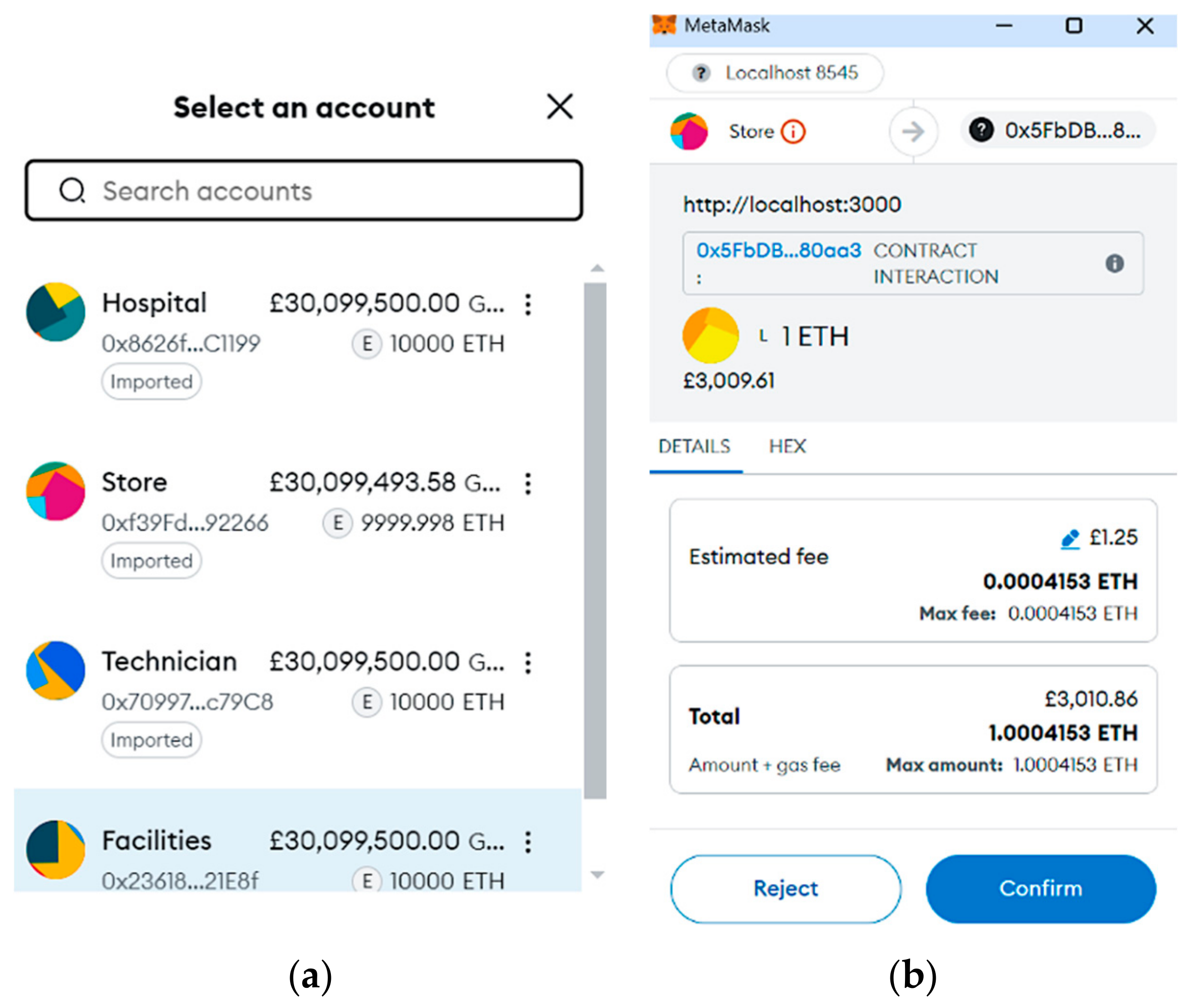
4. Demonstration of Medical Waste Blockchain Supervision
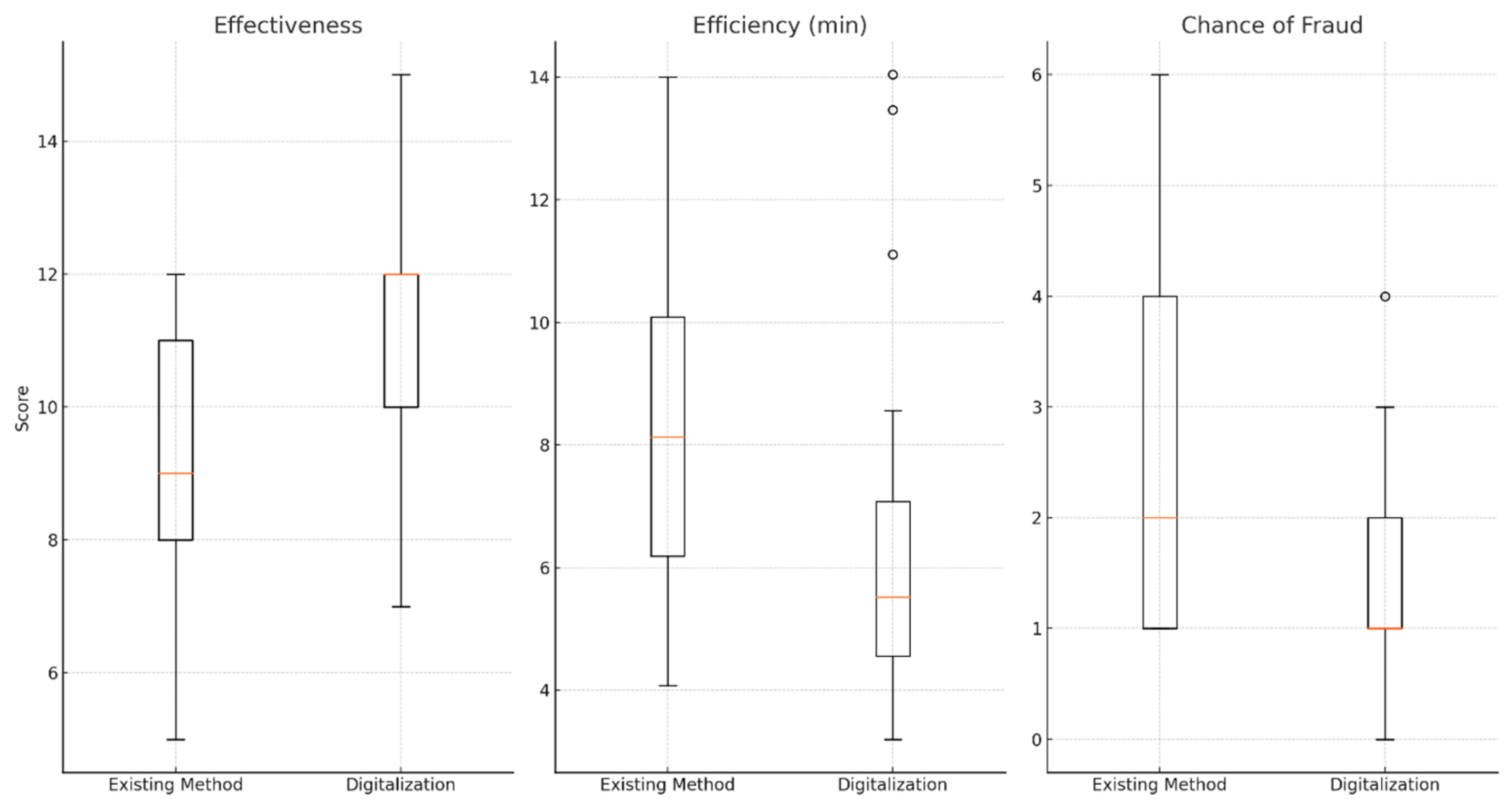
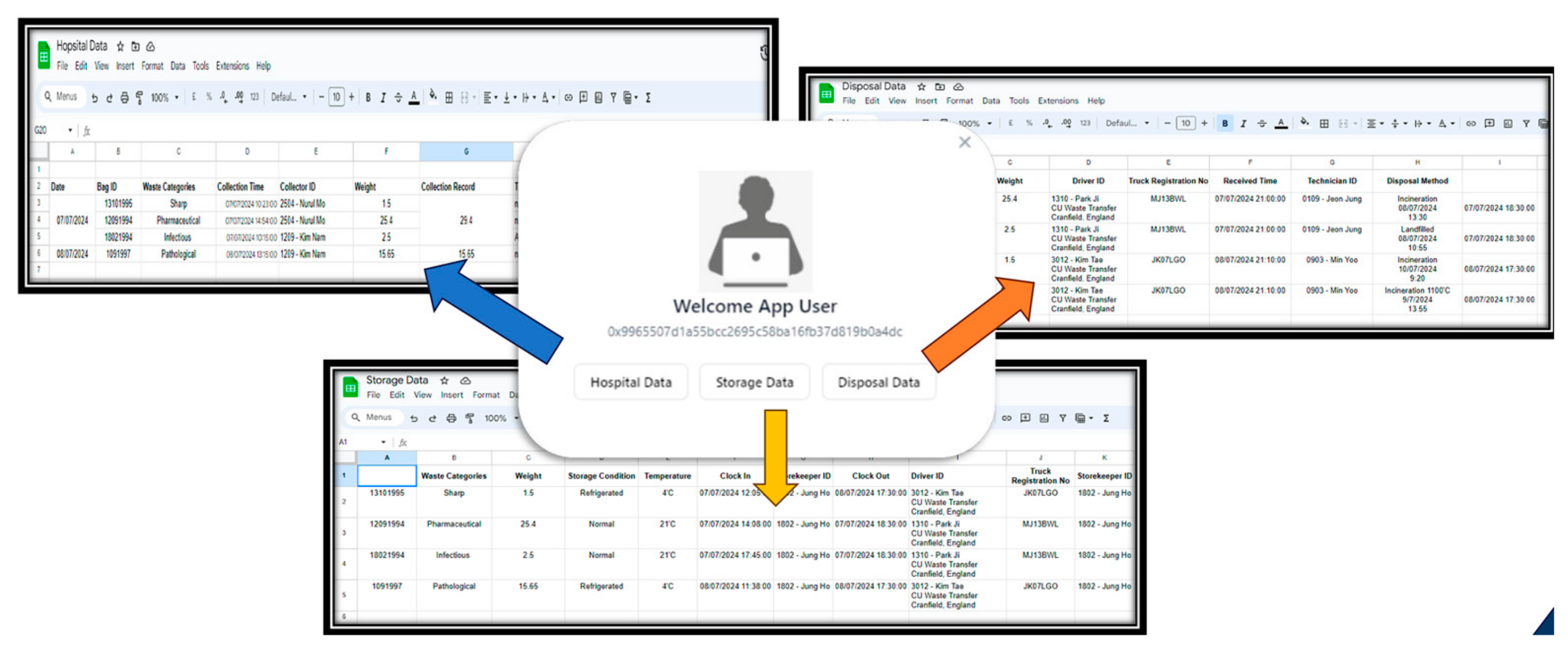
Proof of Concept Verification
5. Conclusions
Author Contributions
Funding
Institutional Review Board Statement
Informed Consent Statement
Data Availability Statement
Conflicts of Interest
References
- Janik-Karpinska, E.; Brancaleoni, R.; Niemcewicz, M.; Wojtas, W.; Foco, M.; Podogrocki, M.; Bijak, M. Healthcare Waste—A Serious Problem for Global Health. Healthcare 2023, 11, 242. [Google Scholar] [CrossRef] [PubMed]
- Hauri, A.M.; Armstrong, G.L.; Hutin, Y.J. The global burden of disease attributable to contaminated injections given in health care settings. Int. J. STD AIDS 2004, 15, 7–16. [Google Scholar] [CrossRef]
- Mohamed, N.H.; Khan, S.; Jagtap, S. Modernizing Medical Waste Management: Unleashing the Power of the Internet of Things (IoT). Sustainability 2023, 15, 9909. [Google Scholar] [CrossRef]
- Ugandar, R.E.; Rahamathunnisa, U.; Sajithra, S.; Christiana, M.B.V.; Palai, B.K.; Boopathi, S. Hospital Waste Management Using Internet of Things and Deep Learning: Enhanced Efficiency and Sustainability. In Applications of Synthetic Biology in Health, Energy, and Environment; IGI Global: Hershey, PA, USA, 2023; pp. 317–343. ISBN 9781668465783. [Google Scholar]
- Menekşe, A.; Camgöz Akdağ, H. Medical Waste Disposal Planning for Healthcare Units Using Spherical Fuzzy CRITIC-WASPAS. Appl. Soft Comput. 2023, 144, 110480. [Google Scholar] [CrossRef]
- Wang, L.; Wang, H. An Integrated Qualitative Group Decision-Making Method for Assessing Health-Care Waste Treatment Technologies Based on Linguistic Terms with Weakened Hedges. Appl. Soft Comput. 2022, 117, 108435. [Google Scholar] [CrossRef]
- Singh, N.; Ogunseitan, O.A.; Tang, Y. Medical Waste: Current Challenges and Future Opportunities for Sustainable Management. Crit. Rev. Environ. Sci. Technol. 2022, 52, 2000–2022. [Google Scholar] [CrossRef]
- Belsare, K.; Singh, M.; Gandam, A.; Malik, P.K.; Agarwal, R.; Gehlot, A. An Integrated Approach of IoT and WSN Using Wavelet Transform and Machine Learning for the Solid Waste Image Classification in Smart Cities. Trans. Emerg. Telecommun. Technol. 2023, 35, e4857. [Google Scholar] [CrossRef]
- Soni, G.; Kandasamy, S. Smart Garbage Bin Systems—A Comprehensive Survey; Springer: Singapore, 2018; Volume 808, ISBN 9789811076343. [Google Scholar]
- Lamichhane, M.; Sadov, O.; Zaslavsky, A. Smart Waste Management System: A Fusion of IoT and Blockchain Technology. In Dependable IoT for Human and Industry; River Publishers: Aalborg, Denmark, 2018; Volume 1, pp. 351–366. [Google Scholar]
- Fletcher, C.A.; Clair, R.S.; Sharmina, M. A Framework for Assessing the Circularity and Technological Maturity of Plastic Waste Management Strategies in Hospitals. J. Clean. Prod. 2021, 306, 127169. [Google Scholar] [CrossRef]
- Ben-Romdhane, H.; Ouertani, N.; Krichen, S.; Nouaouri, I. On Optimizing Healthcare Waste Routing Systems Using Waste Separation Policies: A Case Study. Appl. Soft Comput. 2023, 146, 110615. [Google Scholar] [CrossRef]
- Yi, T.C.; Noor Hazwan Jusoh, M. Overview of Clinical Waste Management in Malaysia. Rev. Artic. 2021, 1, 47–57. [Google Scholar]
- Malaysia Ministry of Environment Electropnic Scheduled Waste Information System ESWIS. Available online: https://eswis.doe.gov.my/facilityList.aspx?Status=R&CategoryID=5 (accessed on 27 July 2022).
- Singapore National Environmental Agency. User Guide for Toxic Industrial Waste E-Tracking (Collector); National Environment Agency: Singapore, 2019. [Google Scholar]
- Chartier, Y.; Emmanuel, J.; Pieper, U.; Pruss, A.; Rushbrook, P.; Stringer, R.; Townend, W.; Wiburn, S.; Zghondi, R. Safe Management of Wastes from Health-Care Activities, 2nd ed.; World Health Organization: Geneva, Switzerland, 2014; ISBN 9789241548564. [Google Scholar]
- Ongena, G.; Smit, K.; Boksebeld, J.; Adams, G.; Roelofs, Y.; Ravesteijn, P. Blockchain-Based Smart Contracts in Waste Management: A Silver Bullet? In Proceedings of the 31st Bled eConference: Digital Transformation: Meeting the Challenges, BLED 2018, Bled, Slovenia, 17–20 June 2018; pp. 345–356. [Google Scholar]
- Gopalrao Wawale, S.; Shabaz, M.; Mehbodniya, A.; Soni, M.; Deb, N.; Elashiri, M.A.; Dwivedi, Y.D.; Naved, M. Biomedical Waste Management Using IoT Tracked and Fuzzy Classified Integrated Technique. Hum.-Centric Comput. Inf. Sci. 2022, 12, 32. [Google Scholar] [CrossRef]
- Gopalakrishnan, P.K.; Hall, J.; Behdad, S. Cost Analysis and Optimization of Blockchain-Based Solid Waste Management Traceability System. Waste Manag. 2021, 120, 594–607. [Google Scholar] [CrossRef]
- Murphy, M. Safe and Sustainable Waste Management Policy; North Bristol: Bristol, UK, 2023. [Google Scholar]
- Department of Environment. Environmental Quality Scheduled Wastes Regulations 2005—P.U.(A) 294/2005; Department of Environment: Putrajaya, Malaysia, 2005. [Google Scholar]
- Raundale, P.; Gadagi, S.; Acharya, C. IoT Based Biomedical Waste Classification, Quantification and Management; IEEE: Piscataway, NJ, USA, 2017; ISBN 9781509048908. [Google Scholar]
- Borders of Estonia Latvia Russia; European Union. Medical Waste ELRII-448 Outputs and Results Outputs. Brussels, Belgium, 2015. Available online: https://estlatrus.eu/uploaded_files/project_files/RESULTS_448_final.pdf (accessed on 28 January 2026).
- Laouar, M.R.; Hamad, Z.T.; Eom, S. Towards Blockchain-Based Urban Planning: Application for Waste Collection Management; ACM International Conference Proceeding Series; ACM Digital Library: New York, NY, USA, 2019. [Google Scholar]
- Meneghini, C.; Favarin, S.; Joyce, T. Estimating Illicit Waste Trafficking in Europe Transcrime Research in Brief; Transcrime: Milan, Italy, 2019; ISBN 9788899719111. [Google Scholar]
- European Court of Auditors. EU Action to Tackle the Issue of Plastic Waste; European Commission: Brussels, Belgium, 2020; Available online: https://www.eca.europa.eu/lists/ecadocuments/rw20_04/rw_plastic_waste_en.pdf (accessed on 28 January 2026).
- Ahmad, R.W.; Salah, K.; Jayaraman, R.; Yaqoob, I.; Omar, M. Blockchain for Waste Management in Smart Cities: A Survey. IEEE Access 2021, 9, 131520–131541. [Google Scholar] [CrossRef]
- Razali, S.S.; Ishak, M.B. Clinical Waste Handling and Obstacles in Malaysia. J. Urban Environ. Eng. 2010, 4, 47–54. [Google Scholar] [CrossRef]
- Mohammed Aarif, K.O.; Mohamed Yousuff, C.; Mohammed Hashim, B.A.; Mohamed Hashim, C.; Sivakumar, P. Smart Bin: Waste Segregation System Using Deep Learning-Internet of Things for Sustainable Smart Cities. Concurr. Comput. 2022, 34, e7378. [Google Scholar] [CrossRef]
- World Bank Group. Solid Waste Management (SWM) in Korea Learning 2: Waste Segregation and Collection. Available online: https://olc.worldbank.org/content/solid-waste-management-swm-korea-learning-2-waste-segregation-and-collection (accessed on 25 July 2022).
- Ahmed, A. Smart Cities and IoT: Examining the Potential Benefits and Challenges of Using IoT to Create More Efficient and Sustainable Urban Environments. Int. J. Intell. Syst. Appl. Eng. 2023, 11, 306–320. [Google Scholar]
- Noe, R. Amsterdam’s Smart System of Underground Garbage Bins—Core77. Available online: https://www.core77.com/posts/102208/Amsterdams-Smart-System-of-Underground-Garbage-Bins (accessed on 21 January 2024).
- European Environment Agency. Overview of National Waste Prevention Programmes in Europe Country Profile Photo: © Mario Cvitkovic from Pixabay Spain; European Environment Agency: Copenhagen, Denmark, 2021. [Google Scholar]
- Boh, S. Smart Bins Gaining Traction in Singapore|The Straits Times. TheStraitsTimes, 16 November 2016.
- Hamizah Mohamed, N.; Khan, S.; Jagtap, S. Towards Digitalization of Malaysian Medical Facilities Waste Management. In Proceedings of the 11th International Conference on Through-life Engineering Services—TESConf 2022, Milton Keynes, UK, 8–9 November 2022. [Google Scholar]
- Kim, J.; Korea Environment Corporation RFID Operations Team; Department of Resource Recycling. Medical Waste Management in Korea’s COVID-19 Response; Department of Resource Reccling, Korea Environment Corporation Korea Environment Corporation RFID Operations Team: Incheon, Republic of Korea, 2020. [Google Scholar]
- Wang, H.; Zheng, L.; Xue, Q.; Li, X. Research on Medical Waste Supervision Model and Implementation Method Based on Blockchain. Secur. Commun. Netw. 2022, 2022, 5630960. [Google Scholar] [CrossRef]
- Jang, Y.C.; Lee, C.; Yoon, O.S.; Kim, H. Medical Waste Management in Korea. J. Environ. Manag. 2006, 80, 107–115. [Google Scholar] [CrossRef]
- UNDP Seoul Policy Centre [USPC Webinar] Managing Healthcare Waste Management During COVID-19 in Korea and Elsewhere—YouTube 2020. Available online: https://www.youtube.com/watch?v=xfJHczt-b0k (accessed on 28 January 2026).
- Roy, A.; Manna, A.; Kim, J.; Moon, I. IoT-Based Smart Bin Allocation and Vehicle Routing in Solid Waste Management: A Case Study in South Korea. Comput. Ind. Eng. 2022, 171, 108457. [Google Scholar] [CrossRef]
- Sen Gupta, Y.; Mukherjee, S.; Dutta, R.; Bhattacharya, S. A Blockchain-Based Approach Using Smart Contracts to Develop a Smart Waste Management System. Int. J. Environ. Sci. Technol. 2021, 19, 7833–7856. [Google Scholar] [CrossRef]
- Amal, L.; Son, L.H.; Chabchoub, H.; Lahiani, H. Analysis of Municipal Solid Waste Collection Using GIS and Multi-Criteria Decision Aid. Appl. Geomat. 2020, 12, 193–208. [Google Scholar] [CrossRef]
- Nielsen, I.; Lim, M.; Nielsen, P. Optimizing Supply Chain Waste Management through the Use of RFID Technology. In Proceedings of the 2010 IEEE International Conference on RFID-Technology and Applications, RFID-TA 2010, Guangzhou, China, 17–19 June 2010; pp. 296–301. [Google Scholar]
- CBS NEWS. Steve Jobs in His Own Words—CBS News. CBS NEWS, 6 October 2011. Available online: https://www.cbsnews.com/news/steve-jobs-in-his-own-words/ (accessed on 16 September 2024).
- Suji Priya, J.; Aruna, S.; Usha Ranee, L.; Tasneem Firdhosh, A.; Malavikka, S.; Monika, S. Revolutionizing Industries Through IoT, Blockchain and AI Integration. In Proceedings of the 2023 3rd International Conference on Pervasive Computing and Social Networking, ICPCSN 2023, Salem, India, 19–20 June 2023; pp. 972–977. [Google Scholar]
- Wong, D.R.; Bhattacharya, S.; Butte, A.J. Prototype of Running Clinical Trials in an Untrustworthy Environment Using Blockchain. Nat. Commun. 2019, 10, 917. [Google Scholar] [CrossRef] [PubMed]
- Li, H.; Zhu, L.; Shen, M.; Gao, F.; Tao, X.; Liu, S. Blockchain-Based Data Preservation System for Medical Data. J. Med. Syst. 2018, 42, 141. [Google Scholar] [CrossRef] [PubMed]
- Taherdoost, H. A Critical Review of Blockchain Acceptance Models—Blockchain Technology Adoption Frameworks and Applications. Computers 2022, 11, 24. [Google Scholar] [CrossRef]
- Akram, S.V.; Singh, R.; Gehlot, A.; Rashid, M.; Alghamdi, A.S.; Alshamrani, S.S.; Prashar, D. Role of Wireless Aided Technologies in the Solid Waste Management: A Comprehensive Review. Sustainability 2021, 13, 13104. [Google Scholar] [CrossRef]
- Salha, R.A.; El-Hallaq, M.A.; Alastal, A.I. Blockchain in Smart Cities: Exploring Possibilities in Terms of Opportunities and Challenges. J. Data Anal. Inf. Process. 2019, 7, 118–139. [Google Scholar] [CrossRef]
- Yaqoob, I.; Salah, K.; Jayaraman, R.; Al-Hammadi, Y. Blockchain for Healthcare Data Management: Opportunities, Challenges, and Future Recommendations. Neural Comput. Appl. 2022, 34, 11475–11490. [Google Scholar] [CrossRef]
- Karia, J.; Sundararajan, M.; Srinivasa Raghavan, G. Distributed Ledger Systems to Improve Data Synchronization in Enterprise Processes. In Proceedings of the 2021 IEEE International Conference on Distributed Computing, VLSI, Electrical Circuits and Robotics, DISCOVER 2021—Proceedings; Institute of Electrical and Electronics Engineers Inc.: Piscataway, NJ, USA, 2021; pp. 41–45. [Google Scholar]
- Sanchhaya Education Private Limited. Centralized vs. Decentralized vs. Distributed Systems—GeeksforGeeks. Available online: https://www.geeksforgeeks.org/comparison-centralized-decentralized-and-distributed-systems/ (accessed on 4 October 2024).
- Mollah, M.B.; Zhao, J.; Niyato, D.; Lam, K.Y.; Zhang, X.; Ghias, A.M.Y.M.; Koh, L.H.; Yang, L. Blockchain for Future Smart Grid: A Comprehensive Survey. IEEE Internet Things J. 2021, 8, 18–43. [Google Scholar] [CrossRef]
- Yang, R.; Wakefield, R.; Lyu, S.; Jayasuriya, S.; Han, F.; Yi, X.; Yang, X.; Amarasinghe, G.; Chen, S. Public and Private Blockchain in Construction Business Process and Information Integration. Autom. Constr. 2020, 118, 103276. [Google Scholar] [CrossRef]
- Fan, M.; Zhang, X. Consortium Blockchain Based Data Aggregation and Regulation Mechanism for Smart Grid. IEEE Access 2019, 7, 35929–35940. [Google Scholar] [CrossRef]
- Zhang, R.; Xue, R.; Liu, L. Security and Privacy on Blockchain. ACM Comput. Surv. 2019, 52, 1–34. [Google Scholar] [CrossRef]
- Bhalla, A. Centralized vs. Decentralized Digital Networks—Blockchain Council. Available online: https://www.blockchain-council.org/blockchain/centralized-vs-decentralized-digital-networks/ (accessed on 4 October 2024).
- Bagrecha, N.R.; Polishwala, I.M.; Mehtora, P.A.; Sharma, R.; Thakare, B.S. 2020 International Conference for Emerging Technology (INCET): Belgaum, India, 5–7 June 2020; IEEE: Piscataway, NJ, USA; ISBN 9781728162218.
- Kshetri, N. What Is Blockchain Transparency?—DeFipedia. Available online: https://defipedia.com/topic/blockchain-transparency# (accessed on 4 October 2024).
- Böhme, R.; Christin, N.; Edelman, B.; Moore, T. Bitcoin: Economics, Technology, and Governance. J. Econ. Perspect. 2015, 29, 213–238. [Google Scholar] [CrossRef]
- Yue, K.; Zhang, Y.; Chen, Y.; Li, Y.; Zhao, L.; Rong, C.; Chen, L. A Survey of Decentralizing Applications via Blockchain: The 5G and beyond Perspective. IEEE Commun. Surv. Tutor. 2021, 23, 2191–2217. [Google Scholar] [CrossRef]
- Saeed, H.; Malik, H.; Bashir, U.; Ahmad, A.; Riaz, S.; Ilyas, M.; Bukhari, W.A.; Khan, M.I.A. Blockchain Technology in Healthcare: A Systematic Review. PLoS ONE 2022, 17, e0266462. [Google Scholar] [CrossRef]
- Ali Syed, T.; Alzahrani, A.; Jan, S.; Siddiqui, M.S.; Nadeem, A.; Alghamdi, T. A Comparative Analysis of Blockchain Architecture and Its Applications: Problems and Recommendations. IEEE Access 2019, 7, 176838–176869. [Google Scholar] [CrossRef]
- Buterin, V. A Next Generation Smart Contract & Decentralized Application Platform. WhitePaper 2014, 3. Available online: https://ethereum.org/content/whitepaper/whitepaper-pdf/Ethereum_Whitepaper_-_Buterin_2014.pdf (accessed on 28 January 2026).
- Zheng, Z.; Xie, S.; Dai, H.N.; Chen, W.; Chen, X.; Weng, J.; Imran, M. An Overview on Smart Contracts: Challenges, Advances and Platforms. Future Gener. Comput. Syst. 2020, 105, 475–491. [Google Scholar] [CrossRef]
- Alarood, A.A.; Abubakar, A.; Alzahrani, A.; Alsubaei, F.S. Electronic Waste Collection Incentivization Scheme Based on the Blockchain. Sustainability 2023, 15, 209. [Google Scholar] [CrossRef]
- Rejeb, A.; Zailani, S. Blockchain Technology and the Circular Economy: A Systematic Literature Review. J. Sustain. Dev. Energy Water Environ. Syst. 2023, 11, 1100436. [Google Scholar] [CrossRef]
- Ahmad, R.W.; Salah, K.; Jayaraman, R.; Yaqoob, I.; Omar, M.; Ellahham, S. Blockchain-Based Forward Supply Chain and Waste Management for COVID-19 Medical Equipment and Supplies. IEEE Access 2021, 9, 44905–44927. [Google Scholar] [CrossRef] [PubMed]
- Scott, I.J.; de Castro Neto, M.; Pinheiro, F.L. Bringing Trust and Transparency to the Opaque World of Waste Management with Blockchain: A Polkadot Parathread Application. Comput. Ind. Eng. 2023, 182, 109347. [Google Scholar] [CrossRef]
- Kassou, M.; Bourekkadi, S.; Khoulji, S.; Slimani, K.; Chikri, H.; Kerkeb, M.L. Blockchain-Based Medical and Water Waste Management Conception; E3S Web of Conferences; EDP Sciences: Les Ulis, France, 2021; Volume 234. [Google Scholar]
- Gupta, N.; Bedi, P. E-Waste Management Using Blockchain Based Smart Contracts. In Proceedings of the 2018 International Conference on Advances in Computing, Communications and Informatics, ICACCI 2018, Bangalore, India, 19–22 September 2018; pp. 915–921. [Google Scholar]
- Castiglione, A.; Cimmino, L.; Di Nardo, M.; Murino, T. A Framework for Achieving a Circular Economy Using the Blockchain Technology in a Sustainable Waste Management System. Comput. Ind. Eng. 2023, 180, 109263. [Google Scholar] [CrossRef]
- Liu, Z.; Wu, T.; Wang, F.; Osmani, M.; Demian, P. Blockchain Enhanced Construction Waste Information Management: A Conceptual Framework. Sustainability 2022, 14, 12145. [Google Scholar] [CrossRef]
- Kharat, M.G.; Parhi, S.; Kapoor, S.; Kharat, M.G.; Pandey, S. Striving for Sustainability in Healthcare Management: Waste Handling and Disposal Network Optimization. Circ. Econ. Sustain. 2024, 5, 413–439. [Google Scholar] [CrossRef]
- Gopalakrishnan, P.; Ramaguru, R. Blockchain Based Waste Management. Int. J. Eng. Adv. Technol. 2019, 8, 2632–2635. [Google Scholar]
- Gopalakrishnan, P.K.; Hall, J.; Behdad, S. A Blockchain-Based Traceability System for Waste Management in Smart Cities. In Proceedings of the ASME 2020 International Design Engineering Technical Conferences and Computers and Information in Engineering Conference, Virtual, 17–19 August 2020; Volume 6. [Google Scholar]
- Zhang, A.; Lin, X. Towards Secure and Privacy-Preserving Data Sharing in e-Health Systems via Consortium Blockchain. J. Med. Syst. 2018, 42, 140. [Google Scholar] [CrossRef]
- Ratnasabapathy, S.; Perera, S.; Alashwal, A. A Review of Smart Technology Usage in Construction and Demolition Waste Management. In Proceedings of the 8th World Construction Symposium, Colombo, Sri Lanka, 8–10 November 2019; pp. 45–55. [Google Scholar]
- Omidian, H.; Omidi, Y. Blockchain in Pharmaceutical Life Cycle Management. Drug Discov. Today 2022, 27, 935–938. [Google Scholar] [CrossRef]
- Widyatmika, M.A.; Bolia, N.B. Understanding Citizens’ Perception of Waste Composting and Segregation. J. Mater. Cycles Waste Manag. 2023, 25, 1608–1621. [Google Scholar] [CrossRef] [PubMed]
- Marimuthu, R.; Shanthi, M.; Aramvith, S.; Sivaranjani, S. Smart Waste Management Model for Effective Disposal of Waste Management Through Technology; Springer: Cham, Switzerland, 2021. [Google Scholar]
- Sangion, A.; Gramatica, P. Hazard of Pharmaceuticals for Aquatic Environment: Prioritization by Structural Approaches and Prediction of Ecotoxicity. Environ. Int. 2016, 95, 131–143. [Google Scholar] [CrossRef]
- Praveena, S.M.; Mohd Rashid, M.Z.; Mohd Nasir, F.A.; Wee, S.Y.; Aris, A.Z. Occurrence, Human Health Risks, and Public Awareness Level of Pharmaceuticals in Tap Water from Putrajaya (Malaysia). Expo. Health 2021, 13, 93–104. [Google Scholar] [CrossRef]
- Azyze, N.L.A.M.S.; Isa, I.S.M.; Chin, T.S. IoT-Based Communal Garbage Monitoring System for Smart Cities. Indones. J. Electr. Eng. Comput. Sci. 2022, 27, 37. [Google Scholar] [CrossRef]
- Hussain, A.; Draz, U.; Ali, T.; Tariq, S.; Irfan, M.; Glowacz, A.; Daviu, J.A.A.; Yasin, S.; Rahman, S. Waste Management and Prediction of Air Pollutants Using IoT and Machine Learning Approach. Energies 2020, 13, 3930. [Google Scholar] [CrossRef]
- Ghumra, D.P.; Rathi, O.; Mule, T.A.; Khadye, V.S.; Chavan, A.; Barba, F.C.; Main, S.; Odaneth, A.; Thorat, B.N. Technologies for Valorization of Municipal Solid Wastes. Biofuels Bioprod. Biorefining 2022, 16, 877–890. [Google Scholar] [CrossRef]
- Yoon, C.W.; Kim, M.J.; Park, Y.S.; Jeon, T.W.; Lee, M.Y. A Review of Medical Waste Management Systems in the Republic of Korea for Hospital and Medical Waste Generated from the COVID-19 Pandemic. Sustainability 2022, 14, 3678. [Google Scholar] [CrossRef]
- Finck, M. Blockchain and the General Data Protection Regulation; European Parliamentary Research Service: Brussels, Belgium, 2019. [Google Scholar] [CrossRef]
- The European Parliament; The Council of the European Union Regulation (EU). 2016/679 of The European Parliament and of The Council. Available online: https://eur-lex.europa.eu/eli/reg/2016/679/oj (accessed on 19 May 2025).
- Bano, A. Food Waste Reduction and Its Potential Impact on Trade Balance–A Case Study of Estonia. Master’s Thesis, Estonian University of Life Sciences, Tartu, Estonia, 2021. Available online: https://dspace.emu.ee/server/api/core/bitstreams/7e5fc1d7-c7ff-4929-99f1-d2db473f6d4c/content (accessed on 28 January 2026).
- European Environment Agency. Netherlands Early Warning Assessment Related to the 2025 Targets for Municipal Waste and Packaging Waste; European Environment Agency: Copenhagen, Denmark, 2022. [Google Scholar]
- Nordsense Overflowing Bins in Madrid Resolved with Smart Sensors. Available online: https://nordsense.com/cases-madrid/ (accessed on 11 October 2024).
- Nandini, N.; Tiyas Budiyanti, R.; Patria Jati, S. Artificial Intelligence in Healthcare Waste Management: A Narrative Review of Current Applications and Future Prospects; E3S Web of Conferences; EDP Sciences: Les Ulis, France, 2025; Volume 650. [Google Scholar]
- Akhmetzhanova, S.; Oralbekova, Z.; Bayakhmetov, A.; Abduvalova, A.; Yeshmakhanova, T.; Berdygulova, A.; Toktarkozha, G. IoT-Based Architecture with AI-Ready Analytics for Medical Waste Management: System Design and Pilot Validation. Appl. Sci. 2026, 16, 3081. [Google Scholar] [CrossRef]
- Alder, S. Healthcare Data Breach Statistics. Available online: https://www.hipaajournal.com/healthcare-data-breach-statistics/ (accessed on 16 October 2024).
- Tariq, N.; Qamar, A.; Asim, M.; Khan, F.A. Blockchain and Smart Healthcare Security: A Survey. Procedia Comput. Sci. 2020, 175, 615–620. [Google Scholar] [CrossRef]
- Singh, S.; Sanwar Hosen, A.S.M.; Yoon, B. Blockchain Security Attacks, Challenges, and Solutions for the Future Distributed IoT Network. IEEE Access 2021, 9, 13938–13959. [Google Scholar] [CrossRef]
- Xu, G.; Qi, C.; Dong, W.; Gong, L.; Liu, S. A Privacy—Preserving Medical Data Sharing Scheme Based OnBlockchain. IEEE J. Biomed. Health Inform. 2023, 27, 698–709. [Google Scholar] [CrossRef]
- Haleem, A.; Javaid, M.; Singh, R.P.; Suman, R.; Rab, S. Blockchain Technology Applications in Healthcare: An Overview. Int. J. Intell. Netw. 2021, 2, 130–139. [Google Scholar] [CrossRef]
- Ibrahim, M.; Kebede, M.; Mengiste, B. Healthcare Waste Segregation Practice and Associated Factors among Healthcare Professionals Working in Public and Private Hospitals, Dire Dawa, Eastern Ethiopia. J. Environ. Public Health 2023, 2023, 8015856. [Google Scholar] [CrossRef]
- Torkayesh, A.E.; Deveci, M.; Torkayesh, S.E.; Tirkolaee, E.B. Analyzing Failures in Adoption of Smart Technologies for Medical Waste Management Systems: A Type-2 Neutrosophic-Based Approach. Environ. Sci. Pollut. Res. 2022, 29, 79688–79701. [Google Scholar] [CrossRef]
- NHS The Newcastle upon Tyne Hospitals. Waste and Resources Management Strategy; NHS The Newcastle upon Tyne Hospitals: Newcastle upon Tyne, UK, 2025; Available online: https://www.newcastle-hospitals.nhs.uk/wp-content/uploads/2025/10/x275608_Shine_WasteStrategy_p4_ab_CROPPED.pdf (accessed on 28 January 2026).
- NHS England. Appendices to the NHS Clinical Waste Strategy; NHS England: London, UK, 2023; Volume 1. Available online: https://www.england.nhs.uk/wp-content/uploads/2023/03/B2159ii-appendices-nhs-clinical-waste-strategy.pdf (accessed on 28 January 2026).
- NHS England. Health Technical Memorandum 07-01: Safe and Sustainable Management of Healthcare Waste; NHS England: London, UK, 2022; Available online: https://www.england.nhs.uk/wp-content/uploads/2021/05/B2159iii-health-technical-memorandum-07-01.pdf (accessed on 28 January 2026).






| Peer-to-Peer Category | Description | Advantage | Disadvantage |
|---|---|---|---|
| Structured | Networks with a predetermined topology that organises data using specific techniques. | Effective data arrangement, retrieval, and consistent performance | Complex setup that may be inflexible and less adaptable to changes |
| Unstructured | Networks that facilitate unrestricted data exchange and retrieval | Increase flexibility and ease of setup and maintenance | Ineffective data retrieval and slowdown may occur from haphazard searches |
| Centralised | Unstructured networks that allow for unlimited data retrieval and exchange | Faster initial setup, simple architecture, easy to maintain and control | Single point of failure, scalability problems, and reduced consumer privacy |
| Decentralised | A paradigm in which multiple peers can function as both clients and servers and where no single entity is in charge of the network | Better fault tolerance, enhanced security, better dependability, and increased user control and privacy | Slower data retrieval is possible, and more intricate data organisation is needed. |
| Benefit | Reasoning |
|---|---|
| Transparency | Decentralised solutions ensure accountability and improve waste management methods by giving all stakeholders instant access to the same data. |
| Interoperability | Better integration amongst stakeholders can be facilitated by a decentralised system, which will enable them to exchange and validate information more effectively. This is important for trash management |
| Reduced Risk of Contamination | A decentralised system can assist in the prompt identification of possible waste-related concerns, lowering the risk of contamination and infections, by giving real-time data to all stakeholders |
| Stakeholder Empowerment | Decentralised networks provide direct access to pertinent information, empowering all stakeholders in waste management to take well-informed decisions |
| Integrity | Blockchain technology makes it possible to track tangible assets by keeping an eye on changes to transactions and guaranteeing integrity through public verifiability, which makes it possible for everyone to confirm the legitimacy of the waste transactions |
| Type of Solid Waste | Waste Management Procedure | Transaction | Data Collection | Strength and Limitation | Study | |||
|---|---|---|---|---|---|---|---|---|
| Segregation & Collection | Storage | Transportation | Disposal | |||||
| Medical | √ | √ | √ | √ | Manual | Manual | The system includes waste collection status and registration. However, it does not include information on waste conditions or the quality of the procedure. | [69] |
| General | Not specified | Not specified | The system presents the idea of communicating with the stakeholders, but the details of the system need to be specifically discussed. | [24] | ||||
| Medical | √ | √ | Manual | Manual | The system provides information about waste collection and waste registration to the storeroom. However, it does not include information about the quality of the procedure. | [37] | ||
| General | √ | Claimed | √ | Automated | Automated | The system includes information on waste segregation and collection and automated consignment to transport out. No information on waste conditions has been collected. | [41] | |
| E-waste | Not specified | Not specified | The system proposed the idea of trading the e-waste to the buyer. The weight of the waste collected and shared with the environment, but no waste procedure is detailed. | [67] | ||||
| General | √ | √ | √ | √ | Manual | Manual | The system includes the status of the waste collection and registration. Segregation will only be included and done after waste collection. There is no information on waste condition, or the quality of the procedure included. | [70] |
| Medical | √ | √ | Not specified | The system provides information on segregated waste, including the waste level and collection. Decisions on disposal methods are communicated through the system. No data on waste condition and quality of procedure are collected. | [71] | |||
| E-waste | √ | √ | Not specified | The system can connect the waste chain from the consumer to the end of the recycling procedure, but it does not provide information on the quality of the waste collected. | [72] | |||
| General | √ | Not specified | The systems connect the waste generator to an application to motivate waste segregation among citizens. However, the system does not present information on waste management. | [73] | ||||
| Construction | Not specified | Not specified | A digital passport is created for the waste to be traded among the waste buyers. No condition of waste has been properly collected and discussed through the digital passport. | [74] | ||||
| Medical | √ | Automated | Automated | The systems include tracking the status of waste disposal. No details of waste conditions are being captured and shared with the environment. | [75] | |||
| General | √ | Not specified | A platform to connect waste generators and buyers of recyclable wastes. The systems directly connect with the manufacturers of the products that need the material for new production and other vendors. The system charges for every service provided but does not identify any quality of sorted waste. | [76] | ||||
| General | √ | √ | √ | Manual | Automated | The systems provide information on waste and track the task done to the waste. This can help to prove that the waste has been disposed of correctly. No information about the quality of every procedure and process has been collected for monitoring the waste. | [77] | |
| Stakeholders | Role |
|---|---|
| Waste Generator |
|
| Waste collector |
|
| Storekeepers |
|
| Transport transfer |
|
| Disposal Occupier/Technician |
|
| Authorities |
|
| Stakeholders | Collection Data |
| Waste Generators |
|
| Storekeepers |
|
| Transporters |
|
| Disposal facilities |
|
| Segregation and Collection | Storage | Transport | Disposal | ||
|---|---|---|---|---|---|
| National monitoring requirement | Segregation of waste | 1. Storage duration 2. Refrigerated temperature for extended storage. | Licensed contractor | Disposal method | |
| Existing | Waste Transfer Note | √ | |||
| Hazardous Waste Consignment Note | √ | √ | |||
| Proposed system | √ | √ | √ | √ | |
Disclaimer/Publisher’s Note: The statements, opinions and data contained in all publications are solely those of the individual author(s) and contributor(s) and not of MDPI and/or the editor(s). MDPI and/or the editor(s) disclaim responsibility for any injury to people or property resulting from any ideas, methods, instructions or products referred to in the content. |
© 2026 by the authors. Licensee MDPI, Basel, Switzerland. This article is an open access article distributed under the terms and conditions of the Creative Commons Attribution (CC BY) license.
Share and Cite
Mohamed, N.H.; Goddanti, J.; Khan, S.; Jagtap, S. Waste 4.0: Blockchain-Enabled Peer-to-Peer Communication Among Medical Waste Stakeholders. Sustainability 2026, 18, 4558. https://doi.org/10.3390/su18094558
Mohamed NH, Goddanti J, Khan S, Jagtap S. Waste 4.0: Blockchain-Enabled Peer-to-Peer Communication Among Medical Waste Stakeholders. Sustainability. 2026; 18(9):4558. https://doi.org/10.3390/su18094558
Chicago/Turabian StyleMohamed, Nurul Hamizah, Jayashri Goddanti, Samir Khan, and Sandeep Jagtap. 2026. "Waste 4.0: Blockchain-Enabled Peer-to-Peer Communication Among Medical Waste Stakeholders" Sustainability 18, no. 9: 4558. https://doi.org/10.3390/su18094558
APA StyleMohamed, N. H., Goddanti, J., Khan, S., & Jagtap, S. (2026). Waste 4.0: Blockchain-Enabled Peer-to-Peer Communication Among Medical Waste Stakeholders. Sustainability, 18(9), 4558. https://doi.org/10.3390/su18094558