


Abstract
Considering that consumers have dual reference effects of price and goodwill; that is, consumers have psychological expectations for price and brand goodwill when making consumption decisions. A difference game model with reference effects is established for a closed-loop supply chain composed of a manufacturer, a retailer and a recycler, and a bidirectional cost-sharing contract is adopted for coordination. At the same time, the impact of dual reference effects and the bidirectional cost sharing contract on supply chain members’ profits are further analyzed by numerical simulation. We find that: (1) The impact of the price reference effect and the goodwill reference effect on supply chain decisions and market demand exhibits significant cost interval dependence. Notably, within a specific cost interval and under the influence of the dual reference effects, the market exhibits a phenomenon of “high price, high demand.” (2) The price reference effect influences the power structure of the supply chain. Specifically, when the price reference effect exceeds a certain threshold, the retailer’s profit surpasses the manufacturer’s profit. (3) The bidirectional cost-sharing contract coordinates the discrete dynamic closed-loop supply chain under dual reference effects. Consequently, it achieves a double Pareto improvement in supply chain members’ profits and brand goodwill.
1. Introduction
As the role of brand goodwill in corporate economic development becomes increasingly significant, brand building has garnered considerable attention from countries around the world. For instance, the Welsh government in the United Kingdom has allocated £50 million to support local enterprises in enhancing the overall regional brand image in sectors such as tourism, creativity, and food (https://www.gov.wales/cymru-wales-brand-exhibitor-presence-support-scheme-html, accessed on 7 March 2026); in the United States, Congressman Raja Krishnamoorthi (D-IL) introduced the Brand USA Restoration Act to aid in the development of the country’s tourism brand (https://krishnamoorthi.house.gov/media/press-releases/congressman-krishnamoorthi-introduces-brand-usa-restoration-act-restore, accessed on 7 March 2026). It can be observed that brand goodwill plays a significant role in shaping consumers’ purchasing decisions. It also exerts a considerable influence on corporate operations and management. Accordingly, it is essential to examine brand goodwill alongside the effects of related consumer behaviors on operational decisions, such as product pricing and brand promotion investment. In parallel, rapid technological advancement and the accelerating pace of product iteration have led to a sharp increase in electronic waste. In China, for example, the average annual growth rate of e-waste—including mobile phones, computers, and printers—has reached 10.4%. Total emissions are projected to reach 27.22 million tons by 2030, thereby intensifying resource scarcity and environmental pollution [1]. In response, governments have implemented policies such as the Extended Producer Responsibility (EPR) and the Waste Electrical and Electronic Equipment Directive (WEEE), mandating that companies recycle end-of-life products. Given this context, sustainability has become closely intertwined with recycling behavior, with the latter regarded as a core element of sustainability initiatives. Closed-loop supply chains provide an effective framework for the recycling and reuse of end-of-life products. Moreover, engaging in product recycling and remanufacturing can also yield economic benefits for firms [2,3]. This dual consideration of environmental and economic drivers is reflected in corporate practice. For instance, in 2023, recycled and renewable materials accounted for 22% of all materials shipped by Apple. Meanwhile, HP has recycled and processed approximately 1.683 million tons of computer hardware since 1987 [4]. Taken together, closed-loop supply chain management has become not only a critical component of corporate practice but also a key area of academic inquiry.
Consumers are the service objects of supply chain members, and their consumption behavior and preferences significantly influence the decisions of supply chain entities. The traditional assumption of the rational consumer has been challenged with the development of behavioral economics. In particular, consumers may exhibit irrationality and various behavioral preferences, such as reference effects and risk aversion. In this study, we focus specifically on the price reference effect and the goodwill reference effect. The latter originates from consumers’ comparison behavior regarding brand goodwill and is reflected in the market as changes in consumer brand loyalty. For instance, according to iiMedia Research, Apple users exhibit the highest brand loyalty at 52.9%. Among users who have switched away from Apple, 12.4% turned to Huawei, 13.2% chose Xiaomi, 10.3% selected Vivo, and another 10.3% opted for OPPO (https://www.toutiao.com/article/7506930622188634687/, accessed on 7 March 2026). These reference effects arise from comparisons between observed and expected price or goodwill levels. Specifically, consumers form expectations about product price, quality, and brand goodwill based on past consumption experiences. When the actual level exceeds the expected level, consumers perceive them as “high”; otherwise, they perceive them as “low” [5]. These reference effects will influence consumers’ purchasing decisions and market demand. They may also heighten market uncertainty and thereby increase the complexity of decision-making for supply chain enterprises. However, most existing studies analyze the impact of reference effects on the decision-making and performance of supply chain members, overlook consumers’ comparative behavior regarding brand goodwill.
At the same time, the external environment faced by supply chain enterprises is dynamic. Given this, the cooperation and decision-making interactions among supply chain members tend to evolve in a phased manner over time. This dynamic nature further complicates decision-making for supply chain enterprises and may increase the difficulty of cooperation among supply chain members, ultimately reducing supply chain performance. Nevertheless, in analyzing dynamic closed-loop supply chain decision-making optimization problems, existing research is largely based on the assumption of continuous time. As a result, it neglects the phased and discontinuous characteristics of enterprises’ actual decision-making processes.
In summary, the above observations reveal a research gap in the existing literature. In particular, prior studies have largely overlooked consumers’ comparative behavior regarding brand goodwill, as well as the phased and discontinuous characteristics of dynamic decision-making in supply chain enterprises. To address this gap, this paper aims to explore the following scientific questions.
(1) In a discrete dynamic closed-loop supply chain, how do the price reference effect and the goodwill reference effect influence market demand, as well as the decisions and profits of supply chain members?
(2) Under the dual reference effects and within a discrete dynamic setting, can a bidirectional cost-sharing contract enhance the profits of supply chain members? Moreover, how would such a contract affect their decisions and market demand?
To address the above questions, we consider a closed-loop supply chain consisting of a manufacturer, a retailer, and a recycler. Meanwhile, consumers exhibit both a price reference effect and a goodwill reference effect. In this background, the decision-making process proceeds as follows. The manufacturer first decides the wholesale price and brand promotion effort. Based on the wholesale price, the retailer then determines the retail price. Finally, the recycler decides the recycling rate.
Using difference game theory, we construct difference game models under two scenarios: the no cost-sharing contract (Case N) and the bidirectional cost-sharing contract (Case S). The equilibrium results under these two cases are obtained by applying Bellman’s discrete dynamic programming theory. By analyzing the effects of the dual reference effects and the bidirectional cost-sharing contract under these two scenarios, the important findings of this paper are as follows:
(1) The impact of the price reference effect and the goodwill reference effect on supply chain members’ decisions depends on the manufacturing cost. Specifically, when the manufacturing cost is below a certain threshold, these reference effects lead to lower wholesale and retail prices, as well as higher market demand and recycling rate. In contrast, when the manufacturing cost exceeds that threshold, the opposite occurs: wholesale and retail prices increase, while market demand and the recycling rate decrease. Moreover, when the manufacturing cost falls within a certain range, the market exhibits a “high-price, high-demand” phenomenon, driven by the influence of brand goodwill.
(2) The price reference effect benefits supply chain members, whereas the goodwill reference effect has both favorable and unfavorable implications. In addition, under the price reference effect, the retailer’s profit may exceed that of the manufacturer. This suggests that the price reference effect weakens the manufacturer’s advantage as a Stackelberg leader.
(3) An appropriate bidirectional cost-sharing contract can mitigate the double marginalization effect within the supply chain. It can also enhance brand goodwill, product recovery rate and the profits of supply chain members, thereby achieving a double Pareto improvement in both profit and goodwill.
Our paper makes two main contributions. First, we introduces the goodwill reference effect into the research framework of supply chain decision optimization. This allows for the incorporation of consumers’ comparison behavior regarding brand goodwill. Our study then analyzes the joint impact of the price reference effect and the goodwill reference effect on supply chain management. Second, We consider the dynamic and discontinuous nature of real-world corporate decision-making. By integrating difference game theory with supply chain decision optimization, we ensure that the model, analytical framework, and research findings are more closely aligned with practical realities.
The rest of this paper is organized as follows. After reviewing the literature in Section 2 and setting the model in Section 3. The solution and equilibrium analysis of the model are included in Section 4 and Section 5 respectively. Numerical studies are provided in Section 6. We conclude this study in Section 7. All the proofs, along with the related notational abbreviations, are provided in Appendix A.
2. Literature Review
This paper relates to two main research areas: reference effects and dynamic supply chain management. This section reviews the relevant literature and summarizes existing studies to highlight the contributions of this work.
2.1. Reference Effects
Existing research on reference effects primarily focuses on their influence on operational decisions, including product pricing, information sharing, sales strategy selection, channel choice, and blockchain adoption.
For example, Ma and Hu et al. examined a closed-loop supply chain consisting of a manufacturer, a retailer, and an internet service provider platform. They analyzed the impact of the price reference effect on supply chain performance [6]. Zhao et al. considered a dual-channel supply chain with a supplier and a platform. Their study explored how the price reference effect affects product pricing, information collection, and information sharing strategies [7]. Yuan and Xiao investigated the role of price reference in shaping retailers’ induced selling strategies [8]. Jiang et al. incorporated consumer heterogeneity and the price reference effect. They transformed the firm’s pricing problem into an infinite-horizon dynamic optimization problem and proposed an improved iterative algorithm to solve it [9]. Ma et al. studied a two-tier supply chain composed of a manufacturer and an online platform. Considering the effect of online false marketing on consumers’ quality perception, they investigated blockchain investment and distribution strategies under the quality reference effect [10]. Wang et al. analyzed how the price reference effect influences process improvement investment and product pricing in supply chains [11]. In another study, Wang et al. examined extended warranty contract design and pricing under the price reference effect [12]. Ma et al. focused on a two-tier supply chain consisting of a brand manufacturer and a remanufacturer, and explored the effects of price and quality reference effects on product pricing and blockchain adoption strategies [13]. The studies reviewed above mainly focus on consumers’ comparison behavior regarding price and quality. However, they largely overlook consumers’ comparison behavior with respect to brand goodwill. In fact, brand goodwill is a dominant factor influencing consumers’ purchasing decisions [14]. Therefore, consumers’ brand-related comparisons significantly affect market demand and firms’ operational decisions.
In light of this research gap, we consider both the price reference effect and the goodwill reference effect in shaping market demand. We construct corresponding demand and profit functions, and further analyze how these two reference effects influence operational decisions within the supply chain.
2.2. Dynamic Supply Chain Management
Research in dynamic supply chain management primarily concentrates on issues such as advertising cooperation, advertising investment, product pricing, and sales channel selection.
For instance, Kennedy et al. used stochastic processes to characterize the impact of advertising efforts on market share. They studied advertising cooperation strategies in a three-tier supply chain [15]. Wang et al. represented user base as a state equation of marketing efforts, and examined co-marketing issues between mobile platform owners and app developers [16]. Feichtinger et al. employed diffusion dynamics models to capture network effects in the digital economy, and investigated advertising investment strategies under budget constraints [17]. Guo et al. studied firms’ advertising investment strategies in the presence of both digital and traditional advertising channels [18]. Chiang modeled cumulative market demand as a differential equation with respect to price, and analyzed pricing and distribution issues for durable goods [19]. Hu and Sun used market demand, cumulative sales, and inventory levels as state variables to investigate pricing and sales strategies for self-replicating products [20]. Li et al. expressed the volume of recalled products as a state equation of demand functions. They studied dynamic pricing strategies in the context of product quality crises and consumer psychology [21]. Zhang and An considered a two-tier supply chain consisting of a fresh produce supplier and a retailer. Using preservation technology level and product greenness as state variables, they examined sales channel selection strategies in fresh supply chains [22].
The above studies are largely based on the assumption of continuous time. In practice, however, decision-making often exhibits phased changes and discrete characteristics. Therefore, this paper adopts a discrete-time assumption and employs difference game theory to study decision optimization in closed-loop supply chains. This analytical framework more closely aligns with the realistic decision-making environment in which supply chain firms continuously interact.
3. Model and Assumptions
Consider a closed-loop supply chain (CLSC) consisting of a manufacturer, retailer, and recycler. At stage , in the forward supply chain, the manufacturer wholesales products with manufacturing cost to the retailer at price , the retailer then sell the products to consumers at price . To enhance corporate image and brand goodwill, the manufacturer conducts brand promotion with effort level . In the reverse supply chain, the manufacturer authorizes the recycler to collect used products, based on recycling cost and benefits, the recycler determines the recovery rate . Based on this framework, we formalize the following assumptions.
Assumption 1.
In the discrete-time system, let
denotes the interest rate, . Then the discount factor for period is . When represents the compounding discount factor, the present value coefficient for period becomes , .
Assumption 2.
Manufacturer’s brand goodwill (hereafter “goodwill”) constitutes a critical factor influencing consumers purchasing decision. To enhance goodwill, the manufacturer implements brand promotion with effort level . The brand promotion cost is modeled as a convex function of promotional effort, that is,
, where
is the effort cost coefficient,
. Consequently, the dynamic evolution of goodwill
can be formulated as
where denotes the conversion coefficient of brand promotion effort (effectiveness parameter), and represents the goodwill decay coefficient (market oblivion rate), quantifying the diminishing effect of promotional efforts due to consumer forgetting, , . Let ; thus, the goodwill at stage can be expressed as
Evidently, the goodwill at stage depends both on promotional effort and previous-stage goodwill . Additionally, the goodwill at the initial stage is .
Assumption 3.
Unlike product-specific advertising, brand promotion primarily influences market demand through goodwill. Brand goodwill enhances consumer’s willingness-to-pay (WTP) and stimulates social sharing of branded products [23], thereby expanding the potential market size. Thus, the goodwill-affected potential market size can be modeled as , where
presents the potential market size,
presents goodwill diffusion coefficient,
,
. Under the dual reference effects of price and goodwill, consumer compares the product’s price and goodwill with their psychological expected price and psychological expected goodwill when making consumption decisions. The demand function is given by
where () donates the coefficient of price’s impact on demand, and denote the price reference effect coefficient and goodwill reference effect coefficient, respectively, quantifying the intensity of reference effects, , . and denote the reference price and reference goodwill, respectively, representing consumer’s psychological expectations regarding price and brand goodwill, , .
Assumption 4.
In the product recovery process,
denotes the manufacturer’s the unit profit from establishing the recycling channel, represents the unit remanufacturing benefit, and represents the transfer price paid to the recycler per unit. The unit profit of the recycler is , and is the recycling price of the product. Meanwhile, let to ensure that the relevant profit is positive. To simplify the expressions, let , . and represent the unit profits of the manufacturer and the recycler, respectively, in the product recycling and remanufacturing process. The recycler’s recycling cost is a convex function of the recycling rate, that is, . represents the cost coefficient of the recycling rate, .
Assumption 5.
In the discrete-time dynamic Closed-Loop Supply Chain, the decision variables of the supply chain entities are as follows: the manufacturer decides the wholesale price () and brand promotion effort (). Then, the retailer determines the retail price (), and the recycler sets the recycling rate (). To ensure the non-negativity of decision variables, demand functions, and steady-state goodwill, let , , , where , , .
Based on the aforementioned assumptions, the profit functions of the manufacturer, retailer, and recycler are given by
The subscripts M, R, and C denote the manufacturer, retailer, and recycler, respectively, while the superscript N indicates the no cost-sharing scenario. Since the manufacturer’s brand promotion enhances goodwill, increases market demand, and raises the retailer’s revenue, the retailer has an incentive to share the manufacturer’s brand promotion cost. Similarly, a higher recycling rate by the recycler boosts the manufacturer’s profit, motivating the manufacturer to share the recycler’s recycling cost. Let donates the manufacturer’s cost-sharing ratio for recycling cost, donates the retailer’s cost-sharing ratio for brand promotion cost. Under the bidirectional cost-sharing contract, the profit functions of the manufacturer, retailer, and recycler are given by
The superscript S denotes the cost-sharing scenario. If and , the bidirectional cost-sharing contract degenerates into a wholesale price contract. The parameters formulated in this study are summarized in Table 1.
Table 1.
Model parameters and symbol definitions.
4. Model Solution and Analysis
4.1. No Cost-Sharing Contract Scenario (Case N)
Under the no cost-sharing scenario, the decision sequence of supply chain members is as follows: manufacturer determines the wholesale price and brand promotion effort, retailer determines the retail price, recycler determines the recycling rate. Based on the state variables (1) and (2) and profit functions (4)–(6), the corresponding value functions are derived as
Proposition 1.
Under the case N, the manufacturer’s optimal wholesale price and brand promotion effort, the retailer’s optimal retail price, the recycler’s optimal recycling rate and the equilibrium market demand are given by
In Case N, the manufacturer decides on the wholesale price and brand goodwill to maximize its profit. The retailer decides on the retail price to maximize its profit. The recycler decides on the recycling rate to maximize its profit. The manufacturer and retailer pass the brand promotion costs on to consumers through the wholesale and retail prices. This results in higher product prices. However, the positive effect of brand goodwill on market demand outweighs the negative effect of price. Consequently, market demand increases. The expansion of the product base in the market effectively incentivizes the recycler to improve the recycling rate. Therefore, the decisions of all supply chain members, as well as market demand, are positively correlated with brand goodwill. It should be noted that this positive correlation is not absolute. It is constrained by consumers’ psychological expectation threshold (i.e., ) for brand goodwill. Specifically, when brand goodwill falls below this threshold, consumers’ psychological expectations are not satisfied. The reference effect then generates severe negative impacts, causing both market demand and the recycling rate to become zero.
Where , , . is the equilibrium goodwill. denotes the steady-state convergence value of goodwill under no cost-sharing contract scenario when .
Proposition 2.
Under the case N, the optimal profits of supply chain members are respectively given by
Proposition 2 presents the optimal profits of supply chain members in Case N. The core logic behind these optimal profits lies in the trade-off between the positive and negative effects of brand goodwill on the supply chain system. Brand goodwill generates three positive effects. First, it directly increases the product’s price premium, enabling the manufacturer and retailer to set higher wholesale and retail prices. Second, it enhances consumers’ willingness to pay, thereby expanding market demand. Third, it enlarges the product recycling base, which incentivizes the recycler to improve the recycling rate and thus increase recycling revenue. However, improving brand goodwill also entails negative effects. It requires sustained brand promotion investment, which raises the manufacturer’s marginal cost. Moreover, the resulting product price increase—driven by cost pass-through—negatively affects market demand. Consequently, this constrains the profit growth of supply chain members.
Given the above mechanisms, the net impact of brand goodwill depends on its level. When brand goodwill is relatively low, its positive effects dominate. As a result, the profits of all members increase with brand goodwill. In contrast, when brand goodwill exceeds a certain threshold, the marginal cost of brand promotion outweighs the marginal benefit brought by goodwill. At the same time, the negative demand effect of price increases is amplified. This leads to a decline in the optimal profits of supply chain members. In other words, brand goodwill does not always have a positive impact on supply chain members.
In Equation (18), The specific expressions for
() are given by
where , , , , .
4.2. Bidirectional Cost-Sharing Scenario (Case S)
To incentivize the recycler to improve the recycling rate and enhance recovery revenue, the manufacturer shares a proportion of the recycling cost. Concurrently, to promote the manufacturer’s brand goodwill investment, expand market demand, and increase overall profits, the retailer shares a proportion of the brand promotion cost. Under this bidirectional cost-sharing contract, the decision sequence of supply chain members remains consistent with the no cost-sharing scenario, manufacturer simultaneously determines wholesale price and brand promotion effort, retailer determines the retail price, recycler determines the recycling rate. Based on the state variables (1) and (2) and profit functions (8)–(10), the corresponding value functions are derived as
Proposition 3.
Under the case S, the manufacturer’s optimal wholesale price and brand promotion effort, the retailer’s optimal retail price, the recycler’s optimal recycling rate and the equilibrium market demand are given by
In Case S, the manufacturer shares part of the recycling cost, thereby incentivizing the recycler to improve the recycling rate. Meanwhile, the retailer shares part of the brand promotion cost, which enables the manufacturer to increase brand promotion investment and consequently enhance brand goodwill. Given these arrangements, the manufacturer and retailer consider both the pass-through of recycling costs and brand promotion costs, as well as the extent of brand goodwill improvement. They then set product prices to maximize their respective profits. The pass-through of recycling costs raises product prices and negatively affects market demand. In contrast, the improvement in brand goodwill positively affects market demand. When the positive effect of brand goodwill dominates, the bidirectional cost-sharing contract can increase market demand. The recycler, taking into account both the recycling cost and market conditions, sets the recycling rate to maximize its profit.
When , both market demand and the recycling rate in Case S become zero. This indicates that consumers’ relatively high psychological expectations of brand goodwill intensify the negative impact of the reference effect. Note that is an increasing function of . This implies that by promoting the improvement of brand goodwill, the bidirectional cost-sharing contract can reduce the negative impact of the reference effect.
Where , , . is the equilibrium goodwill. denotes the steady-state convergence value of goodwill under the bidirectional cost-sharing contract scenario when .
Proposition 4.
Under the case S, the equilibrium goodwill are given by
Proposition 4 presents the optimal profits of supply chain members in Case S. In this case, the manufacturer shares part of the recycler’s recycling cost and passes this cost through the wholesale price. Meanwhile, the retailer shares part of the manufacturer’s brand promotion cost. The retailer then incorporates both the shared brand promotion cost and the transferred recycling cost into the retail price decision. This creates a “dual cost pass-through” mechanism. The bidirectional cost-sharing contract can enhance brand goodwill. Depending on whether price or goodwill plays the dominant role, this contract has different effects on market demand and the recycling rate. Under the above cost pass-through mechanism, although the profit structures of supply chain members remain consistent with those in Case N, there are significant internal differences between the two cases.
In Equation (31), () are given by
where , , , , , , , .
5. Equilibrium Analysis
By solving the difference game models under different scenarios, we derive the equilibrium decisions and profits for both Case N and Case S. Subsequently, we conduct a comparative analysis of the equilibrium solutions across the models to reveal the impacts of the price reference effect, the goodwill reference effect, and a bidirectional cost-sharing contract on supply chain members’ decisions and market demand. Furthermore, based on a comparative analysis of the steady-state equilibrium solutions, we obtain the following corollaries.
Corollary 1.
(1) When
, , ; (2) When , , .
When the manufacturing cost is high (i.e., ), the manufacturer and retailer raise prices to pass through the cost. Although this strategy preserves survival-level profits, the actual retail price exceeds consumers’ psychological reference price. This triggers a perception of “unfair premium.” Such a perception not only suppresses current market demand but also reduces consumers’ willingness to return products after use. As a result, the recycling rate of used products experiences a delayed decline. This implies that profit compensation under high cost comes at the expense of the resource recycling potential of the closed-loop supply chain.
Conversely, when the manufacturing cost is low (i.e., ), the manufacturer and retailer adopt a low-pricing strategy. Through the perception of “value for money,” this strategy can expand market share and increase the recycling base. However, excessive low pricing may weaken consumers’ expectations of product durability and residual value. This, in turn, inhibits their motivation to actively participate in product recycling. Therefore, the price reference effect forces firms to make a dynamic trade-off between cost transmission and recycling ecology. Under low cost, firms must guard against the implicit erosion of recycling behavior caused by the impression of “low price, low quality.” Under high cost, they need to assess the damage that price increases may inflict on the long-term recycling network.
This finding further extends the existing understanding of the price reference effect. Unlike previous studies, the results of both Reference [8] and Reference [13] indicate that the price reference effect has a monotonic impact on product prices. In contrast, this paper shows that, in the context of a closed-loop supply chain, the impact of the price reference effect on product prices becomes non-monotonic as the interactive decisions of supply chain members and cost constraints change. Its specific effect depends on the range within which the manufacturing cost falls. That is, under the price reference effect, pricing decisions in a closed-loop supply chain do not simply follow the cost-plus principle. Instead, they involve a trade-off between profit compensation and consumers’ perception of fairness.
Corollary 2.
(1) When
, ; (2) When , .
In the low-cost stage (i.e., ), brand promotion investment serves two purposes. First, it enables the strategy of “exchanging profit for volume” by increasing product penetration and expanding the future recycling base of used products. Second, and more importantly, it strengthens brand image, thereby laying a scale foundation for long-term resource recycling. This pricing logic—building volume first and recycling later—essentially converts short-term price concessions into long-term circular economy benefits. In doing so, it constructs a closed-loop value creation path of “production → consumption → recycling → reproduction” for the firm.
In the high-cost stage (i.e., ), reducing brand promotion investment not only lowers market demand for the product and the stock of recyclable products, but also weakens the brand trust foundation of the recycling system. When cost pressures force the manufacturer to cut back on promotion investment, the accumulation of brand goodwill is interrupted. Consequently, consumers’ trust in the brand’s environmental commitment declines, leading to a breakdown of the virtuous “brand–recycling” linkage in the closed-loop supply chain.
The above conclusions contrast with those of Reference [10]. Reference [10] finds that the price reference effect has a negative impact on brand goodwill. In contrast, our finding shows that the impact of the price reference effect on brand goodwill can be either positive or negative, depending on the range within which the manufacturing cost falls.
Corollary 3.
(1) When
, , ; (2) When , , .
Corollary 3 reveals the impact of the price reference effect on market demand and the product recycling rate. It further clarifies the asymmetric mechanism through which this impact varies with the level of manufacturing cost. When the manufacturing cost is low, the manufacturer and retailer tend to adopt a low-pricing strategy that satisfies consumers’ psychological reference price. This strategy enhances consumers’ satisfaction with price comparison. At the same time, the manufacturer improves brand goodwill to strengthen consumers’ perceived value. In this context, a stronger price reference effect further amplifies consumers’ perception of “value for money,” stimulates the expansion of market demand, and significantly increases the marginal benefit of product recycling. Consequently, the recycling rate also increases as the price reference effect strengthens. This indicates that, in a low-cost environment, the price reference effect promotes both market growth and resource recycling through a positive transmission chain: demand pull leads to increased benefits, which in turn leads to recycling incentives.
Conversely, when the manufacturing cost is high, the manufacturer and retailer are forced to raise the retail price to pass through the cost. As a result, the actual price exceeds consumers’ psychological reference range. In this situation, a stronger price reference effect intensifies consumers’ perception of “premium loss,” leading to a contraction in market demand. The marginal benefit for the recycler to improve the recycling rate then declines. Hence, the recycling rate decreases as the price reference effect strengthens. Reference [20] finds that the price reference effect increases market demand. However, our finding shows that this effect does not always increase market demand. When the manufacturing cost is high, under the double marginalization effect, the product price exceeds consumers’ psychological expectations. In this case, the price reference effect negatively affects market demand.
Interestingly, when the manufacturing cost falls within a certain intermediate range, a stronger price reference effect is accompanied by simultaneous increases in the wholesale price, retail price, brand promotion effort, and market demand. Within this range, although the price rises, it has not yet exceeded consumers’ psychological expectation threshold. Meanwhile, the improvement in brand goodwill dominates the growth in market demand. This creates a market pattern in which “high price and high demand” coexist. This counter-intuitive dynamic finds a logically coherent explanation within the framework of Veblen’s theory of conspicuous consumption. Veblen pointed out that, in the context of conspicuous consumption, the price of a good itself can serve as a signal of social status and identity. A higher price can paradoxically stimulate stronger consumer demand. The intermediate cost range described in this corollary constitutes a domain where the price reference effect and the Veblen effect overlap. In this domain, consumers not only derive value trust from brand goodwill, but also, to some extent, interpret high prices as a signal of scarcity and exclusivity. This generates a behavioral response of “buying more as the price rises.”
Such phenomena mainly exist in industries that rely on brand goodwill to build competitive advantage. For example, in 2023, despite a macro environment of continuous price increases, LVMH’s sales still reached €86.2 billion (approximately RMB 672 billion). Hermès achieved €13.4 billion in revenue, representing a 16% year-on-year increase (https://www.sohu.com/a/759769559_121897745, accessed on 7 March 2026). Among the top 15 global high-end smartphone models in the first quarter of 2023, Apple, leveraging its high brand goodwill, occupied seven positions despite high pricing, with the top four all being Apple products (https://www.smzdm.com/p/164024311/, accessed on 7 March 2026). These cases confirm the reinforcement mechanism of Veblenian behavior. For brand value deeply embedded in social identity construction, a price increase does not suppress consumption desire; instead, it further stimulates Veblen-type demand among high-net-worth groups by intensifying scarcity expectations. In this process, the marginal contribution of brand goodwill to demand significantly outweighs the constraint of price sensitivity, driving the market onto an atypical growth trajectory where high prices buy high reputation, and high reputation supports high demand.
Corollary 4.
(1) When
, , ; (2) When , , ; (3) When , ; (4) When , .
Corollary 4 reveals how the goodwill reference effect moderates the pricing strategies of the manufacturer and retailer, as well as the manufacturer’s decision on brand promotion effort. When the manufacturing cost is low, the manufacturer has sufficient room for profit elasticity. In this case, the manufacturer tends to increase brand promotion effort in order to meet consumers’ psychological expectations of high brand goodwill. At the same time, the manufacturer and retailer coordinate to reduce both the wholesale price and the retail price. This creates a competitive advantage combination of “high goodwill and low price.” Such a strategy directly satisfies consumers’ dual comparison preferences regarding goodwill and price. It also effectively expands market share. As a result, it achieves a dual improvement in sales volume and total profit. Furthermore, it accumulates a sufficient base for the recycling of used products, thereby balancing economic and environmental performance.
When the manufacturing cost is high, the profit margin becomes squeezed. In this situation, the manufacturer’s optimal strategy is to reduce brand promotion effort in order to cut variable costs and secure basic profits. This cost-control logic is consistent with the theory of “lean operations” in operations management. Meanwhile, the manufacturer and retailer pass the increased costs on to consumers by raising both the wholesale price and the retail price. This forms a strategy combination of “low goodwill and high price.”
Corollary 5.
(1) When
, , ; (2) When , , ; (3) When , .
Corollary 5 further reveals how the goodwill reference effect influences market demand and the product recycling rate through a transmission mechanism. It also clarifies how this influence exhibits asymmetric characteristics as the manufacturing cost varies. Building on Corollary 4, when the manufacturing cost is low, the manufacturer and retailer adopt low prices and high brand goodwill. This strategy satisfies consumers’ dual psychological expectations regarding both brand goodwill and price. In this context, the goodwill reference effect amplifies consumers’ brand preference and strengthens their willingness to pay for high-goodwill products. As a result, market demand is significantly stimulated. The total circulation of products expands, and the potential recycling base of used products increases. Consequently, the recycling rate rises. This indicates that, in a low-cost environment, the goodwill reference effect simultaneously promotes market growth and the resource recycling efficiency of the closed-loop supply chain through a positive chain: brand investment leads to demand pull, which in turn leads to recycling incentives.
Conversely, when the manufacturing cost is high, the manufacturer and retailer choose a strategy of low brand promotion investment and high prices to secure their profit margins. In this situation, the supply chain members fail to meet consumers’ expectations of high brand goodwill while also adopting a high-pricing strategy. This leads consumers to develop a negative perception of “insufficient brand value” when comparing goodwill. As the goodwill reference effect strengthens, this negative perception is further amplified. Market demand then contracts at an accelerated pace, which limits the resource recycling potential of the closed-loop supply chain.
Furthermore, when the manufacturing cost falls within a certain reasonable range, the manufacturer strategically increases both brand promotion effort and the wholesale price. This, in turn, leads to a rise in the retail price. Erdem finds through empirical research that brand goodwill can reduce consumers’ price sensitivity [24]. This finding is consistent with the underlying logic of the “high-price, high-demand” phenomenon observed in this paper. By accumulating brand equity, the manufacturer endows the product with differentiated value, thereby lowering consumers’ price sensitivity. The goodwill reference effect further strengthens consumers’ brand loyalty and willingness to pay a premium. In this context, the market does not experience the sales decline predicted by the conventional law of demand. Instead, it exhibits a pattern where high price and high demand coexist. This indicates that the goodwill reference effect can effectively suppress the crowding-out effect of price increases on demand, enabling the manufacturer to achieve premium expansion through brand building.
Corollary 6.
(1) When
, , ; When , , .
(2) If , When , , ; When , , .
(3) If , When , , ; When , , .
Corollary 6 integrates supply chain governance theory, externality theory, and sustainable operations theory to reveal the underlying governance logic of the bidirectional cost-sharing contract in a closed-loop supply chain.
The essence of the bidirectional cost-sharing contract lies in the coordinated alignment between the internalization of goodwill externalities and the incentive for sustainable operations. According to externality theory, brand promotion generates positive externalities. By allocating promotion costs in a reasonable manner, the bidirectional cost-sharing contract converts these positive externalities into shared benefits for the supply chain. This logic is consistent with the core idea of “internalizing externalities” in supply chain governance.
The brand goodwill diffusion coefficient determines the spillover intensity of brand investment on market demand. Meanwhile, the retailer’s cost-sharing ratio for brand promotion directly affects the manufacturer’s long-term investment willingness. The degree of fit between these two factors jointly determines the level of economic and environmental performance achieved by the supply chain. This insight also provides a theoretical basis for contract design in closed-loop supply chains.
When brand goodwill has a strong market diffusion effect, a reasonable cost-sharing mechanism can convert the positive externalities of brand promotion into shared supply chain benefits. This, in turn, incentivizes the manufacturer to continuously invest in brand goodwill, thereby stabilizing and expanding the scale of product circulation. This process not only enlarges the base of used products, but also enables a benign reduction in wholesale and retail prices through interest alignment among supply chain members. As a result, a sustainable closed loop is formed: cost sharing leads to goodwill appreciation; goodwill appreciation leads to demand expansion; and demand expansion leads to recycling efficiency improvement. In this model, cost sharing is no longer a mere transfer of benefits. Instead, it becomes a key institutional arrangement that drives resource recycling efficiency and achieves dual economic and environmental value. This conclusion further enriches the theoretical system of contract governance in closed-loop supply chains.
Conversely, if the retailer lacks sufficient willingness to share costs, the manufacturer lacks stable incentives for goodwill investment. Insufficient accumulation of brand assets then directly weakens market attractiveness. This outcome is consistent with the logic in supply chain governance that “insufficient interest alignment leads to operational inefficiency.” In this situation, supply chain members instead rely on price increases to obtain short-term gains. This leads to a contraction in market size and a decline in the marginal benefit of recycling. Ultimately, the system falls into an inefficient equilibrium characterized by “low goodwill, high price, weak demand, and low recycling.” This outcome not only harms the overall profitability of the supply chain, but also reduces the resource recycling efficiency of the closed-loop supply chain and weakens long-term sustainable operations resilience. It runs counter to the goals of sustainable supply chain management. This also provides an important insight for firms designing bidirectional cost-sharing contract: the fit between the cost-sharing ratio and the goodwill diffusion effect must be carefully considered in order to achieve coordinated supply chain development.
6. Numerical Analysis
To analyze how dual reference effects and a bidirectional cost-sharing contract influence state variables and the profits of supply chain members in a dynamic system, this section compares member profits across different models. To satisfy the non-negativity constraints of decision variables and market demand, we set the parameters as follows: , , , , , , , , , , , , , , , , , .
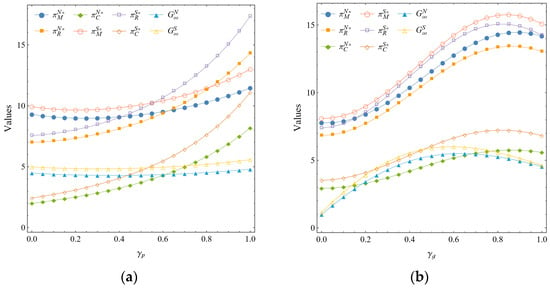
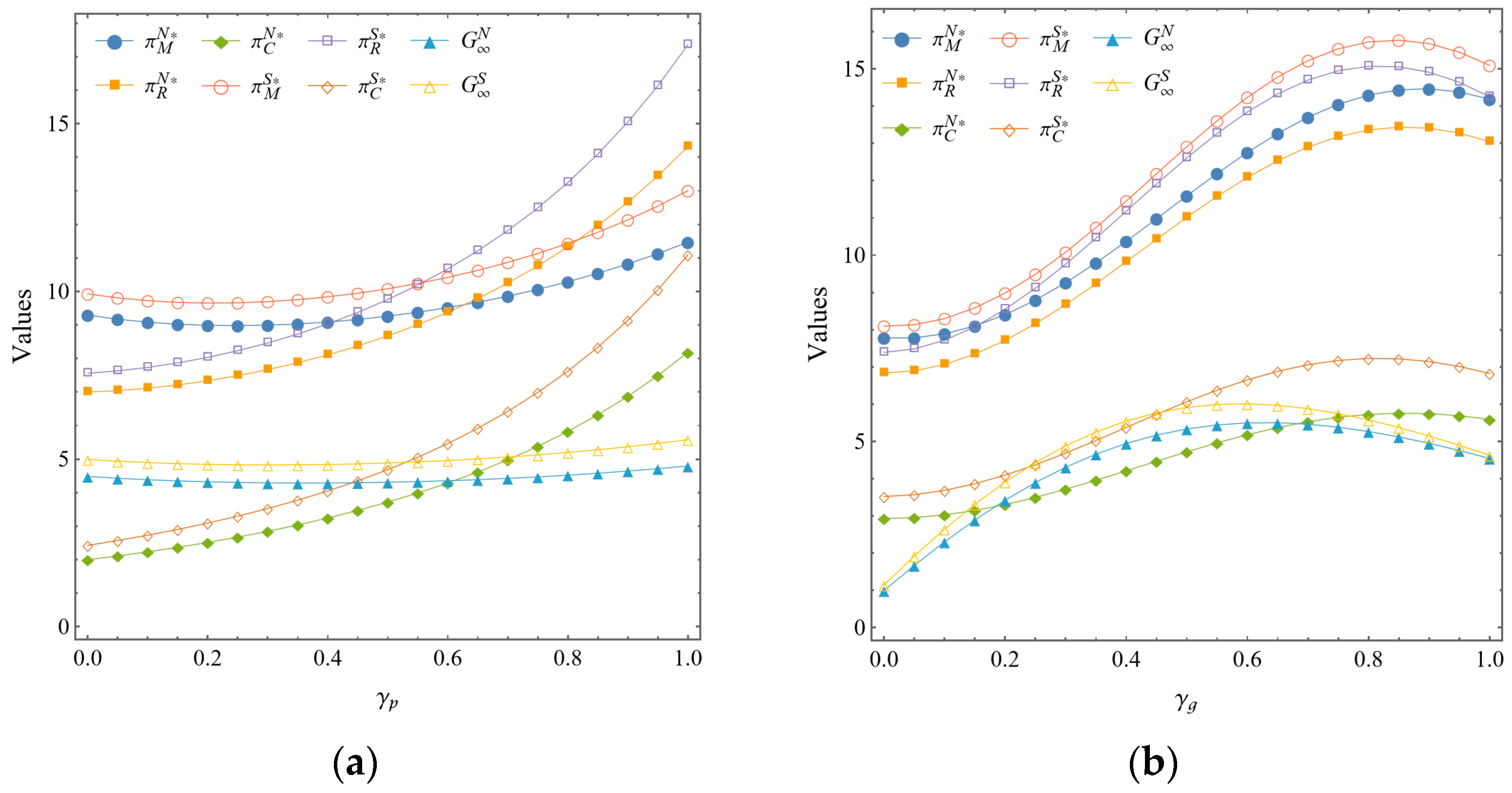
Figure 1a demonstrates the influence of the price reference effect on both supply chain members’ optimal profits and brand goodwill under steady-state conditions. The vertical axis quantifies the optimal profit values of supply chain participants, while the horizontal axis measures the intensity of the price reference effect. Within the interval where and the cost parameter satisfies , the manufacturer and retailer collaborate to lower product prices and increase brand promotion investment. This strategy meets consumers’ dual psychological expectations regarding price and brand goodwill. As a result, it expands market share and enhances their own profits. At the same time, the expansion of market share increases the recycler’s recycling revenue. This, in turn, strengthens the recycler’s incentive to improve the recycling rate. Under this scenario, brand goodwill and the profits of all supply chain members increase with the strength of the price reference effect. It is particularly noteworthy that when the price reference effect exceeds a certain threshold, the retailer’s profit surpasses that of the manufacturer. This phenomenon indicates that the price reference effect weakens, to some extent, the manufacturer’s first-mover advantage as a Stackelberg leader. Consequently, it leads to a shift in channel power structure. This implies that as consumers become more price-comparison conscious, manufacturers should reassess their pricing and brand investment strategies. They should avoid over-reliance on their leadership position while neglecting the retailer’s profit growth potential. Conversely, retailers can leverage the price reference effect to secure a more favorable profit distribution position in the supply chain game.
Figure 1.
The impact of price and goodwill reference effects on the profits of supply chain members and their brand goodwill.
Figure 1b illustrates the impact of the goodwill reference effect on supply chain members’ profits and brand goodwill under steady-state conditions. The vertical axis represents the optimal profit values of the supply chain members, while the horizontal axis indicates the intensity of the goodwill reference effect. Consider the condition where and the manufacturing cost parameter satisfies . Under this condition, the goodwill reference effect induces the manufacturer to increase brand promotion efforts, thereby meeting consumers’ psychological expectations of brand goodwill. At the same time, the manufacturer and retailer collaboratively reduce product prices to further expand market share and enhance profits. However, brand promotion efforts exhibit increasing marginal cost. As a result, brand goodwill and the profits of all supply chain members first increase and then decrease. This indicates that when the goodwill reference effect is strong but not excessive, brand investment can effectively stimulate demand. Yet, once promotion efforts exceed a certain threshold, the rising marginal cost erodes profits. This creates a negative effect of “over-investment.” Further comparison reveals that both brand goodwill and the profits of supply chain members under Case S are higher than those under Case N. This result demonstrates that the bidirectional cost-sharing contract can effectively coordinate the closed-loop supply chain in the presence of both the price reference effect and the goodwill reference effect. Consequently, it achieves a double Pareto improvement in brand goodwill and supply chain profits.
7. Conclusions
In this paper, considering a discrete Closed-Loop Supply Chain consisting of a manufacturer, a retailer, and a recycler, we investigate the impacts of price and goodwill reference effects on supply chain decisions and profitability, and further examine the coordinating effect of bilateral cost-sharing contract on the supply chain system. Moreover, the proposed findings are subsequently validated and augmented through robust parameter design and numerical simulation via Taguchi experimental methods. The main findings of this paper are as follows:
(1) The price reference effect significantly influences supply chain members’ pricing decisions, brand promotion investment, market demand, and recycling rate. When the manufacturing cost is low, the manufacturer and retailer adopt a low-price strategy. This strategy meets consumers’ price comparison expectations, expands market share, and incentivizes the recycler to improve the recycling rate. In this case, a stronger price reference effect facilitates market growth and resource recycling. When the manufacturing cost is high, the manufacturer and retailer pass on the cost burden. As a result, prices exceed consumers’ psychological reference range. The price reference effect then amplifies consumers’ “premium aversion,” thereby suppressing demand and recycling. Notably, when the manufacturing cost falls within a certain specific range, an increase in the price reference effect leads to simultaneous rises in the wholesale price, retail price, brand promotion effort, and market demand. This results in a phenomenon of “high price, high market demand.” Within this range, the positive pull effect on market demand—generated by brand goodwill accumulated through increased brand promotion investment—outweighs the negative demand-suppressing effect of the price increase. In other words, a stronger price reference effect incentivizes the manufacturer to invest more in brand promotion. Meanwhile, the goodwill reference effect compensates for the demand squeeze caused by the price increase. Ultimately, this makes the price reference effect positively correlated with market demand. This phenomenon breaks the conventional logic of the law of demand. It reveals that, under the joint influence of dual reference effects, the price reference effect may produce positive market outcomes by “forcing” brand building.
(2) Through consumers’ comparison behavior regarding brand goodwill, the goodwill reference effect influences the manufacturer’s brand promotion effort, pricing strategies, market demand, and recycling rate. In a low-cost environment, the manufacturer increases promotion investment and enhances goodwill. It also coordinates with the retailer to lower prices. This forms a competitive advantage of “high goodwill + low price,” which drives simultaneous growth in demand and recycling. In a high-cost environment, the manufacturer reduces promotion and raises prices. This leads to a combination of “insufficient brand value” and premium loss, which suppresses demand and recycling. In particular, when the manufacturing cost lies within a reasonable range, the goodwill reference effect can support the coexistence of “high price, high demand,” enabling premium expansion. Real-world examples—such as the premium expansion of LVMH and Hermès—provide empirical support for this finding.
(3) The effectiveness of the bidirectional cost-sharing contract depends on the goodwill diffusion coefficient and the retailer’s cost-sharing ratio. When the market impact of goodwill is strong and the retailer’s sharing ratio is high, the contract incentivizes the manufacturer to increase promotion effort and enhance goodwill. It also leads to lower wholesale and retail prices. This creates a virtuous cycle: “cost sharing → promotion incentive → goodwill enhancement → demand expansion → price reduction.” As a result, market demand, the recycling rate, and supply chain members’ profits are significantly improved. Conversely, a low sharing ratio leads to a vicious cycle. Simulation results show that brand goodwill and profits under the bidirectional cost-sharing contract (Case S) are superior to those under the no-contract scenario (Case N). That is, the bidirectional cost-sharing contract can achieve a double Pareto improvement in brand goodwill and supply chain profits, thereby realizing multidimensional supply chain coordination.
(4) Under the influence of the price reference effect, the recycler’s profit is always lower than those of the manufacturer and the retailer. However, when the price reference effect exceeds a certain threshold, the retailer’s profit surpasses that of the manufacturer. This indicates that the price reference effect weakens, to some extent, the manufacturer’s first-mover advantage as a Stackelberg leader. Consequently, this suggests that the price reference effect alters the power structure of the supply chain.
7.1. Management Insights
This paper offers several insights for the literature on dynamic closed-loop supply chain operations management under reference effects. On the one hand, when analyzing the impact of reference effects on firms’ operational management, most existing studies consider only price and quality reference effects. They overlook consumers’ comparison behavior regarding brand goodwill. In contrast, this paper simultaneously considers both the price reference effect and the goodwill reference effect on market demand. It further analyzes their influence on the operational decisions of supply chain enterprises. On the other hand, existing research on dynamic closed-loop supply chains is mainly based on the assumption of continuous time. These studies analyze the continuous changes in decisions and their impacts. However, they neglect the discontinuous nature of decision-making in actual management practice. In contrast, we construct a difference game model under the discrete-time assumption. We then study the decision optimization problem of dynamic closed-loop supply chains. As a result, our analytical framework is more aligned with the real-world decision-making environment of enterprises. The findings of this paper also offer actionable implications for practitioners in closed-loop supply chain management.
(1) For manufacturer:
As the leader of the supply chain, the manufacturer should fully recognize the importance of controlling manufacturing costs and enhancing brand goodwill. On the one hand, controlling manufacturing costs leaves sufficient room for product pricing. It also helps avoid excessively high product prices. On the other hand, the manufacturer should increase brand promotion investment. This investment meets consumers’ psychological expectations of goodwill and strengthens the product’s market position. Ultimately, it strives to foster the emergence of a “high-price, high-demand” market. In practice, some firms have already achieved a win–win situation in terms of price and market share through brand strategies. For example, according to a report by 36 Kr, thanks to its strong brand recognition, Apple secured seven positions among the top fifteen global high-end smartphone shipment models in the first quarter of 2023. This occurred despite Apple’s relatively high product pricing. As the leader of the supply chain, the manufacturer should fully recognize the importance of controlling manufacturing costs and enhancing brand goodwill. On the one hand, controlling manufacturing costs leaves sufficient room for product pricing. It also helps avoid excessively high product prices. On the other hand, the manufacturer should increase brand promotion investment. This investment meets consumers’ psychological expectations of goodwill and strengthens the product’s market position. Ultimately, it strives to foster the emergence of a “high-price, high-demand” market. In practice, some firms have already achieved a win–win situation in terms of price and market share through brand strategies. For example, according to a report by 36 Kr, thanks to its strong brand recognition, Apple secured seven positions among the top fifteen global high-end smartphone shipment models in the first quarter of 2023. This occurred despite Apple’s relatively high product pricing.
Furthermore, in a market where the price reference effect is strong, consumers become more price-comparison conscious. As a result, the retailer’s profit may surpass that of the manufacturer. This weakens the manufacturer’s first-mover advantage as a Stackelberg leader. The manufacturer should therefore reassess its pricing and brand investment strategies. It should avoid over-reliance on its leadership position while neglecting the retailer’s profit growth potential. When necessary, the manufacturer may adjust the cooperation model with the retailer.
(2) For retailer:
Retailer can leverage consumers’ price comparison behavior. They may negotiate lower wholesale prices or a higher profit-sharing ratio in the supply chain game. Retailer may also enhance consumers’ satisfaction with price comparisons through end-user promotions, price-matching guarantees, and similar measures. In doing so, they amplify the positive effect of the price reference effect. Moreover, when the manufacturing cost falls within a specific range, retailers should collaborate with the manufacturer on brand promotion while raising the retail price. For instance, they can strengthen brand image through in-store displays, membership marketing, and other means. This magnifies the positive role of the goodwill reference effect.
(3) For recycler:
The recycler’s recycling revenue is directly related to product market demand. Recycler should closely monitor changes in market demand. They should flexibly adjust their operational decisions according to different market conditions. For example, during low-cost phases or “high-price, high-demand” phases, the strategies of the manufacturer and retailer significantly expand market share. This expansion increases the potential base of end-of-life products for recycling. Recycler should therefore proactively arrange their recycling networks. Recycler should increase collection points and optimize recycling processes. In doing so, they capture the scale advantages brought by demand expansion.
7.2. Limitations and Prospects
(1) This paper assumes that all supply chain members are risk-neutral, but in reality, supply chain members may also be risk-averse. Therefore, studying the impact of risk aversion on discrete dynamic closed-loop supply chain is also of value.
(2) The state variable in this paper represents dynamic processes that change over time, without considering random disturbance from external factors. In future research, stochastic processes can be introduced, and their impact on the decision-making and performance of closed-loop supply chain can be analyzed.
Author Contributions
L.H.: Conceptualization, Formal analysis, Methodology, Software, Validation, Visualization, Writing—original draft, Writing—review and editing. L.L.: Funding acquisition, Formal analysis, Investigation, Methodology, Software, Validation, Visualization, Writing—original draft, Writing—review and editing. M.L.: Methodology, Software, Writing—review & Editing. All authors have read and agreed to the published version of the manuscript.
Funding
This work was supported by National Natural Science Foundation of China (No. 72162015).
Institutional Review Board Statement
Not applicable.
Informed Consent Statement
Not applicable.
Data Availability Statement
The original contributions presented in this study are included in the article. Further inquiries can be directed to the corresponding author.
Conflicts of Interest
The authors have no relevant financial or non-financial interests to disclose.
Appendix A
Proof of Propositions 1–2.
Based on the value functions (10)–(13), the Bellman equation can be formulated as: , , . We conjecture that the solutions to the value functions take the form of: , , . From the first-order condition , we can obtain . Substituting the aforementioned into the Bellman equation . Then, from the first-order condition , we can obtain . Substitute into , and then substitute both and into . Solving the system of equations through first-order conditions and , we can obtain and . By substituting expressions and into and , we obtain and . Substituting the aforementioned equilibrium solutions into the demand function yields Equation (16); meanwhile, substituting the aforementioned equilibrium solutions into , , , and combining with Equation (13) to discount all values to period , we obtain Equations (17)–(20) using the method of undetermined coefficients. Furthermore, substituting into Equation (14) and solving the difference equation yields . Q.E.D. □
The proofs of Propositions 3–4 follow similar arguments to those of Propositions 1–2, and are therefore omitted for brevity. By substituting the steady-state goodwill into the equilibrium solution and replacing G in the demand function, we obtain the equilibrium decisions and demand under steady-state goodwill.
Proof of Corollary 1.
Since is a function of and , substituting the explicit expression of into the decision variables makes them functions of and . By applying multivariate chain rule differentiation, we can obtain . First, we determine the sign of , and find it is strictly positive, which does not affect the sign determination of . We denote relationship as . Through computation, we can obtain . So, , where , , . Thus, when , . Using the same method, we can draw the following conclusions:
(1) when , , when , ; when , , when , .
(2) when , , when , .
(3) when , , when , ; when , , when , .
(4) when , , when , ; when , , when , .
(5) when , , when , .
(6) when , , when , ; when , , when , .
We can obtain Corollaries 1–5 by organizing the above content. Then, we present the proof of Corollary 6.
. After reducing to a common denominator, whose denominator is positive, we need only discuss the numerator. The numerator after reduction to a common denominator can be expressed in the form , where , , , . So, when , , when , , when , . Similarly, the remaining parts of Corollaries 6–7 can be proved.
Other specific expressions of , and are as follows.
□
References
- Wang, J.; Zhang, T.; Fan, X. Reverse channel design with a dominant retailer and upstream competition in emerging markets: Retailer- or manufacturer- collection? Transp. Res. Part E Logist. Transp. Rev. 2020, 137, 101924. [Google Scholar] [CrossRef] [Scilit]
- Liao, H.N.; Wu, D.; Wang, Y.H.; Lyu, Z.; Sun, H.; Nie, Y.; He, H. Impacts of carbon trading mechanism on closed-loop supply chain: A case study of stringer pallet remanufacturing. Socio-Econ. Plan. Sci. 2022, 81, 101209. [Google Scholar] [CrossRef] [Scilit]
- Schill, M.; Shaw, D. Recycling today, sustainability tomorrow: Effects of psychological distance on behavioural practice. Eur. Manag. J. 2016, 34, 349–362. [Google Scholar] [CrossRef] [Scilit]
- Popescu, I.; Wu, Y. Dynamic pricing strategies with reference effects. Oper. Res. 2007, 55, 413–429. [Google Scholar] [CrossRef] [Scilit]
- Liu, H.; Lei, M.; Huang, T.; Leong, G.K. Refurbishing authorization strategy in the secondary market for electrical and electronic products. Int. J. Prod. Econ. 2018, 195, 198–209. [Google Scholar] [CrossRef] [Scilit]
- Ma, D.; Hu, J. Research on collaborative management strategies of closed-loop supply chain under the influence of big-data marketing and reference price effect. Sustainability 2020, 12, 1685. [Google Scholar] [CrossRef] [Scilit]
- Zhao, N.; Liu, X.; Wang, Q.; Zhou, Z. Information technology-driven operational decisions in a supply chain with random demand disruption and reference effect. Comput. Ind. Eng. 2022, 171, 108377. [Google Scholar] [CrossRef] [Scilit]
- Yuan, Y.; Xiao, T. Retailer’s decoy strategy versus consumers’ reference price effect in a retailer-stackelberg supply chain. J. Retail. Consum. Serv. 2022, 68, 103081. [Google Scholar]
- Jiang, H.; Cao, J.; Shen, Z.M. Intertemporal pricing via nonparametric estimation: Integrating reference effects and consumer heterogeneity. Manuf. Serv. Oper. Manag. 2022, 26, 28–46. [Google Scholar]
- Ma, D.; Li, K.; Hu, J. How to leverage blockchain to react to consumer reference effects and develop a distribution strategy in online retailing? Transp. Res. Part E Logist. Transp. Rev. 2024, 187, 103579. [Google Scholar]
- Wang, Z.; Veldman, J.; Teunter, R. Process improvement under the reference price effect. Eur. J. Oper. Res. 2025, 322, 937–948. [Google Scholar] [CrossRef] [Scilit]
- Wang, L.X.; Li, C.; Wang, J. Design and pricing of extended warranty menus with reference effects. Eur. J. Oper. Res. 2026, 328, 201–215. [Google Scholar] [CrossRef] [Scilit]
- Ma, D.; Yin, H.; Hu, J. Sword or futility? Blockchain-based competition in refurbished market considering consumer reference behaviors. Sustainability 2026, 18, 472. [Google Scholar] [CrossRef] [Scilit]
- Wang, C.; Wang, Y.; Wang, J. Factors influencing consumers’ purchase decision-making in O2O business model: Evidence from consumers’ overall evaluation. J. Retail. Consum. Serv. 2021, 61, 102565. [Google Scholar] [CrossRef] [Scilit]
- Kennedy, A.P.; Sethi, S.P.; Siu, C.C.; Yam, S.C.P. Cooperative advertising in a dynamic three-echelon supply chain. Prod. Oper. Manag. 2021, 30, 3881–3905. [Google Scholar] [CrossRef] [Scilit]
- Ji, Y.; Wang, R.; Gou, Q. Monetization on mobile platforms: Balancing in-app advertising and user base growth. Prod. Oper. Manag. 2019, 28, 2202–2220. [Google Scholar] [CrossRef] [Scilit]
- Feichtinger, G.; Grass, D.; Hartl, F.R.; Kort, P.M.; Seidl, A. The digital economy and advertising diffusion models: Critical mass and the stalling equilibrium. Eur. J. Oper. Res. 2024, 318, 966–978. [Google Scholar] [CrossRef] [Scilit]
- Guo, R.; Ji, Y.; Jiang, Z. Optimal dynamic advertising policies in digital and traditional channels: A control-theoretic approach. Inf. Syst. Res. 2025. [Google Scholar] [CrossRef] [Scilit]
- Chiang, K.W. Supply chain dynamics and channel efficiency in durable product pricing and distribution. Manuf. Serv. Oper. Manag. 2012, 14, 327–343. [Google Scholar] [CrossRef] [Scilit]
- Ma, P.; Gong, Y.; Mirchandani, P. Trade-in for remanufactured products: Pricing with double reference effects. Int. J. Prod. Econ. 2020, 230, 107800. [Google Scholar] [CrossRef] [Scilit]
- Li, K.; Ma, D.; Hu, J. Dynamic pricing strategies based on consumers’ psychology during product-harm crises. Transp. Res. Part E Logist. Transp. Rev. 2026, 208, 104705. [Google Scholar]
- Zhang, L.; Ni, A. E-commerce platform, live streaming or combinations? Dynamic decision analysis of fresh agricultural supply chain. J. Theor. Appl. Electron. Commer. Res. 2026, 21, 44. [Google Scholar] [CrossRef] [Scilit]
- Vidale, M.L.; Wolfe, H.B. An operations research study of sales response to advertising. Oper. Res. 1957, 5, 370–381. [Google Scholar] [CrossRef] [Scilit]
- Erdem, T.; Swait, J.; Louviere, J. The impact of brand credibility on consumer price sensitivity. Int. J. Res. Mark. 2002, 19, 1–19. [Google Scholar] [CrossRef] [Scilit]

Disclaimer/Publisher’s Note: The statements, opinions and data contained in all publications are solely those of the individual author(s) and contributor(s) and not of MDPI and/or the editor(s). MDPI and/or the editor(s) disclaim responsibility for any injury to people or property resulting from any ideas, methods, instructions or products referred to in the content. |
© 2026 by the authors. Licensee MDPI, Basel, Switzerland. This article is an open access article distributed under the terms and conditions of the Creative Commons Attribution (CC BY) license.