


Abstract
The COVID-19 pandemic has renewed interest in proximity tourism as a driver for culturally sustainable local development. Against this backdrop, this study examines the Province of Latina, Italy, evaluating the potential of proximity tourism flows originating from the Metropolitan City of Rome to reduce the socioeconomic and infrastructural disparities that affect the provincial territory. Using a multi-stage quantitative framework, the research identifies key determinants of municipal attractiveness and assesses the structural relationships between tourism activities, economic development, and demographic trends. Results reveal a clear spatial polarization: while coastal municipalities successfully leverage natural and cultural assets for development, they increasingly face challenges related to overtourism and gentrification. Conversely, marginalized hilly and mountainous peripheries remain underdeveloped despite their high heritage value. Empirical evidence suggests that while proximity tourism does not directly drive demographic growth, it acts indirectly as a catalyst by stimulating economic development. The study concludes that proximity tourism can foster territorial cohesion and socioeconomic resilience only when coupled within integrated strategies that improve accessibility, valorize peripheral assets, and keep the added value of tourism embedded within host communities. These findings offer actionable insights for policymakers aiming to transition toward more inclusive and culturally sustainable tourism models in the post-pandemic era.
1. Introduction
The global tourism sector has encountered a profound paradigm shift following the COVID-19 pandemic, which contributes to re-evaluating mass international mobility in favor of more localized and resilient travel patterns [1,2,3,4,5,6,7]. Particularly, during the post-pandemic crisis, proximity tourism, characterized by short-distance travel, local excursions, and the utilization of second homes, from being merely a temporary substitute for global travel has evolved into an intentional approach to reinterpreting familiar environments [3,4,5,6,8]. This trend encourages a reinterpretation of everyday landscapes, allowing tourists to engage with localities not only for utilitarian purposes but also for their aesthetic, cultural, and experiential value [3,4,5,6].
At the individual level, proximity tourism involves adopting a perspective that blends curiosity with a renewed appreciation of the familiar [4,9,10]. From a societal perspective, practices such as locavism or bioregional tourism strengthen connections between tourists and local communities, while offering accessible tourism opportunities for individuals with limited financial resources [4,10,11]. On a territorial scale, proximity tourism highlights the relationships between central and peripheral areas, promoting experiential diversity and fostering the development of less visited or remote regions [12]. Economically, it contributes to revitalizing neglected elements of local heritage, support off-season tourism, foster new mobilities, and contribute to sustainable transitions in the tourism sector [1,10,13,14,15,16,17].
Based on these premises, this study adopts a framework situated in the “relational turn” of tourism geography [18,19]. By analyzing the interplay between geographical and organized proximity [20,21], proximity tourism can be reimagined as a structural enabler of socioeconomic and infrastructural resilience rather than a purely commercial activity. This perspective can be adopted to investigate how territorial development emerges from the multiple interactions between tourists (visitors) and local actors [19,22,23].
While international research on proximity tourism often considers homogeneous destinations, there is a lack of understanding regarding how these dynamics perform across heterogeneous geographies. To address this gap, this study focuses on the Province of Latina (Latium Region, Italy), as its territory encompasses an interesting geomorphological and socioeconomic mix: anthropogenic reclamation lands (Agro Pontino), fringe coastal areas and fragile islands (the Pontine archipelago), and marginalized hilly and mountainous peripheries (the Lepini, Ausoni, and Aurunci systems).
By examining how proximity tourism flows from the neighboring Metropolitan City of Rome interact with such diverse territorial clusters, the study contributes to the international discourse on spatial justice and territorial cohesion [17,20]. Specifically, we address a critical research gap regarding the capacity of proximity tourism to either foster socioeconomic resilience or exacerbate long-standing polarizations between economically developed urban areas and inner peripheries coping with depopulation trends [24,25,26], thereby offering a scalable framework for culturally sustainable regional and territorial governance [27]. We notice how proximity tourism is not free of challenges, as infrastructures and socioeconomic activities remain underdeveloped in peripheral areas, while tourism services are often concentrated in provincial hubs, potentially reinforcing spatial imbalances and contributing to issues such as overtourism, identity loss, and resource pressure [1,28,29,30]. Moreover, recent scholarship on touristification and place-based displacement highlights the risk of persisting inequalities, gentrification, and local resistance if tourism activities are not managed in a way that is both locally and culturally sustainable [31,32,33,34,35,36,37].
To address these instances, Section 2 provides a comprehensive literature review, connecting recent findings on proximity tourism with global theories on geography and sustainability; Section 3 describes the study area, detailing the historical and topographic specificities of the Province of Latina; Section 4 outlines the multi-layered methodological framework, including Principal Component Analysis (PCA), gravity-based regression models, and Structural Equation Modeling (SEM); Section 5 presents the empirical results; Section 6 offers a critical discussion of the findings through the lens of center-periphery dynamics; and Section 7 summarizes the study’s original scientific contributions, policy implications, and limitations.
2. Literature Overview
This section explores the conceptual evolution of the notion of proximity, the relational turn in tourism geography, theories of culturally sustainable local development, and how they are applied within the scholarly discourse on tourism development. The School of Proximity considers the interplay between geographical (accessibility and distance costs) and organized proximity (relational belonging and logic of similarity) as essential for territorial and socioeconomic development [20,21]. In the same vein, Italian scholars demonstrated how the spatial concentration of small firms within a shared cultural and social milieu creates resilience and local development [20,21]. This legacy has transitioned into the analysis of the inner areas, where the role of tourism in promoting the economic and demographic revitalization of marginalized municipalities has both supporters and critics [24,38,39,40,41,42,43,44].
Concerning the positive aspects of the tourism-development nexus, the notion of temporary geographical proximity [20,21] suggests that occasional face-to-face interactions (such as local excursions or short stays) can activate organized proximity, fostering trust and long-term coordination between external and local actors that might compensate for the insufficient mass of the local dimension. Moreover, it is worth mentioning how contemporary tourism geography considers destinations as dynamic modes of relating between the local communities and their environments [18,19,45]. This shift aligns with sustainable tourism theories, which seek a balance between economic viability, sociocultural integrity, and environmental protection [7,17,22,46,47,48,49,50,51].
A critical component of the discourse on sustainable tourism is the emphasis posed on local control and empowerment, ensuring that value generated by tourism remains embedded within host communities [23,52,53,54,55]. The international debate also warns about how excessive concentration can lead to overtourism, gentrification, and tourism-phobia [32,33,34,35,36,37,56,57,58,59]. Culturally sustainable local tourism and territorial governance is thus required to manage the overall resilience of the destinations, considering carrying capacities and preventing the crowding out of residents’ interests and their place-based displacement [58,60,61,62,63].
Concerning Italy, recent research highlights the role of slow routes and cultural heritage as catalysts for the reinterpretation of peripheral inner landscapes [38,39]. Also, studies on coastal areas and small islands (as the Pontine archipelago) underscore the fragile balance between tourism-led growth and the preservation of natural and sociocultural equilibria in isolated territories [31,64,65,66,67]. Finally, Italian scholars have contributed extensively to the overtourism and place-based displacement discourse, considering Rome, Venice, and other territories as emblematic laboratories for measuring the social and physical deterioration caused by unsustainable visitor flows [35,68,69].
Against this backdrop, this paper extends previous authors’ research on the tourism attractiveness of Latium’s territories and on the role of tourism in reducing socioeconomic and territorial disparities between urban centers and peripheral areas [29,70,71]. Specifically, a research gap is identified in understanding the development of proximity tourism activities from the Metropolitan City of Rome to the Province of Latina (Italy, Latium Region). In doing so, we move beyond a descriptive case study to evaluate how proximity tourism can be strategically activated to bridge the divide between the provincial service poles and the municipalities located in the inner areas, fostering culturally sustainable local development [27]. Specifically, the study poses two fundamental research questions:
- Which Latina’s municipalities are most attractive and accessible for proximity tourism originating from the Metropolitan City of Rome?
- Can tourism development facilitate a more balanced socioeconomic and demographic growth across the province’s diverse territories, or does it reinforce existing polarizations between the coastal hubs and the inner localities?
3. Study Area: The Province of Latina
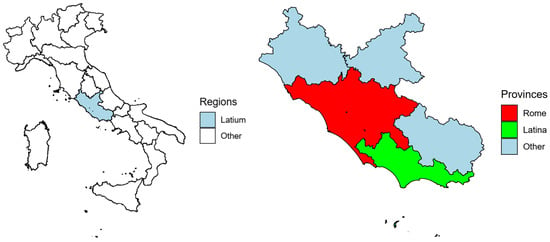
Established in 1943, the Province of Latina is located in the southwestern part of the Latium Region (see Figure 1). Its territory covers an area of approximately 2256 square kilometers and is geographically and socioeconomically connected to the Metropolitan City of Rome.
Figure 1.
Italy, Latium Region, the Metropolitan City of Rome and the Province of Latina. Source: our elaboration on ISTAT data (2025).
The province’s topography is characterized by a significant structural divide: 75% of the area consists of plains below 300 m above sea level, while hilly areas (301–700 m) and mountains account for 17% and 8%, respectively. This geomorphological mix is further enriched by the presence of the Pontine Islands archipelago (Ponza, Palmarola, Zannone, Gavi, Ventotene, and Santo Stefano) and a dense network of inland watercourses and coastal lakes.
This specific combination of reclaimed agricultural lands, peripheral coastal areas, marginalized mountain and fragile island ecosystems provides an interesting laboratory to test how proximity tourism flows from Rome interact with diverse internal contexts, ranging from high-density service poles to peripheral areas facing depopulation risks.
The identity of the province is inextricably linked to the reclamation of the Pontine Marshes (Agro Pontino). Historically a vast swampland between Cisterna and Terracina, the territory underwent a massive hydrological and social engineering project in the early 20th century, which established new agricultural hubs and urban centers such as Latina (formerly Littoria, founded in 1932).
Following World War II, the province transitioned from an agrarian economy to a hub for manufacturing and tertiary growth [72]. However, the economic crisis of the 1990s and the recent COVID-19 pandemic exposed structural vulnerabilities, emphasizing the potential role of proximity tourism as a resilient alternative for culturally sustainable local development.
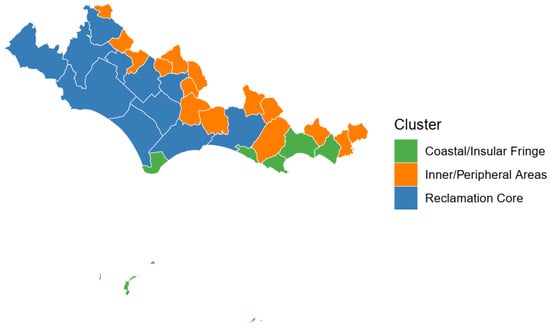
Nowadays, the Province of Latina is characterized by heterogeneous levels of socioeconomic development, accessibility, and service provision, that shape center–peripheral relations between two groups of localities. As illustrated in Figure 2, on one hand, the province has a “Reclamation Core” characterized by high demographic density and consolidated industrial activities. On the other hand, the province has a peripheral area that includes the “Coastal and Island Fringe” and the “Inner Mountain Periphery” (Lepini, Ausoni, and Aurunci systems). While coastal areas like San Felice Circeo and Sperlonga are touristically developed, they exhibit peripheral traits such as extreme seasonality and infrastructure pressure due to overtourism phenomena. The mountainous and hilly municipalities are the most peripheral, characterized by high natural and cultural value but limited accessibility and depopulation risks.
Figure 2.
The three municipal clusters of the province. Source: our elaboration on ISTAT data (2025).
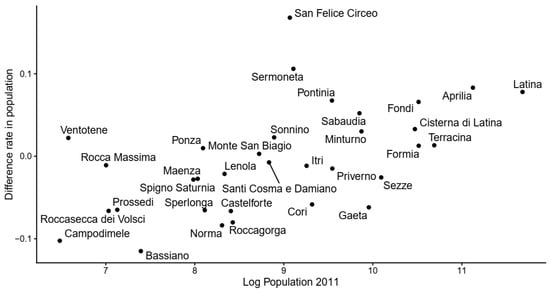
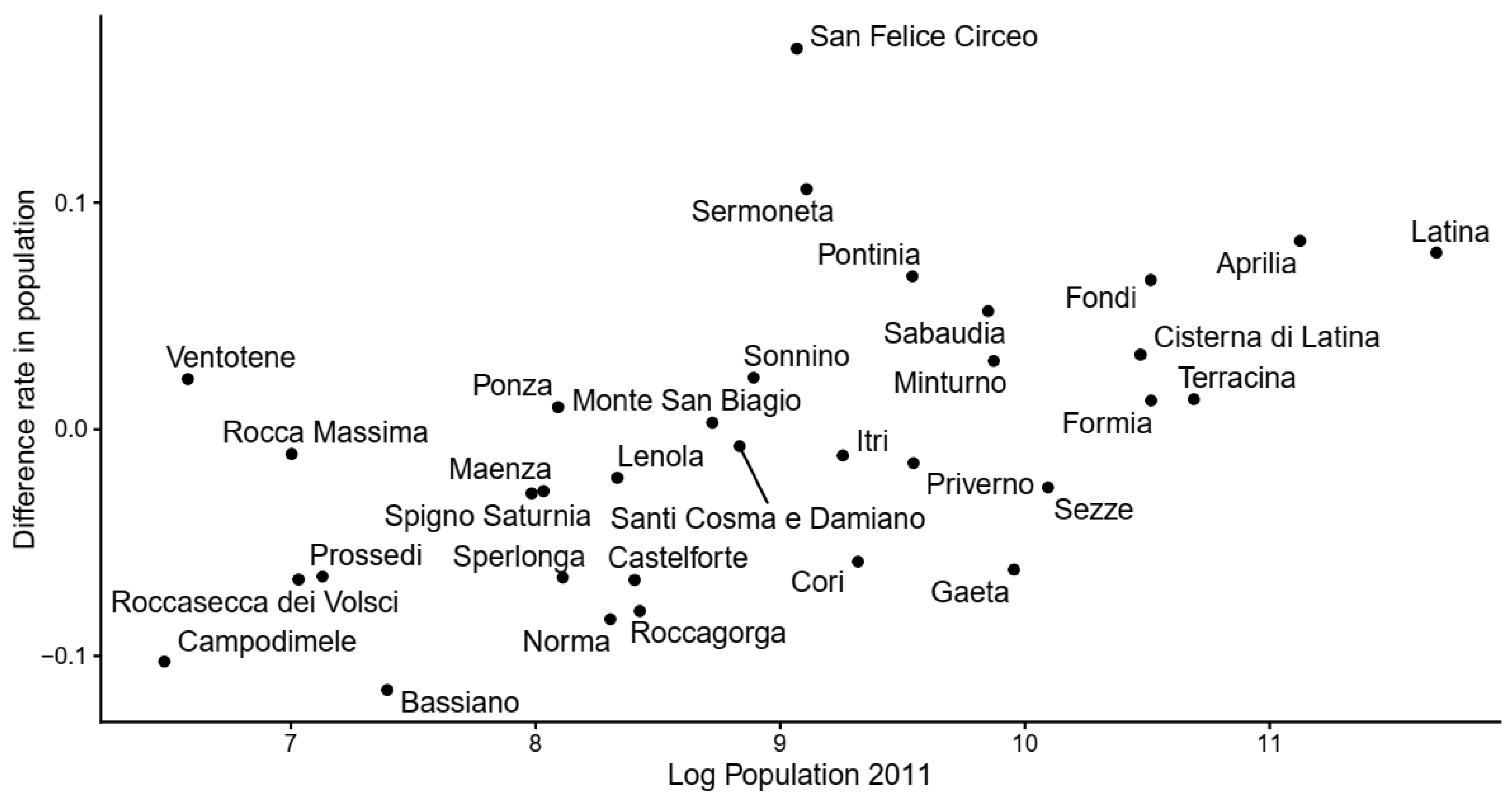
The province currently hosts a population of approximately 566,224 residents. Table 1 details its distribution across the three already-mentioned clusters. Furthermore, as illustrated in Figure 3, population data suggests how larger municipalities generally exhibit positive demographic trends, while smaller and more peripheral municipalities are more exposed to depopulation risks. This evidence highlights spatial reconfiguration characterized by a trend toward demographic agglomeration in the reclamation core of the province, as well as in a small number of other coastal centers, probably due to an intensification of territorial and socioeconomic disparities. The resulting heterogeneous demographic and territorial structure underscores the necessity of a multidimensional analysis to identify whether proximity tourism can truly foster cohesion or if it merely reinforces the existing polarizations between the developed core and the fragile peripheries.
Table 1.
Population of the four Latina’s clusters of municipalities.
Figure 3.
Demographic trends in the Province of Latina. Source: our elaboration on ISTAT data (2025).
4. Materials and Methods
To evaluate the potential of proximity tourism as a driver for culturally sustainable local development in the Province of Latina, this study employs a multi-stage quantitative framework. The analysis moves beyond descriptive mapping to investigate the structural and causal relationships between territorial attractiveness, accessibility, and socioeconomic outcomes.
The methodology is structured into three complementary analytical layers, integrated to provide a holistic understanding of the study area (see Table 2 for a schematic representation). The first stage aggregates 30 high-dimensional municipal indicators into a manageable set of latent components. It serves as the “inventory phase”, identifying the core domains of territorial potential. Leveraging on the results of the first stage, the second stage tests the divergence hypothesis. Specifically, it identifies whether tourism and population are distributed uniformly or tend to cluster in specific hubs based on gravitational forces. The final stage bridges the gap between observed clustering and latent causality. It tests the direct and indirect impacts of tourism on demographic growth, accounting for measurement errors and complex interdependencies. Combining these levels is necessary because while PCA describes the territory and spatial regressions identify patterns of agglomeration, only SEM can reveal the underlying causal mechanisms that relate tourism and culturally sustainable local development, such as the crowding-out effect or the indirect economic and structural effects of tourism on population growth.
Table 2.
Integrated methodological framework.
Data were sourced from the Italian National Institute of Statistics (ISTAT) for socioeconomic indicators, Google Maps 24.x-25.x for accessibility metrics (travel times and distances from Rome), and publicly available cultural inventories for heritage assets. Data were analyzed using Microsoft Excel (Office 2024; versions in the 2410–2509 range) and RStudio (versions 2024.04–2025.09), both of which are continuously updated environments. A total of 30 variables were processed to create 26 elementary indices, subsequently organized into 12 sub-domains reflecting size, demographic trends, accessibility, and various forms of development. Detailed variable descriptions are provided in Table A1, Table A2 and Table A3 of the Appendix A.
PCA [73,74] was applied to the 12 sub-domains to extract uncorrelated components that retain the maximum variance of the territory. The analysis revealed that rural and socioeconomic indicators in Latina share a high degree of common variance, leading to their merger into a single “Development” component. Conversely, natural and cultural assets represent distinct spatial patterns, necessitating their separation into “Natural Attractiveness” and “Cultural Attractiveness” (see Section 5).
To evaluate whether spatial dependencies influence the distribution of tourism and population, the study employs Ordinary Least Squares (OLS) models and weighted regression models. Specifically, the gravity model defines interaction as a function of the population mass of municipalities and their reciprocal geographical distance. To ensure robustness and address multicollinearity, two estimation strategies were implemented: Weighted Least Squares (WLS), that aggregates spatial interactions into a scalar weight for each municipality, reflecting its aggregate gravitational centrality, and Weighted Gravitational Least Squares (WGLS), a spatial ridge regression that incorporates the full interaction matrix to stabilize coefficient estimates in the presence of spatial autocorrelation.
The final step uses a three-stage SEM approach combining Exploratory Factor Analysis (EFA), Confirmatory Factor Analysis (CFA), and path analysis. This framework estimates relationships between latent constructs (e.g., tourism and economic development) and observed demographic changes simultaneously. By treating tourism and economic units as latent factors, the model clarifies the indirect paths through which tourism affects population growth. This enables a critical assessment of whether proximity tourism promotes territorial resilience or reproduces the disparities of the center-periphery model.
Before illustrating the results of our research, it is worth spending few words to better explain the novelty in the methodology that we have implemented to perform the spatial regression analysis. Spatial dependencies may bias OLS estimates [75,76]; therefore, for robustness purposes, two estimation strategies are implemented. WLS and ridge regression models incorporating a gravitational interaction matrix were applied [77,78,79,80].
The gravitational model is defined as
where Fij is the interaction between municipalities i and j, Mi and Mj represent population, dij is the geographical distance, G (set to 1) is a proportionality constant, α and β (both set to 1) represent the importance of the mass variables and γ (set to 2) scales the influence of distance.
To assess the robustness of the OLS estimates in the presence of spatial dependence, we extend the model by incorporating a spatial weighting matrix W, derived from the gravitational interaction model described above. The corresponding Weighted Least Squares (WLS) estimator becomes
where W captures the spatial structure of interactions among municipalities. In this framework, the variance–covariance matrix of the estimator is given by
with residual variance estimated as
where n denotes the number of observations and p the number of regressors. Under regularity conditions, the estimator preserves the properties of the Best Linear Unbiased Estimator (BLUE) within the weighted space defined by W.
While the WLS specification accounts for heterogeneous spatial importance across observations, it summarizes the interaction matrix into a vector of row sums. Thus, each municipality receives a scalar weight reflecting its aggregate gravitational centrality. This approach captures the overall intensity of spatial interactions but does not explicitly model their directional structure or potential spillover effects. To incorporate the full spatial information embedded in the interaction matrix, we implement a penalized linear regression model that extends classical ridge regression by integrating a spatial penalty term. The coefficient vector β is estimated as
where λ is the penalization parameter and the spatial penalty term is defined as , where W+ is the Moore–Penrose pseudo-inverse. This formulation embeds spatial dependence directly into the regularization structure, producing a form of spatial ridge regression consistent with the spatial framework proposed by [81].
The covariance matrix of the penalized estimator is given by
where This expression enables statistical inference and supports the evaluation of model fit and predictive performance.
The selection of the penalization parameter λ follows a data-driven procedure based on K-fold cross-validation [82,83]. For each candidate value , the dataset is partitioned into K folds. The model is estimated on the training subset and evaluated on the corresponding test fold using the predictive log-likelihood criterion:
where and denotes the estimate of the residual variance obtained from the training set. The average log-likelihood across the K folds is computed as
and the optimal penalization parameter is selected as
The approach stabilizes coefficient estimates in the presence of multicollinearity, spatial autocorrelation, or complex proximity structures, while maintaining desirable asymptotic properties.
5. Results
In this Section, we present the results of the quantitative analyses. Section 5.1 illustrates the results of the descriptive analysis, Section 5.2 presents the results of the regression analysis, and Section 5.3 illustrates the results of the path analysis.
5.1. Descriptive Analyses
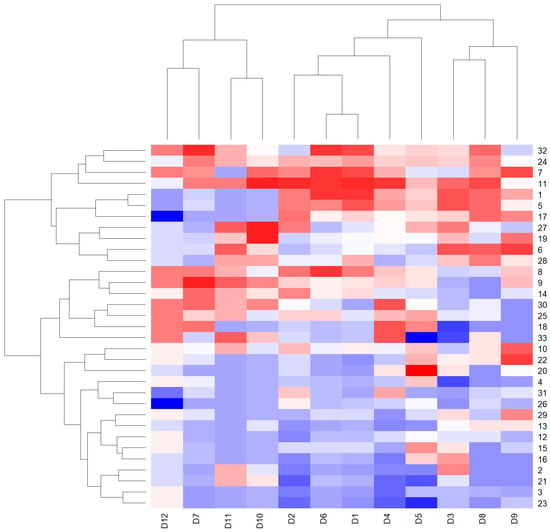
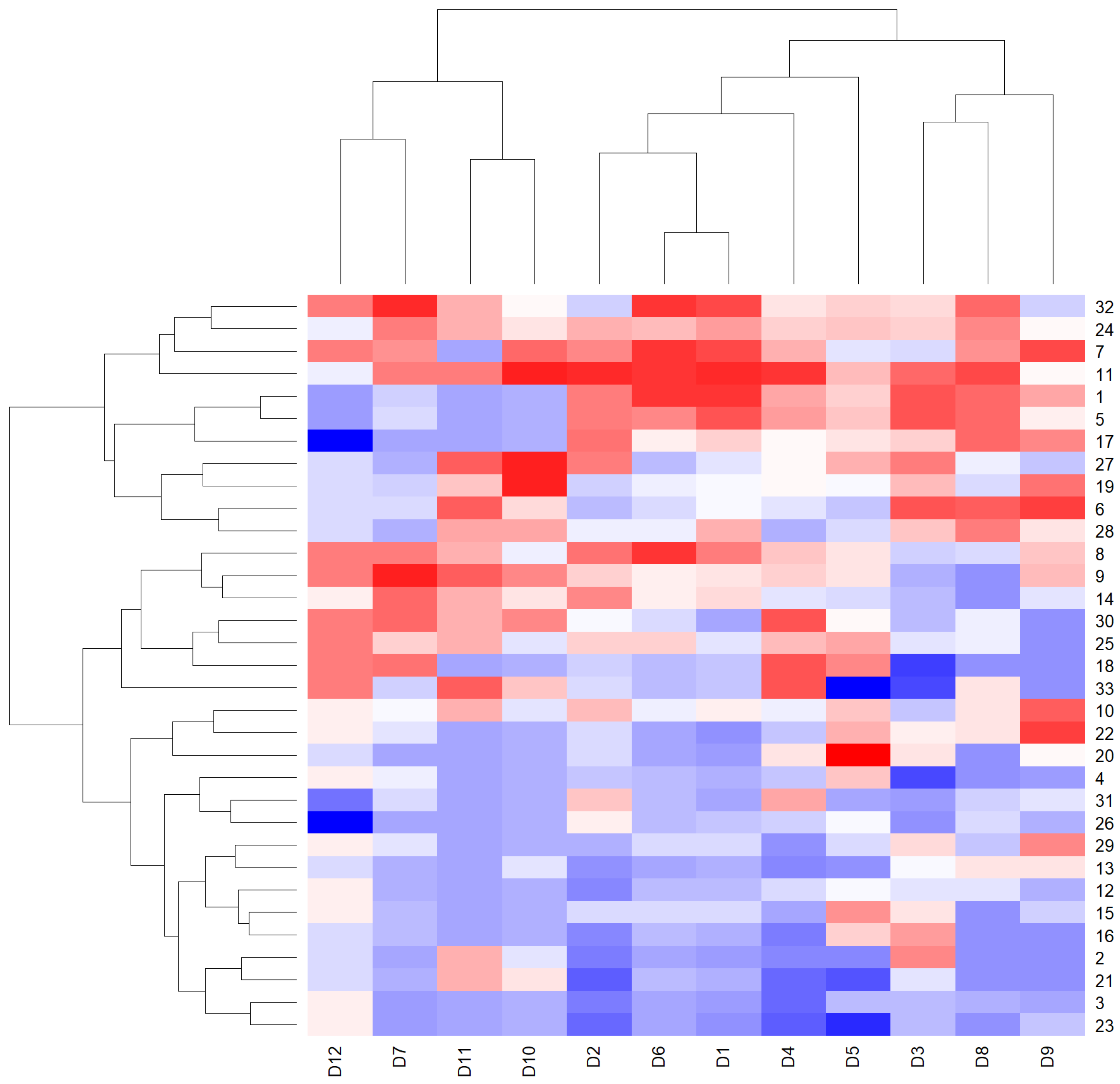
The scores computed for the 12 sub-domains are summarized in Figure 4. These sub-domains can be aggregated into three main domains:
Figure 4.
A descriptive analysis. Source: our elaboration on ISTAT and Google Maps data (2025).
- Socioeconomic development: includes “Size” (D1), “Relevance” (D2), “Economic structure” (D4), “Economic development” (D5), and “Financial development” (D6);
- Tourism relevance: includes “Tourism attractiveness” (D12), “Culture” (D10), “Cultural development” (D11), and “Tourism capacity” (D7);
- Rural development: includes “Accessibility” (D3), “Agrotourism farms” (D8), and “Traditional food productions” (D9).
Similarly, the 33 municipalities of the Province of Latina can be grouped into three clusters, mostly resembling the classification illustrated in Table 1:
- Municipalities of the reclamation: generally located in the Pontine plain, this cluster can be further disaggregated into: (i) attractive and economically developed municipalities; as Terracina (32); Sabaudia (24); Fondi (7); and Latina (11); (ii) economically developed but unattractive municipalities; as Aprilia (1); Cisterna di Latina (5); and Pontinia (17); (iii) inner municipalities as Sermoneta (27); Priverno (19); Cori (6); and Sezze (28).
- Coastal and insular attractive municipalities: Formia (8); Gaeta (9); Minturno (14); Sperlonga (30); San Felice Circeo (25); Ponza (18); and Ventotene (33).
- Inner/peripheral municipalities: Itri (10); Rocca Massima (22); Prossedi (20); Castelforte (4); Spigno Saturnia (31); Santi Cosma e Damiano (26); Sonnino (29); Maenza (13); Lenola (12); Monte San Biagio (15); Norma (16); Bassiano (2); Roccagorga (21); Campodimele (3); and Roccasecca dei Volsci (23).
Overall, the municipalities of the reclamation represent the socioeconomic core of the Province of Latina. As shown in the heatmap (see Figure 4), they exhibit different economic development trajectories, combining agricultural, industrial, and tourism-related activities. Coastal and peripheral municipalities leverage their natural and cultural attractiveness to develop intensive and profitable tourism, mitigating marginalization. Approximately half of the province’s municipalities can be considered peripheral, characterized by limited accessibility and socioeconomic development, and facing depopulation risks.
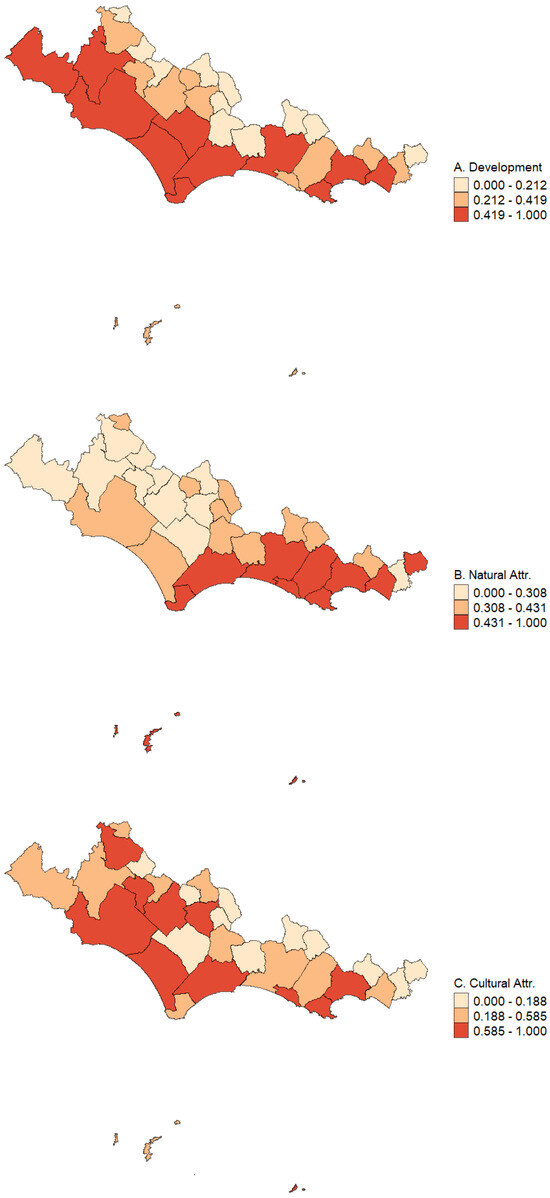
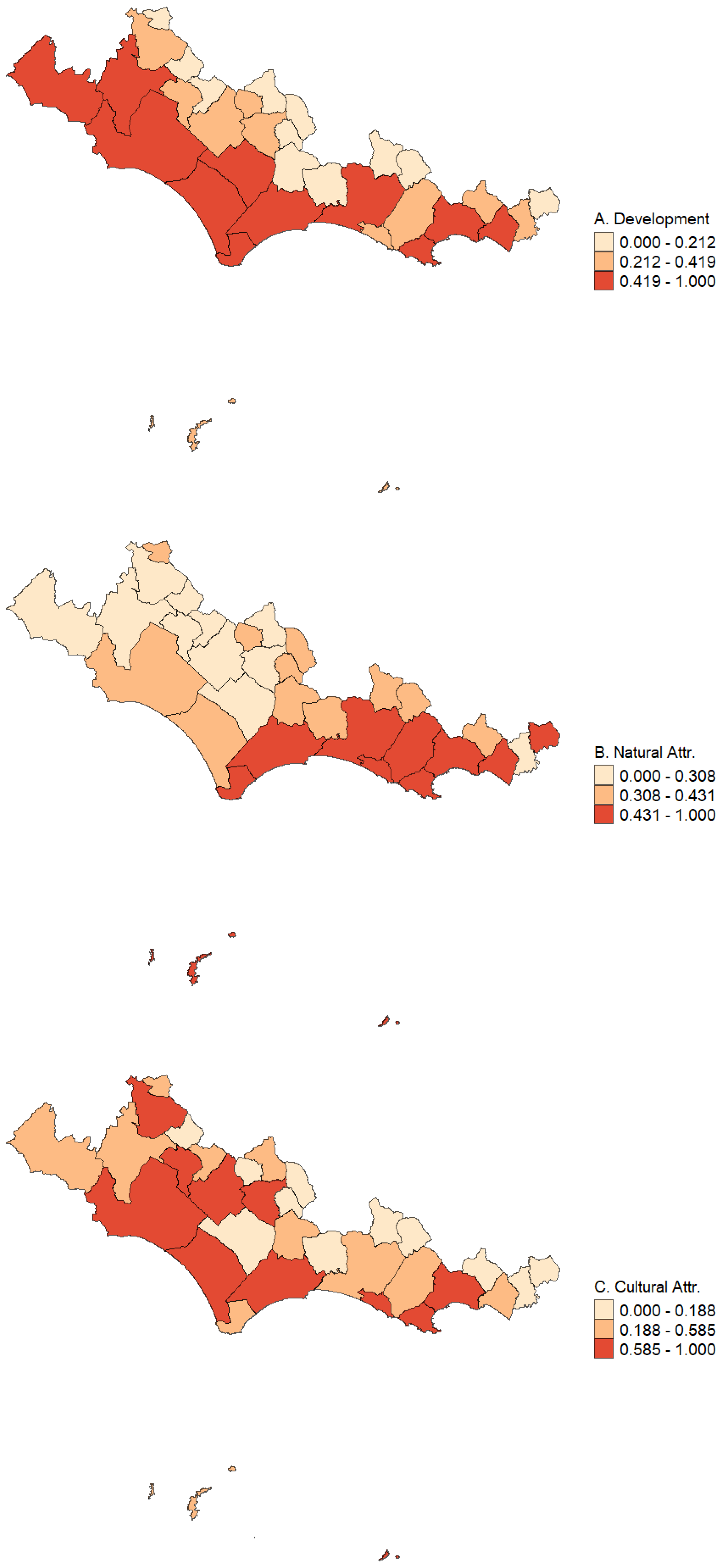
Based on this preliminary evidence, we performed a principal component analysis (PCA) to reduce the 12 sub-domains to a smaller number of components. Results are illustrated in Figure 5. The correlation revealed multiple high correlations, confirmed by Bartlett’s test of sphericity (p-value = 3.587 × 10⁻²⁵, df = 66). The Kaiser–Meyer–Olkin (KMO) test indicated an overall measure of sampling adequacy (MSA) of 0.65; however, D5 showed a low MSA of 0.40 and was removed from the analysis. After excluding D5, Bartlett’s test yielded 4.100 × 10⁻²⁶ with df = 55, and the overall KMO increased to 0.68, with all sub-domain MSAs above 0.5. PCA constrained to three factors indicated a low communality for D9 (0.40), which was subsequently removed. Excluding both D5 and D9, Bartlett’s test returned 1.813 × 10⁻²⁷ with df = 45, and the overall KMO rose to 0.72, with all sub-domain MSAs above 0.5. We then conducted PCA with three factors using oblique rotation, assuming correlation among factors. The analysis showed that all communalities exceeded 0.65, the mean item complexity was low (1.3), the root mean square residual (RMSR) was acceptable (0.05), and fit indices indicated excellent model fit (0.99).
Figure 5.
Spatial representation of Development (A), Natural (B) and Cultural attractiveness (C). Source: our elaboration on ISTAT and Google Maps data (2025).
The three factors extracted from the principal component analysis (PCA) explain 0.79 of the variance–covariance matrix. Based on the estimated loadings for each sub-domain, the three components can be interpreted as representing the main domains of our composite index:
- Development: encompassing demographic size and change, economic and financial development, tourism and rural development, and accessibility.
- Natural attractiveness: reflecting remoteness, economic and tourism development, limited rural development, and environmental appeal.
- Cultural attractiveness: including the number and relevance of museums, natural attractiveness, and, to a lesser extent, tourism development and accessibility.
The empirical shift from the initial conceptual domains (Tourism relevance, Socioeconomic development, and Rural development) to the final factors extracted through PCA (Development, Natural attractiveness, and Cultural attractiveness) is a key finding of the multidimensional analysis. While the initial grouping was based on a theoretical dendrogram and heatmap, the actual factor extraction process revealed a different underlying variance structure. Specifically, the PCA demonstrated that rural and socioeconomic indicators share a high degree of common variance in the Province of Latina, leading to their merger into a single, robust “Development” component. Conversely, the data suggested that natural and cultural assets represent distinct territorial patterns with different spatial distributions. This empirical realignment provides a more nuanced understanding of the local landscape, moving from a functionalist classification to one that reflects how these dimensions interact within the study area.
5.2. Regression Analysis
In this subsection, we examine the spatial distribution and dynamics of the tourism offer and population in the Province of Latina. Specifically, regression analyses are used to provide empirical evidence explaining the structure and observed changes in the tourism offer. The analysis is then replicated to investigate the demographic structure and population changes at the municipal level.
Table 3 and Table 4 report the results of a set of ordinary least squares (OLS) regression models, testing whether tourism accommodation facilities and population are distributed uniformly across the territory (convergence hypothesis) or tend to agglomerate in specific clusters (divergence hypothesis). The results indicate that the agglomeration hypothesis is more plausible in both cases. The coefficients for the number of tourism accommodation facilities in 2011 (TOU11) in model OLS1 and for population in 2011 (POP11) in model OLS4 are positive and statistically significant, suggesting clustering rather than uniform distribution. Moreover, the analysis shows that the tourism offer is more developed in municipalities with higher natural attractiveness, both in 2011 and 2021 (models OLS2 and OLS3). Similarly, in 2011, population levels were higher in municipalities characterized by more developed tourism and better connectivity to Rome via public transportation services (model OLS5). However, by 2021, the influence of tourism development on population distribution appears to have weakened, as indicated by model OLS6. Overall, these findings highlight the presence of spatial clustering in both tourism supply and population distribution, and suggest that natural attractiveness and connectivity play a key role in shaping territorial patterns over time.
Table 3.
Output of OLS regression models for tourism.
Table 4.
Output of OLS regression models for population.
Table 5 and Table 6 report the results of the first robustness check, which involves weighted least squares (WLS) models using information from the gravitational models aggregated into a single weight for each municipality. Overall, the WLS models yield coefficient estimates that are similar in magnitude and sign to those obtained from the OLS models. However, the WLS models do not always provide a better fit to the data than the OLS models. The second robustness check employs ridge regression models estimated using the full information from the gravitational models and the optimal level of penalization (lambda), with results reported in Table 7 and Table 8. These models largely confirm the OLS estimates, as the optimal penalization is achieved at relatively small values of lambda. In summary, both robustness checks support the reliability of the OLS findings, indicating that the observed patterns in tourism supply and population distribution are consistent across alternative estimation approaches.
Table 5.
Output of WLS regression models for tourism.
Table 6.
Output of WLS regression models for population.
Table 7.
Output of WGLS regression models for tourism.
Table 8.
Output of WGLS regression models for population.
5.3. Path Analysis
To overcome the limitations of the spatial regression models (OLS, WLS, and WGLS), which successfully identified patterns of territorial agglomeration but were hindered by high multicollinearity among regressors, the study transitions to a Structural Equation Modeling (SEM) framework. This transition is necessary to bridge the gap between observed spatial clustering and latent causal dynamics. While the previous models established where tourism and population converge, the SEM allows for the simultaneous estimation of direct and indirect effects, clarifying whether tourism development acts as a catalyst for economic growth or if it generates crowding-out effects on the local population. By employing Exploratory and Confirmatory Factor Analysis (EFA and CFA) as intermediate steps, the model ensures that the latent constructs used in the path analysis are statistically valid and purged of measurement error.
The path analysis begins with the full set of 36 elementary variables. The Kaiser–Meyer–Olkin (KMO) test was then applied iteratively to identify a shortlist of variables suitable for factor analysis. Only variables with a measure of sampling adequacy (MSA) greater than 0.5 were retained, resulting in a subset of eight variables considered ideal for multivariate analysis.
The outcomes of the KMO test are summarized in Table 9. Although the overall MSA is moderate (0.66), it is deemed acceptable, and the mean sampling adequacy for individual indicators ranges from 0.55 to 0.75. These results provide a reliable basis for examining the interrelationships among tourism, economic, and demographic dimensions at the municipal scale.
Table 9.
Kaiser–Meyer–Olkin Factor adequacy.
Following the results of the KMO test, we performed an Exploratory Factor Analysis (EFA). During the analysis, we observed that the change in the number of active local units between 2012 and 2019 (LUG1912) and the number of museums registered in 2018 (MUS18) exhibited a high degree of uniqueness, which could undermine the validity of several diagnostic tests. As a result, both variables were excluded, and a second EFA was conducted using the remaining six variables. This iteration produced acceptable values for all diagnostic tests, indicating a reliable factor structure. The resulting estimates are reported in Table 10.
Table 10.
Loadings, commonalities and uniqueness.
The EFA results indicate that two rotated factors, estimated using the “oblimin” option, explain 72% of the total variance (43% by the first factor and 29% by the second factor). The first factor aggregates the four tourism-related variables, while the second factor includes the two economic-related variables. Consequently, these factors can be interpreted as representing the degree of tourism development and economic development in each municipality.
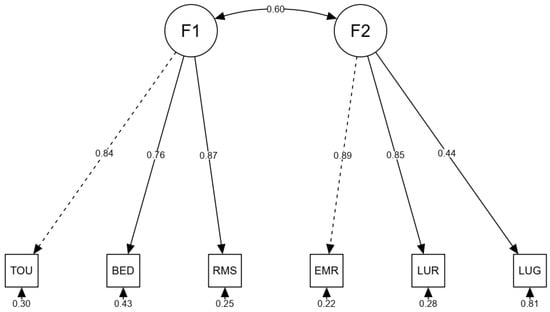
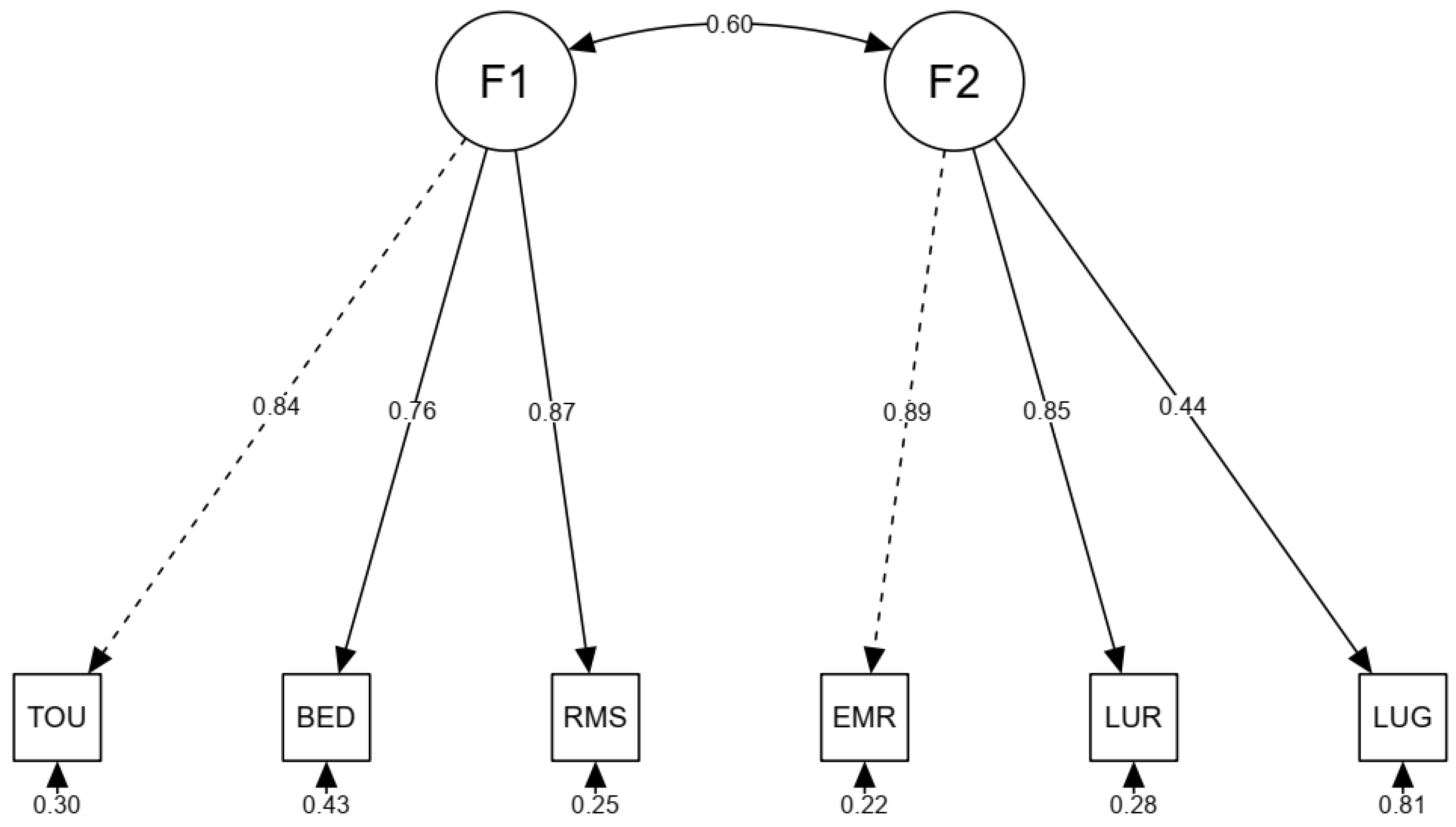
Based on the EFA results, we conducted a Confirmatory Factor Analysis (CFA), hypothesizing two latent factors: one for tourism-related variables and one for economic-related variables. The initial CFA did not provide acceptable results. Therefore, the model was refined by excluding the change in the number of tourism-related activities between 2011 and 2021 (TUG2111) from the latent construct “tourism development” (F1), as it exhibited a negative variance, and by reintroducing the change in the number of active local units between 2012 and 2019 (LUG1912) under the construct “economic development” (F2). In the revised CFA model, all parameters were statistically significant and exhibited the expected signs, with all variances positive and at least weakly significant. Additionally, all diagnostic tests indicated an acceptable fit. The resulting CFA model is illustrated in Figure 6.
Figure 6.
The output of the CFA.
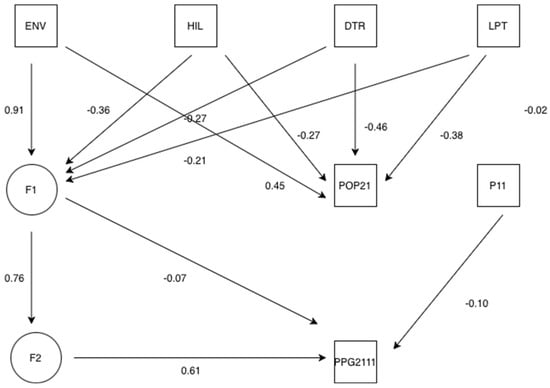
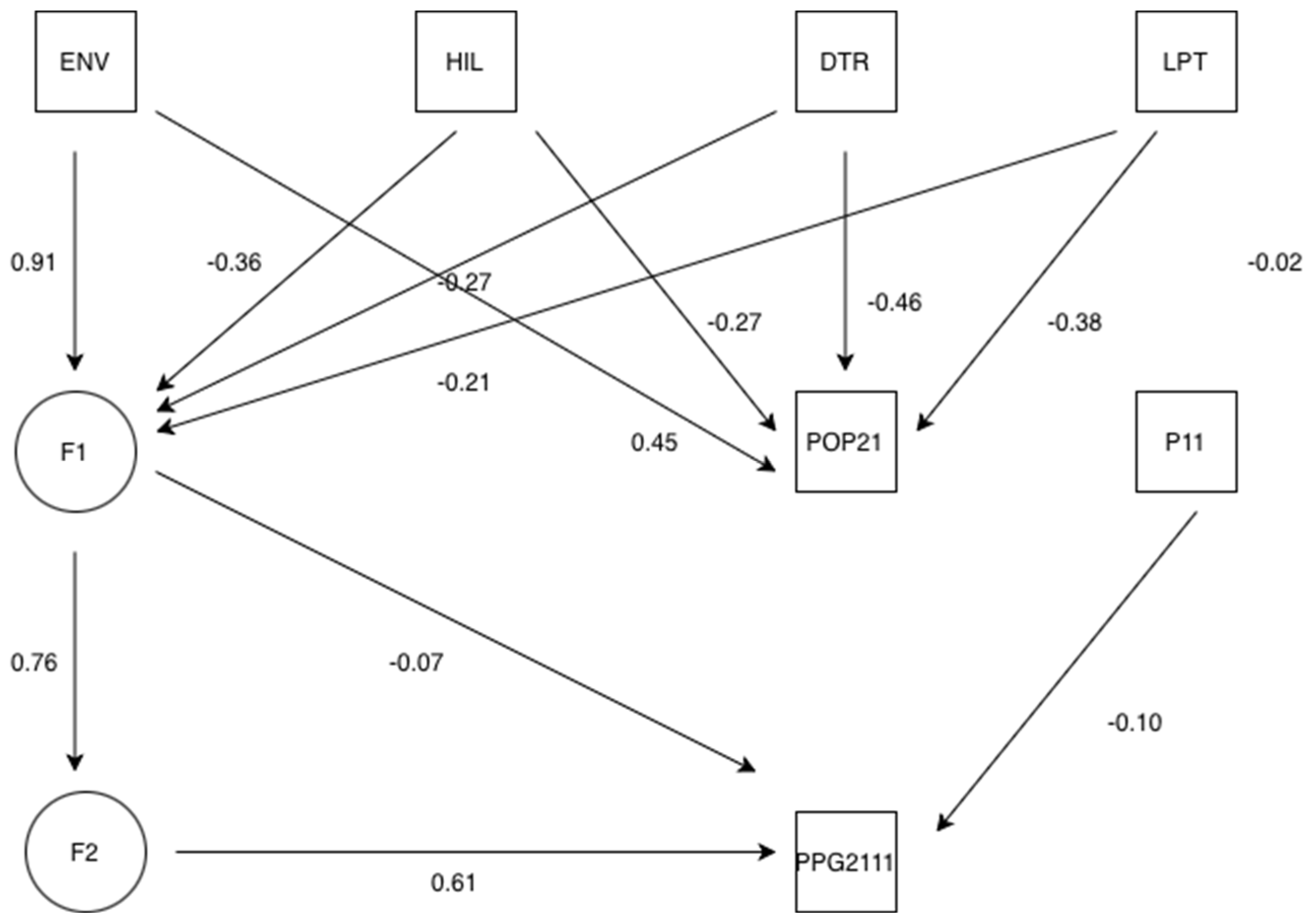
Based on the results of the CFA, we estimated a structural equation model (SEM) composed of four regression equations:
- Population change between 2011 and 2021 (PPG2111) was regressed on the population level in 2011 (P11) and the two latent factors representing tourism development (F1) and economic development (F2).
- Economic development (F2) was regressed on tourism development (F1).
- Tourism development (F1) was regressed on environmental attractiveness (ENV), travel time from Rome by car (DTR), travel time from Rome by public transport (LPT), and the geomorphological characteristics of the territory (HIL).
- Population level in 2021 (POP21) was regressed on environmental attractiveness (ENV), travel time from Rome by car (DTR), travel time from Rome by public transport (LPT), and geomorphological characteristics of the territory (HIL).
All regression coefficients were of the expected sign and statistically significant, except for the effect of tourism development on population change, which was negative and not significant. All variances were positive and at least weakly significant. The SEM results are illustrated in Figure 7, excluding the explanatory power of the latent constructs, which are already presented in Figure 6. Detailed statistics for all equations are provided in the Appendix A.
Figure 7.
The output of the SEM. Source: our elaboration.
Several relevant relationships emerge from the SEM results illustrated in Figure 7:
- Population change between 2011 and 2021 is positively associated with economic development but negatively associated with tourism development and the population level in 2011. The latter two effects, however, are not statistically significant.
- The effect of tourism development on population change is moderated by economic development. This suggests that tourism development may have a positive overall effect on population change in central municipalities, while generating a slightly negative effect in more peripheral or marginalized territories.
- Tourism development and population level share common determinants, namely environmental attractiveness and territorial accessibility (HIL, DTR, LPT). Therefore, when investments in tourism foster infrastructural development and improved access to local amenities, they can indirectly strengthen residents’ attachment to their municipalities and promote residential stability.
6. Discussion
The quantitative analyses indicate that the Province of Latina possesses multiple attractive features that can be strategically leveraged to develop proximity tourism initiatives targeting residents of Rome (see Figure 4 and Figure 5). Our results show that primary coastal municipalities (such as San Felice Circeo, Terracina, Fondi, Sperlonga, Gaeta, Formia, and Minturno) are ideal destinations, combining natural and cultural attractiveness with relatively high socioeconomic development. However, the results reveal a stark spatial polarization that demands critical interpretation through the lens of the center-periphery framework [24]. In the Provincial context, as illustrated in Section 3, the center is represented by the economically developed service poles and the reclamation core, while the periphery encompasses the fragile coastal/island fringe and the marginalized mountain systems. This polarization is both geographic and organized [20,21], as coastal municipalities currently absorb most tourism flows, exacerbating the long-standing territorial imbalances [29,30,31,40].
It is worth noting how the shift in the factor extraction process during the PCA refinement provides a more nuanced understanding of the territory than that one provided by the results of the descriptive analysis. The empirical merging of rural and socioeconomic development suggests that in the Province of Latina the two dimensions are deeply intertwined within the anthropogenic landscape of the Agro Pontino. Meanwhile, the separation of natural and cultural attractiveness indicates that the current tourism model is heavily biased toward environmental assets (coasts and islands), leaving cultural heritage as an underexploited resource in the mountain and reclamation hubs.
The results from the Ordinary Least Squares (OLS), Weighted Least Squares (WLS), and Weighted Gravitational Least Squares (WGLS) models provide additional empirical evidence in support of the spatial polarization of the Provincial territory. Specifically, the OLS models reject the convergence hypothesis in favor of a divergence pattern, indicating that both population and tourism accommodation facilities tend to agglomerate in specific clusters rather than distributing uniformly across the province. This finding validates the conceptual concern that proximity tourism may intentionally or unintentionally reinforce existing imbalances between developed coastal hubs and marginalized peripheries [29,30,31,40].
Furthermore, regression analysis identifies natural attractiveness (ENV) and territorial accessibility (LPT) as the primary structural determinants of the province’s tourism offer and demographic distribution, confirming the bias toward environmental assets highlighted by the PCA. The high significance of public transport connectivity to Rome (LPT) in the population levels of 2011 and 2021 confirms that geographical proximity is largely inoperative unless supported by accessibility and institutional infrastructure [20,21,24].
The application of WLS and WGLS serves as a robustness check to account for spatial dependence and multicollinearity. By incorporating the full information from the gravitational interaction matrix, these models consistently confirm the OLS estimates. This methodological rigor ensures that the Province of Latina functions as a laboratory to test how proximity flows from a major metropolitan center interact with heterogeneous geographies, such as reclaimed lands, mountain systems, coastal areas, and islands, providing a robust basis for scalable territorial governance.
A significant finding from the SEM is the weak and negative direct effect of tourism development on population growth. While potentially counterintuitive, this result is aligned to the literature on overtourism and tourism phobia. Specifically, this pattern likely reflects the crowding-out effects and place-based displacement described in contemporary scholarship [32,33,34,35,36,37,56,57,58,59]. In destinations like San Felice Circeo, Sperlonga, and the Pontine islands, the intensification of tourism can lead to gentrification and a deterioration of residents’ quality of life, effectively pushing local populations away [35,59,68,69]. This confirms the ambivalent character of tourism: while it acts as a primary economic vehicle, it simultaneously creates social and physical overcapacities that can fragment social cohesion and undermine community well-being [58,60,61,62,63].
Conversely, the SEM reveals a positive indirect relationship, where tourism development enhances demographic stability by stimulating local economic activities. This finding aligns with theories of community-based tourism and culturally sustainable local development, suggesting that if value remains embedded within host communities, tourism can indeed foster socioeconomic resilience [23,52,53,54,55]. The indirect path implies that tourism provides the economic substrate (e.g., jobs and business opportunities) that allows communities to survive and thrive. For proximity tourism to truly function as a structural enabler of resilience rather than a purely extractive commercial activity, a relational turn is necessary, where territorial development emerges from mutually beneficial interactions between visitors and local systems [18,19].
The role of accessibility remains a dominant determinant in shaping these territorial patterns, and the inability of marginalized hilly and mountainous peripheries to convert their high heritage value into sustainable dynamism underscores a deficit in organized proximity and territorial governance [24]. This supports the assertion that geographical proximity is largely inoperative if not coupled with organized proximity [20,21]. As noted by [17], increased accessibility must be supplemented by temporary geographical proximity, where occasional face-to-face interactions through local excursions can bridge the divide between urban centers and peripheral areas.
Based on the results of the SEM, Table 11 summarizes the effects of tourism (F1) on population growth (PPG2111) across different time horizons.
Table 11.
Summary of Tourism Effects (F1) on Population Growth (PPG).
7. Conclusions
This study conceptualizes proximity tourism from the Metropolitan City of Rome to the Province of Latina both as a localized mobility practice and as a structural engine for territorial cohesion and socioeconomic resilience. By integrating multidimensional indicators at the municipal scale, the research provides a critical synthesis of how geographical and organized proximity interact to shape the development trajectories of peripheral areas in the post-pandemic era.
The original scientific contribution of this work lies in its reframing of the Province of Latina as a laboratory to test existing proximity tourism models across highly heterogeneous geographies. Moving beyond descriptive case studies, the paper addresses a critical conceptual gap by demonstrating that the impacts of proximity tourism are mediated by specific geomorphological, infrastructural and socioeconomic contexts, ranging from anthropogenic reclamation lands to fragile island systems and marginalized mountain peripheries. Methodologically, the study establishes a scalable three-layered framework, transitioning from dimensionality reduction (PCA) to convergence and spatial regression analysis (OLS/WLS/WGLS) and causal path modeling (SEM), which offers a robust template for investigating territorial disparities in other heterogeneous contexts.
The empirical results provide a significant synthesis of the ambivalent nature of tourism development. The findings confirm a stark spatial polarization: while coastal municipalities successfully leverage natural assets to stimulate economic growth, they increasingly face crowding-out effects and gentrification that negatively impact residential stability. Conversely, the marginalized hilly and mountainous municipalities possess high cultural heritage value but lack the accessibility and organized proximity (institutional networks and transport connectivity) necessary to transform this potential into culturally sustainable local development.
From a policy perspective, the study concludes that proximity tourism can act as a driver for culturally sustainable local development if it is embedded within integrated territorial strategies. Policymakers should prioritize supra-municipal thematic routes (e.g., centered on the historical memory of land reclamation or mountain heritage) to rebalance visitor flows away from saturated coastal hubs toward marginalized inner areas. Ensuring that the added value generated remains embedded within host communities is essential to prevent extractivism and activate virtuous cycles of public reinvestment in the localities.
Despite its contributions, this research is limited by its cross-sectional nature and the lack of demand-side behavioral data. Future research should adopt longitudinal approaches to track the long-term impacts of proximity flows and incorporate consumer perceptions to better understand the evolving aesthetic and cultural needs of proximity tourists. Ultimately, a stronger institutional recognition of proximity tourism as a structural component of territorial governance will be fundamental to achieving a more culturally sustainable local development model.
Author Contributions
Conceptualization: M.F. and A.S.; Methodology: M.F. and A.S.; Formal analysis and investigation: M.F. and A.S.; Data curation: M.F. and A.S.; Project administration: M.F. and A.S.; Software: M.F. and A.S.; Supervision: M.F. and A.S.; Validation: M.F. and A.S.; Visualization: M.F. and A.S.; Writing—original draft: M.F. and A.S.; Writing—review and editing: M.F. and A.S. All authors have read and agreed to the published version of the manuscript.
Funding
This research received no external funding.
Institutional Review Board Statement
Not applicable.
Informed Consent Statement
Not applicable.
Data Availability Statement
The original data presented in the study are openly available in Figshare at https://doi.org/10.6084/m9.figshare.30023137.v1.
Conflicts of Interest
The authors declare no conflicts of interest.
Abbreviations
The following abbreviations are used in this manuscript:
| OLS | Ordinary Least Square |
| WLS | Weighted Least Square |
| SEM | Structural Equation Modeling |
| ISTAT | Italian National Institute of Statistics |
| PCA | Principal Component Analysis |
| BLUE | Best Linear Unbiased Estimators |
| WGLS | Weighted Gravitational Least Squares |
| EFA | Exploratory Factor Analysis |
| CFA | Confirmatory Factor Analysis |
| KMO | Kaiser–Meyer–Olkin |
| MSA | Measure of Sample Adequacy |
| RMSR | Root mean square residual |
Appendix A
Appendix A.1
Table A1.
A brief description of the dataset.
Table A2.
The structure of the composite index.
Table A3.
Main Descriptive statistics.
Appendix A.2
Table A4.
SEM output.
References
- Romagosa, F. The COVID-19 crisis: Opportunities for sustainable and proximity tourism. Tour. Geogr. 2020, 22, 690–694. [Google Scholar] [CrossRef] [Scilit]
- Chen, H.; Wang, L.; Xu, S.; Law, R.; Zhang, M. Research on the Influence Mechanism of Intention to Proximity Travel under the COVID-19. Behav. Sci. 2023, 13, 10. [Google Scholar] [CrossRef] [Scilit]
- Rantala, O.; Salmela, T.; Valtonen, A.; Höckert, E. Envisioning Tourism and Proximity after the Anthropocene. Sustainability 2020, 12, 3948. [Google Scholar] [CrossRef] [Scilit]
- Salmela, T.; Nevala, H.; Nousiainen, M.; Rantala, O. Proximity tourism: A thematic literature review. Matkailututkimus 2021, 17, 46–63. [Google Scholar] [CrossRef] [Scilit]
- Richards, G. Tourists in their own city–considering the growth of a phenomenon. Tour. Today 2017, 16, 8–16. [Google Scholar]
- Besson, A.M. Everyday aesthetics on staycation as a pathway to restoration. Int. J. Humanit. Cult. Stud. 2017, 4, 34–52. [Google Scholar]
- Li, J.; Coca-Stefaniak, J.A.; Nguyen, T.H.H.; Morrison, A.M. Sustainable tourist behavior: A systematic literature review and research agenda. Sustain. Dev. 2024, 32, 3356–3374. [Google Scholar] [CrossRef] [Scilit]
- Bizzarri, C.; Micera, R. The Valorization of Italian “Borghi” as a Tool for the Tourism Development of Rural Areas. Sustainability 2021, 13, 6643. [Google Scholar] [CrossRef] [Scilit]
- Diaz-Soria, I. Being a tourist as a chosen experience in a proximity destination. In Proximity and Intraregional Aspects of Tourism; Jeuring, J., Diaz-Soria, I., Eds.; Routledge: London, UK, 2018; pp. 93–114. [Google Scholar] [CrossRef] [Scilit]
- Geremew, Y.M.; Kleynhans, C. Staycation as a Means of Synergising Resilience and Stakeholder Collaboration for Sustainable Tourism Development: A Roadmap for Crisis Management. Sustainability 2025, 17, 7308. [Google Scholar] [CrossRef] [Scilit]
- Hollenhorst, S.J.; Houge-Mackenzie, S.; Ostergren, D.M. The trouble with tourism. Tour. Recreat. Res. 2014, 39, 305–319. [Google Scholar] [CrossRef] [Scilit]
- Bertacchini, E.; Nuccio, M.; Durio, A. Proximity tourism and cultural amenities: Evidence from a regional museum card. Tour. Econ. 2021, 27, 187–204. [Google Scholar] [CrossRef] [Scilit]
- Diaz-Soria, I.; Llurdés Coit, J.L. Thoughts about proximity tourism as a strategy for local development. Cuad. Tur. 2013, 32, 303–305. [Google Scholar]
- Jeuring, J.H. Discursive contradictions in regional tourism marketing strategies: The case of Fryslân, The Netherlands. J. Destin. Mark. Manag. 2017, 5, 65–75. [Google Scholar] [CrossRef] [Scilit]
- Rantala, O.; Höckert, E.; Anttila, S.; Ranta, S.; Valtonen, A. Proximity and tourism in the Anthropocene. Ann. Tour. Res. 2024, 105, 103733. [Google Scholar] [CrossRef] [Scilit]
- Moscardo, G.; Konovalov, E.; Murphy, L.; McGehee, N. Mobilities, community well-being and sustainable tourism. J. Sustain. Tour. 2013, 21, 532–556. [Google Scholar] [CrossRef] [Scilit]
- Więckowski, M. Will the consequences of COVID-19 trigger a redefining of the role of transport in the development of sustainable tourism? Sustainability 2021, 13, 1887. [Google Scholar] [CrossRef] [Scilit]
- Mura, P.; Wijesinghe, S.N.R. Critical theories in tourism—A systematic literature review. Tour. Geogr. 2023, 25, 487–507. [Google Scholar] [CrossRef] [Scilit]
- Pernecky, T. Advancing critico-relational inquiry: Is tourism studies ready for a relational turn? J. Sustain. Tour. 2024, 32, 1201–1216. [Google Scholar] [CrossRef] [Scilit]
- Torre, A.; Gallaud, D. Introduction: Proximity relations in the 21st century. In Handbook of Proximity Relations; Torre, A., Gallaud, D., Eds.; Edward Elgar Publishing: Cheltenham, UK; Northampton, MA, USA, 2022; pp. 1–47. [Google Scholar]
- Zimmermann, J.B.; Torre, A.; Grossetti, M. The French School of Proximity: Genesis and evolution of a school of thought. In Handbook of Proximity Relations; Torre, A., Gallaud, D., Eds.; Edward Elgar Publishing: Cheltenham, UK; Northampton, MA, USA, 2022; pp. 49–69. [Google Scholar]
- Goebel, K.; Camargo-Borges, C.; Eelderink, M. Exploring participatory action research as a driver for sustainable tourism. Int. J. Tour. Res. 2020, 22, 425–437. [Google Scholar] [CrossRef] [Scilit]
- Porya, A.; Chowdhary, N. Navigating Commodification and Preservation: Boundary-Making for Sustainable Ethnic Tourism. Int. J. Tour. Res. 2026, 28, e70261. [Google Scholar] [CrossRef] [Scilit]
- Barca, F.; Casavola, P.; Lucatelli, S. A strategy for inner areas in Italy: Definition, objectives, tools and governance. Mater. Uval Ser. 2014, 31, 1–66. Available online: https://www.academia.edu/65721786/A_Strategy_for_Inner_Areas_in_Italy_Definition_Objectives_Tools_and_Governance (accessed on 1 March 2026).
- De Rossi, A. Riabitare l’Italia: Le Aree Interne tra Abbandoni e Riconquiste; Donzelli Editore: Rome, Italy, 2019. [Google Scholar]
- Cersosimo, D.; Donzelli, C. (Eds.) Manifesto per Riabitare L’italia; Donzelli Editore: Rome, Italy, 2020. [Google Scholar]
- Throsby, D. Culture, economics and sustainability. J. Cult. Econ. 1995, 19, 199–206. [Google Scholar] [CrossRef] [Scilit]
- Jeuring, J.H.G.; Haartsen, T. The challenge of proximity: The (un)attractiveness of near-home tourism destinations. Tour. Geogr. 2017, 19, 118–141. [Google Scholar] [CrossRef] [Scilit]
- Salustri, A.; Cocco, V. Turismo locale e aree interne: Un binomio possibile? Mem. Geogr. 2022, 21, 79–87. [Google Scholar]
- Lucia, M.G.; Rota, F.S. Turismo di prossimità, sostenibilità e sviluppo locale. Doc. Geogr. 2024, 32, 1–14. [Google Scholar] [CrossRef]
- Bertocchi, D.; Ferri, C. Far from gentrification and touristification? Residents’ perceptions of displacement on Murano Island. Shima 2021, 15, 186–205. [Google Scholar] [CrossRef] [Scilit]
- Cócola Gant, A.; López Gay, A. Transnational gentrification, tourism and the formation of ‘foreign only’ enclaves in Barcelona. Urban Stud. 2020, 57, 3025–3043. [Google Scholar] [CrossRef] [Scilit]
- Cócola Gant, A. Place based displacement: Touristification and neighborhood change. Geoforum 2023, 138, 103665. [Google Scholar] [CrossRef] [Scilit]
- Milano, C.; Novelli, M.; Russo, A.P. Anti-tourism activism and the inconvenient truths about mass tourism, touristification and overtourism. Tour. Geogr. 2024, 26, 1313–1337. [Google Scholar] [CrossRef] [Scilit]
- Salerno, G.M. Touristification and displacement. The long-standing production of Venice as a tourist attraction. City 2022, 26, 519–541. [Google Scholar] [CrossRef] [Scilit]
- Simas, T.B.; Oliveira, S.A.L.C.D.; Cano-Hila, A.B. Tourismophobia or touristification? An analysis of the impacts of tourism in Poblenou, Barcelona. Ambient. Constr. 2021, 21, 117–131. [Google Scholar] [CrossRef] [Scilit]
- Screti, F. Populism in mediated anti-tourism discourse: A critical analysis of the documentary tourist go home! J. Tour. Cult. Change 2022, 20, 617–632. [Google Scholar] [CrossRef] [Scilit]
- Zignale, M. Turismo di prossimità. La percezione dei luoghi come riscoperta e valorizzazione del territorio locale. Doc. Geogr. 2024, 32, 53–65. [Google Scholar] [CrossRef]
- Autiero, A. Entroterra, sentieri e turismo di prossimità come leva di sviluppo locale: Il caso di Centola in Campania. Doc. Geogr. 2024, 32, 101–122. [Google Scholar] [CrossRef]
- Gemmiti, R.; Bressan, G.; Prisco, M.R.; Scognamiglio, G. Squilibri e insostenibilità del turismo in Italia. Il turismo di prossimità come rimedio? Doc. Geogr. 2024, 32, 293–313. [Google Scholar] [CrossRef]
- Díaz Soria, I. Proximity tourism within social solidarity economy: Spanish experiences. Doc. Geogr. 2024, 32, 15–33. [Google Scholar] [CrossRef]
- Jeuring, J.H.G.; Díaz Soria, I. Introduction: Proximity and intraregional aspects of tourism. Tour. Geogr. 2016, 19, 4–8. [Google Scholar] [CrossRef] [Scilit]
- Verrascina, M.; Monteleone, A.; Borsotto, P.; Cristiano, S.; Dara Guggione, G.; Papaleo, C. La sostenibilità delle produzioni agroalimentari territoriali: L’analisi di 3 casi di studio. In Sostenibilità e Innovazione Delle Filiere Agricole Nelle Aree Interne. Scenari, Politiche e Strategie; Storti, D., Provenzano, V., Arzeni, A., Ascani, M., Rota, F.S., Eds.; Franco Angeli: Milano, Italy, 2020; pp. 127–152. ISBN 9788835114246. [Google Scholar]
- Scassellati, A. Agricoltura Sociale, Welfare Rigenerativo e Sviluppo Locale Nelle Aree Rurali. Transform! Italia 2021. Available online: https://transform-italia.it/agricoltura-sociale-welfare-rigenerativo-e-sviluppo-locale-nelle-aree-rurali/ (accessed on 1 March 2026).
- Blasi, S.; Fano, S.; Sedita, S.R.; Toschi, G. A network perspective of cognitive and geographical proximity of sustainable tourism organizations: Evidence from Italy. Int. J. Contemp. Hosp. Manag. 2024, 36, 478–504. [Google Scholar] [CrossRef] [Scilit]
- Loulanski, T.; Loulanski, V. The sustainable integration of cultural heritage and tourism: A meta-study. J. Sustain. Tour. 2011, 19, 837–862. [Google Scholar] [CrossRef] [Scilit]
- McLennan, C.; Pham, T.D.; Ruhanen, L.; Ritchie, B.W.; Moyle, B. Counter-factual scenario planning for long-range sustainable local-level tourism transformation. J. Sustain. Tour. 2012, 20, 801–822. [Google Scholar] [CrossRef] [Scilit]
- Mendoza-González, G.; Martínez, M.L.; Guevara, R.; Pérez-Maqueo, O.; Garza-Lagler, M.C.; Howard, A. Towards a sustainable sun, sea, and sand tourism: The value of ocean view and proximity to the coast. Sustainability 2018, 10, 1012. [Google Scholar] [CrossRef] [Scilit]
- Bourlon, F.; Gale, T.; Adiego, A.; Álvarez-Barra, V.; Salazar, A. Grounding sustainable tourism in science—A geographic approach. Sustainability 2021, 13, 7455. [Google Scholar] [CrossRef] [Scilit]
- Higgins-Desbiolles, F. Socialising tourism for social and ecological justice after COVID-19. In Global Tourism and COVID-19: Implications for Theory and Practice; Lew, A.A., Cheer, J.M., Brouder, P., Mostafanezhad, M., Eds.; Routledge: Abingdon, UK, 2021; pp. 156–169. [Google Scholar] [CrossRef] [Scilit]
- Kong, H.; Qiu, X.; Wang, K.; Bu, N.; Cheung, C.; Zhang, N. Exploring Chinese sustainable tourism: A 25-year perspective. J. Sustain. Tour. 2025, 33, 1373–1391. [Google Scholar] [CrossRef] [Scilit]
- Weaver, D. Indigenous tourism stages and their implications for sustainability. J. Sustain. Tour. 2010, 18, 43–60. [Google Scholar] [CrossRef] [Scilit]
- Dłużewska, A.M. Well-being versus sustainable development in tourism—The host perspective. Sustain. Dev. 2019, 27, 512–522. [Google Scholar] [CrossRef] [Scilit]
- Mtapuri, O.; Camilleri, M.A.; Dłużewska, A.M. Advancing community-based tourism approaches for the sustainable development of destinations. Sustain. Dev. 2022, 30, 423–432. [Google Scholar] [CrossRef] [Scilit]
- Wang, T.; Yang, Z.; Chen, X.; Han, F. Bibliometric analysis and literature review of tourism destination resilience research. Int. J. Environ. Res. Public Health 2022, 19, 5562. [Google Scholar] [CrossRef] [Scilit]
- Benner, M. The decline of tourist destinations: An evolutionary perspective on overtourism. Sustainability 2020, 12, 3653. [Google Scholar] [CrossRef] [Scilit]
- Buitrago-Esquinas, E.M.; Foronda-Robles, C.; Yñiguez-Ovando, R. A literature review on overtourism to guide the transition to responsible tourism. Rev. Estud. Andal. 2023, 45, 71–90. [Google Scholar] [CrossRef] [Scilit]
- Hristić, D.N.; Pantić, M.; Stefanović, N. Tourism as an Opportunity or the Danger of Saturation for the Historical Coastal Towns. Sustainability 2024, 16, 4080. [Google Scholar] [CrossRef] [Scilit]
- Back, A.; Lundmark, L.; Zachrisson, A. Bridging (over)tourism geographies: Proposing a systems approach in overtourism research. Tour. Geogr. 2025, 27, 293–312. [Google Scholar] [CrossRef] [Scilit]
- Beaumont, N.; Dredge, D. Local tourism governance: A comparison of three network approaches. J. Sustain. Tour. 2010, 18, 7–28. [Google Scholar] [CrossRef] [Scilit]
- Blázquez-Salom, M.; Blanco-Romero, A.; Vera-Rebollo, F.; Ivars-Baidal, J. Territorial tourism planning in Spain: From boosterism to tourism degrowth? J. Sustain. Tour. 2019, 27, 1764–1785. [Google Scholar] [CrossRef] [Scilit]
- Ngo, T.; Pham, T. Indigenous residents, tourism knowledge exchange and situated perceptions of tourism. J. Sustain. Tour. 2023, 31, 597–614. [Google Scholar] [CrossRef] [Scilit]
- Azcárate, M.C. Tourism, space, and place: Bridging past, present and future research. Tour. Geogr. 2025, 27, 735–755. [Google Scholar] [CrossRef] [Scilit]
- Gallia, A. La valorizzazione dei beni culturali e ambientali per lo sviluppo delle isole minori italiane. Riv. Giuridica Mezzog. 2012, 4, 929–960. [Google Scholar] [CrossRef] [Scilit]
- Ruggieri, G.; Calò, P. Tourism Dynamics and Sustainability: A Comparative Analysis between Mediterranean Islands—Evidence for Post-COVID-19 Strategies. Sustainability 2022, 14, 4183. [Google Scholar] [CrossRef] [Scilit]
- Salustri, A. A Multidimensional Analysis of the Municipalities of the Italian Small Islands. Sustainability 2022, 14, 9871. [Google Scholar] [CrossRef] [Scilit]
- Hayfield, E.A.; Nielsen, H.P. Belonging in an aquapelago: Island mobilities and emotions. Isl. Stud. J. 2022, 17, 192–213. [Google Scholar] [CrossRef] [Scilit]
- Bertocchi, D.; Visentin, F. The overwhelmed city: Physical and social over-capacities of global tourism in Venice. Sustainability 2019, 11, 6937. [Google Scholar] [CrossRef] [Scilit]
- Guarini, M.R.; Segura-de-la-Cal, A.; Sica, F.; Núñez-Guerrero, Y. Heritage Value and Short-Term Rentals: Spatial Dynamics of Airbnb Prices in Rome. Land 2026, 15, 77. [Google Scholar] [CrossRef] [Scilit]
- Salustri, A.; Cocco, V.; Mawroh, H. Mixing culture, food and wine, and rural development to cope with the COVID-19-related crisis of the tourism industry in Italy. J. Foodserv. Bus. Res. 2022, 25, 702–724. [Google Scholar] [CrossRef] [Scilit]
- Salustri, A. An out-of-town trip in the province of Rieti: A multidimensional analysis of the tourism attractiveness and territorial development of the localities. Tour. Hosp. 2022, 3, 880–895. [Google Scholar] [CrossRef] [Scilit]
- Fiumara, E. Economia e Società Locale Dagli Anni ‘80 ad Oggi; Camera di Commercio di Latina: Latina, Italy, 2006. [Google Scholar]
- Jolliffe, I.T. Principal Component Analysis, 2nd ed.; Springer: New York, NY, USA, 2002. [Google Scholar] [CrossRef] [Scilit]
- Revelle, W. Procedures for Psychological, Psychometric, and Personality Research, R package version 2.5.3; Northwestern University: Evanston, IL, USA, 2025. [Google Scholar]
- Pace, R.K.; Lesage, J. Spatial econometrics. In Handbook of Spatial Statistics; Gelfand, A.E., Diggle, P.J., Fuentes, M., Guttorp, P., Eds.; CRC Press: Boca Raton, FL, USA, 2010; pp. 245–260. [Google Scholar]
- Fischer, M.M.; Wang, J. Spatial Data Analysis. Models, Methods and Techniques; Springer: Berlin/Heidelberg, Germany, 2011. [Google Scholar] [CrossRef] [Scilit]
- Bruno, E.; Castellano, R.; Punzo, G.; Salvati, L. Direct and spillover effects of short- and long-term land pricing drivers: Evidence from Italian districts, 1992–2019. J. Reg. Sci. 2024, 64, 804–839. [Google Scholar] [CrossRef] [Scilit]
- Bivand, R.S.; Wong, D.W.S. Comparing implementations of global and local indicators of spatial association. Test 2018, 27, 716–748. [Google Scholar] [CrossRef] [Scilit]
- Punzo, G.; Castellano, R.; Bruno, E. Using geographically weighted regressions to explore spatial heterogeneity of land use influencing factors in Campania (Southern Italy). Land Use Policy 2022, 112, 105853. [Google Scholar] [CrossRef] [Scilit]
- Wang, H.; Li, L.; Che, L.; Kong, H.; Wang, Q.; Wang, Z.; Xu, J. Geospatial Least Squares Support Vector Regression Fused with Spatial Weight Matrix. ISPRS Int. J. Geo-Inf. 2021, 10, 714. [Google Scholar] [CrossRef] [Scilit]
- LeSage, J.P.; Pace, R.K. Introduction to Spatial Econometrics; CRC Press: New York, NY, USA, 2009. [Google Scholar] [CrossRef] [Scilit]
- Stone, M. Cross-validatory choice and assessment of statistical predictions. J. R. Stat. Soc. Ser. B Stat. Methodol. 1974, 36, 111–147. [Google Scholar] [CrossRef] [Scilit]
- Stone, M. An asymptotic equivalence of choice of model by cross-validation and Akaike’s criterion. J. R. Stat. Soc. Ser. B Stat. Methodol. 1976, 39, 44–47. Available online: https://www.jstor.org/stable/2984877 (accessed on 5 March 2026). [CrossRef] [Scilit]

Disclaimer/Publisher’s Note: The statements, opinions and data contained in all publications are solely those of the individual author(s) and contributor(s) and not of MDPI and/or the editor(s). MDPI and/or the editor(s) disclaim responsibility for any injury to people or property resulting from any ideas, methods, instructions or products referred to in the content. |
© 2026 by the authors. Licensee MDPI, Basel, Switzerland. This article is an open access article distributed under the terms and conditions of the Creative Commons Attribution (CC BY) license.