


In the current landscape, the sustainable development goals (SDGs) represent one of the main frameworks for addressing major global challenges, from the climate crisis to the reduction of inequalities. Promoted by the United Nations, these goals require not only political and institutional commitment, but also robust scientific support capable of guiding decision-making in an effective and evidence-based manner. It is within this context that an approach emerges which adopts a quantitative and interdisciplinary framework to assess global progress towards SDGs. By synthesising methodologies from economics, engineering, environmental sciences, data analytics, statistics and social policy, it becomes possible to grasp the complex and interdependent nature of sustainable development, moving beyond fragmented and sectoral perspectives.
In this context, the recent literature increasingly highlights the need to adopt a quantitative and interdisciplinary approach to the analysis of SDGs, given their inherently complex and multidimensional nature. The interconnections between the economic, social and environmental dimensions indeed require analytical tools capable of capturing both the synergies and the trade-offs between the various objectives [1,2,3]. In this context, exclusively qualitative or fragmented approaches prove insufficient, making it necessary to integrate robust quantitative methods within a broader systemic perspective [4].
From a methodological perspective, numerous quantitative techniques have been developed to support sustainability assessment. Among these, Multi-Criteria Decision Analysis (MCDA) stands out as a particularly effective tool for addressing complex decision-making problems characterised by multiple, often conflicting, criteria [5,6]. The approaches used allow for the aggregation of heterogeneous indicators into composite indices, facilitating comparisons among countries and supporting decision-making processes [7,8,9]. MCDA provides a structured framework to evaluate alternatives by integrating quantitative and qualitative criteria and capturing stakeholder preferences, enabling transparent assessment of trade-offs among sustainability dimensions [10,11,12]. However, the literature highlights that results are highly sensitive to the methodological choices adopted, particularly regarding normalisation and aggregation techniques, with possible implications for the comparability of results [13,14].
To overcome these challenges, recent studies propose integrating MCDA with advanced statistical methods and data-driven techniques. In particular, tools such as Principal Component Analysis and clustering algorithms, such as K-means, are increasingly used to reduce data dimensionality, identify latent patterns and classify countries based on their sustainability performance [15,16,17]. These approaches allow for improved analytical robustness in SDG assessments and a deeper understanding of the structural relationships between indicators.
At the same time, the interdisciplinary dimension plays a fundamental role. The analysis of SDGs cannot be confined to a single discipline, but requires the integration of economic models, environmental assessments and social analyses. This integrated approach allows for a more comprehensive interpretation of sustainability dynamics and supports the development of more effective and targeted policies [14,18,19]. Overall, the combination of quantitative methods and an interdisciplinary perspective represents a key direction for advancing SDG research and improving sustainability-oriented decision-making processes.
This Special Issue, “A Quantitative Analysis and Interdisciplinary Approach to the Sustainable Development Goals”, presents 35 articles listed in Table 1 in order of views. A gap is evident regarding medical topics, which are likely marginal to the journal’s focus, but nonetheless relevant. Indeed, greater attention needs to be paid to clinical studies and healthcare professionals, who face increasingly complex challenges.
Table 1.
List of papers.
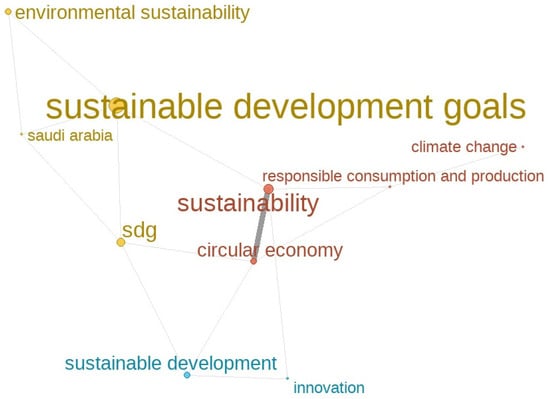
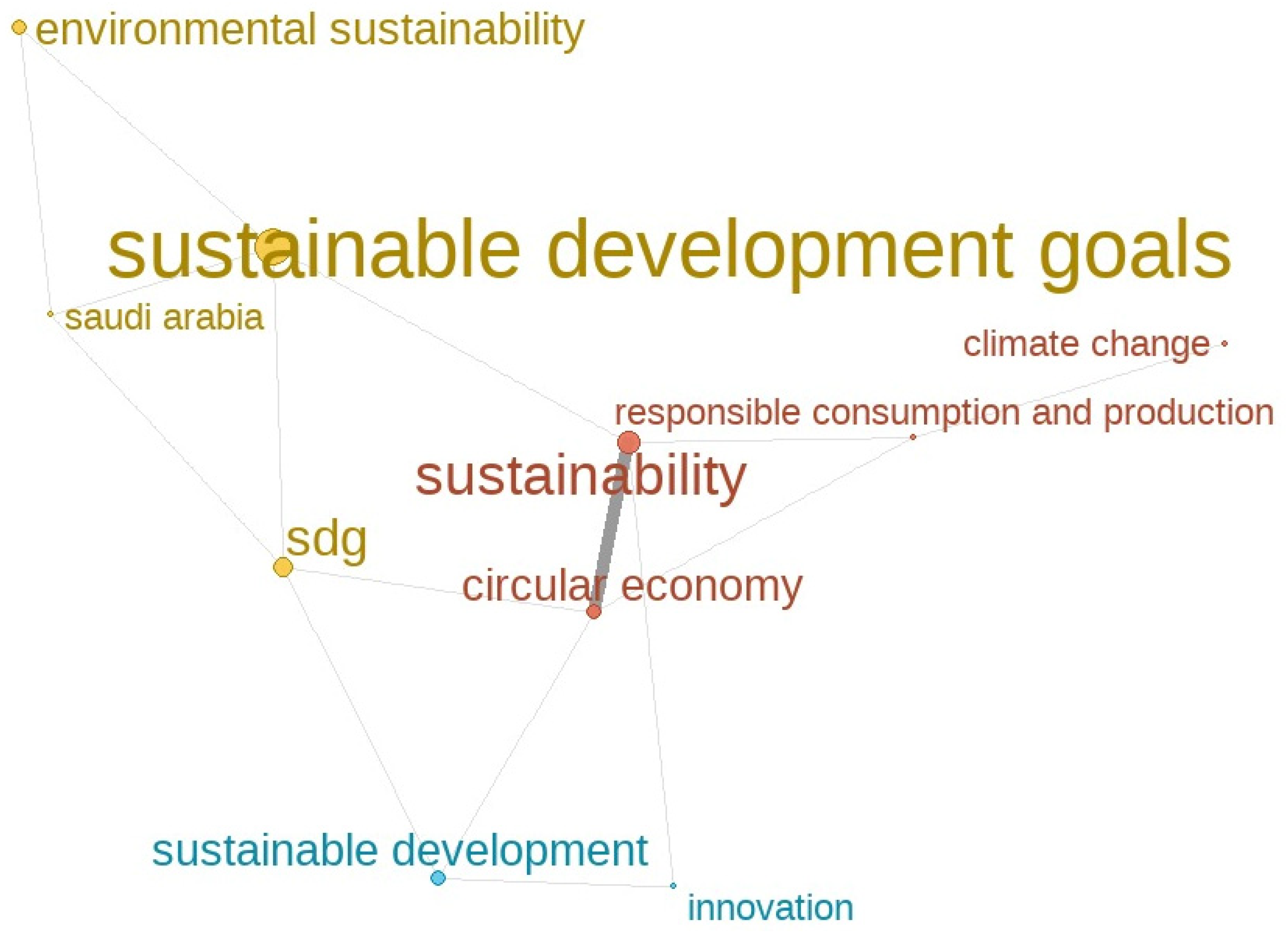
Co-occurrence analysis, developed in R, highlights a thematic structure strongly centred on the concept of sustainability, which emerges as the main node and point of connection between different areas of research (Figure 1). Closely related concepts, such as the circular economy and responsible consumption and production, are situated near this term, indicating a strong integration between sustainability and economic models oriented towards circularity and the efficient use of resources.
Figure 1.
Standard frequency analysis.
The term “sustainable development goals” appears as the most significant node in terms of frequency, suggesting that much of the analysed literature revolves around the SDG framework as a global reference. However, it is relatively peripheral in the network compared to other, more operational clusters, highlighting how the SDGs primarily serve as a conceptual framework.
Several thematic clusters can also be distinguished: one linked to innovation and sustainable development (innovation, sustainable development), one focused on environmental aspects (environmental sustainability, climate change), and yet another is economic and production-oriented (circular economy, responsible consumption and production). The presence of links between these clusters suggests an interdisciplinary approach, in which technological, environmental and economic dimensions are interconnected.
Overall, the network highlights how sustainability is treated as a systemic concept, requiring the integration of various disciplinary and applied fields to address global challenges.
In this context, quantitative analysis plays a fundamental role. The growing availability of data and the development of advanced methodologies make it possible to measure complex phenomena with greater precision, monitor progress over time and compare different situations at geographical and sectoral levels. Composite indicators, statistical and econometric models, and simulation tools, enable the identification of recurring patterns and the assessment of the impact of adopted policies. However, measurement is never a neutral process: the choice of indicators, sources and methodologies can significantly influence the results, making a critical interpretation of the data necessary.
Precisely for this reason, a purely quantitative approach is insufficient and must be complemented by an interdisciplinary perspective. SDGs do not, in fact, exist in separate spheres, but constitute a complex and interconnected system, in which the economic, social and environmental dimensions continuously influence one another.
In this context, it is essential to distinguish among three distinct senses of sustainability—economic, environmental and social—and then to analyse their interactions and interrelationships. Understanding these dynamics requires an integrated approach, capable of harnessing the contributions of different disciplines. A particularly significant aspect is the interconnections between the various goals. Interventions designed to improve a specific area may have indirect effects on others, generating both synergies and conflicts. For example, policies geared towards economic growth may help reduce poverty, but at the same time increase pressure on natural resources if not properly managed. For this reason, it is increasingly important to adopt a systematic view, supported by quantitative tools capable of modelling complex relationships and alternative scenarios.
Technological innovation represents a further key element. The use of big data, artificial intelligence and machine learning techniques enables the analysis of large quantities of heterogeneous information and the identification of correlations that are difficult to detect using traditional approaches. These tools expand the scope for analysis and support more informed decisions, but at the same time require cross-disciplinary skills to be used effectively and responsibly. However, it is also essential to consider the environmental impact of these technologies: the high energy consumption associated with data processing and model training requires the adoption of sustainability-oriented analyses, aimed at assessing and reducing the energy footprint and emissions generated, whilst promoting more efficient solutions and the use of renewable energy sources.
Alongside these aspects, there is a clear need for a pragmatic approach, one capable of moving beyond ideological divisions and focusing on concrete, applicable and measurable solutions. Sustainability, in fact, cannot remain confined to a theoretical or regulatory level: it requires tangible actions, experimentation and the ability to adapt to different contexts. In this sense, the integration of quantitative analysis and interdisciplinarity becomes an operational tool for designing effective interventions, avoiding oversimplifications and polarised views.
In this context, the contribution of the younger generations also takes on a central role. Young people can be seen as true “morning watchmen”, capable of identifying changes and proposing new ways of interpreting reality. Their participation is not merely desirable, but necessary, to make transition processes more inclusive and dynamic. Research carried out with young people is, in fact, a powerful tool for disseminating knowledge, helping to make content more accessible and relevant to society.
Sustainable transition, therefore, cannot be interpreted solely as a technological transformation. It is first and foremost a social process, involving values, behaviours and relationships. Strengthening the sense of community and shared responsibility becomes fundamental to building truly sustainable development models. In this context, experiences in which young people return to educational settings to recount their own journeys and share knowledge represent concrete examples of how it is possible to build more aware and participatory communities.
These dynamics highlight how sustainability is also a matter of belonging and collaboration. The idea that “anything is possible when we work as a group” reflects the need to move beyond individualistic approaches and adopt a collective vision of global challenges. It is precisely through the convergence of diverse skills, experiences and perspectives that innovative and lasting solutions emerge.
Ultimately, interdisciplinarity emerges as the essential ingredient for tackling the complexity of SDGs. It represents not merely a working method, but a genuine paradigm shift, which enables the connection of diverse knowledge, people and tools. Integrated with a rigorous quantitative approach and a pragmatic, action-oriented vision, it provides the foundations for building effective and sustainable strategies in the long term.
Achieving the targets set for 2030 will therefore depend on the ability to combine analytical rigour, cultural openness and collective commitment. Only through this synthesis will it be possible to transform sustainability from a theoretical aspiration into a concrete reality, capable of generating value for present and future generations. However, the 2030 deadline is fast approaching and necessitates the adoption of a long-term vision capable of looking beyond that date. People must be at the heart of the agenda, with technologies that support rather than replace them, in accordance with a principle of fraternity.
Author Contributions
Conceptualisation, I.D., M.G., and V.S.; writing—original draft preparation, I.D., M.G., and V.S.; writing—review and editing, I.D., M.G., and V.S.; supervision, I.D. All authors have read and agreed to the published version of the manuscript.
Funding
This research received no external funding.
Institutional Review Board Statement
Not applicable.
Informed Consent Statement
Not applicable.
Data Availability Statement
The original contributions presented in the study are included in the article; further inquiries can be directed to the corresponding author.
Acknowledgments
The Editor would like to thank all the authors who contributed to this Special Issue for their commitment and the high quality of their research.
Conflicts of Interest
The authors declare no conflicts of interest.
References
- Kostetckaia, M.; Hametner, M. How Sustainable Development Goals interlinkages influence European Union countries’ progress towards the 2030 Agenda. Sustain. Dev. 2022, 30, 916–926. [Google Scholar] [CrossRef] [Scilit]
- Alcamo, J.; Thompson, J.; Alexander, A.; Antoniades, A.; Delabre, I.; Dolley, J.; Marshall, F.; Menton, M.; Middleton, J.; Scharlemann, J.P.W. Analysing interactions among the sustainable development goals: Findings and emerging issues from local and global studies. Sustain. Sci. 2020, 15, 1561–1572. [Google Scholar] [CrossRef] [Scilit]
- Nazar, R.; Meo, M.S.; Ali, S. Role of public health and trade for achieving sustainable development goals. J. Public Aff. 2022, 22, e2585. [Google Scholar] [CrossRef] [Scilit]
- Kluck, T.; Li, C.; Pradhan, P. A Systematic Review Highlights the Need for Holistic Modeling of the Sustainable Development Goals. Sustain. Dev. 2025, 33, 8398–8413. [Google Scholar] [CrossRef] [Scilit]
- Cegan, J.C.; Filion, A.M.; Keisler, J.M.; Linkov, I. Trends and applications of multi-criteria decision analysis in environmental sciences: Literature review. Environ. Syst. Decis. 2017, 37, 123–133. [Google Scholar] [CrossRef] [Scilit]
- Wulf, C.; Mesa Estrada, L.S.; Haase, M.; Tippe, M.; Wigger, H.; Brand-Daniels, U. MCDA for the sustainability assessment of energy technologies and systems: Identifying challenges and opportunities. Energy. Sustain. Soc. 2025, 15, 45. [Google Scholar] [CrossRef] [Scilit]
- Sachs, J.D.; Lafortune, G.; Fuller, G.; Drumm, E. Implementing the SDG Stimulus. Sustainable Development Report 2023; SDSN: Paris, France; Dublin University Press: Dublin, Ireland, 2023. [Google Scholar]
- Ricciolini, E.; Tiralti, A.; Paolotti, L.; Rocchi, L.; Boggia, A. Sustainable development according to 2030 agenda in European Union countries: Evidence of the enlargement policy. Sustain. Dev. 2024, 32, 1894–1912. [Google Scholar] [CrossRef] [Scilit]
- Kudełko, J. Development sustainability levels in EU countries. Sustain. Dev. 2025, 33, 2797–2811. [Google Scholar] [CrossRef] [Scilit]
- Sousa, M.; Almeida, M.F.; Calili, R. Multiple Criteria Decision Making for the Achievement of the UN Sustainable Development Goals: A Systematic Literature Review and a Research Agenda. Sustainability 2021, 13, 4129. [Google Scholar] [CrossRef] [Scilit]
- Stevens, F.; Grigoroudis, E.; Zopounidis, C.; Tsagarakis, K.P. An integrated evaluation framework for Environmental, Social, and Governance-driven social media performance through Multi-criteria Decision-Analysis. Decis. Anal. J. 2024, 12, 100505. [Google Scholar] [CrossRef] [Scilit]
- Dwivedi, P.P.; Sharma, D.K. Performance measures of sustainable development goals using SWI MCDM methods: A case of the Indian states. Int. Trans. Oper. Res. 2026, 33, 2466–2498. [Google Scholar] [CrossRef] [Scilit]
- D’Adamo, I.; Di Leo, S.; Gastaldi, M.; Paris, A. Evaluating sustainability in Europe with composite indicators. Discov. Sustain. 2025, 6, 1251. [Google Scholar] [CrossRef] [Scilit]
- D’Adamo, I.; Gastaldi, M.; Uricchio, A.F. A multiple criteria analysis approach for assessing regional and territorial progress toward achieving the Sustainable Development Goals in Italy. Decis. Anal. J. 2025, 15, 100559. [Google Scholar] [CrossRef] [Scilit]
- Smailbegovic, U.; Kadric, D.; Kadric, E.; Chahoud, S.G. Assessing National Sustainability Transitions in Europe: A Dynamic MCDA and Clustering-Based Approach. Sustain. Dev. 2026, 1–24. [Google Scholar] [CrossRef] [Scilit]
- Daraio, C.; Di Leo, S.; Simar, L. Viable eco-efficiency targets for waste collection communities. Sci. Rep. 2024, 14, 15038. [Google Scholar] [CrossRef] [Scilit] [PubMed]
- Çelik, S.; Öztürk, Ö.F.; Akkucuk, U.; Şaşmaz, M.Ü. Global Sustainability Performance and Regional Disparities: A Machine Learning Approach Based on the 2025 SDG Index. Sustainability 2025, 17, 7411. [Google Scholar] [CrossRef] [Scilit]
- Hametner, M.; Kostetckaia, M. Frontrunners and laggards: How fast are the EU member states progressing towards the sustainable development goals? Ecol. Econ. 2020, 177, 106775. [Google Scholar] [CrossRef] [Scilit]
- Sachs, J.D.; Schmidt-Traub, G.; Mazzucato, M.; Messner, D.; Nakicenovic, N.; Rockström, J. Six Transformations to achieve the Sustainable Development Goals. Nat. Sustain. 2019, 2, 805–814. [Google Scholar] [CrossRef] [Scilit]
- D’Adamo, I.; Della Sciucca, M.; Gastaldi, M.; Lupi, B. Indicator Assessment of Sustainable Development Goals: A Global Perspective. Sustainability 2025, 17, 8259. [Google Scholar] [CrossRef] [Scilit]
- Ebrahimi, S.; Chen, J.; Bridgelall, R.; Szmerekovsky, J.; Motwani, J. Unlocking the Commercialization of SAF Through Integration of Industry 4.0: A Technological Perspective. Sustainability 2025, 17, 7325. [Google Scholar] [CrossRef] [Scilit]
- Bravo-Sanzana, M.; Terán-Mendoza, O.; Miranda, R.; Oriol, X.; Varela, J.; Mieres-Chacaltana, M. Assessing Psychological Well-Being Among Adolescents: A New Multidimensional Instrument for Chilean School Students. Sustainability 2025, 17, 9482. [Google Scholar] [CrossRef] [Scilit]
- Balasooriya, A.; Sedera, D. Top Management Challenges in Using Artificial Intelligence for Sustainable Development Goals: An Exploratory Case Study of an Australian Agribusiness. Sustainability 2025, 17, 6860. [Google Scholar] [CrossRef] [Scilit]
- Kabir, M.F.; Sohail, M.F.; Hachem-Vermette, C. Adapting the 15-Minute City to North America: A Framework for Neighborhood Clusters with Urban Agriculture and Green Mobility. Sustainability 2025, 17, 8196. [Google Scholar] [CrossRef] [Scilit]
- Khalufi, N.A.M. Digital Nudges and Environmental Concern in Shaping Sustainable Consumer Behavior Aligned with SDGs 12 and 13. Sustainability 2025, 17, 11292. [Google Scholar] [CrossRef] [Scilit]
- Fernández-Miguel, A.; García-Muiña, F.E.; Riccardi, M.P.; Veglio, V.; Settembre-Blundo, D. Strategic and Systemic Sustainability: Redefining EU Governance Beyond Environmental Policy. Sustainability 2025, 17, 8208. [Google Scholar] [CrossRef] [Scilit]
- de Lange, D.; Leal Filho, W. Examining How Sustainability Addresses Gender Inequality Using FIFA Women’s World Cup Soccer Outcomes. Sustainability 2025, 17, 8133. [Google Scholar] [CrossRef] [Scilit]
- Yang, X.; Chen, S.; Liu, T.; Luo, J.; Tang, Y. Practice Primacy: Revisiting the Knowledge–Action Gap in Pro-Environmental Behavior with eXplainable AI. Sustainability 2025, 17, 9916. [Google Scholar] [CrossRef] [Scilit]
- Liu, Y.; Ma, H. Evaluation of China’s ESG Policy Texts Based on the “Instrument-Theme-Subject” Framework. Sustainability 2025, 17, 7796. [Google Scholar] [CrossRef] [Scilit]
- Leiva, A.; Larrea-Sebal, A.; Acha, A.; Montes, L.R. Impact of Biotechnology on Sustainable Development: An Opinion Analysis. Sustainability 2025, 17, 10023. [Google Scholar] [CrossRef] [Scilit]
- Yaşa Özeltürkay, E.; Doğrul, Ü.; Oğuz, S.; Yalçıntaş, D.; Gülmez, M. Examining the Role of Food Technology Neophobia in Shaping Consumer Attitudes and Intentions to Purchase Genetically Modified Foods. Sustainability 2025, 17, 6416. [Google Scholar] [CrossRef] [Scilit]
- Song, K.; Alivi, M.A. Social Media and Environmental Communication in China: A Systematic Review of Present Status, Trends, and Future Challenges. Sustainability 2025, 17, 11057. [Google Scholar] [CrossRef] [Scilit]
- Hahladakis, J.N. From Local Actions to Global Impact: Overcoming Hurdles and Showcasing Sustainability Achievements in the Implementation of SDG12. Sustainability 2025, 17, 7106. [Google Scholar] [CrossRef] [Scilit]
- Kamali Saraji, M.; Torabi, M. Progress Toward a Circular Economy: A Comparative Analysis of EU Member States. Sustainability 2025, 17, 8448. [Google Scholar] [CrossRef] [Scilit]
- Zueva, S.; Innocenzi, V.; Ippolito, N.M.; Birloaga, I.; Vegliò, F.; Ferella, F. Iron Removal from Quartz Ore by Acid Leaching: From Lab- to Pilot-Scale. Sustainability 2025, 17, 10008. [Google Scholar] [CrossRef] [Scilit]
- Frigura-Iliasa, F.M.; Sergiu, G.D.; Sornek, K.; Homa, M.; Frigura-Iliasa, M. Educational Simulator for Sustainable Energy Management for a Typical Household. Sustainability 2026, 18, 2506. [Google Scholar] [CrossRef] [Scilit]
- Dell’Aversano, S.; Villante, C.; Anatone, M. Decomposing CO2 Emissions with the Kaya Identity: Global Trends, National Dynamics, and Policy Implications. Sustainability 2026, 18, 1627. [Google Scholar] [CrossRef] [Scilit]
- Ajayi, O.; Myo, A.; Cheng, Y.; Li, J. Rice–Fish Integration as a Pathway to Sustainable Livelihoods Among Smallholder Farmers: Evidence from DPSIR-Informed Analysis in Sub-Saharan Africa. Sustainability 2026, 18, 498. [Google Scholar] [CrossRef] [Scilit]
- Wendland, A.; Walczak, R.; Koszewski, K.; Ejsmont, K.; Świech, H.; Szczepankowska-Bednarek, U.; Pałka, P.; Olszewski, R. Social Geoparticipation and Spatial Justice in Campus Revitalization: The Warsaw University of Technology Case Study. Sustainability 2025, 17, 10653. [Google Scholar] [CrossRef] [Scilit]
- Li, M.; Maffei, A.; Mukhanova, G.; Kuldeyev, E.; Amralinova, B.; Tymbayeva, Z. Reverse Supply Chain Optimization in Kazakhstan’s Mining Industry: Unlocking Value from Waste. Sustainability 2025, 17, 10589. [Google Scholar] [CrossRef] [Scilit]
- Chen, Q.; Sun, L.; Tang, J.; Zhang, Q.; Zhou, K.; Lu, Y.; Qu, G.; Lu, S. Evaluation of the Synergistic Interactions Between Socioeconomic Development and Ecosystem Services in China’s Hebei Province: A Perspective from the SDGs. Sustainability 2025, 17, 10785. [Google Scholar] [CrossRef] [Scilit]
- Smol, M.; Waluś, E.; Marcinek, P. Conceptualizing the Education Roadmap to Support the Implementation of Circular Economy Principles in the Forestry Sector—A Case Study of the Baltic Sea Region. Sustainability 2025, 17, 11145. [Google Scholar] [CrossRef] [Scilit]
- Liu, R.; Zhang, Y. Quantifying Global Cooperation in the Sustainable Development Goals. Sustainability 2025, 17, 11283. [Google Scholar] [CrossRef] [Scilit]
- Gumzej, R.; Kramberger, T.; Halang, W. Sustainable Transaction Processing in Transaction-Intensive E-Business Applications Through Resilient Digital Infrastructures. Sustainability 2026, 18, 279. [Google Scholar] [CrossRef] [Scilit]
- Jaya, I.G.; Nusirwan; Kusumasari, D.; Susenna, A.; Agustina, L.; Sukma, Y.A.; Prasetyono, H.; Pangastuti, S.S.; Kristiani, F.; Hermina, N. Regional Patterns of Digital Skills Mismatch in Indonesia’s Digital Economy: Insights from the Indonesia Digital Society Index. Sustainability 2026, 18, 1077. [Google Scholar] [CrossRef] [Scilit]
- Zhen, M.; Li, H.; Wang, Y. Quantitative Comparison of China’s Multi-Level Carbon Peaking Policies Based on Natural Language Processing. Sustainability 2026, 18, 296. [Google Scholar] [CrossRef] [Scilit]
- Durczak, K.; Sala, D.; Liashenko, O.; Pyzalski, M.; Pavlov, K.; Pavlova, O.; Romaniuk, R.; Sujak, A. Governance Matters: Evidence from Global Analysis on Environmental Sustainable Development Goals. Sustainability 2026, 18, 1140. [Google Scholar] [CrossRef] [Scilit]
- Sarabdeen, M. A Quantitative Analysis of Foreign Direct Investment, Development Foreign Assistance, and Personal Remittance Earnings on Environmental Sustainability (SDG13) in Developing Economies: Does Corruption Matter? Sustainability 2025, 17, 11218. [Google Scholar] [CrossRef] [Scilit]
- Abulkhair, M. E-Government Digitalization as a Strategic Enabler of Sustainable Development Goals: Evidence from Saudi Arabia. Sustainability 2026, 18, 1168. [Google Scholar] [CrossRef] [Scilit]
- Aldosari, M.S. Perception of Environmental Sustainability and Its Health Implications: Evidence from Faculty Members in Saudi Universities. Sustainability 2026, 18, 1194. [Google Scholar] [CrossRef] [Scilit]
- Adnan, B.; Sharif, F.; Nizami, A.-S.; Shahzad, M.; Rana, A.D.; Mariam, A. From Green to Gray: A Three-Decade Geospatial Assessment of Urban Growth and Vegetation Loss in Lahore (1993–2023). Sustainability 2026, 18, 2714. [Google Scholar] [CrossRef] [Scilit]
- Wang, S.; Cao, S.; Du, M.; Liu, Y.; Qian, Y. Investigating Sustainable Development Trajectories in China (2006–2021): A Coupling Coordination Analysis of the Social, Economic, and Ecological Nexus. Sustainability 2026, 18, 899. [Google Scholar] [CrossRef] [Scilit]
- Su, Y.; Wang, J.; Li, J.; Liu, J. Driving Mechanisms of High-Quality Urban Development: Evidence from Lianyungang City, China. Sustainability 2026, 18, 1220. [Google Scholar] [CrossRef] [Scilit]
- Ntakirutimana, P.; Ndayisaba, Y.M.; Mani, G.; Chipeta, C.; Mcsharry, P.; Sowon, K.; Luhanga, E.T. Preliminary Insights on Digital Financial Literacy Gaps Among Rwandan Youth and Considerations for AI-Powered Interventions. Sustainability 2026, 18, 4155. [Google Scholar] [CrossRef] [Scilit]

Disclaimer/Publisher’s Note: The statements, opinions and data contained in all publications are solely those of the individual author(s) and contributor(s) and not of MDPI and/or the editor(s). MDPI and/or the editor(s) disclaim responsibility for any injury to people or property resulting from any ideas, methods, instructions or products referred to in the content. |
© 2026 by the authors. Licensee MDPI, Basel, Switzerland. This article is an open access article distributed under the terms and conditions of the Creative Commons Attribution (CC BY) license.