


Abstract
The intersection of digital citizenship, sustainable education, and community belonging represents an emerging yet underexplored area of inquiry, particularly within Arab higher education contexts where institutional digitalization is accelerating alongside distinct sociocultural expectations around academic identity. This study aims to investigate the mediating role of sustainable education in the relationship between digital citizenship and community belonging among Egyptian university students. A quantitative cross-sectional survey design was employed with a main sample of 819 university students. Participants completed three validated instruments: the Revised Digital Citizenship Scale, the Sustainable Education Scale, and the Where I Belong Survey. Mediation analysis was conducted using Hayes’ PROCESS macro with 5000 bootstrap resamples. Results reveal that digital citizenship is significantly and positively associated with both sustainable education and community belonging. Sustainable education, in turn, significantly predicts community belonging after controlling for digital citizenship, with the indirect effect accounting for approximately 38% of the total effect, consistent with partial mediation. These findings demonstrate that responsible digital engagement is associated with community belonging not only directly but also in a pattern statistically consistent with partial mediation through sustainability-oriented values including equity, inclusiveness, and democratic participation. These findings suggest theoretically informed directions for future intervention design, wherein integrating sustainable education principles into digital learning environments may warrant empirical investigation as a potential approach to cultivating ethically grounded, socially cohesive academic communities.
1. Introduction
The rapid integration of digital technologies into higher education has brought renewed attention to the concept of digital citizenship, broadly defined as the responsible, ethical, and effective use of technology in navigating digital environments [1,2,3]. In the university context, digital citizenship encompasses a spectrum of competencies and values, including digital ethics, online safety, information literacy, and respectful communication, all of which collectively shape how students engage within digital spaces [4,5,6]. As universities increasingly depend on digital platforms for learning and social interaction, cultivating responsible digital behaviors has become essential not only for academic success but also for fostering safe, inclusive, and ethically grounded campus communities [7,8,9].
Closely related to students’ digital engagement is their sense of community belonging, defined as the degree to which students feel accepted, valued, included, and supported within their academic peer groups and broader university environment [10,11,12]. Research indicates that a strong sense of belonging is associated with reduced depressive symptoms, loneliness, and emotional distress, and with improved well-being among university students [13,14,15]. Beyond mental health, belonging meaningfully enhances academic motivation, self-efficacy, and persistence, with students reporting stronger peer connectedness being considerably less likely to disengage or withdraw from their studies [16,17,18].
Emerging scholarship suggests a meaningful relationship between active digital citizenship and students’ sense of community belonging, wherein positive online interactions, digital collaboration, and ethical engagement collectively strengthen social ties and foster shared identity within academic communities [19,20,21]. Respectful and responsible participation in digital spaces, including learning management systems and social media platforms, has been associated with stronger peer connectedness and greater institutional affiliation [22,23,24,25]. Furthermore, ethical digital engagement promotes prosocial norms and intercultural communication, extending students’ sense of belonging beyond immediate peer groups toward broader civic and global communities [8,26,27,28].
Despite the potential of digital environments to foster connection, university students continue to face significant challenges in sustaining genuine community belonging within increasingly digitalized academic settings [29,30]. Cyberbullying, cyberstalking, and digital harassment remain pervasive threats, generating fear, academic withdrawal, and diminished trust among peers, thereby directly eroding students’ sense of safety and inclusion [31,32,33,34,35]. Compounding these risks, online and hybrid learning environments frequently produce feelings of isolation and alienation, as transactional or camera-off interactions fail to cultivate meaningful relational bonds [36,37,38,39]. Such fragmented digital social experiences underscore the urgent need for intentional, ethically grounded approaches to digital citizenship education that genuinely nurture belonging [40,41].
It is within this gap that sustainable education emerges as a theoretically compelling and practically significant bridging framework. Sustainable education, understood as a holistic approach that cultivates social responsibility, critical thinking, and global awareness, may offer a moral and relational framework that instrumental digital skills alone do not provide [42,43,44]. Rather than treating sustainability as a discrete subject, this approach integrates environmental, social, and economic dimensions across disciplines, encouraging students to engage with complex global challenges through systems thinking and interdisciplinary inquiry [45,46,47,48]. Transformative sustainable education further emphasizes student agency, positioning learners as active participants and change agents capable of connecting local academic experiences to broader societal and planetary responsibilities [49,50].
Sustainable education is increasingly recognized as a foundational moral framework that equips students with the values necessary for responsible digital citizenship, positioning equity, justice, ethics, and care as guiding principles for online behavior [27,51,52]. Education for Sustainable Development explicitly cultivates learners’ sense of ethical responsibility and social justice—values that translate directly into conscientious digital practices such as combating exclusion, respecting privacy, and resisting cyberbullying [53,54]. When sustainability-oriented values are integrated into digital learning environments, students may develop a digitally grounded identity that supports civic engagement, inclusive participation, and critical use of technology [55,56,57,58]. At the individual level, this process operates through value internalization: sustained exposure to equity- and justice-oriented digital learning experiences shapes students’ personal normative commitments, which in turn orient their social behavior toward inclusive participation and community identification.
Central to this study’s theoretical argument is the proposition that sustainable education mediates the relationship between digital citizenship and community belonging by functioning as a proximal value-formation mechanism through which digital competencies are transformed into genuine social connectedness [51,59]. At the individual level, students who engage responsibly in digital environments internalize equity-, justice-, and inclusion-oriented norms that orient their social behavior toward inclusive participation and community identification [55,56,57,58]. Social Learning Theory suggests that sustainability-oriented values may be reinforced through peer modeling and digital self-efficacy, Systems Theory situates this internalization process within interconnected institutional structures that generate and sustain shared norms of inclusion and equity [27,51,57,59,60,61,62]. Although alternative pathways—including institutional climate, peer interaction quality, and academic engagement—constitute relevant contextual antecedents, they operate upstream of this individual-level value-formation process, functioning as enablers rather than proximal mechanisms [27,63]. Sustainable education thus directly captures the normative shift that deepens students’ community belonging [64,65,66].
Despite growing theoretical interest in both digital citizenship and sustainable education, empirical research examining their joint influence on community belonging remains limited, particularly within university settings in the Arab world where institutional digitalization is accelerating alongside distinct sociocultural expectations around inclusion and academic identity. The present study addresses this gap by investigating the mediating role of sustainable education in the relationship between digital citizenship and community belonging among Egyptian university students. By doing so, it aims to produce actionable insights for higher education institutions seeking to design digital learning environments that are not only technologically proficient but also ethically grounded, socially cohesive, and sustainability-oriented.
2. Materials and Methods
2.1. Study Design
This study employed a quantitative cross-sectional survey design to examine the mediating role of sustainable education in the relationship between digital citizenship and community belonging among Egyptian university students. Data were collected from Egyptian university students during the first academic semester of 2025/2026, spanning the period from 17 September to 28 December 2025.
2.2. Participants
Two independent samples were deliberately recruited following methodological recommendations to validate measurement structures on a sample separate from that used for hypothesis testing, thereby reducing capitalization on chance and the risk of overfitting. A psychometric sample (N = 658) was used for scale validation, and a main sample (N = 819) was used for hypothesis testing. All participation was entirely voluntary, and informed consent was obtained from all participants prior to their involvement in the study.
Both samples were drawn from the same broader population of Egyptian university students across comparable institutions, disciplines, and academic years. As shown in Table 1, the two samples exhibited similar demographic distributions across gender, academic year, residence, and marital status, providing no evidence of systematic between-sample differences. This demographic comparability supports the assumption that the factor structures, reliability estimates, and validity indices established in the psychometric sample are reasonably generalizable to the main analytic sample, though formal cross-sample invariance testing was not conducted and is acknowledged as a limitation. The mean age of the psychometric sample was 20.39 years (SD = 2.13, range = 18–26), while the mean age of the main sample was 20.29 years (SD = 1.74, range = 18–24). Demographic characteristics of both samples are presented in Table 1.
Table 1.
Demographic Characteristics of Study Participants.
Participants were recruited through a convenience sampling approach, with the online Google Form distributed via academic staff and student networks across six Egyptian public and private universities spanning multiple faculties and disciplines. Inclusion criteria required participants to be currently enrolled undergraduate students aged 18 years or older. To safeguard data quality, duplicate submissions were minimized through the Google Form’s response-limit settings, which restricted submission to one response per account. Attention check items were embedded within the questionnaires to identify inattentive responding. In total, 1621 responses were initially received across both samples. Following data collection, 144 responses were removed due to incompleteness, straight-lining, or failure of attention check items, yielding a final retained dataset of 1477 participants, comprising the psychometric sample (N = 658) and the main analytic sample (N = 819). Responses were screened for incompleteness and straight-lining; invalid or incomplete responses were removed before analysis.
Following data collection, responses were screened for incompleteness and straight-lining; invalid or incomplete responses were removed before analysis.
2.3. Measures
The Revised Digital Citizenship Scale (DCS-R) [67] is a 19-item self-report instrument measuring four dimensions: Internet Political Activism (6 items), Technical Skills (3 items), Critical Perspectives (7 items), and Networking Agency (3 items). Items are rated on a 7-point Likert scale ranging from 1 (Strongly Disagree) to 7 (Strongly Agree). Confirmatory factor analysis conducted on the psychometric sample indicated acceptable model fit (χ2/df = 4.012, GFI = 0.907, CFI = 0.944, RMSEA = 0.068). Internal consistency was strong across all subscales and the total scale, with omega coefficients (ω) and alpha coefficients (α) all exceeding 0.80, and total scale reliability reaching ω = 0.900 and α = 0.899. To further evaluate construct validity, convergent validity was assessed using Average Variance Extracted (AVE), with values ranging from 0.52 to 0.61 across subscales, all exceeding the recommended threshold of 0.50.
The Sustainable Education Scale (SES) [68] is a 19-item instrument developed on the basis of human rights education, sustainable development, and social justice frameworks. The scale comprises four subscales: Equality in Education (7 items), Inclusiveness in Education (5 items), Quality in Education (3 items), and Democratic Education (4 items). Items are rated on a 5-point Likert scale ranging from 1 (Strongly Disagree) to 5 (Strongly Agree). Confirmatory factor analysis supported adequate model fit (χ2/df = 3.970, GFI = 0.902, CFI = 0.936, RMSEA = 0.067). Reliability estimates were excellent across all subscales and the total scale, with total ω = 0.913 and α = 0.913. Convergent validity was supported by AVE values ranging from 0.54 to 0.63, all surpassing the 0.50 threshold.
The Where I Belong Survey—Youth/Adult Version (WIBS) [69] is a 16-item scale measuring two dimensions: Interpersonal Belonging (5 items) and Context Belonging (11 items). Items 1–5 are rated on a 4-point Likert scale (1 = Strongly Disagree to 4 = Strongly Agree), while items 6–16 are rated on a 4-point scale ranging from 1 (I feel no belonging to this context) to 4 (I feel complete belonging to this context). Confirmatory factor analysis demonstrated good model fit (χ2/df = 2.604, GFI = 0.941, CFI = 0.975, RMSEA = 0.049). Reliability was excellent at the subscale and total levels, with total ω = 0.930 and α = 0.932. Convergent validity was supported by AVE values of 0.58 and 0.61 for Interpersonal Belonging and Context Belonging respectively, both exceeding the 0.50 criterion.
2.4. Translation and Cultural Adaptation
All three scales were originally developed in English and were translated into Arabic—the native language of the participants—and back-translated into English. The two translators selected for this process held doctoral-level qualifications in education or applied linguistics, demonstrated native-level Arabic proficiency, and had prior experience translating psychometric instruments in social science research. Both forward and backward translations were conducted independently to verify semantic equivalence and cultural appropriateness. Following the completion of the back-translation, all translators and two members of the research team convened in a structured consensus meeting to review and resolve any discrepancies in wording or meaning. Decisions regarding final item wording were reached collaboratively, with priority given to preserving the conceptual intent of each item over strict literal equivalence.
Prior to the main data collection, a pilot phase was conducted with a small convenience sample of 30 university students who were not included in either the psychometric or main samples. Participants were asked to complete all three translated instruments and to flag any items they found ambiguous, culturally unfamiliar, or difficult to interpret. Based on their feedback, minor wording adjustments were made to several items to improve clarity and naturalness in the Arabic context. Semantic, conceptual, and contextual equivalence were each systematically considered throughout the adaptation process. Particular attention was paid to items referencing digital civic practices and institutional participation, domains in which direct lexical equivalence sometimes required culturally appropriate rephrasing rather than literal word-for-word translation, to preserve the intended psychological construct across linguistic and cultural contexts.
2.5. Data Analysis
Data were analyzed using SPSS version 27 and AMOS version 26. Confirmatory factor analysis (CFA) was conducted on the psychometric sample to evaluate the structural validity of each scale. Pearson correlation coefficients were computed to examine bivariate associations among study variables. Common method variance was assessed using Harman’s single-factor test, with the first extracted factor accounting for 37.58% of total variance, falling below the 40% threshold. This result is reported descriptively only; Harman’s single-factor test is widely recognized as an insufficient diagnostic for common method bias, and this result should not be interpreted as meaningful evidence against method-related inflation of associations. The possibility that observed correlations are partly attributable to common method variance therefore cannot be ruled out. The hypothesized mediation model was tested using Hayes’ PROCESS macro (Model 4) with 5000 bootstrap resamples and 95% bias-corrected confidence intervals, enabling estimation of the total, direct, and indirect effects of digital citizenship on community belonging through sustainable education [70,71].
3. Results
3.1. Descriptive Statistics and Correlation Analysis
Prior to testing the hypothesized mediation model, Pearson correlation coefficients were computed to examine the bivariate associations among all study variables. Table 2 presents the correlation matrix for the subscale scores and composite totals of digital citizenship, sustainable education, and community belonging.
Table 2.
Pearson Correlation Matrix for Digital Citizenship Subscales, Sustainable Education Subscales, and Community Belonging Subscales and Total Scores.
The results revealed significant positive correlations among all study variables (p < 0.01). At the subscale level, Internet Political Activism (IPA), Technical Skills (TS), Critical Perspectives (CP), and Networking Agency (NA) were moderately to strongly intercorrelated (r = 0.57–0.63), and each subscale demonstrated substantial associations with the digital citizenship total score (r = 0.77–0.89). Similarly, the four dimensions of sustainable education—Equality in Education, Inclusiveness in Education, Quality in Education, and Democratic Education—were positively interrelated (r = 0.51–0.61) and strongly associated with the sustainable education composite (r = 0.78–0.89). The two community belonging subscales, Interpersonal Belonging and Context Belonging, were also positively correlated (r = 0.48) and both strongly associated with the community belonging total score (r = 0.75 and 0.94, respectively).
At the composite level, digital citizenship was positively and moderately correlated with sustainable education (r = 0.582, p < 0.001) and community belonging (r = 0.478, p < 0.001). Sustainable education also demonstrated a significant moderate correlation with community belonging (r = 0.484, p < 0.001). These bivariate associations collectively provided initial support for the plausibility of the hypothesized mediation model.
3.2. Mediation Analysis
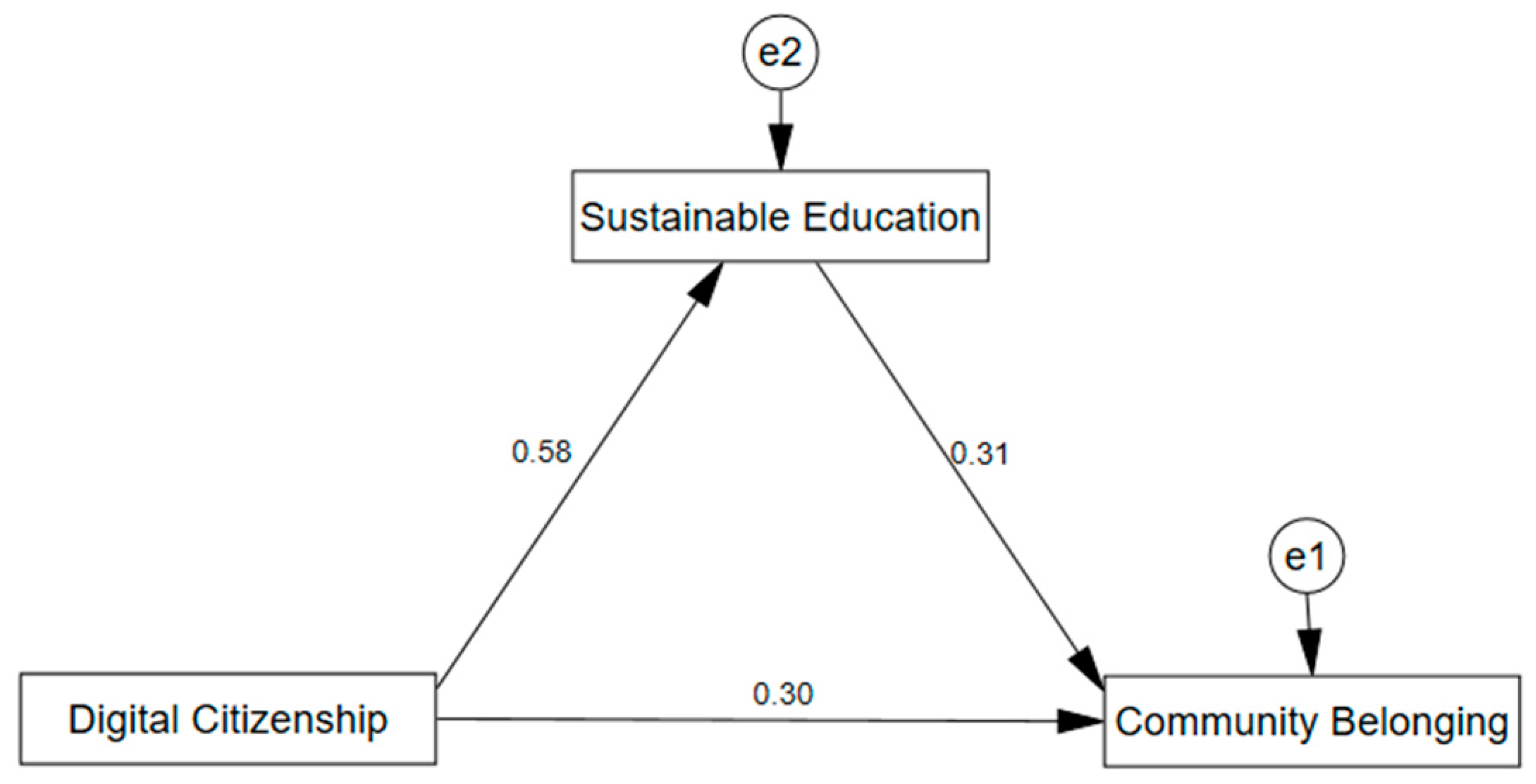
The primary aim of this study was to examine whether sustainable education mediates the relationship between digital citizenship and community belonging. A simple mediation model (Model 4) was estimated using Hayes’ PROCESS macro with 5000 bootstrap resamples and 95% bias-corrected confidence intervals. Table 3 presents the path coefficients, and Table 4 summarizes the total, direct, and indirect effects. The path diagram is illustrated in Figure 1.
Table 3.
Unstandardized and Standardized Path Coefficients for the Mediation Model.
Table 4.
Total, Direct, and Indirect Effects of Digital Citizenship on Community Belonging Through Sustainable Education.
Figure 1.
Path Diagram of the Mediation Model: Digital Citizenship, Sustainable Education, and Community Belonging.
With respect to the first path of the mediation model (path a; DC → SE), digital citizenship was a significant positive correlate of sustainable education (β = 0.582, B = 0.519, SE = 0.025, t = 20.47, p < 0.001), indicating that higher levels of digital citizenship were associated with greater sustainable education scores. The model explained 33.9% of the variance in sustainable education (R2 = 0.339).
Regarding the second path of the mediation model (path b; SE → CB), sustainable education was significantly associated with community belonging after controlling for digital citizenship (β = 0.311, B = 0.245, SE = 0.029, t = 8.59, p < 0.001). The direct effect of digital citizenship on community belonging (path c’; DC → CB) also remained statistically significant (β = 0.297, B = 0.208, SE = 0.025, t = 8.20, p < 0.001), accounting for 62.09% of the total effect. Together, digital citizenship and sustainable education explained 29.3% of the variance in community belonging (R2 = 0.293).
Turning to the indirect effect, the bootstrap analysis demonstrated that sustainable education significantly mediated the relationship between digital citizenship and community belonging. As shown in Table 4, the indirect effect was statistically significant (B = 0.127, β = 0.181, SE = 0.016, 95% CI [0.095, 0.157]), given that the confidence interval did not include zero. The indirect effect accounted for 37.89% of the total effect (B = 0.335, β = 0.478, 95% CI [0.293, 0.378]). The total effect of digital citizenship on community belonging was significant (t = 15.56, p < 0.001), and the presence of a significant direct effect alongside a significant indirect effect indicated partial mediation. These results are statistically consistent with partial mediation by sustainable education in the relationship between digital citizenship and community belonging.
The mediation pattern observed in the present study suggests that while digital citizenship exerts a direct and meaningful influence on students’ sense of community belonging, a substantial portion of this effect operates indirectly through the internalization of sustainable education values. Specifically, students who demonstrate higher levels of digital citizenship also tend to develop stronger orientations toward sustainable education principles—including social equity, inclusiveness, and democratic engagement—which, in turn, foster a deeper sense of community belonging within their academic environments.
4. Discussion
The present study examined whether sustainable education mediates the relationship between digital citizenship and community belonging among Egyptian university students. Results confirmed a partial mediation model, wherein digital citizenship was significantly associated with sustainable education and community belonging, while sustainable education independently predicted belonging after controlling for digital citizenship. The indirect effect accounted for approximately 38% of the total effect, indicating that sustainable education functions as a meaningful but incomplete statistical explanator of the association. These findings suggest that digitally engaged students tend to report greater social connectedness, and that this association is statistically consistent with partial indirect association through sustainability-oriented values including equity, inclusiveness, and democratic participation.
The observed associations align with and extend prior scholarship in meaningful ways. The direct link between digital citizenship and community belonging corroborates findings by Galioto et al. [22] and Thacker et al. [25], who demonstrated that responsible online engagement strengthens peer connectedness and institutional affiliation. The observed association between digital citizenship and sustainable education is consistent with Lozano-Díaz and Fernández-Prados [51] and Emejulu and McGregor [27], who suggested that critical digital engagement may foster justice-oriented civic values. Furthermore, the pathway from sustainable education to belonging resonates with Buchholz et al. [8] and Fajri et al. [28], who linked ethically grounded digital practices to prosocial norms.
The partial mediation pattern also parallels Cleofas and Labayo [26] and Blayone et al. [65], suggesting that democratized, sustainability-embedded digital learning environments foster inclusive community identification among undergraduate students. Within the Egyptian context, equity and democratic participation may carry particular salience for social connectedness. Egyptian university students navigate digital spaces shaped by collectivist norms, traditionally hierarchical educational structures, and growing aspirations for civic participation, conditions under which sustainability-oriented values may serve as meaningful anchors of shared academic identity and belonging.
It is important to note that the present findings are associational in nature and do not demonstrate the effectiveness of sustainability-integrated digital interventions. The following recommendations are therefore proposed as theoretically grounded directions for practice rather than empirically validated prescriptions. Universities should deliberately integrate sustainable education principles—including social equity, democratic participation, and cultural inclusiveness—into digital learning curricula rather than focusing exclusively on technical proficiency. Instructional designers and faculty should create online learning experiences that promote ethical reflection, collaborative problem-solving, and intercultural dialogue, thereby potentially transforming digital competencies into genuine social bonds. Student affairs professionals should leverage digital platforms to build intentional communities grounded in shared sustainability values. These approaches are especially relevant in contexts like Egypt and broader Arab higher education systems and warrant empirical testing through longitudinal and experimental designs before firm institutional conclusions can be drawn.
These approaches are especially relevant in contexts like Egypt and broader Arab higher education systems, where digital transformation is accelerating alongside distinct sociocultural expectations around academic identity and communal belonging. Specifically, Egyptian university students are embedded within collectivist cultural norms that prioritize group harmony and communal obligation, operate within traditionally teacher-centered pedagogical structures that shape expectations of institutional authority, and increasingly engage with digital civic spaces amid growing aspirations for participatory education; these contextual factors likely amplified the observed associations between sustainability-oriented values and community belonging in the present sample.
Several limitations should be considered when interpreting these findings. First, the cross-sectional design precludes causal inference; all observed associations should therefore be interpreted as correlational rather than causal, and longitudinal or experimental designs are needed to establish temporal precedence. Second, reliance exclusively on self-report measures introduces susceptibility to social desirability bias. Common method variance was assessed only via Harman’s single-factor test, which is widely regarded as a limited standalone diagnostic, and this constitutes a methodological limitation. Third, the sample was drawn entirely from Egyptian universities, potentially limiting generalizability to other cultural or institutional contexts. Fourth, the model explained approximately 29% of variance in community belonging, underscoring that it represents a partial explanatory framework rather than a comprehensive account; individual-level factors such as personality traits, institutional factors such as teaching quality, and sociocultural factors such as family support remain unexamined. Finally, some conceptual overlap among sustainable education components—particularly inclusiveness, equality, and democratic engagement—and community belonging may have inflated observed associations.
The present findings suggest several directions for future research. Longitudinal designs are needed to establish temporal ordering among the study variables, and experimental designs are warranted to provide causal evidence that the present cross-sectional design cannot supply. Future studies should replicate the proposed model across diverse cultural and institutional contexts—including Arab, Western, and East Asian settings—to assess the generalizability of the mediation mechanism. Researchers are encouraged to examine additional mediators and moderators, particularly faculty support and campus climate, which are theoretically compelling antecedents of belonging that may substantially account for the unexplained variance, alongside individual-level, and sociocultural variables, to develop more comprehensive explanatory models of community belonging. Qualitative and mixed-methods approaches would further deepen understanding of how students internalize sustainability values within digital environments.
5. Conclusions
This study provides cross-sectional, correlational evidence statistically consistent with sustainable education partially accounting for the association between digital citizenship and community belonging among Egyptian university students, contributing a theoretically grounded model to an underexplored area of higher education research. The findings demonstrate that responsible digital engagement is associated with belonging not only directly but also indirectly in a pattern consistent with partial mediation through sustainability-oriented values that partially account for the participating students’ social and institutional connectedness. These findings should be interpreted within the boundaries of what the model can explain. Digital citizenship and sustainable education together accounted for approximately 29% of the variance in community belonging, indicating that the proposed model captures a meaningful but limited portion of a complex outcome shaped by numerous individual, institutional, and sociocultural factors not examined here. These results offer theoretically grounded directions for future research and intervention design, suggesting that embedding equity, inclusiveness, and democratic engagement within digital learning environments represents a promising avenue worthy of empirical investigation, with the potential to contribute to the development of academically motivated, ethically grounded, and genuinely connected student communities. Future longitudinal and experimental studies incorporating additional predictors—including faculty support, campus climate, personality traits, and family context—are needed before broader conclusions about the determinants of community belonging can be drawn.
Author Contributions
Conceptualization, Y.H.R., E.A., N.A. and B.M.B.; methodology, Y.H.R., E.A., N.A. and B.M.B.; software, Y.H.R., E.A., N.A. and B.M.B.; validation, Y.H.R., E.A., N.A. and B.M.B.; formal analysis, Y.H.R., E.A., N.A. and B.M.B.; investigation, M.F.E. and M.A.N.-a.; resources, M.F.E. and M.A.N.-a.; data curation, M.F.E. and M.A.N.-a.; writing—original draft preparation, Y.H.R., E.A., N.A. and B.M.B.; writing—review and editing, Y.H.R., E.A., N.A. and B.M.B.; visualization, Y.H.R., E.A., N.A. and B.M.B.; supervision, Y.H.R.; project administration, Y.H.R.; funding acquisition, Y.H.R. Y.H.R. contributed approximately 30% of the total author contributions. E.A., N.A. and B.M.B. collectively contributed approximately 50%. All authors have read and agreed to the published version of the manuscript.
Funding
This research received no external funding.
Institutional Review Board Statement
The study was conducted in accordance with the Declaration of Helsinki and approved by the Re-search Ethics Committee of the Faculty of Education at Al-Azhar University, Dakahlia, Egypt (protocol code Ref. No. EDU-REC-2025-175, approval date 16 September 2025).
Informed Consent Statement
Informed consent was obtained from all subjects involved in the study.
Data Availability Statement
The datasets generated and analyzed during the current study are available from the corresponding author upon reasonable request.
Acknowledgments
The authors thank all participants for their valuable contribution to this study.
Conflicts of Interest
The authors declare no conflicts of interest.
Abbreviations
The following abbreviations are used in this manuscript:
| CFA | Confirmatory Factor Analysis |
| CI | Confidence Interval |
| DCS-R | Revised Digital Citizenship Scale |
| DC | Digital Citizenship |
| CTX-B | Context Belonging |
| CB | Community Belonging |
| CP | Critical Perspectives |
| DE | Democratic Education |
| EE | Equality in Education |
| IB | Interpersonal Belonging |
| IE | Inclusiveness in Education |
| IPA | Internet Political Activism |
| NA | Networking Agency |
| QE | Quality in Education |
| RMSEA | Root Mean Square Error of Approximation |
| SD | Standard Deviation |
| SE | Sustainable Education |
| SES | Sustainable Education Scale |
| SPSS | Statistical Package for the Social Sciences |
| TS | Technical Skills |
| WIBS | Where I Belong Survey |
References
- Akcil, U.; Bastas, M. Examination of University Students’ Attitudes towards E-learning during the COVID-19 Pandemic Process and the Relationship of Digital Citizenship. Contemp. Educ. Technol. 2020, 13, ep291. [Google Scholar] [CrossRef] [Scilit]
- Althibyani, H.A.; Al-Zahrani, A.M. Investigating the effect of students’ knowledge, beliefs, and digital citizenship skills on the prevention of cybercrime. Sustainability 2023, 15, 11512. [Google Scholar] [CrossRef] [Scilit]
- Prasetiyo, W.H.; Sumardjoko, B.; Muhibbin, A.; Naidu, N.B.M.; Muthalib, A. Promoting Digital Citizenship among Student-Teachers: The Role of Project-Based Learning in Improving Appropriate Online Behaviors. Particip. Educ. Res. 2023, 10, 389–407. [Google Scholar] [CrossRef] [Scilit]
- Bal, E.; Akcil, U. The implementation of a sustainable online course for the development of digital citizenship skills in higher education. Sustainability 2024, 16, 445. [Google Scholar] [CrossRef] [Scilit]
- Hawamdeh, M.; Altinay, Z.; Altinay, F.; Arnavut, A.; Ozansoy, K.; Adamu, I. Comparative analysis of students and faculty level of awareness and knowledge of digital citizenship practices in a distance learning environment: Case study. Educ. Inf. Technol. 2022, 27, 6037–6068. [Google Scholar] [CrossRef] [Scilit] [PubMed]
- Wahib, M.S.K.; Alamiry, Z.A.A.; Majeed, B.H.; ALRikabi, H.T.S. Digital citizenship for faculty of Iraqi universities. Period. Eng. Nat. Sci. 2023, 11, 262–274. [Google Scholar] [CrossRef] [Scilit]
- Al-Ali, S.; Al-Zahrani, A.; Althibyani, H. Digital citizenship and academic integrity in higher education. Educ. Sci. 2024, 14, 112. [Google Scholar]
- Buchholz, B.A.; DeHart, J.; Moorman, G. Digital Citizenship During a Global Pandemic: Moving beyond digital literacy. J. Adolesc. Adult Lit. 2020, 64, 11–17. [Google Scholar] [CrossRef] [Scilit] [PubMed]
- Fernández-Prados, J.S.; Lozano-Díaz, A.; Ainz-Galende, A. Measuring Digital Citizenship: A comparative analysis. Informatics 2021, 8, 18. [Google Scholar] [CrossRef] [Scilit]
- Ahn, M.Y.; Davis, H.H. Four domains of students’ sense of belonging to university. Stud. High. Educ. 2019, 45, 622–634. [Google Scholar] [CrossRef] [Scilit]
- Allen, K.; Slaten, C.; Hong, S.; Lan, M.; Craig, H.; May, F.; Counted, V. Belonging in Higher Education: A Twenty year Systematic Review. J. Univ. Teach. Learn. Pract. 2024, 21, 1–55. [Google Scholar] [CrossRef] [Scilit]
- Gopalan, M.; Brady, S.T. College Students’ Sense of Belonging: A National perspective. Educ. Res. 2019, 49, 134–137. [Google Scholar] [CrossRef] [Scilit]
- Dingle, G.A.; Han, R.; Carlyle, M. Loneliness, Belonging, and Mental health in Australian university students pre- and Post-COVID-19. Behav. Change 2022, 39, 146–156. [Google Scholar] [CrossRef] [Scilit]
- Feng, J.; Li, J. Social participation and mental health among university students—A social integration perspective. Front. Psychol. 2025, 16, 1654004. [Google Scholar] [CrossRef] [Scilit]
- Gopalan, M.; Linden-Carmichael, A.; Lanza, S. College students’ sense of belonging and mental health amidst the COVID-19 pandemic. J. Adolesc. Health 2021, 70, 228–233. [Google Scholar] [CrossRef] [Scilit] [PubMed]
- Korpershoek, H.; Canrinus, E.T.; Fokkens-Bruinsma, M.; De Boer, H. The relationships between school belonging and students’ motivational, social-emotional, behavioural, and academic outcomes in secondary education: A meta-analytic review. Res. Pap. Educ. 2019, 35, 641–680. [Google Scholar] [CrossRef] [Scilit]
- Masika, R.; Jones, J. Building student belonging and engagement: Insights into higher education students’ experiences of participating and learning together. Teach. High. Educ. 2016, 21, 138–150. [Google Scholar] [CrossRef] [Scilit]
- Murphy, M.C.; Gopalan, M.; Carter, E.R.; Emerson, K.T.U.; Bottoms, B.L.; Walton, G.M. A customized belonging intervention improves retention of socially disadvantaged students at a broad-access university. Sci. Adv. 2020, 6, eaba4677. [Google Scholar] [CrossRef] [Scilit]
- Abbas, N.; Whitfield, J.; Atwell, E.; Bowman, H.; Pickard, T.; Walker, A. Online chat and chatbots to enhance mature student engagement in higher education. Int. J. Lifelong Educ. 2022, 41, 308–326. [Google Scholar] [CrossRef] [Scilit]
- Ansari, J.A.N.; Khan, N.A. Exploring the role of social media in collaborative learning the new domain of learning. Smart Learn. Environ. 2020, 7, 9. [Google Scholar] [CrossRef] [Scilit]
- Fu, J. Digital practices of student citizenship. J. Int. Stud. 2025, 15, 151–170. [Google Scholar] [CrossRef] [Scilit]
- Galioto, M.; Pedone, F.; Vantarakis, A.; Tavares, P.; Bianco, A. The use of social networks in institutional communication at university: A prospective pattern for enhancing the sense of belonging among students. Front. Commun. 2025, 10, 1523295. [Google Scholar] [CrossRef] [Scilit]
- Kalmar, E.; Aarts, T.; Bosman, E.; Ford, C.; De Kluijver, L.; Beets, J.; Veldkamp, L.; Timmers, P.; Besseling, D.; Koopman, J.; et al. The COVID-19 paradox of online collaborative education: When you cannot physically meet, you need more social interactions. Heliyon 2022, 8, e08823. [Google Scholar] [CrossRef] [Scilit]
- Simelane-Mnisi, S. Effectiveness of LMS digital tools used by the academics to foster students’ engagement. Educ. Sci. 2023, 13, 980. [Google Scholar] [CrossRef] [Scilit]
- Thacker, I.; Seyranian, V.; Madva, A.; Duong, N.T.; Beardsley, P. Social connectedness in physical isolation: Online teaching practices that support Under-Represented undergraduate students’ feelings of belonging and engagement in STEM. Educ. Sci. 2022, 12, 61. [Google Scholar] [CrossRef] [Scilit]
- Cleofas, J.V.; Labayo, C.C. Youth netizens as global citizens: Digital citizenship and global competence among undergraduate students. Front. Commun. 2024, 9, 1398001. [Google Scholar] [CrossRef] [Scilit]
- Emejulu, A.; McGregor, C. Towards a radical digital citizenship in digital education. Crit. Stud. Educ. 2019, 60, 131–147. [Google Scholar] [CrossRef] [Scilit]
- Fajri, I.; Budimansyah, D.; Komalasari, K. Digital Citizenship in Civic Education Learning: A Systematic Literature review. J. Ilm. Peuradeun 2022, 10, 833–854. [Google Scholar] [CrossRef] [Scilit]
- Dulfer, N.; Gowing, A.; Mitchell, J. Building belonging in online classrooms: Relationships at the core. Teach. High. Educ. 2024, 30, 1024–1040. [Google Scholar] [CrossRef] [Scilit]
- Rajan, M.H.; Herbert, C.; Polly, P. Disrupted student engagement and motivation: Observations from online and face-to-face university learning environments. Front. Educ. 2024, 8, 1320822. [Google Scholar] [CrossRef] [Scilit]
- Abaido, G.M. Cyberbullying on social media platforms among university students in the United Arab Emirates. Int. J. Adolesc. Youth 2019, 25, 407–420. [Google Scholar] [CrossRef] [Scilit]
- Albikawi, Z.F. Anxiety, Depression, Self-Esteem, Internet Addiction and Predictors of Cyberbullying and Cybervictimization among Female Nursing University Students: A Cross Sectional Study. Int. J. Environ. Res. Public Health 2023, 20, 4293. [Google Scholar] [CrossRef] [Scilit]
- Bussu, A.; Pulina, M.; Ashton, S.; Mangiarulo, M.; Molloy, E. Cyberbullying and cyberstalking victimisation among university students: A narrative systematic review. Int. Rev. Vict. 2024, 31, 59–90. [Google Scholar] [CrossRef] [Scilit]
- Sheikh, M.M.R.; Hossan, M.R.; Menih, H. Cyberbullying victimization and perpetration among university students in Bangladesh: Prevalence, impact and help-seeking practices. J. Sch. Violence 2023, 22, 198–214. [Google Scholar] [CrossRef] [Scilit]
- Zhong, J.; Zheng, Y.; Huang, X.; Mo, D.; Gong, J.; Li, M.; Huang, J. Study of the influencing factors of cyberbullying among Chinese college students incorporated with Digital Citizenship: From the Perspective of Individual Students. Front. Psychol. 2021, 12, 621418. [Google Scholar] [CrossRef] [Scilit]
- Brodie, J.; Osowska, R. Supporting entrepreneurship students’ sense of belonging in online virtual spaces. Ind. High. Educ. 2021, 35, 353–359. [Google Scholar] [CrossRef] [Scilit]
- Cureton, D.; Jones, J.; Hughes, J. The Postdigital University: Do we still need just a little of that human touch? Postdigit. Sci. Educ. 2020, 3, 223–241. [Google Scholar] [CrossRef] [Scilit] [PubMed]
- Smith, S.; Watson, S. Experiences of belonging: A comparative case study between China-domiciled and UK-domiciled students. J. Univ. Teach. Learn. Pract. 2022, 19, 12. [Google Scholar] [CrossRef] [Scilit]
- Tang, C.; Thyer, L.; Bye, R.; Kenny, B.; Tulliani, N.; Peel, N.; Gordon, R.; Penkala, S.; Tannous, C.; Sun, Y.; et al. Impact of online learning on sense of belonging among first year clinical health students during COVID-19: Student and academic perspectives. BMC Med. Educ. 2023, 23, 100. [Google Scholar] [CrossRef] [Scilit] [PubMed]
- Budiono, B.; Yayuk, E.; Haqqi, Y.A. Balancing health, technology, and academic life: Coping and belonging in graduate student well-being. Retos 2025, 71, 904–923. [Google Scholar] [CrossRef] [Scilit]
- Heiman, T.; Olenik-Shemesh, D. Cyber-Victimization Experience among Higher Education Students: Effects of Social Support, Loneliness, and Self-Efficacy. Int. J. Environ. Res. Public Health 2022, 19, 7395. [Google Scholar] [CrossRef] [Scilit]
- Filho, W.L.; Raath, S.; Lazzarini, B.; Vargas, V.; De Souza, L.; Anholon, R.; Quelhas, O.; Haddad, R.; Klavins, M.; Orlovic, V. The role of transformation in learning and education for sustainability. J. Clean. Prod. 2018, 199, 286–295. [Google Scholar] [CrossRef] [Scilit]
- Gorski, A.; Ranf, E.; Badea, D.; Halmaghi, E.; Gorski, H. Education for Sustainability—Some bibliometric insights. Sustainability 2023, 15, 14916. [Google Scholar] [CrossRef] [Scilit]
- Howlett, C.; Ferreira, J.; Blomfield, J. Teaching sustainable development in higher education. Int. J. Sustain. High. Educ. 2016, 17, 305–321. [Google Scholar] [CrossRef] [Scilit]
- Abo-Khalil, A.G. Integrating sustainability into higher education challenges and opportunities for universities worldwide. Heliyon 2024, 10, e29946. [Google Scholar] [CrossRef] [Scilit]
- De Cámara, E.S.; Fernández, I.; Castillo-Eguskitza, N. A holistic approach to integrate and evaluate sustainable development in higher education. The case study of the University of the Basque Country. Sustainability 2021, 13, 392. [Google Scholar] [CrossRef] [Scilit]
- Fuertes-Camacho, M.T.; Graell-Martín, M.; Fuentes-Loss, M.; Balaguer-Fàbregas, M.C. Integrating Sustainability into Higher Education Curricula through the Project Method, a Global Learning Strategy. Sustainability 2019, 11, 767. [Google Scholar] [CrossRef] [Scilit]
- Yanniris, C. Education for Sustainability, Peace, and Global Citizenship: An Integrative approach. Educ. Sci. 2021, 11, 430. [Google Scholar] [CrossRef] [Scilit]
- Lambrechts, W.; Van Liedekerke, L.; Van Petegem, P. Higher education for sustainable development in Flanders: Balancing between normative and transformative approaches. Environ. Educ. Res. 2018, 24, 1284–1300. [Google Scholar] [CrossRef] [Scilit]
- Trevisan, L.V.; Filho, W.L.; Pedrozo, E.Á. Transformative organisational learning for sustainability in higher education: A literature review and an international multi-case study. J. Clean. Prod. 2024, 447, 141634. [Google Scholar] [CrossRef] [Scilit]
- Lozano-Díaz, A.; Fernández-Prados, J.S. Educating Digital Citizens: An opportunity to critical and activist perspective of sustainable development goals. Sustainability 2020, 12, 7260. [Google Scholar] [CrossRef] [Scilit]
- Pangrazio, L.; Sefton-Green, J. Digital Rights, Digital Citizenship and Digital Literacy: What’s the Difference? J. New Approaches Educ. Res. 2021, 10, 15–27. [Google Scholar] [CrossRef] [Scilit]
- Drljić, K.; Konrad, S.Č.; Rutar, S.; Štemberger, T. Digital equity and sustainability in higher education. Sustainability 2025, 17, 2011. [Google Scholar] [CrossRef] [Scilit]
- O’Reilly, M.; Levine, D.; Batchelor, R.; Adams, S. Digital ethics of care and digital citizenship in UK primary schools: Children as interviewers. J. Child. Media 2024, 18, 585–604. [Google Scholar] [CrossRef] [Scilit]
- Aguayo, C.; Videla, R.; López-Cortés, F.; Rossel, S.; Ibacache, C. Ethical enactivism for smart and inclusive STEAM learning design. Heliyon 2023, 9, e19205. [Google Scholar] [CrossRef] [Scilit] [PubMed]
- Harrison, T.; Polizzi, G. (In)civility and adolescents’ moral decision making online: Drawing on moral theory to advance digital citizenship education. Educ. Inf. Technol. 2021, 27, 3277–3297. [Google Scholar] [CrossRef] [Scilit]
- Modi, S.; Gupta, T.; Rahmatullah, M. Digital storytelling as a tool for global citizenship and sustainability. J. Interdiscip. Stud. Educ. 2024, 13, 86–104. [Google Scholar] [CrossRef] [Scilit]
- Nurhayati, L.; Supriadi, U.; Jenuri, J.; Karim, A. Integrating digital citizenship and religious moderation in open and distance education: A holistic approach to character development in Indonesia. AAOU J. 2025, 20, 261–276. [Google Scholar] [CrossRef] [Scilit]
- De La Calle, A.M.; Pacheco-Costa, A.; Gómez-Ruiz, M.Á.; Guzmán-Simón, F. Understanding Teacher Digital Competence in the Framework of Social Sustainability: A Systematic Review. Sustainability 2021, 13, 13283. [Google Scholar] [CrossRef] [Scilit]
- Liu, T.; Luo, Y.T.; Pang, P.C. Digital technologies-enhanced older adults health management: Developing a five-dimensional extension of social learning theory for community settings. Front. Public Health 2025, 13, 1627983. [Google Scholar] [CrossRef] [Scilit]
- Schneider, S.; Beege, M.; Nebel, S.; Schnaubert, L.; Rey, G.D. The Cognitive-Affective-Social Theory of Learning in digital Environments (CASTLE). Educ. Psychol. Rev. 2021, 34, 1–38. [Google Scholar] [CrossRef] [Scilit]
- Calcagni, F.; Maia, A.T.A.; Connolly, J.J.T.; Langemeyer, J. Digital co-construction of relational values: Understanding the role of social media for sustainability. Sustain. Sci. 2019, 14, 1309–1321. [Google Scholar] [CrossRef] [Scilit]
- Selwyn, N. Digital degrowth: Toward radically sustainable education technology. Learn. Media Technol. 2023, 49, 186–199. [Google Scholar] [CrossRef] [Scilit]
- Adefila, A.; Arrobbio, O.; Brown, G.; Robinson, Z.; Spolander, G.; Soliev, I.; Willers, B.; Morini, L.; Padovan, D.; Wimpenny, K. Ecologized Collaborative Online International Learning: Tackling wicked sustainability problems through Education for Sustainable Development. J. Teach. Educ. Sustain. 2021, 23, 41–57. [Google Scholar] [CrossRef] [Scilit]
- Blayone, T.J.B.; vanOostveen, R.; Barber, W.; DiGiuseppe, M.; Childs, E. Democratizing digital learning: Theorizing the fully online learning community model. Int. J. Educ. Technol. High. Educ. 2017, 14, 13. [Google Scholar] [CrossRef] [Scilit]
- Lee, H.; Hwang, Y. Technology-Enhanced Education through VR-Making and Metaverse-Linking to Foster Teacher Readiness and Sustainable Learning. Sustainability 2022, 14, 4786. [Google Scholar] [CrossRef] [Scilit]
- Connolly, R.; Miller, J. Evaluating and revising the Digital Citizenship Scale. Informatics 2022, 9, 61. [Google Scholar] [CrossRef] [Scilit]
- Çam-Tosun, F.; Söğüt, S. Development of the Sustainable Education Scale (SES): A validity and reliability study. Sustain. Dev. 2024, 32, 4084–4098. [Google Scholar] [CrossRef] [Scilit]
- Van Kessel, K.; McDiarmid, S.; Browne, D.; Henderson, H.; Children and Youth Planning Table of Waterloo Region. Validation of a community belonging measure for youth and adults. J. Community Psychol. 2026, 54, e70089. [Google Scholar] [CrossRef] [Scilit] [PubMed]
- Hayes, A.F. Introduction to Mediation, Moderation, and Conditional Process Analysis: A Regression-Based Approach, 2nd ed.; Guilford Press: New York, NY, USA, 2018. [Google Scholar]
- Preacher, K.J.; Hayes, A.F. Asymptotic and resampling strategies for assessing and comparing indirect effects in multiple mediator models. Behav. Res. Methods 2008, 40, 879–891. [Google Scholar] [CrossRef] [Scilit] [PubMed]

Disclaimer/Publisher’s Note: The statements, opinions and data contained in all publications are solely those of the individual author(s) and contributor(s) and not of MDPI and/or the editor(s). MDPI and/or the editor(s) disclaim responsibility for any injury to people or property resulting from any ideas, methods, instructions or products referred to in the content. |
© 2026 by the authors. Licensee MDPI, Basel, Switzerland. This article is an open access article distributed under the terms and conditions of the Creative Commons Attribution (CC BY) license.