


Abstract
This study investigates the dynamic impact of technological innovation and institutional governance on the value-added contribution of Malaysia’s agriculture, forestry, and fishery (AFF) sectors. This research addresses a critical literature gap by integrating Schumpeterian Innovation Theory and Institutional Theory to examine how these drivers promote the primary sector by employing the Autoregressive Distributed Lag (ARDL) approach. The empirical results revealed that while technological innovation provides a highly significant boost to sectoral productivity in the short run, its long-run effect is negative. This suggested a structural contraction consistent with Schumpeterian creative destruction notion. Additionally, governance quality exhibited an initial compliance shock before yielding positive results, though it remains prone to long-term institutional traps. These findings contribute a multi-sectoral integrated framework that challenges the traditional siloed approach to AFF research. The study offers vital implications for policymakers, emphasizing the need for adaptive governance and inclusive innovation strategies to ensure that Malaysia’s path toward modernization does not compromise national food sovereignty.
1. Introduction
The global pursuit of Sustainable Development Goal 2 (Zero Hunger) has placed the transformation of primary sectors comprising agriculture, forestry, and fishery (AFF) at the center of the international policy agenda. The AFF sectors remain fundamental to economic development, contributing significantly to employment, rural livelihoods, and food systems. Beyond their traditional role, these sectors are increasingly recognized for their contribution to national income through value-added to gross domestic product (GDP). However, the capacity of AFF sectors to sustain and enhance their value-added contribution is being challenged by structural inefficiencies, climate change pressures, and evolving global food demands. Specifically, within the Malaysian context, fragmented land ownership where smallholders dominate the landscape has further limits the economies of scale necessary for high-tech investment. This is further aggravated by an aging farming population with the diminishing interest of the younger generation, which has slowed the transition to smart farming agriculture. In this context, technological innovation and governance has emerged as a critical driver in transforming production systems, improving productivity, and strengthening resilience across these sectors.
A growing body of literature emphasizes the pivotal role of innovation and technology in enhancing agricultural productivity and ensuring food security. For instance, studies such as Ibrahim et al. [1] and Khan et al. [2] highlight how advancements in agricultural technologies, including precision farming, biotechnology, and digital platforms, have significantly improved production efficiency and resource utilization. Similarly, Gouvea et al. [3] underscore the importance of information and communication technologies (ICT) in facilitating knowledge dissemination, market access, and supply chain integration, thereby contributing to improved food security outcomes. Empirical evidence from Zhao et al. [4] further demonstrates that agricultural technology innovation positively influences food security through coordinated development mechanisms, particularly in large and diverse economies. Beyond agriculture, innovation also plays a crucial role in forestry and fisheries, although these sectors often receive comparatively less scholarly attention. The integration of technological and managerial innovations has been shown to enhance sustainability practices, optimize resource extraction, and mitigate environmental degradation [5]. Moreover, the agricultural innovation system framework, as discussed by Zwane [6], emphasizes the interconnected roles of institutions, stakeholders, and technologies in fostering sustainable productivity gains across the broader AFF sectors. Importantly, the effectiveness of technological innovation is often mediated by complementary factors such as governance, institutional quality, and social inclusion. Studies by Asare-Nuamah et al. [7] and Pal et al. [8] demonstrated that strong governance frameworks enhance the impact of innovation on food security outcomes. Likewise, Anser et al. [9] and Khalid Anser et al. [10] revealed that the interaction between ICT adoption and governance significantly influences food security, particularly in developing regions.
Despite these past findings, there has been relatively limited attention given to the impact of innovation and governance on the value-added of AFF sectors. Furthermore, many studies tend to examine agriculture in isolation, overlooking the integrated nature of agriculture, forestry, and fishery as a collective production system. This limits the understanding of how technological innovation and governance contribute to broader economic performance across these interrelated sectors. Besides that, there has been lack of such studies conducted specifically in Malaysia. Hence, this study aims to address these gaps by examining the impact of technological innovation and governance on the value-added of the agriculture, forestry, and fishery sectors as a percentage of GDP in Malaysia. By adopting a more integrated sectoral perspective, this research seeks to provide deeper insights into the role of innovation and governance in driving sustainable economic growth within the AFF sectors.
2. Literature Review
2.1. Theoretical Review
The theoretical landscape of the agriculture, forestry, and fishery sectors has been increasingly defined by the interplay between technological advancement and the structural frameworks that govern them. While Schumpeterian Innovation Theory serves as the primary engine for increasing production value-added, its success was also fundamentally contingent upon the quality of the institutional environment. Hence, both the Schumpeterian Innovation Theory and North’s institution theory served as the underpinning theories for the development of this study’s research framework in the attempt to gather insight on the drivers of agriculture, forestry, and fishery sectors.
2.1.1. Schumpeterian Innovation Theory
The relationship between innovation and economic growth is fundamentally rooted in Schumpeterian Innovation Theory, which posited that the introduction of technology innovation is the primary driver of economic development [11]. For the primary sectors, this implies that value-added growth is not merely a result of resource extraction but of the organizational and technological capabilities to transform these resources. Dabic et al. [12] argue for an integrated approach, combining Keynesian macro-perspectives with neo-Schumpeterian meso-level analysis. This integration is critical for understanding how financial systems and institutional frameworks support the diffusion of innovation across entire sectors, thereby influencing the aggregate value-added contribution to a nation’s GDP. In the past, the agriculture, forestry and fishery sectors have been categorized as low-tech or supplier-driven. Nielsen et al. [13] demonstrated that these sectors exhibit substantial internal innovation activities that are often underestimated by traditional metrics.
In the forestry sector specifically, Callegari et al. [14] note that while the relationship between innovation and technology is often seen as incidental, the modern forestry firm must act as a Schumpeterian entrepreneur to navigate market shifts. Meanwhile, Pan et al. [15] identify a radiation-driving effect where innovative entrepreneurship among farmers creates spatial spillovers, boosting regional economic growth and grain production efficiency. This suggests that the impact of technology on GDP is mediated by the entrepreneurial capacity of rural actors to adopt and adapt these technologies [15]. Furthermore, the transition toward sustainability has introduced the concept of eco-innovation. Buchana [16] provides evidence that eco-innovation in the agricultural sector acts as a vehicle for addressing poor productivity and environmental barriers. By integrating sustainable practices with technological advancements, firms can overcome institutional barriers and enhance their long-term contribution to agricultural sustainability and economic value [16].
Schumpeterian theory remains a foundational framework for analyzing innovation and continues to influence contemporary research. However, its practical application, particularly in empirically oriented fields, such as forestry, has been constrained by the abstract and often ambiguous nature of Schumpeter’s theory. These challenges have led to difficulties in operationalizing the theory, resulting in misconceptions and only partial integration within forestry innovation studies. Consequently, despite its strong theoretical appeal, the framework has provided limited empirical support in this sector [14]. According to Nielsen et al. [13], there has been relatively little empirical evidence on the innovation impact in agriculture, forestry and fisheries due to the conceptual understanding that innovation was more developed in manufacturing sector. In other words, the agriculture, forestry and fisheries sectors have been often perceived as less innovation-driven. Rapid technological shifts in forestry or fishery can lead to the displacement of local labor and the collapse of traditional marketing subsystems [17]. The replacement of traditional methods of production that happens faster than the introduction of new value-added capabilities could reduce productivity instead.
2.1.2. Institutional Theory
Douglass North’s theory of institutions posited that economic performance is a direct reflection of the institutional evolution of a society [18]. Institutions provide formal laws and informal norms that reduce transaction costs and uncertainty in agriculture, forestry and fishery sectors. In the specific context of fisheries, Jentoft [19] argues that institutions are not just regulatory bodies but are the cognitive and normative structures that define how resources are used.
Faundez [18] further highlighted that the institution theory is essential for understanding how the rule of law and property rights provide the necessary stability for long-term investments in primary production, which ultimately boosts sectoral GDP contribution. According to Jentoft [19], effective institutions in fisheries are those that can adapt to change, ensuring that the sector remains a viable economic contributor rather than collapsing under the weight of open-access externalities. This is also supported by Nunan [20], who advocated that institutional arrangements can better manage renewable natural resources, leading to more sustainable and productive outcomes [20].
Additionally, Rudd [21] emphasizes the need for an institutional framework for ecosystem-based management. This framework is crucial for monitoring policy experiments, ensuring that fishery management aligns with broader economic and ecological goals to maintain the sector’s value-added over time. Similarly, Putsenteil et al. [22] asserted that the development of agriculture is inseparable from the institutional environment, which governs everything from credit access to land tenure. When institutions function effectively, they create a safety culture and reliability that encourages innovation and intensive production [23]. In the broader context of environmental sustainability, Yasmeen et al. [24] demonstrate that institutional strength is a key mediator between resource use and sustainable development.
However, while institutional frameworks are designed to support traditional, intensive farming [23], they may become barriers to newer, sustainable eco-innovations [16]. This rigidity can lead to a long-term decline in productivity as the sector fails to adapt to changing climate or market demands. Besides that, institution theory has also implied that institutions are often path-dependent and slow to change. This could potentially create a regulatory lag where existing laws protect obsolete, high-carbon, or water-intensive agricultural practices [18]. For agriculture, forestry and fishery sectors, where products are often perishable or subject to international trade standards, institutional governance could also lead to bureaucratic bottlenecks which eventually result in post-harvest losses.
Besides that, governance structures that are influenced by powerful interest groups at the expense of small-scale producers would lead to the consequences of institutional capture. Marginalization in the forestry sector extends beyond timber volume to the forest services’ sub-sector. These services are critical for monitoring pathogenic phenomena and biosecurity threats. Neglecting this sector limits the ability of the state to detect forest health declines early, which eventually erodes the long-term value-added of the entire ecosystem. In the context of fisheries, Nunan [20] suggests that even well-intentioned co-management institutions can be co-opted by local elites, leading to the marginalization of traditional fishers. When institutions favor certain industrial-scale operations over traditional ones, the value-added may appear to increase only in the short term. Eventually the social displacement with loss of local knowledge can lead to a long-term decline in the sector’s overall resilience.
2.2. Empirical Review
The empirical literature regarding the primary sectors of agriculture, forestry, and fishery (AFF) revealed a complex landscape where production value-added is shaped by the convergence of technological modernization, international capital, and institutional quality. While studies consistently show that technological innovation shifts production frontiers [25] and creates significant spatial spillovers [26], the realization of these gains is often mediated by the nature of foreign direct investment (FDI) and the robustness of institutional governance. Empirical evidence from diverse regions ranging from Eastern Africa [27] to Southeast Asia [28] highlights a double-edged sword effect, whereby, FDI and innovation could drive short-term GDP growth, they may simultaneously challenge long-term food security and environmental sustainability if not governed by adaptive, tenure-secure institutions [29,30]. This review synthesizes these empirical findings to illustrate how the interaction between these drivers determines the trajectory of sectoral productivity and national food sovereignty.
2.2.1. Relationship Between Innovation Technology and AFF
Empirical evidence consistently demonstrates that technological modernization is a critical determinant of production efficiency in primary industries. For instance, Olaganathan [25] highlighted that the adoption of modern technologies has significantly shifted production frontiers, though often at the cost of increased fossil fuel utilization in Asia-Pacific countries. Meanwhile, Chang [31] found that technological development has a measurable positive effect on total fisheries production volumes. Similarly, Ashimova et al. [32] demonstrated that the management of gross output in the AFF sectors is increasingly tied to the adoption of competitive technologies that allow for higher regional and international competitiveness. The transition from labor-intensive to technology-intensive production becomes a hallmark of the modern primary sector [33].
On the other hand, findings by Ma et al. [26] using the spatial effect analysis have proved that forestry technology innovation does not only benefit the local industry but also produces significant positive spillovers into neighboring regions, driving aggregate economic growth. This builds on earlier comparative work by Davis et al. [34], which noted that while forestry research often has a slower gestation period than agricultural research, its international impact on sustainable resource management is profound. Meanwhile, Asche [35] posited that when traditional wild-catch yields plateau, innovation is induced toward aquaculture and more efficient harvesting techniques. Additionally, Hungevu et al. [36] emphasize low-cost technological innovations are often the most effective drivers of sustainable fisheries. The utilization of modern innovation technology provides a pathway to economic development without the prohibitive costs of high-end machinery. By utilizing remote sensing and precision application, the AFF sector can minimize the negative externalities of human activity on biodiversity, aligning economic growth with ecological preservation.
In a similar manner, Gogoi et al. [37] also supported that the integration of biotechnology and bioengineering into AFF production is essential for the global bio-economy, ensuring that food security does not come at the expense of ecological integrity. Besides that, Hou et al. [38] also identified technological innovation as a critical mediator in pairing with environmental governance that can leads to improved fishery economy outcomes. Lindgaard Christensen et al. [39] revealed that innovation is rarely an attempt by a firm but in need of deep collaboration between producers, technology providers, and research institutions. Similarly, Chapman et al. [40] also urged the need to increase partnering with the private industry to facilitate better commercialization of ideas, encourage more research and produce results with prevention built-in. However, technological shifts could potentially introduce new risks with reporting of occupational hazards shifts. Hence, this requires simultaneous innovation in safety protocols to ensure that production growth is socially sustainable. Besides that, technological adoption is expected to lead to a significant increase in production efficiency. This in turn lead to a reduction in post-harvest waste, thereby enhancing the overall net value-added of the sector.
2.2.2. Relationship Between Institution Governance and AFF
A number of empirical evidence has suggested that governance is not merely a supportive framework but a critical factor to be considered in securing production. Pruntseva [41] demonstrated that the impact of governance on agricultural production is a decisive element for a country’s food security, influencing how resources are allocated and utilized. This is reinforced by Yasmeen et al. [24], who found that institutional quality is essential for balancing agricultural expansion with environmental sustainability, ensuring that growth in the primary sector does not lead to irreversible ecological degradation. Furthermore, Roy et al. [42] emphasized that good governance is a prerequisite for sustainable development. Their analysis suggests that without transparent and accountable institutions, the primary sector often suffers from resource misallocation and rent-seeking behavior, which ultimately depresses the sector’s contribution to national value-added.
In a similar manner, Seufert [30] has highlighted the critical role of the FAO voluntary guidelines and the responsible governance of tenure in land, fisheries, and forests to protect the livelihoods of small-scale producers. When tenure is insecure due to weak institutional governance, investments in productivity-enhancing technologies decline, leading to a stagnation in sectoral output. This was supported by Jentoft [19] empirically analyses institutions as social and cognitive structures in the fishery sector. His work revealed that the success of fishery production depends on the ability of institutions to evolve alongside changing social and environmental conditions. If institutions fail to incorporate local normative structures, the resulting management failure can lead to resource collapse [19].
Meanwhile, Andersson [43] and Andersson et al. [44] pointed out how decentralized forest governance affects production and conservation. Their findings suggest that institutional diversity tends to produce more resilient outcomes than centralized, top-down mandates. This was further reinforced by De Koning’s [45] empirical observations which suggested a poor governance institution can lead to unintended consequences, such as increased illegal logging or the marginalization of forest-dependent communities. This in turn negatively impacts the sector’s sustainable GDP contribution. While the decentralization of management was generally supported, the AFF sector remains vulnerable to massive biotic, abiotic, and anthropogenic disturbances. Therefore, a Hybrid Operating Model is required with bottom-up decision-making for daily productivity and technological adoption. This model ensures that productivity is positively correlated with biodiversity, even amidst the global climate crisis.
However, modern governance must also navigate the intersection of social innovation and industrial growth. Cortner et al. [46] identify both opportunities and challenges in the governance of sustainable forestry, noting that institutional silos often prevent holistic resource management. As such, Ravazzoli et al. [47] offered the potential of social innovation in marginalized areas as measures to counter these challenges. Their empirical assessment indicates that when governance allows for social innovation, marginalized regions can experience a significant revitalization in production and social welfare.
A primary gap in existing literature found that most of the past studies tend to examine technological innovation and institutional governance as independent, isolated drivers. Empirical studies frequently focus on the mechanical or biological shift in production frontiers, such as vessel tracking in fisheries [31] or biotechnology in the broader bioeconomy [37] without taking account of the governing rules [18]. Conversely, institutional analyses often focus on tenure security [30] or decentralization [43] without empirically measuring how these structures facilitate or hinder the adoption of technological innovations. There is a notable scarcity of integrated studies that evaluate the joint effects between governance and innovation on food security [41].
Secondly, the food security notion has been less emphasized in most studies. Most existing studies tend to examine production by specific sub-sectors. For example, Asche et al. [35] and Obekpa et al. [48] focused on the impact of induced innovation on the fishery sector. Meanwhile, Ma et al. [26] and Lin et al. [49] explored its effect on the forestry sector. On the other hand, Pan et al. [15] and Waberi [27] investigated its role in agriculture activities. With individual sectors being in focus, the literature fails to capture the holistic contribution of the agriculture, forestry, and fishery (AFF) as part of the aggregate food security production. This disaggregation overlooks the interdependencies required to maintain a resilient food supply chain [13,17].
Lastly, there are limited studies being performed specifically within the Malaysian context. While there is significant empirical work in regions such as Eastern Africa [17], Nigeria [50,51], and China [26], there is a distinct lack of integrated research conducted in Malaysia. Malaysia’s unique position balancing high-tech industrialization with a rich primary resource base would require a localized understanding of how institutional quality [24] and innovation patterns [11] interact to drive value-added GDP and food sovereignty.
Hence, this study contributes to the literature by narrowing these gaps through an integrated SDG framework. Rather than viewing innovation and governance as separate entities, this research positions them as co-dependent variables within the SDG 2 (Zero Hunger) framework. By specifically examining how these drivers influence the achievement of sustainable food security, the study aligns with the SDG-integrated framework, which demands a move away from sectoral silos toward a systemic understanding of how economic drivers (FDI and tech) and social drivers (governance) converge to ensure a sustainable future [37,38].
3. Methodology
This research employed the ARDL-bound testing approach to examine the relationship between innovation technology and institution governance on agriculture, forestry, and fishing production in Malaysia by using annual data between the year 1990 until 2022. Table 1 showed the data sources used in this study. The investigation on the relationship is pertinent in gathering insight of Malaysia’s progress towards achieving the SDG2 (Zero Hunger). The Autoregressive Distributed Lag (ARDL) model is suitable to be used in examining cointegration relationships when variables are of a mix stationary at level (I(0)) and at the first difference (I(1)) [52]. However, it is necessary to ensure that none of the variables are integrated of order two or higher I(2), as this could invalidate the findings. Additionally, the ARDL approach produces more robust and accurate estimates compared to other alternative cointegration techniques for small sample analysis [53].
Table 1.
Data source.
Although it is not a necessary condition to conduct unit root test, it remains essential for unit root tests to be carried out to avoid ARDL approach crashing under I(2). If these conditions are not followed, it may lead to model misspecification and inconsistent estimates with its implication on forecast and policy [54]. The conceptual framework for this study was developed via the underlying Schumpeterian Innovation Theory and institution theory.
The model developed for empirical estimation was supported by the underlying theories of endogenous growth theory and Solow-Swan neoclassical growth model. According to Le et al. [55], the AFF sector acts as the primary supplier of raw materials and food products. Hence, an increase in value-added of the AFF production signaled an expansion in domestic food availability. Additionally, Squires [56] emphasizes that agriculture, forestry, and fishery collectively provide the essential nutrients and calories required for human nutrition, making the productivity of these sectors a direct proxy for a nation’s foundational bio-capacity and food needs essential for SDG2. This supported the linkage between AFF value-added production with food security. As such, the selection of the variables was well-supported and the model log-linear transformed was indicated in Equation (1):
- : Log of agriculture, forestry, and fishing, value-added (% of GDP)
- : Log of patents registered per capita, serving as a proxy for technological innovation.
- : Log of the fixed telephone subscriptions (per 100 people), serving as a proxy for information communication innovation.
- : Log of foreign direct investment, net inflows as a percentage of GDP.
- : Log of quality of governance, encompassing institutional effectiveness, regulatory quality, and rule of law.
Next, the econometric specification of the ARDL model is outlined accordingly in Equation (2).
where the symbol represents the intercept, ∆ represents the difference operator and represents the error term. The first part of the equation indicates long-run variables, whereas the second part of the equation. presents short-term variable.
Next, the short-run analysis was conducted by re-parameterizing the ARDL to Error Correction Model (ECM). The Error Correction Term derived as the error term from the cointegration model indicating the extent to which any disequilibrium is being corrected. Equation (3) showed the Error Correction Model (ECM) specification:
To ensure that the estimated model is robust, free from serial correlation, heteroskedasticity and misspecification, several diagnostic tests such as Ramsey-RESET test, Breusch–Godfrey serial correlation LM test, Breusch–Pagan–Godfrey heteroskedasticity test, Glejser test, Normality test, stability tests CUSUM and CUSUM of Squares.
4. Results
Based on the unit root tests of both Augmented Dickey–Fuller (ADF) and Phillips-Perron (PP), none of the variables were found of integrated order two, I(2). All the variables were found of mixed order integration, I(0) and I(1). Hence, this validates and warrants the use of ARDL model in examining the long-run cointegration with no issue of spurious finding (Table 2).
Table 2.
Unit root test.
The selection of the optimal lag length for the cointegration model was done automatically with ARDL (3, 4, 3, 0, 4) model selected in this analysis.
Empirical findings of the ARDL model based on the F-statistic as reported in Table 3 indicated significant result. The F-statistic of 4.596535 was found significantly greater than the upper critical value of 3.49 at 5% level of significance. As such, it can be inferred that the long-run cointegration between the variables clearly existed.
Table 3.
Long-run cointegration based on F-stats bound test.
The long-run model of the corresponding ARDL (3, 4, 3, 0, 4) can be written as follows:
Based on the long-run estimation of the ARDL model, both innovation technology and institution governance were found significant (Table 4). This finding provided support that these two factors played critical role as key drivers to the production of the primary sectors comprising Agriculture, Forestry and Fishery (AFF). However, the negative coefficient of the LNTECH(−1) variable indicated significant negative effects of the innovation technology on the primary sectors of AFF production. This could imply that the improvement of technology instead of raising productivity has lowered the value-added production from AFF sectors. One could attribute the decline of productivity due to high operation costs of modern innovation technology. This finding was aligned with the Schumpeterian theory discussed by Tzeng [11], where rapid shifts can lead to a structural contraction of traditional sectors if the old methods replacement has been outpaced by the of new value-added capabilities.
Table 4.
Long-run elasticities based on the ARDL (3, 4, 3, 0, 4) model.
In a similar manner, the governance variable (LNQOG(−1)) was also found to be negatively significant in the long run. This can be inferred that the influence of institutional governance in the long term deterred the growth of AFF sectors. Under such findings, one could suggest that the current institutional governance hampered the progress of productivity as it failed to encourage social innovations. This finding supports the notion of an institutional trap or regulatory rigidity, as theorized by Faundez [18] and De Koning [45], where existing governance structures may protect obsolete practices or create bureaucratic bottlenecks that hinder long-term economic expansion in the primary sectors.
Meanwhile, both the information communication innovation (LNICT(−1)) and foreign direct investment (LNFDI(−1)) were reported to be insignificant in the long run. This showed that both of these variables did not display any significant effect towards the productivity of the AFF sectors in the long term. This suggests that while FDI is often touted as a catalyst for development [27], its direct impact on Malaysia’s AFF share of GDP may be negligible over extended periods without stronger mediating factors. Meanwhile, one can also interpret the insignificant result of information communication innovation as a productivity paradox where the long-term benefits of digital connectivity are offset by the high costs of maintenance or a lack of specialized digital skills among rural producers [13]. Additionally, the insignificant finding of information communication innovation also indicated that the fixed-line telephone subscription is no longer sufficient to catalyze growth in a digital era that demands for strong internet connectivity.
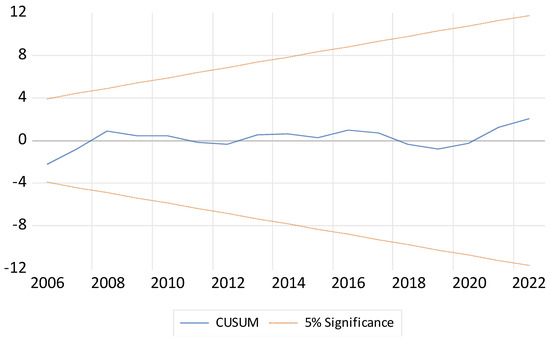
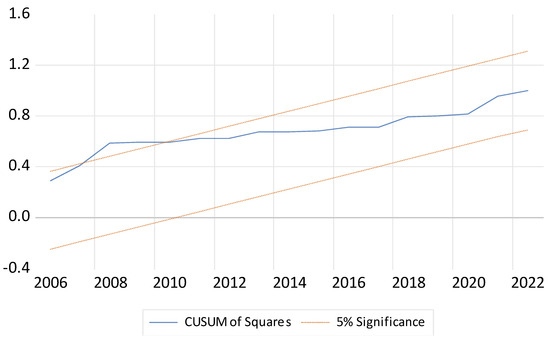
In order to ensure the robustness and reliability of the estimated ARDL model, diagnostic tests consisting of Ramsey RESET test, the normality test of residuals, the Breusch–Pagan test and stability tests using the cumulative sum (CUSUM) and cumulative sum of squares (CUSUMSQ) were conducted. As indicated in Table 5, all the diagnostic test results reveal that the model successfully satisfies the diagnostic criteria. Specifically, the p-values associated with the serial correlation test indicated that the model does not suffer from any serial correlation problem at 5% significance level.
Table 5.
Diagnostic tests.
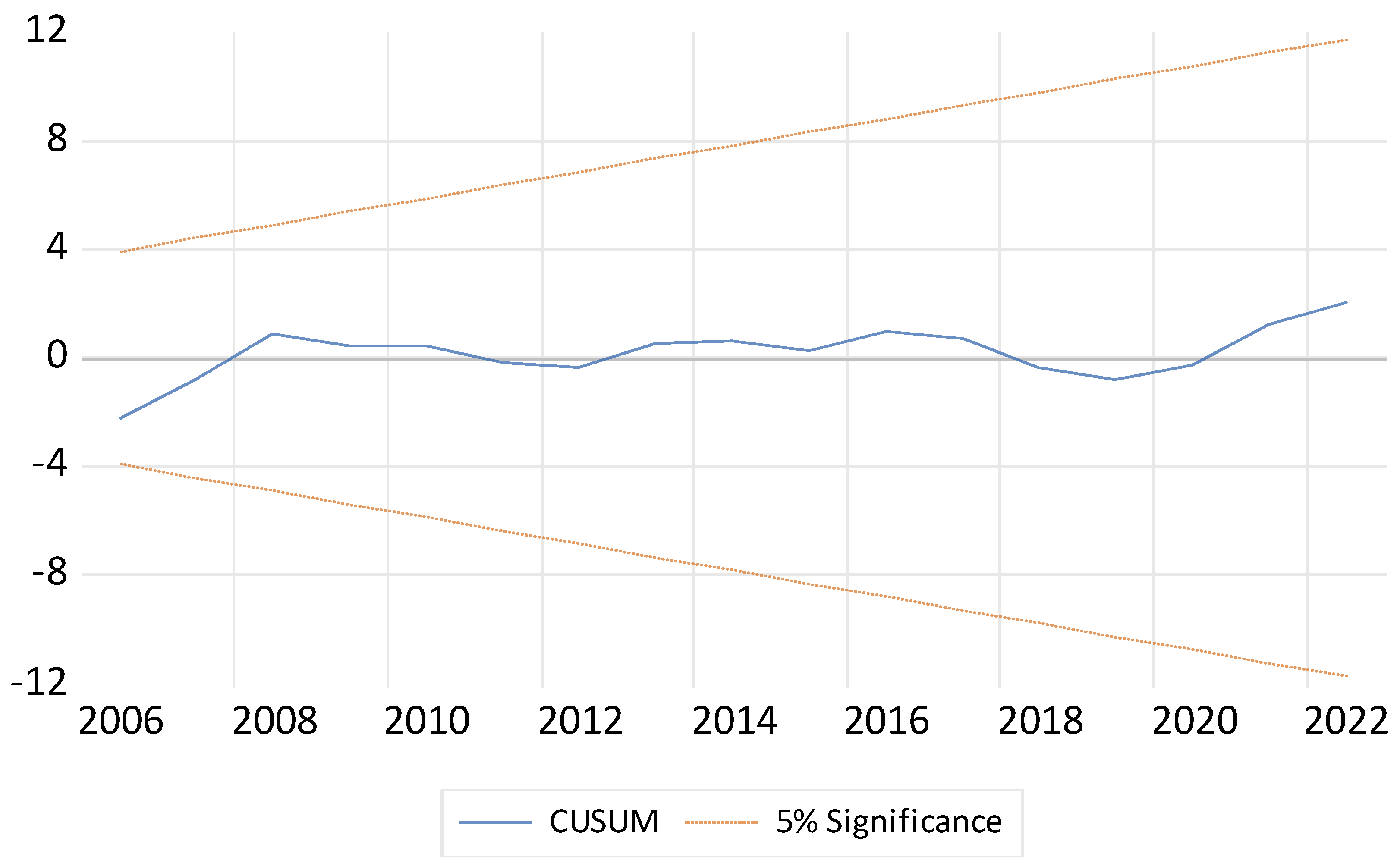
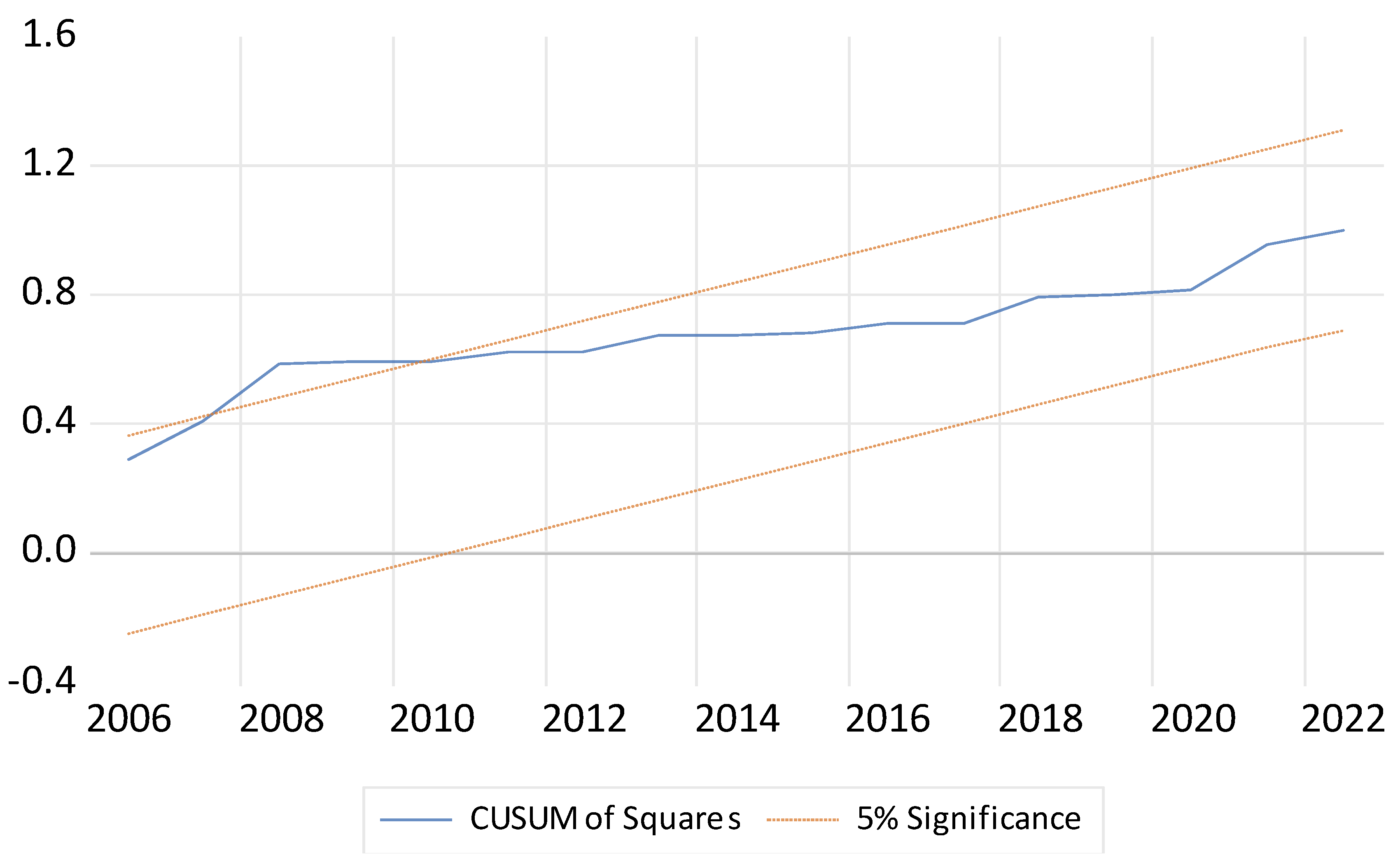
Similarly, the Breusch–Pagan heteroscedasticity also showed that the model is free from heteroscedasticity problem. Meanwhile, the normality test and functional form test of the Ramsey RESET test have demonstrated that the model has normally distributed residuals and correct functional form specification. Furthermore, the CUSUM and CUSUMSQ statistics as shown in Figure 1 and Figure 2 revealed that the model remained well within the critical bounds at 5% significance levels. Thus, confirming the stability of the estimated coefficients over the sample period.
Figure 1.
Cumulative sum (CUSUM) test.
Figure 2.
Cumulative sum of squares (CUSUMSQ) test.
Next, result from Table 6 showed the short-run impact of the variables to the production of AFF sectors. Estimation of the Error Correction Term (CointeEq(−1)) was found to be highly significant negative with t-statistic (−6.431859) which affirmed the existence of a stable long-run relationship. The coefficient of −0.8476 indicates an exceptionally high speed of adjustment. Approximately 84.7% of the disequilibrium from a shock in the previous year is corrected within the current year. This high rate of convergence suggests that despite short-run disruptions, the primary sector of AFF returns to its long-run equilibrium path relatively quickly.
Table 6.
Short-run elasticities based on the Error Correction Model (ECM).
Subsequently, the lag coefficients reported the short-run elasticities providing a more dynamic view of the sector’s responsiveness to both the technological and institutional shocks. Unlike the long-run results, technological innovation appears to indicate a highly significant positive impact in the short run. The first, second, and third lags (D(LNTECH)) are all positive and significant at the 1% level. This confirms the empirical findings of Ma et al. [26] and Chang et al. [31], that advocated an immediate technological adoption which provides a necessary boost to sectoral productivity and food security.
However, the short-run impact of the institution governance (D(LNQOG)) was not linear as it reported significant negative result for its immediate effect but significant positive impact for its second and third lag effect. This mirrors the unpredictable outcomes which were earlier discussed by De Koning [45], suggesting an adjustment period where initial regulatory shocks disrupt production before the benefits of improved governance materialize. Meanwhile, the lag effect of information communication technology (D(LNICT)) demonstrated a significant negative effect on its second lag. This suggested a negative impact of information communication innovation on the AFF sector in the short run. This likely reflected the bureaucratic burden on marketing subsystems that has been discussed by Domaob et al. [17], where delayed adoption costs or infrastructure gaps temporarily hinder value-added capture. Besides that, the negative finding also highlighted that the current fixed-line telephones subscription is not sufficient to catalyze the long-term growth which demands higher connectivity such as internet network penetration.
5. Discussions
The findings from this study clearly indicate the significance of both technological innovation and institutional governance as drivers for the AFF sectors. However, the present results demonstrated different findings for the variables during the short run and long run. For instance, the technological innovation factor was found positively significant in the short run, but it demonstrated significant negative impact in the long run. This could imply that innovation helps in promoting the growth of AFF sectors in the short run but dampens its production over the long run. This clearly provides robust support to the creation aspect of Schumpeter’s theory. In which, this simply means that immediate technological adoption in the short run (such as advanced harvesting gear or precision farming) will rapidly enhance yields and operational efficiency, thereby boosting sectoral value-added. Hence, this aligned with empirical observations such as Ma et al. [26] and Chang et al. [31], where innovation induces a shift in production frontiers. Besides that, this finding strongly aligned with Malaysia’s current policy trajectory under the National Agrofood Policy 2021–2030 (DAN 2.0). DAN 2.0 prioritizes the integration of 4IR technologies to overcome structural labor shortages and enhance productivity. In practice, this is increasingly evident in the adoption of Internet of Things (IoT) solutions within Malaysia’s high-value commodity sectors. For example, the use of automated sensor-based irrigation and fertigation systems in durian plantations, as well as the implementation of satellite imagery and drone-assisted pest management in oil palm estates, demonstrates how precision farming can lead to immediate yield leaps. However, the long-run findings showed significant negative impact which appeared to be contending the traditional growth-oriented interpretations of the Schumpeterian Innovation Theory. Instead, the finding offered support to the destruction phase of the Schumpeterian theory. This highlighted the rapid technological shifts which lead to a structural contraction of the primary sector due to labor change and capital movement to higher-tech industrial sectors in the long run. Therefore, this suggested that without strategic diversification, innovation technology could fail in delivering higher value-added for the AFF sectors.
Meanwhile, the empirical finding for the institutional governance variable showed mixed effects in the short run. As indicated by the short run results, the immediate effect of (D(LQOG)) is negative before reverting to positive in the second and third lags. This finding offered strong support to the theoretical concept of institutional lag effect. This suggested that new governance frameworks initially create compliance shock or bureaucratic frictions that temporarily hinder production before eventually helping in creating a stabilized regulatory environment. Such findings somehow validate the unpredictable outcomes that have been theorized in the findings by De Koning [45]. In the Malaysian context, this is most visible in the mandatory adoption of the Malaysian Sustainable Palm Oil (MSPO) certification and the Malaysia Timber Legality Assurance System (MyTLAS). While these certifications are vital for securing long-term global market access and environmental sustainability (SDG 15), their initial implementation phase often creates significant bureaucratic frictions and high compliance costs, particularly for rural smallholders. Yet, the long-run effect for the governance variable was found to be in contrast. The significant negative long-run relationship strongly supported the institutional traps notion that was claimed in Faundez [18], whereby rigid or centralized governance structures fail to adapt to the evolving needs of a high-tech primary sector. Hence, this finding was also aligned with the institution theory that rigid or centralized governance structures can become barriers to long-term economic expansion if they protect obsolete practices or fail to adapt to modern market dynamics. In Malaysia, this trap is structurally embedded in the jurisdictional divide between Federal and State authorities. This administrative friction creates a rigid environment that fails to adapt to the fast-paced technological needs of a modern primary sector. As a consequence, the centralized governance framework can inadvertently act as a bottleneck, leading to the long-term stagnation of the sector’s value-added contribution despite the availability of technological innovation.
Apart from that, the empirical finding also demonstrated the insignificance of information communication technology (LNICT) and foreign direct investment (LNFDI) in the long run. The short-run effect for foreign direct investment continues to be missing, while the information communication technology showed a negative short-run impact. The findings for foreign direct investment can be explained by the likelihood of biological gestation periods in AFF production. For instance, the time required for crops or timber to mature which delays the realization of value-added. Meanwhile, the negative significance of the second lag effect from information communication technology suggested a digital divide. While ICT is essential for modern marketing subsystems, the initial investment in digital infrastructure may drain resources before the efficiency gains are obtained, particularly in marginalized rural areas.
6. Conclusions
In conclusion, this study investigated the dynamic relationship between technological innovation, institutional governance, FDI, and ICT on the value-added contribution of Malaysia’s agriculture, forestry, and fishery (AFF) sectors. The empirical findings from the ARDL model revealed that while technological innovation (LNTECH) provides a robust and significant boost to sectoral productivity in the short run, its long-run impact is negative. This suggested a structural shift consistent with Schumpeterian creative destruction. Similarly, the quality of governance (LNQOG) exhibits an adjustment lag, initially disrupting the sector before yielding positive short-term recovery. Yet, it ultimately faced an institutional trap in the long-term equilibrium. The exceptionally high speed of adjustment (84.7%) underscores the inherent resilience of Malaysia’s primary sector in returning to equilibrium following these technological and regulatory shocks.
Finding from this research makes several distinct contributions to the existing literature in the pursuit of SDG 2 using an integrated SDG framework of analysis. Firstly, this study offered a theoretical integration by simultaneously modeling Schumpeterian Innovation Theory and Institutional Theory in the development of the research framework. Hence, it narrowed the gap identified in which most past studies have attempted to examine these drivers independently instead of their joint effects via an integrated framework. Secondly, unlike previous studies that siloed agriculture, forestry, or fishery, this research utilizes an integrated AFF value-added approach. This provides a holistic view of the primary sector’s contribution to national food security, thus aligning it with the integrated framework of the SDGs. Next, this study provides a disaggregated empirical analysis of these variables specifically within the Malaysian context. Finally, this study offered findings based on both long-run and short-run analysis using the ARDL approach. This allows to highlight the divergence between immediate productivity gains and long-term structural risks. Hence, providing a more granular understanding of the double-edged sword effect of modernization in primary sectors.
Based on the empirical findings, a few policy recommendations are proposed to enhance sectoral value-added and ensure the achievement of SDG 2. Firstly, the findings call for a need to strengthen the adaptive governance frameworks. Given the long-run negative impact of LNQOG and the short-run adjustment lag, transition should be made from rigid, top-down regulations to more flexible, decentralized governance structures. For instance, the Ministry of Agriculture and Food Security (MAFS) should delegate greater operational autonomy to State Agriculture Departments (JPN) and state-linked agencies. In doing so, these state-level bodies will be better positioned to tailor ICT adoption strategies such as smart irrigation or drone usage to local use. This reduces the initial compliance shock and prevents the sector from falling into an institutional trap that stifles long-term growth. This in turn will mitigate the Schumpeterian Displacement that causes a long-term contraction of the sector’s GDP due to the introduction of new modern technology. In other words, the government must implement some inclusive innovation policies such as reskilling programs for labor displaced by technology and incentivizing higher-value-added downstream processing within rural areas.
Besides that, the negative short-run impact of ICT suggests that digital infrastructure alone is insufficient. Policy focus should shift toward subsidizing digital literacy and specialized software for small-scale producers to lower adoption costs. This will enhance the efficiency of marketing subsystems and bridge the digital productivity paradox. Besides that, policy interventions must align with the Malaysia Digital Economy Blueprint (MyDIGITAL) with aims to transform Malaysia into a digitally-driven, high-income nation. In addition, targeted subsidies should be provided to rural smallholders to undergo digital literacy training. With FDI reported showing no immediate or long-term significance, policies should be refined to attract strategic FDI. The incentives should emphasize foreign investments that include mandatory technology transfer and local capacity building to overcome the long biological gestation periods inherent in the primary sector. As the high speed of adjustment (84.7%) indicates that the sector recovers quickly from shocks, this called upon the need to leverage sectoral resilience. Policymakers can leverage this resilience by implementing sustainability and eco-innovation pilots. By aligning these policies with the identified dynamics of innovation and governance, Malaysia can secure its primary production base, ensuring that the path toward high-income status does not compromise national food sovereignty.
This study utilizes patents registered per capita as a proxy for technological innovation. As such, it may not perfectly isolate the innovation specific to the agriculture, forestry, and fishery (AFF) sectors. This creates potential for sample bias, as high-tech patent growth may not reflect the immediate technological realities of rural producers. Future research should prioritize sector-specific metrics, such as agricultural R&D expenditure or Green Patent Classifications, to more accurately capture the direct impact of primary-sector innovation. Nevertheless, the current proxy provides valuable insights into the broader national knowledge environment and its indirect relationship with the AFF sector’s growth.
Author Contributions
Conceptualization, W.S.Y.; validation, J.Y. and S.I.T.; formal analysis, W.S.Y.; data curation, R.Z., R.R. and S.M.; writing—original draft preparation, W.S.Y. and R.Z.; writing—review and editing, J.Y. and S.I.T.; visualization, R.Z.; project administration, W.S.Y. All authors have read and agreed to the published version of the manuscript.
Funding
This research received no external funding.
Institutional Review Board Statement
Not applicable.
Informed Consent Statement
Not applicable.
Data Availability Statement
Data sources can be found from secondary sources such as Worldbank database, Department of Statistics Malaysia (DOSM).
Conflicts of Interest
The authors declare no conflicts of interest.
Abbreviations
The following abbreviations are used in this manuscript:
| AFF | Agriculture, Forestry and Fishery |
| ARDL | Autoregressive Distributed Lag |
| ECM | Error Correction Model |
| CUSUM | Cumulative Sum |
| CUSUMSQ | Cumulative Sum of Squares |
References
- Ibrahim, M.A.; Nabeel, M.; Raza, M.Q.; Hameed, N.; Rafiq, R.; Zaheer, M.; Ain, N.U.; Iftikhar, Z.; Ammar, A.; Khalid, M.N.; et al. The role of technology and innovation in enhancing food security. J. Phys. Biomed. Biol. Sci. 2023, 2023, 14. [Google Scholar]
- Khan, N.; Ray, R.L.; Kassem, H.S.; Hussain, S.; Zhang, S.; Khayyam, M.; Ihtisham, M.; Asongu, S.A. Potential role of technology innovation in transformation of sustainable food systems: A review. Agriculture 2021, 11, 984. [Google Scholar] [CrossRef] [Scilit]
- Gouvea, R.; Kapelianis, D.; Li, S.; Terra, B. Innovation, ICT & food security. Glob. Food Secur. 2022, 35, 100653. [Google Scholar] [CrossRef] [Scilit]
- Zhao, C.; Geng, R.; Chi, T.; Khiewngamdee, C.; Liu, J. Agricultural technology innovation and food security in China: An empirical study on coupling coordination and its influencing factors. Agronomy 2024, 14, 123. [Google Scholar] [CrossRef] [Scilit]
- Elame, F.; Lionboui, H.; Behnassi, M. Technological and managerial innovation in agriculture to ensure food security under climate change. In Strategizing Agricultural Management for Climate Change Mitigation and Adaptation; Springer International Publishing: Cham, Switzerland, 2023; pp. 207–219. [Google Scholar]
- Zwane, E. The role of agricultural innovation system in sustainable food security. S. Afr. J. Agric. Ext. 2020, 48, 122–134. [Google Scholar]
- Asare-Nuamah, P.; Amoah, A.; Asongu, S.A. Achieving food security in Ghana: Does governance matter? Politics Policy 2023, 51, 614–635. [Google Scholar] [CrossRef] [Scilit]
- Pal, S.; Lean, H.H.; Villanthenkodath, M.A. Achieving sustainable food security: Integrating environmental and governance issues. J. Environ. Stud. Sci. 2025, 16, 283–297. [Google Scholar] [CrossRef] [Scilit]
- Anser, M.K.; Osabohien, R.; Olonade, O.; Karakara, A.A.; Olalekan, I.B.; Ashraf, J.; Igbinoba, A. Impact of ICT adoption and governance interaction on food security in West Africa. Sustainability 2021, 13, 5570. [Google Scholar] [CrossRef] [Scilit]
- Khalid Anser, M.; Iqbal Godil, D.; Aderounmu, B.; Onabote, A.; Osabohien, R.; Ashraf, J.; Peng, M.Y.-P. Social inclusion, innovation and food security in West Africa. Sustainability 2021, 13, 2619. [Google Scholar] [CrossRef] [Scilit]
- Tzeng, C.H. A review of contemporary innovation literature: A Schumpeterian perspective. Innovation 2009, 11, 373–394. [Google Scholar] [CrossRef] [Scilit]
- Dabic, M.; Cvijanović, V.; González-Loureiro, M. Keynesian, post-Keynesian versus Schumpeterian, neo-Schumpeterian: An integrated approach to the innovation theory. Manag. Decis. 2011, 49, 195–207. [Google Scholar] [CrossRef] [Scilit]
- Nielsen, R.; Christensen, J.L.; Dahl, M.S.; Eliasen, S.; Østergaard, C. Back to Basics: Innovation in Agricultural, Forest and Fishery. In Proceedings of the DRUID 25th Celebration Conference, Copenhagen, Denmark, 17–20 June 2008. [Google Scholar]
- Callegari, B.; Nybakk, E. Schumpeterian theory and research on forestry innovation and entrepreneurship: The state of the art, issues and an agenda. For. Policy Econ. 2022, 138, 102720. [Google Scholar] [CrossRef] [Scilit]
- Pan, Y.; Zhang, S.; Zhang, M. The impact of entrepreneurship of farmers on agriculture and rural economic growth: Innovation-driven perspective. Innov. Green Dev. 2024, 3, 100093. [Google Scholar] [CrossRef] [Scilit]
- Buchana, Y. Eco-innovation and agricultural sustainability: Empirical evidence from South Africa’s agricultural sector. Innov. Dev. 2025, 15, 113–132. [Google Scholar] [CrossRef] [Scilit]
- Domaob, J.S.; Bandera, A.D.; Usman-Macadaag, O.M. Marketing subsystems in agriculture, fisheries, and forestry: A systematic literature review. GAS J. Econ. Bus. Manag. (GASJEBM) 2025, 2, 23–30. [Google Scholar]
- Faundez, J. Douglass North’s theory of institutions: Lessons for law and development. Hague J. Rule Law 2016, 8, 373–419. [Google Scholar] [CrossRef] [Scilit]
- Jentoft, S. Institutions in fisheries: What they are, what they do, and how they change. Mar. Policy 2004, 28, 137–149. [Google Scholar] [CrossRef] [Scilit]
- Nunan, F. Analysing institutions to explain the practice and outcomes of fisheries co-management. In Governing Renewable Natural Resources; Routledge: London, UK, 2019; pp. 94–109. [Google Scholar]
- Rudd, M.A. An institutional framework for designing and monitoring ecosystem-based fisheries management policy experiments. Ecol. Econ. 2004, 48, 109–124. [Google Scholar] [CrossRef] [Scilit]
- Putsenteil, P.; Klapkiv, Y.; Karpenko, V.; Gvozdecka, I. The role of institutions in the development of agriculture. Bulg. J. Agric. Sci. 2020, 26, 23–33. [Google Scholar]
- Janssen, B.; Nonnenmann, M.W. New institutional theory and a culture of safety in agriculture. J. Agromed. 2017, 22, 47–55. [Google Scholar] [CrossRef] [Scilit]
- Yasmeen, R.; Padda, I.U.H.; Yao, X.; Shah, W.U.H.; Hafeez, M. Agriculture, forestry, and environmental sustainability: The role of institutions. Environ. Dev. Sustain. 2022, 24, 8722–8746. [Google Scholar] [CrossRef] [Scilit]
- Olaganathan, R.; Quigley, K. Technological modernization and its impact on agriculture, fisheries and fossil fuel utilization in the Asia Pacific Countries with emphasis on sustainability perspective. Int. J. Adv. Biotechnol. Res. (IJBR) 2017, 8, 422. [Google Scholar]
- Ma, Z.; Liu, T.; Li, J.; Liu, Z.; Chen, W. Spatial effect analysis of forestry technology innovation on forestry industry economic growth. Forests 2023, 14, 557. [Google Scholar] [CrossRef] [Scilit]
- Waberi, A.A. Impact of foreign direct investment on agriculture, forestry and fisheries: Evidence from Eastern African countries. Theor. Econ. Lett. 2025, 15, 1003–1018. [Google Scholar] [CrossRef]
- Suphannachart, W. Foreign direct investment in the agricultural sector of Thailand and its effect on productivity. Eur. J. Sci. Res. 2012, 91, 393–403. [Google Scholar]
- Santangelo, G.D. The impact of FDI in land in agriculture in developing countries on host country food security. J. World Bus. 2018, 53, 75–84. [Google Scholar] [CrossRef] [Scilit]
- Seufert, P. The FAO voluntary guidelines on the responsible governance of tenure of land, fisheries and forests. Globalizations 2013, 10, 181–186. [Google Scholar] [CrossRef] [Scilit]
- Chang, J.B.; Lee, Y. The effects of technological development on fisheries production. Fish. Sci. 2019, 85, 259–269. [Google Scholar] [CrossRef] [Scilit]
- Ashimova, Z.; Abitov, Z.; Abitova, D.; Uristembek, A. The management of gross output of the agricultural, forestry, and fishery sectors of Kazakhstan. J. Reg. Int. Compet. 2025, 6, 65–77. [Google Scholar] [CrossRef] [Scilit]
- Miles, I. Patterns of innovation in service industries. IBM Syst. J. 2008, 47, 115–128. [Google Scholar] [CrossRef] [Scilit]
- Davis, J.S.; Mckenney, D.W.; Turnbull, J.W. The international impact of forestry research and a comparison with agricultural and fisheries research. Can. J. For. Res. 1994, 24, 321–336. [Google Scholar] [CrossRef] [Scilit]
- Asche, F.; Smith, M.D. Induced innovation in fisheries and aquaculture. Food Policy 2018, 76, 1–7. [Google Scholar] [CrossRef] [Scilit]
- Hungevu, R.; Lawal, A.; Yinusa, S.; Titiloye, T.A.; Lasisi, R.; Okunola, M. The impact of low-cost technological innovations on sustainable fisheries for economic development in developing countries. World J. Adv. Res. Rev. 2025, 25, 1170–1184. [Google Scholar] [CrossRef] [Scilit]
- Gogoi, B.; Nath, T.; Kashyap, D.; Sarma, S.; Kalita, R. Sustainable agriculture, forestry and fishery for bioeconomy. In Current Developments in Biotechnology and Bioengineering; Elsevier: Amsterdam, The Netherlands, 2020; pp. 349–371. [Google Scholar]
- Hou, N.; Zhu, Q.; Yang, J.; Zhang, D.; Liu, W.; Chang, H. The impact of environmental governance on the development of fishery economy—The intermediary role of technological innovation. Sustainability 2021, 13, 11378. [Google Scholar] [CrossRef] [Scilit]
- Lindgaard Christensen, J.; Dahl, M.; Eliasen, S.; Nielsen, R.; Richter Østergaard, C. Patterns and collaborators of innovation in the primary sector: A study of the Danish agriculture, forestry and fishery industry. Ind. Innov. 2011, 18, 203–225. [Google Scholar] [CrossRef] [Scilit]
- Chapman, L.J.; Husberg, B. Agriculture, forestry, and fishing sector. J. Saf. Res. 2008, 39, 171–173. [Google Scholar] [CrossRef] [Scilit] [PubMed]
- Pruntseva, G.; Popadynets, N.; Barna, M.; Stetsiv, I.; Stetsiv, I.; Yakubiv, V.; Shymanovska-Dianych, L.; Fedotova, Y.; Karpiak, M.; Hryhoruk, I. The impact of governance on agricultural production as an exclusive factor of the country’s food security. Accounting 2021, 7, 75–80. [Google Scholar] [CrossRef] [Scilit]
- Roy, K.C.; Tisdell, C.A. Good governance in sustainable development: The impact of institutions. Int. J. Soc. Econ. 1998, 25, 1310–1325. [Google Scholar] [CrossRef] [Scilit]
- Andersson, K. Understanding decentralized forest governance: An application of the institutional analysis and development framework. Sustain. Sci. Pract. Policy 2006, 2, 25–35. [Google Scholar] [CrossRef] [Scilit]
- Andersson, K.; Benavides, J.P.; León, R. Institutional diversity and local forest governance. Environ. Sci. Policy 2014, 36, 61–72. [Google Scholar] [CrossRef] [Scilit]
- De Koning, J. Unpredictable outcomes in forestry—Governance institutions in practice. Soc. Nat. Resour. 2014, 27, 358–371. [Google Scholar] [CrossRef] [Scilit]
- Cortner, H.J.; Burns, S.; Clark, L.R.; Sanders, W.H.; Townes, G.; Twarkins, M. Governance and institutions: Opportunities and challenges. J. Sustain. For. 2001, 12, 65–96. [Google Scholar] [CrossRef] [Scilit]
- Ravazzoli, E.; Dalla Torre, C.; Da Re, R.; Marini Govigli, V.; Secco, L.; Górriz-Mifsud, E.; Pisani, E.; Barlagne, C.; Baselice, A.; Bengoumi, M.; et al. Can social innovation make a change in European and Mediterranean marginalized areas? Social innovation impact assessment in agriculture, fisheries, forestry, and rural development. Sustainability 2021, 13, 1823. [Google Scholar] [CrossRef] [Scilit]
- Obekpa, H.O.; Frimpong, E.; Ayuba, A. Influence of foreign direct investment and exchange rate on fisheries in Nigeria. Stud. Agric. Econ. 2020, 122, 153–161. [Google Scholar] [CrossRef] [Scilit]
- Lin, B.; Du, R.; Dong, Z.; Jin, S.; Liu, W. The impact of foreign direct investment on the productivity of the Chinese forest products industry. For. Policy Econ. 2020, 111, 102035. [Google Scholar] [CrossRef] [Scilit]
- Ananwude, A.C.; Nwobia, C.E.; Onyegiri, P.K. Foreign direct investment and agricultural sector performance in Nigeria: A disaggregated approach. J. Risk Financ. Stud. 2025, 6, 19–28. [Google Scholar]
- Rotowa, O.J. Economic analysis of agriculture, forestry and fisheries to the economic development of Nigeria. J. Res. Stud. Sci. Eng. Technol. 2019, 6, 15–22. [Google Scholar]
- Yun, W.S.; Ridzuan, A.R.; Izadin, A.A.I.; Wudil, A.A.; Ruiqi, Z.; Ann, T.S. Decarbonizing growth: The role of human capital development and innovation in Malaysia’s pursuit of SDG 13. Int. J. Energy Econ. Policy 2025, 15, 18–27. [Google Scholar] [CrossRef] [Scilit]
- Pesaran, M.H.; Shin, Y.; Smith, R.J. Bounds testing approaches to the analysis of level relationships. J. Appl. Econom. 2001, 16, 289–326. [Google Scholar] [CrossRef] [Scilit]
- Nkoro, E.; Uko, A.K. Autoregressive Distributed Lag (ARDL) cointegration technique: Application and interpretation. J. Stat. Econom. Methods 2016, 5, 63–91. [Google Scholar]
- Le, T.H.; Quang, T.N.; Bui, T.; Thi, H.N. Structure of Agricultural, Forestry and Fishery Sector in the Vietnam Economy: An Input–Output Analysis. J. Account. Bus. Financ. Res. 2022, 14, 8–18. [Google Scholar] [CrossRef] [Scilit]
- Squires, V.R. (Ed.) The Role of Food, Agriculture, Forestry and Fisheries in Human Nutrition-Volume III; EOLSS Publications: Oxford, UK, 2021. [Google Scholar]

Disclaimer/Publisher’s Note: The statements, opinions and data contained in all publications are solely those of the individual author(s) and contributor(s) and not of MDPI and/or the editor(s). MDPI and/or the editor(s) disclaim responsibility for any injury to people or property resulting from any ideas, methods, instructions or products referred to in the content. |
© 2026 by the authors. Licensee MDPI, Basel, Switzerland. This article is an open access article distributed under the terms and conditions of the Creative Commons Attribution (CC BY) license.