


Abstract
This paper investigates whether sustainability consciousness is already developed in the final years of primary education. The study involved n = 1532 students in grades 5 and 6 from n = 48 primary schools in the Epirus region of Greece during the 2024–2025 school year. To assess their knowingness, attitudes, and behaviors related to sustainable development, we used the Sustainability Consciousness Questionnaire, which was reverse-translated into Greek and tested in a pilot study for age appropriateness. Reliability was examined, and all three subscales—knowingness, attitudes, and behavior—showed statistically significant positive correlations. Students generally reported high levels of sustainability consciousness, with girls consistently scoring higher across all categories. The findings highlight the potential to foster sustainability-related values and practices early in education, providing original evidence from Greek primary schools and expanding the instrument’s international use among younger learners.
1. Introduction
This paper aims to explore sustainability consciousness in primary education in Greece. Recently, the global community has emphasized the vital role of education in advancing the 2030 Agenda for Sustainable Development, with Target 4.7 emphasizing the importance of acquiring knowledge, skills, and values that foster sustainable societies [1]. While several studies have examined sustainability consciousness among adolescents and university students [2,3], less is known about its development in younger children. In Greece, this gap is even more significant, as systematic data on children’s knowledge, attitudes, and behaviors related to sustainability remain scarce. To address this, the study employs the Sustainability Consciousness Questionnaire [4], a validated tool that assesses cognitive, attitudinal, and behavioral aspects of sustainability, with a large sample of students in the final grades of primary school. This approach offers new insights into early sustainability awareness and helps extend the instrument’s international use to younger learners.
In light of the above, the present study contributes to the existing literature on sustainability consciousness in several ways. First, at the theoretical level, it extends the application of the sustainability consciousness framework to younger age groups, offering further insight into how sustainability-related knowingness, attitudes, and behaviors are conceptualized in primary education. Second, at the methodological level, it applies the Sustainability Consciousness Questionnaire [4] in a new cultural and educational context, providing additional evidence for its use with primary school students. Third, at the contextual level, the study addresses a significant gap by offering the first empirical data on sustainability consciousness among primary school students in Greece, thereby contributing to a more comprehensive understanding of the construct across different national settings.
2. Theoretical Background
2.1. Global Framing: The 2030 Agenda and SDG 4
The United Nations’ 2030 Agenda and the 17 Sustainable Development Goals (SDGs) provide a global framework for addressing interconnected social, economic, and environmental challenges [5]. Within this framework, education is recognized as a key means for enabling individuals to contribute to more just and sustainable societies by developing relevant knowledge, values, and competences [1].
This role is explicitly reflected in Target 4.7 of SDG 4, which calls for all learners to acquire the knowledge and skills needed to promote sustainable development. Beyond cognitive understanding, this target emphasizes the importance of fostering values, attitudes, and action-oriented competences related to sustainability, human rights, global citizenship, and cultural diversity [6]. In line with this perspective, UNESCO highlights that education should not be limited to knowledge transmission but should support learners in developing the capacity to respond to complex global challenges in responsible and engaged ways [7,8].
Within this global policy context, the emphasis on integrating knowledge, values, and action underscores the need for approaches that capture learners’ comprehensive engagement with sustainable development. In this respect, the concept of sustainability consciousness provides a structured framework for examining how individuals develop cognitive, attitudinal, and behavioral orientations toward sustainability.
2.2. The Concept of Sustainability Consciousness
According to Gericke et al. [4], sustainability consciousness is a broad indicator of how people understand, value, and act with respect to sustainable development. The same authors also link its theoretical foundation to the three pillars of sustainability—environment, society, and economy—across the three dimensions of learning: cognitive, value-based, and behavioral.
Building on this global educational framework, sustainability consciousness has been introduced as a broad indicator of how individuals understand, value, and act in relation to sustainable development [4]. The same authors link its theoretical foundation to the three pillars of sustainability—environment, society, and economy—across the three dimensions of learning: cognitive, value-based, and behavioral.
Sustainability consciousness extends beyond traditional environmental education because it not only focuses on ecological concerns but also encompasses all 17 Sustainable Development Goals (SDGs). Measuring this construct allows us to understand how people grasp complex issues, develop values related to social justice and equity, and adopt behaviors that promote sustainability across different areas. Olsson and Gericke [3] noted that when sustainability consciousness is fostered in schools, students are more likely to develop responsible attitudes toward social and environmental issues and to take actions that benefit the broader community.
Gericke et al. [4] provided the theoretical foundation for the construct and introduced the Sustainability Consciousness Questionnaire (SCQ), an instrument to be internationally validated for assessing these three dimensions. Their work built on earlier efforts to measure knowingness, attitudes, and behaviors related to sustainability. For example, Michalos et al. systematically linked the three dimensions of learning with the three pillars of sustainable development, offering an early methodological framework [9]. UNESCO also outlined 15 thematic areas that balance environmental, social, and economic aspects of development, which served as a key reference for designing the questionnaire [10,11]. In this way, sustainability consciousness was conceptualized as a multidimensional construct that extends beyond environmental education. As Lezak and Thibodeau argued, environmental awareness has often been narrowly measured, focusing mainly on ecological issues and neglecting the complex systems perspective that underpins sustainability [12]. Introducing the idea of sustainability consciousness helps address this gap by offering a broader perspective. However, comparative studies show that students often approach the three dimensions separately, highlighting the need for tools that promote a more integrated understanding [13]. Research indicates that when ESD is incorporated into schools, students’ sustainability consciousness can increase significantly [14]. At the same time, integrating ESD into national curricula has been emphasized as essential to ensure the concept permeates the entire education system [15].
Since then, the SCQ has been validated across a variety of cultural and educational settings, as shown below, demonstrating its strength across contexts and usefulness for examining sustainability as a broad psycho-educational concept.
2.3. International Applications and Measurement Needs for Sustainability Consciousness
Since its initial development, the Sustainability Consciousness Questionnaire (SCQ) has been widely used to assess Education for Sustainable Development (ESD) across international settings. In Sweden, studies have revealed significant differences by gender and age, as well as the so-called “adolescent dip,” a decline in positive attitudes toward sustainability during adolescence [2,3]. This finding underscores the importance of studying younger age groups before this trend emerges. At the same time, introducing ESD in Swedish schools has been shown to significantly improve students’ knowingness, attitudes, and behaviors related to sustainable development [16].
Beyond the Scandinavian context, SCQ has also been used in other European countries. In Spain and Belgium, it was used to evaluate interventions promoting environmental citizenship, demonstrating its ability to reliably detect changes in knowledge, attitudes, and behaviors [17]. Recent psychometric tests confirmed the instrument’s structure in Italian [18] and Portuguese [19] samples. The tool has also been applied in more specialized settings, such as professional education, where it measured the sustainability awareness of future engineers in India, demonstrating its versatility. However, despite its use across diverse contexts, evidence from younger age groups and certain national settings remains relatively limited.
One important non-European contribution came from Japan, where the SCQ was validated, and its cross-cultural validity was confirmed [20]. These studies indicate that the instrument is appropriate for use with diverse populations and across many age groups.
The measurement of sustainability consciousness has also been linked to the effectiveness of educational interventions. According to prior research, ESD clearly influences knowledge, attitudes, and behaviors [14]. Additional research has emphasized its connection to socio-emotional skills and the importance of school environments that promote cooperation, accountability, and empathy [21].
UNESCO has highlighted that monitoring progress toward SDG Target 4.7 requires reliable tools capable of capturing how learners acquire sustainability-related knowledge, values, and competences [1,6]. UNESCO also emphasizes that education should promote critical thinking while motivating learners to take action that transforms their societies [8]. Additionally, research shows that many values and attitudes are formed during childhood, making early attention to sustainability consciousness especially crucial [2,22]. This importance is further recognized in the joint work of UNESCO and WHO, which stresses that every school should serve as a community that fosters not only learning but also health, well-being, and sustainability through a holistic approach that develops knowledge, attitudes, and behaviors from the earliest stages of education [23].
From the above, it is clear that SCQ is a strong and reliable tool for measuring sustainability consciousness across diverse cultural and educational contexts. However, most research has focused on teenagers and young adults, with limited use among primary school children. In this respect, the lack of data in certain national contexts, including Greece, is particularly evident, as no systematic information exists on children’s sustainability consciousness. Assessing this construct at younger ages is crucial not only for understanding how knowledge, attitudes, and behaviors related to sustainability develop, but also for guiding educational policies that seek to incorporate sustainability from the earliest years of schooling.
At the same time, we are aware that SCQ, as a quantitative instrument, may not fully capture the complexity of sustainability consciousness, which encompasses cognitive, attitudinal, and behavioral dimensions shaped by diverse educational and social contexts. Broader curricular and policy-related factors, including national educational frameworks, may also influence the development of sustainability consciousness, and insights from qualitative research would be useful.
2.4. Research Gap
Despite the widespread international use of the Sustainability Consciousness Questionnaire (SCQ), most studies have concentrated on adolescents and young adults. Swedish research has documented the adolescent dip phenomenon, highlighting the importance of examining the development of sustainability-related knowingness, attitudes, and behaviors in younger age groups before this stage begins [2].
Furthermore, most applications in European and international settings have been limited to secondary or higher education. In Spain, Belgium, and Sweden, the SCQ was used to assess interventions involving adolescents and young people [17]. In Italy, the instrument was validated on a national adult sample [18], whereas in Portugal, its adaptation highlighted a research gap in Southern European countries, focusing mainly on adults and university students [19]. Likewise, studies in Japan and Spain have primarily focused on student samples and prospective teachers [20,24].
As a result, the use of the SCQ in primary education remains limited, especially in Greece, where no systematic, published studies document levels of sustainability consciousness among elementary students. Addressing this research gap requires applying the SCQ-S with primary school children in Greece to gather reliable data on their knowingness, attitudes, and behaviors related to sustainable development and to inform educational policies that promote sustainability from the earliest years of schooling.
2.5. Research Purpose and Questions
This study aims to contribute to understanding sustainability consciousness among younger age groups, filling a research gap noted in the international literature. Specifically, we will distribute a Greek version of the Sustainability Consciousness Questionnaire-Short Version (SCQ-S) [4] to a large, representative sample of 5th- and 6th-grade primary school students in Greece.
In this context, we focused on the following research questions:
- Does the SCQ-S yield reliable results when used in the context of Greek primary education?
- What is the overall level of sustainability consciousness among Greek primary school students?
- Are the three subscales of the SCQ-S correlated?
- Are there significant gender differences in sustainability consciousness?
3. Materials and Methods
To address the research questions, a quantitative survey approach guided the study, which was carried out during 2024–2025.
3.1. Sample
The total sample consisted of n = 1532 students in the 5th and 6th grades of primary school, drawn from schools in the Region of Epirus during the 2024–2025 school year. Students in 5th and 6th grades were selected because they are considered developmentally capable of understanding and responding reliably to the questionnaire items, based on the Greek primary education curriculum. The participating schools represented different types of institutions (public, private, and experimental) and covered both urban centers and rural areas. In total, schools from three regional units were included: Ioannina (41 schools), Arta (5 schools), and Thesprotia (2 schools). In the regional unit of Ioannina, the 41 participating schools constitute a substantial proportion (53.94%) of the total primary school population (n = 76), ensuring wide geographical dispersion. More specifically, the selected schools were distributed across different municipalities and encompassed a broad range of socio-economic contexts. Similarly, the schools from Arta were drawn from both central and peripheral locations, while the two participating schools from Thesprotia also reflected variation in terms of urban and rural settings. Collectively, the sample demonstrates a satisfactory level of representativeness, as it captures variability across geographical areas, socio-economic strata, and institutional school types. Although no claim of full statistical representativeness is made, the sample’s diversity enhances the dataset’s empirical robustness and supports a more comprehensive understanding of sustainability consciousness within the regional primary education context.
Of the overall sample, most students were girls (n = 805, 52.5%); n = 714 students (46.6%) were in 5th grade, and n = 818 students (53.4%) were in 6th grade. The vast majority were of Greek nationality (n = 1496, 97.7%) and had siblings (n = 1350, 88.1%). An overview of the sample’s demographic profile is provided in Table 1.
Table 1.
Demographic characteristics of the students’ sample (N = 1532).
3.2. Research Instrument
For data collection, the study used the Sustainability Consciousness Questionnaire-Short Version (SCQ-S) [4], a validated instrument designed to measure sustainability consciousness. Its theoretical foundation rests on three basic dimensions-cognitive, affective, and behavioral- linked to the three-pillar model of sustainable development: environment, society, and economy. The short version of the Sustainability Consciousness Questionnaire (SCQ-S) was selected because it is considered more suitable for younger participants, reducing response fatigue while preserving the core dimensions of sustainability consciousness.
The adaptation of the instrument into Greek followed the reverse-translation method. First, the original questionnaire was translated from English into Greek by two independent translators, and the versions were compared and harmonized for conceptual accuracy. The Greek version was then retranslated into English by a third independent translator. The final version was checked against the original to confirm semantic and conceptual equivalence. A pilot study and reliability check were conducted, confirming the instrument’s suitability for the Greek educational context.
During this process, one item from the cognitive subscale (environmental dimension) was replaced to better suit students in the 5th and 6th grades in Greece: the original statement, “For sustainable development, people need to be educated in how to protect themselves against natural disasters,” was replaced with “To achieve sustainable development, it is necessary to reduce air pollution and urban waste.” Both items belong to the environmental dimension of sustainability, but the adapted version was considered more age-appropriate and in line with Greek curricular priorities. This modification was limited to a single item and was not expected to alter the instrument’s underlying conceptual focus on the environmental dimension. Nevertheless, we acknowledge that this modification may limit direct cross-study comparability, an issue that should be considered in future research and addressed through further cross-cultural validation.
To assess the suitability of the adapted item, an expert panel was established. Three specialists in Education for Sustainable Development (two academics and one school advisor) independently evaluated the relevance and clarity of the new statement for students aged 10–12. Ratings were provided on a four-point scale. All three experts considered the adapted statement relevant, resulting in an item-level content validity index (I-CVI) of 1.00 and an average scale index (S-CVI/Ave—Scale-Level Content Validity Index, Average method) of 0.93. Both values surpass the recommended thresholds in the literature [25,26], indicating that the new item is appropriate for students in this study. The questionnaire includes statements on sustainable development that address the three domains of learning:
- Knowingness of sustainability (e.g., environmental, social, and economic principles)
- Attitudes towards sustainable development issues (e.g., awareness, values)
- Behavioral intentions and practices (e.g., environmentally responsible actions, social justice)
Responses were provided on a five-point Likert scale from 1 = Strongly disagree to 5 = Strongly agree, with higher scores indicating greater levels of sustainability consciousness. The complete structure of the SCQ-S is shown in Table 2, which displays the distribution of items across the three dimensions of sustainable development: environmental, social, and economic.
Table 2.
Distribution of SCQ-S items across the dimensions of sustainable development.
The statements were adjusted for age appropriateness by using simpler and clearer language for primary school students. Although most items were positively phrased, one item (A5i) was negatively worded and reverse-coded during analysis. This did not affect the instrument’s clarity but helped identify possible inattentive or biased responses.
Overall, the SCQ-S reflects sustainability consciousness as a comprehensive yet multidimensional psycho-educational concept.
3.3. Procedure
Data collection was conducted in full compliance with ethical standards and data protection principles, including the General Data Protection Regulation (GDPR). The study received approval from the Ethics and Research Committee of the National and Kapodistrian University of Athens (Decision 83/6.7.2023) and from the Regional Directorate of Education of Epirus for school implementation (Φ.31.2/4036). All participants were informed of the study’s purpose, procedures, and how the data would be used. Participation was entirely voluntary and required signed consent from parents or legal guardians.
Data were collected in late September and early October of the 2024–2025 school year. The questionnaires were distributed in paper form by classroom teachers and completed by students during class time through a process that ensured complete anonymity of responses. We believe that administering the questionnaire in classroom settings helped minimize missing or invalid responses.
3.4. Statistical Analysis
The data were analyzed using IBM SPSS Statistics (version 28). Descriptive statistics (means, standard deviations, minimum, and maximum values) were calculated for the three subscales and the overall SCQ-S score. The internal consistency of the scales was then assessed with Cronbach’s alpha. Finally, correlations among the three subscales—Knowingness, Attitudes, and Behaviors—were examined using Pearson’s correlation coefficient to explore the relationships among the cognitive, value-based, and behavioral dimensions of sustainability consciousness.
3.5. Reliability
As shown in Table 3, the SCQ-S and its three subscales showed satisfactory to high internal consistency, confirming the instrument’s coherence. The overall Cronbach’s alpha (α = 0.89) indicates high internal consistency [27]. These findings align with international evidence documenting the SCQ-S as a reliable measure of sustainability consciousness among adolescents and young adults. The current study extends its application to younger learners, confirming that the SCQ-S can be used with primary school students and yields reliable results.
Table 3.
Reliability of the SCQ-S and its subscales (Cronbach’s alpha).
It is worth noting that Cronbach’s alpha values for the subscales were somewhat lower than the coefficient for the overall score. This result can be attributed to the smaller number of items per dimension (only 9) and to participants’ age, which may affect the consistency of their responses. Even so, the coefficients remain within acceptable limits, supporting the instrument’s reliability [27].
4. Results
The Section 4 reports on three areas: descriptive findings from the SCQ-S, correlations among knowingness, attitudes, and behavior, and gender differences observed among the student sample.
4.1. Students’ Sustainability Consciousness
Table 4 shows the means, standard deviations, and the minimum and maximum values for the three SCQ-S subscales and the total score. Students reported relatively high levels across all dimensions, with means between 4.02 and 4.14 on a five-point scale.
Table 4.
Descriptive statistics of the SCQ-S.
The overall sustainability consciousness score had a mean of 4.07 ± 0.49, indicating that students already demonstrate a positive orientation toward sustainable development at cognitive, attitudinal, and behavioral levels.
4.2. Correlations Among the SCQ-S Dimensions
To examine the relationships among the three main dimensions of the SCQ-S, Pearson correlations were computed. As shown in Table 5, all correlations were positive and statistically significant (p < 0.001). The strongest relationship was between Knowingness and Attitudes (r = 0.685), followed by the correlation between Attitudes and Behavior (r = 0.615). The connection between Knowingness and Behavior (r = 0.585), although slightly lower, was still strong and significant.
Table 5.
Correlations among the SCQ-S subscales.
4.3. Students’ Sustainability Consciousness by Gender
Potential gender differences were analyzed across the three SCQ-S subscales and the overall score (Table 6). Girls scored significantly higher than boys in all areas (p < 0.05). The differences in Knowingness (d = 0.15), Attitudes and Behaviors (d = 0.19 and d = 0.25, respectively) were small. For the total SCQ-S score, the gender difference was also small (d = 0.23).
Table 6.
Gender differences in the SCQ-S.
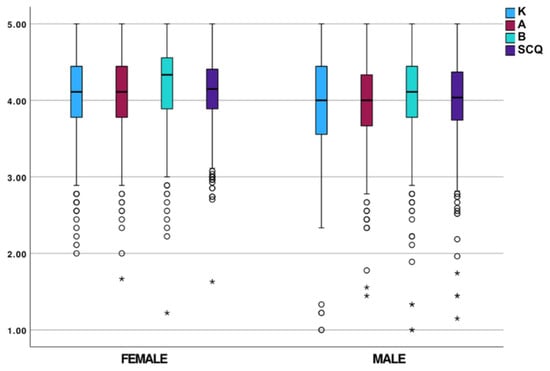
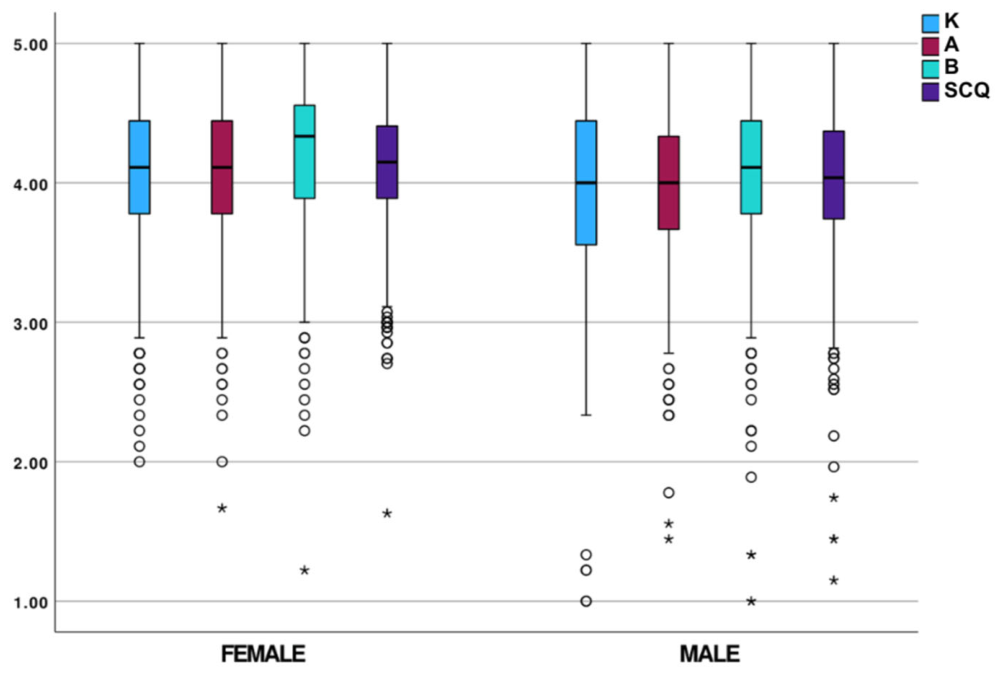
Overall, the results showed that girls (females) reported higher levels of sustainability consciousness across cognitive, attitudinal, and behavioral domains (Figure 1), with gender differences ranging from small to moderate in size.
Figure 1.
Boxplots of knowingness, attitudes, behaviors, and total sustainability consciousness scores by gender.
A two-way ANOVA was conducted to examine the effects of gender and grade level on SCQ scores. The overall model was significant, F(3, 1528) = 11.39, p < 0.001, and explained 2.2% of the variance. There were significant main effects of gender, F(1, 1528) = 18.88, p < 0.001, and of grade level, F(1, 1528) = 14.44, p < 0.001. However, the interaction between gender and grade level was not statistically significant, F(1, 1528) = 0.51, p = 0.475, indicating that the effect of gender was consistent across grade levels.
5. Discussion
5.1. Conceptual and Measurement Foundations of the SCQ
The findings of this study align with the multidimensional concept of sustainability consciousness introduced by Gericke et al. [4]. In the Greek primary sample, knowingness, attitudes, and behaviors showed satisfactory internal consistency, and the correlations among these three dimensions were notably positive. In late primary education, the three dimensions appear to develop simultaneously, forming a unified sustainability profile within the examined group. These findings can also be viewed in light of broader educational perspectives that emphasize the role of values, critical thinking, and active engagement in shaping learners’ orientations toward sustainability, even though the present study focuses specifically on sustainability consciousness as an empirically measurable construct.
These findings suggest that students with greater sustainability knowingness tend to have more positive attitudes, which are linked to a higher likelihood of engaging in behaviors aligned with sustainable development. This pattern is consistent with the instrument’s theoretical framework, which assumes that knowingness influences attitudes, which in turn influence behaviors, while the direct relationship between knowingness and behavior is generally weaker. Similar patterns have been reported in international studies, further supporting the construct validity of the SCQ-S [4].
Comparable patterns have been reported in Sweden, Italy, and Portugal [4,18,19]. The results observed in the Greek sample fall within the range described in these contexts. At the same time, the distribution across dimensions in the current sample appears relatively balanced. In research with Indian engineering students, knowingness was reported at higher levels than behavioral engagement, indicating a distinction between cognitive understanding and enacted dispositions [28]. In the Greek primary data, such differentiation is less evident. The three dimensions are at similar levels, which may reflect the developmental characteristics of this age group. Further research is needed to determine whether this alignment continues over time.
The SCQ has been widely used in studies exploring educational contexts. Research with pre-service teachers in Spain observed shifts in awareness and attitudes after targeted learning experiences, while behavioral indicators showed more limited change [24]. Studies of environmental citizenship initiatives and whole-school approaches to education for sustainable development have also shown that the instrument can detect differences related to pedagogical settings [14,17]. Studies of environmental citizenship initiatives and whole-school approaches to education for sustainable development have also shown that the instrument can detect differences related to pedagogical settings [14,17], while intervention-based studies have reported improvements in students’ knowingness, attitudes, and self-reported behaviors following targeted sustainability instruction [29]. In addition, recent research in higher education indicates that pro-environmental attitudes are shaped through the interplay of knowledge, sustainability consciousness, and social influence [30]. The current study offers a different perspective. It provides baseline evidence from late primary education, capturing sustainability consciousness at a specific stage in the educational journey.
The relatively high average scores observed in this sample indicate that sustainability-related orientations are already present before students’ transition to secondary education. These findings should be interpreted carefully, given contextual and age-related factors that make direct comparisons across studies difficult. In the Greek context, systematic SCQ data at the primary level have been lacking. This study offers an initial empirical reference for this age group and lays the groundwork for future research on how sustainability consciousness develops across subsequent educational stages.
5.2. Placing Greek Primary Education Findings in the Context of International Research on Sustainability Consciousness
Adolescence often involves a temporary decline in expressed environmental and social engagement; a pattern commonly called the “adolescent dip.” Empirical research shows that secondary school students may report weaker intentions to act on sustainability-related issues compared to both younger children and older youth [31,32,33,34,35]. The reasons for this pattern are not universally agreed upon. Some authors link it to developmental changes in reasoning and self-concept [36]. Others highlight the socio-emotional reorientation during this period, including increased responsiveness to peer influences and shifting identity processes [37,38,39]. From a different perspective, the Reasonable Person Model emphasizes adolescents’ increased need for autonomy, competence, and meaningful involvement in decision-making [40,41].
Viewed in this context, the levels of sustainability consciousness observed in the Greek primary sample are notable. Students in late primary education reported relatively high levels of knowingness, attitudes, and behaviors. This pattern is consistent with recent findings suggesting that sustainability consciousness is linked to cooperative mindsets and socially oriented dispositions, even at earlier stages of education [42]. Since the study is cross-sectional, it cannot draw conclusions about developmental paths. However, it does suggest that sustainability-related attitudes are already present before students transition to secondary education. Whether these attitudes stay stable or change during adolescence is an empirical question for future longitudinal studies.
Educational research often highlights the challenges of fostering sustainability consciousness during adolescence. Approaches based on action competence and participatory learning are frequently discussed in this context [43,44,45]. When young people seek autonomy and meaningful engagement, opportunities for responsibility and experiential participation become especially important [46]. The current findings emphasize the period preceding this developmental transition and highlight the importance of examining late primary education as a key phase in the development of sustainability-related attitudes.
Gender differences were also observed. Girls scored higher than boys across all SCQ-S dimensions, with small but consistent effect sizes. Similar patterns have been reported in international research, where female students often display stronger pro-sustainability knowingness, attitudes, and behaviors [3,47,48]. These differences are often discussed in relation to socialization processes that emphasize care and responsibility, as well as value-based frameworks linking female identities with self-transcendence and concern for collective welfare [49,50]. The modest size of the effects observed in this study suggests that gender should be viewed as one factor among many influencing sustainability consciousness.
The Greek primary data expand the age range currently covered in SCQ research. Most existing studies focus on adolescents, pre-service teachers, or university students. Observations during late primary education are still relatively limited. Systematically documenting this stage may help clarify how sustainability-related orientations develop before adolescence and how they evolve in later educational stages.
5.3. Linking Education, Policy, and Sustainability
Our findings become especially meaningful when viewed alongside international priorities for Education for Sustainable Development (ESD). Target 4.7 of the 2030 Agenda emphasizes that education should foster not just knowledge but also attitudes, values, and skills that support sustainable development, human rights, gender equality, global citizenship, and respect for cultural diversity. The high levels of sustainability consciousness already observed among Greek primary students suggest that early education can play a significant role in these areas. It also reinforces the idea that ESD should not be reserved for secondary or higher education alone but should start at earlier stages [1,6,8].
A promising way to boost sustainability consciousness is by connecting ESD with Social and Emotional Learning (SEL). SEL is more than just a general teaching approach; in practice, it helps students develop empathy, responsibility, cooperation, and critical thinking skills, which are often missing in traditional curricula [51]. These skills align with the attitudes and behaviors assessed by the SCQ. They are also vital for turning knowledge into action [21]. The World Health Organization already highlighted their importance, and later reviews confirmed their influence on everyday sustainable choices [52,53]. Overall, the evidence shows that integrating SEL into ESD can enhance learners’ abilities not only cognitively but also emotionally and behaviorally.
At the school level, evidence indicates that the Whole School Approach is particularly effective. This model links curriculum with school culture, community partnerships, and teacher professional development. Reliable indicators, such as the SCQ-S, enable monitoring progress across these areas [22]. Studies also show that schools integrating ESD holistically and pluralistically tend to have students with higher levels of sustainability consciousness, underscoring the importance of systematic implementation and assessment [14,16].
Finally, policy frameworks are crucial. UNESCO laid the groundwork for ESD during the Decade of Education for Sustainable Development (2005–2014) and has since proposed ideas for the future, including a renewed social contract where education promotes solidarity and cooperation [7]. Simultaneously, collaborative efforts by UNESCO and the WHO emphasize the school as a setting that supports not only cognitive learning but also health, well-being, and sustainability [6,23,54,55,56].
Within this broader agenda, our study shows that the SCQ-S can serve as a valuable monitoring tool in the Greek primary education context and, more broadly, as a resource for national policies that aim to integrate sustainability meaningfully within schooling, whether through skills programs or whole-school approaches. In practice, the questionnaire could help Greek policymakers and curriculum designers connect with recent national initiatives such as the “Skills Labs” and “Active Citizenship,” which focus on developing life skills and civic competencies in primary education. Using the SCQ-S within such frameworks would enable more systematic tracking of students’ development and generate evidence to guide improvements in teaching practices and strengthen Education for Sustainable Development in Greece.
5.4. Implications, Limitations, and Future Research Directions
This study makes a significant contribution to understanding sustainability consciousness in primary education, as it is one of the first uses of the SCQ-S with primary school students in Greece. By showing relatively high average scores in knowingness, attitudes, and behaviors, it provides evidence that sustainability consciousness can be effectively developed from an early age, supporting the international idea that early educational efforts may prevent the “adolescent dip” previously reported in Sweden and other countries [2,3,33].
Additionally, our study offers empirical evidence in a research area where Greece has previously shown a substantial gap. To date, most studies using the SCQ have focused on adolescents or university students in countries such as Sweden, Italy, Portugal, and Japan [18,19,20], while primary education has remained underrepresented. Our research, therefore, enhances the cross-cultural validation of the instrument, confirming its suitability for younger age groups within the Greek context.
Nevertheless, the study has certain limitations. First, the data are based on students’ self-reports, which may be subject to social desirability bias [4]. Second, the research was conducted in a specific geographical area (Epirus), limiting the extent to which the findings can be applied. Third, its cross-sectional design does not allow conclusions about the long-term development of sustainability consciousness.
For future research, three directions are suggested. First, longitudinal studies are necessary to track the development of sustainability consciousness from elementary school through adolescence, to empirically explore how the adolescent dip appears, and which educational strategies might reduce it [2,39]. Additionally, the connection between sustainability consciousness and other learning areas, such as social and emotional skills, should be examined more comprehensively within integrated educational frameworks [21,52]. The SCQ-S could be effectively combined with qualitative methods (e.g., interviews, observations) to uncover more detailed insights into children’s attitudes and behaviors.
Overall, the contribution of this study is in establishing a more systematic mapping of sustainability consciousness in Greek primary education. It also supports international efforts to validate and implement the SCQ across various cultural settings, aiding the realization of UNESCO’s guidelines for SDG 4.7 [1,6,8].
6. Conclusions
This study contributes to the growing body of research on sustainability consciousness by providing empirical evidence from primary education, an educational stage that has received comparatively limited attention in international SCQ research. By examining students’ sustainability-related knowingness, attitudes, and behaviors in the final years of primary school in Greece, the study extends the application of the Sustainability Consciousness Questionnaire [4] to a younger age group and provides an initial empirical reference point for the Greek context.
More broadly, the findings highlight the importance of exploring sustainability consciousness during the early stages of schooling. Understanding how sustainability-related orientations emerge during childhood can offer valuable insights into the educational conditions that support the development of responsible, sustainability-oriented perspectives. Instruments such as the SCQ-S may therefore serve as useful tools for monitoring the development of sustainability-related knowingness, attitudes, and behaviors within educational systems and for supporting evidence-based educational planning.
Further research is needed to examine how sustainability consciousness evolves across different educational stages and cultural contexts. Longitudinal studies could provide deeper insight into how early sustainability awareness develops over time and how educational experiences influence this process.
Overall, by providing empirical evidence from Greek primary education, the study expands the international evidence base on sustainability consciousness and highlights the importance of examining sustainability-related orientations at earlier stages of the educational trajectory. Understanding how young learners engage with sustainability concepts is an important step toward designing educational environments that support the development of informed, responsible, and sustainability-minded citizens.
Author Contributions
Conceptualization, M.K.-I. and E.M.; methodology, M.K.-I., E.M. and C.S.; formal analysis, M.K.-I.; investigation, M.K.-I.; data curation, M.K.-I.; writing—original draft preparation, M.K.-I.; writing—review and editing, E.M., A.G., K.P. and C.S.; supervision, E.M.; project administration, M.K.-I. All authors have read and agreed to the published version of the manuscript.
Funding
This research received no external funding.
Institutional Review Board Statement
The study was conducted in accordance with the Declaration of Helsinki and approved by the Ethics Committee of the National and Kapodistrian University of Athens (Decision 83/6.7.2023) and from the Regional Directorate of Education of Epirus for school implementation (Φ.31.2/4036), approval date: 6 July 2023.
Informed Consent Statement
Informed consent was obtained from all subjects involved in the study. Written informed consent was obtained from the parents or legal guardians of the participating students.
Data Availability Statement
The datasets generated and analyzed during the current study are not publicly available due to ethical and privacy restrictions related to research involving minor participants and the conditions of approval granted by the Ethics Committee of the National and Kapodistrian University of Athens.
Acknowledgments
The authors would like to thank the Education Advisors of Primary Education in Epirus (V. Kyrkou, L. Kostanasios, M. Bimpa, A. Doka, D. Ntoutsis and T. Liolios) for their support during the implementation of the study. The authors also thank the Regional Director of Primary and Secondary Education of Epirus, Marina Bessi, as well as the school principals, teachers and students who participated in the research for their valuable cooperation.
Conflicts of Interest
Τhe authors declare no conflicts of interest.
References
- UNESCO. Education for Sustainable Development Goals: Learning Objectives; UNESCO: Paris, France, 2017. [Google Scholar]
- Olsson, D.; Gericke, N. The adolescent dip in students’ sustainability consciousness: Implications for education for sustainable development. J. Environ. Educ. 2016, 47, 35–51. [Google Scholar] [CrossRef] [Scilit]
- Olsson, D.; Gericke, N. The effect of gender on students’ sustainability consciousness: A nationwide Swedish study. J. Environ. Educ. 2017, 48, 357–370. [Google Scholar] [CrossRef] [Scilit]
- Gericke, N.; Boeve-de Pauw, J.; Berglund, T.; Olsson, D. The Sustainability Consciousness Questionnaire: The theoretical development and empirical validation of an evaluation instrument for stakeholders working with sustainable development. Sustain. Dev. 2019, 27, 35–49. [Google Scholar] [CrossRef] [Scilit]
- United Nations. Transforming Our World: The 2030 Agenda for Sustainable Development; United Nations: New York, NY, USA, 2015. [Google Scholar]
- UNESCO. Education for Sustainable Development: A Roadmap; UNESCO: Paris, France, 2020. [Google Scholar]
- UNESCO. Rethinking Education: Towards a Global Common Good? UNESCO: Paris, France, 2015. [Google Scholar]
- UNESCO. Reimagining Our Futures Together: A New Social Contract for Education; UNESCO: Paris, France, 2021. [Google Scholar]
- Michalos, A.C.; Creech, H.; McDonald, C.; Kahlke, P.M. Measuring knowledge, attitudes and behaviours concerning sustainable development among tenth grade students in Manitoba. Soc. Indic. Res. 2012, 106, 213–238. [Google Scholar] [CrossRef] [Scilit]
- UNESCO. United Nations Decade of Education for Sustainable Development (2005–2014): International Implementation Scheme; UNESCO: Paris, France, 2005. [Google Scholar]
- UNESCO. Review of Contexts and Structures for Education for Sustainable Development; UNESCO: Paris, France, 2009. [Google Scholar]
- Lezak, S.B.; Thibodeau, P.H. Systems thinking and environmental concern. J. Environ. Psychol. 2016, 46, 143–153. [Google Scholar] [CrossRef] [Scilit]
- Berglund, T.; Gericke, N. Separated and integrated perspectives on environmental, economic and social dimensions: An investigation of students’ views on sustainable development. Environ. Educ. Res. 2016, 22, 1115–1138. [Google Scholar] [CrossRef] [Scilit]
- Boeve-de Pauw, J.; Gericke, N.; Olsson, D.; Berglund, T. The effectiveness of education for sustainable development. Sustainability 2015, 7, 15693–15717. [Google Scholar] [CrossRef] [Scilit]
- Borg, C.; Gericke, N.; Höglund, H.O.; Bergman, E. Subject- and experience-bound differences in teachers’ conceptual understanding of sustainable development. Environ. Educ. Res. 2014, 20, 526–551. [Google Scholar] [CrossRef] [Scilit]
- Olsson, D.; Gericke, N.; Chang Rundgren, S.N. The effect of implementation of education for sustainable development in Swedish compulsory schools—Assessing pupils’ sustainability consciousness. Environ. Educ. Res. 2016, 22, 176–202. [Google Scholar] [CrossRef] [Scilit]
- Ariza, M.R.; Boeve-de Pauw, J.; Olsson, D.; Van Petegem, P.; Parra, G.; Gericke, N. Promoting environmental citizenship through education: The role of sustainability consciousness. Sustainability 2021, 13, 11420. [Google Scholar] [CrossRef] [Scilit]
- Bacci, S.; Bertaccini, B.; Macrì, E.; Pettini, A. Measuring sustainability consciousness in Italy. Qual. Quant. 2024, 58, 4751–4778. [Google Scholar] [CrossRef] [Scilit]
- Arantes, L.; Sousa, B.B. The Sustainability Consciousness Questionnaire: Validation among Portuguese population. Sustainability 2025, 17, 305. [Google Scholar] [CrossRef] [Scilit]
- Ogishima, H.; Ito, A.; Kajimura, S.; Himichi, T. Validity and reliability of the Japanese version of the sustainability consciousness questionnaire. Front. Psychol. 2023, 14, 1130550. [Google Scholar] [CrossRef] [Scilit]
- Ferreira, M.; Martinsone, B.; Talić, S. Promoting sustainable social-emotional learning at school through relationship-centered learning environments, teaching methods and formative assessment. J. Teach. Educ. Sustain. 2020, 22, 21–36. [Google Scholar] [CrossRef] [Scilit]
- Mogren, A.; Gericke, N.; Scherp, H.Å. Whole school approaches to education for sustainable development: A model that links to school improvement. Educ. Sci. 2019, 9, 276. [Google Scholar] [CrossRef] [Scilit]
- UNESCO; World Health Organization. Making Every School a Health-Promoting School: Global Standards and Indicators; UNESCO: Paris, France, 2021. [Google Scholar]
- Marcos-Merino, J.M.; Corbacho-Cuello, I.; Hernández-Barco, M. Analysis of Sustainability Knowingness, Attitudes and Behavior of a Spanish Pre-Service Primary Teachers Sample. Sustainability 2020, 12, 7745. [Google Scholar] [CrossRef] [Scilit]
- Lynn, M.R. Determination and quantification of content validity. Nurs. Res. 1986, 35, 382–386. [Google Scholar] [CrossRef] [Scilit]
- Polit, D.F.; Beck, C.T. The content validity index: Are you sure you know what’s being reported? Res. Nurs. Health 2006, 29, 489–497. [Google Scholar] [CrossRef] [Scilit]
- Nunnally, J.C.; Bernstein, I.H. Psychometric Theory, 3rd ed.; McGraw-Hill: New York, NY, USA, 1994. [Google Scholar]
- Shaik, S.; Varun, A. Sustainability consciousness and awareness of sustainable development goals among future engineers. Preprints 2024, 202409.1920. [Google Scholar] [CrossRef] [Scilit]
- Lytovchenko, I.; Yamshynska, N.; Kutsenok, N.; Filatova, V. Teaching sustainability online to university students with the use of interactive presentation tools: A case study. Adv. Educ. 2021, 8, 11–18. [Google Scholar] [CrossRef] [Scilit]
- Sehar, A.; Orangzab; Akbar, M.; Poulova, P.; Vasudevan, A.; Huang, T. Understanding the drivers of a pro-environmental attitude in higher education institutions: The interplay between knowledge, consciousness, and social influence. Front. Environ. Sci. 2025, 12, 1458698. [Google Scholar] [CrossRef] [Scilit]
- Liefländer, A.K.; Bogner, F.X.; Kibbe, A.; Kaiser, F.G. Evaluating environmental knowledge dimension convergence to assess educational programme effectiveness. Int. J. Sci. Educ. 2013, 35, 1636–1657. [Google Scholar] [CrossRef] [Scilit]
- Liefländer, A.K.; Bogner, F.X. The effects of children’s age and gender on acquiring pro-environmental attitudes through environmental education. J. Environ. Educ. 2014, 45, 105–117. [Google Scholar] [CrossRef] [Scilit]
- Negev, M.; Sagy, G.; Garb, Y.; Salzberg, A.; Tal, A. Evaluating the environmental literacy of Israeli elementary and high school students. J. Environ. Educ. 2008, 39, 3–20. [Google Scholar] [CrossRef] [Scilit]
- Uitto, A.; Juuti, K.; Lavonen, J.; Byman, R.; Meisalo, V. Secondary school students’ interests, attitudes and values concerning school science related to environmental issues in Finland. Environ. Educ. Res. 2011, 17, 167–186. [Google Scholar] [CrossRef] [Scilit]
- Uitto, A.; Saloranta, S. The relationship between secondary school students’ environmental and human values, attitudes, interests and motivations. Procedia Soc. Behav. Sci. 2010, 9, 1866–1872. [Google Scholar] [CrossRef] [Scilit]
- Piaget, J. The Psychology of the Child; Basic Books: New York, NY, USA, 1972. [Google Scholar]
- Crone, E.A.; Dahl, R.E. Understanding adolescence as a period of social-affective engagement and goal flexibility. Nat. Rev. Neurosci. 2012, 13, 636–650. [Google Scholar] [CrossRef] [Scilit]
- Somerville, L.H.; Jones, R.M.; Casey, B.J. A time of change: Behavioral and neural correlates of adolescent sensitivity to appetitive and aversive environmental cues. Brain Cogn. 2010, 72, 124–133. [Google Scholar] [CrossRef] [Scilit]
- Steinberg, L. Cognitive and affective development in adolescence. Trends Cogn. Sci. 2005, 9, 69–74. [Google Scholar] [CrossRef] [Scilit]
- Kaplan, S.; Kaplan, R. Humanscape: Environments for People; Island Press: Washington, DC, USA, 2002. [Google Scholar]
- Kaplan, S.; Kaplan, R. Creating a larger role for environmental psychology: The Reasonable Person Model as an integrative framework. J. Environ. Psychol. 2009, 29, 329–339. [Google Scholar] [CrossRef] [Scilit]
- Azkarate-Iturbe, O.; Muela, A.; Larrea, I.; Uriarte-Arostegi, J. Sustainability Consciousness and Cooperative Mindset among Secondary Education Students: A Multilevel Study. Sustain. Dev. 2025, 1–11. [Google Scholar] [CrossRef] [Scilit]
- Breiting, S.; Mogensen, F. Action competence and environmental education. Cambridge J. Educ. 1999, 29, 349–353. [Google Scholar] [CrossRef] [Scilit]
- Mogensen, F.; Schnack, K. The action competence approach and the “new” discourses of education for sustainable development. Environ. Educ. Res. 2010, 16, 59–74. [Google Scholar] [CrossRef] [Scilit]
- Wals, A.E.J. Learning our way to sustainability. J. Educ. Sustain. Dev. 2011, 5, 177–186. [Google Scholar] [CrossRef] [Scilit]
- Hart, R. Children’s Participation: The Theory and Practice of Involving Young Citizens in Community Development and Environmental Care; Routledge: London, UK, 2013. [Google Scholar]
- Boeve-de Pauw, J.; Van Petegem, P. The effect of Flemish eco-schools on student environmental knowledge, attitudes and affect. Int. J. Sci. Educ. 2011, 33, 1513–1538. [Google Scholar] [CrossRef] [Scilit]
- Zelezny, L.C.; Chua, P.P.; Aldrich, C. Elaborating on gender differences in environmentalism. J. Soc. Issues 2000, 56, 443–457. [Google Scholar] [CrossRef] [Scilit]
- Schwartz, S.H.; Rubel, T. Sex differences in value priorities: Cross-cultural and multimethod studies. J. Pers. Soc. Psychol. 2005, 89, 1010–1028. [Google Scholar] [CrossRef] [Scilit]
- Schwartz, S.H. Universals in the content and structure of values: Theoretical advances and empirical tests. Adv. Exp. Soc. Psychol. 1992, 25, 1–65. [Google Scholar] [CrossRef] [Scilit]
- Collaborative for Academic, Social, and Emotional Learning. 2013 CASEL Guide: Effective Social and Emotional Learning Programs; Collaborative for Academic, Social, and Emotional Learning: Chicago, IL, USA, 2013. [Google Scholar]
- World Health Organization. Life Skills Education for Children and Adolescents in Schools; World Health Organization: Geneva, Switzerland, 1997. [Google Scholar]
- Arbués, E.; Abad-Villaverde, B.; Costa-París, A.; Balaguer, Á.; Conesa-Lareo, M.-D.; Beltramo, C. Socio-Emotional Competencies for Sustainable Development: An Exploratory Review. Educ. Sci. 2025, 15, 831. [Google Scholar] [CrossRef] [Scilit]
- UNESCO. Good Practices in Education for Sustainable Development; UNESCO: Paris, France, 2006. [Google Scholar]
- UNESCO. Education for Sustainable Development Beyond 2019; UNESCO: Paris, France, 2019. [Google Scholar]
- UNESCO MGIEP. Rethinking Learning: A Review of Social and Emotional Learning for Education Systems; UNESCO MGIEP: New Delhi, India, 2022. [Google Scholar]

Disclaimer/Publisher’s Note: The statements, opinions and data contained in all publications are solely those of the individual author(s) and contributor(s) and not of MDPI and/or the editor(s). MDPI and/or the editor(s) disclaim responsibility for any injury to people or property resulting from any ideas, methods, instructions or products referred to in the content. |
© 2026 by the authors. Licensee MDPI, Basel, Switzerland. This article is an open access article distributed under the terms and conditions of the Creative Commons Attribution (CC BY) license.