


Abstract
The sustainability of information poses an ever-greater challenge in the digital age, particularly within local media ecosystems, where access to technology does not necessarily lead to informed participation or stronger ties with institutions. In contexts such as Ecuador, persistent inequalities shape the way people access, use and trust information, reinforcing complex forms of the digital divide. This study analyses how the sustainability of information is reflected in media consumption patterns and levels of institutional engagement within a regional context. Based on a survey of 1784 people in the province of Imbabura, the study applies a combined approach using cluster analysis and random forest models to identify distinct audience profiles. The results reveal four distinct groups, demonstrating that the intensity and diversity of media use are more relevant than mere digital access. High levels of digital use do not guarantee greater institutional engagement; instead, hybrid patterns emerge that combine traditional, digital and institutional media in different ways. The findings show that digital access alone is not sufficient to ensure information sustainability or the formation of institutional opinion. From a public policy perspective, universities and public institutions should promote digital literacy, build trust and design more targeted communication strategies to reduce information inequalities and foster informed participation.
1. Introduction
Sustainability is a multifaceted concept that transcends strictly environmental approaches and incorporates social, informational, and institutional dimensions. From the perspective of social sustainability, the emphasis lies on the impact that organisations have on individuals and society, with the aim of ensuring equitable access to social resources, opportunities, and quality of life for present and future generations [1]. In this context, information assumes a central role, as it constitutes an essential resource for civic participation, social cohesion, and informed decision-making.
Improving well-being, ensuring a fair distribution of resources, valuing diversity, fostering social cohesion, and promoting inclusive governance are key principles of social sustainability. Across different productive sectors, such as the textile and agricultural sectors, these principles translate into practices that positively impact workers, local communities, and society as a whole [2]. However, in the informational domain, these objectives are shaped by the profound transformations resulting from the digitalisation of media ecosystems and by persistent inequalities in access to and use of information.
Although the expansion of digital platforms has broadened opportunities for access to information and interaction between institutions and audiences, this process does not automatically guarantee greater institutional participation or improved construction of public opinion. The literature warns that digitalisation may produce ambivalent effects: while excessive institutional influence can lead to polarisation, a moderate and sustained presence has greater potential to foster consensus, trust, and institutional legitimacy [3]. Consequently, digital access alone does not constitute a sufficient condition to ensure information sustainability or institutional engagement.
In this regard, the digital disconnection observed in certain population segments does not necessarily reflect attitudes of rejection towards information or institutions; rather, in many cases, it is driven by structural limitations associated with unequal access to devices, connectivity, and digital competences. This situation is particularly evident in economically disadvantaged communities, where such constraints restrict full participation in contemporary informational environments [4,5,6]. These inequalities not only affect access to digital education [7], but also limit the ability to form informed opinions and establish sustained links with institutions.
In the educational domain, university media function as strategic actors for social and informational sustainability, as they contribute to knowledge dissemination, the strengthening of institutional ties, and the construction of public opinion within the territories in which they operate. However, these media face the challenge of adapting to new information consumption habits, particularly among younger audiences, which entails exploring short digital formats, social media-oriented content, and participatory strategies that actively involve students in media production [8]. The capacity of university media to fulfil their social function therefore depends on their effective articulation with local and digital media ecosystems.
In the Ecuadorian case, empirical evidence indicates a predominant use of social media as a source of information, accompanied by increased risks of misinformation and significant disparities in media literacy, content verification, and trust in information sources [9]. Similarly, gaps have been identified in access, use, and informational competences, with direct effects on decision-making and the performance of different social groups [10,11], as well as the central role of social media in shaping political imaginaries and public opinion, particularly among young people [12].
International and national studies on institutional communication have primarily focused on analysing content strategies and the use of social media by institutions, revealing predominantly informative and unidirectional communication, with limited levels of segmentation and personalisation [13,14,15,16]. Furthermore, research examining institutional perception, credibility, or trust continues to rely largely on traditional statistical methods, such as regression analyses or structural equation modelling, without systematically incorporating machine learning techniques [17,18,19].
There remains a limited number of studies applying machine learning approaches to segment audiences and analyse media consumption patterns in relation to institutional perception and engagement. Most of this research focuses on content personalisation or general characterisation of digital behaviour, without jointly integrating media consumption, levels of digitalisation, and the construction of institutional opinion [20,21,22,23]. In Ecuador, machine learning-based studies have primarily focused on predicting digital behaviour, without comprehensively addressing these dimensions [24], thereby highlighting a particularly relevant knowledge gap in local Latin American contexts.
This study contributes to the literature by operationalising information sustainability through empirical segmentation based on machine learning, thereby expanding predominantly normative approaches. Furthermore, Latin America exhibits hybrid media dynamics that combine analogue traditions with uneven digitalisation, making the Ecuadorian case a particularly relevant setting for analysing information sustainability.
In response to this gap, the present study aims to identify audience profiles based on media consumption and levels of digitalisation, and to analyse how these profiles relate to the construction of institutional opinion in the Ecuadorian context as part of the analysis of the SI. To this end, the following hypotheses are proposed:
H1.
The level of digital media use significantly influences the configuration of differentiated information consumption profiles within the local media ecosystem.
H2.
A higher level of informational digitalisation does not guarantee greater institutional engagement; rather, it gives rise to hybrid configurations of media consumption.
H3.
The frequency of consumption of institutional media is positively associated with a favourable evaluation of academic management and university content.
H4.
Informational profiles within the local media ecosystem exhibit hybrid configurations characterised by the combination of traditional, digital, and institutional media consumption at varying levels of intensity.
H5.
The digital divide in local contexts is a multidimensional phenomenon better explained by differences in media consumption patterns and institutional perceptions than by isolated technological access.
H6.
Variables related to digitalisation and institutional media consumption enable robust prediction of membership in differentiated informational profiles through machine learning models.
To this end, a methodology based on cluster analysis and Random Forest models is applied in order to provide empirical evidence to inform the design of segmented institutional communication strategies aimed at strengthening information sustainability and reducing digital divides in local media ecosystems.
2. Literature Review
2.1. Social and Informational Sustainability
Equitable access to information constitutes an essential component of social sustainability, as it ensures that individuals are able to form informed opinions and participate actively and responsibly in social, political, and institutional life. This approach is closely linked to the principles of social justice, equity, and community cohesion, and is particularly relevant in contexts where informational inequalities disproportionately affect socially and economically vulnerable groups [25,26].
From a democratic perspective, access to diverse and reliable information is fundamental to the exercise of citizenship, as it enables individuals to critically assess public governance, demand accountability, and make informed decisions [27,28]. However, this ideal is challenged by the persistence of structural inequalities and by the influence of power relations that may limit the visibility of certain voices and perspectives within the informational ecosystem [29].
In this context, the notion of information sustainability (IS) is associated with the role of information systems and media ecosystems in supporting the Sustainable Development Goals (SDGs). Several studies indicate that the sustainable management of information systems can contribute to improving resource efficiency, strengthening social responsibility, and generating long-term economic and social value [30,31]. This mutual interaction between sustainability and IS management involves assessing the environmental, social, and economic impacts of these systems [32]. Therefore, the integration of sustainability criteria into information management entails a comprehensive evaluation of the social, economic, and organisational impacts of communication systems and channels.
The formation of informed opinion thus constitutes a central pillar of social sustainability, as it directly influences equity, social cohesion, and community participation. Ensuring equitable informational conditions not only promotes collective well-being, but also strengthens social resilience and the capacity of communities to address present and future structural challenges [1,33].
In this study, the concept of information sustainability is understood not merely as access to information, but as the structural capacity of a media ecosystem to ensure equitable, stable and meaningful conditions for the production, circulation, access, use and appropriation of information over time. From this perspective, information sustainability implies not only technological availability, but also the existence of dynamics that promote diversity of sources, quality of information, the formation of informed opinion and interaction with institutions within a given media environment.
In this regard, it is important to distinguish between IS as a theoretical construct and the empirical indicators used for its analysis; for this reason, in the present study, IS is not measured directly, but is operationalised through proxy variables related to the informational behaviour of individuals within the media ecosystem, specifically: media consumption patterns; the level of digitalisation; and the degree of interaction and institutional perception. These dimensions allow us to indirectly capture the conditions under which individuals access, process and use information.
Therefore, the analysis of media consumption profiles is not an end in itself, but rather an analytical tool for understanding IS as a structural phenomenon, insofar as it reveals inequalities in exposure, use, trust and institutional integration within the local information ecosystem.
2.2. The Digital Divide and Media Use
The digital divide refers to inequalities in access to, use of, and effective appropriation of digital technologies and informational content. This phenomenon is not limited to a strictly technological dimension; rather, it reflects deep social inequalities associated with factors such as socio-economic status, education, age, gender, and geographical location [34,35].
The literature distinguishes different levels of the digital divide. The first level relates to physical access to technological infrastructure, including the availability of devices and internet connectivity, where economic and territorial conditions play a decisive role. Therefore, improving infrastructure—particularly in rural or peripheral areas—is essential to reduce this type of exclusion [36].
The second level of the digital divide is associated with differences in digital competences and patterns of use. Previous studies indicate that higher levels of education and income are associated with more diverse and sophisticated uses of digital technologies, whereas limited digital literacy constrains meaningful appropriation of informational environments [37,38,39].
The third-level digital divide, in turn, focuses on the outcomes derived from the use of digital technologies, such as economic, social, and civic benefits. Empirical evidence indicates that the impact of internet use is not homogeneous and that, in certain contexts, groups with fewer resources may benefit unequally, reinforcing the need for public policies and institutional strategies aimed at ensuring equitable outcomes [36,40].
In the media domain, the maturity of digital media varies significantly across countries and regions, shaped by economic, infrastructural, and political factors [41]. Likewise, the use of social media may contribute both to reducing and deepening digital divides, depending on patterns of access, use, and the content consumed [42,43]. By contrast, the consumption of traditional media remains relevant; however, the transition towards digital environments has highlighted the importance of digital competences for meaningful informational use, which may intensify existing knowledge gaps [44,45].
Overall, the digital divide constitutes a multifaceted phenomenon that directly affects access to information and media consumption habits. Addressing it requires a comprehensive approach that combines improvements in physical access, the development of digital competences, and the promotion of equitable informational outcomes.
2.3. Media Consumption and Opinion Construction
Media consumption plays a decisive role in the formation of public opinion, as it influences the ways in which individuals process, interpret, and respond to available information. The construction of informed opinion contributes to strengthening community participation, promoting equity, and fostering more effective decision-making processes, which are key elements in the development of more resilient and sustainable societies [46].
Various socio-demographic factors influence media consumption patterns and, consequently, the formation of opinion. Age, level of education, and political interest shape the selection of information sources, such that younger individuals with higher levels of education tend to favour digital environments, whereas older groups show a stronger preference for traditional media such as television [47,48]. In political contexts, media consumption may generate polarised opinions; for example, in China, state media and social media platforms exert differing influences on public opinion regarding foreign policy [49].
From a dynamic perspective, theoretical and mathematical models have demonstrated that the media can accelerate the diffusion of opinions and influence the equilibrium of public opinion, particularly when informational interventions are directed at individuals with greater attitudinal flexibility [50,51]. Likewise, the influence of opinion leaders, media celebrities, and influencers—through parasocial relationships—can significantly shape public perceptions and attitudes [52].
In this regard, media consumption—whether through digital platforms or traditional media—not only facilitates the circulation of information, but also conditions the capacity to develop an institutionally informed opinion. The absence of an explicit opinion may therefore be interpreted as an indicator of limited informational exposure rather than a negative or dismissive attitude, which is particularly relevant for the analysis of audiences with limited media engagement [53,54].
2.4. Universities and Institutional Media
Universities play a strategic role in promoting social and informational sustainability, as they function as spaces for the production, dissemination, and legitimisation of knowledge. Through their institutional media and digital platforms, higher education institutions contribute to the construction of an informed citizenry and to strengthening their links with the territories in which they operate [55,56].
The integration of traditional, digital, and university media constitutes a media ecosystem with the potential to foster local development and community participation. While traditional media remain relevant, their articulation with digital platforms enables the creation of more interactive and transparent informational environments, thereby expanding opportunities for learning and dialogue with audiences [57].
Furthermore, the integration of sustainability into the core functions of universities—such as teaching, research, and engagement with society—contributes to promoting long-term social transformations [58,59,60]. The way in which universities communicate their sustainability initiatives and values directly influences their institutional image and public perception, reinforcing their positioning as key actors in sustainable development [13,61].
However, recent studies warn that, despite the potential of social media and institutional media, levels of audience interaction tend to remain limited, thereby restricting their dialogic capacity and informational impact [58,62]. In this context, the strategic and segmented use of university media is essential for strengthening informational sustainability, fostering institutional engagement, and reducing gaps in access and participation within local media ecosystems [63,64,65].
2.5. Theoretical Framework
Media Ecosystem Theory constitutes the conceptual framework underpinning this study. This perspective, initially developed by Marshall McLuhan [66] and Neil Postman [67], and subsequently expanded in the digital context by Philip Napoli [68], Satish Nambisan et al. [69], and Peter Verhoef et al. [70], posits that media do not operate in isolation but rather as interdependent systems in which technologies, institutions, and audiences co-evolve dynamically.
From this perspective, the media environment functions as a complex ecosystem in which each element—such as digital platforms, traditional media, institutions, and users—structurally influences the configuration of informational behaviours. Digital transformation does not entail the linear replacement of traditional media by digital media; rather, it involves a systemic reconfiguration of the communicational environment, in which hybrid patterns of consumption, trust, and institutional engagement emerge.
Applied to the university and territorial context, this theory makes it possible to understand that informational sustainability does not depend exclusively on technological access, but rather on the interaction between:
- Intensity of media consumption;
- Level of digitalisation;
- Institutional perception;
- Content evaluation.
3. Methodology
The present study adopts a quantitative, explanatory, and predictive approach, combining unsupervised multivariate analysis techniques and supervised machine learning, with the aim of identifying, structuring, and validating typologies of media consumption and institutional interaction within the university communication ecosystem.
The integration of exploratory techniques—Multiple Correspondence Analysis and Hierarchical Clustering on Principal Components (MCA + HCPC)—with Random Forest (RF) machine learning algorithms responds to recent recommendations in research on organisational sustainability, which emphasise the need to combine structural segmentation with predictive validation in order to strengthen methodological robustness [71,72,73].
Generative AI tools (ChatGPT-5.4) were used exclusively to assist with language editing, grammar correction, and clarity improvements in parts of the manuscript. The AI tool was also used to support text organization and improve readability.
3.1. Database
The data collection instrument consisted of a structured survey designed to comprehensively measure media consumption patterns and levels of institutional interaction in the province of Imbabura, comprising a total of 1784 observations.
The questionnaire was developed using a multidimensional approach, considering both exposure to traditional media and the transition towards digital environments, as well as institutional perceptions associated with university media. This structure enabled the capture not only of frequency of use, but also of intensity, preferences, satisfaction, and the relative importance assigned to alternative platforms.
The instrument consisted of 34 items organised into six clearly differentiated thematic blocks, which are presented in relation to the underlying theoretical framework in Table 1:
Table 1.
Relationship between the underlying theoretical framework and the questionnaire blocks used in the survey.
Although the instrument included relevant sociodemographic variables, these were not incorporated into the segmentation process using Multiple Correspondence Analysis (MCA) and Hierarchical Cluster Analysis (HCPC); this decision was driven by the need to construct clusters based on patterns of news consumption and institutional perception, thereby preventing external structural characteristics from influencing the formation of the clusters. This decision is in line with the literature, which recommends prioritising behavioural variables in segmentation processes to capture interaction dynamics more accurately and avoid biases arising from sociodemographic attributes [70,74,75].
The instrument primarily incorporated qualitative variables of a nominal and ordinal nature. It included polytomous nominal categories associated with media preferences, occupation, and territorial location, as well as Likert-type ordinal scales to measure frequency of consumption and intensity of satisfaction.
Whilst Principal Component Analysis (PCA) is geared towards the analysis of continuous variables through the decomposition of variance, Multiple Correspondence Analysis (MCA) is specifically designed for the analysis of categorical variables, using the decomposition of inertia in contingency matrices; this methodological difference allows MCA to capture associations between categories, rather than linear correlations; among the main advantages is the ability to simultaneously analyse individuals and categories within the same factorial space, facilitating the exploration of latent structures; one of the main limitations is the interpretation of dimensions, which may depend to a greater extent on the researcher’s analytical judgement [76,77]
Given the nature of the variables, which are categorical and ordinal Likert-type, Multiple Correspondence Analysis (MCA) was employed as an appropriate technique for modelling latent structures in categorical data without imposing assumptions of normality [77,78]. The use of this technique is particularly suitable in sustainable segmentation studies, where patterns of perception and consumption are often structured in unobservable latent dimensions [79,80,81].
3.2. Dimensionality Reduction Using Multiple Correspondence Analysis (MCA)
Multiple Correspondence Analysis (MCA) was employed as a dimensionality reduction technique, as it allows for the modelling of latent structures in high-dimensional contingency matrices without requiring assumptions of normality or linearity. This makes it a suitable tool for studies of institutional behaviour and perception [80], particularly given that the data collection instrument was predominantly composed of ordinal categorical variables.
In contexts of organisational sustainability and institutional communication, where constructs are often composed of perceptions, frequencies of use, and qualitative evaluations, MCA facilitates the identification of underlying structural axes that organise collective behaviour [82].
The MCA results (Table 2) indicate that the first two dimensions account for the entirety of the inertia retained in the reduced factorial space, thereby confirming the existence of a stable two-dimensional structure that is sufficiently informative for segmentation purposes.
Table 2.
Results of Multiple Correspondence Analysis (MCA).
In methodological terms, Dimension 1 presented an eigenvalue of 0.264 and explained 60.5% of the total retained inertia, thus constituting the primary axis structuring the data space. The operational interpretation of this axis was based on the categories with the highest absolute coordinates, revealing a concentration of modalities associated with institutional consumption frequency (CF_U), content evaluation (CF_E), and perceptions of UTV (SC_UTV). Consequently, this axis was methodologically defined as a gradient of intensity and evaluation of institutional engagement.
Dimension 2, in turn, presented an eigenvalue of 0.172 and explained 39.5% of the retained inertia. The categories with the greatest geometric weight on this axis were associated with the use of digital platforms (UP_DI) and frequency of digital use (F_U), allowing it to be interpreted operationally as an axis of digitalisation and informational patterns.
It is important to note that this interpretation is conducted exclusively for structural purposes, in order to understand the geometric organisation of the factorial space prior to hierarchical classification. The dimensions derived from MCA represent latent axes structuring informational behaviour rather than directly observable variables, in line with the theoretical foundations of geometric data analysis.
3.3. Hierarchical Clustering on Principal Components (HCPC)
In order to identify homogeneous profiles of informational behaviour, the Hierarchical Clustering on Principal Components (HCPC) procedure was applied. This method combines factorial dimensionality reduction and hierarchical clustering within a sequential framework. It has proven particularly suitable in segmentation studies based on categorical variables, as it enables the reduction in the dimensionality of the data space prior to the application of clustering techniques, thereby improving the stability and interpretability of the resulting clusters [83].
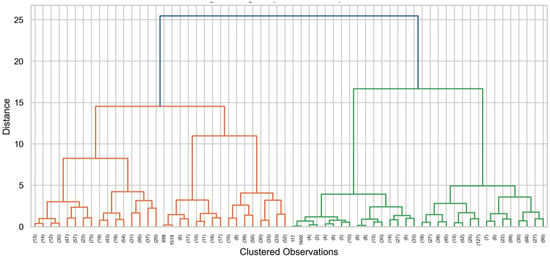
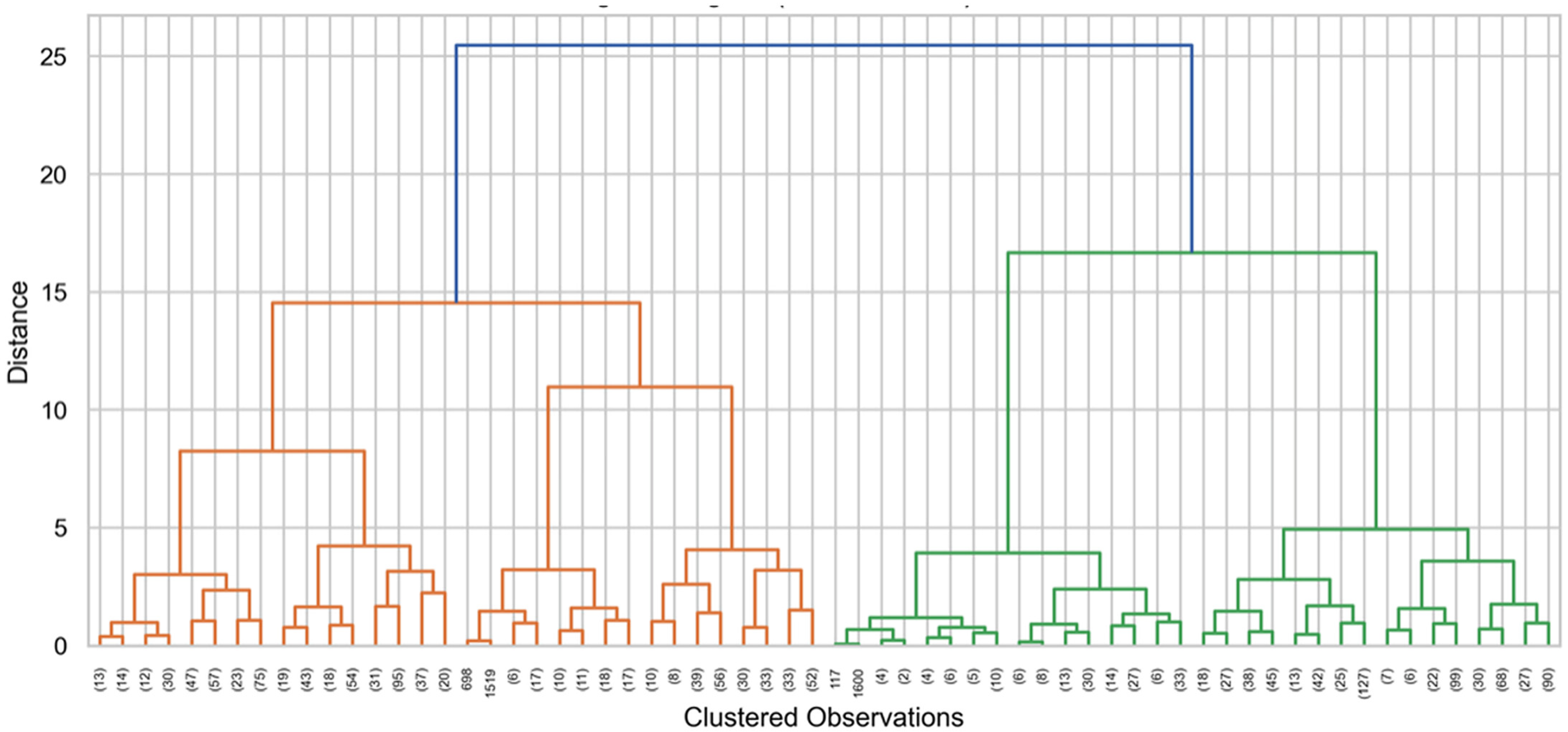
The classification was performed on the factorial coordinates obtained from the MCA, using Euclidean distance as the proximity metric. Subsequently, Ward’s method was applied, which minimises intra-cluster variance at each stage of aggregation, favouring the formation of compact and well-differentiated groups [84]. This criterion is widely recommended in recent research in the social sciences and sustainability due to its robustness in handling complex categorical structures [85,86]. The number of clusters was determined using a combined approach that integrates statistical and interpretability criteria; analysis of the dendrogram revealed a significant jump in the fusion distance when moving from four to three clusters, suggesting a substantial loss of information when reducing the solution to fewer groups, This behaviour is consistent with the literature on hierarchical clustering, where abrupt changes in inertia or distance indicate optimal partitions [87].
3.4. Supervised Validation Using Random Forest
In order to evaluate the structural consistency of the clusters identified through HCPC, a supervised Random Forest (RF) model was implemented. This procedure enabled the assessment of the predictive stability of the clusters and reduced exclusive reliance on unsupervised techniques.
The Random Forest algorithm, proposed by Leo Breiman [88], is an ensemble learning method based on constructing multiple decision trees using bootstrap samples of the data and random selection of variables at each node. This approach reduces the variance of individual models and improves generalisation capacity, and is widely used in multiclass classification contexts with complex structures [89].
In this study, the clusters obtained through HCPC were used as the target variable, while the original categorical variables constituted the set of predictors. This design enabled the evaluation of whether the identified segmentation structure could be reproduced through a supervised model, thereby providing an indirect form of internal validation.
3.5. Hyperparameter Tuning
The model was calibrated using grid search with five-fold stratified cross-validation. Different configurations of the number of trees, maximum depth, and number of variables considered at each split were explored, with the optimal combination selected based on the Macro-F1 score. This metric was chosen due to its suitability in multiclass contexts with potentially unequal group sizes, as it assigns equal weight to performance across all categories and avoids biases arising from the dominance of majority classes.
3.6. Performance Evaluation
The final performance of the model was evaluated both on an independent test set (hold-out) and through cross-validation (out-of-fold) across the entire dataset. Multiple complementary metrics were reported: accuracy, balanced accuracy, Macro-F1, and the Kappa coefficient. This combination provides a comprehensive assessment of predictive performance and reduces reliance on a single global indicator, in line with recent recommendations in ensemble-based explanatory modelling [90].
3.7. Robustness and Replicability
Dimensionality reduction using MCA enabled the structuring of the categorical space into interpretable latent dimensions, reducing redundancy and facilitating more consistent segmentation. Subsequently, supervised validation using Random Forest was implemented with systematic hyperparameter tuning. The robustness of the model was evaluated using cross-validation procedures to ensure the stability and generalisability of the results.
Multiple evaluation metrics (accuracy, balanced accuracy, Macro-F1, and the Kappa coefficient) were employed to avoid dependence on a single global indicator. The analysis of variable importance—both through impurity reduction and permutation importance—allowed the consistency between the unsupervised structure and the supervised classification to be assessed. Finally, the use of fixed seeds in stochastic algorithms ensures computational replicability, reinforcing the transparency and traceability of the analytical process.
4. Results
4.1. Factor Structure of the Informational Space
Multiple Correspondence Analysis identified a stable two-dimensional structure that organises informational behaviour along two principal axes. The first dimension explained 60.5% of the retained inertia, while the second dimension accounted for 39.5%, jointly capturing the entirety of the variability represented in the reduced space.
Dimension 1 revealed a gradient associated with the intensity and evaluation of institutional engagement. On the positive pole, categories were identified that correspond to higher frequencies of institutional media consumption (CF_U), favourable content evaluations (CF_E), and structured perceptions of UTV (SC_UTV). By contrast, the negative pole comprised categories associated with low consumption, limited institutional awareness, or less favourable evaluations. This configuration suggests that the primary axis differentiates levels of institutional engagement.
Dimension 2 distinguished patterns of informational digitalisation. The categories with the highest coordinates were associated with the use of digital platforms (UP_DI) and frequency of digital consumption (F_U), thereby defining an axis that differentiates profiles with a high reliance on digital media from those characterised by less digitalised informational practices.
4.2. Identification of Profiles Using HCPC
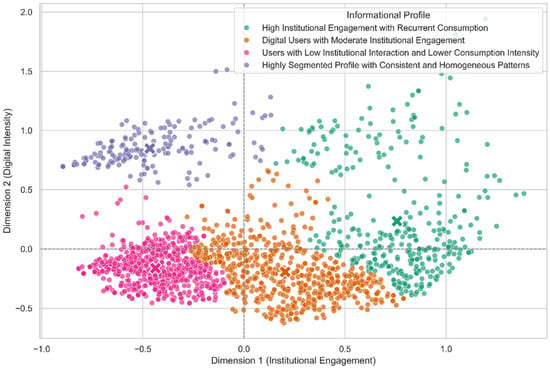
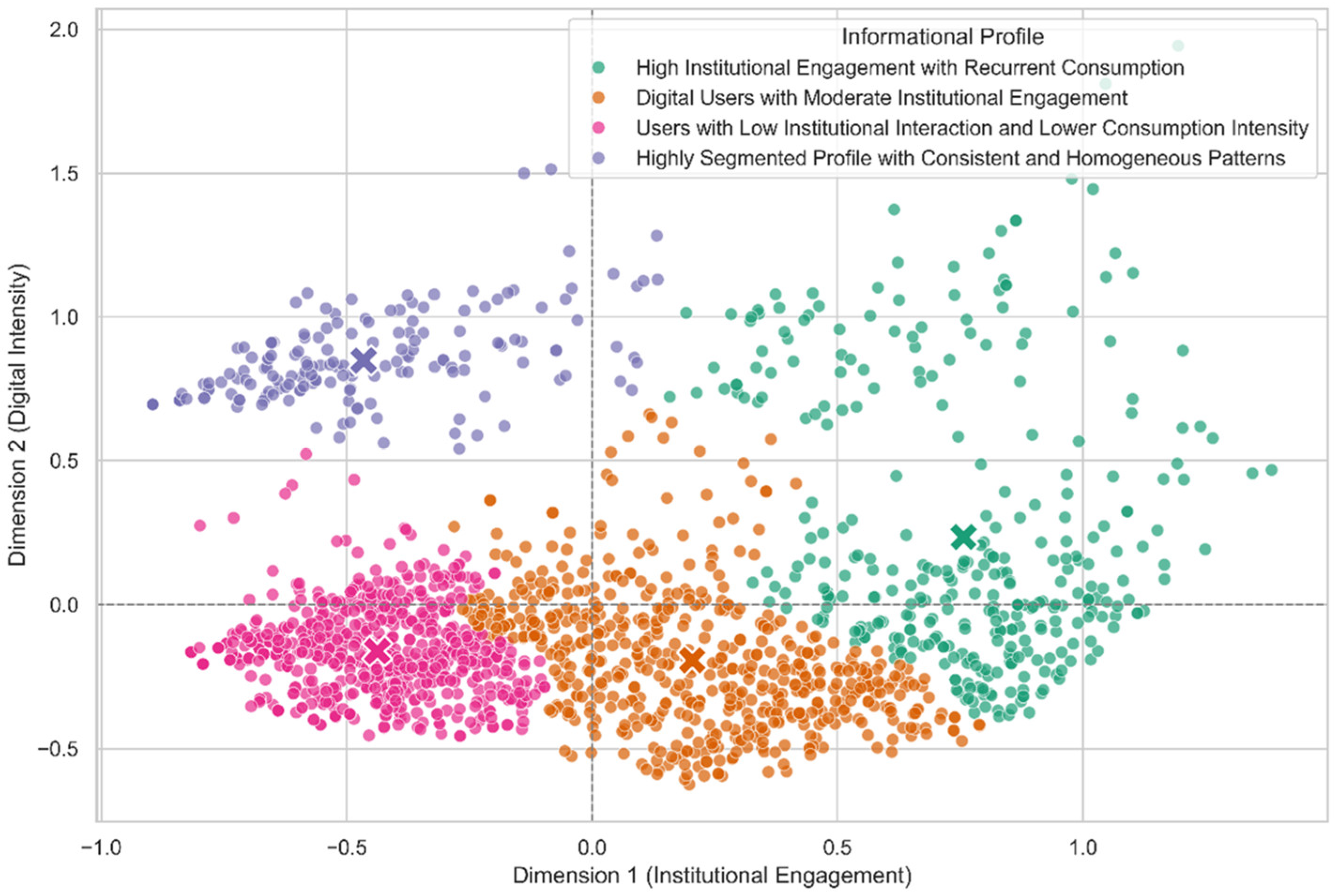
The application of the HCPC procedure on the factorial coordinates enabled the identification of four distinct clusters (Figure 1 and Figure 2, Table 3).
Figure 1.
Dendrogram using Ward’s method based on MCA dimensions.
Figure 2.
Informational Profiles in the MCA Space.
Table 3.
Final distribution of HCPC observations.
The analysis of standardised residuals allowed each group to be characterised based on significantly overrepresented categories (|z| ≥ 2). The identified profiles can be summarised as follows:
The profiles reflecting differentiated combinations of institutional digitalisation, consistent with the previously identified factorial structure, are presented below:
- Cluster 1: High institutional engagement with recurrent consumption
This profile is characterised by a high frequency of institutional media consumption (CF_U), favourable content evaluations (CF_E), and structured perceptions of UTV (SC_UTV). Individuals in this group exhibit a consolidated relationship with the institutional ecosystem, combining frequent interaction with positive evaluation. From a structural perspective, this cluster is located at the positive pole of the institutional intensity axis, indicating a high level of engagement. This pattern reflects not only consumption but also a consistent process of recognition and favourable evaluation.
- Cluster 2: Digital users with moderate institutional engagement
This group combines active use of digital platforms (UP_DI) and a medium-to-high frequency of digital consumption (F_U) with moderate institutional engagement. Individuals within this profile primarily access information through digital channels; however, their relationship with UTV and UTN does not reach the levels observed in Cluster 1. This represents a digital-first profile characterised by functional rather than identity-based institutional interaction. Digitalisation does not imply disengagement; rather, it reflects a less intense and more instrumental relationship with the institutional environment.
- Cluster 3: Digital users with a weak institutional connection
This profile corresponds to users who prioritise digital environments for obtaining information but do not develop a meaningful relationship with institutional media. This behaviour is characterised by frequent use of digital platforms as the primary means of accessing information (UP_DI), accompanied by moderate to high levels of digital consumption (F_U); however, this pattern does not translate into a strong institutional connection, as low levels of UTV content consumption are observed (CF_U). This demonstrates that digitalisation does not necessarily imply a strengthening of the institutional connection, but can coexist with consumption patterns that are disconnected from it.
- Cluster 4: Users with low levels of institutional engagement and lower consumption intensity
This group comprises categories associated with lower consumption frequency, lower institutional evaluation, and reduced interaction intensity. It is located at the negative pole of the institutional engagement axis, indicating a pattern of low integration within the analysed media ecosystem. This profile does not necessarily imply the absence of digital consumption, but rather lower intensity and weaker structuring of institutional engagement, resulting in limited interaction and lower levels of involvement.
4.3. Predictive Validation of Clusters
The Random Forest model demonstrated robust performance in both cross-validation and independent test sets. This algorithm was selected due to its capacity to model non-linear relationships and capture complex interactions among categorical variables, while reducing the risk of overfitting through bootstrap aggregation. These characteristics are well documented in multiclass classification applications within the social sciences and sustainability research [74,91].
Hyperparameter optimisation was conducted using GridSearchCV with five-fold stratified cross-validation, employing Macro-F1 as the target metric. This metric is particularly appropriate in multiclass problems with unequal group sizes, where accuracy may overestimate performance in majority classes [92]. The optimal model selected 300 trees (n_estimators = 300), max_features = sqrt, and unrestricted depth (max_depth = None), a configuration that demonstrated convergence in performance and adequate generalisation capacity.
The Random Forest model demonstrated robust performance in both the independent test set and cross-validation (Table 4). In the hold-out set, the model achieved an accuracy of 0.92, a balanced accuracy of 0.93, and a Macro-F1 score of 0.93, with a Cohen’s kappa of 0.89, indicating a high level of agreement beyond chance. These results suggest that the segmentation exhibits clear discriminative boundaries in the space of the original variables.
Table 4.
Performance of the Random Forest model.
Out-of-fold cross-validation results confirmed the stability of the model (accuracy = 0.93; Macro-F1 score = 0.94; Cohen’s kappa = 0.90), demonstrating consistency between training and generalisation. The small difference between cross-validation performance and performance on the independent test set indicates the absence of significant overfitting.
The analysis of variable importance revealed that the use of digital platforms (UP_DI), frequency of digital consumption (F_U), institutional perception (ER_UTN), and content evaluation (SC_UTV) constitute the main discriminative factors between profiles. These variables align with the structural dimensions identified through MCA, reinforcing the internal coherence of the model.
The representative tree of the ensemble model showed that variables related to institutional media consumption frequency (CF_U) and perceptions of UTV (SC_UTV) appear in early splitting nodes, highlighting their structural role in cluster differentiation. Taken together, these results confirm that the segmentation is not only statistically stable but also structurally interpretable.
5. Discussion
5.1. Digitalisation and Intensity of Institutional Engagement
The results indicate that the differentiation between informational profiles does not depend solely on patterns of digitalisation, but rather on the interaction between the use of digital platforms and the level of institutional engagement. In this regard, variables such as the use of digital media (UP_DI) and the frequency of digital consumption (F_U) emerge as key structural factors shaping informational behaviour, thereby supporting hypothesis H1. Furthermore, the findings suggest that digitalisation can coexist with different levels of institutional media evaluation and consumption, giving rise to hybrid informational profiles rather than dichotomous configurations between digital and institutional media. This provides empirical support for hypothesis H2.
This finding is particularly relevant in the context of university communication sustainability, as it challenges the traditional narrative that positions digital media in opposition to academic institutions. Rather than a linear shift towards digital environments, the data reveal a reconfiguration of the informational relationship, where the intensity of institutional engagement depends both on consumption experience and on perceptions of quality and trust in content.
5.2. Theoretical Implications: Hybrid Digitalisation and Institutional Sustainability
The results provide empirical evidence for contemporary discussions on digital transformation in educational organisations, particularly in contexts where institutional sustainability increasingly depends on the strategic management of communication. Recent studies suggest that digitalisation should not be interpreted as a process of substitution between traditional and digital channels, but rather as an ecosystemic reconfiguration of the informational environment [70]. Consistent with this perspective, the findings show that intensive use of digital platforms can coexist with varying levels of institutional evaluation, giving rise to hybrid consumption profiles that challenge the dichotomous logic of “digital vs. institutional”.
The evidence supports approaches that conceptualise organisational communication as a central component of sustainability and institutional legitimacy [93]. The differentiation of profiles based on consumption frequency, institutional perception, and content evaluation suggests that communicational sustainability does not depend exclusively on technological adoption, but rather on the construction of trust and symbolic capital in complex digital environments [94].
Beyond access to technological infrastructure, the differentiation between informational profiles is explained by patterns of use, levels of media exposure, and forms of interaction with institutional content. This contributes to understanding the multidimensional nature of the digital divide and supports hypothesis H5. In this sense, the digital divide should be interpreted as a structural inequality within the informational ecosystem, where differences in media literacy, consumption habits, and institutional trust directly influence individuals’ ability to participate in contemporary informational processes.
5.3. Hybrid Configurations and Tensions in Institutional Consumption
The structural analysis of the ensemble model suggests that the differentiation between profiles does not depend on isolated variables, but rather on coherent combinations of digitalisation and institutional evaluation. This configurational logic aligns with recent approaches that conceptualise digital transformation as a systemic and multidimensional process, in which technology, organisational culture, and perceived value interact dynamically [70]. High levels of digital engagement do not necessarily imply institutional displacement; rather, they reflect a reconfiguration of the informational relationship, consistent with studies highlighting the hybrid nature of contemporary media ecosystems [95].
Empirical evidence shows that individuals do not operate exclusively within traditional or digital media environments, but instead combine different informational channels according to their consumption habits, interests, and levels of institutional trust. This behaviour supports hypothesis H4, which posits that informational profiles within local media ecosystems are characterised by hybrid consumption configurations. In this context, the local media ecosystem can be understood as a dynamic space in which traditional media, digital platforms, and institutional media converge, generating complex patterns of interaction that cannot be explained solely through a logic of technological substitution.
5.4. Structural Hierarchy of the Ensemble Model
The aggregate analysis of the Random Forest model (Table 5) confirms the existence of a hierarchical structure in profile differentiation. Permutation importance metrics identify the use of digital platforms (UP_DI) and the frequency of digital consumption (F_U) as the primary discriminative factors. However, variables associated with institutional evaluation—such as perceptions of UTV (SC_UTV), institutional evaluation (ER_UTN), and frequency of institutional media consumption (CF_U)—appear immediately afterwards in terms of predictive relevance.
Table 5.
Structural hierarchy of variables in the ensemble model.
The methodology of this study was designed to identify distinct profiles of news consumption and institutional engagement based on patterns observed in the data, using a combination of dimensionality reduction, hierarchical clustering and predictive validation; therefore the cross-sectional and self-reported nature of the data is consistent with the analytical purpose of the study, which does not seek to estimate causal effects, but rather to describe, segment and validate empirical patterns of behaviour and perception.
The convergence between permutation importance and impurity reduction (MDI), together with the frequency of use in forest nodes, reveals a hierarchical structure of differentiation. At the first level, the model separates profiles according to digital intensity; at the second level, it segments them based on institutional engagement; and at subsequent levels, it refines the classification using specific content-related variables. This hierarchy confirms that digitalisation acts as the primary axis, while the consolidation of profiles depends on the interaction between digital behaviour and institutional capital.
The early appearance of variables associated with institutional perception and university media consumption within the model structure indicates that greater exposure to these media is linked to more favourable evaluations of academic management and communicational content. This provides empirical support for hypothesis H3 by evidencing the relationship between institutional media consumption and content evaluation. This finding emphasises that the construction of institutional trust is closely associated with the frequency of media interaction, reinforcing the role of university media as key actors within the territorial informational ecosystem.
Finally, the strong performance of the machine learning model provides evidence in support of hypothesis H6, demonstrating that variables related to digitalisation and institutional media consumption exhibit high predictive capacity for classifying differentiated informational profiles. The consistency between unsupervised segmentation and the results of the supervised model suggests that the identified patterns reflect underlying structures of informational behaviour within the analysed media ecosystem. This finding highlights the potential of machine learning as an analytical tool for understanding complex communication dynamics in information sustainability research.
6. Limitations and Future Research Directions
The analysis is confined to a specific geographical context—the province of Imbabura in Ecuador—which limits the generalisability of the findings to other territorial settings with different socio-economic, cultural, or media characteristics. Similarly, the study is based on cross-sectional data, which restricts the ability to observe changes over time in media consumption patterns and in the relationship between digitalisation and institutional engagement.
Although the sample size enables the identification of robust segmentation patterns, the data rely on participants’ self-reported perceptions, which may be influenced by recall bias or social desirability bias. Furthermore, the analytical model focuses primarily on variables related to media consumption and institutional perception; therefore, other potentially relevant factors—such as digital skills, cultural capital, or levels of media literacy—were not explicitly incorporated into the analysis.
From a methodological perspective, while the combined use of multivariate analysis and machine learning techniques allowed for the identification of complex structures in informational behaviour, the study focused on a specific set of algorithms and variables. This opens avenues for exploring additional analytical approaches that may provide deeper insights into these phenomena. In this regard, future research could incorporate more advanced machine learning models or explainable techniques to examine in greater detail the causal relationships between digitalisation, institutional trust, and information sustainability.
Finally, future research could extend the scope of the study through longitudinal designs that enable the analysis of the evolution of informational profiles over time, as well as interregional or international comparisons that contribute to understanding how media ecosystems vary across different territorial contexts.
7. Conclusions
The findings confirm that information sustainability in local media ecosystems does not depend solely on access to digital technologies, but also on how individuals integrate into the informational system through different patterns of media consumption and levels of institutional engagement. The identification of differentiated audience profiles demonstrates that the digital divide is a multidimensional phenomenon that extends beyond the availability of technological infrastructure, as it also involves usage practices, levels of informational exposure, and degrees of institutional trust. In this sense, the results indicate that digitalisation acts as a structuring axis of informational behaviour, while the consolidation of profiles depends on the interaction between media consumption, institutional evaluation, and forms of participation within the communication ecosystem.
From a theoretical perspective, this research contributes to the field of social sustainability by proposing information sustainability as a structural dimension of territorial development within local media ecosystems. This approach broadens the understanding of the digital divide by integrating variables related to media consumption, institutional perception, and the interaction between traditional, digital, and institutional media. Moreover, the study contributes to the literature on media ecosystems by demonstrating that informational patterns are shaped by hybrid consumption dynamics, in which digitalisation does not fully replace traditional or institutional media, but rather interacts with them within an interdependent informational system. This perspective is particularly relevant in Latin American contexts, where studies on information sustainability and audience segmentation remain limited.
From a methodological standpoint, the study demonstrates the potential of integrating multivariate segmentation techniques with machine learning models to analyse complex communication phenomena. The combination of Multiple Correspondence Analysis, hierarchical clustering, and Random Forest models enabled the identification of latent structures in informational behaviour and the validation of the stability of the identified profiles. This methodological approach expands the analytical tools available for studying institutional communication and information sustainability by providing greater explanatory capacity to examine non-linear interactions between variables related to digitalisation, media consumption, and institutional trust.
From a practical and public policy perspective, the findings suggest that strategies aimed at reducing the digital divide must go beyond the expansion of technological infrastructure. In particular, universities, local governments, and regional media should implement media and digital literacy policies that strengthen audiences’ critical capacities to engage with contemporary informational ecosystems. Furthermore, university media can play a strategic role in promoting information sustainability by developing accessible content, multi-platform formats, and segmented communication strategies that respond to the different consumption profiles identified.
In addition, it is recommended that public and educational institutions promote data-driven institutional communication programmes that enable a more precise understanding of audience informational dynamics. This includes the use of advanced analytical tools to monitor media consumption patterns, design differentiated territorial communication strategies, and enhance informational transparency. Similarly, strengthening partnerships between universities, local media, and community organisations could contribute to the creation of more inclusive informational environments, fostering citizen participation and equitable access to reliable information.
Overall, this study demonstrates that information sustainability is a key component of social sustainability within territories, as it directly influences how individuals access, interpret, and use information in their daily lives. Understanding differentiated configurations of media consumption enables the design of more inclusive and effective communication strategies aimed at strengthening institutional trust and reducing informational inequalities. In this regard, the integration of machine learning-based analytical approaches opens new opportunities for the development of evidence-based public policies and institutional strategies capable of promoting more sustainable, participatory, and socially integrated media ecosystems.
Author Contributions
Conceptualization, L.S.-E. and J.P.-P.; methodology, D.C.-T., L.S.-E. and J.P.-P.; software, D.C.-T.; validation, D.C.-T. and L.S.-E.; formal analysis, D.C.-T. and L.S.-E.; investigation, L.S.-E.; J.P.-P. and D.C.-T.; resources, L.S.-E. and D.C.-T.; data curation, D.C.-T. and L.S.-E.; writing—original draft preparation, L.S.-E.; J.P.-P. and D.C.-T.; writing—review and editing, L.S.-E. and J.P.-P.; visualization, D.C.-T.; supervision, L.S.-E. and J.P.-P.; project administration, L.S.-E. and J.P.-P. All authors have read and agreed to the published version of the manuscript.
Funding
The APC was financed by the Universidad Técnica del Norte. Code: InvestigaUTN-2025-1499.
Institutional Review Board Statement
Ethical review and approval were waived for this study due to that the research reported in our manuscript is based on a non-interventional, observational study using an anonymous structured survey conducted in the province of Imbabura, Ecuador. The study did not involve any form of experimental intervention, nor did it collect personal identifiers, sensitive information, biological data, or health-related data.
Informed Consent Statement
Informed consent was obtained from all subjects involved in the study.
Data Availability Statement
The research instrument for this study is available at https://doi.org/10.17605/OSF.IO/JDK7U.
Acknowledgments
The authors express their gratitude for the support received from Universidad Técnica del Norte. Generative AI tools (ChatGPT-5.4) were used exclusively to assist with language editing, grammar correction, and clarity improvements in parts of the manuscript. The AI tool was also used to support text organization and improve readability.
Conflicts of Interest
The authors state that they have no conflicts of interest. The funders had no role in the design of the study; in the collection, analyses, or interpretation of data; in the writing of the manuscript; or in the decision to publish the results.
References
- Muthu, S.S. Assessment of Social Sustainability Management in Various Industrial Sectors. In Environmental Footprints and Eco-Design of Products and Processes; Springer: Cham, Switzerland, 2025; pp. 1–4. [Google Scholar] [CrossRef] [Scilit]
- Beyer, K.; Arnold, M.G. Examining the social side of sustainability in the debate on business model innovations in the textile, clothing and fashion industry: A typology based on the value chain perspective. Int. J. Innov. Sustain. Dev. 2022, 16, 322–371. [Google Scholar] [CrossRef]
- Segovia-Martin, J.; Tamariz, M. Synchronising institutions and value systems: A model of opinion dynamics mediated by proportional representation. PLoS ONE 2021, 16, e0257525. [Google Scholar] [CrossRef] [Scilit]
- Papadopoulos, T.; Broadbent, R. Reducing the digital divide: An evaluation framework for the wired community@Collingwood project. In Creating Global Economies Through Innovation and Knowledge Management: Theory & Practice; International Business Information Management Association: Madrid, Spain, 2009; pp. 701–709. [Google Scholar]
- Etim, A.S. Adoption and Use of Technology Tools and Services by Economically Disadvantaged Communities: Implications for Growth and Sustainability. In Digital Inclusion and Economic Development; IGI Global: Hershey, PA, USA, 2023; p. 383. [Google Scholar] [CrossRef] [Scilit]
- Cerrillo Vidal, J.A.; Beluschi-Fabeni, G. Resistances, difficulties and fears: An approach to understanding the causes of persistent digital divides. Eur. Public Soc. Innov. Rev. 2024, 9, 1–20. [Google Scholar] [CrossRef] [Scilit]
- García Zare, E.J.; Soto Abanto, S.E.; Rodríguez Paredes, N.P.; Merino Salazar, T.D.R.; Pagador Flores, S.E.; Baldárrago Baldárrago, J.L.; Salas-Ruiz, J.A.; Mejía Pardo, P.I. Technological Devices and Digital Competences: A Look into the Digital Divides for University Continuity during the COVID-19 Pandemic. Sustainability 2023, 15, 8494. [Google Scholar] [CrossRef] [Scilit]
- Khlouf, M.M.M.; Azmoty, M.N. From FM to TikTok: A mixed-methods study of platform gaps, content misalignment, and rural–urban divides in Jordanian university radio engagement. Front. Commun. 2025, 10, 1678387. [Google Scholar] [CrossRef] [Scilit]
- Suing, A.; Suárez-Villegas, J. Perfil, incidencia y perspectivas de la desinformación entre los ecuatorianos. J. Media 2024, 5, 993–1006. [Google Scholar] [CrossRef] [Scilit]
- Villamar, I.; Granda, L.; Viejó, J.; Cobos, J. Analysis of the Impact of Information Behavior on the Marketing and Fertilization Strategies of Small Cocoa Producers in the Provinces of Guayas and Los Ríos in Ecuador. Agriculture 2025, 15, 858. [Google Scholar] [CrossRef] [Scilit]
- Luzuriaga-Amador, M.; Novillo-Luzuriaga, N.; Guevara-Viejó, F.; Valenzuela-Cobos, J. Evaluation of information competencies in fertilization and commercialization strategies of small banana producers in Ecuador. Sustainability 2025, 17, 868. [Google Scholar] [CrossRef] [Scilit]
- Caviedes, Y.; López, L.; Prieto, A. Las redes sociales como escenario en el que se construyen los imaginarios políticos de los jóvenes: Caso Ecuador. Signo Pensam. 2025, 44, 3. [Google Scholar] [CrossRef] [Scilit]
- Capriotti, P.; Losada-Díaz, J.; Martínez-Gras, R. Evaluating the content strategy developed by universities on social media. Prof. Inf. 2023, 32, e320210. [Google Scholar] [CrossRef] [Scilit]
- Capriotti, P.; Zeler, I. Análisis de la comunicación efectiva en redes sociales en instituciones de educación superior. Humanit. Soc. Sci. Commun. 2023, 10, 656. [Google Scholar] [CrossRef] [Scilit]
- Galioto, M.; Pedone, F.; Vantarakis, A.; Tavares, P.; Bianco, A. The use of social media in university institutional communication: A prospective model to strengthen students’ sense of belonging. Front. Commun. 2025, 10, 1523295. [Google Scholar] [CrossRef] [Scilit]
- Castillo, L.; Alarcón-Llontop, L.R. Plan de comunicación basado en tecnologías de la información y la comunicación para la cultura organizacional universitaria peruana. Edelweiss Appl. Sci. Technol. 2025, 9, 2717–2731. [Google Scholar] [CrossRef] [Scilit]
- Nishan, A.; Hossain, M.; Haque, M.; Ankhi, R.; Hosen, A. The intersection of macroeconomic narratives and public trust. Cogniz. J. Multidiscip. Stud. 2025, 5, 11–38. [Google Scholar] [CrossRef] [Scilit]
- Guo, S.; Wang, D.; Shen, C. The gap between expectations and evaluation: Audience interaction with news and perceptions of media performance and credibility. Glob. Media China 2024, 11, 24–41. [Google Scholar] [CrossRef] [Scilit]
- Al-Mshashaqbeh, Y. Modeling Jordanian audience engagement and news credibility in the digital media era: A PLS-SEM approach. Front. Commun. 2025, 10, 1675693. [Google Scholar] [CrossRef] [Scilit]
- Choi, Y.; Lee, C. Profiling AI speaker users: Machine learning insights into consumer adoption patterns. PLoS ONE 2024, 19, e0315540. [Google Scholar] [CrossRef] [Scilit] [PubMed]
- Zeybek, S.; Kaçaman, M. User interest classification on social networks using machine learning and deep learning. Ömer Halisdemir Univ. J. Eng. Sci. 2025, 14, 4. [Google Scholar] [CrossRef] [Scilit]
- Ali, A.; Raza, A.; Sayed, M.; Qureshi, B.; Memon, Y. Data-driven machine learning approaches for Netflix content analysis and visualization. J. Eng. Res. Rep. 2025, 27, 278–290. [Google Scholar] [CrossRef] [Scilit]
- Fayq, K.; Tkatek, S.; Idouglid, L. Enhancing TV program success prediction using machine learning by integrating people meter audience metrics with digital engagement metrics. Indones. J. Electr. Eng. Comput. Sci. 2025, 39, 353–363. [Google Scholar] [CrossRef] [Scilit]
- Cruz, J. Modelos predictivos basados en aprendizaje automático para el análisis del comportamiento digital. Datos Metadatos 2025, 4, 944. [Google Scholar] [CrossRef] [Scilit]
- Hall, T.D. Information Redlining: The urgency to close the digital access and literacy divide and the role of libraries as lead interveners. J. Libr. Adm. 2021, 61, 484–492. [Google Scholar] [CrossRef] [Scilit]
- Rydzewski, P. Digital inequality and sustainable development. Probl. Ekorozw. 2025, 20, 96–108. [Google Scholar] [CrossRef] [Scilit]
- Aalberg, T.; Curran, J. How media inform democracy: Central debates. In How Media Inform Democracy: A Comparative Approach; Routledge: London, UK, 2012; pp. 3–14. [Google Scholar]
- Elenbaas, M.; de Vreese, C.; Schuck, A.; Boomgaarden, H. Reconciling passive and motivated learning: The saturation-conditional impact of media coverage and motivation on political information. Commun. Res. 2014, 41, 481–504. [Google Scholar] [CrossRef] [Scilit]
- Perry, H.B. Is access enough? Interrogating the influence of money and power in shaping information. Open Inf. Sci. 2020, 4, 29–38. [Google Scholar] [CrossRef] [Scilit]
- Erek, K.; Schmidt, N.H.; Zarnekow, R.; Kolbe, L.M. Management instruments for sustainable information systems management. In Green Technologies: Concepts, Methodologies, Tools and Applications; IGI Global: Hershey, PA, USA, 2011; pp. 1448–1465. [Google Scholar]
- Ștefana-Cătălina, P.-D.; Ionuț-Viorel, H.; Marius, P.; Petronela, L.R. Enhanced model for evaluating the information systems success from the sustainability management perspective. In Green Intelligence: Carbon Footprint Assessment in Digital Economy; CRC Press: Boca Raton, FL, USA, 2025; pp. 57–73. [Google Scholar] [CrossRef] [Scilit]
- Erek, K. From green IT to sustainable information systems management: Managing and measuring sustainability in IT organizations. In Proceedings of the Americas Conference on Information Systems (AMCIS), Detroit, MI, USA, 4–8 August 2011; Association for Information Systems: Atlanta, GA, USA, 2011; pp. 766–781. [Google Scholar]
- Selvakumar, P. The role of technology in enhancing social sustainability. In Enhancing Social Sustainability in Manufacturing Supply Chains; IGI Global: Hershey, PA, USA, 2025; pp. 275–302. [Google Scholar] [CrossRef] [Scilit]
- Unwin, T.; de Bastion, G. Digital divide. In International Encyclopedia of Human Geography; Elsevier: Oxford, UK, 2009; pp. 191–197. [Google Scholar] [CrossRef] [Scilit]
- Hilbert, M. Digital divide(s). In The International Encyclopedia of Digital Communication and Society; Wiley: Hoboken, NJ, USA, 2015; pp. 1–7. [Google Scholar] [CrossRef] [Scilit]
- Huang, T.; Quan, Y. Narrowing the digital divide: The growth and distributional effect of internet use on income in rural China. China Econ. Rev. 2025, 91, 102387. [Google Scholar] [CrossRef] [Scilit]
- Hwang, Y.; Park, N. Digital divide in social networking sites. Int. J. Mob. Commun. 2013, 11, 446–464. [Google Scholar] [CrossRef] [Scilit]
- Friemel, T.N. The digital divide has grown old: Determinants of a digital divide among seniors. New Media Soc. 2016, 18, 313–331. [Google Scholar] [CrossRef] [Scilit]
- Huang, M.; Ye, Y. “A matter of life and death”: Mitigating the gray digital divide in using health information technologies in the post-pandemic era. Health Commun. 2025, 40, 620–630. [Google Scholar] [CrossRef] [Scilit]
- Fuchs, C.; Horak, E. Africa and the digital divide. Telemat. Inform. 2008, 25, 99–116. [Google Scholar] [CrossRef] [Scilit]
- Ruohonen, J.; Tuikka, A.-M. Digital divides and online media. In 2021 5th International Conference on E-Society, E-Education and E-Technology, Taipei, Taiwan, 21–23 August 2021; Association for Computing Machinery: New York, NY, USA, 2021; pp. 157–163. [Google Scholar] [CrossRef] [Scilit]
- Dubey, P.; Dubey, P.; Sahu, K.K. Bridging the gap: Unveiling the impact of COVID-19 and social media on the digital divide. In Psychology and Intricacies in Social Media Interactions: A Critical Perspective; Routledge: London, UK, 2025; pp. 193–206. [Google Scholar] [CrossRef] [Scilit]
- Otokiti, A.; Williams, K.S.; Warsame, L. Impact of digital divide on the adoption of online patient portals for self-motivated patients. Healthc. Inform. Res. 2020, 26, 220–228. [Google Scholar] [CrossRef] [Scilit]
- Wei, L.; Hindman, D.B. Does the digital divide matter more? Comparing the effects of new media and old media use on the education-based knowledge gap. Mass Commun. Soc. 2011, 14, 216–235. [Google Scholar] [CrossRef] [Scilit]
- Abdelfattah, B.M. Individual-multinational study of internet use: The digital divide explained by displacement hypothesis and knowledge-gap hypothesis. World Appl. Sci. J. 2012, 5, 3649–3657. [Google Scholar]
- Netto, V.M.; Vargas, J.C.; Saboya, R.T. The social effects of architecture: Built form and social sustainability. In Urban Social Sustainability: Theory, Policy and Practice; Routledge: London, UK, 2019; pp. 125–148. [Google Scholar] [CrossRef] [Scilit]
- Brown, M.; Marmarà, V. ‘Media-ted’ electoral campaigns: Europeanisation and postcolonial dynamics of voters’ use of media platforms in Malta. Postcolonial Dir. Educ. 2022, 11, 42–78. [Google Scholar]
- Weston, M.; Vogler, D.; Jürgens, P.; Rauchfleisch, A.; Eisenegger, M. Tracking the roots of low news usage on smartphones: Do individual interests, political attitudes, and media consumption habits affect the mobile news use of young adults? J. Broadcast. Electron. Media 2025, 69, 529–548. [Google Scholar] [CrossRef] [Scilit]
- Wang, H.; Cai, T. Media exposure and Chinese college students’ attitudes toward China’s maritime claims and disputes in the South and East China Seas. Cogent Soc. Sci. 2018, 4, 1482995. [Google Scholar] [CrossRef] [Scilit]
- Li, T.; Zhu, H. Effect of the media on the opinion dynamics in online social networks. Physica A 2020, 551, 124117. [Google Scholar] [CrossRef] [Scilit]
- Out, C.; Tu, S.; Neumann, S.; Zehmakan, A.N. The impact of external sources on the Friedkin-Johnsen model. In Proceedings of the CIKM ’24: Proceedings of the 33rd ACM International Conference on Information and Knowledge Management, Boise, ID, USA, 21–25 Ocotober 2024; Association for Computing Machinery: New York, NY, USA, 2024; pp. 1815–1824. [Google Scholar] [CrossRef] [Scilit]
- Stehr, P.; Rössler, P.; Leissner, L.; Schönhardt, F. Parasocial opinion leadership: Media personalities’ influence within parasocial relations. Int. J. Commun. 2015, 9, 982–1001. [Google Scholar]
- Asher, D.E.; Caylor, J.P.; Neigel, A.R. Effects of social media involvement, context, and data-type on opinion formation. In Proceedings of the 2018 International Workshop on Social Sensing (SocialSens), Orlando, FL, USA, 17 April 2018; IEEE: New York, NY, USA, 2018; pp. 32–37. [Google Scholar] [CrossRef] [Scilit]
- Johnson, T.; Kellstedt, P.M. Media consumption and the dynamics of policy mood. Polit. Behav. 2014, 36, 377–399. [Google Scholar] [CrossRef] [Scilit]
- Mulyani, M.; Octavia, J.R. Educational board game design based on local wisdom for youth to support social sustainability learning. IOP Conf. Ser. Earth Environ. Sci. 2023, 1256, 012006. [Google Scholar] [CrossRef] [Scilit]
- Wolff, L.-A.; Ehrström, P. Social sustainability and transformation in higher educational settings: A utopia or possibility? Sustainability 2020, 12, 4176. [Google Scholar] [CrossRef] [Scilit]
- Ispir, B. Interactive media steer in educational television programs. In Digital Multimedia: Concepts, Methodologies, Tools, and Applications; IGI Global: Hershey, PA, USA, 2017; pp. 1111–1122. [Google Scholar] [CrossRef] [Scilit]
- Gori, E.; Romolini, A.; Fissi, S.; Contri, M. Toward the dissemination of sustainability issues through social media in the higher education sector: Evidence from an Italian case. Sustainability 2020, 12, 4658. [Google Scholar] [CrossRef] [Scilit]
- Atakan, S.; İşcioğlu, T.E. Sustainability practices of higher education institutions—An analysis from a developing country. In Accounting, Finance, Sustainability, Governance and Fraud; Springer: Singapore, 2019; pp. 215–235. [Google Scholar] [CrossRef] [Scilit]
- Sart, G. Sustainable campus design in universities. In Considerations on Education for Economic, Social, and Environmental Sustainability; IGI Global: Hershey, PA, USA, 2023; pp. 121–135. [Google Scholar] [CrossRef] [Scilit]
- Nicolino, G.; Barros, S. Introducing the graphical assessment of universities’ sustainability image (GAUSI) instrument: A marketing tool. In World Sustainability Series; Springer: Cham, Switzerland, 2016; pp. 193–212. [Google Scholar] [CrossRef] [Scilit]
- Carretón-Ballester, C.; Quiles-Soler, C.; Lorenzo-Solá, F. Social responsibility of Spanish universities for sustainable relationships. Prof. Inf. 2023, 32, e320602. [Google Scholar] [CrossRef] [Scilit]
- Shriberg, M. Is the “maize-and-blue” turning green? Sustainability at the University of Michigan. Int. J. Sustain. High. Educ. 2003, 4, 263–276. [Google Scholar] [CrossRef] [Scilit]
- Unz, D.C. Exposure to news. In The International Encyclopedia of Communication; Wiley: Malden, MA, USA, 2008. [Google Scholar] [CrossRef] [Scilit]
- Sobkowicz, P.; Kaschesky, M.; Bouchard, G. Opinion mining in social media: Modeling, simulating, and forecasting political opinions in the web. Gov. Inf. Q. 2012, 29, 470–479. [Google Scholar] [CrossRef] [Scilit]
- McLuhan, M. Understanding Media: The Extensions of Man; McGraw-Hill: New York, NY, USA, 1964. [Google Scholar]
- Postman, N. Teaching as a Conserving Activity; Delta: New York, NY, USA, 1979. [Google Scholar]
- Napoli, P. Exposure diversity reconsidered. J. Inf. Policy 2011, 1, 246–259. [Google Scholar] [CrossRef] [Scilit]
- Nambisan, S.; Zahra, S.A.; Luo, Y. Global platforms and ecosystems: Implications for international business theories. J. Int. Bus. Stud. 2019, 50, 1464–1486. [Google Scholar] [CrossRef] [Scilit]
- Verhoef, P.C.; Broekhuizen, T.; Bart, Y.; Bhattacharya, A.; Dong, J.Q.; Fabian, N.; Haenlein, M. Digital transformation: A multidisciplinary reflection and research agenda. J. Bus. Res. 2021, 122, 889–901. [Google Scholar] [CrossRef] [Scilit]
- Atkinson, W. Charting fields and spaces quantitatively: From multiple correspondence analysis to categorical principal components analysis. Qual. Quant. 2024, 58, 829–848. [Google Scholar] [CrossRef] [Scilit]
- Matta, E.; Stalidis, G. Profiling online and physical supermarket customers using factor and clustering methods. Smart Innov. Syst. Technol. 2024, 386, 227–243. [Google Scholar] [CrossRef] [Scilit]
- Saráuz-Estevez, L.; Pupiales-Proaño, J.; Cuaical-Tapia, D. Key factors in the sustainable growth of MSMEs in Ibero-America: An empirical study based on machine learning. Sustainability 2026, 18, 1940. [Google Scholar] [CrossRef] [Scilit]
- Kumar, S.; Kaur, P.; Gosain, A. A comprehensive survey on ensemble methods. In Proceedings of the 2022 IEEE 7th International conference for Convergence in Technology (I2CT), Mumbai, India, 7–9 April 2022. [Google Scholar] [CrossRef] [Scilit]
- Wedel, M.; Kannan, P.K. Marketing Analytics for Data-Rich Environments. J. Mark. 2016, 80, 97–121. [Google Scholar] [CrossRef] [Scilit]
- Broeksema, B.; Telea, A.C.; Baudel, T. Visual analysis of multi-dimensional categorical data sets. Comput. Graph. Forum 2013, 32, 158–169. [Google Scholar] [CrossRef] [Scilit]
- Khangar, N.V.; Kamalja, K.K. Multiple correspondence analysis and its applications. Electron. J. Appl. Stat. Anal. 2017, 10, 432–462. [Google Scholar] [CrossRef]
- D’Enza, A.I.; Markos, A. Incremental visualization of categorical data. In Advances in Statistical Models for Data Analysis; Morlini, I., Minerva, T., Vichi, M., Eds.; Springer: Cham, Switzerland, 2015; pp. 137–148. [Google Scholar] [CrossRef] [Scilit]
- Agapito, D.; Valle, P.; Mendes, J. The sensory dimension of tourist experiences: Capturing meaningful sensory-informed themes in Southwest Portugal. Tour. Manag. 2014, 42, 224–237. [Google Scholar] [CrossRef] [Scilit]
- Greenacre, M.; Groenen, P.; Hastie, T.; Iodice D’Enza, A.; Markos, A.; Tuzhilina, E. Principal component analysis. Nat. Rev. Methods Primers 2022, 2, 100. [Google Scholar] [CrossRef] [Scilit]
- Le Roux, B.; Rouanet, H. Multiple Correspondence Analysis; SAGE Publications: Thousand Oaks, CA, USA, 2010. [Google Scholar] [CrossRef] [Scilit]
- Costa, P.S.; Santos, N.C.; Cunha, P.; Cotter, J.; Sousa, N. The use of multiple correspondence analysis to explore associations between categories of qualitative variables in healthy ageing. J. Aging Res. 2013, 2013, 302163. [Google Scholar] [CrossRef] [Scilit]
- Beh, E.; Lombardo, R. Correspondence analysis using the Cressie–Read family of divergence statistics. Int. Stat. Rev. 2024, 92, 17–42. [Google Scholar] [CrossRef] [Scilit]
- Murtagh, F.; Legendre, P. Ward’s hierarchical agglomerative clustering method: Which algorithms implement Ward’s criterion? J. Classif. 2014, 31, 274–295. [Google Scholar] [CrossRef] [Scilit]
- Rani, P.; Sid Ahmed, N.; Jain, A. A decision support system for heart disease prediction based upon machine learning. J. Reliab. Intell. Environ. 2021, 7, 263–275. [Google Scholar] [CrossRef] [Scilit]
- Xu, D.; Tian, Y. A comprehensive survey of clustering algorithms. Ann. Data Sci. 2015, 2, 165–193. [Google Scholar] [CrossRef] [Scilit]
- Blanutsa, V.I. Dendrograms in Regional Socio-Economic Analysis: Interpretation and Verification. Sci. Vis. 2021, 13, 1–15. [Google Scholar] [CrossRef] [Scilit]
- Breiman, L. Random forests. Mach. Learn. 2001, 45, 5–32. [Google Scholar] [CrossRef] [Scilit]
- Probst, P.; Boulesteix, A.-L.; Wright, M.N. Hyperparameters and tuning strategies for random forest. arXiv 2018, arXiv:1804.03515. [Google Scholar] [CrossRef] [Scilit]
- Lundberg, S.M.; Erion, G.; Chen, H.; DeGrave, A.; Prutkin, J.; Nair, B.; Katz, R.; Himmelfarb, J.; Bansal, N.; Lee, S.-I. From local explanations to global understanding with explainable AI for trees. Nat. Mach. Intell. 2020, 2, 56–67. [Google Scholar] [CrossRef] [Scilit] [PubMed]
- Biau, G.; Scornet, E. A random forest guided tour. TEST 2016, 25, 197–227. [Google Scholar] [CrossRef] [Scilit]
- Chicco, D.; Jurman, G. The advantages of the Matthews correlation coefficient (MCC) over F1 score and accuracy in binary classification evaluation. BMC Genom. 2020, 21, 6. [Google Scholar] [CrossRef] [Scilit]
- Capriotti, P.; Zeler, I.; Camilleri, M.A. Corporate communication through social networks: The identification of the key dimensions for dialogic communication. In Strategic Corporate Communication in the Digital Age; Emerald Publishing: Bingley, UK, 2021; pp. 33–52. [Google Scholar] [CrossRef] [Scilit]
- Salvi, A.; Vitolla, F.; Rubino, M.; Giakoumelou, A.; Raimo, N. Online information on digitalisation processes and its impact on firm value. J. Bus. Res. 2021, 124, 437–444. [Google Scholar] [CrossRef] [Scilit]
- Nambisan, S.; Wright, M.; Feldman, M. The digital transformation of innovation and entrepreneurship: Progress, challenges and key themes. Res. Policy 2019, 48, 103773. [Google Scholar] [CrossRef] [Scilit]

Disclaimer/Publisher’s Note: The statements, opinions and data contained in all publications are solely those of the individual author(s) and contributor(s) and not of MDPI and/or the editor(s). MDPI and/or the editor(s) disclaim responsibility for any injury to people or property resulting from any ideas, methods, instructions or products referred to in the content. |
© 2026 by the authors. Licensee MDPI, Basel, Switzerland. This article is an open access article distributed under the terms and conditions of the Creative Commons Attribution (CC BY) license.