


Abstract
Against the backdrop of rising environmental pressure and increasing reliance on supply-chain-based governance, this study examines the environmental impact of China’s Green Supply Chain Management Demonstration Program. Using a panel of Chinese listed firms from 2012 to 2024, I exploit the inclusion of firms in the government-designated demonstration list as an exogenous policy shock and estimate its effects within a difference-in-differences framework. The results show that participation in the program significantly improves corporate environmental performance. Treated firms are more likely to adopt environmentally friendly practices, including renewable energy use, circular economy initiatives, and energy-saving technologies, and are more likely to receive environmental awards and other forms of positive environmental recognition. Mechanism analyses suggest that these effects operate through increased green patenting activity and enhanced environmental information disclosure quality. Heterogeneity analyses indicate that the effects are stronger for firms with higher supply chain efficiency, more limited access to external resources, and lower pre-existing green innovation, as well as for state-owned enterprises, firms located in eastern China, and those benefiting from greater government green support. Overall, the findings provide causal evidence that supply-chain-oriented environmental policies can effectively enhance corporate environmental performance in emerging economies
1. Introduction
Improving corporate environmental performance has become a central policy objective for governments seeking to reconcile economic growth with environmental sustainability. In both developed and emerging economies, firms are increasingly expected to internalize environmental externalities by adopting cleaner production processes, reducing emissions, and engaging in environmentally responsible practices [1]. A growing body of literature examines how environmental regulations, market-based instruments, and voluntary initiatives affect firms’ environmental behavior [2,3,4,5,6]. Despite this progress, relatively little is known about whether supply-chain-oriented environmental policies can effectively promote corporate environmental performance, particularly in emerging markets where institutional constraints and financing frictions remain salient.
A related and rapidly expanding literature on green supply chain management (GSCM) emphasizes the importance of incorporating environmental considerations into supply chain activities, including green procurement, cleaner production, eco-design, and reverse logistics [1,7,8]. Prior studies suggest that adopting GSCM practices can improve firms’ environmental performance and, in some cases, enhance operational efficiency and competitiveness [9,10,11]. However, most of this literature focuses on voluntary firm-level adoption of GSCM practices, survey-based evidence, or case studies, which limits causal identification [12,13,14]. Moreover, existing studies typically examine internal supply chain coordination or buyer–supplier relationships, paying less attention to the role of government-led supply chain governance in shaping firms’ environmental behavior.
From a policy perspective, supply chains represent a critical leverage point for environmental governance. Environmental impacts often extend beyond firm boundaries and are transmitted through complex production networks. As a result, policymakers have increasingly shifted attention from firm-level environmental regulation toward supply-chain-based approaches that encourage firms to internalize environmental responsibilities across upstream and downstream partners. Nevertheless, empirical evidence on whether such supply-chain-oriented policies can generate broad and measurable improvements in corporate environmental performance remains scarce, especially in emerging economies.
China provides a unique and informative setting to study this question. As the world’s largest manufacturing economy and carbon emitter, China faces substantial environmental challenges. In response, the Chinese government has actively experimented with innovative environmental governance tools that complement traditional command-and-control regulation. One prominent example is the Green Supply Chain Management Demonstration Program, which was initiated under the Guidelines for the Implementation of the Green Manufacturing Engineering Program issued by the Ministry of Industry and Information Technology (MIIT). Rather than imposing mandatory requirements, the program encourages firms to voluntarily participate in green supply chain initiatives. Firms enter the program through a multi-stage process involving self-application, recommendation by local authorities, third-party evaluation, and expert review. Selected firms are publicly designated as green supply chain management demonstration enterprises. Following inclusion, firms are expected to fulfill specific environmental and supply chain-related obligations, while also becoming eligible for policy support and preferential treatment. This institutional design combines voluntary participation with government endorsement and post-selection incentives, making the program a representative example of an incentive-based green supply chain policy. Recent studies suggest that such policies can reshape firms’ innovation incentives, supply chain relationships, and financing conditions [15,16], yet direct evidence on their environmental consequences remains limited.
This study examines whether China’s Green Supply Chain Management Demonstration Program improves corporate environmental performance. Exploiting firms’ inclusion in the government-designated demonstration list as a plausibly exogenous policy event, I employ a difference-in-differences research design using a panel of Chinese listed firms from 2012 to 2024. This empirical setting allows me to compare changes in environmental performance between participating firms and a carefully constructed control group before and after policy adoption, while controlling for time-invariant firm characteristics and common macroeconomic trends.
My baseline results show that firms included in the demonstration program experience a significant improvement in environmental performance relative to non-participating firms. Further analyses reveal that, as commonly emphasized in the GSCM literature, treated firms are more likely to adopt concrete environmental strategies such as renewable energy usage, circular economy practices, and energy-saving technologies. In addition, treated firms are more likely to receive environmental awards or other forms of positive environmental recognition, suggesting that the observed improvements are externally validated rather than merely symbolic.
I further explore the mechanisms through which the demonstration program affects environmental outcomes. The evidence indicates that participation in the program is associated with increased green patenting activity and enhanced environmental information disclosure. These channels are consistent with the theoretical mechanisms proposed in the GSCM literature, which emphasize the role of innovation incentives and information transparency in facilitating environmentally responsible supply chain practices [13,17,18,19].
In addition, I document substantial heterogeneity in the program’s environmental effects. The estimated impacts are stronger among firms with higher supply chain efficiency, more limited access to external resources, and lower pre-existing levels of green innovation. I also find that the effects are more pronounced for state-owned enterprises, firms located in China’s eastern regions, and those benefiting from greater government green support. These patterns highlight how firm characteristics and supply chain structures condition the effectiveness of green supply chain management policies.
This study contributes to the literature in several ways. First, I extend the GSCM literature by providing large-sample, causal evidence on the environmental effects of a government-led green supply chain policy, complementing prior studies that focus on firm-initiated practices. Second, by identifying supply chain finance, green innovation, and information disclosure as key mechanisms, I shed light on how green supply chain policies translate into real environmental outcomes. Third, my findings offer policy-relevant insights for emerging economies, suggesting that supply-chain-based environmental governance can serve as an effective complement to traditional environmental regulation.
The remainder of the paper is organized as follows. Section 2 provides the institutional background of China’s Green Supply Chain Management Demonstration Program. Section 3 reviews the related literature and develops the research hypotheses. Section 4 describes the research design and data. Section 5 presents the empirical results. Section 6 concludes.
2. Institutional Background
To advance the national strategy of building a manufacturing powerhouse and facilitate the transition toward an ecological civilization, China has progressively established a green manufacturing policy framework that integrates environmental objectives into industrial development. In June 2016, the State Council issued the Industrial Green Development Plan (2016–2020), formally articulating green development as a core principle of industrial transformation. Shortly thereafter, in September 2016, the MIIT released the Notice on the Construction of a Green Manufacturing System, marking the official launch of green manufacturing pilot and demonstration initiatives.
The green manufacturing system emphasizes four key components: green factories, green industrial parks, green products, and green supply chains. Among these, GSCM holds a central position by extending environmental governance beyond individual firms and promoting coordination and collaboration across upstream and downstream enterprises. Conceptually, GSCM integrates green manufacturing principles with supply chain management techniques, embedding environmental considerations throughout the entire product lifecycle—from raw material procurement and production to distribution, use, recycling, and disposal. By incentivizing supply chain partners to adopt environmentally responsible practices, green supply chains are designed to generate synergistic effects that enhance systemic sustainability.
In line with this framework, MIIT issued the Guidelines for the Implementation of the Green Manufacturing Engineering Program (2016–2020) in September 2016, explicitly calling for the establishment of green supply chain management systems and the active promotion of national green supply chain pilot projects. In 2017, MIIT announced the first batch of green supply chain management demonstration enterprises. The selection process involved multiple stages: voluntary application by enterprises, preliminary screening and recommendation by local industrial authorities, evaluation by third-party institutions, and final expert review. The program aims to encourage firms to build sustainable green supply chain management systems and play a leading role in promoting green development within their industries.
Although firms voluntarily apply to participate in the Green Supply Chain Management (GSCM) Demonstration Program, the program can still be interpreted as a quasi-exogenous policy shock. The selection process is organized by the Ministry of Industry and Information Technology (MIIT) and involves multiple stages of evaluation. Specifically, candidate firms are assessed according to a comprehensive evaluation framework that includes six primary dimensions—GSCM strategy, green supplier management, green production, green recycling, green information platform construction, and green information disclosure—and twenty-two secondary indicators. The evaluation process further involves review and recommendation by local authorities, assessment by third-party experts, and final approval by the central government.
This multi-layered and government-led selection process implies that firms cannot fully determine whether or when they are ultimately designated as GSCM demonstration enterprises. In particular, while firms may influence the decision to apply for the program, the timing of approval largely depends on the government’s evaluation procedures and batch allocation. As a result, conditional on firm fixed effects and year fixed effects, the timing of firm inclusion can be reasonably treated as quasi-exogenous.
Furthermore, the green supply chain management demonstration program has expanded steadily. By 2024, nine batches of the national green manufacturing list had been published, each including green supply chain demonstration firms. The green supply chain management demonstration program represents a government-initiated, incentive-based policy that combines voluntary participation with post-selection obligations and policy support. Its staggered implementation across firms and over time, along with the public disclosure of demonstration lists, provides a suitable institutional setting for identifying the causal effects of green supply chain policies on corporate environmental performance.
3. Literature Review and Hypothesis Development
3.1. Literature Review on Green Supply Chain Management
Green supply chain management (GSCM) integrates environmental objectives into supply chain operations to balance ecological and economic goals. The concept has evolved from initial emphasis on strategic alignment [7] toward lifecycle-oriented approaches and multidimensional frameworks [8,20]. Research in this field has expanded rapidly, driven by regulatory and market pressures, with a notable increase in studies focusing on emerging economies like China [10,19,21,22,23].
Methodologically, studies have progressed from survey-based scales to predictive modeling and multidimensional frameworks [13,20,24]. Empirical studies show that GSCM adoption generally enhances operational efficiency, environmental performance, and financial outcomes [9,10,11], though effects may vary across different supply chain roles. Industry-specific studies reveal both benefits and implementation barriers [25,26]. Organizational and institutional factors, such as stakeholder pressure, collaboration capability, and governance integration, significantly influence GSCM implementation and effectiveness [23,27,28,29,30]. Digital transformation further enables innovation and optimization [31,32].
Recent literature highlights mediating mechanisms like green innovation and reputational enhancement through which GSCM contributes to sustainability and corporate value [16,17,33,34,35]. Evidence also points to financial benefits, including eased financing constraints and improved productivity [18,36]. Despite these insights, significant gaps persist, particularly regarding causal identification—much existing research relies on survey data [12,13]—and the need to clarify the specific channels through which policy-driven GSCM programs affect performance outcomes [15]. This study aims to address these gaps by examining a quasi-natural experiment in China’s green supply chain pilot program.
3.2. Hypothesis Development
GSCM represents a strategic evolution in environmental governance, extending beyond firm-level efforts to encompass the coordinated environmental optimization of entire production networks [7]. By integrating ecological considerations into supply chain coordination, GSCM facilitates joint improvements in both environmental and operational performance across upstream and downstream partners. A body of evidence from emerging economies, including China, suggests that GSCM adoption is associated with improved environmental outcomes, such as lower emissions and enhanced resource efficiency [10,21]. Building on this literature, I propose that participation in China’s GSCM Demonstration Program enhances corporate environmental performance through a combination of internal operational channels and external market-oriented channels.
The program’s requirements are expected to drive internal transformation. First, by standardizing green management systems and improving coordination across supply chain nodes, the program can enhance overall supply chain efficiency. More efficient logistics, procurement, and production processes are intrinsically linked to lower resource intensity and waste generation, directly improving environmental performance. Second, to meet the program’s evaluation standards and maintain reputational status, participating firms face heightened incentives to invest in green innovation, including energy-saving technologies and eco-friendly product designs. Green innovation is a well-established mediator through which GSCM practices translate into sustained environmental gains [17,33]. Third, the program mandates enhanced environmental information disclosure, reducing internal information asymmetry and facilitating stronger external monitoring. Improved transparency and information sharing are critical for converting formal GSCM commitments into measurable performance improvements.
Externally, program participation serves as a credible signal of a firm’s environmental commitment and governance quality to financial institutions and supply chain partners. This signaling effect can be particularly powerful in environments with high information asymmetry. A key manifestation is improved access to supply chain finance. Designated firms may be perceived as lower-risk and more sustainable partners, thereby securing more favorable financing terms [18,28]. Relaxed financing constraints enable firms to channel more resources into green technologies and cleaner production processes, thus amplifying the environmental benefits initiated by the program.
Integrating these internal and external pathways, I posit that the GSCM demonstration program provides both the operational impetus and the resource capacity for firms to achieve superior environmental performance. The internal channels of efficiency, innovation, and disclosure drive direct improvements, while the external signaling effect and improved access to finance provide critical resources to sustain and scale these efforts. Accordingly, I propose the following hypothesis:
Hypothesis 1.
Firms participating in the Green Supply Chain Management Demonstration Program experience a significant improvement in environmental performance relative to non-participating firms.
4. Research Design
4.1. Sample Selection and Data Sources
In this study, I select Chinese A-share listed companies from 2012 to 2024 as the initial sample and process the data as follows: (1) firms in the financial and utility industries are excluded; (2) firms designated as ST or *ST are removed; (3) observations with missing environmental performance or environmental strategy data are excluded; (4) samples with other missing key variables are also excluded. All continuous variables are winsorized at the 1st and 99th percentiles.
Based on the Green Manufacturing System Construction Demonstration List issued by China’s Ministry of Industry and Information Technology, I manually identify listed companies from the green supply chain pilot list. Data on environmental performance, environmental strategy, green patents, and supply chain finance are sourced from the Chinese Research Data Services (CNRDS) database. All other financial and firm-level data are obtained from the China Stock Market & Accounting Research (CSMAR) Database.
4.2. Empirical Model
To examine the impact of the China’s Green Supply Chain Management Demonstration Program on corporate environmental performance, I employ a staggered difference-in-differences (DID) model. Specifically, the baseline regression is specified as follows:
where denotes the environmental performance score of firm i in year t; is a dummy variable that equals 1 if firm i is ever included in the Green Supply Chain Management Demonstration Program during the sample period, and 0 otherwise; is a time-varying indicator that equals 1 starting from the year when firm i enters the program and in all subsequent years, and 0 otherwise. My focus is on the coefficient of the interaction term. According to the previous analysis, is predicted to be positive, indicating that compared with control group, the treatment group participating in the program has better environmental performance.
I follow previous studies to construct the following control variables: firm size (Size), financial leverage (Lev), profitability (ROA), cash flow (Cash) and book-to-market ratio (BTM). I also add following variables to control the effect of corporate governance: number of board members (Board), the percentage of top shareholding (Top 1), and the ratio of institutional investors (Inst Own). In addition, the paper controls for firm fixed effects (Firm) and year fixed effects (Year). Detailed definitions of variables are presented in Appendix A. All continuous variables are winsorized at the 1% and 99% levels to eliminate the impact of extreme values.
4.3. Descriptive Statistics
Panel A of Table 1 reports the summary statistics for the main variables. The mean value of environmental performance (Env_Perf) is 24.26, with a standard deviation of 21.52, indicating considerable variation across firms. For the key explanatory variable, the interaction term Treat × Post has a mean of 0.021, confirming that only a small fraction (2.1%) of the firm-year observations represent firms participating in the Green Supply Chain Management Demonstration Program in the post-treatment period.
Table 1.
Descriptive Statistics.
Regarding firm characteristics, the average firm size (Size) is 23.18 (in natural logarithm of total assets). Firms have a mean leverage (Lev) of 0.463 and an average return on assets (ROA) of 0.038. The mean operating cash flow ratio (Cash) is 0.056. The book-to-market ratio (BTM) averages 0.695. Corporate governance variables show that the average board size (Board) is approximately 2.26 (log-transformed), the largest shareholder holds about 35.76% of shares (Top 1), and institutional ownership (Inst Own) averages 51.57%. The standard deviations for these control variables suggest substantial heterogeneity in the sample, supporting the inclusion of these factors to mitigate omitted variable bias.
In Panel B, I present univariate comparisons of key firm characteristics between the treated and control groups before and after the program’s implementation. Given the staggered rollout of the GSCM Program, I designate 2017—the first year of implementation—as the benchmark policy onset. Prior to the policy (<2017), treated and control firms exhibit highly comparable environmental performance, with mean values of 10.28 and 10.33, respectively, indicating no systematic pre-treatment differences. Following implementation, treated firms demonstrate a marked improvement in environmental performance relative to controls. Firm size is also broadly similar across groups, though some differences emerge in ownership-related variables. To address concerns related to pre-existing heterogeneity in ownership structure and other firm characteristics, the baseline difference-in-differences specification includes firm and year fixed effects, which absorb time-invariant heterogeneity and common shocks. Additionally, I implement a propensity score matching difference-in-differences (PSM-DID) approach in later robustness tests to ensure treated and control firms are comparable along observable dimensions prior to treatment. Overall, while some cross-sectional differences persist, they are adequately accounted for in the empirical design. The similarity in pre-treatment environmental performance further supports the validity of the identification strategy.
5. Empirical Results
5.1. Baseline Results
Table 2 presents the baseline difference-in-differences estimation results. Columns (1) to (3) report the estimates with progressively expanded sets of control variables and firm-level characteristics. In all specifications, firm and year fixed effects are included. Column (1) shows the parsimonious specification with only the interaction term Treat × Post. The coefficient is 3.8453 and statistically significant at the 5% level, indicating that participation in the Green Supply Chain Management Demonstration Program leads to an increase in corporate environmental performance scores. Column (2) introduces fundamental financial controls, including Size, Lev, ROA, Cash, and BTM. The coefficient on Treat × Post remains positive and statistically significant at the 5% level (β = 3.5004). The magnitudes of the control variables are generally intuitive: firm size is positively associated with environmental performance, while leverage exhibits a significant negative association. Column (3) further incorporates corporate governance variables (Board, Top 1, Inst Own). The estimated treatment effect is 3.5783 and remains significant at the 5% level, confirming the robustness of the main result to a richer set of firm-level controls.
Table 2.
Baseline Analysis.
Across all three columns, the coefficient of Treat × Post is consistently positive and statistically significant at conventional levels. This provides robust preliminary evidence that the Green Supply Chain Management Demonstration Program has a positive causal effect on firms’ environmental performance.
5.2. The Effect of GSCM Demonstration Program on Environmental Strategies
I then investigate the impact of the GSCM Demonstration Program on corporate environmental strategies. Table 3 reports the regression results for eight distinct environmental strategies using a fixed-effects logistic model. I find that the effect of the program varies considerably across different dimensions.
Table 3.
Environmental Strategies.
First, from the perspective of corporate strategies, I find that the coefficient on Treat × Post is positive and statistically significant for Env_Str_C (Circular Economy) and Env_Str_D (Energy Conservation). This indicates the GSCM program primarily enhances circular economy practices and energy conservation, which represent operational adjustments closely related to resource efficiency and supply-chain coordination. In contrast, other environmental strategies, such as providing eco-friendly products (Env_Str_A), pollution reduction measures (Env_Str_B), and green office practices (Env_Str_E), are not the main targets, and their coefficients are not statistically significant.
On the other hand, treated firm in the program are more likely to receive environmental awards and other forms of positive environmental recognition. The coefficients on Treat × Post is positive and statistically significant for Env_Str_G (Environmental Awards), and Env_Str_H (Other Environmental Advantages), but not significant for Env_Str_F (Environmental Certification). This suggests that the program not only encourages firms to adopt environmentally friendly practices but also increases the likelihood that their efforts are recognized externally. However, these results may also be partially explained by potential signaling effects, as firms participating in the demonstration program become more visible to regulators, industry associations, and evaluators. The findings may suggest not only improvements in environmental practices but also enhanced environmental visibility and reputational signaling.
Overall, these findings suggest that the GSCM program primarily promotes corporate environmental strategies in domains closely aligned with supply chain resource optimization and efficiency gains, rather than uniformly enhancing all forms of environmental engagement.
5.3. Robustness Tests
To ensure the reliability of the main findings, I conduct a series of robustness checks, including the parallel trend test, matched sample analysis, placebo test, and several additional tests based on alternative specifications and samples.
5.3.1. Parallel Trend Test
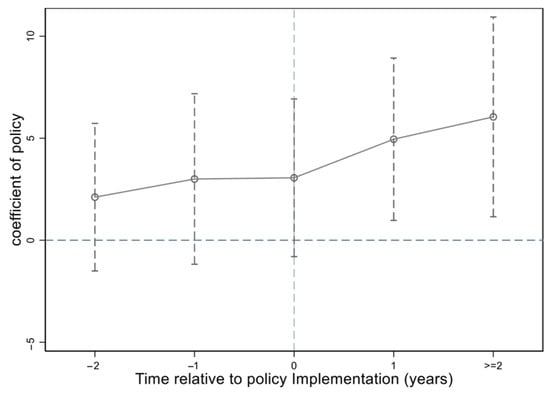
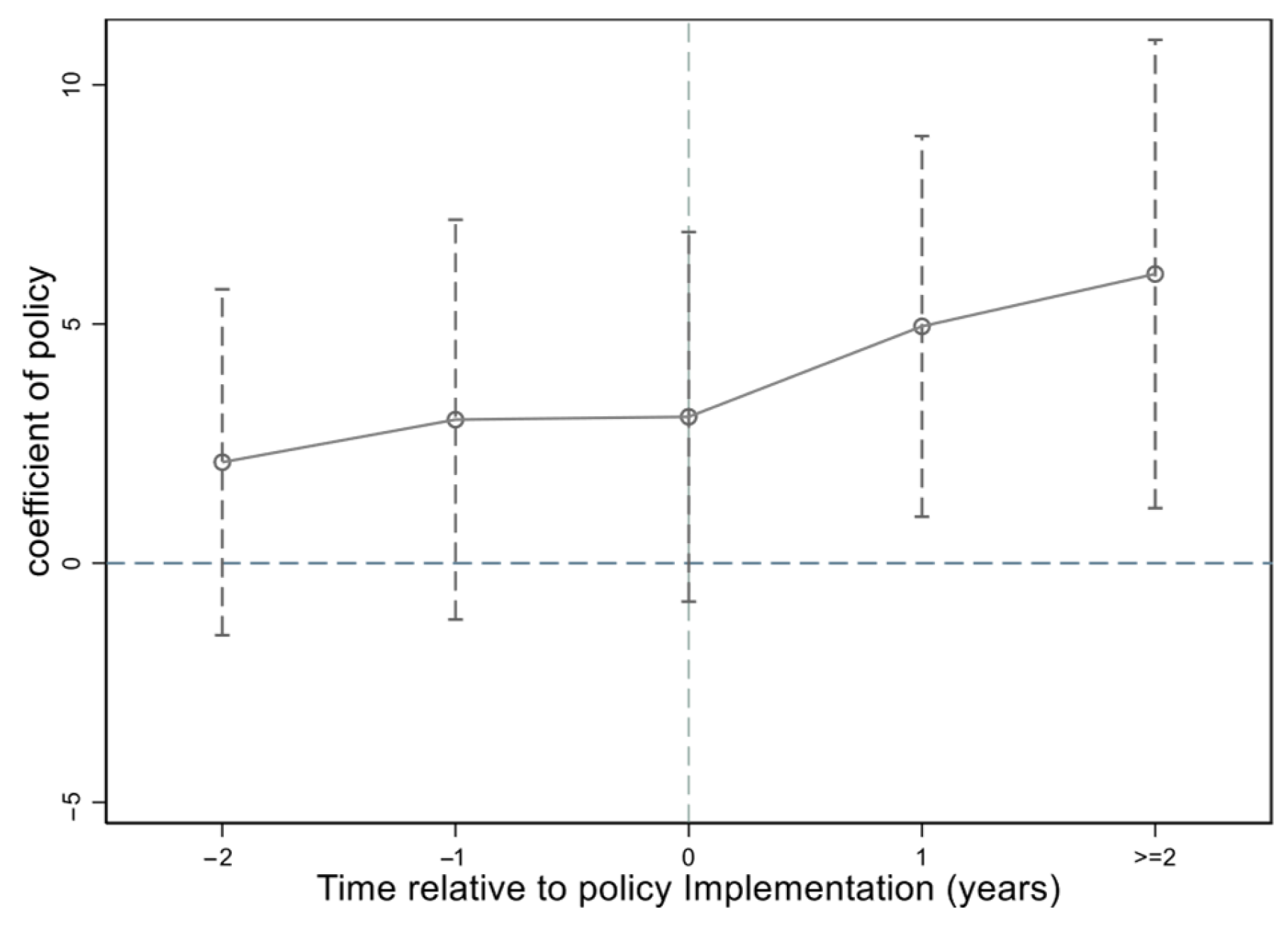
While the difference-in-differences (DID) framework controls for time-invariant firm heterogeneity and common shocks, the validity of causal interpretation relies on the parallel trend assumption. That is, conditional on firm fixed effects and year fixed effects, treated and control firms are assumed to follow similar trends in environmental performance in the absence of the policy. To test this assumption, I replace the policy dummy with a series of year-by-year dummies for the periods before and after the program’s implementation. Figure 1 plots the estimated coefficients along with their 95% confidence intervals. The results show that in the pre-treatment periods, the coefficients are statistically insignificant and their confidence intervals include zero, indicating no systematic differences in environmental performance between the treatment and control groups before the policy. After the implementation, the coefficients become positive and statistically significant, with an increasing trend over time. This pattern supports the parallel trend assumption and confirms a dynamic treatment effect of the program. This observed pattern is consistent with the notion that green supply chain management requires time to materialize—implementing circular economy practices, improving energy efficiency, and coordinating environmental standards across suppliers involve gradual operational adjustments and technology adoption, leading to environmental benefits that emerge progressively rather than as an immediate policy shock.
Figure 1.
Parallel Trend Tests. This figure presents event-study estimates with 95% confidence intervals.
5.3.2. Matched Sub-Sample Analysis
To address potential sample selection bias due to ex-ante differences between treated and control firms, I employ propensity score matching (PSM). As the program is predominantly composed of manufacturing firms, I restrict the matching process to manufacturing firms only. I estimate a Probit model with Treat as the dependent variable and all baseline control variables as predictors, including firm and year fixed effects. Based on the estimated propensity scores, I construct a matched sample and re-run my baseline regression. As shown in Table 4, the coefficient on Treat × Post remains positive and statistically significant, consistent with my main results.
Table 4.
PSM-DID Tests.
5.3.3. Placebo Test
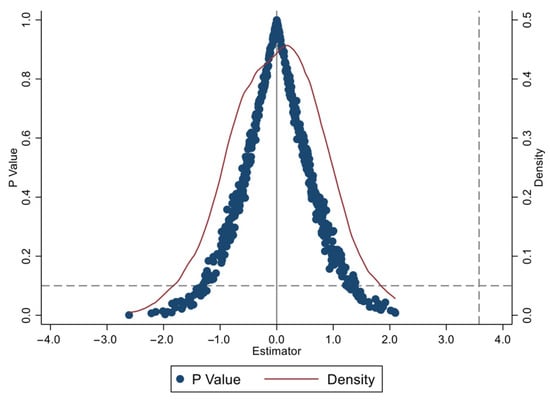
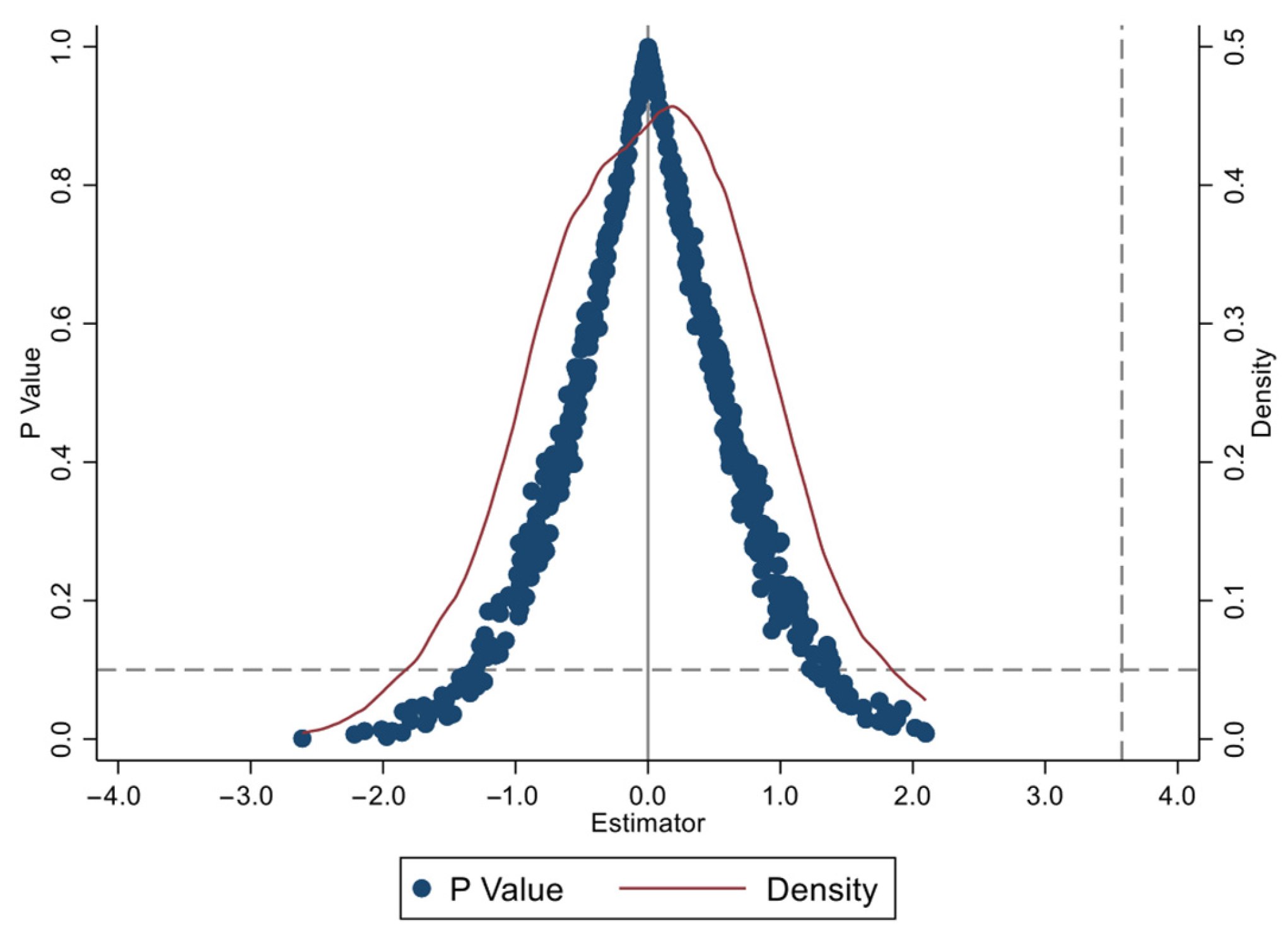
To mitigate concerns about omitted variables, I perform a placebo test by randomly assigning the treatment status among firms within each program batch. This process is repeated 500 times to generate a distribution of placebo coefficients. Figure 2 displays the resulting distribution, which is centered around zero and statistically insignificant, confirming that my baseline estimates are unlikely to be driven by unobserved confounding factors.
Figure 2.
Placebo Tests.
5.3.4. Synthetic Control Approach
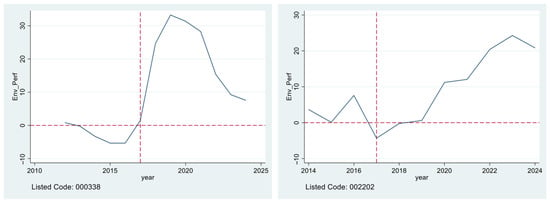
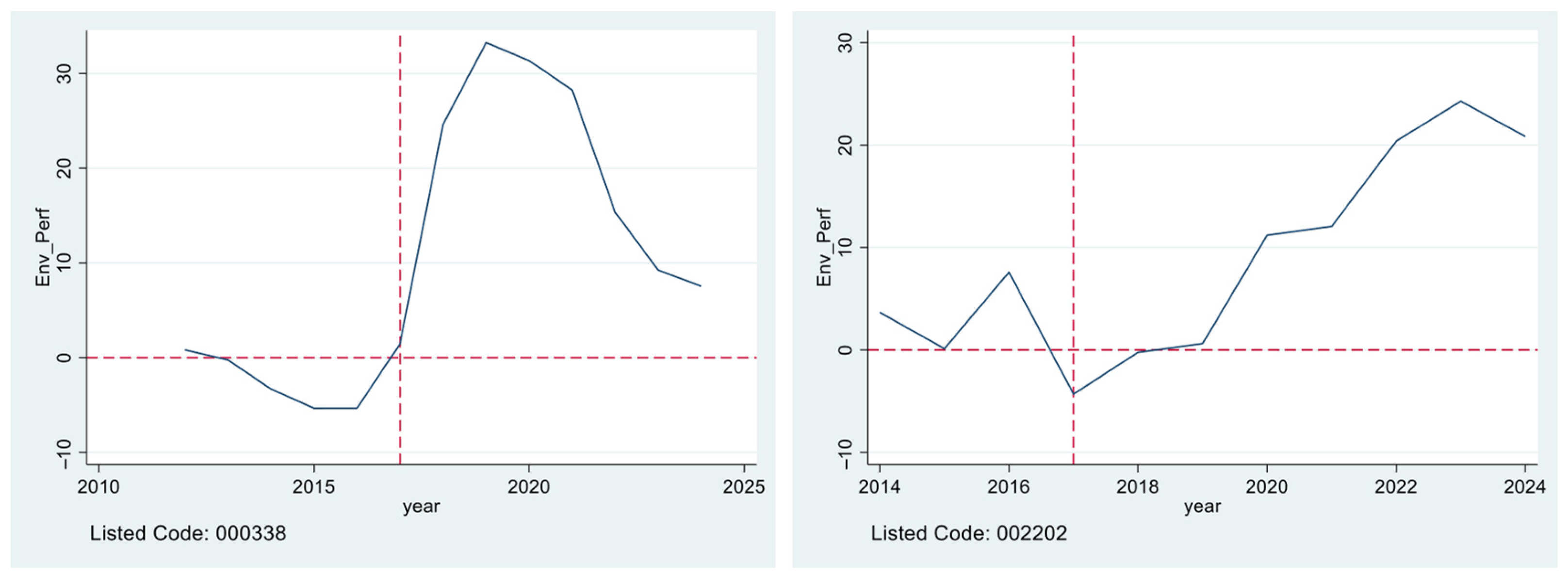
In this section, I employ a synthetic control method to further test the robustness of the main findings. This approach constructs a counterfactual for each treated unit by weighting a pool of untreated units to best match the pre-treatment characteristics and outcomes of the treated firm. I select two representative treated firms from the first batch of the pilot program in 2017: Weichai Power (000338), a leading Chinese company in the automotive and equipment manufacturing industry, primarily engaged in engines, powertrains, commercial vehicles, construction machinery, and related components; and Goldwind (002202), a global leader in wind power generation and integrated clean energy solutions. As shown in Figure 3, Weichai Power’s environmental performance improved substantially after 2017 compared to its synthetic control. Goldwind also shows improvement, though with a delay, suggesting that environmental performance in the wind power sector may exhibit a lagged response. Overall, these results corroborate the main findings.
Figure 3.
Synthetic Control Tests.
5.3.5. Excluding Concurrent Policy Interference
The sample period covers multiple environmental policy initiatives beyond the GSCM demonstration program. To mitigate concerns that the estimates might be confounded by concurrent regulations, I control for firm participation in the Green Factory Pilot Program, the Supply Chain Innovation and Application Demonstration Program, and the Low-Carbon City Pilot. As shown in Table 5, the estimated effect of the GSCM demonstration program remains significant across all specifications. This suggests that the GSCM program has an independent effect on environmental performance, and the results are unlikely to be confounded by other concurrent policies.
Table 5.
Other Policy Effects.
5.3.6. Additional Robustness Checks
I further conduct several supplementary tests, the results of which are summarized in Table 6: (1) Replace the environmental performance measurement with the Huazheng Environmental Scores (Column 1). These scores are constructed by an independent rating agency with no conflicts of interest, ensuring their objectivity and reliability. (2) Replace the environmental performance score with environmental rankings (Column 2). (3) To examine potential lagged effects, regress environmental performance on the one-year lagged Treat × Post variable (Column 3). (4) Expand the sample by retaining observations with missing environmental strategy data, yielding 39,729 observations (Column 4). (5) Exclude the year 2024 from the sample to avoid potential truncation bias (Column 5). (6) Drop the year 2020 to eliminate confounding effects from the COVID-19 pandemic (Column 6).
Table 6.
Other Robustness Tests.
Across all these alternative specifications and samples, the coefficient on Treat × Post remains positive and statistically significant at conventional levels. These consistent findings reinforce the robustness of my main conclusion that the Green Supply Chain Management Demonstration Program improves corporate environmental performance.
5.4. Mechanism Analysis
The baseline results document a significantly positive effect of the Green Supply Chain Management Demonstration Program on corporate environmental performance. To further investigate the underlying channels through which this effect operates, this section examines two key mechanisms: the stimulation of green innovation and the improvement of environmental information disclosure.
To formally test these mechanisms, the following models are estimated:
where represents the channel variables, including green innovation (G_Patent) and environmental information disclosure (Env_Disc). Specifically, G_Patent is measured as the natural logarithm of one plus the number of green patent applications. Env_Disc captures the overall level of corporate environmental disclosure, which is constructed by scoring both monetary information (e.g., environmental liabilities and governance) and non-monetary information (e.g., environmental management and certifications). All other variables are defined consistently with Equation (1).
The results are reported in Table 7. I first examine the green innovation channel. As shown in Column (1), the coefficient on Treat × Post is positive and statistically significant for green patent applications (G_Patent, β = 0.2405, t = 2.18), indicating that participation in the program significantly promotes firms’ green innovation activities. Column (2) further shows that G_Patent is positively associated with environmental performance (β = 0.8133, t = 2.71) after controlling for the policy effect, while the coefficient on Treat × Post remains positive and significant. Taken together, these results suggest that green innovation serves as an important channel through which the program enhances environmental performance, although the persistence of the policy coefficient also indicates the presence of additional mechanisms.
Table 7.
Mechanism Analysis.
I next turn to the environmental information disclosure channel. As reported in Column (3), the program significantly improves the level of environmental disclosure (Env_Disc, β = 1.6614, t = 1.73). In Column (4), Env_Disc is strongly positively associated with environmental performance (β = 0.2760, t = 9.58), and the coefficient on Treat × Post remains positive and marginally significant. These findings indicate that enhanced disclosure is another key pathway through which the program contributes to environmental improvements. Improved transparency likely strengthens both internal governance and external stakeholder monitoring, thereby incentivizing firms to adopt more environmentally responsible practices.
Overall, the evidence provides consistent support for the proposed mechanisms: the Green Supply Chain Management Demonstration Program promotes corporate environmental performance in part by stimulating green innovation and improving environmental information disclosure. However, given that the estimated policy effects remain significant after controlling for the mediators, the results also suggest that these channels capture only part of the total effect.
5.5. Moderating Effects
The baseline analysis confirms the overall positive effect of the Green Supply Chain Management Demonstration Program on corporate environmental performance. To further understand the contextual boundaries and conditional effectiveness of this policy, I examine several moderating factors that may influence the strength of its impact. Specifically, I investigate heterogeneity related to supply chain efficiency, external resource constraints, and pre-existing green innovation capabilities.
5.5.1. Moderating Role of Supply Chain Efficiency
I first explore whether a firm’s operational efficiency within its supply chain moderates the program’s environmental impact. Specifically, by maintaining lower inventory levels, fostering inter-organizational coordination, and wielding greater influence over supply chain partners, a firm can amplify its ability to implement and benefit from green management practices. I employ three complementary measures of efficiency: Inventory Turnover, Synergistic Ability (proxied by the inverse of inventory movement) and Supply Chain Power which reflects managerial flexibility (proxied by the inverse of supply-chain concentration). For each measure, the sample is split at the median into high- and low-efficiency subgroups.
The results are presented in Table 8. Columns (1) and (2) show the treatment effect for firms with high and low inventory turnover, respectively. The coefficient on Treat × Post is positive and statistically significant at the 1% level only for the high-efficiency subgroup (β = 6.6201, t = 2.62), while it is insignificant for low-efficiency firms. A similar pattern emerges in Columns (3) and (4), which are based on synergistic ability. The treatment effect is significant at the 5% level for firms with high synergistic ability (β = 6.4155, t = 2.29) but remains insignificant for those with low ability. Columns (5) and (6) examine the role of supply chain power, a source of greater flexibility. The results show that the treatment effect on environmental performance is positive and significant only for firms with high supply chain power (β = 3.8481, t = 2.05), but is negligible and insignificant for firms with low supply chain power.
Table 8.
Moderating Effects of Supply Chain Efficiency.
These findings suggest that the environmental benefits of the program are significantly stronger for firms with more efficient supply chain operations. Efficient firms likely possess superior internal coordination, leaner processes, and greater managerial flexibility, enabling them to more effectively integrate the program’s requirements and translate them into tangible environmental improvements. For firms with lower operational efficiency, structural and coordination frictions may dilute the policy’s effectiveness.
5.5.2. Moderating Role of External Resource Constraints
I further examine whether a firm’s access to external resources conditions the effectiveness of the GSCM demonstration program. Firms facing greater external resource constraints may have stronger incentives to leverage policy-driven signals to obtain financial and reputational support, thereby amplifying the program’s environmental impact. Conversely, firms already endowed with ample resources may experience less marginal benefit. I proxy external resource constraints using two measures: government subsidy intensity and disclosure quality.
Government Subsidy captures the extent of direct financial support a firm receives from the government, with firms below the sample median classified as facing high resource constraints. Disclosure Quality is measured by the firm’s information disclosure rating, where firms with an “A” rating are considered to have high-quality disclosure, reflecting better access to reputational and market-based resources.
The results in Table 9 reveal a striking pattern. Columns (1) and (2) show that the treatment effect is statistically significant only for firms with low government subsidies (high constraints), with a large and significant coefficient (β = 12.0747, t = 3.81). For firms with high subsidies, the coefficient is small and insignificant. Similarly, Columns (3) and (4) indicate that the program’s effect is concentrated in firms with low disclosure quality (β = 4.6848, t = 1.73), while it is insignificant for firms with “A”-rated high disclosure quality.
Table 9.
Moderating Effects of external resource.
These findings strongly support the view that the GSCM demonstration program serves as a particularly valuable external signal for resource-constrained firms. For firms lacking substantial government support or established market credibility, participation in the program provides a credible endorsement that can significantly improve access to finance, supply chain partnerships, and stakeholder trust. This enhanced access to external resources enables them to undertake environmental investments that were previously infeasible. In contrast, firms already well-supported by subsidies or possessing strong reputational capital exhibit a weaker marginal response to the policy. This heterogeneity underscores the role of the program in mitigating resource barriers to corporate environmental improvement.
5.5.3. Moderating Role of Pre-Existing Green Innovation Capability
Finally, I investigate how a firm’s green innovation level shapes the environmental returns to the GSCM demonstration program. Green innovation capability reflects a firm’s prior experience, technological absorption capacity, and commitment to environmental R&D, which may influence its ability to leverage the program’s incentives and translate them into performance gains. I measure pre-existing green innovation using two indicators: whether the firm had filed any green patent applications prior to the program year, and whether it had been granted any green patents. Firms are correspondingly categorized as having either high (≥1 patent) or low (0 patents) pre-existing innovation levels.
As shown in Table 10, the moderating effect reveals an interesting pattern. For firms with no prior green patent applications (Column 2), the treatment effect is positive and statistically significant at the 5% level (β = 5.5724, t = 2.11). In contrast, the effect is statistically insignificant for firms that had already applied for green patents (Column 1). A similar tendency is observed when using the green patent grant criterion: the treatment effect remains positive and significant at the 10% level for firms with no prior green patents granted (β = 3.6620, t = 1.81, Column 4), while it is statistically insignificant for firms that already possessed granted green patents (Column 3).
Table 10.
Moderating Effects of Innovation Level.
These results suggest that the GSCM demonstration program is most effective in improving the environmental performance of firms with lower pre-existing levels of green innovation. For firms that have not previously engaged in formal green innovation, the program provides critical institutional incentives, learning opportunities, and resource support that catalyze initial steps toward environmental improvement. In contrast, firms that already possess established green innovation capabilities may have previously undertaken many of the viable environmental upgrades, leaving less room for marginal improvement driven by the program. This implies that the GSCM demonstration program plays a particularly important role in broadening the base of firms engaging in environmental upgrading, rather than merely reinforcing the performance of already “green” leaders.
5.6. Further Heterogeneity Tests
To provide a more comprehensive picture of the differential impacts of the program, I examine additional sources of heterogeneity based on ownership structure, geographic location and government green support level. These dimensions reflect important institutional and market conditions that may shape a firm’s responsiveness to policy-driven environmental initiatives.
The results, presented in Table 11, indicate considerable variation in program effectiveness across these subgroups. First, when comparing state-owned enterprises (SOEs) with non-SOEs, the treatment effect is positive and statistically significant only for SOEs (Column 1: β = 7.7700, t = 2.39). This may reflect SOEs’ stronger alignment with national policy objectives, greater access to administrative resources, and higher visibility, which collectively enhance their capacity to implement and benefit from the program. Although the specific mechanisms behind this ownership heterogeneity are not the focus of this study, these potential channels are acknowledged, and future research could explore them in more detail.
Table 11.
Heterogeneity Tests.
Second, the analysis of regional heterogeneity shows that the treatment effect is statistically significant only for firms located in China’s eastern regions (Column 3: β = 4.3227, t = 1.92), which are typically characterized by more developed markets, stricter environmental regulations, and greater availability of green technologies and financing. This pattern aligns with evidence from adaptive policy studies, where local institutional capacity and policy support shape the responsiveness to environmental interventions [37]. Third, considering local green support, which is measured as fiscal environmental protection expenditure relative to general budget expenditure, the results show that firms in regions with higher green support experience stronger program effects (Columns 5: High β = 4.6712, t = 1.80). This finding suggests that the program’s effectiveness depends on institutional and fiscal conditions that facilitate firms’ ability to translate policy signals into environmental improvements. It is also consistent with studies highlighting how green image, digital capabilities, and technology transfer networks can enhance firms’ ability to use environmental policies [38,39]. In summary, the results highlight that the GSCM demonstration program is most effective for SOEs, firms in the economically advanced eastern region, or those operating in areas with substantial government green support.
6. Discussion and Conclusions
This study examines whether green supply chain management policies can effectively enhance corporate environmental performance, using China’s Green Supply Chain Management Demonstration Program as a quasi-natural experiment. Consistent with the working hypothesis that supply-chain-based environmental governance can induce substantive firm-level responses, the empirical results show that firms included in the demonstration program experience a significant and economically meaningful improvement in environmental performance relative to non-participating firms. Importantly, the observed effects reflect real environmental actions—such as the adoption of energy-saving technologies and circular economy practices—rather than merely symbolic compliance, lending support to arguments in the GSCM literature that supply chain initiatives can translate into tangible environmental outcomes.
Interpreted in the context of prior studies, these findings extend existing evidence that largely relies on voluntary adoption, surveys, or case-based analyses. While earlier research emphasizes the role of internal coordination and buyer–supplier relationships, this study demonstrates that a government-initiated yet non-mandatory policy can shape corporate environmental behavior through incentive-based supply chain governance. The mechanism analyses further align with theoretical expectations by showing that GSCM operates through both internal channels—improving supply chain efficiency, stimulating green innovation, and enhancing disclosure quality—and external channels, particularly by generating signaling effects that ease access to supply chain finance. These results are consistent with the view that financial constraints and information asymmetry are critical barriers to environmental investment in emerging economies.
The heterogeneity patterns provide additional insights into the boundary conditions of green supply chain policies. Stronger effects among firms with higher supply chain efficiency, limited external resources, and lower initial green innovation suggest that GSCM policies are particularly effective where marginal returns to policy support are high. The more pronounced impacts observed for state-owned enterprises and firms in eastern regions further indicate that institutional environments and regional development levels condition policy effectiveness.
Unlike traditional command-and-control regulation, the demonstration program operates partly through supply chain relationships and reputational incentives. Public designation increases the visibility of participating firms, while post-selection evaluation and policy support create incentives for firms to maintain environmental standards. As a result, environmental performance becomes linked not only to regulatory compliance but also to firms’ position and credibility within supply chains.
From a broader policy perspective, these findings highlight the role of supply chains as an institutional channel through which environmental policies can influence firm behavior. In many emerging economies, environmental regulation often faces constraints related to monitoring capacity and enforcement resources. Supply-chain-based governance may partially alleviate these constraints by shifting part of the pressure for environmental improvement from regulators to market relationships among firms. In this sense, policies that mobilize supply chain coordination and reputational mechanisms may complement conventional regulatory approaches.
At the same time, the external validity of the findings depends on certain institutional conditions. In emerging economies where supply chain integration is increasing but regulatory capacity remains limited, similar policy instruments may provide a pragmatic approach to encouraging greener production practices. However, the effectiveness of such policies may vary depending on the strength of market institutions and the transparency of corporate environmental information.
Several limitations warrant caution. Although the empirical strategy mitigates concerns related to selection, unobservable firm characteristics may still influence participation and outcomes. Although firms voluntarily apply for the program, the timing of approval is largely determined by a government-led evaluation process and batch allocation, which provides a source of plausibly exogenous variation in treatment timing. Nevertheless, unobserved factors may still be correlated with both the likelihood of selection and subsequent environmental outcomes. Moreover, data constraints limit the analysis of detailed upstream and downstream supply chain interactions. Future research could explore richer network-level supply chain data, alternative policy designs, or cross-country settings to assess the generalizability of these findings and to further unpack the dynamic effects of green supply chain governance.
Overall, this study highlights the potential of green supply chain management policies to promote corporate environmental performance and sustainable development in emerging economies. Many emerging economies face similar challenges, including limited regulatory capacity, fragmented supply chains, and the need to balance environmental objectives with continued industrial development. The results suggest that integrating supply chain mechanisms into environmental policymaking may represent a promising direction not only for China but also for other emerging economies seeking cost-effective and scalable approaches to improving environmental outcomes.
Funding
This research received no external funding.
Data Availability Statement
The data analyzed in this study were obtained from the databases described in the article. Access to the data is subject to the terms and conditions of the respective data providers.
Conflicts of Interest
The author declares no conflicts of interest.
Abbreviations
The following abbreviations are used in this manuscript:
| GSCM | Green Supply Chain Management |
| MIIT | Ministry of Industry and Information Technology |
| DID | Difference-in-difference |
| CSMAR | China Stock Market & Accounting Research |
| CNRDS | Chinese Research Data Services |
Appendix A
Table A1.
Definitions of variables.
References
- Zhu, Q.; Sarkis, J. An inter-sectoral comparison of green supply chain management in China: Drivers and practices. J. Clean. Prod. 2006, 14, 472–486. [Google Scholar] [CrossRef] [Scilit]
- Grewal, J.; Serafeim, G.; Yoon, A. Shareholder Activism on Sustainability Issues; Harvard Business School Working Paper 17-003; Harvard Business School: Boston, MA, USA, 2016. [Google Scholar]
- Barko, T.; Cremers, M.; Renneboog, L. Shareholder engagement on environmental, social, and governance performance. J. Bus. Ethics 2022, 180, 777–812. [Google Scholar] [CrossRef] [Scilit]
- Fiechter, P.; Hitz, J.M.; Lehmann, N. Real effects of a widespread CSR reporting mandate: Evidence from the European Union’s CSR Directive. J. Account. Res. 2022, 60, 1499–1549. [Google Scholar] [CrossRef] [Scilit]
- He, F.; Guo, X.; Yue, P. Media coverage and corporate ESG performance: Evidence from China. Int. Rev. Financ. Anal. 2024, 91, 103003. [Google Scholar] [CrossRef] [Scilit]
- Tsang, A.; Wang, Y.; Xiang, Y.; Yu, L. The rise of ESG rating agencies and management of corporate ESG violations. J. Bank. Financ. 2024, 169, 107312. [Google Scholar] [CrossRef] [Scilit]
- Sarkis, J. A strategic decision framework for green supply chain management. J. Clean. Prod. 2003, 11, 397–409. [Google Scholar] [CrossRef] [Scilit]
- Sarkis, J.; Zhu, Q.; Lai, K.H. An organizational theoretic review of green supply chain management literature. Int. J. Prod. Econ. 2011, 130, 1–15. [Google Scholar] [CrossRef] [Scilit]
- Green, K.W.; Zelbst, P.J.; Meacham, J.; Bhadauria, V.S. Green supply chain management practices: Impact on performance. Supply Chain Manag. 2012, 17, 290–305. [Google Scholar] [CrossRef] [Scilit]
- Yu, W.; Chavez, R.; Feng, M.; Wiengarten, F. Integrated green supply chain management and operational performance. Supply Chain Manag. 2014, 19, 683–696. [Google Scholar] [CrossRef] [Scilit]
- Feng, M.; Yu, W.; Wang, X.; Wong, C.Y.; Xu, M.; Xiao, Z. Green supply chain management and financial performance: The mediating roles of operational and environmental performance. Bus. Strategy Environ. 2018, 27, 811–824. [Google Scholar] [CrossRef] [Scilit]
- Tseng, M.L.; Islam, M.S.; Karia, N.; Fauzi, F.A.; Afrin, S. A literature review on green supply chain management: Trends and future challenges. Resour. Conserv. Recycl. 2019, 141, 145–162. [Google Scholar] [CrossRef] [Scilit]
- Herrmann, F.F.; Barbosa-Póvoa, A.P.; Butturi, M.A.; Marinelli, S.; Sellitto, M.A. Green supply chain management: Conceptual framework and models for analysis. Sustainability 2021, 13, 8127. [Google Scholar] [CrossRef] [Scilit]
- Micheli, G.J.; Cagno, E.; Mustillo, G.; Trianni, A. Green supply chain management drivers, practices and performance: A comprehensive study on the moderators. J. Clean. Prod. 2020, 259, 121024. [Google Scholar] [CrossRef] [Scilit]
- Li, J.; Zhu, C. Can green supply chain management improve supply chain resilience? A quasi-natural experiment from China. Sustainability 2025, 17, 7481. [Google Scholar] [CrossRef] [Scilit]
- Ning, J.; Liu, B.; Xu, Y.; Yu, L. Does green supply chain management improve corporate sustainability performance? Evidence from China. Environ. Impact Assess. Rev. 2025, 112, 107828. [Google Scholar] [CrossRef] [Scilit]
- Seman, N.A.A.; Govindan, K.; Mardani, A.; Zakuan, N.; Saman, M.Z.M.; Hooker, R.E.; Ozkul, S. The mediating effect of green innovation on the relationship between green supply chain management and environmental performance. J. Clean. Prod. 2019, 229, 115–127. [Google Scholar] [CrossRef] [Scilit]
- Gu, H.; Yang, S.; Xu, Z.; Cheng, C. Supply chain finance, green innovation, and productivity: Evidence from China. Pac.-Basin Financ. J. 2023, 78, 101981. [Google Scholar] [CrossRef] [Scilit]
- Li, G.; Li, L.; Choi, T.M.; Sethi, S.P. Green supply chain management in Chinese firms: Innovative measures and the moderating role of quick response technology. J. Oper. Manag. 2020, 66, 958–988. [Google Scholar] [CrossRef] [Scilit]
- Rabbi, M.; Ali, S.M.; Kabir, G.; Mahtab, Z.; Paul, S.K. Green supply chain performance prediction using a Bayesian belief network. Sustainability 2020, 12, 1101. [Google Scholar] [CrossRef] [Scilit]
- Kuei, C.H.; Madu, C.N.; Chow, W.S.; Chen, Y. Determinants and associated performance improvement of green supply chain management in China. J. Clean. Prod. 2015, 95, 163–173. [Google Scholar] [CrossRef] [Scilit]
- Dong, Z.; Tan, Y.; Wang, L.; Zheng, J.; Hu, S. Green supply chain management and clean technology innovation: An empirical analysis of multinational enterprises in China. J. Clean. Prod. 2021, 310, 127377. [Google Scholar] [CrossRef] [Scilit]
- Zhu, Q.; Feng, Y.; Choi, S.B. The role of customer relational governance in environmental and economic performance improvement through green supply chain management. J. Clean. Prod. 2017, 155, 46–53. [Google Scholar] [CrossRef] [Scilit]
- Zhang, J.; Ma, W. Research on construction and optimization paths for quality concept model of green supply chain of livestock products. Sustainability 2024, 16, 9659. [Google Scholar] [CrossRef] [Scilit]
- Tippayawong, K.Y.; Niyomyat, N.; Sopadang, A.; Ramingwong, S. Factors affecting green supply chain operational performance of the Thai auto parts industry. Sustainability 2016, 8, 1161. [Google Scholar] [CrossRef] [Scilit]
- Majumdar, A.; Sinha, S.K. Analyzing the barriers of green textile supply chain management in Southeast Asia using interpretive structural modeling. Sustain. Prod. Consum. 2019, 17, 176–187. [Google Scholar] [CrossRef] [Scilit]
- Samad, S.; Nilashi, M.; Almulihi, A.; Alrizq, M.; Alghamdi, A.; Mohd, S.; Azhar, S.N.F.S. Green supply chain management practices and impact on firm performance: The moderating effect of collaborative capability. Technol. Soc. 2021, 67, 101766. [Google Scholar] [CrossRef] [Scilit]
- Yang, H.; Miao, L.; Zhao, C. The credit strategy of a green supply chain based on capital constraints. J. Clean. Prod. 2019, 224, 930–939. [Google Scholar] [CrossRef] [Scilit]
- Peng, H.; Shen, N.; Liao, H.; Wang, Q. Multiple network embedding, green knowledge integration and green supply chain performance: Investigation based on agglomeration scenario. J. Clean. Prod. 2020, 259, 120821. [Google Scholar] [CrossRef] [Scilit]
- Han, Z.; Huo, B. The impact of green supply chain integration on sustainable performance. Ind. Manag. Data Syst. 2020, 120, 657–674. [Google Scholar] [CrossRef] [Scilit]
- Qiao, J.; Li, S.; Xiong, S.; Li, N. How does the digital capability advantage affect green supply chain innovation? An inter-organizational learning perspective. Sustainability 2023, 15, 11583. [Google Scholar] [CrossRef] [Scilit]
- Li, T.; Donta, P.K. Predicting green supply chain impact with SNN-stacking model in digital transformation context. J. Organ. End User Comput. 2023, 35, 1–19. [Google Scholar] [CrossRef] [Scilit]
- Novitasari, M.; Agustia, D. Green supply chain management and firm performance: The mediating effect of green innovation. J. Ind. Eng. Manag. 2021, 14, 391–403. [Google Scholar] [CrossRef] [Scilit]
- Zhang, L.; Dou, Y.; Wang, H. Green supply chain management, risk-taking, and corporate value—Dual regulation effect based on technological innovation capability and supply chain concentration. Front. Environ. Sci. 2023, 11, 1096349. [Google Scholar] [CrossRef] [Scilit]
- Quintana-García, C.; Benavides-Chicón, C.G.; Marchante-Lara, M. Does a green supply chain improve corporate reputation? Empirical evidence from European manufacturing sectors. Ind. Mark. Manag. 2021, 92, 344–353. [Google Scholar] [CrossRef] [Scilit]
- Li, B.; Du, Z.; Wang, M. Financing preference and the role of credit insurance in a green supply chain. Manag. Decis. Econ. 2022, 43, 3882–3897. [Google Scholar] [CrossRef] [Scilit]
- Jiang, C.; Wang, Y.; Yang, Z.; Zhao, Y. Do adaptive policy adjustments deliver ecosystem-agriculture-economy co-benefits in land degradation neutrality efforts? Evidence from southeast coast of China. Environ. Monit. Assess. 2023, 43, 1215. [Google Scholar] [CrossRef] [Scilit]
- Ma, J.; Shang, Y.; Liu, L. Green image, digital transformation, and corporate green innovation. Int. Rev. Financ. Anal. 2025, 106, 104518. [Google Scholar] [CrossRef] [Scilit]
- Hu, F.; Yang, H.; Wei, S.; Zhou, H.; Chen, Y.; Hu, H. Urban green technology transfer networks and green finance development: Evidence from the Yangtze River Delta, China. Pac.-Basin Financ. J. 2026, 96, 103055. [Google Scholar] [CrossRef] [Scilit]
- ISO 14001:2015; Environmental Management Systems—Requirements with Guidance for Use. International Organization for Standardization: Geneva, Switzerland, 2015.

Disclaimer/Publisher’s Note: The statements, opinions and data contained in all publications are solely those of the individual author(s) and contributor(s) and not of MDPI and/or the editor(s). MDPI and/or the editor(s) disclaim responsibility for any injury to people or property resulting from any ideas, methods, instructions or products referred to in the content. |
© 2026 by the author. Licensee MDPI, Basel, Switzerland. This article is an open access article distributed under the terms and conditions of the Creative Commons Attribution (CC BY) license.