The Influence of Paradoxical Leadership on Hotel Sustainable Service Performance: The Mediating Role of Organizational Citizenship Behavior
 , ,
, ,  and
and
Abstract
1. Introduction
2. Literature Review
2.1. Paradoxical Leadership (PL)
2.2. Organizational Citizenship Behavior (OCB) in the Hospitality Industry
- Altruism
- 2.
- Courtesy
- 3.
- Sportsmanship
- 4.
- General Compliance
- 5.
- Civic Virtue
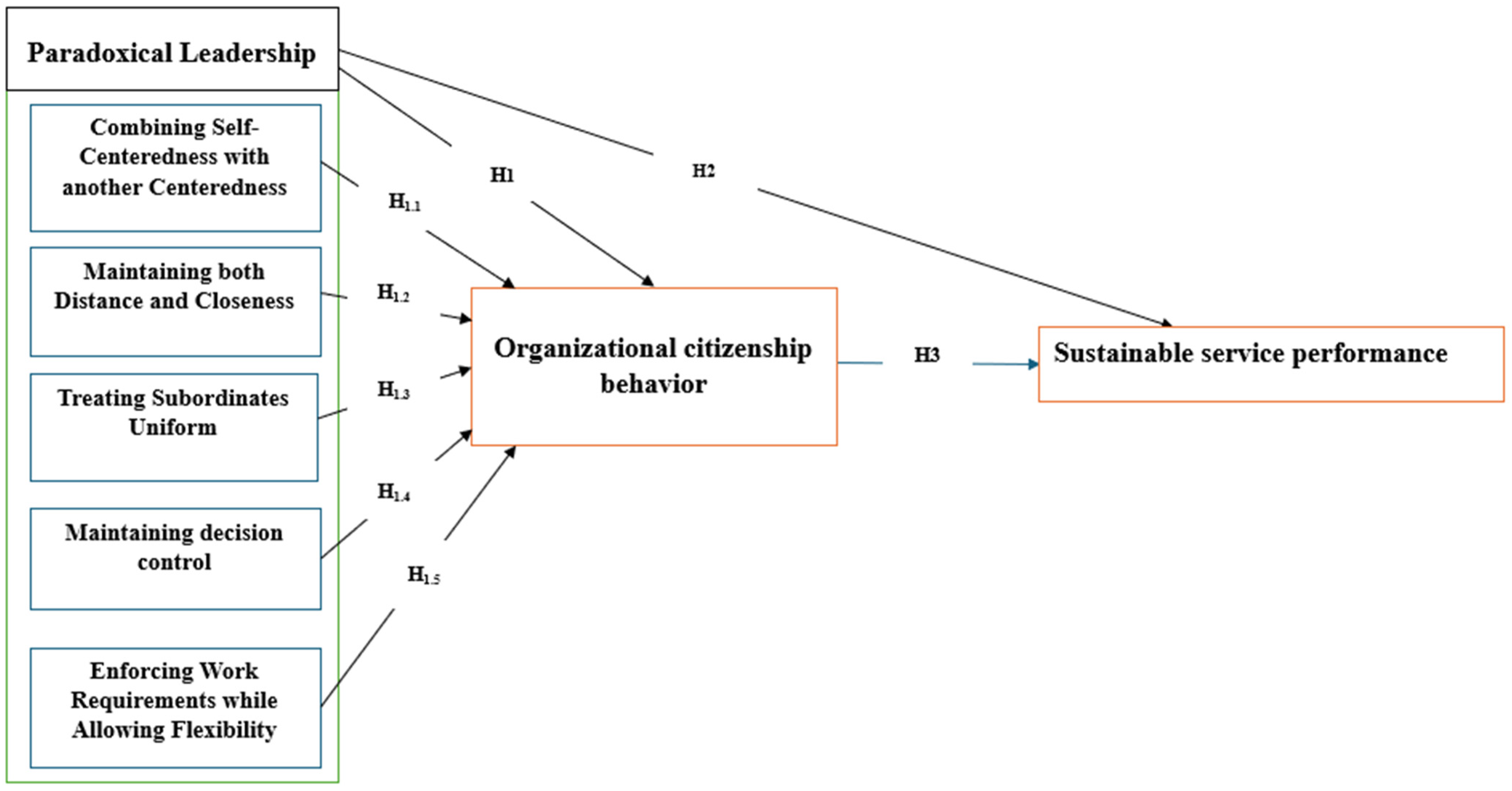
2.3. The Conceptualized Model and Hypotheses Development
2.3.1. The Interplay Between Overall PL and OCB in the Hospitality Context
2.3.2. The Interplay Between the Dimension of PL and OCB in the Hospitality Context
The Relationship Between SO and OCB in Hotels
The Relationship Between DC and OCB in Hotels
The Relationship Between UI and OCB in Hotels
The Relationship Between CA and OCB in Hotels
The Relationship Between RF and OCB in Hotels
2.3.3. Sustainable Service Performance
3. Methods
3.1. Research Population and Sample
- = required sample size;
- N = population size (48,000);
- Z = Z-score corresponding to the desired confidence level (1.96 for 95%);
- = estimated population proportion (assumed 0.5 for maximum variability);
- E = margin of error (typically 5%).
3.2. Measurement and Procedures
3.3. Data Collection
3.4. Common Bias Method
3.5. Data Analysis and Hypotheses Testing
3.5.1. Validity Assessment
3.5.2. Reliability Assessment
3.5.3. Means and Standard Deviation
4. Results and Discussion
4.1. The Correlation Results
4.1.1. PL’SO and OCB
4.1.2. PL’DC and OCB
4.1.3. PL’UI and OCB
4.1.4. PL, OCB, and Sustainable Service Performance
4.1.5. PL’RF and OCB
5. Conclusions
5.1. General Discussions
5.2. Theoretical Implications
5.3. Practical Implications
6. Limitations and Further Research
Author Contributions
Funding
Institutional Review Board Statement
Informed Consent Statement
Data Availability Statement
Conflicts of Interest
Appendix A
- Paradoxical leadership adapted from Zhang et al. [9]
- Combining self-centeredness with other-centeredness (SO)
- SO1:
- Shows a desire to lead but allows others to share the leadership role.
- SO2:
- Likes to be the center of attention but allows others to share the spotlight as well.
- SO3:
- Insists on getting respect but also shows respect toward others.
- SO4:
- Has a high self-opinion but shows awareness of personal imperfection and the value of other people.
- SO5:
- Is confident regarding personal ideas and beliefs but acknowledges that he or she can learn from others.
- Maintaining both distance and closeness (DC)
- DC1:
- Recognizes the distinction between supervisors and subordinates but does not act superior in the leadership role.
- DC2:
- Keeps distance from subordinates but does not remain aloof.
- DC3:
- Maintains position differences but upholds subordinates’ dignity.
- DC4:
- Maintains distance from subordinates at work but is also amiable toward them.
- Treating subordinates uniformly while allowing individualization (UI)
- UI1:
- Uses a fair approach to treat all subordinates uniformly, but also treats them as individuals.
- UI2:
- Puts all subordinates on an equal footing but considers their individual traits or personalities.
- UI3:
- Communicates with subordinates uniformly without discrimination but varies his or her UI1: communication styles depending on their individual characteristics or needs.
- UI4:
- Manages subordinates uniformly but considers their individualized needs.
- UI5:
- Assigns equal workloads but considers individual strengths and capabilities to handle different tasks.
- preservation of decision authority with autonomy (CA)
- CA1:
- Controls important work issues but allows subordinates to handle details.
- CA2:
- Makes final decisions for subordinates but allows subordinates to control specific work processes.
- CA3:
- Makes decisions about big issues, but delegates lesser issues to subordinates.
- CA4:
- Maintains overall control but gives subordinates appropriate autonomy.
- Enforcing work requirements while allowing flexibility (RF)
- RF1:
- Stresses conformity in task performance but allows for exceptions.
- RF2:
- Clarifies work requirements but does not micromanage work.
- RF3:
- Is highly demanding regarding work performance but is not hypercritical.
- RF4:
- Has high requirements but allows subordinates to make mistakes.
- Organizational citizenship behavior adapted from Konovsky & Pugh [74].
- Altruism
- AL1:
- I willingly help colleagues in my hotel who have heavy workloads.
- AL2:
- I assist coworkers who have work-related problems during service delivery.
- AL3:
- I help new employees in the hotel learn their tasks and adjust to their work environment.
- Courtesy
- CO1:
- I take steps to prevent work-related problems with my coworkers in the hotel.
- CO2:
- I consult with colleagues before making decisions that might affect their work.
- CO3:
- I try to avoid creating work-related difficulties for my coworkers.
- Sportsmanship
- SP1:
- I do not complain about minor issues related to hotel work conditions.
- SP2:
- I maintain a positive attitude even when faced with difficulties during service operations.
- SP3:
- I tolerate inconveniences at work without excessive complaints.
- General compliance
- GC1:
- I strictly follow hotel rules and operational procedures.
- GC2:
- I perform my job duties carefully even when supervisors are not present.
- GC3:
- I respect work schedules and organizational policies in the hotel.
- Civic Virtue
- CV1:
- I actively participate in meetings and activities organized by the hotel.
- CV2:
- I stay informed about important issues and developments affecting the hotel.
- CV3:
- I show concern for the long-term success and reputation of the hotel.
- SSP1:
- Our hotel achieves high service performance in a sustainable manner.
- SSP2:
- Service delivery in this hotel balances customer satisfaction and environmental responsibility.
- SSP3:
- Employees contribute to long-term service excellence, not only short-term results.
- SSP4:
- The hotel maintains socially responsible practices while providing services.
- SSP5:
- Service operations are efficient and environmentally conscious.
- SSP5:
- The quality of service provided by this hotel is sustainable over time.
- SSP6:
- Overall, this hotel demonstrates strong sustainable service performance.
References
- Tripathi, S.; Dixon, J. Leadership in a paradoxical public-sector environment: The challenges of ambiguity. Int. J. Leadersh. Public Serv. 2008, 4, 4–14. [Google Scholar] [CrossRef]
- Bansal, P.; DesJardine, M.R. Business sustainability: It is about time. Strateg. Organ. 2014, 12, 70–78. [Google Scholar] [CrossRef]
- Kim, M.; Beehr, T.A.; Prewett, M.S. Employee responses to empowering leadership: A meta-analysis. J. Leadersh. Organ. Stud. 2018, 25, 257–276. [Google Scholar] [CrossRef]
- Salama, W.; Nor El Deen, M.; Albakhit, A.; Zaki, K. Understanding the connection between sustainable human resource management and the hotel business outcomes: Evidence from the green-certified hotels of Egypt. Sustainability 2022, 14, 5647. [Google Scholar] [CrossRef]
- Torfing, J.; Cristofoli, D.; Gloor, P.A.; Meijer, A.J.; Trivellato, B. Taming the snake in paradise: Combining institutional design and leadership to enhance collaborative innovation. Policy Soc. 2020, 39, 592–616. [Google Scholar] [CrossRef]
- Jones, S.; Harvey, M. A distributed leadership change process model for higher education. J. High. Educ. Policy Manag. 2017, 39, 126–139. [Google Scholar] [CrossRef]
- Mensah, I. Environmental management practices among hotels in the greater Accra region. Int. J. Hosp. Manag. 2006, 25, 414–431. [Google Scholar] [CrossRef]
- Smith, W.K.; Lewis, M.W.; Tushman, M.L. “Both/and” leadership. Harv. Bus. Rev. 2016, 94, 62–70. [Google Scholar]
- Zhang, Y.; Waldman, D.A.; Han, Y.-L.; Li, X.-B. Paradoxical leader behaviors in people management: Antecedents and consequences. Acad. Manag. J. 2015, 58, 538–566. [Google Scholar] [CrossRef]
- Shehata, A.E.; Khan, M.A.; Khalid, R.; Raza, M.; Selem, K.M. Consequences of PL in the hotel setting: Moderating role of work environment. J. Hosp. Mark. Manag. 2023, 32, 670–693. [Google Scholar] [CrossRef]
- Lüscher, L.S.; Lewis, M.W. Organizational change and managerial sensemaking: Working through paradox. Acad. Manag. J. 2008, 51, 221–240. [Google Scholar] [CrossRef]
- Yildirim, A.; Yirik, E.; Çelikten, M.; Çelikten, Y. An investigation of the relationship between managers’ effective leadership behaviors and employees’ organizational commitment levels. Univers. J. Manag. 2020, 8, 195–208. [Google Scholar] [CrossRef]
- Fürstenberg, N.; Alfes, K.; Kearney, E. How and when PL benefits work engagement: The role of goal clarity and work autonomy. J. Occup. Organ. Psychol. 2021, 94, 672–705. [Google Scholar] [CrossRef]
- Bramwell, B.; Lane, B. Critical research on the governance of tourism and sustainability. J. Sustain. Tour. 2011, 19, 411–421. [Google Scholar] [CrossRef]
- Alsoltane, I.; Alallaq, H. The mediating role of team perspective between PL, Innovative work behavior and team innovation. Int. J. Innov. Creat. Change 2020, 13, 626–642. [Google Scholar]
- Chen, S.; Zhang, Y.; Liang, L.; Shen, T. Does PL facilitate leaders’ task performance? A perspective of self-regulation theory. Int. J. Environ. Res. Public Health 2021, 18, 3505. [Google Scholar] [CrossRef]
- Ullah Bukhari, Z. Key antecedents of organizational citizenship behavior in the banking sector of Pakistan. Int. J. Bus. Manag. 2009, 3, 106–115. [Google Scholar] [CrossRef]
- Koys, D.J. The effects of employee satisfaction, organizational citizenship behavior, and turnover on organizational effectiveness: A unit-level, longitudinal study. Pers. Psychol. 2001, 54, 101–114. [Google Scholar] [CrossRef]
- Lievens, F.; Anseel, F. Confirmatory factor analysis and invariance of an organizational citizenship behaviour measure across samples in a Dutch-speaking context. J. Occup. Organ. Psychol. 2004, 77, 299–306. [Google Scholar] [CrossRef]
- Ghaderi, Z.; Tabatabaei, F.; Khoshkam, M.; Shahabi Sorman Abadi, R. Exploring the role of perceived organizational justice and organizational commitment as predictors of job satisfaction among employees in the hospitality industry. Int. J. Hosp. Tour. Adm. 2023, 24, 415–444. [Google Scholar] [CrossRef]
- Lin, M.-J. Does unemployment increase crime?: Evidence from US Data 1974–2000. J. Hum. Resour. 2008, 43, 413–436. [Google Scholar] [CrossRef]
- Chen, X.; Yang, B. A review of PL research. J. Hum. Resour. Sustain. Stud. 2023, 11, 871–886. [Google Scholar] [CrossRef]
- Lee, U.H.; Kim, H.K.; Kim, Y.H. Determinants of organizational citizenship behavior and its outcomes. Glob. Bus. Manag. Res. 2013, 5, 54. [Google Scholar]
- Ishak, N.A.; Alam, S.S. The effects of leader-member exchange on organizational justice and organizational citizenship behavior: Empirical study. Eur. J. Soc. Sci. 2009, 8, 324–334. [Google Scholar]
- Chinomona, R. The impact of organizational support on work spirituality, organizational citizenship behaviour and job performance: The case of Zimbabwe’s small and medium enterprises (SME) sector. Afr. J. Bus. Manag. 2012, 6, 10003. [Google Scholar] [CrossRef]
- Joireman, J.; Kamdar, D.; Daniels, D.; Duell, B. Good citizens to the end? It depends: Empathy and concern with future consequences moderate the impact of a short-term time horizon on organizational citizenship behaviors. J. Appl. Psychol. 2006, 91, 1307. [Google Scholar] [CrossRef] [PubMed]
- Polat, S. Organizational citizenship behavior display levels of the teachers at secondary schools according to the perceptions of the school administrators. Procedia-Soc. Behav. Sci. 2009, 1, 1591–1596. [Google Scholar] [CrossRef]
- Guo, L.; Cheng, K.; Luo, J. The effect of exploitative leadership on knowledge hiding: A conservation of resources perspective. Leadersh. Organ. Dev. J. 2021, 42, 83–98. [Google Scholar] [CrossRef]
- Joshy, L.M.; Mohandas, N.P.; Verma, G.G. Interplay of paradoxical virtual leadership and psychological contract violation—Impact on organizational citizenship behavior. Leadersh. Organ. Dev. J. 2024, 45, 1471–1488. [Google Scholar] [CrossRef]
- Lee, J.Y.; Kim, S.; Noh, S.; Jang, S.H.; Lee, S.Y. Paradoxical organizational culture, authoritarian leadership, and international firm performance: Evidence from international firms in China. J. Int. Manag. 2024, 30, 101117. [Google Scholar] [CrossRef]
- Meng, X.; Chenchen, N.; Liang, F.; Ocean Liu, Y. Research on the influence of PL on compulsory organizational citizenship behavior. Psychol. Res. Behav. Manag. 2021, 14, 1959–1970. [Google Scholar] [CrossRef]
- Pan, Z. PL and organizational citizenship behaviour: The serial mediating effect of a paradoxical mindset and personal service orientation. Leadersh. Organ. Dev. J. 2021, 42, 869–881. [Google Scholar] [CrossRef]
- Stynen, D.; Semeijn, J. PL and well-being in turbulent times: A time-lagged study. Front. Psychol. 2023, 14, 1148822. [Google Scholar] [CrossRef]
- Wu, M.; Peng, Z. Destructive leadership, supervisor pressure and compulsory organization citizenship behaviors: The moderating role of leader-member exchange. Manag. Rev. 2018, 30, 141–152. [Google Scholar] [CrossRef]
- Xue, Y.; Li, X.; Liang, H.; Li, Y. How does PL affect employees’ voice behaviors in workplace? A leader-member exchange perspective. Int. J. Environ. Res. Public Health 2020, 17, 1162. [Google Scholar] [CrossRef]
- Cunha, M.P.E.; Putnam, L.L. Paradox theory and the paradox of success. Strateg. Organ. 2019, 17, 95–106. [Google Scholar] [CrossRef]
- Fan, X.; Wang, D.; Wang, F.; Kraimer, M.L. When leaders are forced to stay: The indirect effects of leaders’ reluctant staying on subordinates’ performance. J. Organ. Behav. 2024, 45, 459–476. [Google Scholar] [CrossRef]
- Waldman, D.A.; Bowen, D.E. Learning to be a paradox-savvy leader. Acad. Manag. Perspect. 2016, 30, 316–327. [Google Scholar] [CrossRef]
- Sparr, J.L. Paradoxes in organizational change: The crucial role of leaders’ sensegiving. J. Change Manag. 2018, 18, 162–180. [Google Scholar] [CrossRef]
- Yi, L.; Uddin, M.A.; Das, A.K.; Mahmood, M.; Sohel, S.M. Do transformational leaders engage employees in sustainable innovative work behaviour? Perspective from a developing country. Sustainability 2019, 11, 2485. [Google Scholar] [CrossRef]
- Dashuai, R.; Bin, Z. How does PL affect innovation in teams: An integrated multilevel dual process model. Hum. Syst. Manag. 2020, 39, 11–26. [Google Scholar] [CrossRef]
- Lewis, M.W. Exploring paradox: Toward a more comprehensive guide. Acad. Manag. Rev. 2000, 25, 760–776. [Google Scholar] [CrossRef]
- Elkington, J. The triple bottom line. Environ. Manag. Read. Cases 1997, 2, 49–66. [Google Scholar]
- Alsetoohy, O.; Al-Abyadh, M.H.A.; Döngül, E.S.; Agina, M.F.; Elshaer, A. How humble leadership affects voluntary green behavior and green performance? The roles of job autonomy and green supporting climate in hotels. Probl. Ekorozwoju 2022, 17, 230–242. [Google Scholar] [CrossRef]
- Kearney, E.; Gebert, D.; Voelpel, S.C. When and how diversity benefits teams: The importance of team members’ need for cognition. Acad. Manag. J. 2009, 52, 581–598. [Google Scholar] [CrossRef]
- Bibi, A.; Xiong, Y.; Rajoka, M.S.R.; Mehwish, H.M.; Radicetti, E.; Umair, M.; Shoukat, M.; Khan, M.K.I.; Aadil, R.M. Recent advances in the production of exopolysaccharide (EPS) from Lactobacillus spp. and its application in the food industry: A review. Sustainability 2021, 13, 12429. [Google Scholar] [CrossRef]
- Organ, D.W.; Konovsky, M. Cognitive versus affective determinants of organizational citizenship behavior. J. Appl. Psychol. 1989, 74, 157. [Google Scholar] [CrossRef]
- Podsakoff, P.M.; MacKenzie, S.B.; Paine, J.B.; Bachrach, D.G. Organizational citizenship behaviors: A critical review of the theoretical and empirical literature and suggestions for future research. J. Manag. 2000, 26, 513–563. [Google Scholar] [CrossRef]
- Bolino, M.C.; Klotz, A.C.; Turnley, W.H.; Harvey, J. Exploring the dark side of organizational citizenship behavior. J. Organ. Behav. 2013, 34, 542–559. [Google Scholar] [CrossRef]
- Karatepe, O.M. High-performance work practices and hotel employee performance: The mediation of work engagement. Int. J. Hosp. Manag. 2013, 32, 132–140. [Google Scholar] [CrossRef]
- Boiral, O.; Paillé, P. Organizational citizenship behaviour for the environment: Measurement and validation. J. Bus. Ethics 2012, 109, 431–445. [Google Scholar] [CrossRef]
- Graham, J.W. An essay on organizational citizenship behavior. Empl. Responsib. Rights J. 1991, 4, 249–270. [Google Scholar] [CrossRef]
- Bhal, K.T.; Gulati, N.; Ansari, M.A. Leader-member exchange and subordinate outcomes: Test of a mediation model. Leadersh. Organ. Dev. J. 2009, 30, 106–125. [Google Scholar] [CrossRef]
- Owens, B.P.; Johnson, M.D.; Mitchell, T.R. Expressed humility in organizations: Implications for performance, teams, and leadership. Organ. Sci. 2013, 24, 1517–1538. [Google Scholar] [CrossRef]
- Jones, T.M.; Felps, W.; Bigley, G.A. Ethical theory and stakeholder-related decisions: The role of stakeholder culture. Acad. Manag. Rev. 2007, 32, 137–155. [Google Scholar] [CrossRef]
- Maccoby, M. Narcissistic leaders: The incredible pros, the inevitable cons. Harv. Bus. Rev. 2004, 82, 92–101. [Google Scholar]
- Yagil, D. Charismatic leadership and organizational hierarchy: Attribution of charisma to close and distant leaders. Leadersh. Q. 1998, 9, 161–176. [Google Scholar] [CrossRef]
- Antonakis, J.; Atwater, L. Leader distance: A review and a proposed theory. In Leadership Perspectives; Routledge: London, UK, 2017; pp. 129–160. [Google Scholar] [CrossRef]
- Howell, J.M.; Neufeld, D.J.; Avolio, B.J. Examining the relationship of leadership and physical distance with business unit performance. Leadersh. Q. 2005, 16, 273–285. [Google Scholar] [CrossRef]
- Boies, K.; Howell, J.M. Leader–member exchange in teams: An examination of the interaction between relationship differentiation and mean LMX in explaining team-level outcomes. Leadersh. Q. 2006, 17, 246–257. [Google Scholar] [CrossRef]
- Kreiner, G.E.; Hollensbe, E.C.; Sheep, M.L. Where is the “me” among the “we”? Identity work and the search for optimal balance. Acad. Manag. J. 2006, 49, 1031–1057. [Google Scholar] [CrossRef]
- Smith, W.K.; Lewis, M.W. Toward a theory of paradox: A dynamic equilibrium model of organizing. Acad. Manag. Rev. 2011, 36, 381–403. [Google Scholar]
- Gagné, M. The Oxford Handbook of Work Engagement, Motivation, and Self-Determination Theory; Oxford University Press: Oxford, UK, 2014. [Google Scholar]
- Cheng, K.-T. The role of job embeddedness: A moderator for justice and citizenship behaviour in the workplace. Eur. J. Int. Manag. 2019, 13, 287–306. [Google Scholar] [CrossRef]
- Alsetoohy, O.; Albadry, O.M.; Mathew, V.; Kamar, M.A.; Menesy, R.M.; Alhamdi, F.; Al-Monawer, N.; Sheikhelsouk, S. Fostering adaptive performance and mitigating deviance behavior in hotels: Insights from ethical leadership and Islamic work ethics. J. Islam. Mark. 2025, 16, 1–21. [Google Scholar] [CrossRef]
- Alsetoohy, O.; Alzuman, A.; Mathew, V.; Al-Monawer, N.S.; Espino-Rodríguez, T.F.; Kamar, M.A.; Alhamdi, F.M.; El-Sherbeeny, A.M.; Sheikhelsouk, S. Occupational health and safety management practices and safety outcomes in hotels: Influences of knowledge, motivation, and innovation in supply chain and housekeeping operations. Int. J. Hosp. Manag. 2026, 133, 104448. [Google Scholar] [CrossRef]
- Alsetoohy, O.; Albadry, O.; Mathew, V.; Kamar, M.A.; Al-Monawer, N.S.; Alzuman, A.; Sheikhelsouk, S. National culture, ethical climate and relational identification: A triadic framework for quality management and performance excellence in hotels. J. Hosp. Tour. Insights 2026, 9, 924–947. [Google Scholar] [CrossRef]
- Hassan, H.; Abdeen, M.K.; Omar Barakat, M. Service robots in hotels in Egypt: Customers’ willingness and managers’ challenges. Pharos Int. J. Tour. Hosp. 2025, 4, 1–16. [Google Scholar] [CrossRef]
- Dean, A.; Voss, D. Design and Analysis of Experiments; Springer: Berlin/Heidelberg, Germany, 1999. [Google Scholar]
- Cochran, W.G. Sampling Techniques; John Wiley & Sons: Hoboken, NJ, USA, 1977. [Google Scholar]
- Bryman, A. Social Research Methods; Oxford University Press: Oxford, UK, 2016. [Google Scholar]
- Likert, R. A technique for the measurement of attitudes. Arch. Psychol. 1932, 140, 55. [Google Scholar]
- Evans, J.R.; Mathur, A. The value of online surveys: A look back and a look ahead. Internet Res. 2018, 28, 854–887. [Google Scholar] [CrossRef]
- Konovsky, M.A.; Pugh, S.D. Citizenship behavior and social exchange. Acad. Manag. J. 1994, 37, 656–669. [Google Scholar] [CrossRef]
- Organ, D.W. The motivational basis of organizational citizenship behavior. Res. Organ. Behav. 1990, 12, 43–72. [Google Scholar]
- Parasuraman, A.; Berry, L.L.; Zeithaml, V.A. Perceived service quality as a customer-based performance measure: An empirical examination of organizational barriers using an extended service quality model. Hum. Resour. Manag. 1991, 30, 335–364. [Google Scholar] [CrossRef]
- Oliveras-Villanueva, M.; Llach, J.; Perramon, J. Service quality in hospitality and the sustainability effect: Systematic literature review and future research agenda. Sustainability 2020, 12, 8152. [Google Scholar] [CrossRef]
- Brislin, R.W. Environment and Culture; Springer: Berlin/Heidelberg, Germany, 1980; pp. 47–82. [Google Scholar]
- Hair, J.F.; Black, W.C.; Babin, B.J.; Anderson, R.E. Multivariate Data Analysis; Cengage: Boston, MA, USA, 2019. [Google Scholar]
- Kimberlin, C.L.; Winterstein, A.G. Validity and reliability of measurement instruments used in research. Am. J. Health-Syst. Pharm. 2008, 65, 2276–2284. [Google Scholar] [CrossRef] [PubMed]
- Khairy, H.A.; Liu, S.; Sheikhelsouk, S.; EI-Sherbeeny, A.M.; Alsetoohy, O.; Al-Romeedy, B.S. The Effect of Benevolent Leadership on Job Engagement through Psychological Safety and Workplace Friendship Prevalence in the Tourism and Hospitality Industry. Sustainability 2023, 15, 13245. [Google Scholar] [CrossRef]
- Jiang, W.; Zhao, X.; Ni, J. The impact of transformational leadership on employee sustainable performance: The mediating role of organizational citizenship behavior. Sustainability 2017, 9, 1567. [Google Scholar] [CrossRef]
- Ghasemy, M.; Akbarzadeh, M.; Gaskin, J.E. Being satisfied and serving communities as outcomes of servant leadership in the academic context: Policies based on a multi-level structural equation model. Asia Pac. Educ. Rev. 2022, 23, 69–86. [Google Scholar] [CrossRef]
- Nayebpour, H.; Sehhat, S. Designing the competency model of human resource managers based on paradox theory (case study: Information and communication technology industry). Int. J. Organ. Anal. 2024, 32, 1181–1203.02–2023. [Google Scholar] [CrossRef]
- Wang, D.; Donohue, R.; Guo, F.; Yang, M.; Luu, T. A paradox theory lens for developing cross-cultural competence: Mindset, behavior, and work design. J. Bus. Res. 2024, 177, 114645. [Google Scholar] [CrossRef]
- Nordbäck, E.; Nurmi, N.; Gibbs, J.L.; Boyraz, M.; Logemann, M. The multilevel well-being paradox: Towards an integrative process theory of coping in teams. J. Organ. Behav. 2024, 45, 663–683. [Google Scholar] [CrossRef]
- Ho, G.K.; Lam, C.; Law, R. Conceptual framework of strategic leadership and organizational resilience for the hospitality and tourism industry for coping with environmental uncertainty. J. Hosp. Tour. Insights 2023, 6, 835–852. [Google Scholar] [CrossRef]
- Crump, M.J.; Milliken, B. Short article: The flexibility of context-specific control: Evidence for context-driven generalization of item-specific control settings. Q. J. Exp. Psychol. 2009, 62, 1523–1532. [Google Scholar] [CrossRef] [PubMed]
- Hoechle, D. Robust standard errors for panel regressions with cross-sectional dependence. Stata J. 2007, 7, 281–312. [Google Scholar] [CrossRef]
- Rehan, A.; Thorpe, D.; Heravi, A. A framework for leadership practices and communication in the context of the construction sector. Proj. Leadersh. Soc. 2024, 5, 100142. [Google Scholar] [CrossRef]


| Test the Quality of the Model Acceptance Condition [80] | PL | OCB |
|---|---|---|
| Test Value | Test Value | |
| X2/Degree of freedom > 5 | 7.719 | 5.945 |
| p value > 0.5 | 0.000 | 0.000 |
| Goodness of fit Index (GFI) > 0.90 | 0.812 | 0.827 |
| Tuker-Lewis Index (TLI) > 0.95 | 0.913 | 0.888 |
| Comparative Fit Index (CFI) > 0.90 | 0.925 | 0.915 |
| Normed Fit Index (NFI) > 0.90 | 0.902 | 0.901 |
| Incremental Fit Index (IFI) > 0.95 | 0.925 | 0.915 |
| Relative Fit Index (RFI) > 0.90 | 0.886 | 0.817 |
| Root Mean Square Residual (RMR) < 0.5 | 0.040 | 0.054 |
| Root Mean Square Error of Approximation (RMSEA) < 0.5 | 0.097 | 0.135 |
| Variables | Dimension | No. of Statement | ACC |
|---|---|---|---|
| PL | SO | 5 | 0.932 |
| DC | 4 | 0.906 | |
| UI | 5 | 0.917 | |
| CA | 4 | 0.933 | |
| RF | 4 | 0.938 | |
| Total Measurement | 22 | 0.979 | |
| OCB | Altruism | 3 | 0.950 |
| Courtesy | 3 | 0.913 | |
| Sportsmanship | 3 | 0.878 | |
| General Compliance | 3 | 0.901 | |
| Civic Virtue | 3 | 0.891 | |
| Total Measurement | 15 | 0.969 | |
| Sustainable service performance | 0.892 | ||
| SSP1 | 0.822 | ||
| SSP2 | 0.715 | ||
| SSP3 | 0.801 | ||
| SSP4 | 0.814 | ||
| SSP5 | 0.845 | ||
| SSP5 | 0.773 | ||
| SSP6 | 0.781 | ||
| Total Measurement | 7 |
| Variables | The Dimension | Mean | Standard Deviation |
|---|---|---|---|
| PL | SO | 3.31 | 1.03 |
| DC | 2.88 | 0.911 | |
| UI | 2.97 | 0.899 | |
| CA | 2.95 | 0.937 | |
| RF | 3.01 | 0.935 | |
| Total Measurement | 3.62 | 0.885 | |
| OCB | Altruism | 3.48 | 1.20 |
| Courtesy | 3.01 | 0.968 | |
| Sportsmanship | 3.26 | 1.08 | |
| General Compliance | 3.08 | 1.00 | |
| Civic Virtue | 3.23 | 1.08 | |
| Total Measurement | 3.21 | 0.972 | |
| Sustainable service performance | SSP1 | 3.167 | 1.136 |
| SSP2 | 2.917 | 1.083 | |
| SSP3 | 3.11 | 1.141 | |
| SSP4 | 3.06 | 1.033 | |
| SSP5 | 3.233 | 1.072 | |
| SSP5 | 3.137 | 1.102 | |
| SSP6 | 3.197 | 1.09 |
| Research Variables | 1 | 2 | 3 | 4 | 5 | 6 | 7 | |
| 1 | Overall PL | 1 | ||||||
| 2 | SO | 1 | ||||||
| 3 | DC | 0.832 ** | 1 | |||||
| 4 | UI | 0.847 ** | 0.857 ** | 1 | ||||
| 5 | CA | 0.794 ** | 0.842 | 0.849 ** | 1 | |||
| 6 | RF | 0.788 ** | 0.834 ** | 0.853 ** | 0.936 ** | 1 | ||
| 7 | OCB | 877 ** | 0.925 ** | 0.815 ** | 0.841 ** | 0.750 ** | 0.760 ** | 1 |
| SO | Beta | R | R2 |
| SO1: | 0.112 ** | 0.710 | 0.504 |
| SO2: | 0.279 ** | 0.848 | 0.719 |
| SO3: | 0.176 ** | 0.813 | 0.660 |
| SO4: | 0.265 ** | 0.862 | 0.743 |
| SO5: | 0.200 ** | 0.858 | 0.736 |
| MCC DC Calculated F Degree of Freedom Indexed F Level of Significance | 0.927 0.859 358.003 5294 3.01 0.000 | ||
| DC | Beta | R | R2 |
|---|---|---|---|
| DC1: | 0.102 * | 0.672 | 0.451 |
| DC2: | 0.255 ** | 0.746 | 0.556 |
| DC3: | 0.337 ** | 0.756 | 0.571 |
| DC4: | 0.227 ** | 0.712 | 0.506 |
| MCC DC Calculated F Degree of Freedom Indexed F Level of Significance | 0.822 0.676 153.531 4295 3.31 0.000 | ||
| UI | Beta | R | R2 |
|---|---|---|---|
| UI1: | 0.143 ** | 0.715 | 0.511 |
| UI2: | 0.367 ** | 0.743 | 0.552 |
| UI3: | 0.219 ** | 0.751 | 0.564 |
| UI4: | 0.208 ** | 0.728 | 0.529 |
| UI5: | 0.056 | 0.707 | 0.499 |
| MCC DC Calculated F Degree of Freedom Indexed F Level of Significance | 0.855 0.730 159.182 5294 3.01 0.000 | ||
| CA | Beta | R | R2 |
|---|---|---|---|
| CA1: | 0.330 ** | 0.712 | 0.506 |
| CA2: | 0.152 ** | 0.663 | 0.439 |
| CA3: | 0.164 ** | 0.688 | 0.473 |
| CA4: | 0.176 ** | 0.676 | 0.456 |
| MCC DC Calculated F Degree of Freedom Indexed F Level of Significance | 0.753 0.567 96.613 4295 3.31 0.000 | ||
| RF | Beta | R | R2 |
|---|---|---|---|
| RF1: | 0.193 ** | 0.694 | 0.481 |
| RF2: | 0.264 ** | 0.706 | 0.498 |
| RF3: | 0.112 | 0.686 | 0.470 |
| RF4: | 0.260 ** | 0.706 | 0.498 |
| MCC DC Calculated F Degree of Freedom Indexed F Level of Significance | 0.762 0.580 102.042 4295 3.31 0.000 | ||
Disclaimer/Publisher’s Note: The statements, opinions and data contained in all publications are solely those of the individual author(s) and contributor(s) and not of MDPI and/or the editor(s). MDPI and/or the editor(s) disclaim responsibility for any injury to people or property resulting from any ideas, methods, instructions or products referred to in the content. |
© 2026 by the authors. Licensee MDPI, Basel, Switzerland. This article is an open access article distributed under the terms and conditions of the Creative Commons Attribution (CC BY) license.
Share and Cite
Ghoneim, M.A.; Alsetoohy, O.; Aljubilah, A.F.; Mathew, V.; Abdulmawla, M.; Liu, S.; Al-Adwan, A.S.; Sheikhelsouk, S. The Influence of Paradoxical Leadership on Hotel Sustainable Service Performance: The Mediating Role of Organizational Citizenship Behavior. Sustainability 2026, 18, 3284. https://doi.org/10.3390/su18073284
Ghoneim MA, Alsetoohy O, Aljubilah AF, Mathew V, Abdulmawla M, Liu S, Al-Adwan AS, Sheikhelsouk S. The Influence of Paradoxical Leadership on Hotel Sustainable Service Performance: The Mediating Role of Organizational Citizenship Behavior. Sustainability. 2026; 18(7):3284. https://doi.org/10.3390/su18073284
Chicago/Turabian StyleGhoneim, Manal A., Omar Alsetoohy, Aljawharah Fahad Aljubilah, Viju Mathew, Mostafa Abdulmawla, Sijun Liu, Ahmad Samed Al-Adwan, and Samar Sheikhelsouk. 2026. "The Influence of Paradoxical Leadership on Hotel Sustainable Service Performance: The Mediating Role of Organizational Citizenship Behavior" Sustainability 18, no. 7: 3284. https://doi.org/10.3390/su18073284
APA StyleGhoneim, M. A., Alsetoohy, O., Aljubilah, A. F., Mathew, V., Abdulmawla, M., Liu, S., Al-Adwan, A. S., & Sheikhelsouk, S. (2026). The Influence of Paradoxical Leadership on Hotel Sustainable Service Performance: The Mediating Role of Organizational Citizenship Behavior. Sustainability, 18(7), 3284. https://doi.org/10.3390/su18073284