


Abstract
The Jordan Valley, a critical agro-ecosystem in Jordan, faces escalating challenges from chronic water scarcity compounded by environmental and socio-economic pressures, necessitating a systems perspective to understand cross-sector interactions beyond isolated sectoral issues. This study interprets socio-ecological interactions influencing sustainability outcomes in the region and identifies key feedback loops and adaptive responses under water scarcity through an integrated Socio-Ecological Systems (SES) and Water–Energy–Food–Ecosystems (WEFE) framework. Employing a qualitative document analysis (QDA) design, a purposive collection of peer-reviewed studies and institutional publications (n = 50) published between 2002 and 2025 was assembled and systematically coded using a structured deductive–inductive strategy grounded in SES components and WEFE domain interactions. Results reveal seven interconnected themes: water scarcity as a structural constraint, agricultural intensification and resource pressures, climate change as a stress multiplier, ecosystem degradation and service loss, pollution and environmental quality challenges, socio-economic vulnerability and livelihood constraints, and fragmented governance with coordination gaps. These themes highlight reinforcing loops where scarcity promotes groundwater reliance and non-conventional water use, intensification heightens salinity and contamination risks, climate variability escalates irrigation demands, and ecological degradation diminishes buffering capacity, while socio-economic limitations hinder adaptation and governance fragmentation impairs integrated planning and enforcement. While prior studies have examined water scarcity, agricultural intensification, or climate impacts in isolation, this study advances the literature by synthesizing these dynamics through an integrated SES–WEFE analytical lens, revealing reinforcing system feedbacks and governance constraints that are not visible within single-sector or descriptive syntheses.
1. Introduction
The Jordan Valley is one of Jordan’s most strategically important agro-ecosystems, characterized by intensive irrigated agriculture, diverse ecological landscapes, and longstanding socio-economic dependence on water-driven production systems. Its fertile alluvial soils, favorable winter climate, and extensive irrigation networks—particularly those supplied through the King Abdullah Canal—have historically enabled year-round cultivation and positioned the valley as a core zone for national agricultural output and rural livelihoods [1]. At the same time, the Jordan Valley operates within an exceptionally water-scarce national context. According to recent national reporting, renewable freshwater availability in Jordan declined to approximately 61 m3 per capita per year [2,3], placing the country among the most water-stressed countries globally and intensifying competition across agricultural, municipal, and environmental water uses [4].
Over recent decades, the Jordan Valley has been reshaped by intersecting environmental and socio-economic pressures associated with agricultural intensification and water scarcity. Irrigated production has increasingly relied on a combination of surface water, groundwater abstraction, and non-conventional supplies, including treated and blended wastewater reuse in parts of the valley [1,5].
While these strategies have supported continued production under arid conditions, evidence from the valley documents cumulative impacts on soil and water systems, including soil salinization and deterioration of groundwater and irrigation return flows, particularly where saline water is used and drainage is insufficient [6,7,8]. Intensified production systems—especially the growth of protected agriculture—have also increased dependence on fertilizers, pesticides, and plastic-based inputs, contributing to broader pollution pressures when waste management and environmental controls are weak [7]. Climate change further amplifies these stresses by functioning as a multiplier of existing scarcity and environmental vulnerability. Analyses for Jordan indicate increasing temperatures, heightened evapotranspiration, and declining or more variable precipitation patterns, all of which elevate irrigation requirements and reduce the reliability of surface and groundwater resources that irrigated agriculture depends on [9,10]. In the Jordan Valley context, these climatic pressures interact with already constrained hydrological systems and management challenges, increasing uncertainty for agricultural decision-making and exacerbating risks of resource degradation and ecosystem stress in the lower basin [1,6,8].
Socio-economic vulnerability is tightly intertwined with these biophysical constraints. Agricultural livelihoods in the Jordan Valley remain highly sensitive to water availability, input costs, and climatic variability, and many farming communities face persistent challenges related to income instability and limited adaptive capacity. Labor conditions in the agricultural sector—including reliance on seasonal and migrant labor and constrained social protection—have been documented as structural factors shaping vulnerability and resilience in Jordan’s agricultural communities [11,12]. At the institutional level, sustainability outcomes are further influenced by governance fragmentation across water, agriculture, and environmental domains, where limited coordination and uneven implementation of strategies constrain integrated responses to cross-sector pressures [13,14].
While several studies have examined water management, irrigation dynamics, and environmental change in the Jordan Valley, most have focused on sector-specific assessments or quantitative modeling approaches. A qualitative document analysis (QDA) approach enables systematic interpretation of how policy documents, institutional reports, and academic studies collectively conceptualize socio-ecological interactions and governance constraints. By synthesizing these perspectives, the study moves beyond descriptive review toward an interpretive systems analysis grounded in SES–WEFE integration.
Understanding these interconnected dynamics requires moving beyond sectoral framings of water scarcity or agricultural development toward approaches that conceptualize the Jordan Valley as a coupled socio-ecological system in which environmental processes, human decision-making, and institutional arrangements co-evolve [15,16]. In this context, the Water–Energy–Food–Ecosystems (WEFE) Nexus provides a complementary lens for examining how decisions in one domain propagate across others, producing trade-offs, synergies, and feedback loops that shape long-term sustainability under conditions of chronic scarcity. Rather than treating WEFE as a quantitative optimization tool, it can be used as an organizing framework to interpret cross-sector interactions and to identify leverage points for resilience-oriented planning in water-scarce irrigated systems.
Accordingly, this study adopts a qualitative document analysis design to examine how socio-ecological interactions and adaptive responses in the Jordan Valley are represented across peer-reviewed research and relevant institutional publications. In this approach, documents are treated as qualitative data, and a structured interpretive framework informed by socio-ecological systems thinking and WEFE principles is applied to identify recurring patterns, characterize cross-sector linkages, and interpret how water scarcity, agricultural intensification, climate pressures, ecosystem change, pollution, and livelihood dynamics are understood as interconnected processes. By developing a qualitative, systems-oriented reading of the evidence base, the study seeks to generate an integrative understanding of adaptive responses and constraints that can support future research priorities, strengthen cross-sector governance, and inform sustainability strategies in the Jordan Valley and comparable water-scarce agro-ecosystems. This study is guided by the following research questions. In this study, reinforcing feedback loops refer to recurring socio-ecological interactions in which an initial pressure or response amplifies subsequent pressures across interconnected system components, thereby intensifying long-term vulnerability. Cross-sector trade-offs refer to situations in which actions taken to improve outcomes in one domain of the WEFE system generate costs, constraints, or unintended negative consequences in another.
- (1)
- How do socio-ecological interactions within the Jordan Valley generate reinforcing feedback loops under conditions of chronic water scarcity?
- (2)
- How does integrating SES and WEFE analytical lenses enhance understanding of cross-sector trade-offs, governance constraints, and adaptive responses in water-scarce agro-ecosystems?
2. Methods
2.1. Research Design
This study employed a qualitative document analysis (QDA) design to examine socio-ecological interactions, adaptive responses, and cross-sectoral dynamics shaping sustainability outcomes in the Jordan Valley. QDA is an established qualitative research methodology used to generate new analytical insights through the systematic interpretation of textual materials, including academic publications, institutional documents, policy reports, and technical assessments. It is particularly suited to complex environmental and socio-ecological research contexts where empirical datasets are dispersed across multiple sources and where understanding emerges through interpretive synthesis rather than quantitative measurement. In contrast to interviews or ethnographic approaches, which are better suited to capturing lived experience and site-based social practice, QDA was more appropriate here because the study focused on institutional narratives, policy framings, and documented socio-ecological interactions at system level. Likewise, the research questions were interpretive and explanatory in nature, without requiring a mixed-methods design for the purposes of this study. In this way, QDA enabled a conceptually integrated reading of the Jordan Valley as a coupled SES–WEFE system.
The study adopts an interpretivist and constructivist orientation, acknowledging that knowledge about socio-ecological systems is constructed through discourse, institutional narratives, and the framing of challenges in published materials. This orientation positions documents as meaningful social artifacts that reflect how water scarcity, agricultural intensification, climate pressures, ecosystem changes, pollution, and livelihood vulnerabilities are understood, prioritized, and addressed across different sectors. By analyzing these documents qualitatively, the study aims to uncover the underlying assumptions, cross-sector linkages, and feedback mechanisms that shape adaptive responses in the Jordan Valley.
The research design integrates two complementary analytical frameworks: the Socio-Ecological Systems (SES) framework and the Water–Energy–Food–Ecosystems (WEFE) Nexus. Together, these frameworks provide a structured lens for exploring interdependencies across biophysical, institutional, and socio-economic dimensions. The SES framework guides interpretation of how environmental processes and human decision-making co-evolve, while the WEFE Nexus highlights cross-sector trade-offs, competition, and synergies. These frameworks informed the development of the coding structure and guided thematic interpretation of the documents.
Unlike scoping or systematic review approaches, the purpose of this study was not to catalogue or aggregate evidence, but to develop an integrative, systems-oriented understanding of socio-ecological dynamics in the Jordan Valley. The analysis therefore prioritizes conceptual depth, interpretive synthesis, and the identification of emergent patterns across diverse documentary sources.
2.2. Analytical Framework
This study is guided by a combined analytical framework that integrates Socio-Ecological Systems (SES) theory with the Water–Energy–Food–Ecosystems (WEFE) Nexus. Together, these frameworks provide a structured conceptual foundation for examining the interdependencies, feedback loops, and cross-sector interactions that shape adaptive responses and sustainability trajectories in the Jordan Valley.
The Socio-Ecological Systems (SES) framework conceptualizes the Jordan Valley as a coupled system in which human activities and ecological processes are deeply interconnected and co-evolve over time. SES theory emphasizes the relational nature of system components—resource systems, resource units, actors, and governance structures—and the feedback mechanisms that link them. This perspective supports analysis of how water scarcity, agricultural intensification, ecosystem degradation, and socio-economic vulnerabilities interact to influence resilience, path dependency, and long-term system behavior. By applying SES principles, the study identifies how environmental pressures shape human decisions and how these decisions, in turn, reinforce or mitigate ecological stress.
Complementing the SES foundation, the Water–Energy–Food–Ecosystems (WEFE) Nexus framework is used to organize cross-sectoral interactions that cannot be fully captured by single-dimensional analyses. The WEFE Nexus highlights the interconnectedness of resource systems and the ways in which interventions in one domain—such as water allocation, agricultural practices, or energy use—generate cascading effects across others. In the context of the Jordan Valley, where agriculture is energy-intensive, water-dependent, and ecologically embedded, the WEFE lens enables systematic interpretation of trade-offs, synergies, and systemic constraints. The framework helps reveal how water scarcity influences energy demand for pumping and irrigation, how agricultural intensification affects ecosystem services, and how governance arrangements mediate competing sectoral pressures.
Operationally, these two frameworks guided the development of the coding structure used in the qualitative document analysis. SES concepts informed categories related to system components, actor behaviors, governance arrangements, and resilience factors, while the WEFE Nexus provided categories capturing interlinkages among water, energy, food systems, and ecosystem conditions. Together, the frameworks enabled a comprehensive and integrated reading of the documents, allowing the analysis to move beyond isolated sectoral observations and toward a holistic understanding of the socio-ecological dynamics at play.
While both SES and WEFE are widely applied in sustainability research, their analytical emphases differ. The SES framework prioritizes internal system structure—actors, resource systems, governance arrangements, and feedback mechanisms—enabling diagnosis of resilience dynamics and path dependency. In contrast, the WEFE Nexus foregrounds cross-sectoral resource interdependencies and trade-offs among water, energy, food, and ecosystem domains.
Applied independently, SES may insufficiently capture operational sectoral trade-offs shaping resource allocation decisions, while WEFE analyses may overlook deeper institutional configurations and long-term resilience dynamics. Integrating both frameworks therefore generates added analytical value by linking structural system diagnostics (SES) with cross-domain interaction mapping (WEFE), allowing identification of reinforcing and balancing feedback loops emerging at the intersection of governance, resource allocation, and ecological processes.
Potential conceptual tensions between the two frameworks—particularly SES’s system-component orientation and WEFE’s sector-based framing—were addressed by embedding WEFE domains as functional interaction layers within the broader SES architecture rather than treating them as parallel analytical structures. This hierarchical integration ensured conceptual coherence, avoided duplication, and strengthened interpretive consistency throughout the coding and analysis process.
By combining SES and WEFE principles, the analytical framework ensures that the qualitative interpretation captures not only thematic patterns but also the structural relationships that define sustainability challenges in the Jordan Valley. This integrated lens is essential for identifying how cross-sectoral pressures evolve, how adaptive strategies emerge, and where leverage points for resilience may exist within a system marked by chronic water scarcity and environmental vulnerability.
2.3. Data Sources and Document Selection
The study draws on a diverse body of peer-reviewed academic literature, institutional publications, and technical reports relevant to water management, agricultural systems, climate impacts, environmental conditions, and socio-economic dynamics in the Jordan Valley. In qualitative document analysis, documents serve as the primary data source, functioning as socially constructed texts that reflect how different actors conceptualize challenges, articulate priorities, and propose or enact adaptive responses within a given socio-ecological context. Accordingly, the focus of document selection was not on ehaustive coverage, but on identifying materials that provide rich, conceptually relevant insights into the interrelated domains of water, agriculture, ecosystems, energy use, and livelihoods in the Jordan Valley.
The analytical corpus consisted of 50 documents published between 2002 and 2025. Documents were selected based on three criteria. These inclusion criteria were applied consistently across academic and institutional sources to define the final dataset. First, they had to focus substantively on the Jordan Valley or present evidence applicable to irrigated, water-scarce agricultural systems in Jordan. Second, the documents needed to address at least one of the core domains aligned with the SES–WEFE analytical framework: land and agricultural systems, water resources and irrigation dynamics, climate change impacts, ecosystem conditions and services, pollution and environmental pressures, or socio-economic and governance dimensions. Third, materials had to offer interpretive, empirical, or analytical value that could contribute to understanding cross-sector interactions or socio-ecological feedbacks. Publications that were purely descriptive, lacking conceptual relevance or analytical depth, were not included in the final dataset.
Peer-reviewed literature was identified through key terms relating to the Jordan Valley, water scarcity, irrigated agriculture, climate impacts, soil and water degradation, socio-economic vulnerability, and environmental governance. Institutional documents were selected from reputable national and international organizations, including governmental agencies, development institutions, and research centers, as these documents often contain detailed sectoral analyses, policy evaluations, and contextual insights not available in academic sources. All documents included in the analysis were publicly accessible and published in English, ensuring transparency and consistency in interpretation.
Peer-reviewed sources were primarily identified through academic databases, including Scopus and Google Scholar, using combinations of search terms such as “Jordan Valley,” “water scarcity,” “irrigated agriculture,” “groundwater depletion,” “climate change impacts,” “soil salinity,” “environmental degradation,” and “water governance.” Search terms were combined using Boolean operators (AND/OR) to refine relevance. Institutional and policy documents were identified through official websites of national ministries and regulatory authorities, including the Ministry of Water and Irrigation (MWI), Ministry of Environment (MoEnv), Ministry of Agriculture (MoA), and related governmental platforms.
Rather than using systematic review procedures, documents were selected iteratively to support conceptual saturation, an approach appropriate for qualitative research. In this study, saturation was understood as the point at which additional documents no longer generated substantively new thematic categories or materially altered the emerging interpretation of cross-sector linkages and socio-ecological feedbacks. This judgment was based on iterative comparison across coded documents and the domain–theme coding matrix, rather than on a fixed numerical threshold. As the thematic structure developed, additional documents were used to confirm emerging patterns, refine their interpretation, and identify cases in which these patterns were more conditional or context-specific. This process helped ensure that the final corpus provided sufficiently rich and conceptually diverse coverage of the socio-ecological dynamics relevant to the study’s research objectives.
While the analytical timeframe spans 2002–2025,the majority of the documents were published after 2015, while a limited number of earlier foundational studies were retained due to their relevance in documenting long-term irrigation development, groundwater depletion, and salinity dynamics in the Jordan Valley.
Figure 1 summarizes the iterative purposive selection and screening process used to identify and refine the analytical corpus, including data sources, screening steps, and eligibility criteria, leading to the final dataset (n = 50; 2002–2025).
Figure 1.
Document Selection and Qualitative Coding Process (2002–2025).
These comprised peer-reviewed journal articles, institutional and technical reports, and official publications issued by national authorities, including selected descriptive reports in Arabic produced by governmental and regulatory institutions. Arabic-language documents were included when they provided essential contextual, regulatory, or empirical information relevant to the Jordan Valley’s socio-ecological dynamics. The full list of analyzed documents (n = 50) is provided in Supplementary Table S1 to ensure transparency and traceability of the qualitative corpus.
Documents were excluded if they were purely descriptive without analytical relevance, focused exclusively on technical design without socio-ecological implications, were not publicly accessible, or did not contribute substantively to cross-sector interpretation within the SES–WEFE framework.
To enhance analytical reliability, coding categories and thematic interpretations were iteratively reviewed through repeated self-checking, cross-referencing with original texts, and systematic comparison with analytic memos. This process supported internal consistency and minimized interpretive bias throughout the analysis.
2.4. Data Extraction and Preparation
Data extraction and preparation followed a structured qualitative process to ensure that all selected documents were analyzed consistently and systematically within the SES–WEFE analytical framework. Each document was first read in full to gain familiarity with its scope, context, and conceptual orientation. This initial reading enabled identification of relevant sections addressing water resources, agricultural practices, climate impacts, ecosystem conditions, pollution pressures, socio-economic dynamics, and governance challenges within the Jordan Valley. During this stage, analytic memos were created to capture preliminary reflections, emergent patterns, and potential cross-domain linkages across domains.
Following familiarization, all documents were imported into a qualitative analysis database developed using a structured matrix in Microsoft Excel. The analytical goals of this study supported the use of a matrix-based system, which provided transparent organization of coded text segments, categories, and emerging themes. For each document, relevant excerpts were extracted verbatim and categorized according to their substantive focus. Extracted segments included direct descriptions of agricultural or environmental conditions, discussions of policy or governance arrangements, explanations of climate-related trends, and interpretations of socio-economic vulnerabilities.
Microsoft Excel (Microsoft 365, Microsoft Corporation, Redmond, WA, USA) was selected as a structured qualitative coding environment due to the moderate size of the document corpus (n = 50) and the study’s emphasis on thematic synthesis and cross-domain SES–WEFE mapping rather than micro-level grounded theory development. The tabular matrix structure enabled systematic coding, iterative refinement of categories, cross-referencing across documents, and transparent traceability between verbatim excerpts, open codes, and final thematic classifications. Given the defined coding framework and corpus scope. A coding matrix was developed to align extracted content with the SES and WEFE conceptual categories defined in the analytical framework. SES-informed categories included system components (resource systems, resource units, actors, and governance structures), interactions, and resilience-related attributes. WEFE-informed categories reflected linkages across water, energy, food systems, and ecosystem functions. Additional inductive codes were created as new concepts emerged during the extraction stage, particularly where documents described feedback loops, trade-offs, or cross-sectoral dynamics not fully captured by initial deductive categories.
To ensure analytical consistency, extracted segments were organized into rows containing: (1) the document source, (2) the textual excerpt, (3) the initial code, (4) axial thematic category, and (5) analytic notes describing how the excerpt contributed to understanding socio-ecological interactions in the Jordan Valley. This structure established a transparent audit trail linking raw textual data to the interpretive analysis conducted in subsequent stages.
The preparation process concluded with a second round of document review, during which extracted segments and preliminary codes were cross-checked against the full texts to verify accuracy and context. This step also allowed refinement of codes, consolidation of overlapping categories, and identification of areas requiring deeper examination during the thematic analysis. Through this iterative extraction and preparation process, the study established a robust qualitative dataset that supported systematic interpretation of socio-ecological dynamics across diverse sources.
2.5. Coding and Analysis Procedures
The analytical process followed a multi-stage qualitative coding strategy designed to identify, organize, and interpret socio-ecological patterns across the selected documents. Coding proceeded through a combination of deductive, inductive, and iterative approaches to ensure that both theoretically informed categories and emergent insights were systematically captured. Deductive codes were derived from the SES and WEFE frameworks, while inductive codes were developed directly from the content of the documents.
The first stage of coding involved open coding, during which all extracted excerpts were examined line-by-line to identify meaningful units of information. Each excerpt was assigned an initial code that reflected its substantive focus, such as descriptions of irrigation practices, patterns of groundwater decline, climate-related stressors, soil degradation processes, ecosystem changes, labor dynamics, or governance arrangements. This stage prioritized capturing the breadth of concepts present in the data without imposing premature structure. Analytic memos were generated throughout this phase to document reflections, recurring ideas, and potential intersections across codes.
In the second stage, axial coding was conducted to explore relationships among the initial codes and to organize them under broader thematic categories. SES-aligned categories were used to link human actions with ecosystem processes, connecting codes related to resource systems, resource units, actors, and governance structures. Similarly, WEFE-aligned categories were used to group codes representing interactions across water, energy, food systems, and ecosystems. Through this process, conceptually similar codes were merged, while others were expanded or refined to more accurately reflect emerging patterns. Axial coding helped identify cross-sectoral linkages, such as how irrigation choices influence soil quality, how energy demands intersect with groundwater abstraction, or how water scarcity affects livelihood strategies.
The third stage involved selective coding, in which core themes were synthesized to form an integrated narrative about socio-ecological interactions in the Jordan Valley. During this stage, the coding matrix was reviewed repeatedly to trace connections among themes, identify feedback loops, and examine trade-offs between short-term adaptive actions and long-term sustainability outcomes. This process enabled interpretation of how system-level dynamics arise from the interplay of water scarcity, agricultural intensification, governance fragmentation, climate variability, and socio-economic vulnerability. Memos from earlier stages were revisited to ensure that the themes reflected both the depth and complexity of the dataset.
To enhance analytic rigor, coding and theme development were conducted iteratively. Codes were revised, merged, or expanded as new insights emerged from cross-document comparison. The dataset was revisited multiple times to ensure internal consistency and to validate that interpretations accurately reflected the underlying text. The integration of deductive and inductive strategies ensured that the final themes were theoretically grounded while remaining faithful to the empirical content of the documents. The coding process was primarily deductive, guided by predefined SES components and WEFE domain categories, while inductive refinement occurred during open coding to capture context-specific dynamics and emergent feedback mechanisms.
Through this structured coding and analysis process, the study developed a coherent, systems-oriented understanding of how socio-ecological interactions and adaptive responses are conceptualized across diverse sources. This framework supported the identification of interconnected pressures, system feedbacks, and potential leverage points for improving sustainability and resilience in the Jordan Valley. Table 1 provides an overview of the emergent themes and subthemes identified through the qualitative document analysis. In addition to the thematic syntheses presented in Table 2, Table 3, Table 4, Table 5, Table 6, Table 7 and Table 8, a representative extract of the coding matrix (selected documents) is provided in Supplementary Table S2. This extract includes verbatim excerpts, initial open codes, axial SES–WEFE categorizations, and final thematic assignments, thereby illustrating the analytical progression from raw textual material to synthesized themes.
Supplementary Tables S3–S7 further present structured summaries of theme distributions and cross-domain alignments across the full corpus (n = 50), enhancing transparency and allowing readers to assess thematic breadth and saturation.
2.6. Ensuring Rigor and Trustworthiness
To enhance the methodological rigor and trustworthiness of this qualitative document analysis, the study employed several strategies aligned with established qualitative research standards. These measures were integrated throughout the research process to ensure that findings were analytically robust, well grounded in the data, and transparently derived.
Credibility was supported through triangulation across multiple document types, including peer-reviewed studies, institutional reports, and technical assessments. This cross-source comparison enabled the identification of recurring patterns and reduced the risk of over-reliance on any single perspective. Analytic memos were maintained throughout coding and interpretation to document evolving insights, allowing for continuous reflexive engagement with the data. Furthermore, the use of both deductive (framework-informed) and inductive (data-driven) coding enhanced credibility by ensuring that themes reflected both theoretical concepts and emergent evidence.
Dependability was ensured through the systematic use of an audit trail documenting all stages of data handling, coding decisions, theme development, and analytical refinements. The coding matrix served as a structured record capturing the movement from raw excerpts to final themes. Iterative revisiting of codes and categories supported consistency in interpretation, while ongoing memoing provided a detailed account of analytic rationale and decisions. This clear documentation enables reproducibility and provides transparency for evaluating the analytical process.
Confirmability was reinforced through reflexivity and analytic neutrality. The interpretive stance of the researcher was explicitly acknowledged, and care was taken to ensure that conclusions were grounded in the data rather than in prior assumptions. Direct textual excerpts were used during coding to minimize subjective distortion, and analytic decisions were continually cross-checked against original documents. Triangulation across diverse sources further strengthened confirmability by ensuring that patterns emerged from multiple independent texts rather than singular viewpoints.
Transferability was supported by providing detailed contextual descriptions of the Jordan Valley’s socio-ecological characteristics and by structuring themes around clearly defined domains aligned with the SES and WEFE frameworks. These contextual details allow readers and future researchers to assess the applicability of the findings to other water-scarce, irrigated agro-ecosystems. While the study is context-specific, the analytical approach and conceptual insights offer broader relevance to regions facing similar cross-sectoral pressures and governance challenges.
Together, these strategies ensure that the qualitative analysis is credible, dependable, confirmable, and transferable. They strengthen the scientific robustness of the study and demonstrate adherence to recognized standards of qualitative inquiry, distinguishing the study as original research rather than a descriptive literature synthesis.
2.7. Ethical Considerations
This study relied exclusively on publicly available documents, including peer-reviewed academic articles, institutional publications, and technical reports. As the research did not involve human participants, personal data, or identifiable private information, it did not require approval from an institutional review board or ethics committee. All documents were used in accordance with academic and publishing standards, and no copyrighted materials were reproduced beyond permissible quotation for scholarly analysis. The qualitative interpretations presented in this study reflect analytic engagement with publicly accessible texts and do not involve interaction with vulnerable populations or the collection of sensitive or confidential information. Accordingly, the study complies with widely recognized ethical principles governing non-human-subject research and qualitative analysis of documentary sources.
3. Results
3.1. Overview of Emergent Themes
The qualitative document analysis yielded seven interlinked themes that collectively describe the Jordan Valley as a coupled socio-ecological system shaped by chronic water scarcity. Across sources, water scarcity was consistently positioned as the dominant system constraint, interacting with agricultural intensification, climate variability, ecosystem stress, pollution pressures, livelihood vulnerability, and governance fragmentation.
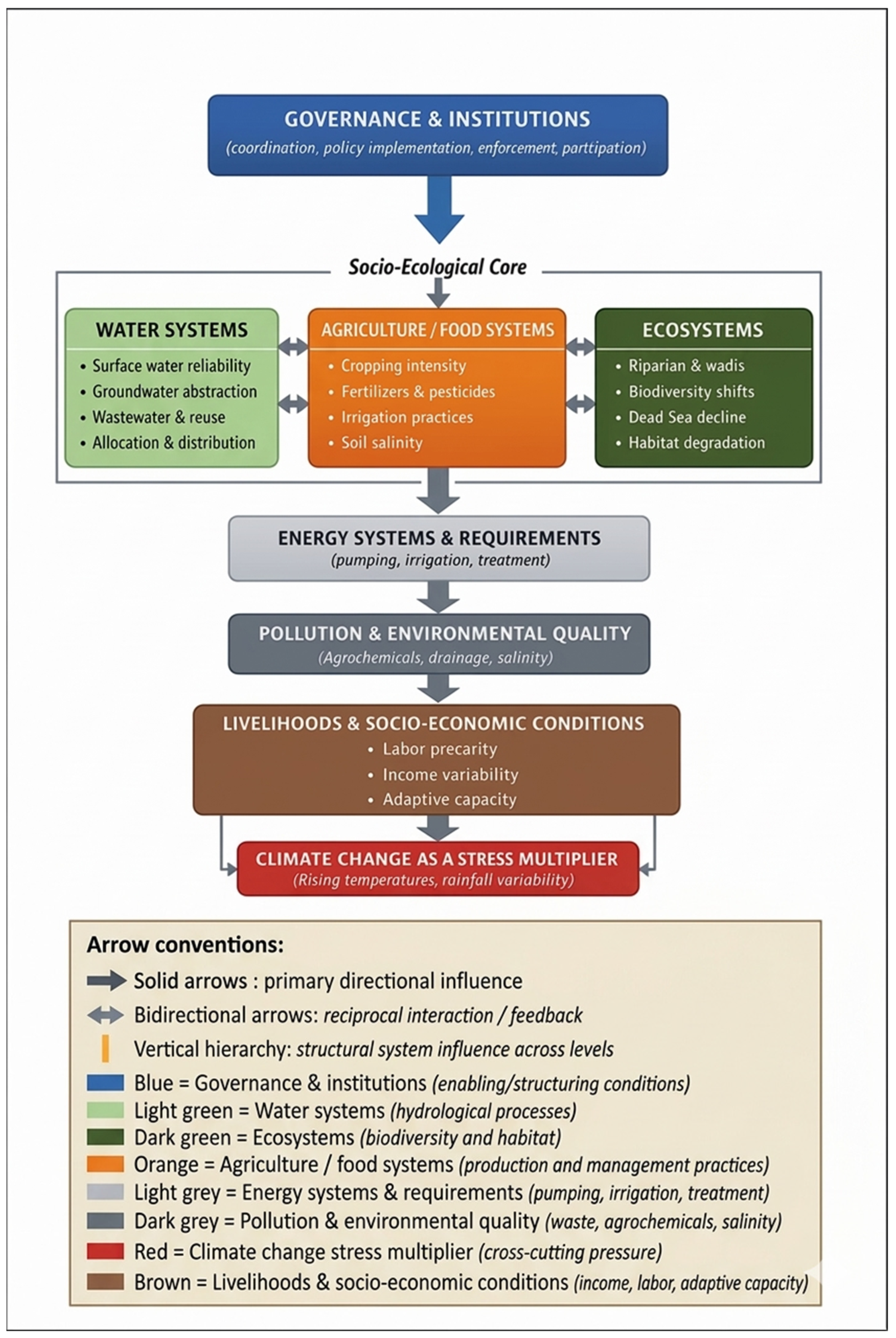
Rather than operating as separate “sectors,” these themes appeared repeatedly as reinforcing dynamics. Documents commonly described short-term adaptation responses (e.g., alternative water sourcing, intensified production practices) that stabilize agricultural outputs while creating longer-term risks (e.g., soil and water-quality degradation, ecosystem decline, and uneven social impacts). Table 1 summarizes the themes and subthemes that structure Section 3, and Figure 2 presents the SES–WEFE–guided analytical map used to organize the coding and interpretation.
Table 1.
Emergent themes and subthemes identified through qualitative document analysis.
Figure 2.
SES–WEFE coding structure used to organize analysis (conceptual map).
3.2. Water Scarcity as a Structuring System Constraint
Water scarcity emerged as the most dominant and recurrent theme across all analyzed documents. It functions not merely as an environmental condition but as the primary structural force shaping agricultural decisions, production risks, ecological stress, and governance tensions in the Jordan Valley. The documents consistently portrayed surface water variability, groundwater depletion, and increasing dependence on non-conventional water as interconnected pressures that define both the limits and opportunities for adaptation.
Unreliable flows in the King Abdullah Canal, fluctuations in Yarmouk River inflows, and rising municipal demand intensify competition over high-quality water. As a result, farmers increasingly rely on groundwater pumping and blended or treated wastewater, each carrying long-term implications for soil salinity, production stability, and environmental health. These pressures are compounded by temperature-driven increases in irrigation requirements, creating a cycle in which water scarcity reinforces agricultural intensification, which then reinforces further scarcity through higher extraction and reduced water quality. Figure 3 illustrates the core water-related feedback loops identified in the analysis, while Table 2 summarizes representative evidence from the documents.
Figure 3.
Water Scarcity Feedback Loops in the Jordan Valley. Conceptual diagram showing water scarcity as the central outcome of interacting feedbacks among declining surface water availability, increased groundwater pumping, agricultural intensification, non-conventional water use, and governance stress in the Jordan Valley. Box colors represent the main thematic domains. Solid and dashed arrows indicate different types of directional relationships and feedbacks among components.
Table 2.
Representative Coded Excerpts Related to Water Scarcity.
3.3. Agricultural Intensification and Resource Pressures
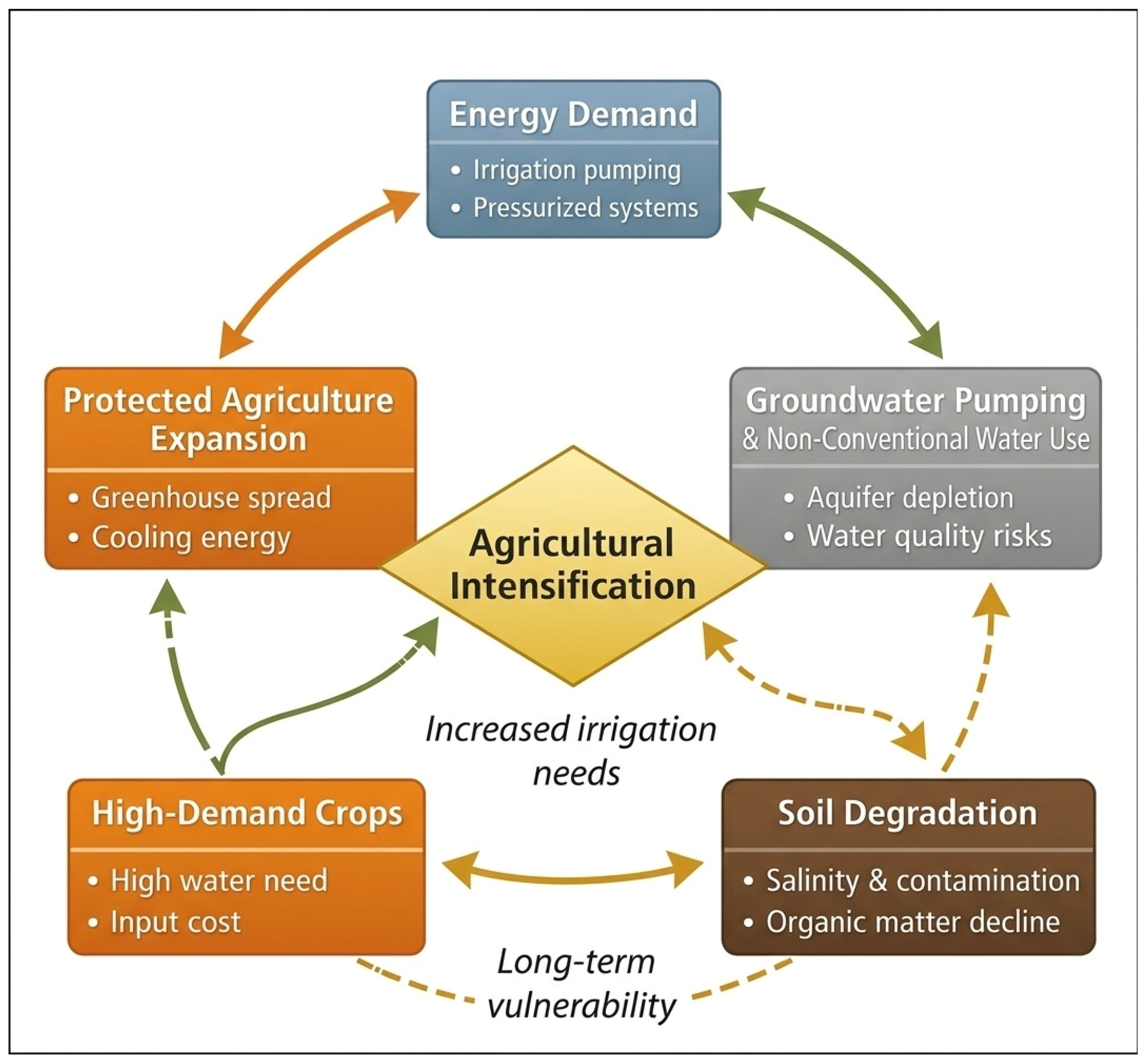
Agricultural intensification appeared throughout the documents as a central response to market demands, year-round production cycles, and the region’s comparative climatic advantages. However, the analysis shows that this intensification is deeply intertwined with the Jordan Valley’s water scarcity challenges. Expansion of protected agriculture, increased fertilizer and pesticide use, high-demand cropping patterns, and heavier irrigation requirements collectively amplify pressure on water and soil systems. Multiple sources describe a reinforcing loop: intensification increases irrigation needs, which increases groundwater pumping and dependence on alternative water sources, which then accelerates soil salinity and ecosystem degradation.
Energy dynamics emerged as a structurally significant mediator within this intensification process [19,20,21,22,23]. Groundwater abstraction in the Jordan Valley is closely coupled with energy availability and pricing structures [19,20,21,22,23]. Where electricity costs are subsidized or relatively affordable, the marginal cost of pumping declines, potentially weakening economic constraints on extraction. In this sense, energy does not merely enable irrigation—it actively shapes the scale and persistence of groundwater use under scarcity conditions.
The diffusion of solar-powered pumping systems further illustrates this dual dynamic [23]. Solar irrigation reduces operational costs and enhances short-term farmer resilience by lowering dependence on grid electricity or fuel. However, reduced pumping costs may also diminish financial disincentives for over-abstraction, particularly in contexts where regulatory enforcement is weak. This creates a water–energy feedback loop in which improved energy access stabilizes production while potentially intensifying aquifer stress.
Moreover, irrigation energy intensity increases as water tables decline and temperatures rise. Deeper pumping and higher irrigation frequencies require greater energy input per unit of agricultural output, reinforcing the interdependence between water scarcity, energy demand, and production decisions. Intensification therefore expands not only water demand but also the broader energy footprint of agriculture through pumping, pressurized irrigation systems, greenhouse cooling, and water treatment processes.
These findings indicate that energy functions as a co-equal WEFE nexus component influencing extraction behavior, adaptive capacity, and long-term system sustainability, rather than solely as a sub-dimension of agricultural intensification. Table 3 summarizes representative coded evidence, while Figure 4 illustrates the intensification-driven feedback loop identified in the qualitative analysis.
Table 3.
Representative Coded Evidence on Agricultural Intensification.
Figure 4.
Agricultural Intensification Feedback Loop in the Jordan Valley. Conceptual diagram showing agricultural intensification as a reinforcing process linked to protected agriculture expansion, high-demand crops, rising energy demand, groundwater pumping and non-conventional water use, and soil degradation in the Jordan Valley. Box colors represent the main thematic domains. Solid and dashed arrows indicate different types of directional relationships and feedbacks among components.
3.4. Climate Change as a Stress Multiplier
Climate change consistently emerged in the analysis as a system-wide amplifier rather than an isolated driver of change. Documents describe rising temperatures, increased evapotranspiration, and greater rainfall variability as forces that intensify pre-existing water scarcity, accelerate agricultural water demand, and heighten ecological sensitivity. These climatic pressures do not act independently; instead, they reinforce the region’s hydrological and agricultural vulnerabilities, increasing irrigation requirements, reducing the reliability of surface water flows, and exacerbating groundwater exploitation.
Climate-driven stress also interacts with soil and ecosystem degradation. Higher temperatures and prolonged dry spells increase salinity accumulation, reduce organic matter, and weaken ecological resilience in riparian and wadi environments. Social impacts were also noted, with climate variability contributing to income instability among small farmers, greater production risk, and higher adaptation costs. Table 4 summarizes representative evidence extracted from the documents, while Figure 5 illustrates the reinforcing loop through which climate change magnifies water and agricultural stress in the Jordan Valley.
Figure 5.
Climate Change Stress-Multiplier Loop in the Jordan Valley. Conceptual diagram showing climate change as a cross-cutting stress multiplier linked to temperature rise, rainfall variability, increased water demand, higher input needs, and farmer uncertainty and risk in the Jordan Valley. Box colors represent the main thematic domains. Solid and dashed arrows indicate different types of directional relationships and feedbacks among components.
Table 4.
Representative Coded Evidence on Climate Change as a Stress Multiplier.
3.5. Ecosystem Degradation and Loss of Ecosystem Services
Ecosystem degradation emerged as a major cross-cutting theme in the qualitative analysis, reflecting the cumulative ecological consequences of intensified agriculture, shifting hydrology, pollution pressures, and long-term climate variability in the Jordan Valley. The documents repeatedly highlighted declining riparian and wadi systems, reduced environmental flows, and the ecological impacts of the shrinking Dead Sea. These ecological stressors are not isolated outcomes; rather, they operate as part of a reinforcing feedback loop in which human-driven pressures weaken ecosystem services—such as natural drainage, soil fertility, habitat stability, and flood regulation—thereby increasing system vulnerability.
Soil degradation, loss of vegetative cover, habitat fragmentation, and shifts in biodiversity (including the spread of invasive species) were frequently noted. Reduced soil fertility and organic matter decline were linked with salinity buildup, contaminated return flows, and low-quality irrigation water. In turn, weakened ecosystems become less resilient to climatic shocks and less able to buffer pollution or support stable agricultural production. Table 5 summarizes coded evidence representing these patterns, while Figure 6 illustrates the system-level ecological degradation loop as identified in the analysis.
Figure 6.
Ecosystem Degradation Feedback Loop in the Jordan Valley. Conceptual diagram showing ecosystem degradation as the central outcome of interacting pressures linked to reduced river/wadi flows, invasive species pressure, pollutants and agrochemical runoff, degraded water resources, and decline of vertebrates in the Jordan Valley. Box colors represent the main thematic domains. Solid and dashed arrows indicate different types of directional relationships and feedbacks among components.
Table 5.
Representative Coded Evidence on Ecosystem Degradation.
3.6. Pollution and Environmental Quality Challenges
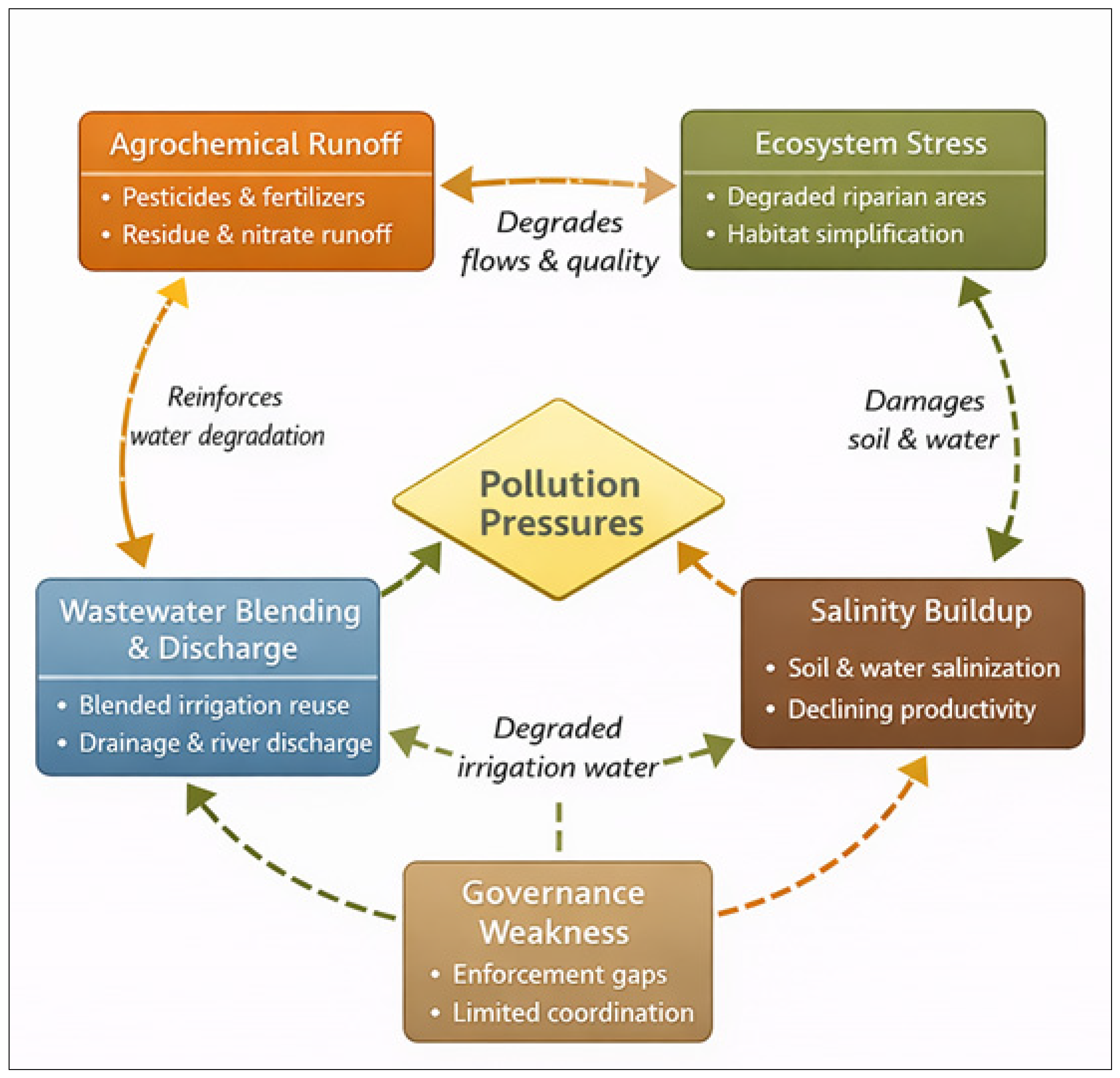
Pollution and environmental quality concerns emerged as major recurring themes across the analyzed documents, reflecting the cumulative impacts of intensified agriculture, low-quality water use, and weak environmental management systems in the Jordan Valley. Pollution pressures primarily stem from agrochemical runoff, treated wastewater, drainage return flows, and salinity accumulation—each of which affects soil health, water quality, and overall ecosystem functioning. These pressures form a reinforcing loop, where low-quality irrigation water contributes to soil degradation, degraded soils require greater input use, and increased inputs produce additional contamination.
Documents frequently highlighted pesticide and fertilizer overuse, especially in protected agriculture systems, where intensive production elevates the risk of nutrient leaching and chemical buildup. Wastewater reuse—now a key adaptation strategy under water scarcity—was often referenced as both essential and problematic, improving water availability while introducing contaminants and salinity risks when not adequately monitored. These pollution pressures weaken ecosystem resilience and reduce the capacity of natural systems to buffer against environmental shocks. Table 6 summarizes key coded evidence related to pollution dynamics, and Figure 7 visualizes the pollution feedback loop emerging from the qualitative analysis.
Table 6.
Representative Coded Evidence on Pollution and Environmental Quality Challenges.
Figure 7.
Pollution and Environmental Quality Feedback Loop in the Jordan Valley Conceptual diagram showing pollution pressures as a central process linked to agrochemical runoff, ecosystem stress, wastewater blending and discharge, salinity buildup, and governance weakness in the Jordan Valley. Box colors represent the main thematic domains. Solid and dashed arrows indicate different types of directional relationships and feedbacks among components.
3.7. Socio-Economic Vulnerability and Livelihood Constraints
Socio-economic vulnerability emerged as a cross-cutting theme that shapes how farmers, laborers, and local communities experience and respond to environmental and resource pressures in the Jordan Valley. The documents consistently emphasized income instability, limited financial buffers, dependency on informal labor, and exposure to fluctuating input and market prices. These vulnerabilities interact with environmental stressors—especially water scarcity, salinity, and climate variability—to produce uneven adaptive capacities, where smallholder farmers are disproportionately affected.
Seasonal labor shortages, reliance on migrant workers, and high production costs were commonly cited as pressures that undermine resilience and long-term planning. For many farmers, adaptation measures—such as adopting advanced irrigation technologies or investing in soil improvements—remain financially out of reach, reinforcing dependency on short-term strategies that may worsen long-term sustainability. Market volatility, limited access to credit, and weak institutional support further amplify livelihood fragility. Table 7 presents representative evidence supporting this theme, while Figure 8 illustrates how socio-economic vulnerability functions as both a driver and consequence of SES–WEFE system pressures.
Figure 8.
Socio-Economic Vulnerability Feedback Loop in the Jordan Valley. Conceptual diagram showing socio-economic vulnerability as a central outcome linked to income instability, input and market exposure, weak adaptive capacity, labor precarity, and climate and resource stress in the Jordan Valley. Box colors represent the main thematic domains. Solid and dashed arrows indicate different types of directional relationships and feedbacks among components.
Table 7.
Representative Coded Evidence on Socio-Economic Vulnerability.
3.8. Fragmented Governance and Cross-Sector Coordination Gaps
Governance fragmentation emerged as one of the most influential structural themes shaping water, agriculture, and environmental outcomes in the Jordan Valley. Across the analyzed documents, institutional responsibilities were described as dispersed across multiple ministries, agencies, water authorities, and local entities with limited horizontal coordination. This misalignment creates procedural delays, policy inconsistencies, and weak enforcement—ultimately undermining the implementation of integrated resource management strategies.
Documents highlighted that water allocation decisions often prioritize sectoral mandates over system-wide resilience, while agricultural planning is insufficiently linked to water availability projections, environmental thresholds, or long-term climate risks. Monitoring and regulatory gaps were common, especially regarding groundwater abstraction, wastewater quality, fertilizer use, and enforcement of environmental standards. Limited participation mechanisms for farmers further weaken trust and restrict information flow, reducing the effectiveness of policies intended to promote sustainability.
The resulting governance loop is characterized by misaligned incentives, fragmented decision-making, and short-term coping strategies that unintentionally reinforce long-term vulnerabilities. Table 8 synthesizes representative coded evidence from the dataset, while Figure 9 visualizes the governance fragmentation feedback loop identified in the analysis.
Figure 9.
Governance Fragmentation Feedback Loop in the Jordan Valley. Conceptual diagram showing fragmented governance as a central condition linked to institutional fragmentation, policy–practice gaps, weak adaptive capacity, weak farmer engagement, and resource mismanagement in the Jordan Valley. Box colors represent the main thematic domains. Solid and dashed arrows indicate different types of directional relationships and feedbacks among components.
Table 8.
Representative Coded Evidence on Governance Fragmentation.
3.9. Integrated SES–WEFE System Interactions (Synthesis)
This section integrates the themes identified through the qualitative analysis to present the overall SES–WEFE interaction structure emerging from the reviewed evidence. By synthesizing the relationships across water, agriculture, ecosystems, governance, and socio-economic dimensions, it highlights the reinforcing feedback dynamics that shape the functioning and resilience of the Jordan Valley system.
The synthesis of all coded themes reveals the Jordan Valley as a tightly coupled socio-ecological system in which water scarcity, agricultural intensification, climate variability, ecosystem degradation, pollution pressures, socio-economic vulnerability, and governance fragmentation operate as mutually reinforcing dynamics. Rather than functioning as separate domains, the qualitative evidence demonstrates that these pressures interact through circular causal pathways that collectively shape system resilience and long-term sustainability.
Water scarcity acts as the principal structural constraint, influencing agricultural practices, input intensity, and groundwater dependency. These agricultural responses, in turn, elevate pollution loads, degrade soils, and reduce ecosystem capacity to buffer shocks. Climate change intensifies each of these processes by raising irrigation needs, accelerating salinity buildup, and destabilizing seasonal water availability. Socio-economic vulnerabilities—particularly among small-scale farmers—both emerge from and reinforce these environmental pressures, limiting adaptive capacity and increasing reliance on short-term, high-risk strategies.
Governance fragmentation ties these loops together. Poor coordination, weak enforcement, and limited farmer engagement reduce the alignment of incentives across sectors, enabling unsustainable extraction, unmanaged pollution, and insufficient ecosystem protection. This institutional misalignment reinforces the long-term feedback loops identified across the SES–WEFE domains, locking the system into a trajectory of high resource pressure, environmental decline, and social fragility.
Table 9 summarizes the key cross-domain interactions, while Figure 10 visualizes the integrated systems map illustrating how pressures propagate through the socio-ecological system.
Table 9.
Cross-Domain Feedback Loops Identified in the SES–WEFE Synthesis.
Figure 10.
Integrated SES–WEFE System Interaction Map for the Jordan Valley. Integrative conceptual diagram illustrating the cross-domain interactions among climate change, water, food/agriculture, ecosystems, and fragmented governance in the Jordan Valley. Box colors represent the main thematic domains. Solid and dashed arrows indicate different types of directional relationships and feedbacks among components.
4. Discussion
The findings from this qualitative document analysis indicate that water scarcity functions as the primary structuring constraint shaping socio-ecological dynamics in the Jordan Valley, rather than a stand-alone environmental stressor. Across the coded materials, reduced and increasingly variable freshwater availability drives a shift toward groundwater abstraction and treated/blended wastewater reuse, which sustains agricultural production in the short term while accumulating long-term risks through groundwater depletion, soil salinization, and water-quality degradation [1,4,40,41,42,43,44,45,46]. Interpreted through an SES–WEFE lens, these findings imply that “adaptation” in the valley often operates as a form of risk displacement: scarcity is managed by reallocating pressure to other system components (aquifers, soils, ecosystems), thereby stabilizing outputs today at the expense of tomorrow’s resilience.
Comparable dynamics have been reported in other arid and semi-arid irrigation systems, where water scarcity is shaped not only by declining water availability but also by salt balances, water-quality deterioration, and governance constraints [47,48]. In the Nile Delta, for example, system-level analyses have shown that apparent efficiency gains at plot level do not necessarily produce equivalent water savings at the delta scale, particularly where drainage-water reuse and salt accumulation remain structurally embedded in irrigated production [47]. Similar pressures are evident in the Indus Basin, where the long-term sustainability of irrigated agriculture has been closely linked to groundwater stress, salinity management, and persistent governance and infrastructure challenges [48]. Related patterns are also documented in North African irrigation systems, including northeastern Morocco and semiarid Tunisia, where irrigated agriculture remains economically important but is increasingly affected by groundwater-quality decline, brackish irrigation, and salinization risks [49,50]. Viewed in this broader comparative context, the Jordan Valley does not appear as an isolated case of scarcity, but as part of a wider family of dryland irrigation systems in which adaptation may stabilize production in the short term while redistributing environmental pressures across soils, aquifers, and ecosystem functions [47,48,49,50]
A second major contribution of the analysis is demonstrating how agricultural intensification is tightly coupled with water scarcity and frequently becomes a reinforcing driver of resource stress. The evidence base repeatedly links intensive greenhouse and high-input production systems with soil-quality deterioration and salinity accumulation under conditions of limited drainage and heavy irrigation [6,7]. Even where water-saving irrigation technologies are adopted, system-level gains may remain constrained when intensification and expansion offset field-scale efficiency improvements, a dynamic documented in water-scarce agricultural systems [8,42,43,44,45]. Critically, this points to a policy-relevant tension: technical efficiency interventions may be necessary but remain insufficient when governance and incentive structures do not adequately regulate aggregate extraction. In such contexts, improvements in irrigation technologies may enhance field-level efficiency while failing to ensure basin-level water conservation, particularly where cultivated areas expand or cropping intensity increases. This pattern is consistent with the rebound effect in irrigation systems, whereby gains in irrigation efficiency do not necessarily reduce aggregate water demand at scheme or basin scale, especially when apparent water savings are offset by expansion, intensification, increased evapotranspiration, or reduced reusable return flows [51,52,53,54]. These dynamics underscore the importance of coupling technological modernization with coordinated governance mechanisms to prevent long-term resource stress and to align agricultural responses with broader national climate policy directions [8,51,52,53,54,55].
Climate change emerged as a cross-cutting stress multiplier that deepens existing hydrological uncertainty and raises the baseline pressure across the WEFE domains. The reviewed evidence indicates rising mean temperatures, more frequent heat extremes, and declining or more variable precipitation, with implications for groundwater recharge, surface water reliability, and higher evapotranspiration-driven irrigation requirements [8,9]. Importantly, the qualitative synthesis suggests climate change should be treated as an interaction term—not an additive factor—because it amplifies the consequences of current management trajectories. In practice, higher crop water requirements under warming conditions can intensify groundwater pumping and accelerate salinity processes, while reduced flows and altered salinity dynamics further degrade riparian systems and ecosystem functioning [6,8,10]. This interaction-based interpretation strengthens the case for integrated adaptive responses that jointly address water management, agricultural practices, and ecosystem protection.
The analysis also foregrounds socio-economic vulnerability as a mechanism that shapes how environmental pressures translate into lived outcomes and adaptive behavior. Documented reliance on seasonal and migrant labor, income variability, and uneven adaptive capacity indicates that households’ ability to adopt climate-smart practices, improved irrigation management, or salinity control is constrained by financial and institutional barriers [11,12,33]. From a systems perspective, vulnerability is not simply a downstream “impact”; it feeds back into environmental pressures by encouraging short-term coping strategies that prioritize immediate yields over long-term soil and water stewardship. This finding implies that resilience-building policies must incorporate distributive and procedural dimensions—who can adapt, at what cost, and with what access to information, credit, and institutional support—if sustainability interventions are to avoid deepening inequities.
Beyond its empirical insights, this study contributes theoretically to the SES and WEFE literature in three ways. First, it extends SES application to a predominantly state-managed irrigation system, demonstrating how water scarcity can function as a structural organizing constraint rather than solely as a resource variable. Second, it operationalizes the WEFE Nexus qualitatively by mapping reinforcing feedback loops across domains, moving beyond trade-off identification toward system-level interaction analysis. Third, it highlights governance fragmentation as a central mediating variable linking environmental stress, production strategies, and socio-economic vulnerability. These contributions nuance existing theory by emphasizing feedback-driven dynamics under conditions of chronic scarcity.
Overall, fragmented governance appears to be the system condition that binds and reinforces many of the negative feedback loops identified across themes. The evidence synthesized in the source document emphasizes that sustainability challenges in the Jordan Valley cannot be addressed through sectoral or purely technical interventions because agricultural productivity, water management, ecosystem integrity, and social equity are interdependent and embedded in institutional arrangements [13,14,23]. This study’s integrated results suggest that without coordination across water–agriculture–environment institutions, enforcement of abstraction and pollution controls, and credible mechanisms for farmer engagement, the system remains locked into maladaptive trajectories where short-term stabilization measures undermine long-term socio-ecological resilience. Accordingly, the most actionable implication is governance-centered: aligning incentives, strengthening monitoring, and enabling cross-sector planning are not “enablers” on the periphery; they are core interventions required to shift the Jordan Valley toward sustainable adaptive responses.
Figure 9 and Figure 10 help synthesize these findings by visually integrating the principal socio-ecological interactions identified across the analysis. Rather than representing isolated sectoral outcomes, the diagrams illustrate how water scarcity, agricultural intensification, governance fragmentation, ecosystem degradation, and adaptive responses are linked through reinforcing feedbacks and cross-sector trade-offs. Read in conjunction with the Discussion, these figures support the interpretation of the Jordan Valley as a tightly coupled SES–WEFE system in which short-term adaptation may stabilize production while intensifying longer-term environmental and institutional pressures.
5. Conclusions and Implications
This study examined two interrelated questions concerning the socio-ecological dynamics of water scarcity in the Jordan Valley. First, the analysis shows that chronic water scarcity generates reinforcing feedback loops by triggering adaptive responses—such as groundwater abstraction, wastewater reuse, production intensification, and reliance on lower-quality water—that may stabilize agricultural output in the short term while amplifying salinity risks, ecosystem degradation, and long-term resource stress. Second, the integrated use of SES and WEFE lenses offered additional analytical value by showing how water, agriculture, ecosystems, and governance are linked through cross-sector trade-offs rather than isolated sectoral problems. This combined perspective makes visible how governance fragmentation, uneven adaptive capacity, and resource management decisions interact to shape both vulnerability and the limits of existing adaptive responses in the Jordan Valley.
The findings of this qualitative socio-ecological analysis illustrate that the Jordan Valley operates as a tightly coupled and increasingly fragile system shaped by chronic water scarcity, intensifying agricultural demands, climate-driven stress, ecosystem degradation, and socio-economic vulnerability. These pressures reinforce one another through feedback loops that erode long-term resilience. Water scarcity—exacerbated by climate variability and groundwater over-extraction—triggers intensified production and greater reliance on low-quality water, contributing to soil salinity, declining ecosystem services, and heightened production risks. Governance fragmentation further constrains coordinated responses, limiting the system’s capacity for adaptive stabilization.
To translate these systemic insights into operational policy directions, interventions must target leverage points within the identified feedback loops. This may include establishing a cross-ministerial WEFE coordination platform integrating the Ministry of Water and Irrigation, Ministry of Agriculture, Ministry of Environment, and energy authorities to align groundwater abstraction policies, irrigation allocation rules, and renewable energy deployment. Linking irrigation licensing with real-time groundwater monitoring systems, incentivizing solar irrigation only under regulated abstraction caps, and embedding ecosystem restoration targets within agricultural subsidy schemes would operationalize nexus-informed governance. Such mechanisms move beyond general coordination calls toward enforceable and measurable adaptive responses.
By addressing structural feedbacks rather than isolated sectoral symptoms, policy interventions can more effectively enhance long-term socio-ecological resilience in the Jordan Valley and comparable water-scarce agroecosystems.
Methodologically, this study demonstrates the value of qualitative document analysis (QDA) for integrated nexus research. Unlike scoping reviews that primarily map literature coverage, or quantitative models that optimize sectoral variables, QDA allows the systematic interpretation of cross-domain narratives, institutional framings, and feedback structures embedded in policy and technical documents. This approach makes visible governance fragmentation, adaptive trade-offs, and reinforcing socio-ecological dynamics that are often obscured in sector-specific or model-driven analyses. In this sense, the contribution is not only empirical but also methodological, illustrating how interpretive systems mapping can support nexus-informed sustainability planning.
The systemic findings of this study also align with and inform broader sustainability frameworks. The identified water–agriculture–ecosystem feedbacks directly relate to SDG 6 (sustainable water management), SDG 2 (sustainable food systems), SDG 13 (climate resilience), and SDG 15 (ecosystem protection). By highlighting governance fragmentation and feedback-driven vulnerability, the analysis supports integrated implementation approaches consistent with Jordan’s Nationally Determined Contributions (NDCs) under the UNFCCC and risk-reduction principles reflected in the Sendai Framework. Embedding SES–WEFE-informed coordination within national planning structures could therefore strengthen policy coherence across these global commitments.
6. Limitations and Future Research
This study is subject to several limitations that should be considered when interpreting its findings. First, the analysis is based on qualitative document analysis of publicly available academic and institutional sources. While this approach enables integrative system-level interpretation, it does not provide direct empirical observation of on-the-ground practices or real-time decision-making processes.
Second, the study relies on published materials that reflect specific institutional, disciplinary, and policy perspectives. Although triangulation across diverse sources was employed to enhance analytical robustness, some stakeholder experiences—particularly those of smallholder farmers and informal laborers—may be underrepresented in documentary records.
Third, the qualitative and interpretive nature of the analysis prioritizes thematic synthesis and systems understanding over quantitative generalization. As such, the findings are intended to support analytical insight and policy reflection rather than statistical inference.
The qualitative coding and thematic synthesis were conducted by a single analyst. Although formal intercoder reliability testing was not undertaken, methodological rigor was supported through iterative coding cycles, systematic cross-referencing with original texts, reflexive memoing, and transparent documentation of coding structures (see Supplementary Table S2). Nonetheless, the absence of independent intercoder validation represents a methodological limitation, and future research could strengthen reliability through multi-analyst coding or structured peer debriefing processes.
Although the corpus included both English- and Arabic-language sources, differences in indexing systems, digital accessibility, and archival organization may have influenced representation within the dataset. English-language peer-reviewed literature is more systematically searchable, whereas some Arabic governmental documents are less consistently archived in accessible formats. While efforts were made to incorporate relevant Arabic institutional materials, this imbalance may introduce partial selection bias in thematic emphasis.
The analytical corpus spans 2002–2025 to capture both historical and contemporary socio-ecological and governance dynamics in the Jordan Valley. While this extended timeframe enables longitudinal interpretation of structural trends, it also integrates documents produced under differing institutional, hydrological, and policy contexts. Accordingly, the findings emphasize recurring system patterns and feedback structures rather than detailed period-specific policy evaluation.
While the SES framework provides a valuable structure for analyzing coupled human–environment systems, it was originally developed to examine common-pool resource governance and community-based management contexts. Its application to a predominantly state-managed irrigation system, such as the Jordan Valley, therefore requires interpretive adaptation. In this study, SES is used as an analytical lens to structure cross-sector interactions rather than as a prescriptive governance model.
A further boundary condition concerns the institutional specificity of the Jordan Valley as a predominantly state-managed irrigation system. Many of the socio-ecological dynamics identified in this study—particularly those related to water allocation, groundwater regulation, infrastructure dependence, and the coordination of adaptive responses—are shaped by formal state institutions and sectorally organized governance arrangements. While similar feedbacks may also occur in other water-scarce agroecosystems, the form they take and the mechanisms through which they are mediated may differ in contexts characterized by stronger community self-governance, farmer-managed irrigation, or more decentralized resource management. The transferability of the findings should therefore be understood as conceptual rather than directly universal, with particular caution needed when extending these interpretations to irrigation systems governed through substantially different institutional configurations.
Similarly, the WEFE Nexus has been critiqued for conceptual ambiguity in operationalizing the “ecosystems” dimension and for challenges in translating ecosystem services into measurable policy instruments. In this research, the ecosystems component is interpreted qualitatively through documented evidence of ecological degradation, salinity processes, and service loss, rather than through quantitative ecosystem accounting. These considerations should be acknowledged when interpreting the analytical scope of the integrated SES–WEFE framework applied here.
Future research could extend this systems-oriented analysis through more integrative methodological designs. Mixed-methods approaches combining participatory rural appraisal (PRA) with groundwater modeling and irrigation-demand simulations would allow examination of how farmer-level adaptation interacts with basin-scale extraction constraints. Multi-analyst qualitative coding could enhance interpretive robustness, while comparative multi-case QDA studies across irrigation systems in the MENA region would help assess whether similar SES–WEFE feedback structures emerge under different governance regimes. Longitudinal monitoring frameworks linking socio-economic surveys with real-time abstraction and salinity data would further enable empirical testing of the feedback dynamics identified in this study.
Supplementary Materials
The following supporting information can be downloaded at: https://www.mdpi.com/article/10.3390/su18073161/s1, Table S1: Document Corpus (n = 50); Table S2: Coding Matrix; Table S3: Theme Frequency; Table S4: Source Type Frequency; Table S5: WEFE Domain Frequency; Table S6: Source Type × Theme Cross-Tabulation; Table S7: Domain × Theme Cross-Tabulation.
Author Contributions
Conceptualization, S.A.; methodology, A.A. (Ahmad Alwan) and S.A.; validation, A.A. (Ahmad Alwan) and M.A.N.; investigation, S.A., M.A.N. and L.H.; resources, R.A.-R. and A.A. (Abeer Albalawneh); data curation, M.A.L.; writing—original draft preparation, S.A., A.A. (Ahmad Alwan) and M.A.N.; writing—review and editing, A.A. (Ahmad Alwan) and S.A.; visualization, S.A.; supervision, A.A. (Ahmad Alwan) and N.N.; project administration, A.A. (Ahmad Alwan); funding acquisition, N.N. All authors have read and agreed to the published version of the manuscript.
Funding
This research was supported by the European Union through the PRIMA Programme under Grant Agreement No. 2243 (Project EcoFuture), Call 2022, Section 1: WEFE Nexus IA.
Institutional Review Board Statement
Not applicable.
Informed Consent Statement
Not applicable.
Data Availability Statement
The original contributions presented in this study are included in the article. Further inquiries can be directed at the corresponding author.
Conflicts of Interest
Authors Safaa Aljaafreh, Abeer Albalawneh, Maram Al Naimat, Luma Hamdi, Rasha Al-Rkebat, and Ahmad Alwan were employed by the National Agricultural Research Center. The remaining authors declare that the research was conducted in the absence of any commercial or financial relationships that could be construed as a potential conflict of interest.
References
- Molle, F.; Venot, J.-P.; Hassan, Y. Irrigation in the Jordan Valley: Are water pricing policies overly optimistic? Agric. Water Manag. 2008, 95, 427–438. [Google Scholar] [CrossRef] [Scilit]
- Ministry of Water and Irrigation. National Water Strategy 2023–2040; Ministry of Water and Irrigation: Amman, Jordan, 2023.
- Hazaymeh, A.; Lange, J. A review on water quality aspects of urban rainwater harvesting in Jordan. Jordan J. Earth Environ. Sci. 2024, 15, 3. [Google Scholar]
- Al-Addous, M.; Bdour, M.; Alnaief, M.; Rabaiah, S.; Schweimanns, N. Water resources in Jordan: A review of current challenges and future opportunities. Water 2023, 15, 3729. [Google Scholar] [CrossRef] [Scilit]
- Al-Mashaqbeh, O.A.; Ghrair, A.M.; Megdal, S.B. Grey water reuse for agricultural purposes in the Jordan Valley: Household survey results in Deir Alla. Water 2012, 4, 580–596. [Google Scholar] [CrossRef] [Scilit]
- Ammari, T.G.; Tahhan, R.; Abubaker, S.; Al-Zu’bi, Y.; Tahboub, A.; Ta’Any, R.; Stietiya, M.H. Soil salinity changes in the Jordan Valley potentially threaten sustainable irrigated agriculture. Pedosphere 2013, 23, 376–384. [Google Scholar] [CrossRef] [Scilit]
- Ammari, T.G.; Tahhan, R.; Sulebi, N.A.L.; Tahboub, A.; Ta’Any, R.A.; Abubaker, S. Impact of intensive greenhouse production system on soil quality: The case of the Jordan Valley. Pedosphere 2015, 25, 282–293. [Google Scholar] [CrossRef] [Scilit]
- Al-Kharabsheh, A. Challenges to sustainable water management in Jordan. Jordan J. Earth Environ. Sci. 2020, 11, 38. [Google Scholar]
- Hadadin, N.; Qaqish, M.; Akawwi, E.; Bdour, A. Water shortage in Jordan—Sustainable solutions. Desalination 2010, 250, 197–202. [Google Scholar] [CrossRef] [Scilit]
- Al-Bakri, J.; Salahat, M.; Suleiman, A.; Suifan, M.; Hamdan, M.; Khresat, S.; Kandakji, T. Impact of climate and land use changes on water and food security in Jordan. Sustainability 2013, 5, 724–748. [Google Scholar] [CrossRef] [Scilit]
- Phenix Center for Economic and Informatics Studies. Labor Market Conditions and Workers’ Needs in the Jordanian Agricultural Sector: Roadmap; Phenix Center: Amman, Jordan, 2024. [Google Scholar]
- Department of Statistics. Jordan Statistical Yearbook 2022; Department of Statistics: Amman, Jordan, 2022.
- Salameh, E.; Shteiwi, M.; Al Raggad, M. Water Resources of Jordan: Political, Social and Economic Implications of Scarce Water Resources; Springer: Cham, Switzerland, 2018. [Google Scholar] [CrossRef] [Scilit]
- Zeitoun, M.; Lankford, B.; Krueger, T.; Forsyth, T.; Carter, R.; Hoekstra, A.Y.; Matthews, N. Reductionist and integrative research approaches to complex water security policy challenges. Glob. Environ. Chang. 2016, 39, 143–154. [Google Scholar] [CrossRef] [Scilit]
- Ostrom, E. A general framework for analyzing the sustainability of social–ecological systems. Science 2009, 325, 419–422. [Google Scholar] [CrossRef] [Scilit]
- Folke, C. Resilience. Ecol. Soc. 2016, 21, 44. [Google Scholar] [CrossRef] [Scilit]
- Ministry of Environment of Jordan. Jordan’s Second National Communication to the UNFCCC; Ministry of Environment of Jordan: Amman, Jordan, 2009.
- Government of Jordan. Voluntary National Review (VNR); United Nations: New York, NY, USA, 2021.
- Ministry of Energy and Mineral Resources (MEMR). Comprehensive Energy Sector Strategy 2020–2030; MEMR: Amman, Jordan, 2020.
- Ministry of Energy and Mineral Resources (MEMR). Energy Sector Strategy Summary 2020–2030; MEMR: Amman, Jordan, 2020.
- Ministry of Energy and Mineral Resources (MEMR). Annual Report 2020; MEMR: Amman, Jordan, 2020.
- Ministry of Energy and Mineral Resources (MEMR). Annual Report 2022; MEMR: Amman, Jordan, 2022.
- Jordan Renewable Energy and Energy Efficiency Fund (JREEEF). Achievements 2015–2020; JREEEF: Amman, Jordan, 2020.
- Ministry of Agriculture (MoA). Agricultural Statistical Annual Report 2023; MoA: Amman, Jordan, 2023.
- Ministry of Water and Irrigation (MWI). Jordan Water Sector: Facts and Figures 2022; MWI: Amman, Jordan, 2022.
- Ministry of Agriculture (MoA). Annual Achievements Report 2024; MoA: Amman, Jordan, 2024.
- Ministry of Environment of Jordan. Jordan’s Fourth National Communication on Climate Change; Ministry of Environment of Jordan: Amman, Jordan, 2015.
- UNFCCC Secretariat. Updated Nationally Determined Contribution (NDC) Submission to the UNFCCC; UNFCCC Secretariat: Bonn, Germany, 2021. [Google Scholar]
- Ministry of Environment (MoEnv). Strategy Plan of the Ministry of Environment 2024; MoEnv: Amman, Jordan, 2024.
- Ministry of Environment (MoEnv). Country Ecofact Sheet—Biodiversity; MoEnv: Amman, Jordan, 2020.
- Ministry of Water and Irrigation (MWI). Water Sector Policy for Wastewater Management and Reuse; MWI: Amman, Jordan, 2023.
- Ministry of Water and Irrigation (MWI). Nationwide Groundwater Quality Baseline Study 2020–2023; MWI: Amman, Jordan, 2023.
- Department of Statistics (DOS). Jordan in Figures 2022; DOS: Amman, Jordan, 2022.
- Ministry of Water and Irrigation (MWI). Energy Efficiency and Renewable Energy Policy for the Water Sector (2020 Update); MWI: Amman, Jordan, 2020.
- Ministry of Environment (MoEnv). Strategic Plan 2020–2022; MoEnv: Amman, Jordan, 2020.
- Ministry of Water and Irrigation (MWI). Water Sector Policy for Groundwater Sustainability; MWI: Amman, Jordan, 2023.
- Ministry of Water and Irrigation (MWI). Jordan Water Utilities Monitoring Report 2023; MWI: Amman, Jordan, 2023.
- Ministry of Water and Irrigation (MWI). IT Roadmap for the Water Sector in Jordan (Action Plan 2025); MWI: Amman, Jordan, 2025.
- Ministry of Agriculture (MoA). Annual Report 2023; MoA: Amman, Jordan, 2023.
- Abu-Allaban, M.; El-Naqa, A.; Jaber, M.; Hammouri, N. Water scarcity impact of climate change in semi-arid regions: A case study in Mujib Basin, Jordan. Arab. J. Geosci. 2015, 8, 951–959. [Google Scholar] [CrossRef] [Scilit]
- Ministry of Water and Irrigation (MWI). Water Sector Policy for Demand Management; MWI: Amman, Jordan, 2023.
- Ministry of Water and Irrigation (MWI). Water Sector Policy for Surface Water Utilization; MWI: Amman, Jordan, 2023.
- Ministry of Water and Irrigation (MWI). Water Sector Policy for Drought Management; MWI: Amman, Jordan, 2023.
- Ministry of Water and Irrigation (MWI). Climate Change Policy for a Resilient Water Sector; MWI: Amman, Jordan, 2023.
- Ministry of Water and Irrigation (MWI). The Water Sector’s Energy Policy 2023–2040; MWI: Amman, Jordan, 2023.
- Ministry of Water and Irrigation (MWI). Design and Planning Guidelines for Wastewater Projects; MWI: Amman, Jordan, 2025.
- Molle, F.; Gaafar, I.; El-Agha, D.E.; Rap, E. The Nile Delta’s water and salt balances and implications for management. Agric. Water Manag. 2018, 197, 110–121. [Google Scholar] [CrossRef] [Scilit]
- Qureshi, A.S.; Perry, C. Managing Water and Salt for Sustainable Agriculture in the Indus Basin of Pakistan. Sustainability 2021, 13, 5303. [Google Scholar] [CrossRef] [Scilit]
- Fetouani, S.; Sbaa, M.; Vanclooster, M.; Bendra, B. Assessing ground water quality in the irrigated plain of Triffa (north-east Morocco). Agric. Water Manag. 2008, 95, 133–142. [Google Scholar] [CrossRef] [Scilit]
- Bouksila, F.; Bahri, A.; Berndtsson, R.; Persson, M.; Rozema, J.; Van der Zee, S.E.A.T.M. Assessment of soil salinization risks under irrigation with brackish water in semiarid Tunisia. Environ. Exp. Bot. 2013, 92, 176–185. [Google Scholar] [CrossRef] [Scilit]
- Dumont, A.; Mayor, B.; López-Gunn, E. Is the rebound effect or Jevons paradox a useful concept for better management of water resources? Insights from the irrigation modernisation process in Spain. Aquat. Procedia 2013, 1, 64–76. [Google Scholar] [CrossRef] [Scilit]
- Wheeler, S.A.; Carmody, E.; Grafton, R.Q.; Kingsford, R.T.; Zuo, A. The rebound effect on water extraction from subsidising irrigation infrastructure in Australia. Resour. Conserv. Recycl. 2020, 159, 104755. [Google Scholar] [CrossRef] [Scilit]
- Hamidov, A.; Helming, K.; Balla, D.; Khamidov, M.; Mavlyanova, R.; Gafurov, Z.; Bekchanov, M. Rebound effects in irrigated agriculture in Uzbekistan: A stakeholder-based assessment. Sustainability 2022, 14, 8375. [Google Scholar] [CrossRef] [Scilit]
- Lankford, B.A. Resolving the paradoxes of irrigation efficiency: Irrigated systems accounting analyses depletion-based water conservation for reallocation. Agric. Water Manag. 2023, 290, 108437. [Google Scholar] [CrossRef] [Scilit]
- Ministry of Environment (MoEnv). National Climate Change Policy 2022–2050; MoEnv: Amman, Jordan, 2022.
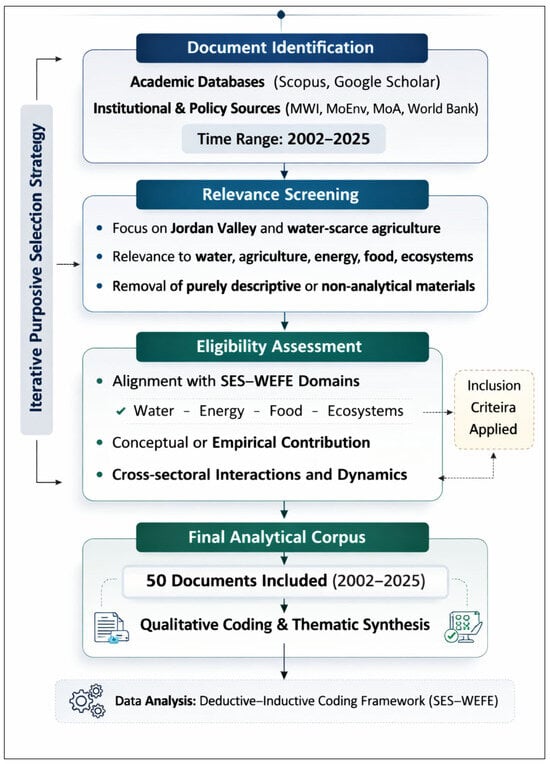
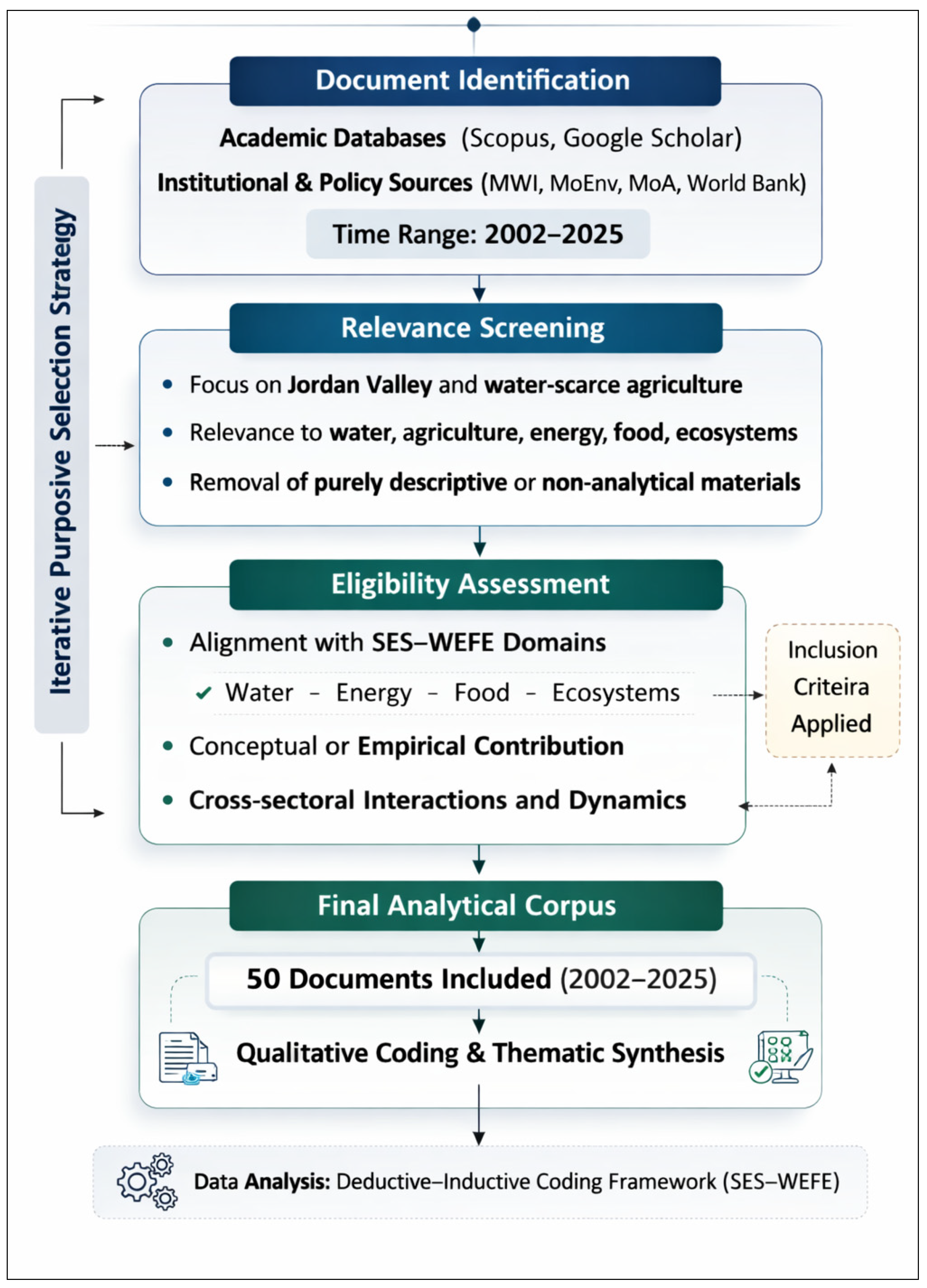
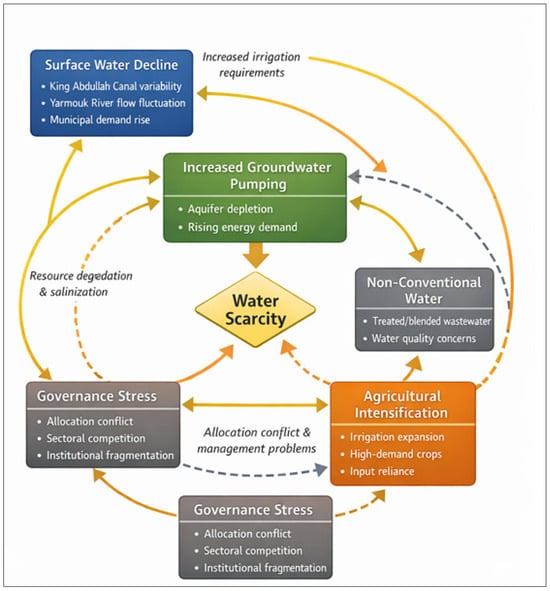
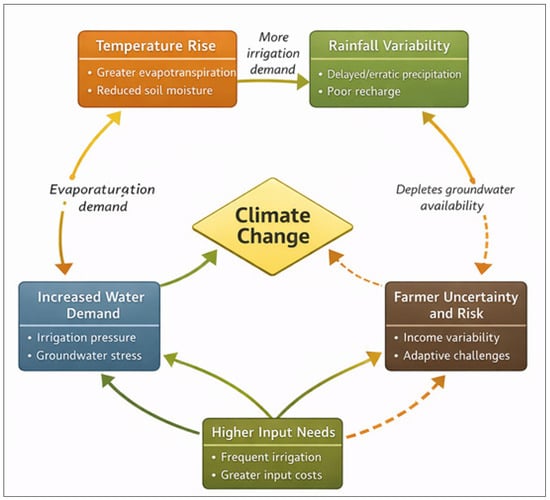
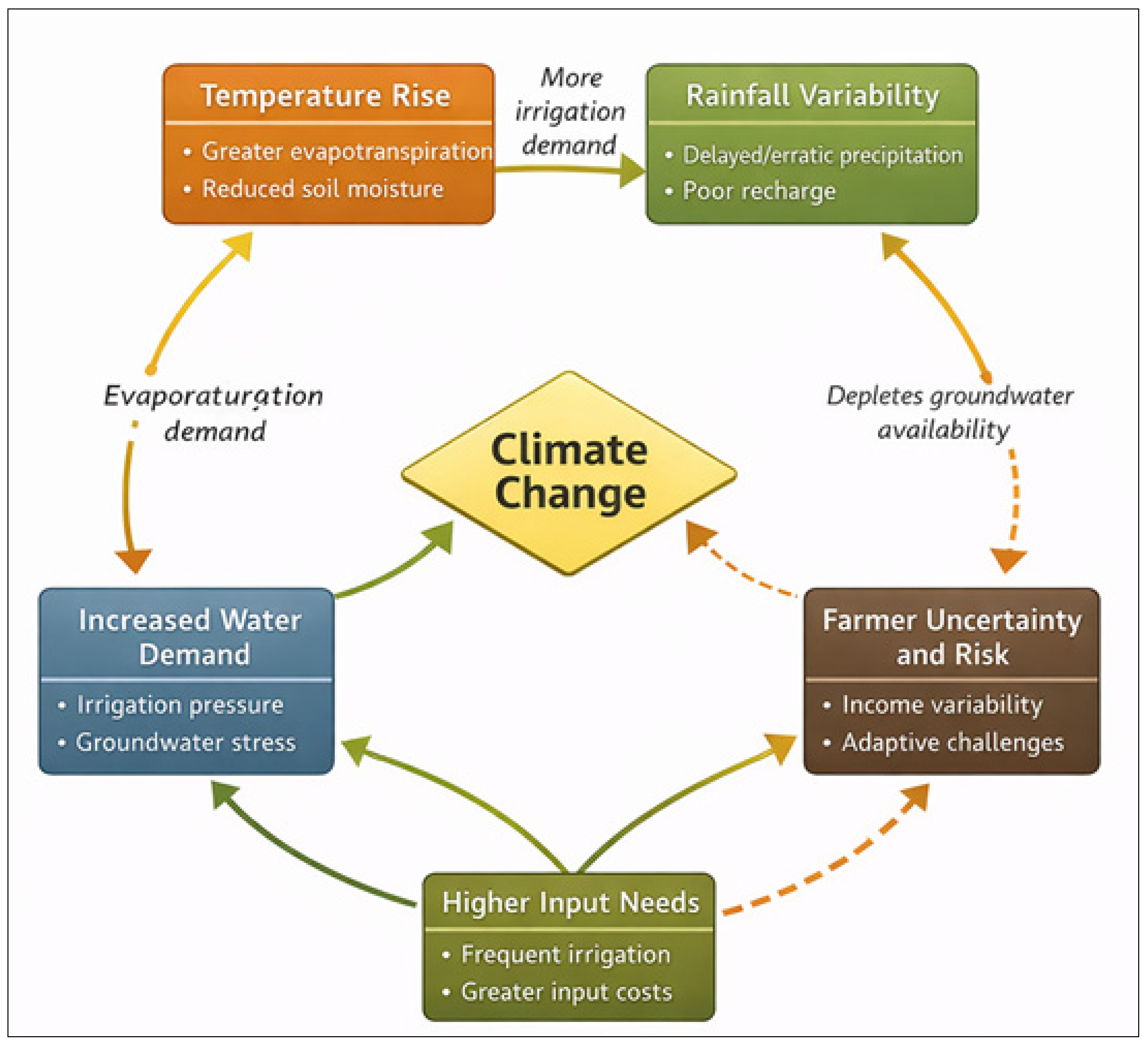
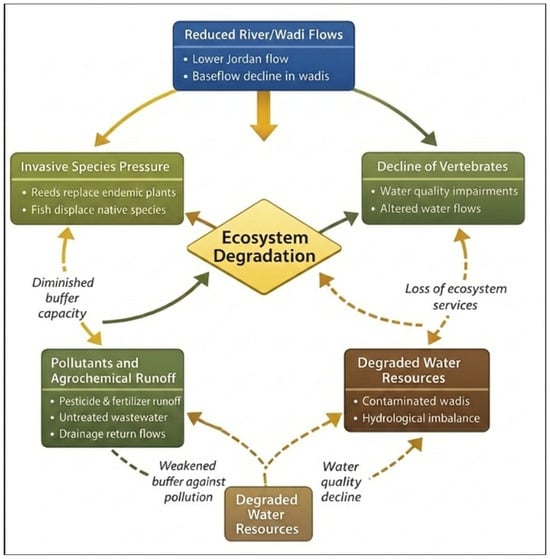
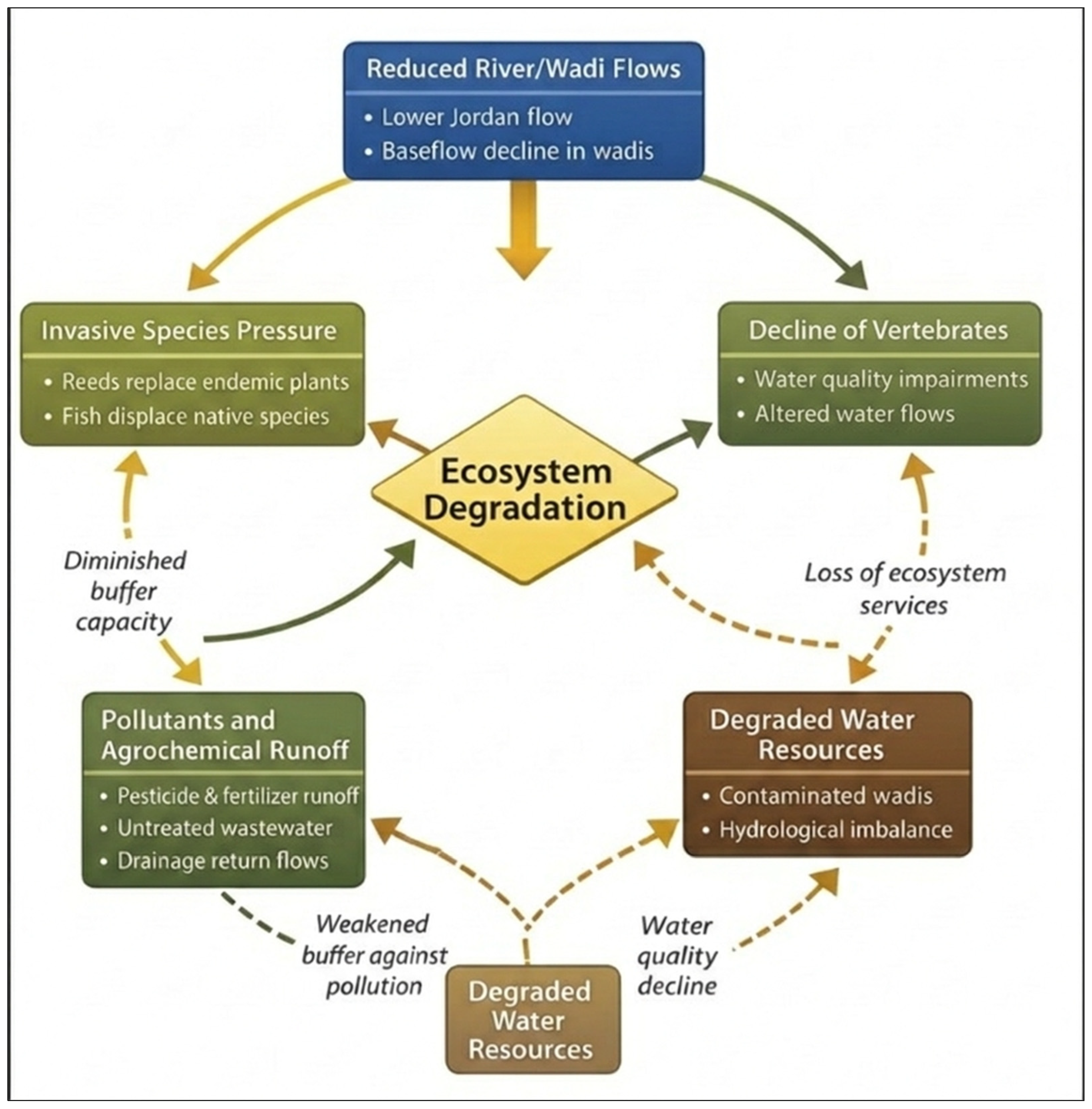
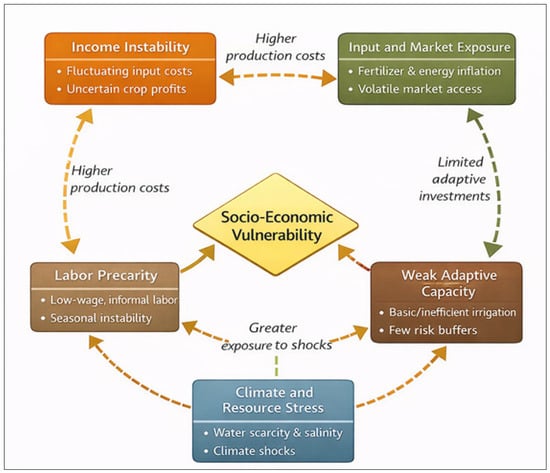
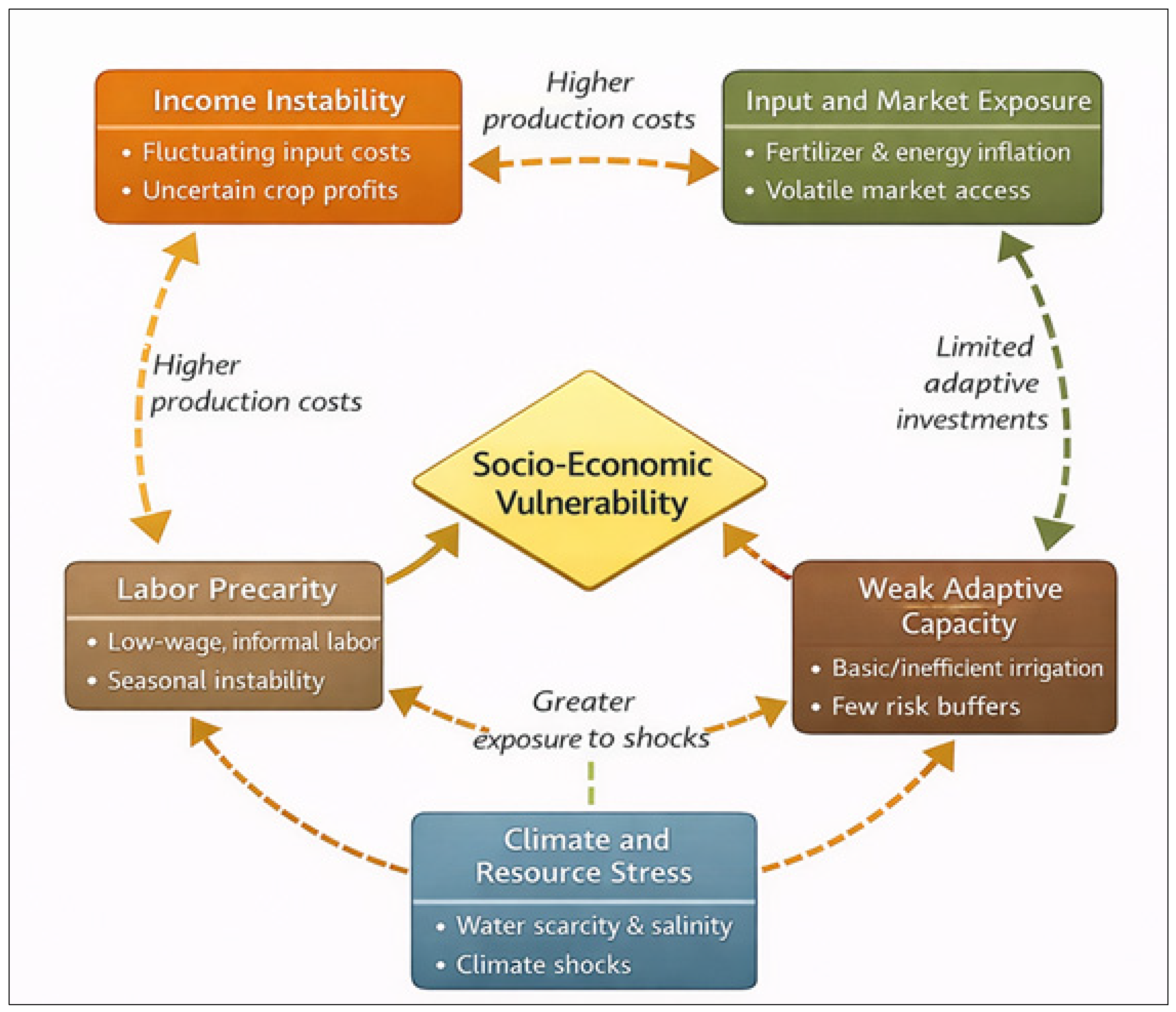
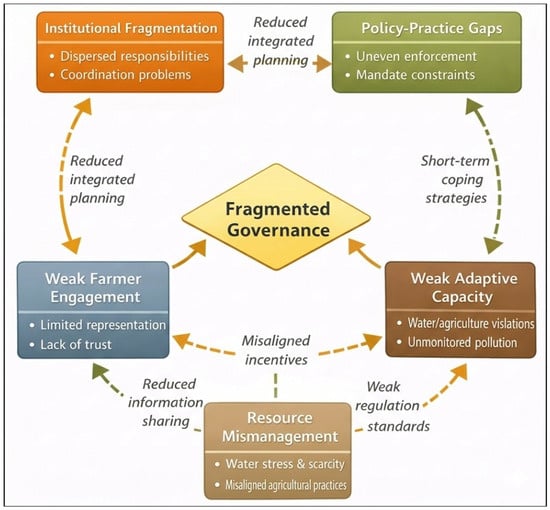
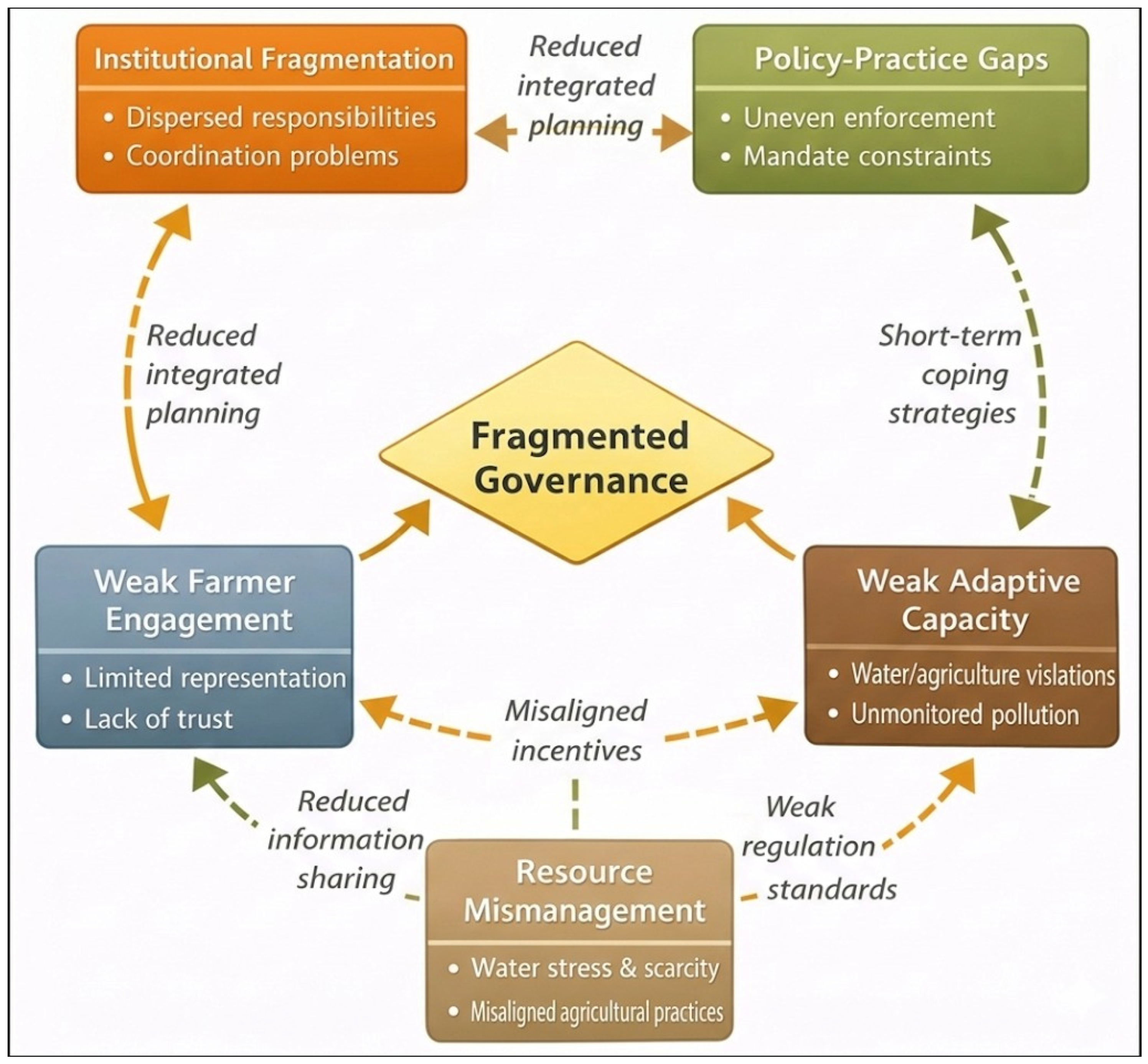
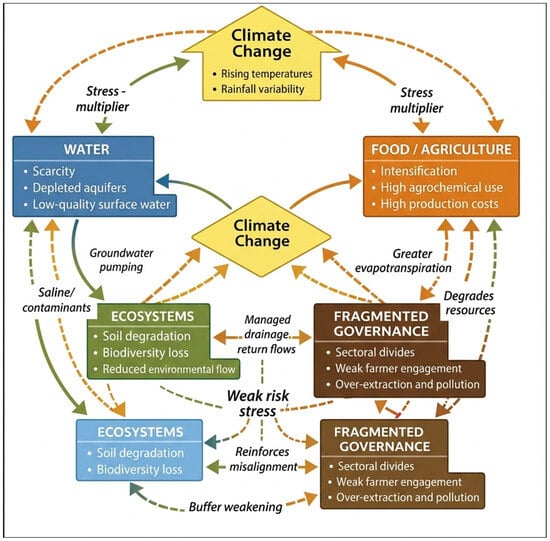
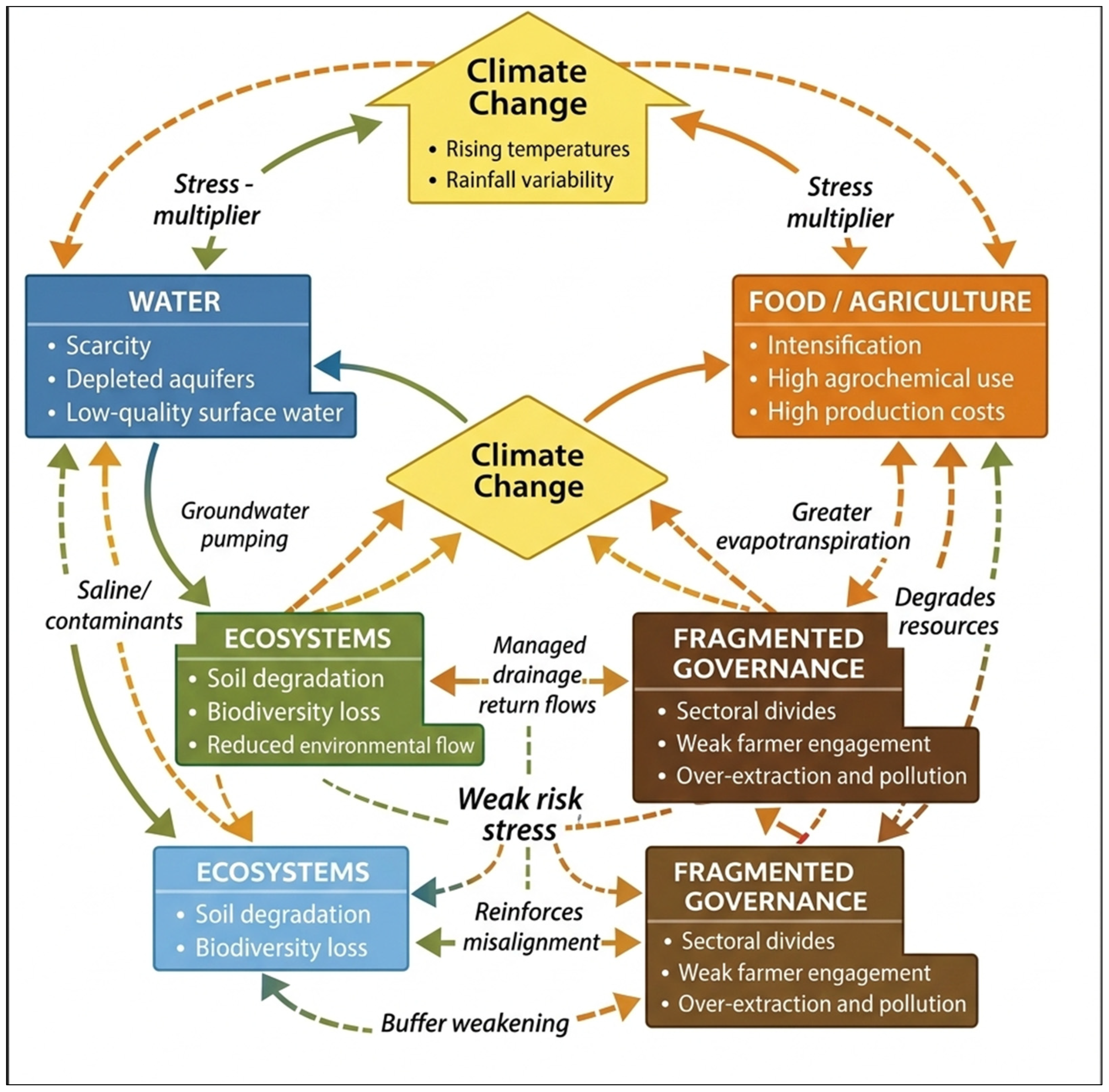

Disclaimer/Publisher’s Note: The statements, opinions and data contained in all publications are solely those of the individual author(s) and contributor(s) and not of MDPI and/or the editor(s). MDPI and/or the editor(s) disclaim responsibility for any injury to people or property resulting from any ideas, methods, instructions or products referred to in the content. |
© 2026 by the authors. Licensee MDPI, Basel, Switzerland. This article is an open access article distributed under the terms and conditions of the Creative Commons Attribution (CC BY) license.