


Abstract
With the rapid development of technology and increasing material consumption, the efficient management of waste streams has become a critical challenge within the circular economy, particularly in resource-intensive sectors such as electronic waste recycling. This study examines how artificial intelligence can improve the assessment and forecasting of circular economy investment efficiency, with particular attention paid to resource-intensive sectors such as electronic waste recycling. The study reviews data from European Union countries for the period 2010–2024, including economic, technological, and environmental indicators. A machine learning model system based on ensemble predictive methods was developed to assess the effectiveness of circular economy investments. The results show that artificial intelligence-based models have higher forecasting accuracy than traditional econometric methods, and the most important factors determining investment efficiency are the level of automation, recycling efficiency, and the stringency of environmental policies. The study provides a new, data-driven methodological approach to assessing circular economy investments and discusses their implications for sustainable real estate development and resource management.
1. Introduction
Accelerating technological development and global consumption trends have led to a significant increase in the consumption of electronic devices, and at the same time, an increase in the amount of electronic waste [1]. This situation poses problems not only for environmental aspects, but also for economic planning and investment assessment. The e-waste recycling sector, as an essential part of the circular economy, is becoming an increasingly important element of sustainable growth and responsible use of resources [2]. At the same time, the policy direction of the entire European Union (EU) is focused on the transition to a circular economy model, the aim of which is to ensure that products, materials, and resources remain in economic activity for as long as possible, and the amount of waste is minimal [3,4,5]. Electronic waste represents one of the fastest-growing and most complex waste streams due to its high material intensity, technological heterogeneity, and recycling challenges. As such, it constitutes a particularly relevant segment of the circular economy, reflecting broader issues related to resource efficiency, technological innovation, and investment performance.
The European Union provides a particularly suitable empirical context for this analysis due to its relatively homogeneous regulatory framework, advanced circular economy policies, and high availability of comparable macroeconomic, technological, and environmental data across countries. Moreover, EU member states differ substantially in their levels of technological readiness, recycling performance, and investment structures, which allows for meaningful cross-country comparison of circular economy investment efficiency under shared policy objectives.
The development of the circular economy is closely related to the principles of sustainable investment and, in particular, to the real estate (RE) sector, which is one of the largest consumers and sources of emissions [6,7]. In this study, the real estate sector is not analyzed as a separate empirical object but is treated as a key application domain through which circular economy investment outcomes and policy implications can be interpreted. Sustainable RE development, which includes increasing resource efficiency, recycling of building materials, and integrating energy transformation, is becoming an integral part of the circular economy chain [8,9].
Therefore, investments in the circular economy and its solutions can not only reduce the negative environmental impact but also generate financial returns, strengthening the resilience of the real estate market and its long-term value growth [10].
In this way, the real estate sector becomes a strategic unit where the economic, environmental, and technological aspects of sustainability intersect [11]. Instead, real estate is treated as a key contextual and application domain through which macro-level circular economy investment efficiency and policy outcomes can be interpreted.
However, traditional investment valuation methods are often not accurate enough when it comes to complex, multi-factorial processes such as circular economy investments. Classic econometric models are based on linear relationships between variables and often fail to properly process unstructured, interrelated dependent data [12]. As a result, artificial intelligence (AI) and machine learning (ML) methods are becoming increasingly relevant, as they can recognize nonlinear dependencies, interactions between variables, and ensure more accurate prognostic research [13,14,15].
These methods, applied in the field of investment valuation, allow for the transition from static to dynamic analytical systems that can take into account the interaction of various factors—technological, environmental, and economic.
The application of artificial intelligence in the assessment of circular economy investments allows for a new look at the processes of sustainable capital allocation [16]. Based on data from the period 2010–2024 covering various EU countries, it can be observed that such artificial intelligence methods as Random Forest, XGBoost, or SHAP analysis provide the opportunity not only to predict the return on investment, but also to assess the most important factors influencing the efficiency of investments. Research shows that the level of automation, recycling efficiency, and the stringency of environmental policies are key variables in determining the viability of investments in the circular economy sector. Assessing these factors is particularly important in the real estate market, where sustainability and resource efficiency become competitive advantages in the long term.
The real estate sector is closely related to the principles of the circular economy, not only through energy consumption, but also throughout the entire life cycle of buildings [17]. The increasing attention to the use of secondary raw materials, recycling of building materials, and sustainable design determines the need to assess the economic impact of these decisions [4,18]. Artificial intelligence methods open up new possibilities here—they allow us to assess how circular economy investments affect real estate value growth, rental profitability, project payback, or risk level [19]. In addition, the application of circular economy principles in real estate projects (e.g., cradle-to-cradle design or zero-waste construction strategies) increases the long-term value of assets and reduces operating costs, which further strengthens the case for sustainable investment [20].
In today’s market, investors and policymakers are increasingly faced with the challenge of making data-driven decisions in the context of environmental and economic sustainability [21,22,23,24,25]. In this context, the term “investors” refers primarily to institutional investors, public investment bodies, and private entities involved in financing circular economy infrastructure, recycling technologies, and sustainability-oriented projects.
The study focuses mainly on circular economy investments related to electronic waste recycling, but its conclusions also cover the broader context of sustainable real estate and resource management. This approach allows the analysis to remain consistent at the macro level while retaining a clear connection to a concrete and economically significant circular economy activity.
For example, automated artificial intelligence models can predict how investment efficiency will change under different scenarios—depending on the progress of recycling technologies, demand for raw materials, or tightening environmental policies [26]. This approach allows for the creation of a more comprehensive, dynamic, sustainable investment model that meets both economic and ecological goals.
The novelty of this study lies in its methodological approach: instead of traditional regression models, it is proposed to use ensemble artificial intelligence methods, which allow not only to predict the results of investments, but also to assess their dependence on technological and environmental factors. Accordingly, electronic waste recycling is used as a representative circular economy segment throughout the analysis. This allows combining two important aspects of sustainability—efficient resource use and optimization of capital allocation. In this way, investment assessment based on AI methods becomes a new tool for formulating sustainable real estate and resource management strategies and supporting policy decisions.
Despite the growing body of literature on circular economy development, sustainable real estate, and green investment, several important research gaps remain. First, most empirical studies assess circular economy performance using aggregated indicators or traditional econometric models, which are often unable to capture nonlinear relationships, interaction effects, and structural heterogeneity across countries. Second, while artificial intelligence methods are increasingly discussed conceptually in sustainability and finance research, their empirical application to cross-country investment efficiency assessment within the circular economy context remains limited. Third, existing studies typically analyze circular economy sectors or real estate sustainability in isolation, without providing an integrated analytical framework that links macro-level investment efficiency, technological and policy drivers, and sectoral implications. As a result, there is a lack of data-driven methodological approaches that systematically compare traditional econometric techniques with advanced AI-based models in evaluating circular economy investments across heterogeneous institutional and economic environments. The aim of this article is to investigate how artificial intelligence models can improve the assessment and forecasting accuracy of circular economy investment efficiency in EU countries, compared to traditional econometric approaches. The study aims to answer several key questions:
1. What economic, technological, and environmental factors determine the effectiveness of circular economy investments?
2. What additional explanatory and predictive value do artificial intelligence methods provide compared to traditional econometric models when assessing circular economy investment efficiency?
3. How can these factors be interpreted in the context of sustainable real estate development and long-term resource management?
The results of the study should contribute to the scientific literature in two ways. First, they will provide an empirical basis for assessing the returns and risks of circular economy investments using advanced artificial intelligence methods. Second, they will expand the understanding of how sustainable real estate projects can become catalysts for the circular economy by integrating economic and environmental criteria into a unified data-driven assessment system. Such a methodological synthesis helps to create not only a new analytical tool for investors but also for policymakers seeking to promote responsible capital allocation and long-term sustainability.
2. Review of the Literature
2.1. Circular Economy Investments and Sustainable Development
The circular economy (CE) has become one of the most important sustainability policy areas in the European Union (EU) and worldwide in recent years [27,28,29,30,31,32,33,34,35,36,37,38].
It aims to move from the traditional linear “take-make-dispose” model to one in which resources, products, and materials are used for as long as possible, and waste becomes a raw material for new production cycles [39]. The circular economy is based on three main objectives: reducing resource use, shortening waste streams, and maximizing the economic value of produced materials [40]. These aspects not only strengthen environmental and sustainability aspects, but also create new investment opportunities, especially in the technology, recycling, and real estate sectors [41].
Investment in circular economy sectors is considered one of the most important tools for achieving sustainable economic growth [42,43,44]. At the EU level, such investments are promoted by the Circular Economy Action Plan and the Green Deal, which aim to promote resource efficiency and reduce CO2 emissions in all industries [45]. According to this plan, circular economy measures should become an integral part of all sectors by 2030, from industry to real estate development [46]. Such ambitions create not only environmental but also financial pressures—companies and investors need to reorient their capital allocation to meet the new sustainability requirements.
Investments in the circular economy are a complex and complicated aspect, as the assessment must include both economic and ecological aspects [47,48]. On the other hand, such investments imply higher infrastructure costs and technological uncertainty in the short term. However, in the long term, they lead to greater resource efficiency, less dependence on primary raw materials, and greater resilience of assets to market and environmental risks [49]. In this sense, the circular economy becomes not only an environmental but also a strategic investment paradigm, focused on long-term capital preservation and sustainable income generation.
The scientific literature highlights that the success of investments in the circular economy depends on several key factors. The first is technological progress and the level of innovation that allows for increased efficiency in recycling and resource recovery [50]. The second is the institutional and political environment, including regulatory rules, various subsidies (especially public ones), and the coherence of green policies [51]. The third is the economic environment, especially the availability of capital and investor confidence in sustainability initiatives [52]. The synergy of these factors determines whether circular economy models can be widely applied in practice and whether they will be financially sustainable.
A significant part of the research on the circular economy links this concept to the development of sustainable real estate. The real estate sector accounts for more than 35% of the EU’s energy consumption, and more than 30% of waste originates from there [53]. Therefore, integrating this sector into the circular economy is a very important goal. Initiatives and projects such as recycling of building materials, the use of secondary raw materials, and increasing energy efficiency not only reduce the environmental impact but also create long-term value for real estate. Integrating circular economy principles into real estate projects leads to higher returns on investment, as sustainable buildings have lower operating costs, higher market value, and a more attractive image [54].
In addition, the real estate sector can become a catalyst for the circular economy by combining waste reduction, energy consumption, and investment flows into a single integrated system. Sustainable buildings and infrastructure allow for more efficient resource management—from recovering construction materials to optimizing water or energy consumption. Such an approach not only reduces the ecological footprint but also increases the potential for capital returns in the long term, which is especially important for investors focused on ESG criteria [55,56]. Within this broader context, electronic waste recycling is frequently highlighted in the literature as a capital-intensive and innovation-driven segment of the circular economy, where investment efficiency is closely linked to technological progress and regulatory frameworks.
2.2. The Role of the Real Estate Sector in the Circular Economy and Resource Management
The real estate (RE) sector is one of the largest intersections of the economy and the environment—it consumes around 40% of all energy, generates a third of all CO2 emissions, and a significant share of solid waste [57]. These indicators show that the RE sector plays a crucial role in achieving the goals of a circular economy and resource efficiency. Traditionally, RE projects have been evaluated mainly in terms of financial returns or changes in market value, but in the modern sustainability paradigm, they are increasingly considered as complex resource management units with long-term social and ecological impacts [58].
Integrating circular economy principles into the RE sector changes the traditional model of value creation. Instead of seeking maximum profit in the short term, sustainable RE projects are based on long-term efficiency, management of raw material flows, and lower operating costs [59]. This includes optimizing the energy consumption of buildings, using recyclable building materials, and adapting secondary assets (e.g., old buildings) to new functions [60]. This approach is in line with the essence of the circular economy—ensuring that the construction and operation cycles generate as little waste and energy loss as possible, while maintaining the value of the property for a longer period [61].
One of the most important aspects of the interaction between the circular economy and real estate is the principle of life cycle thinking. This methodological approach allows for the assessment of how a building affects the environment from design to demolition, including the impact of materials, energy consumption, and waste management [62]. Research shows that by making innovative and sustainable decisions at the design stage, up to 50% of the negative impact of a building on the environment can be reduced [63]. Therefore, not only economic but also ecological efficiency is becoming increasingly important in the investment assessment process, which is reflected in the financial return over time [64]. Sustainable buildings are characterized by higher market value, lower risk, and more stable rental flow [65].
Another important aspect is the development of circular infrastructure, which includes not only individual buildings, but also city- or regional-scale solutions [66]. The concept of a “smart city” and the principles of “green urbanism” are becoming the main tools for implementing a circular economy [67]. Such solutions allow optimizing the flows of resources—water, energy, waste—on the scale of the entire city system. Empirical research shows that cities that apply the principles of a circular economy achieve up to 30% lower resource costs and significantly higher investment attractiveness [68]. These results show that the circular economy is not only an environmental strategy but also a means to increase the return on investment in real estate and market resilience.
It is important to note that the real estate sector also performs a capital transformation function in a circular economy. Investments in sustainable buildings, recycling systems, or energy-efficient choices help to redirect capital from fossil-based sectors to more sustainable ones, thus promoting economic and, most importantly, structural change [69]. This is particularly relevant in the European market, where taxonomy requirements and ESG standards are determining changes in capital flows [70]. Real estate, as a long-term asset, is becoming an investment channel where circular economy principles can be implemented through specific infrastructure, from material selection to smart energy management [71].
Sustainable real estate development is also closely linked to the dimension of social sustainability. The circular economy promotes not only efficient use of resources, but also social responsibility—a healthier living environment, better access to energy, and a higher quality of life [72]. These factors are becoming increasingly important in the real estate valuation process, as growing consumer awareness and regulatory pressure are changing market behavior: buyers and tenants are increasingly choosing sustainable, energy-efficient properties, which increases the value of such investments.
2.3. Application of Artificial Intelligence in Investment and Environmental Assessment
The development of artificial intelligence (AI) and machine learning (ML) methods over the past decade has fundamentally changed the logic of data-driven decision-making in the fields of investment, environmental, and real estate analysis [73]. These methods allow processing large and complex amounts of data, identifying nonlinear dependencies between economic, technological, and environmental factors, and identifying long-term trends that traditional econometric models are usually unable to accurately assess [74]. The application of AI methods to the assessment of sustainable investments becomes particularly relevant in the context of the circular economy, where it is necessary to integrate a number of interrelated indicators—from processing efficiency and the level of automation to strict environmental policies [75].
One of the most important advantages of artificial intelligence is the ability to combine disparate data into a single analytical framework. Research shows that machine learning models such as Random Forest and XGBoost achieve significantly higher prediction accuracy than classical models, especially when the data is heterogeneous or covers a limited observation period [76]. Such models can adapt to various changing economic conditions and identify the most important factors that ultimately determine the effectiveness or risk of investments [77]. This provides a new approach to assessing the circular economy—allowing for modeling the complex relationships between recycling, energy consumption, and capital allocation processes [78].
Empirical research shows that artificial intelligence methods are increasingly used in the development of a green finance system [79]. For example, some authors emphasize that machine learning allows for real-time assessment of the risks of sustainable investments, including both macroeconomic and environmental indicators [80]. Such systems allow investors to identify which sectors are most vulnerable to climate policy or technological change [81]. This approach is particularly relevant in the context of the circular economy, where the value of investments often depends on innovation and technological progress, as well as constant changes in environmental standards [82].
Artificial intelligence is also widely used in the waste management and recycling sectors, which are an integral part of the circular economy. Machine learning algorithms and systems are used to predict waste flows, optimize recycling capacities, and assess the efficiency of energy production [83]. These models can help identify which advanced technologies or specific policies have the greatest impact on achieving environmental goals. Such analysis allows for the combination of environmental indicators with investment data, allowing for a more accurate assessment of the cost-effectiveness of sustainability measures.
In real estate (RE) analysis, AI methods are gaining increasing acceptance due to their ability to predict price, demand, and return dynamics [84]. Random forest and gradient boosting models allow identifying which variables—such as economic growth, energy prices, raw material availability, or sustainability requirements—have the greatest impact on changes in the RE market [85]. Such methods are particularly useful in assessing the impact of circular economy investments on the sustainable real estate and resource management sector, as they can identify how the development of recycling infrastructure, renewable energy, or sustainable materials affects the return on investment [86].
Another important area is ensuring the interpretation and transparency of artificial intelligence. In recent years, more and more attention has been paid to the explainability of models, especially when decisions affect financial flows and public policy [87]. For this, methods such as SHAP (Shapley Additive exPlanations) are used, which allow for a quantitative assessment of the contribution of each variable to the forecast. In this way, it is possible to determine which indicators most affect the efficiency of investments, be it the level of automation or the stringency of environmental policies [88]. Such analysis gives the study not only a predictive, but also an explanatory nature, which is extremely important when making investment or regulatory decisions.
AI methods also help to perform scenario and sensitivity analysis, which allows for predicting how investment returns or sustainability indicators would change under different environmental or economic conditions [89]. For example, AI models can estimate how investment efficiency would respond to a 20–50% increase in recycling efficiency or to stricter policies [70]. Such scenarios help not only investors but also policymakers to assess which solutions would bring the greatest benefits, both economically and environmentally [90].
3. Materials and Methods
The aim of this study is to assess how artificial intelligence (AI) methods can improve the assessment and forecasting accuracy of circular economy (CE) investments compared to traditional econometric models. The study also aims to show how these processes relate to the development of the sustainable real estate (RE) sector and resource management.
All statistical analyses and machine learning models were implemented using R software (version 4.3.2; R Foundation for Statistical Computing, Vienna, Austria). The Random Forest and XGBoost models were estimated using the packages randomForest (version 4.7-1.1) and xgboost (version 1.7.6), while model interpretability analysis was conducted using the SHAP framework implemented via the shapviz package (version 0.9.3).
3.1. Data Sources and Sample
The analysis was conducted using data from 2010 to 2024, covering six European Union countries selected due to data availability, institutional comparability, and their relevance to circular economy and sustainable investment policies. The selected time span captures several important structural phases relevant to circular economy investments, including the post-financial crisis recovery period, the acceleration of circular economy policies after 2015, the COVID-19 shock, the subsequent energy crisis, and the recent rapid diffusion of artificial intelligence technologies. While these phases introduce additional heterogeneity into the data, they also provide a realistic testing ground for assessing the robustness of AI-based models, which are specifically designed to handle non-linear dynamics, regime shifts, and complex interactions over time. The study used three groups of indicators—economic, technological, and environmental. Data sources:
- Eurostat—macroeconomic and environme
- ntal data (GDP, ROI, recycling efficiency, energy intensity, circular material use indicators);
- OECD—Environmental Policy Stringency Index and Innovation Investment;
- European Environment Agency (EEA)—waste streams, energy consumption, emission indicators;
- World Green Building Council—data on sustainable buildings and real estate investments;
- World Bank, UNEP—additional indicators on resource use, environmental quality, and technological readiness.
Since some of the data were missing, the predictive mean matching imputation procedure was applied, and all variables were standardized (z-score normalization) to ensure their comparability.
3.2. Set of Variables
The dependent variable is the Investment Efficiency Index (IEI), which summarizes the performance of circular economy investments. It is constructed from several indicators:
where is the return on investment, is recycling efficiency (%), is the circular material use rate (%), and the weights are derived from the proportion of variance in each component (using the principal component weighting method).
Independent variables:
- Automation_Level—level of automation in industry (robots per 10,000 workers);
- Recycling_Efficiency—waste recycling rate (%);
- Environmental_Policy_Stringency—environmental policy stringency index (0–6);
- R&D_Expenditure—R&D expenditure (% of GDP);
- Energy_Intensity—energy consumption per unit of GDP (toe/1000 €);
- Waste_Generation_per_capita—amount of waste (kg per capita);
- GDP_per_capita—indicator of economic well-being;
- Green_Building_Share—share of sustainable buildings among new constructions (%), included as a proxy variable capturing the diffusion of circular economy principles within the real estate sector and its interaction with macro-level investment efficiency, rather than as a basis for sector-specific real estate modeling;
- Electricity_Price—average electricity price (€/MWh).
Such variables allow combining the assessment of renewable energy, sustainable housing, and macroeconomics into one model.
3.3. Model Structure
The analysis was carried out in two stages:
(1) Traditional econometric models
Used for comparison to confirm the direction of the relationship:
where represents country-specific effects, —time effects, —matrix of explanatory variables, and —the error term.
This model allows controlling for country-specific factors (e.g., quality of institutions or geographical location), but its limitation is the assumption of a linear relationship between the factors.
(2) Artificial Intelligence Models—Random Forest and XGBoost
Both techniques belong to the ensemble decision tree family, but their construction logic differs:
- Random Forest uses the bagging principle, i.e., many random trees whose predictions are averaged:where denotes each tree’s prediction, and is the number of trees.
This method reduces the risk of overfitting and allows for the detection of nonlinear relationships.
- XGBoost is based on the boosting method—each new tree corrects the errors of the previous ones, and the error function is reduced iteratively:where is the loss function (Mean Squared Error) and is the regularization term controls model complexity.
Both models were validated using five-fold cross-validation, and the accuracy was assessed using RMSE, MAE, and R2 indicators:
3.4. Variable Importance and Interpretability
SHAP (SHapley Additive exPlanations) analysis, based on game theory principles, was used to interpret the models.
It allows us to assess the contribution of each variable to the predicted outcome:
where is the marginal contribution of the variable , and are model predictions with and without that variable, respectively.
Positive SHAP values mean that the factor increases the efficiency of investments, and negative values mean that it decreases them.
SHAP allows us to identify the most important determining factors, such as the level of automation, recycling efficiency, or the stringency of environmental policies. By combining high predictive accuracy with explainability, the SHAP framework addresses one of the main criticisms of AI-based models in economic research, namely their limited transparency. This allows the results to be interpreted in a policy-relevant and economically meaningful manner rather than as purely algorithmic outputs.
3.5. Scenario Analysis
To stimulate the sensitivity of CE investment efficiency to policy and technological shifts, a scenario analysis was conducted:
where represents baseline predictions and represents outcomes under alternative assumptions.
Three sets of scenarios were modeled:
S1: increase in environmental policy stringency by +10 to +50%;
S2: increase in automation level by +20 to +100%;
S3: increase in recycling efficiency by +10 to +40%.
These scenarios allow us to predict how investment efficiency and the potential for sustainable RE development change depending on the direction of policy or technology.
3.6. Methodological Summary
This methodological framework combines:
- Panel regression (OLS, FE)—for benchmark association estimates and comparison; AI models (Random Forest, XGBoost)—for detecting nonlinear and interaction effects;
- SHAP—for interpretation and policy impact assessment.
This approach allows us not only to predict the CE, but also to reveal which factors are most important for RE and how they interact with each other in different EU contexts.
4. Results
This section presents empirical results obtained using traditional econometric models and advanced artificial intelligence (AI) methodologies. The comparison allows us to assess whether ensemble-type models (Random Forest and XGBoost) provide additional value in predicting the effectiveness of circular economy investments in European Union countries for the period 2010–2024.
4.1. Changes in Investment Efficiency (IEI) 2010–2024
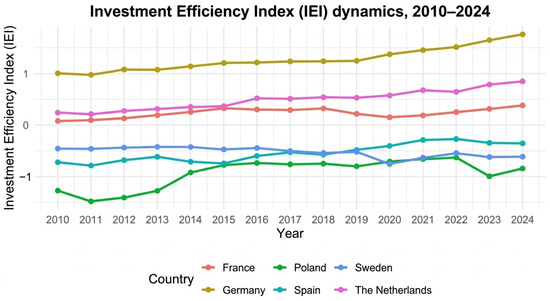
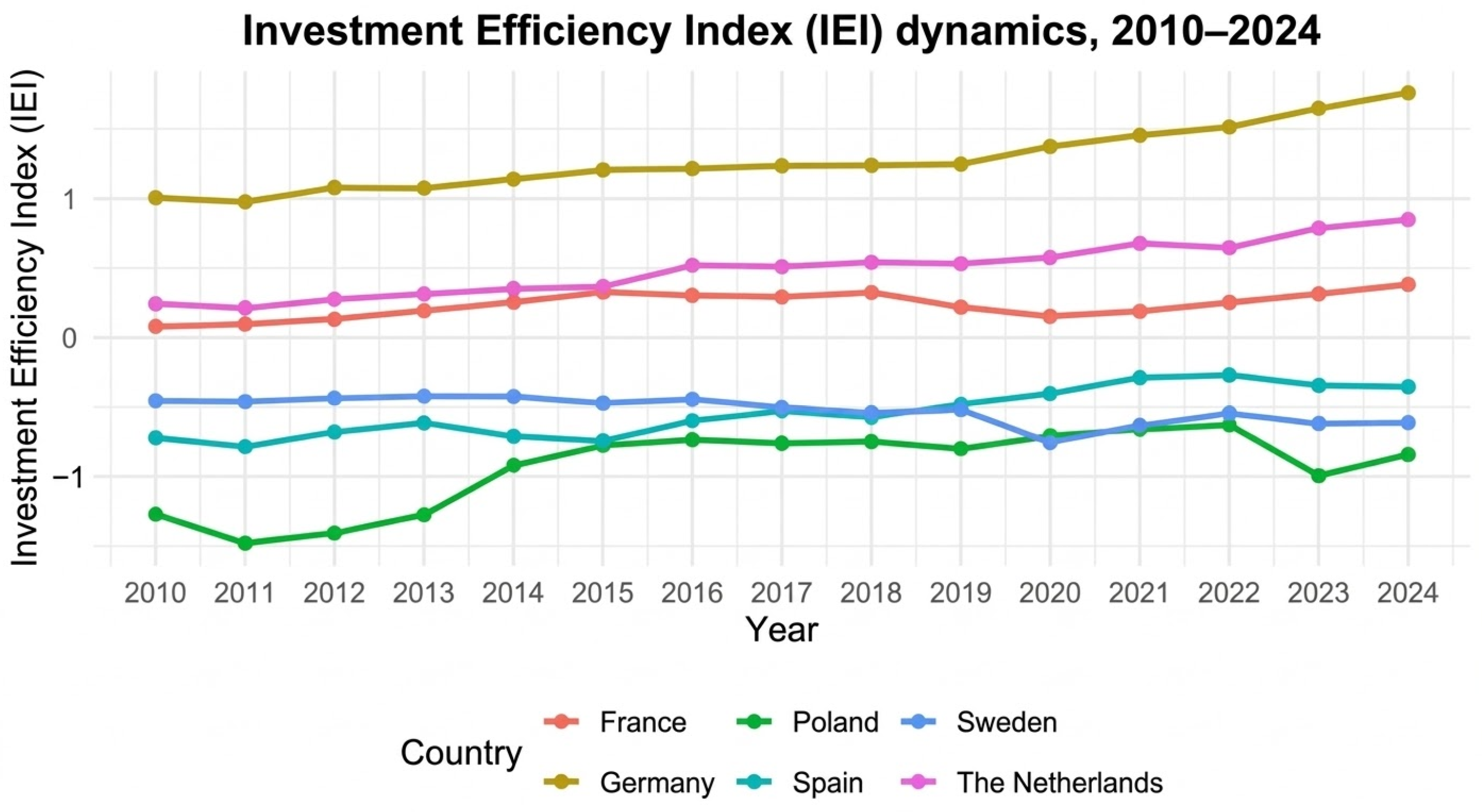
First, the dynamics of the Investment Efficiency Index (IEI) over time were analyzed. Figure 1 depicts the changes in the IEI of six EU countries over the entire period under analysis, allowing for the assessment of systematic trends.
Figure 1.
Investment Efficiency Index (IEI) dynamics, 2010–2024.
Intuitive conclusions:
- Germany and the Netherlands stand out with a consistent increase, reflecting a high level of automation and advanced waste recycling technologies.
- Spain and Sweden show a moderate level of stability, where the IEI remains close to zero but gradually increases.
- France shows a mild growth, especially after 2018, which coincides with higher investments in circular economy initiatives.
- Poland remains volatile, with several significant drops, indicating economic and technological imbalances.
This graphic shows that the IEI is not stationary, so AI methods are suitable because they can capture non-standard, nonlinear trends.
4.2. Traditional Panel Regression: Trends but Limited Power
Panel regression models (Fixed Effects and Random Effects) performed an important comparative function, but their explanatory power was limited. The FE model (with country and year effects) found:
- Recycling_Eff (recycling efficiency)—positive and statistically significant effect on IEI.
- Environmental Policy Stringency—negative direction (stricter policies may reduce the indicator in the short term due to higher compliance costs).
- R&D Expenditure—positive direction (technological innovations increase the efficiency of investments).
However, the models faced typical panel limitations:
Limited number of countries, strong multicollinearity between economic and environmental indicators, and a theoretically false assumption of linearity.
For these reasons, AI-based methods were applied to reveal more complex interactions and non-linear patterns.
4.3. Accuracy of Artificial Intelligence Models and the Importance of Variables
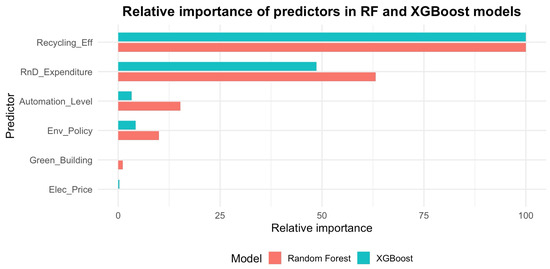
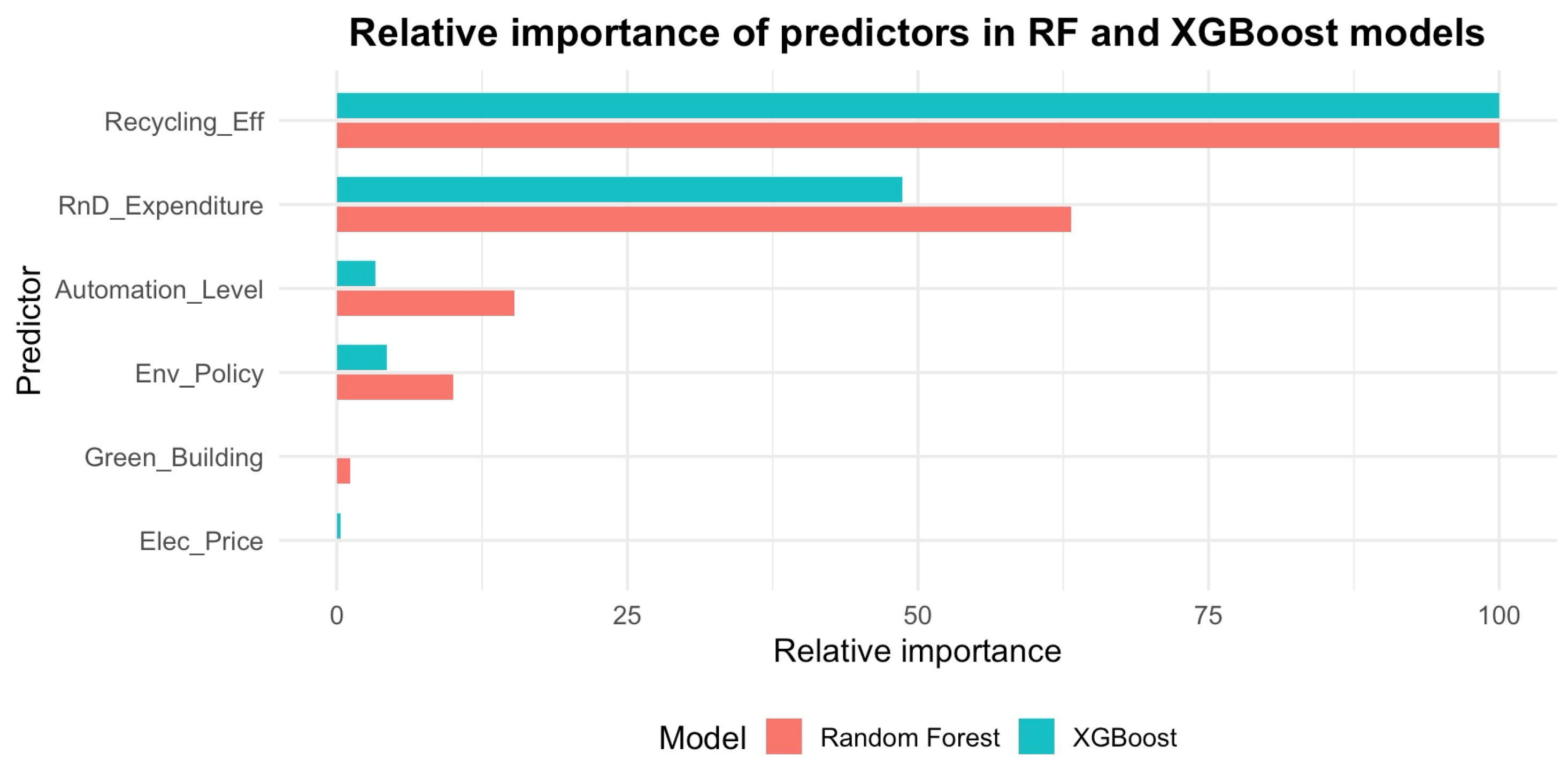
Random Forest and XGBoost models significantly outperformed panel models (in terms of R2, RMSE, and MAE) (see Table 1). The most important factors identified using both models are presented in Figure 2.
Table 1.
Comparative predictive performance of econometric and AI-based models. Note: AI-based models demonstrate higher predictive accuracy across all evaluation metrics, indicating their superior ability to capture nonlinear relationships and interaction effects compared to traditional panel regression approaches.
Figure 2.
Relative importance of predictors in Random Forest and XGBoost models.
The comparison of model performance confirms that ensemble-based AI methods substantially outperform traditional econometric models in terms of predictive accuracy. This difference is not only quantitative but also methodological. While panel regression models impose linearity and additive structures, AI-based approaches are capable of capturing threshold effects, nonlinear responses, and interactions between technological, policy, and economic variables. These features are particularly relevant in the context of circular economy investments, where structural changes, policy shocks, and technological diffusion processes create complex and non-stationary dynamics.
Key insights:
- Recycling_Eff is the strongest predictor in both models (clearly dominant).
- R&D_Expenditure is the second most important indicator—countries with higher innovation investments have significantly higher IEI.
- Automation_Level has a higher importance in AI models than in panel models (non-linear interactions).
- Env_Policy has a complex, non-unidirectional effect—this is revealed in the PDP analysis.
Although real estate variables are not dominant predictors in the models, the inclusion of Green_Building_Share confirms that the diffusion of sustainable construction practices is positively associated with broader circular economy investment efficiency, supporting the role of real estate as a transmission channel rather than a primary driver.
AI models not only improved forecasting accuracy but also revealed which factors most determine investment efficiency.
4.4. Partial Dependence Analytics: Impact of Technology and Policy Scenarios
Since the AI models identified the main factors, the PDP (Partial Dependence Plots) methodology was further used to assess nonlinear dependencies.
4.4.1. The Impact of Automation Level
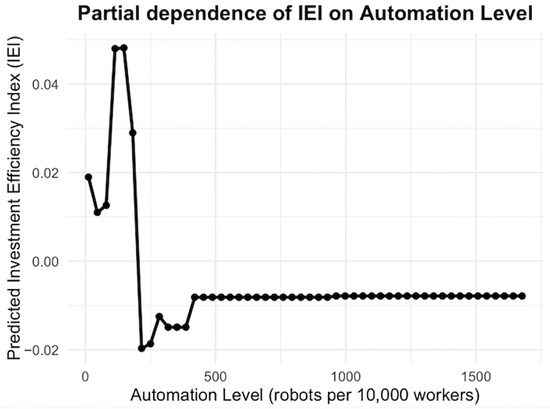
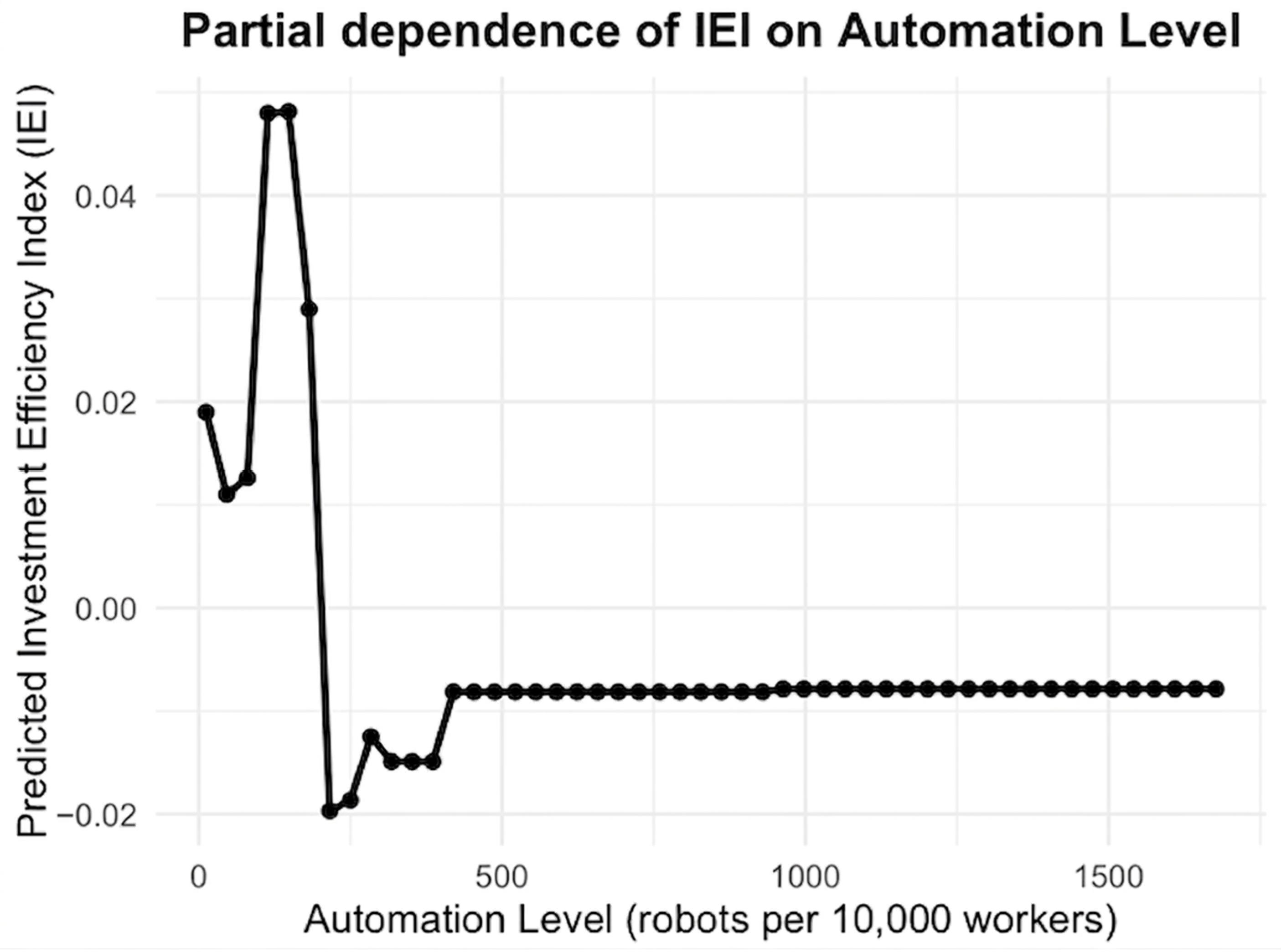
Figure 3 shows that the growth of automation increases IEI, but the effect is of limited magnitude and stabilizes above ~300 robots/10,000 workers.
Figure 3.
Partial dependence of IEI on Automation Level.
Interpretation: The initial growth of automation yields the largest jump in investment efficiency, but later the returns become diminishing.
4.4.2. The Impact of Environmental Policy Stringency
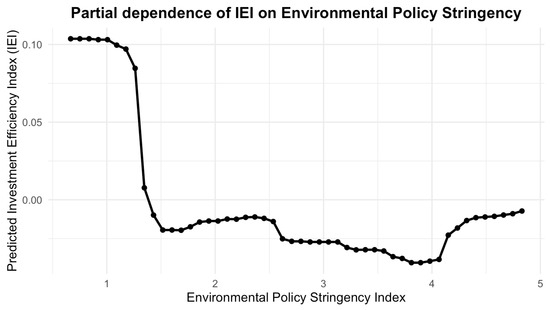
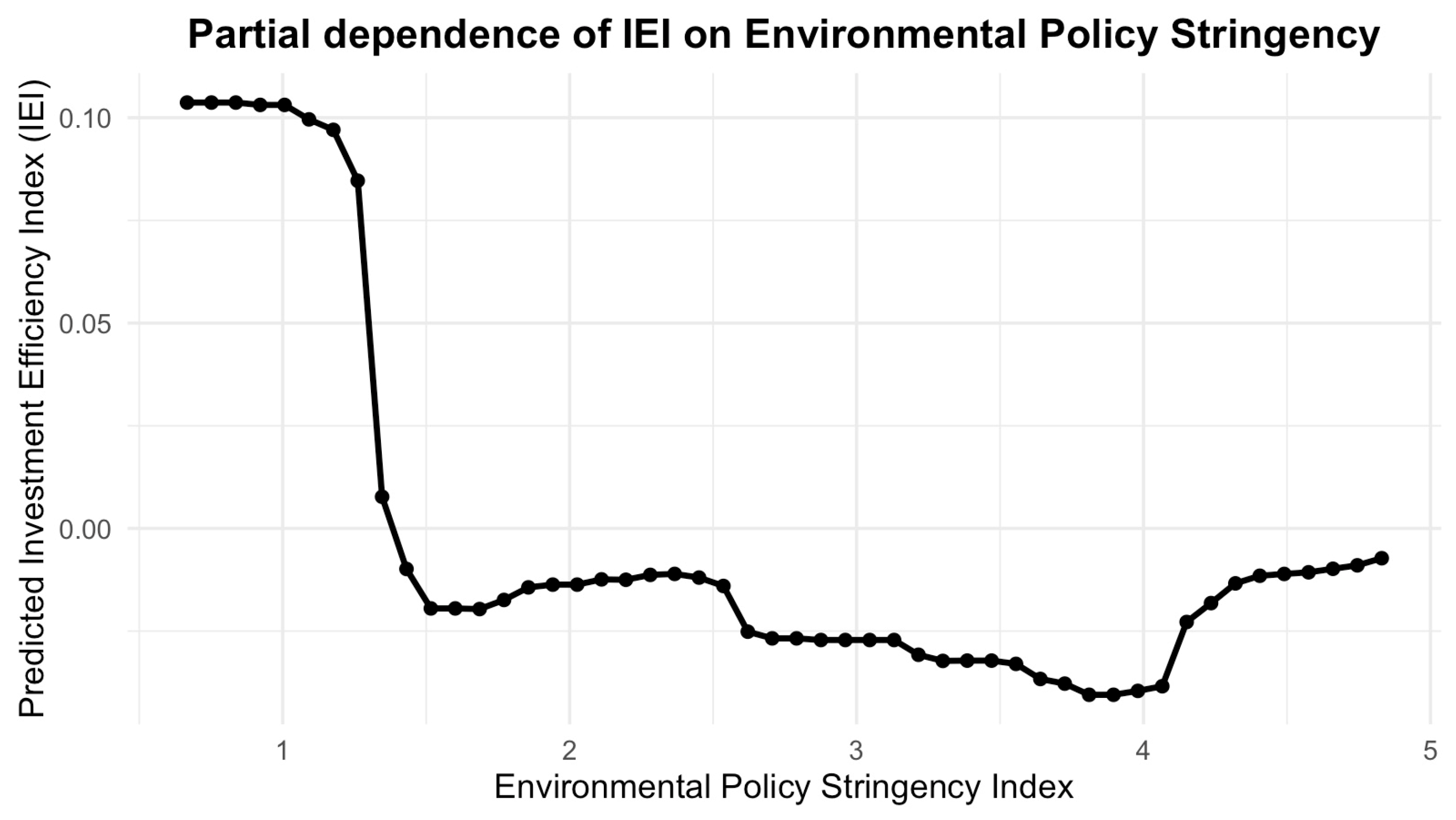
Figure 4 reveals that the effect is non-monotonic:
Figure 4.
Partial dependence of IEI on Environmental Policy Stringency.
- Policy has a positive effect up to ~1.3;
- Between 1.3–3.3 stringency reduces efficiency (transitional costs);
- Above 4.0 policy starts to have a positive effect again as markets adjust.
This confirms that the policy impact curve is not linear and that traditional econometric models do not preserve it.
4.4.3. Technology-Policy Interaction (2D PDP)
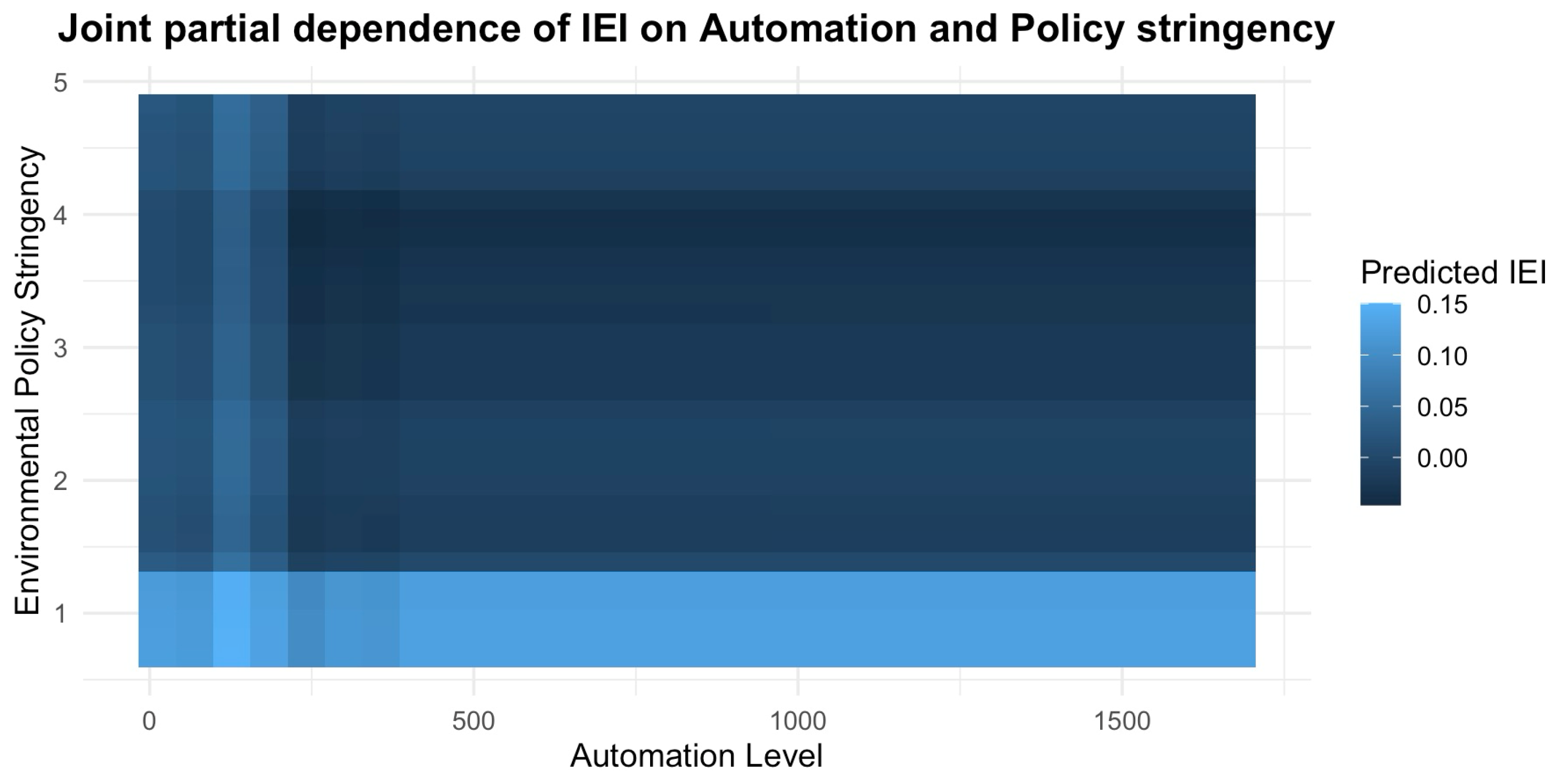
Figure 5 presents the result of a two-dimensional PDP showing how Automation_Level × Policy_Stringency jointly shape IEI.
Figure 5.
Joint partial dependence of IEI on Automation and Policy Stringency.
This interaction reveals three key moments:
- Low automation level + policy stringency—low IEI.
- Medium automation + medium policy—stable efficiency.
- High automation level + policy stringency—high long-term IEI, as technology amortizes the costs of regulation.
5. Discussion
This study, using both traditional econometric methods and advanced artificial intelligence (AI) technologies, analyzed the evolution of investment efficiency in EU countries, focusing on the circular economy dimensions, technological progress, and regulatory environment. The results of the study revealed several key aspects that expand the theoretical understanding of sustainable investment and confirm the latest direction of empirical research. Scientific articles have mainly analyzed general trends in the circular economy, but have not paid attention to structural differences between countries, while this work shows how economic structures determine the dynamics of investment efficiency [18,68,82]. The observed heterogeneity across countries and over time partly reflects external shocks and structural changes, such as the COVID-19 pandemic and energy market disruptions, which further reinforces the relevance of flexible, non-linear modeling approaches used in this study.
First, the analysis of IEI dynamics showed significant differences across countries, indicating that investment efficiency is closely related to the structural characteristics of economies and their readiness to transform to a circular economy model. The consistent rise of IEI in Germany and the Netherlands confirms that innovative and technology-intensive economies generate higher long-term returns in the context of sustainability. Meanwhile, the fluctuations in Poland indicate sensitivity to both external shocks and internal structural transformations. Previous studies have relied mainly on regression models and therefore have not seen nonlinear effects, which makes it difficult to assess systematic relationships [91,92].
Panel regression models provided an informative, but limited picture. Statistically significant relationships between recycling efficiency, R&D investment, and IEI provide a theoretical basis for efficient circular economy investments, but the models could not assess more complex nonlinear dynamic effects. This is in line with the limitations of regression models mentioned in the literature when analyzing systemic transitions and interactions of technological changes.
AI methods, in particular Random Forest and XGBoost, have significantly expanded the understanding of the structure of the influence of factors. The analysis of the importance of variables showed that Recycling_Eff and R&D_Expenditure are consistently dominant predictors, confirming the insights of previous studies that technological renewal and resource cyclicality are key conditions for the success of the circular economy. Meanwhile, Automation_Level and Environmental_Policy_Stringency act in a complex way and are sensitive to interaction effects. These findings are particularly relevant for electronic waste recycling, where high technological complexity and material recovery potential make investment efficiency especially sensitive to innovation intensity, automation, and regulatory conditions.
The partial dependence results provided a new perspective. Automation PDP revealed the effect of diminishing marginal returns to investment, which coincides with the technology diffusion models discussed in the literature. The PDP for environmental policy showed a clear U-shaped relationship, meaning that medium-stringency regulation can reduce efficiency in the short term, but high stringency, combined with adapted technologies, increases efficiency. The two-dimensional PDP plot further reinforced this conclusion: the IEI is highest when a high level of automation amortizes the costs of regulation and allows companies to operate efficiently in a more stringent regulatory environment. It is important to note that researchers usually emphasize the benefits of automation, but do not examine the phenomenon of diminishing returns [93].
From a real estate perspective, the results can be interpreted through the lens of life-cycle thinking and capital transformation discussed in the literature. Improvements in recycling efficiency, automation, and innovation reduce resource intensity and operational risks over the life cycle of built assets, thereby indirectly enhancing the long-term value and resilience of sustainable real estate investments. In this sense, real estate functions as a sector where the economic effects of circular economy investments materialize over extended time horizons rather than as a short-term performance driver. These results empirically support the life-cycle and capital transformation perspectives discussed in the literature, demonstrating how circular economy investments translate into long-term value creation rather than short-term financial gains.
The generalization of the findings is based on the consistent performance of AI models across countries and time periods, as well as on the stability of key predictors identified through variable importance and partial dependence analyses. Rather than relying on point estimates, the study emphasizes structural relationships and interaction patterns that remain robust under different model specifications and scenario assumptions. This strengthens the external validity of the results within comparable institutional and policy environments.
These results are of great importance for strategic planning. They confirm that circular economy policies cannot be implemented in isolation—they are most effective only in conjunction with the development of innovation and technological solutions. In other words, regulation alone is not enough; it must be combined with investments in automation, R&D, and technologies that generate recycling revenues. The methodological structure of the study follows a coherent logic from the formulation of research questions, through comparative model estimation, to interpretable results and policy-relevant discussion, ensuring that the conclusions are directly grounded in the empirical evidence.
6. Conclusions
The study provides several key findings that are important for both the theoretical field of sustainability economics and practical public policy-making and investment strategies.
Investment efficiency varies across EU countries and depends on structural economic characteristics. Countries that have invested earlier and consistently in technological progress, innovation, and circular economy infrastructure demonstrate higher and more stable IEI.
Traditionally used panel regression models identify main trends but fail to reveal complex nonlinear and interaction effects. This means that more flexible methods are needed to model sustainability and circular economy processes.
Artificial intelligence models (Random Forest, XGBoost) provide significantly deeper insights into the factors determining investment efficiency. They identified Recycling_Eff and R&D_Expenditure as the strongest and most reliable predictors of IEI. These results indicate the need for policymakers and investors to prioritize recycling infrastructure and innovation.
The interaction between technology and policy is a critical element. The AI-based PDPs have shown that high levels of automation significantly amplify the positive effects of strict environmental policies, while low levels of automation can have the opposite effect. This means that the transition to a circular economy model requires integrating technological solutions with regulatory packages.
A long-term sustainable investment strategy must focus on a holistic approach: technology alone or policy alone is not enough. Higher returns are only achieved if innovation, recycling, automation, and policy form a coherent system. While the empirical analysis is conducted at the macroeconomic level, the findings provide relevant insights for sustainable real estate development by highlighting how technological progress and circular economy policies shape the long-term investment environment in which real estate assets operate.
Although the empirical analysis focuses on EU countries, the proposed AI-based assessment framework can be applied to other regions with significant electronic waste generation and emerging circular economy initiatives, particularly in parts of Asia, where global production and recycling activities are highly concentrated.
Despite the contributions of this study, several limitations should be acknowledged. First, potential endogeneity between key explanatory variables, particularly R&D expenditure and investment efficiency, cannot be fully excluded. Second, the analysis does not explicitly model spatial dependencies and cross-country spillover effects, which may play a role in the diffusion of circular economy investments. Third, the study period includes major external shocks, such as the COVID-19 pandemic and the energy crisis, which may have affected short-term investment dynamics. Finally, data availability required the use of imputation procedures, which may influence the stability of the results. Future research could address these limitations by applying causal and spatial modeling techniques, explicitly accounting for structural breaks, and extending the analysis to non-EU regions.
Although the empirical analysis is conducted at the aggregate level, the results provide particularly relevant insights for electronic waste recycling as a representative circular economy segment characterized by high investment intensity and technological dependence.
In conclusion, the study confirms that artificial intelligence methods are extremely valuable in assessing the effectiveness of circular economy investments and predicting strategic policy and investment directions. They allow for a more detailed understanding of dynamics that traditional econometric models fail to capture, and provide a reliable basis for shaping sustainable economic and investment strategies.
Author Contributions
Conceptualization, L.O.N. and D.L.; methodology, L.O.N., M.T. and D.L.; experiment and data analysis, L.O.N., D.L. and M.T.; conclusions, L.O.N. and D.L.; discussion, L.O.N. and D.L.; writing—original draft preparation, L.O.N., D.L. and M.T.; writing—review and editing, L.O.N., D.L. and M.T. All authors have read and agreed to the published version of the manuscript.
Funding
This research received no external funding.
Institutional Review Board Statement
Not applicable.
Informed Consent Statement
Not applicable.
Data Availability Statement
The original contributions presented in the study are included in the article.
Conflicts of Interest
The authors declare no conflicts of interest.
References
- Quinto, S.; Law, N.; Fletcher, C.; Le, J.; Antony Jose, S.; Menezes, P.L. Exploring the E-Waste Crisis: Strategies for Sustainable Recycling and Circular Economy Integration. Recycling 2025, 10, 72. [Google Scholar] [CrossRef] [Scilit]
- Elgarahy, A.M.; Eloffy, M.G.; Priya, A.K.; Hammad, A.; Zahran, M.; Maged, A.; Elwakeel, K.Z. Revitalizing the circular economy: An exploration of e-waste recycling approaches in a technological epoch. Sustain. Chem. Environ. 2024, 7, 100124. [Google Scholar] [CrossRef] [Scilit]
- Drofenik, J.; Seljak, T.; Novak Pintarič, Z. A multi-level approach to circular economy progress: Linking national targets with corporate implementation. J. Clean. Prod. 2025, 493, 144902. [Google Scholar] [CrossRef] [Scilit]
- Okunevičiūtė Neverauskienė, L.; Linkevičius, D.; Tvaronavičienė, M. Visegrad Region Dependency on Mining Industries: Impact of Raw Material Prices on Housing Prices and Investments. Acta Montan. Slovaca 2025, 30, 320. [Google Scholar] [CrossRef] [Scilit]
- Bazienė, K.; Gargasas, J. Circular economy for production of renewable fuels and materials from waste-to-value technologies. Entrep. Sustain. Issues 2025, 12, 398–408. [Google Scholar] [CrossRef] [Scilit]
- Wieteska-Rosiak, B. Integrating the Circular Economy into ESG in the Real Estate Sector: Current Practices, Challenges, and Pathways to Standardization. Real Estate Manag. Valuat. 2025, 33, 109–122. [Google Scholar] [CrossRef] [Scilit]
- Okunevičiūtė Neverauskienė, L.; Tvaronavičienė, M.; Linkevičius, D. Energy Efficiency, CO2 Emission Reduction, and Real Estate Investment in Northern Europe: Trends and Impact on Sustainability. Buildings 2025, 15, 1195. [Google Scholar] [CrossRef] [Scilit]
- Adrian-Cosmin, C.; Dan, S.; Pescari, S. Sustainable development and circular economy in the built environment. Ann. Constantin Brancusi Univ. Targu-Jiu Econ. Ser. 2023, 2023, 265–271. [Google Scholar]
- Bazienė, K.; Gargasas, J.; Rajendran, S.; Solomon, J.N. Towards circular economy through novel waste recycling technologies. Entrep. Sustain. Issues 2024, 12, 460–472. [Google Scholar] [CrossRef] [Scilit]
- Toponar, O.; Shpatakova, O.; Kopchak, Y.; Klievtsievych, N.; Miniailenko, I. Integrating the Circular Economy into Business Processes to Reduce Waste and Increase Environmental Sustainability. Grassroots J. Nat. Resour. 2024, 7, 140–159. [Google Scholar] [CrossRef] [Scilit]
- Sobotková, N.; Bartoš, V. Development trends in the financial performance of construction companies in the Czech Republic and abroad. Entrep. Sustain. Issues 2025, 12, 158–168. [Google Scholar] [CrossRef] [Scilit]
- Simionescu, M. Machine Learning vs. Econometric Models to Forecast Inflation Rate in Romania? The Role of Sentiment Analysis. Mathematics 2025, 13, 168. [Google Scholar] [CrossRef] [Scilit]
- Mugunzva, F.I.; Manchidi, N.H. Re-envisioning the artificial intelligence-entrepreneurship nexus: A pioneering synthesis and future pathways. Insights Reg. Dev. 2024, 6, 71–84. [Google Scholar] [CrossRef] [Scilit]
- Hazdiuk, K.; Bilak, Y.; Shumyliak, L.; Cibák, L. An experimental analysis of artificial intelligence (AI) use for traffic monitoring in urban environments. Insights Reg. Dev. 2025, 7, 231–250. [Google Scholar] [CrossRef] [Scilit]
- Bonanno, M.; Cardile, D.; Liuzzi, P.; Celesti, A.; Micali, G.; Corallo, F.; Quartarone, A.; Tomaiuolo, F.; Calabrò, R.S. Can artificial intelligence improve the diagnosis and prognosis of disorders of consciousness? A scoping review. Front. Artif. Intell. 2025, 8, 1608778. [Google Scholar] [CrossRef] [Scilit] [PubMed]
- Umar, M.B.; Umar, S.I.; Muhammad, I.K.; Abdulhamid, A.-A. Application of AI in the circular economy: Development finance institutions’ role in resource optimization in the industry. J. Stat. Sci. Comput. Intell. 2025, 1, 124–137. [Google Scholar] [CrossRef] [Scilit]
- Moustafa, Z.; Asif, M.; Wuni, I.Y. Circular economy in the building sector: A systematic review of environmental, economic, and social dimensions. Sustain. Futures 2025, 9, 100690. [Google Scholar] [CrossRef] [Scilit]
- Ranasinghe, N.; Domingo, N.; Kahandawa, R. Enhancing building material circularity: A systematic review on prereq-uisites, obstacles and the critical role of data traceability. J. Build. Eng. 2024, 98, 111136. [Google Scholar] [CrossRef] [Scilit]
- Bressanelli, G.; Adrodegari, F.; Pigosso, D.C.A.; Parida, V. Towards the Smart Circular Economy Paradigm: A Definition, Conceptualization, and Research Agenda. Sustainability 2022, 14, 4960. [Google Scholar] [CrossRef] [Scilit]
- Yeşil, T. Artificial Intelligence (AI) use in business: Artificial Neural Network modelling for predicting cost, minimising waste and optimising resource utilisation in furniture industry. Entrep. Sustain. Issues 2025, 13, 107–117. [Google Scholar] [CrossRef] [Scilit]
- Ondrík, P.; Jankal, R. Digital transformation: A comparative analysis of SME digital maturity models. Entrep. Sustain. Issues 2025, 13, 155–174. [Google Scholar] [CrossRef] [Scilit]
- Gavaza, B.K. Drivers of Artificial Intelligence adoption in township small businesses in South Africa. Insights Reg. Dev. 2025, 7, 116–129. [Google Scholar] [CrossRef] [Scilit]
- Boršoš, P.; Luptáková, I.D.; Huraj, L.; Gabriška, D. Acceptance of artificial intelligence technology in the recruitment process of Slovak enterprises. Entrep. Sustain. Issues 2025, 13, 464–477. [Google Scholar] [CrossRef] [Scilit]
- Garusinghe, A.; Perera, K.; Weerapperuma, U. Integrating Circular Economy Principles in Modular Construction to Enhance Sustainability. Sustainability 2023, 15, 1730. [Google Scholar] [CrossRef] [Scilit]
- Chau, L.; Anh, L.; Duc, V. Valuing ESG: How financial markets respond to corporate sustainability. Int. Bus. Rev. 2025, 34, 102418. [Google Scholar] [CrossRef] [Scilit]
- Raut, S.; Hossain, N.U.I.; Kouhizadeh, M.; Fazio, S.A. Application of artificial intelligence in circular economy: A critical analysis of the current research. Sustain. Futures 2025, 9, 100784. [Google Scholar] [CrossRef] [Scilit]
- Kirchherr, J.; Yang, N.-H.N.; Schulze-Spüntrup, F.; Heerink, M.J.; Hartley, K. Conceptualizing the Circular Economy (Revisited): An Analysis of 221 Definitions. Resour. Conserv. Recycl. 2023, 194, 107001. [Google Scholar] [CrossRef] [Scilit]
- Ruginė, H.; Žilienė, R. Towards a new framework of circular economy. Entrep. Sustain. Issues 2024, 11, 278–289. [Google Scholar] [CrossRef] [Scilit]
- Heinzová, R.; Hoke, E. Sustainability and green management in hospitals. Entrep. Sustain. Issues 2025, 13, 313–324. [Google Scholar] [CrossRef] [Scilit]
- Spišáková, E.D.; Majerníková, J. Bridging global and European agendas: An evaluation of progress on SDG 4 and the Europe 2020 strategy. Entrep. Sustain. Issues 2025, 13, 340–355. [Google Scholar] [CrossRef] [Scilit]
- Piccinetti, L.; Kapiel, T.Y.; Salem, N.; Omoruyi, T.U.; Massa Gallucci, A.; Elseify, M.K.; El-Bary, A.A.; Rezk, M.R. The circular blue economy in Egypt: Opportunities for regional cooperation and integration with Mediterranean countries for sustainable development. Insights Reg. Dev. 2025, 7, 104–122. [Google Scholar] [CrossRef] [Scilit]
- Miszczak, K.; Kriviņš, A.; Kaze, V.; Maciąg, A. Sustainability awareness: Evidence from Japan. Entrep. Sustain. Issues 2025, 13, 342–357. [Google Scholar] [CrossRef] [Scilit]
- Sebbaghi, S.; Aqachmar, Z.; El Amrani El Idrissi, N.; Tvaronavičienė, M. Optimization of building air conditioning using a hybrid cogeneration system with photovoltaic energy. Insights Reg. Dev. 2025, 7, 83–93. [Google Scholar] [CrossRef] [Scilit]
- Daniek, K.; Chmelíková, G.; Kozielec, A. Development of the circular economy in Poland and the Czech Republic—A comparative analysis. Entrep. Sustain. Issues 2024, 11, 406–424. [Google Scholar] [CrossRef] [Scilit] [PubMed]
- Piccinetti, L.; Elseify, M.K.; Santoro, D.; Piccinetti, A.; Khasawneh, A.; Rezk, M.R. Inclusive adoption of circular economy in Egypt: Communication and stakeholder engagement among low- and middle-income communities. Insights Reg. Dev. 2025, 7, 154–175. [Google Scholar] [CrossRef] [Scilit]
- Rezk, M.R.; Hassan, M.M.; Omoruyi, T.U.; El-Bary, A.A.; Piccinetti, L. Policy options in accelerating circular economy adoption in the Gulf countries. Insights Reg. Dev. 2025, 7, 43–66. [Google Scholar] [CrossRef] [Scilit]
- Rezk, M.R.; Piccinetti, L.; Salem, N.; Omoruyi, T.U.; Santoro, D. Nigeria’s transition to a circular economy: Challenges, opportunities and future perspectives. Insights Reg. Dev. 2024, 6, 11–23. [Google Scholar] [CrossRef] [Scilit]
- Goranova, S.; Anguelov, K. Circular economy and “polluter pays” principle in Bulgarian municipalities. Entrep. Sustain. Issues 2025, 13, 284–304. [Google Scholar] [CrossRef] [Scilit]
- Chirumalla, K.; Balestrucci, F.; Sannö, A.; Oghazi, P. The transition from a linear to a circular economy through a multi-level readiness framework: An explorative study in the heavy-duty vehicle manufacturing industry. J. Innov. Knowl. 2024, 9, 100539. [Google Scholar] [CrossRef] [Scilit]
- Yang, M.; Chen, L.; Wang, J.; Msigwa, G.; Osman, A.I.; Fawzy, S.; Rooney, D.W.; Yap, P.-S. Circular economy strategies for combating climate change and other environmental issues. Environ. Chem. Lett. 2023, 21, 55–80. [Google Scholar] [CrossRef] [Scilit]
- Eelager, M.P.; Dalbanjan, N.P.; Madihalli, S.; Madar, M.; Agadi, N.P.; Korganokar, K.; Kiran, B. Pathways to a sustainable future: Exploring the synergy between sustainability and circular economy. Sustain. Futures 2025, 10, 101208. [Google Scholar] [CrossRef] [Scilit]
- Radivojević, V.; Rađenović, T.; Dimovski, J. The Role of Circular Economy in Driving Economic Growth: Evidence from EU Countries. Sage Open 2024, 14, 21582440241240624. [Google Scholar] [CrossRef] [Scilit]
- Okunevičiūtė Neverauskienė, L.; Linkevičius, D.; Andriušaitienė, D. How macroeconomic factors impact residential real estate prices in Eastern Europe. Business. Manag. Econ. Eng. 2025, 23, 30–43. [Google Scholar] [CrossRef] [Scilit]
- Okunevičiūtė Neverauskienė, L.; Ginevičius, R.; Danilevičienė, I. The influence of wage and employment on competitiveness: An assessment. J. Compet. 2024, 16, 83–105. [Google Scholar]
- Castellet-Viciano, L.; Hernández-Chover, V.; Bellver-Domingo, Á.; Hernández-Sancho, F. The Role of Circular Economy Strategies in Promoting Sustainability in the Agri-Food Sector: Insights from the Valencian Community. Appl. Sci. 2025, 15, 10655. [Google Scholar] [CrossRef] [Scilit]
- Nowak-Marchewka, K.; Osmólska, E.; Stoma, M. Progress and Challenges of Circular Economy in Selected EU Countries. Sustainability 2025, 17, 320. [Google Scholar] [CrossRef] [Scilit]
- Ferrante, M.; Vitti, M.; Sassanelli, C. The evolution of circular economy performance assessment: A systematic literature review. Renew. Sustain. Energy Rev. 2025, 217, 115757. [Google Scholar] [CrossRef] [Scilit]
- Okuneviciute Neverauskiene, L.; Klepone, D. Empirical evidence on the startup growth in the Baltic Region high tech land-scape. Transform. Bus. Econ. 2024, 23, 1164–1191. [Google Scholar]
- Tang, Y.; Gao, D.; Zhou, X. Green Response: The Impact of Climate Risk Exposure on ESG Performance. Sustainability 2024, 16, 10895. [Google Scholar] [CrossRef] [Scilit]
- Ingaldi, M.; Ulewicz, R. The Business Model of a Circular Economy in the Innovation and Improvement of Metal Processing. Sustainability 2024, 16, 5513. [Google Scholar] [CrossRef] [Scilit]
- Marelli, L.; Trane, M.; Barbero Vignola, G.; Gastaldi, C.; Mecia, G.; Delgado-Callico, L.; Steve, B.; Lucia, B.; Esther, S.M.; Thomas, G.; et al. Delivering the EU Green Deal—Progress Towards Targets; Publications Office of the European Union: Luxembourg, 2025. [Google Scholar] [CrossRef]
- Rodríguez-Espíndola, O.; Cuevas-Romo, A.; Chowdhury, S.; Díaz-Acevedo, N.; Albores, P.; Despoudi, S.; Malesios, C.; Dey, P. The role of circular economy principles and sustainable-oriented innovation to enhance social, economic and environmental perfor-mance: Evidence from Mexican SMEs. Int. J. Prod. Econ. 2022, 248, 108495. [Google Scholar] [CrossRef] [Scilit]
- Maduta, C.; Melica, G.; D’Agostino, D.; Bertoldi, P. Towards a decarbonised building stock by 2050: The meaning and the role of zero emission buildings (ZEBs) in Europe. Energy Strategy Rev. 2022, 44, 101009. [Google Scholar] [CrossRef] [Scilit]
- AlJaber, A.; Martinez-Vazquez, P.; Baniotopoulos, C. Exploring Circular Economy Strategies in Buildings: Evaluating Feasibility, Stakeholders Influence, and the Role of the Building Lifecycle in Effective Adoption. Appl. Sci. 2025, 15, 1174. [Google Scholar] [CrossRef] [Scilit]
- Olabi, A.G.; Shehata, N.; Issa, U.H.; Mohamed, O.A.; Mahmoud, M.; Abdelkareem, M.A.; Abdelzaher, M. The role of green buildings in achieving the sustainable development goals. Int. J. Thermofluids 2025, 25, 101002. [Google Scholar] [CrossRef] [Scilit]
- Yepes, V.; Navarro, I. Trends in Sustainable Buildings and Infrastructure; MDPI: Basel, Switzerland, 2021. [Google Scholar] [CrossRef] [Scilit]
- Mironiuc, M.; Ionașcu, E.; Huian, M.C.; Țaran, A. Reflecting the Sustainability Dimensions on the Residential Real Estate Prices. Sustainability 2021, 13, 2963. [Google Scholar] [CrossRef] [Scilit]
- Orieno, O.H.; Ndubuisi, N.L.; Eyo-Udo, N.L.; Ilojianya, V.I.; Biu, P.W. Sustainability in project management: A comprehensive review. World J. Adv. Res. Rev. 2024, 21, 656–677. [Google Scholar] [CrossRef] [Scilit]
- Omer, M.A.E.; Mahmoud Ibrahim, A.M.; Elsheikh, A.H.; Hegab, H. A framework for integrating sustainable production practices along the product life cycle. Environ. Sustain. Indic. 2025, 26, 100606. [Google Scholar] [CrossRef] [Scilit]
- Jørgensen, B.N.; Ma, Z. Energy Efficiency and Decarbonization Strategies in Buildings: A Review of Technologies, Policies, and Future Directions. Appl. Sci. 2025, 15, 11660. [Google Scholar] [CrossRef] [Scilit]
- Finamore, M.; Oltean-Dumbrava, C. Circular economy in construction—Findings from a literature review. Heliyon 2024, 10, e34647. [Google Scholar] [CrossRef] [Scilit]
- Dahlbo, H.; Bachér, J.; Lähtinen, K.; Jouttijärvi, T.; Suoheimo, P.; Mattila, T.; Sironen, S.; Myllymaa, T.; Saramäki, K. Construction and demolition waste management—A holistic evaluation of environmental performance. J. Clean. Prod. 2015, 107, 333–341. [Google Scholar] [CrossRef] [Scilit]
- Ahmed, N.; Abdel-Hamid, M.; Abd El-Razik, M.M.; El-Dash, K.M. Impact of sustainable design in the construction sector on climate change. Ain Shams Eng. J. 2021, 12, 1375–1383. [Google Scholar] [CrossRef] [Scilit]
- Yu, W.; Liu, S.; Ding, L. Efficiency Evaluation and Selection Strategies for Green Portfolios under Different Risk Appetites. Sustainability 2021, 13, 1933. [Google Scholar] [CrossRef] [Scilit]
- Banerjee, A.; Das, P.; Fuerst, F. Are green and healthy building labels counterproductive in emerging markets? An ex-amination of office rental contracts in India. J. Clean. Prod. 2024, 455, 141838. [Google Scholar] [CrossRef] [Scilit]
- Tondelli, S.; Marzani, G. How to Plan for Circular Cities: A New Methodology to Integrate the Circular Economy Within Urban Policies and Plans. Sustainability 2025, 17, 5534. [Google Scholar] [CrossRef] [Scilit]
- Zhao, W. Smart city technologies for sustainable urban planning: Evidence and equity lessons from Shenzhen. Sustain. Futures 2025, 10, 101198. [Google Scholar] [CrossRef] [Scilit]
- Farokhi, A.; Miri, S. Circular Economy Principles in Architectural Design, Construction, and Cities. J. Eng. Ind. Res. 2025, 6, 53–69. [Google Scholar] [CrossRef]
- Iwuanyanwu, O.; Gil-Ozoudeh, I.; Okwandu, A.C.; Ike, C.S. Retrofitting existing buildings for sustainability: Challenges and innovations. Eng. Sci. Technol. J. 2024, 5, 2616–2631. [Google Scholar] [CrossRef] [Scilit]
- Brabec, J.; Macháč, J. Impacts of the EU Taxonomy implementation: A systematic literature review. Climate Policy 2025, 1–13. [Google Scholar] [CrossRef] [Scilit]
- Peach, R. The role of asset management and circular economy principles in the engineering built environment. In Proceedings of the AMPEAK, Adelaide, Australia, 14–17 April 2024. [Google Scholar]
- Upadhayay, S.; Alqassimi, O.; Khashadourian, E.; Sherm, A.; Prajapati, D. Development in the Circular Economy Concept: Systematic Review in Context of an Umbrella Framework. Sustainability 2024, 16, 1500. [Google Scholar] [CrossRef] [Scilit]
- Rashid, A.B.; Kausik, M.A.K. AI revolutionizing industries worldwide: A comprehensive overview of its diverse applications. Hybrid Adv. 2024, 7, 100277. [Google Scholar] [CrossRef] [Scilit]
- Magazzino, C.; Haroon, M. The interrelation among environmental quality, public accounts, and macroeconomic fun-damentals: An analysis of OECD countries using machine learning techniques. Environ. Dev. 2025, 54, 101175. [Google Scholar] [CrossRef] [Scilit]
- Danish, M.S.S.; Senjyu, T. Shaping the future of sustainable energy through AI-enabled circular economy policies. Circ. Econ. 2023, 2, 100040. [Google Scholar] [CrossRef] [Scilit]
- Firat, M. Comparative Analysis of Random Forest vs XGBoost Machine Learning Algorithms for Predicting ODL Student Success. 2025. Available online: https://www.researchgate.net/publication/394286628_Comparative_Analysis_of_Random_Forest_vs_XGBoost_Machine_Learning_Algorithms_for_Predicting_ODL_Student_Success?channel=doi&linkId=6891045f7b62e240dd330309&showFulltext=true (accessed on 11 March 2026). [CrossRef]
- Aro, O.E. Predictive Analytics in Financial Management: Enhancing Decision-Making and Risk Management. Int. J. Res. Publ. Rev. 2024, 5, 2181–2194. [Google Scholar] [CrossRef] [Scilit]
- Lei, H.; Yang, W.; Zhang, B.; Li, C.-Q. An advanced method for assessing circular economy performance of built environment. J. Clean. Prod. 2025, 486, 144561. [Google Scholar] [CrossRef] [Scilit]
- Chen, L.; Li, S.; She, Z. A study on the impact of artificial intelligence applications on corporate green technological in-novation: A mechanism analysis from multiple perspectives. Int. Rev. Econ. Financ. 2025, 103, 104490. [Google Scholar] [CrossRef] [Scilit]
- Lanza, A.A.G.; Bernardini, E.; Faiella, I. Machine Learning, ESG Indicators, and Sustainable Investment. In Financial Risk Management and Climate Change Risk; Springer: Cham, Switzerland, 2023; pp. 223–250. [Google Scholar] [CrossRef] [Scilit]
- Adhikari, B.; Safaee Chalkasra, L.S. Mobilizing private sector investment for climate action: Enhancing ambition and scaling up implementation. J. Sustain. Financ. Invest. 2023, 13, 1110–1127. [Google Scholar] [CrossRef] [Scilit]
- Yin, S.; Jia, F.; Chen, L.; Wang, Q. Circular economy practices and sustainable performance: A meta-analysis. Resour. Conserv. Recycl. 2023, 190, 106838. [Google Scholar] [CrossRef] [Scilit]
- Faiz, F.; Ninduwezuor-Ehiobu, N.; Adanma, U.M.; Solomon, N.O. AI-Powered waste management: Predictive modeling for sustainable landfill operations. Compr. Res. Rev. Sci. Technol. 2024, 2, 20–44. [Google Scholar] [CrossRef] [Scilit]
- Segura de la Cal, A.; Martínez Raya, A.; Morales-Alonso, G. Mapping the role of Artificial Intelligence in real estate: A bibliometric and case study analysis. J. Entrep. Manag. Innov. 2025, 21, 5–23. [Google Scholar] [CrossRef] [Scilit]
- Zhang, J.; Yin, K. Application of gradient boosting model to forecast corporate green innovation performance. Front. Environ. Sci. 2023, 11, 1252271. [Google Scholar] [CrossRef] [Scilit]
- Das, A.K.; Hossain, F.; Khan, B.U.; Rahman, M.; Asad, M.A.Z.; Akter, M. Circular economy: A sustainable model for waste reduction and wealth creation in the textile supply chain. SPE Polymers 2025, 6, e10171. [Google Scholar] [CrossRef] [Scilit]
- Yeo, W.J.; Van Der Heever, W.; Mao, R.; Cambria, E.; Satapathy, R.; Mengaldo, G. A comprehensive review on financial ex-plainable AI. Artif. Intell. Rev. 2025, 58, 189. [Google Scholar] [CrossRef] [Scilit]
- Infant, S.S.; Vickram, S.; Saravanan, A.; Mathan Muthu, C.M.; Yuarajan, D. Explainable artificial intelligence for sustainable urban water systems engineering. Results Eng. 2025, 25, 104349. [Google Scholar] [CrossRef] [Scilit]
- Pérez-Pérez, J.F.; Bonet, I.; Sánchez-Pinzón, M.S.; Caraffini, F.; Lochmuller, C. Using Artificial Intelligence to Predict the Fi-nancial Impact of Climate Transition Risks Within Organisations. Int. J. Intell. Syst. 2024, 2024, 3334263. [Google Scholar] [CrossRef] [Scilit]
- Khan, M.D.A.; Rahman, A.; Mahmud, F.U.; Bishnu, K.K.; Ahmed, M.; Mridha, M.F.; Aung, Z. A systematic review of AI-driven business models for advancing Sustainable Development Goals. Array 2025, 28, 100539. [Google Scholar] [CrossRef] [Scilit]
- Haase, M.; Bernegger, H.; Meslec, M. Models of Circular Economy Principles. In Proceedings of the 4th International Conference “Coordinating Engineering for Sustainability and Resilience” & Midterm Conference of CircularB “Implementation of Circular Economy in the Built Environment”, Timișoara, Romania, 29–31 May 2024; pp. 461–470. [Google Scholar] [CrossRef] [Scilit]
- Kung, H.-Y.; Juan, Y.-K.; Castro-Lacouture, D. Decision support model for evaluating circular economy strategies in private residential construction. Dev. Built Environ. 2025, 21, 100602. [Google Scholar] [CrossRef] [Scilit]
- Al-haimi, B.; Khalid, H.; Zakaria, N.H.; Jasimin, T.H. Digital transformation in the real estate industry: A systematic literature review of current technologies, benefits, and challenges. Int. J. Inf. Manag. Data Insights 2025, 5, 100340. [Google Scholar] [CrossRef] [Scilit]

Disclaimer/Publisher’s Note: The statements, opinions and data contained in all publications are solely those of the individual author(s) and contributor(s) and not of MDPI and/or the editor(s). MDPI and/or the editor(s) disclaim responsibility for any injury to people or property resulting from any ideas, methods, instructions or products referred to in the content. |
© 2026 by the authors. Licensee MDPI, Basel, Switzerland. This article is an open access article distributed under the terms and conditions of the Creative Commons Attribution (CC BY) license.