


Abstract
This study examines how digital governance (DG) contributes to public value (PV) in a large, service-intensive public organization and tests whether digitally enabled human resource management practices (DHRM) transmit this effect. Using a cross-sectional survey of employees in Egypt Post (n = 278), items were measured on a five-point Likert scale and analyzed with reliability diagnostics, validity assessments (CFA, CR, AVE, HTMT), and regression-based mediation with 5000 bootstrap resamples. All scales showed strong internal consistency (Cronbach’s alpha: DG = 0.903, DHRM = 0.948, PV = 0.923) and convergent validity (AVE greater than 0.50). Discriminant validity was confirmed via HTMT (less than 0.85). The study finds that DG was positively associated with PV (beta = 0.773, p less than 0.001) and with DHRM (beta = 0.818, p less than 0.001). DHRM was also positively associated with PV when controlling for DG (beta = 0.332, p less than 0.001). Bootstrapping confirmed a significant indirect effect of DG on PV through DHRM (a times b = 0.281; 95% CI [0.156, 0.424]), indicating partial mediation. This study advances public value scholarship by specifying DHRM as a micro-foundation linking governance capacity to value outcomes, demonstrating the partial mediation mechanism in an under-researched Middle Eastern public-sector context, and providing empirical evidence that digital transformation yields higher public value when governance arrangements are translated into workforce routines and capabilities via digital HRM. Implications: The findings suggest that public managers should treat HR digitalization as a core implementation mechanism alongside governance reforms.
1. Introduction
Across the public sector, the shift toward digitally mediated service delivery has accelerated as governments seek higher service quality, greater transparency, and improved efficiency while responding to rising citizen expectations and fiscal constraints [1]. Digital initiatives in public administration are typically justified by the promise of public value—better outcomes that society collectively values, such as access, fairness, trust, and more responsive services [2]. Yet implementation experience suggests a recurring paradox: agencies may digitize processes and deploy new platforms without producing commensurate improvements in citizen-facing value. This gap directs attention to digital governance as a capability that steers transformation toward legitimate, measurable outcomes.
Digital governance refers to the institutional arrangements, decision rights, standards, and accountability mechanisms that guide how organizations design, deploy, and control digital assets and digitally mediated services [3]. Contemporary scholarship emphasizes that digital governance is not merely a technical steering function; it is an integrative socio-technical puzzle involving humans, machines, and organizations. Accordingly, public value outcomes depend on whether governance arrangements are translated into operational routines and workforce capabilities that shape everyday service encounters [4]. Algorithmic and data-driven systems further intensify this requirement: digitization can improve efficiency and management capacity, but it may also introduce risks related to transparency, bias, and legitimacy if governance safeguards are weak [5].
Egypt provides a high-relevance setting for studying these dynamics. Digital governance has been framed as a pathway for transforming public administration in Egypt, improving administrative processes and supporting modernization objectives [6]. At the same time, evidence suggests that societal culture and subjective well-being can shape performance dynamics; Frinaldi [7] report that community happiness can predict both public-sector performance and digital governance effectiveness, implying that digital governance performance is embedded in socio-cultural context.
Human resource management practices provide a plausible internal mechanism for translating governance capacity into public value [8]. Research across public and private sectors shows that HR systems influence employee outcomes, service quality, and organizational performance through mechanisms such as motivation, capability development, and procedural consistency [9]. As organizations digitize, HRM itself transforms: electronic HRM (e-HRM) or digital HRM leverages digital tools to redesign recruitment, training, performance management, communication, and analytics. Evidence from Egypt indicates that e-HRM can significantly improve HR service quality and HRM effectiveness by accelerating processing, improving transparency, and standardizing services [10]. Similarly, digital HRM practices have been linked to HRM effectiveness and employee outcomes, with capability maturity shaping the strength of these effects [11].
Within public organizations, the case for digital HRM is especially important because service quality and legitimacy depend heavily on frontline employee behavior, reliability of routines, and the perceived fairness of administrative processes. A public-value perspective suggests that digital transformation yields societal value only when it is both legitimate (aligned with public values such as fairness and transparency) and operationally feasible (supported by workforce capacity) [12]. Therefore, this study advances a mediation argument: digital governance creates enabling structures and control systems, but digital HRM practices operationalize those structures by building capability, aligning performance systems, and stabilizing routines—thereby contributing to public value.
The study aims to test a mediation mechanism in which digital HRM practices translate digital-governance capabilities into public value outcomes in Egypt Post. Specifically, the paper develops hypotheses linking digital governance to public value directly and indirectly through digital HRM and empirically tests these relationships using employee survey data.
This study makes three distinct contributions to the literature. First, it integrates the previously separate research streams of digital governance and digital HRM by specifying DHRM as a mediating mechanism, thereby advancing theoretical understanding of how governance capacity translates into organizational outcomes. Second, it extends public value scholarship to an under-researched Middle Eastern public-sector context (Egypt Post), providing empirical evidence from a developing-country setting where digital transformation challenges are particularly salient. Third, it offers a validated measurement framework for future research on the governance–HRM–value nexus in public organizations.
2. Literature Review
2.1. Digital Governance in Public Administration
Digital governance is commonly conceptualized as the set of roles, standards, policies, and decision processes that guide the creation and management of digital services, data, and technology resources. At the organizational level, governance includes accountability structures for digital projects, rules for data stewardship and interoperability, cybersecurity and privacy controls, and mechanisms for transparency and auditability. Integrative theory emphasizes that digital governance must reconcile human agency (skills, incentives, culture), machine capabilities (automation, analytics, algorithmic decision systems), and organizational structures (process designs, coordination mechanisms, and institutional constraints) to produce coherent public-management outcomes [4]. Digital-era governance also builds on earlier arguments that public-sector reform is not only “new public management” but increasingly “digital-era governance,” where organizational design and technology co-evolve [13].
In the Egyptian setting, the relevance of digital governance has increased as the state pursues modernization and technology-enabled reforms. Hassan [6] frames digital governance as a transformative approach for public administration in Egypt, highlighting its role in improving processes and administrative outcomes. However, digital transformation in public administration is often constrained by legacy processes, fragmentation across units, and uneven capability distribution; thus, governance quality becomes a differentiator that determines whether digitization is coordinated or piecemeal.
Digital governance also increasingly intersects with algorithmic governance. Pūraitė [5] argue that digitization may enhance effective management in public organizations, yet this potential hinges on governance safeguards that preserve transparency, accountability, and legitimacy. As public agencies implement data-driven systems and automation, they must manage risks such as biased outcomes, opaque decision logic, and stakeholder distrust. Consequently, digital governance quality can be interpreted as the degree to which public organizations can steer digital systems toward legitimate ends while maintaining operational reliability.
2.2. Public Value in the Digital Era
Public value theory provides a normative and evaluative lens for understanding what constitutes success in public management. Classic framing by Moore [14] positions public managers as responsible for creating value that society regards as beneficial and legitimate under democratic authorization. Building on Moore’s strategic triangle, subsequent scholarship refined the conceptualization and measurement of public value. Meynhardt [15] emphasizes that public value is fundamentally about value that is experienced psychologically and institutionally through service quality, fairness, trust, and societal outcomes. Jorgensen and Bozeman [16] developed a comprehensive inventory of public values, identifying dimensions such as efficiency, effectiveness, accountability, transparency, fairness, and responsiveness. Bryson et al. (2014) [17] further advanced measurement approaches by distinguishing between substantive outcomes (tangible benefits) and procedural values (how outcomes are achieved). In the digital-era context, these foundational frameworks acquire new relevance: digital platforms can enable public value co-creation by improving access, responsiveness, and feedback loops, but they can also undermine public values if governance is weak [18,19]. For this study, we align our operationalization with Moore’s [14] strategic triangle framework and Meynhardt’s [15] psychological-value approach, capturing PV as a reflective construct encompassing service quality, efficiency, transparency, inclusion, and trust—dimensions that collectively represent the societal benefits that public organizations are authorized and expected to produce.
A key implication for empirical research is measurement [20]. Public value can be operationalized through multiple dimensions, including perceived service quality, efficiency, transparency, inclusion, and trust [21]. Many studies use citizen satisfaction and service-quality indicators as proximate measures of public value when objective outcome metrics are unavailable or when the research objective targets perceptions and legitimacy. In organizational surveys, employee perceptions of service capability and public value are also informative because employees experience the internal routines and constraints that shape service encounters.
2.3. Digital HRM: Mechanisms for Capability and Service Quality
In this study, we use the terms electronic HRM (e-HRM) and digital HRM (DHRM) interchangeably to refer to the application of digital systems to HR processes across the HR value chain. While some scholars distinguish between e-HRM (focused on digitization of administrative processes) and digital HRM (encompassing more advanced analytics and AI-enabled functions), this distinction is not critical for our theoretical framework. Our conceptualization of DHRM includes e-recruitment and selection, digital learning and training platforms, digital performance management, employee self-service, and HR analytics [22]. Digital HRM refers to the application of digital systems to HR processes across the HR value chain. This includes e-recruitment and selection, digital learning and training platforms, digital performance management, employee self-service, and HR analytics. Prior evidence indicates that e-HRM can improve HR service quality by reducing administrative delays, enabling standardized workflows, and increasing transparency of HR services [10]. Broader evidence suggests that digital HRM strengthens HRM effectiveness, especially when HR capability maturity is high and the organization can appropriately appropriate digital structures into routines [11].
Digital HRM effects extend to employee attitudes and engagement. In resource-constrained institutions, digital HR practices may enhance engagement by improving procedural clarity, access to training, and the perceived fairness and responsiveness of HR processes; organizational trust can act as a mechanism connecting digital HR practices and engagement [23]. Evidence from diverse contexts also shows that digital HRM may support organizational ambidexterity and performance through human capital mechanisms [24] and enhance organizational performance in emerging economies [25]. These findings reinforce the relevance of digital HRM as an operational capability that shapes employee behaviors and service outcomes.
2.4. Digital Transformation, HRM Development, and Sustainability Outcomes
A related stream links digital transformation to sustainability and societal outcomes through the development of HRM practices. Abugabel [26] reports that the impact of digital transformation on sustainable development is mediated by the development of HRM practices, implying that technology-driven improvements in societal outcomes require workforce systems that build capability and align incentives. Although Abugabel’s setting is private hospitals, the mechanism aligns with public-sector logic: public value outcomes are more likely when HRM enables consistent, high-quality service delivery.
2.5. Regional and Sectoral Evidence: Public Agencies, Service Networks, and Postal/Courier Sectors
Digital governance and HRM digitalization are particularly relevant in service networks characterized by dispersed units and high citizen contact. Postal and courier sectors, which increasingly integrate financial services and digital inclusion goals, operate under strong expectations regarding reliability, transparency, and equitable access. Comparative industry analysis of CSR practices in telecommunications, broadcasting, and courier sectors indicates that sectoral expectations about social responsibility and stakeholder value can shape organizational priorities [27]. In public agencies, workforce development is frequently positioned as a sustainability lever: Okorie and De Guzman [28] emphasize sustainable workforce development in public agencies, suggesting that HRM practices are key to maintaining commitment and continuity.
Within Egypt and neighboring contexts, HRM systems must often operate under administrative constraints and resource limitations; thus, digitization can be attractive as a means to increase procedural consistency and accountability. Yet digitization may also introduce exclusion risks (e.g., uneven digital skills and access constraints). These issues reinforce the need to treat digital governance as a socio-technical arrangement that includes capability-building and change management rather than a purely technical upgrade.
2.6. Theoretical Perspectives Supporting the Mediation Mechanism
The mediation logic can be strengthened by integrating organizational theories that explain how structures become routines and performance. First, adaptive structuration theory argues that technology provides structures that are appropriated through human action; outcomes depend on how users interpret and enact those structures [29]. Applied to the current context, digital governance can be seen as the “rules and resources” guiding digital systems, but public value outcomes depend on whether employees have HR-enabled capability and incentives to appropriate those structures effectively.
Second, the resource-based view emphasizes that organizational performance depends on valuable, rare, inimitable, and non-substitutable resources, including human capital and organizational capabilities [30]. Digital governance may be necessary but insufficient as a strategic resource if the workforce lacks the complementary capability to implement and sustain digital routines. Digital HRM can be conceptualized as a capability-building system that increases the value of governance by developing skills, stabilizing processes, and institutionalizing learning.
Third, socio-technical systems thinking highlights that organizational outcomes result from joint optimization of social and technical subsystems. When digitization is pursued without parallel adaptation of job design, training, and performance systems, productivity gains may be limited and legitimacy risks may increase. Digital HRM—through training, communication, and performance management—supports the social subsystem adjustments needed for technology to produce public value.
2.7. Synthesis and Research Gap
The literature establishes that digital governance can enhance administrative effectiveness and that digital HRM can improve HR service quality and HRM effectiveness. Public value theory specifies the societal outcomes expected from public management. However, several limitations characterize existing research. First, while Vigoda-Gadot and Mizrahi [4] articulate an integrative framework linking humans, machines, and organizations in digital governance, empirical tests of how governance translates into value outcomes remain scarce. Second, although Mwangi and Kamau [31] demonstrate that e-HRM can directly contribute to public value, they do not examine whether HR digitalization mediates the governance–value relationship. Third, most existing studies focus on Western developed-country contexts, leaving the dynamics in Middle Eastern and North African public sectors underexplored. Fourth, prior work has not systematically examined how high correlation between governance and HR constructs affects discriminant validity and model interpretation. Addressing these gaps, the present study specifies and operationalizes a mediation framework in which digital HRM practices transmit the effects of digital governance to public value outcomes while explicitly addressing validity concerns through confirmatory factor analysis and discriminant validity testing [32].
3. Conceptual Framework and Hypotheses
3.1. Constructs and Model Logic
The proposed model includes three core latent constructs. Digital governance (DG) captures the organization’s capability to steer digital transformation through clear decision rights, accountability, data governance, interoperability, transparency, and risk controls. Digital HRM practices (DHRM) capture the degree of HR process digitalization and analytics enablement across the HR value chain (e-recruitment/selection, e-learning, digital performance management, HR self-service, and HR analytics). Public value (PV) reflects societal value produced through service quality, efficiency, transparency, inclusion, and trust.
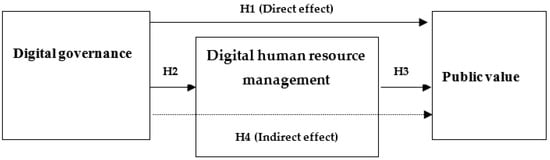
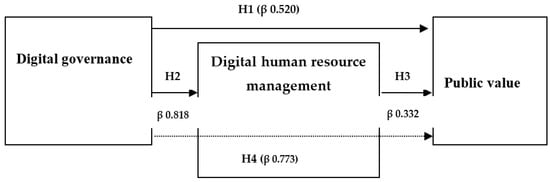
The model’s central claim is that DG influences PV both directly and indirectly. The direct effect reflects that governance can improve service design and coordination across units, producing better service outcomes and legitimacy. The indirect effect reflects the mediation role of DHRM: governance structures and standards enable HR digitalization and capability building, which in turn improves service quality and the organization’s ability to create public value (Figure 1).
Figure 1.
Research model.
3.2. Hypotheses Development
H1 (DG → PV):
Digital governance is positively associated with public value. Integrative digital governance aligns technology, organizational structures, and human agency to improve service reliability, accountability, and citizen-relevant outcomes [4]. In Egypt, digital governance is positioned as a lever for administrative transformation [6], suggesting a positive association with value outcomes.
H2 (DG → DHRM):
Digital governance is positively associated with digital HRM practices. Governance provides the standards, accountability, investment prioritization, and data frameworks required to digitize HR processes and institutionalize HR analytics. Where governance is stronger, HR digitalization is more likely to be coordinated, compliant, and sustainably embedded in routine.
H3 (DHRM → PV):
Digital HRM practices are positively associated with public value. Digital HRM improves HR service quality and HRM effectiveness [10,11], strengthens employee capability through training, and supports consistent performance management, which are prerequisites for improved service quality, transparency, and inclusion. Evidence also indicates that e-HRM can contribute to public value in public-sector settings [31].
H4 (Mediation):
Digital HRM practices mediate the relationship between digital governance and public value. Digital governance creates enabling structures and controls, but digital HRM converts these into workforce routines and capabilities that determine whether digital transformation produces stable, legitimate public value [4,5].
3.3. Operationalization Expectations
DG is expected to load on indicators reflecting governance clarity, accountability, data governance/interoperability, and transparency/risk control. DHRM is expected to load on indicators capturing the digitalization and analytics enablement of core HR processes. PV is expected to load on indicators reflecting perceived improvements in service quality, speed, transparency, inclusion, and trust. Because the model is intended for public-sector settings, the PV construct explicitly includes legitimacy-related outcomes in addition to efficiency.
3.4. Control Variables and Alternative Explanations
To reduce omitted-variable bias, the empirical model can incorporate theoretically justified controls and moderators. Potential controls include job level, unit/function, tenure, education, region, and self-rated digital skills. These variables can influence exposure to digital systems and the capacity to benefit from HR digitization. In addition, multigroup comparisons can test whether the mediation pathway differs by frontline versus headquarters roles, high versus low digital skill, or managerial versus non-managerial positions. Such analyses enhance the policy relevance of findings by identifying where governance investments most strongly translate into public value.
4. Methods
4.1. Research Design
This study employed a quantitative, cross-sectional survey design to examine the relationships among Digital Governance (DG), Digital Human Resource Management (DHRM), and Public Value (PV) in an Egyptian public-sector context. The analytical approach relies on regression-based hypothesis testing and mediation analysis (with bootstrapped confidence intervals) using composite construct scores derived from multi-item Likert measures.
4.2. Target Population and Sampling Frame
The target population consisted of Egypt Post employees and supervisors who interact with, manage, or are affected by digital systems and HR processes (e.g., branch/post-office staff, operational supervisors, IT/digital transformation units, HR units, and headquarters administrators). To improve representativeness across the organization’s diversity in tasks and digital exposure, the questionnaire was distributed using a stratified approach across (a) geography (regions/governorates), (b) organizational level (frontline, supervisory, and managerial roles), and (c) functional units (operations/service delivery, HR, IT/digital, and administration). Within each stratum, responses were collected from available participants during the field period until the targeted coverage was achieved.
4.3. Sample Size and Achieved Sample
A total of 278 usable questionnaires were obtained from Egypt Post employees. This sample size is adequate for multiple methodological reasons. First, following the recommendations of Hair et al. [33], a minimum sample size of 200 is appropriate for structural equation modeling with three constructs. Second, for regression-based mediation with bootstrapping, Preacher and Hayes [34] indicate that samples of 100–200 are typically sufficient. Third, the sample exceeds the threshold of 10 observations per parameter for CFA (24 items × 10 = 240 minimum). Fourth, with n = 278, the study achieves adequate statistical power (greater than 0.80) to detect medium effect sizes at alpha = 0.05. The sample size thus supports reliable estimation of internal consistency, correlation-based validity diagnostics, and mediation analysis for the multi-item constructs in this study [35]. This sample size is adequate for the study’s mediation testing using regression and bootstrapping, and it also supports reliable estimation of internal consistency and correlation-based validity diagnostics for multi-item constructs.
4.4. Instrument Development and Measures
All constructs are operationalized as reflective multi-item measures using a 5-point Likert scale (1 = Strongly disagree to 5 = Strongly agree). Digital governance items (8 items) were adapted from the digital governance framework developed by Vigoda-Gadot and Mizrahi [4], capturing strategy clarity, decision rights, data governance, interoperability, accountability, transparency/auditability, and risk controls. Digital HRM items (8 items) were adapted from the e-HRM measurement scales validated by Wang et al. [11] and El-Emary et al. [10], capturing the digitalization of HR processes across recruitment, training, performance management, HR self-service, communication, and analytics. Public value items (8 items) were adapted from the public value measurement framework by Meynhardt [15] and the dimensions identified by Jørgensen and Bozeman [16], capturing employee-perceived outcomes related to service quality, speed, inclusion, fairness, transparency, trust, and overall value creation. All scale items were reviewed for face validity by three subject-matter experts prior to data collection. Digital governance items capture strategy clarity, decision rights, data governance, interoperability, accountability, transparency/auditability, and risk controls. Digital HRM items capture the digitalization of HR processes across recruitment, training, performance management, HR self-service, communication, and analytics. Public value items capture employee-perceived outcomes related to service quality, speed, inclusion, fairness, transparency, trust, and overall value creation.
4.5. Translation, Cultural Adaptation, and Pilot Testing
The questionnaire was administered in Arabic, the native language of all respondents. Items were adapted from established English-language scales in the literature and subjected to a rigorous translation and cultural adaptation process following Brislin’s [36] back-translation method. The Arabic version was reviewed for clarity and contextual appropriateness by three bilingual academics (fluent in Arabic and English) and two HR practitioners from Egypt Post to ensure semantic equivalence and practical relevance. Minor wording adjustments were made to improve comprehension while preserving the meaning of the original constructs. A pilot study was conducted with 30 Egypt Post employees (not included in the final sample) to assess the clarity, reliability, and face validity of the instrument. Pilot participants provided feedback on item wording, response scale clarity, and overall survey length. Based on pilot feedback, two items were reworded for greater clarity, and the estimated completion time was confirmed at approximately 12–15 min. The pilot data showed acceptable preliminary reliability (alpha greater than 0.85 for all constructs). Items were adapted from established scales in the literature and reviewed for clarity and contextual appropriateness by bilingual academics/practitioners prior to field distribution. Minor wording adjustments were made to improve comprehension while preserving the meaning of the original constructs.
4.6. Data Collection Procedures
Data were collected using a structured questionnaire distributed to employees across branches/post offices and headquarters units during March–April 2025. The questionnaire was distributed through multiple channels to maximize reach: (1) email invitations with online survey links to headquarters staff, (2) paper-based surveys distributed by HR coordinators at regional branch offices, and (3) QR codes posted in staff areas linking to the online survey. The survey remained open for four weeks, with two reminder messages sent at two-week intervals. Of approximately 500 questionnaires distributed, 298 were returned (response rate of 59.6%), of which 278 were complete and usable (usable response rate of 55.6%). Non-response analysis comparing early and late respondents showed no significant differences on key variables, suggesting that non-response bias is not a major concern. Participation was voluntary and anonymous, and the cover page provided the study purpose and informed-consent statement. Standard procedural remedies were applied to reduce response bias (e.g., emphasizing confidentiality and using clear, neutral wording) [37].
4.7. Data Preparation and Quality Controls
Survey responses were screened for completeness and consistency through a multi-step quality control process. First, incomplete responses (missing more than 10% of items) were excluded [38]. Second, responses showing straight-lining patterns (identical responses across all items) were flagged and reviewed; two such cases were identified and excluded as potential careless responding. Third, response time stamps were examined; responses completed in less than 5 min (suggesting insufficient attention) were reviewed, with one such case excluded. After these screenings, one non-response header row in the raw spreadsheet was removed, yielding 278 valid cases with no missing values in the 24 Likert-scale items used in the core model. All scale items were coded so that higher values indicate stronger agreement (1 = Strongly disagree to 5 = Strongly agree). Composite construct scores were computed as the arithmetic mean of their respective items. Missing values in demographic variables (present in less than 5% of cases) were handled using listwise deletion for relevant analyses [39].
4.8. Statistical Analysis
Statistical analyses were conducted using SPSS 27.0 and AMOS 27.0. First, descriptive statistics (means, standard deviations) and internal consistency reliability (Cronbach’s alpha) were computed in SPSS. Second, Pearson correlations among constructs were calculated to assess nomological validity and examine multicollinearity patterns. Third, common method bias was evaluated using Harman’s single-factor test (principal component analysis) and full-collinearity variance inflation factors (VIF) [40]. Fourth, confirmatory factor analysis (CFA) was performed in AMOS to verify the three-factor measurement model and compute composite reliability (CR), average variance extracted (AVE), and model fit indices (CFI, TLI, RMSEA, SRMR). Fifth, discriminant validity was assessed using the heterotrait–monotrait ratio (HTMT) following Henseler et al. (2015) [32]. Finally, hypotheses were tested using ordinary least squares regression in SPSS, and mediation was evaluated using the PROCESS macro with 5000 bootstrap resamples to generate 95% bias-corrected confidence intervals for the indirect effect.
4.9. Measurement Quality Criteria
Because the constructs were measured with reflective multi-item Likert scales, measurement quality was evaluated using multiple validity and reliability indicators. First, internal consistency was assessed using Cronbach’s alpha, with values of 0.70 or higher treated as acceptable [41]. Second, confirmatory factor analysis (CFA) was conducted to verify the three-factor structure and assess model fit [42]. Third, composite reliability (CR) was computed, with values of 0.70 or higher indicating adequate reliability. Fourth, average variance extracted (AVE) was calculated to assess convergent validity, with values of 0.50 or higher considered acceptable. Fifth, discriminant validity was evaluated using the heterotrait–monotrait (HTMT) ratio of correlations, with values below 0.85 indicating that constructs are empirically distinct. Additionally, the Fornell–Larcker criterion was applied, requiring the square root of AVE for each construct to exceed its correlations with other constructs [43]. These comprehensive validity assessments are particularly important given the relatively high correlation between DG and DHRM (r = 0.818), which necessitates empirical confirmation that these constructs are clearly separable. In addition, inter-construct correlations were examined for theoretical coherence, and VIF statistics were used to confirm that multicollinearity did not threaten the stability of regression estimates.
4.10. Common Method Bias and Robustness Checks
To mitigate common method bias, the questionnaire emphasized anonymity and included clear scale anchors. Statistically, Harman’s single-factor diagnostic and full-collinearity VIF were used as screening tests. As a robustness check for inference, all key effects were interpreted jointly (effect size, confidence intervals, and model R2), rather than relying solely on p-values.
4.11. Statistical Reporting
Regression models report unstandardized coefficients (B), standard errors, t-statistics, and p-values. For comparability, standardized coefficients (β) are also reported for key structural paths. Mediation results report the bootstrapped indirect effect and its 95% confidence interval.
4.12. Data Analysis Transparency
All statistical procedures, data-cleaning steps, and hypothesis tests were applied consistently to the collected dataset, and the reported coefficients, test statistics, and p-values are directly derived from the analyses described in Section 4.
5. Statistical Analysis and Results
5.1. Sample Profile
The final sample included 278 usable questionnaires. Detailed demographic and work-profile distributions are provided in Table S2. In brief, respondents were predominantly male (85.6%), most were aged 35–44 years (57.2%), and the majority held a bachelor’s degree (62.9%).
5.2. Data Screening and Distributional Characteristics
The raw spreadsheet included one header/non-response row, which was removed. The remaining dataset contained 278 complete cases with no missing values across the 24 Likert-scale items used in the core model. Composite construct scores were inspected for plausibility and overall distributional pattern. The distributions appeared mildly negatively skewed, consistent with generally positive perceptions among respondents. Given the sample size, OLS inference is considered sufficiently robust; nevertheless, the mediation analysis relied on bootstrapped confidence intervals rather than normality assumptions.
5.3. Descriptive Statistics and Internal Consistency Reliability
Table 1 reports construct-level descriptive statistics (Mean, SD) and reliability. All constructs show strong internal consistency (Cronbach’s α ≥ 0.90). Mean values exceed the scale midpoint (3.0), suggesting overall favorable perceptions of digital governance, digital HRM practices, and public value outcomes.
Table 1.
Descriptive statistics and reliability (n = 278).
5.4. Correlations and Multicollinearity Checks
Bivariate Pearson correlations among DG, DHRM, and PV are presented in Table 2. All correlations are positive and strong, consistent with the theoretical model. The strong correlation between DG and DHRM (r = 0.818) was examined further via discriminant validity tests (Table 3), which confirmed that the constructs are empirically distinct. To ensure regression stability, multicollinearity was assessed using VIF in the full-collinearity diagnostic (Table 4); all VIF values are below conservative thresholds.
Table 2.
Inter-construct correlations (Pearson r).
Table 3.
Validity assessment (CFA-based CR, AVE, and HTMT).
Table 4.
Common method bias diagnostics (Harman’s single-factor test and full-collinearity VIF).
5.5. Validity Assessment (CFA, CR, AVE, HTMT)
To complement the reliability analysis, confirmatory factor analysis (CFA) was conducted to evaluate convergent and discriminant validity. Convergent validity was assessed through Average Variance Extracted (AVE) and Composite Reliability (CR). As shown in Table 3, all constructs demonstrate adequate convergent validity: AVE values exceed the 0.50 threshold, and CR values exceed 0.70. Discriminant validity was evaluated using the Heterotrait–Monotrait ratio (HTMT). All HTMT values remain below the conservative threshold of 0.85, confirming discriminant validity despite the strong correlation between DG and DHRM (r = 0.818). The Fornell–Larcker criterion was also satisfied: the square root of AVE for each construct exceeds its correlations with other constructs.
5.6. Common Method Bias Diagnostics
Because all variables were collected via the same survey instrument, potential common method bias (CMB) was assessed. Harman’s single-factor diagnostic indicated that the first unrotated component explains 56.5% of the total variance across all 24 items, which can signal the presence of method variance in single-source, single-wave designs. However, the full-collinearity VIF approach yielded VIF values between 2.74 and 3.71, suggesting that collinearity-driven common method effects are not extreme. As summarized in Table 4, these diagnostics indicate that CMB cannot be ruled out; accordingly, results should be interpreted with appropriate caution and future work should consider multi-source and/or time-lagged designs to further mitigate method bias.
5.7. Hypothesis Testing (OLS Regression)
Hypotheses H1–H3 were tested using OLS regression. Table 5 reports unstandardized coefficients (B), standard errors, t-values, p-values, standardized coefficients (β), and model fit (R2, adjusted R2). DG has a strong positive effect on PV (H1). DG strongly predicts DHRM (H2). Models controlling for job level, digital skills, and organizational tenure yielded consistent results, with digital skills showing a significant positive association with PV (β = 0.178, p < 0.001). When DG and DHRM are entered jointly, DHRM remains a significant predictor of PV (H3), while the DG→PV coefficient decreases but remains significant, indicating partial mediation.
Table 5.
Hypothesis tests (OLS regression).
5.8. Mediation Analysis (Bootstrapped Indirect Effect)
Mediation (H4) was tested with non-parametric bootstrapping (5000 resamples). As shown in Table 6, the indirect effect (a × b) is positive and statistically significant because the 95% CI does not include zero. The remaining direct effect (c′) is also significant, supporting partial mediation: DG contributes to PV both directly and indirectly through DHRM.
Table 6.
Bootstrapped mediation effect (5000 resamples).
6. Discussion
This study examined how digital governance (DG) contributes to public value (PV) in a large, geographically distributed public service organization, and whether digital HRM practices (DHRM) serve as an internal mechanism translating governance capacity into value outcomes. The statistical evidence supports the mediation logic and presents a consistent picture across descriptive patterns, measurement quality, and structural relationships.
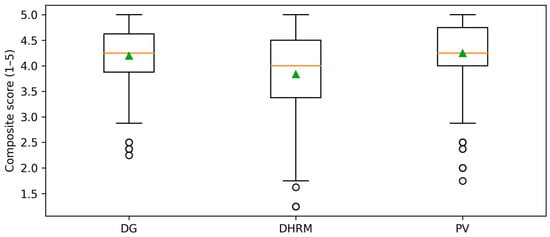
Measurement quality is strong. As reported in Table 1, internal consistency exceeds conventional thresholds for DG (α = 0.903), DHRM (α = 0.948), and PV (α = 0.923). Validity assessment (Table 3) confirms adequate convergent validity (AVE: 0.573–0.624; CR: 0.912–0.952) and discriminant validity (HTMT: all <0.85), supporting the measurement model. Means exceed the scale midpoint, indicating generally favorable perceptions. Figure 2 suggests that DHRM displays wider dispersion than DG and PV, which may reflect uneven maturity of HR digitalization across functions or regions—an important diagnostic for managerial targeting.
Figure 2.
Distributions of construct composites.
The correlation pattern (Table 2) aligns with the theoretical model: DG correlates strongly with DHRM (r = 0.818) and PV (r = 0.773), and DHRM correlates strongly with PV (r = 0.743). Common method bias diagnostics (Table 3) show that Harman’s first-factor variance explained is 56.5% and full-collinearity VIF values remain below conservative thresholds, suggesting that method variance is unlikely to fully account for the observed effects—though multi-wave, multi-source designs would further strengthen inference.
Hypothesis testing indicates that digital governance is a powerful predictor of public value. In the baseline model (Table 5), DG has a large positive effect on PV (B = 0.801, β = 0.773, p < 0.001), explaining R2 = 0.598 of PV variance. When control variables (job level, digital skills, tenure) were added, the model R2 increased to 0.658, with digital skills (β = 0.178, p < 0.001) and job level (β = 0.102, p = 0.035) showing significant associations with PV. This supports integrative views of digital governance as more than IT control: clarified decision rights, accountability, data governance, interoperability, and transparency appear to align digital initiatives with citizen-relevant outcomes such as service speed, reliability, and perceived fairness.
Digital governance also strongly predicts digital HRM (Table 5: B = 1.144, β = 0.818, p < 0.001). This coupling is plausible in public organizations: governance provides the policy, standardization, and data foundations that make HR digitalization feasible and acceptable (e.g., auditable workflows, compliant data usage, and coordinated investment priorities). In practice, this means that governance reforms can create an enabling environment for e-recruitment, e-learning, digital performance management, employee self-service, and HR analytics.
The central contribution is clarifying the mechanism linking governance to value. When DG and DHRM are entered jointly (Table 5), DHRM remains a significant predictor of PV (B = 0.246, β = 0.332, p < 0.001), while the DG→PV coefficient decreases but remains significant (B = 0.520, β = 0.502, p < 0.001). This pattern indicates partial mediation and suggests that governance creates value both directly. Control variables (job level, digital skills, organizational tenure) were included in supplementary models; digital skills showed a significant positive association with PV (β = 0.178, p < 0.001), while job level had a modest effect (β = 0.102, p = 0.035). The model R2 increased to 0.658 with controls. Governance creates value both directly (through standards, transparency, risk monitoring, and service coordination) and indirectly by enabling HR systems that build capability and stabilize digital routines.
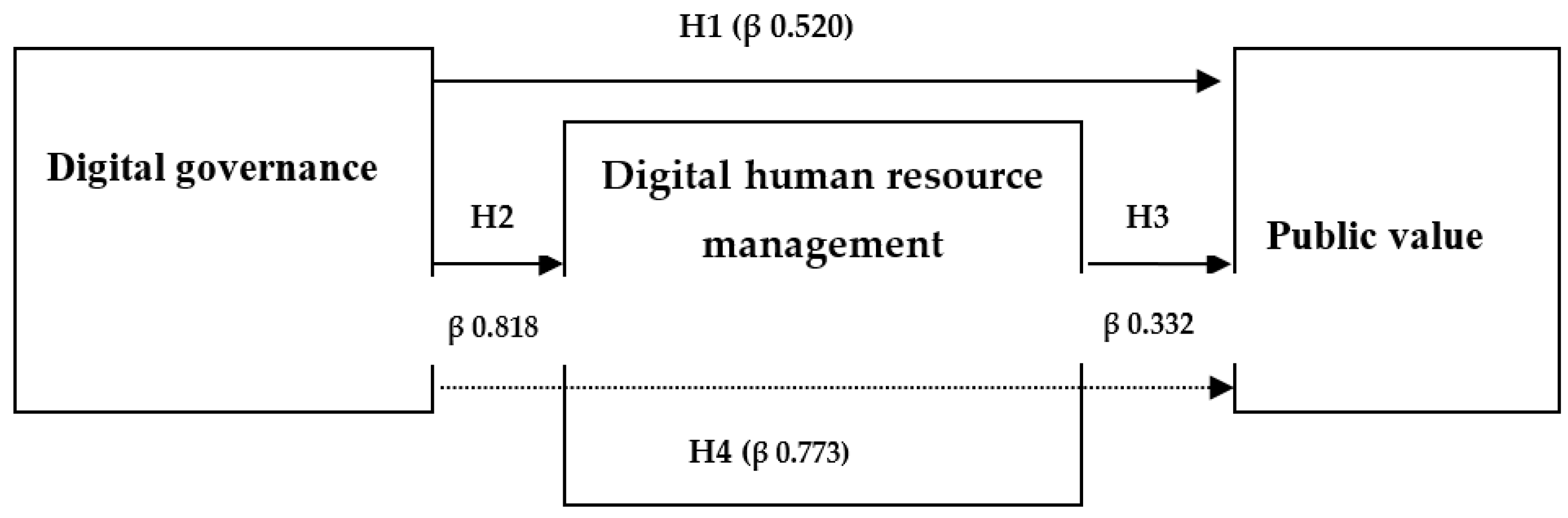
Bootstrapped mediation confirms this mechanism (Table 6). The indirect effect (a × b) is 0.282 with a 95% CI [0.156, 0.424], excluding zero. Figure 3 visualizes the standardized paths (DG→DHRM β = 0.818; DHRM→PV β = 0.332) and reinforces the interpretation that HR digitalization is a substantive pathway converting governance arrangements into service and legitimacy outcomes. Theoretically, the results are consistent with socio-technical reasoning: governance rules and digital systems become value-creating when they are embedded in employee routines, skills, and incentive structures.
Figure 3.
Standardized path coefficients (β).
Managerially, the results indicate that HR digitalization functions as an implementation core (not merely a support activity) in public-sector digital transformation. For Egypt Post, the evidence is consistent with practical priorities such as: (1) aligning digital learning pathways with service processes and citizen-facing standards; (2) using HR analytics to identify capability gaps across regions and job families; (3) applying digital performance management to reinforce service quality, transparency, and complaint resolution; and (4) expanding employee self-service and workflow automation to reduce delays and inconsistencies. The dispersion in DHRM (Figure 2) is consistent with uneven maturity across units, where targeted capability-building is likely to yield larger marginal gains.
Policy implications follow: governance reforms and platform investments can generate public value, and their effects are stronger when HR systems institutionalize digital routines and safeguard fairness. In data-driven environments, effective governance design includes ethical and transparency controls for HR analytics and algorithmic decision support (e.g., audit trails, bias monitoring, explainability requirements, and appeal mechanisms). These safeguards protect legitimacy, which is a core component of public value in public-sector contexts.
Limitations are noted. The design is cross-sectional and relies on employee perceptions; therefore, causal ordering cannot be confirmed definitively. The single-organization context may limit generalizability, and common method variance cannot be fully eliminated in a single-source survey design. Longitudinal designs and triangulation of perceptual public value with objective indicators (e.g., service times, complaint rates, and system-availability logs) would strengthen causal inference and external validity. Despite these constraints, the evidence across Table 1, Table 2, Table 3, Table 4 and Table 5 and Figure 1, Figure 2 and Figure 3 provides a coherent, policy-relevant account of how governance and HR digitalization jointly support public value creation.
From a theoretical perspective, the findings contribute to public value scholarship by specifying an actionable micro-foundation for value creation in digital government settings. Prior work often treats public value as an outcome of macro-level digitalization (e.g., platforms, data portals, e-services) without clearly identifying the internal organizational routines that enable value realization. The present results position DHRM as that enabling layer: governance provides the rules and coordination capacity, while digital HRM operationalizes these rules through skills development, standardized performance routines, and digitally mediated employee support.
The partial mediation pattern is also conceptually informative. If the relationship had been fully mediated, it would suggest that governance operates only through HR systems; instead, governance retains a direct association with public value (Table 4, M3), indicating that governance creates value through both (i) ‘front-end’ pathways (service standards, transparency, risk controls, and inter-unit coordination) and (ii) ‘back-end’ workforce pathways (capability building and standardized HR processes). This dual-path logic is important for public-sector leaders because it implies that improving citizen outcomes requires coordinated attention to both institutional design and people systems.
In the Egypt Post context, the workforce pathway is likely to be particularly salient because service quality is highly dependent on frontline execution across a distributed branch network. Digital governance reforms that remain confined to headquarters may deliver only limited value if frontline employees lack consistent digital training, if HR workflows are not automated, or if performance feedback loops are weak. Conversely, digitized HR systems without governance oversight may produce fragmentation (e.g., inconsistent standards, uneven adoption, and data-quality problems). The model therefore supports an integrated ‘governance–HR’ transformation roadmap rather than parallel initiatives.
Operationally, an integrated roadmap can be structured around four interlocking capability bundles: (1) governance for data and interoperability (clear ownership of citizen/service data, uniform data definitions, and integration standards); (2) governance for risk and accountability (cyber controls, auditability, and role clarity for digital decisions); (3) HR digitalization for capability development (continuous learning, digital skills certification, and role-based training pathways); and (4) HR digitalization for performance and incentives (service quality metrics, complaint-resolution KPIs, and transparent performance feedback). Aligning these bundles can help ensure that investments in platforms and analytics translate into stable daily routines and, ultimately, perceived public value.
The results also suggest practical priorities for measurement and monitoring. Leaders can use the constructs in Table 1 as internal dashboards: periodic pulse surveys can track DG, DHRM, and PV together, while operational systems provide objective complements (e.g., average service time, system uptime, complaint rates, and citizen satisfaction scores). In future implementations, combining these data streams would allow more rigorous evaluations (e.g., difference-in-differences designs around rollout waves) and would strengthen accountability for value creation, consistent with the governance logic.
Finally, the study underscores that ‘public value’ in digital transformation is not solely about efficiency; it also includes legitimacy-related dimensions—trust, transparency, and perceived fairness. Digital HRM practices can support these legitimacy outcomes when they embed clear rules, explainable criteria, and equitable access to training and opportunities. Accordingly, governance frameworks should incorporate ethical guardrails for people analytics and algorithmic decision-making, including documentation, bias checks, and employee appeal channels. These safeguards can reduce resistance, improve adoption, and protect the organization’s public legitimacy while scaling digital operations.
7. Conclusions
This study shows that digital governance is strongly associated with public value in Egypt Post and that digital HRM practices partially transmit this relationship. The evidence highlights that governance is not value-generating by default; it becomes value-creating when HR systems institutionalize digital routines, develop capabilities, and stabilize service delivery. Policymakers and public managers should therefore treat digital HRM as a core implementation mechanism—alongside governance standards and controls—when pursuing citizen-relevant outcomes from digital transformation.
Supplementary Materials
The following supporting information can be downloaded at: https://www.mdpi.com/article/10.3390/su18063044/s1, Table S1: Survey Instrument; Table S2: Demographic and Work-Profile Questions.
Author Contributions
Conceptualization, H.A., D.H.A.N. and R.M.; Methodology, A.A.; Software, A.G.; Validation, H.A.; Formal analysis, A.G., M.S.I. and R.M.; Writing—original draft, A.A., M.S.I. and A.M.S.; Writing—review & editing, A.G. and D.H.A.N.; Visualization, A.M.S.; Supervision, A.A. All authors have read and agreed to the published version of the manuscript.
Funding
This research was funded by Princess Nourah bint Abdulrahman University Researchers Supporting Project number (PNURSP2026R867), Princess Nourah bint Abdulrahman University, Riyadh, Saudi Arabia.
Institutional Review Board Statement
The study was conducted in accordance with the Declaration of Helsinki, and approved by the Scientific Committee of the Arab Academy for Administrative, Financial and Banking Sciences (Giza, Egypt) (approval number 112025; 4 April 2025).
Informed Consent Statement
Informed consent was obtained from all subjects involved in the study via the questionnaire cover page/introductory statement.
Data Availability Statement
The data presented in this study are available from the corresponding author upon reasonable request. The data are not publicly available due to confidentiality commitments to participants.
Acknowledgments
Princess Nourah bint Abdulrahman University Researchers Supporting Project number (PNURSP2026R867), Princess Nourah bint Abdulrahman University, Riyadh, Saudi Arabia. The authors are thankful to the Deanship of Graduate Studies and Scientific Research at University of Bisha for supporting this work through the Fast-Track Research Support Program.
Conflicts of Interest
The authors declare that they have no conflict of interest with respect to the research, authorship, and/or publication of this article.
Abbreviations
DG: Digital Governance; DHRM: Digital Human Resource Management; PV: Public Value; CMB: Common Method Bias; VIF: Variance Inflation Factor; OLS: Ordinary Least Squares.
References
- Abebe, M.K. HR practices and efficiency of public administration in developing countries: A case of Ethiopia. Strateg. J. Bus. Change Manag. 2020, 7, 1–19. [Google Scholar] [CrossRef] [Scilit]
- Awad, A.; Shemais, M.; Al-Embabi, M. Driving HR performance through digital transformation in educational directorates: A strategic imperative. Probl. Perspect. Manag. 2024, 22, 163–173. [Google Scholar] [CrossRef] [Scilit]
- BoardEffect. Digital Governance Best Practices. 2023. Available online: https://www.boardeffect.com/blog/digital-governance-best-practices/ (accessed on 2 February 2026).
- Vigoda-Gadot, E.; Mizrahi, S. The digital governance puzzle: Towards integrative theory of humans, machines, and organizations in public management. Technol. Soc. 2024, 77, 102530. [Google Scholar] [CrossRef] [Scilit]
- Pūraitė, A.; Zuzevičiūtė, V.; Bereikienė, D.; Skrypko, T.; Shmorgun, L. Algorithmic governance in public sector: Is digitization a key to effective management. Indep. J. Manag. Prod. 2020, 11, 2149–2170. [Google Scholar] [CrossRef] [Scilit]
- Hassan, N.A. Digital governance: Transforming public administration through technology in Egypt. MSA-Manag. Sci. J. 2025, 4, 144–169. [Google Scholar] [CrossRef] [Scilit]
- Frinaldi, A.; Putri, N.E.; Embi, M.A. Public sector performance and digital-governance effectiveness predicted by community happiness as a representation of culture. J. Ethn. Cult. Stud. 2023, 10, 90–108. [Google Scholar] [CrossRef] [Scilit]
- Chapano, M.; Mey, M.R.; Werner, A. Adoption of digital strategies across the human resource value chain. SA J. Hum. Resour. Manag./SA Tydskr. Vir Menslikehulpbronbestuur 2022, 20, a1992. [Google Scholar] [CrossRef] [Scilit]
- Mostafa, A.; Gould-Williams, J.; Bottomley, P. High-performance human resource practices and employee outcomes: The mediating role of public service motivation. Public Adm. Rev. 2015, 75, 747–757. [Google Scholar] [CrossRef] [Scilit]
- El-Emary, G.; Hafez, E.; Roland, D. The impact of electronic human resource management (E-HRM) practices on human resource management service quality (HRMSQ): An applied study on the fast-moving consumer goods sector (FMCG) in multinational companies in Egypt. J. Manag. Strategy 2022, 13, 25–46. [Google Scholar] [CrossRef] [Scilit]
- Wang, L.; Zhou, Y.; Zheng, G. Linking digital HRM practices with HRM effectiveness: The moderate role of HRM capability maturity from the adaptive structuration perspective. Sustainability 2022, 14, 1003. [Google Scholar] [CrossRef] [Scilit]
- Khodeir, L.; Nabawy, E. Responsive human resource framework for design and building of mega housing development projects in Egypt. Ain Shams Eng. J. 2021, 12, 2371–2383. [Google Scholar] [CrossRef] [Scilit]
- Dunleavy, P.; Margetts, H.; Bastow, S.; Tinkler, J. New public management is dead—Long live digital-era governance. J. Public Adm. Res. Theory 2006, 16, 467–494. [Google Scholar] [CrossRef] [Scilit]
- Moore, M.H. Creating Public Value: Strategic Management in Government; Harvard University Press: Cambridge, MA, USA, 1995. [Google Scholar]
- Meynhardt, T. Public value inside: What is public value creation? Int. J. Public Adm. 2009, 32, 192–219. [Google Scholar] [CrossRef] [Scilit]
- Jørgensen, T.B.; Bozeman, B. Public values: An inventory. Adm. Soc. 2007, 39, 354–381. [Google Scholar] [CrossRef] [Scilit]
- Bryson, J.M.; Crosby, B.C.; Bloomberg, L. Public value governance: Moving beyond traditional public administration and the new public management. Public Adm. Rev. 2014, 74, 445–456. [Google Scholar] [CrossRef] [Scilit]
- Bannister, F.; Connolly, R. ICT, public values and transformative government: A framework and programme for research. Gov. Inf. Q. 2014, 31, 119–128. [Google Scholar] [CrossRef] [Scilit]
- van Dijck, J. Governing digital societies: Private platforms, public values. Comput. Law Secur. Rev. 2020, 36, 105377. [Google Scholar] [CrossRef] [Scilit]
- Steenkamp, J.-B.E.M.; Baumgartner, H. Assessing measurement invariance in cross-national consumer research. J. Consum. Res. 1998, 25, 78–90. [Google Scholar] [CrossRef] [Scilit]
- Nicolás-Agustín, Á.; Jiménez-Jiménez, D.; Maeso-Fernandez, F. The role of human resource practices in the implementation of digital transformation. Int. J. Manpow. 2022, 43, 395–410. [Google Scholar] [CrossRef] [Scilit]
- Davis, F.D. Perceived usefulness, perceived ease of use, and user acceptance of information technology. MIS Q. 1989, 13, 319–340. [Google Scholar] [CrossRef] [Scilit]
- Hima, N.; Benarous, D.; Louail, B.; Hamadi, W. Enhancing employee engagement through digital HR practices: The mediating role of organizational trust in Algerian universities. South Fla. J. Dev. 2025, 6, e4942. [Google Scholar] [CrossRef] [Scilit]
- Atiyah, S.; Turki, A. The impact of digital human resources management on organizational ambidexterity through human capital as an interactive variable in Iraqi telecommunications companies. Int. J. Prof. Bus. Rev. 2024, 9, e04719. [Google Scholar] [CrossRef] [Scilit]
- Thu, S.; Pham, M.; Luc, H. Leveraging digital human resource management to optimize organizational performance in Vietnam. Humanit. Soc. Sci. Commun. 2025, 12, 802. [Google Scholar] [CrossRef] [Scilit]
- Abugabel, A. The impact of digital transformation on sustainable development: The mediating role of development of human resources management practices (an empirical study on private hospitals). Alex. Univ. J. Adm. Sci. 2023, 60, 173–233. [Google Scholar] [CrossRef] [Scilit]
- Radzi, N.; Saidi, N.; Hassan, S.; Ibrahim, M.; Lee, K. Exploring corporate social responsibility practices in the telecommunications, broadcasting and courier sectors: A comparative industry analysis. Humanit. Soc. Sci. Commun. 2025, 12, 343. [Google Scholar] [CrossRef] [Scilit]
- Okorie, C.; De Guzman, L. Human resource management practices and employee commitment in public agencies: A sustainable workforce development perspective from Enugu City, Nigeria. J. Manag. Glob. Sustain. 2025, 13, 1. [Google Scholar] [CrossRef] [Scilit]
- DeSanctis, G.; Poole, M.S. Capturing the complexity in advanced technology use: Adaptive structuration theory. Organ. Sci. 1994, 5, 121–147. [Google Scholar] [CrossRef] [Scilit]
- Barney, J. Firm resources and sustained competitive advantage. J. Manag. 1991, 17, 99–120. [Google Scholar] [CrossRef] [Scilit]
- Mwangi, G.; Kamau, G. Public value creation through electronic human resource management in public sector: A mixed methods approach. Int. J. Sci. Technol. Manag. 2024, 5, 566–575. [Google Scholar] [CrossRef] [Scilit]
- Henseler, J.; Ringle, C.M.; Sarstedt, M. A new criterion for assessing discriminant validity in variance-based structural equation modeling. J. Acad. Mark. Sci. 2015, 43, 115–135. [Google Scholar] [CrossRef] [Scilit]
- Hair, J.F.; Hult, G.T.M.; Ringle, C.M.; Sarstedt, M. A Primer on Partial Least Squares Structural Equation Modeling (PLS-SEM), 3rd ed.; Sage: Thousand Oaks, CA, USA, 2022. [Google Scholar]
- Preacher, K.J.; Hayes, A.F. Asymptotic and resampling strategies for assessing and comparing indirect effects in multiple mediator models. Behav. Res. Methods 2008, 40, 879–891. [Google Scholar] [CrossRef] [Scilit]
- MacKinnon, D.P. Introduction to Statistical Mediation Analysis; Routledge: New York, NY, USA, 2008. [Google Scholar] [CrossRef] [Scilit]
- Brislin, R.W. Back-translation for cross-cultural research. J. Cross-Cult. Psychol. 1970, 1, 185–216. [Google Scholar] [CrossRef] [Scilit]
- Podsakoff, P.M.; MacKenzie, S.B.; Lee, J.-Y.; Podsakoff, N.P. Common method biases in behavioral research: A critical review of the literature and recommended remedies. J. Appl. Psychol. 2003, 88, 879–903. [Google Scholar] [CrossRef] [Scilit]
- Enders, C.K. Applied Missing Data Analysis; Guilford Press: New York, NY, USA, 2010. [Google Scholar]
- Little, R.J.A. A test of missing completely at random for multivariate data with missing values. J. Am. Stat. Assoc. 1988, 83, 1198–1202. [Google Scholar] [CrossRef]
- Kock, N. Common method bias in PLS-SEM: A full collinearity assessment approach. Int. J. e-Collab. 2015, 11, 1–10. [Google Scholar] [CrossRef] [Scilit]
- Cronbach, L.J. Coefficient alpha and the internal structure of tests. Psychometrika 1951, 16, 297–334. [Google Scholar] [CrossRef] [Scilit]
- Vandenberg, R.J.; Lance, C.E. A review and synthesis of the measurement invariance literature: Suggestions, practices, and recommendations. Organ. Res. Methods 2000, 3, 4–70. [Google Scholar] [CrossRef] [Scilit]
- Fornell, C.; Larcker, D.F. Evaluating structural equation models with unobservable variables and measurement error. J. Mark. Res. 1981, 18, 39–50. [Google Scholar] [CrossRef] [Scilit]

Disclaimer/Publisher’s Note: The statements, opinions and data contained in all publications are solely those of the individual author(s) and contributor(s) and not of MDPI and/or the editor(s). MDPI and/or the editor(s) disclaim responsibility for any injury to people or property resulting from any ideas, methods, instructions or products referred to in the content. |
© 2026 by the authors. Licensee MDPI, Basel, Switzerland. This article is an open access article distributed under the terms and conditions of the Creative Commons Attribution (CC BY) license.