Article

Multirod Side-Pumped Ce:Nd:YAG Architectures for Sustainable Solar Laser Power Generation

Centre of Physics and Technological Research (CEFITEC), Departamento de Física, FCT, Universidade NOVA de Lisboa, Campus de Caparica, 2829-516 Caparica, Portugal
*
Author to whom correspondence should be addressed.
Sustainability 2026, 18(6), 2972; https://doi.org/10.3390/su18062972
Submission received: 22 December 2025 / Revised: 10 February 2026 / Accepted: 16 March 2026 / Published: 18 March 2026
(This article belongs to the Special Issue Solar Energy Technology in Sustainable Development)

Abstract

A detailed numerical optimization of side-pumped cerium- and neodymium-codoped yttrium aluminum garnet (Ce:Nd:YAG) solar laser architectures was performed using Zemax® and LASCADTM, aiming for both high-power multimode and TEM00-mode performances. Multiple rod configurations and laser resonator geometries were evaluated to maximize absorbed pump power, improve mode overlap, and ensure thermal stability. For multimode operation, the optimal design was a four-rod cross side-pumped configuration employing 4.0 mm diameter, 25 mm length rods, which numerically delivered a solar laser output power of 134 W (resulting in a collection efficiency of 49.1 W/m2 and solar-to-laser conversion efficiency of 4.91%), representing a 1.50-times improvement over the best previously reported value of 89.29 W. For TEM00-mode generation, the best performance was obtained with a three-rod horizontal side-pumped configuration using 2.5 mm diameter, 34 mm length rods, achieving a collection efficiency of 21.1 W/m2 and solar-to-laser conversion efficiency of 2.11%, surpassing the record 16.49 W/m2 reported in earlier literature. Thermal analyses revealed low peak temperatures, reduced thermally induced stress, and minimized refractive-index gradients in both architectures, confirming that multirod side pumping significantly improves the thermal environment and enables stable operation at high absorbed pump powers. These results demonstrate that carefully engineered multirod geometries can simultaneously enhance collection efficiency, beam quality, and thermal robustness, highlighting multirod side-pumped solar lasers as a promising pathway for further power scaling and next-generation high-performance solar laser systems.

1. Introduction

Solar-pumped laser systems enable the direct conversion of broadband, incoherent sunlight into spectrally narrow, coherent output via a gain material. As this process relies solely on renewable solar energy, it offers considerable advantages for regions with high solar insolation and promotes more sustainable industrial and space-based technologies [1,2,3,4,5,6,7]. Sustainable solar lasers provide a compelling pathway for green hydrogen production [8,9,10]. In particular, pulsed solar lasers may enable catalyst-free hydrogen extraction from ammonia–water under ambient conditions via laser-induced bubbling, offering an efficient and environmentally friendly alternative to conventional H2 production methods [10].
Since the first observation of solar-driven laser action using a Dy2+:CaF2 crystal in 1963 [11], extensive efforts have explored gas, liquid, and solid-state gain media, culminating in the widespread adoption of Nd3+-doped yttrium aluminum garnet (Nd:YAG) due to its favorable spectroscopic and thermo-mechanical properties [12,13,14,15,16,17].
Despite its robustness, Nd:YAG suffers from a reduced spectral coincidence between Nd3+ absorption lines and the solar spectrum, limiting solar-to-laser conversion efficiency. Co-doping the YAG host with Ce3+ introduces broad UV-blue absorption bands that can efficiently harvest sunlight and transfer energy to Nd3+, improving pumping efficiency [18,19,20,21,22]. Although Ce3+ → Nd3+ energy-transfer mechanisms have long been studied under artificial pumping sources, their behavior under true broadband solar pumping has only recently become experimentally accessible [23,24,25,26,27]. Initial single-rod experiments demonstrated promising output powers, but also revealed a key challenge: strong longitudinal pump inhomogeneity often leads to excessive localized heating, resulting in performance degradation or rod fracture at high solar flux [23]. Subsequent work employing side-pumping schemes has partially mitigated this issue by distributing the pump energy more uniformly along the rod length, enabling significant gains in output power [24,28].
Significant milestones have been reached in the last few years [26,27]. Most recently, using a Fresnel-lens-pumped grooved-bonded Ce:Nd:YAG/YAG rod, Wang et al. achieved a major breakthrough: 89.29 W of continuous-wave output at 1064 nm, with a solar-to-laser conversion efficiency of 3.96%, and a collection efficiency of 32.71 W/m2 [27].
Parallel progress has focused on achieving fundamental-mode (TEM00) operation. Early demonstrations with single, small-diameter rods confirmed that high beam quality can be obtained under solar pumping [29]. Liang et al. improved TEM00-mode efficiency using a Fresnel-lens end-side-pumped 2 mm diameter rod, delivering 1.41 W with 16.49 W/m2 collection efficiency and 3.96% solar-to-laser conversion efficiency [29].
Further laser power scaling in single-rod systems is hindered by thermal accumulation, leading to beam distortion, increased thermal stress, and, in extreme cases, rod fracture [23,28]. For these reasons, multirod Ce:Nd:YAG architectures have emerged as a promising solution. By dividing the concentrated solar flux among several slender rods, the thermal load per rod is reduced while maintaining high absorption efficiency. Moreover, multirod configurations increase the effective pump-aperture area, reducing sensitivity to heliostat-tracking inaccuracies [25,30,31].
Importantly, multirod Ce:Nd:YAG approaches have shown remarkable gains in efficiency. In 2022, Liang et al. demonstrated the highest reported efficiency for simultaneous solar laser generation using three end-side-pumped Ce:Nd:YAG rods within a single pump cavity, delivering a total of 16.5 W, achieving 41.25 W/m2 collection efficiency, and a solar-to-laser conversion efficiency of 4.64% [25]. In 2023, Almeida et al. demonstrated a dual-rod side-pumped Ce:Nd:YAG solar laser producing 58 W continuous-wave, and a wide tracking error compensation width of 5.1° [30]. These multirod systems not only boost output power but also improve thermal robustness and tolerance to alignment errors.
More recent experimental studies have extended the multirod concept toward high beam quality operation, demonstrating that dividing the solar pump flux among several thin Ce:Nd:YAG rods can significantly improve the stability of TEM00 oscillation, mitigating thermally induced aberrations that typically degrade beam quality [32,33]. These demonstrations relied on end-side-pumping schemes. For example, Costa et al. reported a total TEM00-mode solar laser output power of 6.05 W, resulting in a collection efficiency of 8.77 W/m2 [33]. The larger effective pump aperture of multirod assemblies relaxes alignment tolerances, making TEM00 operation more robust against heliostat-tracking errors. These advantages indicate that multirod architectures are a promising route toward stable, high-quality solar-pumped TEM00 Ce:Nd:YAG lasers, although their full potential remains constrained by the limitations inherent to end-side pumping.
In this context, the present work introduces practical and uniquely designed multirod side-pumped Ce:Nd:YAG laser heads, specifically tailored for high-power multimode and diffraction-limited TEM00-mode solar laser operation. Rather than relying on a generic multirod arrangement, two distinct and implementation-friendly laser head geometries were systematically optimized, each adapted to the physical requirements of the targeted operating regime. Through detailed numerical modeling, this study demonstrated that distributing the concentrated solar flux among multiple slender rods via side pumping improved pump uniformity, reduced thermal gradients, and relaxed alignment constraints, while remaining compatible with realistic mechanical implementation. This approach enabled effective power scaling, predicting a continuous-wave multimode laser output power of 134 W (corresponding to a collection efficiency of 49.1 W/m2, and solar-to-laser conversion efficiency of 4.91%), approximately 1.5 times higher than the 89.29 W previously reported by Wang et al. using a single Ce:Nd:YAG rod [27]. In parallel, TEM00-mode solar laser collection efficiency of 21.1 W/m2 and solar-to-laser conversion efficiency of 2.11% were numerically calculated, exceeding the record 16.49 W/m2 reported by Liang et al. [29].
These results highlight that the use of regime-specific, practical multirod side-pumped laser heads is a key enabler for simultaneously achieving record efficiency, thermal robustness, and operational stability, positioning this approach as a viable pathway toward next-generation high-performance solar-pumped laser systems.

2. Ce:Nd:YAG Solar Laser Systems

2.1. PROMES-CNRS Heliostat-Parabolic Mirror System

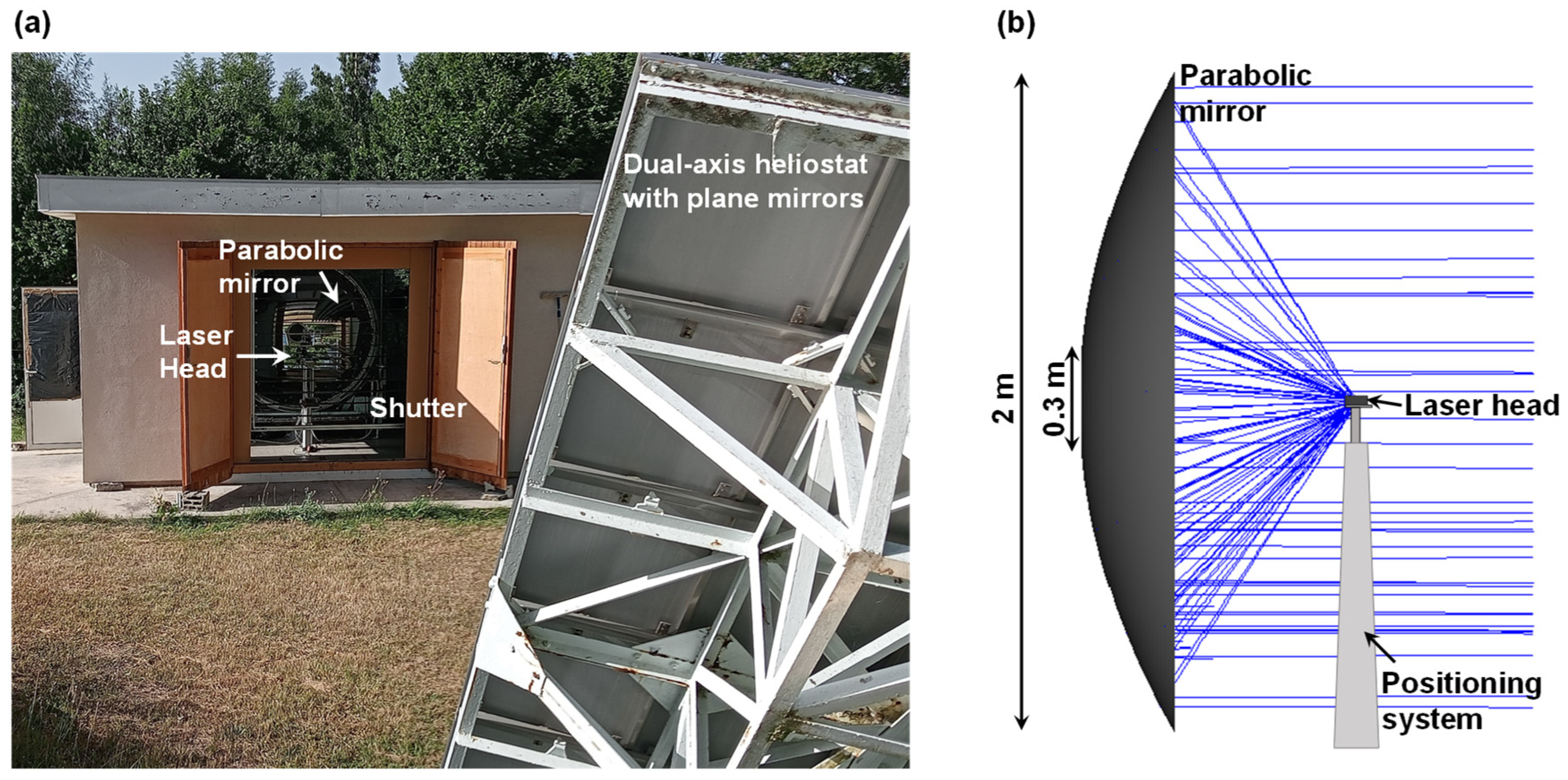
In the present study, the solar input used in the numerical simulations was based on the PROMES-CNRS heliostat–parabolic mirror facility (Figure 1). Sunlight is first intercepted by a dual-axis heliostat composed of 36 squared facets, each 0.5 × 0.5 m2, which transmits the solar rays toward a stationary 2.0 m diameter parabolic primary concentrator with a 60° rim angle and an 0.85 m focal length. The parabolic mirror and the heliostat facets employ rear-surface silver coatings; however, due to aging effects, iron content in the glass, and prolonged exposure, their reflectivity in the focal region was reduced to about 59% [30]. An effective collection area was assumed to be 2.73 m2, after accounting for the central opening of the parabolic mirror, the mechanical supports, partial facet misalignment, and shadowing from auxiliary components such as the blade shutter, water tubes, and the laser head mounted on the XYZ positioning system. Under 1000 W/m2 direct normal irradiance in Odeillo, France, this solar optical system is capable of delivering nearly 1611 W of concentrated solar power onto a near-Gaussian focal spot.

2.2. Multirod Side-Pumped Ce:Nd:YAG Solar Laser Heads

In this work, two different multirod side-pumped Ce:Nd:YAG solar laser heads were designed, each one optimized for a specific operating regime. The first design uses four slender Ce:Nd:YAG rods to maximize absorbed solar power and achieve high-output multimode operation while keeping thermal loads manageable in each rod. The second design employs three Ce:Nd:YAG rods, arranged to improve pump uniformity and minimize the thermal lensing effect, thereby enabling stable TEM00-mode performance under real-sun pumping conditions. Together, these multirod side-pumped configurations provide a clear comparison between architectures aimed at power scaling and those aimed at achieving high beam quality.

2.2.1. Four-Rod Side-Pumped Ce:Nd:YAG Solar Laser Head for Multimode Operation

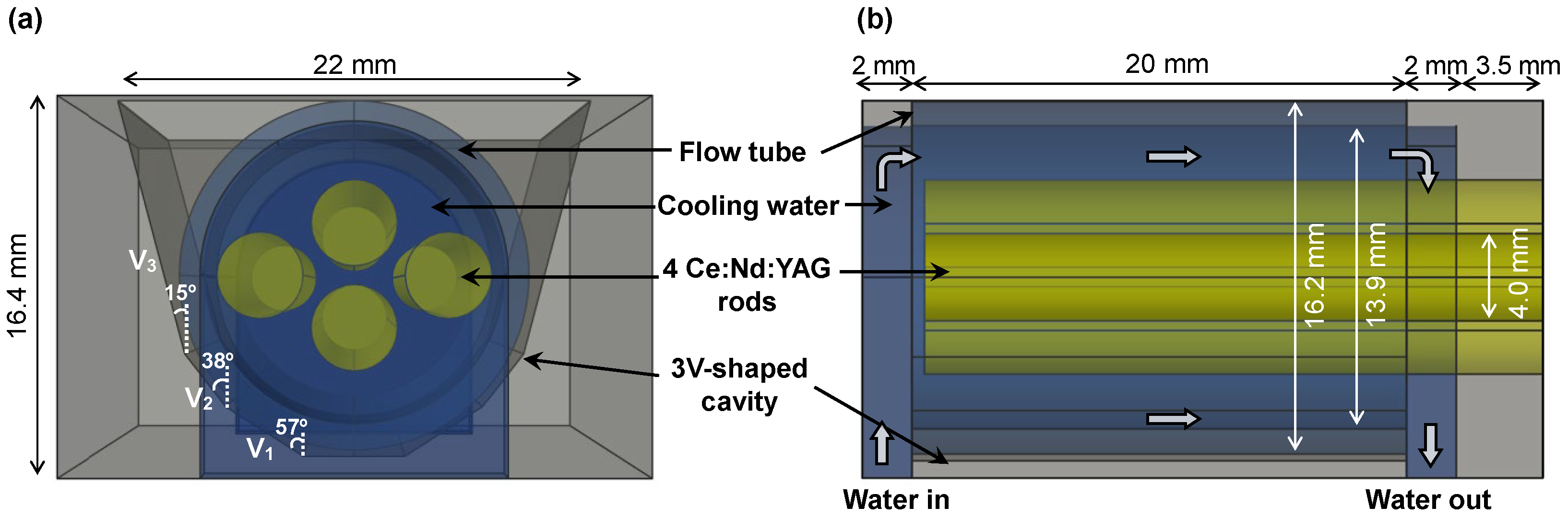
The first laser head, designed for multimode operation, featured a two-stage secondary concentrator consisting of a 3V-shaped dry pump cavity with a flat bottom and a fused-silica flow tube housing four Ce:Nd:YAG rods with dimensions of 4 mm × 25 mm arranged in a cross configuration (Figure 2).
The 3V-shaped cavity, with an opening aperture of 22 mm × 20 mm and a depth of 16.4 mm, included a primary V-shaped reflector (V1) with an 57° half-angle, two intermediate planar reflectors (V2) each tilted at a 38° half-angle, accompanied by two planar reflectors positioned above (V3) each inclined at a 15° half-angle (Figure 2). This arrangement efficiently redirects concentrated solar rays over a wide range of incident angles into the rods, improving pump absorption and coupling.
The Inner surfaces of the 3V-shaped cavity were assumed to exhibit a reflectivity of 95%. The fused-silica flow tube provided water cooling along 21.5 mm of the rod length, with the remaining 3.5 mm allocated for mechanical support. Measuring 16.2 mm in outer diameter, 13.9 mm in internal diameter, and 20 mm in total length, the flow tube also contributed by collecting solar radiation and concentrating it on the rods.

2.2.2. Three-Rod Side-Pumped Ce:Nd:YAG Solar Laser Head for TEM00-Mode Operation

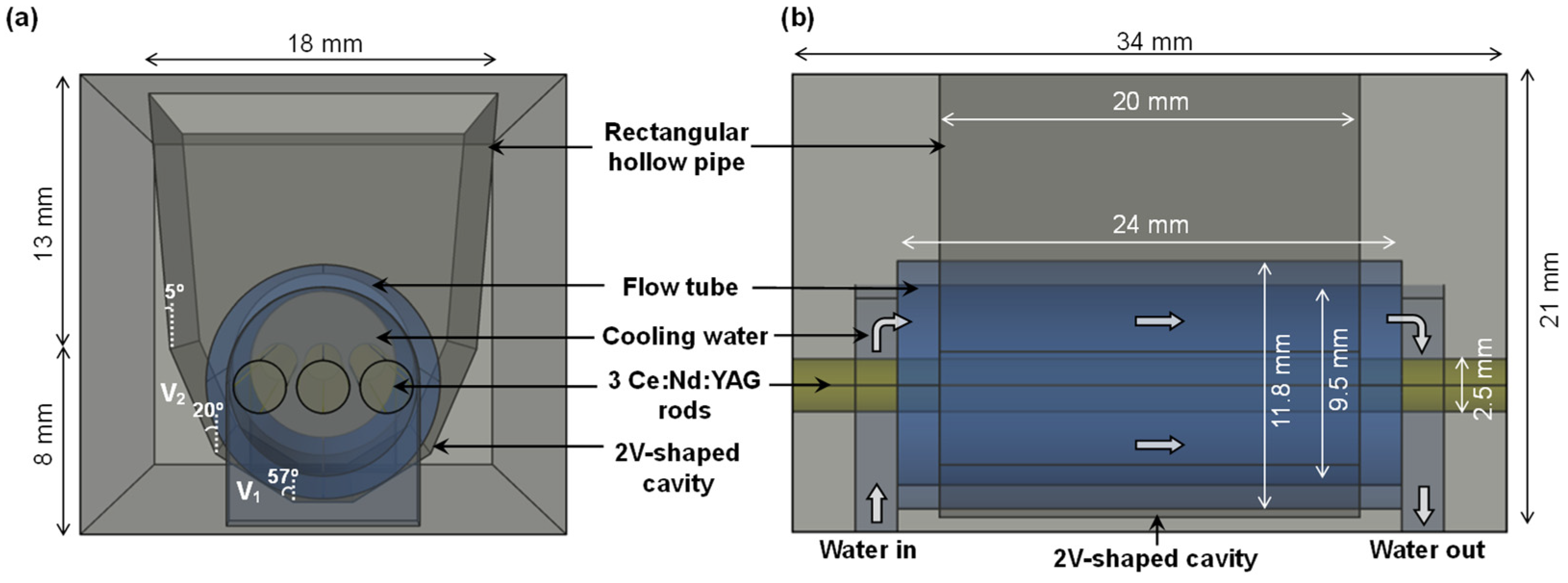
The second laser head, designed for TEM00-mode operation, featured a two-stage secondary concentrator comprising a rectangular hollow light guide, a 2V-shaped dry pump cavity with a flat bottom, and a fused-silica flow tube containing three Ce:Nd:YAG laser rods arranged horizontally, with dimensions of 2 mm × 34 mm (Figure 3).
The rectangular hollow guide, absent in the multimode laser head, serves to homogenize the pump radiation, ensuring more uniform illumination of the three rods. It featured an opening aperture of 18 mm × 20 mm, a depth of 13 mm, and a 5° half-angle tilt.
The 2V-shaped cavity, with an opening aperture of 16 mm × 20 mm and a depth of 8 mm, consisted of a primary V-shaped reflector (V1) with an 57° half-angle, accompanied by two planar reflectors positioned above (V2), each inclined at a 20° half-angle (Figure 3). This configuration efficiently redirects concentrated solar rays arriving from a wide range of angles into the rods, enhancing pump coupling.
The inner surfaces of both the rectangular guide and 2V cavity were assumed to have 95% reflectivity. The flow tube provided water cooling along 28 mm of the rod length, with the remaining 6 mm (3 mm at each end) reserved for mechanical support. With an outer diameter of 11.8 mm, an internal diameter of 9.5 mm, and a total length of 24 mm, the fused-silica flow tube ensured proper thermal management of the three rods.

3. Numerical Optimization of the Ce:Nd:YAG Solar Laser

3.1. Zemax® Ray Tracing Analysis

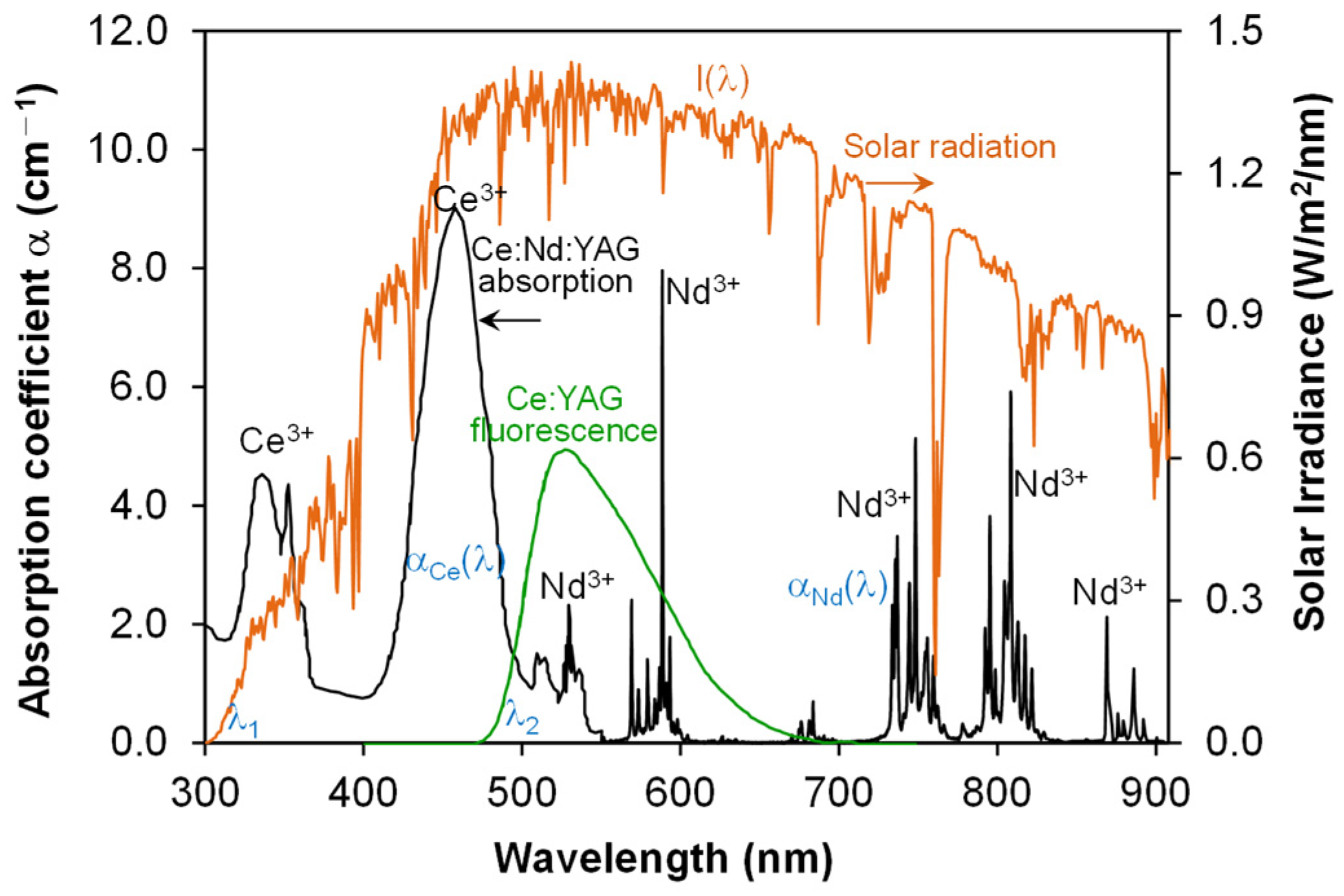
Figure 4 displays the absorption spectrum of the Ce:Nd:YAG crystal alongside the spectrum of solar emission. The strongest Ce3+ absorption feature is centered at 460 nm, exhibiting an 9.0 cm−1 absorption coefficient. A secondary Ce3+ band appears at 339 nm, characterized by a 4.5 cm−1 coefficient. In the case of Nd3+ ions, absorption in the green and yellow regions occurs at 531 nm and 586 nm, associated with coefficients of 2.3 cm−1 and 3.7 cm−1. Additional Nd3+ absorption features in the red and near-infrared regions, observed at 736, 746, 793, 808, 865, and 880 nm, exhibit cross-section values of 5.0, 4.6, 4.2, 4.9, 3.1, and 4.2 cm−1, respectively.
As expressed in Equation (1), the total power absorbed by Nd3+ ions P Nd 3 + for a given unit area is calculated by integrating the spectral irradiance of the Sun I(λ) over two wavelength ranges. The first range, from 320 nm to 500 nm, corresponds to Ce3+ absorption, while the second range, spanning 500 nm to 1000 nm, corresponds to Nd3+ absorption. The coefficients α Ce ( λ ) and α Nd ( λ ) represent the wavelength-dependent absorption of Ce3+ and Nd3+ ions, respectively, in a Ce3+/Nd3+-doped YAG crystal (0.1 at.% Ce3+, 1.1 at.% Nd3+).
P N d 3 + = λ 1 λ 2 I λ [ 1 e x p α C e λ L ] η n o n - r a d i a t i v e   C e 3 + N d 3 + d λ   + λ 1 λ 2 I λ [ 1 e x p α C e λ L ] η r a d i a t i v e   C e 3 + N d 3 + d λ   + λ 2 λ 3 I λ [ 1 e x p α N d λ L ]   d λ
The first two integrals in Equation (1) represent indirect absorption pathways for Nd3+ arising from Ce3+ → Nd3+ energy transfer, which may proceed via radiative or non-radiative mechanisms. The terms η radiative Ce 3 + Nd 3 + and η non - radiative Ce 3 + Nd 3 + denote these efficiencies, respectively. The third integral accounts for the I(λ) through Nd3+ ions. Here, L denotes the effective absorption path length in the gain material. The calculated overlap between the spectrum of solar radiation and the Nd3+ and Ce3+ absorption spectra were determined to be 15.3% and 16.0%, respectively, which agrees well with the previously reported Nd3+–solar spectral overlap of 14–16% [14,17]. For the parabolic mirror at PROMES-CNRS, which has a collection area of 2.73 m2 (effective) and is exposed to a solar irradiance of 1000 W/m2, the 15.3% overlap with Ce3+ absorption corresponds to 417.7 W of effective pump power. Since approximately 70% of the power absorbed by Ce3+ is transferred non-radiatively to Nd3+ ions [35], the contribution to source 1 in Zemax® becomes 292.4 W. Furthermore, the portion of the solar spectrum overlapping 16% with Nd3+ absorption provides an additional 436.8 W of pump power, also assigned to source 1. This source includes 16 narrow Nd3+ absorption lines, centered at: 527, 531, 569, 579, 586, 592, 732, 736, 743, 746, 753, 758,790, 793, 803, 805, 808, 811, 815, 820, 865, and 880 nm. The weight of each line depends on the corresponding I(λ) value. Thus, the total power represented in source 1 combines direct Nd3+ absorption and the non-radiative Ce3+ → Nd3+ transfer 729.2 W.
Radiative transfer from Ce3+ to Nd3+ accounts for the remaining 30% of the Ce3+-absorbed power [35]. This gives 125.3 W which is assigned to source 2 in the non-sequential Zemax® model. Source 2 contains six Nd3+ absorption peaks at 527, 531, 569, 579, 586, and 592 nm, each weighted according to the Ce3+ fluorescence irradiance If(λ).
With these two sources defined, source 1 (16 lines, 729.2 W) and source 2 (6 lines, 125.3 W), numerical optimization was performed on the Ce:Nd:YAG solar laser following the methodology used in earlier studies [25].
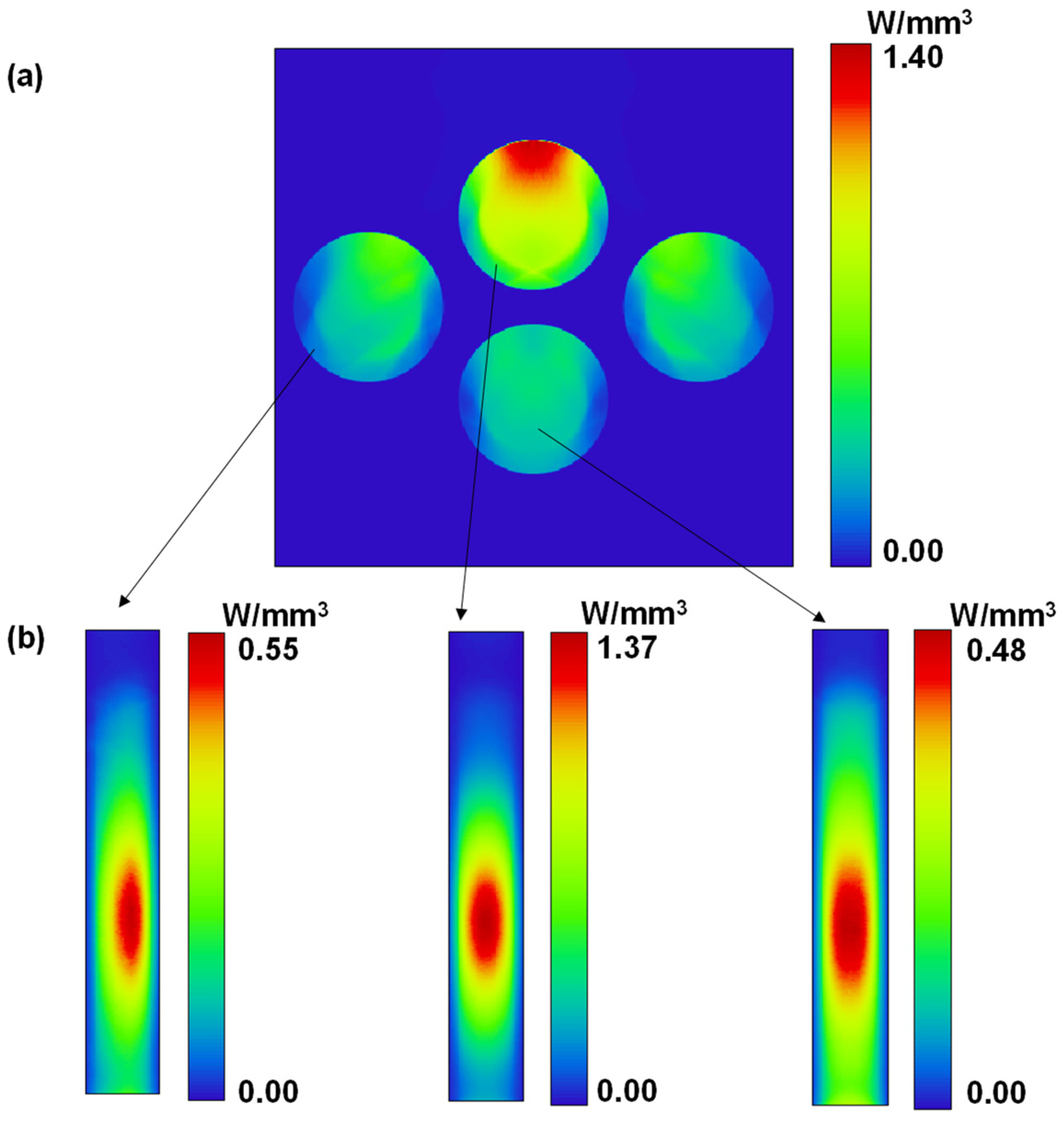
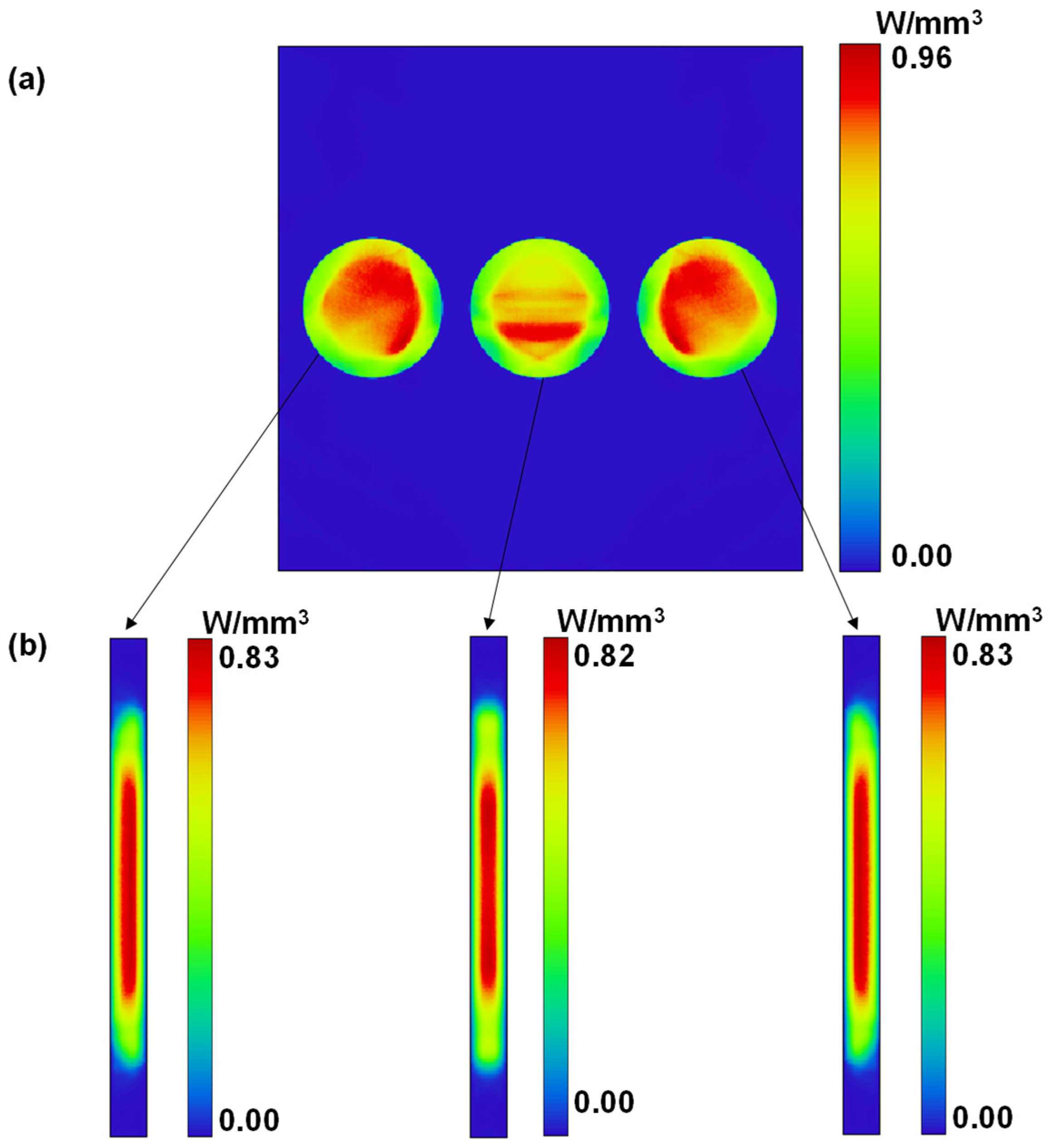
In the ray-tracing simulations, the Ce:Nd:YAG rod was segmented into 62,500 discrete zones. For each zone, the optical path was calculated, and the absorbed pump power was computed by combining the contributions from every zone. The distributions of pump flux for the central transverse and longitudinal planes of the four-rod multimode head and the three-rod TEM00-mode head are presented in Figure 5 and Figure 6, respectively.
In the four-rod multimode configuration, only one lateral rod is presented, since both lateral rods exhibit nearly identical absorbed pump-flux profiles. The three-rod TEM00-mode head exhibits a markedly more symmetric and uniform absorbed pump distribution along both transverse and longitudinal directions, compared to the four-rod multimode head (Figure 5 and Figure 6). This enhanced pump homogeneity demonstrates the effectiveness of the rectangular hollow light guide in redistributing the concentrated solar radiation. This improved pump uniformity reduces thermal gradients and is a key factor in enabling stable and efficient TEM00-mode solar laser operation.

3.2. LASCADTM Analysis

The pump-flux distributions calculated via Zemax® simulations were then imported into LASCADTM to fine-tune the laser resonator and assess the thermal load within the Ce:Nd:YAG medium. For a Ce:Nd:YAG crystal with 0.1 at.% Ce and 1.1 at.% Nd, the LASCADTM model considered 2.8 × 10⁻¹⁹ cm2 stimulated-emission cross-section, 230 μs fluorescence lifetime, 0.002 cm−1 combined scattering and absorption loss (α). A 660 nm mean absorbed pump wavelength [14], weighted by the intensity distribution of the solar spectrum, was also adopted.
The optical resonators for the four-rod multimode and the three-rod TEM00 laser heads were modeled in LASCADTM.
For the multimode head, high-reflection (HR) coatings (>99.5% at 1064 nm) were assumed on one terminal surface of every Ce:Nd:YAG rod; while a partial-reflection (PR) mirror, whose reflectivity could be varied from 90% to 95% according to the rod diameter being studied, was positioned along the optical axis at the opposite end. The HR-coated rod facets acted as rear mirrors, forming a compact cavity optimized for multimode operation.
For the TEM00-mode head, two plane mirrors aligned perpendicular to the rod axis were used. The rear mirror carried a high-reflectivity coating at 1064 nm (HR, 99.98%), while the PR 1064 nm featured a tunable reflectivity in the range of 90–95%. This configuration ensures that both ends of the rods can be precisely aligned, allowing for effective emission of the TEM00-mode solar laser.
The round-trip resonator losses accounted for diffraction, absorption and scattering within the active lasing material, as well as coating losses from both the rod facets and cavity mirrors. For the multimode head, using a 4.0 mm diameter Ce:Nd:YAG rod of 25 mm length (LR), the optical losses due to absorption and scattering amounted to 2αLR = 1.0%. Adding 0.4% loss from imperfect HR and anti-reflection (AR) coatings increased the round-trip loss to 1.4%. For the TEM00-mode head, with a 2.5 mm diameter, Ce:Nd:YAG rod of 34 mm LR, the round-trip loss was 1.76%.

4. Results

4.1. Four-Rod Side-Pumped Ce:Nd:YAG Solar Laser for Multimode Operation

For multimode operation, the laser head was systematically optimized to enhance the absorption of pump power within the active medium. Multiple configurations were analyzed, including arrangements with two to five Ce:Nd:YAG rods. The configuration that provided the highest absorbed power and the most favorable pump distribution was the four-rod cross arrangement (Figure 2), which was therefore selected as the optimal design. Increasing the number of rods beyond four led to enhanced shading effects and a reduction in pump density per rod, resulting in no further laser output performance improvement.
A rectangular hollow light guide was also evaluated during the optimization process; however, it was found to reduce the absorbed power in the rods, and was consequently excluded from the final multimode configuration.
For multimode laser oscillation, an asymmetric optical resonator was implemented in the LASCADTM simulations. To optimize the multimode laser performance, various combinations of PR 1064 nm output couplers were evaluated in LASCADTM by independently varying their radii of curvature (RoC) and reflectivity (R). The best performance was obtained when output coupler had RoC = ∞, and R = 91% for the Ce:Nd:YAG rod with dimensions 4.0 mm × 25 mm. Under these conditions, the LASCADTM beam propagation method (BPM) predicted a diffraction loss of only 0.01%. Including absorption, scattering and coating contributions, the total round-trip loss reached 1.41% for the multimode solar laser.
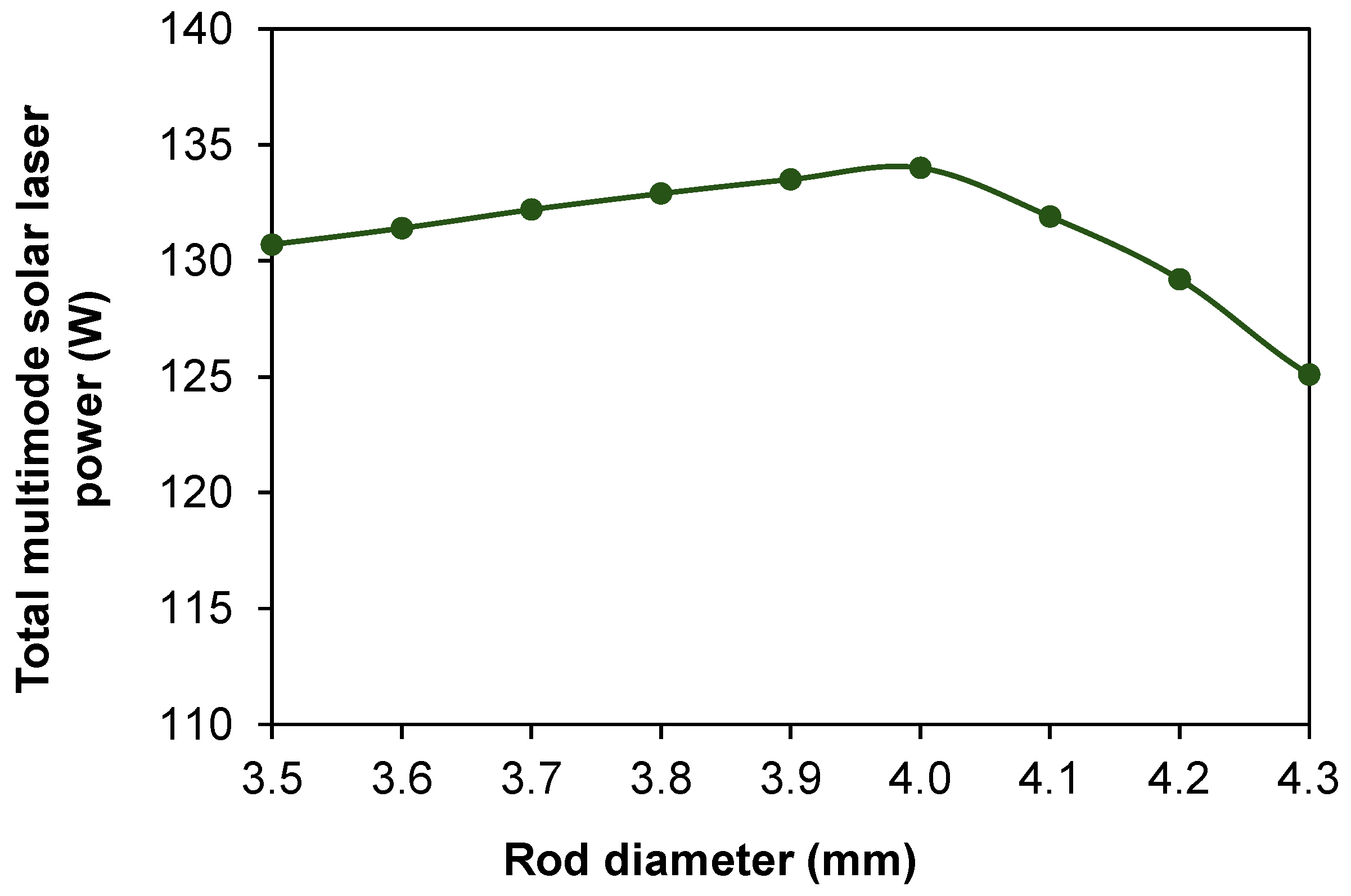
A range of Ce:Nd:YAG rod diameters was investigated (Figure 7), with the 4.0 mm diameter, 25 mm length rod providing the highest laser power. In this configuration, the two lateral rods generated 22.3 W each, while the upper and lower central rods produced 64.4 W and 25 W, respectively. The noticeable difference between the laser output of the upper rod and the remaining rods is mainly attributed to asymmetric pump distribution and optical path shading effects, which result in non-uniform intracavity mode formation. The maximum total multimode laser output reached 134 W, yielding a solar laser collection efficiency of 49.1 W/m2.
The dependence of laser output power on the Ce:Nd:YAG rod diameter reflects a trade-off between pump absorption efficiency and pump intensity. For thin rods, the limited absorption path results in insufficient absorbed pump power, leading to reduced laser output. As the rod diameter increases, pump absorption improves, increasing the available gain and output power. However, for excessively large diameter, the absorbed pump power is distributed over a larger volume, reducing pump intensity and gain density, which in turn lowers the laser efficiency and output power. Consequently, an optimal rod diameter exists that maximizes laser performance.
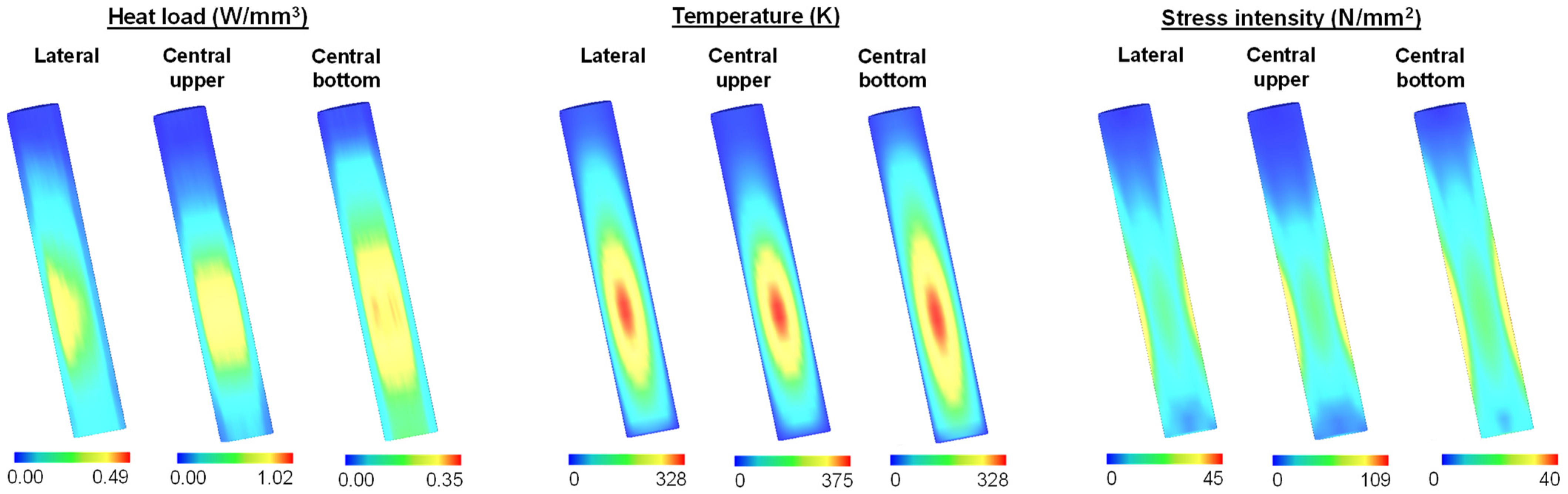
The thermally induced effects in the Ce:Nd:YAG rods, with dimensions of 2.5 mm × 34 mm, of the four-rod side-pumped configuration were assessed using LASCADTM, demonstrating excellent thermal performance (Figure 8). The two identical lateral rods operated under relatively low thermal loading, exhibiting a maximum heat load of 0.49 W/mm3, a peak temperature of 328 K, and a thermal stress of 45 N/mm2. Similarly, the central bottom rod showed low thermal values, with a maximum heat load of 0.35 W/mm3, a peak temperature of 328 K, and a thermal stress of 40 N/mm2. The central upper rod experienced moderately higher thermal effects, reaching 1.02 W/mm3, 375 K, and 109 N/mm2. However, these values remain well within safe limits for stable laser operation, staying under the tensile strength of Ce:Nd:YAG that is typically between 130 and 260 N/mm2 [36].
Overall, the thermal balance of the four-rod side-pumped configuration is very favorable. By distributing the absorbed solar pump power among multiple gain media, the multirod architecture avoids excessive thermal loading in any single rod, thereby reducing average radial and axial temperature gradients. This mitigates thermally induced refractive-index variations, limits thermo-mechanical stress accumulation, and supports stable multimode laser operation. Consequently, the four-rod side-pumped design is capable of sustaining high absorbed pump power while maintaining good thermal stability, which is essential for achieving high multimode solar laser output power.

4.2. Three-Rod Side-Pumped Ce:Nd:YAG Solar Laser for TEM00-Mode Operation

The TEM00-mode laser head was systematically optimized to ensure uniform pump absorption within the active medium. Configurations with two to five Ce:Nd:YAG rods were evaluated, with the three-rod horizontal alignment (Figure 3) providing the most efficient pump distribution for stable TEM00-mode operation. The three-rod horizontal configuration provided the best balance between pump uniformity and mode control required for stable TEM00-mode operation, whereas configurations with a larger number of rods degraded the pump uniformity necessary for diffraction-limited laser performance.
A rectangular hollow light guide was also assessed and found to Improve the uniformity of pump absorption across the rods, enabling enhanced laser beam quality.
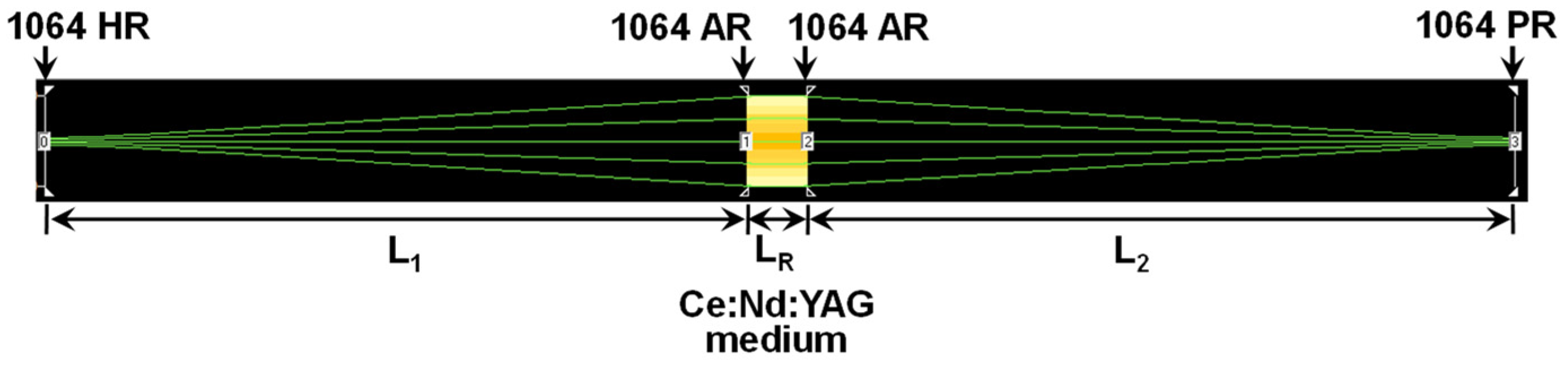
For TEM00-mode laser oscillation, a symmetrical optical resonator was implemented in the LASCADTM simulations (Figure 9). In this configuration, L1 and L2 denote the distances from the HR and PR mirrors, respectively, to the closest rod end. The resonator was optimized with equal mirror-to-rod distances of L1 = L2 = 377 mm for the Ce:Nd:YAG rod with dimensions 2.5 mm × 34 mm.
The distances L1 and L2 proved critical for optimal mode overlap. Increasing L1 and L2 enlarged the fundamental mode, particularly at higher pump powers. To achieve a collimated beam and efficient, stable TEM00-mode laser power extraction, the laser is designed to function near the boundary of the optically stable zone, in which the TEM00-mode exhibits increased sensitivity to thermal focal shifts.
To optimize the TEM00-mode laser performance, various combinations of HR 1064 nm rear mirrors and PR 1064 nm output couplers were tested in LASCADTM by independently adjusting their RoC and the PR mirror reflectivity. The optimal configuration was achieved with both mirrors set to RoC1 = RoC2 = 0.55 m and the PR output coupler reflectivity adjusted to R = 94%. Under these conditions, the BPM in LASCADTM predicted a diffraction loss of only 0.13% for the Ce:Nd:YAG rod with dimensions 2.5 mm × 34 mm within the resonator. Considering absorption, scattering, and coating losses, the total round-trip loss for the TEM00-mode solar laser was calculated to be 1.89%.
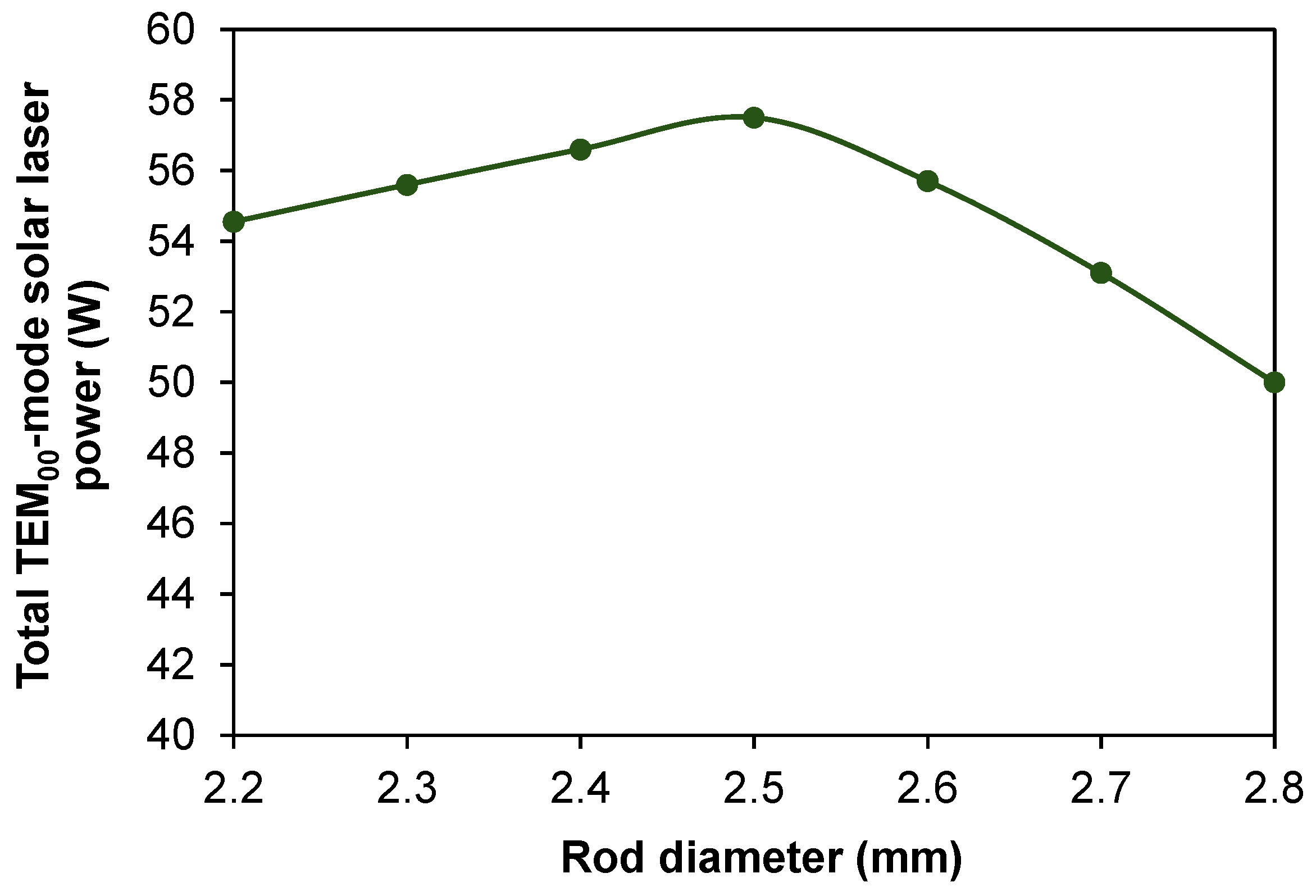
A range of Ce:Nd:YAG rod diameters was systematically evaluated (Figure 10), with the 2.5 mm diameter, 34 mm length rods yielding the highest TEM00-mode laser output. In this arrangement, each of the two lateral rods contributed 19.4 W, while the central rod delivered 18.7 W. The resulting maximum total laser output for the TEM00-mode configuration reached 57.5 W, yielding a solar laser collection efficiency of 21.1 W/m2.
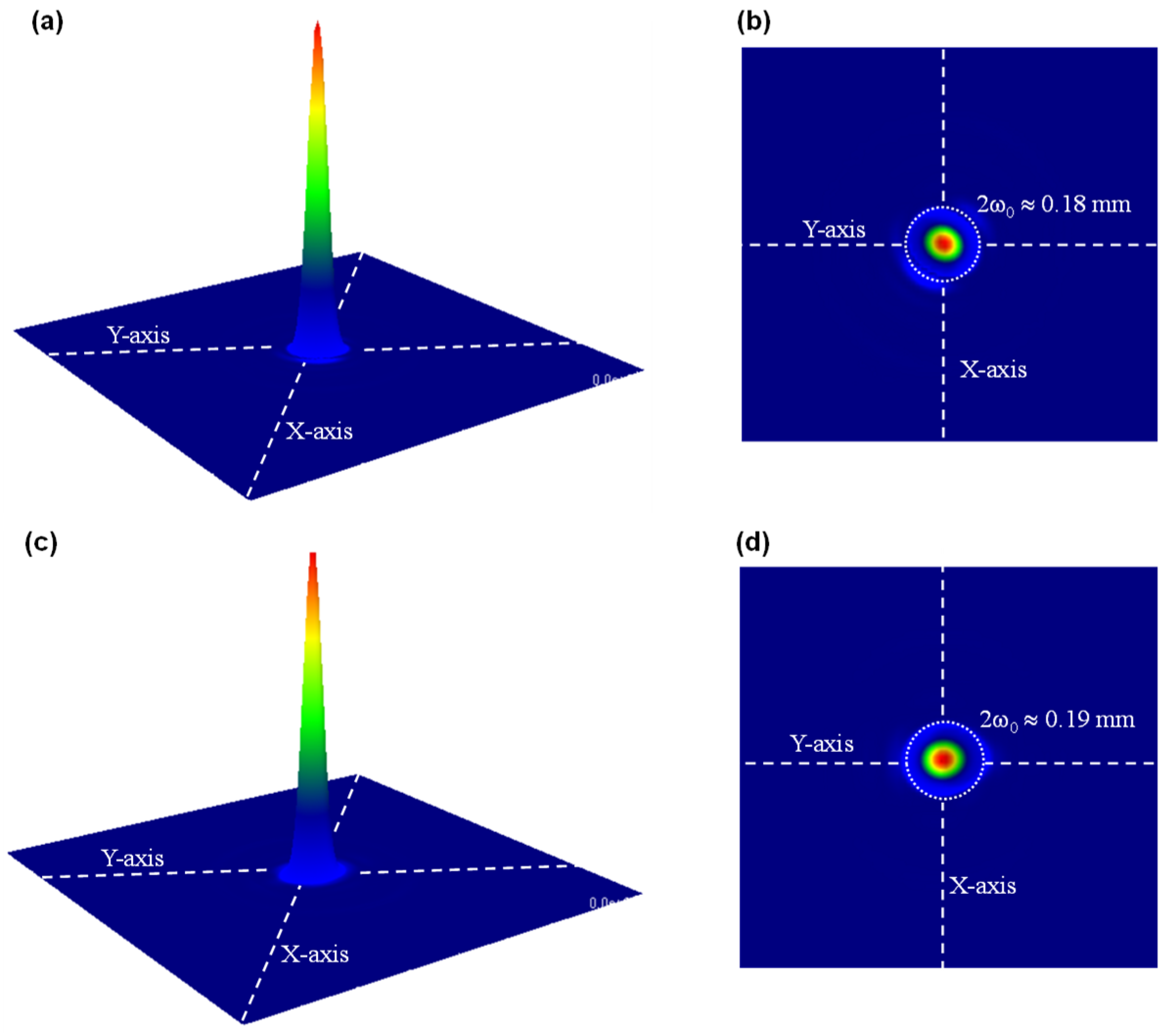
The TEM00-mode laser performance was assessed for each of the three 2.5 mm diameter Ce:Nd:YAG rods in the side-pumped configuration. The two lateral rods, which are identical, exhibited beam quality factors of Mx2 = 1.02 and My2 = 1.00, with corresponding solar laser beam brightness figures of merit of 19.0 W each. The central rod achieved Mx2 = 1.08 and My2 = 1.00, with a brightness figure of merit of 17.3 W. Collectively, these values confirm the excellent beam quality and high brightness achievable with the three-rod arrangement. The TEM00-mode laser beam patterns, depicted in Figure 11, show a near diffraction-limited Gaussian distribution with a 1/e2 spot size (ω) on the output mirror of approximately 0.18 mm and 0.19 mm for the lateral and central rods, respectively.
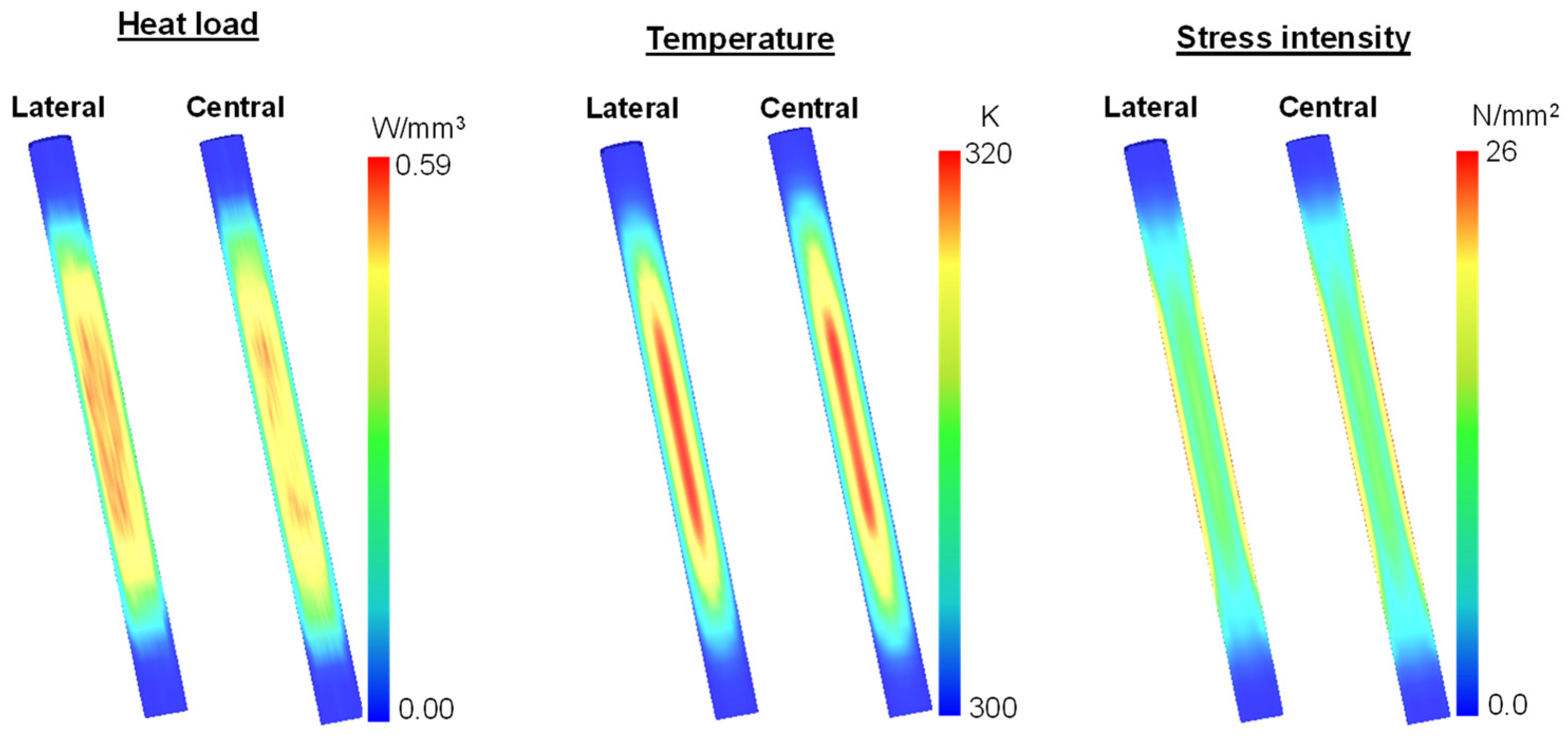
The thermally induced effects in the Ce:Nd:YAG rods, with dimensions 2.5 mm × 34 mm, of the three-rod side-pumped configuration were evaluated using LASCADTM, confirming the excellent thermal performance of this architecture (Figure 12). The lateral and central rods exhibited comparable thermal behavior, with a maximum heat load of 0.59 W/mm3, a peak temperature of 320 K, and a thermal stress of 26 N/mm2.
Compared with the four-rod configuration, the three-rod geometry provides a more balanced thermal environment. This improved thermal homogeneity plays a crucial role in stabilizing TEM00-mode operation by reducing thermally induced refractive-index gradients, minimizing thermal lensing, and lowering stress-driven distortions in the gain medium. Consequently, the side-pumped three-rod architecture offers a more favorable thermal regime for sustained fundamental-mode oscillation under high solar pump power.

5. Discussion

The results of this work demonstrate that side-pumped multirod Ce:Nd:YAG architectures are an effective strategy for improving both multimode and TEM00-mode solar laser performance. By distributing the concentrated solar pump power among several thin rods, the system mitigates the thermally induced distortions that typically limit power scalability and beam quality in single-rod systems. LASCADTM simulations confirmed excellent thermal behavior in both optimized configurations, with reduced peak temperatures, low thermal stresses, and good heat extraction, enabling stable operation under high solar flux.
For multimode operation, the optimal configuration employed Ce:Nd:YAG rods with dimensions 4.0 mm × 25 mm. This four-rod geometry achieved a maximum laser output power of 134 W, resulting in a solar laser collection efficiency of 49.1 W/m2, and solar-to-laser conversion efficiency of 4.91%. This performance surpasses the 89.29 W reported by Wang et al. [27], representing an improvement of approximately 1.50 times. The enhanced output is attributed to the larger pump absorption volume and improved thermal management provided by the multirod geometry. These comparative results are summarized in Table 1.
For TEM00-mode operation, thinner and longer Ce:Nd:YAG rods with dimensions 2.5 mm × 34 mm were found to be the most effective. Under these conditions, the three-rod side-pumped configuration achieved a total TEM00-mode collection efficiency and solar-to-laser conversion efficiency of 21.1 W/m2 and 2.11%, respectively, surpassing the record 16.49 W/m2 and 2.06% reported by Liang et al. [29] by approximately 1.28 and 1.02 times, respectively,. More significantly, this result represents a clear improvement over earlier multirod TEM00 solar lasers employing end-side-pumping schemes [32,33]. In particular, an approximately 2.41-fold higher collection efficiency and 2.34-fold higher solar-to-laser conversion efficiency is achieved compared with Costa et al. (Table 1) using a multirod Ce:Nd:YAG system pumped from the rod ends [33].
It should be noted that the higher solar laser output power obtained in multimode operation (Figure 7) compared with TEM00-mode operation (Figure 10) is an intrinsic consequence of the different extraction regimes. Multimode operation allows higher-order transverse modes to oscillate, enabling more efficient utilization of the available absorbed pump power, and producing higher laser output power. In contrast, TEM00-mode operation requires longer cavity length to enforce diffraction-limited beam quality, which inherently limits gain extraction and results in lower collection efficiency. This trade-off between beam quality and output power is a well-known characteristic of high-brightness laser systems.
The substantially higher efficiency achieved in the present work clearly demonstrates the advantages of side-pumping in multirod configurations, namely improved pump uniformity along the rod length, reduced longitudinal thermal gradients, and enhanced spatial matching of the pumped region with the fundamental laser mode, limitations that are intrinsic to end-side-pumped geometries.
The resulting beam quality factors led to high solar-laser brightness figures of merit for each rod. These findings confirm that the combination of optimized rod geometry with multirod side-pumping constitutes a key strategy for achieving high-brightness, thermally stable TEM00-mode solar laser operation.
The comparison between multimode and TEM00-mode operation clearly illustrates the trade-off between maximum output power and beam quality. The four-rod architecture supports higher pump absorption and thus higher multimode laser power, while the three-thin-rod configuration enables near-diffraction-limited TEM00-mode operation with greatly enhanced brightness. In both cases, the use of side-pumping and multiple gain rods provides a thermal advantage over conventional single-rod designs.
Overall, the integration of optimized rod dimensions with a multirod side-pumped architecture offers a robust pathway toward scalable, efficient, and high-brightness solar-pumped solid-state lasers. The multimode and TEM00-mode improvements achieved in this study represent a meaningful advancement beyond previous solar laser demonstrations.
From a practical engineering perspective, multirod side-pumped architectures may initially appear more complex to assemble than single-rod systems. However, once constructed, these configurations exhibit enhanced alignment tolerances and good mechanical stability, reducing the sensitivity to small angular and positional misalignments. In particular, the side-pumping geometry mitigates the impact of heliostat-tracking errors by avoiding strong longitudinal pump inhomogeneities, which is a critical advantage for outdoor solar-laser operation.

6. Conclusions

A comprehensive numerical study of side-pumped multirod Ce:Nd:YAG solar laser architectures was conducted using Zemax® and LASCAD™, leading to optimized designs for high-power multimode and diffraction-limited TEM00-mode operation. Two laser heads were identified as optimal: a four-rod cross configuration for multimode generation and a three-rod horizontal configuration for TEM00-mode operation.
The four-rod multimode design demonstrated efficient pump distribution, low thermal gradients, and excellent thermo-mechanical stability, yielding a numerically calculated solar laser output power of 134 W, a collection efficiency of 49.1 W/m2, and solar-to-laser conversion efficiency of 4.91%. For diffraction-limited operation, the three-rod configuration achieved a solar laser collection efficiency of 21.1 W/m2 and a solar-to-laser conversion efficiency of 2.11%, together with excellent beam quality and brightness performance. These results exceed previously reported performance levels for multirod Ce:Nd:YAG solar lasers.
Thermal analyses confirmed that both configurations maintain low peak temperatures and reduced thermal stress, demonstrating that multirod side pumping provides a stable thermal platform capable of sustaining higher absorbed pump power without performance degradation. These results show that thermal management, enabled by properly designed multirod geometries, is a decisive factor for efficiency improvement and power scaling in solar-pumped lasers, highlighting this approach as a practical pathway for future high-performance and high-brightness solar laser systems.

Author Contributions

Conceptualization, C.R.V. and D.L.; methodology, C.R.V., D.L. and J.A.; software, C.R.V., D.L. and J.A.; validation, C.R.V. and B.D.T.; formal analysis, C.R.V.; investigation, C.R.V., D.L. and J.A.; resources, D.L., C.R.V.; data curation, C.R.V. and H.C.; writing—original draft preparation, C.R.V.; writing—review and editing, C.R.V., D.L., J.A., B.D.T. and H.C.; supervision, D.L.; project administration, D.L. and C.R.V.; funding acquisition, D.L. and C.R.V. All authors have read and agreed to the published version of the manuscript.

Funding

This research was funded by Science and Technology Foundation of Portuguese Ministry of Science, Technology and Higher Education (FCT-MCTES), through the strategic project UIDB/00068/2025 (https://doi.org/10.54499/UID/00068/2025) and project 2024.06922.RESTART.

Institutional Review Board Statement

Not applicable.

Informed Consent Statement

Not applicable.

Data Availability Statement

The original contributions presented in the study are included in the article, further inquiries can be directed at the corresponding author.

Acknowledgments

The FCT fellowship grants 2021.06172.BD, CEECIND/09483/2023, and FCT-Tenure 2023.11076.TENURE.011 of Hugo Costa, Bruno D. Tibúrcio, and Joana Almeida, respectively, are acknowledged.

Conflicts of Interest

The authors declare no conflicts of interest.

References

  1. Rather, J.D.G.; Gerry, E.T.; Zeiders, G.W. Investigation of Possibilities for Solar Powered High Energy Lasers in Space; NASA Technical Reports Server (NTRS); NASA: Washington, DC, USA, 1977. [Google Scholar]
  2. Vasile, M.; Maddock, C.A. Design of a formation of solar pumped lasers for asteroid deflection. Adv. Space Res. 2012, 50, 891–905. [Google Scholar] [CrossRef] [Scilit]
  3. Takashi, Y.; Tomomasa, O.; Hung, D.T.; Hiroki, K.; Junichi, N.; Kouta, O. Demonstration of Solar-Pumped Laser-Induced Magnesium Production form Magnesium Oxide. In Magnesium Technology 2012; Mathaudhu, S.N., Sillekens, W.H., Neelameggham, N.R., Hort, N., Eds.; Springer International Publishing: Cham, Switzerland, 2016; pp. 55–58. [Google Scholar]
  4. Guan, Z.; Zhao, C.M.; Yang, S.H.; Wang, Y.; Ke, J.Y.; Zhang, H.Y. Demonstration of a free-space optical communication system using a solar-pumped laser as signal transmitter. Laser Phys. Lett. 2017, 14, 055804. [Google Scholar] [CrossRef] [Scilit]
  5. Motohiro, T.; Takeda, Y.; Ito, H.; Hasegawa, K.; Ikesue, A.; Ichikawa, T.; Higuchi, K.; Ichiki, A.; Mizuno, S.; Ito, T.; et al. Concept of the solar-pumped laser-photovoltaics combined system and its application to laser beam power feeding to electric vehicles. Jpn. J. Appl. Phys. 2017, 56, 08MA07. [Google Scholar] [CrossRef] [Scilit]
  6. Abdel-Hadi, Y.A. Space-based solar laser system simulation to transfer power onto the earth. NRIAG J. Astron. Geophys. 2020, 9, 558–562. [Google Scholar] [CrossRef] [Scilit]
  7. Liang, D.; Almeida, J.; Vistas, C.; Tibúrcio, B.; Garcia, D. Solar-Pumped Lasers; Green Energy and Technology; Springer: Cham, Switzerland, 2023. [Google Scholar]
  8. Yabe, T.; Bagheri, B.; Ohkubo, T.; Uchida, S.; Yoshida, K.; Funatsu, T.; Oishi, T.; Daito, K.; Ishioka, M.; Yasunaga, N.; et al. 100 W-class solar pumped laser for sustainable magnesium-hydrogen energy cycle. J. Appl. Phys. 2008, 104, 083104. [Google Scholar] [CrossRef] [Scilit]
  9. Hisatomi, T.; Domen, K. Reaction systems for solar hydrogen production via water splitting with particulate semiconductor photocatalysts. Nat. Catal. 2019, 2, 387–399. [Google Scholar] [CrossRef] [Scilit]
  10. Yan, B.; Li, Y.; Cao, W.; Zeng, Z.; Liu, P.; Ke, Z.; Yang, G. Efficient and Rapid Hydrogen Extraction from Ammonia–Water via Laser Under Ambient Conditions without Catalyst. J. Am. Chem. Soc. 2024, 146, 4864–4871. [Google Scholar] [CrossRef] [Scilit] [PubMed]
  11. Kiss, Z.J.; Lewis, H.R.; Duncan, R.C. Sun pumped continuous optical maser. Appl. Phys. Lett. 1963, 2, 93–94. [Google Scholar] [CrossRef] [Scilit]
  12. Young, C.G. A Sun-Pumped cw One-Watt Laser. Appl. Opt. 1966, 5, 993–997. [Google Scholar] [CrossRef] [Scilit]
  13. Arashi, H.; Oka, Y.; Sasahara, N.; Kaimai, A.; Ishigame, M. A Solar-Pumped cw 18 W Nd:YAG Laser. Jpn. J. Appl. Phys. 1984, 23, 1051–1053. [Google Scholar] [CrossRef] [Scilit]
  14. Weksler, M.; Shwartz, J. Solar-pumped solid-state lasers. IEEE J. Quantum Electron. 1988, 24, 1222–1228. [Google Scholar] [CrossRef] [Scilit]
  15. Lando, M.; Kagan, J.; Linyekin, B.; Dobrusin, V. A solar-pumped Nd:YAG laser in the high collection efficiency regime. Opt. Commun. 2003, 222, 371–381. [Google Scholar] [CrossRef] [Scilit]
  16. Dinh, T.H.; Ohkubo, T.; Yabe, T.; Kuboyama, H. 120 watt continuous wave solar-pumped laser with a liquid light-guide lens and an Nd:YAG rod. Opt. Lett. 2012, 37, 2670–2672. [Google Scholar] [CrossRef] [Scilit]
  17. Guan, Z.; Zhao, C.; Li, J.; He, D.; Zhang, H. 32.1 W/m2 continuous wave solar-pumped laser with a bonding Nd:YAG/YAG rod and a Fresnel lens. Opt. Laser Technol. 2018, 107, 158–161. [Google Scholar] [CrossRef] [Scilit]
  18. Meng, J.X.; Li, J.Q.; Shi, Z.P.; Cheah, K.W. Efficient energy transfer for Ce to Nd in Nd/Ce codoped yttrium aluminum garnet. Appl. Phys. Lett. 2008, 93, 221908. [Google Scholar] [CrossRef] [Scilit]
  19. Samuel, P.; Yanagitani, T.; Yagi, H.; Nakao, H.; Ueda, K.I.; Babu, S.M. Efficient energy transfer between Ce3+ and Nd3+ in cerium codoped Nd: YAG laser quality transparent ceramics. J. Alloys Compd. 2010, 507, 475–478. [Google Scholar] [CrossRef] [Scilit]
  20. Li, Y.; Zhou, S.; Lin, H.; Hou, X.; Li, W. Intense 1064nm emission by the efficient energy transfer from Ce3+ to Nd3+ in Ce/Nd co-doped YAG transparent ceramics. Opt. Mater. 2010, 32, 1223–1226. [Google Scholar] [CrossRef] [Scilit]
  21. Guo, Y.; Huang, J.; Ke, G.; Ma, Y.; Quan, J.; Yi, G. Growth and optical properties of the Nd,Ce:YAG laser crystal. J. Lumin. 2021, 236, 118134. [Google Scholar] [CrossRef] [Scilit]
  22. Tai, Y.; Zheng, G.; Wang, H.; Bai, J. Near-infrared quantum cutting of Ce3+–Nd3+ co-doped Y3Al5O12 crystal for crystalline silicon solar cells. J. Photochem. Photobiol. A 2015, 303–304, 80–85. [Google Scholar] [CrossRef] [Scilit]
  23. Vistas, C.R.; Liang, D.; Garcia, D.; Almeida, J.; Tibúrcio, B.D.; Guillot, E. Ce:Nd:YAG continuous-wave solar-pumped laser. Optik 2020, 207, 163795. [Google Scholar] [CrossRef] [Scilit]
  24. Vistas, C.R.; Dawei, L.; Joana, A.; Bruno, D.T.; Dário, G.; Miguel, C.; Hugo, C.; Emmanuel, G. Ce:Nd:YAG side-pumped solar laser. J. Photon. Energy 2021, 11, 018001. [Google Scholar] [CrossRef] [Scilit]
  25. Liang, D.; Vistas, C.R.; Garcia, D.; Tibúrcio, B.D.; Catela, M.; Costa, H.; Guillot, E.; Almeida, J. Most efficient simultaneous solar laser emissions from three Ce:Nd:YAG rods within a single pump cavity. Sol. Energy Mater. Sol. Cells 2022, 246, 111921. [Google Scholar] [CrossRef] [Scilit]
  26. Cai, Z.; Zhao, C.; Zhao, Z.; Zhang, J.; Zhang, Z.; Zhang, H. Efficient 38.8 W/m2 solar pumped laser with a Ce:Nd:YAG crystal and a Fresnel lens. Opt. Express 2023, 31, 1340–1353. [Google Scholar] [CrossRef] [Scilit]
  27. Wang, L.; Zhang, H.; Xu, W.; Zhao, C.; Guo, A. 89.29 W solar-pumped Ce:Nd:YAG lasers with a solar-to-laser conversion efficiency of 3.96%. Opt. Express 2025, 33, 41181–41193. [Google Scholar] [CrossRef] [Scilit]
  28. Vistas, C.R.; Liang, D.; Garcia, D.; Catela, M.; Tibúrcio, B.D.; Costa, H.; Guillot, E.; Almeida, J. Uniform and Non-Uniform Pumping Effect on Ce:Nd:YAG Side-Pumped Solar Laser Output Performance. Energies 2022, 15, 3577. [Google Scholar] [CrossRef] [Scilit]
  29. Liang, D.; Almeida, J.; Catela, M.; Costa, H.; Garcia, D.; Tibúrcio, B.D.; Guillot, E.; Vistas, C.R. Lowest threshold solar-pumped Ce:Nd:YAG laser with 2.06% solar-to-TEM00 mode laser conversion efficiency. Sol. Energy Mater. Sol. Cells 2024, 270, 112817. [Google Scholar] [CrossRef] [Scilit]
  30. Almeida, J.; Liang, D.; Catela, M.; Costa, H.; Garcia, D.; Tibúrcio, B.D.; Guillot, E.; Vistas, C.R. Solar-pumped dual-rod Ce:Nd:YAG laser with 58 W continuous-wave output power and 5.1° tracking error compensation width. Opt. Express 2023, 31, 40041–40055. [Google Scholar] [CrossRef] [Scilit]
  31. Tibúrcio, B.D.; Liang, D.; Costa, H.; Almeida, J.; Haeussler, A.; Guillot, E.; Vistas, C.R. Highly stable multirod side-pumped Ce:Nd:YAG solar laser with simultaneous multimode and TEM00-mode emission. Opt. Mater. 2026, 174, 117888. [Google Scholar] [CrossRef] [Scilit]
  32. Dawei, L.; Hugo, C.; Bruno, D.T.; Cláudia, R.V.; Anita, H.; Emmanuel, G.; Joana, A. Simultaneous emission of three TEM00-mode Ce:Nd:YAG solar laser beams from a single-pump cavity. J. Photon. Energy 2025, 15, 048001. [Google Scholar] [CrossRef] [Scilit]
  33. Costa, H.; Liang, D.; Gomes, S.; Almeida, J.; Tibúrcio, B.D.; Haeussler, A.; Guillot, E.; Vistas, C.R. Simultaneous emission of four TEM00-mode solar-pumped lasers. Appl. Opt. 2025, 64, 9925–9932. [Google Scholar] [CrossRef] [Scilit]
  34. Reference Solar Spectral Irradiance: ASTM G-173. Available online: http://rredc.nrel.gov/solar/spectra/am1.5/astmg173/astmg173.html (accessed on 1 March 2025).
  35. Wang, L.; Xia, C.; Xu, P.; Di, J.; Sai, Q.; Mou, F. Energy transfer in Ce, Nd, and Yb co-doped YAG phosphors. Chin. Opt. Lett. 2013, 11, 061604. [Google Scholar] [CrossRef] [Scilit]
  36. Nd:Ce:YAG Laser Crystals-Hangzhou Shalom Electro-Optics Technology Co., Ltd. Available online: https://www.shalomeo.com/Laser-Crystals-and-Components/Laser-Crystals/Nd-Ce-YAG-Laser-Crystals/product-290.html (accessed on 1 December 2025).
Figure 1. (a) Photograph of the heliostat-parabolic mirror system of the PROMES-CNRS. (b) Design of the parabolic mirror with the laser head.
Sustainability 18 02972 g001
Figure 2. Frontal (a) and lateral (b) views of the four-rod multimode solar laser head design.
Sustainability 18 02972 g002
Figure 3. Frontal (a) and lateral (b) views of the three-rod TEM00-mode solar laser head design.
Sustainability 18 02972 g003
Figure 4. Absorption spectrum of Ce:Nd:YAG (black line), fluorescence spectrum of Ce:YAG (green line), and standard spectrum of solar radiation (orange line) [34], (adapted from [25]).
Sustainability 18 02972 g004
Figure 5. The distributions of pump flux for the central transverse (a) and longitudinal (b) planes of the four-rod multimode head using the Ce:Nd:YAG rod, with dimensions 4.0 mm × 25 mm.
Sustainability 18 02972 g005
Figure 6. The distributions of pump flux for the central transverse (a) and longitudinal (b) planes of the three-rod TEM00 head using the Ce:Nd:YAG rod, with dimensions 2.5 mm × 34 mm.
Sustainability 18 02972 g006
Figure 7. Multimode solar laser output computed numerically versus the rod diameter.
Sustainability 18 02972 g007
Figure 8. Heat load, temperature, and stress intensity distributions numerically obtained via LASCAD™ simulations for the lateral (representative of the two identical lateral rods), central upper and central bottom Ce:Nd:YAG rods, with dimensions 4.0 mm × 25 mm.
Sustainability 18 02972 g008
Figure 9. Schematic diagram of the symmetric laser resonator. L1 and L2 indicate the distances between the high-reflectivity (HR) mirror and the partial-reflectivity (PR) mirror, respectively, to the anti-reflection (AR) 1064 nm output ends the laser rod (1 and 2) with length LR.
Sustainability 18 02972 g009
Figure 10. TEM00-mode solar laser output computed numerically versus the rod diameter.
Sustainability 18 02972 g010
Figure 11. Numerically simulated 3D (a,c) and 2D (b,d) TEM00-mode laser beam profile for the 2.5 mm diameter, 34 mm length Ce:Nd:YAG lateral (a,b) and central (c,d) rods. ω, spot size 1/e2 width. Color scale represents the normalized intensity: blue indicates minimum (near zero) and red indicates maximum at the center, with intermediate colors showing gradual variation.
Sustainability 18 02972 g011
Figure 12. Heat load, temperature, and stress intensity distributions numerically obtained via LASCAD™ simulations for the lateral (representative of the two identical lateral rods) and central Ce:Nd:YAG rods, with dimensions 2.5 mm × 34 mm.
Sustainability 18 02972 g012
Table 1. Comparison of the Ce:Nd:YAG solar laser results obtained in this study with those reported for earlier multirod and single-rod prototypes operating in multimode and TEM00-mode.
ParametersPresent Work (Multirod)Wang et al. [27]
(Single-Rod/
Multimode)
Almeida et al. [30]
(Multirod/
Multimode)
Liang et al. [29]
(Single-Rod/TEM00-Mode)
Costa et al. [33]
(Multirod/TEM00-Mode)
MultimodeTEM00-Mode
Primary concentratorParabolic mirrorFresnel lensParabolic mirrorFresnel lensParabolic mirror
Effective collection area2.73 m22.73 m22.30 m20.0855 m20.690 m2
Active mediumCe:Nd:YAGCe:Nd:YAGCe:Nd:YAGCe:Nd:YAGCe:Nd:YAG
Number of rods431214
Laser rod dimensionsØ 4.0 mm ×
25 mm
Ø 2.5 mm ×
34 mm
Ø 7.0 mm ×
90 mm
Ø 3.0 mm ×
80 mm
Ø 2.0 mm ×
30 mm
Ø 2.5 mm ×
20 mm
Pumping methodside-pumpingend-side-
pumping
side-pumpingend-side-
pumping
end-side-
pumping
Maximum laser power134.0 W
(Multimode)
57.5 W
(TEM00-mode)
89.29 W
(Multimode)
58.0 W
(Multimode)
1.41 W
(TEM00-mode)
6.05 W
(TEM00-mode)
Collection efficiency49.1 W/m221.1 W/m232.71 W/m225.2 W/m216.49 W/m28.77 W/m2
Solar-to-laser conversion efficiency4.91%2.11%3.96%2.62%2.06%0.90%
Disclaimer/Publisher’s Note: The statements, opinions and data contained in all publications are solely those of the individual author(s) and contributor(s) and not of MDPI and/or the editor(s). MDPI and/or the editor(s) disclaim responsibility for any injury to people or property resulting from any ideas, methods, instructions or products referred to in the content.