1. Introduction
The issue of imbalanced and insufficient regional development remains prominent in China, with substantial disparities in development levels and income distribution across urban–rural areas and regions. In 2024, the gross domestic product (GDP) of Eastern China reached approximately 70.24 trillion yuan, while that of Northeast China stood at 6.35 trillion yuan, with the former being approximately 11.1 times the latter. In terms of per capita disposable income, Eastern China was significantly higher than Central China, Western China, and Northeast China: Shanghai recorded the highest per capita disposable income at 88,366 yuan, whereas Gansu Province had the lowest at 26,612 yuan, representing a 3.32-fold difference.
In the era of the digital economy, as an emerging and pivotal driver of development, digital innovation exerts a significant influence on regional income levels. It may either promote balanced regional development and narrow income disparities across regions, or exacerbate the digital divide and thereby widen regional income disparities. The Organization for Economic Cooperation and Development (OECD) emphasizes the strategic role of digital transformation and innovation in boosting economic growth and improving social welfare. The policies and acts of various countries, such as China’s “14th Five-Year Plan for Digital Economy Development”, the “Digital India” plan, the “Digital Europe Plan” and The United States’ “Infrastructure Investment and Employment Act”, have highlighted the issue of the digital divide in digital innovation, as well as the regional development disparities arising from it.
Existing studies suggest that without effective policy intervention, digital innovation can raise overall income levels while simultaneously widening income disparities [
1]. However, through advancing balanced infrastructure development, skills training, and resource redistribution, the diffusion effect of digital innovation can be unleashed to narrow regional income disparities [
2]. Therefore, explanations regarding the impact of digital innovation on regional income disparities still remain fragmented and at times contradictory. Two main research gaps need to be filled. First, a digital patent, as the output of digital innovation, is usually used to measure digital innovation. Yet, digital innovation as an integrated system should be measured from multiple dimensions. Second, the impact mechanisms of digital innovation on regional income disparities remain insufficiently deep, particularly regarding its spatial effects and the non-linear relationships shaped by key institutional variables, such as marketization level.
This study makes main contributions as follows:
It constructs a comprehensive evaluation index system for digital innovation. Specifically, a multi-dimensional evaluation index system for provincial digital innovation is established from three core dimensions, namely input, output, and environment, which provides a standardized measurement of provincial-level digital innovation.
We reveal the spatial spillover effect of digital innovation on income disparities. This study finds that digital innovation has a strong spatial spillover effect, and the intensity of its cross-regional diffusion is significantly higher than the local direct effect, which provides detailed insights into the spatial characteristics of the economic effects of digital innovation.
We identify the critical threshold effect of marketization level in the relationship between digital innovation and regional income disparities. This study clarifies the key institutional threshold of marketization and confirms that the direction of the impact of digital innovation on income disparities undergoes a fundamental change when the marketization level crosses a specific threshold, which deepens the understanding of the conditional mechanism underlying the relationship between digital innovation and income distribution.
2. Literature Review
2.1. Digital Innovation
Digital innovation has emerged as a pivotal driver of economic development, and existing research has constructed a diverse academic spectrum centered on its theoretical frameworks, conceptual dimensions, and ecosystem dynamics. At the level of theoretical framework and empirical applications, studies exhibit an evolutionary shift from single-dimensional performance-oriented approaches toward the integration of comprehensive objectives. Early contributions, such as that of Bag, concentrated on modeling to enhance supply chain performance [
3]. Beyond supply chain models, digital innovation research has been extensively embedded within analytical frameworks addressing corporate green transformation and regional sustainable development. For instance, Xiao et al. empirically examined the promoting effect of digital technology on urban total-factor energy efficiency, finding that a 1% increase in digital-technology innovation can drive an approximate 0.035% rise in energy efficiency [
4]. In terms of conceptual connotation and value orientation, research underscores its multidimensionality and evolving normative stance. It extends beyond technical efficiency to encompass human-centric considerations, such as Ambrogio et al.’s focus on employee well-being [
5], and environmental responsibility, exemplified by Liu et al.’s application in pollution control [
6]. Furthermore, digital innovation is increasingly distinguished between substantive and strategic forms, particularly in the context of low-carbon innovation. Studies indicate that digital transformation significantly promotes substantive low-carbon innovation, suggesting that its value orientation reflects genuine environmental commitment rather than mere strategic disclosure [
7,
8]. This finding points to an evolution in the core value logic underlying digital innovation. From the perspectives of ecosystem and dynamic resilience, research has moved beyond a purely technical lens to emphasize the complexity and adaptability of the system. Fielke et al. proposed an analytical framework for the evolutionary pathways of digital ecosystems using agriculture as a case [
9]; Stea et al. constructed an interdisciplinary health-data-sharing system [
10]; and Bettiol et al. highlighted that the interplay between dynamic capabilities and organizational structure is key to maintaining system resilience under uncertainty [
11]. Collectively, these studies signal that the understanding of digital innovation has advanced toward an ecological perspective characterized by multi-agent collaboration and symbiotic evolution.
2.2. Regional Income Disparities
The formation and evolution of regional income inequality constitute a complex process spanning multiple dimensions and scales. Existing literature primarily examines this phenomenon through three analytical lenses, which provide important references for clarifying the distinctive role of digital innovation in this study. At the level of traditional sectors, structural adjustment mechanisms play a foundational role. Reforms in rural factor markets [
12], infrastructure development [
13], the structure of fiscal expenditure [
14], and the share of capital income [
15] have all been shown to significantly influence urban–rural and regional disparities. These studies highlight how factor allocation and structural policies fundamentally shape income distribution in the pre-digital era. Within the digital economy, impact pathways exhibit marked complexity and even contradiction. Prior research indicates that digital expansion may exacerbate overall inequality [
16], while other evidence suggests it can mitigate specific dimensions of inequality, such as educational disparities [
17] and exert dual effects across different social groups, including ethnic communities [
18]. Collectively, these findings reveal the multifaceted and condition-dependent nature of distributional effects in the digital era. At the systemic level, studies have uncovered linkages between income inequality and other societal challenges. For instance, digitalization may moderate the impact of inequality on energy consumption [
19], while economic disparities themselves are a major driver of widening carbon inequality [
20]. Schechtl’s research further indicates that in high-income countries, wealth inequality exerts a stronger influence on intergenerational mobility than income inequality, a relationship closely tied to differential access to education [
21]. Such research situates income distribution within broader socio-economic systems and underscores the need to account for the multiple, cascading distributional consequences that digital innovation may engender.
2.3. The Impact of the Digital Economy on Regional Income Disparities
Current research on the impact of the digital economy on income disparities primarily focuses on three key dimensions: the direction of impact, underlying mechanisms, and regional heterogeneity. Regarding the direction of impact, scholars have identified both widening and narrowing effects. Studies such as Deng et al. demonstrate that the digital economy disproportionately boosts urban residents’ income, thereby enlarging the urban–rural income gap [
1]. Conversely, some research points to its equalizing potential, such as Jiang et al., who propose an inverted U-shaped relationship between digital finance development and income disparities [
22]. In terms of mechanisms, three primary pathways are emphasized: first, employment structure bias, as illustrated by Lin et al., who find that industrial digitalization expands the income disparities by generating high-skilled urban jobs [
23]; second, the deepening digital divide, with Qiu et al. showing that “usage” and “efficiency” divides exacerbate inequality through information asymmetry and human capital differentiation [
24]; and third, regionally, studies reveal significant heterogeneity. The impact is most pronounced in eastern China [
24], exhibits spatial spillover effects [
1], and remains less evident in central and western regions [
23]. Collectively, these findings underscore that the digital economy’s influence on income disparities is a complex process shaped by overlapping mechanisms and distinct regional patterns.
Although existing research has examined the diverse impacts of digital innovation, there remains a general lack of integrated analysis concerning its systematic structure, spatial spillover effects, and institutional threshold mechanisms. As a result, explanations regarding its influence on regional income disparities remain fragmented and at times contradictory. Through the analysis of relevant literature, it was found that two main research gaps can be identified. Firstly, there is a lack of a theoretical framework that regards digital innovation as an integrated system and analyzes its income distribution effects based on it. This may lead to research conclusions that cannot fully reflect the macro distribution effects generated by digital innovation as a whole, resulting in insufficient explanatory power for real economic phenomena. Second, studies on the impact mechanisms of digital innovation on regional income disparities remain insufficiently deep, particularly regarding the systematic examination of its spatial spillover effects and the non-linear relationships shaped by key institutional variables, such as marketization level. If the former is ignored, it may lead to biased model estimates due to the omission of spatial interaction terms. For example, digital innovation may widen local income gaps by siphoning resources from neighboring regions, but at the same time, narrow the gap between neighboring regions through technology spillovers. If only local effects are observed, this fluctuating spatial linkage may be misjudged as a single effect of digital innovation, which is the underlying contradiction between the conclusions of “widening” and “narrowing” in existing literature. If the latter is ignored, it implicitly assumes that the impact of digital innovation is linear, thus masking the complexity and conditional dependence of its distribution effects on key institutional variables such as marketization level. Based on this, this study focuses on the systematic and multidimensional characteristics of digital innovation, constructs a comprehensive evaluation index system for provincial-level digital innovation, and employs a spatial Durbin model and panel threshold regression model to empirically examine the direct impact of digital innovation on regional income disparities, spatial spillover effects, and its non-linear mechanism in the process of marketization. The aim is to address existing gaps in theoretical construction and mechanism identification, and provide a sound theoretical foundation and policy implications.
3. Analysis of Impact Mechanism and Research Hypotheses
3.1. Impact Mechanism of Digital Innovation on Regional Income Disparities
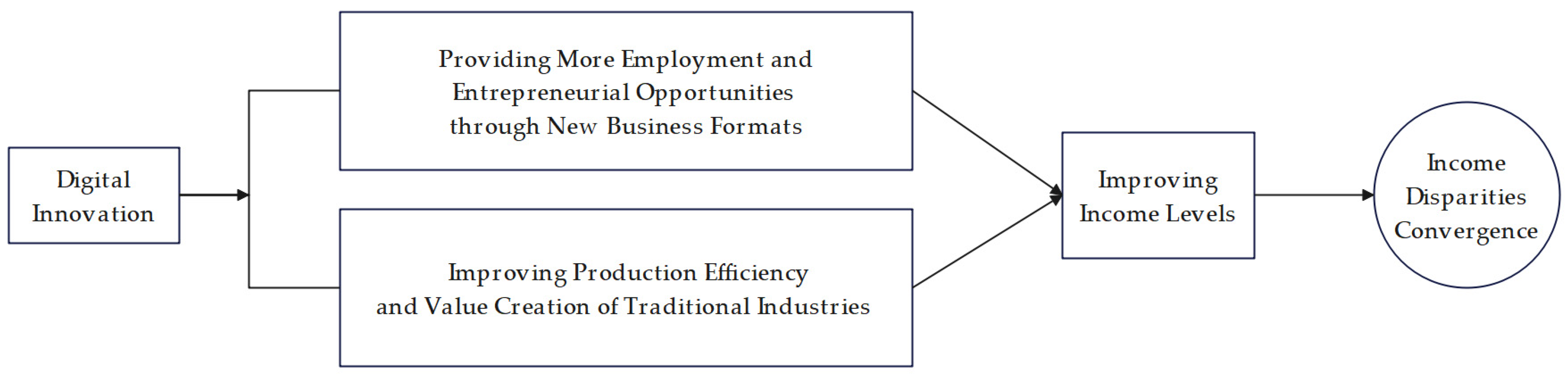
Digital innovation has driven the rapid emergence of new forms of business and models such as the platform economy, live-streaming e-commerce, smart logistics, and digital services, which significantly lower the entry barriers for entrepreneurship and employment. They can provide more flexible employment opportunities and independent entrepreneurship pathways for low-income groups in less developed regions, which creates a remarkable employment multiplier effect and effectively expands their sources of income [
25]. This promotes the overall and rapid growth of income levels among low-income groups in less developed regions, thereby narrowing the income disparities with developed regions.
Digital innovation also accelerates the spatial flow of innovation factors and further optimizes the supply-and-demand structure of production factors in traditional industries in less developed regions, which effectively improves resource allocation efficiency and drives the overall and rapid growth of less developed regions [
26]. Meanwhile, digital innovation promotes wider spatial coverage of technology diffusion and technology sharing and enables less developed regions to take the initiative to connect with advanced technologies from developed regions through learning effects, thereby continuously enhancing the value creation capacity of traditional industries. The dual improvement in production efficiency and value creation of traditional industries in less developed regions can not only drive the steady increase in employee compensation, but also promote faster regional economic growth, helping less developed regions achieve the convergence of regional income disparities. The impact mechanism is depicted in
Figure 1. On this basis, this research puts forward Hypothesis 1.
Hypothesis 1. Digital innovation reduces regional income disparities.
3.2. Spatial Spillover Effect of Digital Innovation on Regional Income Disparities
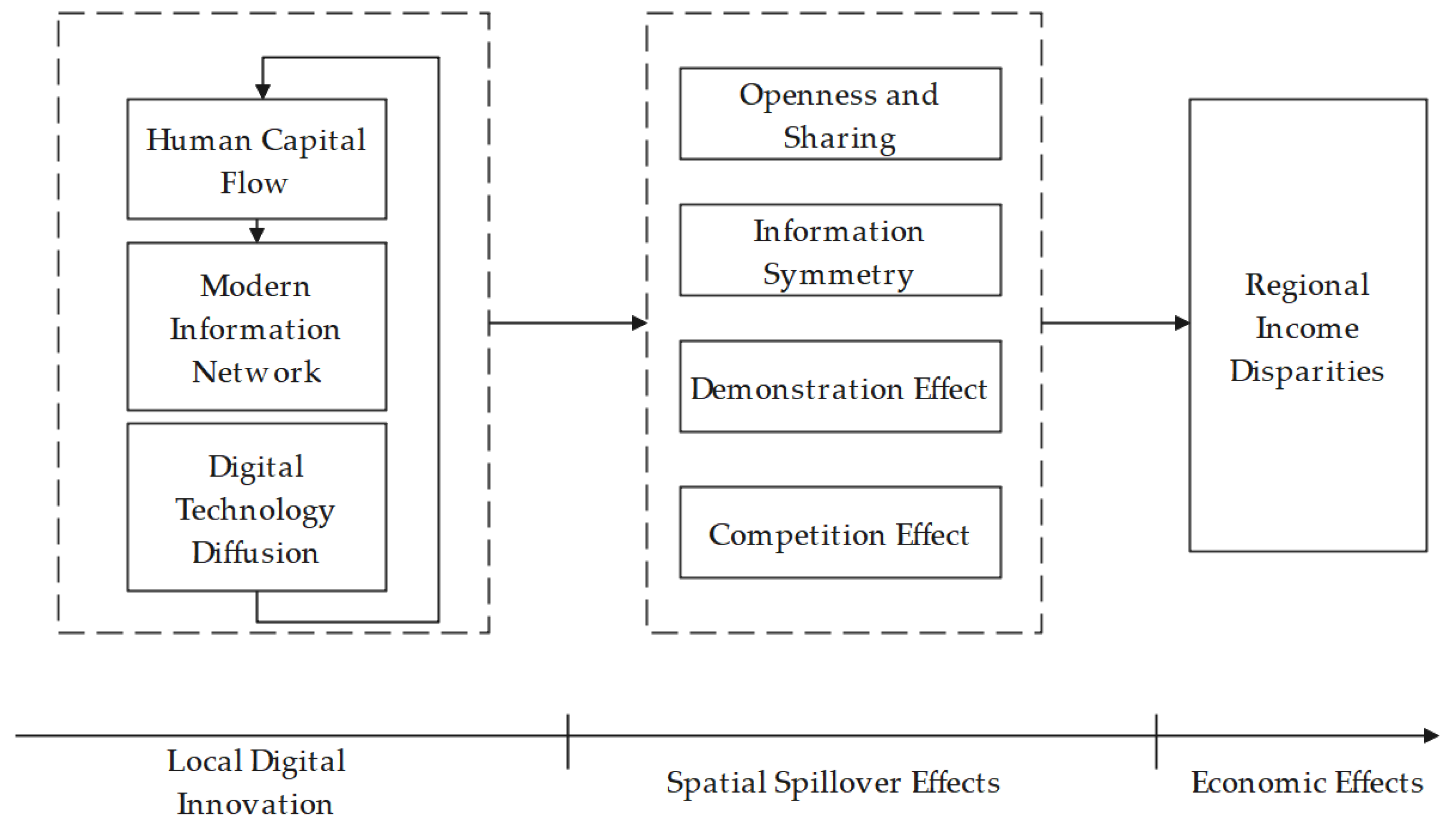
Digital innovation treats information and knowledge as production factors and relies on technologies such as the Internet and big data. Its networked and shared characteristics provide the foundation for generating spatial spillover effects in regional economic development. This feature is consistent with the core viewpoint of innovation diffusion theory, which holds that innovation will gradually spread from the central region with superior conditions to the surrounding areas, forming knowledge and technology spillovers.
Digital innovation affects the income disparities in neighboring regions through the flow of human capital. First, digital infrastructure (such as online education platforms) breaks geographical restrictions, enabling workers in neighboring regions to share resources in core cities. Second, information transparency triggers a “siphon-spillover” effect, where talent agglomeration enhances knowledge diffusion and digital platforms facilitate cross-regional employment. Finally, the interaction between demonstration effects and competition effects forms a dynamic balance, which can significantly narrow the income disparities. According to innovation diffusion theory, this resource and knowledge sharing achieved through talent flow, information dissemination, and platform interaction is the key channel for innovation to spread from high-potential areas to low-potential areas, helping to narrow technology gaps.
The modern information network has strengthened the demonstration and competition effects between regions. On the one hand, the rapid spread of information enables backward regions to imitate the policies and models of advanced regions, producing a positive demonstration effect. In contrast, excessive competition may lead to the waste of resources, which is not conducive to balanced regional development. At present, the competition in the digital economy around the country is fierce, and we need to be alert to the negative effect of “beggar-thy-neighbor”.
Digital technology has expanded the scope of spatial spillover by enhancing the accessibility of information networks. Technological progress makes it easier for digital elements to spread, which can improve the production efficiency of underdeveloped regions in the short term, but may inhibit local innovation capacity in the long term, putting them in a “follower” dilemma. Therefore, coordinated regional development needs to strike a balance between technology introduction and independent innovation to avoid affecting long-term development potential due to excessive dependence on external technology. These three mechanisms together constitute a complete path for the digital innovation to affect the regional income disparities, which is presented in
Figure 2. On this basis, this research puts forward Hypothesis 2.
Hypothesis 2. Local digital innovation affects local income disparities and influences neighboring regions through spatial spillover effects.
3.3. Threshold Effect of Digital Innovation on Regional Income Disparities
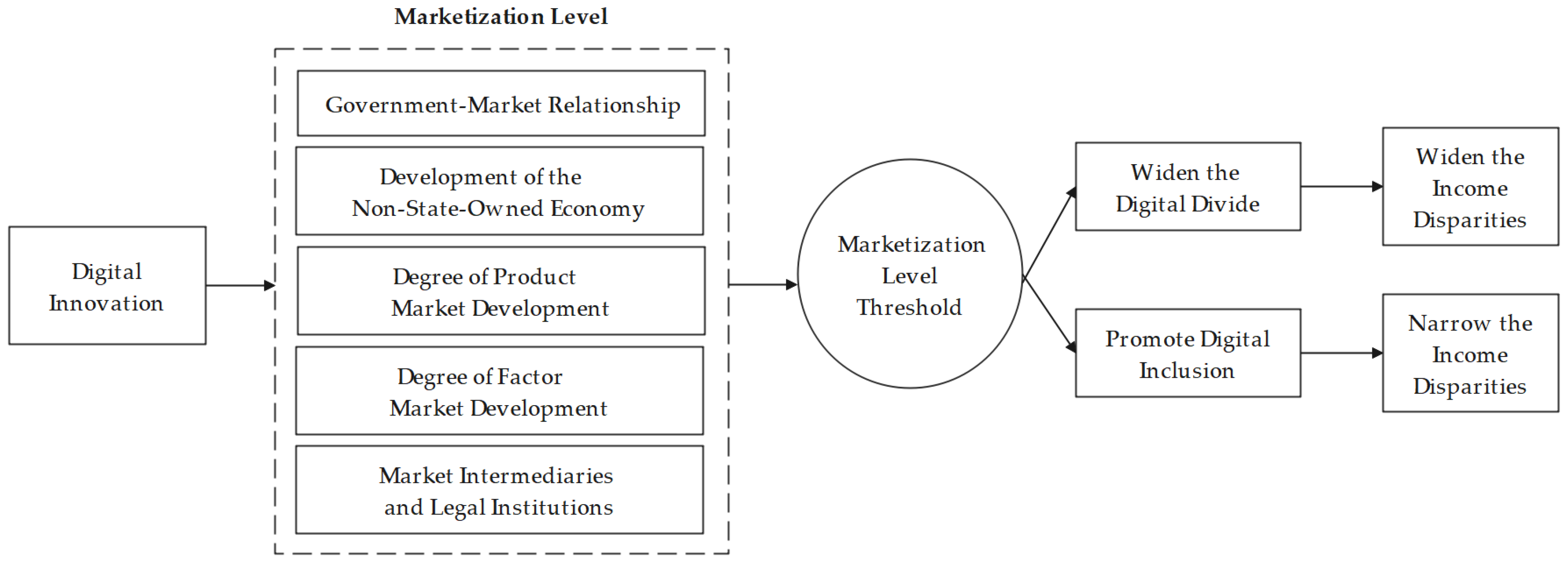
According to the theory of institutional complementarity, the economic benefits of digital innovation are influenced by the market-oriented institutional environment. The impact of the marketization level can be analyzed along five dimensions. In regions where the government–market relationship is distorted, the non-state-owned sector is underdeveloped, product markets are segmented, factor market development is insufficient, and market intermediaries are weak. Institutional deficiencies impede the effective integration of digital resources, forming a “digital divide” and causing digital innovation to widen the income gap. Conversely, when government intervention is moderate, the private economy is vibrant, product and factor markets are highly integrated, and the legal environment is sound. A favorable institutional environment facilitates the inclusive distribution of digital dividends. This enables digital innovation to narrow the income gap by reducing transaction costs and enhancing production efficiency. The coordinated evolution of these five dimensions and the overall level of marketization may create a marketization threshold, which affects whether digital innovation widens or narrows the income gap. The threshold effect is shown in
Figure 3.This embodies the law of “technology–institution collaborative evolution”: technological innovation must be matched with an appropriate institutional environment to achieve inclusive growth. On this basis, this research puts forward Hypothesis 3.
Hypothesis 3. Marketization level exhibits a threshold effect in the impact of digital innovation on the regional income disparities.
4. Research Design
4.1. Model Construction
4.1.1. Panel Regression Model
To test the direct impact of digital innovation on income disparities, this research sets the following panel regression model:
where
represents the province,
represents time,
represents the income disparities,
is the explanatory variable,
is a series of control variables,
represents the provincial fixed effect,
controls the time fixed effect,
represents the random disturbance term.
4.1.2. Spatial Econometric Model
Since the impact of digital innovation may extend beyond local boundaries, spatial dependence and spillover effects cannot be fully captured by traditional regression models. Spatial econometric models address spatial dependence more effectively, thereby improving estimation accuracy. Common spatial econometric models include the spatial lag model (SLM), spatial error model (SEM), and spatial Durbin model (SDM). The spatial Durbin model (SDM) can be transformed into the spatial lag model and spatial error model under certain conditions. This research constructs a spatial Durbin model to study the impact of digital innovation on regional income disparities and its spatial spillover effect. The Wald and LR tests are employed to assess whether the SDM simplifies to the SLM or SEM. The model is as follows:
where
is the spatial autocorrelation coefficient,
is the spatial weight matrix, and
is the random error term.
Model (2) includes the spatial lag terms of explanatory variables and explained variables. At this time, the impact of independent variables on dependent variables cannot be simply characterized by regression coefficients. The impact of independent variables on dependent variables can be decomposed into direct effect, indirect effect, and total effect. The direct effect reflects the average effect of local independent variables on local dependent variables, the spatial spillover effect reflects the impact of independent variables in other regions on local dependent variables, and the total effect reflects the average effect of independent variables in all regions on local dependent variables. The partial differential method can be used to decompose model (2); the detailed process can be found in
Appendix A.
4.1.3. Panel Threshold Effect Model
This research uses the panel threshold effect model to conduct an empirical analysis with marketization level as the threshold variable. The model is set as follows:
Among them, represents the threshold variable of marketization level, , , , represent the coefficients to be estimated, and represents the threshold values to be estimated. represents an indicator function, which takes the value of one if the conditions in the brackets are met, otherwise it is 0. Formula (3) only considers the case of a single threshold. In practical applications, the research model of multiple threshold effects can be further expanded based on steps such as a sample size test.
4.1.4. Selection of Spatial Weight Matrix
Combined with the research problem, in the selection of spatial matrices, two types of spatial weight matrices were constructed: the economic distance matrix and the economic geographic nested matrix. The economic distance matrix reflects the diffusion effect of digital innovation between regions with similar levels of economic development. The nested matrix of economic geography is used to simulate its composite spatial transmission path based on geographical proximity and economic conditions adaptation. The regression results of both matrices are robust and significant, cross-validating the reliability of the spillover effect of digital innovation space.
(1) Economic distance weight matrix (
W1).
(2) Economic–geographical nested matrix (
W2).
Here, is the straight line distance between the provincial capitals of adjacent provinces, and respectively represent the average per capita GDP of region and region from 2014 to 2023, and is the adjustment of the geographical attenuation rate.
4.2. Variable Selection
4.2.1. Explained Variable
This research takes the regional income disparities (GAP) as the explained variable, the deviation method is used to calculate the regional income disparities of 30 provinces as the explained variable to test the regional economic gap. The specific formula is as follows:
Here, represents the absolute regional income disparities, that is, the absolute value of the gap between the natural logarithm of the actual per capita regional GDP of province i in year t and the natural logarithm of the national average per capita regional GDP in that year.
4.2.2. Core Explanatory Variable
As shown in
Table 1,this research takes the level of digital innovation (DIG) as the core explanatory variable, constructs a comprehensive evaluation index system of digital innovation based on regional digital innovation input, digital innovation output, and digital innovation environment, and uses the entropy weight method to calculate the digital innovation level index of each province to measure the level of digital innovation in each region.
4.2.3. Control Variables
When examining the impact of digital innovation on regional income disparities, this study introduces three core control variables that significantly influence income distribution and are closely associated with digital economic development. This selection aims to mitigate potential confounding effects between the core explanatory variable and other key economic factors, thereby enhancing the purity and reliability of the model estimation results.
First, human capital level (EDU). As a core driver of economic growth, human capital plays a key role in knowledge production. Studies have shown that regions with higher human capital stock tend to show faster technological progress and economic growth rates. Education input is a primary channel for enhancing human capital. This research uses the number of students in colleges and universities to measure the level of human capital.
Second, the level of urbanization (URB). Urbanization improves economic efficiency by expanding domestic demand and optimizing resource allocation, while also promoting knowledge spillovers and innovation through reduced spatial distance and better infrastructure. On the other hand, the improvement of the urbanization level promotes knowledge spillover and innovation activities by shortening the spatial distance between enterprises and improving infrastructure. Differences in urbanization levels significantly influence regional economic disparities [
27]. This research uses the urbanization rate as a specific measure of the urbanization level.
Third, industrial structure (IND). The optimization and upgrading of industrial structure expand market scale, strengthen enterprise competitiveness, enhance innovation efficiency, and improve resource allocation. These effects jointly promote regional economic growth and help explain regional disparities.
4.2.4. Threshold Variable
Marketization level (MAR). Previous studies have shown that in cities with a higher degree of marketization, the promotion of inclusive development by the digital economy is more significant [
28,
29]. This indicates that marketization level may serve as a threshold variable affecting the relationship between the digital economy and income distribution. To examine whether digital innovation exhibits a similar distributional relationship, this study selects marketization level as an important factor affecting the regional income disparities. Higher marketization facilitates resource optimization, enhances factor mobility, and improves economic efficiency. Higher marketization also attracts investment and talent, further promoting regional economic development. Regions with low marketization often face inefficient resource allocation and weak innovation capacity, resulting in relatively slower economic growth. Therefore, disparities in marketization levels significantly shape regional economic differences. Marketization level can be comprehensively measured by five dimensions: the relationship between the government and the market, the development of the non-state-owned economy, the degree of product market development, the degree of factor market development, and the development of market intermediaries and the legal environment [
30]. This research uses the marketization index to measure marketization levels.
4.3. Data Sources and Descriptive Statistics
This study uses panel data from 30 provinces in China (excluding Hong Kong, Macao, Taiwan, and Tibet) from 2014 to 2023. Data are obtained from the National Bureau of Statistics, the China Statistical Yearbook, provincial statistical yearbooks, the Peking University Digital Finance Research Center, and the provincial marketization database. Digital economy patent data are sourced from the China National Intellectual Property Administration and matched using patent classification codes following the “Statistical Classification of Digital Economy and Its Core Industries (2021)” [
31].
Table 2 reports the descriptive statistics. The mean regional income disparity (GAP) is 0.329 with a standard deviation of 0.203, indicating notable interregional variation. The digital innovation index (DIG) has a mean of 0.162 and a standard deviation of 0.154, suggesting evident regional disparities. The average marketization level (MAR) and human capital level (EDU) are 8.560 and 4.387, respectively, both showing considerable regional variation as reflected by their large standard deviations. The mean urbanization rate (URB) is 0.625, and the industrial structure index (IND) averages 0.518, reflecting relatively balanced development across regions. Overall, substantial interregional differences exist across variables, which may contribute to variations in regional income disparities.
5. Empirical Results and Analysis
5.1. Benchmark Regression Analysis
The national sample is used for regression analysis based on a two-way fixed effects model. The analysis results are shown in
Table 3. Column (1) does not add any control variables, and the results show that the digital innovation level (DIG) is significantly negative at the 1% level, and the impact coefficient of digital innovation on income disparities in this region is −0.166, which means that for every 1% increase in digital innovation level, it will directly promote a 0.166% reduction in income disparities, indicating that digital innovation significantly narrows the regional income disparities. Column (2) adds control variables (URB, EDU, IND) on the basis of Column (1). The results show that the sign and significance of the coefficient of digital innovation level have not changed, while the adjusted R2 has increased from 0.046 to 0.136, which comprehensively indicates that the addition of control variables is effective, and again verifies Hypothesis 1, that is, the improvement of digital innovation level has a significant negative impact on the regional income disparities and plays a positive role in narrowing the regional income disparities.
5.2. Spatial Spillover Effect Analysis
5.2.1. Spatial Autocorrelation Test
Before estimating the parameters of the spatial econometric model, it is necessary to confirm whether the explained variable has spatial correlation. Using the economic distance matrix and the economic–geographical nested matrix, this study conducts a global Moran’s I test. The results are shown in
Table 4. The results show that Moran’s I values of the regional income disparities from 2014 to 2023 are significantly positive, indicating a clear pattern of spatial agglomeration. This finding provides preliminary evidence for introducing a spatial econometric model.
5.2.2. Selection of Spatial Econometric Model
The development of the digital economy in one region is likely to affect neighboring regions; that is, the development of the digital economy affects the income disparities of neighboring regions through spatial spillover effects. Incorporating spatial factors thus improves the completeness and accuracy of the estimation. The data in this research passed the Lagrange multiplier (LM) test, both the spatial error model and the spatial lag model are significant, and also passed the Wald test, so the spatial Durbin model (SDM) was finally selected. The Hausman test found that the SDM with spatial fixed effects is the optimal model.
5.2.3. Regression Analysis of SDM with Fixed Effects
Based on the above model selection results, model (2) is estimated under fixed effects, and the results are reported in
Table 5. Columns (1) and (3) present estimates without control variables, whereas Columns (2) and (4) include the full set of controls. From the estimation results in
Table 5, under the two spatial weights, the core explanatory variable W × DIG is significantly negative at the 5% level, narrowing the regional economic development gap, indicating that digital innovation has a significant positive spillover effect between different provinces. After adding control variables, the sign and significance of the digital innovation coefficient remain stable, and the adjusted R
2 increases, confirming the effectiveness of including the controls.
Although the SDM estimation results indicate a positive spatial lag coefficient for digital innovation, such coefficients allow only a preliminary assessment of potential spatial spillovers. To more accurately identify the marginal effects of explanatory variables and uncover the structural features of spatial interactions, this study employs the partial differential approach to decompose the spatial effects into three components: direct effect, indirect effect, and total effect. The model estimation results in
Table 5 are decomposed according to Formulas (3)–(6), and the results are shown in
Table 6.
Table 6 shows the effect decomposition under the two spatial weight matrices. Among them, the direct effect reflects the impact of local digital innovation on the regional income disparities in the region, that is, the spatial local effect. The indirect effect represents the impact of local digital innovation on the income disparities in neighboring regions, that is, the spatial spillover effect. The total effect is the sum of the direct effect and the indirect effect. The results show that the spillover effects attenuate with increasing geographical distance, with the most pronounced effects observed among adjacent regions.
Regarding the direct effect, the coefficient of digital innovation is significantly negative, indicating that the improvement of local digital innovation level helps to narrow the local income disparities, which is consistent with the previous conclusion. In terms of indirect effects, the spatial spillover coefficient of digital innovation is also significantly negative, indicating that the development of local digital innovation will have a negative impact on the income disparities of other regions (especially neighboring regions). This provides empirical support for Hypothesis 2 and confirms the positive cross-regional diffusion effect of digital innovation. The total effect results show that the coefficient of digital innovation level is significantly negative, and its value is equal to the sum of the direct effect and indirect effect coefficients. Overall, digital innovation contributes to the convergence of regional income disparities.
In terms of the coefficient value, under the economic distance matrix, the direct effect of digital innovation is −0.222, indicating that a 1% increase in local digital innovation reduces the local income gap by 0.222%; the indirect effect is −0.492, meaning that the income gap in other regions is reduced by 0.492%. It can be seen that the spatial spillover effect (indirect effect) is significantly greater than the spatial local effect (direct effect), and the spillover effect is about 2.2 times that of the local effect. This is mainly because, during the sample period and its lag phase, the “network externalities” generated by digital innovation have surpassed the traditional local “economies of scale,” resulting in a stronger radiating effect on surrounding regions than the local direct effect. This impact first acts on neighboring regions and produces the maximum effect, then diffuses outward through neighboring regions, during which it undergoes multiple cycles of transmission and feedback. Calculations show that the spatial spillover effect accounts for more than 68% of the total effect, and the analysis results of the economic–geographical nested matrix also show similar characteristics. It can be seen that local digital innovation can not only narrow the local income disparities, but also effectively narrow the income disparities in other regions (especially neighboring regions) through the interaction of the regional economic system. Further analysis shows that not only does local digital innovation help to narrow the local income disparities, but also the unified large market formed between regions creates favorable conditions for the development of the local digital economy, and the spatial spillover effect of digital innovation in surrounding regions also has an important impact on the region.
A brief interpretation of the control variables is as follows. Under the two weight matrices, human capital (EDU) only has a significant negative local effect, indicating that the improvement of local human capital level can narrow the local income disparities, and no cross-regional diffusion effect has been formed. The indirect effect of urbanization rate (URB) is not significant under the two weight matrices, indicating that the role of urbanization in narrowing the income disparities has geographical limitations, and local policies should be the main focus; there is no need to over-consider regional coordination. The local inhibitory effect of industrial structure (IND) (about −0.25, p < 0.05) does not form a significant spatial spillover in the two types of matrices, suggesting that the effect of industrial upgrading on income disparities exhibits clear spatial boundary characteristics.
5.2.4. Robustness Test
To verify the reliability of the benchmark regression and eliminate biases arising from the sample period and special samples, this study conducts the following robustness tests. This study employs two approaches to conduct robustness checks. First, the sample period is adjusted to 2015–2023, with the results reported in Column (1). Second, we exclude municipal cities from the sample to rule out potential estimation biases caused by their unique administrative and economic characteristics. Therefore, this research excludes the data of municipalities directly under the Central Government and conducts regression tests again. The results are shown in Column (2) of
Table 7. Both regression results show that digital innovation is negatively correlated with regional income disparities, and the results are significant. This confirms the robustness of the baseline results.
5.3. Non-Linear Effect Test
This research further examines the non-linear effect of digital innovation level on regional income disparities. Accordingly, a panel threshold regression model is employed for empirical analysis. This study focuses on the factor of marketization level, which determines the penetration efficiency and resource allocation capacity of digital technology.
Marketization is adopted as the threshold variable, with the regional income disparities as the dependent variable. The panel threshold effect model is used for regression analysis, and the results are shown in
Table 8. The findings indicate a single threshold at a marketization level of 6.923. Therefore, research Hypothesis H3 is verified.
Further analysis of the threshold effect regression results (see
Table 9). When the marketization level is ≤6.923, the coefficient of digital innovation level on the regional income disparities is 0.730, which passes the 1% significance test. When the marketization level exceeds 6.923, the coefficient becomes −0.314 and remains significant at the 1% level. It can be seen that the impact of digital innovation level on regional income disparities is not a simple linear relationship, but a single threshold effect based on marketization level, that is, when the marketization level is lower than the threshold value (such as Gansu, Yunnan, Xinjiang, etc.), digital innovation widens the regional income disparities. When the marketization level is greater than the threshold value (such as Jiangsu, Shanghai, Guangdong, etc.), digital innovation narrows t regional income disparities. This threshold effect is closely linked to structural dimensions of market-oriented development: in regions with lower marketization levels, institutional shortcomings, such as imbalanced government–market relations and lagging development of product and factor markets, collectively constrain the inclusive sharing of digital dividends. As a result, technological benefits tend to become partially monopolized, thereby exacerbating income differentiation. When the marketization level is high (>6.923), a sound market mechanism and institutional environment can promote the inclusive application of digital innovation, optimize resource allocation, and help underdeveloped regions share technological dividends, thus narrowing the income disparities. In regions with lower levels of marketization, policy priorities should focus on deepening market-system development. Emphasis should be placed on streamlining government–market relations, cultivating diverse market entities, and dismantling barriers to factor mobility. Conversely, in highly marketized regions, the focus should shift toward optimizing the allocation of data elements and refining competition policies. Specific measures may include establishing dynamic industry monitoring and fair-competition review mechanisms, improving the market-based system for data asset valuation, and preventing market monopolization and disorderly competition to avoid efficiency losses arising from excessive rivalry. Strengthening regional cooperation and policy coordination is also essential to promote the synergistic advancement of digital innovation and marketization, thereby facilitating the convergence of income disparities.
6. Discussion
This study systematically examines the impact of digital innovation on regional income disparities by constructing a comprehensive evaluation index system and employing spatial econometric and threshold regression models. The core findings reveal that digital innovation not only exhibits a local convergence effect on income disparities but also demonstrates a spatially driven “coordinated-development effect” across regions. However, the full realization of these effects is contingent upon the maturity of the market-oriented institutional environment. By comparing with and extending prior literature in multiple respects, these results offer an integrated perspective for understanding regional development disparities in the digital-economy era.
First, this study confirms the overall income-convergence effect of digital innovation, providing critical empirical evidence to reconcile divergent views in the field. Existing literature remains divided regarding the impact of digital technology on income disparities: one strand argues that it may widen gaps through technological bias, whereas another highlights its inclusive potential. The benchmark regression results in this study offer robust support for the latter perspective using provincial-level panel data from China. More importantly, the threshold analysis reveals that this convergence effect is neither linear nor unconditional. Only when a region’s marketization level surpasses a specific institutional threshold can the “dividends” of digital innovation be effectively activated and translated into tangible income-convergence momentum. This insight helps bridge current academic debates by demonstrating that digital innovation does not inherently lead to equality or divergence; rather, its distributional outcome is essentially shaped by the synergy between “technological potential” and “institutional environment.” These findings corroborate and extend institutional-complementarity theory in the digital-economy context, indicating that in regions with lagging marketization, digital technology may exacerbate regional disparities in the absence of supportive institutional reforms due to resource misallocation and opportunity monopolization.
Second, this study demonstrates that the spatial spillover effects of digital innovation significantly outweigh its local direct effects—an important extension to existing research. Although some studies have noted spatial correlations within the digital economy, few have precisely decomposed and compared the relative strength of local versus spillover impacts. The effect decomposition based on the spatial Durbin model clearly shows that the negative spillover effect of digital innovation on income disparities in neighboring regions is approximately 2.2 times stronger than its direct local effect. This result aligns with theories of technology-innovation diffusion and provides quantitative evidence that, in an era of increasingly mature digital infrastructure, the costs of cross-regional flows of knowledge, data, and business models have substantially declined. Consequently, the sharing and inclusiveness of innovation outcomes have become more efficient and widespread than in the industrial economy period. These observations offer new evidence for re-examining core–periphery dynamics in regional development and suggest that digital networks may be reshaping the mechanisms underlying regional coordinated growth.
Third, the analytical framework adopted in this study integrates three dimensions: systematic measurement, spatial interaction, and institutional threshold, thereby addressing the fragmentation prevalent in the literature. Previous research has often focused either on isolated applications of digital innovation (e.g., in supply chains or environmental governance) or on linear, locally bounded estimates of its impacts. In contrast, this study develops a multidimensional provincial-level digital innovation index to capture it as an integrated ecosystem, examines its cross-boundary complexities via spatial econometric models, and identifies the institutional boundary conditions that enable positive outcomes through threshold regression. This holistic approach not only offers a unified theoretical framework to explain the seemingly contradictory effects of digital innovation documented in different studies (i.e., the co-existence of “dividends” and “gaps”) but also provides a more nuanced roadmap for policy design. It underscores that policy interventions must move beyond a one-size-fits-all approach: in highly marketized regions, the emphasis should be on optimizing data-element allocation and competition policies to foster deeper application and efficient diffusion of digital innovation; in regions with lower marketization levels, the priority lies in advancing market-system reforms, clarifying government–market relations, cultivating diverse market entities, accelerating the development of factor and product markets to remove mobility barriers, while simultaneously upgrading digital infrastructure and promoting digital-skill acquisition, thereby steering digital innovation from exacerbating disparities toward enabling balanced and inclusive development.
7. Conclusions and Suggestions
Based on the panel data of 30 provinces from 2014 to 2023, this research constructs an evaluation index system of digital innovation level, calculates the digital innovation level index of each province by using the entropy method, and uses the panel regression model and spatial Durbin model to study the impact of digital innovation on regional income gap and its spatial spillover effect. The research shows the following. First, the panel regression results show a significantly negative coefficient for digital innovation, indicating that improvements in digital innovation are associated with a reduction in the regional income disparities, that is, the improvement of the digital innovation level can narrow the regional income disparities, which verifies Hypothesis 1. Second, the impact of digital innovation has significant spillover effects between different regions, and the spatial spillover coefficient is significantly negative. Digital innovation in one region is negatively associated with income disparities in other regions, particularly adjacent ones, indicating that the spillover effect of digital innovation in the region reduces the income disparities in other regions, especially neighboring regions. The spatial spillover effect (indirect effect) is significantly greater than the spatial local effect (direct effect), and the spillover effect is about 2.2 times that of the local effect. Overall, digital innovation reduces income disparities both locally and in surrounding regions through regional economic linkages, which verifies Hypothesis 2. Third, the panel threshold model is used to test the non-linear effect of digital innovation level on regional income disparities. The results indicate a non-linear relationship, characterized by a single threshold effect determined by marketization level, that is, when the marketization level is lower than a specific threshold value, digital innovation widens the regional income disparities. When the marketization level is greater than a specific threshold value, digital innovation narrows the regional income disparities, which verifies Hypothesis 3. The findings of this study regarding the spatial spillover effect and marketization-level threshold effect of digital innovation align closely with the core objective of the Global Digital Compact—namely, “promoting equitable diffusion of digital innovation and achieving universal sharing of digital dividends.” By offering empirical evidence and practical insights from China, this research contributes to global efforts aimed at mitigating income disparities through digital innovation, while also enriching the scholarly discourse on the relationship between digital innovation and income distribution worldwide.
Based on the above conclusions, the following policy implications are proposed:
First, attach importance to the positive role of digital innovation in common prosperity. Regions should leverage the enabling role of digital innovation and implement differentiated digital development strategies. For digital innovation highlands, they should be supported to focus on core technology research and development and high-end digital industry development. For regions lagging behind in digital development, it is necessary to focus on promoting inclusive digital applications such as e-commerce and distance education, and supporting the implementation of digital skills training programs. Strengthen the cross-regional coordinated layout of digital infrastructure, focus on extending new infrastructure such as 5G networks and computing power centers to underdeveloped areas, and establish a regional integrated data element market to promote the cross-regional flow of factors such as technology and capital.
Second, give full play to the spatial spillover effect of regional digital innovation. A coordinated development framework for digital urban agglomerations should be established, form an industrial division pattern of “core city leadership-surrounding area supporting”, and establish an innovation spillover compensation mechanism based on marketization, providing substantial incentives to core regions that continue to export technology, talent, and capital through specific tools such as cross regional tax sharing, regional innovation bonds, and intellectual property license returns. Provide incentives to regions that export technology. In addition, it is suggested to establish a cross-regional digital governance coordination mechanism, unify data standards and management specifications, and establish a monitoring and evaluation system for digital innovation spillover effects to provide a scientific basis for regional coordinated development policies. The core of these recommendations is to strengthen both the local and spillover effects of digital innovation and promote the formation of a more balanced regional development pattern through the organic combination of technological innovation, institutional innovation, and regional coordination.
Third, adopting a differentiated and regionally coordinated policy approach is essential. In provinces with marketization levels below the identified threshold, such as Gansu, Yunnan, and Xinjiang, policy efforts should prioritize deepening market-system reforms, clarifying government–market relations, fostering diverse market entities, and accelerating the development of factor and product markets to dismantle mobility barriers. Concurrently, enhancing digital infrastructure and promoting digital-skill acquisition will help steer digital innovation away from exacerbating disparities and toward more balanced, inclusive development. In contrast, regions with marketization levels above the threshold, including Jiangsu, Shanghai, and Guangdong, should focus on advancing market-oriented allocation of data elements, refining relevant institutional frameworks, and strengthening antitrust and fair-competition oversight in the digital sector. Deepening cross-regional cooperation in digital innovation will further facilitate the equitable sharing of digital dividends. Furthermore, a differentiated performance-evaluation mechanism should be established, supported by precise policy instruments and dedicated funding. A dynamic monitoring and assessment system should also be implemented to ensure the deep integration and synergistic progress of digital innovation and marketization, thereby continuously narrowing regional income disparities.
8. Limitations and Prospects
While this study advances our understanding of the relationship between digital innovation and income distribution, several limitations warrant attention and point to avenues for future research. First, regarding the evaluation index system, although the constructed digital innovation index integrates multi-dimensional information, the scientific rigor and comprehensiveness of its constituent indicators could be further refined. Future studies could optimize the index by incorporating more cutting-edge theoretical insights and leveraging big data approaches. Second, at the data level, constrained by data availability, this research relies on provincial-level macro-data, which may partially obscure finer-grained intra-regional variations and limit the analysis of micro-level transmission mechanisms. Third, this article focuses on verifying the overall convergence effect and spatial mechanism of digital innovation, while further investigation is needed into the structural dimension of distributional effects of digital innovation on the polarization effect that it may cause, namely, the uneven distribution of digital innovation resources in different regions and the formation of the regional digital divide. Finally, concerning influencing factors, regional income disparities are a complex phenomenon shaped by multiple determinants. Beyond the core variables examined here, other macroeconomic and policy-environment factors should be more systematically controlled for and analyzed in future work to provide a more comprehensive understanding of the underlying dynamics.
In light of these limitations, future research could be extended and deepened along the following lines to more comprehensively and accurately uncover the intrinsic relationship between digital innovation and income distribution. An empirical test of these claims is an open area worthy of further discussion.
First, the evaluation system for digital innovation should be refined to enhance the scientific rigor and contextual adaptability of the indicators. Future studies could begin by systematically assessing the quality gaps in existing digital innovation indices and, in conjunction with the core mechanisms through which digital innovation influences income distribution, develop a more targeted and mechanism-oriented evaluation framework.
Second, expanding data dimensions to explore micro-level mechanisms could overcome the limitations of provincial-level macro-data. Future work might incorporate firm-level microdata, focusing on the behavioral characteristics of enterprises as agents of digital innovation, and deeply analyze how corporate digital R&D investment, degree of digital transformation, and application of digital innovation outputs affect the internal labor–capital income gap and salary disparities between executives and ordinary employees.
Third, expand research perspectives and systematically study potential polarization effects of digital innovation. Specifically, based on constructing indicators of regional digital innovation resource agglomeration and dispersion, methods such as dynamic spatial panel models and quantile regression could be employed to empirically test the thresholds and transmission pathways through which digital innovation contributes to the formation of a “core–periphery” structure.
Fourth, future research should incorporate multiple influencing factors to mitigate endogeneity and confounding effects, thereby strengthening the causal identification of conclusions. This can be achieved by adopting appropriate identification strategies and controlling for a broader set of confounding variables. Meanwhile, heterogeneity analysis should be conducted to examine the varied impacts of digital innovation on income distribution across different contexts, which can support the formulation of targeted regional policies.
Fifth, expand research boundaries and enrich research scenarios and method applications. Future research can further expand the temporal and spatial boundaries of research, collect cross-border data from different countries and development stages worldwide, compare the income distribution effects of digital innovation between developed and developing countries and under different institutional environments, and enhance the universality of research conclusions. At the same time, emerging research methods such as machine learning and big data analysis can be combined to explore the complex non-linear relationship between digital innovation and income distribution in massive data, breaking through the limitations of traditional econometric methods.