


Abstract
The Industrial Metaverse (IM) integrates digital twins, IoT, AI, and immersive technologies to create interconnected, data-driven production environments. While its potential for enhancing efficiency and collaboration is widely acknowledged, its operationalization, particularly in alignment with sustainability goals, remains underexplored. This paper investigates how manufacturing firms transition from isolated pilots to strategic adoption of IM technologies, using a Digital Maturity Model as an analytical lens. Drawing on two industrial case studies, a university-based smart production lab, and expert roundtable discussions, we identify key barriers such as interoperability, governance, and skills gaps, alongside opportunities for circular material flows and resource optimization. Based on these insights, we propose three pathways for implementation: (1) digital maturity and Infrastructure Readiness, (2) organizational transformation for metaverse-enabled workflows, and (3) strategic value realization through sustainable business models. The study contributes a roadmap for managers and policymakers seeking to leverage the IM as a catalyst for resilience, circularity, and long-term competitiveness in smart manufacturing ecosystems.
1. Introduction
The industrial metaverse (IM) represents a vision of a transformative leap in modern manufacturing, combining advanced technologies such as modern operating systems (ERP, MES, PLM), digital twins, the Internet of Things (IoT), artificial intelligence (AI), and extended reality (XR) with physical operations technology to create immersive, interconnected, and dynamic industrial ecosystems [1,2]. The concept signifies more than technological novelty at the level of the individual technology; it addresses strategic technology integration to respond to critical challenges and opportunities in a rapidly evolving manufacturing landscape [3,4]. While elements have been developed and demonstrated, the organizational and manufacturing models have not, therefore, this is the outset for this paper. Due to the early stage of IM operationalization, the paper is explorative in nature and aims to set pathways for future research and development rather than presenting definitive research-based conclusions.
The Industrial Metaverse concept is rapidly evolving, and several definitions can be found in the literature (see [1] for a recent overview of definitions). In this paper we define the Industrial Metaverse as: (1) A massively scaled and interoperable meta-ecosystem of digital ecosystems that seamlessly merges the digital with the real industrial world. (2) It enables persistent, immersive, and real-time collaboration between businesses and individuals across technical and organizational boundaries. (3) Eventually, the IM facilitates the design, optimization, and testing of products, processes, and systems in a virtual environment covering the entire product life cycle.
The IM concept builds on the technological and organizational foundation established by Industry 4.0 (I4.0), including cyber-physical systems, pervasive connectivity, and data-driven automation [1,3,5,6]. However, it extends beyond many I4.0 implementations by shifting the focus from connectivity and isolated analytics applications toward synchronous, shared, and behaviorally meaningful digital representations of assets and processes that stretch across the entire value chain [7]. It is based on a cluster of interoperable digital twins that support interactive exploration, cross-domain collaboration and decision-making across the value chain. In this sense, the IM is not defined by the novelty of any single technology only, but by the strategic integration of technologies into coherent tools that can respond to emerging challenges and opportunities in manufacturing. While key enabling components have been developed and demonstrated [3], broadly accepted organizational and manufacturing models for IM adoption remain immature [8]. This gap motivates and frames the contribution of this paper.
As global competition intensifies, manufacturers adopting the IM may gain a strategic edge, leveraging capabilities to boost productivity, enhancing operational sustainability and resilience, and delivering tailored, high-quality products at scale. A core opportunity of IM lies in enabling real-time simulation and decision-making through digital twins enabling companies to act quickly with an outset in an informed basis. Manufacturers can model and optimize processes in virtual environments before implementing changes in the physical world, reducing downtime and resource consumption. Additionally, the metaverse’s integration of IoT sensors facilitates predictive maintenance, preventing costly equipment failures and enhancing overall efficiency [9,10]. Further to this, the IM fosters new levels of collaboration. Using digital technologies, geographically dispersed teams can interact within shared virtual environments, accelerating innovation and problem-solving. This capability is vital in a globalized manufacturing ecosystem that demands agility and responsiveness [9,11]. Moreover, the metaverse aligns with sustainability goals by optimizing resource use and minimizing waste, offering pathways to sustainable production systems.
While the conceptual potential of IM has been widely acknowledged [1], its operationalization remains an intricate challenge, requiring robust interdisciplinary approaches that integrate technological, organizational, and strategic dimensions. This paper unfolds experiences from two industrial case companies where pilots have been initiated, and infrastructure has been projected. These industrial experiences are complimented with a learning-based university smart lab setup, where students, researchers, and industry work together on multiple demonstrators as a sandbox for scaled industrial application. On this basis it explores the practical pathways and methodologies for transitioning the IM from a futuristic vision to an actionable reality within contemporary industrial ecosystems.
The Digital Maturity Model by Colli et al. [11] provides a structured framework for assessing the progression of manufacturing firms in their digital transformation journey. It evaluates maturity across key dimensions such as strategy, organization, processes, technology, and people. The model helps identify gaps and guide targeted improvements. Compared to other well established maturity models [12,13], it builds on an inherent learning perspective and the foundational idea of cumulative capabilities [14], which also indicates a strong focus on the need to build-up gradual experience and aligning these. Flynn and Flynn’s [14] cumulative capability model suggests that firms progress by layering capabilities rather than replacing them. Similarly, IM maturity builds sequentially, but it is important to note that the sequence matters: in its simple form robust data governance enables connectivity, which supports real-time simulation, leading to adaptive workflows and strategic sustainability. Further to this, skipping foundational stages risks fragmented adoption and unrealized value. As industries now explore the potential of the IM through a convergence of immersive technologies, real-time data, and interconnected systems, understanding how capabilities are built and their sequential relationships, becomes an important object of scientific inquiry. This paper offers a lens to assess readiness and guide sequential implementation and call attention to how transitioning to the IM requires coordinated advancement across all maturity dimensions to fully realize its transformative potential.
2. Materials and Methods
This study adopts an exploratory multi-case design to investigate how manufacturing firms operationalize and build capabilities for the Industrial Metaverse (IM) in alignment with sustainability objectives. The approach combines empirical insights from two industrial case studies, a university-based smart production lab, and three expert roundtable sessions. This triangulation ensures a comprehensive understanding of technological, organizational, and strategic dimensions. As the IM is an emergent and largely conceptual paradigm, significant technological and organizational uncertainties persist, and many of its envisioned capabilities require further maturation before they can be fully operationalized. Accordingly, our exploratory design reflects these early-stage conditions, aiming to map foundational patterns and boundary conditions rather than to claim completeness within a still-evolving socio-technical landscape.
2.1. Case Selection
Two manufacturing firms were selected based on their active engagement in digital transformation and sustainability initiatives, authors have had an ongoing connection to both companies for more than 5 years working with different elements of digital and sustainable transformation and the combination of the two. The first operates in industrial electronics, focusing on remanufacturing and circular business models. The second is a plastics manufacturer pursuing dynamic recipes for circular material inputs. These cases represent contrasting contexts (electronics and plastics) providing diverse perspectives on IM adoption.
2.2. Data Collection: Data Were Gathered from Three Sources
- Industrial Demonstrators: On-site observations and project documentation from IM pilot initiatives at the two case companies (October 2024–October 2025).
- University Smart Lab: Experiments and demonstrators conducted in a controlled environment, serving as a sandbox for testing IM capabilities.
- Expert Roundtables: Three sessions involving 18 participants from industry, technology providers, and academia. Discussions were structured around Digital Maturity Model dimensions and their mutual interaction/interdependencies: Value Creation, Technology, Competence, Connectivity, and Governance. All sessions were recorded.
To establish a grounded view of how the IM is perceived, conceptualized, and operationalized in practice, we first convened industrial roundtables comprising senior practitioners across operations, digital manufacturing/IT, sustainability, and product management. The purpose was agenda-setting: to surface salient IM use cases, boundary conditions (technical, organizational, regulatory), and decision points that matter to industry actors. We applied a protocol (pre-reads, guided elicitation, convergence mapping) to synthesize shared constructs and points of contention; these outputs served as a scoping framework for the subsequent cases. Insights were used as agenda-setting inputs and conceptual anchors while cases provided context-rich empirical instantiation. The two use cases were purposefully selected to illustrate the panel-elicited themes (product-centric remanufacturing vs. material/process variability), allowing us to move from panel-level generalities to fine-grained, context-rich illustrations. To mitigate bias and ensure analytical distance, panel insights were triangulated with archival materials and on-site observations, and we explicitly coded for disagreement/uncertainty to identify limits and contingencies rather than only consensus.
2.3. Data Analysis
A thematic analysis was conducted using Colli et al.’s Digital Maturity Model [11] as a coding framework. Data from cases, lab experiments, and roundtables were coded for recurring themes related to IM adoption barriers, enablers, and sustainability impacts. Cross-case comparison was applied to identify patterns and divergences. Triangulation across sources enhanced validity. To strengthen reliability, member checking was performed with company representatives, and coding was peer-reviewed by two researchers. Multiple data sources were used to ensure robustness and reduce bias.
3. Results
3.1. Challenges and Opportunities for Adopting IM
Value Creation: Participants widely agreed on the transformative potential of the IM in supporting cross-functional collaboration, breaking down data silos, and enabling “virtual test before invest” through simulation-based prototyping. The IM was seen as a “single source of truth” that could enhance decision-making and accelerate innovation. However, despite these perceived benefits, companies expressed difficulty in quantifying value creation. Many initiatives remain in early stages, often viewed as “strategic bets” without robust business cases or metrics for return on investment in line with the extant literature [9].
Technology: While virtual modeling and simulation are well-established within manufacturing, their integration across systems and life-cycle stages remains limited. Current implementations are largely standalone tools (e.g., CAD, discrete-event simulations, FEM analyses) with poor interoperability. Several participants showed interest in platforms such as NVIDIA Omniverse to facilitate integration. Pilot projects, such as RFLP frameworks within Model-Based Systems Engineering (MBSE), are being used to explore how disparate models can be aligned. An emerging challenge is based on material variations, striving towards controlling and increasing uniformity of material inflows. Changes to the material platform are often considered to be a major challenge, which have fundamental consequences for several steps of the manufacturing process, require major investments, and which would often be considered as a project with several year timelines. This does not tally well with a shift towards a circular materials economy, where material foraging requires deep material insights and the ability to compensate for diversity in the material base or with a strategic need to increase sourcing resilience.
Competencies: A key challenge for advancing metaverse adoption is the availability of relevant skills. Participants highlighted the need for competencies in applying advanced digital tools, systems thinking, and collaborative project work across distributed teams. Bridging the gap between domain-specific engineering knowledge, requirements and performance objective, and hand digital tool proficiency is seen as essential for effective implementation. Domain specific competency profiles often adhere to higher order performance criteria and will not allow their purposes to be constrained by systems and system capabilities, but on the other hand they learn that they rely on the very same systems to fully achieve their objectives.
Connectivity: A critical dilemma emerged around system architecture. Some companies are adopting large-scale PLM platforms (e.g., 3DExperience, Siemens Teamcenter), though integration with simulation tools remains a work in progress. While the industrial companies aided by these systems have become very apt with utilizing the configurable space and producing highly customized and even efficient one-piece flow manufacturing set-ups. Eventually, companies must choose between integrated PLM ecosystems: 1. offering centralized control but rising vendor lock-in, and 2. federated, best-in-class tool chains reliant on open standards. The latter offers flexibility but introduces challenges in maintaining interfaces and achieving real-time synchronization across systems. No single dominant platform currently supports the full spectrum of IM functionality, making connectivity a strategic bottleneck. Companies in the sample also still face connectivity challenges in their factories where black spots still exist despite significant investments, but more importantly large parts of the supply chain remain unchartered in terms of access to operating data and system integration.
Governance: Adopting the IM requires significant changes to organizational workflows, especially in product and production development processes. Intellectual property rights (IPR) emerged as a major concern, particularly regarding the exchange of digital models with sub-suppliers and customers. Furthermore, the question of whether simulation competencies should be developed in-house or outsourced remains unresolved. Participants underscored the importance of top management support, adequate budgeting, and structured change management as critical enablers for successful governance.
In summary, the discussions highlighted that while the IM offers vast potential, its adoption is tightly linked to an organization’s digital maturity. Moving from siloed experimentation to scaled integration will require coordinated progress across all maturity dimensions, examples of such efforts towards integration can be found in the following illustrative cases from two of the participating companies. In the first case the idea is to develop IM capabilities to open avenues for repurposing industrial electronics at scale, but also to ensure product longevity through ongoing health monitoring. In the second case the company is aiming to extend its current materials platform with circular material inputs, which means that the ability to work with dynamic recipes and dynamic control of the manufacturing process can be leveraged by the IM.
3.2. Case Study A: Scaling the Repurposing of Industrial Electronic Equipment
The focal company has initiated two exploratory programs to evaluate the feasibility of large-scale repurposing of industrial electronic products. The first program is situated within a geographically bounded service infrastructure in Asia, while the second concerns a customized product line developed for an original equipment manufacturer (OEM). Across both initiatives, returned products undergo an initial assessment to determine their suitability for refurbishment. Components exhibiting performance degradation or end-of-life symptoms are selectively replaced prior to resale. At present, these pilots operate on a limited scale (approximately 250 units per month), and rely heavily on manual inspection procedures.
Preliminary analyses highlight several constraints that impede wider deployment. Assessments of component wear are based largely on technician experience, because systematic data on degradation trajectories, validated aging models, and advanced analytical tools are either lacking or insufficiently mature. Consequently, the company faces challenges in complying with certification requirements and sectoral regulatory frameworks, thereby restricting the volume of units eligible for resale. Nevertheless, early experiments using IM capabilities suggest that integrating lifecycle data supported by a digital product passport application, condition monitoring, and advanced modeling could considerably strengthen evaluation accuracy. The organization anticipates that such digital infrastructures could enable a scale-up of remanufacturing operations to approximately 5000 units per month within five years, which according to the current assessment represent a critical volume for economic and environmental viability. An important value generating effect of the IM supported initiative is the constant flow of information from market applications that allows for optimizing service operations and also supplies critical inputs to product development, quality management and procurement, if market inputs are connected to appropriate functional support systems (e.g., PLM, Quality Management Systems).
The envisioned solution to address the above-mentioned constraints builds on an IM architecture, in which digital product passports consolidate lifecycle, usage, and service data. These data, in turn, support analytics capable of estimating component health and allocating returned items to appropriate repurposing pathways from “as-new” refurbishment to recycling. Critical decision points arise at multiple stages: initially during product decommissioning, when service technicians must assign products to specific recovery routes, and subsequently during remanufacturing, when compliance assessments must confirm that refurbished components meet technical and regulatory requirements.
In parallel with technological development, the company is evaluating opportunities for internal optimization and procurement, but more critically the commercial viability of three complementary business models:
- Remanufactured product sales: A nascent offering centered on the resale of refurbished units. The two current pilots (one region-specific and one OEM-specific) provide controlled settings for validating customer acceptance, warranty structures, and value propositions.
- Data-enabled services: Introduced in 2021, this service model integrates operational data with condition-based diagnostics. By enabling predictive maintenance and early identification of component degradation, the model extends product lifetime and enhances service quality. Digital product passports and improved lifetime estimation models are expected to further support this service line.
- Spare part sales for upgrades and maintenance: An established revenue stream that will increasingly rely on accurate predictions of component end-of-life. IM-enabled insights are expected to refine replacement recommendations and improve demand forecasting.
3.3. Case Study B: Dynamic Process Recipes for Incorporating Circular Polymer Materials
The second case concerns a global manufacturer of high-performance plastic components that is seeking to expand its use of recycled and alternative polymer materials. Despite substantial investments over more than a decade, the company has encountered persistent challenges in integrating such materials at scale. High functional performance requirements, combined with strict process tolerances, have constrained substitution efforts. Meanwhile, external regulatory expectations and internal sustainability commitments have intensified pressure to transition toward more circular material strategies.
The firm produces more than 3000 unique component variants with long service lives, leading to the coexistence of multiple generations of polymer formulations across products in active use. Take-back initiatives intended to recover materials for reprocessing thus encounter a complex array of legacy material compositions, including some that contain substances now restricted under current regulatory regimes. This complicates sorting processes and introduces risks of contamination in recycled feedstock.
To strengthen data quality and improve product governance, the company implemented an enterprise-wide product lifecycle management (PLM) system during the 2010s. This integration enhanced cross-functional alignment facilitated automation of product launch and production-planning activities, and provided improved visibility into material flows, manufacturing parameters, and cost structures.
More recently, the company has begun to explore the use of dynamic process recipes, i.e., adaptive formulations and parameter settings that adjust in response to variations in incoming material characteristics, equipment conditions, and customer-specific performance criteria. Initially conceived to stabilize production and optimize process control, the approach is increasingly viewed as a strategic enabler for incorporating recycled polymers whose properties will most likely vary more than virgin materials across batches (virgin materials also vary from supplier to supplier, but within acceptable and manageable tolerances). Although extensive testing, validation, and compliance documentation remain necessary, the use of digital twins within an industrial-metaverse environment provides a virtualized platform for simulation, risk assessment, and coordinated updates across operational systems. These capabilities are expected to play a critical role in the company’s future transition toward more flexible and sustainable material-processing practices.
4. Discussion
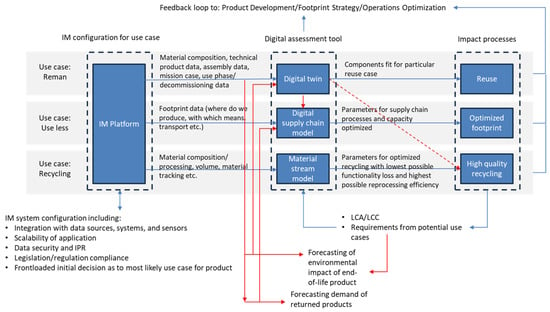
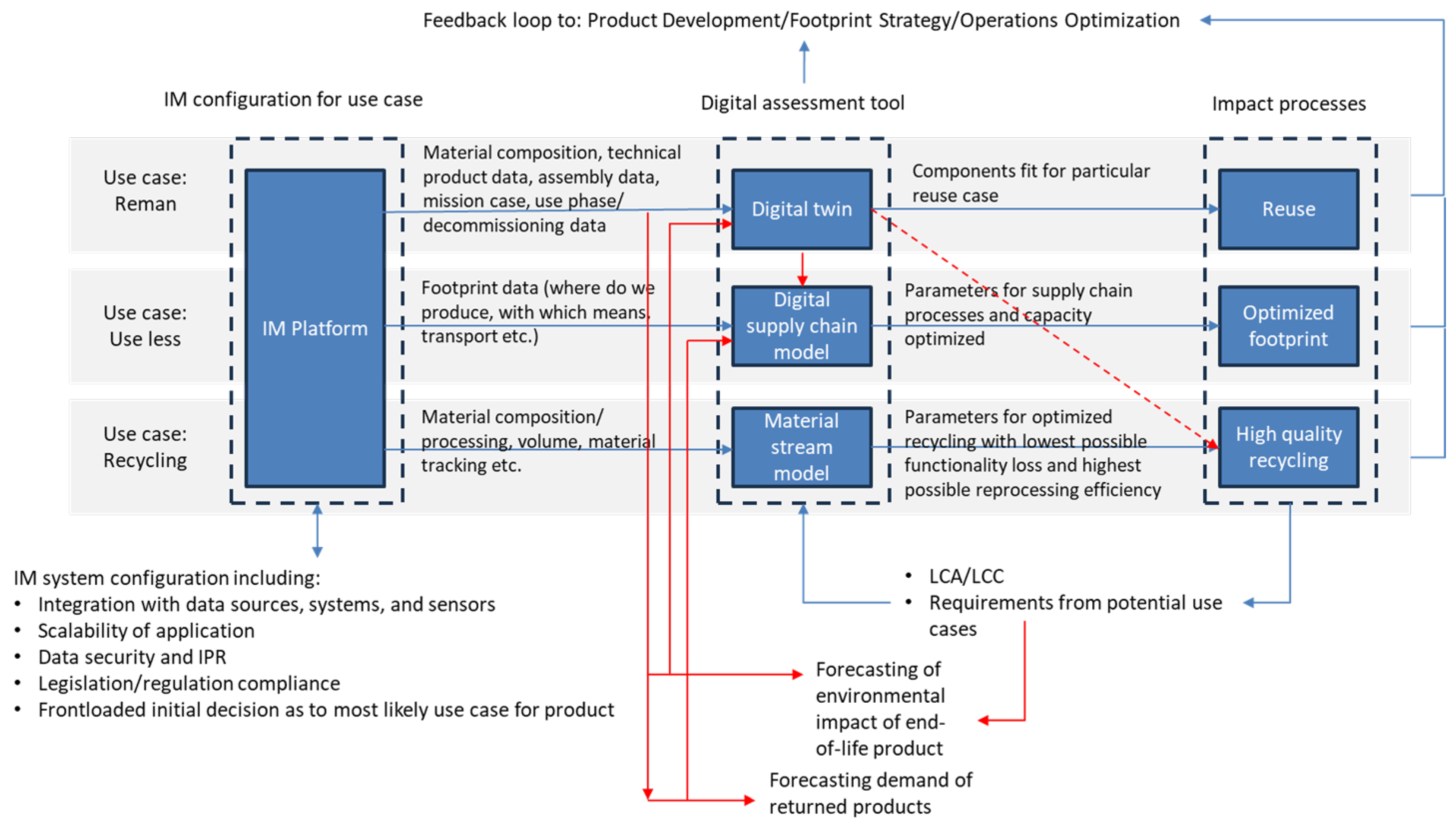
The two use cases collectively illustrate how emerging Industrial Metaverse (IM) infrastructures once matured, can orchestrate decision-making across distinct circularity pathways, a relationship visualized in Figure 1. The figure synthesizes how an IM platform integrates heterogeneous data, ranging from component-level degradation signals to supply chain configurations and material-stream characteristics, into interconnected models (digital twins, supply-chain models, and material-stream models) that support differentiated outcomes such as reuse, optimized resource footprints, or high-quality recycling. Viewed together, the cases demonstrate how IM-enabled modeling capabilities begin to operationalize these pathways in practice: the electronics-remanufacturing case leverages product-centric twins to guide component-level decisions, while the plastics-processing case illustrates how dynamic modeling supports process adaptation and material-stream optimization. This alignment provides a foundation for discussing the broader implications, tensions, and uncertainties that accompany IM-based coordination in circular manufacturing systems.
Figure 1.
IM connected to use cases and impact generating analytical tools.
As illustrated in Figure 1, the IM configuration raises integration challenges and requires architectural solutions. Recent work highlights that IM architectures depend on interoperable, multi-model simulation ecosystems capable of synchronizing behavior, data, and visualization across domains. In line with Jabbour et al. [15], integrating discrete-event simulation with immersive environments enables coherent, distributed models that support decision-making across product, process, and material lifecycles. Our cases illustrate this need: the electronics use case relies on federated product-centric twins for component triage, while the plastics case depends on process-centric twins to manage material variability. Together, these examples show how IM deployments require simulation-based coordination that extends beyond typical Industry 4.0 implementations.
To strengthen the theoretical grounding, we explicitly position the IM as a system-of-systems that depends on simulation-based decision support, distributed systems modeling, and interoperability standards. In line with recent work [15], our cases leverage federated digital twins and multi-level modeling to synchronize process logic, visualization, and data exchange across the lifecycle, which represent capabilities that extend beyond typical Industry 4.0 deployments and underscore the IM’s qualitatively new integration challenges (as also illustrated in Figure 1).
Accordingly, the electronics-repurposing and dynamic-recipe cases operationalize these principles by coupling digital product passports and recipe orchestration with interoperable simulation ecosystems: discrete-event engines drive state changes and policy testing, tools provide shared situational awareness for human-in-the-loop decisions, and coordinate ownership and updates across actors.
Although the suite of production technologies is out of scope for this paper, it remains a core challenge as the IM does not only require interoperability of information systems, but also a integration with operations technology. Additive manufacturing (AM) is an illustrative domain where IM capabilities, such as federated digital twins, immersive design environments, and integrated material-process simulation offer immediate value. Although outside our empirical scope, AM exemplifies how IM can support flexible production, virtual experimentation, and circular-material strategies such as the virtual warehouse [16].
Our findings reinforce Colli et al.’s [11] argument that digital maturity is a prerequisite for advanced Industry 4.0 adoption. However, this study extends the discourse by demonstrating how IM capabilities intersect with sustainability objectives and an extended enterprise perspective, particularly in enabling circular material flows and resource efficiency. While prior research has focused on technological integration [17], our results highlight the organizational and governance dimensions as critical enablers for scaling IM beyond pilot projects. The empirical findings can be summarized into three critical pathways for operationalizing the IM:
- Digital maturity and Infrastructure Readiness: Successful implementation of the IM hinges on the seamless integration of technologies such as real-time simulation via digital twins and decentralized data architectures [17,18]. This pathway examines conditions for technological readiness, including the roles of interoperability and standards.
- Organizational Transformation: Beyond technology, the operationalization of the IM requires significant organizational adaptation. This includes governance structures, reskilling the workforce and industrial relationships for metaverse-enabled workflows [18,19], adopting agile operational models, and fostering a culture of innovation [18]. The paper delves particularly into the challenges of the resulting collaborative infrastructure where multiple internal and external stakeholders need to align around the opportunities offered by data-based systems [20].
- Strategic Value and Realization: For enterprises to embrace the IM, tangible business value must be demonstrated. This section discusses value creation and appropriation, with a focus on enhancing productivity, sustainability, and real-time decision-making [11,21]. Industry-specific scenarios are analyzed, such as circular materials in manufacturing, real-time supply chain optimization based on varying inputs.
Hereby the paper contributes to the ongoing discourse in management engineering by providing core elements for a structured roadmap for realizing the IM’s transformative potential.
4.1. Pathway 1: Digital Maturity and Infrastructure Readiness
The cases show that adopting IM can accelerate sustainability efforts by reducing waste through virtual prototyping, enabling predictive maintenance, and supporting circular business models. In the electronics case, digital product passports and lifecycle analytics help extend product life and reduce material consumption. In the plastics case, dynamic recipe simulations allow firms to use recycled materials while still meeting functional requirements. These findings complement the prior literature highlighting the synergy between digitalization and circularity [21], but the cases provide more concrete examples of how such synergies can be operationalized.
Both cases also demonstrate that successful IM implementation is closely tied to a firm’s level of digital maturity. Following Colli et al.’s Digital Maturity Model, digital transformation unfolds through staged development of technological, organizational, and cultural capabilities. Even though both companies possess strong digital capabilities, the IM demands more advanced integration, linking digital twins, IoT data, AI models, and extended-reality environments into coherent, immersive, and interconnected systems. This raises new requirements even for digitally advanced organizations. Firms in intermediate maturity stages encounter particular difficulties: limited interoperability, fragmented IT landscapes, siloed data, and shortages of digital skills. Without clear governance and strategic direction, investments in metaverse-related technologies risk remaining isolated pilots that fail to scale across business units.
For digitally maturing or advanced firms, however, the IM presents substantial opportunities. It can shorten innovation cycles through virtual prototyping, enhance decision-making with real-time analytics, and open new service-oriented business models. Because IM technologies strengthen integration across IT and operational systems, they support cross-functional collaboration and improve end-to-end supply-chain visibility. Thus, progressing through digital maturity stages is not only a prerequisite for IM adoption but also a key driver of its added value. Tailored transformation roadmaps addressing organizational capabilities, workforce readiness, and ecosystem partnerships become essential. In this sense, the IM is both a catalyst and an outcome of the broader digital-transformation journey described by Colli et al. [11].
A recurring issue raised in the cases concerns where data processing should occur. IM technologies challenge the long-standing practice of embedding intelligence locally in equipment. Centralized processing reduces hardware requirements on robots and machines, improves maintainability, and enables the use of more advanced AI models [22]. However, it requires fast and reliable wireless networks, and interruptions or latency can disrupt real-time operations. Connectivity gaps, especially across supply chains, still pose significant barriers for the firms studied.
Decentralized (edge) processing reduces latency, increases resilience, and lowers network dependency, but requires more capable and costly local hardware, and increases integration complexity. In practice, the companies rely on hybrid solutions: edge computing handles real-time control and safety-critical functions, while centralized systems manage storage, analytics, and AI model training. This hybrid model allows partial exploitation of IM capabilities but is widely recognized as a transitional arrangement until more robust connectivity and infrastructure become available.
4.2. Pathway 2: Organizational Transformation for Metaverse-Enabled Workflows
As appears from the two cases reported, the new IM-based operating model faces key gaps in technology, economy, policy, supply chains, and skills. Challenges include limited advanced system infrastructure, poor data sharing, high costs of transition and weak business incentives [1,9]. Furthermore, market resistance, low demand for circular products, and misperceptions about quality also slow progress. Solutions include investment in circular innovation and design, systematization of circular processes, and cross-industry collaboration. Addressing these gaps will enable scaled circularity across industries, reducing waste and maximizing resource efficiency, thus playing a key role where the stand alone “island” nature of operations systems of today come short as they only address parts of the product life cycle (e.g., manufacturing systems) or represent specific functional needs (e.g., product design). In line with other recent calls for research on IM [23], and given its immersive character the IM supplies the potential for addressing several of these gaps, primarily it does so by allowing opportunities for system-based optimization of material lifecycle flows where the product/component/material can be assessed in the context of the system-of-systems it belongs to.
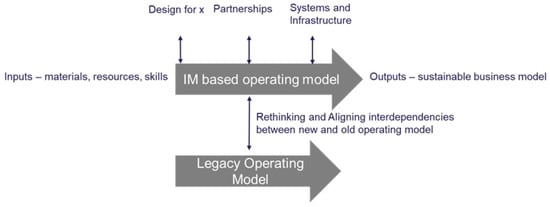
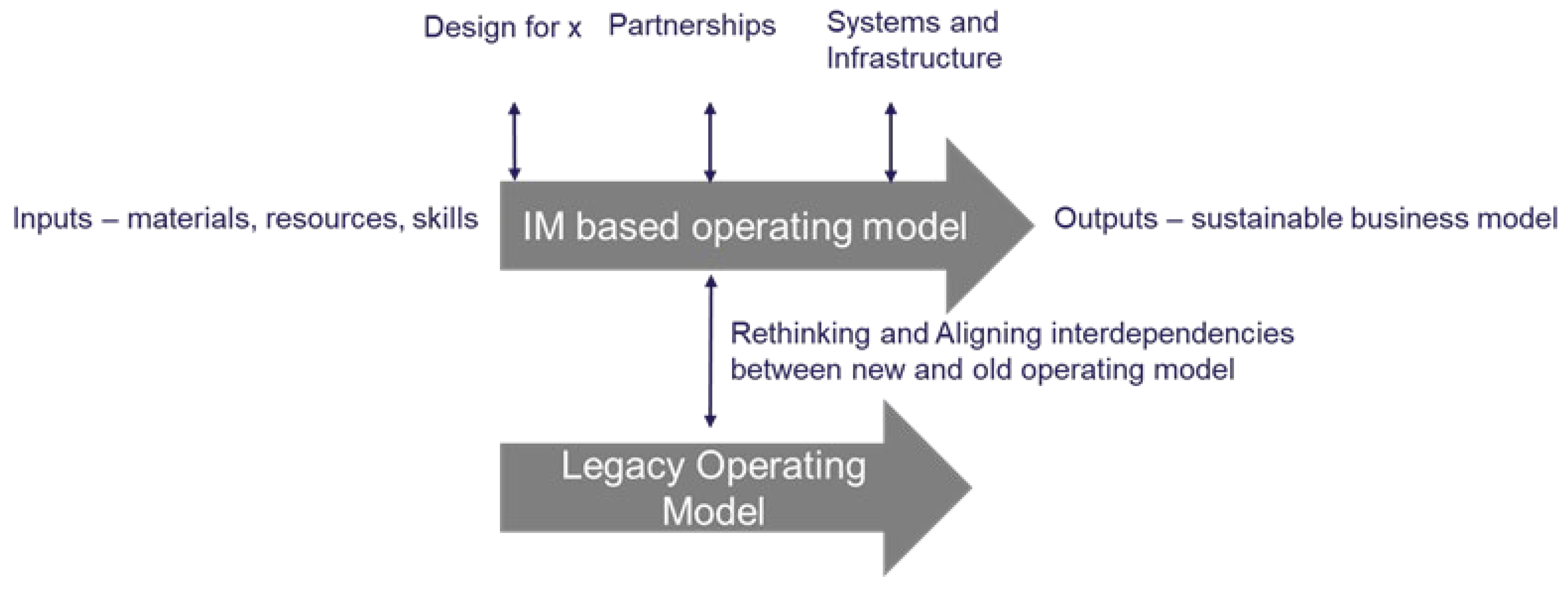
As illustrated in Figure 2, a new operating model, however, relies on organizational resources from the legacy linear system, but it is also constrained by its entrenched structure, and faces challenges in competing with an optimized, decades-old model designed for efficiency rather than sustainability. In the roundtable there is also a concern that it may raise the level of technology fatigue, which is perceived as a key source of the challenges with scaling pilots. The alignment between the new and legacy models is critical to success with scaling the new IM-based operating model and in particular the ability to assist ongoing sense making and building recognizable bridges between the two, which are recognizable to key actors.
Figure 2.
Contextual elements of the IM operating model illustrating the inherent interdependencies with existing operating model and its underlying business processes.
4.3. Pathway 3: Strategic Value and Realization
Under increasing pressures, reactionary initiatives may seem appealing but often lack lasting impact [11]. To achieve sustainability goals, leaders must rethink how their organizations function and design operating models for sustainable outcomes when transitioning from pilot to scaled industrial solution. The realization of strategic value from the IM hinges on more than technological sophistication, it requires clear alignment with organizational goals and broader shifts in business models. Across the cases studied, firms that viewed IM initiatives through a strategic lens (rather than as isolated technical experiments) demonstrated greater momentum toward maturity. These organizations recognized that IM capabilities can drive value beyond operational efficiency, enabling co-creation, servitization, and circular business models.
For example, the integration of digital twins and XR in remanufacturing not only optimized resource use but also supported sustainability reporting and product lifecycle transparency, creating new value for both customers and regulators. Similarly, the university smart lab showcased how predictive capabilities, and immersive training can support resilience and workforce adaptability [24], two strategic imperatives in volatile markets. Importantly, IM infrastructures offer a foundation for data-driven value creation at the ecosystem level. By facilitating real-time collaboration across functions and partners, they enable agile decision-making and responsiveness to shifting market demands. However, realizing this potential requires rethinking governance structures, value propositions, and customer relationships and risks include potential rebound effects where the emerging gains can unintentionally drive higher overall production volumes and resource consumption, offsetting some of the sustainability benefits. Strategic value realization also intersects with digital maturity: firms at higher maturity levels were better positioned to link IM investments to business objectives. Thus, IM adoption must be embedded in strategic roadmaps, supported by leadership commitment and continuous capability development.
4.4. Limitations and Further Research
The IM is still in its formative stage, and this study reflects insights from early pilots and experimental setups rather than mature implementations [23]. As a result, some findings may represent preliminary trends rather than stable patterns. There is a risk of overinterpreting early indicators of success or scalability, as these initiatives have not yet been tested under full operational conditions. Furthermore, the cases examined are situated in specific industrial contexts, which may limit generalizability across sectors. Sustainability impacts were assessed qualitatively, without quantitative measures such as carbon footprint or resource efficiency, constraining the ability to rigorously evaluate environmental benefits.
It is also important to note that while we explore the immense potential of the IM for efficiency gains and transformation towards sustainable manufacturing, we also recognize that there are several uncertainties and risks to consider.
One set of risks is the environmental risks. These stem primarily from the substantial computational and infrastructural requirements of the IM. Immersive industrial environments depend on extensive cloud infrastructures, high-performance computation, real-time simulation engines, and increasingly large AI models, all of which generate significant energy demand. While digitalization is commonly seen as a pathway to dematerialization, a significant research gap persists as the actual substitutive effect of virtual operations on resource-intensive physical processes has yet to be rigorously measured or systematically evaluated.
Another set of risks is related to a social sustainability perspective. The IM may generate both inclusion and well-being challenges that have so far received insufficient empirical attention. The technology’s reliance on high-performance hardware and stable internet connectivity risks reinforcing digital inequalities by limiting access for economically or infrastructurally disadvantaged regions. Furthermore, within industrial organizations, the shift toward immersive and data-intensive work environments may alter job profiles in ways that increase cognitive load and place new demands on workers’ digital competencies [24]. Research highlights that although productivity gains are plausible within highly instrumented virtual workspaces, these gains may be accompanied by reduced interpersonal interaction, new forms of techno-stress, and uneven skill adaptation across the workforce.
And finally, economic and governance risks also complicate the adoption of the IM [25]. Implementing and maintaining high-fidelity digital twins, sensor infrastructures, XR devices, and cybersecurity measures entails substantial capital expenditure, potentially exacerbating inequalities between well-resourced firms and smaller enterprises. These asymmetric investment capacities risk creating uneven digital transformation landscapes, with implications for industrial competitiveness, labor mobility, and regional development.
Together, these risks illustrate that the IM is not a neutral technological evolution but a socio-technical transformation requiring further careful and interdisciplinary research efforts [24].
Future research should adopt longitudinal designs and include diverse industries to validate these early observations and track how IM evolves from concept to widespread adoption.
5. Conclusions
The IM holds transformative potential for smart manufacturing by enabling immersive, data-rich environments that bridge the physical and digital. However, realizing this potential requires more than technological innovation, it demands organizational transformation and strategic alignment. This study identifies three key pathways to operationalizing the IM: technological integration, organizational change, and strategic value realization. Anchored in the Digital Maturity Model, the paper provides insights for firms advancing from pilot projects to scalable solutions. As manufacturing shifts toward sustainable circularity, the IM offers a vital foundation for future-ready operations, workforce development, and sustainable value creation in digitally empowered ecosystems. As discussed throughout the paper, well-known digital-transformation challenges, such as interoperability, data availability, and skills constraints, continue to shape the pace of IM adoption, and require new thinking about operating models. Organizational inertia and unclear governance further complicate adoption. These barriers must be strategically addressed to unlock the IM’s full potential and ensure long-term value creation in manufacturing.
One emerging theme is the tension between centralized and decentralized data architectures. While centralized models offer control and security, they introduce latency and dependency risks. Conversely, edge computing enhances resilience but increases complexity. This trade-off has implications for sustainability, as real-time decision-making is vital for optimizing resource use and reducing waste. Future governance models must address these challenges by promoting open standards and secure data-sharing protocols across supply chains.
At the same time, the IM raises non-trivial risks and trade-offs, including substantial computational and energy demands, risks of vendor lock-in through proprietary platforms, and heightened complexities in distributed data governance and compliance. Moreover, tensions between centralized and decentralized architectures introduce long-term uncertainties regarding system resilience and sustainability, underscoring the need for more critical examination alongside the technological opportunities. We suggest to condition any near-term IM deployment on documented access to low-carbon power and verifiable water-efficient cooling (e.g., zero-evaporation closed-loop systems), recognizing that given current forecasts of data-center electricity demand more than doubling by 2030 and rising direct/indirect water footprints, the pace of IM adoption must be explicitly gated by local grid decarbonization and water-stress thresholds which also align with government policy in Denmark where the case companies are based.
Further research should quantify the environmental benefits of IM adoption, such as reductions in energy consumption and carbon emissions. Longitudinal studies could explore how firms progress from pilots to full-scale implementation and how governance structures evolve to support circularity. Additionally, comparative studies across industries would help identify sector-specific barriers and enablers for sustainable IM integration.
For practitioners, the study underscores the importance of ecosystem collaboration. The iterative feedback loop between industrial cases, university demonstrators, and expert roundtables proved essential for validating concepts and accelerating learning. Managers should consider establishing similar collaborative structures to mitigate risks associated with adoption of IM and to ensure alignment with sustainability goals. Furthermore, investment in workforce reskilling and governance frameworks is critical to overcome barriers such as interoperability and intellectual property concerns.
The firms studied demonstrated strong interest in IM and related capability building but faced difficulties transitioning from isolated pilots to integrated systems. Successful initiatives emphasized agile experimentation, cross-functional collaboration, and strategic alignment with sustainability goals. Insights reveal that early-stage engagement with knowledge partners and ecosystem stakeholders accelerates maturity and fosters long-term competitiveness.
Author Contributions
Conceptualization, B.V.W. and O.M.; methodology, B.V.W. and A.H.L.; validation, B.V.W., U.B. and A.H.L.; formal analysis, B.V.W., O.M. and B.C.D.; investigation, B.V.W., B.C.D., U.B. and O.M.; data curation, B.C.D.; writing—original draft preparation, B.V.W.; writing—review and editing, all authors; project administration, O.M. and B.V.W. All authors have read and agreed to the published version of the manuscript.
Funding
This research has been supported by MADE—the Danish platform for Advanced Production—and TRACE—the Danish platform for Circular Economy—both are funded by the Innovation Fund of Denmark. The Lauritz Andersen Foundation has supported LAB based experiments with IM.
Institutional Review Board Statement
Not applicable. No formal interview template has been created for the project—rather it reflects ongoing thematic discussions of the Industrial Metaverse and applications related to this.This supplemented by university LAB visits where the university has organized demonstrators based on inputs from the participants to provide proof of concept related to the two cases in the article. One of these cases has also recently become publicly available as a set of video presentations (found here https://trace.dk/plastics/cfit-circularity-of-industrial-thermoplastic-for-high-quality-recycling/, accessed on 14 February 2025).
Informed Consent Statement
Not applicable.
Data Availability Statement
The data presented in this study are available on request from the corresponding author due to the early stage and exploratory nature of the material.
Acknowledgments
The authors thank the participating companies and the members of the expert roundtables for their engagement and insights, and the university smart lab team for supporting demonstrator development. The authors would also like to express our sincere gratitude to the anonymous reviewers and the editor for their thoughtful, constructive, and generative feedback on this manuscript. Their careful reading and insightful suggestions have substantially strengthened the clarity, rigor, and overall contribution of the paper.
Conflicts of Interest
The authors declare no conflicts of interest.
Abbreviations
The following abbreviations are used in this manuscript:
| IM | Industrial Metaverse |
| IoT | Internet of Things |
| XR | Extended Reality |
| DPP | Digital Product Passport |
| PLM | Product Lifecycle Management |
| ERP | Enterprise Resource Planning |
| MES | Manufacturing Execution System |
| MBSE | Model-Based Systems Engineering |
| RFLP | Requirements–Functional–Logical–Physical |
References
- Xiao, X.; Roy, R.; Omidyeganeh, M.; Furnari, F. Industrial Metaverse design methodologies: A comprehensive literature review. Int. J. Comput. Integr. Manuf. 2025, 2025, 1–31. [Google Scholar] [CrossRef] [Scilit]
- Zhang, S.; Li, J.; Shi, L.; Ding, M.; Nguyen, D.C.; Chen, W.; Han, Z. Industrial Metaverse: Enabling Technologies, Open Problems, and Future Trends. IEEE Commun. Surv. Tutor. 2026, 28, 2771–2804. [Google Scholar] [CrossRef] [Scilit]
- Yao, X.; Ma, N.; Zhang, J.; Wang, K.; Yang, E.; Faccio, M. Enhancing wisdom manufacturing as industrial metaverse for industry and society 5.0. J. Intell. Manuf. 2024, 35, 235–255. [Google Scholar] [CrossRef] [Scilit]
- Porter, M.E.; Heppelmann, J.E. Why every organization needs an augmented reality strategy. Harv. Bus. Rev. 2017, 95, 46–57. [Google Scholar]
- Cao, J.; Zhu, X.; Sun, S.; Wei, Z.; Jiang, Y.; Wang, J.; Lau, V.K.N. Toward Industrial Metaverse: Age of Information, Latency and Reliability of Short-Packet Transmission in 6G. IEEE Wirel. Commun. 2023, 30, 40–47. [Google Scholar] [CrossRef] [Scilit]
- Xiang, W.; Yu, K.; Han, F.; Fang, L.; He, D.; Han, Q.-L. Advanced Manufacturing in Industry 5.0: A Survey of Key Enabling Technologies and Future Trends. IEEE Trans. Ind. Inform. 2024, 20, 1055–1068. [Google Scholar] [CrossRef] [Scilit]
- Lee, J.; Kundu, P. Integrated cyber-physical systems and industrial metaverse for remote manufacturing. Manuf. Lett. 2022, 34, 12–15. [Google Scholar] [CrossRef] [Scilit]
- Martínez-Gutiérrez, A.; Díez-González, J.; Perez, H.; Araújo, M. Towards industry 5.0 through metaverse. Robot. Comput.-Integr. Manuf. 2024, 89, 102764. [Google Scholar] [CrossRef] [Scilit]
- Colli, M.; Nygaard Uhrenholt, J.; Madsen, O.; Wæhrens, B.V. Translating transparency into value: An approach to design IoT solutions. J. Manuf. Technol. Manag. 2021, 32, 1515–1532. [Google Scholar] [CrossRef] [Scilit]
- Lee, J.; Davari, H.; Singh, J.; Pandhare, V. Industrial Artificial Intelligence for Industry 4.0-Based Manufacturing Systems. Manuf. Lett. 2018, 18, 20–23. [Google Scholar] [CrossRef] [Scilit]
- Colli, M.; Berger, U.; Bockholt, M.; Madsen, O.; Møller, C.; Wæhrens, B.V. A maturity assessment approach for conceiving context-specific roadmaps in the Industry 4.0 era. Annu. Rev. Control 2019, 48, 165–177. [Google Scholar] [CrossRef] [Scilit]
- Schuh, G.; Anderl, R.; Gausemeier, J.; ten Hompel, M.; Wahlster, W. Industrie 4.0 Maturity Index: Managing the Digital Transformation of Companies; acatech STUDY; Acatech: Munich, Germany, 2017; Available online: https://en.acatech.de/publication/industrie-4-0-maturity-index-managing-the-digital-transformation-of-companies/ (accessed on 14 February 2025).
- Schumacher, A.; Erol, S.; Sihn, W. A maturity model for assessing Industry 4.0 readiness and maturity of manufacturing enterprises. Procedia CIRP 2016, 52, 161–166. [Google Scholar] [CrossRef] [Scilit]
- Flynn, B.B.; Flynn, E.J. An exploratory study of the nature of cumulative capabilities. J. Oper. Manag. 2004, 22, 439–457. [Google Scholar] [CrossRef] [Scilit]
- Jabbour, J.; Possik, J.; Yaacoub, C.; Solis, A.O.; Zacharewicz, G. Synergistic Fusion of Simulation and Virtual Reality: A Proposed New Approach for Collaborative Integration. In Proceedings of the 22nd International Conference on Modeling & Applied Simulation, Athens, Greece, 18–20 September 2023. [Google Scholar] [CrossRef] [Scilit]
- Chaudhuri, A.; Rogers, H.; Soberg, P.; Pawar, K.S. The role of service providers in 3D printing adoption. Ind. Manag. Data Syst. 2019, 119, 1189–1205. [Google Scholar] [CrossRef] [Scilit]
- Dwivedi, Y.K.; Hughes, D.L.; Ismagilova, E.; Aarts, G.; Coombs, C.; Crick, T.; Duan, Y.; Dwivedi, R.; Edwards, J.; Eirug, A.; et al. Artificial Intelligence (AI): Multidisciplinary Perspectives on Emerging Challenges, Opportunities, and Agenda for Research, Practice and Policy. Int. J. Inf. Manag. 2021, 57, 101994. [Google Scholar] [CrossRef] [Scilit]
- Bühler, M.M.; Jelinek, T.; Nübel, K. Training and Preparing Tomorrow’s Workforce for the Fourth Industrial Revolution. Educ. Sci. 2022, 12, 782. [Google Scholar] [CrossRef] [Scilit]
- Grieves, M.; Vickers, J. Digital Twin: Mitigating unpredictable, undesirable emergent behavior in complex systems. In Transdisciplinary Perspectives on Complex Systems; Springer: Cham, Switzerland, 2017; pp. 85–113. [Google Scholar] [CrossRef] [Scilit]
- Legenvre, H.; Hameri, A. The emergence of data sharing along complex supply chains. Int. J. Oper. Prod. Manag. 2024, 44, 292–297. [Google Scholar] [CrossRef] [Scilit]
- Rehman, S.U.; Giordino, D.; Zhang, Q.; Alam, G.M. Twin transitions & industry 4.0: Unpack-ing the relationship between digital and green factors to determine green competitive advantage. Technol. Soc. 2023, 73, 102227. [Google Scholar] [CrossRef] [Scilit]
- Jeschke, S.; Brecher, C.; Meisen, T.; Özdemir, D.; Eschert, T. Industrial Internet of Things and Cyber Manufacturing Systems. In Industrial Internet of Things; Springer: Cham, Switzerland, 2017; pp. 3–19. [Google Scholar] [CrossRef] [Scilit]
- Majumdar, A.; Singh, S.P.; Chaudhuri, A.; Luthra, S. Research agenda and Guest editorial: Metaverse adoption and implementation in logistics and supply chain management: Challenges, issues and opportunities. Int. J. Logist. Manag. 2026, 37, 1–7. [Google Scholar] [CrossRef] [Scilit]
- Hansen, A.K.; Villani, V.; Pupa, A.; Heidemann Lassen, A. Introducing Novice Operators to Collaborative Robots: A Hands-On Approach for Learning and Training. IEEE Trans. Autom. Sci. Eng. 2025, 22, 3933–3946. [Google Scholar] [CrossRef] [Scilit]
- Ramkumar, M.; Goswami, M. Adoption of metaverse in supply chain—An empirical investigation based on technology–task fit perspective. Int. J. Logist. Manag. 2026, 37, 130–156. [Google Scholar] [CrossRef]
Disclaimer/Publisher’s Note: The statements, opinions and data contained in all publications are solely those of the individual author(s) and contributor(s) and not of MDPI and/or the editor(s). MDPI and/or the editor(s) disclaim responsibility for any injury to people or property resulting from any ideas, methods, instructions or products referred to in the content. |
© 2026 by the authors. Licensee MDPI, Basel, Switzerland. This article is an open access article distributed under the terms and conditions of the Creative Commons Attribution (CC BY) license.