Article

Impacts of Wetland Degradation on Soil Organic Carbon and Carbon Sequestration Function: A Case Study of the Huixian Wetland in the Li River Basin


1
College of Environmental Science and Engineering, Guilin University of Technology, Guilin 541004, China
2
Guangxi Key Laboratory of Environmental Pollution Control Theory and Technology, Guilin University of Technology, Guilin 541006, China
3
University Engineering Research Center of Watershed Protection and Green Development, Guilin University of Technology, Guilin 541006, China
*
Author to whom correspondence should be addressed.
These authors contributed equally to this work.
Sustainability 2026, 18(6), 2940; https://doi.org/10.3390/su18062940
Submission received: 13 February 2026 / Revised: 5 March 2026 / Accepted: 11 March 2026 / Published: 17 March 2026

Abstract

Wetlands play a vital role in the global carbon cycle and serve as critical carbon sink systems. However, increasing human disturbances and land-use changes have led to widespread wetland degradation, severely weakening their carbon sequestration capacity. This study investigated the Huixian Wetland in the Li River Basin of Southwest China to examine the impacts of wetland degradation on soil physicochemical properties, organic carbon fractions, and carbon fluxes. Based on vegetation and environmental conditions, the wetland was classified into four degradation gradients: non-degraded (ND), slightly degraded (SD), moderately degraded (MD), and heavily degraded (HD), and their spatial differences were systematically analyzed. The results showed that with increasing degradation, soil moisture, total nitrogen, and total phosphorus significantly decreased, whereas soil bulk density and electrical conductivity exhibited an increasing trend. Total organic carbon and active organic carbon fractions, including readily oxidizable organic carbon, light fraction organic carbon, microbial biomass carbon, and dissolved organic carbon, exhibited a pronounced decreasing trend along the degradation gradient, with the decline being most evident in the HD area. Among the labile carbon fractions, microbial biomass carbon (MBC) and light fraction organic carbon (LFOC) exhibited the most drastic declines in heavily degraded areas, indicating their high sensitivity as early warning indicators of wetland degradation. Observations of CO2 fluxes revealed that from April to September, the net ecosystem exchange (NEE) was negative across all areas, indicating that the wetland functioned as a carbon sink overall. However, NEE values increased with higher degradation levels, suggesting a progressive decline in the carbon sequestration capacity of the wetland; ecosystem respiration (ER) peaked in July and increased with the degree of degradation. The findings indicate that wetland degradation leads to soil environment deterioration, reduction in organic carbon storage, and enhanced CO2 emissions, ultimately weakening its carbon sink function. To enhance carbon sequestration capacity and maintain ecological functions, sustainable management strategies such as hydrological restoration and vegetation reconstruction are recommended. This study provides a scientific basis for wetland ecological conservation and carbon management in the context of climate change.

1. Introduction

Wetlands are hailed as the “kidneys of the Earth” and the “cradle of life,” playing a crucial role in maintaining global ecological balance and the carbon cycle [1]. Wetland ecosystems provide multiple ecological functions, including biodiversity conservation, water regulation, pollutant purification, and carbon sequestration [2]. In the global carbon cycle, wetlands absorb atmospheric CO2 through plant photosynthesis and promote organic matter accumulation under anaerobic conditions, making them important carbon reservoirs [3]. Studies have shown that wetland soil carbon stocks are much higher than those of other terrestrial ecosystems, accounting for more than 35% of global soil organic carbon (SOC) storage—far exceeding forests and grasslands. Only about 15% of the carbon fixed and transformed by wetland plants is returned to the atmosphere, confirming that wetlands act as massive carbon sinks that absorb, transform, and mitigate atmospheric CO2 increases [4]. Despite their ecological importance, wetlands have undergone extensive degradation in recent years due to human activities and climate change, seriously impairing their ecological functions [5]. Despite their ecological importance, wetlands have undergone extensive degradation in recent years due to human activities and climate change, seriously impairing their ecological functions [6]. Manifested as urban expansion, agricultural development, and infrastructure construction, this degradation has transformed large wetland areas into other land uses, leading to sharp declines in wetland area [6]. Research indicates that over the past 50 years, global wetland area has decreased by more than 35%, with particularly severe losses in Asia [7,8]. Crucially, wetland degradation accelerates SOC decomposition and increases carbon emissions, thereby reducing the carbon sequestration capacity that is vital for climate mitigation. Addressing this multifactorial challenge requires a systemic understanding of water-ecology-society interactions, a core pursuit of the emerging discipline of water ecology [9].
Soil organic carbon (SOC) is the core component of the terrestrial carbon cycle [10]. It primarily originates from atmospheric CO2 fixed through plant photosynthesis and accumulates in soils via litter inputs, root exudates, and microbial residues [11]. SOC influences soil fertility, microbial activity, and nutrient cycling, while also playing a key role in regulating the balance between carbon sequestration and greenhouse gas emissions. As both a major source and sink of atmospheric CO2, even small changes in SOC storage can significantly impact atmospheric CO2 concentrations [12,13]. To accurately assess the impact of wetland degradation on SOC, SOC is commonly divided into recalcitrant organic carbon (ROC) and labile organic carbon (LOC) [14]. LOC mainly includes dissolved organic carbon (DOC), light fraction organic carbon (LFOC), and microbial biomass carbon (MBC) [15]. ROC represents the most stable fraction of SOC with extremely low degradation rates, serving as the core of long-term carbon storage and determining the stability of the wetland carbon sink [16]. In contrast, LOC is highly sensitive to environmental changes and serves as an important early indicator of wetland degradation [17].
Since the Copenhagen United Nations Climate Change Conference in December 2009, the role of wetlands in the global carbon cycle has drawn increasing attention from governments and academia worldwide [18]. The carbon sequestration function of wetlands is jointly influenced by environmental factors and vegetation [19]. Hydrological conditions are among the most critical determinants of wetland carbon sink capacity, as they regulate the soil redox environment, thereby influencing organic carbon stability and mineralization rates. Temperature affects both plant photosynthesis and organic matter decomposition rates, regulating wetland carbon balance [20]. Soil physicochemical properties also change with wetland degradation, which in turn affects vegetation growth and SOC accumulation [21]. Variations in soil water content are closely related to changes in vegetation community structure; studies have shown that drainage substantially increases SOC decomposition rates due to reduced soil moisture [22]. Soil pH also plays an important role in SOC stability, microbial activity, and plant growth [23]. Changes in soil bulk density influence root penetration and water infiltration, thereby constraining plant growth and SOC storage [24]. Soil total phosphorus (TP) and total nitrogen (TN) contents regulate microbial activity and consequently affect SOC decomposition rates [25]. Vegetation changes directly alter plant biomass, as wetland plants absorb CO2 via photosynthesis, convert it into biomass (leaves, stems, roots), and partially contribute it to soil SOC pools [26]. Root systems further influence SOC storage through organic exudates and rhizosphere microbial processes [27]. As critical “converters,” wetlands play key roles in both carbon fixation and release of gases such as CO2, and degradation severely undermines their carbon reservoir functions [28].
The Huixian Karst Wetland in Guilin is the largest karst wetland in China, providing irreplaceable ecological services such as regional climate regulation, water conservation, and biodiversity protection [29]. However, wetland ecosystems are highly sensitive to environmental changes. In recent years, combined pressures from human activities and climate change have caused significant degradation of the Huixian Wetland, with shrinking area and severely threatened ecological functions. As degradation progresses, hydrological fluctuations intensify, particularly in the dry season, when reduced groundwater recharge leads to persistent declines in water levels and periodic desiccation in certain areas. These changes stress vegetation communities adapted to hydric conditions. Meanwhile, intensified human activities have accelerated degradation by converting wetlands into farmland, fishponds, and construction land. Drainage and reclamation have disrupted hydrological connectivity and altered vegetation structure. Beyond hydrological and vegetation shifts, soil properties also degrade: accelerated SOC decomposition, aggregate destruction, and increased surface exposure result in declining SOC content and diminished carbon sequestration capacity.
Therefore, taking the Huixian Wetland as a case study, this paper sets out the following research objectives: (1) To analyze the variation characteristics of SOC fractions (DOC, MBC, LFOC, ROC), plant biomass, soil properties, and CO2 fluxes under different degradation levels: non-degraded (ND), slightly degraded (SD), moderately degraded (MD), and heavily degraded (HD); (2) To investigate the correlations between plant biomass, environmental factors (pH, soil moisture, TP, TN, etc.), SOC fractions, and CO2 fluxes; (3) To evaluate the impacts of wetland degradation on carbon sequestration functions and propose practical strategies for wetland restoration and management aimed at enhancing carbon storage capacity.

2. Materials and Methods

2.1. Study Area Overview

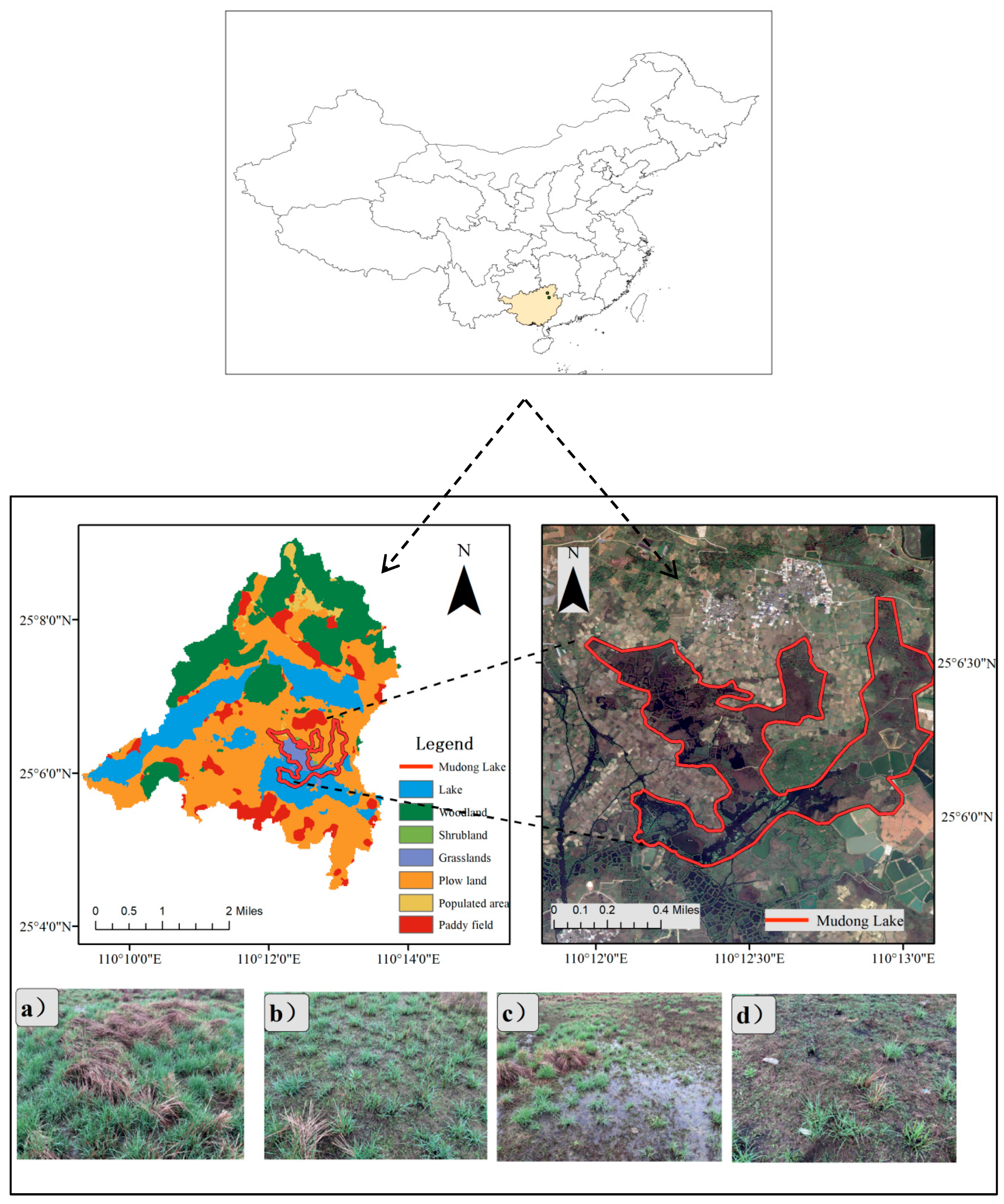
The Huixian Karst Wetland is located in Huixian Town, Lingui District, Guilin City, Guangxi Zhuang Autonomous Region, China (Figure 1). It is a karst wetland dominated by herbaceous marshes and lakes, situated at an elevation of 150–160 m, with a total area of approximately 120 km2. This wetland is one of the few large-scale karst wetlands at low and medium elevations in China [30]. The Huixian Wetland lies within the subtropical monsoon climate zone, with an average annual temperature of 16.5–20.5 °C, a maximum recorded temperature of 38.8 °C, a minimum of −3.3 °C, and an average annual precipitation of 1890.4 mm. Precipitation is unevenly distributed across space and time, with most rainfall concentrated between March and August, resulting in abundant precipitation during spring and summer and relatively little in autumn and winter. The soils are mainly red and yellow soils, primarily distributed in depressions, plains, and gentle slopes, while in mountainous areas the soil layer is thin and bedrock is often exposed. The vegetation is dominated by emergent and submerged plants, with abundant species diversity and luxuriant growth. Vegetation coverage typically reaches 80–95%, and the dominant species include Phragmites communis, Cladium chinense, Ceratophyllum demersum var. oryzelorum, and Limnophila sessiliflora. In recent years, however, wetland degradation has intensified due to the combined effects of climate change, land reclamation, aquaculture development, and infrastructure construction.

2.2. Field Investigation and Sampling

2.2.1. Field Investigation

From May to June 2024, field sampling and investigations were conducted in the Huixian Wetland. To ensure a more reasonable and accurate assessment of wetland degradation, a combination of quantitative and qualitative methods was employed, selecting three indicators of wetland degradation: percentage of bare patches, vegetation coverage, and dominant species [31,32]. (The field sampling for soil and vegetation analysis was conducted as a one-time campaign during May to June 2024, which corresponds to the peak growing season of the wetland vegetation, ensuring the capture of representative biomass and soil conditions. For each of the four degradation levels (ND, SD, MD, HD), five replicate plots (each 20 m × 20 m) were established, resulting in a total of 20 sampling plots. Wetlands with vegetation coverage greater than 90% and almost no bare patches were classified as non-degraded (ND), with representative vegetation including Phragmites australis, Typha angustifolia, and Acorus calamus. Wetlands with vegetation coverage between 60% and 90% (SD) and only a small number of bare patches were identified as slightly degraded, with representative vegetation including Phragmites australis, Typha angustifolia, and Polygonum hydropiper. Wetlands with vegetation coverage between 30% and 60% and a relatively high number of bare patches were classified as moderately degraded (MD), with representative vegetation including Phragmites australis and Taraxacum officinale. Wetlands with vegetation coverage below 30%, large areas of bare and desiccated patches, and partially sandy surfaces were considered heavily degraded (HD), with representative vegetation including Setaria viridis and Persicaria spp.

2.2.2. Measurement of Plant Biomass

At each sampling point, aboveground plants were harvested using a sickle and placed in sealed bags. The samples were transported to the laboratory for drying. In the laboratory, aboveground plant samples were dried in a forced-air oven at 65 °C to constant weight, and the dry weight was measured to determine aboveground biomass (AGB). At the same locations, root samples were collected from the 0–30 cm soil layer using a shovel. Roots were carefully separated, placed in plastic bags, transported to the laboratory, washed, dried, and weighed to obtain belowground biomass (BGB).

2.2.3. CO2 Flux Measurements

Carbon dioxide fluxes were monitored monthly across the entire growing season, from April to September 2024. Measurements were taken on representative clear days between 09:00 and 11:00 local time to minimize diurnal variability.
At each of the 20 permanent sampling plots (5 plots × 4 degradation levels), CO2 flux was measured using a transparent static chamber (base: 40 cm × 40 cm; height: 50 cm; material: polycarbonate) connected to a portable infrared gas analyzer (LI-840). The chamber was deployed on a pre-installed base and sealed for a period of 2 min. The net ecosystem exchange (NEE) was determined from the linear rate of change in CO2 concentration inside the chamber under ambient light conditions.
Immediately following the NEE measurement, the chamber was covered with an opaque black cloth to exclude all light. After a 5-min equilibration period to allow the ecosystem to stabilize under dark conditions, the CO2 concentration was monitored for another 2 min to determine the ecosystem respiration (ER) rate.
For each plot and sampling month, the above sequence (NEE followed by ER) was repeated three times (technical replicates), and the average of these three readings was calculated as the final flux value for that plot and time point. The gas analyzer applied real-time corrections for chamber temperature and atmospheric pressure. Flux calculations were based on the slope of the CO2 concentration change over time; individual measurements with a linear regression coefficient (R2) of less than 0.90 were excluded from the average.
Sign Convention and Derived Variable:
Throughout this study, we adopt the following sign convention:
(1)
Negative NEE values indicate a net uptake of CO2 by the ecosystem (i.e., a carbon sink condition).
(2)
Positive NEE values indicate a net release of CO2 to the atmosphere.
(3)
ER is always reported as a positive value, representing the total CO2 released by ecosystem respiration.
(4)
Gross ecosystem productivity (GEP), representing the total carbon fixed by photosynthesis, was then calculated as:
GEP = ER − NEE
This formulation ensures logical consistency, as it yields a positive GEP value when NEE is negative (uptake > respiration).

2.3. Sample Analysis

Soil physicochemical properties were determined using standard methods: soil pH was measured potentiometrically in a 1:2.5 soil-to-deionized water suspension using a calibrated pH meter (PHS-3C, INESA, Shanghai, China) after 30 min of equilibration [33]; soil bulk density was determined by the core method using a 100 cm3 stainless steel ring sampler [34]; total nitrogen (TN) was analyzed using the Kjeldahl method with an automated digestion and distillation unit (K9840, Haineng, China) [35]; total phosphorus (TP) was measured by the ammonium molybdate colorimetric method at 700 nm using a UV-Vis spectrophotometer after digestion with HClO4 and H2SO4 [36]; and soil water content (WC) was determined gravimetrically after oven-drying at 105 °C for 24 h [37].
Soil organic carbon fractions were analyzed as follows: recalcitrant organic carbon (ROC) was measured using the acid oxidation method with 6 M HCl treatment at 105 °C for 16 h [38], This procedure for separating the recalcitrant carbon pool follows the acid hydrolysis method described by Rovira and Vallejo [39]; light fraction organic carbon (LFOC) was separated by density fractionation (NaI solution, 1.8 g cm−3) followed by centrifugation at 3000× g for 20 min [40]; microbial biomass carbon (MBC) was determined by the chloroform fumigation–extraction method using a 0.45 kEC conversion factor [41], Microbial biomass carbon was calculated from the difference between fumigated and non-fumigated extracts using a conversion factor (kEC) of 0.45, as established in the foundational chloroform fumigation–extraction method; dissolved organic carbon (DOC) was extracted with deionized water (1:5 w/v, 30 min shaking), filtered through a 0.45 μm membrane, and analyzed with a TOC analyzer (TOC-L CPH, Shimadzu, Japan) [42]; and total organic carbon (TOC) was determined by the Walkley–Black wet oxidation method using external heating at 150 °C for 30 min [43]. The measured TOC content was corrected using a factor of 1.33, which has been validated for soils in southern China to account for incomplete oxidation. All analyses were performed in triplicate.
In addition to analyzing individual labile organic carbon fractions, a comprehensive indicator, the geometric mean of labile organic carbon (GMC), was calculated to integrate the responses of DOC, LFOC, and MBC to wetland degradation [44].
G M C = D O C × L F O C × M B C 3
where DOC, LFOC, and MBC are the dissolved organic carbon, light fraction organic carbon, and microbial biomass carbon, respectively. This index provides a more holistic view of the state of the soil labile carbon pool.

2.4. Data Analysis

Data are presented as mean ± standard error (SE). The error bars in all figures represent the standard error of the mean (n = 5 plots per degradation level for field data; n = 3 for laboratory analytical replicates). Differences in plant biomass, soil properties, SOC fractions, and CO2 fluxes among degradation levels were assessed using one-way analysis of variance (One-Way ANOVA), followed by Tukey’s Honestly Significant Difference (HSD) post hoc test for multiple comparisons when the ANOVA indicated significant effects (p < 0.05). Relationships among variables were examined using Pearson correlation analysis. All analyses were performed using SPSS 27, and figures were generated with Origin 2024.

3. Results

3.1. Changes in Plant Biomass Under Different Degrees of Wetland Degradation

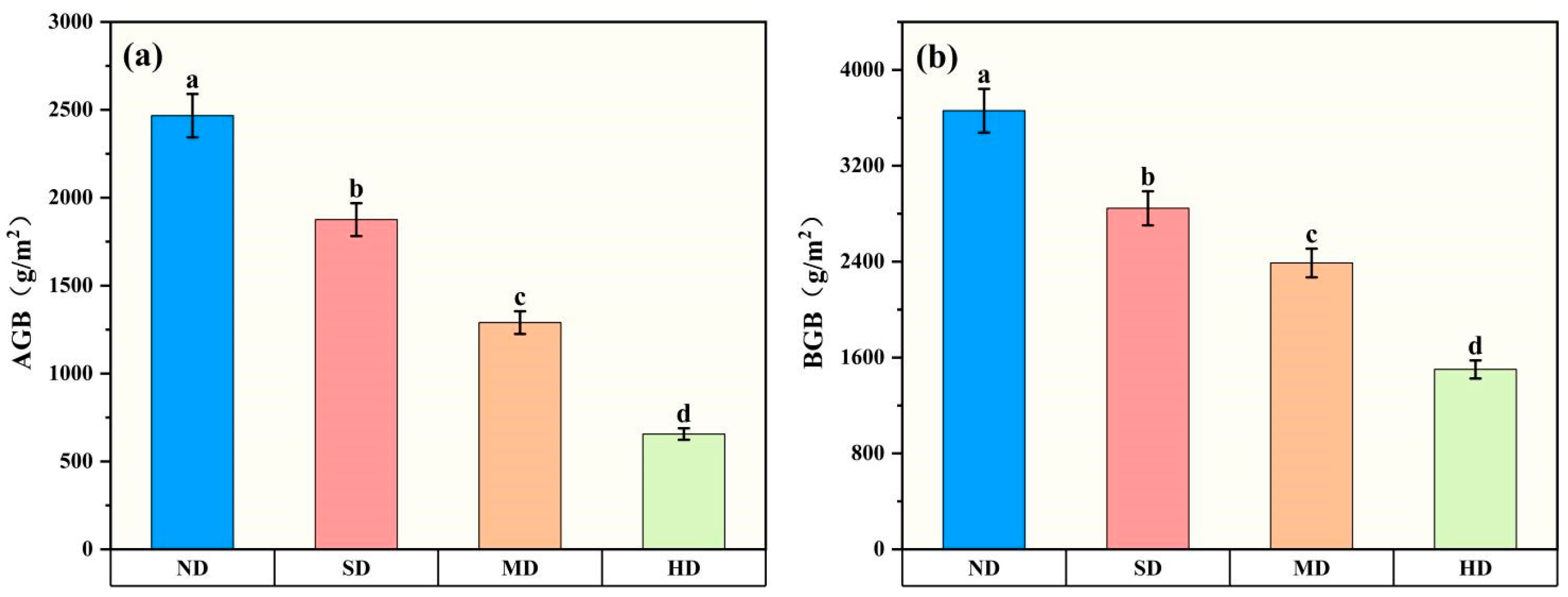
Plant biomass showed significant differences among wetlands with different degradation levels (p < 0.05). Both aboveground and belowground biomass decreased with increasing wetland degradation (Figure 2). AGB was highest in ND, reaching 2466.89 g/m2. The AGB in SD, MD, and HD was 76%, 52%, and 27% of that in ND, respectively. Similarly, BGB was highest in ND (3658.79 g/m2) and lowest in HD (1500.69 g/m2). The BGB in SD, MD, and HD was 78%, 65%, and 41% of the ND value, respectively. Post hoc tests confirmed that AGB in HD was significantly lower than in ND by 1811.41 g/m2 (95% CI: 1410.5 to 2212.3), and BGB was lower by 2158.10 g/m2 (95% CI: 1680.5 to 2635.7).

3.2. Changes in Soil Properties Under Different Degrees of Wetland Degradation

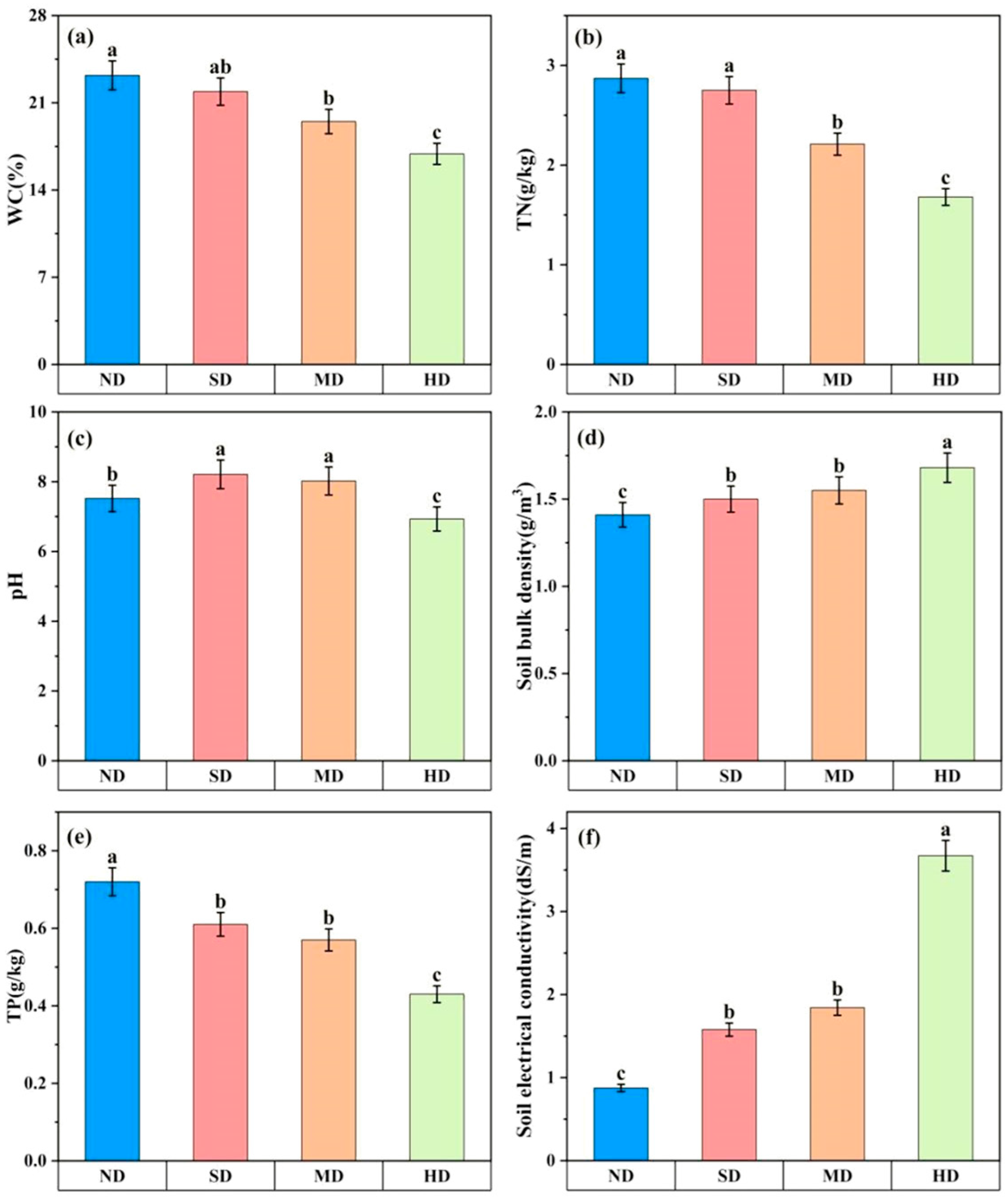
Soil WC decreased with degradation, with values of 23.2% (ND), 21.9% (SD), 19.5% (MD), and 16.9% (HD). Soil TN in MD and HD was 77% and 59% of the ND value (2.87 g/kg), respectively. Soil TP was highest in ND (0.72 g/kg). The TP content in SD, MD, and HD was 85%, 79%, and 60% of that in ND, respectively. Specifically, the mean content of TN in HD was 1.19 g/kg lower than in ND (95% CI: 0.73 to 1.65), and TP was 0.29 g/kg lower (95% CI: 0.17 to 0.41), while no significant difference was observed between ND and SD (p > 0.05) (Figure 3). Soil pH exhibited an initial increase followed by a decline with the intensification of degradation. Higher pH values were observed in SD and MD, which were significantly greater than those in ND and HD (p < 0.05). Soil bulk density increased with increasing degradation. In HD, bulk density was significantly higher than in ND, SD, and MD, whereas no significant difference was observed between SD and MD (p > 0.05). Soil TP was highest in ND, being 16.39%, 24.56%, and 65.11% higher than in SD, MD, and HD, respectively. Soil electrical conductivity (EC) was highest in HD, significantly greater than in ND, SD, and MD (p < 0.05), with no significant difference between SD and MD.

3.3. Changes in Soil SOC Under Different Degrees of Wetland Degradation

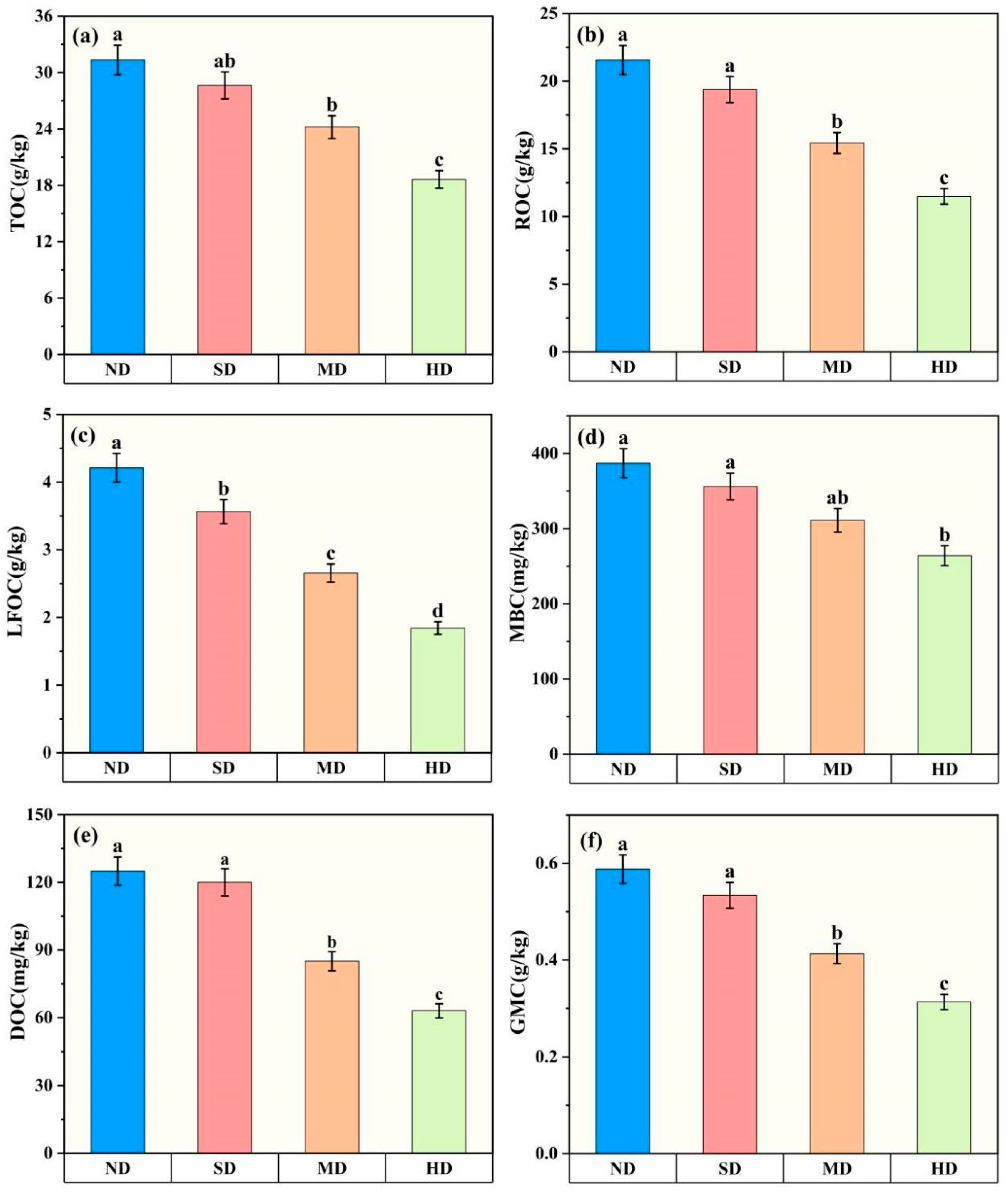
Soil TOC showed a decreasing trend with increasing wetland degradation (Figure 4). The TOC content in MD and HD was significantly lower than in ND (p < 0.05), being approximately 68% and 32% of the ND value, respectively. The TOC content in MD and HD was significantly lower than in ND (p < 0.05), being approximately 68% and 32% of the ND value, respectively. The TOC in HD was 12.71 g/kg lower than in ND (95% CI: 8.6 to 16.8). Soil ROC was higher in ND and SD and was significantly greater than in MD and HD (p < 0.05). Soil LFOC decreased progressively with increasing degradation, with significant differences observed among all degradation levels (p < 0.05). The LFOC in HD was the lowest, with its content reduced to only about 44%, 61%, and 69% of that in ND, SD, and MD, respectively. The LFOC in HD was the lowest, with its content reduced to only about 44%, 61%, and 69% of that in ND, SD, and MD, respectively. This represents a reduction of 2.37 g/kg (95% CI: 1.59 to 3.15) compared to the ND area.
No significant differences in MBC were found among ND, SD, and MD, but all were significantly higher than in HD (p < 0.05). Soil DOC was higher in ND and SD, with no significant difference between them, but both were significantly greater than in MD and HD (p < 0.05). The geometric mean of labile organic carbon (GMC), which integrates the dynamics of DOC, LFOC, and MBC, exhibited a significant decreasing trend with intensifying degradation. The GMC value in the HD area was the lowest, demonstrating a marked reduction compared to the ND, SD, and MD areas (p < 0.05), indicating a severe decline in the overall quality and quantity of the soil labile carbon pool under heavy degradation.

3.4. Changes in CO2 Flux Under Different Degrees of Wetland Degradation

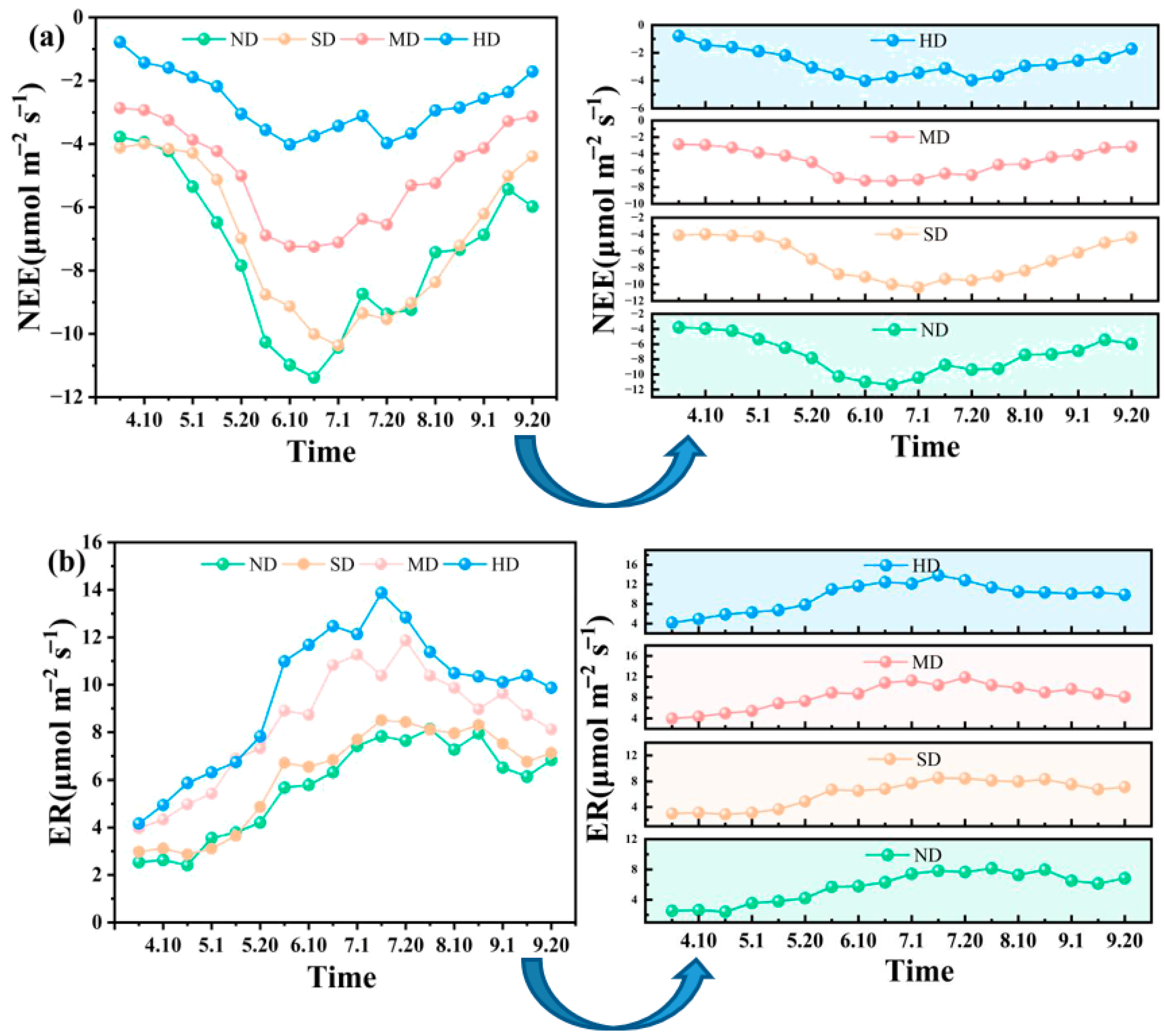
As shown in the figure, from April to September, NEE values were consistently negative, indicating that wetlands under different degradation levels functioned as carbon sinks, with CO2 uptake dominating (Figure 5). With increasing wetland degradation, NEE showed an upward trend, suggesting a gradual reduction in CO2 absorption capacity and an increase in CO2 emissions. Over time, NEE exhibited a pattern of first decreasing and then increasing, reaching the lowest values in June and July, while higher values were observed in April and September. ER showed an opposite seasonal pattern, with an initial increase followed by a decrease, peaking in July across all degradation levels and then declining. Moreover, ER increased with the degree of wetland degradation.

3.5. Correlations Among Plant Biomass, Soil Properties, Soil Organic Carbon Components, and CO2 Flux

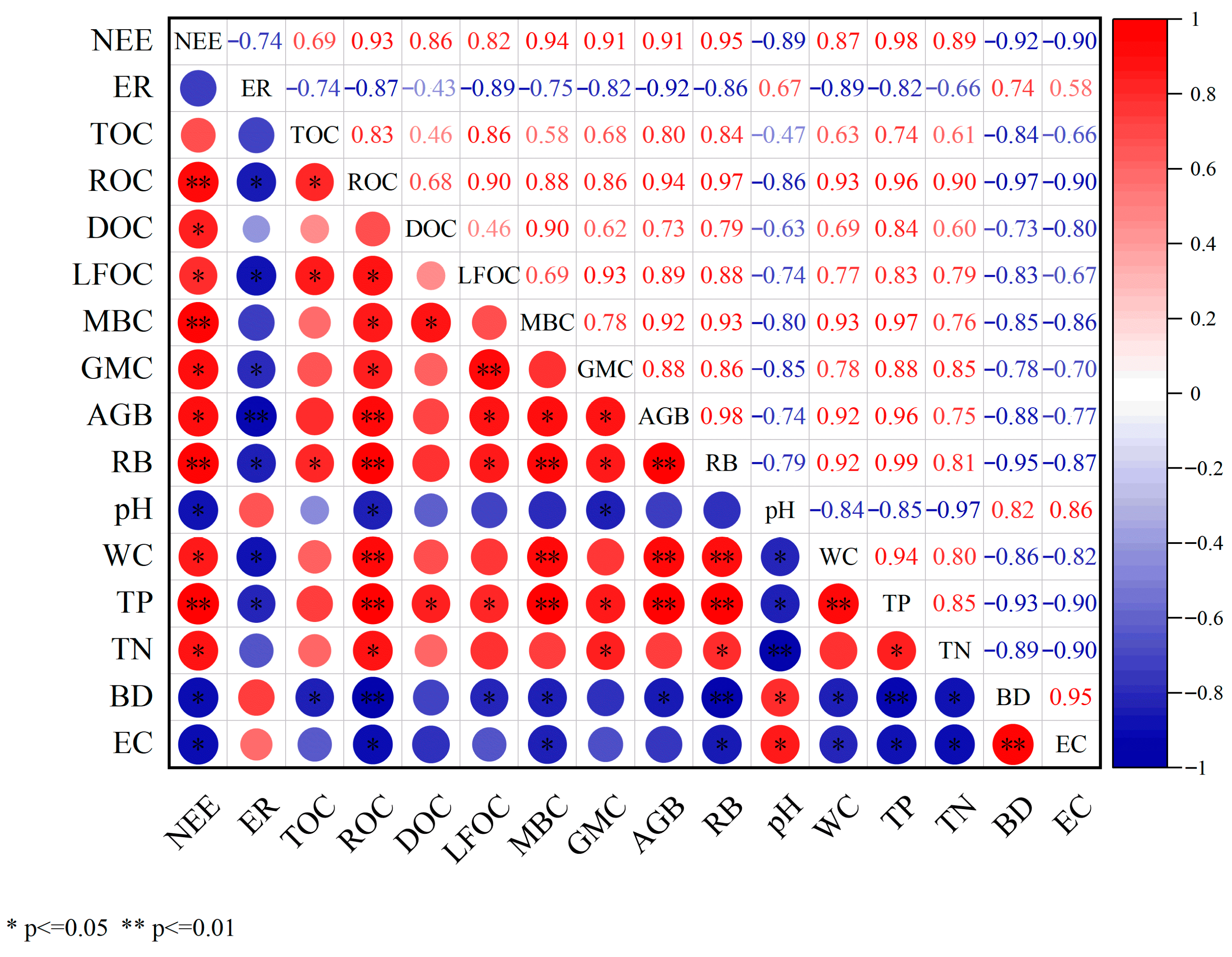
Significant correlations were observed between plant biomass and soil properties (Figure 6). AGB was significantly negatively correlated with BD (p < 0.05), while showing highly significant positive correlations with WC and TP (p < 0.01). BGB was positively correlated with TN (p < 0.05) and highly positively correlated with WC and TP (p < 0.01) but negatively correlated with EC (p < 0.05) and highly negatively correlated with BD (p < 0.01). Plant biomass and soil properties jointly influenced variations in SOC components. Specifically, AGB was positively correlated with LFOC, MBC, and GMC (p < 0.05), and highly positively correlated with ROC (p < 0.01). BGB was positively correlated with TOC, LFOC, and GMC (p < 0.05), and highly positively correlated with ROC and MBC (p < 0.01). Soil pH was negatively correlated with ROC and GMC (p < 0.05). WC was highly positively correlated with ROC and MBC (p < 0.01). TP was positively correlated with DOC, LFOC, and GMC (p < 0.05), and highly positively correlated with ROC and MBC (p < 0.01). TN was positively correlated with ROC and GMC (p < 0.05). BD was negatively correlated with TOC and LFOC (p < 0.05) and highly negatively correlated with ROC (p < 0.01). EC was negatively correlated with ROC and MBC (p < 0.05).
CO2 fluxes were also significantly correlated with plant biomass, soil properties, and SOC components (Figure 6). NEE showed a significant positive correlation with AGB (p < 0.05) and a highly significant positive correlation with BGB (p < 0.01). ER was highly negatively correlated with AGB (p < 0.01) and negatively correlated with BGB (p < 0.05). NEE was negatively correlated with pH, BD, and EC (p < 0.05), while positively correlated with WC and TN (p < 0.05), and highly positively correlated with TP. ER was negatively correlated with WC and TP (p < 0.05). NEE was positively correlated with DOC, LFOC, and GMC (p < 0.05), and also with ROC and MBC (p < 0.05). ER was negatively correlated with ROC, LFOC, and GMC (p < 0.05).

4. Discussion

4.1. Differential Responses of Plant Biomass to Wetland Degradation

Vegetation is among the most sensitive indicators of environmental change in wetland ecosystems, and plant biomass can directly reflect ecological responses to degradation processes [45]. Our results showed that both aboveground biomass (AGB) and root biomass (BGB) differed significantly among wetlands with different degradation stages (p < 0.05), generally declining with increasing degradation intensity. This finding is consistent with previous studies, which demonstrated that wetland degradation is often accompanied by shifts in community structure, thereby affecting plant growth and resource allocation patterns [46].
In the non-degraded (ND) wetland, plant growth was most vigorous, with AGB reaching 2466.89 g/m2, which was 31.53%, 91.31%, and 276.35% higher than in slightly degraded (SD), moderately degraded (MD), and highly degraded (HD) wetlands, respectively. This pattern may be attributed to the favorable hydrological and nutrient conditions in ND, which promote vegetation growth and biomass accumulation [47]. The dominant tall perennial herbaceous species in ND, with their canopy structures, are more competitive for light and space, thereby facilitating higher AGB and BGB accumulation [48]. In contrast, BGB was lowest in HD, being 144.19% lower than ND, 89.62% lower than SD, and 59.19% lower than MD. This suggests that degradation not only restricts aboveground photosynthetic capacity but also inhibits root development and expansion. HD wetlands are often characterized by excessive drainage, soil compaction, or vegetation loss, leading to deteriorated soil moisture and aeration conditions that hinder root growth [49].
Moreover, wetland degradation is frequently accompanied by species replacement and community simplification, where mesophytic and xerophytic species gradually replace hydrophilic species. These smaller-sized plants with lower resource acquisition efficiency are unable to sustain high biomass levels [50]. Therefore, the progressive decline in AGB and BGB along the degradation gradient demonstrates that plant biomass traits serve as reliable indicators of wetland degradation.

4.2. Differential Responses of Soil Properties to Wetland Degradation

Soil physicochemical properties are key indicators of wetland ecological function, playing critical roles in regulating plant growth, microbial activity, and biogeochemical cycling [51]. Our study revealed that as degradation intensified, soil water content (WC), total nitrogen (TN), and total phosphorus (TP) generally decreased, whereas bulk density (BD) and electrical conductivity (EC) significantly increased, reflecting pronounced impacts of degradation on soil quality.
Specifically, WC was significantly higher in ND and SD (23.22% and 21.93%, respectively) than in MD and HD (p < 0.05), suggesting that non- and slightly degraded wetlands maintain superior water retention capacity, which stabilizes hydrological conditions and supports plant growth [52]. In MD and HD, structural deterioration and reduced vegetation cover enhanced evaporation, leading to water loss. TN showed no significant difference between ND and SD (p > 0.05), but was markedly lower in MD and HD, being 70.83% and 30.16% lower than ND, respectively, possibly due to reduced organic matter input and weakened microbial N cycling [53]. Since nitrogen is a vital nutrient, its decline not only restricts plant growth but also weakens carbon sequestration.
Soil pH followed a “rise-then-fall” trend across degradation stages, being significantly higher in SD and MD than in ND and HD (p < 0.05). This may result from ion accumulation under mild degradation and acidification due to reduced hydrological buffering and organic acid accumulation under severe degradation [54]. BD increased significantly with degradation, being highest in HD (p < 0.05). Elevated BD indicates compaction, reduced porosity, and impaired soil aeration, conditions unfavorable for plant growth and microbial processes [55]. No significant difference was observed between SD and MD (p > 0.05), suggesting that compaction was not yet fully developed at these stages.
TP was highest in ND, being 16.39%, 24.56%, and 65.11% higher than in SD, MD, and HD, respectively. This decline may be linked to reduced biological uptake and inputs, along with enhanced P fixation in degraded soils [56]. EC was highest in HD, indicating greater salt accumulation, likely caused by evaporation and external inputs [57].
Overall, wetland degradation significantly alters soil physicochemical properties, where deteriorated water, nutrient, and structural conditions act as major drivers of ecological decline. These results highlight the critical role of soil responses in wetland degradation and restoration.

4.3. Differential Responses of Soil Organic Carbon Components to Wetland Degradation

Soil organic carbon (SOC) is a key indicator of wetland carbon storage and sequestration capacity, while its labile components (e.g., DOC, MBC, LFOC, ROC) reflect carbon availability and dynamic turnover potential [58]. Our findings revealed that TOC, ROC, LFOC, MBC, and DOC all declined with increasing degradation, with significantly lower levels in MD and HD than in ND and SD (p < 0.05). This indicates that degradation significantly reduces both the quantity and quality of soil carbon pools.
TOC, the major soil carbon reservoir, was 31.64% and 68.22% lower in MD and HD than ND, consistent with findings from the Zoige Plateau [59] and Sanjiang Plain wetlands [60], which showed that vegetation loss, reduced organic input, and enhanced oxidation lower carbon storage.
ROC and LFOC, as labile carbon fractions, are highly sensitive to disturbance [61]. In our study, ROC was highest in ND and SD but declined sharply in HD, while LFOC decreased by 128.59% in HD compared with ND, suggesting that degradation severely impairs carbon turnover and bioavailability, limiting microbial and plant access to carbon sources [62].
MBC, an indicator of microbial activity, showed no significant difference among ND, SD, and MD, but was markedly lower in HD. This indicates that severe degradation constrains microbial carbon utilization and reproduction, likely due to organic matter decline, water stress, and unfavorable physicochemical conditions [63].
DOC, the soluble carbon fraction, was significantly higher in ND and SD than in MD and HD, consistent with findings in the Mu Us Desert [64] and alpine wetlands [65]. Reduced DOC content limits carbon mobility and microbial cycling.
Furthermore, the pronounced decrease in the geometric mean of labile organic carbon (GMC) underscores the coordinated depletion of multiple active carbon pools under degradation pressure. The synergistic decline of DOC, LFOC, and MBC, as captured by the GMC index, suggests that wetland degradation does not merely reduce the size of individual carbon pools but degrades the functional integrity and metabolic activity of the entire soil labile carbon system. This reinforces the conclusion that the carbon sequestration function is compromised at a systemic level.
Our findings on the differential declines of labile organic carbon (LOC) fractions provide empirical validation for their role as early warning indicators of wetland degradation, as hypothesized in the Introduction. Among the measured fractions, microbial biomass carbon (MBC) and light fraction organic carbon (LFOC) exhibited the most drastic reductions, particularly in the heavily degraded (HD) area. The extreme sensitivity of MBC likely reflects the immediate negative impact of degraded soil conditions on microbial community viability and activity. Similarly, the sharp decline in LFOC, which consists of partially decomposed plant and microbial residues, indicates a rapid depletion of the most bioavailable soil carbon pool due to reduced fresh organic matter input and accelerated oxidation. In contrast, while dissolved organic carbon (DOC) and total organic carbon (TOC) also decreased significantly, their response gradients were somewhat less steep compared to MBC and LFOC. Recalcitrant organic carbon (ROC), as expected, showed higher stability but still declined markedly under severe degradation. This hierarchy of sensitivity (MBC ≈ LFOC > DOC > TOC > ROC) underscores that MBC and LFOC are the most responsive biomarkers of initial wetland deterioration. Monitoring these specific fractions could therefore enable earlier detection of ecosystem stress than bulk TOC measurements alone, informing timely conservation interventions.
In summary, wetland degradation reduces SOC stocks (TOC) and alters labile fractions, thereby disrupting carbon dynamics, microbial processes, and carbon sequestration capacity. Preserving hydrology and vegetation is thus essential for maintaining SOC storage.

4.4. Differential Responses of CO2 Fluxes to Wetland Degradation

Our study showed that during April–September, NEE values were consistently negative across all degradation stages, indicating that the wetlands functioned as carbon sinks. However, NEE increased with degradation intensity, suggesting a weakened carbon sink capacity and higher CO2 emissions. This trend agrees with studies from the Zoige Plateau, which reported that severe degradation can convert wetlands from carbon sinks to carbon sources [66].
Seasonally, NEE reached its lowest value in June–July, indicating maximum carbon uptake, likely driven by peak plant growth and photosynthetic activity [67]. Similar patterns have been reported in alpine wetlands on the Qinghai–Tibet Plateau, where growing season temperature strongly regulates monthly NEE and GPP [68].
ER peaked in July before declining, with higher values under greater degradation. This may result from accelerated decomposition of organic matter and intensified microbial activity in degraded soils [69,70]. For instance, studies in Chenhu wetland demonstrated that ER seasonality closely follows soil temperature, with warmer summers enhancing microbial respiration and CO2 release [71]. It is crucial to note that despite the marked increase in NEE (i.e., reduced net uptake) and ER with degradation, the NEE values remained negative throughout our April-September monitoring period. This indicates that the Huixian Wetland sustained its net carbon sink function during the growing season. However, the magnitude of this sink was severely compromised. The trajectories suggest that with continued degradation, the ecosystem could approach carbon neutrality or potentially become a net carbon source, especially if similar trends extend into the non-growing season or if further degradation occurs.
Thus, degradation significantly alters the seasonal dynamics of CO2 fluxes, undermining wetland carbon sink functions. Conserving wetlands is therefore essential for sustaining carbon sequestration and mitigating climate change.

4.5. Linking Degradation Impacts to Karst-Specific Hydrological and Biogeochemical Processes

The observed patterns of carbon pool depletion and flux alteration in the Huixian Wetland must be interpreted within the context of its karst geological setting, which imposes unique hydrological and biogeochemical controls on the carbon cycle. Unlike non-karst wetlands, the degradation-driven loss of carbon sink function here is likely amplified by characteristic karst processes.
Firstly, the well-developed epikarst zone with its dual porosity (fissures, conduits) facilitates a rapid “short-circuiting” of hydrological pathways. This leads to quick infiltration of surface water and efficient subsurface drainage. Consequently, the leaching and export of dissolved carbon species—both dissolved organic carbon (DOC) and dissolved inorganic carbon (DIC) generated from carbonate weathering—are accelerated . The reduction in vegetation cover and soil stability with degradation further exacerbates this process by increasing surface erosion, thereby enhancing the particulate and dissolved carbon export via both overland flow and swift underground conduits.
Secondly, the dynamic hydrology inherent to karst systems plays a critical role in regulating carbon stability. Degradation-induced water table drawdown or increased surface dryness exposes previously saturated, anoxic organic layers (e.g., peat, humus) to oxygen. This shift to oxic conditions dramatically stimulates the microbial mineralization of soil organic carbon, a process reflected in the significant decline of microbial biomass carbon (MBC) and the increase in ecosystem respiration (ER) observed in our study. The pervasive fissure networks in karst may render the soil profile more vulnerable to such oxygenation compared to more homogenous substrates, potentially leading to a deeper and more rapid activation of recalcitrant carbon pools.
Furthermore, the calcium-rich environment of karst wetlands adds another layer of biogeochemical specificity. Calcium ions (Ca2+) can interact with organic matter to form stable organo-mineral complexes (often referred to as “cation bridging”), which physically protect organic carbon from microbial attack and contribute to the long-term stabilization of soil organic carbon (SOC). Wetland degradation, potentially accompanied by soil acidification or drastic hydrological changes, may disrupt this stabilizing mechanism. The destabilization of these calcium-associated complexes could be a key, yet often overlooked, factor contributing to the significant loss of recalcitrant organic carbon (ROC) observed in heavily degraded areas, providing a distinct karst perspective on the vulnerability of supposedly stable carbon pools [72].
In summary, the degradation of the Huixian Karst Wetland’s carbon sink function is not merely a consequence of generic vegetation loss and soil alteration. It is critically modulated and intensified by the region’s distinctive hydrogeology—characterized by fast, dual-pathway water flow and calcium-coupled biogeochemistry. This interplay makes the carbon cycle in karst wetlands particularly sensitive to disturbance and underscores the necessity of considering these geological singularities when diagnosing degradation mechanisms and planning restoration interventions.

4.6. Impacts of Huixian Wetland Degradation on Carbon Sink Function and Sustainable Restoration Strategies

Our findings demonstrate that wetland degradation significantly weakens the carbon sink function of the Huixian wetland. With increasing degradation, NEE values rose, indicating greater CO2 emissions and a severe weakening of the carbon sink function, pushing the ecosystem towards a carbon source threshold. Simultaneously, TOC and its labile fractions (ROC, LFOC, DOC, MBC) declined significantly, reflecting depletion of soil carbon pools. These changes were closely linked to reduced plant biomass, diminished organic matter input, altered hydrology, and deteriorated soil conditions [73,74].
Soil water content, TN, EC, pH, and BD also showed strong degradation responses. Water availability is a key driver of carbon cycling, as drier conditions enhance soil aeration, accelerating organic matter mineralization and CO2 emissions [75]. Higher BD indicates compaction, limiting organic matter accumulation and microbial activity [76]. These shifts not only reflect carbon pool decline but also act as feedback drivers, amplifying carbon sink loss.
Accordingly, wetland restoration strategies should prioritize hydrological regulation, restoring natural water levels and connectivity to reduce oxidation and enhance carbon sequestration [77]. Vegetation restoration is also critical, particularly the re-establishment of dominant wetland communities (e.g., Typha, Phragmites), which enhance primary productivity and carbon input.
Therefore, restoration strategies should be tailored to degradation severity. For heavily degraded (HD) areas characterized by soil exposure and desertification, the initial focus should be on hydrological restoration (e.g., blocking drainage ditches, utilizing karst springs for seasonal replenishment) to re-establish a minimum water level. Concurrently, drought-tolerant pioneer plant species (e.g., Setaria viridis, Persicaria spp., as observed in HD areas) can be introduced to stabilize the soil surface, reduce erosion, and initiate organic matter accumulation. As soil and hydrologic conditions improve, the focus should shift to actively promoting the establishment of native hygrophilous communities (e.g., Phragmites australis, Typha angustifolia) through seeding or transplanting, ultimately aiming to rebuild a self-sustaining wetland ecosystem with high carbon sequestration capacity.
From a sustainability perspective, wetland carbon sinks are vital not only for regional greenhouse gas mitigation but also for climate adaptation, ecosystem service enhancement, and ecological security. Therefore, wetland restoration should be integrated with land-use planning, non-point pollution control, and agricultural water management, forming a coordinated governance framework. Long-term monitoring, integrating remote sensing, flux measurements, and soil analyses, is essential for dynamic assessment of carbon pools and evaluating restoration effectiveness. The implementation of systematic water ecological assessments is a fundamental scientific tool for quantifying degradation, prioritizing restoration efforts, and measuring outcomes, thereby enabling sustainable water resources and environmental management [78].
In summary, the decline of the Huixian wetland’s carbon sink function results from multi-factor and multi-scale interactions. Enhancing carbon storage capacity requires combined measures involving ecological restoration, hydrological regulation, soil rehabilitation, and integrated management. Future studies should focus on spatiotemporal dynamics of CO2 fluxes, long-term carbon effects of restoration measures, and responses of coupled C–N–P cycles, providing scientific support for achieving carbon neutrality goals.

5. Conclusions

This study systematically assessed variations in soil physicochemical properties, SOC fractions, and CO2 fluxes across degradation stages in the Huixian wetland. With increasing degradation, WC, TN, TP, and multiple SOC fractions (TOC, ROC, LFOC, MBC, and DOC) declined significantly, while BD and EC increased, indicating deterioration of soil structure and nutrient status.
CO2 flux observations revealed that wetlands acted as carbon sinks throughout the growing season (negative NEE). However, with degradation, NEE increased (weakened carbon uptake) and ER was significantly enhanced, particularly in HD, suggesting that degradation reduces carbon inputs while accelerating carbon outputs, thus weakening carbon sink capacity.
These findings highlight the central role of soil quality in regulating wetland carbon cycling. Future wetland protection and management should prioritize hydrological regulation, vegetation restoration, and organic matter recovery. Incorporating wetland conservation into regional sustainability strategies will not only enhance carbon storage capacity but also contribute to climate mitigation and maintain the stability and ecosystem services of karst wetlands. Future studies should integrate long-term positioning observations and manipulative experiments to evaluate the restoration potential of carbon sink functions under different remediation measures, particularly in karst wetland systems.

Author Contributions

Conceptualization, Y.W. and M.T.; software, Y.W. and M.T.; validation, Y.W. and J.D.; formal analysis, Z.W.; investigation, Y.W., Z.W. and B.X.; resources, J.D.; data curation, Y.W.; writing—original draft preparation, Y.W.; writing—review and editing, Y.W. and J.D.; visualization, J.D.; supervision, Z.W.; project administration, J.D. All authors have read and agreed to the published version of the manuscript.

Funding

This research was funded by the Science and Technology Planning Project of Guangxi, China (No. AB 23026045), the Guangxi Key Research and Development Program Project (No. AB25069160), and the Science and Technology Plan Project of Guilin (No. 20220114-2).

Institutional Review Board Statement

Not applicable.

Informed Consent Statement

Not applicable.

Data Availability Statement

Data are contained within the article.

Conflicts of Interest

The authors declare no conflict of interest.

References

  1. Mustafa, G.; Hussain, S.; Liu, Y.; Ali, I.; Liu, J.; Bano, H. Microbiology of wetlands and the carbon cycle in coastal wetland mediated by microorganisms. Sci. Total Environ. 2024, 954, 175734. [Google Scholar] [CrossRef]
  2. Wan, D.; Yu, P.; Kong, L.; Zhang, J.; Chen, Y.; Zhao, D.; Liu, J. Effects of inland salt marsh wetland degradation on plant community characteristics and soil properties. Ecol. Indic. 2024, 159, 111582. [Google Scholar] [CrossRef]
  3. Villa, J.A.; Bernal, B. Carbon sequestration in wetlands, from science to practice: An overview of the biogeochemical process, measurement methods, and policy framework. Ecol. Eng. 2018, 114, 115–128. [Google Scholar] [CrossRef]
  4. Mitra, S.; Wassmann, R.; Vlek, P.L.G. An appraisal of global wetland area and its organic carbon stock. Curr. Sci. 2005, 88, 25–35. [Google Scholar]
  5. Salimi, S.; Almuktar, S.A.; Scholz, M. Impact of climate change on wetland ecosystems: A critical review of experimental wetlands. J. Environ. Manag. 2021, 286, 112160. [Google Scholar] [CrossRef] [PubMed]
  6. Baldock, J.A. Composition and cycling of organic carbon in soil. In Nutrient Cycling in Terrestrial Ecosystems; Springer: Berlin/Heidelberg, Germany, 2007; pp. 1–35. [Google Scholar]
  7. Newton, A.; Icely, J.; Cristina, S.; Perillo, G.M.E.; Turner, R.E.; Ashan, D.; Cragg, S.; Luo, Y.; Tu, C.; Li, Y.; et al. Anthropogenic, direct pressures on coastal wetlands. Front. Ecol. Evol. 2020, 8, 144. [Google Scholar] [CrossRef]
  8. Davidson, N.C. How Much Wetland Has the World Lost? Long-term and Recent Trends in Global Wetland Area. Mar. Freshw. Res. 2014, 65, 934–941. [Google Scholar] [CrossRef]
  9. Qu, J.; Rose, J.B. Why WE? A Scientific Odyssey for Planetary Sustainability via Water & Ecology. Water Ecol. 2025, 1, 100005. [Google Scholar] [CrossRef]
  10. Mei, W.; Dong, H.; Qian, L.; Yan, J.; Hu, Y.; Wang, L. Effects of anthropogenic disturbances on the carbon sink function of Yangtze River estuary wetlands: A review of performance, process, and mechanism. Ecol. Indic. 2024, 159, 111643. [Google Scholar] [CrossRef]
  11. Han, J.Y.; Kim, D.-H.; Oh, S.; Moon, H.S. Effects of water level and vegetation on nitrate dynamics at varying sediment depths in laboratory-scale wetland mesocosms. Sci. Total Environ. 2020, 703, 134741. [Google Scholar] [CrossRef]
  12. Dungait, J.A.J.; Hopkins, D.W.; Gregory, A.S.; Whitmore, A.P. Soil organic matter turnover is governed by accessibility not recalcitrance. Glob. Change Biol. 2012, 18, 1781–1796. [Google Scholar] [CrossRef]
  13. Bhattacharya, S.S.; Kim, K.-H.; Das, S.; Uchimiya, M.; Jeon, B.H.; Kwon, E.; Szulejko, J.E. A review on the role of organic inputs in maintaining the soil carbon pool of the terrestrial ecosystem. J. Environ. Manag. 2016, 167, 214–227. [Google Scholar] [CrossRef]
  14. Chen, X.; Chen, H.Y.; Chen, X.; Wang, J.; Chen, B.; Wang, D.; Guan, Q. Soil labile organic carbon and carbon-cycle enzyme activities under different thinning intensities in Chinese fir plantations. Appl. Soil Ecol. 2016, 107, 162–169. [Google Scholar] [CrossRef]
  15. Ma, W.; Li, G.; Wu, J.; Xu, G.; Wu, J. Response of soil labile organic carbon fractions and carbon-cycle enzyme activities to vegetation degradation in a wet meadow on the Qinghai–Tibet Plateau. Geoderma 2020, 377, 114565. [Google Scholar] [CrossRef]
  16. Wang, M.; Wang, S.; Cao, Y.; Jiang, M.; Wang, G.; Dong, Y. The effects of hummock-hollow microtopography on soil organic carbon stocks and soil labile organic carbon fractions in a sedge peatland in Changbai Mountain, China. Catena 2021, 201, 105204. [Google Scholar] [CrossRef]
  17. Zhang, H.; Tang, J.; Liang, S.; Li, Z.; Wang, J.; Wang, S. Early thawing after snow removal and no straw mulching accelerates organic carbon cycling in a paddy soil in Northeast China. J. Environ. Manag. 2018, 209, 336–345. [Google Scholar] [CrossRef] [PubMed]
  18. Shi, X.; Zhao, S.; Li, C.; Sun, B.; Wu, Y.; Fan, C. The carbon storage and distribution patterns of wetland in Hulun Buir. Ecol. Sci. 2015, 34, 110–118. [Google Scholar]
  19. An, Y.; Gao, Y.; Liu, X.; Tong, S.; Liu, B.; Song, T.; Qi, Q. Soil organic carbon and nitrogen variations with vegetation succession in passively restored freshwater wetlands. Wetlands 2021, 41, 11. [Google Scholar] [CrossRef]
  20. Hao, Q.; Song, Z.; Zhang, X.; He, D.; Guo, L.; van Zwieten, L.; Yu, C.; Wang, Y.; Wang, W.; Fang, Y.; et al. Organic blue carbon sequestration in vegetated coastal wetlands: Processes and influencing factors. Earth Sci. Rev. 2024, 255, 104853. [Google Scholar] [CrossRef]
  21. Zhang, Z.; Gao, X.; Zhang, S.; Gao, H.; Huang, J.; Sun, S.; Song, X.; Fry, E.; Tian, H.; Xia, X. Urban development enhances soil organic carbon storage through increasing urban vegetation. J. Environ. Manag. 2022, 312, 114922. [Google Scholar] [CrossRef]
  22. Dash, P.; Bhattacharyya, P.; Roy, K.; Neogi, S.; Nayak, A. Environmental constraints’ sensitivity of soil organic carbon decomposition to temperature, management practices and climate change. Ecol. Indic. 2019, 107, 105644. [Google Scholar] [CrossRef]
  23. Hu, M.; Yan, R.; Wu, H.; Ni, R.; Zhang, D.; Zou, S. Linking soil phosphorus availability and phosphatase functional genes to coastal marsh erosion: Implications for nutrient cycling and wetland restoration. Sci. Total Environ. 2023, 898, 165559. [Google Scholar] [CrossRef]
  24. Bentley, S.B.; Tomscha, S.A.; Deslippe, J.R. Indictors of wetland health improve following small-scale ecological restoration on private land. Sci. Total Environ. 2022, 837, 155760. [Google Scholar] [CrossRef] [PubMed]
  25. Li, M.; Zhang, K.; Yan, Z.; Liu, L.; Kang, E.; Kang, X. Soil water content shapes microbial community along gradients of wetland degradation on the Tibetan plateau. Front. Microbiol. 2022, 13, 824267. [Google Scholar] [CrossRef] [PubMed]
  26. Chen, Y.; Wei, T.; Ren, K.; Sha, G.; Guo, X.; Fu, Y.; Yu, H. The coupling interaction of soil organic carbon stock and water storage after vegetation restoration on the Loess Plateau, China. J. Environ. Manag. 2022, 306, 114481. [Google Scholar] [CrossRef] [PubMed]
  27. Jiang, J.; Wang, Y.-P.; Liu, F.; Du, Y.; Zhuang, W.; Chang, Z.; Yu, M.; Yan, J. Antagonistic and additive interactions dominate the responses of belowground carbon-cycling processes to nitrogen and phosphorus additions. Soil Biol. Biochem. 2021, 156, 108216. [Google Scholar] [CrossRef]
  28. Neubauer, S.C.; Megonigal, J.P. Biogeochemistry of wetland carbon preservation and flux. In Wetland Carbon and Environmental Management; Wiley: Hoboken, NJ, USA, 2021; pp. 33–71. [Google Scholar]
  29. DeSuo, C.; Zulu, M.; Zhao, X.-G.; Wang, K. Remote sensing supervision on spatio-temporal evolution of Karst wetland in recent 40 years in Huixian district of Guilin, China. J. Guangxi Norm. Univ. 2009, 26, 111–117. [Google Scholar]
  30. Solon, J.; Roo-Zielińska, E.; Degorski, M. Landscape scale of topography-soil-vegetation relationship: Influence of land use and land form. Pol. J. Ecol. 2012, 60, 3. [Google Scholar]
  31. Zhang, J. Responses of Plant Community Change on Wetland Degradation in Yellow River Delta Region. In Coastal Saline Soil Rehabilitation and Utilization Based on Forestry Approaches in China; Springer: Berlin/Heidelberg, Germany, 2014; pp. 165–179. [Google Scholar]
  32. Wu, G.; Li, X.; Gao, J. The evolution of hummock–depressionmicro-topography in an alpine marshy wetland in Sanjiangyuan as inferred from vegetation and soil characteristics. Ecol. Evol. 2021, 11, 3901–3916. [Google Scholar] [CrossRef]
  33. Robertson, G.P.; Coleman, D.C.; Bledsoe, C.S.; Sollins, P. Standard Soil Methods for Long-Term Ecological Research; Oxford University Press: Oxford, UK, 2015; pp. 55–78. [Google Scholar]
  34. Bremner, J.M. Nitrogen-total. In Methods of Soil Analysis, Part 3: Chemical Methods; Sparks, D.L., Page, A.L., Helmke, P.A., Loeppert, R.H., Eds.; SSSA Book Series No. 5; Soil Science Society of America: Madison, WI, USA, 1996; pp. 1085–1121. [Google Scholar]
  35. Murphy, J.; Riley, J.P. A modified single solution method for the determination of phosphate in natural waters. Anal. Chim. Acta 1962, 27, 31–36. [Google Scholar] [CrossRef]
  36. Walkley, A.; Black, I.A. An examination of the Degtjareff method for determining soil organic matter, and a proposed modification of the chromic acid titration method. Soil Sci. 1934, 37, 29–38. [Google Scholar] [CrossRef]
  37. Rovira, P.; Vallejo, V.R. Labile and recalcitrant pools of carbon and nitrogen in organic matter decomposing at different depths in soil: An acid hydrolysis approach. Geoderma 2002, 107, 109–141. [Google Scholar] [CrossRef]
  38. Gregorich, E.G.; Beare, M.H.; McKim, U.F.; Skjemstad, J.O. Chemical and biological characteristics of physically uncomplexed organic matter. Soil Sci. Soc. Am. J. 2006, 70, 975–985. [Google Scholar] [CrossRef]
  39. Vance, E.D.; Brookes, P.C.; Jenkinson, D.S. An extraction method for measuring soil microbial biomass C. Soil Biol. Biochem. 1987, 19, 703–707. [Google Scholar] [CrossRef]
  40. Jones, D.L.; Willett, V.B. Experimental evaluation of methods to quantify dissolved organic nitrogen (DON) and dissolved organic carbon (DOC) in soil. Soil Biol. Biochem. 2006, 38, 991–999. [Google Scholar] [CrossRef]
  41. ASTM D4972-19; Standard Test Method for pH of Soils. ASTM International: West Conshohocken, PA, USA, 2019.
  42. Song, Y.; Song, T.; An, Y.; Shan, L.; Su, X.; Yu, S. Soil ecoenzyme activities coupled with soil properties and plant biomass strongly influence the variation in soil organic carbon components in semi-arid degraded wetlands. Sci. Total Environ. 2024, 922, 171361. [Google Scholar] [CrossRef]
  43. Doudová, J.; Douda, J. Along with intraspecific functional trait variation, individual performance is key to resolving community assembly processes. Funct. Ecol. 2020, 34, 2362–2374. [Google Scholar] [CrossRef]
  44. Abulaizi, M.; Chen, M.; Yang, Z.; Hu, Y.; Zhu, X.; Jia, H. Response of soil bacterial community to alpine wetland degradation in arid Central Asia. Front. Plant Sci. 2023, 13, 990597. [Google Scholar] [CrossRef]
  45. Song, A.; Liang, S.; Li, H.; Yan, B. Effects of biodiversity on functional stability of freshwater wetlands: A systematic review. Front. Microbiol. 2024, 15, 1397683. [Google Scholar] [CrossRef]
  46. Wan, J.; Yuan, X.; Han, L.; Ye, H.; Yang, X. Characteristics and distribution of organic phosphorus fractions in the surface sediments of the inflow rivers around Hongze Lake, China. Int. J. Environ. Res. Public Health 2020, 17, 648. [Google Scholar] [CrossRef]
  47. Wang, G.-P.; Liu, J.-S.; Wang, J.-D.; Yu, J.-B. Soil phosphorus forms and their variations in depressional and riparian freshwater wetlands (Sanjiang Plain, Northeast China). Geoderma 2006, 132, 59–74. [Google Scholar] [CrossRef]
  48. Xu, G.; Shao, H.; Sun, J.; Chang, S.X. Phosphorus fractions and profile distribution in newly formed wetland soils along a salinity gradient in the Yellow River Delta in China. J. Plant Nutr. Soil Sci. 2012, 175, 721–728. [Google Scholar] [CrossRef]
  49. Yu, J.; Qu, F.; Wu, H.; Meng, L.; Du, S.; Xie, B. Soil phosphorus forms and profile distributions in the tidalriver network region in the yellow river delta estuary. Sci. World J. 2014, 2014, 912083. [Google Scholar]
  50. Wang, W.-Q.; Sardans, J.; Zeng, C.-S.; Tong, C.; Wang, C.; Peñuelas, J. Impact of plant invasion and increasing floods on total soil phosphorus and its fractions in the Minjiang river estuarine wetlands, China. Wetlands 2016, 36, 21–36. [Google Scholar]
  51. Zhai, J.; Zhou, H.; Wu, Y.; Wang, G.; Xue, S. Effect of Nitrogen and Phosphorus on Soil Enzyme Activities and Organic Carbon Stability in Qinghai–Tibet Plateau. Agronomy 2024, 14, 1376. [Google Scholar] [CrossRef]
  52. Shi, Y.; Sheng, L.; Wang, Z.; Zhang, X.; He, N.; Yu, Q. Responses of soil enzyme activity and microbial community compositions to nitrogen addition in bulk and microaggregate soil in the temperate steppe of Inner Mongolia. Eurasian Soil Sci. 2016, 49, 1149–1160. [Google Scholar] [CrossRef]
  53. Lehmann, J.; Kleber, M. The contentious nature of soil organic matter. Nature 2015, 528, 60–68. [Google Scholar] [CrossRef] [PubMed]
  54. Luan, J.; Cui, L.; Xiang, C.; Wu, J.; Song, H.; Ma, Q. Soil carbon stocks and quality across intact and degraded alpine wetlands in Zoige, east Qinghai-Tibet Plateau. Wetl. Ecol. Manag. 2014, 22, 427–438. [Google Scholar] [CrossRef]
  55. Song, Y.; Song, C.; Yang, G.; Miao, Y.; Wang, J.; Guo, Y. Changes in labile organic carbon fractions and soil enzyme activities after marshland reclamation and restoration in the Sanjiang Plain in Northeast China. Environ. Manag. 2012, 50, 418–426. [Google Scholar] [CrossRef] [PubMed]
  56. Wang, K.; Bi, B.; Zhu, K.; Wen, M.; Han, F. Responses of soil dissolved organic carbon properties to the desertification of desert wetlands in the Mu Us Sandy Land. J. Environ. Manag. 2024, 354, 120318. [Google Scholar] [CrossRef]
  57. Abulaizi, M.; Chen, M.; Tian, Y.; Hu, Y.; Han, D.; Hu, Y.; Zhou, J.; Yang, Z.; Jia, H. Response of Soil Organic Carbon and Its Components to Alpine Wetland Degradation in Arid Central Asia. Land 2025, 14, 387. [Google Scholar] [CrossRef]
  58. Lin, C.-Y.; Li, X.-L.; Zhang, J.; Sun, H.-F.; Zhang, J.; Han, H.-B.; Wang, Q.-H.; Ma, C.-B.; Li, C.-Y.; Zhang, Y.-X.; et al. Effects of degradation succession of alpine wetland on soil organic carbon and total nitrogen in the Yellow River source zone, west China. J. Mt. Sci. 2021, 18, 694–705. [Google Scholar] [CrossRef]
  59. Wu, Y.; Xu, N.; Wang, H.; Li, J.; Zhong, H.; Dong, H.; Zeng, Z.; Zong, C. Variations in the diversity of the soil microbial community and structure under various categories of degraded wetland in Sanjiang Plain, northeastern China. Land Degrad. Dev. 2021, 32, 2143–2156. [Google Scholar]
  60. Li, C.Y.; Li, X.L.; Su, X.X.; Yang, Y.W.; Li, H.L. Effects of alpine wetland degradation on soil microbial structure and diversity on the Qinghai Tibet plateau. Eurasian Soil Sci. 2021, 54, S33–S41. [Google Scholar] [CrossRef]
  61. Zhu, J.; Zhang, F.; Li, H.; He, H.; Li, Y.; Yang, Y.; Zhang, G.; Wang, C.; Luo, F. Seasonal and interannual variations of CO2 fluxes over 10 years in an alpine wetland on the Qinghai-Tibetan Plateau. J. Geophys. Res. Biogeosci. 2020, 125, e2020JG006011. [Google Scholar] [CrossRef]
  62. Zhang, Y.; Liu, L.; Luo, H.; Wang, W.; Li, P. Characteristics of Carbon Fluxes and Their Environmental Control in Chenhu Wetland, China. Water 2024, 16, 3169. [Google Scholar] [CrossRef]
  63. Ma, Q.; Zhang, C.; Chen, L.; Yao, M.; Yang, F.; Yan, H.; Li, W. Carbon Dioxide Fluxes and Influencing Factors in the Momoge Salt Marsh Ecosystem, Jilin Province, China. Appl. Sci. 2023, 13, 11604. [Google Scholar] [CrossRef]
  64. Anderson, F.E.; Bergamaschi, B.; Sturtevant, C.; Knox, S.; Hastings, L.; Windham-Myers, L.; Detto, M.; Hestir, E.L.; Drexler, J.; Miller, R.L.; et al. Variation of energy and carbon fluxes from a restored temperate freshwater wetland and implications for carbon marketverification protocols. J. Geophys. Res. Biogeosci. 2016, 121, 777–795. [Google Scholar]
  65. Roehm, C.L.; Roulet, N.T. Seasonal contribution of CO2 fluxes in the annual C budget of a northern bog. Glob. Biogeochem. Cycles 2003, 17, 1029. [Google Scholar]
  66. Li, Z.; Jin, Z.; Li, Q. Changes in land use and their effects on soil properties in Huixian Karst wetland system. Pol. J. Environ. Stud. 2017, 26, 699–707. [Google Scholar] [CrossRef]
  67. Yin, S.; Bai, J.; Wang, W.; Zhang, G.; Jia, J.; Cui, B.; Liu, X. Effects of soil moisture on carbon mineralization in floodplain wetlands with different flooding frequencies. J. Hydrol. 2019, 574, 1074–1084. [Google Scholar] [CrossRef]
  68. Gao, H.; Chen, H.; Jin, Y.; Gao, R.; Wei, C.; Zhang, C.; Zhang, W. Occurrence and Speciation of Pollutants in Guilin Huixian Wetland: Nutrients, Microplastics, Heavy Metals, and Emerging Contaminants. Water 2024, 16, 2816. [Google Scholar] [CrossRef]
  69. Yin, X.; Yu, X.; Qin, L.; Jiang, M.; Lu, X.; Zou, Y. Reclamation leads to loss of soil organic carbon and molecular complexity: Evidence from natural to reclaimed wetlands. Soil Tillage Res. 2025, 248, 106436. [Google Scholar] [CrossRef]
  70. Zhao, Y.; Zou, S.Z.; Shen, H.Y.; Lan, F.N.; Xie, H.; Li, J. Sources and control factors of main ions and dissolved inorganic carbon in karst water of the Huixian karst wetland, Guangxi. Geol. China 2024, 51, 1701–1713. [Google Scholar]
  71. Ge, J.; Qi, Y.; Yi, Y.; Ma, C.; Yao, W.; Liu, X.; Wang, H.; Li, K.; Yue, F.-J.; Peng, T.; et al. Rainfall shapes CO2 emission and dissolved organic matter dynamics in a karst catchment: Controlling factors revealed by isotopic and molecular signatures. Water Res. 2025, 289, 124875. [Google Scholar] [CrossRef] [PubMed]
  72. Zhu, X.; Shen, Y.; Yuan, X.; Yuan, C.; Jin, L.; Zhao, Z.; Chen, F.; Yang, B.; Jiang, X.; Liu, W. High levels of soil calcium and clay facilitate the recovery and stability of organic carbon: Insights from different land uses in the karst of China. Environ. Sci. Pollut. Res. 2024, 31, 34234–34248. [Google Scholar] [CrossRef] [PubMed]
  73. Lu, M.; Zou, Y.; Xun, Q.; Yu, Z.; Jiang, M.; Sheng, L.; Lu, X.; Wang, D. Anthropogenic disturbances caused declines in the wetland area and carbon pool in China during the last four decades. Glob. Change Biol. 2021, 27, 3837–3845. [Google Scholar]
  74. Huo, L.; Zou, Y.; Lyu, X.; Zhang, Z.; Wang, X.; An, Y. Effect of wetland reclamation on soil organic carbon stability in peat mire soil around Xingkai Lake in Northeast China. Chin. Geogr. Sci. 2018, 28, 325–336. [Google Scholar] [CrossRef]
  75. Lan, J.; Jiang, Y.; Huang, M. Vegetation restoration enhances soil organic carbon accumulation in Southwest China’s karst region: The role of aggregation, calcium, and microbes. Catena 2025, 257, 109184. [Google Scholar] [CrossRef]
  76. Zhou, J.; Zhao, Y.; Huang, P.; Zhao, X.; Feng, W.; Li, Q.; Xue, D.; Dou, J.; Shi, W.; Wei, W.; et al. Impacts of ecological restoration projects on the ecosystem carbon storage of inland river basin in arid area, China. Ecol. Indic. 2020, 118, 106803. [Google Scholar] [CrossRef]
  77. Fu, B.; Li, S.; Yu, X.; Yang, P.; Yu, G.; Feng, R.; Zhuang, X. Chinese ecosystem research network: Progress and perspectives. Ecol. Complex. 2010, 7, 225–233. [Google Scholar] [CrossRef]
  78. Qu, J.; Peng, J. Significance and enlightenment of implementing water ecological assessment. Water Ecol. 2025, 1, 100002. [Google Scholar] [CrossRef]
Figure 1. Location map of the Huixian Wetland; (a) Non-degraded wetland; (b) Slightly degraded wetland; (c) Moderately degraded wetland; (d) Heavily degraded wetland.
Sustainability 18 02940 g001
Figure 2. Effects of wetland degradation levels on plant aboveground biomass (AGB) and belowground biomass (BGB). (a) plant aboveground biomass; (b) belowground biomass. Different letters indicate significant differences (p < 0.05). ND: non-degraded wetland; SD: slightly degraded wetland; MD: moderately degraded wetland; HD: heavily degraded wetland.
Sustainability 18 02940 g002
Figure 3. Effects of wetland degradation levels on soil properties. (a) Soil water content (WC); (b) Total nitrogen (TN); (c) Soil pH; (d) Bulk density; (e) Total phosphorus (TP); (f) Electrical conductivity (EC). Different letters indicate significant differences among degradation levels (p < 0.05). ND: non-degraded wetland; SD: slightly degraded wetland; HD: moderately degraded wetland; MD: severely degraded wetland.
Sustainability 18 02940 g003
Figure 4. Effects of wetland degradation levels on soil organic carbon (SOC) components. (a) Total organic carbon (TOC); (b) Readily oxidizable organic carbon (ROC); (c) Light fraction organic carbon (LFOC); (d) Microbial biomass carbon (MBC); (e) Dissolved organic carbon (DOC); (f) Geometric Mean of labile organic Carbon(GMC). Different letters indicate significant differences among degradation levels (p < 0.05). ND: non-degraded wetland; SD: slightly degraded wetland; MD: moderately degraded wetland; HD: severely degraded wetland.
Sustainability 18 02940 g004
Figure 5. Effects of wetland degradation levels on CO2 emission fluxes. (a) Net ecosystem exchange (NEE); (b) Ecosystem respiration (ER). ND: non-degraded wetland; SD: slightly degraded wetland; MD: moderately degraded wetland; HD: severely degraded wetland.
Sustainability 18 02940 g005
Figure 6. Pearson correlation analysis. The symbols * and ** indicate significant correlations at the 0.05 and 0.01 levels, respectively.
Sustainability 18 02940 g006
Disclaimer/Publisher’s Note: The statements, opinions and data contained in all publications are solely those of the individual author(s) and contributor(s) and not of MDPI and/or the editor(s). MDPI and/or the editor(s) disclaim responsibility for any injury to people or property resulting from any ideas, methods, instructions or products referred to in the content.