


Abstract
Climate change and tightening resource and environmental constraints are increasing the strategic importance of environmental, social, and governance (ESG) performance for firms’ long-term viability. This study examines whether ESG performance enhances organizational resilience in China and explores the roles of innovation capability and environmental uncertainty. Using an unbalanced panel of 1037 non-financial Chinese A-share listed firms from 2014 to 2022, we estimate panel models and conduct a series of robustness and endogeneity tests. The results show that ESG performance significantly improves organizational resilience. Innovation capability partially mediates this relationship, indicating that ESG enhances resilience in part by strengthening firms’ innovative capacity. Environmental uncertainty also positively moderates the effect of innovation capability on organizational resilience, although the evidence is modest. Further analysis shows that the positive ESG–resilience relationship is stronger among state-owned enterprises and small and medium-sized firms. Overall, the findings suggest that ESG functions not only as a sustainability signal, but also as an organizational capability that supports resilience under uncertainty.
1. Introduction
China, the world’s largest emerging economy, provides a setting in which firms must navigate frequent disruptions and rapid institutional change, making organizational resilience a strategic priority and a focal topic in management research [1]. Organizational resilience refers to a firm’s ability to anticipate, withstand, adapt to and recover from disruptions [2]. Capability-based accounts treat resilience as a dynamic process rooted in organizational resources and routines that support anticipation, coping and renewal, yet empirical work still diverges on how to operationalize resilience and identify its most effective firm-level drivers in turbulent contexts [3,4].
In parallel, environmental, social and governance (ESG) performance has become a widely used benchmark for assessing corporate sustainability and long-term value creation [5]. Empirical research often links ESG performance to corporate financial performance and risk profiles, but the strength of this link varies with context, measurement and research design [6]. In China, regulators and capital-market participants increasingly rely on ESG ratings and disclosures to guide capital allocation and promote high-quality development among listed firms [7]. Even so, much of the ESG literature remains centered on financial outcomes, leaving open whether ESG contributes to a firm’s underlying resilience capability over longer horizons.
The COVID-19 shock offered a vivid illustration that sustainability-related practices can matter when conditions deteriorate: firms with stronger ESG or corporate social responsibility records tended to experience smaller stock price declines, lower volatility and faster recovery across China and other markets [8,9,10,11,12]. More broadly, social and environmental practices can help firms rebound by strengthening stakeholder relationships and preserving resource flexibility in the face of adverse events [13]. What remains less clear is how ESG is translated into durable, multidimensional resilience beyond short-run market reactions, and under what conditions this translation becomes more or less effective.
This study builds on the dynamic capabilities view to explain how ESG can be converted into organizational resilience in China [14]. From this perspective, resilience is not only about absorbing shocks but also about reconfiguring resources and routines as conditions change. ESG engagement can support this reconfiguration by strengthening a firm’s legitimacy and stakeholder trust [15,16] and by improving the information environment through more credible and usable ESG disclosures [17], which can ease access to critical resources when constraints tighten. These conditions help firms sustain innovation investment and adjust routines rather than retrench, making innovation capability a plausible channel through which ESG translates into adaptive action and stronger resilience. The payoff to such innovation-enabled reconfiguration is likely to be greater when the environment is harder to forecast and strategic adjustments must be made under uncertainty [18,19]. In the Chinese context, ESG performance has also been closely intertwined with innovation-oriented investment and outcomes [20], while the growing divergence across ESG evaluations can itself generate sustainability uncertainty that pushes firms toward capability reconfiguration such as digital transformation—an observation that further motivates a dynamic-capabilities interpretation of ESG-driven adaptation [21].
Against this background, this paper examines how ESG performance relates to organizational resilience in China and investigates the roles of innovation capability and environmental uncertainty in this relationship. Using panel data on Chinese A-share listed firms from 2014 to 2022, we test whether higher ESG performance is associated with greater organizational resilience, whether innovation capability mediates this relationship, and whether environmental uncertainty strengthens the resilience payoff of innovation capability. We further examine heterogeneity by ownership type and firm size. In doing so, the study contributes by shifting the ESG discussion from short-horizon financial outcomes toward organizational resilience as a multidimensional capability outcome, and by clarifying the capability channel and boundary condition through which ESG becomes economically consequential in China.
The remainder of the paper is organized as follows. Section 2 reviews the relevant literature and develops hypotheses. Section 3 describes the methodology. Section 4 reports the empirical results, robustness and heterogeneity tests. Section 5 discusses the findings. Section 6 concludes with implications and limitations.
2. Literature Review and Hypotheses
2.1. ESG Performance and Organizational Resilience
ESG performance can be framed as a set of organizational choices that shape risk governance, stakeholder coordination, and resource allocation under competing objectives. A practical complication is that these choices are observed through ESG ratings that can diverge materially across providers, which weakens the informational content of ESG signals and increases ambiguity about sustainability quality [22]. When evaluations diverge, firms face stronger demands for verification and credibility building, which is reflected in higher audit fees in China when ESG ratings are less consistent [23]. At the same time, measured ESG can depart from substantive effort, because high scores may coexist with elevated greenwashing exposure, making it necessary to separate rating outcomes from underlying capability formation [24]. That distinction has clear risk implications, since the crash risk protection associated with ESG becomes weaker when ratings are more inconsistent in China [25]. It also has financing implications beyond public capital markets, because divergent ESG evaluations can heighten sustainability uncertainty in supply chain finance and affect financing access and terms, tightening operational constraints precisely when firms need flexibility [26]. Despite these advances, the ESG literature still offers a limited-capability-centered account of how ESG-related governance and stakeholder practices translate into resilience building mechanisms that sustain functioning through disruption.
Organizational resilience research provides a capability vocabulary for that missing link and increasingly treats resilience as a performance outcome that requires explicit counterfactual baselines and time horizons, because recovery and renewal cannot be interpreted without specifying what normal performance would have been and over what horizon adjustment is assessed [27]. This framing directs attention away from single shock reactions and toward staged processes in which antecedents shape coping decisions and coping decisions shape longer-run outcomes [28]. It also highlights organizational infrastructures that make coordinated response repeatable. Resilience-oriented management control systems can embed sensing, coordination, and learning into routines, reducing reliance on ad hoc responses during adversity [29]. Relational resources matter as well, because stakeholder cooperation can buffer firms under systemic stress, and corporate social capital has been shown to provide such buffering capacity during crisis conditions [30]. Even so, resilience scholarship has not fully specified how sustainability-oriented governance practices, as captured by ESG, map onto these routines and relational resources in a way that can be tested systematically on firm-level data over longer horizons.
Linking the two streams yields a capability and constraint logic for why ESG = should be associated with organizational resilience. If ESG-oriented governance improves information quality and stakeholder alignment, it can relax financing and coordination frictions precisely when disruptions raise the value of timely resource redeployment. This mechanism is consistent with firm-level evidence from China that ties ESG performance to organizational resilience through channels such as investment efficiency, analyst attention, and debt financing costs, all of which shape the resources and information conditions firms can mobilize under stress [31]. The same logic becomes especially salient in severe disruption contexts, where ESG-related attributes are associated with stronger corporate resilience during crisis periods [32]. It is also consistent with the idea that sustainability-oriented practices can mitigate firm-level climate risk pressures that otherwise undermine continuity and recovery capacity [33]. Accordingly, we propose the following hypothesis:
H1.
ESG performance positively affects organizational resilience. Firms with higher ESG performance have greater organizational resilience than those with lower ESG performance.
2.2. Innovation Capability
Although ESG performance may enhance resilience directly, prior research points to innovation capability as a central capability through which organizations develop and deploy resilience. Innovation capability can be defined as the firm’s ability to continuously generate, recombine and implement new ideas in products, processes or business models under conditions of uncertainty [34]. Empirical evidence from small and medium-sized enterprises shows that resource-based management initiatives and organizational learning strengthen innovation capability, which in turn supports resilience in turbulent environments [35]. Research on digital transformation similarly indicates that resilience improvements often operate through learning and innovation, underscoring innovation capability as a key basis for absorbing and adapting to shocks [36,37].
A growing body of work also documents a positive association between ESG performance and corporate innovation. Higher ESG scores are linked to stronger innovative output (e.g., patenting) even after controlling for endogeneity [38]. ESG performance promotes green innovation—particularly in private and technology-intensive firms—by aligning sustainability objectives with technological opportunities and by alleviating financing constraints [39,40], and it is further associated with higher innovation efficiency through improved access to finance, stronger environmental awareness and more effective resource allocation [41,42,43]. Related evidence suggests that ESG performance is associated with lower downside risk, partly through higher innovation input and output, positioning innovation as an important conduit from ESG to risk and performance outcomes [44]. Synthesizing these insights, we expect innovation capability to transmit part of the effect of ESG performance to organizational resilience. This leads to the following hypothesis:
H2.
Innovation capability mediates the relationship between ESG performance and organizational resilience. High ESG performance leads to improved innovation capability, which in turn enhances organizational resilience.
2.3. Environmental Uncertainty
Environmental uncertainty refers to the unpredictability of market demand, technology, regulation and competitive behavior in the external environment, shaping firms’ innovation decisions and capability needs. Evidence from Chinese listed companies indicates that environmental uncertainty can reduce both innovation input and output, with adverse effects that may persist over several years when firms lack appropriate strategic responses [45]. Other work shows that environmental dynamism and complexity condition how innovation intensity translates into innovation performance and that firms need to adapt their innovation attention and resource allocation as uncertainty rises [46]. From a resilience perspective, this implies that uncertainty can increase the frequency and severity of shocks and raise the requirements for capabilities that support coping and adaptation.
More recent studies, however, suggest that uncertainty can also strengthen the value of innovation-related capabilities for resilience when firms possess suitable capabilities and governance mechanisms. Environmental scanning and process innovation improve organizational resilience, and environmental uncertainty reinforces these relationships by increasing the value of innovation for coping with change [47]. Perceived uncertainty can stimulate eco-innovation in small and medium-sized enterprises when they possess strong internal capabilities, and this effect is further reinforced by government support [48]. A similar logic is suggested by dynamic capabilities research, which shows that the impact of environmental dynamism on innovation performance depends on firms’ internal capability base, especially the alignment of absorptive capacity and organizational ambidexterity [49]. Related studies further indicate that, under higher uncertainty, innovation becomes a more important channel through which firms build resilience and achieve sustainable performance [50,51]. Contingency research on management control systems further indicates that perceived environmental uncertainty alters how firms use control mechanisms to support innovation and performance, implying that the payoff to innovation-related capability depends on the level of uncertainty [52]. Accordingly, we propose the following hypothesis:
H3.
Environmental uncertainty positively moderates the relationship between innovation capability and organizational resilience. The higher the environmental uncertainty, the stronger the contribution of innovation capability to organizational resilience.
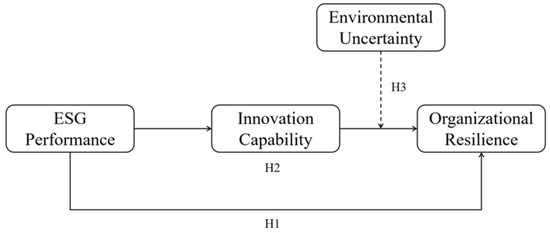
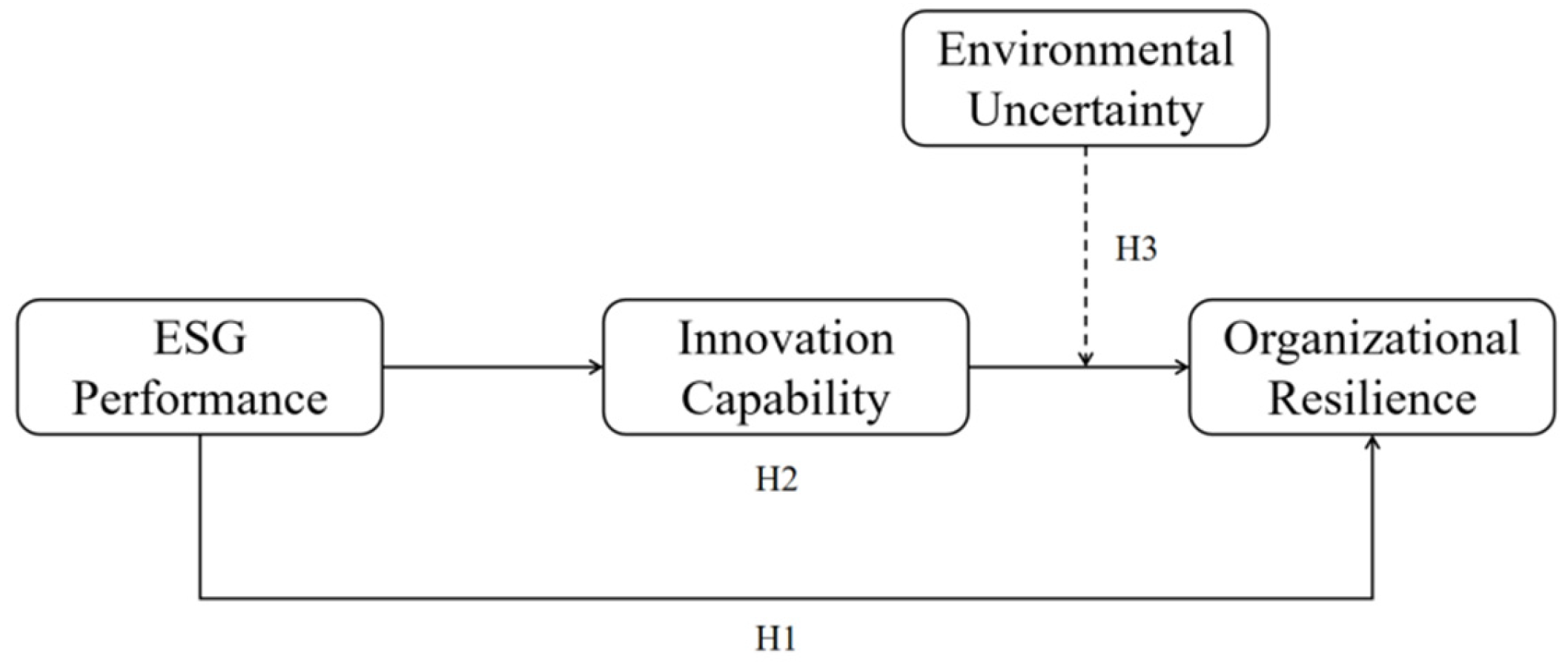
The conceptual framework that integrates the direct effect of ESG performance on organizational resilience (H1), the mediating role of innovation capability (H2) and the moderating effect of environmental uncertainty (H3) is presented in Figure 1.
Figure 1.
Conceptual framework.
3. Methodology
3.1. Sample Selection and Data Source
The sample consists of non-financial firms listed on the Shanghai and Shenzhen A-share markets from 2014 to 2022. The starting year reflects the point from which Huazheng ESG ratings for Chinese listed firms are available in a consistent format, while the end year covers recent shocks, including trade frictions and the COVID-19 pandemic, that are important for observing resilience dynamics among Chinese listed firms [53]. Following common practice in studies on Chinese listed firms, financial institutions are excluded because of their specific regulatory regimes and balance sheet structures, firms labeled ST or *ST are removed because they face trading restrictions and restructuring risk, and firm-year observations with missing values for key variables are dropped [44]. To limit the influence of extreme values, all continuous variables are winsorized at the 1st and 99th percentiles by year.
ESG data are obtained from the Huazheng ESG rating system. Huazheng is one of the most widely used ESG rating providers in the Chinese market and is frequently employed in recent empirical research on Chinese listed firms [54]. Firm-level financial information and innovation data, including R&D expenditure and the accounting items used to construct the resilience index and control variables, are obtained from the CSMAR and RESSET databases, which are standard data sources in capital-market research in China. Environmental uncertainty is constructed from firms’ historical operating revenue and then adjusted at the industry level. After applying all screening criteria, the final unbalanced panel comprises 1037 firms and 9315 firm-year observations, covering a wide range of industries and both state-owned and privately controlled enterprises.
3.2. Variables
3.2.1. Organizational Resilience
The dependent variable is organizational resilience (OR), defined as a firm’s ability to withstand shocks, adapt through resource reconfiguration, and recover while sustaining development after adversity [3]. Following Sheng and Li [55], we construct a three-tier indicator system covering three dimensions: risk resistance capacity, adaptability and adjustment capacity, and recovery and transcendence capacity. Specifically, the index captures firms’ resource endowment and risk prevention conditions, adjustment and resource reallocation capacity, and post-shock recovery and development potential. The detailed indicator system is reported in Table 1. All indicators are first aligned so that higher values consistently indicate stronger resilience and are then normalized. OR is then constructed using an entropy-weighted TOPSIS approach, which combines an objective weighting procedure with a distance-based composite evaluation method.
Table 1.
Organizational resilience index system.
Under entropy weighting, an indicator receives a higher weight when it provides stronger cross-sectional discrimination in the sample [56]. Indicators with limited variation contribute less information for distinguishing firms and therefore receive lower weights. Thus, the entropy weight reflects an indicator’s relative information content rather than its theoretical importance. As shown in Table 1, fixed assets (0.163), intangible assets (0.147), market share (0.125), employee compensation incentives (0.119), government subsidy amount (0.111), and fixed asset turnover rate (0.108) receive relatively high weights, whereas net profit growth rate (0.002), debt-to-asset ratio (0.010), capital preservation and appreciation rate (0.013), and total asset growth rate (0.015) receive relatively low weights. At the dimension level, risk resistance capacity accounts for 0.605 of the composite index, adaptability and adjustment capacity for 0.347, and recovery and transcendence capacity for 0.048, indicating that the OR measure is driven mainly by variation in firms’ resource base and adjustment capacity rather than by post-shock growth indicators alone. TOPSIS then evaluates each firm-year observation by its relative closeness to the ideal solution and distance from the negative ideal solution [57]. The resulting OR index ranges from 0 to 1, with higher values indicating stronger organizational resilience.
3.2.2. ESG Performance
The main independent variable is ESG performance (ESG). We use Huazheng ESG ratings, which evaluate firms annually on environmental, social and governance dimensions using an indicator system tailored to the Chinese institutional environment. Huazheng assigns nine letter grades from AAA to C. Following recent ESG studies on Chinese listed firms that use Huazheng data, the ratings are converted into numerical scores by mapping AAA to 9, AA to 8, and so on down to C as 1, so that a higher score reflects better ESG performance [54]. For firms that receive multiple assessments within a year, the annual average ESG score is used.
3.2.3. Innovation Capability
Innovation capability (Inno) is the mediating variable. It is proxied by R&D intensity, measured as annual R&D expenditure divided by operating revenue. This input-based ratio is widely used in firm-level innovation research and captures the intensity of resources committed to innovation relative to firm scale. It is also appropriate in the Chinese listed firm context, where recent research examines corporate innovation from the perspective of innovation input intensity, output quantity, and output quality [58]. Compared with patent-based measures, this indicator is more suitable for capturing year-to-year variation in firms’ innovation commitment and is less affected by cross-industry differences in patenting propensity.
3.2.4. Environmental Uncertainty
Environmental uncertainty (EU) is modeled as an external contextual variable that conditions the effect of innovation capability on organizational resilience. In this sense, EU is introduced as a moderator rather than as an independent source of firm heterogeneity; any subsequent presentation across different uncertainty levels serves only to illustrate the same moderating relationship. Following Ghosh and Olsen [59], EU is measured using an industry-adjusted revenue volatility approach. Specifically, for each firm-year, operating revenue over the previous five years is regressed on a time trend, and the standard deviation of the residuals is divided by mean revenue over the same period to obtain a detrended coefficient of variation. This firm-level measure is then scaled by the corresponding industry average in the same year. Higher values indicate greater environmental uncertainty.
3.2.5. Control Variables
We include a set of control variables that are standard in empirical studies on Chinese listed firms’ performance, risk and resilience, in order to capture other firm-level factors that may influence resilience [44]. These variables control for ownership structure, firm size, capital structure, asset composition, growth opportunities, managerial input and governance. Specifically, we control for ownership nature (Soe), firm size (Size), capital intensity (Density), fixed asset ratio (Fixed), book-to-market ratio (BM), management expense ratio (Mfee), board size (Board) and whether directors, supervisors and senior executives have overseas experience (OverseaBack). Year dummies and industry dummies are included to absorb macroeconomic shocks and industry-specific trends. Variable definitions are summarized in Table 2.
Table 2.
Variable Definitions.
3.3. Empirical Models
To test the hypotheses, we estimate linear regressions using firm-year panel data with year fixed effects and industry fixed effects. This specification controls for common macro shocks affecting all firms in a given year and for time-invariant industry-level differences that may shape ESG performance, innovation capability, and organizational resilience. Given that the empirical analyses include a rich set of firm-level controls, this specification is appropriate for examining the relationships of interest while reducing omitted-variable bias from common temporal and sectoral factors [60]. Standard errors are clustered at the firm level to account for heteroskedasticity and serial correlation.
The baseline model examines the direct effect of ESG performance on organizational resilience (H1):
where is the resilience index of firm in year , is ESG performance, is the vector of control variables, represents firm fixed effects, represents year fixed effects and is the error term. A significantly positive is consistent with H1.
To test the mediating role of innovation capability (H2), we follow the widely adopted causal step and indirect effect framework. First, we estimate the effect of ESG on the mediator:
Second, we include both ESG and Inno in the resilience equation:
Mediation is supported if ESG significantly predicts innovation capability ( > 0), innovation capability significantly predicts resilience while controlling for ESG ( > 0), and the absolute value of is smaller than that of in the baseline model. The significance of the indirect effect from ESG to OR through Inno is assessed using Sobel-type tests [61].
To examine whether environmental uncertainty strengthens the effect of innovation capability on resilience (H3), we estimate the following moderation model:
Innovation capability and environmental uncertainty are mean-centered before constructing the interaction term in order to reduce multicollinearity and to facilitate interpretation of the main effects. The coefficient of interest is . A significantly positive indicates that the contribution of innovation capability to organizational resilience increases with higher environmental uncertainty, which is consistent with H3.
To address the potential endogeneity of ESG performance, we conduct additional analyses using lagged ESG variables and an instrumental-variable approach. In the IV specification, the average ESG score of other firms in the same province and year, excluding the focal firm, is used as an instrument. ESG practices in China exhibit regional clustering and peer effects, which supports the relevance of this peer-based instrument. In the 2SLS estimation, we further include province-by-year fixed effects to absorb time-varying regional shocks that may affect both ESG performance and organizational resilience. Instrument relevance and identification strength are evaluated using the Kleibergen–Paap rk LM statistic and Kleibergen–Paap Wald rk F statistic. In addition, the main results are re-estimated under alternative variable definitions and model specifications to assess robustness.
4. Analysis and Results
4.1. Descriptive Statistics and Correlation Analysis
Table 3 reports the descriptive statistics for all variables. The sample contains 9315 firm-year observations. Organizational resilience (OR) has a mean of 0.113, a median of 0.085, and a standard deviation of 0.087, with values ranging from 0.035 to 0.533, indicating substantial variation in resilience across firms. ESG performance (ESG) has a mean of 4.147 and ranges from 1.250 to 6.250, suggesting considerable heterogeneity in firms’ sustainability performance. Innovation capability (Inno) has a mean of 0.040 and a maximum of 0.239, implying that while the average level of R&D intensity is relatively modest, some firms invest heavily in innovation. Industry-adjusted environmental uncertainty (EU) has a mean of 1.215, a median of 0.920, and a wide range from 0.129 to 6.405, indicating marked differences in the external environments faced by sample firms. In addition, 39.3% of the observations are state-owned enterprises, the average firm size is 22.696, and the mean fixed asset ratio is 0.215, suggesting that the sample mainly consists of relatively large listed firms with moderate asset intensity.
Table 3.
Descriptive statistics.
Table 4 reports the Pearson correlations among the main variables. OR is positively correlated with ESG (r = 0.254, p < 0.01), providing preliminary support for H1. By contrast, OR is negatively correlated with Inno (r = −0.073, p < 0.01) and EU (r = −0.042, p < 0.01), suggesting that the unconditional association between innovation capability, environmental uncertainty, and organizational resilience differs from the corresponding multivariate results once firm characteristics and fixed effects are taken into account. ESG is weakly and insignificantly correlated with Inno (r = 0.005), while it is negatively correlated with EU (r = −0.193, p < 0.01), indicating that firms with stronger ESG performance tend to face relatively lower environmental uncertainty. Among the control variables, the largest correlation among the explanatory variables is between Size and BM (r = 0.604), followed by the correlation between Inno and Mfee (r = 0.479), both well below the conventional threshold of 0.700. This suggests that multicollinearity is unlikely to pose a serious concern in the subsequent regressions. Overall, the pairwise correlations are broadly informative, but multivariate analysis is still needed to identify the net effects of ESG, Inno, and EU on organizational resilience.
Table 4.
Correlation matrix.
4.2. Baseline Regression
Table 5 reports the baseline regression results for the effect of ESG on OR. Columns (1)–(4) progressively incorporate year and industry fixed effects, with Column (2) controlling for year fixed effects, Column (3) controlling for industry fixed effects, and Column (4) including both. Across all specifications, ESG remains positively and significantly associated with OR, and the estimated coefficient ranges from 0.001 to 0.003, indicating that the positive effect of ESG is robust to alternative model settings. In the preferred specification with the full set of controls and both year and industry fixed effects (Column 4), the coefficient on ESG is 0.003 (t = 4.20), providing strong support for H1.
Table 5.
Regression results of ESG performance on organizational resilience.
Regarding the control variables, firm size is consistently positive and highly significant, suggesting that larger firms exhibit stronger resilience. By contrast, Density, Fixed, and BM are significantly negative in most specifications, implying that firms with heavier asset structures or higher book-to-market characteristics tend to have lower resilience. Mfee and OverseaBack are significantly positive across all columns, indicating that management expense intensity and executives’ overseas background are positively associated with organizational resilience. The coefficient on Soe is not robust across specifications, and Board remains statistically insignificant throughout. The explanatory power of the model improves after fixed effects are introduced, with R2 increasing from 0.530 in Column (1) to 0.567 in Column (4), further confirming the robustness of the baseline results.
4.3. Mediating Role of Innovation Capability
Table 6 reports the mediating effect of innovation capability (Inno) on the relationship between ESG and OR. Column (1) presents the baseline regression of ESG on OR. Column (2) examines the effect of ESG on Inno. Column (3) further includes Inno in the regression of OR. The results show that ESG is positively and significantly associated with OR in Column (1). In Column (2), ESG has a significantly positive effect on Inno, indicating that firms with better ESG performance exhibit stronger innovation capability. In Column (3), Inno is positively and significantly related to OR, while the coefficient on ESG remains positive and significant but declines from 0.003 to 0.002 after Inno is included. This pattern suggests that innovation capability partially mediates the effect of ESG on OR. The Sobel–Goodman mediation tests further support this inference. Overall, the results support H2 and indicate that ESG performance enhances organizational resilience partly through improving firms’ innovation capability.
Table 6.
Mediation analysis of innovation capability.
4.4. Moderating Role of Environmental Uncertainty
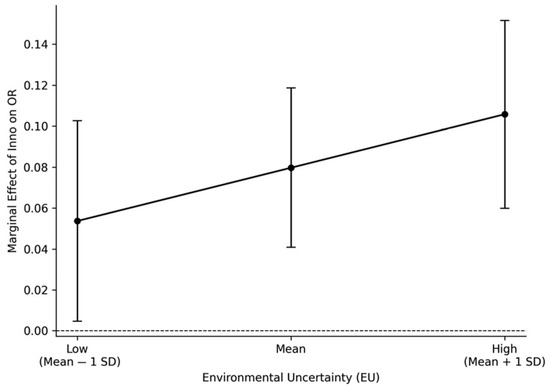
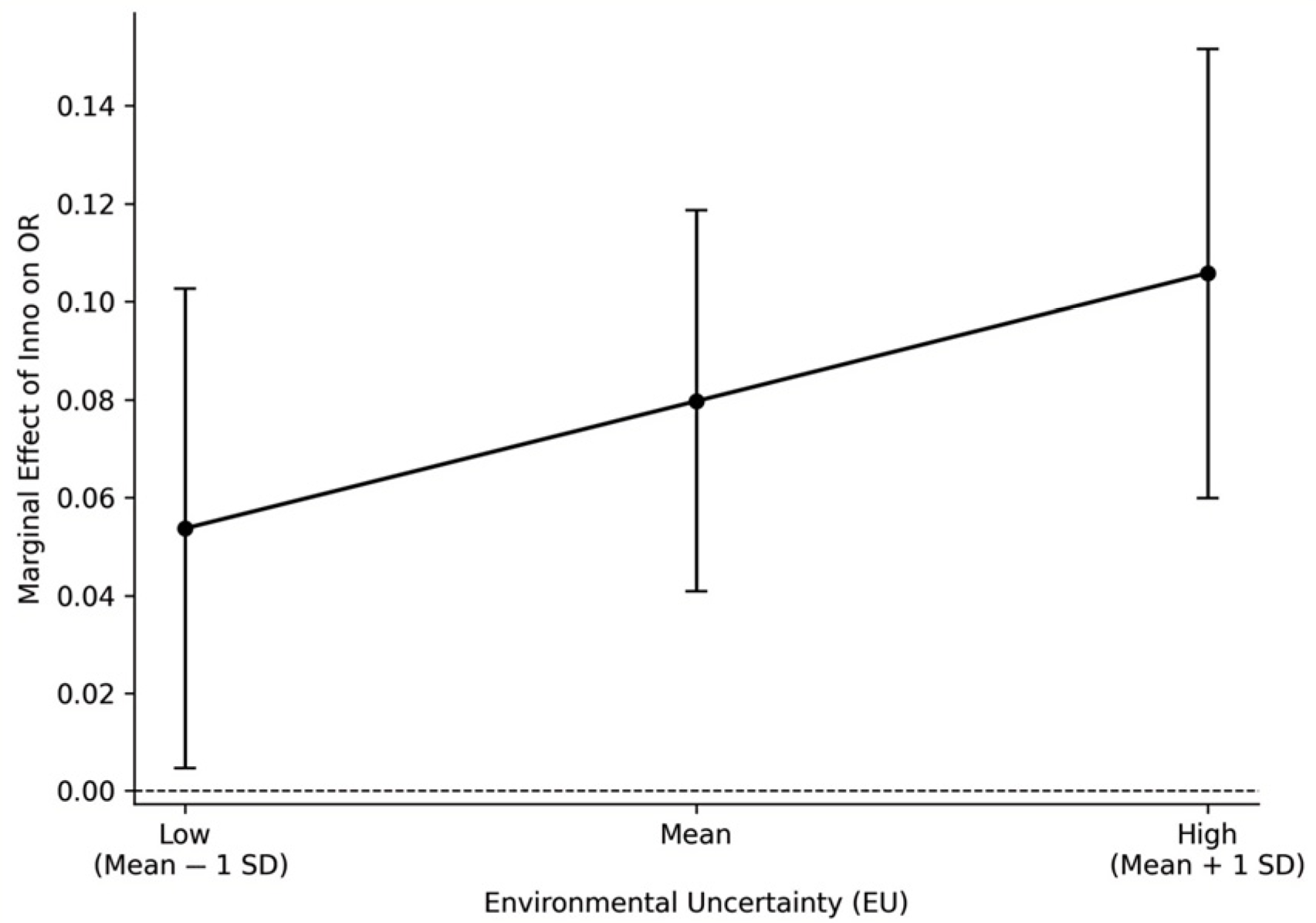
Table 7 reports the moderating effect of environmental uncertainty (EU) on the relationship between Inno and OR. Columns (1) and (2) regress OR on Inno, industry-adjusted EU, and the full set of controls, with Column (2) further including the interaction term between Inno and EU. Both Inno and EU are mean-centered before constructing the interaction term. Inno is positively and significantly associated with OR in both columns, indicating that stronger innovation capability enhances firm resilience. EU also enters positively and significantly. More importantly, the interaction term is positive and significant at the 10% level, suggesting that EU strengthens the positive effect of Inno on OR. Given the relatively weak statistical significance of the interaction term, to further assess its economic significance, Figure 2 presents a simple slope analysis. The marginal effect of Inno on organizational resilience rises from 0.054 at low EU to 0.080 at mean EU and 0.106 at high EU, and remains statistically significant across all three levels. This pattern indicates that innovation capability generates greater resilience gains in more uncertain environments. Overall, the evidence provides cautious support for H3.
Table 7.
Moderating effect of environmental uncertainty on the innovation–resilience relationship.
Figure 2.
Marginal effect of innovation capability on organizational resilience at different levels of environmental uncertainty.
4.5. Robustness and Endogeneity Checks
To address potential endogeneity, Table 8 reports 2SLS estimates using ESG-iv, defined as the average ESG score of other firms in the same province and year, excluding the focal firm, as an instrument for ESG. This instrument is relevant because ESG practices in China exhibit regional clustering and peer effects, making neighboring firms’ ESG performance strongly correlated with the focal firm’s ESG. Its exogeneity is also plausible because the regressions control for firm-level covariates, year fixed effects, industry fixed effects, and province × year fixed effects, which absorb common regional shocks and institutional conditions. The first-stage results confirm strong relevance: ESG-iv is positively associated with ESG (coefficient = 0.770, t = 60.270), and the Kleibergen–Paap rk LM and Wald rk F statistics indicate no underidentification or weak-instrument problem. In the second stage, the fitted value of ESG remains positively and significantly associated with organizational resilience (coefficient = 0.004, t = 2.760), with control variables showing patterns broadly consistent with the baseline regressions. Overall, the 2SLS results provide further support for H1.
Table 8.
Instrumental-variable (2SLS) regression results.
Table 9 reports a series of additional robustness checks. Columns (1)–(5) examine the robustness of the baseline ESG–organizational resilience relationship under alternative measures and specifications. Specifically, Column (1) reconstructs the organizational resilience index after excluding four indicators that are more closely related to post-shock performance growth, namely rebound gross profit margin, net profit growth rate, total asset growth rate, and capital preservation and appreciation rate. The ESG coefficient remains positive and significant, indicating that the baseline findings are not mechanically driven by profitability- or growth-related components embedded in the resilience measure. Column (2) replaces the baseline ESG measure with the Wind ESG composite score, and the positive effect remains robust. Column (3) further introduces industry-by-year fixed effects to absorb time-varying sector-specific shocks, and ESG continues to be positively associated with organizational resilience. Columns (4) and (5) replace contemporaneous ESG with its one-period and two-period lags, respectively. In both cases, the lagged ESG coefficients remain positive and statistically significant, with coefficients of 0.002 and 0.002, respectively, which helps alleviate concerns about reverse causality. Columns (6) and (7) provide supplementary evidence on the innovation–resilience relationship under different macro-policy environments. Economic policy uncertainty is measured as the arithmetic average of the monthly economic policy uncertainty index within each year and scaled by 1/100, and the sample is divided accordingly into lower- and higher-uncertainty subsamples. Inno remains positively associated with organizational resilience across these subsamples, indicating that the positive role of innovation capability is preserved under different macro-policy conditions. Taken together, the results in Table 9 reinforce the robustness of the main conclusions.
Table 9.
Robustness checks with alternative measures and specifications.
4.6. Heterogeneity Tests
4.6.1. Ownership Type
China’s mixed-ownership structure suggests that the resilience effect of ESG may vary by ownership type. Prior research shows that the economic consequences of CSR in China differ systematically between SOEs and non-SOEs, indicating that ownership is an important conditioning factor in the CSR/ESG–performance relationship [62]. To examine this heterogeneity, we re-estimate the baseline model separately for SOEs and non-SOEs. As reported in Table 10, ESG is positively and significantly associated with organizational resilience in both subsamples. However, the coefficient is larger for SOEs than for non-SOEs. Specifically, the ESG coefficient is 0.004 (t = 2.800) for SOEs and 0.002 (t = 2.930) for non-SOEs, indicating that ESG contributes to organizational resilience across ownership types but has a stronger effect in state-owned firms. This pattern is consistent with the institutional setting in China, where state ownership is more closely tied to CSR-related disclosure, administrative expectations, and external scrutiny. Overall, the results indicate that the resilience effect of ESG is more pronounced in SOEs.
Table 10.
Heterogeneity analysis by ownership type.
4.6.2. Firm Size
Firm size may condition how ESG performance translates into organizational resilience. Large firms typically possess greater resource slack and more formalized CSR disclosure arrangements, whereas SMEs are more vulnerable to external shocks and may therefore obtain greater marginal resilience gains from ESG engagement [63]. To examine this heterogeneity, we split the sample into large firms and SMEs based on the sample median of total assets and re-estimate the baseline model for each subsample. As reported in Table 11, ESG is positively and significantly associated with organizational resilience in both groups, but the coefficient is substantially larger for SMEs than for large firms. Specifically, the ESG coefficient is 0.003 (t = 6.280) for large firms and 0.023 (t = 15.930) for SMEs, indicating that ESG contributes to resilience across firm sizes but its effect is markedly stronger among smaller firms. This result suggests that ESG serves as a more important resilience-enhancing mechanism for SMEs, which are more dependent on external legitimacy, stakeholder support, and adaptive capacity when facing adverse shocks.
Table 11.
Heterogeneity analysis by firm size.
5. Discussion
5.1. The Impact of ESG Performance on Organizational Resilience
The main result of this study is that ESG performance has a stable positive effect on organizational resilience. The positive coefficient remains after the progressive inclusion of year and industry fixed effects, after alternative measurement strategies, after dynamic specifications, and after instrumental-variable estimation (see Table 5, Table 8 and Table 9). This pattern is important because it rules out several narrower interpretations of the baseline finding. The positive ESG coefficient is not reducible to a single rating source, to a particular empirical specification, or to a resilience index that mechanically embeds short-term profitability growth. The result therefore points to a more substantive organizational relationship between ESG and firms’ ability to remain functional, adaptive, and developmentally viable under adverse conditions.
This result extends the meaning of ESG in the corporate literature. Much of the existing work has emphasized valuation effects, financing conditions, disclosure outcomes, or investor reactions. By contrast, the present study shifts attention to whether ESG is associated with a deeper organizational outcome, namely resilience. That shift is analytically important because resilience captures the firm’s capacity to absorb disruption, reconfigure resources, and sustain operations under stress. In this sense, ESG is not only an external reporting signal. It also reflects a set of governance, coordination, and strategic arrangements that can shape how firms respond when constraints tighten. This interpretation is supported by evidence that carbon risk is priced in financial markets, that mandatory CSR and sustainability reporting reshape firms’ information environments and incentives, and that ESG ratings themselves diverge across providers, making robustness across alternative ESG measures especially important [12,22,64,65].
5.2. Innovation Capability and the Role of Environmental Uncertainty
The mechanism analysis clarifies how ESG is translated into organizational resilience. When innovation capability is introduced into the model, ESG remains positive and significant, but its coefficient declines, and the Sobel–Goodman tests confirm a statistically significant indirect effect (see Table 6). The implication is that ESG contributes to organizational resilience partly by strengthening firms’ innovation capability. This result matters theoretically because it opens the black box of the ESG effect. ESG is not only associated with stronger governance discipline or broader stakeholder recognition. It also appears to support the firm’s capacity to invest, learn, and adjust, which are central ingredients of resilient organizational action.
The moderating analysis adds a second layer to this mechanism. Environmental uncertainty raises the marginal contribution of innovation capability to organizational resilience, and the slope analysis shows a clear increase in that marginal effect from low- to medium- to high-uncertainty environments (see Table 7 and Figure 2). At the same time, the interaction term is significant only at the 10% level, so the result should be interpreted as a cautious boundary-condition finding rather than as a strong stand-alone effect. What the evidence supports is a contingent logic: innovation capability becomes more valuable for organizational resilience when firms operate in more volatile environments. This point is conceptually important because it distinguishes environmental uncertainty from firm-type heterogeneity. In this study, uncertainty does not function as a separate classification device. It functions as an external condition that changes the resilience payoff to innovation. Recent research offers a coherent backdrop for this interpretation by showing that ESG can promote corporate technological innovation, that the returns to green innovation vary with environmental uncertainty, and that resilient action under adversity depends fundamentally on resourcefulness and adaptive recombination [58,66,67]. Evidence that ESG ratings can stimulate low-carbon investment through financing and governance channels further reinforces the view that ESG can shape the organizational conditions under which innovation becomes feasible and valuable [68].
5.3. Ownership, Firm Size, and the Conditional Value of ESG
The heterogeneity analysis shows that the resilience effect of ESG is conditional rather than uniform. By ownership type, the positive effect of ESG is stronger in state-owned enterprises than in non-state-owned enterprises (see Table 10). By firm size, the positive effect of ESG is substantially stronger in small and medium-sized firms than in large firms (see Table 11). These two results are analytically complementary. Together, they indicate that the organizational consequences of ESG depend on both institutional embedding and resource position.
The ownership result points to the role of institutional embedding. In the Chinese context, ESG practices in SOEs are more likely to be connected to formal governance arrangements, public accountability, and administrative expectations. Under these conditions, ESG is more readily translated into resilience-related organizational outcomes. The size result points to a different mechanism. SMEs face tighter resource constraints and possess fewer internal buffers, so ESG can have a larger marginal effect by strengthening stakeholder confidence, supporting access to external resources, and improving adaptive discipline under stress. The significance of these findings lies in their combination. ESG creates greater resilience gains either where institutional transmission is stronger or where the marginal value of adaptive and relational resources is higher. Prior research has shown that the CSR–performance relationship in China differs by ownership type and that the performance consequences of CSR disclosure can vary by firm size [62,63]. The present study extends that line of inquiry by showing that the same conditionality applies to organizational resilience, which is a more fundamental outcome than short-term performance because it concerns whether firms remain adaptive and operationally viable when disruption occurs.
6. Conclusions
6.1. Conclusions
Using panel data on Chinese A-share listed firms from 2014 to 2022, this study examines whether ESG performance contributes to organizational resilience, how that effect operates, and under what conditions it becomes stronger. Three conclusions emerge from the analysis. First, ESG performance has a robust positive effect on organizational resilience. This result survives alternative specifications, alternative measures, lagged ESG tests, the exclusion of pure performance growth indicators from the resilience index, and instrumental-variable estimation. The empirical pattern therefore supports an interpretation of ESG as a substantive organizational capability rather than a narrow reputational or measurement artifact.
Second, innovation capability carries part of the ESG effect. ESG strengthens organizational resilience not only directly but also indirectly by improving firms’ innovation capability. This result identifies a concrete transmission channel and shows that capability formation is central to understanding how ESG becomes economically meaningful inside the firm. Third, the ESG effect is contingent. Environmental uncertainty increases the resilience return to innovation capability, while ownership type and firm size shape the strength of the ESG effect itself. The stronger effect in SOEs highlights the role of institutional embedding, and the stronger effect in SMEs highlights the role of marginal resource value. Taken together, these findings show that ESG should be understood not as a uniform premium attached to sustainability, but as an organizational capability whose consequences depend on internal mechanisms and external conditions.
6.2. Implications
The managerial implication is that ESG should not be treated as a peripheral reporting exercise. Its value depends on the extent to which it is embedded in governance structures, innovation priorities, and resource allocation routines. Firms are more likely to derive resilience benefits from ESG when sustainability objectives shape internal coordination, long-horizon investment, and the ability to reconfigure under pressure. This point is especially salient in uncertain environments, where innovation capability becomes more valuable for organizational resilience. The heterogeneity results sharpen this implication further. For SMEs, ESG can serve as a practical mechanism for strengthening stakeholder trust and adaptive capacity under tighter constraints. For SOEs, ESG appears most consequential when it is integrated into accountability systems and strategic governance processes.
The policy implications are equally clear. Reporting and disclosure frameworks do more than enhance transparency. They also influence firms’ information environments and managerial incentives, which affects how sustainability issues are internalized in organizational decision-making [67]. Carbon risk is already reflected in investor pricing [64], green financing instruments shape the allocation of capital to sustainability-oriented projects [69], and environmental credit constraints can alter corporate behavior through regulatory and financing channels [70]. The present findings add that these institutional arrangements also matter for organizational resilience because they affect whether firms sustain adaptive capacity when external conditions deteriorate. A broader implication concerns value chain governance. Environmental responsibility and sustainability pressure increasingly diffuse through production networks rather than remaining confined within individual firms, which makes interfirm coordination more relevant for resilience-oriented corporate strategy [71,72].
6.3. Limitations and Future Research
Several limitations should be acknowledged. First, although the organizational resilience index captures multiple dimensions of resistance, adjustment, and recovery, it remains a composite measure based on observable firm characteristics and outcomes. It cannot fully reflect softer foundations of resilience, such as leadership quality, organizational culture, informal coordination, or managerial cognition. Future research may combine archival data with survey, interview, or case-based evidence to examine these dimensions more directly.
Second, while the empirical design addresses endogeneity through instrumental variables, lag structures, and multiple robustness tests, the study remains observational. Future work may exploit ESG-related policy reforms, mandatory disclosure changes, or localized environmental shocks in China to strengthen causal identification. Third, environmental uncertainty is measured here as an industry-adjusted revenue volatility indicator. Although this choice is suitable for capturing differences in external operating volatility, future research may further distinguish external uncertainty from firm-specific instability by incorporating macroeconomic policy uncertainty, sector-level demand shocks, or input price volatility. Finally, innovation capability explains only part of the ESG effect. Other channels, including financing access, internal controls, human capital allocation, digital upgrading, and supply-chain structure, remain important directions for future research in the Chinese context and in comparative studies across institutional settings.
Author Contributions
Conceptualization, J.Y.; methodology, J.W. (Jinglu Wang); software, J.W. (Jinglu Wang); validation, J.W. (Jinxiao Wang); formal analysis, J.W. (Jinglu Wang); investigation, J.W. (Jinxiao Wang); resources, J.Y.; data curation, J.W. (Jinxiao Wang); writing—original draft preparation, J.W. (Jinglu Wang); writing—review and editing, J.Y. and J.W. (Jinxiao Wang); visualization, J.W. (Jinxiao Wang); supervision, J.Y.; project administration, J.Y.; funding acquisition, J.Y. All authors have read and agreed to the published version of the manuscript.
Funding
This research was funded by the National Social Science Fund of China (20BMZ128).
Institutional Review Board Statement
Not applicable.
Informed Consent Statement
Not applicable.
Data Availability Statement
The data presented in this study are available upon request from the corresponding author.
Conflicts of Interest
The authors declare no conflicts of interest.
References
- Linnenluecke, M.K. Resilience in business and management research: A review of influential publications and a research agenda. Int. J. Manag. Rev. 2017, 19, 4–30. [Google Scholar] [CrossRef] [Scilit]
- Hillmann, J.; Guenther, E. Organizational resilience: A valuable construct for management research? Int. J. Manag. Rev. 2021, 23, 7–44. [Google Scholar] [CrossRef] [Scilit]
- Duchek, S. Organizational resilience: A capability-based conceptualization. Bus. Res. 2020, 13, 215–246. [Google Scholar] [CrossRef] [Scilit]
- Conz, E.; Magnani, G. A dynamic perspective on the resilience of firms: A systematic literature review and a framework for future research. Eur. Manag. J. 2020, 38, 400–412. [Google Scholar] [CrossRef] [Scilit]
- Linnenluecke, M.K. Environmental, social and governance (ESG) performance in the context of multinational business research. Multinatl. Bus. Rev. 2022, 30, 1–16. [Google Scholar] [CrossRef] [Scilit]
- Khan, M.A. ESG disclosure and firm performance: A bibliometric and meta analysis. Res. Int. Bus. Financ. 2022, 61, 101668. [Google Scholar] [CrossRef] [Scilit]
- Shen, H.; Lin, H.; Han, W.; Wu, H. ESG in China: A review of practice and research, and future research avenues. China J. Account. Res. 2023, 16, 100325. [Google Scholar] [CrossRef] [Scilit]
- Albuquerque, R.; Koskinen, Y.; Yang, S.; Zhang, C. Resiliency of environmental and social stocks: An analysis of the exogenous COVID-19 market crash. Rev. Corp. Financ. Stud. 2020, 9, 593–621. [Google Scholar] [CrossRef] [Scilit]
- Broadstock, D.C.; Chan, K.; Cheng, L.T.; Wang, X. The role of ESG performance during times of financial crisis: Evidence from COVID-19 in China. Financ. Res. Lett. 2021, 38, 101716. [Google Scholar] [CrossRef] [Scilit]
- Cardillo, G.; Bendinelli, E.; Torluccio, G. COVID-19, ESG investing, and the resilience of more sustainable stocks: Evidence from European firms. Bus. Strategy Environ. 2023, 32, 602–623. [Google Scholar] [CrossRef] [Scilit]
- Xu, N.; Chen, J.; Zhou, F.; Dong, Q.; He, Z. Corporate ESG and resilience of stock prices in the context of the COVID-19 pandemic in China. Pac.-Basin Financ. J. 2023, 79, 102040. [Google Scholar] [CrossRef] [Scilit]
- Gianfrate, G.; Rubin, M.; Ruzzi, D.; van Dijk, M. On the resilience of ESG firms during the COVID-19 crisis: Evidence across countries and asset classes. J. Int. Bus. Stud. 2024, 55, 1069–1084. [Google Scholar] [CrossRef] [Scilit]
- DesJardine, M.; Bansal, P.; Yang, Y. Bouncing back: Building resilience through social and environmental practices in the context of the 2008 global financial crisis. J. Manag. 2019, 45, 1434–1460. [Google Scholar]
- Teece, D.J. Business models and dynamic capabilities. Long Range Plan. 2018, 51, 40–49. [Google Scholar] [CrossRef] [Scilit]
- Bridoux, F.; Stoelhorst, J.W. Stakeholder theory, strategy, and organization: Past, present, and future. Strateg. Organ. 2022, 20, 797–809. [Google Scholar] [CrossRef] [Scilit]
- Valentinov, V. Stakeholder theory: Toward a classical institutional economics perspective. J. Bus. Ethics 2023, 188, 75–88. [Google Scholar]
- Huang, J.; Hu, P.; Wang, D.D.; Wang, Y. The double signal of ESG reports: Readability, growth, and institutional influence on firm value. Sustainability 2025, 17, 2514. [Google Scholar] [CrossRef] [Scilit]
- Kafetzopoulos, D.; Psomas, E.; Skalkos, D. Innovation dimensions and business performance under environmental uncertainty. Eur. J. Innov. Manag. 2020, 23, 856–876. [Google Scholar] [CrossRef] [Scilit]
- Al Dhaheri, M.H.; Ahmad, S.Z.; Papastathopoulos, A. Do environmental turbulence, dynamic capabilities and artificial intelligence force SMEs to be innovative? J. Innov. Knowl. 2024, 9, 100528. [Google Scholar] [CrossRef] [Scilit]
- Lu, C.; Wu, C.; Feng, L.; Zhan, J.; Shi, Y.; Chen, H. Does ESG performance enhance corporate green technological innovation? Micro evidence from Chinese-listed companies. Sustainability 2025, 17, 636. [Google Scholar] [CrossRef] [Scilit]
- Chen, X.; Song, Y.; Hu, X.; Sun, G. Sustainability uncertainty and digital transformation: Evidence from corporate ESG rating divergence in China. Sustainability 2025, 17, 6515. [Google Scholar] [CrossRef] [Scilit]
- Berg, F.; Kölbel, J.F.; Rigobon, R. Aggregate confusion: The divergence of ESG ratings. Rev. Financ. 2022, 26, 1315–1344. [Google Scholar] [CrossRef] [Scilit]
- Ling, S.; Xia, H.; Liu, Z. ESG rating divergence and audit fees: Evidence from China. Financ. Res. Lett. 2024, 67, 105749. [Google Scholar] [CrossRef] [Scilit]
- Kathan, M.C.; Utz, S.; Dorfleitner, G.; Eckberg, J.; Chmel, L. What you see is not what you get: ESG scores and greenwashing risk. Financ. Res. Lett. 2025, 74, 106710. [Google Scholar] [CrossRef] [Scilit]
- Luo, D.; Yan, J.; Yan, Q. The duality of ESG: Impact of ratings and disagreement on stock crash risk in China. Financ. Res. Lett. 2023, 58, 104479. [Google Scholar] [CrossRef] [Scilit]
- Sun, G.; Hu, X.; Chen, X.; Xiao, J. Sustainability uncertainty and supply chain financing: A perspective based on divergent ESG evaluations in China. Systems 2025, 13, 850. [Google Scholar] [CrossRef] [Scilit]
- Ilseven, E.; Puranam, P. Measuring organizational resilience as a performance outcome. J. Organ. Des. 2021, 10, 127–137. [Google Scholar] [CrossRef] [Scilit]
- Su, W.; Junge, S. Unlocking the recipe for organizational resilience: A review and future research directions. Eur. Manag. J. 2023, 41, 1086–1105. [Google Scholar] [CrossRef] [Scilit]
- Weber, M.M.; Pedell, B.; Rötzel, P.G. Resilience-oriented management control systems: A systematic review of the relationships between organizational resilience and management control systems. J. Manag. Control 2024, 35, 563–620. [Google Scholar] [CrossRef] [Scilit]
- Fiordelisi, F.; Galloppo, G.; Lattanzio, G. Where does corporate social capital matter the most? Evidence from the COVID-19 crisis. Financ. Res. Lett. 2022, 47, 102538. [Google Scholar] [CrossRef] [Scilit]
- Luo, W.; Yu, Y.; Cao, X.; Deng, M. The impact of ESG performance on organizational resilience: Evidence from China. Corp. Soc. Responsib. Environ. Manag. 2025, 32, 6807–6830. [Google Scholar] [CrossRef] [Scilit]
- Walker, T.; Fernandes, A.; Karami, M. Corporate resilience during crises and the role of ESG factors: Evidence from the COVID-19 pandemic. Financ. Res. Lett. 2024, 69, 106168. [Google Scholar] [CrossRef] [Scilit]
- Hossain, A.T.; Masum, A.-A. Does corporate social responsibility help mitigate firm-level climate change risk? Financ. Res. Lett. 2022, 47, 102791. [Google Scholar] [CrossRef] [Scilit]
- Lv, W.D.; Tian, D.; Wei, Y.; Xi, R.X. Innovation resilience: A new approach for managing uncertainties concerned with sustainable innovation. Sustainability 2018, 10, 3641. [Google Scholar] [CrossRef] [Scilit]
- Do, H.; Budhwar, P.; Shipton, H.; Nguyen, H.D.; Nguyen, B. Building organizational resilience, innovation through resource-based management initiatives, organizational learning and environmental dynamism. J. Bus. Res. 2022, 141, 808–821. [Google Scholar] [CrossRef] [Scilit]
- Awad, J.A.; Martín-Rojas, R. Digital transformation influence on organisational resilience through organisational learning and innovation. J. Innov. Entrep. 2024, 13, 69. [Google Scholar] [CrossRef] [Scilit]
- Garrido-Moreno, A.; Martín-Rojas, R.; García-Morales, V.J. The key role of innovation and organizational resilience in improving business performance: A mixed-methods approach. Int. J. Inf. Manag. 2024, 77, 102777. [Google Scholar] [CrossRef] [Scilit]
- Sun, X.; Xiong, X. ESG performance and corporate innovation. Res. Int. Bus. Financ. 2025, 76, 102817. [Google Scholar] [CrossRef] [Scilit]
- Long, H.; Feng, G.F.; Chang, C.P. How does ESG performance promote corporate green innovation? Econ. Change Restruct. 2023, 56, 2889–2913. [Google Scholar] [CrossRef] [Scilit]
- Liang, K.; Cao, Z.; Tang, S.; Hu, C.; Zhang, M. Evaluating the influence of environmental, social, and governance (ESG) performance on green technology innovation: Based on Chinese A-share listed companies. Sustainability 2025, 17, 1085. [Google Scholar] [CrossRef] [Scilit]
- Wan, H.; Fu, J.; Zhong, X. ESG performance and firms’ innovation efficiency: The moderating role of state-owned firms and regional market development. Bus. Process Manag. J. 2024, 30, 270–290. [Google Scholar] [CrossRef] [Scilit]
- Zhang, X.; Li, W.; Ji, T.; Xie, H. The impact of ESG performance on firms’ technological innovation: Evidence from China. Front. Environ. Sci. 2024, 12, 1342420. [Google Scholar] [CrossRef] [Scilit]
- Chen, C.; Chen, S.; Wu, D. The impact of ESG performance on R&D investment stability: Evidence from China. Int. Rev. Econ. Financ. 2025, 99, 104046. [Google Scholar]
- Lin, B.; Li, B. ESG performance, corporate innovation and downside risk: Empirical evidence from China. Int. J. Emerg. Mark. 2025, 20, 4256–4287. [Google Scholar] [CrossRef] [Scilit]
- Deng, M.; Fang, X.; Tian, Z.; Luo, W. The impact of environmental uncertainty on corporate innovation: Evidence from Chinese listed companies. Sustainability 2022, 14, 4902. [Google Scholar] [CrossRef] [Scilit]
- Zeren, W.; Zhixiong, L. Research on environmental uncertainty, innovation attention and enterprise innovation performance: A case study of software and IT services industry. Sci. Technol. Prog. Policy 2021, 38, 82–89. [Google Scholar]
- YahiaMarzouk, Y.; Jin, J. The relationship between environmental scanning and organizational resilience: Roles of process innovation and environmental uncertainty. Front. Environ. Sci. 2022, 10, 966474. [Google Scholar] [CrossRef] [Scilit]
- Han, X.; Yue, B.; He, Z. Thriving in uncertainty: Examining the relationship between perceived environmental uncertainty and corporate eco-innovation through the lens of dynamic capabilities. Front. Environ. Sci. 2023, 11, 1196997. [Google Scholar] [CrossRef] [Scilit]
- Kim, K.; Seo, E.-H.; Kim, C.Y. The Relationships Between Environmental Dynamism, Absorptive Capacity, Organizational Ambidexterity, and Innovation Performance from the Dynamic Capabilities Perspective. Sustainability 2025, 17, 449. [Google Scholar] [CrossRef] [Scilit]
- Yu, J.; Xiang, K. Transformational leadership, organizational resilience, and team innovation performance: A model for testing moderation and mediation effects. Behav. Sci. 2024, 15, 10. [Google Scholar] [CrossRef] [Scilit]
- Liang, Y.; Koo, J.M.; Lee, M.J. The interplay of environmental dynamism, digitalization capability, green entrepreneurial orientation, and sustainable performance. Sustainability 2024, 16, 7674. [Google Scholar] [CrossRef] [Scilit]
- Ludji, T.R. Contingency relationship between perceived environmental uncertainty and management control systems: Implications for innovation and performance. J. Account. Organ. Change 2025. ahead of print. [Google Scholar] [CrossRef] [Scilit]
- Guo, X.; Cheng, P.; Choi, B. Impact of corporate environmental uncertainty on environmental, social, and governance performance: The role of government, investors, and geopolitical risk. PLoS ONE 2024, 19, e0309559. [Google Scholar] [CrossRef] [Scilit] [PubMed]
- Li, Q.; Zhang, Y.; Yan, J. ESG: Resource or burden? Evidence from Chinese listed firms with innovation capability as the mediating mechanism. Systems 2025, 13, 831. [Google Scholar] [CrossRef] [Scilit]
- Sheng, C.; Li, J. Measuring corporate resilience using dynamic factor analysis: Evidence from listed companies in China. Systems 2025, 13, 575. [Google Scholar] [CrossRef] [Scilit]
- Shannon, C.E. A mathematical theory of communication. Bell Syst. Technol. J. 1948, 27, 379–423, 623–656. [Google Scholar] [CrossRef] [Scilit]
- Tzeng, G.H.; Huang, J.J. Multiple Attribute Decision Making: Methods and Applications; CRC Press: Boca Raton, FL, USA, 2011. [Google Scholar]
- Yang, X.; Li, Z.; Qiu, Z.; Wang, J.; Liu, B. ESG Performance and Corporate Technology Innovation: Evidence from China. Technol. Forecast. Soc. Change 2024, 206, 123520. [Google Scholar] [CrossRef] [Scilit]
- Ghosh, D.; Olsen, L. Environmental uncertainty and managers’ use of discretionary accruals. Account. Organ. Soc. 2009, 34, 188–205. [Google Scholar] [CrossRef] [Scilit]
- Wooldridge, J.M. Econometric Analysis of Cross Section and Panel Data; MIT Press: Cambridge, MA, USA, 2010. [Google Scholar]
- Hayes, A.F. Introduction to Mediation, Moderation, and Conditional Process Analysis: A Regression-Based Approach; Guilford Publications: New York, NY, USA, 2017. [Google Scholar]
- Kao, E.H.; Yeh, C.C.; Wang, L.H.; Fung, H.G. The relationship between CSR and performance: Evidence in China. Pac.-Basin Financ. J. 2018, 51, 155–170. [Google Scholar] [CrossRef] [Scilit]
- Ting, P.H. Do large firms just talk corporate social responsibility? The evidence from CSR report disclosure. Financ. Res. Lett. 2021, 38, 101476. [Google Scholar] [CrossRef] [Scilit]
- Bolton, P.; Kacperczyk, M. Do Investors Care about Carbon Risk? J. Financ. Econ. 2021, 142, 517–549. [Google Scholar] [CrossRef] [Scilit]
- Christensen, H.B.; Hail, L.; Leuz, C. Mandatory CSR and Sustainability Reporting: Economic Analysis and Literature Review. Rev. Account. Stud. 2021, 26, 1176–1248. [Google Scholar] [CrossRef] [Scilit]
- Holzner, C.; Wagner, M. Linking Levels of Green Innovation with Profitability under Environmental Uncertainty: An Empirical Study. J. Clean. Prod. 2022, 378, 134438. [Google Scholar] [CrossRef] [Scilit]
- Sonenshein, S.; Nault, K. When the Symphony Does Jazz: How Resourcefulness Fosters Organizational Resilience during Adversity. Acad. Manag. J. 2024, 67, 648–678. [Google Scholar] [CrossRef] [Scilit]
- Lu, J.; Li, H. The Impact of ESG Ratings on Low-Carbon Investment: Evidence from Renewable Energy Companies. Renew. Energy 2024, 223, 119984. [Google Scholar] [CrossRef] [Scilit]
- Flammer, C. Corporate Green Bonds. J. Financ. Econ. 2021, 142, 499–516. [Google Scholar] [CrossRef] [Scilit]
- Di, D.; Li, G.; Shen, Z.; Song, M.; Vardanyan, M. Environmental Credit Constraints and Pollution Reduction: Evidence from China’s Blacklisting System for Environmental Fraud. Ecol. Econ. 2023, 210, 107870. [Google Scholar] [CrossRef] [Scilit]
- Sun, K.; Ye, J.; Yue, Y.; Xiao, Y. Tracing Carbon Emissions and Intensity in Relational Global Value Chain Activities. J. Clean. Prod. 2023, 429, 139579. [Google Scholar] [CrossRef] [Scilit]
- Yue, Y.; Sun, K.; Lu, J.; Li, G. Relational Global Value Chain Carbon Emissions and Their Network Structure Patterns: Evidence from China. Sustainability 2024, 16, 6940. [Google Scholar] [CrossRef] [Scilit]

Disclaimer/Publisher’s Note: The statements, opinions and data contained in all publications are solely those of the individual author(s) and contributor(s) and not of MDPI and/or the editor(s). MDPI and/or the editor(s) disclaim responsibility for any injury to people or property resulting from any ideas, methods, instructions or products referred to in the content. |
© 2026 by the authors. Licensee MDPI, Basel, Switzerland. This article is an open access article distributed under the terms and conditions of the Creative Commons Attribution (CC BY) license.