


Abstract
Higher education institutions are expected to cultivate graduates capable of addressing sustainability challenges through innovation, collaboration, and digital competence. However, many business programs struggle to integrate experiential authenticity, intelligent technologies, and collaborative learning into coherent instructional models, limiting students’ intrinsic motivation and sustainability-oriented competence development. This study aims to examine how experiential learning, artificial intelligence-assisted collaborative learning, and team-based learning operate within the Conceive–Design–Implement–Operate instructional framework to influence learning interest and learning satisfaction in a sustainability-oriented business course. Survey data from 217 undergraduate students were analyzed using confirmatory factor analysis, structural equation modeling, and moderated regression analysis. The results indicate that both experiential and AI-supported collaborative learning positively enhance students’ learning interest, which partially mediates their effects on learning satisfaction. Team-based learning strengthens the experiential pathway but does not significantly moderate the AI-assisted pathway. These findings clarify differentiated motivational mechanisms within structured instructional systems and provide theoretical support for designing digitally enhanced sustainability education.
1. Introduction
Undergraduate business students preparing for careers in sustainability-oriented and digitally transformed organizations are increasingly affected by the growing competency gap between traditional lecture-centered instructional approaches and contemporary workplace demands. Employers and industry partners report that graduates often lack the ability to integrate experiential problem solving, digital technologies, and collaborative decision-making into real-world sustainability challenges. This competency gap constrains graduates’ innovation readiness, employability, and adaptive capacity in rapidly evolving organizational environments, while institutions face reputational and curricular pressures to demonstrate relevance and societal impact. If higher education systems fail to redesign instructional architectures accordingly, they risk producing graduates equipped with theoretical knowledge yet insufficiently prepared for reflective, adaptive, and collaborative sustainability practice.
Recent advances in management education have emphasized the integration of collaborative, team-based, and technology-enhanced pedagogies to foster student engagement and the development of 21st-century managerial competencies. Empirical evidence indicates that collaborative learning promotes critical thinking, interpersonal communication, and the transfer of applied knowledge in authentic learning contexts [1]. Through meaningful peer interaction, such approaches also enhance reflective understanding and strengthen learners’ self-efficacy [2]. Hybrid and digital collaborative learning frameworks have been shown to improve adaptability, creativity, and innovation readiness among business students—attributes that are essential in dynamic and sustainability-oriented organizational environments [3,4]. However, these approaches are frequently implemented in isolation, lacking a coherent instructional architecture that systematically integrates experiential authenticity, intelligent technologies, and collaborative regulation. Such fragmentation limits sustained motivational activation and weakens alignment between instructional processes and sustainability-driven professional practice. This structural gap underscores the need for an integrated pedagogical framework capable of organizing experiential, technological, and collaborative mechanisms within a structured learning cycle.
The Conceive–Design–Implement–Operate (CDIO) instructional framework, originally developed at the Massachusetts Institute of Technology, bridges the gap between disciplinary knowledge and professional practice through experiential and project-based learning [5]. Foundational CDIO scholarship emphasizes the systematic integration of disciplinary knowledge, personal and interpersonal skills, and product–process–system building competencies within a coherent curricular architecture [6]. The CDIO Syllabus 3.0 specifies program-level learning outcomes, and the CDIO Standards 3.0 provide implementation principles for curriculum reform and quality assurance [7]. Over time, CDIO has extended beyond engineering into business and management education, where it has supported entrepreneurship training, innovation capability development, and sustainability-oriented curriculum reform [8,9,10,11,12]. Rather than serving merely as a reform label, CDIO provides a process-oriented instructional cycle that embeds conception, design, implementation, and operational reflection into a unified pedagogical structure.
Within the present study, sustainability is conceptualized as a value-oriented instructional domain aligned with Education for Sustainable Development (ESD) principles rather than as a directly measured outcome construct. Rather than positioning CDIO as an outcome construct requiring psychometric validation, the present study extends CDIO scholarship by examining how motivational regulation mechanisms operate within a CDIO-structured sustainability curriculum. Specifically, this study advances a process-based reconceptualization of CDIO by positioning the framework not merely as a competence-alignment or curriculum reform model, but as a structured motivational regulation architecture that organizes experiential authenticity, adaptive AI scaffolding, and collaborative engagement within a coherent instructional cycle.
While prior CDIO research has predominantly focused on competence alignment and curriculum reform in engineering education, the present reconceptualization shifts analytical attention toward the motivational activation processes embedded within CDIO-based instructional systems. By foregrounding regulatory mechanisms such as interest activation, autonomy support, and collaborative engagement, the study highlights how CDIO can function as an organizing structure that coordinates multiple motivational pathways in sustainability-oriented learning environments. This perspective also clarifies the theoretical contribution of the study by suggesting that motivational activation within the CDIO cycle may represent an important precursor to sustainability competence development. Consequently, future CDIO and ESD research may benefit from examining how motivational processes unfold across CDIO phases and how such activation contributes to long-term engagement and sustainability-oriented capability development.
Experiential learning (EL), as articulated in Kolb’s cyclical model, emphasizes learning through concrete experience, reflective observation, abstract conceptualization, and active experimentation [13]. The model has been widely adopted in higher education to promote innovation-oriented learning and sustained engagement. For example, experiential product development projects implemented in management education have been shown to facilitate students’ internalization of innovation processes [14]. Furthermore, experiential university–industry collaborations have been found to strengthen students’ innovative capabilities, learning motivation, and project-based learning performance [15]. Subsequent research has confirmed that EL narrows the theory–practice gap while enhancing team communication, mutual respect, and collaboration effectiveness [16,17].
In parallel with these pedagogical developments, the growing prominence of data-driven decision-making requires students to develop data literacy and the ability to transform data into actionable managerial insights [18]. Artificial intelligence (AI) supports these competencies by augmenting analytical reasoning, collaboration, and communication through intelligent feedback and contextualized assistance [19]. Although AI-based tools can enhance learning efficiency and contextual understanding [20,21], existing studies caution that excessive reliance on AI may weaken independent thinking and reflective judgment. Accordingly, effective instructional design should integrate AI-assisted collaboration with reflective, context-driven inquiry to balance technological automation and human cognitive engagement [22,23].
To address this gap, this study applies the CDIO framework within a sustainability-oriented business planning course, integrating experiential learning (EL), AI-assisted collaborative learning (AICL), and team-based learning (TBL). Rather than modeling CDIO as a latent construct, the study investigates how motivational mechanisms operate when experiential, AI-supported, and team-based pedagogies are embedded within a CDIO-structured instructional process. Specifically, it examines how these instructional approaches influence learning interest (LI) and learning satisfaction (LS).
Accordingly, the primary theoretical contribution of this study lies in advancing a process-based understanding of motivational regulation within structured sustainability-oriented instructional systems. While CDIO provides the instructional architecture and AI-enhanced learning represents the adaptive technological mechanism, the central analytical focus concerns how differentiated motivational pathways are activated and coordinated within this structured learning cycle.
Therefore, the objective of this study is to examine how experiential learning, artificial intelligence-assisted collaborative learning, and team-based learning operate within a CDIO instructional framework to shape students’ learning interest and learning satisfaction in sustainability-oriented business education. The research questions are as follows:
RQ1: How do EL and AICL affect students’ LI?
RQ2: How does TBL moderate the effects of EL and AICL on LI?
RQ3: Does LI mediate the relationships between EL and LS and between AICL and LS?
By situating motivational processes within a CDIO-structured sustainability context, this study contributes to the literature on motivational regulation in digitally enhanced sustainability education.
2. Theoretical Overview and Hypotheses
2.1. Effects of Experiential Learning and AI-Assisted Collaborative Learning on Learning Interest
Learning interest (LI) is a crucial motivational construct that energizes both cognitive engagement and emotional commitment in educational contexts. It is defined as a sustained psychological state encompassing curiosity, enjoyment, and focused attention, which enhances persistence and the pursuit of knowledge [24,25]. In recent years, educators have increasingly adopted instructional designs, such as experiential learning (EL) and AI-assisted collaborative learning (AICL), that actively stimulate curiosity, learner autonomy, and sustained engagement.
Experiential learning frameworks are increasingly emphasized due to their capacity to immerse students in authentic real-world learning experiences, thereby fostering intrinsic motivation. This approach integrates cycles of concrete experience, reflective observation, conceptualization, and experimentation, allowing learners to internalize knowledge through continuous practice and reflection. Experiential interventions in entrepreneurship education have been shown to promote deeper cognitive engagement and stimulate students’ desire to pursue new knowledge [26]. In addition, hands-on activities such as simulations and practical projects have been found to enhance knowledge retention and LI [26]. Moreover, experiential and project-based activities have been demonstrated to foster emotional connection, perceived relevance, and enjoyment—key antecedents of sustained LI [27,28]. Authentic industry-integrated experiential modules, in which students apply experiential learning to solve real-world business problems, further strengthen their curiosity and professional motivation while enhancing perceived course value and interest, thereby encouraging a large investment of time and sustained engagement in learning [29,30]. When courses are designed in alignment with ESD principles—emphasizing authentic contexts, action-oriented learning, and critical reflection—experiential learning further deepens students’ engagement and reinforces their interest in sustainability-oriented business practice [31].
Collectively, these findings provide theoretical and empirical justification for examining the positive association between experiential learning and learning interest.
Parallel to experiential approaches, AICL has transformed contemporary education by integrating intelligent systems that support personalization, adaptivity, and peer collaboration. Within AI-driven learning environments, dynamic feedback, contextual guidance, and adaptive team formation have been shown to foster learner autonomy and motivational engagement. Empirical evidence further indicates that AI-supported collaboration enhances peer evaluation quality and learning motivation [32], while metaverse-based collaborative tasks demonstrate that AI-powered environments promote creative thinking and learner engagement [33].
Beyond cognitive performance, AICL also exerts significant motivational benefits. Empirical evidence shows that AICL significantly increases students’ situational interest, engagement, and self-efficacy, with particularly pronounced effects among low-motivation learners, suggesting its compensatory and activation-oriented role in sustaining learning interest [34]. Moreover, psychological mechanisms such as perceived environmental support and a sense of belonging have been identified as critical antecedents of LI. Systematic reviews of AI-driven educational agents and robots further reveal that adaptive feedback and personalized scaffolding are associated with sustained intrinsic motivation and LI across diverse subjects and learner groups [35,36].
These findings collectively support the theoretical expectation that AI-assisted collaborative learning is positively associated with learning interest.
2.2. Interaction Effects and the Mediating Role of Team-Based Learning
Team-based learning (TBL) provides a structured form of collaborative engagement that has the potential to amplify the motivational effects of EL and AICL. It encourages interdependence, peer accountability, and reflective dialogue, conditions that support the psychological needs of relatedness and competence, as articulated in self-determination theory. From a constructivist perspective, team interactions facilitate social knowledge construction, enabling learners to test, negotiate, and refine ideas through discourse and cooperation.
Empirical evidence indicates that the effects of EL are significantly strengthened when delivered through collaborative instructional structures. In TBL environments that integrate experiential components—such as simulations, project-based activities, and authentic tasks—students have demonstrated higher levels of engagement and learning satisfaction [37]. Similarly, experiential tasks embedded within team-based frameworks have enhanced learner participation and intrinsic motivation [38]. Moreover, the integration of industry-based experiential learning into team settings has been associated with improvements in professional competence and intrinsic motivation [39]. From a cognitive-developmental perspective, team-based experiential learning facilitates the accumulation of experience through iterative cycles of action, reflection, and experimentation, thereby strengthening students’ analytical and judgment capabilities and enhancing their identification with the course, participation intentions, and higher-order cognitive development [40]. In social entrepreneurship education, experiential projects organized as team-based collaborations with real communities significantly improved students’ social entrepreneurial self-efficacy, which, in turn, reinforced their social entrepreneurial intentions [41]. Similarly, when students confronted authentic and socially meaningful challenges in teams, engaged in co-creation, and repeatedly prototyped solutions in real or simulated contexts, their motivation and commitment to learning were substantially strengthened [42].
Taken together, these studies justify examining whether team-based learning strengthens the relationship between experiential learning and learning interest.
Similarly, the integration of AI-assisted collaborative learning (AICL) into team-based instructional settings has been shown to generate adaptive and socially enriching learning experiences. Empirical studies indicate that AI-supported teams benefit from personalized scaffolding and data-driven coordination, which help sustain learner motivation and cognitive engagement [43]. In addition, AI-enhanced collaborative environments have improved team cohesion, innovativeness, and learning persistence [44]. Recent empirical evidence further demonstrates that artificial intelligence-driven personalized assistants enhance learning interest through intelligent problem generation and real-time adaptive support mechanisms [45]. Moreover, AI collaborative learning systems that optimize interaction quality and provide high-level service support have enhanced both learning interest and satisfaction [46]. Through AICL, adaptive systems provide additional resources for slower learners and more advanced guidance for faster learners, thereby dynamically calibrating task difficulty to an optimal level that enhances learning achievement, strengthens self-efficacy, and sustains learning interest [47]. Moreover, in AI-powered team-based learning contexts, students have demonstrated higher efficiency in information sharing, establishing shared understanding, and collaborative problem solving. Empirical findings indicate that such environments improve the quality of creative idea generation and the maturity of business model design, ultimately yielding positive effects on overall learning performance [48].
These findings support investigating whether team-based learning moderates the relationship between AI-assisted collaborative learning and learning interest.
2.3. Learning Interest as a Mediator and Predictor of Learning Satisfaction
Drawing on prior research, learning interest has been conceptualized as a central psychological mechanism that not only enhances students’ motivation and academic engagement but also shapes their evaluative judgments of learning experiences and overall learning satisfaction. Rather than functioning merely as an affective byproduct, learning interest operates as an explanatory pathway through which instructional conditions exert their influence on learning outcomes. From the perspective of self-determination theory, learning environments that support autonomy, competence, and relatedness foster the development of interest, which, in turn, transforms need-supportive experiences into positive emotional responses and favorable evaluations of learning quality [49].
Empirical findings also provide robust evidence for this mediating role. In blended learning contexts, perceived autonomy and competence have enhanced learning interest and enjoyment, which subsequently contributed to increased learning satisfaction [50]. Similarly, learning interest has been identified as a mediator between teaching quality and student satisfaction, indicating that the impact of instructional effectiveness is partially transmitted through heightened intrinsic engagement [51]. In technology-enhanced learning environments, students’ perceived benefits partially mediated the relationship between subject interest and learning satisfaction, further demonstrating that interest serves as a psychological conduit linking pedagogical inputs to evaluative outcomes [52].
Within experiential learning settings, authentic and reflective learning activities engaging students in hands-on tasks and real-world applications have enhanced students’ engagement, motivation, and learning outcomes [53,54]. Such activities allow learners to perceive the content as useful, relevant, and personally meaningful, and these situational perceptions of value and relevance are emphasized as key conditions for the arousal and maintenance of situational motivation and interest in academic settings [55], especially when combined with opportunities for guided reflection reported in experiential learning research. Empirical studies in game-based and simulation-based business education similarly suggest that when learners experience high levels of situational interest and enjoyment in realistic immersive learning environments, they tend to show stronger cognitive engagement and better learning outcomes, which in turn contribute to more satisfying learning experiences [56,57].
Collectively, these findings suggest that experiential learning enhances students’ learning satisfaction not merely through direct instructional effects but by first stimulating their learning interest. As students become more interested and engaged in authentic experiential tasks, they are more likely to report higher levels of satisfaction and more enduring positive attitudes toward the course [58].
In AI-assisted collaborative learning (AICL) environments, intelligent technologies such as chatbots and generative AI systems provide adaptive hints, real-time feedback, and shared digital resources that enhance the interactivity and efficiency of collaborative tasks. By offering personalized scaffolding and responsive support, these tools strengthen students’ perceptions of autonomy, competence, and relatedness, thereby activating autonomous motivation and stimulating task-specific learning interest [59,60]. When learners experience AI-enhanced collaboration as meaningful and supportive, their situational interest is more likely to be aroused and sustained throughout the learning process.
Prior research on AI-powered and technology-supported learning further indicates that heightened motivation and interest in digitally enriched environments are associated with stronger engagement, more positive evaluations of the learning experience, and improved performance outcomes [61,62]. Importantly, evidence suggests that the effects of technological and interactional features on evaluative outcomes such as learning satisfaction are largely indirect. Specifically, elements such as interaction quality, information quality, and adaptive system support influence satisfaction primarily through their impact on learners’ motivational and interest-related processes [63].
Taken together, these findings imply that AICL enhances students’ learning satisfaction by first fostering their learning interest. In other words, learning interest functions as a psychological mechanism through which AI-assisted collaborative features are translated into more favorable learning evaluations.
Empirical evidence consistently demonstrates that students’ positive emotional experiences, shaped by perceived service quality and ESG-oriented educational practices, significantly influence their evaluative judgments of the learning environment. When students develop genuine learning interest and derive enjoyment from the learning process, they are more likely to form favorable assessments of their overall learning experience, resulting in higher levels of learning satisfaction (LS) [64].
In sustainability-oriented contexts, students who participate in ESG-focused courses tend to evaluate these experiences more positively and express stronger intentions to engage in similar offerings. This suggests that when course content aligns with students’ sustainability values and interests, their perceived relevance and personal meaning of the curriculum are enhanced, thereby strengthening their overall LS [65]. Furthermore, research indicates that when learners perceive educational activities as intrinsically enjoyable and intellectually stimulating, they are more likely to report higher satisfaction with course design, instructional support, and peer collaboration [66].
Collectively, the literature supports examining learning interest as both a mediating mechanism and a direct predictor of learning satisfaction.
2.4. Summary of Research Hypotheses
Based on the foregoing theoretical arguments, the proposed relationships among experiential learning, AI-assisted collaborative learning, team-based learning, learning interest, and learning satisfaction are summarized as follows. To ensure conceptual clarity and coherence, all hypotheses are formulated in question form and grouped together at the end of the theoretical section.
H1:
Is experiential learning positively associated with learning interest?
H2:
Is AI-assisted collaborative learning positively associated with learning interest?
H3:
Does team-based learning positively moderate the relationship between experiential learning and learning interest?
H4:
Does team-based learning positively moderate the relationship between AI-assisted collaborative learning and learning interest?
H5:
Does learning interest mediate the relationship between experiential learning and learning satisfaction?
H6:
Does learning interest mediate the relationship between AI-assisted collaborative learning and learning satisfaction?
H7:
Is learning interest positively associated with learning satisfaction?
3. Methodology
This study is explanatory and theory-testing in scope, positioned at the causal level within the research pyramid. It adopts a positivist research paradigm and a quantitative approach. The purpose is predictive and hypothesis-driven, employing deductive inference. Data were collected from primary sources using structured questionnaires. The time dimension is cross-sectional, as data were gathered at a single point after course completion. The research design is non-experimental and correlational, utilizing structural equation modeling and hierarchical regression analysis to test the mediation and moderation effects.
3.1. Teaching Plan
The ESD goals emphasize equipping learners not only with knowledge of sustainability and its societal importance but also with the capacity to plan, execute, and evaluate sustainability-oriented initiatives. In the context of the United Nations’ Sustainable Development Goals, higher education institutions must cultivate professionals capable of integrating technological innovation, service optimization, and business model design to generate economic and social value [67]. Beyond conceptual understanding, students must learn to apply interdisciplinary knowledge to real-world problems and design financially viable and socially responsive solutions that strengthen stakeholder collaboration and promote systemic change. Accordingly, universities play a critical role in encouraging student engagement with local communities, identifying pressing societal challenges, and implementing socially innovative projects that contribute to sustainable development.
Based on this pedagogical perspective, this study selected the business planning course offered by the Department of Business Administration at a technological university in Taiwan during the 2024 academic year. The course aimed to (1) strengthen students’ understanding of structured business planning, (2) cultivate social innovation thinking, and (3) support the cross-disciplinary application of information technology. Guided by the CDIO framework, the course design systematically integrated multiple instructional methods, including classroom lectures, EL, AICL, and TBL, to form a cohesive and practice-oriented learning process aligned with authentic business and community contexts.
To contextualize EL, the course adopted the Shiding Local Revitalization Project in New Taipei City as a real-world learning site and project theme. The students participated in field-based learning experiences that encouraged them to explore social issues, identify local resources, and design innovative business solutions to address community needs. Through this process, learners were guided to translate sustainability concepts into actionable strategies, thereby strengthening their ability to integrate social innovation with commercial viability. Supported by AI-assisted collaboration, students were able to access data, visualize business models, and simulate potential implementation outcomes in real time. This integration of experiential fieldwork, AI-driven analysis, and teamwork fostered higher-order cognitive processes, including critical thinking, independent problem solving, and reflective learning.
Overall, the course operationalized ESD principles within the CDIO framework to promote active engagement and real-world learning. By linking sustainability challenges to entrepreneurial creativity and digital technologies, the students were empowered to co-create innovative business models that generated shared value for local communities and stakeholders.
3.2. Sampling
The sample included 230 undergraduate students enrolled in three classes. After excluding incomplete responses, 217 valid questionnaires were collected, yielding a response rate of 94.3%. The participants were primarily senior year students majoring in business administration who had previously completed core courses in marketing, entrepreneurship, and management; this provided a sufficient academic foundation for CDIO-based EL. Participation was voluntary and anonymous, and informed consent was obtained before data collection.
The survey was administered separately to three intact classes during the final week of the semester. All classes followed an identical syllabus, instructional design, project structure, and assessment criteria under the CDIO framework to ensure procedural consistency. The same questionnaire instrument and standardized administration procedures were applied across classes to maintain measurement equivalence and minimize procedural variance.
Responses were collected through an online platform (the university’s Digital Learning Academy system), which ensured uniform administration conditions and secure response management. Gender was dummy-coded (1 = male, 2 = female) and included as a control variable in the structural model. All statistical analyses were conducted using SPSS version 25.0.
3.3. Measures
All measurement scales were adapted from well-established instruments to ensure contextual relevance and content validity. Responses were recorded using a 5-point Likert scale ranging from 1 (“strongly disagree”) to 5 (“strongly agree”). The EL items were adapted with minor contextual modifications from prior validated measures [68]. Representative items include “The experiential activities incorporated into the course effectively supported my learning” and “The experiential activities offered in the course provided authentic, real-world experiences relevant to the course content.” The AICL scale was adopted from an instrument originally designed to assess students’ perceptions of AI-supported tools, such as large language models, in collaborative learning environments [69]. Sample items include “AI-assisted collaborative learning enriched my learning experience” and “AI-assisted collaborative learning helped me obtain useful information when needed.” The TBL was measured using a scale adapted from established teamwork and instructional design research, with slight adjustments to align with the present study context [70]. Example items include “I believe that, through teamwork, we can learn the skills or knowledge required for the learning task.” and “I believe that our team members can learn the basic concepts presented in the learning task.” The LI was assessed using items capturing students’ intrinsic motivation, particularly their interest in and enjoyment of learning activities [71], such as “I thought this was an interesting way to learn.” Finally, the LS was measured based on a validated scale evaluating students’ satisfaction following engagement in CDIO-oriented instructional frameworks [72]. A representative item is “The learning activities in this course helped me better understand the course objectives.”
The full questionnaire is provided in Appendix A to enhance measurement transparency and replicability.
3.4. Confirmatory Factor Analysis
Following a two-step analytical approach [73], a confirmatory factor analysis (CFA) was conducted to validate the measurement model. Items with standardized factor loadings below 0.50 or significant cross-loadings were removed. The final model comprised 17 items and demonstrated acceptable to excellent model fit, with the following indices: χ2 = 126.50, SRMR = 0.03, RMSEA = 0.06, IFI = 0.97, NNFI = 0.96, CFI = 0.97, GFI = 0.95, and AGFI = 0.92.
To assess the reliability and validity of these measures, we calculated composite reliability (CR) and average variance extracted (AVE). The composite reliability for all constructs ranged from 0.77 to 0.89, exceeding the recommended threshold of 0.70, while the AVE values ranged from 0.63 to 0.72, surpassing the 0.50 criterion [74]. Furthermore, all standardized factor loadings for the 17 indicators were statistically significant (p < 0.01), indicating adequate convergent validity.
Discriminant validity was confirmed by verifying that the square root of each construct’s AVE exceeded its inter-construct correlations. The shared variances ranged from 0.02 to 0.29, which were substantially lower than the corresponding AVE values. Taken together, these results establish the reliability and construct validity of the measurement model.
Given that all constructs were measured using self-report questionnaires, and each participant completed the survey once at the end of the course, common method variance (CMV) was assessed using Harman’s single-factor test. Although data were collected from three separate classes at slightly different time points within the same academic term, the single-source self-report design may still introduce method-related variance. An unrotated exploratory factor analysis indicated that the first factor accounted for 32.4% of the total variance, which is below the commonly referenced threshold of 50%. This result suggests that common method bias is unlikely to substantially inflate the observed relationships among the constructs. Nonetheless, because statistical remedies cannot entirely eliminate method-related variance, future research is encouraged to employ longitudinal, multi-source, or experimental designs to further mitigate potential common method effects.
Among the constructs, learning satisfaction exhibited comparatively lower composite reliability. Although the CR value (0.77) remains above the recommended threshold of 0.70, it is relatively lower than that of the other constructs. This pattern may be attributed to the evaluative and multidimensional nature of the construct within CDIO-based instructional contexts. Unlike learning interest, which reflects a relatively focused intrinsic motivational state, learning satisfaction captures broader post-experience judgments that integrate perceptions of challenge, instructional design, cognitive effort, and personal performance. In sustainability-oriented and experiential learning environments, tasks are typically authentic, complex, and problem-driven, which may elicit more varied evaluative responses among students. Such heterogeneity in evaluative judgment can lead to slightly lower internal consistency compared with more affect-centered constructs. From a theoretical perspective, this distinction reflects the inherent difference between motivational engagement and global satisfaction appraisal in active, experiential learning settings.
4. Results and Analyses
This section presents the empirical findings in direct response to the research questions. First, regarding whether experiential learning and artificial intelligence-assisted collaborative learning influence students’ learning interest, the results indicate that both instructional approaches are positively associated with learning interest. Second, with respect to the moderating role of team-based learning, the findings show that team-based learning strengthens the relationship between experiential learning and learning interest, whereas its moderating effect on artificial intelligence-assisted collaborative learning is not statistically significant. Third, concerning the mediating mechanism, learning interest functions as a partial mediator linking both instructional approaches to learning satisfaction. The following subsections report the detailed statistical analyses supporting these conclusions.
4.1. Structural Model Test
Structural equation modeling (SEM) was conducted using maximum likelihood estimation to test the hypothesized relationships. The chi-square value was χ2 (69) = 175.70. The normed chi-square statistic was 2.55, which falls within the recommended range of 2–3 [75]. The goodness-of-fit indices, including GFI (0.95), AGFI (0.92), NNFI (0.95), IFI (0.96), and CFI (0.96), all exceeded the commonly accepted threshold of 0.90, indicating an acceptable model fit [76]. In addition, the root mean square error of approximation (RMSEA = 0.06) and the standardized root mean square residual (SRMR = 0.04) were below the recommended cutoff value of 0.08 [75].
Collectively, these goodness-of-fit statistics indicate that the proposed structural model adequately fits the observed data. The standardized path coefficients are reported in Table 1 and Table 2, and the overall structural relationships are illustrated in Figure 1.
Table 1.
Descriptive statistics and correlations.
Table 2.
Confirmatory factor analysis results.
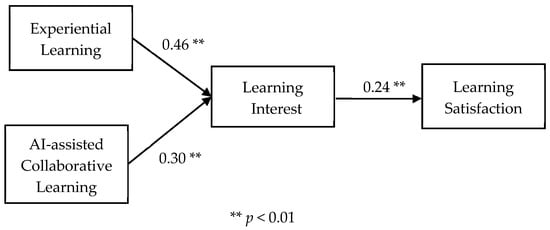
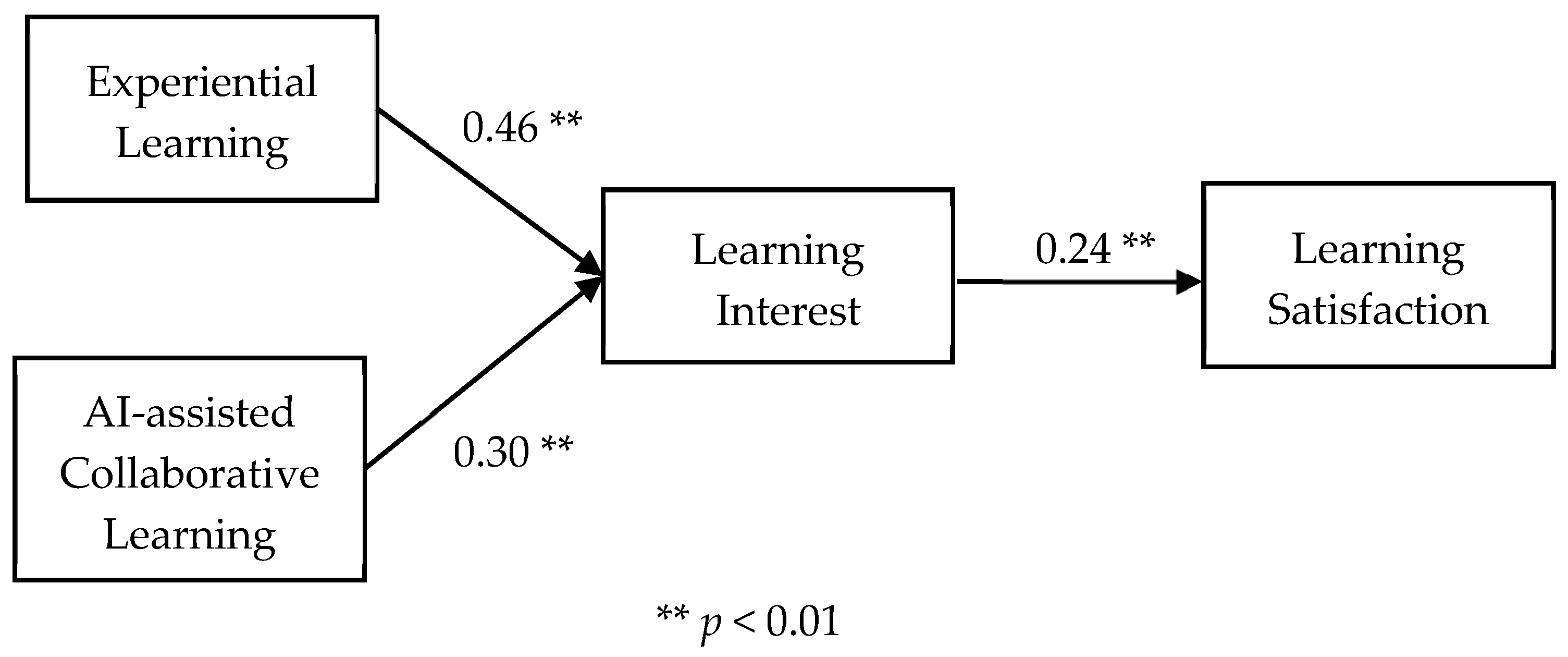
Figure 1.
The structural model.
Figure 1 shows that EL was significantly associated with LI (β = 0.46, p < 0.01), and AICL was positively associated with LI (β = 0.30, p < 0.01). Thus, H1 and H2 were supported. In addition, the association between LI and LS was positive and statistically significant (β = 0.24, p < 0.01), thereby providing empirical support for H7.
4.2. Bootstrapping Results
To examine the mediating effects of LI, bootstrapping procedures were conducted in accordance with the established methodological guidelines [77]. Based on 1000 bootstrap resamples, the indirect effect of EL on LS through LI was 0.12 (95% bias-corrected bootstrap confidence interval [0.04, 0.20]). The indirect effect of AICL on LS through LI was 0.08 (95% bias-corrected bootstrap confidence interval [0.02, 0.14]). As neither confidence interval included zero, these results indicate a statistically significant indirect effect of LI.
However, Table 3 shows that the direct effects and total effects remained statistically significant (p < 0.05), and their confidence intervals did not include zero, indicating that the mediating effects of LI were partial rather than full. Accordingly, H5 and H6 were partially supported.
Table 3.
Standardized path coefficients.
4.3. Hierarchical Regression Analysis
The interaction hypotheses were tested using moderated hierarchical regression analysis. Control variables and independent variables were entered in Model 1, followed by the inclusion of the interaction terms in Model 2. All predictor variables were mean-centered prior to the construction of the interaction terms [78]. The variance inflation factors (VIFs) ranged from 1.02 to 1.68, indicating no serious multicollinearity concerns. The change in explained variance (△R2) between Models 1 and 2 was statistically significant (p < 0.05), suggesting the presence of a significant interaction term. The regression results are presented in Table 4.
Table 4.
Results of regression analyses.
H3 posited that the interaction between EL and TBL would be positively related to LI. H4 predicted that the interaction between AICL and TBL would be positively related to LI. Model 2 shows that the interaction between EL and TBL was positively and statistically significant (β = 0.12, t = 2.74, p < 0.01), whereas the interaction between AICL and TBL was not statistically significant (β = 0.07, t = 1.71, p > 0.05). Accordingly, H3 was supported, while H4 was not supported. The detailed results are summarized in Table 4.
5. Discussion
This study examined how experiential learning (EL), AI-assisted collaborative learning (AICL), and team-based learning (TBL) operate within a CDIO framework to influence learning interest (LI) and learning satisfaction (LS) in a sustainability-oriented higher education context. The findings indicate that experiential learning and AI-assisted collaborative learning are positively associated with learning interest, while team-based learning strengthens the relationship between experiential learning and learning interest. Learning interest further functions as a partial mediator linking instructional approaches to learning satisfaction. These results highlight the central role of motivational activation in connecting instructional conditions with students’ evaluative learning outcomes.
The positive relationship between EL and LI aligns with experiential learning theory and situational interest research, which suggest that authentic and meaningful tasks stimulate intrinsic engagement [13,24,25]. Within the CDIO instructional cycle, experiential activities connect conceptual knowledge with real-world application, thereby increasing perceived relevance and sustaining learner interest. In sustainability-oriented education, embedding real-world social and environmental challenges within experiential activities may further enhance students’ perception of meaningful learning.
Similarly, the positive association between AICL and LI is consistent with research demonstrating that AI-supported learning environments enhance engagement through adaptive feedback and personalized scaffolding [32,33,34,35,36,59,60,61,62,63]. Rather than serving merely as technological assistance, AI-assisted collaborative learning appears to regulate motivation by aligning instructional support with learners’ perceived competence and autonomy. Through real-time feedback and contextualized guidance, AI-supported systems may help learners maintain engagement throughout complex learning processes.
The moderation findings suggest differentiated motivational mechanisms within CDIO-based pedagogy. Team-based learning strengthens the experiential pathway, suggesting that collaborative interaction amplifies engagement generated by authentic experiential tasks. When experiential activities are embedded within team-based contexts, peer dialogue and shared problem solving may enhance learners’ sense of relatedness and collective meaning-making, thereby intensifying motivational activation. In contrast, the non-significant interaction between AICL and TBL suggests that AI-assisted learning operates primarily through individualized adaptive scaffolding. Because AI-supported systems already respond dynamically to individual learning needs, additional collaborative amplification may provide limited incremental motivational benefits.
Taken together, these findings suggest that instructional mechanisms embedded in CDIO-based pedagogy activate multiple motivational pathways rather than a single unified engagement process. Experiential authenticity appears to generate relevance-driven engagement that benefits from collaborative amplification, whereas AI-assisted learning supports individualized engagement through adaptive technological guidance.
More importantly, the results support a process-based reconceptualization of the CDIO framework. While traditional CDIO research has primarily emphasized curriculum reform and competence alignment with professional practice, the present study suggests that CDIO can also be interpreted as a motivational regulation architecture that coordinates experiential authenticity, adaptive technological scaffolding, and collaborative interaction within a coherent instructional cycle. By shifting analytical attention away from competence validation toward motivational activation processes, this perspective deepens understanding of how CDIO-based instructional systems sustain student engagement in sustainability-oriented learning environments.
From a pedagogical perspective, the findings provide several implications for sustainability-oriented higher education. Experiential projects addressing authentic sustainability challenges may effectively stimulate learner interest when combined with collaborative learning structures. Team-based interaction appears to amplify the motivational benefits of experiential learning, while AI-supported tools can function as adaptive scaffolding mechanisms that sustain individualized engagement during complex learning tasks. Effective CDIO-based sustainability pedagogy may therefore depend on the strategic integration of experiential authenticity, collaborative interaction, and adaptive technological support within the instructional cycle.
6. Conclusions and Implications
This study advances understanding of CDIO-based sustainability pedagogy by conceptualizing CDIO not merely as a curriculum reform framework but as a structured motivational regulation architecture. This architecture coordinates experiential authenticity, adaptive artificial intelligence, and collaborative engagement within a unified instructional cycle. Building on prior scholarship on experiential learning [13,14,15,16,17], AI-supported collaborative environments [32,33,34,35,36], and interest development theory [24,25], this study develops a process-based perspective for understanding motivational regulation within structured sustainability-oriented instructional systems.
Beyond these empirical findings, the study contributes to the literature by clarifying how the CDIO framework can function as an organizing structure for motivational activation in complex learning environments. While prior CDIO research has largely emphasized competence alignment and curriculum reform, the present study highlights how experiential authenticity, adaptive technological scaffolding, and collaborative engagement can operate together within the CDIO cycle to sustain student engagement in sustainability-oriented learning contexts.
This reconceptualization also provides new directions for future CDIO and Education for Sustainable Development (ESD) research. Rather than examining CDIO primarily through competence outcomes, future studies may explore how motivational processes unfold across the CDIO phases and how such engagement contributes to the development of sustainability-related competences over time. Understanding these motivational dynamics may help clarify how instructional design influences students’ long-term engagement with sustainability challenges.
From a pedagogical perspective, the findings offer several practical implications for sustainability-oriented higher education. First, embedding authentic sustainability challenges within experiential learning activities may effectively stimulate students’ learning interest by increasing the perceived relevance of course content. Second, integrating collaborative team structures into experiential learning projects may further amplify motivational engagement through peer interaction and shared problem solving. Third, AI-assisted learning tools can function as adaptive scaffolding mechanisms that support individualized engagement by providing real-time feedback, information access, and personalized guidance during complex learning tasks.
Taken together, these findings suggest that CDIO-based sustainability pedagogy can provide a structured instructional environment in which experiential authenticity, collaborative interaction, and adaptive technological support jointly sustain student engagement. Such an instructional approach may support higher education institutions in designing sustainability-oriented curricula that not only promote knowledge acquisition but also cultivate sustained learner engagement with complex societal challenges.
7. Limitations and Directions for Future Research
Several limitations should be acknowledged. First, although data were collected from three intact classes of a business planning course, all classes were taught by the same instructor and followed an identical CDIO-based instructional design, syllabus, project structure, and assessment criteria. Accordingly, the study represents a single instructional context within one Taiwanese technological university, which may limit external validity. Future research employing multiple instructors, institutions, disciplines, or cross-cultural samples would strengthen the generalizability and boundary conditions of the proposed framework.
Second, the cross-sectional design constrains causal inference. While structural equation modeling permits theoretically informed directional testing, temporal precedence cannot be fully established. Longitudinal, quasi-experimental, or experimental designs would allow stronger causal claims and enable examination of how motivational activation evolves into sustained learning or sustainability-related competence outcomes over time.
Third, all constructs were measured using self-reported instruments collected at a single time point, which may introduce common method variance (CMV), potentially resulting in common method bias (CMB). To reduce potential method-related inflation, standardized administration procedures were implemented across the three classes, participation was voluntary, and responses were anonymous, thereby minimizing evaluation apprehension and social desirability bias. In addition, Harman’s single-factor test was conducted; the first unrotated factor accounted for 32.4% of the total variance, which is below the commonly referenced 50% threshold, suggesting that CMV is unlikely to substantially inflate the observed structural relationships. Nevertheless, because statistical diagnostics cannot fully eliminate method-related variance, future studies are encouraged to incorporate multi-source data, behavioral performance indicators, objective learning analytics, time-lagged measurement, or marker-variable techniques to further mitigate potential method effects.
Finally, sustainability was conceptualized as a value-oriented instructional domain aligned with Education for Sustainable Development principles rather than operationalized as a directly measured competence outcome. Future research may integrate validated sustainability competence scales or objective sustainability performance indicators to examine whether motivational regulation within CDIO-structured instruction translates into measurable sustainability capability development.
Author Contributions
Y.-C.C. and C.-C.C. conceived and designed the research; Y.-C.C. and C.-C.C. performed the research; Y.-C.C. and C.-C.C. collected the data; Y.-C.C. and C.-C.C. analyzed the data; Y.-C.C. wrote the paper. All authors have read and agreed to the published version of the manuscript.
Funding
This research received no external funding.
Institutional Review Board Statement
Ethical review and approval were waived for this study in accordance with the Article 5 of the Taiwan Human Subjects Research Act.
Informed Consent Statement
Informed consent was obtained from all participants prior to data collection, responses were collected anonymously or de-identified, and no personally identifiable information was recorded. All data were used solely for research purposes and are reported in aggregated form.
Data Availability Statement
The original contributions presented in this study are included in the article. Further inquiries can be directed to the corresponding author.
Acknowledgments
The authors would like to thank the Ministry of Education, Taiwan, for financially supporting this research under Contract No. MOE-113-TPRBM-1078-003Y.
Conflicts of Interest
The authors declare no conflicts of interest.
Abbreviations
| CDIO | Conceive–Design–Implement–Operate |
| EL | Experiential Learning |
| AICL | AI-assisted Collaborative Learning |
| TBL | Team-based Learning |
| LI | Learning Interest |
| LS | Learning Satisfaction |
Appendix A. Research Questionnaire
- Research Ethics Statement:
This questionnaire forms part of an academic research project funded by the Ministry of Education. The study is conducted in full compliance with established ethical research standards. All responses are collected anonymously and treated with strict confidentiality; the data will be used exclusively for academic research purposes. Participation is entirely voluntary, and completion of this questionnaire indicates your informed consent to take part in the study. We sincerely appreciate your valuable contribution to scholarly research.
- Section 1: Experiential Learning
- The experiential activities incorporated into the course effectively supported my learning.
- The experiential activities offered in the course provided authentic, real-world experiences relevant to the course content.
- The experiential activities included in the course facilitated my reflection on the personal relevance of the course content.
- The experiential activities arranged in the course helped me reflect on how the course content impacts me.
- Section 2: AI-assisted Collaborative Learning
- AI-assisted collaborative learning enriched my learning experience.
- AI-assisted collaborative learning helped me obtain useful information when needed.
- The learning activity conducted in the learning system was easy to understand and follow.
- Section 3: Team-based Learning
- I believe that, through teamwork, we can learn the skills or knowledge required for the learning task.
- I believe that, through teamwork, we can better understand the most difficult parts of the learning task.
- I believe that, through teamwork, we can learn the most complex knowledge related to the learning task taught by the instructor.
- I believe that our team members can learn the basic concepts presented in the learning task.
- Section 4: Learning Interest
- This way of learning was fun.
- I thought this was an interesting way to learn.
- I would describe this way of learning as very interesting.
- Section 5: Learning Satisfaction
- The learning activities in this course helped me better understand the course objectives.
- The instructional activities in this course encouraged me to adopt new ways of thinking.
- The overall instructional design of this course provided a more challenging and engaging learning experience compared with traditional lecture-based courses.
- Section 6: Demographic Information
- Gender: □ Male □ Female
- Age: ____
- Academic Level: □ Freshman □ Sophomore □ Junior □ Senior
References
- Dias-Oliveira, E.; Pasion, R.; da Cunha, R.V.; Coelho, S.L. The development of critical thinking, team working, and communication skills in a business school—A project-based learning approach. Think. Skills Creat. 2024, 54, 101680. [Google Scholar] [CrossRef] [Scilit]
- Qureshi, M.A.; Khaskheli, A.; Qureshi, J.A.; Raza, S.A.; Yousufi, S.Q. Factors affecting students’ learning performance through collaborative learning and engagement. Interact. Learn. Environ. 2023, 31, 2371–2391. [Google Scholar] [CrossRef] [Scilit]
- Zhou, T.; Cañabate, D.; Bubnys, R.; Stanikūnienė, B.; Colomer, J. Collaborative learning, cooperative learning and reflective learning to foster sustainable development: A scoping review. Rev. Educ. 2025, 13, e70065. [Google Scholar] [CrossRef] [Scilit]
- Chaudhury, A.; Deng, P.S. Does hybrid working promote collaboration and creativity? An empirical study. Issues Inf. Syst. 2022, 23, 200–214. [Google Scholar] [CrossRef] [Scilit]
- Edström, K.; Kolmos, A. PBL and CDIO: Complementary models for engineering education development. Eur. J. Eng. Educ. 2014, 39, 539–555. [Google Scholar] [CrossRef] [Scilit]
- Crawley, E.F.; Malmqvist, J.; Östlund, S.; Brodeur, D.R. Rethinking Engineering Education: The CDIO Approach, 2nd ed.; Springer: Cham, Switzerland, 2014. [Google Scholar] [CrossRef] [Scilit]
- Malmqvist, J.; Edström, K.; Rosén, A. CDIO Standards 3.0–Updates to the Core CDIO Standards. In Proceedings of the 16th International CDIO Conference (CDIO 2020 Virtual), Online, 8–10 June 2020; pp. 60–76. Available online: https://www.diva-portal.org/smash/get/diva2:1469617/FULLTEXT02 (accessed on 24 February 2026).
- Lin, C.H. The Implication of Project-Based Learning with CDIO and Team Teaching on Business-Management Course. In Proceedings of the International Conference on Innovative Technologies and Learning (ICITL 2023), Hong Kong, China, 21–24 August 2023; pp. 304–314. [Google Scholar] [CrossRef] [Scilit]
- He, J. Construction and practice of innovation and entrepreneurship education model in higher vocational education based on CDIO concept—A case study of Shaanxi Energy Institute. Educ. Innov. Res. 2025, 3, 136–142. [Google Scholar] [CrossRef] [Scilit]
- Hariharasakthisudhan, P.; Logesh, K.; Sathickbasha, K.; Kannan, S. Enhancing project-based learning in engineering education: A hybrid DT-CDIO-RA framework for sustainable product design. Discov. Educ. 2025, 4, 138. [Google Scholar] [CrossRef] [Scilit]
- Lai, C.H.; Ho, L.C.; Liao, Z.Y. Sustainability of programming education through CDIO-oriented practice: An empirical study on Syntax-level structural visualization for functional programming languages. Sustainability 2025, 17, 5630. [Google Scholar] [CrossRef] [Scilit]
- Huang, T.; Wang, T.; Zhang, F.; Hao, Y.; Liang, L.; Wang, X.; Yao, M.; Yuan, C. Integrating sustainability and ethical responsibility into building water supply and drainage engineering education: A CDIO-based curriculum reform. Sustainability 2026, 18, 1933. [Google Scholar] [CrossRef] [Scilit]
- Kolb, A.Y.; Kolb, D.A. Experiential learning theory as a guide for experiential educators in higher education. Exp. Learn. Teach. High. Educ. 2017, 1, 7. Available online: https://nsuworks.nova.edu/elthe/vol1/iss1/7 (accessed on 24 February 2026). [CrossRef] [Scilit]
- Gilbert, D.H. From chalk and talk to walking the walk: Facilitating dynamic learning contexts for entrepreneurship students in fast-tracking innovations. Educ. Train. 2011, 54, 152–166. [Google Scholar] [CrossRef] [Scilit]
- Keinänen, M.; Oksanen, A. Students’ perception of learning innovation competences in activity-based learning environment. J. Prof. Vocat. Educ. 2017, 19, 48–61. Available online: https://journal.fi/akakk/article/download/84740/43760/ (accessed on 24 February 2026).
- Blankesteijn, M.L.; Houtkamp, J.; Bossink, B. Towards transformative experiential learning in science- and technology-based entrepreneurship education for sustainable technological innovation. J. Innov. Knowl. 2024, 9, 100544. [Google Scholar] [CrossRef] [Scilit]
- Prince, H.E. The lasting impacts of outdoor adventure residential experiences on young people. J. Advent. Educ. Outdoor Learn. 2021, 21, 261–276. [Google Scholar] [CrossRef] [Scilit]
- Goralski, M.A.; Tan, T.K. Artificial intelligence and poverty alleviation: Emerging innovations and their implications for management education and sustainable development. Int. J. Manag. Educ. 2022, 20, 100662. [Google Scholar] [CrossRef] [Scilit]
- Javaid, M.; Haleem, A.; Singh, R.P.; Khan, S.; Khan, I.H. Unlocking the opportunities through ChatGPT tool towards ameliorating the education system. BenchCouncil Trans. Benchmarks Stand. Eval. 2023, 3, 100115. [Google Scholar] [CrossRef] [Scilit]
- Patac, L.P.; Patac, A.V., Jr. Using ChatGPT for academic support: Managing cognitive load and enhancing learning efficiency—A phenomenological approach. Soc. Sci. Humanit. Open 2025, 11, 101301. [Google Scholar] [CrossRef] [Scilit]
- Lee, H.Y.; Huang, Y.M.; Wu, T.T. ChatGPT in education: A systematic review of current landscape, limitations and future directions through general system theory lens. Eur. J. Educ. 2025, 60, e70262. [Google Scholar] [CrossRef] [Scilit]
- Edwards, J.; Nguyen, A.; Lämsä, J.; Sobocinski, M.; Whitehead, R.; Dang, B.; Järvelä, S. Human-AI collaboration: Designing artificial agents to facilitate socially shared regulation among learners. Br. J. Educ. Technol. 2025, 56, 712–733. [Google Scholar] [CrossRef] [Scilit]
- Yu, W.F. AI as a co-creator and a design material: Transforming the design process. Des. Stud. 2025, 97, 101303. [Google Scholar] [CrossRef] [Scilit]
- Hidi, S.; Renninger, K.A. The four-phase model of interest development. Educ. Psychol. 2006, 41, 111–127. [Google Scholar] [CrossRef] [Scilit]
- Murayama, K. A reward-learning framework of knowledge acquisition: An integrated account of curiosity, interest, and intrinsic–extrinsic rewards. Psychol. Rev. 2022, 129, 175–198. [Google Scholar] [CrossRef] [Scilit]
- Taneja, M.; Kiran, R.; Bose, S.C. Understanding the relevance of experiential learning for entrepreneurial self-efficacy: A gender-wise perspective. Int. J. Manag. Educ. 2023, 21, 100760. [Google Scholar] [CrossRef] [Scilit]
- Hwang, G.J.; Chang, C.C.; Chien, S.Y. A motivational model-based virtual reality approach to prompting learners’ sense of presence, learning achievements, and higher-order thinking in professional safety training. Br. J. Educ. Technol. 2022, 53, 1343–1360. [Google Scholar] [CrossRef] [Scilit]
- Zhong, J.; Ismail, L.; Lin, Y. Investigating EFL students’ engagement in project-based speaking activities: From a multi-dimensional perspective. Front. Psychol. 2025, 16, 1598513. [Google Scholar] [CrossRef] [Scilit]
- He, S.; Zhang, H. Exploring the impact of digital experiential learning on tourism education students: Experimental study. J. Hosp. Tour. Educ. 2025, 37, 203–213. [Google Scholar] [CrossRef] [Scilit]
- Grant, K.A. Developing MBA students’ management consulting skills through experiential learning. In Practical Applications of Experiential and Community-Engaged Learning Methods in Business; Edward Elgar Publishing: Cheltenham, UK, 2025; pp. 91–110. [Google Scholar] [CrossRef] [Scilit]
- Corazza, L.; Cottafava, D.; Torchia, D. Education for sustainable development: A critical reflexive discourse on a transformative learning activity for business students. Environ. Dev. Sustain. 2025, 27, 20471–20491. [Google Scholar] [CrossRef] [Scilit]
- Kovari, A. A systematic review of AI-powered collaborative learning in higher education: Trends and outcomes from the last decade. Soc. Sci. Humanit. Open 2025, 11, 101335. [Google Scholar] [CrossRef] [Scilit]
- Pradana, M.; Elisa, H.P. Metaverse in education: A systematic literature review. Cogent Soc. Sci. 2023, 9, 2252656. [Google Scholar] [CrossRef] [Scilit]
- Jin, S.; Zhong, Z. Effects of collaborative generative learning on learners with different motivation levels in AI-enabled immersive virtual environments. J. Educ. Comput. Res. 2026, 64, 344–370. [Google Scholar] [CrossRef] [Scilit]
- Tan, L.Y.; Hu, S.; Yeo, D.J.; Cheong, K.H. Artificial intelligence-enabled adaptive learning platforms: A review. Comput. Educ. Artif. Intell. 2025, 9, 100429. [Google Scholar] [CrossRef] [Scilit]
- Bauer, E.; Richters, C.; Pickal, A.J.; Klippert, M.; Sailer, M.; Stadler, M. Effects of AI-generated adaptive feedback on statistical skills and interest in statistics: A field experiment in higher education. Br. J. Educ. Technol. 2025, 56, 1735–1757. [Google Scholar] [CrossRef] [Scilit]
- Burton, R.; Kellett, U.; Mansah, M.; Sriram, D. A systematic review of online team based learning approaches in health professional education. Nurse Educ. Today 2024, 138, 106156. [Google Scholar] [CrossRef] [Scilit] [PubMed]
- Darby, S.; O’Hanlon, D.; Casterton, S.; Harding, N.; O’Brien, A.M.; Quinn, G.; Tweddell, S. Improved learning outcomes and teacher experience: A qualitative study of team-based learning in secondary schools. Soc. Sci. Humanit. Open 2023, 8, 100590. [Google Scholar] [CrossRef] [Scilit]
- Scheuring, F.; Thompson, J. Enhancing graduate employability–exploring the influence of experiential simulation learning on life skill development. Stud. High. Educ. 2025, 50, 256–270. [Google Scholar] [CrossRef] [Scilit]
- Kim, L.; Imjai, N.; Kaewjomnong, A.; Dowpiset, K.; Aujirapongpan, S. Does experiential learning matter to strategic intuition skills of MBA students? Implications of diagnostic capabilities and critical thinking skills. Int. J. Manag. Educ. 2025, 23, 101138. [Google Scholar] [CrossRef] [Scilit]
- Al Issa, H.E.; Thai, M.T.T.; Saad, S. Empowering social entrepreneurial intentions through experiential learning and self-efficacy. Int. J. Manag. Educ. 2025, 23, 101154. [Google Scholar] [CrossRef] [Scilit]
- Romero Caballero, S.; Canquiz Rincón, L.; Rodríguez Toscano, A.; Valencia Pérez, A.; Moreno Gómez, G. Challenge-based learning and design thinking in higher education: Institutional strategies for linking experiential learning, innovation, and academic performance. Innov. Educ. Teach. Int. 2025, 62, 557–574. [Google Scholar] [CrossRef] [Scilit]
- Hu, W.; Tian, J.; Li, Y. Enhancing student engagement in online collaborative writing through a generative AI-based conversational agent. Internet High. Educ. 2025, 65, 100979. [Google Scholar] [CrossRef] [Scilit]
- Asfani, K.; Chen, H.L. Problem or project-based computer-supported collaborative learning practices in computer education: A systematic review of SSCI articles published from 2014 to 2023. Educ. Inf. Technol. 2025, 30, 7627–7658. [Google Scholar] [CrossRef] [Scilit]
- Wang, C.; Wang, H.; Li, Y.; Dai, J.; Gu, X.; Yu, T. Factors influencing university students’ behavioral intention to use generative artificial intelligence: Integrating the theory of planned behavior and AI literacy. Int. J. Hum.-Comput. Interact. 2025, 41, 6649–6671. [Google Scholar] [CrossRef] [Scilit]
- Su, N.; Al Mamun, A.; Reza, M.N.H.; Yang, Q.; Masud, M.M. Unveiling the nexus between quality and student engagement in web-based collaborative learning systems. Educ. Inf. Technol. 2024, 29, 23717–23752. [Google Scholar] [CrossRef] [Scilit]
- Wang, H.; Wang, C.; Chen, Z.; Liu, F.; Bao, C.; Xu, X. Impact of AI-agent-supported collaborative learning on the learning outcomes of university programming courses. Educ. Inf. Technol. 2025, 30, 17717–17749. [Google Scholar] [CrossRef] [Scilit]
- Lin, C.J.; Lee, H.Y.; Wang, W.S.; Huang, Y.M.; Wu, T.T. Enhancing reflective thinking in STEM education through experiential learning: The role of generative AI as a learning aid. Educ. Inf. Technol. 2025, 30, 6315–6337. [Google Scholar] [CrossRef] [Scilit]
- Ryan, R.M.; Deci, E.L. Intrinsic and extrinsic motivations: Classic definitions and new directions. Contemp. Educ. Psychol. 2000, 25, 54–67. [Google Scholar] [CrossRef] [Scilit]
- Jo, H.J.; Jung, Y.H.; Hong, Y.J.; Shin, Y.B.; Baek, K.D.; Kim, E.; Kim, J.J. The applicability of virtual reality-based training for controlling anger in aggressive individuals. Cyberpsychol. Behav. Soc. Netw. 2022, 25, 278–286. [Google Scholar] [CrossRef] [Scilit] [PubMed]
- Zhang, Y.; Zhang, X.; Meng, Z. Effect of interactive immediacy on online learning satisfaction of international students in Chinese universities: The chain mediating role of learning interest and academic engagement. Acta Psychol. 2024, 244, 104202. [Google Scholar] [CrossRef] [Scilit]
- Dubey, P.; Sahu, K.K. Mediation analysis of students’ perceived benefits in predicting their satisfaction to technology-enhanced learning. J. Res. Innov. Teach. Learn. 2023, 16, 82–99. [Google Scholar] [CrossRef] [Scilit]
- Pole, K.; McGee, M. Experiential Learning. In Teaching and Learning in Higher Education; Wang, S., Zhou, Z., Marginson, S., Eds.; Springer: Singapore, 2025. [Google Scholar] [CrossRef] [Scilit]
- Guo, Z.; Fryer, L.K. What really elicits learners’ situational interest in learning activities: A scoping review of six most commonly researched types of situational interest sources in educational settings. Curr. Psychol. 2025, 44, 587–601. [Google Scholar] [CrossRef] [Scilit]
- Törmänen, T.; Ketonen, E.; Lehtoaho, E.; Turuen, M.; Zabolotna, K.; Shubina, T.; Järvenoja, H. Situational motivation in academic learning: A systematic review. Educ. Psychol. Rev. 2025, 37, 56. [Google Scholar] [CrossRef] [Scilit]
- Lee, Y.I.; Yu, T.K. Game-based learning enhances business decision-making Learning for on-the-job MBA students: A case study of dynamic systems-thinking course. Int. J. Manag. Educ. 2025, 23, 101140. [Google Scholar] [CrossRef] [Scilit]
- Lin, Y.L.; Wang, W.T. Using business simulation games to explore the effects of instructional and technological support on students’ psychological needs, cognitive load, and learning achievement. J. Educ. Comput. Res. 2025, 63, 587–626. [Google Scholar] [CrossRef] [Scilit]
- Guo, J.; An, F. Exploring the categories of students’ interest and their relationships with deep learning in technology supported environments. Sci. Rep. 2025, 15, 10370. [Google Scholar] [CrossRef] [Scilit]
- Annamalai, N.; Bervell, B.; Mireku, D.O.; Andoh, R.P.K. Artificial intelligence in higher education: Modelling students’ motivation for continuous use of ChatGPT based on a modified self-determination theory. Comput. Educ. Artif. Intell. 2025, 8, 100346. [Google Scholar] [CrossRef] [Scilit]
- Li, Y.; Sadiq, G.; Qambar, G.; Zheng, P. The impact of students’ use of ChatGPT on their research skills: The mediating effects of autonomous motivation, engagement, and self-directed learning. Educ. Inf. Technol. 2025, 30, 4185–4216. [Google Scholar] [CrossRef] [Scilit]
- Dahri, N.A.; Al-Rahmi, W.M.; Alhashmi, K.A.; Bashir, F. Enhancing mobile learning with AI-powered chatbots: Investigating ChatGPT’s impact on student engagement and academic performance. Int. J. Interact. Mob. Technol. 2025, 19, 17–38. [Google Scholar] [CrossRef] [Scilit]
- Zulfiqar, S.; Sarwar, B.; Huo, C.; Zhao, X.; ul Mahasbi, H. AI-powered education: Driving entrepreneurial spirit among university students. Int. J. Manag. Educ. 2025, 23, 101106. [Google Scholar] [CrossRef] [Scilit]
- Zhuo, Z.; Li, D.; Chen, J.; Chen, X.; Wang, S. Exploring factors influencing ChatGPT-assisted learning satisfaction from an information systems success model perspective: The case of art and design students. Systems 2025, 14, 7. [Google Scholar] [CrossRef] [Scilit]
- Lin, S.T.; Chen, K.S. ESG strategies in educational quality management: An empirical study on fostering student loyalty and sustainability. Sustainability 2025, 17, 3723. [Google Scholar] [CrossRef] [Scilit]
- Vaughan, Y.; Tao, C.W.; Shafieizadeh, K. Bridging the ESG education gap: Understanding hospitality students’ perceptions and expectations. J. Hosp. Tour. Educ. 2026, 1–16. [Google Scholar] [CrossRef] [Scilit]
- Hou, R.; Jin, L.; He, J.; Wang, J.L. Peer support and learning outcomes in “Study with me” among generation Z college students: Mediating roles of motivation, test anxiety, and self-efficacy. Front. Psychol. 2025, 16, 1582857. [Google Scholar] [CrossRef] [Scilit] [PubMed]
- UNESCO. Education for Sustainable Development: A Roadmap; UNESCO: Paris, France, 2020; Available online: https://unesdoc.unesco.org/ (accessed on 24 February 2026).
- Huang, Y.M.; Silitonga, L.M.; Wu, T.T. Applying a business simulation game in a flipped classroom to enhance engagement, learning achievements, and higher-order thinking skills. Comput. Educ. 2022, 183, 104494. [Google Scholar] [CrossRef] [Scilit]
- Sellami, A.; Santhosh, M.E.; Siby, N.; Bhadra, J.; Ahmad, Z. High school students’ perceptions of the role of social support in cultivating their interests in and aspirations to STEM degrees and careers: A Middle Eastern case study. Sustainability 2023, 15, 12960. [Google Scholar] [CrossRef] [Scilit]
- Wang, S.L.; Lin, S.S. The effects of group composition of self-efficacy and collective efficacy on computer-supported collaborative learning. Comput. Hum. Behav. 2007, 23, 2256–2268. [Google Scholar] [CrossRef] [Scilit]
- Yin, J.; Goh, T.T.; Yang, B.; Xiaobin, Y. Conversation technology with micro-learning: The impact of chatbot-based learning on students’ learning motivation and performance. J. Educ. Comput. Res. 2021, 59, 154–177. [Google Scholar] [CrossRef] [Scilit]
- Chu, H.C.; Hwang, G.J.; Tsai, C.C.; Tseng, J.C.R. A two-tier test approach to developing location-aware mobile learning systems for natural science courses. Comput. Educ. 2010, 55, 1618–1627. [Google Scholar] [CrossRef] [Scilit]
- Anderson, J.C.; Gerbing, D.W. Structural equation modeling in practice: A review and recommended two-step approach. Psychol. Bull. 1988, 103, 411–423. [Google Scholar] [CrossRef]
- Fornell, C.; Larcker, D.F. Evaluating structural equation models with unobservable variables and measurement error. J. Mark. Res. 1981, 18, 39–50. [Google Scholar] [CrossRef] [Scilit]
- Hair, J.F.; Black, W.C.; Babin, B.J.; Anderson, R.E.; Tatham, R.L. Multivariate Data Analysis, 5th ed.; Prentice Hall: Upper Saddle River, NJ, USA, 1998. [Google Scholar]
- Bentler, P.M. Comparative fit indexes in structural models. Psychol. Bull. 1990, 107, 238–246. [Google Scholar] [CrossRef] [Scilit] [PubMed]
- Cheung, G.W.; Lau, R.S. Testing mediation and suppression effects of latent variables: Bootstrapping with structural equation models. Organ. Res. Methods 2008, 11, 296–325. [Google Scholar] [CrossRef] [Scilit]
- Aiken, L.S.; West, S.G. Multiple Regression: Testing and Interpreting Interactions; Sage Publications: Newbury Park, CA, USA, 1991. [Google Scholar]

Disclaimer/Publisher’s Note: The statements, opinions and data contained in all publications are solely those of the individual author(s) and contributor(s) and not of MDPI and/or the editor(s). MDPI and/or the editor(s) disclaim responsibility for any injury to people or property resulting from any ideas, methods, instructions or products referred to in the content. |
© 2026 by the authors. Licensee MDPI, Basel, Switzerland. This article is an open access article distributed under the terms and conditions of the Creative Commons Attribution (CC BY) license.