


Abstract
This study aims to evaluate the impact of agricultural land property rights system reform on Agricultural Green Total Factor Productivity (AGTFP) and to uncover its underlying mechanisms. Treating the nationwide rollout of the Three Rights Separation Reform (TRSR) as a quasi-natural experiment, we employ provincial panel data from 2011 to 2023. The Super-SBM model is applied to measure AGTFP, followed by a multi-period Difference-in-Differences framework to identify the causal effects. The results indicate that the TRSR significantly enhances AGTFP, yielding an average improvement of 0.112 units. Mechanism analyses reveal that this gain is achieved through three distinct channels: promoting labor-saving technological progress, optimizing factor allocation efficiency, and facilitating agricultural green transformation. Heterogeneity analyses further demonstrate that the positive effects are more pronounced in plains regions, areas with lower rural per capita income, and jurisdictions with higher agricultural fiscal expenditure. These findings remain robust after a series of robustness and endogeneity tests. This study provides novel institutional evidence on the drivers of AGTFP and offers policy-relevant insights for advancing sustainable agricultural transformation in developing economies.
1. Introduction
China’s agricultural sector has undergone a historic transformation since the Reform and Opening-up, transitioning from supply shortages to sustained abundance. Its output surged from 158.4 billion yuan in 1979 to 15.85 trillion yuan in 2023, marking an average annual growth of 5.5%. This growth has laid a solid groundwork for high-quality socioeconomic progress. However, the conventional “high input, high consumption, high output” model, while propelling rapid agricultural economic expansion, has concurrently exacerbated environmental pollution and resulted in low agricultural production efficiency [1]. The escalating use of chemical fertilizers and pesticides in agriculture, coupled with the increasing scarcity of arable land, poses a mounting threat to the sustainable development of China’s agricultural sector [2]. There is an urgent need for the agricultural sector to transition towards a sustainable development model that is resource-efficient and environmentally friendly.
The existing academic discourse on Agricultural Green Total Factor Productivity (AGTFP) focuses predominantly on its assessment techniques and geographic and temporal distribution patterns. As agricultural production involves both desirable outputs (e.g., agricultural yields) and undesirable outputs (e.g., non-point source pollution, carbon emissions), environmental factors such as pollution and emissions should be included in the measurement of AGTFP [3]. There is no consensus in academia on the primary drivers of AGTFP growth in China. Liu et al. [4] argue that the growth of China’s AGTFP is mainly driven by technological progress, while other scholars suggest that financial factors [5] and environmental regulations [6] can also influence AGTFP. However, research specifically addressing the agricultural land property rights system is still lacking. Significant uncertainty therefore persists regarding the capacity of institutional reforms in this domain to influence AGTFP.
In the context of China’s agricultural development, reforms of agricultural land property rights constitute one of the primary levers for promoting agricultural modernization. The agricultural land property rights system forms the core institutional foundation in rural areas. The Separation of Three Rights Reform (TRSR) is defined by its clarification of the distinct roles of ownership, contract, and management rights. Consequently, it strengthens collective ownership, stabilizes farmers’ contract rights, and enables the market-based transfer of management rights. Wei et al. [7] posits that secure land rights can increase investment in land and accelerate land transfer, while relatively free transfer rights generate output-equalizing effects and trading-gain effects, both of which enhance resource allocation efficiency. Research by Li et al. [8] also found that agricultural land rental markets facilitate the transfer of land from households with low productivity or engaged in off-farm work to poorer households with sufficient labor, which is conducive to large-scale farming and significantly improves agricultural production efficiency. De Janvry et al. [9] discovered that titled households in Mexico had a migration rate approximately 28% higher than untitled households, and formal titling helps optimize land resource allocation. Chen et al. [10] also found that land titling contributes to reducing agricultural labor intensity and increasing farmers’ off-farm labor time, thereby improving the allocation of agricultural production factors. AGTFP embodies the pursuit of achieving agricultural output that is both “greater in quantity and better in quality,” meaning increasing grain yield and quality while reducing environmental costs and enhancing agricultural ecological benefits [11]. Theoretically, TRSR is conducive to promoting agricultural scale management and specialization. However, whether it can also mitigate negative environmental impacts and achieve resource conservation and sustainable development remains an open question.
This study treats the Separation of Three Rights Reform as a quasi-natural experiment, serving as a proxy for agricultural land property rights system reform. Using Chinese provincial panel data from 2011 to 2023, it examines the impact of this reform on AGTFP. Compared to the existing literature, the marginal contributions of this paper are threefold: First, in terms of research perspective, it focuses specifically on agricultural land property rights system reform, integrating it with AGTFP within a unified analytical framework, thereby supplementing the theoretical research on AGTFP. Second, regarding the mechanism of action, it delves into the transmission roles of labor-saving technological progress, factor allocation efficiency, and green agricultural production transformation, revealing the internal mechanisms through which TRSR promotes AGTFP. Third, concerning policy effects, it analyzes the heterogeneous characteristics of TRSR’s promoting effect on AGTFP from multiple perspectives. This contributes to a more comprehensive understanding of how TRSR fosters AGTFP. This paper expands the research on the economic impacts of agricultural land property rights system reform and provides a new perspective for comprehensively evaluating its overall influence on sustainable agricultural development.
2. Theoretical Analysis and Research Hypotheses
The TRSR unleashes substantial institutional vitality. By enhancing labor-saving technological progress, promoting factor allocation efficiency, and fostering the transition to green agricultural production, it creates a more stable and efficient institutional environment for sustainable agricultural development.
2.1. TRSR, Labor-Saving Technological Progress, and AGTFP
The TRSR establishes crucial institutional preconditions for labor-saving technological progress in agricultural production through the substitution of capital for labor and the enhancement of labor productivity itself, ultimately driving the growth of AGTFP.
On one hand, the TRSR mitigates the risks and uncertainties associated with long-term investment, providing a strong incentive for capital investment [12], thereby raising the capital substitution rate and driving labor-saving technological progress. Theodore W. Schultz, in Transforming Traditional Agriculture [13], posited that the key to transforming traditional agriculture lies in introducing new factors of production, and farmers’ willingness to adopt these factors depends on the associated returns and risks. Under the TRSR framework, the stability of contract rights secures the fundamental interests of farming households [14], while the transfer and concentration of management rights create conditions for new types of agricultural business entities such as family farms and cooperatives. This shift toward capital-intensive production unlocks several efficiencies [15]. The mechanization it enables cuts labor requirements per unit. Furthermore, by facilitating precision farming, it enhances crop yields and slashes the overuse of chemical inputs, with both pathways contributing positively to AGTFP.
On the other hand, the property rights system reform can enhance labor productivity. The growth in labor productivity results from the synergistic interaction of multiple factors, including capital, technology, and management. According to the Induced Innovation Theory by Hayami and Ruttan [16], technological innovation is induced to save the relatively scarce factor. This is evident in China, where the exodus of rural labor has raised its opportunity cost, making it scarcer and thereby inducing labor-saving technological change in agriculture [17]. The TRSR accommodates and accelerates this trend, “inducing” remaining agricultural operators to adopt technological advancements to cope with rising labor costs. Concurrently, the concentration of management rights among more capable operators promotes the application and diffusion of advanced agronomic techniques and digital management knowledge, optimizing production processes and organizational methods [18]. Enhancing agricultural sustainability is facilitated by boosting labor productivity, which helps drive the sector’s green transition.
2.2. TRSR, Factor Allocation Efficiency, and AGTFP
Coase posited that in an ideal state of zero transaction costs, as long as property rights are clearly defined, resources can ultimately achieve optimal allocation through market transactions, regardless of their initial distribution. The TRSR separates the contract rights and management rights of agricultural land. While upholding collective ownership and stabilizing farmers’ contract rights, it establishes management rights as an independent, marketable property right. This clear delineation of management rights reduces negotiation frictions and contractual uncertainties arising from ambiguous ownership [19]. Consequently, land, as a factor of production, can flow more smoothly from less efficient operators to new types of business entities that are more productive and possess greater knowledge and technology for green production [20]. This market-based reallocation facilitates superior combinations of land with other factors such as capital, technology, and management [21]. It promotes large-scale and specialized operation, thereby creating fundamental conditions for adopting resource-saving and environmentally friendly green production technologies, which in turn drives the improvement of AGTFP.
Furthermore, the TRSR optimizes the organized allocation efficiency of labor and services by fostering farmer cooperatives. Transaction cost theory suggests that when market transactions are characterized by high frequency, asset specificity, and uncertainty, internalizing transactions within organizations can reduce costs [22]. Individual smallholders face high transaction costs when connecting to markets, purchasing production inputs, and accessing technology and financial services [23]. The trend of land concentration spurred by the TRSR generates a scaled demand for unified operation and services. Farmer cooperatives organize scattered households, internalizing what were external transactions. By centralizing procurement, cooperatives lower the costs of green agricultural inputs such as organic fertilizers and biopesticides [24]. Through unified production standards and technical guidance, they promote the adoption and monitoring of green cultivation practices. By consolidating sales, they enhance the market bargaining power and brand value of agricultural products. Thus, at the organizational level, a Pareto improvement in factor allocation is achieved, contributing to increased AGTFP.
2.3. TRSR, Agricultural Green Transformation, and AGTFP
The TRSR promotes the enhancement of AGTFP by fostering a green transformation in agricultural production modes. This green transformation is primarily manifested in two aspects: land improvement, and the proactive reduction and control of environmental pollution sources.
Firstly, the TRSR drives land improvement by incentivizing medium- and long-term investment in land. The Induced Innovation Theory emphasizes that changes in the relative prices of factors induce technological changes that economize on the increasingly scarce factor [25]. Under the TRSR, secure management rights raise operators’ expected returns from the land’s long-term productive capacity, thereby altering the relative prices of factors in their investment decisions. In the past, under conditions of insecure property rights, operators tended toward short-term, extractive use. Once management rights are secured, the price of treating land as sustainable capital for long-term investment decreases relatively [26]. Consequently, operators have a strong incentive to invest in improving medium- and low-yield farmland. This enhances the land’s resource-carrying capacity and basic productivity, leading to an increase in AGTFP.
Secondly, the TRSR promotes the reduction in the use of polluting inputs such as chemical fertilizers, pesticides, and agricultural plastic film. The Porter Hypothesis suggests that appropriate environmental regulatory pressure can stimulate innovation compensation effects, ultimately enhancing competitiveness [27]. The effects of large-scale operation and property rights stability generated by the TRSR can create a powerful form of market and social discipline. On one hand, large-scale operators, motivated by the need to reduce variable costs and ensure agricultural product quality and safety to enhance market competitiveness, have an economic incentive to adopt precise management [28]. This includes using technologies like soil testing and formulated fertilization or green pest control to reduce chemical overuse [8]. On the other hand, the concentration of management rights clarifies the responsible entities for agricultural production activities. This reduces the costs of environmental monitoring and traceability and strengthens the constraining force of social supervision and brand reputation mechanisms on production behaviors [29]. Consequently, this reduces undesirable outputs in agricultural production, promoting the growth of AGTFP.
Based on the above analysis, this paper proposes the following theoretical hypotheses:
Hypothesis 1.
The TRSR can promote AGTFP.
Hypothesis 2.
The TRSR can promote AGTFP by enhancing labor-saving technological progress.
Hypothesis 3.
The TRSR can promote AGTFP by improving factor allocation efficiency.
Hypothesis 4.
The TRSR can promote AGTFP by promoting agricultural green transformation.
3. Research Design
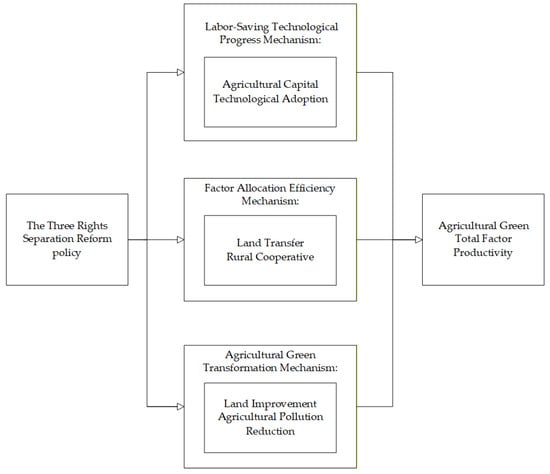
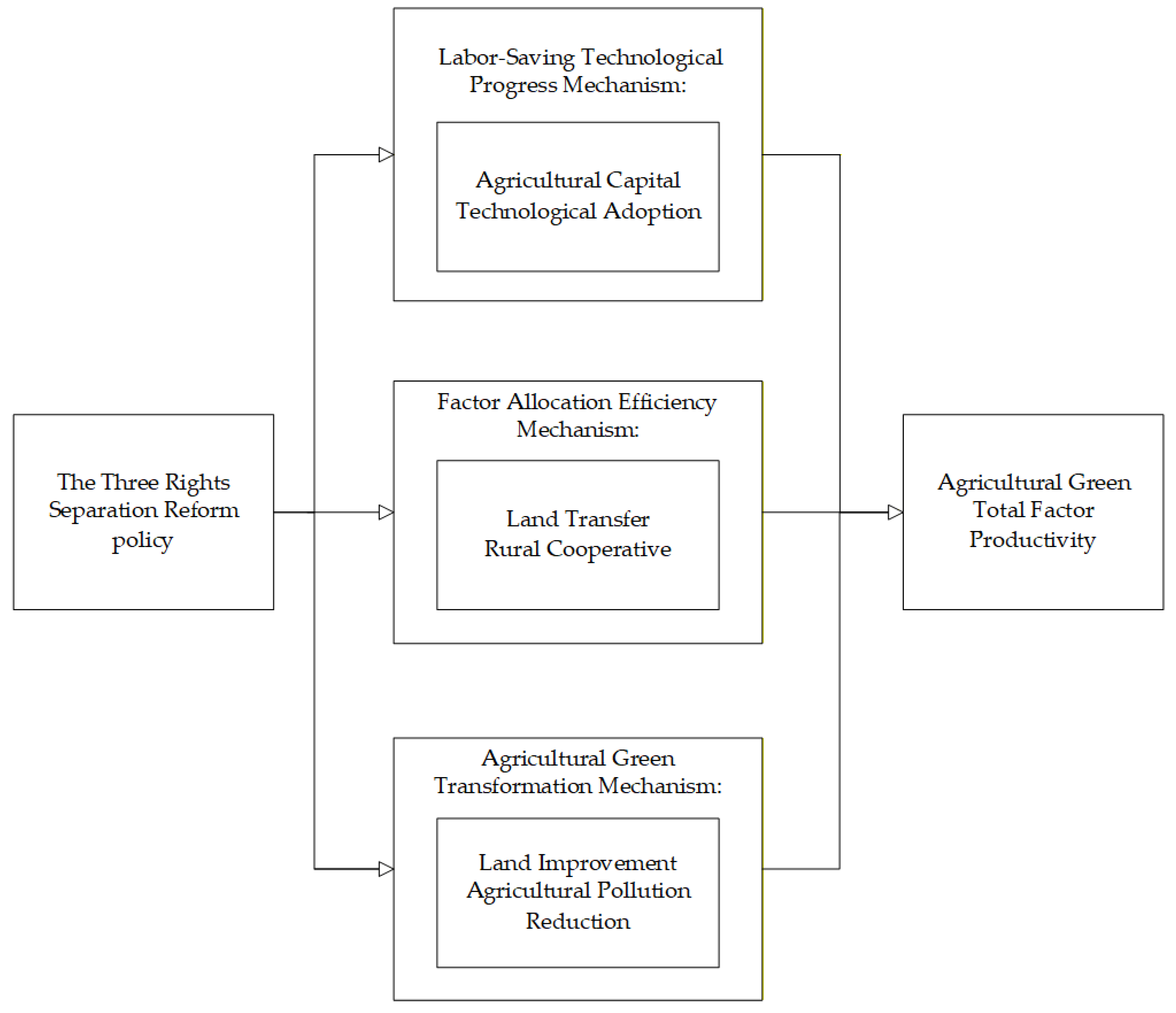
This study treats the Separation of Three Rights Reform as a quasi-natural experiment, serving as a proxy for agricultural land property rights system reform. Using Chinese provincial panel data from 2011 to 2023, it examines the impact of the TRSR on AGTFP. Figure 1 presents the research framework of this paper.
Figure 1.
Research Framework.
3.1. Model Specification
Following Song et al. [30], this study employs the following econometric model to examine the overall impact of the TRSR on AGTFP:
where and denote province and year, respectively. represents the Agricultural Green Total Factor Productivity. is the policy dummy variable for the TRSR. denotes a vector of control variables. represents time fixed effects, represents province fixed effects, and is the random error term. Robust standard errors, clustered at the provincial level, are used for model estimation. The primary coefficient of interest is . A significantly positive would indicate that the TRSR generates welfare benefits by enhancing AGTFP within the region, whereas a significantly negative would suggest that the TRSR reduces AGTFP.
3.2. Dependent Variable
AGTFP (Agricultural Green Total Factor Productivity): This measure emphasizes the synergistic achievement of multiple objectives, including carbon reduction, pollution mitigation, green expansion, and economic growth. Building upon existing AGTFP measurement indicator systems, this paper incorporates factors such as agricultural carbon sinks and agricultural non-point source pollution to construct an integrated “Resource-Environment-Economy” AGTFP measurement framework (see Table 1).
Table 1.
AGTFP measurement framework.
The input variables encompass labor, proxied by primary industry employment; land, represented by total sown and aquaculture area; and capital, measured as agricultural capital stock. Intermediate inputs include the pure component of applied chemical fertilizer, the quantity of pesticide used, and agricultural film consumption, with total agricultural water use completing the input set. For desirable outputs, agricultural gross output is gauged by the total value of agriculture, forestry, animal husbandry, and fishery, while the agricultural carbon sink is estimated from total crop carbon sequestration following Chen et al. [31]. Undesirable outputs consist of agricultural carbon emissions, calculated from energy use, material inputs, rice cultivation, and livestock breeding, and agricultural non-point source pollution, captured by a composite index covering pollution from fertilizer runoff, pesticides, plastic film, livestock, organic waste, and aquaculture.
This paper adopts the EBM-GML productivity index proposed by Tone and Tsutsui [32] to estimate AGTFP. This model advances upon traditional DEA and SBM approaches in two critical aspects: it incorporates slack variables and retains the original proportion information of efficiency frontier projections, while also resolving common computational issues like infeasible linear programming and non-circular indices. Consequently, it provides a more accurate and robust measurement framework.
3.3. Core Explanatory Variable
The key explanatory variable is a binary indicator (TRSR) capturing the phased national implementation of the Separation of Three Rights Reform announced in 2014. It equals 1 for a province starting in the year of its province-wide rollout. Our sample period (2011–2023) yields 251 treated observations, constituting 63.03% of the panel. A phased implementation schedule was adopted: initial pilots in Sichuan, Anhui, Shandong (2014); followed by two groups of ten provinces in 2015 (e.g., Henan, Shanghai) and 2016 (e.g., Shaanxi, Hebei); then six regions including Beijing and Tianjin (2017); with Tibet and Xinjiang commencing in 2018.
3.4. Control Variables
In line with prior studies [33], the analysis incorporates several control variables (see Table 2). Government intervention (GOV) is measured as the share of fiscal expenditure in regional GDP, while fiscal support (FSI) uses general fiscal expenditure relative to GDP. Openness to trade (OPE) is the ratio of total import-export value to regional GDP. Labor force level (LAB) and economic development (GDP) are represented by the logarithm of the number of employed persons and per capita GDP, respectively. The urbanization level (URB) is captured by the urbanization rate.
Table 2.
Descriptive statistics of the main data.
3.5. Data Sources
The empirical analysis is based on annual panel data covering 31 mainland Chinese provinces and provincial-level municipalities from 2010 through 2023. The analysis excludes Taiwan, Hong Kong, and Macao due to incomplete statistical records. Key data sources include authoritative publications like the China Rural Statistical Yearbook and the China Statistical Yearbook.
4. Empirical Results and Analysis
4.1. Baseline Regression
Table 3 reports the estimation results for Equation (1). The baseline results indicate a statistically significant positive impact of the TRSR on AGTFP. Columns (1) through (7) present the regression results for the effect of TRSR on AGTFP. All models include province and year fixed effects, with standard errors clustered at the provincial level; t-statistics are shown in parentheses. Column (1) includes no control variables, while Columns (2) through (7) sequentially add the control variables GOV, LAB, OPE, FSI, URB, and GDP.
Table 3.
Baseline Regression.
The estimated impact of the core explanatory variable is consistently positive and statistically significant across every model specification. As shown in Column (7) of Table 3, which presents the preferred specification, the implementation of the TRSR increases the AGTFP level by 0.112 units. A comparison with findings from prior research suggests that the AGTFP improvement attributed to the TRSR is comparable in magnitude to improvements typically ascribed to green finance initiatives [34]. This underscores the significant contribution of the TRSR to enhancing green agricultural production.
4.2. Mechanism Analysis
While the baseline regression confirms the positive effect of TRSR on AGTFP, it does not reveal the underlying channels. Theoretical analysis suggests that TRSR promotes AGTFP by facilitating labor-saving technological progress, optimizing factor allocation efficiency, and driving the agricultural green transition. This section empirically tests these hypothesized mechanisms.
4.2.1. TRSR, Labor-Saving Technological Progress, and AGTFP
Technological progress reflects outcomes related to changes in agricultural capital input and the adoption of new technologies. The theoretical mechanism analysis posits that TRSR can promote the substitution of machinery for labor and enhance labor productivity. We adopt dual measures to test this mechanism. The capital substitution rate, proxied by the per-mu agricultural machinery value relative to labor input for grain producers [35], captures capital-for-labor replacement. Labor productivity is calculated as the gross output value of agriculture, forestry, animal husbandry, and fishery divided by labor input. Empirical results in Table 4 (Columns 1 and 2) indicate that the TRSR positively and significantly affects both the capital substitution rate and labor productivity.
Table 4.
TRSR, Labor-Saving Technological Progress, and AGTFP.
4.2.2. TRSR, Factor Allocation Efficiency, and AGTFP
Disparities in total factor productivity among farming households largely stem from the misallocation of land resources [36]. If land were allocated efficiently, AGTFP would see substantial improvement. Following the TRSR, the enhancement of land resource allocation efficiency manifests in two primary ways. By establishing clearer property rights, the TRSR has activated the agricultural land transfer market in China, enabling the market-driven reallocation of this essential production factor. Guided by market principles, this flow directs land from less efficient to more efficient farmers, achieving a Pareto improvement in land resource allocation during the process. In addition, the TRSR can further foster new types of agricultural business organizations, such as farmer cooperatives. By facilitating the expansion and consolidation of farmland management scales and shifting production from smallholders to larger-scale operations, the TRSR drives an increase in the number of farmer cooperatives.
The regression outcomes are reported in Table 5, Columns (1) and (2), with the land transfer rate and the count of farmer cooperatives serving as the dependent variables. The estimates confirm that the TRSR exerts a positive and significant effect on both variables, a mechanism through which it fosters higher AGTFP.
Table 5.
TRSR, Factor Allocation Efficiency, and AGTFP.
4.2.3. TRSR, Agricultural Green Transformation, and AGTFP
In the preceding theoretical analysis, we hypothesized that the TRSR could, through secure property rights, incentivize long-term investment in enhancing land productivity and, through scaled operation, incentivize the reduction in agricultural environmental pollution. We conducted regressions using the quantity of land improvement and the usage of agricultural film, pesticides, and chemical fertilizers as the dependent variables.
The result in Column (1) of Table 6 shows that the TRSR significantly promotes long-term land investment, represented by farmland improvement. This is conducive to improving the quality of land as a production factor and provides improved infrastructure conditions for the subsequent promotion and application of water- and fertilizer-saving green technologies. The results in Columns (2) through (4) indicate that the TRSR significantly reduces the intensity of use of three key pollution sources (agricultural film, pesticides, and chemical fertilizers) in agricultural production, thereby promoting the transition of agriculture towards a green and sustainable model.
Table 6.
TRSR, Agricultural Green Transformation, and AGTFP.
4.3. Further Analysis
Although the TRSR promotes AGTFP, variations in environmental regulation intensity and rural financial development levels may influence this outcome. Therefore, we examine their moderating effects on the TRSR. The results in Columns (1) and (2) of Table 7 indicate that stronger environmental regulations and higher levels of rural financial development both enhance the positive effect of the TRSR.
Table 7.
Further Analysis.
On one hand, the positive and significant interaction term between environmental regulation intensity and the TRSR suggests that strong external regulatory policies and the property rights system reform can form a potent institutional synergy. While the TRSR internally incentivizes business entities to improve production practices over the long term through property rights incentives, stringent environmental regulations translate societal demands for environmental protection into tangible cost constraints, significantly raising the cost of non-compliance for polluting production methods. Consequently, in regions with strong environmental regulations, the TRSR prompts business entities to prioritize allocating resources towards adopting green technologies and transitioning to ecological models, thereby amplifying the green performance of the TRSR.
On the other hand, the positive and significant interaction term between rural finance and the TRSR reveals that abundant capital supply can provide an accelerator effect for the TRSR. The scaled operation, technological upgrading, and green transition driven by the TRSR require substantial upfront capital investment. A high level of rural financial development, implying strong credit availability and low financing costs, can effectively alleviate the liquidity constraints faced by new types of agricultural business entities. This enables them to swiftly translate their green development intentions into actual investment and capital expenditure after obtaining land management rights. Therefore, in regions with well-developed rural finance, the development demand activated by the TRSR receives timely response and support from the capital market. Green production factors can integrate with the land factor more rapidly and effectively, making the TRSR’s effect on enhancing AGTFP more pronounced and robust.
4.4. Heterogeneity Analysis
The impact of the TRSR may vary across provinces due to differences in natural resource endowments, economic development levels, and government support. Consequently, we conduct a heterogeneity analysis by grouping regions based on their topography, rural per capita disposable income, and the proportion of agricultural fiscal expenditure.
First, the results in Columns (1) and (2) of Table 8 indicate that the TRSR has a more significant effect on enhancing AGTFP in plain areas. Plain regions, characterized by flat terrain and contiguous land parcels, inherently benefit from natural attributes that substantially reduce the transaction costs and technical barriers associated with land transfer, consolidation, and large-scale mechanization. In contrast, hilly and mountainous areas, constrained by fragmented plots and topographical obstacles, find it more difficult to fully realize the benefits of the TRSR in the short term. Therefore, when the TRSR activates the land management rights market through clarified property rights, plain areas can achieve scaled land management most rapidly and thoroughly, leading to a more pronounced improvement in AGTFP.
Table 8.
Heterogeneity Analysis.
Second, the results in Columns (3) and (4) of Table 8 show that the effect of the TRSR is more pronounced in regions with lower rural per capita disposable income. Lower rural income typically signifies relatively lagging agricultural development and potentially more severe distortions in factor allocation. In such regions, the TRSR, as a fundamental supply of property rights institutions, generates a strong “institutional breakthrough” effect. By activating the core land factor market, it leverages the originally rigid resource allocation structure, opening a gateway for introducing modern production factors and green technologies, thereby delivering significant marginal improvements. In comparison, regions with higher income levels possess a better foundation for agricultural modernization, leaving relatively limited room for marginal improvement from institutional reforms.
Third, the results in Columns (5) and (6) of Table 8 reveal that the TRSR is more effective in regions with a larger share of agricultural fiscal expenditure. A higher proportion of agricultural fiscal spending indicates that local governments provide more substantial complementary support for agricultural infrastructure construction, green technology extension, and ecological compensation. This improves the foundational conditions for agricultural production and the external environment for green transition, effectively lowering the private costs and risks for business entities to adopt green technologies and make long-term investments. Therefore, while the TRSR endows micro-level agents with endogenous incentives, robust public fiscal support removes obstacles and provides assistance, jointly driving the improvement of AGTFP.
4.5. Robustness Tests
4.5.1. Parallel Trends Test
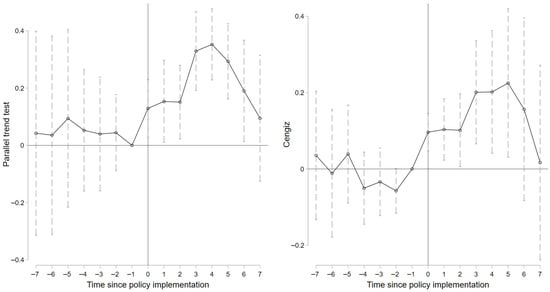
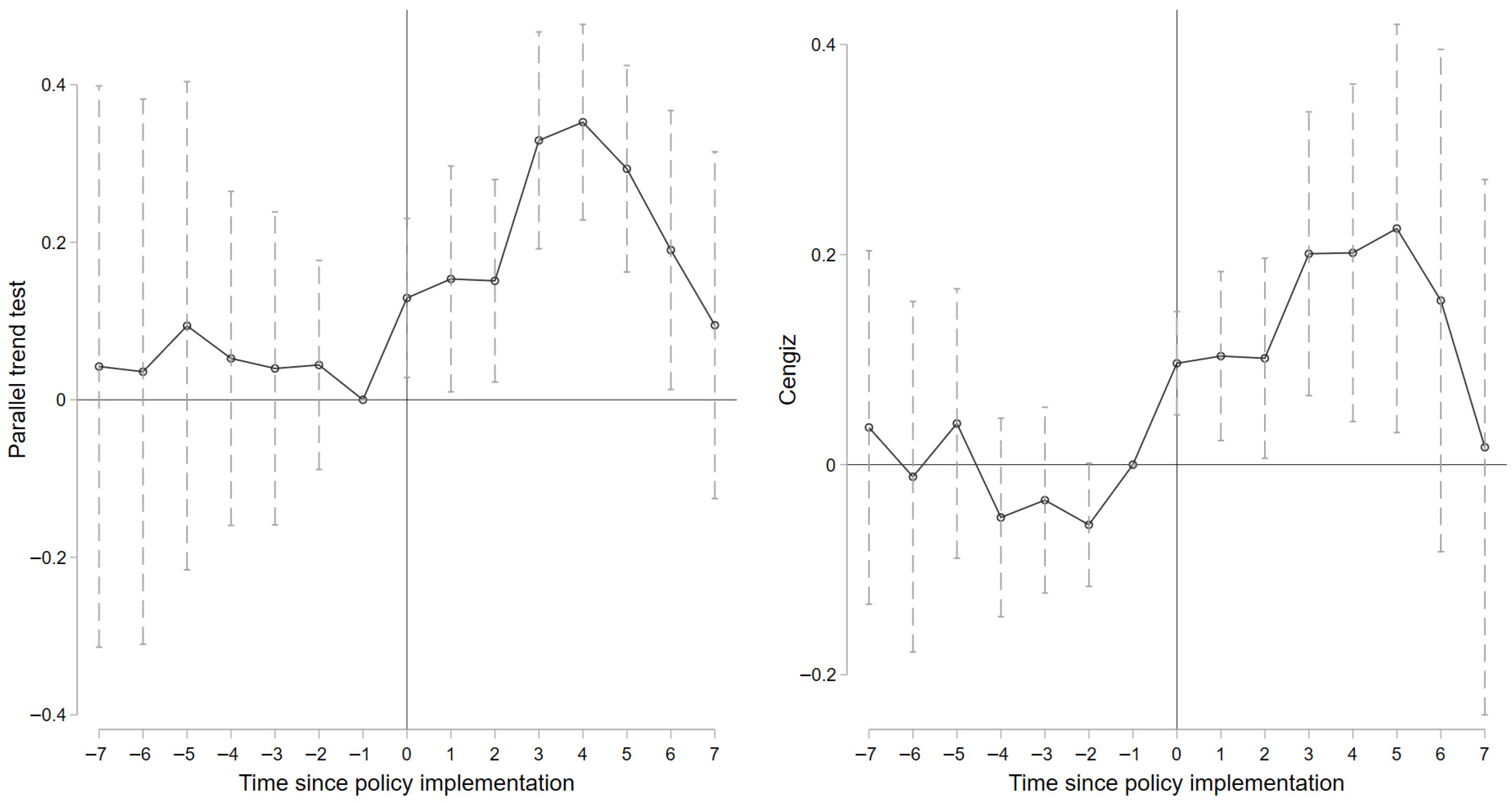
The validity of the Difference in Differences estimator requires that the treatment and control groups maintained a similar trend in outcomes before the policy implementation. This means that, in the absence of the TRSR policy, the trends in AGTFP for regions that implemented the reform and those that did not would have evolved in parallel. Given the sample period from 2011 to 2023, and to avoid multicollinearity, this paper defines event time windows from −7 to 7 periods relative to the policy implementation year. The parallel trends assumption is supported by the test results. Employing the period right before the policy shock as the baseline and using 95% confidence intervals, Figure 2 demonstrates that all pre-treatment period coefficients are statistically insignificant.
Figure 2.
Parallel Trends Test.
Considering that heterogeneous treatment effects might exist in multi-period DID models and could affect the reliability of the parallel trends test, this paper additionally employs the heterogenous treatment effect-robust estimator proposed by Cengiz [37] to perform the test. As additionally illustrated in Figure 2, there is no statistically significant disparity in AGTFP between the two groups prior to the TRSR implementation, lending additional support and keeping the parallel trends hypothesis tenable.
4.5.2. Placebo Test
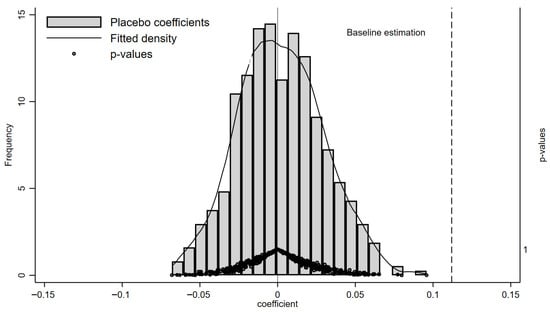
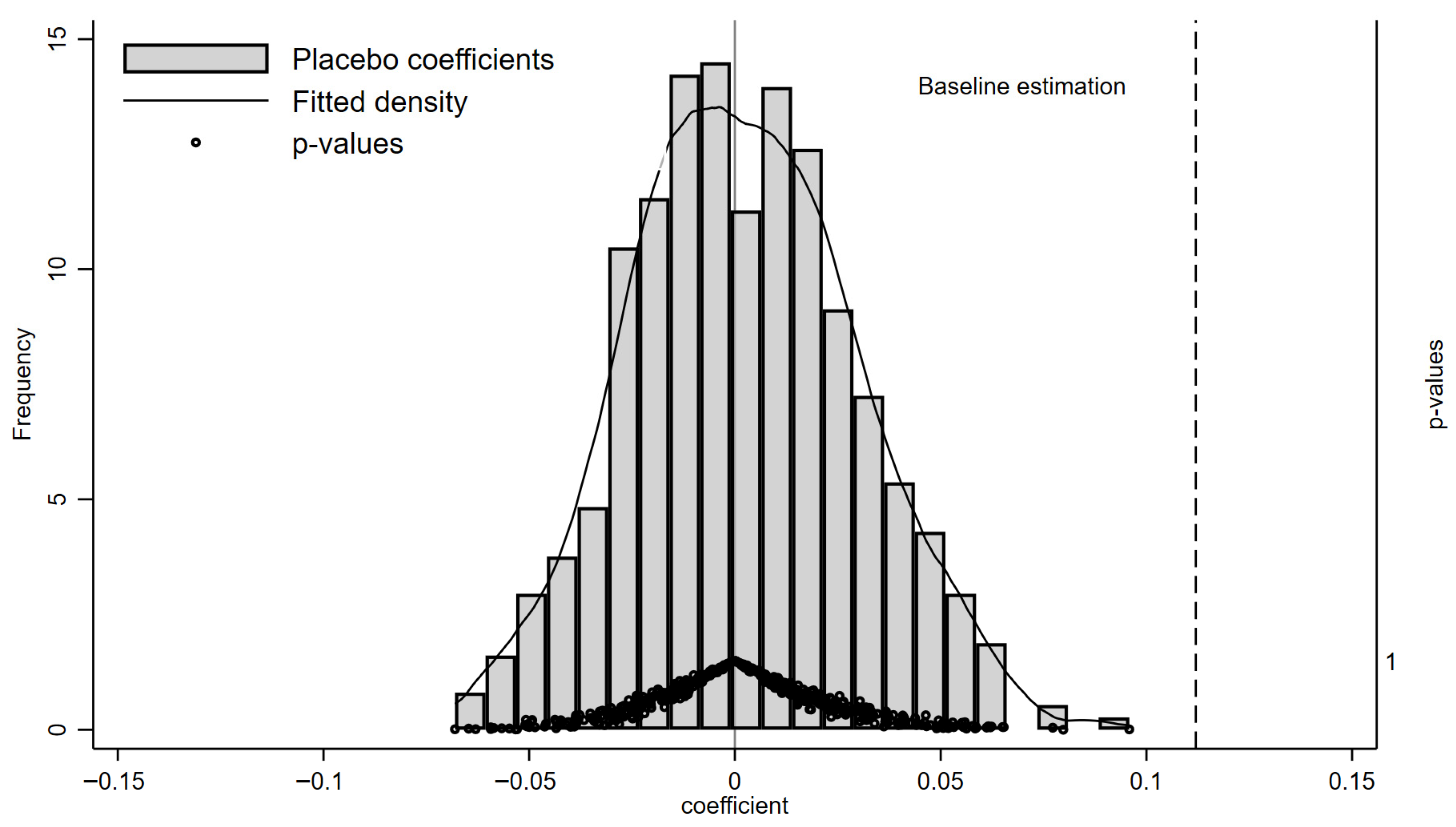
Furthermore, to rule out the possibility that the estimated treatment effect of the TRSR policy is spurious, this paper conducts a placebo test. Specifically, the actual policy variable is replaced with a randomly assigned, placebo policy variable that theoretically should have no impact on the dependent variable. By iterating this process 500 times using the DID model framework, we obtain a distribution of pseudo-regression coefficients and their corresponding p-values. These values are used to construct the placebo test plot. As shown in Figure 3, the pseudo-coefficients are concentrated around zero and differ substantially from the actual estimated coefficient. Moreover, the p-values for most iterations are above 0.01, indicating that the coefficients in most of these simulated experiments are statistically insignificant. This suggests that randomly assigned samples do not exhibit any policy effect, confirming the robustness of the placebo test result.
Figure 3.
Placebo Test.
4.5.3. PSM-DID
Given the non-random implementation of the TRSR across regions, which raises endogeneity concerns, Propensity Score Matching is applied to enhance comparability. A matched control group is selected via the radius matching method. The corresponding estimation results from the matched sample are presented in Column (1) of Table 9. The results indicate that even after matching the treatment and control groups via radius matching, the coefficient for TRSR remains significantly positive, further confirming the robustness of the earlier baseline regression findings.
Table 9.
PSM and Endogeneity test.
4.5.4. Endogeneity
To mitigate endogeneity concerns stemming from non-random policy pilot selection, this study utilizes a Two-Stage Least Squares (2SLS) estimation strategy, employing the 1978 per capita sown area as an instrumental variable. The year 1978 marked the beginning of China’s Household Responsibility System in rural areas. The per capita sown area at that time reflects a region’s initial resource endowment and agricultural economic structure. Such historical conditions may have influenced the region’s later sensitivity to agricultural land property rights reforms and the selection for policy pilots, thereby satisfying the relevance condition for the IV. Simultaneously, given the vast institutional changes and economic development China has undergone since 1978, it is less likely that this distant historical variable affects current outcomes through other channels, thus satisfying the exogeneity requirement. The results show that the model passes the underidentification test and the weak instrument test. In the first-stage model (Column (2) of Table 9), the IV has a significantly positive impact on the TRSR pilot, meeting the relevance requirement. In the second-stage model (Column (3) of Table 9), the impact of TRSR on AGTFP remains significantly positive, consistent with the baseline regression results.
4.5.5. Excluding the Influence of Other Policies
To exclude the interference of other concurrent agricultural reform policies and ensure the robustness of the estimation for the core explanatory variable, this paper further includes dummy variables for the Agricultural Socialized Service Pilot (ASSP) and the Agricultural Insurance Subsidy Pilot (AISP) as control variables in the baseline model. Column (1) of Table 10 controls for the former policy, Column (2) controls for the latter, and Column (3) simultaneously includes both policies in the regression. The results show that the coefficient for TRSR remains significantly positive at the 5% level across all specifications, indicating that the baseline regression results are robust.
Table 10.
Excluding the Influence of Other Policies.
4.5.6. Other Robustness Tests
First, the continuous variables were trimmed at the 1% level on both tails to reduce outlier influence. Post-treatment results (Table 11, Column 1) maintain a statistically significant (5% level) positive coefficient for TRSR on AGTFP, closely aligning with baseline estimates. This demonstrates that the core results are not sensitive to extreme observations and are robust.
Table 11.
Other Robustness Tests.
Second, Excluding Municipalities. Considering that the four municipalities directly under the central government (Beijing, Shanghai, Tianjin, Chongqing) may exhibit systematic differences from regular provinces in administrative hierarchy, policy implementation, and resource concentration, their industrial structures and development paths are somewhat unique. To prevent these special samples from unduly influencing the overall estimates, their observations were excluded in this robustness check. As shown in Column (2) of Table 11, re-estimation reveals that the coefficient for TRSR retains a similar direction, significance level, and magnitude as in the baseline regression. This confirms that the positive impact identified in the baseline analysis holds for non-municipality provinces.
Third, An alternative specification was tested by replacing the dependent variable with AGTFP computed via the Undesirable Output SBM Super-Efficiency model (VRS). The result, presented in Column (3) of Table 11, shows that the TRSR coefficient retains its positive sign and 5% statistical significance, which supports the robustness of the finding.
Fourth, Adding Region-Specific Linear Time Trends. To further address the concern that pilot regions might have distinct underlying time trends, interaction terms between region dummies and a linear time trend were added to the model to control for region-specific linear developmental trends. As shown in Column (4) of Table 11, the estimated coefficient for TRSR remains positive and significant. This demonstrates that the promoting effect of the agricultural land property rights system reform is not driven by region-specific trends, and the conclusion remains robust.
5. Discussion and Limitations
5.1. Discussion
This study demonstrates that the agricultural land property rights system reform has a significant positive effect on AGTFP. This finding aligns with existing research to some extent. Chen et al. [38] suggest that distortions in the land market may reduce AGTFP, while Min [39] find that improvements in land management efficiency enhance AGTFP. The discovery of the green transformation pathway further extends the research of Li et al. [8]; while their study con-firms that agricultural land property rights reform promotes output growth, this paper additionally reveals its significant environmental dividend.
On an international scale, the reform of agricultural land property rights in other countries differs from that in China. In a study covering 4750 smallholder farmers across Bolivia, Ecuador, and Peru, Schling and Saenz [40] find that farmers holding formal land titles exhibit technical efficiency approximately 25 percent higher than those without legal title. Their analysis further reveals that possessing legal title is associated with higher likelihood of making productive investments in land and experiencing fewer land conflicts. These findings closely parallel our mechanism analysis, which identifies factor allocation efficiency and green investment as key pathways through which China’s TRSR enhances AGTFP.
However, evidence from Sub-Saharan Africa presents a more nuanced picture. A systematic review of 55 studies examining recent land policy reforms across Sub-Saharan Africa suggests that the relationship between land tenure security and agricultural productivity is controversial [41]. The review identifies at least four reasons for this ambiguity. First, limited empirical evidence supports positive productivity effects. Second, some research suggests that reforms may impede investment in agricultural inputs. Third, farmers continue to face persistent challenges in accessing secure land despite policy reforms. Fourth, farmers within customary land systems remain vulnerable. These findings contrast sharply with the robust positive effects observed in both China and Latin America, suggesting that the productivity-enhancing potential of land reforms may depend on complementary institutional infrastructure, such as functioning credit markets, extension services, and administrative capacity, which varies significantly across regions.
The European experience, as synthesized in recent comparative research on land policies across 12 European countries, emphasizes that land policy represents an intentional strategy followed by public authorities aimed at aligning land use and disposal rights [42]. This conceptualization highlights that the effectiveness of property rights reforms depends critically on how public authorities strategically position themselves relative to private landowner interests, whether through planning against property, planning with property, or planning by property. The Chinese TRSR’s emphasis on stabilizing contract rights while liberalizing management rights represents a distinctive institutional innovation. It achieves security without full privatization, potentially avoiding some of the transitional disruptions observed in other contexts.
This comparative assessment yields several insights. First, the positive relationship between secure land rights and agricultural productivity observed in China aligns with evidence from Latin America, suggesting a potentially generalizable structural mechanism. Second, the mixed evidence from Sub-Saharan Africa and transitional challenges documented elsewhere underscore that land reform effects depend on complementary institutional infrastructure. Third, China’s distinctive institutional design, which separates contract rights from management rights within collective ownership, represents a middle ground between full privatization and state control. This approach may offer lessons for other contexts navigating similar trade-offs between security, equity, and efficiency.
5.2. Limitations
This study has several limitations. First, constrained by data availability, this paper is unable to conduct empirical analysis using more granular county-level data. Second, the implementation experience of China’s agricultural land property rights reform policy may not be directly applicable to other countries. Given China’s strong policy execution capacity, implementing similar policies in other national contexts may not yield equivalent results. Finally, agricultural land property rights reform is not without potential drawbacks. Deininger et al. [43] argue that such reforms may increase economic vulnerability for some farmers who lose land management rights. If these farmers fail to secure stable income sources during economic downturns, they may face the risk of falling back into poverty. This underscores the importance for governments to prioritize protecting the interests of vulnerable groups when implementing agricultural land system reforms.
6. Conclusions and Recommendations
6.1. Conclusions
This study achieves its objective of assessing the impact of agricultural land property rights system reform on AGTFP. Utilizing provincial panel data from 2011 to 2023, we first employed the Super-SBM model to construct a comprehensive AGTFP measure. Subsequently, a multi-period Difference-in-Differences framework was applied to identify the causal effects of the Separation of Three Rights reform and to uncover its underlying transmission mechanisms. The main findings are summarized as follows.
First, the agricultural land property rights system reform serves as a crucial institutional engine for driving AGTFP improvement. The baseline analysis demonstrates a significant positive impact of the TRSR on AGTFP, yielding an average improvement of 0.112 units. This finding remains robust after a battery of robustness checks and endogeneity tests. Furthermore, the analysis identifies important moderating factors: stringent environmental regulations and well-developed rural financial services significantly amplify the policy dividend of the TRSR by strengthening green constraints and alleviating financing constraints, respectively.
Second, through mediation mechanism analysis, this study reveals three distinct pathways through which the TRSR promotes AGTFP. First, by inducing capital deepening and technology adoption, it fosters labor-saving technological progress; Second, By facilitating land transfer and nurturing new types of agricultural business entities, it improves factor allocation efficiency, achieving optimal matching of land, labor, and management; Third, By stabilizing operational expectations and incentivizing long-term investment, it directly drives the green transformation of agricultural production. This transformation is evidenced by increased investments in productivity-enhancing projects like the improvement of medium- and low-yield farmland, as well as source reduction in polluting inputs such as chemical fertilizers and pesticides.
Third, the effectiveness of the reform exhibits significant context dependency. Heterogeneity analysis reveals that the positive impact of the TRSR is more pronounced in regions characterized by plains geography, lower rural per capita income, and higher agricultural fiscal expenditure. These findings collectively demonstrate how institutional reform, through multiple mechanisms and under varying contextual conditions, contributes to sustainable agricultural development.
6.2. Recommendations
Based on the above conclusions, this paper proposes the following policy recommendations.
First, the moderation analysis reveals that the green productivity effects of the TRSR are significantly amplified when coupled with stringent environmental regulations and well-developed rural financial services. This suggests that policymakers should not treat land reform as a standalone intervention. Specifically, regions implementing land tenure reforms should simultaneously strengthen environmental enforcement mechanisms, such as pollution monitoring and input use regulations, to translate secure property rights into greener production practices. Concurrently, financial institutions should be incentivized to develop credit products tailored to farmers who have obtained formal land management rights, enabling them to finance green technology adoption.
Second, As the Induced Innovation Theory validated in this study demonstrates, continued rural out-migration drives rising labor scarcity and costs, which in turn necessitate technological change that substitutes capital for labor. Therefore, support for agricultural drones, automated irrigation systems, and precision farming equipment should be prioritized because these technologies address the binding constraint of labor scarcity while simultaneously delivering green dividends through reduced input waste. Policies should include subsidies for machinery adoption, investment in rural digital infrastructure to support smart agriculture, and training programs that enable farmers to operate and maintain advanced equipment.
Third, the mechanism analysis demonstrates that the TRSR enhances AGTFP through improved factor allocation efficiency, specifically by enabling land to flow toward more productive operators. Policymakers should establish transparent land transfer service platforms that provide standardized contracts, price information, and dispute resolution mechanisms. These platforms reduce transaction costs and enable land to consolidate into economically viable scales. However, efficiency gains must be balanced with equity considerations. For smallholders who may exit farming, policies should include vocational training programs, preferential access to non-farm employment opportunities, and social safety nets. For those who continue farming, graduated support should be provided to facilitate voluntary transitions to scale operations when economically feasible.
Fourth, the heterogeneity analysis reveals that TRSR effects vary significantly across geographical and economic contexts, suggesting the need for place-based policy design. In plains regions, where topography facilitates mechanization and scale economies, policies should prioritize investments in land consolidation, large-scale irrigation infrastructure, and high-capacity agricultural machinery. For low-income rural areas, where marginal returns to institutional reform are highest, policies should combine land rights certification with targeted productive investments. Complementary programs should include agricultural extension services, basic infrastructure improvements, and initial capital support to help farmers translate secure rights into productivity gains. In regions with high agricultural fiscal expenditure, where public resources amplify reform effectiveness, policies should strengthen accountability mechanisms ensuring that expenditures translate into measurable green productivity outcomes. Performance-based budgeting and rigorous program evaluation should accompany increased fiscal commitments.
Author Contributions
Conceptualization, X.G. and T.S.; methodology, X.G.; software, T.S.; validation, X.G. and T.S.; formal analysis, X.G.; investigation, X.G.; resources, T.S.; data curation, X.G.; writing—original draft preparation, X.G.; writing—review and editing, X.G. and T.S.; visualization, T.S.; supervision, T.S.; project administration, X.G.; funding acquisition, X.G. All authors have read and agreed to the published version of the manuscript.
Funding
This research was supported by the Research on the Theory and Policy of Promoting Rural Revitalization through Multi-level Integration of Socialism and Market Economy (Project No. 2021ZXS).
Institutional Review Board Statement
Not applicable.
Informed Consent Statement
Not applicable.
Data Availability Statement
Data are readily available upon request from the corresponding author.
Conflicts of Interest
The authors declare no conflicts of interest.
References
- Wu, Z.; Zhou, Z.; Liang, H.; Wu, H.; Liu, Z.; Xie, Z.; Zhu, J.; Zheng, B.; Wan, W. Application of a comprehensive framework to estimate the risk of agricultural non-point source pollution in China since 2000. J. Clean. Prod. 2025, 509, 145581. [Google Scholar] [CrossRef] [Scilit]
- Xia, F.; Zhao, Z.; Niu, X.; Wang, Z. Integrated pollution analysis, pollution area identification and source apportionment of heavy metal contamination in agricultural soil. J. Hazard. Mater. 2024, 465, 133215. [Google Scholar] [PubMed]
- Nuruzzaman, M.; Bahar, M.M.; Naidu, R. Diffuse soil pollution from agriculture: Impacts and remediation. Sci. Total Environ. 2025, 962, 178398. [Google Scholar] [CrossRef] [Scilit] [PubMed]
- Liu, L.; Liu, K. Can digital technology promote sustainable agriculture? Empirical evidence from urban China. Cogent Food Agric. 2023, 9, 2282234. [Google Scholar] [CrossRef] [Scilit]
- Liu, D.; Li, Y.; You, J.; Balezentis, T.; Shen, Z. Digital inclusive finance and green total factor productivity growth in rural areas. J. Clean. Prod. 2023, 418, 138159. [Google Scholar] [CrossRef] [Scilit]
- Shi, Y.; Lu, W.; Lin, L.; Li, Z.; Chen, H. Does Environmental Regulation Affect China’s Agricultural Green Total Factor Productivity? Considering the Role of Technological Innovation. Agriculture 2025, 15, 649. [Google Scholar] [CrossRef] [Scilit]
- Wei, Z.; Peng, J.; Zhao, Y.; Li, X.; Wang, C. Reform of agricultural land property rights system and grain production resilience: Empirical evidence based on China’s “Three Rights Separation” reform. PLoS ONE 2025, 20, e0319387. [Google Scholar]
- Li, J.; Quan, T.; Zhang, H. Reform of agricultural land property rights system and green and high-quality development of agriculture: Empirical evidence based on China’s “three rights separation” reform. Pol. J. Environ. Stud. 2023, 32, 5147–5159. [Google Scholar]
- De Janvry, A.; Emerick, K.; Gonzalez-Navarro, M.; Sadoulet, E. Delinking land rights from land use: Certification and migration in Mexico. Am. Econ. Rev. 2015, 105, 3125–3149. [Google Scholar] [CrossRef] [Scilit]
- Liu, X.; Liu, Y.; Liu, Z.; Chen, Z. Impacts of climatic warming on cropping system borders of China and potential adaptation strategies for regional agriculture development. Sci. Total Environ. 2021, 755, 142415. [Google Scholar]
- Yang, B.; Li, Y.; Wang, M.; Liu, J. Nonlinear Nexus between agricultural tourism integration and agricultural green total factor productivity in China. Agriculture 2024, 14, 1386. [Google Scholar] [CrossRef] [Scilit]
- Li, H.; Zhu, J. Property rights and land quality. Am. J. Agric. Econ. 2024, 106, 1619–1647. [Google Scholar] [CrossRef] [Scilit]
- Schultz, T.W. Transforming Traditional Agriculture; Yale University Press: New Haven, CT, USA, 1964. [Google Scholar]
- Zhang, X.; Hu, L.; Yu, X. Farmland Leasing, misallocation Reduction, and agricultural total factor Productivity: Insights from rice production in China. Food Policy 2023, 119, 102518. [Google Scholar] [CrossRef] [Scilit]
- Séogo, W.; Zahonogo, P. Do land property rights matter for stimulating agricultural productivity? Empirical evidence from Burkina Faso. Land Use Policy 2023, 125, 106475. [Google Scholar]
- Ruttan, V.W.; Hayami, Y. Toward a theory of induced institutional innovation. J. Dev. Stud. 1984, 20, 203–223. [Google Scholar] [CrossRef] [Scilit]
- Luo, J.; Hu, M.; Huang, M.; Bai, Y. How does innovation consortium promote low-carbon agricultural technology innovation: An evolutionary game analysis. J. Clean. Prod. 2023, 384, 135564. [Google Scholar] [CrossRef] [Scilit]
- Miao, X.; Li, Z.; Wang, M.; Mei, J.; Chen, J. Measurement of cultivated land ecosystem resilience in black soil region of Northeast China under the background of cultivated land protection policy in China: Case study of Qiqihar City. J. Clean. Prod. 2024, 434, 140141. [Google Scholar] [CrossRef] [Scilit]
- Hao, W.; Hu, X.; Wang, J.; Zhang, Z.; Shi, Z.; Zhou, H. The impact of farmland fragmentation in China on agricultural productivity. J. Clean. Prod. 2023, 425, 138962. [Google Scholar] [CrossRef] [Scilit]
- Zou, B.; Mishra, A.K. Modernizing smallholder agriculture and achieving food security: An exploration in machinery services and labor reallocation in China. Appl. Econ. Perspect. Policy 2024, 46, 1662–1691. [Google Scholar] [CrossRef] [Scilit]
- Hu, Z. Towards solar extractivism? A political ecology understanding of the solar energy and agriculture boom in rural China. Energy Res. Soc. Sci. 2023, 98, 102988. [Google Scholar] [CrossRef] [Scilit]
- Gong, M.; Li, H.; Elahi, E. Three Rights Separation reform and its impact over farm’s productivity: A case study of China. Land Use Policy 2022, 122, 106393. [Google Scholar] [CrossRef] [Scilit]
- Hua, J.; Tian, M.; Zhao, Y.; Zhou, K.; Mei, F. Study on the mitigation effect and promotion mechanism of agricultural digitalization on the agricultural land resource mismatch. Agriculture 2024, 14, 913. [Google Scholar] [CrossRef] [Scilit]
- Zhong, Z.; Jiang, W.; Li, Y. Bridging the gap between smallholders and modern agriculture: Full insight into China’s agricultural cooperatives. J. Rural Stud. 2023, 101, 103037. [Google Scholar] [CrossRef] [Scilit]
- Dugoua, E.; Gerarden, T.D. Induced innovation, inventors, and the energy transition. Am. Econ. Rev. Insights 2025, 7, 90–106. [Google Scholar] [CrossRef] [Scilit]
- Ndimbo, G.K.; Haulle, E. Large-scale agricultural investments and contract farming in Tanzania: A systematic review on the livelihoods, food security and ecological implications. J. Agric. Food Res. 2024, 18, 101514. [Google Scholar] [CrossRef] [Scilit]
- Leng, Y.; Liu, X.; Wang, X. Environmental regulation and high-quality agricultural development. PLoS ONE 2023, 18, e0285687. [Google Scholar] [CrossRef] [Scilit]
- Jin, T.; Han, X. Robotic arms in precision agriculture: A comprehensive review of the technologies, applications, challenges, and future prospects. Comput. Electron. Agric. 2024, 221, 108938. [Google Scholar] [CrossRef] [Scilit]
- Schaub, S.; Ghazoul, J.; Huber, R.; Zhang, W.; Sander, A.; Rees, C.; Banerjee, S.; Finger, R. The role of behavioural factors and opportunity costs in farmers’ participation in voluntary agri-environmental schemes: A systematic review. J. Agric. Econ. 2023, 74, 617–660. [Google Scholar] [CrossRef] [Scilit]
- Song, Y.; Zhang, B.; Wang, J.; Kwek, K. The impact of climate change on China’s agricultural green total factor productivity. Technol. Forecast. Soc. Change 2022, 185, 122054. [Google Scholar] [CrossRef] [Scilit]
- Chen, Y.; Miao, J.; Zhu, Z. Measuring green total factor productivity of China’s agricultural sector: A three-stage SBM-DEA model with non-point source pollution and CO2 emissions. J. Clean. Prod. 2021, 318, 128543. [Google Scholar] [CrossRef] [Scilit]
- Tone, K.; Tsutsui, M. Network DEA: A slacks-based measure approach. Eur. J. Oper. Res. 2009, 197, 243–252. [Google Scholar] [CrossRef] [Scilit]
- Zhou, X.; Zhang, Y. Administration or marketization: Environmental regulation, marketization and agricultural green total factor productivity. J. Environ. Manag. 2024, 370, 122433. [Google Scholar] [CrossRef] [Scilit] [PubMed]
- Xiao, Q.; Wang, Y.; Liao, H.; Han, G.; Liu, Y. The impact of digital inclusive finance on agricultural green total factor productivity: A study based on China’s provinces. Sustainability 2023, 15, 1192. [Google Scholar] [CrossRef] [Scilit]
- Limpamont, A.; Kittipanya-ngam, P.; Chindasombatcharoen, N.; Cavite, H.J.M. Towards agri-food industry sustainability: Addressing agricultural technology adoption challenges through innovation. Bus. Strategy Environ. 2024, 33, 7352–7367. [Google Scholar] [CrossRef] [Scilit]
- Xu, B.; Baležentis, T.; Štreimikienė, D.; Shen, Z. Enhancing agricultural environmental performance: Exploring the interplay of agricultural productive services, resource allocation, and marketization factors. J. Clean. Prod. 2024, 439, 140843. [Google Scholar] [CrossRef] [Scilit]
- Cengiz, D.; Dube, A.; Lindner, A.; Zipperer, B. The effect of minimum wages on low-wage jobs. Q. J. Econ. 2019, 134, 1405–1454. [Google Scholar] [CrossRef] [Scilit]
- Chen, X.; Song, Z.; Deng, H. Land market distortion and agricultural green total factor productivity: Provincial-level evidence from China. Econ. Res.-Ekon. Istraživanja 2023, 36, 2158482. [Google Scholar] [CrossRef] [Scilit]
- Min, Z. Research on the Impact of Land Management Efficiency on AGTFP. Acad. J. Bus. Manag. 2024, 6, 229–237. [Google Scholar] [CrossRef] [Scilit]
- Schling, M.; Saenz, M. Land Regularization and Technical Efficiency in Agricultural Production: An Empirical Study in Andean Countries; IDB: Washington, DC, USA, 2024. [Google Scholar]
- Ekpodessi, S.G.; Nakamura, H. Revisiting the Impact of Land Policies Reforms on Agricultural Productivity in Sub Saharan Africa: Focus on Land Ownership. Preprints 2025. [Google Scholar]
- Hartmann, T.; Hengstermann, A.; Jehling, M.; Schindelegger, A.; Wenner, F. Land Policies in Europe: Land-Use Planning, Property Rights, and Spatial Development; Springer Nature: Berlin/Heidelberg, Germany, 2025. [Google Scholar]
- Deininger, K.; Jin, S.; Ma, M. Structural transformation of the agricultural sector in low-and middle-income economies. Annu. Rev. Resour. Econ. 2022, 14, 221–241. [Google Scholar] [CrossRef] [Scilit]

Disclaimer/Publisher’s Note: The statements, opinions and data contained in all publications are solely those of the individual author(s) and contributor(s) and not of MDPI and/or the editor(s). MDPI and/or the editor(s) disclaim responsibility for any injury to people or property resulting from any ideas, methods, instructions or products referred to in the content. |
© 2026 by the authors. Licensee MDPI, Basel, Switzerland. This article is an open access article distributed under the terms and conditions of the Creative Commons Attribution (CC BY) license.